EP0259152A2 - Teppich und Verfahren zur dessen Herstellung - Google Patents
Teppich und Verfahren zur dessen Herstellung Download PDFInfo
- Publication number
- EP0259152A2 EP0259152A2 EP87307765A EP87307765A EP0259152A2 EP 0259152 A2 EP0259152 A2 EP 0259152A2 EP 87307765 A EP87307765 A EP 87307765A EP 87307765 A EP87307765 A EP 87307765A EP 0259152 A2 EP0259152 A2 EP 0259152A2
- Authority
- EP
- European Patent Office
- Prior art keywords
- fibrous material
- polymeric
- fibrous
- liquid
- coated
- Prior art date
- Legal status (The legal status is an assumption and is not a legal conclusion. Google has not performed a legal analysis and makes no representation as to the accuracy of the status listed.)
- Withdrawn
Links
Images

Classifications
-
- D—TEXTILES; PAPER
- D04—BRAIDING; LACE-MAKING; KNITTING; TRIMMINGS; NON-WOVEN FABRICS
- D04H—MAKING TEXTILE FABRICS, e.g. FROM FIBRES OR FILAMENTARY MATERIAL; FABRICS MADE BY SUCH PROCESSES OR APPARATUS, e.g. FELTS, NON-WOVEN FABRICS; COTTON-WOOL; WADDING ; NON-WOVEN FABRICS FROM STAPLE FIBRES, FILAMENTS OR YARNS, BONDED WITH AT LEAST ONE WEB-LIKE MATERIAL DURING THEIR CONSOLIDATION
- D04H1/00—Non-woven fabrics formed wholly or mainly of staple fibres or like relatively short fibres
- D04H1/40—Non-woven fabrics formed wholly or mainly of staple fibres or like relatively short fibres from fleeces or layers composed of fibres without existing or potential cohesive properties
- D04H1/58—Non-woven fabrics formed wholly or mainly of staple fibres or like relatively short fibres from fleeces or layers composed of fibres without existing or potential cohesive properties by applying, incorporating or activating chemical or thermoplastic bonding agents, e.g. adhesives
- D04H1/64—Non-woven fabrics formed wholly or mainly of staple fibres or like relatively short fibres from fleeces or layers composed of fibres without existing or potential cohesive properties by applying, incorporating or activating chemical or thermoplastic bonding agents, e.g. adhesives the bonding agent being applied in wet state, e.g. chemical agents in dispersions or solutions
- D04H1/68—Non-woven fabrics formed wholly or mainly of staple fibres or like relatively short fibres from fleeces or layers composed of fibres without existing or potential cohesive properties by applying, incorporating or activating chemical or thermoplastic bonding agents, e.g. adhesives the bonding agent being applied in wet state, e.g. chemical agents in dispersions or solutions the bonding agent being applied in the form of foam
-
- Y—GENERAL TAGGING OF NEW TECHNOLOGICAL DEVELOPMENTS; GENERAL TAGGING OF CROSS-SECTIONAL TECHNOLOGIES SPANNING OVER SEVERAL SECTIONS OF THE IPC; TECHNICAL SUBJECTS COVERED BY FORMER USPC CROSS-REFERENCE ART COLLECTIONS [XRACs] AND DIGESTS
- Y10—TECHNICAL SUBJECTS COVERED BY FORMER USPC
- Y10T—TECHNICAL SUBJECTS COVERED BY FORMER US CLASSIFICATION
- Y10T428/00—Stock material or miscellaneous articles
- Y10T428/24—Structurally defined web or sheet [e.g., overall dimension, etc.]
- Y10T428/24355—Continuous and nonuniform or irregular surface on layer or component [e.g., roofing, etc.]
-
- Y—GENERAL TAGGING OF NEW TECHNOLOGICAL DEVELOPMENTS; GENERAL TAGGING OF CROSS-SECTIONAL TECHNOLOGIES SPANNING OVER SEVERAL SECTIONS OF THE IPC; TECHNICAL SUBJECTS COVERED BY FORMER USPC CROSS-REFERENCE ART COLLECTIONS [XRACs] AND DIGESTS
- Y10—TECHNICAL SUBJECTS COVERED BY FORMER USPC
- Y10T—TECHNICAL SUBJECTS COVERED BY FORMER US CLASSIFICATION
- Y10T442/00—Fabric [woven, knitted, or nonwoven textile or cloth, etc.]
- Y10T442/10—Scrim [e.g., open net or mesh, gauze, loose or open weave or knit, etc.]
- Y10T442/102—Woven scrim
- Y10T442/15—Including a foam layer
-
- Y—GENERAL TAGGING OF NEW TECHNOLOGICAL DEVELOPMENTS; GENERAL TAGGING OF CROSS-SECTIONAL TECHNOLOGIES SPANNING OVER SEVERAL SECTIONS OF THE IPC; TECHNICAL SUBJECTS COVERED BY FORMER USPC CROSS-REFERENCE ART COLLECTIONS [XRACs] AND DIGESTS
- Y10—TECHNICAL SUBJECTS COVERED BY FORMER USPC
- Y10T—TECHNICAL SUBJECTS COVERED BY FORMER US CLASSIFICATION
- Y10T442/00—Fabric [woven, knitted, or nonwoven textile or cloth, etc.]
- Y10T442/60—Nonwoven fabric [i.e., nonwoven strand or fiber material]
- Y10T442/68—Melt-blown nonwoven fabric
Definitions
- Surface covering material is typically comprised of a top wear surface and a bottom surface.
- Surface covering materials would include floor mats and runners. Such mats and runners may also be used as a surface-cushioning and shock-absorbing material.
- Cow Cushion® a trademark of the American Enka Company, Inc.
- These floor mats are composed of a three-dimensional layer of a stiff, melt-spun extruded nylon filament fibrous material wherein the fibers form a three-dimensional, peak-and-valley structure.
- the material comprises a randomly disposed, non-woven layer and forms a highly irregular, discontinuous mass of very open filaments melt-bonded at the filament intersections.
- the mat has a solid vinyl plastisol surface which may have fibrous material, like a polyester fabric, thereon.
- the mats are employed in barns and in veterinary cages, the solid surface being the wear-resistant face surface stood upon by the animals and being spaced apart from the floor surface of the barn or veterinary cage by the nylon fibrous fibers in the lower section of the mat.
- Such mats are useful in that the surface of the barn or the veterinary cage may be washed down with water to remove animal faeces and urine.
- the three-dimensional nylon filament material is known as Enkamat® (a trademark of the American Enka Company, Inc.) and is also employed as a reinforcement, soil restraining and drainage mat (see for example U.S. Patent No. 3,866,352 issued February 18, 1975).
- Such mats are formed of filaments of melt-spun polymeric particularly thermoplastic synthetic fiber, randomly melt-bonded at the filament intersections to form a very open, typically over about 90%, three-dimensional structure which has a peak-and-valley structure.
- the mats generally have a filament diameter of 0.1mm to 1.5mm for a pliable, resilient, crush-resistant fibrous mat structure.
- the invention relates to a surface covering material and to a method of preparing and using the material.
- the invention concerns a resilient, foraminous floor mat and a method of preparing and using the floor mat.
- a surface covering material which is a resilient, abrasion-resistant, foraminous surface covering material which material allows a liquid, such as water, to run easily therethrough and which material is light and flexible, and yet presents an open, efficient, dirt-collecting, wear-resistant face surface and lower surface of greater surface area than the top surface.
- the surface material replaces a flat, solid material as a wear-resistant face without employing the same amount of plastic material.
- the surface covering comprises an open, fibrous, synthetic mesh material in which the filaments or fibers have been coated with a polymer to present an irregular open, discontinuous, wear-resistant face surface and a lower open gripping surface.
- the surface covering material finds particular use as a floor mat or runner material and as cushioning material.
- the surface coating material has a significantly open or foraminous, porous structure. It has an open, wear-resistant surface with a reduced tendency to snag, for example, with the wiping of shoes thereon to remove dirt, soil, snow and the like.
- the foraminous nature of the surface coating materials permit the material to be easily cleaned by washing with a hose, and yet the structure is such that moisture and dirt is not trapped permanently within the material.
- the surface coating material may be employed as an artificial playing surface, as an anti-fatigue surface or as a shock-absorbing or cushioning material or for other uses. It may be particularly used where the drainage of a liquid, such as water, is desired such as in a shower stall, a barn or for veterinary use where rapid drainage through the surface covering material is desirable.
- the mat has significant enhancing, load-bearing characteristics due to the combination of the foamable vinyl coating and the resilience of the original mat, and thus may be employed when load-bearing properties are desired.
- the surface covering material comprises a layer of a resilient, mesh-like synthetic fibrous material which is composed of woven or non-woven, randomly-disposed filaments or fibers, typically melt spun, and polymeric fibers such as nylon, with the layer material being pliable and resilient in nature.
- the layer material may vary in thickness and be of varying stiffness, typically, for example, may be comprised of a randomly-disposed, extruded polymeric such as nylon fibrous material in a significantly open structure, such as the Enkamat® material.
- the extruded fibers are in contact and intersecting to form a highly open, irregular mesh and discontinuous mass of fibrous material. It is flexible and readily available in roll form.
- the covering material includes the layer of fibers wherein the fibers have been coated with a polymeric material, either solid or particularly foam, such as a solid or high-density foam vinyl chloride resin material which forms a resilient, abrasion-resistant coating thereon to coat all of the fibers and provide for a polymeric build-up on the points of bonded intersections of the fibers, since the intersections of the fibers tend to trap more material than the body of the fibers so that the resulting surface coating material comprises a very open, but random, structure.
- a polymeric material either solid or particularly foam, such as a solid or high-density foam vinyl chloride resin material which forms a resilient, abrasion-resistant coating thereon to coat all of the fibers and provide for a polymeric build-up on the points of bonded intersections of the fibers, since the intersections of the fibers tend to trap more material than the body of the fibers so that the resulting surface coating material comprises a very open, but random, structure.
- the surface of the covering material is characterized by a generally planar surface composed of a plurality of irregular, typically rounded, polymeric materials which form conical or pyramidal-type islands to provide a greater gripping or contact surface area of polymeric material on the bottom surface than on the top surface of the covering.
- the bottom surface of the polymeric islands act as a friction or gripping surface for the surface covering.
- the opposite, or generally the top surface is characterized by an irregular, discontinuous, broken, abrasion-resistant surface which serves as the top surface.
- the surface coating is characterized by a substantial foraminous-type structure which permits the flow of liquid therethrough to provide for the rapid drainage of liquid, typically wherein the open surface area is greater than 25% of the total surface area of top surface of the covering and typically 30% to 50%.
- the surface covering is prepared by coating the open mesh, fibrous material with a polymeric material. And after coating, the material is placed onto a planar surface such as a release paper or an endless belt such as a glass fiber belt coated with a fluorocarbon resin. Upon heating the coated polymeric material, typically where the polymeric material is composed of a vinyl resin plastisol and depending on the viscosity, a plurality of irregular, typically round feet or spotting of the polymeric material occurs on the pressure-release support surface. However, the material remains significantly open and porous. Generally, in order to provide a resilient-type material, the polymeric material comprises a high-density-type foam material, such as a material having over 20 or 25 pounds per cubic foot foam density.
- the polymeric material may comprise a variety of polymers, such as urethane polymers, but generally composed of a vinyl halide polymer, such as a vinyl chloride copolymer or homopolymer material, is applied to the material in a liquid organosol or plastisol form, and after coating, heated to fuse the vinyl plastisol material.
- a vinyl halide polymer such as a vinyl chloride copolymer or homopolymer material
- the selected coating polymer should bond to the polymeric filaments of the mat.
- a layer of fibrous material is coated with the polymeric liquid by dipping, spraying or coating or otherwise contacting the layer of fibrous material so as to coat the fibers and also to provide for some accumulation of the liquid polymeric material at the fibrous intersections.
- excess material runs down and forms a smooth, but discontinuous, surface on the one or lower side to form a plurality of islands having a generally planar surface against the pressure-release surface.
- the mesh-type material employed such as the extruded nylon filament material, typically has a melting point considerably above that of the fusion point of the liquid polymeric material used, such as a vinyl plastisol.
- the extruded nylon, non-woven material has a melting point of 400°F.
- a vinyl plastisol is generally fused at temperatures of 275°F. to 350°F., so that the extruded nylon material may be coated with a vinyl plastisol, the vinyl plastisol accumulating at the fiber intersections and also forming islands against the pressure-release surface and being fused without affecting the resilient nature of the nylon filament fibers forming the mat layer.
- the thickness of the floor mat may vary, and typically it ranges from one-quarter inch to one inch, while the stiffness of the material may vary depending upon the nature of the fibrous material and whether a solid or foam polymeric material is employed in the coating.
- the fibrous material is composed of a melt-extruded, synthetic, polymeric, thermoplastic material, melt-bonded at the fiber intersections, such as a non-woven, randomly exposed, extruded nylon fibers, which forms a very open mesh-type material, and which nylon fibers have been coated with a high density, foamable vinyl plastisol. After coating, the layer is placed on a pressure-release or flat surface and then the vinyl plastisol fused by heating in an oven to form the foraminous surface coating.
- liquid coating polymers including the polyolefins, such as polyethylene, polypropylene and other synthetic polymers, such as urethane, vinyl chloride resins are preferred, both for wear resistance and crushability, since some urethanes are typically moisture sensitive and may tend to oxidize with time.
- polyolefins such as polyethylene, polypropylene and other synthetic polymers, such as urethane, vinyl chloride resins are preferred, both for wear resistance and crushability, since some urethanes are typically moisture sensitive and may tend to oxidize with time.
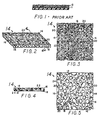
- Fig. 1 shows a prior art surface covering 10 used in barns and veterinary cages wherein the mat 10 comprises a solid top surface coating 11 composed of a vinyl chloride resin securely bonded to a lower, much thicker, layer of an extruded nylon, open mesh, non-woven filamentous or fibrous material 12.
- the top surface of the solid vinyl chloride layer 11 may also have a fabric or fibrous top surface.
- the surface covering 10 is usually employed in barns and veterinary cages since the top surface layer 11 is spaced apart by the open mesh, resilient, extruded nylon 12 from the floor surface, and the surface covering may be washed with water into the open lower layer 12.
- the prior art surface covering 10 is produced by casting a vinyl chloride plastisol layer onto a pressure-release surface, either paper or an endless fluorocarbon belt, applying the pliable extruded nylon, open mesh layer 12 onto the liquid plastisol layer, then heat fusing the surface of the plastisol in an oven to the nylon mesh layer.
- Figs. 2 to 5 are directed to the surface covering 14 of the invention, in which an extruded nylon, randomly disposed, open-mesh layer 12, as shown in Fig. 1 (known as Enkamat®, a trademark of American Enka Company, Inc.), has been coated with a high density, vinyl chloride plastisol as a polymeric coating 16 which forms a high density, polyvinyl foam layer, e.g. of 25 to 40 pounds per cubic foot.
- the lower surface is composed of a plurality of irregular islands 18 composed of the vinyl chloride with the surface covering 13 having substantial open areas 20 on the top surface 22 and also on the bottom surface 24.
- the top surface 22 is an irregular, discontinuous, open, peak-and-valley type surface which forms a wear-resistant top surface
- the bottom surface 24 has a plurality of the vinyl chloride islands of irregular size and shape, which constrict somewhat the open area of the lower surface of the covering 14.
- the islands 18 are formed by the vinyl plastisol draining onto the lower release surface during the construction of the surface covering 14 and prior to heating the vinyl plastisol to blow and fuse the vinyl plastisol.
- the high density vinyl plastisol layer congregates more at the intersections of the extruded nylon fibers, but also coats the nylon fibers to form a surface coating 14 which is resilient, abrasion-resistant and foraminous.
- the drawings illustrate a resilient, abrasion-resistant, foraminous surface covering composed of a layer of a resilient, extruded nylon fiber material which has been coated more thickly at the intersections of the fibers than the fibers with a high density vinyl chloride foam material, in which the high density foam material forms a generally planar surface formed of conical-type islands with a planar base surface on the bottom surface 24 and has an open, irregular, discontinuous top surface 22, the open area generally 40% to 50% or more than the bottom surface.
- the surface covering material 14 presents a wear-resistant surface and a bottom island gripping surface which can be easily cleaned by applying water which washes through the surface covering.
- the photographs Fig. 6 to 9 are of a sample mat produced by dipping a nylon Enkamat® mesh layer into a foamable vinyl resin plastisol, placing the dipped layer onto a paper release surface, heating the vinyl contact mat to form and fuse this vinyl plastisol to form a high density foam mat with a mat thickness of about 0.400 inches.
- the mat is generally prepared by merely contacting the pliable, open-mesh material, such as by immersing an inner layer of the open-mesh, extruded nylon, fibrous material into a vinyl chloride plastisol of selected viscosity so as to coat the entire mesh layer; thereafter, placing the mesh layer onto a release surface such as release-surface coated paper or onto the surface of an endless belt, and then passing the coated nylon fibrous layer so coated through a hot air oven, thus subjecting the coated layer to heat to a temperature of about 250°F. to 375°F sufficient to blow and fuse the liquid vinyl plastisol.
- the vinyl plastisol tends to migrate towards the fiber intersections of the fibers, so that the intersections of the fibrous layer tend to accumulate more vinyl plastisol than the coated nylon fibers, while further the vinyl plastisol tends to drain toward the lower surface and to form small puddles or pools against the release surface, so that on fusing, the polymeric islands are formed to provide a bottom planar gripping surface on the bottom surface of the mat which has a greater surface area than the open, top surface.
- the amount and nature of the islands forming the lower gripping surface may vary depending on how long a period of time that the coated layer is left on the release paper or endless belt and the viscosity of the particular vinyl plastisol employed, e.g.
- the viscosity of the vinyl plastisol and the time on the surface should not be sufficient to permit the vinyl plastisol to form a completely enclosed coating on the lower surface since the nature of the surface mat should be as such to provide for substantial open area throughout the depth of the coated nylon fiber area.
Landscapes
- Chemical & Material Sciences (AREA)
- Chemical Kinetics & Catalysis (AREA)
- Dispersion Chemistry (AREA)
- General Chemical & Material Sciences (AREA)
- Engineering & Computer Science (AREA)
- Textile Engineering (AREA)
- Laminated Bodies (AREA)
- Carpets (AREA)
Applications Claiming Priority (2)
| Application Number | Priority Date | Filing Date | Title |
|---|---|---|---|
| US06/903,387 US4689258A (en) | 1986-09-03 | 1986-09-03 | Floor mat and method of manufacture |
| US903387 | 1992-06-24 |
Publications (2)
| Publication Number | Publication Date |
|---|---|
| EP0259152A2 true EP0259152A2 (de) | 1988-03-09 |
| EP0259152A3 EP0259152A3 (de) | 1990-03-07 |
Family
ID=25417420
Family Applications (1)
| Application Number | Title | Priority Date | Filing Date |
|---|---|---|---|
| EP19870307765 Withdrawn EP0259152A3 (de) | 1986-09-03 | 1987-09-03 | Teppich und Verfahren zur dessen Herstellung |
Country Status (3)
| Country | Link |
|---|---|
| US (1) | US4689258A (de) |
| EP (1) | EP0259152A3 (de) |
| CA (1) | CA1256752A (de) |
Families Citing this family (28)
| Publication number | Priority date | Publication date | Assignee | Title |
|---|---|---|---|---|
| GB2267680A (en) * | 1992-06-02 | 1993-12-15 | Kimberly Clark Ltd | Absorbent,abrasive composite non-woven web |
| GB9401902D0 (en) * | 1994-02-01 | 1994-03-30 | Scape Group Plc | Industrial fabric |
| US6487826B1 (en) * | 1999-04-20 | 2002-12-03 | Mccorsley Curtis | Material for building ventilation system |
| US6443164B1 (en) * | 2000-09-22 | 2002-09-03 | Spectrum Products, Inc. | Apparatus for automatic application of compositions to the skin |
| US6696004B1 (en) * | 2002-04-18 | 2004-02-24 | Product Concepts Residential, L.L.C. | Process for manufacturing an imbedded vinyl flooring product |
| US20040073186A1 (en) * | 2002-10-15 | 2004-04-15 | Cameron Mickey G. | Apparatus for automatic application of compositions to the skin |
| US7625827B2 (en) * | 2003-12-19 | 2009-12-01 | Basf Construction Chemicals, Llc | Exterior finishing system and building wall containing a corrosion-resistant enhanced thickness fabric and method of constructing same |
| US7786026B2 (en) * | 2003-12-19 | 2010-08-31 | Saint-Gobain Technical Fabrics America, Inc. | Enhanced thickness fabric and method of making same |
| US20060032170A1 (en) * | 2004-07-30 | 2006-02-16 | Vershum Raymond G | Floor underlayment |
| US7470203B1 (en) | 2004-10-25 | 2008-12-30 | Acorn Products, Llc | Enhanced-grip play balls and methods of manufacture |
| US20060101758A1 (en) * | 2004-11-18 | 2006-05-18 | Egan William F | Composite building material |
| EP1679022B1 (de) * | 2005-01-10 | 2011-05-11 | Derin-Holzapfel & Co. Grundbesitz und Beteiligungs KG | Kunststoff-Flächengebilde mit verdichteter Unterseite |
| US20060245830A1 (en) * | 2005-04-27 | 2006-11-02 | Jon Woolstencroft | Reinforcement membrane and methods of manufacture and use |
| US8292707B2 (en) * | 2007-11-21 | 2012-10-23 | Air Vent, Inc. | Off-peak air intake vent |
| USD574947S1 (en) | 2007-11-21 | 2008-08-12 | Air Vent, Inc. | Off-peak intake vent |
| USD615218S1 (en) | 2009-02-10 | 2010-05-04 | Owens Corning Intellectual Capital, Llc | Shingle ridge vent |
| US20110059325A1 (en) * | 2009-09-07 | 2011-03-10 | Dongguan Ponsa Textitle Limited | Cut and abrasion resistant webbing and method of manufacturing same |
| USD614429S1 (en) * | 2009-11-20 | 2010-04-27 | Lai Jim | Marble style foam mat |
| US10370855B2 (en) | 2012-10-10 | 2019-08-06 | Owens Corning Intellectual Capital, Llc | Roof deck intake vent |
| MX2016014517A (es) * | 2014-05-05 | 2017-01-23 | Procter & Gamble | Masa heterogenea que contiene espuma. |
| US10233650B2 (en) | 2015-01-12 | 2019-03-19 | Lomanco, Inc. | Roof vent |
| US10674701B2 (en) | 2015-06-19 | 2020-06-09 | Titan International, Inc. | Agricultural mat and associated systems and methods |
| US10729600B2 (en) | 2015-06-30 | 2020-08-04 | The Procter & Gamble Company | Absorbent structure |
| WO2017079599A1 (en) | 2015-11-04 | 2017-05-11 | The Procter & Gamble Company | Absorbent structure |
| WO2017079601A1 (en) | 2015-11-04 | 2017-05-11 | The Procter & Gamble Company | Absorbent structure |
| BR112018009100A8 (pt) | 2015-11-04 | 2019-02-26 | Procter & Gamble | estrutura absorvente |
| RU2693630C1 (ru) | 2015-11-04 | 2019-07-03 | Дзе Проктер Энд Гэмбл Компани | Абсорбирующая структура |
| US12083754B2 (en) | 2018-10-03 | 2024-09-10 | Zephyros, Inc. | Composite structure |
Family Cites Families (11)
| Publication number | Priority date | Publication date | Assignee | Title |
|---|---|---|---|---|
| DE1135411B (de) * | 1957-07-08 | 1962-08-30 | Marie Eloed Geb Fauser | Verfahren zur Herstellung von poroesen, textilartigen Faservliesen |
| DE1778026C3 (de) * | 1968-03-21 | 1981-06-11 | Enka Ag, 5600 Wuppertal | Polstermaterial aus einer Vielzahl von in Schlaufen liegenden, sich überkreuzenden synthetischen Endlosfäden |
| FR1590631A (de) * | 1968-06-21 | 1970-04-20 | ||
| US3691004A (en) * | 1969-11-21 | 1972-09-12 | Akzona Inc | Matting of melt-spun amorphous polymer filaments and process |
| DE2530499C3 (de) * | 1975-07-09 | 1978-05-24 | Akzo Gmbh, 5600 Wuppertal | Mattenbahn und Verfahren zu ihrer Herstellung |
| AR208234A1 (es) * | 1976-05-28 | 1976-12-09 | Suilene Sa | Nuevo producto esponjoso constituido por una sustancia espumable capaz de brindar un material alveolar y una estructura reticular fibrosa tridimensional incorporada a la misma |
| ATE11576T1 (de) * | 1980-05-28 | 1985-02-15 | Toray Industries, Inc. | Isolierschicht. |
| US4481248A (en) * | 1982-01-05 | 1984-11-06 | Richard Fraige | Buoyant fiber product and method of manufacturing same |
| US4550050A (en) * | 1982-01-15 | 1985-10-29 | Fiberlok, Inc. | Fiberous batt |
| EP0125494B1 (de) * | 1983-05-13 | 1992-01-02 | Kuraray Co., Ltd. | Ineinandergreifendes Faservlies mit guter Elastizität und Herstellung desselben |
| CA1223764A (en) * | 1983-10-19 | 1987-07-07 | August Murka, Jr. | Papermaker's felt |
-
1986
- 1986-09-03 US US06/903,387 patent/US4689258A/en not_active Expired - Lifetime
-
1987
- 1987-09-02 CA CA000545928A patent/CA1256752A/en not_active Expired
- 1987-09-03 EP EP19870307765 patent/EP0259152A3/de not_active Withdrawn
Also Published As
| Publication number | Publication date |
|---|---|
| CA1256752A (en) | 1989-07-04 |
| EP0259152A3 (de) | 1990-03-07 |
| US4689258A (en) | 1987-08-25 |
Similar Documents
| Publication | Publication Date | Title |
|---|---|---|
| US4689258A (en) | Floor mat and method of manufacture | |
| CA1153951A (en) | Flocked mat | |
| US4614679A (en) | Disposable absorbent mat structure for removal and retention of wet and dry soil | |
| US4587148A (en) | Flocked floor mat with foraminous layer | |
| US4389434A (en) | Permeable grass-like sport surface with fused glass membrane | |
| USRE31345E (en) | Floor covering sheet for stables | |
| US4324824A (en) | Tufted pile floor covering with piling of coated fibrous material | |
| JPH0433906B2 (de) | ||
| JPS6218662B2 (de) | ||
| JPH0331824B2 (de) | ||
| CN101932277A (zh) | 清洁工具 | |
| EP0760875B1 (de) | Verbesserte matte für gebäudeeingänge und verfahren zu ihrer herstellung | |
| JP2002506493A (ja) | 液体を吸収するための使用に適した材料及びその製造方法 | |
| US4502415A (en) | Floor covering for stables | |
| KR102112357B1 (ko) | 반려동물용 매트 | |
| US4129097A (en) | Floor covering sheet for stables | |
| US7654227B1 (en) | Absorbent pad for entrapping small and large particles, retaining liquids and eliminating odors | |
| KR20210000713U (ko) | 코일매트 | |
| US9163356B2 (en) | Cushioned vinyl floor covering | |
| BE1030760B1 (nl) | Twee types vezels getuft in een kunstgrasmat | |
| JPS6353332B2 (de) | ||
| JP2000027113A (ja) | 人工芝生ならびに運動競技場および人工芝スキー場 | |
| US11160437B2 (en) | Selectively permeable floor mat | |
| JPH0445581Y2 (de) | ||
| JPH0524348U (ja) | 人工芝生 |
Legal Events
| Date | Code | Title | Description |
|---|---|---|---|
| PUAI | Public reference made under article 153(3) epc to a published international application that has entered the european phase |
Free format text: ORIGINAL CODE: 0009012 |
|
| AK | Designated contracting states |
Kind code of ref document: A2 Designated state(s): AT BE CH DE ES FR GB GR IT LI LU NL SE |
|
| RBV | Designated contracting states (corrected) |
Designated state(s): BE DE FR GB IT NL |
|
| PUAL | Search report despatched |
Free format text: ORIGINAL CODE: 0009013 |
|
| AK | Designated contracting states |
Kind code of ref document: A3 Designated state(s): BE DE FR GB IT NL |
|
| STAA | Information on the status of an ep patent application or granted ep patent |
Free format text: STATUS: THE APPLICATION IS DEEMED TO BE WITHDRAWN |
|
| 18D | Application deemed to be withdrawn |
Effective date: 19900908 |
|
| RIN1 | Information on inventor provided before grant (corrected) |
Inventor name: NOWELL, GILBERT S. Inventor name: SLOSBERG, DAVID K. |