EP0259985A2 - Procédé de fabrication d'un circuit intégré - Google Patents
Procédé de fabrication d'un circuit intégré Download PDFInfo
- Publication number
- EP0259985A2 EP0259985A2 EP87307183A EP87307183A EP0259985A2 EP 0259985 A2 EP0259985 A2 EP 0259985A2 EP 87307183 A EP87307183 A EP 87307183A EP 87307183 A EP87307183 A EP 87307183A EP 0259985 A2 EP0259985 A2 EP 0259985A2
- Authority
- EP
- European Patent Office
- Prior art keywords
- material layer
- purified water
- photoresist
- water solution
- portions
- Prior art date
- Legal status (The legal status is an assumption and is not a legal conclusion. Google has not performed a legal analysis and makes no representation as to the accuracy of the status listed.)
- Withdrawn
Links
Images

Classifications
-
- H—ELECTRICITY
- H10—SEMICONDUCTOR DEVICES; ELECTRIC SOLID-STATE DEVICES NOT OTHERWISE PROVIDED FOR
- H10P—GENERIC PROCESSES OR APPARATUS FOR THE MANUFACTURE OR TREATMENT OF DEVICES COVERED BY CLASS H10
- H10P70/00—Cleaning of wafers, substrates or parts of devices
- H10P70/20—Cleaning during device manufacture
-
- H—ELECTRICITY
- H10—SEMICONDUCTOR DEVICES; ELECTRIC SOLID-STATE DEVICES NOT OTHERWISE PROVIDED FOR
- H10P—GENERIC PROCESSES OR APPARATUS FOR THE MANUFACTURE OR TREATMENT OF DEVICES COVERED BY CLASS H10
- H10P70/00—Cleaning of wafers, substrates or parts of devices
- H10P70/10—Cleaning before device manufacture, i.e. Begin-Of-Line process
- H10P70/15—Cleaning before device manufacture, i.e. Begin-Of-Line process by wet cleaning only
-
- H—ELECTRICITY
- H10—SEMICONDUCTOR DEVICES; ELECTRIC SOLID-STATE DEVICES NOT OTHERWISE PROVIDED FOR
- H10D—INORGANIC ELECTRIC SEMICONDUCTOR DEVICES
- H10D1/00—Resistors, capacitors or inductors
- H10D1/60—Capacitors
- H10D1/68—Capacitors having no potential barriers
-
- H—ELECTRICITY
- H10—SEMICONDUCTOR DEVICES; ELECTRIC SOLID-STATE DEVICES NOT OTHERWISE PROVIDED FOR
- H10P—GENERIC PROCESSES OR APPARATUS FOR THE MANUFACTURE OR TREATMENT OF DEVICES COVERED BY CLASS H10
- H10P50/00—Etching of wafers, substrates or parts of devices
- H10P50/20—Dry etching; Plasma etching; Reactive-ion etching
- H10P50/28—Dry etching; Plasma etching; Reactive-ion etching of insulating materials
- H10P50/286—Dry etching; Plasma etching; Reactive-ion etching of insulating materials of organic materials
- H10P50/287—Dry etching; Plasma etching; Reactive-ion etching of insulating materials of organic materials by chemical means
-
- H—ELECTRICITY
- H10—SEMICONDUCTOR DEVICES; ELECTRIC SOLID-STATE DEVICES NOT OTHERWISE PROVIDED FOR
- H10P—GENERIC PROCESSES OR APPARATUS FOR THE MANUFACTURE OR TREATMENT OF DEVICES COVERED BY CLASS H10
- H10P95/00—Generic processes or apparatus for manufacture or treatments not covered by the other groups of this subclass
-
- H—ELECTRICITY
- H10—SEMICONDUCTOR DEVICES; ELECTRIC SOLID-STATE DEVICES NOT OTHERWISE PROVIDED FOR
- H10W—GENERIC PACKAGES, INTERCONNECTIONS, CONNECTORS OR OTHER CONSTRUCTIONAL DETAILS OF DEVICES COVERED BY CLASS H10
- H10W10/00—Isolation regions in semiconductor bodies between components of integrated devices
- H10W10/01—Manufacture or treatment
- H10W10/011—Manufacture or treatment of isolation regions comprising dielectric materials
- H10W10/012—Manufacture or treatment of isolation regions comprising dielectric materials using local oxidation of silicon [LOCOS]
-
- H—ELECTRICITY
- H10—SEMICONDUCTOR DEVICES; ELECTRIC SOLID-STATE DEVICES NOT OTHERWISE PROVIDED FOR
- H10W—GENERIC PACKAGES, INTERCONNECTIONS, CONNECTORS OR OTHER CONSTRUCTIONAL DETAILS OF DEVICES COVERED BY CLASS H10
- H10W10/00—Isolation regions in semiconductor bodies between components of integrated devices
- H10W10/10—Isolation regions comprising dielectric materials
- H10W10/13—Isolation regions comprising dielectric materials formed using local oxidation of silicon [LOCOS], e.g. sealed interface localised oxidation [SILO] or side-wall mask isolation [SWAMI]
-
- C—CHEMISTRY; METALLURGY
- C08—ORGANIC MACROMOLECULAR COMPOUNDS; THEIR PREPARATION OR CHEMICAL WORKING-UP; COMPOSITIONS BASED THEREON
- C08F—MACROMOLECULAR COMPOUNDS OBTAINED BY REACTIONS ONLY INVOLVING CARBON-TO-CARBON UNSATURATED BONDS
- C08F210/00—Copolymers of unsaturated aliphatic hydrocarbons having only one carbon-to-carbon double bond
- C08F210/02—Ethene
-
- H—ELECTRICITY
- H10—SEMICONDUCTOR DEVICES; ELECTRIC SOLID-STATE DEVICES NOT OTHERWISE PROVIDED FOR
- H10P—GENERIC PROCESSES OR APPARATUS FOR THE MANUFACTURE OR TREATMENT OF DEVICES COVERED BY CLASS H10
- H10P14/00—Formation of materials, e.g. in the shape of layers or pillars
- H10P14/60—Formation of materials, e.g. in the shape of layers or pillars of insulating materials
- H10P14/69—Inorganic materials
- H10P14/694—Inorganic materials composed of nitrides
- H10P14/6943—Inorganic materials composed of nitrides containing silicon
- H10P14/69433—Inorganic materials composed of nitrides containing silicon the material being a silicon nitride not containing oxygen, e.g. SixNy or SixByNz
Definitions
- the present invention concerns a process used in the manufacturing of integrated circuits and semiconductor materials.
- the silicon crystal is first grown.
- the crystal is cropped for specification, and then ground into a cylinder.
- the cylinder is sliced into thin slices (i.e., wafers), with the thickness of the slices being dependent upon the diameter of the cylinder.
- the slices are then lapped flat, etch ground and contoured, and then initially cleaned. They are then etched for smoothness and to remove damage, thereafter cleaned again, then polished, and then etched and cleaned.
- a hydrogen peroxide solution is used to provide a thin oxide coating (e.g., about 25 to 30 angstroms) and the item is rinsed with a purified water solution. Thereafter, the wafers are packaged in a sterile manner and shipped for circuit fabrication.
- Circuit fabrication is a complex process which requires numerous steps in which thin film materials are layered on a silicon wafer.
- bare portions of the silicon wafer surface may become exposed. These exposed areas become critical functioning parts of the circuit and if the bare silicon is contaminated in any manner, there may be subsequent circuit failure which cannot be detected until the circuit is tested.
- the bare silicon is contaminated in any manner, there may be subsequent circuit failure which cannot be detected until the circuit is tested.
- the bare silicon and a subsequent oxide layer thereon but there is also a critical interface between the silicon oxide and a polysilicon coating; between the polysilicon coating and the silicide or metallic coating; and many other interfaces. It is essential that the bare silicon and the interfaces be free from contaminants.
- Some contamination has more negative effects on the functionality of the circuit elements than other contamination.
- the impact can be defined as either lithographically blocking or chemically contaminating. Particles which are approximately 10 percent to 30 percent of the minimum feature size and optically opaque may significantly alter the functional performance of the circuit element because they alter the lithographic reproduction process. Even smaller particles reduce yield if they chemically alter the silicon near the front surface, or the composition of the films being deposited on the silicon wafer.
- the greatest problems involve degradation of the quality of the oxide used for gate elements or the polysilicon deposition used for the gate plates or contacts. These contamination problems may not cause immediate functional failure and loss of die yield, but may show up as oxide or contact reliability problems after the die is shipped to the customer.
- deionized water is used to clean the wafer during the fabrication of the circuit, including cleaning the bare silicon, and cleaning the material interfaces during the fabrication of the device.
- the silicon wafer and the entire integrated circuit process is oxide compatible. It is, therefore, an object of the invention to condition the silicon wafer during fabrication of the integrated circuit, in a manner so that it has the cleanest possible oxide layer on the bare silicon and so that it is most receptive to the next layer to be applied.
- Another object of the present invention is to provide a process for manufacturing integrated circuits in which the wafer is conditioned during critical interfaces to minimize problems at the interfaces and produce a better yield.
- a process for manufacturing an integrated circuit in which there are multiple patterned layers of thin film materials on a semiconductor wafer, including the steps of providing a material layer overlying the semiconductor wafer surface; providing a photoresist layer over the material layer; exposing the photoresist to change its characteristics; removing portions of the photoresist to provide uncovered portions of the material layer; removing the uncovered portions of the material layer; and thereafter conditioning the item by rinsing with a purified water solution containing at least .01 ppm ozone.
- the item is also conditioned with a purified water solution containing at least .01 ppm ozone.
- the purified water solution preferably contains between 0.02 and .09 ppm ozone.
- the semiconductor wafer material is silicon, although the process may also be applicable to fabricating an integrated circuit on gallium arsenide.
- ozonated and deionized purified water is used for conditioning the wafer during circuit fabrication, to clean the bare surface of the silicon and between various interfaces of the circuit construction.
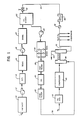
- Figure 1 shows a system for providing the ozonated, deionized purified water.
- raw water is pretreated using multi-media filters and some chemical injection in pretreatment state 10 and is then pumped via pump 12 to a reverse osmosis module 14 from where (if required) it is degasified by degasifier 16 and pumped by repressurization pump 18 to a demineralization state 20 which comprises a cation, anion and mixed bed, or mixed bed alone.
- a double pass reverse osmosis system can be utilized as disclosed in Pittner U.S. Patent No. 4,574,049.
- Demineralized water goes to deionized water storage tank 22. It is repressurized by means of pump 24 and fed to polishing dionized exchange bottles 26 which comprise mixed beds (typically a combination of cation and anion resins).
- the deionized water from mixed beds 26 are filtered via postfilter 28 and then processed through ultraviolet lamps 30 for bacteria control and then through submicron filtration 32.
- the postfilters are used as resin traps.
- the deionized purified water is fed via conduit 34 to a static gas injector 36.
- the deionized purified water is ozonated as follows. Pure oxygen fas is fed through a conventional ozone generator 38 which produces oxygen plus ozone at about 10 psi. The oxygen and ozone at about 10 psi are fed to a compressor 40 where the gas is compressed to 85 psi and then fed to static gas injector 36. The compressed oxygen and ozone will mix with the purified water in the static gas injector 36 to form ozonated water and provide the ozonated water on conduit 42. A bleed line 44 is provided to remove the bubbles from the ozonatede water line.
- the deionized, ozonated, purified water in conduit 42 is fed to the circuit fabrication area, via PVDF plumbing.
- a dissolved ozone meter 46 is provided to monitor the ozone concentration.
- the ozone concentration in the deionized purified water is preferably between .01 and .1 parts per million in order for the wafer during circuit fabrication to be conditioned properly and to prevent significant damage to the system hardware.
- the deionized, ozonated, purified water is recycled but the ozone must be removed prior to return of the water to deionized storage tank 22.
- the ozonated water is processed through ultraviolet lamps 48 for removal of the ozone for recycling.
- the deionized purified water, with the ozone removed, is then fed via conduit 50 through a back pressure regulator 52 to the deionized water storage tank 22.
- Figures 2A - 2N show a portion of the fabrication of the integrated circuit after a clean silicon wafer has been received.
- Figure 2A illustrates the silicon wafer as it may be received from a wafer manufacturer with the silicon wafer 60 being coated with an oxide 62 that is chemically grown or from the previous hydrogen peroxide treatment, with the oxide typically having a thickness of 20 to 30 angstroms. Often the circuit fabricator will remove the oxide to reclean the silicon.
- the oxide layered silicon of Figure 2A may be placed in a furnace where it is oxygeneated to provide a thermally grown oxide 64 (Figure 2B) having a thickness between 100 angstroms and 400 angstroms. Thereafter, a silicon nitride overlayer 66 ( Figure 2C) is provided in a furnace and a photoresist layer 68 is placed over the silicon nitride layer 66.
- the photoresist 68 is illuminated and then etched (see Figure 2E) to leave uncovered portions of the silicon nitride.
- the item of Figure 2E is then conditioned by rinsing it with the deionized purified water containing between .01 and .1 ppm ozone, preferably between .02 and .09 ppm ozone.
- the portions of the silicon nitride 66 that are no longer covered with photoresist 68 are etched to result in the item illustrated in Figure 2F, in which the photoresist has been removed and portions of the oxide 64 are exposed.
- the item is again conditioned by rinsing it with the ozonated water. Thereafter the item is placed in a furnace to provide a thick film oxide 70, approximately 2,000 angstroms thick, which grows where the nitride has been removed. This is illustrated in Figure 2G. Thereafter, the item is conditioned by rinsing it with the ozonated water and the silicon nitride 66 is removed (see Figure 2H).
- a photoresist 68 is added (Figure 2I), illuminated and thereafter etched ( Figure 2I). As illustrated in Figure 2J, this leaves bare portions of the oxide, and the item is again conditioned by rinsing with the ozonated water. As illustrated in Figure 2K, the photoresist is removed and the oxide is etched down to bare silicon in various areas of the silicon surface. Thereafter, as illustrated in Figure 2L, a gate oxide 72 is thermally grown, with the gate oxide having a close tolerance thickness within the range of 150 angstroms to 300 angstroms. The gate oxide is typically the most critical oxidation in the entire fabrication of the integrated circuit. It is absolutely essential that the bare silicon be properly conditioned for the growing of the gate. To this end, the ozonated water rinse treats and conditions the bare silicon and provides a thin oxide layer of perhaps a few monolayers for receiving the gate oxide.
- a layer 74 of polysilicon is deposited.
- another photoresist layer 68 is provided which is illuminated, etched, rinsed with ozonated water, and then the uncovered polysilicon layer is etched and rinsed with the ozonated water, to result in the item illustrated in Figure 2N.
- the conditioning with the ozonated water occur after the material which is no longer covered with photoresist has been etched.
- the conditioning step be performed by rinsing with deionized, purified water containing .01 to .1 ppm ozone, preferably .02 to .09 ppm ozone.
Landscapes
- Cleaning Or Drying Semiconductors (AREA)
- Weting (AREA)
Applications Claiming Priority (2)
| Application Number | Priority Date | Filing Date | Title |
|---|---|---|---|
| US06/903,022 US4749640A (en) | 1986-09-02 | 1986-09-02 | Integrated circuit manufacturing process |
| US903022 | 1986-09-02 |
Publications (2)
| Publication Number | Publication Date |
|---|---|
| EP0259985A2 true EP0259985A2 (fr) | 1988-03-16 |
| EP0259985A3 EP0259985A3 (fr) | 1990-05-30 |
Family
ID=25416802
Family Applications (1)
| Application Number | Title | Priority Date | Filing Date |
|---|---|---|---|
| EP87307183A Withdrawn EP0259985A3 (fr) | 1986-09-02 | 1987-08-14 | Procédé de fabrication d'un circuit intégré |
Country Status (14)
| Country | Link |
|---|---|
| US (1) | US4749640A (fr) |
| EP (1) | EP0259985A3 (fr) |
| KR (1) | KR880004543A (fr) |
| CN (1) | CN1006506B (fr) |
| AU (1) | AU587341B2 (fr) |
| BR (1) | BR8704508A (fr) |
| CA (1) | CA1264870A (fr) |
| DK (1) | DK423587A (fr) |
| FI (1) | FI873795L (fr) |
| IL (1) | IL83547A0 (fr) |
| IN (1) | IN171016B (fr) |
| MY (1) | MY100556A (fr) |
| NO (1) | NO873670L (fr) |
| PH (1) | PH24686A (fr) |
Cited By (8)
| Publication number | Priority date | Publication date | Assignee | Title |
|---|---|---|---|---|
| EP0504431A4 (en) * | 1990-10-09 | 1993-03-10 | Chlorine Engineers Corp., Ltd. | Method of removing organic coating |
| EP0555098A1 (fr) * | 1992-02-07 | 1993-08-11 | Tadahiro Ohmi | Développateur lithographique et procédé lithographique |
| EP0556014A1 (fr) * | 1992-02-10 | 1993-08-18 | Tadahiro Ohmi | Procédé lithographique |
| EP0702399A1 (fr) * | 1994-09-14 | 1996-03-20 | Siemens Aktiengesellschaft | Procédé d'élimination, par traitement chimique par voie humide, de contaminations sur des surfaces de cristaux semiconducteurs |
| EP0767487A1 (fr) * | 1995-10-05 | 1997-04-09 | Texas Instruments Incorporated | Améliorations concernant la fabrication d'un dispositif semi-conducteur |
| US5803980A (en) * | 1996-10-04 | 1998-09-08 | Texas Instruments Incorporated | De-ionized water/ozone rinse post-hydrofluoric processing for the prevention of silicic acid residue |
| US6007970A (en) * | 1992-02-07 | 1999-12-28 | Canon Kabushiki Kaisha | Lithographic developer containing surfactant |
| US7271109B2 (en) | 1994-09-26 | 2007-09-18 | Semiconductor Energy Laboratory Co., Ltd. | Solution applying apparatus and method |
Families Citing this family (28)
| Publication number | Priority date | Publication date | Assignee | Title |
|---|---|---|---|---|
| US5181985A (en) * | 1988-06-01 | 1993-01-26 | Wacker-Chemitronic Gesellschaft Fur Elektronik-Grundstoffe Mbh | Process for the wet-chemical surface treatment of semiconductor wafers |
| US4900336A (en) * | 1989-04-03 | 1990-02-13 | Arrowhead Industrial Water, Inc. | Method of preferentially removing oxygen from ozonated water |
| US5190627A (en) * | 1989-11-07 | 1993-03-02 | Ebara Corporation | Process for removing dissolved oxygen from water and system therefor |
| US5378317A (en) * | 1990-10-09 | 1995-01-03 | Chlorine Engineers Corp., Ltd. | Method for removing organic film |
| US5565378A (en) * | 1992-02-17 | 1996-10-15 | Mitsubishi Denki Kabushiki Kaisha | Process of passivating a semiconductor device bonding pad by immersion in O2 or O3 solution |
| KR970008354B1 (ko) * | 1994-01-12 | 1997-05-23 | 엘지반도체 주식회사 | 선택적 식각방법 |
| JP2914555B2 (ja) * | 1994-08-30 | 1999-07-05 | 信越半導体株式会社 | 半導体シリコンウェーハの洗浄方法 |
| US5674357A (en) * | 1995-08-30 | 1997-10-07 | Taiwan Semiconductor Manufacturing Company, Ltd. | Semiconductor substrate cleaning process |
| US6245155B1 (en) * | 1996-09-06 | 2001-06-12 | Arch Specialty Chemicals, Inc. | Method for removing photoresist and plasma etch residues |
| DE19701971C1 (de) * | 1997-01-22 | 1998-11-26 | Invent Gmbh Entwicklung Neuer Technologien | Verfahren und Vorrichtung zur Reinigung von Substratoberflächen |
| US5882425A (en) * | 1997-01-23 | 1999-03-16 | Semitool, Inc. | Composition and method for passivation of a metallization layer of a semiconductor circuit after metallization etching |
| US5971368A (en) | 1997-10-29 | 1999-10-26 | Fsi International, Inc. | System to increase the quantity of dissolved gas in a liquid and to maintain the increased quantity of dissolved gas in the liquid until utilized |
| US6100198A (en) * | 1998-02-27 | 2000-08-08 | Micron Technology, Inc. | Post-planarization, pre-oxide removal ozone treatment |
| US6183637B1 (en) * | 1998-07-23 | 2001-02-06 | Seh America, Inc. | Resin trap device for use in ultrapure water systems and method of purifying water using same |
| US6235641B1 (en) | 1998-10-30 | 2001-05-22 | Fsi International Inc. | Method and system to control the concentration of dissolved gas in a liquid |
| US6406551B1 (en) | 1999-05-14 | 2002-06-18 | Fsi International, Inc. | Method for treating a substrate with heat sensitive agents |
| US6790783B1 (en) * | 1999-05-27 | 2004-09-14 | Micron Technology, Inc. | Semiconductor fabrication apparatus |
| US6408535B1 (en) | 1999-08-26 | 2002-06-25 | Semitool, Inc. | Ozone conversion in semiconductor manufacturing |
| US6805791B2 (en) * | 2000-09-01 | 2004-10-19 | Applied Science And Technology, Inc. | Ozonated water flow and concentration control apparatus |
| US6387804B1 (en) | 2000-09-19 | 2002-05-14 | Advanced Micro Devices, Inc. | Passivation of sidewall spacers using ozonated water |
| TW541584B (en) * | 2001-06-01 | 2003-07-11 | Semiconductor Energy Lab | Semiconductor film, semiconductor device and method for manufacturing same |
| US6812064B2 (en) * | 2001-11-07 | 2004-11-02 | Micron Technology, Inc. | Ozone treatment of a ground semiconductor die to improve adhesive bonding to a substrate |
| US7365403B1 (en) * | 2002-02-13 | 2008-04-29 | Cypress Semiconductor Corp. | Semiconductor topography including a thin oxide-nitride stack and method for making the same |
| US7502114B2 (en) * | 2004-03-12 | 2009-03-10 | Mks Instruments, Inc. | Ozone concentration sensor |
| WO2006017108A2 (fr) * | 2004-07-09 | 2006-02-16 | Akrion, Llc | Système et procédé de nettoyage pré-grille de substrats |
| JP5251184B2 (ja) * | 2008-03-14 | 2013-07-31 | 栗田工業株式会社 | ガス溶解水供給システム |
| CN101752213B (zh) * | 2008-12-08 | 2011-09-07 | 北京有色金属研究总院 | 一种消除硅片表面水雾的低温热处理工艺 |
| US9627534B1 (en) * | 2015-11-20 | 2017-04-18 | United Microelectronics Corp. | Semiconductor MOS device having a dense oxide film on a spacer |
Family Cites Families (12)
| Publication number | Priority date | Publication date | Assignee | Title |
|---|---|---|---|---|
| US3066050A (en) * | 1960-03-23 | 1962-11-27 | Philco Corp | Fabrication of semiconductor devices |
| US3705055A (en) * | 1970-09-18 | 1972-12-05 | Western Electric Co | Method of descumming photoresist patterns |
| US3890176A (en) * | 1972-08-18 | 1975-06-17 | Gen Electric | Method for removing photoresist from substrate |
| US4027686A (en) * | 1973-01-02 | 1977-06-07 | Texas Instruments Incorporated | Method and apparatus for cleaning the surface of a semiconductor slice with a liquid spray of de-ionized water |
| DE2316097A1 (de) * | 1973-03-30 | 1974-10-17 | Siemens Ag | Verfahren zur nachbehandlung von siliziumkoerpern mit geaetzter oxydschicht |
| US4156619A (en) * | 1975-06-11 | 1979-05-29 | Wacker-Chemitronic Gesellschaft Fur Elektronik-Grundstoffe Mbh | Process for cleaning semi-conductor discs |
| US4341592A (en) * | 1975-08-04 | 1982-07-27 | Texas Instruments Incorporated | Method for removing photoresist layer from substrate by ozone treatment |
| US4129457A (en) * | 1977-05-23 | 1978-12-12 | International Business Machines Corporation | Post-polishing cleaning of semiconductor surfaces |
| DE2928324A1 (de) * | 1979-07-13 | 1981-01-29 | Coolbox Vertriebsgesellschaft | Einrichtung zur messung von ozon in wasser |
| US4318749A (en) * | 1980-06-23 | 1982-03-09 | Rca Corporation | Wettable carrier in gas drying system for wafers |
| US4443295A (en) * | 1983-06-13 | 1984-04-17 | Fairchild Camera & Instrument Corp. | Method of etching refractory metal film on semiconductor structures utilizing triethylamine and H2 O2 |
| US4595498A (en) * | 1984-12-27 | 1986-06-17 | Thomson Components-Mostek Corporation | Water-polishing loop |
-
1986
- 1986-09-02 US US06/903,022 patent/US4749640A/en not_active Expired - Fee Related
-
1987
- 1987-08-11 CA CA000544260A patent/CA1264870A/fr not_active Expired - Lifetime
- 1987-08-12 IN IN703/DEL/87A patent/IN171016B/en unknown
- 1987-08-13 DK DK423587A patent/DK423587A/da not_active Application Discontinuation
- 1987-08-13 AU AU76833/87A patent/AU587341B2/en not_active Ceased
- 1987-08-14 IL IL83547A patent/IL83547A0/xx unknown
- 1987-08-14 EP EP87307183A patent/EP0259985A3/fr not_active Withdrawn
- 1987-08-25 PH PH35733A patent/PH24686A/en unknown
- 1987-08-27 KR KR870009395A patent/KR880004543A/ko not_active Ceased
- 1987-08-28 MY MYPI87001474A patent/MY100556A/en unknown
- 1987-09-01 FI FI873795A patent/FI873795L/fi not_active Application Discontinuation
- 1987-09-01 NO NO873670A patent/NO873670L/no unknown
- 1987-09-01 CN CN87106114A patent/CN1006506B/zh not_active Expired
- 1987-09-01 BR BR8704508A patent/BR8704508A/pt unknown
Cited By (9)
| Publication number | Priority date | Publication date | Assignee | Title |
|---|---|---|---|---|
| EP0504431A4 (en) * | 1990-10-09 | 1993-03-10 | Chlorine Engineers Corp., Ltd. | Method of removing organic coating |
| EP0555098A1 (fr) * | 1992-02-07 | 1993-08-11 | Tadahiro Ohmi | Développateur lithographique et procédé lithographique |
| US6007970A (en) * | 1992-02-07 | 1999-12-28 | Canon Kabushiki Kaisha | Lithographic developer containing surfactant |
| EP0556014A1 (fr) * | 1992-02-10 | 1993-08-18 | Tadahiro Ohmi | Procédé lithographique |
| US6107007A (en) * | 1992-02-10 | 2000-08-22 | Canon Kabushiki Kaisha | Lithography process |
| EP0702399A1 (fr) * | 1994-09-14 | 1996-03-20 | Siemens Aktiengesellschaft | Procédé d'élimination, par traitement chimique par voie humide, de contaminations sur des surfaces de cristaux semiconducteurs |
| US7271109B2 (en) | 1994-09-26 | 2007-09-18 | Semiconductor Energy Laboratory Co., Ltd. | Solution applying apparatus and method |
| EP0767487A1 (fr) * | 1995-10-05 | 1997-04-09 | Texas Instruments Incorporated | Améliorations concernant la fabrication d'un dispositif semi-conducteur |
| US5803980A (en) * | 1996-10-04 | 1998-09-08 | Texas Instruments Incorporated | De-ionized water/ozone rinse post-hydrofluoric processing for the prevention of silicic acid residue |
Also Published As
| Publication number | Publication date |
|---|---|
| FI873795A0 (fi) | 1987-09-01 |
| CN87106114A (zh) | 1988-05-04 |
| DK423587A (da) | 1988-03-03 |
| FI873795A7 (fi) | 1988-03-03 |
| IL83547A0 (en) | 1988-01-31 |
| NO873670D0 (no) | 1987-09-01 |
| PH24686A (en) | 1990-09-07 |
| CN1006506B (zh) | 1990-01-17 |
| IN171016B (fr) | 1992-07-04 |
| EP0259985A3 (fr) | 1990-05-30 |
| BR8704508A (pt) | 1988-04-19 |
| US4749640A (en) | 1988-06-07 |
| DK423587D0 (da) | 1987-08-13 |
| AU587341B2 (en) | 1989-08-10 |
| CA1264870A (fr) | 1990-01-23 |
| FI873795L (fi) | 1988-03-03 |
| NO873670L (no) | 1988-03-03 |
| AU7683387A (en) | 1988-03-10 |
| KR880004543A (ko) | 1988-06-04 |
| MY100556A (en) | 1990-11-15 |
Similar Documents
| Publication | Publication Date | Title |
|---|---|---|
| US4749640A (en) | Integrated circuit manufacturing process | |
| US9136104B2 (en) | Method for cleaning silicon wafer and apparatus for cleaning silicon wafer | |
| JPH041679B2 (fr) | ||
| KR100874071B1 (ko) | 반도체 집적 회로 장치의 제조 방법 | |
| US5139623A (en) | Method of forming oxide film on stainless steel | |
| KR100454005B1 (ko) | 반도체 웨이퍼의 메가소닉 세정을 위한 탈이온수의 온도제어 가스화 | |
| KR101431615B1 (ko) | 실리콘 표면 준비 | |
| EP0701275A2 (fr) | Procédé de nettoyage avant traitement thermique | |
| KR101066461B1 (ko) | 고순도수 제조시스템 및 그 운전방법 | |
| JP2711389B2 (ja) | 集積回路製作方法 | |
| EP0641742A1 (fr) | Procede et systeme pour la production d'eau pure et procede de nettoyage associe | |
| JP3332323B2 (ja) | 電子部品部材類の洗浄方法及び洗浄装置 | |
| JP3639102B2 (ja) | ウェット処理装置 | |
| JP3296407B2 (ja) | 電子部品部材類の洗浄方法及び洗浄装置 | |
| US20050211632A1 (en) | Base dosing water purification system and method | |
| JP2006073747A (ja) | 半導体ウェーハの処理方法およびその装置 | |
| US5700348A (en) | Method of polishing semiconductor substrate | |
| US6416676B1 (en) | Deionized water degasification for semiconductor fabrication | |
| JP7704618B2 (ja) | オゾン水製造方法及びオゾン水製造システム | |
| JP3101642B2 (ja) | 超純水の製造方法 | |
| Gaudet | Point-Of-Use Ultrafiltration of Deionized Rinse Water and Effects on Microelectronics Device Quality | |
| KR100511915B1 (ko) | 폴리싱 웨이퍼 세정방법 | |
| JP2004296997A (ja) | 半導体集積回路装置の製造方法 | |
| KR20010056346A (ko) | 반도체 세정 장치 및 이를 이용한 반도체 기판 세정 방법 | |
| Ohya | State of the art ultrapure water production in Japan |
Legal Events
| Date | Code | Title | Description |
|---|---|---|---|
| PUAI | Public reference made under article 153(3) epc to a published international application that has entered the european phase |
Free format text: ORIGINAL CODE: 0009012 |
|
| 17P | Request for examination filed |
Effective date: 19870825 |
|
| AK | Designated contracting states |
Kind code of ref document: A2 Designated state(s): AT BE CH DE ES FR GB GR IT LI LU NL SE |
|
| PUAL | Search report despatched |
Free format text: ORIGINAL CODE: 0009013 |
|
| AK | Designated contracting states |
Kind code of ref document: A3 Designated state(s): AT BE CH DE ES FR GB GR IT LI LU NL SE |
|
| 17Q | First examination report despatched |
Effective date: 19910916 |
|
| STAA | Information on the status of an ep patent application or granted ep patent |
Free format text: STATUS: THE APPLICATION IS DEEMED TO BE WITHDRAWN |
|
| 18D | Application deemed to be withdrawn |
Effective date: 19920327 |
|
| RIN1 | Information on inventor provided before grant (corrected) |
Inventor name: TREMONT, PETER L. Inventor name: ACKERMANN, ARTHUR J. |