EP0260064A2 - Verfahren zur Trennung von organischem Material aus Festpartikeln - Google Patents
Verfahren zur Trennung von organischem Material aus Festpartikeln Download PDFInfo
- Publication number
- EP0260064A2 EP0260064A2 EP87307772A EP87307772A EP0260064A2 EP 0260064 A2 EP0260064 A2 EP 0260064A2 EP 87307772 A EP87307772 A EP 87307772A EP 87307772 A EP87307772 A EP 87307772A EP 0260064 A2 EP0260064 A2 EP 0260064A2
- Authority
- EP
- European Patent Office
- Prior art keywords
- hydrocarbon fluid
- solids
- particulate solids
- light hydrocarbon
- bed
- Prior art date
- Legal status (The legal status is an assumption and is not a legal conclusion. Google has not performed a legal analysis and makes no representation as to the accuracy of the status listed.)
- Granted
Links
- 239000007787 solid Substances 0.000 title claims abstract description 193
- 238000000034 method Methods 0.000 title claims abstract description 107
- 230000008569 process Effects 0.000 title claims abstract description 90
- 239000011368 organic material Substances 0.000 title claims abstract description 48
- 229930195733 hydrocarbon Natural products 0.000 claims abstract description 202
- 150000002430 hydrocarbons Chemical class 0.000 claims abstract description 201
- 239000012530 fluid Substances 0.000 claims abstract description 190
- 239000004215 Carbon black (E152) Substances 0.000 claims abstract description 184
- 239000000203 mixture Substances 0.000 claims abstract description 37
- ATUOYWHBWRKTHZ-UHFFFAOYSA-N Propane Chemical compound CCC ATUOYWHBWRKTHZ-UHFFFAOYSA-N 0.000 claims description 74
- 239000010802 sludge Substances 0.000 claims description 45
- 239000001294 propane Substances 0.000 claims description 37
- YXFVVABEGXRONW-UHFFFAOYSA-N Toluene Chemical compound CC1=CC=CC=C1 YXFVVABEGXRONW-UHFFFAOYSA-N 0.000 claims description 33
- XLYOFNOQVPJJNP-UHFFFAOYSA-N water Substances O XLYOFNOQVPJJNP-UHFFFAOYSA-N 0.000 claims description 28
- 239000000463 material Substances 0.000 claims description 23
- UHOVQNZJYSORNB-UHFFFAOYSA-N Benzene Chemical compound C1=CC=CC=C1 UHOVQNZJYSORNB-UHFFFAOYSA-N 0.000 claims description 12
- 239000002910 solid waste Substances 0.000 claims description 9
- KAKZBPTYRLMSJV-UHFFFAOYSA-N Butadiene Chemical compound C=CC=C KAKZBPTYRLMSJV-UHFFFAOYSA-N 0.000 claims description 8
- 239000001273 butane Substances 0.000 claims description 8
- 125000004432 carbon atom Chemical group C* 0.000 claims description 8
- IJDNQMDRQITEOD-UHFFFAOYSA-N n-butane Chemical compound CCCC IJDNQMDRQITEOD-UHFFFAOYSA-N 0.000 claims description 8
- OFBQJSOFQDEBGM-UHFFFAOYSA-N n-pentane Natural products CCCCC OFBQJSOFQDEBGM-UHFFFAOYSA-N 0.000 claims description 8
- CTQNGGLPUBDAKN-UHFFFAOYSA-N O-Xylene Chemical compound CC1=CC=CC=C1C CTQNGGLPUBDAKN-UHFFFAOYSA-N 0.000 claims description 7
- 239000002920 hazardous waste Substances 0.000 claims description 7
- 239000003208 petroleum Substances 0.000 claims description 7
- NNPPMTNAJDCUHE-UHFFFAOYSA-N isobutane Chemical compound CC(C)C NNPPMTNAJDCUHE-UHFFFAOYSA-N 0.000 claims description 6
- 239000002699 waste material Substances 0.000 claims description 6
- VXNZUUAINFGPBY-UHFFFAOYSA-N 1-Butene Chemical compound CCC=C VXNZUUAINFGPBY-UHFFFAOYSA-N 0.000 claims description 5
- 238000002156 mixing Methods 0.000 claims description 5
- 125000003118 aryl group Chemical group 0.000 claims description 4
- 239000003209 petroleum derivative Substances 0.000 claims description 4
- PMPVIKIVABFJJI-UHFFFAOYSA-N Cyclobutane Chemical compound C1CCC1 PMPVIKIVABFJJI-UHFFFAOYSA-N 0.000 claims description 3
- LVZWSLJZHVFIQJ-UHFFFAOYSA-N Cyclopropane Chemical compound C1CC1 LVZWSLJZHVFIQJ-UHFFFAOYSA-N 0.000 claims description 3
- VQTUBCCKSQIDNK-UHFFFAOYSA-N Isobutene Chemical group CC(C)=C VQTUBCCKSQIDNK-UHFFFAOYSA-N 0.000 claims description 3
- 125000001931 aliphatic group Chemical group 0.000 claims description 3
- 150000001491 aromatic compounds Chemical class 0.000 claims description 3
- 239000001282 iso-butane Substances 0.000 claims description 3
- QQONPFPTGQHPMA-UHFFFAOYSA-N propylene Natural products CC=C QQONPFPTGQHPMA-UHFFFAOYSA-N 0.000 claims description 3
- 125000004805 propylene group Chemical group [H]C([H])([H])C([H])([*:1])C([H])([H])[*:2] 0.000 claims description 3
- 238000004064 recycling Methods 0.000 claims description 3
- 239000008096 xylene Substances 0.000 claims description 3
- IAQRGUVFOMOMEM-UHFFFAOYSA-N butene Natural products CC=CC IAQRGUVFOMOMEM-UHFFFAOYSA-N 0.000 claims 1
- 239000003921 oil Substances 0.000 description 64
- 235000019198 oils Nutrition 0.000 description 64
- 239000000047 product Substances 0.000 description 17
- 238000004821 distillation Methods 0.000 description 11
- 238000000926 separation method Methods 0.000 description 10
- 238000009835 boiling Methods 0.000 description 9
- -1 asphaltenes Chemical class 0.000 description 6
- 238000007796 conventional method Methods 0.000 description 6
- 239000007788 liquid Substances 0.000 description 6
- 229910000831 Steel Inorganic materials 0.000 description 5
- 238000004061 bleaching Methods 0.000 description 5
- 239000003054 catalyst Substances 0.000 description 5
- 239000004927 clay Substances 0.000 description 5
- 238000005520 cutting process Methods 0.000 description 5
- 239000007789 gas Substances 0.000 description 5
- 239000011261 inert gas Substances 0.000 description 5
- 238000012545 processing Methods 0.000 description 5
- 239000002002 slurry Substances 0.000 description 5
- 239000010959 steel Substances 0.000 description 5
- URLKBWYHVLBVBO-UHFFFAOYSA-N Para-Xylene Chemical group CC1=CC=C(C)C=C1 URLKBWYHVLBVBO-UHFFFAOYSA-N 0.000 description 4
- HOWJQLVNDUGZBI-UHFFFAOYSA-N butane;propane Chemical compound CCC.CCCC HOWJQLVNDUGZBI-UHFFFAOYSA-N 0.000 description 4
- WDECIBYCCFPHNR-UHFFFAOYSA-N chrysene Chemical compound C1=CC=CC2=CC=C3C4=CC=CC=C4C=CC3=C21 WDECIBYCCFPHNR-UHFFFAOYSA-N 0.000 description 4
- 239000012065 filter cake Substances 0.000 description 4
- 238000004231 fluid catalytic cracking Methods 0.000 description 4
- 239000002904 solvent Substances 0.000 description 4
- 239000006227 byproduct Substances 0.000 description 3
- 239000000383 hazardous chemical Substances 0.000 description 3
- VLKZOEOYAKHREP-UHFFFAOYSA-N n-Hexane Chemical compound CCCCCC VLKZOEOYAKHREP-UHFFFAOYSA-N 0.000 description 3
- 238000012360 testing method Methods 0.000 description 3
- 238000011144 upstream manufacturing Methods 0.000 description 3
- YNQLUTRBYVCPMQ-UHFFFAOYSA-N Ethylbenzene Chemical compound CCC1=CC=CC=C1 YNQLUTRBYVCPMQ-UHFFFAOYSA-N 0.000 description 2
- XEEYBQQBJWHFJM-UHFFFAOYSA-N Iron Chemical compound [Fe] XEEYBQQBJWHFJM-UHFFFAOYSA-N 0.000 description 2
- PXHVJJICTQNCMI-UHFFFAOYSA-N Nickel Chemical compound [Ni] PXHVJJICTQNCMI-UHFFFAOYSA-N 0.000 description 2
- 230000008901 benefit Effects 0.000 description 2
- 230000033228 biological regulation Effects 0.000 description 2
- 230000015572 biosynthetic process Effects 0.000 description 2
- 238000013461 design Methods 0.000 description 2
- 230000007613 environmental effect Effects 0.000 description 2
- 238000000605 extraction Methods 0.000 description 2
- 231100001261 hazardous Toxicity 0.000 description 2
- 238000002386 leaching Methods 0.000 description 2
- 239000012263 liquid product Substances 0.000 description 2
- IVSZLXZYQVIEFR-UHFFFAOYSA-N m-xylene Chemical group CC1=CC=CC(C)=C1 IVSZLXZYQVIEFR-UHFFFAOYSA-N 0.000 description 2
- 230000014759 maintenance of location Effects 0.000 description 2
- 230000007246 mechanism Effects 0.000 description 2
- 229910052751 metal Inorganic materials 0.000 description 2
- 239000002184 metal Substances 0.000 description 2
- 150000002739 metals Chemical class 0.000 description 2
- 238000012986 modification Methods 0.000 description 2
- 230000004048 modification Effects 0.000 description 2
- 229940078552 o-xylene Drugs 0.000 description 2
- 239000004033 plastic Substances 0.000 description 2
- 229920003023 plastic Polymers 0.000 description 2
- 239000011347 resin Substances 0.000 description 2
- 229920005989 resin Polymers 0.000 description 2
- 125000000383 tetramethylene group Chemical group [H]C([H])([*:1])C([H])([H])C([H])([H])C([H])([H])[*:2] 0.000 description 2
- 235000019782 De-oiled Rice Bran Nutrition 0.000 description 1
- 239000005909 Kieselgur Substances 0.000 description 1
- 239000004743 Polypropylene Substances 0.000 description 1
- VYPSYNLAJGMNEJ-UHFFFAOYSA-N Silicium dioxide Chemical compound O=[Si]=O VYPSYNLAJGMNEJ-UHFFFAOYSA-N 0.000 description 1
- 241000364021 Tulsa Species 0.000 description 1
- 240000008042 Zea mays Species 0.000 description 1
- 235000005824 Zea mays ssp. parviglumis Nutrition 0.000 description 1
- 235000002017 Zea mays subsp mays Nutrition 0.000 description 1
- KZENBFUSKMWCJF-UHFFFAOYSA-N [5-[5-[5-(hydroxymethyl)-2-thiophenyl]-2-furanyl]-2-thiophenyl]methanol Chemical compound S1C(CO)=CC=C1C1=CC=C(C=2SC(CO)=CC=2)O1 KZENBFUSKMWCJF-UHFFFAOYSA-N 0.000 description 1
- 230000009471 action Effects 0.000 description 1
- 150000004945 aromatic hydrocarbons Chemical class 0.000 description 1
- 239000011324 bead Substances 0.000 description 1
- 239000003575 carbonaceous material Substances 0.000 description 1
- 230000003197 catalytic effect Effects 0.000 description 1
- 230000006835 compression Effects 0.000 description 1
- 238000007906 compression Methods 0.000 description 1
- 239000000470 constituent Substances 0.000 description 1
- 238000001816 cooling Methods 0.000 description 1
- 235000005822 corn Nutrition 0.000 description 1
- 230000001419 dependent effect Effects 0.000 description 1
- 238000005553 drilling Methods 0.000 description 1
- 239000000428 dust Substances 0.000 description 1
- 230000000694 effects Effects 0.000 description 1
- 239000000839 emulsion Substances 0.000 description 1
- 229940058172 ethylbenzene Drugs 0.000 description 1
- 238000011156 evaluation Methods 0.000 description 1
- 238000011049 filling Methods 0.000 description 1
- 238000001914 filtration Methods 0.000 description 1
- 239000008394 flocculating agent Substances 0.000 description 1
- 239000002737 fuel gas Substances 0.000 description 1
- 238000010438 heat treatment Methods 0.000 description 1
- 229910010272 inorganic material Inorganic materials 0.000 description 1
- 239000011147 inorganic material Substances 0.000 description 1
- 229910052500 inorganic mineral Inorganic materials 0.000 description 1
- 238000009413 insulation Methods 0.000 description 1
- 229910052742 iron Inorganic materials 0.000 description 1
- 238000009277 landfarming Methods 0.000 description 1
- 238000010169 landfilling Methods 0.000 description 1
- 230000031700 light absorption Effects 0.000 description 1
- 239000011707 mineral Substances 0.000 description 1
- 238000012544 monitoring process Methods 0.000 description 1
- 239000010813 municipal solid waste Substances 0.000 description 1
- 229910052759 nickel Inorganic materials 0.000 description 1
- QJGQUHMNIGDVPM-UHFFFAOYSA-N nitrogen group Chemical group [N] QJGQUHMNIGDVPM-UHFFFAOYSA-N 0.000 description 1
- 230000001473 noxious effect Effects 0.000 description 1
- 239000003129 oil well Substances 0.000 description 1
- 239000012074 organic phase Substances 0.000 description 1
- 239000012071 phase Substances 0.000 description 1
- 150000002989 phenols Chemical class 0.000 description 1
- 229920000867 polyelectrolyte Polymers 0.000 description 1
- 238000002203 pretreatment Methods 0.000 description 1
- 239000008262 pumice Substances 0.000 description 1
- 238000010926 purge Methods 0.000 description 1
- 230000009257 reactivity Effects 0.000 description 1
- 238000011084 recovery Methods 0.000 description 1
- 230000001105 regulatory effect Effects 0.000 description 1
- 229910001220 stainless steel Inorganic materials 0.000 description 1
- 239000010935 stainless steel Substances 0.000 description 1
- 238000003860 storage Methods 0.000 description 1
- 239000010902 straw Substances 0.000 description 1
- 239000000126 substance Substances 0.000 description 1
- 238000000194 supercritical-fluid extraction Methods 0.000 description 1
- 238000010408 sweeping Methods 0.000 description 1
- 239000011269 tar Substances 0.000 description 1
- 239000011275 tar sand Substances 0.000 description 1
- 238000010998 test method Methods 0.000 description 1
- 231100000331 toxic Toxicity 0.000 description 1
- 230000002588 toxic effect Effects 0.000 description 1
- 229910052720 vanadium Inorganic materials 0.000 description 1
- GPPXJZIENCGNKB-UHFFFAOYSA-N vanadium Chemical compound [V]#[V] GPPXJZIENCGNKB-UHFFFAOYSA-N 0.000 description 1
- 235000015112 vegetable and seed oil Nutrition 0.000 description 1
- 239000008158 vegetable oil Substances 0.000 description 1
- 238000004065 wastewater treatment Methods 0.000 description 1
- 239000002023 wood Substances 0.000 description 1
Images


Classifications
-
- C—CHEMISTRY; METALLURGY
- C10—PETROLEUM, GAS OR COKE INDUSTRIES; TECHNICAL GASES CONTAINING CARBON MONOXIDE; FUELS; LUBRICANTS; PEAT
- C10G—CRACKING HYDROCARBON OILS; PRODUCTION OF LIQUID HYDROCARBON MIXTURES, e.g. BY DESTRUCTIVE HYDROGENATION, OLIGOMERISATION, POLYMERISATION; RECOVERY OF HYDROCARBON OILS FROM OIL-SHALE, OIL-SAND, OR GASES; REFINING MIXTURES MAINLY CONSISTING OF HYDROCARBONS; REFORMING OF NAPHTHA; MINERAL WAXES
- C10G1/00—Production of liquid hydrocarbon mixtures from oil-shale, oil-sand, or non-melting solid carbonaceous or similar materials, e.g. wood, coal
- C10G1/04—Production of liquid hydrocarbon mixtures from oil-shale, oil-sand, or non-melting solid carbonaceous or similar materials, e.g. wood, coal by extraction
-
- B—PERFORMING OPERATIONS; TRANSPORTING
- B09—DISPOSAL OF SOLID WASTE; RECLAMATION OF CONTAMINATED SOIL
- B09C—RECLAMATION OF CONTAMINATED SOIL
- B09C1/00—Reclamation of contaminated soil
- B09C1/02—Extraction using liquids, e.g. washing, leaching, flotation
Definitions
- This invention relates to a process for separating an organic material from a composition comprising said organic material intermixed with particulate solids.
- This invention is particularly suitable for separating hydrocarbons from solid wastes and hazardous wastes (e.g., petroleum waste, refinery sludge, and the like). It is also suitable for treating catalyst fines-containing streams (e.g., decanter oil streams from fluid catalytic cracking units), oil-contaminated drill cuttings, steel mill scale, bleaching clay and the like.
- Refinery sludges are typically mixtures of hydrocarbon oils, heavy residual hydrocarbons including asphaltenes, water and particulate solids. These sludges are produced from a number of refinery units, including various standard waste water treatment separators. These sludges often contain substances such as benzene, toluene, xylene, chrysene and the like which are "listed” by the Environmental Protection Agency (EPA) as hazardous substances.
- EPA Environmental Protection Agency
- U.S. Patent 4,341,619 discloses a process for recovering carbonaceous materials from tar sands by supercritical extraction involving countercurrent flow of the tar sand and a solvent.
- the solvents that are disclosed as being useful include aromatic hydrocarbons, alicyclic hydrocarbons having 5-16 carbon atoms, phenols, and nitrogen-containing compounds. This patent is incorporated herein by reference.
- U.S. Patent 4,434,028 discloses a method and apparatus for removing oil and other organic constituents from particulate, inorganic-rich mineral solids.
- the reference indicates that the disclosed method and apparatus are particularly suitable for removing oil from oil-contaminated drill cuttings. This patent is incorporated herein by reference.
- This invention provides for a process for separating an organic material from a composition comprising said organic material intermixed with particulate solids, the process comprising advancing a light hydrocarbon fluid through said particulate solids at an effective rate to drive said organic material from said particulate solids.
- said process further comprises the steps of: advancing a higher molecular weight hydrocarbon fluid through said particulate solids at an effective rate to drive said undesirable residual organic material from said particulate solids, at least part of said higher molecular weight hydrocarbon fluid remaining intermixed with said particulate solids; and advancing a second light hydrocarbon fluid through said particulate solids at an effective rate to drive remaining higher molecular weight hydrocarbon fluid from said particulate solids.
- compositions that can be treated in accordance with the invention comprise an organic material intermixed with particulate solids.
- the organic material is typically in a liquid state at the pressure and temperature employed in the operation of the inventive process, although part of such organic material may be in a solid state at such pressure and temperature.
- These compositions also typically include water intermixed with the organic material and particulate solids.
- compositions that can be treated include solid waste and/or hazardous waste, including petroleum waste and refinery sludge.
- solid waste refers to any garbage, sludge or other waste material not excluded by EPA definitions.
- hazardous waste refers to solid waste or combinations of solid waste which are “listed” by the EPA as hazardous, or which exhibit ignitability, corrosivity or reactivity, or are considered toxic pursuant to relevant governmental rules or regulations.
- petroleum waste refers to any waste material containing petroleum or hydrocarbon oil intermixed with particulate solids and, in many instances, water.
- refinery sludge refers to sludges generated in petroleum refinery operations that contain petroleum or hydrocarbon oils intermixed with particulate solids; these sludges also contain water and the hydrocarbon oils in these sludges usually contain heavy residual hydrocarbons including asphaltenes.
- compositions that can be treated also include oil-contaminated catalyst fines (a refinery by-product), oil-contaminated drill cuttings (an oil well drilling by-product), oil-contaminated mill scale (a steel mill by-product), oil-contaminated bleaching clay (a vegetable oil filtering media), and the like.
- oil-contaminated catalyst fines a refinery by-product
- oil-contaminated drill cuttings an oil well drilling by-product
- oil-contaminated mill scale a steel mill by-product
- oil-contaminated bleaching clay a vegetable oil filtering media
- compositions that are treated are refinery sludges.
- a typical refinery sludge contains from about 1 to about 15% by weight hydrocarbon oil, from about 75 to about 98% by weight water, and from about 1 to about 15% by weight solids.
- the light hydrocarbon fluids that are useful with the inventive process are preferably selected from those fluids that do not readily form emulsions with water or hydrocarbon oil. These fluids are preferably capable of selectively removing large fractions of hydrocarbon oil from the sludge to be treated while not removing significant amounts of any water that may be present in such sludge.
- the light hydrocarbon fluids preferably have sufficiently low viscosities so that at economical flow rates unmanageable pressure drops are not experienced when the solids to be treated are in the form of a fixed bed, or excessive entrainments are not experienced when such solids are in the form of an agitated or fluidized bed.
- the fluid is preferably economically recoverable from the treated solids product once the inventive process has been completed.
- Preferred light hydrocarbon fluids include aliphatic and cycloaliphatic hydrocarbons having from 2 to about 9 carbon atoms, preferably from 2 to about 4 carbon atoms.
- Examples of such preferred fluids include propane, cyclopropane, propylene, butane, isobutane, cyclobutane, the butenes (e.g., butene-1, cis-butene-2, trans-butene-2), the butadienes (e.g., 1,3-butadiene), isobutylene and liquified petroleum gas (LPG).
- LPG low-density polystyrene
- Propane and commercial grades of LPG e.g., Commercial Propane and Commercial Propane-Butane Mixtures are particularly preferred.
- the light hydrocarbon fluid is advanced through the sludge being treated at an effective rate to drive the hydrocarbon oil in such sludge from the particulate solids.
- undesirable residual organic material may remain intermixed with the particulate solids after treatment with the light hydrocarbon fluid.
- These undesirable residual organic materials typically comprise hydrocarbons having lower relative mutual solubilities, lower mutual diffusivities and/or higher viscosities than the light hydrocarbon fluid.
- These undesirable residual organic materials also include hydrocarbons that are in a solid state at the operating temperature and pressure of the process.
- undesirable residual organic materials include heaving residual hydrocarbons including asphaltenes, condensed ring aromatics, resins, complex mixtures of high-boiling hydrocarbons (e.g., hydrocarbons having boiling points in excess of about 450°F and an average of about 15 carbon atoms or more per molecule), and the like. These undesirable residual organic materials can be separated from the solids by advancing a higher molecular weight hydrocarbon fluid through the particulate solids at an effective rate to drive the undesirable residual organic material from the particulate solids.
- the higher molecular weight hydrocarbon fluids are preferably selected from those hydrocarbon fluids which: can be facilitatingly separated from the initially used light hydrocarbon fluid using conventional techniques; dissolve heavy residual hydrocarbons including asphaltenes at modest temperatures (e.g., in the range of about 30 to about 400°F, preferably about 200°F) and at moderate pressures (e.g., below about 500 psig); extract significant amounts of water from the sludge being treated; and can be separated from such water and heavy residual hydrocarbons using conventional separation techniques.
- higher molecular weight hydrocarbon fluids are preferably aromatic compounds such as, for example, benzene, toluene, xylene (i.e., o-xylene, m-xylene, p-xylene) or a mixture of two or more of such aromatic compounds.
- the higher molecular weight hydrocarbon fluid is preferably an aromatic or aromatic-enriched fluid that is readily available from a refinery system such as, for example, one or more of the reformate fluids (e.g., light reformate, heavy reformate, etc.) that are produced by reformers in a typical refinery system.
- a typical light reformate fluid has an initial boiling point of about 70°F, a final boiling point of about 245°F, a benzene content of about 13% by weight and a toluene content of about 34% by weight.
- a typical heavy reformate fluid has an initial boiling point of about 230°F, a final boiling point of about 375°F, and contains toluene, ethylbenzene, o-xylene and p-xylene.
- the higher molecular weight hydrocarbon fluid it is generally also necessary to further treat the particu late solids with a second light hydrocarbon fluid to separate any higher molecular weight hydrocarbon fluid that may remain intermixed with the particulate solids.
- the second light hydrocarbon fluid can be the same light hydrocarbon fluid that is used initially, or it can be different.
- the second light hydrocarbon fluid preferivelyably has the same characteristics as the initially used light hydrocarbon fluid. It should, however, be of sufficient purity so that any of such second light hydrocarbon fluid that should remain with the solids after treatment has been completed will not impart to such solids concentrations of EPA listed materials above those allowed by relevant EPA rules and regulations.
- preferred second light hydrocarbon fluids include aliphatic and cycloaliphatic hydrocarbons having from 2 to about 9 carbon atoms, preferably from 2 to about 4 carbon atoms.
- preferred fluids include propane, cyclopropane, propylene, butane, isobutane, cyclobutane, the butenes (e.g., butene-1, cis-butene-2, trans-butene-2), the butadienes (e.g., 1,3-butadiene), isobutylene and LPG.
- Examples of commercial grades of LPG that are useful include Commercial Propane, Commercial Butane, Commercial Propane-Butane Mixtures, Special Duty Propane and Propane HD-5. Mixtures of two or more of the foregoing fluids can be used. Propane, and commercial grades of LPG (e.g., Commercial Propane and Commercial Propane-Butane Mixtures) are particularly preferred.
- the sludge to be treated is preferably pretreated to remove some of the water and oil prior to treating the solids in accordance with the inventive process.
- raw sludge coming from various sources in the refinery system is advanced to one or more pretreatment units.
- the pretreatment units that are particularly useful include vacuum filters, belt presses, filter presses or a combination of the foregoing, the design of which are entirely conventional.
- An additional sludge dryer to further de-water the sludge can be used.
- the material coming off the pretreatment units are preferably placed in holding bins.
- the sludge solids produced by the pretreatment units are conveyed to the contacting vessel.
- Conveyance to the contacting vessel can be by conveyor belt, screw conveyor, pneumatic equipment, in slurry form, in bags or baskets which are lowered into the contacting vessel, or by any other conventional means known in the art.
- a suitably designed gasketed filter press can serve as both the pretreatment unit and the contacting unit.
- the pre-treated sludge solids can be mixed with one or more non-sludge materials to facilitate the formation of and/or insure the retention of a fluid-permeable mass or bed of sludge solids.
- the non-sludge materials that are useful are preferably selected from those materials having relatively low bulk desnities when compared to the sludge solids and a structural integrity that does not degrade significantly when in contact with the hydrocarbon oils intermixed with the solids or the hydrocarbon fluids used in accordance with the inventive method. These non-sludge materials also preferably do not contain significant levels of EPA listed materials.
- non-sludge materials examples include inorganic materials such as diatomaceous earth, vermiculate, pumice and the like; organic materials such as saw dust, wood chips, straw, ground tree bark, ground corn cobs, de-oiled rice bran, oil seeds and the like; and synthetic polymeric materials such as porous polypropylene beads, blown plastics (especially off-specification blown plastics) and the like.
- Polyelectrolyte polymer flocculating agents are also useful as the non-sludge material. Mixtures of two or more of the foregoing non-sludge materials can be used.
- the level of addition of non-sludge material to the sludge solids is typically in the range of zero to about 50% by volume, preferably about 5% to about 20% by volume of the non-sludge material based on the volume of the sludge solids.
- This optional step of mixing the sludge solids with a non-sludge material can be effected in the pre-treatment unit or in the contactor using conventional mixing techniques.
- the contacting unit can be one or more pressurized vessels that may be operated in a batch mode, semi-batch mode or in a continuous mode. When multiple vessels are employed, the vessels can be operated in parallel or in staggered sequence.
- the configuration of the vessel is dependent upon the means of solids conveyance to and from the vessel. For example, if solids are conveyed to the vessel in slurry form, nozzles with ball valves or pinch valves can satisfactorily seal the vessel. If solids are conveyed by large bag or basket, large diameter hatch closures can be used to satisfactorily provide closure of the vessel.
- the product solids can also be conveyed from the contacting vessel by slurrying the solids with water followed by an appropriate de-watering step using, for example, vacuum drum filters, clarifiers, settling tanks, centrifuges, sludge dryers and the like.
- the solids can also be conveyed from the contacting vessel by slurrying them in liquid butane and then transferring the slurry to a low pressure lock hopper.
- the contacting vessels can employ mechanical agitators, and heating/cooling jackets as well as external thermal insulation.
- the direction of flow of the driving fluids i.e., light hydrocarbon fluid, higher molecular weight hydrocarbon fluid, and second light hydrocarbon fluid
- the direction of flow of the driving fluids can be upwardly, downwardly or radially or it can alternate between any of the foregoing.
- the mechanism by which the driving fluids effect separation of the organic material from the solids involves (1) a sweeping action wherein the driving fluid advances through the mass or bed of particulate solids and displaces the organic material intermixed with such solids, and/or (2) an extraction wherein the organic material dissolves or disperses in the driving fluid and is carried away from the solids with such fluid.
- drive as used throughout the specification and in the appended claims refers to both of these mechanisms.
- the contacting vessel effluent can be advanced directly to the appropriate refinery stream, or can be treated to separate oil in such effluent from the driving fluid.
- the oil is then advanced to the appropriate refinery stream and the driving fluid can be recycled. Separation can be accomplished by a number of means discussed in greater detail below including flashing and distillation.
- One method for recyling the higher molecular weight hydrocarbon fluid employs a pump and a heater to pump the higher molecular weight hydrocarbon fluid through the contacting vessel until the desired bed temperature is reached.
- a heated storage tank is employed to store the contacting vessel fluid effluent.
- a continuous flash/distillation system separates the higher molecular weight hydrocarbon fluid from the undesirable residual organic materials.
- a cooler and separator are used to separate water from the higher molecular weight hydrocarbon fluid.
- the contacting vessel is filled with solids conveyed from the pretreatment unit. These solids are intermixed with hydrocarbon oil and in most cases water. In applications wherein a slurry fill is used, the excess slurry solvent may be drained down. With other filling methods, an inert gas purge can be used.
- the contacting vessel is pressurized to the desired operating pressure, and condensed or partially condensed light hydrocarbon fluid is pumped into the contacting vessel and flows through the solids in said vessel.
- the temperature within the vessel is preferably in the range of about 32°F to about 300°F, more preferably about 45°F to about 220°F, most preferably about 60°F to about 140°F.
- the pressure within the process is preferably in the range of about 50 to about 2000 psig, more preferively about 70 to about 1000 psig.
- the average contact time between the light hydrocarbon fluid and the solids is preferably in the range of about 5 minutes to about 24 hours, more preferably about 5 minutes to about 10 hours, and still more preferably about 5 minutes to about 5 hours.
- the light hydrocarbon fluid can be advanced through the particulate solids at a sufficient rate to expand the bed when the particulate solids are in the form of a fixed bed, or to fluidize the bed when the particulate solids are in the form of an agitated or fluidized bed.
- the temperature, pressure and flow rate of the light hydrocarbon fluid are set at levels so that preferably at least about 30% by weight, more preferably at least about 50% by weight, most preferably at least about 95% by weight of the fluid is in a condensed state.
- the fluid should have a density in excess of about 15 pounds per cubic foot, preferably in excess of about 20 pounds per cubic foot, more preferably in excess of about 25 pounds per cubic foot.
- the upper limit is preferably about 33 pounds per cubic foot.
- the upper limit is preferably in the range of about 35 to about 40 pounds per cubic foot.
- the effluent from the contacting vessel preferably flows through a continuous on-line monitor, for example, an ultraviolet light absorption or ultraviolet light fluorescent detector which monitors the extent of removal of organic materials from the sludge.
- the flow of the light hydrocarbon fluid into the contactor is stopped when the desired amount of hydrocarbon oil has been removed from the contactor and the light hydrocarbon fluid remaining in the vessel is removed from the vessel.
- the light hydrocarbon fluid can be removed by a number of conventional techniques including displacing the light hydrocarbon fluid with the higher molecular weight hydrocarbon fluid or an inert gas, or by draining the light hydrocarbon fluid from the contactor.
- the higher molecular weight hydrocarbon fluid is then introduced into the contactor and advanced through the solids in said contactor at an effective rate to drive the undesirable residual organic materials intermixed with said solids from said solids.
- the temperature within the contactor during this step of the process is preferably in the range of about 32°F to about 400°F, more preferably about 100°F to about 300°F, most preferably about 100°F to about 250°F.
- the pressure within the contactor during this step of the process is preferably in the range of about atmospheric pressure to about 100 psig.
- the average contact time between the higher molecular weight hydrocarbon fluid and the solids is preferably in the range of about 5 minutes to about 24 hours, more preferably in the range of about 5 minutes to about 10 hours, and still more preferably in the range of about 5 minutes to about 5 hours.
- the higher molecular weight hydrocarbon fluid can be advanced through the particulate solids at a sufficient rate to expand the bed when the particulate solids are in the form of a fixed bed, or to fluidize the bed when the particulate solids are in the form of an agitated or fluidized bed.
- the temperature, pressure and flow rate of the higher molecular weight hydrocarbon fluid are set at levels so that preferably at least about 30% by weight, more preferably at least about 50% by weight, more preferably at least about 95% by weight of the fluid is in a condensed state.
- the higher molecular weight hydrocarbon fluid is removed by displacing the higher molecular weight hydrocarbon fluid with the second light hydrocarbon fluid.
- the second light hydrocarbon fluid is advanced through the solids at a temperature that is preferably in the range of about 32°F to about 300°F, more preferably about 45°F to about 220°F, more preferably about 60°F to about 140°F.
- the pressure within the contractor during this step of the process is preferably in the range of about 50 to about 2000 psig, more preferably about 70 to about 1000 psig.
- the average contact time between the second light hydrocarbon fluid and the solids is preferably in the range of about 5 minutes to about 24 hours, more preferably about 5 minutes to about 10 hours, and still more preferably in the range of about 5 minutes to about 5 hours.
- the second light hydrocarbon fluid can be advanced through the particulate solids at a sufficient rate to expand the bed when the particulate solids are in the form of a fixed bed, or to fluidize the bed when the particulate solids are in the form of an agitated or fluidized bed.
- the temperature, pressure and flow rate of the second light hydrocarbon fluid are set at levels so that preferably at least about 30% by weight, more preferably at least about 50% by weight, more preferably at least about 95% by weight of the fluid is in a condensed state.
- the fluid When in such a condensed state, the fluid should have a density in excess of about 15 pounds per cubic foot, preferably in excess of about 20 pounds per cubic foot, more preferably in excess of about 25 pounds per cubic foot.
- the upper limit is preferably about 33 pounds per cubic foot.
- the upper limit is preferably in the range of about 35 to about 40 pounds per cubic foot.
- the second light hydrocarbon fluid can be removed using a number of conventional techniques including displacing the second light hydrocarbon fluid with an inert gas or by draining the second light hydrocarbon fluid from the contactor and then depressurizing the contactor.
- the solids are then removed from the contactor vessel using the techniques discussed above.
- the solids that are removed can be disposed of using conventional solids disposal techniques.
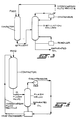
- Fig. 1 is a flow sheet illustrating the inventive process wherein the effluent stream from the contactor is returned directly to the refinery system.
- the sludge to be treated is preferably pretreated as discussed above and the resulting partially de-oiled and de-watered solids are placed in the contactor vessel.
- the light hydrocarbon fluid is introduced into the contactor vessel and advanced downwardly through the solids in the contactor vessel.
- the downward flow of the light hydrocarbon fluid through the solids in the contactor vessel drives the hydrocarbon oil that is intermixed with the solids downwardly through the contactor vessel to and through an outlet in the bottom of the contactor vessel.
- the effluent from the contactor which comprises a mixture of separated hydrocarbon oil and light hydrocarbon fluid, is then returned to an appropriate location in the refinery system (e.g., the crude tower) for further processing. Most of the water that is intermixed with the solids remains behind with the solids. Upon completion of the removal of hydrocarbon from the solids, the solids are removed from the contactor and are disposed of using conventional solids disposal techniques (e.g., landfill, etc.).
- Fig. 2 is a flow sheet illustrating the operation of the inventive process using a contactor vessel, flash valve, flash drum and surge tank.
- the sludge to be treated is preferably pretreated as discussed above and the resulting partially de-oiled and de-watered solids are placed in the contactor vessel.
- the contactor vessel is pressurized to the desired operating pressure by introducing the light hydrocarbon fluid into the contactor vessel and adjusting the flow rates through the compressor and the flash valve.
- Light hydrocarbon fluid is advanced downwardly through the solids in the contactor vessel.
- the downward flow of light hydrocarbon fluid drives the oil that is intermixed with the solids downwardly through the contactor vessel to and through an opening in the bottom of the contactor vessel and through a conduit to the flash valve.
- the effluent stream that is advanced to the flash valve comprises a mixture of hydrocarbon oil and the light hydrocarbon fluid.
- the flash valve is opened to permit the flow of the effluent stream to the flash drum.
- Most of the water that is intermixed with the solids remains behind in the contactor vessel with the solids.
- the light hydrocarbon fluid flashes and separates from the oil.
- the separated oil is removed from flash drum and advanced to the refinery system for further processing.
- Light hydrocarbon fluid is advanced to the surge tank where it is collected and then returned to an appropriate location in the refinery system (e.g., refinery fuel gas system).
- refinery fuel gas system Upon comple tion of the desired separation of the hydrocarbon oil from the solids, the process is discontinued and the solids are removed from the contactor vessel and disposed of using conventional solids disposal techniques.
- Fig. 3 is a flow sheet illustrating the operation of the inventive process using a contactor and a distillation column.
- the sludge to be treated is preferably pretreated as discussed above and the resulting partially de-oiled and de-watered solids are placed in the contactor vessel.
- the light hydrocarbon fluid is advanced downwardly through the contactor vessel.
- the downward flow of light hydrocarbon fluid through the solids drives the hydrocarbon oil that is intermixed with the solids downwardly through the contactor vessel to and through an opening in the bottom of the contactor vessel and then through a conduit to the distillation column.
- the effluent stream that is advanced to the distillation column comprises a mixture of the separated hydrocarbon oil and the light hydrocarbon fluid.
- the hydrocarbon oil and light hydrocarbon fluid are separated in the distillation column using conventional distillation techniques.
- the light hydrocarbon fluid that emerges from the distillation column is recycled to the contactor.
- the separated oil that emerges from the distillation column is advanced to the refinery system for further processing.
- the process is discontinued and the solids are removed from the contactor vessel and disposed of using conventional solids disposal techniques.
- Fig. 4 is a flow sheet illustrating the operation of the inventive process using a contactor vessel, flash drum, compressor and heat exchanger.
- the sludge to be treated is preferably pretreated as discussed above and the resulting partially de-oiled and de-watered solids are placed in the contactor vessel.
- the contactor vessel is pressurized to the desired operating pressure by introducing the light hydrocarbon fluid into the contactor vessel and adjusting the flow rates through the compressor and the flash valve.
- Light hydrocarbon fluid is advanced downwardly through the solids in the contactor vessel.
- the downward flow of light hydrocarbon fluid drives the hydrocarbon oil that is intermixed with the solids downwardly through the contactor vessel to and through an opening in the bottom of the contactor vessel and then through a conduit to the flash valve.
- the effluent stream that is advanced to the flash valve comprises a mixture of hydrocarbon oil and the light hydrocarbon fluid.
- the flash valve is opened to permit the flow of the effluent to the flash drum. Most of the water that is intermixed with the solids remains behind in the contactor vessel with the solids.
- the light hydrocarbon fluid flashes and separates from the hydrocarbon oil.
- the separated hydrocarbon oil is removed from the flash drum and advanced to the refinery system for further processing.
- the light hydrocarbon fluid vaporizes in the flash drum, and is advanced through a conduit to the compressor wherein it is compressed.
- the compressed fluid is advanced to and through the heat exchanger and then back to the contactor. In the heat exchanger, heat is transferred from the light hydrocarbon fluid to the flash drum.
- Fig. 5 is a process flow sheet illustrating the inventive process wherein the sludge to be treated is initially contacted with the light hydrocarbon fluid and then subsequently contacted with the higher molecular weight hydrocarbon fluid and second light hydrocarbon fluid.
- a pretreatment unit there is employed a pretreatment unit, contactor, separator and second separator.
- the sludge to be treated is advanced to the pretreatment unit wherein water and oil are partially removed.
- a conventional filter aid is preferably used to enhance the separation.
- partially de-watered and de-oiled solids are advanced to the contactor.
- the solids are initially contacted with the light hydrocarbon fluid under the conditions of temperature, pressure and flow rate discussed above.
- An agitator is provided in the contactor for mixing purposes; mixing is optional and used to prevent the formation of undesirable channels and the like in the solids bed.
- the effluent stream emmerging from the contactor contains hydrocarbon oil and light hydrocarbon fluid. Most of the water that is intermixed with the solids remains in the contactor.
- the effluent stream is advanced to the first separator wherein the light hydrocarbon fluid and hydrocarbon oil are separated using conventional techniques. Separation can be effected, for example, by flashing the light hydrocarbon fluid in a flash tank.
- the separated oil is advanced to the refinery system for further processing.
- the light hydrocarbon fluid is recirculated to the contactor.
- undesirable residual organic materials e.g., heavy residual hydrocarbons containing asphaltenes
- undesirable residual organic materials can be removed by advancing the higher molecular weight hydrocarbon fluid through the contactor under the conditions of temperature, pressure and flow rate discussed above.
- the effluent stream from the contactor during this step of the process contains a mixture of hydrocarbon oil, undesirable residual organic materials and the higher molecular weight hydrocarbon fluid. This effluent stream is advanced to the separator wherein hydrocarbon oil is separated using conventional techniques.
- the remaining mixture of higher molecular weight hydrocarbon fluid and undesirable residual organic materials is advanced to the second separator to separate out the undesirable residual organic materials.
- This separation can be effected using conventional techniques (e.g., distillation).
- a second light hydrocarbon fluid is advanced through the contactor under the conditions of pressure, temperature and flow rate discussed above to drive any residual higher molecular weight hydrocarbon fluid that may have remained intermixed with the solids in the contactor from such solids.
- the second light hydrocarbon fluid is preferably removed by any of a number of conventional techniques including displacing the second light hydrocarbon fluid with an inert gas or by draining the second light hydrocarbon fluid from the contactor.
- the process also provides for a local fluid pump-around that can be optionally used prior to any of the fluid/solids contacting steps of the process, and/or recycling of the solids to increase the degree of separation of hydrocarbon oil from the solids.
- the solids are removed from the contactor and disposed of using conventional solids disposal techniques.
- the apparatus that was used included a reservoir for liquified propane which was connected via a conduit to a pump system consisting of a pump, reservoir and back pressure regulator.
- a conduit from the reservoir extended to a conduit manifold for connecting the propane conduit to either the top or the bottom of the contactor vessels.
- a pressure transducer was positioned in the propane conduit downstream of the reservoir but upstream from the manifold.
- a metering pump fed an aromatics-enriched fluid to the propane conduit downstream of the pressure transducer, but upstream of the manifold.
- One of two stainless steel contactor vessels were used. Contactor vessel No. 1 had an internal diameter of 1.5 inches and a length of 13 inches.
- Contactor vessel No. 2 had an internal diameter of 3.75 inches and a length of 14 inches.
- Each of the contactors were equipped with an internal thermocouple.
- a temperature control system was mounted around the contactor vessels.
- a conduit extended from these contactor vessels to a flash vessel separator.
- a back pressure regulator was positioned in this conduit.
- a flash valve was also located in this conduit downstream of the back pressure regulator.
- a heat exchanger was positioned in this conduit downstream of the flash valve but upstream of the flash vessel separator.
- a conduit extended from the flash vessel separator to an exhaust vent.
- a dry test meter was placed in this conduit downstream from the flash vessel separator to monitor gases leaving the flash vessel.
- the flash vessel separator had a drain in its bottom for removing liquids.
- An electronic timer was used to monitor flow rates.
- the oil had an iron content of 10 ppm, and less than 0.8 ppm of nickel and vanadium.
- the product solids were lighter in color and more free-flowing than the feed sludge.
- the product solids contained about 1.2% by weight (based on the weight of the product solids) of a black, hexane insoluble, heavy organic, tar-like material.
- the effluent stream was cooled to ambient temperature. A clear water phase separated from the organic phase.
- the contactor vessel was cooled and drained of toluene. 250 grams of liquid propane were advanced downwardly through the solids in the contactor vessel at a temperature of 73.4°F to remove residual toluene. The pressure within the contactor vessel was 130 psig.
- the product solids contained less than 0.2% by weight heavy residual hydrocarbons including asphaltenes, and had a water content lower than the water content of the feed.
- the feed material as well as the product solids were analyzed for various organics including EPA listed hazardous materials, with the results being as follows:
- An advantage of this invention is that an efficient, economical and reliable process is provided for treating refinery sludges and the like to render the product solids from such process delistable and/or to facilitate additional handling and treatment of the solids, e.g., treatment by cementing to prevent metals leaching.
- An additional advantage is that this process is adaptable to treating other solid and hazardous wastes as well as other materials such as catalyst fines-containing streams (e.g., decanter oil streams from fluid catalytic cracking units), oil-contaminated drill cuttings, steel mill scale, bleaching clay and the like.
Landscapes
- Engineering & Computer Science (AREA)
- Chemical & Material Sciences (AREA)
- Life Sciences & Earth Sciences (AREA)
- Oil, Petroleum & Natural Gas (AREA)
- Soil Sciences (AREA)
- Environmental & Geological Engineering (AREA)
- Wood Science & Technology (AREA)
- Chemical Kinetics & Catalysis (AREA)
- General Chemical & Material Sciences (AREA)
- Organic Chemistry (AREA)
- Production Of Liquid Hydrocarbon Mixture For Refining Petroleum (AREA)
- Organic Low-Molecular-Weight Compounds And Preparation Thereof (AREA)
Priority Applications (1)
| Application Number | Priority Date | Filing Date | Title |
|---|---|---|---|
| AT87307772T ATE78858T1 (de) | 1986-09-12 | 1987-09-03 | Verfahren zur trennung von organischem material aus festpartikeln. |
Applications Claiming Priority (2)
| Application Number | Priority Date | Filing Date | Title |
|---|---|---|---|
| US90672786A | 1986-09-12 | 1986-09-12 | |
| US906727 | 1986-09-12 |
Publications (3)
| Publication Number | Publication Date |
|---|---|
| EP0260064A2 true EP0260064A2 (de) | 1988-03-16 |
| EP0260064A3 EP0260064A3 (en) | 1988-11-23 |
| EP0260064B1 EP0260064B1 (de) | 1992-07-29 |
Family
ID=25422883
Family Applications (1)
| Application Number | Title | Priority Date | Filing Date |
|---|---|---|---|
| EP87307772A Expired - Lifetime EP0260064B1 (de) | 1986-09-12 | 1987-09-03 | Verfahren zur Trennung von organischem Material aus Festpartikeln |
Country Status (4)
| Country | Link |
|---|---|
| EP (1) | EP0260064B1 (de) |
| JP (1) | JPS63146987A (de) |
| AT (1) | ATE78858T1 (de) |
| DE (1) | DE3780729D1 (de) |
Cited By (5)
| Publication number | Priority date | Publication date | Assignee | Title |
|---|---|---|---|---|
| US4981579A (en) * | 1986-09-12 | 1991-01-01 | The Standard Oil Company | Process for separating extractable organic material from compositions comprising said extractable organic material intermixed with solids and water |
| US5092983A (en) * | 1986-09-12 | 1992-03-03 | The Standard Oil Company | Process for separating extractable organic material from compositions comprising said extractable organic material intermixed with solids and water using a solvent mixture |
| US5186817A (en) * | 1986-09-12 | 1993-02-16 | The Standard Oil Company | Process for separating extractable organic material from compositions comprising oil-in-water emulsions comprising said extractable organic material and solids |
| WO1994009088A1 (en) * | 1990-11-30 | 1994-04-28 | Union Oil Company Of California | Separation of oils from solids |
| EP0626439A1 (de) * | 1993-05-24 | 1994-11-30 | The Standard Oil Company | Lösungsmittel-Extraktionsverfahren für organische Abfälle, mit Kontrolle des Wassergehalts |
Families Citing this family (2)
| Publication number | Priority date | Publication date | Assignee | Title |
|---|---|---|---|---|
| JP2008297450A (ja) * | 2007-05-31 | 2008-12-11 | Japan Energy Corp | 炭化水素油の分解方法 |
| JP2017066213A (ja) * | 2015-09-29 | 2017-04-06 | 株式会社日立製作所 | 原油回収装置 |
Family Cites Families (2)
| Publication number | Priority date | Publication date | Assignee | Title |
|---|---|---|---|---|
| US4389300A (en) * | 1979-09-26 | 1983-06-21 | Chevron Research Company | Solvent extraction method |
| DE3345563A1 (de) * | 1983-12-16 | 1985-07-11 | Achim Dr.-Ing. 6636 Hülzweiler Wilhelm | Verfahren zur gewinnung von unter normalbedingungen fluessigen kohlenwasserstoffen aus einem kohlenstoffhaltigen einsatzgut |
-
1987
- 1987-09-03 DE DE8787307772T patent/DE3780729D1/de not_active Expired - Lifetime
- 1987-09-03 AT AT87307772T patent/ATE78858T1/de not_active IP Right Cessation
- 1987-09-03 EP EP87307772A patent/EP0260064B1/de not_active Expired - Lifetime
- 1987-09-11 JP JP62228237A patent/JPS63146987A/ja active Pending
Cited By (7)
| Publication number | Priority date | Publication date | Assignee | Title |
|---|---|---|---|---|
| US4981579A (en) * | 1986-09-12 | 1991-01-01 | The Standard Oil Company | Process for separating extractable organic material from compositions comprising said extractable organic material intermixed with solids and water |
| US5092983A (en) * | 1986-09-12 | 1992-03-03 | The Standard Oil Company | Process for separating extractable organic material from compositions comprising said extractable organic material intermixed with solids and water using a solvent mixture |
| US5186817A (en) * | 1986-09-12 | 1993-02-16 | The Standard Oil Company | Process for separating extractable organic material from compositions comprising oil-in-water emulsions comprising said extractable organic material and solids |
| EP0372761A3 (de) * | 1988-12-02 | 1991-07-17 | The Standard Oil Company | Verfahren zur Abtrennung extrahierbarer organischer Stoffe aus Gemischen, die diese extrahierbaren organischen Stoffe zusammen mit Feststoffen und Wasser enthalten |
| AU624439B2 (en) * | 1988-12-02 | 1992-06-11 | Standard Oil Company, The | Process for separating extractable organic material from compositions comprising said extractable organic material intermixed with solids and water |
| WO1994009088A1 (en) * | 1990-11-30 | 1994-04-28 | Union Oil Company Of California | Separation of oils from solids |
| EP0626439A1 (de) * | 1993-05-24 | 1994-11-30 | The Standard Oil Company | Lösungsmittel-Extraktionsverfahren für organische Abfälle, mit Kontrolle des Wassergehalts |
Also Published As
| Publication number | Publication date |
|---|---|
| DE3780729D1 (de) | 1992-09-03 |
| JPS63146987A (ja) | 1988-06-18 |
| ATE78858T1 (de) | 1992-08-15 |
| EP0260064A3 (en) | 1988-11-23 |
| EP0260064B1 (de) | 1992-07-29 |
Similar Documents
| Publication | Publication Date | Title |
|---|---|---|
| US4885079A (en) | Process for separating organic material from particulate solids | |
| US5092983A (en) | Process for separating extractable organic material from compositions comprising said extractable organic material intermixed with solids and water using a solvent mixture | |
| US4981579A (en) | Process for separating extractable organic material from compositions comprising said extractable organic material intermixed with solids and water | |
| JP7791848B2 (ja) | プラスチック廃棄物材料を処理するための方法およびシステム | |
| US5236577A (en) | Process for separation of hydrocarbon from tar sands froth | |
| US4014780A (en) | Recovery of oil from refinery sludges by steam distillation | |
| US5707673A (en) | Process for extracting lipids and organics from animal and plant matter or organics-containing waste streams | |
| US7909989B2 (en) | Method for obtaining bitumen from tar sands | |
| US5186817A (en) | Process for separating extractable organic material from compositions comprising oil-in-water emulsions comprising said extractable organic material and solids | |
| KR100294809B1 (ko) | 증기 분해기에서의 플라스틱 재생방법 | |
| CA2751719C (en) | Extraction of oil sand bitumen with two solvents | |
| US5271851A (en) | Integrated treatment system for refinery oily sludges | |
| US4374015A (en) | Process for the liquefaction of coal | |
| CA2201777A1 (en) | Process for recovering synthetic raw materials and fuel components from used or waste plastics | |
| WO2020233510A1 (zh) | 一种常年污染深度含油和水的污泥、废渣或自然油矿中的油砂的处理方法及其处理系统 | |
| CA2021185C (en) | Process for separation of hydrocarbon from tar sands froth | |
| EP0260064B1 (de) | Verfahren zur Trennung von organischem Material aus Festpartikeln | |
| DE69405711T2 (de) | Behandlung von rueckstandsoel | |
| JPS6059952B2 (ja) | ビチユ−メン材料類の改良分離法 | |
| CA1156583A (en) | Extraction of oil using amides | |
| EP1171546B1 (de) | Verfahren zur abfallentsorgung durch ein verkokungsprozess | |
| CA2382763A1 (en) | Method of separating and converting hydrocarbon composites and polymer materials | |
| US5288391A (en) | Rendering oily wastes landtreatable or usable | |
| US4071434A (en) | Recovery of oil from tar sands | |
| EP0454356A2 (de) | Verfahren zur Abtrennung von extrahierbaren organischen Stoffen aus Gemischen, die Feststoffe und Oel-in-Wasser-Emulsionen enthalten, in denen die extrahierbaren organischen Stoffe enthalten sind |
Legal Events
| Date | Code | Title | Description |
|---|---|---|---|
| PUAI | Public reference made under article 153(3) epc to a published international application that has entered the european phase |
Free format text: ORIGINAL CODE: 0009012 |
|
| AK | Designated contracting states |
Kind code of ref document: A2 Designated state(s): AT BE CH DE ES FR GB IT LI LU NL SE |
|
| PUAL | Search report despatched |
Free format text: ORIGINAL CODE: 0009013 |
|
| AK | Designated contracting states |
Kind code of ref document: A3 Designated state(s): AT BE CH DE ES FR GB IT LI LU NL SE |
|
| 17P | Request for examination filed |
Effective date: 19890511 |
|
| 17Q | First examination report despatched |
Effective date: 19891026 |
|
| GRAA | (expected) grant |
Free format text: ORIGINAL CODE: 0009210 |
|
| AK | Designated contracting states |
Kind code of ref document: B1 Designated state(s): AT BE CH DE ES FR GB IT LI LU NL SE |
|
| PG25 | Lapsed in a contracting state [announced via postgrant information from national office to epo] |
Ref country code: SE Effective date: 19920729 Ref country code: NL Effective date: 19920729 Ref country code: DE Effective date: 19920729 Ref country code: AT Effective date: 19920729 |
|
| REF | Corresponds to: |
Ref document number: 78858 Country of ref document: AT Date of ref document: 19920815 Kind code of ref document: T |
|
| ITF | It: translation for a ep patent filed | ||
| ET | Fr: translation filed | ||
| REF | Corresponds to: |
Ref document number: 3780729 Country of ref document: DE Date of ref document: 19920903 |
|
| PGFP | Annual fee paid to national office [announced via postgrant information from national office to epo] |
Ref country code: FR Payment date: 19920916 Year of fee payment: 6 |
|
| PGFP | Annual fee paid to national office [announced via postgrant information from national office to epo] |
Ref country code: AT Payment date: 19920923 Year of fee payment: 6 |
|
| PGFP | Annual fee paid to national office [announced via postgrant information from national office to epo] |
Ref country code: SE Payment date: 19920924 Year of fee payment: 6 |
|
| PGFP | Annual fee paid to national office [announced via postgrant information from national office to epo] |
Ref country code: DE Payment date: 19920925 Year of fee payment: 6 |
|
| PGFP | Annual fee paid to national office [announced via postgrant information from national office to epo] |
Ref country code: GB Payment date: 19920928 Year of fee payment: 6 |
|
| PGFP | Annual fee paid to national office [announced via postgrant information from national office to epo] |
Ref country code: NL Payment date: 19920930 Year of fee payment: 6 |
|
| PGFP | Annual fee paid to national office [announced via postgrant information from national office to epo] |
Ref country code: BE Payment date: 19921009 Year of fee payment: 6 |
|
| PGFP | Annual fee paid to national office [announced via postgrant information from national office to epo] |
Ref country code: ES Payment date: 19921019 Year of fee payment: 6 |
|
| PG25 | Lapsed in a contracting state [announced via postgrant information from national office to epo] |
Ref country code: ES Free format text: LAPSE BECAUSE OF FAILURE TO SUBMIT A TRANSLATION OF THE DESCRIPTION OR TO PAY THE FEE WITHIN THE PRESCRIBED TIME-LIMIT Effective date: 19921109 |
|
| PGFP | Annual fee paid to national office [announced via postgrant information from national office to epo] |
Ref country code: CH Payment date: 19921113 Year of fee payment: 6 |
|
| PGFP | Annual fee paid to national office [announced via postgrant information from national office to epo] |
Ref country code: LU Payment date: 19921204 Year of fee payment: 6 |
|
| NLV1 | Nl: lapsed or annulled due to failure to fulfill the requirements of art. 29p and 29m of the patents act | ||
| EPTA | Lu: last paid annual fee | ||
| PLBE | No opposition filed within time limit |
Free format text: ORIGINAL CODE: 0009261 |
|
| STAA | Information on the status of an ep patent application or granted ep patent |
Free format text: STATUS: NO OPPOSITION FILED WITHIN TIME LIMIT |
|
| 26N | No opposition filed | ||
| PG25 | Lapsed in a contracting state [announced via postgrant information from national office to epo] |
Ref country code: LU Free format text: LAPSE BECAUSE OF NON-PAYMENT OF DUE FEES Effective date: 19930903 Ref country code: GB Effective date: 19930903 |
|
| PG25 | Lapsed in a contracting state [announced via postgrant information from national office to epo] |
Ref country code: LI Effective date: 19930930 Ref country code: CH Effective date: 19930930 Ref country code: BE Effective date: 19930930 |
|
| BERE | Be: lapsed |
Owner name: THE STANDARD OIL CY Effective date: 19930930 |
|
| GBPC | Gb: european patent ceased through non-payment of renewal fee |
Effective date: 19930903 |
|
| PG25 | Lapsed in a contracting state [announced via postgrant information from national office to epo] |
Ref country code: FR Free format text: LAPSE BECAUSE OF NON-PAYMENT OF DUE FEES Effective date: 19940531 |
|
| REG | Reference to a national code |
Ref country code: CH Ref legal event code: PL |
|
| REG | Reference to a national code |
Ref country code: FR Ref legal event code: ST |
|
| PG25 | Lapsed in a contracting state [announced via postgrant information from national office to epo] |
Ref country code: IT Free format text: LAPSE BECAUSE OF NON-PAYMENT OF DUE FEES Effective date: 20050903 |