EP0260077A1 - Phenyl pyrimidine compound and liquid crystalline composition - Google Patents
Phenyl pyrimidine compound and liquid crystalline composition Download PDFInfo
- Publication number
- EP0260077A1 EP0260077A1 EP87307834A EP87307834A EP0260077A1 EP 0260077 A1 EP0260077 A1 EP 0260077A1 EP 87307834 A EP87307834 A EP 87307834A EP 87307834 A EP87307834 A EP 87307834A EP 0260077 A1 EP0260077 A1 EP 0260077A1
- Authority
- EP
- European Patent Office
- Prior art keywords
- group
- liquid crystal
- compound
- linear
- composition
- Prior art date
- Legal status (The legal status is an assumption and is not a legal conclusion. Google has not performed a legal analysis and makes no representation as to the accuracy of the status listed.)
- Granted
Links
- 239000000203 mixture Substances 0.000 title claims abstract description 87
- -1 Phenyl pyrimidine compound Chemical class 0.000 title claims abstract description 23
- 239000007788 liquid Substances 0.000 title description 12
- 150000001875 compounds Chemical class 0.000 claims abstract description 93
- 125000004423 acyloxy group Chemical group 0.000 claims abstract description 13
- 125000001140 1,4-phenylene group Chemical group [H]C1=C([H])C([*:2])=C([H])C([H])=C1[*:1] 0.000 claims abstract description 12
- 125000004432 carbon atom Chemical group C* 0.000 claims abstract description 11
- 239000004973 liquid crystal related substance Substances 0.000 claims description 48
- 239000004990 Smectic liquid crystal Substances 0.000 claims description 19
- 125000000217 alkyl group Chemical group 0.000 claims description 18
- OXPDQFOKSZYEMJ-UHFFFAOYSA-N 2-phenylpyrimidine Chemical compound C1=CC=CC=C1C1=NC=CC=N1 OXPDQFOKSZYEMJ-UHFFFAOYSA-N 0.000 claims description 16
- 239000000126 substance Substances 0.000 claims description 8
- 125000005843 halogen group Chemical group 0.000 claims description 2
- 125000003545 alkoxy group Chemical group 0.000 claims 6
- 229910052799 carbon Inorganic materials 0.000 claims 2
- 125000004183 alkoxy alkyl group Chemical group 0.000 claims 1
- 125000004453 alkoxycarbonyl group Chemical group 0.000 claims 1
- 125000002521 alkyl halide group Chemical group 0.000 claims 1
- 125000003710 aryl alkyl group Chemical group 0.000 claims 1
- 125000004093 cyano group Chemical group *C#N 0.000 claims 1
- 125000000449 nitro group Chemical group [O-][N+](*)=O 0.000 claims 1
- 239000005262 ferroelectric liquid crystals (FLCs) Substances 0.000 abstract description 17
- 239000000470 constituent Substances 0.000 abstract description 14
- 230000000694 effects Effects 0.000 abstract description 5
- 230000007704 transition Effects 0.000 description 28
- 230000004044 response Effects 0.000 description 17
- CZPWVGJYEJSRLH-UHFFFAOYSA-N Pyrimidine Chemical compound C1=CN=CN=C1 CZPWVGJYEJSRLH-UHFFFAOYSA-N 0.000 description 15
- KYQCOXFCLRTKLS-UHFFFAOYSA-N Pyrazine Chemical compound C1=CN=CC=N1 KYQCOXFCLRTKLS-UHFFFAOYSA-N 0.000 description 12
- 239000002253 acid Substances 0.000 description 7
- 230000010287 polarization Effects 0.000 description 7
- PCNDJXKNXGMECE-UHFFFAOYSA-N Phenazine Natural products C1=CC=CC2=NC3=CC=CC=C3N=C21 PCNDJXKNXGMECE-UHFFFAOYSA-N 0.000 description 6
- 230000000052 comparative effect Effects 0.000 description 6
- 238000002156 mixing Methods 0.000 description 6
- 125000001997 phenyl group Chemical group [H]C1=C([H])C([H])=C(*)C([H])=C1[H] 0.000 description 6
- 230000002269 spontaneous effect Effects 0.000 description 6
- LFQSCWFLJHTTHZ-UHFFFAOYSA-N Ethanol Chemical compound CCO LFQSCWFLJHTTHZ-UHFFFAOYSA-N 0.000 description 5
- 230000007547 defect Effects 0.000 description 5
- 150000002148 esters Chemical class 0.000 description 5
- 238000000034 method Methods 0.000 description 5
- 239000011295 pitch Substances 0.000 description 5
- 239000002904 solvent Substances 0.000 description 5
- 125000005036 alkoxyphenyl group Chemical group 0.000 description 4
- 239000000463 material Substances 0.000 description 4
- WVDDGKGOMKODPV-UHFFFAOYSA-N Benzyl alcohol Chemical compound OCC1=CC=CC=C1 WVDDGKGOMKODPV-UHFFFAOYSA-N 0.000 description 3
- 239000004642 Polyimide Substances 0.000 description 3
- 125000005196 alkyl carbonyloxy group Chemical group 0.000 description 3
- 239000013078 crystal Substances 0.000 description 3
- 238000002844 melting Methods 0.000 description 3
- 230000008018 melting Effects 0.000 description 3
- VLKZOEOYAKHREP-UHFFFAOYSA-N n-Hexane Chemical compound CCCCCC VLKZOEOYAKHREP-UHFFFAOYSA-N 0.000 description 3
- 229920001721 polyimide Polymers 0.000 description 3
- GQQFQIIFWLXSCR-UHFFFAOYSA-N 5-octoxy-2-(4-octylphenyl)pyrimidine Chemical compound N1=CC(OCCCCCCCC)=CN=C1C1=CC=C(CCCCCCCC)C=C1 GQQFQIIFWLXSCR-UHFFFAOYSA-N 0.000 description 2
- UUGLJVMIFJNVFH-UHFFFAOYSA-N Hexyl benzoate Chemical compound CCCCCCOC(=O)C1=CC=CC=C1 UUGLJVMIFJNVFH-UHFFFAOYSA-N 0.000 description 2
- JUJWROOIHBZHMG-UHFFFAOYSA-N Pyridine Chemical compound C1=CC=NC=C1 JUJWROOIHBZHMG-UHFFFAOYSA-N 0.000 description 2
- 238000006959 Williamson synthesis reaction Methods 0.000 description 2
- 150000001350 alkyl halides Chemical class 0.000 description 2
- 230000015572 biosynthetic process Effects 0.000 description 2
- 239000004305 biphenyl Substances 0.000 description 2
- 235000010290 biphenyl Nutrition 0.000 description 2
- 239000002178 crystalline material Substances 0.000 description 2
- 238000011161 development Methods 0.000 description 2
- 238000011156 evaluation Methods 0.000 description 2
- 239000011521 glass Substances 0.000 description 2
- 238000002329 infrared spectrum Methods 0.000 description 2
- 230000003287 optical effect Effects 0.000 description 2
- ZUOUZKKEUPVFJK-UHFFFAOYSA-N phenylbenzene Natural products C1=CC=CC=C1C1=CC=CC=C1 ZUOUZKKEUPVFJK-UHFFFAOYSA-N 0.000 description 2
- XHXFXVLFKHQFAL-UHFFFAOYSA-N phosphoryl trichloride Chemical compound ClP(Cl)(Cl)=O XHXFXVLFKHQFAL-UHFFFAOYSA-N 0.000 description 2
- BWHMMNNQKKPAPP-UHFFFAOYSA-L potassium carbonate Chemical compound [K+].[K+].[O-]C([O-])=O BWHMMNNQKKPAPP-UHFFFAOYSA-L 0.000 description 2
- VTGOHKSTWXHQJK-UHFFFAOYSA-N pyrimidin-2-ol Chemical class OC1=NC=CC=N1 VTGOHKSTWXHQJK-UHFFFAOYSA-N 0.000 description 2
- 238000011160 research Methods 0.000 description 2
- 150000003839 salts Chemical class 0.000 description 2
- 238000003786 synthesis reaction Methods 0.000 description 2
- JOXIMZWYDAKGHI-UHFFFAOYSA-N toluene-4-sulfonic acid Chemical compound CC1=CC=C(S(O)(=O)=O)C=C1 JOXIMZWYDAKGHI-UHFFFAOYSA-N 0.000 description 2
- WCYMDUDMYYUAEI-UHFFFAOYSA-N (4-heptoxyphenyl) 4-octoxybenzoate Chemical compound C1=CC(OCCCCCCCC)=CC=C1C(=O)OC1=CC=C(OCCCCCCC)C=C1 WCYMDUDMYYUAEI-UHFFFAOYSA-N 0.000 description 1
- DJNRDDUZOGKMIC-UHFFFAOYSA-N (4-hexoxyphenyl) 4-octoxybenzoate Chemical compound C1=CC(OCCCCCCCC)=CC=C1C(=O)OC1=CC=C(OCCCCCC)C=C1 DJNRDDUZOGKMIC-UHFFFAOYSA-N 0.000 description 1
- GVXQONXHAYNIKG-UHFFFAOYSA-N (4-nonoxyphenyl) 4-octoxybenzoate Chemical compound C1=CC(OCCCCCCCCC)=CC=C1OC(=O)C1=CC=C(OCCCCCCCC)C=C1 GVXQONXHAYNIKG-UHFFFAOYSA-N 0.000 description 1
- GRZHHTYDZVRPIC-UHFFFAOYSA-N (benzyloxy)acetic acid Chemical compound OC(=O)COCC1=CC=CC=C1 GRZHHTYDZVRPIC-UHFFFAOYSA-N 0.000 description 1
- RYHBNJHYFVUHQT-UHFFFAOYSA-N 1,4-Dioxane Chemical compound C1COCCO1 RYHBNJHYFVUHQT-UHFFFAOYSA-N 0.000 description 1
- VMKOFRJSULQZRM-UHFFFAOYSA-N 1-bromooctane Chemical compound CCCCCCCCBr VMKOFRJSULQZRM-UHFFFAOYSA-N 0.000 description 1
- OXGAMUOXCCWOLZ-UHFFFAOYSA-N 2-(2-octoxyphenyl)-5-phenylmethoxy-1h-pyrimidin-6-one Chemical compound CCCCCCCCOC1=CC=CC=C1C(NC1=O)=NC=C1OCC1=CC=CC=C1 OXGAMUOXCCWOLZ-UHFFFAOYSA-N 0.000 description 1
- YSRAWOBYEMBUJR-UHFFFAOYSA-N 2-(2-octoxyphenyl)pyrimidin-5-ol Chemical compound CCCCCCCCOC1=CC=CC=C1C1=NC=C(O)C=N1 YSRAWOBYEMBUJR-UHFFFAOYSA-N 0.000 description 1
- 125000004493 2-methylbut-1-yl group Chemical group CC(C*)CC 0.000 description 1
- JEQWMLXHLHFIIV-UHFFFAOYSA-N 4-chloro-2-(2-octoxyphenyl)-5-phenylmethoxypyrimidine Chemical compound CCCCCCCCOC1=CC=CC=C1C(N=C1Cl)=NC=C1OCC1=CC=CC=C1 JEQWMLXHLHFIIV-UHFFFAOYSA-N 0.000 description 1
- LHUCFDLLMCMFBK-UHFFFAOYSA-N 4-octoxybenzenecarboximidamide Chemical compound CCCCCCCCOC1=CC=C(C(N)=N)C=C1 LHUCFDLLMCMFBK-UHFFFAOYSA-N 0.000 description 1
- VEXZGXHMUGYJMC-UHFFFAOYSA-M Chloride anion Chemical compound [Cl-] VEXZGXHMUGYJMC-UHFFFAOYSA-M 0.000 description 1
- VEXZGXHMUGYJMC-UHFFFAOYSA-N Hydrochloric acid Chemical compound Cl VEXZGXHMUGYJMC-UHFFFAOYSA-N 0.000 description 1
- DGAQECJNVWCQMB-PUAWFVPOSA-M Ilexoside XXIX Chemical compound C[C@@H]1CC[C@@]2(CC[C@@]3(C(=CC[C@H]4[C@]3(CC[C@@H]5[C@@]4(CC[C@@H](C5(C)C)OS(=O)(=O)[O-])C)C)[C@@H]2[C@]1(C)O)C)C(=O)O[C@H]6[C@@H]([C@H]([C@@H]([C@H](O6)CO)O)O)O.[Na+] DGAQECJNVWCQMB-PUAWFVPOSA-M 0.000 description 1
- KDLHZDBZIXYQEI-UHFFFAOYSA-N Palladium on carbon Substances [Pd] KDLHZDBZIXYQEI-UHFFFAOYSA-N 0.000 description 1
- OFOBLEOULBTSOW-UHFFFAOYSA-N Propanedioic acid Natural products OC(=O)CC(O)=O OFOBLEOULBTSOW-UHFFFAOYSA-N 0.000 description 1
- XBDQKXXYIPTUBI-UHFFFAOYSA-M Propionate Chemical compound CCC([O-])=O XBDQKXXYIPTUBI-UHFFFAOYSA-M 0.000 description 1
- 239000002262 Schiff base Substances 0.000 description 1
- 150000004753 Schiff bases Chemical class 0.000 description 1
- 239000008186 active pharmaceutical agent Substances 0.000 description 1
- 239000002585 base Substances 0.000 description 1
- 235000019445 benzyl alcohol Nutrition 0.000 description 1
- 238000006243 chemical reaction Methods 0.000 description 1
- FOCAUTSVDIKZOP-UHFFFAOYSA-N chloroacetic acid Chemical compound OC(=O)CCl FOCAUTSVDIKZOP-UHFFFAOYSA-N 0.000 description 1
- 229940106681 chloroacetic acid Drugs 0.000 description 1
- 229940114081 cinnamate Drugs 0.000 description 1
- 239000011248 coating agent Substances 0.000 description 1
- 238000000576 coating method Methods 0.000 description 1
- 238000007796 conventional method Methods 0.000 description 1
- HBGGXOJOCNVPFY-UHFFFAOYSA-N diisononyl phthalate Chemical compound CC(C)CCCCCCOC(=O)C1=CC=CC=C1C(=O)OCCCCCCC(C)C HBGGXOJOCNVPFY-UHFFFAOYSA-N 0.000 description 1
- DLAHAXOYRFRPFQ-UHFFFAOYSA-N dodecyl benzoate Chemical compound CCCCCCCCCCCCOC(=O)C1=CC=CC=C1 DLAHAXOYRFRPFQ-UHFFFAOYSA-N 0.000 description 1
- PHSWWKXTGAJPCQ-UHFFFAOYSA-N ethyl 2-phenylmethoxyacetate Chemical compound CCOC(=O)COCC1=CC=CC=C1 PHSWWKXTGAJPCQ-UHFFFAOYSA-N 0.000 description 1
- 230000001747 exhibiting effect Effects 0.000 description 1
- WBJINCZRORDGAQ-UHFFFAOYSA-N formic acid ethyl ester Natural products CCOC=O WBJINCZRORDGAQ-UHFFFAOYSA-N 0.000 description 1
- 125000005446 heptyloxy group Chemical group [H]C([H])([H])C([H])([H])C([H])([H])C([H])([H])C([H])([H])C([H])([H])C([H])([H])O* 0.000 description 1
- 125000002887 hydroxy group Chemical group [H]O* 0.000 description 1
- 238000010348 incorporation Methods 0.000 description 1
- 230000001939 inductive effect Effects 0.000 description 1
- 229910052757 nitrogen Inorganic materials 0.000 description 1
- 238000005457 optimization Methods 0.000 description 1
- 229920000139 polyethylene terephthalate Polymers 0.000 description 1
- 239000005020 polyethylene terephthalate Substances 0.000 description 1
- 229910000027 potassium carbonate Inorganic materials 0.000 description 1
- UMJSCPRVCHMLSP-UHFFFAOYSA-N pyridine Natural products COC1=CC=CN=C1 UMJSCPRVCHMLSP-UHFFFAOYSA-N 0.000 description 1
- 238000001953 recrystallisation Methods 0.000 description 1
- 230000000630 rising effect Effects 0.000 description 1
- 238000010898 silica gel chromatography Methods 0.000 description 1
- 239000011734 sodium Substances 0.000 description 1
- 229910052708 sodium Inorganic materials 0.000 description 1
- QDRKDTQENPPHOJ-UHFFFAOYSA-N sodium ethoxide Chemical compound [Na+].CC[O-] QDRKDTQENPPHOJ-UHFFFAOYSA-N 0.000 description 1
- 125000006850 spacer group Chemical group 0.000 description 1
- 238000004528 spin coating Methods 0.000 description 1
- 125000002088 tosyl group Chemical group [H]C1=C([H])C(=C([H])C([H])=C1C([H])([H])[H])S(*)(=O)=O 0.000 description 1
- WBYWAXJHAXSJNI-VOTSOKGWSA-M trans-cinnamate Chemical compound [O-]C(=O)\C=C\C1=CC=CC=C1 WBYWAXJHAXSJNI-VOTSOKGWSA-M 0.000 description 1
Images
Classifications
-
- C—CHEMISTRY; METALLURGY
- C09—DYES; PAINTS; POLISHES; NATURAL RESINS; ADHESIVES; COMPOSITIONS NOT OTHERWISE PROVIDED FOR; APPLICATIONS OF MATERIALS NOT OTHERWISE PROVIDED FOR
- C09K—MATERIALS FOR MISCELLANEOUS APPLICATIONS, NOT PROVIDED FOR ELSEWHERE
- C09K19/00—Liquid crystal materials
- C09K19/04—Liquid crystal materials characterised by the chemical structure of the liquid crystal components, e.g. by a specific unit
- C09K19/06—Non-steroidal liquid crystal compounds
- C09K19/34—Non-steroidal liquid crystal compounds containing at least one heterocyclic ring
- C09K19/3441—Non-steroidal liquid crystal compounds containing at least one heterocyclic ring having nitrogen as hetero atom
- C09K19/345—Non-steroidal liquid crystal compounds containing at least one heterocyclic ring having nitrogen as hetero atom the heterocyclic ring being a six-membered aromatic ring containing two nitrogen atoms
- C09K19/3458—Uncondensed pyrimidines
-
- C—CHEMISTRY; METALLURGY
- C07—ORGANIC CHEMISTRY
- C07D—HETEROCYCLIC COMPOUNDS
- C07D239/00—Heterocyclic compounds containing 1,3-diazine or hydrogenated 1,3-diazine rings
- C07D239/02—Heterocyclic compounds containing 1,3-diazine or hydrogenated 1,3-diazine rings not condensed with other rings
- C07D239/24—Heterocyclic compounds containing 1,3-diazine or hydrogenated 1,3-diazine rings not condensed with other rings having three or more double bonds between ring members or between ring members and non-ring members
- C07D239/28—Heterocyclic compounds containing 1,3-diazine or hydrogenated 1,3-diazine rings not condensed with other rings having three or more double bonds between ring members or between ring members and non-ring members with hetero atoms or with carbon atoms having three bonds to hetero atoms with at the most one bond to halogen, directly attached to ring carbon atoms
- C07D239/32—One oxygen, sulfur or nitrogen atom
- C07D239/34—One oxygen atom
Definitions
- the present invention relates to a novel, optically active phenyl pyrimidine compound and a liquid crystal composition comprising the optically active phenyl pyrimidine compound.
- liquid crystalline substance of material is meant not only a substance showing a liquid crystalline phase but also a substance or material which is valuable as a constituent of a liquid crystal composition though it is not detected that the substance or material shows a liquid crystalline phase.
- TN type twisted nematic type
- DS type dynamic scattering type
- display is performed by a nematic liquid crystalline cell comprising a nematic liquid cell as the main component.
- One defect of the conventional nematic liquid cell is a low response speed, and only a response speed of several milliseconds is obtained. This defect is one cause of limitation of the application range of the nematic liquid cell. Recently, however, it has been found that a high response speed can be obtained if a smectic liquid crystalline cell is used.
- Liquid crystals having a ferroelectric property that is, ferroelectric liquid crystals
- ferroelectric liquid crystals are compounds synthesized by R.B. Meyer et al in 1975, which are represented by 2-methylbutyl 4-(4-n-decyloxybenzilydeneamino)cinnamate (hereinafter referred to as "DOBAMBC").
- DOBAMBC 2-methylbutyl 4-(4-n-decyloxybenzilydeneamino)cinnamate
- the compounds are characterized as exhibiting a ferroelectric property in the chiral smetic C phase (hereinafter referred to as "Sc * phase”) [J. Physique, 36 , L-69 (1975)].
- N.A. Clark et al found that a high-response speed of an order of microseconds is obtained in a film cell of DOBAMBC [Appl. Phys. Lett., 36 , 89 (1980)], and with this finding as a momentum, the ferroelectric crystal has attracted attention as a material applicable not only to a display system such as a liquid crystal television but also to an optical printer head, an optical Fourier converting element, a light valve, and other optoelectric elements because of high-speed response characteristics.
- a ferroelectric liquid crystal showing a ferroelectric characteristic within a broad temperature range or a smectic C liquid crystal (Sc) which is not chiral is effective for obtaining a liquid crystal composition showing a ferroelectric characteristic within a broad temperature range.
- a Sc is very important to obtain a liquid crystal composition within a broad temperature range, because a molecular structure of compound formed a Sc phase is a long helical pitch and it is able to comprise the Sc compound without a limitation of a volume in a liquid crystal composition.
- the research work on the development of a novel compound as a constituent of a liquid crystal composition, which has a performance of a high speed response and shows a Sc phase within a broad temperature range is worth to be carried out.
- An optically active phenyl pyrimidine compound represented by following general formula (IV) which has a skeleton to be high speed response has carried out by Seiko Electric Industry Company and Teikoku Kagaku Co., Ltd. (The digest of 11th liquid crystal conference, 2N18, 2N19, 2N20, 2N21) R7-Ph-Py-R8 (VI) wherein Ph represents 1,4-phenylene group, Py represents 2,5-pyrimidine group, R7 and R8 represent alkyl group, acyloxy group, alcoxy group or alkylcarbonyloxy group, either R7 or R8 represents an optically active branched group.
- defect of the compound is a small spontaneous polarization. But the compound has a good performance of a high speed response because of own low viscosity. Other defect of the compound has not a smectic phase because of having a branched group of the compound.
- the acknowledge carried out a component technique of a conventional TN type cell is no use on the compound. Further defect of the compound, it is difficult to settle constituent volume in a liquid crystal composition because of an optically active characterisity and an own helical pitch.
- SA ⁇ Sc phase transition point of the compound
- a phenyl pyrimidine compound represented by following general formula (I) and a liquid crystal composition comprising the same.
- R1-Ph-Py-R2 (I) wherein Ph represents 1,4-phenylene group, Py represents 2,5-pyrimidine, R1 and R2 represent independently an acyloxy group or alcoxy group, either R1 or R2 represents a linear acyloxy group or a linear alcoxy group having more than the seven carbon atoms.
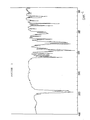
- Figure 1 shows the IR spectrum of the 2-p-octyloxyphenyl-5-octyloxypyrimidine compound obtained in Example 1
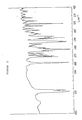
- Fig. 2 shows the IR spectrum of the 2-p-octyloxyphenyl-5-octylcarbonyloxypyrimidine compound obtained in Example 2.
- a phenyl pyrimidine compound of this invention represented by the following formula (I) forms a smetic C phase and is useful for a constituent of a ferroelectric liquid crystal composition.
- R1-Ph-Py-R2 (I) wherein Ph represents 1,4-phenylene group, Py represents 2,5-pyrimidine, R1 and R2 represent independently an acyloxy group or alcoxy group, either R1 or R2 represents a linear acyloxy group or a linear alcoxy group having more than seven carbon atoms.
- the compounds of this invention can be available as a constituent with the compounds of a following three groups;
- Some of the compounds represented by the formula (I) are obtained by reacting an active compound of the formula (A) R-X (A) which is a linear alkyl halide or a linear alcohol tosylate with a hydroxy pyrimidine derivative having a linear alcoxy group represented by the formula (B) R ⁇ OH-Ph-Py-OH (B) wherein R and R ⁇ represent a linear alkyl group, X represents a halogen atom or tosyl group in the both formulas (A) and (B).
- phenyl pyrimidine compounds are obtained by reacting an acid halide compound represented by the formula (C) RCOX (C) with a hydroxy pyrimidine derivative having an alkylcarbonyloxy group represented by the formula (D) in a basic solvent.
- phenyl pyrimidine compounds are obtained by reacting a pyrymidinophenyl derivative having an alkyl group represented by the formula (E) HO-Ph-Py-OR ⁇ (E) with a linear alcohol tosylate or a linear alkyl halide in a basic solvent.
- phenyl pyrimidine compounds are obtained by reacting an acid halide compound represented by the formula (C) with a pyrimidine phenyl compound having a linear alkylcarbonyloxy group represented by the formula (E) or (F) HO-Ph-Py-OCOR ⁇
- the phenyl pyrimidine compounds of this invention have a smectic C phase and have a skeleton of a phenyl pyrimidine group.
- a composition comprising the same has a performance of a high speed response. Since the phenyl pyrimidine compounds are not optically active, the attempts which make to comprising the phenyl pyrimidine compound of this invention in a ferroelectric crystal composition, have been succeeded without limitation of a volume of the comprising compound in the composition and the some properties of the compound such as a helical pitch length or a viscosity.
- a ferroelectric liquid crystal composition comprising some of the phenyl pyrimidine compound of this invention having a nematic phase within the higher temperature range than that of a smetic phase, has a property to form a nematic phase. And it is able to utilize in practice by using a conventional alignment technique of a TN type cell.
- a composition of this invention comprising a phenyl pyrimidine compound forms a smectic C phase within a broad temperature range including room temperature, and has a performance of a high response speed at room temperature, it is able to align the composition by using a conventional technique such as rubbing a polyimide.
- the compositions described in following examples form a smectic C phase and are a ferroelectric liquid crystal within 1-70°C range.
- the compositions are able to align easily in an ITO glass cell which is rubbed and coated polyimide. A very clear contrast of the cell was obtained.
- a response time of the composition needed changing the 90 percentages of a light transparency after applying a rectangular wave of 15 Vp-p/ ⁇ m was only 112 ⁇ s.
- the phenyl pyrimidine compounds are stable chemically because of having no shiff base group which a DOBAMBC compound has.
- the liquid crystal composition comprising the phenyl pyrimidine compound of the present invention is a smectic liquid crystal
- the liquid composition can be used for a memory type display element of the heat writing type or laser writing type.
- C, SX, S*, Sc*, Sa, N*, N and I phases represent a crystal phase, a smectic phase not clearly identified, a chiral smectic phase not clearly identified, a chiral smetic C phase, a smectic A phase, a chiral nematic phase, a nematic phase and an isotropic phase, respectively.
- the compounds of the present invention were purified by silica gel chromatography and recrystallization from an alcohol or hexane.
- the measured values of the phase transition points, shown hereinafter, will be influenced by the purities of substances.
- Benzyloxy acetic acid obtained by reacting benzyl alcohol with chloro acetic acid by Williamson synthesis method was esterized to obtain ethyl benzyloxy acetate (B).
- 2-benzyloxy-2-ethoxycarbonylethylenolate (C) was obtained by condensing the compound (B) and ethyl formate under the presence of sodium as a catalyzer.
- 2-octyloxyphenyl-4-hydroxy-5-benzyloxypyrimidine (D) was obtained by condensing the compound (C) and p-octyloxybenzamidine hydrochloric salt which was synthesized by using p-octyloxyanobenzene, in an ethanol solvent under the presence of sodium ethoxide.
- 2-octyloxyphenyl-4-chloro-5-benzyloxypyrimidine (E) was obtained by reflaxing reaction the compound (D) with phosphorus oxychloride for three hours.
- 2-octyloxyphenyl-5-hydroxypyrimidine (F) was obtained by hydrogenating of the compound (E) under the presence of the both catalyzer Pd-C and potassium carbonate in the 1,4-dioxane solvent under the atmospheric pressure. Finally, the compound (A) was obtained by reacting the compound (F) with octylbromide by Williamson synthesis method.
- phase transition points of the compound (F) were as follows.
- the figure in ( ) means a phase transition point under lowering temperature.
- the compound (F) has a nematic phase.
- the phase transition point of changing from a Sc phase to SA phase of the compound was more than 90°C.
- the compound (F) is very important as a constituent of a liquid crystal composition.
- the compound (G) was obtained by reating the compound (F) with nonanic chloride in pyridine.
- the phase transition points of the compound were as follows.
- the figure in ( ) means a phase transition point under lowering temperature.
- the compound (G) has a nematic phase.
- the phase transition points of changing from a Sc to a N phase of the compound (G) is more than 90°C.
- the compound (G) is very important as a constituent of a liquid crystal composition.
- a transition points of a composition (H) obtained by mixing the three different compounds of this invention are as follows.
- the composition consists of 33.5 wt% of 2-p-octyloxyphenyl-5-octyloxypyrimidine (A), 33.2 wt% of 2-p-decyloxyphenyl-5-octyloxypyrimidine and 33.3 wt% of 2-p-octyloxyphenyl-5-decyloxypyrimidine.
- the figure in ( ) means a phase transition point under lowering temperature.
- the datum shows that the temperature range forming a Sc phase of the composition (H) expand more than 70°C under lowering temperature, owing to comprise the compound of this invention.
- phase transition points of a composition (J) comprising the known three phenylpyrimidine liquid crystal compounds having an alkyl group are as follows.
- the composition consists of 32.9 wt% of 2-p-octylphenyl-5-octyloxypyrimidine, 32.9 wt% of 2-p-nonyloxyphenyl-5-nonylpyrimidine and 34.2 % of 2-p-decyloxyphenyl-5-octylpyrimidine.
- the figure in ( ) means a phase transition point under lowering temperature.
- the datum shows that a temperature range forming a Sc phase of the composition (J) narrow to 20°C than that of the example 6 comprising the compound of this invention.
- phase transition points of a composition comprising the three compounds of this invention are as follows.
- the composition consists of 33.25 wt% of 2-p-octyloxyphenyl-5-octyloxypyrimidine (A), 33.25 wt% of 2-p-decyloxyphenyl-5-octylcarbonyloxypyrimidine and 33.5 wt% of 2-p-octyloxyphenyl-5-octylcarbonyloxypyrimidine.
- the figure in ( ) means a phase transition point under lowering temperature.
- the temperature range forming a Sc phase expand more than 70°C under lowering temperature, owing to comprise the compound of this invention. Furthermore, the composition formes a nematic phase.
- the phase transition points comprising the two types of the compound of this invention and a known phenylpyrimidine Sc liquid crystal compound having an alkyl group.
- the composition consists of 33.3 wt% of 2-p-octylphenyl-5-octyloxypyrimidine, 33.4 wt% of 2-p-octyloxyphenyl-5-octyloxypyrimidine (A) and 33.4 wt% of 2-p-octyloxyphenyl-5-octylcarbonyloxypyrimidine.
- the figure in ( ) means a phase transition point.
- the phase transition point of a composition comprising the composition (H) described in the composition 1 and a known aromatic ester liquid crystal compounds.
- the composition consists of 66 wt% of the composition (H), 11.3 wt% of p-octyloxybenzoic acid p-heptyloxyphenyl ester, 11.4 wt% of p-octyloxybenzoic acid p-nonyloxyphenyl ester and 11.3 wt% of p-octyloxybenzoic acid p-hexyloxyphenyl ester.
- the figure in ( ) means a phase transition point.
- the melting point of the composition 4 (a C-SC transition point) lowered.
- the composition 4 became to form a nematic phase in spite of a no nematic phase of the composition 1 described in the example 4.
- the phase transition point of a composition comprising the composition (H) of this invention described in the composition 1 and a known biphenyl ester liquid crystal compound.
- the composition consists of 89.2 wt% of the composition (H) and 10.8 wt% of p-(p ⁇ -octyloxyphenyl) benzoic acid hexylester.
- the figure in ( ) means a phase transition point under lowering temperature.
- a melting point of the composition 5 (a C-Sc phase transition point) lowered by mixing a known biphenylester Sc liquid crystal compound with the compound of this invention.
- a ferroelectric liquid crystal composition (K) having a following phase transition point was obtained by comprising the synthesized novel compound by the inventors.
- the composition consists of 20.8 wt% of (1S,2S)-4 ⁇ -4 ⁇ -octyloxyphenyl)phenyl 1-chloro-2-methylpentanic acid ester, 11.7 wt% of (1S,2S)-4 ⁇ -(4 ⁇ -nonyloxycarbonyloxyphenyl)phenyl 1-chloro-2-methylpentanic acid ester, 10.0 wt% of (1S,2S)-4 ⁇ -(4 ⁇ -nonylcarbonyloxyphenyl)phenyl 1-chloro-2-methylpentanic acid ester, 10.0 wt% of (1S)-4 ⁇ -(4 ⁇ -nonylcarbonyloxyphenyl)phenyl 1-chloro-2-methylbutanic acid ester, 30.5 wt% of (1S,2S)-4 ⁇ -
- the composition showed a ferroelectric liquid crystal phase even to a temperature below 0°C and a large spontaneous polarization, 183 nC/cm2.
- the ferroelectric liquid crystal composition (L) was obtained by mixing this composition (K) with the composition (H) described in the composition 1. A ratio of this composition (L) was 1:1. A figure in ( ) means a phase transition point under lowering temperature. Sc*-Sa 70°C (70°C) SA-N* 76°C (75.5°C) N*-I 79°C (79°C)
- the composition showed a ferroelectric liquid crystal phase even to a temperature below 0°C and a large spontaneous polarization, 85 nC/cm2.
- composition having a ferroelectric liquid crystal property within a wide temperature range including a room temperature was obtained by mixing a known compound with the compound of this invention.
- the composition was sealed in a cell formed by spin-coating a polyimide on ITO glass and rubbing the coating and having a spacer of a polyethylene terephthalate film having a thickness of 2.5 ⁇ m, and the composition was cooled from the isotropic phase at a rate of 0.1°C per minute, whereby a cell having a good alignment was easily obtained.
- a rectangular wave of 40 Vp-p was applied to the cell and the electro-optic effect was observed by a polarization microscope. A very clear contrast was seen. It was proved that the composition could be applied to a liquid crystal display.
- the response speed of this cell was measured by using a photosemiconductor, it was found that the response speed was required for changing the quantity of transmitted light from 10% to 90% was about 12 microseconds at room temperature, and thus it was confirmed that the response speed was very high.
- the ferroelectric liquid crystal composition having an ability of a high speed response was obtained by mixing a known ferroelectric liquid crystal compound or a known compound having a smetic C phase with the compound of this invention.
- the ferroelectric liquid crystal compound (K) was mixed with the three types of a known phenylpyrimide Sc liquid crystal compound having an alkyl group described in the comparative example 1 to obtain the ferroelectric liquid crystal compound (M).
- the figure in ( ) means a phase transition point under lowering temperature. Sc*-SA 55°C (55°C) SA-N 59°C (58°C) N*-I 62°C (62°C)
Landscapes
- Chemical & Material Sciences (AREA)
- Organic Chemistry (AREA)
- Crystallography & Structural Chemistry (AREA)
- Engineering & Computer Science (AREA)
- Materials Engineering (AREA)
- Liquid Crystal Substances (AREA)
- Liquid Crystal (AREA)
Abstract
R₁-Ph-Py-R₂ (I)
wherein Ph represents 1,4-phenylene group, Py represents 2,5-pyrimidine, R₁ and R₂ represent independently an acyloxy group or alcoxy group, either R₁ or R₂ represents a linear acyloxy group or a linear alcoxy group having more than seven carbon atoms.
Description
- The present invention relates to a novel, optically active phenyl pyrimidine compound and a liquid crystal composition comprising the optically active phenyl pyrimidine compound.
- In this instant specification, by the term "liquid crystalline substance of material" is meant not only a substance showing a liquid crystalline phase but also a substance or material which is valuable as a constituent of a liquid crystal composition though it is not detected that the substance or material shows a liquid crystalline phase.
- As the display system using a liquid crystal display element, which is widely utilized in practice at present, there can be mentioned the twisted nematic type (TN type) and dynamic scattering type (DS type). In these display system, display is performed by a nematic liquid crystalline cell comprising a nematic liquid cell as the main component. One defect of the conventional nematic liquid cell is a low response speed, and only a response speed of several milliseconds is obtained. This defect is one cause of limitation of the application range of the nematic liquid cell. Recently, however, it has been found that a high response speed can be obtained if a smectic liquid crystalline cell is used.
- It has been clarified that some optically active smetic liquid crystals have a ferroelectric property, and there are great expectation on the utilization of such liquid crystals. Liquid crystals having a ferroelectric property, that is, ferroelectric liquid crystals, are compounds synthesized by R.B. Meyer et al in 1975, which are represented by 2-methylbutyl 4-(4-n-decyloxybenzilydeneamino)cinnamate (hereinafter referred to as "DOBAMBC"). The compounds are characterized as exhibiting a ferroelectric property in the chiral smetic C phase (hereinafter referred to as "Sc * phase") [J. Physique, 36, L-69 (1975)].
- N.A. Clark et al found that a high-response speed of an order of microseconds is obtained in a film cell of DOBAMBC [Appl. Phys. Lett., 36, 89 (1980)], and with this finding as a momentum, the ferroelectric crystal has attracted attention as a material applicable not only to a display system such as a liquid crystal television but also to an optical printer head, an optical Fourier converting element, a light valve, and other optoelectric elements because of high-speed response characteristics.
- Since DOBAMBC has a small spontaneous polarization and is a Schiff base, it has poor physical and chemical stabilities. Accordingly, various physically and chemically stable compounds have been investigated as ferroelectric liquid crystalline materials. At present, research work on the development of ferroelectric liquid crystalline materials is concentrated on an enhancement of the high-speed response characteristic, orientation effect, contrast characteristic, memory characteristic, and threshold value characteristic, and optimization of practical properties such as the temperature dependencies of these characteristics.
- However, none of the known ferroelectric liquid crystals, when used alone, shows a large spontaneous polarization, a low viscosity, a long helical pitch, an appropriate molecular tilt angle and a continuous phase transition (V* → SA→ Sc*) within a broad temperature range including room temperature such that the above-mentioned practically desired properties are manifested. Therefore, practically, attempts have been made to optimize the foregoing characteristics by mixing several compounds such as a compound having or inducing a large spontaneous polarization, a compound having a low viscosity and compounds having reverse helical pitches. The incorporation of a ferroelectric liquid crystal showing a ferroelectric characteristic within a broad temperature range or a smectic C liquid crystal (Sc) which is not chiral is effective for obtaining a liquid crystal composition showing a ferroelectric characteristic within a broad temperature range. A Sc is very important to obtain a liquid crystal composition within a broad temperature range, because a molecular structure of compound formed a Sc phase is a long helical pitch and it is able to comprise the Sc compound without a limitation of a volume in a liquid crystal composition. The research work on the development of a novel compound as a constituent of a liquid crystal composition, which has a performance of a high speed response and shows a Sc phase within a broad temperature range is worth to be carried out.
- An optically active phenyl pyrimidine compound represented by following general formula (IV) which has a skeleton to be high speed response has carried out by Seiko Electric Industry Company and Teikoku Kagaku Co., Ltd. (The digest of 11th liquid crystal conference, 2N18, 2N19, 2N20, 2N21)
R₇-Ph-Py-R₈ (VI)
wherein Ph represents 1,4-phenylene group, Py represents 2,5-pyrimidine group, R₇ and R₈ represent alkyl group, acyloxy group, alcoxy group or alkylcarbonyloxy group, either R₇ or R₈ represents an optically active branched group. - One of the defect of the compound is a small spontaneous polarization. But the compound has a good performance of a high speed response because of own low viscosity. Other defect of the compound has not a smectic phase because of having a branched group of the compound. The acknowledge carried out a component technique of a conventional TN type cell is no use on the compound. Further defect of the compound, it is difficult to settle constituent volume in a liquid crystal composition because of an optically active characterisity and an own helical pitch.
- Other hands, a phenyl pyrimidine Sc liquid crystal compound having linear alkyl group represented by following general formula (II) has already known. (H. Zaschke, R. Stolle, Z. Chem. 15, 441 (1975), Flussige Kristalle in Tabellen, Verlag Grundstoffind, Leipzig, 2nd ed. (1976))
- Since a phase transition point (SA → Sc) of the compound is low, less than 70°C, the compound is not suitable to use for constituent of a liquid crystal composition.
R₃-Ph-Py-R₄ (II)
wherein Ph represents 1,4-phenylene group, Py represents 2,5-pyrimidine group, R₃ and R₄ represent independently linear alkyl group, linear acyloxy group or linear alcoxyl group. Either R₃ or R₄ represents linear alkyl group having more than seven carbon atoms. - We investigated a constituent of a ferroelectric liquid crystal composition, as a result we have now completed the present invention based on the novel phenyl pyrimidine compounds.
- It is a primary object of the present invention to provide ① a novel Sc liquid crystal compound or a constituent of a Sc* liquid crystal composition, which is low viscosity, ② a Sc liquid crystal compound of which an upper limit temperature of a Sc phase is more than 70°C, ③ a liquid crystal compound having a nematic phase, applying a conventional alignment effect of a TN type cell.
- In one aspect of the present invention, there is provided a phenyl pyrimidine compound represented by following general formula (I) and a liquid crystal composition comprising the same.
R₁-Ph-Py-R₂ (I)
wherein Ph represents 1,4-phenylene group, Py represents 2,5-pyrimidine, R₁ and R₂ represent independently an acyloxy group or alcoxy group, either R₁ or R₂ represents a linear acyloxy group or a linear alcoxy group having more than the seven carbon atoms. - Figure 1 shows the IR spectrum of the 2-p-octyloxyphenyl-5-octyloxypyrimidine compound obtained in Example 1, and Fig. 2 shows the IR spectrum of the 2-p-octyloxyphenyl-5-octylcarbonyloxypyrimidine compound obtained in Example 2.
- A phenyl pyrimidine compound of this invention represented by the following formula (I) forms a smetic C phase and is useful for a constituent of a ferroelectric liquid crystal composition.
R₁-Ph-Py-R₂ (I)
wherein Ph represents 1,4-phenylene group, Py represents 2,5-pyrimidine, R₁ and R₂ represent independently an acyloxy group or alcoxy group, either R₁ or R₂ represents a linear acyloxy group or a linear alcoxy group having more than seven carbon atoms. - Some of the compounds represented by the above formula (I) of which the seven-fourteen carbon atoms of R₁ or R₂ group form dependently or independently a smectic C phase. Other compounds represented by the above formula (I) are also important as a constituent of a liquid crystal composition.
- The compounds of this invention can be available as a constituent with the compounds of a following three groups;
- (1) The compounds disclosed in the following Japan Patent Application Number 176823/1983, 175711/1983, 23510/1984, 33511/1984, 74748/1984, 189232/1984, 22920/1985, 87034/1985, 117053/1985, 144136/1985, 162654/1985, 162656/1985, 250335/1985, 272834/1985, 291179/1985.
- (2) Compounds having a smetic C phase, such as alkyl alkoxybiphenylcarboxylate, alkyl alkylcarbonyloxybiphenylcarboxylate, alkoxyphenyl alkoxybenzoate, alkyloxycarbonylphenyl alkoxybenzoate, alkoxyalkoxyphenyl alkoxybenzoate, alkoxybiphenyl alkoxybenzoate, alkoxyphenyl alkoxybiphenylcarboxylate, alkoxybiphenyl alkylbenzoate, alkoxyphenyl alkylbiphenylcarboxylate, alkylbiphenyl alkoxybenzoate, alkylpenyl alkoxybiphenylcarboxylate, alkoxybiphenyl alkylcarbonyloxybenzoate, alkoxyphenyl alkylcarbonyloxybiphenylcarboxylate, alkylcarbonyloxy biphenyl alkoxybenzoate, alkylcarbonyloxyphenyl alkoxybiphenylcarboxylate,
5-alkyl-2-(4ʹ-alkoxyphenyl)pyrimidine,
5-alkoxy-2-(4ʹ-alkoxyphenyl)pyrimidine,
5-alkyl-2-(4ʹ-alkylcarbonyloxyphenyl)pyrimidine,
5-alkoxy-2-(4ʹ-alkylcarbonyloxyphenyl)pyrimidine,
5-alkyl-2-(4ʹ-alkyloxycarbonylphenyl)pyrimidine,
5-alkoxy-2-(4ʹ-alkyloxycarbonylphenyl)pyrimidine,
5-alkyl-2-(4ʹ-alkoxyphenyl)pyrazine,
5-alkoxy-2-(4ʹ-alkoxyphenyl)pyrazine,
5-alkyl-2-(4ʹ-alkylcarbonyloxyphenyl)pyrazine,
5-alkoxy-2-(4ʹ-alkylcarbonyloxyphenyl)pyrazine,
5-alkyl-2-(4ʹ-alkyloxycarbonylphenyl)pyrazine,
5-alkoxy-2-(4ʹ-alkyloxycarbonylphenyl)pyrazine,
3-(4ʹ-alkylphenyl)-6-alkoxypyridazine 3-(4ʹ-alkoxyphenyl)-6-alkoxypyridazine, 3-(4ʹ-alkoxyphenyl)-6-alkylpyridazine,
5-(4ʹ-alkylphenyl)-2-(4ʺ-alkoxyphenyl)pyrimidine,
5-(4ʹ-alkoxyphenyl)-2-(4ʺ-alkoxyphenyl)pyrimidine,
5-(4ʹ-alkylphenyl)-2-(4ʺ-alkylcarbonyloxyphenyl)pyrimidine,
5-(4ʹ-alkoxyphenyl)-2-(4ʺ-alkylcarbonyloxyphenyl)pyrimidine,
5-(4ʹ-alkylphenyl)-2-(4ʺ-alkyloxycarbonylphenyl)pyrimidine,
5-(4ʹ-alkoxyphenyl)-2-(4ʺ-alkyloxycarbonylphenyl)pyrimidine,
5-(4ʹ-alkoxyphenyl)-2-(4ʺ-alkoxyphenylcarbonyloxy)pyrimidine,
5-(4ʹ-alkylphenyl)-2-(4ʺ-alkoxyphenylcarbonyloxy)pyrimidine,
5-(4ʹ-alkoxyphenyl)-2-(4ʺ-alkylphenylcarbonyloxy)pyrimidine,
5-(4ʹ-alkylphenyl)-2-(4ʺ-alkylphenylcarbonyloxy)pyrimidine,
5-(4ʹ-alkylphenyl)-2-(4ʺ-alkoxyphenyl)-1,2,4-triazine,
5-(4ʹ-alkoxyphenyl)-2-(4ʺalkoxyphenyl)-1,2,4-triazine,
5-(4ʹ-alkoxyphenyl)-2-(4ʺ-alkylcarbonyloxyphenyl)-1,2,4-triazine,
5-(4ʹ-alkoxyphenyl)-2-(4ʺ-alkylcarbonyloxyphenyl)-1,2,4-triazine,
5-(4ʹ-alkylphenyl)-2-(4ʺ-alkyloxycarbonylphenyl)-1,2,4-triazine and 5-(4ʹ-alkoxyphenyl)-2-(4ʺ-alkyloxycarbonylphenyl)-1,2,4-triazine. - The compound of this invention represented by the general formula (I) is derived as follows;
- Some of the compounds represented by the formula (I) are obtained by reacting an active compound of the formula (A)
R-X (A)
which is a linear alkyl halide or a linear alcohol tosylate with a hydroxy pyrimidine derivative having a linear alcoxy group represented by the formula (B)
RʹOH-Ph-Py-OH (B)
wherein R and Rʹ represent a linear alkyl group, X represents a halogen atom or tosyl group in the both formulas (A) and (B). These abbreviations in this paragraph are same in the following formulas (C)-(I). - Some of the phenyl pyrimidine compounds are obtained by reacting an acid halide compound represented by the formula (C)
RCOX (C)
with a hydroxy pyrimidine derivative having an alkylcarbonyloxy group represented by the formula (D) in a basic solvent.
RʹCOO-Ph-Py-OH (D) - Some of the phenyl pyrimidine compounds are obtained by reacting a pyrymidinophenyl derivative having an alkyl group represented by the formula (E)
HO-Ph-Py-ORʹ (E)
with a linear alcohol tosylate or a linear alkyl halide in a basic solvent. - Some of the phenyl pyrimidine compounds are obtained by reacting an acid halide compound represented by the formula (C) with a pyrimidine phenyl compound having a linear alkylcarbonyloxy group represented by the formula (E) or (F)
HO-Ph-Py-OCORʹ - Some of the phenyl pyrimidine compounds are obtained by reacting an alkoxyphenylamidine hydrochloric salt represented by the formula (G)
RO-Ph-C(=NH)NH₂.HCl (G)
with an alcoholate compound (H) or an alkoxy malonic acid (I) in a basic solvent,
RʹO-C(COOC₂H₅)=CHONa (H)
RʹOCH(COOC₂H₅)₂ (I)
by following reduction of a product after chloronizing of a hydroxy group of the reacting product of a compound (H) and (I). - Other hands, the compounds represented by the formulas (A)-(I) are obtained easily by following examples.
- The phenyl pyrimidine compounds of this invention have a smectic C phase and have a skeleton of a phenyl pyrimidine group. A composition comprising the same has a performance of a high speed response. Since the phenyl pyrimidine compounds are not optically active, the attempts which make to comprising the phenyl pyrimidine compound of this invention in a ferroelectric crystal composition, have been succeeded without limitation of a volume of the comprising compound in the composition and the some properties of the compound such as a helical pitch length or a viscosity. A ferroelectric liquid crystal composition comprising some of the phenyl pyrimidine compound of this invention having a nematic phase within the higher temperature range than that of a smetic phase, has a property to form a nematic phase. And it is able to utilize in practice by using a conventional alignment technique of a TN type cell.
- A composition of this invention comprising a phenyl pyrimidine compound forms a smectic C phase within a broad temperature range including room temperature, and has a performance of a high response speed at room temperature, it is able to align the composition by using a conventional technique such as rubbing a polyimide. For example, the compositions described in following examples form a smectic C phase and are a ferroelectric liquid crystal within 1-70°C range. And the compositions are able to align easily in an ITO glass cell which is rubbed and coated polyimide. A very clear contrast of the cell was obtained. A response time of the composition needed changing the 90 percentages of a light transparency after applying a rectangular wave of 15 Vp-p/µm was only 112 µs. The phenyl pyrimidine compounds are stable chemically because of having no shiff base group which a DOBAMBC compound has.
- Since the liquid crystal composition comprising the phenyl pyrimidine compound of the present invention is a smectic liquid crystal, the liquid composition can be used for a memory type display element of the heat writing type or laser writing type.
- The present invention will now be described in detail with reference to the following examples that by no means limit the scope of the invention.
- In the examples, C, SX, S*, Sc*, Sa, N*, N and I phases represent a crystal phase, a smectic phase not clearly identified, a chiral smectic phase not clearly identified, a chiral smetic C phase, a smectic A phase, a chiral nematic phase, a nematic phase and an isotropic phase, respectively.
- The compounds of the present invention were purified by silica gel chromatography and recrystallization from an alcohol or hexane. The measured values of the phase transition points, shown hereinafter, will be influenced by the purities of substances.
- C₈H₁₇-O-Ph-Py-O-C₈H₁₇ (A)
- Benzyloxy acetic acid obtained by reacting benzyl alcohol with chloro acetic acid by Williamson synthesis method was esterized to obtain ethyl benzyloxy acetate (B). 2-benzyloxy-2-ethoxycarbonylethylenolate (C) was obtained by condensing the compound (B) and ethyl formate under the presence of sodium as a catalyzer. Then 2-octyloxyphenyl-4-hydroxy-5-benzyloxypyrimidine (D) was obtained by condensing the compound (C) and p-octyloxybenzamidine hydrochloric salt which was synthesized by using p-octyloxyanobenzene, in an ethanol solvent under the presence of sodium ethoxide. Furthermore, 2-octyloxyphenyl-4-chloro-5-benzyloxypyrimidine (E) was obtained by reflaxing reaction the compound (D) with phosphorus oxychloride for three hours. 2-octyloxyphenyl-5-hydroxypyrimidine (F) was obtained by hydrogenating of the compound (E) under the presence of the both catalyzer Pd-C and potassium carbonate in the 1,4-dioxane solvent under the atmospheric pressure. Finally, the compound (A) was obtained by reacting the compound (F) with octylbromide by Williamson synthesis method.
- The phase transition points of the compound (F) were as follows. The figure in ( ) means a phase transition point under lowering temperature.
C-S 52°C (42°C)
Sc-SA 91°C (91°C)
SA-N 99°C (99°C)
N-I 100°C (100°C) - The compound (F) has a nematic phase. The phase transition point of changing from a Sc phase to SA phase of the compound was more than 90°C. The compound (F) is very important as a constituent of a liquid crystal composition.
- C₈H₁₇-O-Ph-Py-O-CO-C₈H₁₇
- The compound (G) was obtained by reating the compound (F) with nonanic chloride in pyridine. The phase transition points of the compound were as follows. The figure in ( ) means a phase transition point under lowering temperature.
C-Sc 53°C (65°C)
Sc-N 92°C (91°C)
N-I 96°C (96°C) - The compound (G) has a nematic phase. The phase transition points of changing from a Sc to a N phase of the compound (G) is more than 90°C. The compound (G) is very important as a constituent of a liquid crystal composition.
- Some of the compounds of this invention obtained by the same method of the example 1 or 2 were shown in the table 1. The lowest temperature forming a Sc phase was very high, 81°C. (cf. The other case was 88°C without a compound of which the both R₁ and R₂ are heptyloxy group).
- These compound is very important as a constituent of a liquid crystal composition.
- The comparative data of a rising temperature range forming a Sc phase between phenylpyrimidine Sc liquid crystal compound of this invention having an alcoxy group and a known phenylpyrimidine Sc liquid crystal compound having an alkyl group were shown in the table 2. As the results, the temperature range of the compound of this invention expanded 20°C than a known phenylpyrimidine Sc liquid crystal compound having alkyl group. The compound of this invention was very important as a constituent of a liquid crystal composition.
- A transition points of a composition (H) obtained by mixing the three different compounds of this invention are as follows. The composition consists of 33.5 wt% of 2-p-octyloxyphenyl-5-octyloxypyrimidine (A), 33.2 wt% of 2-p-decyloxyphenyl-5-octyloxypyrimidine and 33.3 wt% of 2-p-octyloxyphenyl-5-decyloxypyrimidine. The figure in ( ) means a phase transition point under lowering temperature.
C-Sc 32° (19°C)
Sc-SA 93°C (93°C)
SA-I 100°C (100°C) - The datum shows that the temperature range forming a Sc phase of the composition (H) expand more than 70°C under lowering temperature, owing to comprise the compound of this invention.
- The phase transition points of a composition (J) comprising the known three phenylpyrimidine liquid crystal compounds having an alkyl group are as follows. The composition consists of 32.9 wt% of 2-p-octylphenyl-5-octyloxypyrimidine, 32.9 wt% of 2-p-nonyloxyphenyl-5-nonylpyrimidine and 34.2 % of 2-p-decyloxyphenyl-5-octylpyrimidine. The figure in ( ) means a phase transition point under lowering temperature.
C-Sc 18°C (9°C)
Sc-SA 58.5°C (58.5°)
SA-N 68°C (68°C)
N-I 70°C (70°C) - The datum shows that a temperature range forming a Sc phase of the composition (J) narrow to 20°C than that of the example 6 comprising the compound of this invention.
- The phase transition points of a composition comprising the three compounds of this invention are as follows. The composition consists of 33.25 wt% of 2-p-octyloxyphenyl-5-octyloxypyrimidine (A), 33.25 wt% of 2-p-decyloxyphenyl-5-octylcarbonyloxypyrimidine and 33.5 wt% of 2-p-octyloxyphenyl-5-octylcarbonyloxypyrimidine. The figure in ( ) means a phase transition point under lowering temperature.
C-Sc 27°C (17°C)
Sc-SA 90°C (90°C)
SA-N 91°C (91°C)
N-I 95°C (95°C) - The temperature range forming a Sc phase expand more than 70°C under lowering temperature, owing to comprise the compound of this invention. Furthermore, the composition formes a nematic phase.
- The phase transition points comprising the two types of the compound of this invention and a known phenylpyrimidine Sc liquid crystal compound having an alkyl group. The composition consists of 33.3 wt% of 2-p-octylphenyl-5-octyloxypyrimidine, 33.4 wt% of 2-p-octyloxyphenyl-5-octyloxypyrimidine (A) and 33.4 wt% of 2-p-octyloxyphenyl-5-octylcarbonyloxypyrimidine. The figure in ( ) means a phase transition point.
C-Sc 36°C (5°C)
Sc-SA 76°C (76°C)
SA-N 78°C (78°C)
N-I 86°C (86°C) - The results show that a nematic phase range expand more 20°C than that of the comparatice example 2, owing to comprise the compound of this invention. The melting point of the composition (C-Sc phase transition point) lowered.
- The phase transition point of a composition comprising the composition (H) described in the
composition 1 and a known aromatic ester liquid crystal compounds. The composition consists of 66 wt% of the composition (H), 11.3 wt% of p-octyloxybenzoic acid p-heptyloxyphenyl ester, 11.4 wt% of p-octyloxybenzoic acid p-nonyloxyphenyl ester and 11.3 wt% of p-octyloxybenzoic acid p-hexyloxyphenyl ester. The figure in ( ) means a phase transition point.
C-Sc 23°C (4°C)
Sc-SA 78°C (78°C)
SA-N 86.5°C (86.5°C)
N-I 90°C (90°C) - The melting point of the composition 4 (a C-SC transition point) lowered. The composition 4 became to form a nematic phase in spite of a no nematic phase of the
composition 1 described in the example 4. - The phase transition point of a composition comprising the composition (H) of this invention described in the
composition 1 and a known biphenyl ester liquid crystal compound. The composition consists of 89.2 wt% of the composition (H) and 10.8 wt% of p-(pʹ-octyloxyphenyl) benzoic acid hexylester. The figure in ( ) means a phase transition point under lowering temperature.
C-Sc 28°C (14°C)
Sc-SA 85°C (85°C)
SA-I 96°C (96°C) - A melting point of the composition 5 (a C-Sc phase transition point) lowered by mixing a known biphenylester Sc liquid crystal compound with the compound of this invention.
- A ferroelectric liquid crystal composition (K) having a following phase transition point was obtained by comprising the synthesized novel compound by the inventors. The composition consists of 20.8 wt% of (1S,2S)-4ʺ-4ʹ-octyloxyphenyl)phenyl 1-chloro-2-methylpentanic acid ester, 11.7 wt% of (1S,2S)-4ʺ-(4ʹ-nonyloxycarbonyloxyphenyl)phenyl 1-chloro-2-methylpentanic acid ester, 10.0 wt% of (1S,2S)-4ʺ-(4ʹ-nonylcarbonyloxyphenyl)phenyl 1-chloro-2-methylpentanic acid ester, 10.0 wt% of (1S)-4ʺ-(4ʹ-nonylcarbonyloxyphenyl)phenyl 1-chloro-2-methylbutanic acid ester, 30.5 wt% of (1S,2S)-4ʹʺ-(4ʺ-(4ʹ-octylcarbonyloxy-3ʹ-chlorophenylcarbonyloxy)phenyl)phenyl 1-chloro-2-methylpentanic acid ester and 17.0 wt% of (2S)-pʹ-(2-methylbutyloxyphenyl)-4-octyloxybenzoic acid ester. A figure in ( ) means a phase transition point under lowering temperature.
Sc*-SA 55°C (55°C)
SA-N* 61.5°C (61.5°C)
N*-I 65°C (65°) - The composition showed a ferroelectric liquid crystal phase even to a temperature below 0°C and a large spontaneous polarization, 183 nC/cm².
- The ferroelectric liquid crystal composition (L) was obtained by mixing this composition (K) with the composition (H) described in the
composition 1. A ratio of this composition (L) was 1:1. A figure in ( ) means a phase transition point under lowering temperature.
Sc*-Sa 70°C (70°C)
SA-N* 76°C (75.5°C)
N*-I 79°C (79°C) - The composition showed a ferroelectric liquid crystal phase even to a temperature below 0°C and a large spontaneous polarization, 85 nC/cm².
- The composition having a ferroelectric liquid crystal property within a wide temperature range including a room temperature was obtained by mixing a known compound with the compound of this invention.
- The composition was sealed in a cell formed by spin-coating a polyimide on ITO glass and rubbing the coating and having a spacer of a polyethylene terephthalate film having a thickness of 2.5 µm, and the composition was cooled from the isotropic phase at a rate of 0.1°C per minute, whereby a cell having a good alignment was easily obtained. A rectangular wave of 40 Vp-p was applied to the cell and the electro-optic effect was observed by a polarization microscope. A very clear contrast was seen. It was proved that the composition could be applied to a liquid crystal display. When the response speed of this cell was measured by using a photosemiconductor, it was found that the response speed was required for changing the quantity of transmitted light from 10% to 90% was about 12 microseconds at room temperature, and thus it was confirmed that the response speed was very high.
- The ferroelectric liquid crystal composition having an ability of a high speed response was obtained by mixing a known ferroelectric liquid crystal compound or a known compound having a smetic C phase with the compound of this invention.
- The ferroelectric liquid crystal compound (K) was mixed with the three types of a known phenylpyrimide Sc liquid crystal compound having an alkyl group described in the comparative example 1 to obtain the ferroelectric liquid crystal compound (M). The figure in ( ) means a phase transition point under lowering temperature.
Sc*-SA 55°C (55°C)
SA-N 59°C (58°C)
N*-I 62°C (62°C) - The results show that the temperature range of the composition (L) (forming a Sc* phase under lowering temperature) described in the example 9 expand 15°C than that of the composition described in the comparative example 3. The response speed of the composition (M) was 118 microseconds and it is same as that of the composition (L).


- The temperature ranges of a SC phase on the known compound was quoted the figures written in the paper (Flussige Kristalle in Tabellen, Verlag Grundstoffind, Leipzig).
Claims (9)
R₁-Ph-Py-R₂ (I)
wherein Ph represents a 1,4-phenylene group and Py represents a 2,5-pyrimidyl group, R₁ and R₂ represent independently a linear acyloxy group or alkoxy group, and either R₁ or R₂ represents a linear acyloxy group or linear alkoxy group having more than seven carbon atoms.
R₃-Ph-Py-R₄ (II)
wherein Ph represents a 1,4-phenylene group, Py represents a 2,5-pyrimidyl group, and either R₃ or R₄ independently represents a linear alkyl group, a linear acyloxy group, or a linear alkoxy group having more than seven carbon atoms.
R₅-Ph-COO-Ph-R₆ (III)
wherein Ph represents a 1,4-phenylene group, and either R₅ or R₆ represents independently a linear alkyl group or a linear alkoxy group.
R₇-Ph-Ph-R₈ (IV)
wherein Ph represents a 1,4-phenylene group, and either R₇ or R₈ represents independently a linear alkyl group, a linear alkoxy group, an acyloxy group or an alkoxycarbonyl group.

R₁-Ph-Py-OH (IV)
wherein Ph represents a 1,4-phenylene group, Py represents a 2,5-pyrimidine group, R₁ represents an acyloxy group or an alkoxy group having more than seven carbon atoms.
Applications Claiming Priority (4)
| Application Number | Priority Date | Filing Date | Title |
|---|---|---|---|
| JP211894/86 | 1986-09-09 | ||
| JP21189486 | 1986-09-09 | ||
| JP3048/87 | 1987-01-09 | ||
| JP304887 | 1987-01-09 |
Publications (2)
| Publication Number | Publication Date |
|---|---|
| EP0260077A1 true EP0260077A1 (en) | 1988-03-16 |
| EP0260077B1 EP0260077B1 (en) | 1993-05-26 |
Family
ID=26336544
Family Applications (1)
| Application Number | Title | Priority Date | Filing Date |
|---|---|---|---|
| EP87307834A Expired - Lifetime EP0260077B1 (en) | 1986-09-09 | 1987-09-04 | Phenyl pyrimidine compound and liquid crystalline composition |
Country Status (4)
| Country | Link |
|---|---|
| US (1) | US4892676A (en) |
| EP (1) | EP0260077B1 (en) |
| JP (1) | JP2508125B2 (en) |
| DE (1) | DE3785985T2 (en) |
Cited By (15)
| Publication number | Priority date | Publication date | Assignee | Title |
|---|---|---|---|---|
| EP0313991A3 (en) * | 1987-10-26 | 1989-06-07 | Chisso Corporation | 5-alkoxy-2-(4-alkoxyphenyl)pyrimidine, method for its preparation and use |
| EP0319167A1 (en) * | 1987-11-26 | 1989-06-07 | Chisso Corporation | 2-Phenyl-5-alkanoyloxypyrimidines |
| US4876026A (en) * | 1986-12-26 | 1989-10-24 | Chisso Corporation | Optically active-2-methylbutyrate and materials using the same |
| US4882086A (en) * | 1988-02-09 | 1989-11-21 | Chisso Corporation | Ferroelectric liquid crystal composition |
| US4895671A (en) * | 1987-10-21 | 1990-01-23 | Chisso Corporation | Optically active phenylpyrimidine compound and a liquid crystal composition |
| US4906752A (en) * | 1987-03-24 | 1990-03-06 | Hoechst Aktiengesellschaft | Liquid-crystal 5-phenylpyrimidine derivatives having sc or sc* phases and a process for preparing them |
| US4906400A (en) * | 1987-06-01 | 1990-03-06 | Chisso Corporation | Smetic liquid crystal compound |
| US4906401A (en) * | 1987-03-24 | 1990-03-06 | Hoechst Aktiengesellschaft | Use of liquid-crystal 5-phenylpyrimidine derivatives as components of smectic liquid-crystal mixtures |
| EP0355374A3 (en) * | 1988-07-13 | 1990-03-07 | Canon Kabushiki Kaisha | Ferroelectric chiral smectic liquid crystal composition and liquid crystal device using same |
| WO1990015116A1 (en) * | 1989-06-10 | 1990-12-13 | MERCK Patent Gesellschaft mit beschränkter Haftung | Fluorophenyl pyrimidines |
| US5071589A (en) * | 1987-09-19 | 1991-12-10 | Hoechst Aktiengesellschaft | Liquid-crystalline mixtures, in particular ferroelectric liquid-crystalline mixtures |
| EP0412409A3 (en) * | 1989-08-05 | 1991-12-11 | Hoechst Aktiengesellschaft | Liquid crystal mixtures, especially ferroelectric liquid crystal mixtures and their use in electrooptic devices |
| US5173211A (en) * | 1988-07-13 | 1992-12-22 | Canon Kabushiki Kaisha | Ferroelectric chiral smectic liquid crystal composition and liquid crystal device using same |
| EP0546298A3 (en) * | 1991-11-08 | 1993-08-18 | F. Hoffmann-La Roche Ag | Fatty acids esters containing a pyridine or pyrimidine ring as components liquid crystalline mixtures |
| US5948551A (en) * | 1994-07-01 | 1999-09-07 | Hoechst Aktiengesellschaft | Use of conjugated compounds containing pyrimidine groups as electroluminescence materials |
Families Citing this family (4)
| Publication number | Priority date | Publication date | Assignee | Title |
|---|---|---|---|---|
| ES2040936T3 (en) * | 1988-07-13 | 1993-11-01 | Canon Kabushiki Kaisha | ESMETIC CHIRAL FERROELECTRIC LIQUID CRYSTAL COMPOSITION AND A LIQUID CRYSTAL DEVICE USING THE LIQUID CRYSTAL COMPOSITION. |
| JP2982330B2 (en) * | 1990-04-28 | 1999-11-22 | ソニー株式会社 | Liquid crystal display device |
| US5128061A (en) * | 1990-08-14 | 1992-07-07 | Optical Shields, Inc. | Phenyl-pyrimidine liquid crystal materials |
| JP2013145336A (en) | 2012-01-16 | 2013-07-25 | Ricoh Co Ltd | Image forming device, image forming method and image forming program |
Citations (2)
| Publication number | Priority date | Publication date | Assignee | Title |
|---|---|---|---|---|
| FR2164702A1 (en) * | 1971-12-22 | 1973-08-03 | Werk Fernsehelektronik Veb | Phenylpyrimidine derivs - used as crystalline liquid nematic substances |
| EP0191860A1 (en) * | 1984-06-07 | 1986-08-27 | Seiko Instruments Inc. | Liquid crystal compound |
Family Cites Families (17)
| Publication number | Priority date | Publication date | Assignee | Title |
|---|---|---|---|---|
| DE3404117A1 (en) * | 1984-02-07 | 1985-08-08 | Merck Patent Gmbh, 6100 Darmstadt | LIQUID CRYSTALLINE PHASE |
| GB8415039D0 (en) * | 1984-06-13 | 1984-07-18 | Secr Defence | Pyrimidines |
| DE3500909A1 (en) * | 1985-01-12 | 1986-07-17 | Merck Patent Gmbh, 6100 Darmstadt | PYRIMIDINE |
| JPS61215374A (en) * | 1985-03-20 | 1986-09-25 | Teikoku Chem Ind Corp Ltd | Pyrimidine derivative |
| JPS61246284A (en) * | 1985-04-24 | 1986-11-01 | Teikoku Chem Ind Corp Ltd | Liquid crystal composition |
| DE3515374C2 (en) * | 1985-04-27 | 1998-02-26 | Hoechst Ag | Chiral tilted smectic liquid crystalline phases and their use in electro-optical display elements |
| DE3515373A1 (en) * | 1985-04-27 | 1986-11-06 | Merck Patent Gmbh, 6100 Darmstadt | NITROGENIC HETEROCYCLES |
| DE3518734A1 (en) * | 1985-05-24 | 1986-11-27 | Merck Patent Gmbh, 6100 Darmstadt | Smectic liquid crystal phases |
| JPH07113112B2 (en) * | 1985-06-18 | 1995-12-06 | チッソ株式会社 | Ferroelectric chiral smectic liquid crystal composition |
| DD240385A1 (en) * | 1985-08-26 | 1986-10-29 | Univ Halle Wittenberg | APPLICATION OF FERROELECTRIC FLUID CRYSTALS |
| DD240386B1 (en) * | 1985-08-26 | 1989-01-18 | Univ Halle Wittenberg | METHOD FOR PRODUCING BRANCHED ACYCLIC ALPHA CHLORO CARBON ACIDES |
| DE3689329T2 (en) * | 1985-12-04 | 1994-07-07 | Ajinomoto Kk | Compounds based on the phenylpyrimidines and liquid-crystalline compositions containing them. |
| JPS62209190A (en) * | 1986-03-10 | 1987-09-14 | Alps Electric Co Ltd | Liquid crystal composition |
| EP0248335B1 (en) * | 1986-05-30 | 1990-10-31 | Hoechst Aktiengesellschaft | Chiral esters of alpha-substituted carboxylic acids and mesogeneous pyrimidine-5-yl-phenols, and their use as dopants in liquid-crystal phases |
| JPS6337187A (en) * | 1986-08-01 | 1988-02-17 | Matsushita Electric Ind Co Ltd | liquid crystal display device |
| JPH0768518B2 (en) * | 1987-07-08 | 1995-07-26 | チッソ株式会社 | Ferroelectric liquid crystal composition |
| JPH06337186A (en) * | 1993-05-28 | 1994-12-06 | Matsushita Seiko Co Ltd | Defrosting controller for air-conditioning machine |
-
1987
- 1987-09-03 JP JP62220696A patent/JP2508125B2/en not_active Expired - Lifetime
- 1987-09-04 DE DE87307834T patent/DE3785985T2/en not_active Expired - Lifetime
- 1987-09-04 EP EP87307834A patent/EP0260077B1/en not_active Expired - Lifetime
- 1987-09-08 US US07/094,290 patent/US4892676A/en not_active Expired - Lifetime
Patent Citations (2)
| Publication number | Priority date | Publication date | Assignee | Title |
|---|---|---|---|---|
| FR2164702A1 (en) * | 1971-12-22 | 1973-08-03 | Werk Fernsehelektronik Veb | Phenylpyrimidine derivs - used as crystalline liquid nematic substances |
| EP0191860A1 (en) * | 1984-06-07 | 1986-08-27 | Seiko Instruments Inc. | Liquid crystal compound |
Cited By (17)
| Publication number | Priority date | Publication date | Assignee | Title |
|---|---|---|---|---|
| US4876026A (en) * | 1986-12-26 | 1989-10-24 | Chisso Corporation | Optically active-2-methylbutyrate and materials using the same |
| US4906752A (en) * | 1987-03-24 | 1990-03-06 | Hoechst Aktiengesellschaft | Liquid-crystal 5-phenylpyrimidine derivatives having sc or sc* phases and a process for preparing them |
| US4906401A (en) * | 1987-03-24 | 1990-03-06 | Hoechst Aktiengesellschaft | Use of liquid-crystal 5-phenylpyrimidine derivatives as components of smectic liquid-crystal mixtures |
| US4906400A (en) * | 1987-06-01 | 1990-03-06 | Chisso Corporation | Smetic liquid crystal compound |
| US5071589A (en) * | 1987-09-19 | 1991-12-10 | Hoechst Aktiengesellschaft | Liquid-crystalline mixtures, in particular ferroelectric liquid-crystalline mixtures |
| US4895671A (en) * | 1987-10-21 | 1990-01-23 | Chisso Corporation | Optically active phenylpyrimidine compound and a liquid crystal composition |
| EP0313991A3 (en) * | 1987-10-26 | 1989-06-07 | Chisso Corporation | 5-alkoxy-2-(4-alkoxyphenyl)pyrimidine, method for its preparation and use |
| EP0319167A1 (en) * | 1987-11-26 | 1989-06-07 | Chisso Corporation | 2-Phenyl-5-alkanoyloxypyrimidines |
| US4882086A (en) * | 1988-02-09 | 1989-11-21 | Chisso Corporation | Ferroelectric liquid crystal composition |
| EP0355374A3 (en) * | 1988-07-13 | 1990-03-07 | Canon Kabushiki Kaisha | Ferroelectric chiral smectic liquid crystal composition and liquid crystal device using same |
| US5173211A (en) * | 1988-07-13 | 1992-12-22 | Canon Kabushiki Kaisha | Ferroelectric chiral smectic liquid crystal composition and liquid crystal device using same |
| WO1990015116A1 (en) * | 1989-06-10 | 1990-12-13 | MERCK Patent Gesellschaft mit beschränkter Haftung | Fluorophenyl pyrimidines |
| EP0412409A3 (en) * | 1989-08-05 | 1991-12-11 | Hoechst Aktiengesellschaft | Liquid crystal mixtures, especially ferroelectric liquid crystal mixtures and their use in electrooptic devices |
| EP0546298A3 (en) * | 1991-11-08 | 1993-08-18 | F. Hoffmann-La Roche Ag | Fatty acids esters containing a pyridine or pyrimidine ring as components liquid crystalline mixtures |
| US5326498A (en) * | 1991-11-08 | 1994-07-05 | Hoffmann-La Roche Inc. | Aromatic esters and liquid crystal mixtures containing same |
| US5393458A (en) * | 1991-11-08 | 1995-02-28 | Hoffmann-La Roche Inc. | Aromatic esters and liquid crystal mixtures containing same |
| US5948551A (en) * | 1994-07-01 | 1999-09-07 | Hoechst Aktiengesellschaft | Use of conjugated compounds containing pyrimidine groups as electroluminescence materials |
Also Published As
| Publication number | Publication date |
|---|---|
| DE3785985D1 (en) | 1993-07-01 |
| US4892676A (en) | 1990-01-09 |
| JP2508125B2 (en) | 1996-06-19 |
| EP0260077B1 (en) | 1993-05-26 |
| DE3785985T2 (en) | 1994-01-20 |
| JPS6470474A (en) | 1989-03-15 |
Similar Documents
| Publication | Publication Date | Title |
|---|---|---|
| EP0260077B1 (en) | Phenyl pyrimidine compound and liquid crystalline composition | |
| EP0237007B1 (en) | Fluoroalkane derivative and liquid crystal composition | |
| US5120468A (en) | 2-substituted-alkyl ether and liquid crystal composition | |
| US5064566A (en) | Smectic liquid crystal phases | |
| US5071589A (en) | Liquid-crystalline mixtures, in particular ferroelectric liquid-crystalline mixtures | |
| EP0255219A2 (en) | Omega-substituted, optically active 2-alkanol ester derivatives | |
| JPS63500945A (en) | Nitrogen-containing heterocyclic compounds | |
| US5021191A (en) | Optically active-2-alkoxy-propyl ether and liquid crystal composition | |
| JP2646638B2 (en) | Liquid crystal composition | |
| EP0439185B1 (en) | Liquid crystal compound | |
| EP0244129B1 (en) | Optically active compound and liquid crystalline composition | |
| EP0289270B1 (en) | Optically active 2-biphenylpyrimidine derivatives and liquid crystal compositions containing them | |
| EP0272115B1 (en) | Optically active liquid crystalline biphenyl compound | |
| EP0279629B1 (en) | 1,2-Propanediol derivatives | |
| EP0267758A2 (en) | Alpha-substituted-propionic acid esters | |
| EP0469893B1 (en) | Fluorinated pyrimidine-phenyl optically active compounds and liquid crystal compositions thereof | |
| US5422037A (en) | Ferroelectric liquid crystal compounds containing halogenated cores and chiral haloalkoxy tail units | |
| KR960000476B1 (en) | Smetic liquid crystal compound | |
| US6146547A (en) | 2-substituted-alkyl ether and liquid crystal composition | |
| US5242619A (en) | Liquid crystalline mixtures having a chiral tilted smectic phase | |
| US5145601A (en) | Ferroelectric liquid crystals with nicotinic acid cores | |
| JPH0533944B2 (en) | ||
| US5209867A (en) | Derivatives of α-(4-substituted phenyl)ethyl alcohols and liquid crystal compositions containing the same | |
| US5486310A (en) | Liquid crystalline mixtures having a chiral tilted smectic phase | |
| JP2545243B2 (en) | 2,5-substituted pyrimidines |
Legal Events
| Date | Code | Title | Description |
|---|---|---|---|
| PUAI | Public reference made under article 153(3) epc to a published international application that has entered the european phase |
Free format text: ORIGINAL CODE: 0009012 |
|
| AK | Designated contracting states |
Kind code of ref document: A1 Designated state(s): DE FR GB |
|
| 17P | Request for examination filed |
Effective date: 19880902 |
|
| 17Q | First examination report despatched |
Effective date: 19900503 |
|
| GRAA | (expected) grant |
Free format text: ORIGINAL CODE: 0009210 |
|
| AK | Designated contracting states |
Kind code of ref document: B1 Designated state(s): DE FR GB |
|
| REF | Corresponds to: |
Ref document number: 3785985 Country of ref document: DE Date of ref document: 19930701 |
|
| ET | Fr: translation filed | ||
| PLBE | No opposition filed within time limit |
Free format text: ORIGINAL CODE: 0009261 |
|
| STAA | Information on the status of an ep patent application or granted ep patent |
Free format text: STATUS: NO OPPOSITION FILED WITHIN TIME LIMIT |
|
| 26N | No opposition filed | ||
| REG | Reference to a national code |
Ref country code: GB Ref legal event code: IF02 |
|
| REG | Reference to a national code |
Ref country code: GB Ref legal event code: 732E |
|
| PGFP | Annual fee paid to national office [announced via postgrant information from national office to epo] |
Ref country code: FR Payment date: 20040830 Year of fee payment: 18 |
|
| PGFP | Annual fee paid to national office [announced via postgrant information from national office to epo] |
Ref country code: GB Payment date: 20040901 Year of fee payment: 18 |
|
| REG | Reference to a national code |
Ref country code: FR Ref legal event code: TP |
|
| PG25 | Lapsed in a contracting state [announced via postgrant information from national office to epo] |
Ref country code: GB Free format text: LAPSE BECAUSE OF NON-PAYMENT OF DUE FEES Effective date: 20050904 |
|
| GBPC | Gb: european patent ceased through non-payment of renewal fee |
Effective date: 20050904 |
|
| PG25 | Lapsed in a contracting state [announced via postgrant information from national office to epo] |
Ref country code: FR Free format text: LAPSE BECAUSE OF NON-PAYMENT OF DUE FEES Effective date: 20060531 |
|
| REG | Reference to a national code |
Ref country code: FR Ref legal event code: ST Effective date: 20060531 |
|
| PGFP | Annual fee paid to national office [announced via postgrant information from national office to epo] |
Ref country code: DE Payment date: 20060831 Year of fee payment: 20 |