EP0260456A2 - Pigmentdispersion und deren Verwendung - Google Patents
Pigmentdispersion und deren Verwendung Download PDFInfo
- Publication number
- EP0260456A2 EP0260456A2 EP87111947A EP87111947A EP0260456A2 EP 0260456 A2 EP0260456 A2 EP 0260456A2 EP 87111947 A EP87111947 A EP 87111947A EP 87111947 A EP87111947 A EP 87111947A EP 0260456 A2 EP0260456 A2 EP 0260456A2
- Authority
- EP
- European Patent Office
- Prior art keywords
- meth
- weight
- pigment
- alkyl
- acrylates
- Prior art date
- Legal status (The legal status is an assumption and is not a legal conclusion. Google has not performed a legal analysis and makes no representation as to the accuracy of the status listed.)
- Granted
Links
Classifications
-
- C—CHEMISTRY; METALLURGY
- C09—DYES; PAINTS; POLISHES; NATURAL RESINS; ADHESIVES; COMPOSITIONS NOT OTHERWISE PROVIDED FOR; APPLICATIONS OF MATERIALS NOT OTHERWISE PROVIDED FOR
- C09B—ORGANIC DYES OR CLOSELY-RELATED COMPOUNDS FOR PRODUCING DYES, e.g. PIGMENTS; MORDANTS; LAKES
- C09B67/00—Influencing the physical, e.g. the dyeing or printing properties of dyestuffs without chemical reactions, e.g. by treating with solvents grinding or grinding assistants, coating of pigments or dyes; Process features in the making of dyestuff preparations; Dyestuff preparations of a special physical nature, e.g. tablets, films
- C09B67/006—Preparation of organic pigments
- C09B67/0066—Aqueous dispersions of pigments containing only dispersing agents
-
- C—CHEMISTRY; METALLURGY
- C08—ORGANIC MACROMOLECULAR COMPOUNDS; THEIR PREPARATION OR CHEMICAL WORKING-UP; COMPOSITIONS BASED THEREON
- C08G—MACROMOLECULAR COMPOUNDS OBTAINED OTHERWISE THAN BY REACTIONS ONLY INVOLVING UNSATURATED CARBON-TO-CARBON BONDS
- C08G18/00—Polymeric products of isocyanates or isothiocyanates
- C08G18/06—Polymeric products of isocyanates or isothiocyanates with compounds having active hydrogen
- C08G18/28—Polymeric products of isocyanates or isothiocyanates with compounds having active hydrogen characterised by the compounds used containing active hydrogen
- C08G18/40—High-molecular-weight compounds
- C08G18/62—Polymers of compounds having carbon-to-carbon double bonds
- C08G18/6216—Polymers of alpha-beta ethylenically unsaturated carboxylic acids or of derivatives thereof
- C08G18/6266—Polymers of amides or imides from alpha-beta ethylenically unsaturated carboxylic acids
-
- C—CHEMISTRY; METALLURGY
- C09—DYES; PAINTS; POLISHES; NATURAL RESINS; ADHESIVES; COMPOSITIONS NOT OTHERWISE PROVIDED FOR; APPLICATIONS OF MATERIALS NOT OTHERWISE PROVIDED FOR
- C09B—ORGANIC DYES OR CLOSELY-RELATED COMPOUNDS FOR PRODUCING DYES, e.g. PIGMENTS; MORDANTS; LAKES
- C09B67/00—Influencing the physical, e.g. the dyeing or printing properties of dyestuffs without chemical reactions, e.g. by treating with solvents grinding or grinding assistants, coating of pigments or dyes; Process features in the making of dyestuff preparations; Dyestuff preparations of a special physical nature, e.g. tablets, films
- C09B67/0071—Process features in the making of dyestuff preparations; Dehydrating agents; Dispersing agents; Dustfree compositions
- C09B67/0084—Dispersions of dyes
- C09B67/0085—Non common dispersing agents
- C09B67/009—Non common dispersing agents polymeric dispersing agent
-
- C—CHEMISTRY; METALLURGY
- C09—DYES; PAINTS; POLISHES; NATURAL RESINS; ADHESIVES; COMPOSITIONS NOT OTHERWISE PROVIDED FOR; APPLICATIONS OF MATERIALS NOT OTHERWISE PROVIDED FOR
- C09D—COATING COMPOSITIONS, e.g. PAINTS, VARNISHES OR LACQUERS; FILLING PASTES; CHEMICAL PAINT OR INK REMOVERS; INKS; CORRECTING FLUIDS; WOODSTAINS; PASTES OR SOLIDS FOR COLOURING OR PRINTING; USE OF MATERIALS THEREFOR
- C09D17/00—Pigment pastes, e.g. for mixing in paints
-
- C—CHEMISTRY; METALLURGY
- C09—DYES; PAINTS; POLISHES; NATURAL RESINS; ADHESIVES; COMPOSITIONS NOT OTHERWISE PROVIDED FOR; APPLICATIONS OF MATERIALS NOT OTHERWISE PROVIDED FOR
- C09K—MATERIALS FOR MISCELLANEOUS APPLICATIONS, NOT PROVIDED FOR ELSEWHERE
- C09K23/00—Use of substances as emulsifying, wetting, dispersing, or foam-producing agents
- C09K23/16—Amines or polyamines
Definitions
- the invention relates to a pigment dispersion which is suitable for the production of coating compositions and which contains at least one solvent and a pigment dispersant, the pigment dispersant consisting of a copolymer containing OH groups and containing copolymerized ethylenically unsaturated monomers.
- the invention also relates to the use of such pigment dispersants for the production of coating compositions, in particular paints.
- Coating agents such as lacquers, paints, fillers, primers, contain film-forming binders and pigments as well as common additives.
- a major problem in the production of such coating compositions is that the pigments are adequately dispersed, and it must be avoided that an optimal state of dispersion obtained is lost again during the storage of intermediates for the production of the lacquers, the lacquers themselves and during processing.
- Intermediate products are essentially pigment pastes and grinding pastes.
- Good pigment dispersion also depends on the type of binder of the coating agent and the type of pigment.
- Coating agents containing e.g. Alkyd resins as binders are generally less prone to problems with pigment dispersion stability than, for example, acrylic resins.
- the pigment dispersions described in DE-C-22 18 613 in the examples contain, based on the amount of pigment, very high proportions of dispersant. Such a high proportion of dispersant limits the universal applicability of such pigment dispersions.
- the object of the invention is to avoid disadvantages of the known dispersants and, particularly when using so-called “critical” pigments, to achieve a good dispersion of the pigments, coating compositions being obtained which have sufficient stability for a long time, so that the coatings obtained especially paints, are satisfactory.
- the invention furthermore relates to the use of the pigment dispersants defined above for the production of coating compositions on an organic and / or aqueous basis.
- the pigment dispersants used according to the invention achieve a surprisingly good dispersion of pigments in general and in particular also of "critical pigments.
- very good dispersion of the pigments is achieved, with a very high dispersion in the pigment pastes and pigment grinding pastes
- the pigments used are optimally used due to the good and fast grinding and stabilization against flocculation.
- the copolymer described above is used as component A.
- This is reacted with the polyisocyanate described above as component B.
- the amount of component A is at least about 80% by weight, and accordingly the amount of component B is at most 20% by weight.
- the sum of components A and B is 100.
- the quantitative ratios must be selected taking into account the particular compounds used in such a way that the reaction product of A and B has a sufficient content of OH groups, e.g. an OH number of at least 60.
- the OH number is particularly preferably at least 80.
- the upper limit is expediently about 150, preferably about 120.
- Component A is a copolymer of the above monomers.
- Compounds of component a) can contain both a tertiary amino group and an N-substituted amide group in the molecule, for example NN, N-dimethylaminopropyl methacrylamide.
- Such compounds can be used alone or in combination with tertiary amino group-bearing (meth) acrylates and / or N-substituted (meth) acrylamides and / or (meth) acrylamide to prepare the copolymer according to the invention.
- it can also be mixtures of tertiary Amino group-containing (meth) acrylates and N-substituted (meth) acrylamides or (meth) acrylamide can be used.
- the combination ratio of the compounds containing tertiary amino groups to the compounds containing N-substituted or unsubstituted amide groups is preferably 1: 1.1 to 1.1: 1.
- N [N, N-di-C 1 to 4 -alkylamino-C 1 to 8 -alkyl] - (meth) acrylamides are N [N, N-diethylaminopropyl] methacrylamide, the corresponding di-n-butyl compound, N [N, N- Dimethylaminoneopentyl] methacrylamide and the corresponding aminomethyl and aminooctyl compounds.
- N [N, N-Dimethylaminopropyl] methacrylamide is particularly preferred.
- N N, N-di-C 1 to 4 -amino-C 1 to 8 -alkyl
- a mixture of N, N-di-C 1 to 4 -alkylamino-C 1 to8-alkyl (meth) acrylates can be used and NC 1 to 12 alkyl (meth) acrylamides or NC 1 to 12 cycloalkyl (meth) acrylamides or NC 1 to 12 aralkyl (meth) acrylamides and / or (meth) acrylamide.
- N, N-di-C 1 to 4 -alkylamino-C 1 to 8 -alkyl (meth) acrylates are: N, N-dimethylaminoethyl acrylate, N, N-dimethylaminoethyl methacrylate, N, N-diethylaminoethyl acrylate, N, N-dimethylaminoneopentyl acrylate.
- the alkyl part of the alkyl groups bonded to the nitrogen atom between the nitrogen atom and the ester group suitably contains 2 to 8 carbon atoms.
- N-substituted (meth) acrylamides are: N-methyl, N-ethyl, Nn-propyl, N-isopropyl, Nn-butyl acrylamide, N-methyl methacrylamide, N- (1,1-dimethyl-3-oxobutyl) acrylamide, N-tert-butyl methacrylamide, N-decylacrylamide, N-cyclohexyl methacrylamide, N-benzyl methacrylamide and N-alkoxymethyl (meth) acrylamides, such as Nn-butoxymethylacrylamide and Nn-butoxymethyl methacrylamide.
- Suitable N-substituents for the (meth) acrylamides are aliphatic, cycloaliphatic or aromatic groups, as are present in (meth) acrylamides of the prior art, which are used for the production of acrylate resins. These groups can also contain heteroatoms, and in this sense e.g. keto groups are also present as N substituents.
- hydroxyacrylates customary in the field of acrylate resins can be used as components b). These are preferably hydroxyethyl acrylate, hydroxyethyl methacrylate, 2-hydroxypropyl acrylate, 2-hydroxypropyl methacrylate, 4-hydroxybutyl acrylate and 4-hydroxybutyl methacrylate.
- the copolymerizable ⁇ , ⁇ -olefinically unsaturated compounds usually used for the production of acrylates are used.
- examples include: vinyl aromatics such as styrene, ⁇ -methylstyrene, o, m, p-methylstyrene, p-tert-butylstyrene, styrene being preferred; Alkyl esters of (meth) acrylic acid, such as methyl, ethyl, propyl, n-butyl, iso-butyl, tert-butyl, hexyl, octyl, decyl, dodecyl, hexadecyl, octadecyl acrylate or methacrylate, with n-butyl, iso-butyl, tert-butyl acrylate, 2-ethylhexyl acrylate and methyl, n-butyl meth
- the weight ratio of components a): b): c) is preferably 12-30: 30-40: 30-60.
- the copolymer according to the invention can be prepared by polymerization using customary processes, e.g. the bulk, solution or bead polymerization.
- customary processes e.g. the bulk, solution or bead polymerization.
- the various polymerization processes are well known and described in: Houben-Weyl, Methods of Organic Chemistry, 4th Edition, Volume 14/1, pp. 24-255 (1961).
- the solution polymerization process is preferred in the preparation of the copolymer according to the invention because the reaction of the hydroxy-functional polymer with partially capped or uncapped polyisocyanates can be carried out more easily and the pigment dispersant is used in dissolved form.
- the polymerization is carried out at temperatures between 60 ° C and 160 ° C, preferably at 80 ° C to 140 ° C.
- the polymerization reaction is started with known polymerization initiators. Suitable initiators are per and azo compounds. The latter are preferably used because per compounds, when using the tertiary amino groups according to the invention and comonomers containing N-substituted or unsubstituted acid amide groups, can cause the pigment dispersant to turn yellow.
- the polymerization initiators especially aliphatic azo compounds, e.g. Azo-bis-isobutyronitrile (AIBN) are expediently added in amounts of 0.1 to 4% by weight, based on the weight of monomers.
- AIBN Azo-bis-isobutyronitrile
- Chain transfer agents can also be used to regulate the molecular weight. Examples are mercaptans, thioglycolic acid esters, chlorinated hydrocarbons.
- the polymerization conditions (reaction temperature, feed time of the monomer mixture, solution concentration) are chosen so that the number average molecular weight (determined by gel permeation chromatography using polystyrene as calibration substance) is between 3000 and 100,000.
- copolymers prepared according to the invention are in a glass transition temperature range from -20 ° C. to + 75 ° C., calculated from the glass transition temperature of the homopolymers of the individual monomers given in the literature (Fox equation).
- An essential feature of the pigment dispersants of the present invention is that the copolymers described above are reacted with polyisocyanates.
- the polyisocyanates used for this purpose according to the invention must contain at least partially uncapped isocyanate groups which react with the OH groups of component A.
- the polyisocyanates can additionally also contain blocked isocyanate groups. Partially masked polyisocyanates are preferred.
- CH-, NH- or OH-acidic compounds are used as capping agents, such as dialkyl maonate, alkyl acetoacetate, acetylacetone, ⁇ -caprolactam, hydroxybenzoic acid ester, tert-butanol and oximes, such as methyl ethyl ketoxime, dimethyl ketoxime. Ethyl acetoacetate, methyl ethyl ketoxime and ⁇ -caprolactam are particularly preferred.
- the ratio of polyisocyanate: capping agent is selected so that after the capping reaction has been carried out, at least one NCO group per molecule of polyisocyanate used is freely available for the reaction of the partially capped polyisocyanate with the OH group-containing copolymer (component A).
- the quantitative ratios of the two resin components to be reacted according to the invention, copolymer A and partially or uncapped polyisocyanate B, are expediently estimated so that the equivalent ratio of the reactive hydroxyl groups of the copolymer A to the isocyanate groups of the partially or uncapped polyisocyanate B is as 99: 1 to 70: 30, preferably 95: 5 to 85:15.
- the polyisocyanates used according to the invention contain biuret, urethane or isocyanurate groups in their molecule, essentially because they are sold as polyisocyanates according to the invention Products are used as starting products and these contain such groups.
- the polyisocyanates used for the reaction with component A contain only one free isocyanate group per molecule, these can also be prepared from commercial products by reacting them with such an amount of capping agent so that on average per Molecule polyisocyanate still a free isocyanate group remains.
- polyisocyanates examples include a reaction product of hexamethylene diisocyanate and water containing biuret groups, for example of 3 moles of hexamethylene diisocyanate with 1 mole of water with an NCO content of about 22% (corresponding to the commercial product Desmodur N®BAYER); a polyisocyanate containing isocyanurate groups, which is produced, for example, by trimerization of hexamethylene diisocyanate, with an NCO content of about 21.5% (corresponding to the commercial product Desmodur 3390®BAYER); or polyisocyanates containing urethane groups, for example reaction products of 3 moles of diisocyanate with 1 mole of triol, e.g. Toluene diisocyanate and trimethylolpropane (NCO content about 17.5%, corresponding to the commercial product Desmodur L ® BAYER).
- biuret groups for example of 3 moles of hexamethylene diisocyanate with 1 mole of
- the pigment dispersion according to the invention is produced by mixing the constituents in known conventional mixing or grinding units.
- the pigment dispersant which has been prepared as described above can be mixed with pigments and customary solvents and, if appropriate, other customary additives.
- a proportion of the binder which is present in the coating agent as a binder and into which coating agent the pigment dispersion according to the invention is later incorporated when it is used can also be added to this mixture. This is common in the field of pigment dispersions. These pigment dispersions, which already contain binders, are aimed at special coating compositions which each contain the corresponding binders.
- the pigment dispersion according to the invention does not contain additional binders, these can be used in a universal manner by the paint manufacturer for the production of coating compositions which contain different binders, since these pigment dispersions according to the invention can be used for different binder systems. This leads to considerably reduced costs for the production, storage and transport of the pigment dispersion pastes required for a paint production.
- the pigment dispersants according to the invention are acrylate copolymers, they naturally show particular compatibility with the conventional lacquer-acrylate resin binders. They are therefore particularly suitable for coating agents that contain acrylate resins as a binder base.
- Organic solvents are preferably suitable as solvents which are contained in the pigment dispersion and in the copolymer. These can be miscible with water and immiscible. It is also possible to use water alone or together with a water-miscible organic solvent. A neutralizing agent for acidic or basic groups can optionally be added to the water.
- solvents examples include glycol ethers such as ethylene glycol dimethyl ether; Glycol ether esters, such as ethyl glycol acetate, butyl glycol acetate, 3-methoxy-n-butyl acetate, butyl diglycol acetate, methoxypropyl acetate; Esters such as butyl acetate, isobutyl acetate, amyl acetate; Ketones such as methyl ethyl ketone, methyl isobutyl ketone, diisobutyl ketone, cyclohexanone, isophorone.
- glycol ethers such as ethylene glycol dimethyl ether
- Glycol ether esters such as ethyl glycol acetate, butyl glycol acetate, 3-methoxy-n-butyl acetate, butyl diglycol acetate, methoxypropyl acetate
- Esters such as butyl acetate
- Aromatic hydrocarbons such as xylene, Solvesso 100 ® (registered trademark) and aliphatic hydrocarbons can also be used in a blend with the solvents mentioned above.
- the pigment used is, for example, with a solution of the pigment dispersant described above in the solvents described above, optionally with the addition of further amounts of solution medium and / or the above-mentioned coating binder and finely dispersed in conventional mixing units.
- Preferred dispersing agents are shaking machines, such as Red Devil from Erichsen, agitator ball mills, sand mills. If appropriate, other auxiliaries which are common in coating technology can be incorporated into the mixture before the pigments are dispersed.
- the "lightening" (completing), i.e. the manufacture of the coating agent, e.g. Lacquer, is carried out with an amount of binder or binder mixture corresponding to the desired pigment volume concentration.
- the paint is preferably applied using a high-speed stirrer, with speeds of around 2000 revolutions per minute being sufficient. When painting, customary paint auxiliaries which may also be used can also be added.
- the resulting lacquers can be diluted to the desired processing viscosity with the conventional organic solvents and / or water contained in the binder.
- the pigment dispersions according to the invention can also be mixed with one another in the ratio required in each case and then lacquered on.
- the batch is then post-polymerized at 100 ° C. for 3 hours, so that the conversion is> 98%.
- the polymer is then diluted with solvent from position VI and cooled to 60.degree.
- the urethanization takes place by adding position VII (partially masked polyisocyanate, Table 1) and a 2-hour reaction time at 60 ° C.
- the pigment dispersant obtained contains practically no free NCO groups.
- the solution diluted to 50% solids with ethyl glycol acetate, gives viscosities of 130 seconds measured in a DIN cup with a 4 mm outlet at 25 ° C.
- the hydroxyl group content is 4.24%, based on the solids content in the copolymer.
- the copolymer gives a melting interval of 70 to 72 ° C.
- the acid number of the copolymer is 10.
- Example 6 a 39 parts by weight of pigment dispersion a) were mixed with 61 parts by weight of the known acrylate resin described in Example 6 a) with stirring mixed.
- the paint obtained was an acrylic automotive paint which had excellent stabilization of the dispersed carbon black particles. No grain coarsening or floating phenomena were observed when the paint was air-dried or when mixed with various other paints obtained in a similar manner.
- Pigment dispersant of Example 1 8 parts by weight Known acrylate resin described in Example 6 a) 83.3 parts by weight Phthalocyanine green pigment 8.5 parts by weight Solsperse 5000® 0.2 parts by weight were mixed in a dissolver and dispersed in a Sussmeyer stirred ball mill.
- Solsperse 5000 is a dispersion additive from ICI and is described in the corresponding data sheets and in the publication J. Toole, Developments in Hyperdispersants Technology for Paints; Paint + Resin - Feb. 1985.
- Pigment dispersant of Example 1 6 parts by weight known acrylate resin described in Example 6 a) 88.05 parts by weight Phthalocyanine blue pigment 5.9 parts by weight Solsperse 5000® 0.05 parts by weight were mixed in a dissolver and dispersed in a Sussmeyer stirred ball mill.
- Pigment dispersant of Example 1 10.8 parts by weight Known acrylate resin described in Example 6 a) 82 parts by weight Quinacridone magenta pigment 7.2 parts by weight were mixed in a dissolver and dispersed in a Sussmeyer stirred ball mill.
- Example 7a 47 parts by weight of the green pigment dispersion from Example 7a) were mixed with 53 parts by weight of the known acrylate resin described in Example 6a).
- Example 7b 100 parts by weight of the blue pigment dispersion from Example 7b) are thoroughly mixed with 100 parts by weight of the black paste from Example 6a).
- the resulting blue tone paste and the known acrylic resin resulting from the addition of the corresponding amount described in Example 6a) show no grain coarsening and no loss of gloss compared to the monopigmented paints, as is the case with analog dispersions which are produced using the commercially available dispersion aids according to the manufacturer's instructions.
- flocculation-free lacquers are obtained with mixtures of the same proportions of black paste (example 6a)), blue paste (example 7b)) and a white clay paste produced analogously from TiO2 pigment. Flocculation and floating of pigments do not occur.
- pigment dispersant Example 1
- solvent mixture xylene / butyl acetate 1: 16.0 parts by weight of pigment yellow CIPY 110 were mixed with the dissolver (5 min) and then dispersed in a bead mill. The fineness achieved was ⁇ 10 ⁇ m.
- pigment dispersant (Example 1) 27.7. Parts by weight pigment red CIPR 88 were mixed with the dissolver (5min). Then were 27.2 parts by weight of solvent mixture xylene / butyl acetate (1: 1) stirred in and then dispersed in a bead mill. The fineness achieved was ⁇ 10 ⁇ m.
- Example 10a 18.0 parts by weight of red-violet pigment dispersion Example 10a 82.0 parts by weight of known acrylate resin described in Example 6a) were mixed with good stirring.
- pigment dispersant (Example 1) 9.5 parts by weight of solvent mixture xylene / butyl acetate (1: 1) 13.9 parts by weight of Pigment black CIPBl. 7 13.9 parts by weight of calcium naphthenate solution 65% were mixed with the dissolver (5min). Then were 31.5 parts by weight of solvent mixture xylene / butyl acetate (1: 1) stirred in and then dispersed in a bead mill. The fineness achieved was ⁇ 10 ⁇ m.
- Example 1 4.0 parts by weight of pigment dispersant (Example 1) 1.0 parts by weight of Bykumen® 2.5 parts by weight of thixotropic agent 51.3 parts by weight of known acrylic resin described in Example 6a) 41.2 parts by weight of titanium dioxide white CIPW 6 were dispersed with the dissolver for 2 min. The grinding fineness obtained was ⁇ 12 ⁇ m.
- the lacquers obtained from Examples 9 to 12 can be processed alone or in any mixtures.
- the desired color can be obtained by mixing different suitable paints.
- the pigment dispersions obtained in Examples 9 to 11 have, despite higher pigmentation, a very low residual viscosity. These pigment dispersions are very suitable for agitator ball mills.
Landscapes
- Chemical & Material Sciences (AREA)
- Organic Chemistry (AREA)
- Chemical Kinetics & Catalysis (AREA)
- Materials Engineering (AREA)
- Engineering & Computer Science (AREA)
- Dispersion Chemistry (AREA)
- Life Sciences & Earth Sciences (AREA)
- Wood Science & Technology (AREA)
- Health & Medical Sciences (AREA)
- Medicinal Chemistry (AREA)
- Polymers & Plastics (AREA)
- Pigments, Carbon Blacks, Or Wood Stains (AREA)
- Paints Or Removers (AREA)
- Emulsifying, Dispersing, Foam-Producing Or Wetting Agents (AREA)
- Colloid Chemistry (AREA)
Abstract
- A) 80 bis 95 Gew.-% eines Copolymerisats aus
- a) 0.5 bis 40 Gew.-% N[N,N-Di-C1bis4alkylamino-C1bis8 alkyl](meth)acrylamide und/oder einem Gemisch von N,N-Di-C1bis4-alkylaminoC1ibis8-alkyl(meth)acrylaten und N-substituierte (Meth)acrylamiden und/oder (Meth)acrylamid, wobei das Verhältnis der Amino(meth)acrylate zu den Amido(meth)acrylaten 1:2 bis 2:1 sein soll,
- b) 10 bis 40 Gew.-% Hydroxi-C2-8-alkyl(meth)acrylate,
- c) 20 bis 89.5 Gew.-% copolymerisierbare α,β-olefinisch ungesättigte Verbindungen, und
- B) 5 bis 20 Gew.-% eines unverkappte und gegebenenfalls auch verkappte Isocyanatgruppen aufweisenden Polyisocyanats, das Biuret-, Urethan- oder Isocyanurat-Gruppen aufweist.
Description
- Die Erfindung betrifft eine Pigmentdispersion, welche sich zur Herstellung von Überzugsmitteln eignet, und die mindestens ein Lösungsmittel und ein Pigmentdispergiermittel enthält, wobei das Pigmentdispergiermittel aus einem OH-Gruppen enthaltenden Mischpolymeren besteht, das ethylenisch ungesättigte Monomere einpolymerisiert enthält. Die Erfindung betrifft auch die Verwendung solcher Pigmentdispergiermittel zur Herstellung von Überzugsmitteln, insbesondere Lacken.
- Überzugsmittel, wie Lacke, Anstrichfarben, Füller, Grundierungen, enthalten als wesentliche Bestandteile filmbildende Bindemittel und Pigmente sowie übliche Zusatzstoffe. Ein großes Problem bei der Herstellung solcher Überzugsmittel liegt darin, die Pigmente ausreichend zu dispergieren, wobei vermieden werden muß, daß ein erhaltener optimaler Dispergierzustand bei der Lagerung von Zwischenprodukten zur Herstellung der Lacke, der Lacke selbst und während der Verarbeitung wieder verloren geht. Unter Zwischenprodukten werden im wesentlichen verstanden Pigmentpasten und Anreibpasten. Im Handel erhältlich sind Pigmentpasten, die in Lösungsmittel die gewünschten Pigmente und Pigmentdispergiermittel enthalten, sowie gegebenenfalls weitere Zusatzstoffe. Anreibpasten enthalten häufig zusätzlich noch Bindemittel, wie sie in dem Überzugsmittel verwendet werden, zu dem die Anreibpasten verarbeitet werden sollen. Diese Probleme sind besonders groß bei Autoreparaturlacken, weil diese in relativ kleinen Mengen verkauft werden und oft sehr lange von den Autoreparatur-Betrieben gelagert werden, ehe sie eingesetzt werden.
- Eine gute Pigmentdispergierung ist auch abhängig von der Art des Bindemittels des Überzugsmittels und der Art des Pigments. Uberzugsmittel enthaltend z.B. Alkydharze als Bindemittel neigen in allgemeinen weniger zu Problemen hinsichtlich der Pigmentdispersions-Stabilität als z.B Acrylharze. Andererseits gibt es Pigmente, die sich sehr gut und stabil dispergieren lassen und andere, in Fachkreisen "kritische" Pigmente genannte, die erhebliche Probleme verursachen. Sie lassen sich sehr schwer stabil dispergieren und bewirken eine schlechte Lagerfähigkeit der Überzugsmittel.
- Eine schlechte Dispergierung führt bei einigen Pigmenten, so auch bei den im folgenden beschriebenen Beispielen, zu einer mehr oder weniger starken Flokkulation bzw. einem Aufschwimmen der Pigmente, eventuell auch anderer anwesender Pigmente. Eine Kornvergröberung und ein Aufschwimmen haben häufig auch einen Einfluß auf die Farbstärke, den Glanz und den Farbort (Verschiebung der optischen Remission des fertigen Anstrichs zu anderen Wellenlängen).
- Bei der Herstellung der Überzugsmittel können bei Einsatz der bekannten Dispergiermittel Probleme hinsichtlich des rheologischen Verhaltens auftreten, z.B. dahingehend, daß in den Mühlen (z.B. geschlossene Rührwerkskugelmühlen) ein ungenügendes Fließverhalten vorliegt. Dies wirkt sich nachteilig auf den Energieverbrauch und die Durchsatzmengen aus.
- Diese Probleme konnten teilweise in mehr oder weniger zufriedenstellendem Ausmaß gelöst werden durch die Verwendung von sogenannten Pigmentdispergiermitteln, wie sie z.B. beschrieben sind in der DE-C-22 18 613, EP-A-52 224, EP-A-154 678 und J. Toole, Developments in Hyperdispersants Technology for Paints; Paint + Resin -Februar 1985. Versuche haben ergeben, daß das in EP-A-52 224, Beispeil 1 beschriebene Pigmentdispergiermittel bei Verwendung von feinstteiligen, hochwertigen Pigmenten für Automobildecklacke zu einem sehr schlechten Viskositätsverhalten führt, welches einen Einsatz auf einer Rührwerkskugelmühle praktisch unmöglich macht. Der im genannten Beispiel 1 der EP-A-52 224 erwähnte Knochenruß gehört nicht zu den feinstteiligen, hochwertigen Pigmenten. Die in der EP-A-52 224 angegebenen Mahlfeinheiten deuten ebenfalls auf eine nicht vollständige Dispergierung bzw. den Einsatz von nicht hochwertigen Pigmenten hin, zu deren Dispergierung vergleichsweise eine geringe Menge Dispergiermittel genügt.
- Die in DE-C-22 18 613 in den Beispielen beschriebenen Pigmentdispersionen enthalten, bezogen auf die Pigmentmenge, sehr hohe Anteile an Dispergiermittel. Ein derartig hoher Anteil an Dispergiermittel schränkt die universelle Verwendbarkeit solcher Pigmentdispersionen ein.
- Mit den in EP-A-154 678 beschriebenen Dispergiermitteln können in vielen Fällen ausgezeichnete Ergebnisse erhalten werden. Bei einigen besonders kritischen Pigmenten können aber ebenfalls die oben beschriebenen Probleme auftreten. Solche besonders kritische Pigmente sind z.B.

- Der Erfindung liegt die Aufgabenstellung zugrunde, Nachteile der bekannten Dispergiermittel zu vermeiden und besonders bei Verwendung von sogenannen "kritischen" Pigmenten eine gute Dispersion der Pigmente zu erzielen, wobei Überzugsmittel erhalten werden, die lange Zeit eine ausreichende Stabilität besitzen, so daß die erhaltenen Überzüge, insbesondere Lacke, zufriedenstellend sind.
- Es wurde gefunden, daß diese Aufgabenstellung überraschend in großem Umfang dadurch gelöst werden kann, daß die nachfolgend definierten Pigmentdispergiermittel eingesetzt werden.
- Gegenstand der Erfindung ist demgemäß eine Pigmentdispersion, welche sich zur Herstellung von Überzugsmitteln eignet, enthaltend mindestens ein Pigment und mindestens ein Lösungsmittel und ein Pigmentdispergiermittel, wobei das Pigmentdispergiermittel aus einem OH-Gruppen enthaltenden Mischpolymeren besteht, das ethylenisch ungesättigte Monomere einpolymerisiert enthält, die dadurch gekennzeichnet ist, daß das Mischpolymere erhältlich ist durch Umsetzung von
- A) 80 bis 95 Gew.-% eines Copolymerisats aus
- a) 0.5 bis 40 Gew.-% N[N,N-Di-C1bis4-alkylamino-C1bis8alkyl](meth)acrylamide und/oder einem Gemisch von N,N-Di-C1bis4-alkylamino-C1bis8-alkyl(meth)acrylaten und N-substituierte (Meth)acrylamiden und/oder (Meth)acrylamid, wobei das Verhältnis der Amino(meth)acrylate zu den Amido(meth)acrylaten 1:2 bis 2:1 sein soll,
- b) 10 bis 40 Gew.-% Hydroxi-C2-8alkyl(meth)acrylate, bevorzugt Hydroxi-C2-4-alkyl(meth)acrylate,
- c) 20 bis 89.5 Gew.-% copolymerisierbare cα,β-olefinisch ungesättigte Verbindungen, und
- B) 5 bis 20 Gew.-% eines unverkappte und gegebenenfalls auch verkappte Isocyanatgruppen aufweisenden Polyisocyanats, das Biuret-, Urethan-oder Isocyanurat-Gruppen aufweist.
- Weiterhin ist Gegenstand der Erfindung die Verwendung der vorstehend definierten Pigmentdispergiermittel zur Herstellung von Uberzugsmitteln auf organischer und/oder wässriger Basis.
- Wie die später beschriebenen Vergleichsversuche zeigen, wird mit den gemäß der Erfindung verwendeten Pigmentdispergiermitteln eine überraschend gute Dispersion von Pigmenten allgemein und insbesondere auch von "kritischen Pigmenten erzielt. Allgemein wird eine sehr gute Dispersion der Pigmente bewirkt, wobei in den Pigmentpasten und Pigmentanreibpasten ein sehr hoher Pigmentanteil vorliegen kann. Ein höherer Anteil an Pigment im Mahlgut, der in einigen Fällen im Vergleich zum Stand der Technik die dreifache Menge erreichen kann, bewirkt eine erhöhte Produktivität , da Viskosität und Dispergieraufwand trotzdem in normalen Bereichen bleiben. Insbesondere ist eine bessere Qualität der Dispergierung bei geringerem Aufwand möglich.
- Durch die gute und schnelle Ausmahlung und Stabilisierung gegen Flokkulation werden die eingesetzten Pigmente optimal ausgenutzt.
- Zur Herstellung des gemäß der Erfindung verwendeten Pigmentdispergiermittels wird als Komponante A das oben beschriebene Copolymerisat eingesetzt. Dieses wird mit dem oben beschriebenen als Komponente B bezeichneten Polyisocyanat umgesetzt. Die Menge der Komponente A beträgt mindestens etwa 80 Gew.-% , und entsprechend die Menge an Komponente B höchstens 20 Gew.-%. Die Summe der Komponenten A und B ist 100. Die Mengenverhältnisse müssen unter Berücksichtigung der jeweils eingesetzten speziellen Verbindungen so ausgewählt werden, daß das Umsetzungsprodukt von A und B einen ausreichenden Gehalt an OH-Gruppen aufweist, z.B. eine OH-Zahl von mindestens 60. Besonders bevorzugt liegt die OH-Zahl bei mindestens 80. Die obere Grenze liegt zweckmäßig bei etwa 150, vorzugsweise bei etwa 120.
- Die Komponente A ist ein Copolymerisat aus den oben genannten Monomeren. Verbindungen der Komponente a) können im Molekül sowohl eine tertiäre Aminogruppe als auch eine N-substituierte Amid-Gruppe enthalten, z.B. N N,N-Dimethylaminopropyl methacrylamid. Derartige Verbindungen können zur Herstellung des erfindungsgemäßen Copolymerisats allein oder in Kombination mit tertiäre Amino-Gruppen tragenden (Meth)acrylaten und/oder N-substituierten (Meth)acrylamiden und/oder (Meth)acrylamid eingesetzt werden. Es können aber auch Gemische aus tertiäre Amino-Gruppen enthaltenden (Meth)acrylaten und N-substituierten (Meth)acrylamiden oder (Meth)acrylamid zum Einsatz kommen.
- Das angewendete Kombinationsverhältnis der Verbindungen, die tertiäre Aminogruppen enthalten, zu den Verbindungen, die N-substituierte oder unsubstituierte Amidgruppen enthalten, beträgt vorzugsweise 1:1.1 bis 1.1:1.
- Als Monomerkomponente a) kommen bevorzugt die folgenden Verbindungen infrage:
Beispiele für N[N,N-Di-C1bis4-alkylamino-C1bis8-alkyl]-(meth)acrylamide sind N[N,N-Diethylaminopropyl]methacrylamid, die entsprechende Di-n-butylverbindung, N[N,N-Dimethylaminoneopentyl]-methacrylamid sowie die entsprechenden Aminomethyl- und Aminooctylverbindungen. Besonders bevorzugt ist N[N,N-Dimethylaminopropyl]methacrylamid. - Anstelle oder zusätzlich zu den N[N,N-Di-C1bis4-amino-C1bis8-alkyl](meth)acrylamiden kann ein Gemisch von N,N-Di-C1bis4-alkylamino-C1bis8-alkyl(meth)acrylaten und N-C1bis12-alkyl(meth)acrylamiden oder N-C1bis12-cycloalkyl(meth)acrylamiden oder N-C1bis12-aralkyl(meth)acrylamiden und/oder (Meth)acrylamid eingesetzt werden.
- Beispiele für N,N-Di-C1bis4-alkylamino-C1bis8-alkyl(meth)acrylate sind:
N,N-Dimethylaminoethylacrylat, N,N-Dimethylaminoethylmethacrylat, N,N-Diethylaminoethylacrylat, N,N-Dimethylaminoneopentylacrylat. Der Alkylteil der am Stickstoffatom gebundenen Alkylgruppen zwischen dem Stickstoffatom und der Estergruppe enthält zweckmäßig 2 bis 8 C-Atome. - Beispiele für N-substituierte (Meth)acrylamide sind:
N-Methyl-, N-Ethyl-, N-n-Propyl-, N-Isopropyl-, N-n-Butylacrylamid, N-Methylmethacrylamid, N-(1,1-Dimethyl-3-oxobutyl)-acrylamid, N-tert.-Butyl-methacrylamid, N-Decylacrylamid, N-Cyclohexylmethacrylamid, N-Benzylmethacrylamid und N-Alkoxymethyl(meth)acrylamide, wie z.B. N-n-Butoxymethylacrylamid und N-n-Butoxymethylmethacrylamid. - Als N-Substituenten für die (meth)acrylamide kommen aliphatische, cycloaliphatische oder aromatische Gruppen infrage, wie sie in (Meth)acrylamiden des Stands der Technik vorliegen, die zur Herstellung von Acrylatharzen eingesetzt werden. Diese Gruppen können auch Heteroatome enthalten, und in diesem Sinne können z.B. auch Keto-Gruppen als N-Substituenten vorliegen.
- Als Komponenten b) können die auf dem Gebiet der Acrylatharze üblichen Hydroxyacrylate eingesetzt werden. Vorzugsweise sind dies Hydroxyethylacrylat, Hydroxyethylmethacrylat, 2-Hydroxypropylacrylat, 2-Hydroxypropylmethacrylat, 4-Hydroxybutylacrylat und 4-Hydroxybutylmethacrylat.
- Als Komponente c) werden die zur Herstellung von Acrylaten üblicherweise eingesetzten copolymerisierbaren α,β-olefinisch ungesättigten Verbindungen verwendet. Beispiele hierfür sind: Vinylaromaten, wie Styrol, α-Methylstyrol, o,m,p-Methylstyrol, p-tert.-Butylstyrol, wobei Styrol bevorzugt ist; Alkylester der (Meth)acrylsäure, wie Methyl-, Ethyl-, Propyl-, n-Butyl-, iso-Butyl-, tert.-Butyl, Hexyl-, Octyl-, Decyl-, Dodecyl-, Hexadecyl-, Octadecyl-Acrylat bzw. -Methacrylat, wobei n-Butyl-, iso-Butyl-, tert.-Butylacrylat, 2-Ethylhexylacrylat und Methyl-, n-Butylmethacrylat bevorzugt sind; Vinylester , wie Vinylacetat, Vinylpropionat, Vinylversatat; Alkylester ungesättigter Polycarbonsäuren z.B. der Malein-, Fumar-, Croton-, Itacon- und Citraconsäure.
- Das Gewichtsverhältnis der Komponenten a):b):c) beträgt vorzugsweise 12-30:30-40:30-60.
- Die Herstellung des erfindungsgemäßen Copolymerisats kann durch Polymerisation nach üblichen Verfahren, z.B. der Substanz-, Lösungs-oder Perlpolymerisation durchgeführt werden. Die verschiedenen Polymerisationsverfahren sind gut bekannt und beschrieben in:Houben-Weyl, Methoden der Organischen Chemie, 4. Aufl., Band 14/1, S. 24-255 (1961).
- Das Lösungspolymerisationsverfahren wird bei der Herstellung des erfindungsgemäßen Copolymerisats bevorzugt, weil die Umsetzung des hydroxyfunktionellen Polymerisats mit teilverkappten oder unverkappten Polyisocyanaten einfacher durchgeführt werden kann und das Pigmentdispergiermittel in gelöster Form zur Anwendung kommt.
- Die Polymerisation wird bei Temperaturen zwischen 60°C und 160°C vorzugsweise bei 80°C bis 140°C durchgeführt. Die Polymerisationsreaktion wird mit bekannten Polymerisationsinitiatoren gestartet. Geeignete Initiatoren sind Per- und Azo-Verbindungen. Letztere werden bevorzugt eingesetzt, weil Per-Verbindungen beim Einsatz der erfindungsgemäßen tertiäre Amino-Gruppen und N-substituierte oder unsubstituierte Säureamid-Gruppen enthaltenden Comonomeren eine Gelbfärbung des Pigmentdispergiermittels bewirken können.
- Die Polymerisationsinitiatoren, insbesondere aliphatische Azo-Verbindungen ,z.B. Azo-bis-isobutyronitril (AIBN) werden zweckmäßig in Mengen von 0.1 bis 4 Gew.-%, bezogen auf die Monomeren-Einwaage, zugesetzt.
- Zur Regelung des Molekulargewichts können Kettenüberträger mitverwendet werden. Beispiele sind Mercaptane, Thioglykolsäureester, Chlorkohlenwasserstoffe.
- Die Polymerisationsbedingungen (Reaktionstemperatur, Zulaufzeit der Monomerenmischung, Lösungskonzentration) werden so gewählt, daß das Zahlenmittel der Molmasse (bestimmt durch Gelpermeationschromatographie unter Verwendung von Polystyrol als Eichsubstanz) zwischen 3000 und 100 000 liegt.
- Die erfindungsgemäß hergestellten Copolymerisate liegen in einem Glasübergangstemperaturbereich von -20°C bis +75°C, berechnet aus der in der Literatur angegebenen Glasübergangstemperatur der Homopolymerisate der einzelnen Monomeren (Fox-Gleichung).
- Ein wesentliches Merkmal der Pigmentdispergiermittel der vorliegenden Erfindung ist, daß die vorstehend beschriebenen Copolymerisate umgesetzt werden mit Polyisocyanaten. Die hierfür gemäß der Erfindung eingesetzten Polyisocyanate müssen mindestens teilweise unverkappte Isocyanatgruppen enthalten, die mit den OH-Gruppen der Komponente A reagieren. Die Polyisocyanate können zusätzlich auch noch verkappte Isocyanatgruppen enthalten. Bevorzugt sind teilweise verkappte Polyisocyanate.
- Als Verkappungsmittel werden CH-, NH- oder OH-acide Verbindungen verwendet wie Maonsäuredialkylester, Acetessigsäurealkylester, Acetylaceton, ε-Caprolactam, Hydroxybenzoesäureester, tert.-Butanol und Oxime, wie Methylethylketoxim, Dimethylketoxim. Besonders bevorzugt sind Acetessigsäureethylester, Methylethylketoxim und ε-Caprolactam.
- Das Verhältnis Polyisocyanat: Verkappungsmittel wird so gewählt, daß nach Durchführung der Verkappungsreaktion rein rechnerisch mindestens eine NCO-Gruppe pro Molekül eingesetztem Polyisocyanat frei verfügbar ist für die Umsetzung des teilweise verkappten Polyisocyanats mit dem OH-gruppenhaltigen Copolymerisat (Komponente A).
- Die Mengenverhältnisse der erfindungsgemäß in Reaktion zu bringenden beiden Harzkomponenten Copolymerisat A und teilweise oder unverkapptes Polyisocyanat B werden zweckmäßig so veranschlagt, daß das Äquivalentverhältnis der reaktionsfähigen Hydroxylgruppen des Copolymerisats A zu den Isocyanatgruppen des teilweise oder unverkappten Polyisocyanats B sich verhält wie 99:1 bis 70:30, vorzugsweise 95:5 bis 85:15.
- Die gemäß der Erfindung verwendeten Polyisocyanate enthalten in ihrem Molekül Biuret-, Urethan- oder Isocyanuratgruppen, und zwar im wesentlichen deshalb, weil gemäß der Erfindung als Polyisocyanate Handels produkte als Ausgangsprodukte verwendet werden und diese solche Gruppen enthalten.
- Da es gemäß der Erfindung zweckmäßig ist, daß die zur Umsetzung mit der Komponente A eingesetzten Polyisocyanate nur eine freie Isocyanatgruppe pro Molekül enthalten, können diese auch aus Handelsprodukten dadurch hergestellt werden, daß sie mit einer solchen Menge Verkappungsmittel umgesetzt werden, so daß im Mittel pro Molekül Polyisocyanat noch eine freie Isocyanatgruppe verbleibt. Beispiele für derartige Polyisocyanate sind ein Biuretgruppen enthaltendes Umsetzungsprodukt von Hexamethylendiisocyanat und Wasser, beispielsweise aus 3 Molen Hexamethylendiisocyanat mit 1 Mol Wasser mit einem NCO-Gehalt von etwa 22% (entsprechend dem Handelsprodukt Desmodur N®BAYER); ein Isocyanuratgruppen enthaltendes Polyisocyanat, das beispielsweise durch Trimerisierung von Hexamethylendiisocyanat hergestellt wird, mit einem NCO-Gehalt von etwa 21,5% (entsprechend dem Handelsprodukt Desmodur 3390®BAYER); oder Urethanggruppen enthaltende Polyisocyanate, beispielsweise Reaktionsprodukte aus 3 Molen Diisocyanat mit 1 Mol Triol, z.B. Toluylendiisocyanat und Trimethylolpropan (NCO-Gehalt etwa 17,5%, entsprechend dem Handelsprodukt Desmodur L ® BAYER).
- Die Herstellung der erfindungsgemäßen Pigmentdispersion erfolgt durch Vermischen der Bestandteile in bekannten üblichen Misch- bzw. Mahlaggregaten. Dabei kann das Pigmentdispergiermittel, das wie oben beschrieben hergestellt wurde, mit Pigmenten und üblichen Lösungsmitteln sowie gegebenenfalls sonstigen üblichen Zusatzstoffen vermischt werden. Nach einer besonders bevorzugten Ausführungsform kann diesem Gemisch auch schon ein Anteil des Bindemittels zugesetzt werden, das im Überzugsmittel als Bindemittel vorhanden ist, in welches Überzugsmittel die Pigmentdispersion gemäß der Erfindung bei ihrer Verwendung später eingearbeitet wird. Dies ist auf dem Gebiet der Pigmentdispersionen üblich. Diese bereits Bindemittel enthaltenden Pigmentdispersionen sind ausgerichtet auf spezielle Uberzugsmittel, die jeweils die entsprechenden Bindemittel enthalten.
- Wenn die Pigmentdispersion gemäß der Erfindung nicht zusätzliche Bindemittel enthält, können diese in universeller Weise vom Lackproduzenten zur Herstellung von Überzugsmitteln verwendet werden, die unterschiedliche Bindemittel enthalten, da diese Pigmentdispersionen gemäß der Erfindung für verschiedene Bindemittelsysteme einsetzbar sind. Dies führt zu erheblich reduzierten Kosten für die Herstellung, Lagerung und Transport der benötigten Pigmentdispersions-Pasten für eine Lackfertigung.
- Da aber die Pigmentdispergiermittel gemäß der Erfindung Acrylat-Copolymerisate sind, zeigen sie naturgemäß eine besondere Verträglichkeit mit den üblichen Lack-Acrylatharz-Bindemitteln. Sie sind deshalb besonders geeignet für solche Überzugsmittel, die als Bindemittelbasis Acrylatharze enthalten.
- Als Lösungsmittel, die in der Pigmentdispersion und in dem Copolymerisat enthalten sind, eignen sich bevorzugt organische Lösungsmittel. Diese können mit Wasser mischbar und nicht mischbar sein. Möglich ist auch die Verwendung von Wasser allein oder zusammen mit einem mit Wasser mischbaren organischen Lösungsmittel. Dem Wasser kann gegebenenfalls ein Neutralisationsmittel für saure bzw. basische Gruppen zugegeben sein. Beispiele für Lösungsmittel sind Glykolether, wie Ethylenglykoldimethylether; Glykoletherester, wie Ethylglykolacetat, Butylglykolacetat, 3-Methoxy-n-butylacetat, Butyldiglykolacetat, Methoxypropylacetat; Ester, wie Butylacetat, Isobutylacetat, Amylacetat; Ketone, wie Methylethylketon, Methylisobutylketon, Diisobutylketon, Cyclohexanon, Isophoron.
- Aromatische Kohlenwasserstoffe, wie Xylol, Solvesso 100 ® (engetragenes Warenzeichen)und aliphatische Kohlenwasserstoffe können ebenfalls im Verschnitt mit den oben genannten Lösungsmitteln eingesetzt werden.
- Zur Herstellung der erfindungsgemäßen Pigmentdispersion wird also beispielsweise das eingesetzte Pigment mit einer Lösung des oben beschriebenen Pigmentdispergiermittels in den oben beschriebenen Lösungsmitteln, gegebenenfalls unter Zusatz weiterer Mengen Lösungs mittel und/oder der oben erwähnten Überzugs-Bindemittel angeteigt und in üblichen Mischaggregaten fein dispergiert.
- Bevorzugte Dispergatoren sind Schüttelmaschinen, wie Red Devil der Firma Erichsen, Rührwerks-Kugelmühlen, Sandmühlen. Gegegebenenfalls mitzuverwendende andere in der Lacktechnologie übliche Hilfsstoffe können bereits vor dem Dispergieren der Pigmente in die Mischung eingearbeitet werden. Das "Auflacken" (Komplettieren), d.h. die Herstellung des Überzugsmittels, z.B. Lackes, erfolgt mit einer der gewünschten Pigmentvolumenkonzentration entsprechenden Menge an Bindemittel bzw. Bindemittelgemisch. Das Auflacken geschieht vorzugsweise mit einem Schnellrührer, wobei Drehzahlen von etwa 2000 Umdrehung pro Minute ausreichen.Beim Auflacken können auch gegebenenfalls mitzuverwendende übliche Lackhilfsmittel hinzugefügt werden. Die resultierenden Lacke können mit den üblichen im Bindemittel enthaltenen organischen Lösungsmitteln und/oder Wasser auf die gewünschte Verarbeitungsviskosität verdünnt werden. Zur Einstellung bestimmter Farbtöne können die erfindungsgemäßen Pigmentdispersionen auch miteinander im jeweils erforderlichen Verhältnis gemischt und anschließend aufgelackt werden. Schließlich besteht auch die Möglichkeit, zum Abtönen eines fertigen Lacks geringe Menge einer erfindungsgemäßen Pigmentpaste in diesen nachträglich einzuarbeiten.
- Herstellung von teilverkappten Polyisocyanaten:
In einen 2-Liter-Dreihals-Kolben , der mit einem Rührwerk, Kontaktthermometer und Rückflußkühler ausgerüstet ist, wird Position A (Lösungsmittel und Verkappungsmittel, die Mengenangaben sind der Tabelle 1 zu entnehmen) vorgelegt und unter Rühren auf 60°C aufgeheizt. Dann wird Position B (Polyisocyanat) zugesetzt und die Temperatur auf 80°C gesteigert. Das Reaktionsgemisch wird solange bei 80°C gehalten, bis die Verkappungsreaktion abgeschlossen ist.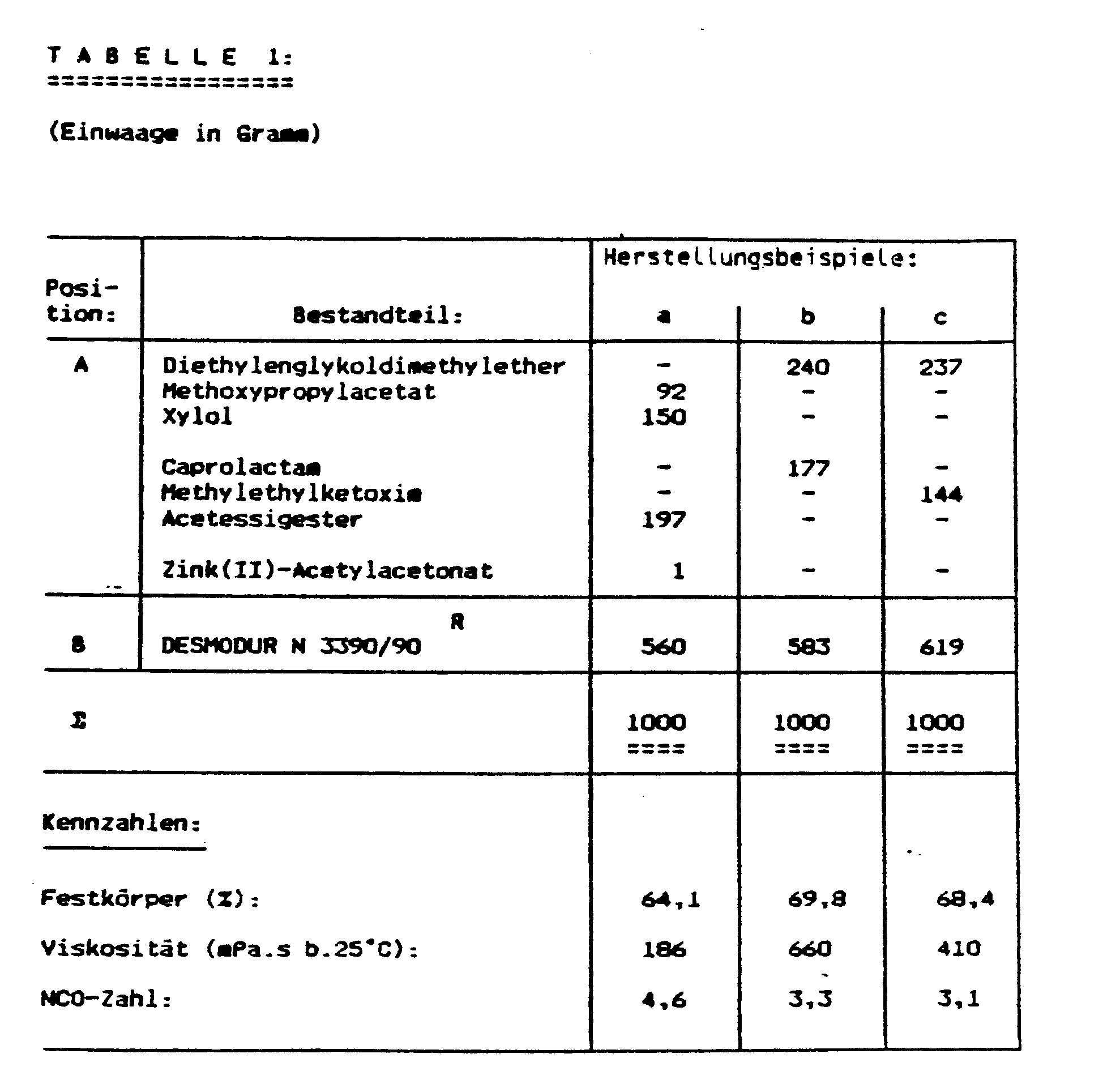
- In einen 4-Liter-Dreihals-Kolben, der mit einem Rührwerk, Kontaktthermometer, Kugelkühler und 2 Tropftrichtern ausgerüstet ist, wird Lösungsmittel der Position I (Mengenangaben sind der Tabelle 2 zu entnehmen) vorgelegt und unter Rühren auf 100°C aufgeheizt. Innerhalb von 5 Stunden werden Position II (Monomerengemisch) und Position III (Azo-bis-isobutyronitril-Lösung) aus Tropftrichtern heraus kontinuierlich gleichzeitig zudosiert, wobei die Temperatur von 100°C konstant gehalten wird. Nach Ende der Zulaufzeit wird Position IV (Azo-bis-iso-butyronitril-Lösung) hinzugefügt. Die Tropftrichter werden mit Lösungsmittel der Position V nachgespült und das Lösungsmittel zum Reaktionsgemisch hinzugegeben.
- Anschließend wird der Ansatz 3 Stunden lang bei 100°C nachpolymerisiert, so daß die Umsetzung>98% beträgt. Dann wird das Polymerisat mit Lösungsmittel der Position VI verdünnt und auf 60°C abgekühlt.
- Die Urethanisierung erfolgt duch Zugabe von Position VII (teilverkapptes Polyisocyanat, Tabelle 1) und einer 2-stündigen Reaktionszeit bei 60°C. Das erhaltene Pigmentdispergiermittel enthält praktisch keine freien NCO-Gruppen.

- 85.8 Gew.-Teile einer 74.2 Gew.-% Feststoffe enthaltenden Lösung eines für Lacke üblicherweise eingesetzten Acrylatharzes, das nachfolgend genauer beschrieben wird, 3.8 Gew.-Teile von einer der in den Beispielen 1,2,3,4 oder 5 erhaltenen Lösungen von Pigmentdispergiermittel, 5.6 Gew.-Teile einer 65 Gew.-% Feststoffe enthaltenden Calciumnaphthenat-Lösung und 4.8 Gew.-Teile Pigmentruß werden mit einem Dissolver vorgemischt und dann in einer Sussemeyer-Rührwerkskugelmühle gemahlen.
Das eingesetzte Acrylatharz wird analog Beispiel 1 der DE-C-26 03 259 wie folgt hergestellt: - In einem mit Rührer, Rückflußkühler und Thermometer ausgerüsteteten Kolben werden 310 g Xylol und 186 g Glycidylester von α,α-Dialkylalkanmonocarbonsäuren folgender Summenformel C₁₃H₂₄O₃ mit einem mittleren Epoxyäquivalent von 245, im folgenden nur noch mit Glycidylester α,α-Dialkylmonocarbonsäuren bezeichnet, auf 142°C erhitzt und ein Gemisch, bestehend aus 145 g Methylmethacrylat, 135 g Hydroxyethylmethacrylat, 6 g tert.-Dodecylmercaptan, 195 g Styrol, 57 g Acrylsäure, 15 g Di-tert.-butylperoxyd in 3 Stunden gleichmäßig hinzugefügt und etwa 4 bis 5 Stunden bei 135°C polymerisiert und kondensiert. Die mit Ethylglykolacetat auf 50% Feststoff verdünnte Lösung ergibt Viskositäten von 130 Sekunden gemessen im DIN-Becher mit einer 4-mm-Auslauföffnung bei 25°C. Der Hydroxylgruppengehalt beträgt 4,24%, bezogen auf den Feststoffanteil im Mischpolymerisat. Das Copolymerisat ergibt nach dem Entfernen des Lösungsmittels ein Schmelzintervall von 70 bis 72°C. Die Säurezahl des Copolymerisats hat den Wert 10.
- 39 Gew.-Teile der Pigmentdispersion a) wurden mit 61 Gew.-Teilen des im Beispiel 6 a) beschriebenen bekannten Acrylatharzes unter Rühren vermischt. Die erhaltene Anstrichfarbe war ein Acryl-Autolack der ausgezeichnete Stabilisierung der dispergierten Rußteilchen aufwies. So waren weder beim Trocknen des Lackes an der Luft noch bei Mischungen mit verschiedenen anderen auf ähnliche Weise erhaltenen Lacken Kornvergröberungen oder Ausschwimmerscheinungen zu beobachten.
- Dieses Beispiel erläutert die Herstellung von verschiedenen gefärbten Pigmentdispersionen und ihre Verwendung bei der Herstellung von Anstrichfarben:
- Die folgenden Bestandteile:
Pigmentdispergiermittel von Beispiel 1 8 Gew.-Teile
in Beispiel 6 a) beschriebenes bekanntes Acrylatharz 83.3 Gew.-Teile
Phthalocyaningrünpigment 8.5 Gew.-Teile
Solsperse 5000® 0.2 Gew.-Teile
wurden im Dissolver vermischt und in einer Sussmeyer-Rührwerkskugelmühle dispergiert.
Solsperse 5000 ist ein Dispergieradditiv der Firma ICI und ist in den entsprechenden Datenblättern beschrieben sowie in der Veröffentlichung J. Toole, Developments in Hyperdispersants Technology for Paints; Paint + Resin - Febr. 1985. - Die folgenden Bestandteile
Pigmentdispergiermittel von Beispiel 1 6 Gew.-Teile
in Beispiel 6 a) beschriebenes bekanntes Acrylatharz 88.05 Gew.-Teile
Phthalocyaninblaupigment 5.9 Gew.-Teile
Solsperse 5000® 0.05 Gew.-Teile
wurden im Dissolver vermischt und in einer Sussmeyer-Rührwerkskugelmühle dispergiert. - Die folgenden Bestandteile:
Pigmentdispergiermittel von Beispiel 1 10.8 Gew.-Teile
in Beispiel 6 a) beschriebenes bekanntes Acrylatharz 82 Gew.-Teile
Chinacridon-Magenta-Pigment 7.2 Gew.-Teile
wurden im Dissolver vermischt und in einer Sussmeyer-Rührwerkskugelmühle dispergiert. - 47 Gew.-Teile der grünen Pigmentdispersion von Beispiel 7a) wurden mit 53 Gew.-Teilen im Beispiel 6a) beschriebenes bekanntes Acrylatharz vermischt.
- 53.8 Gew.-Teile der blauen Pigmentdispersion von Beispiel 7b) wurden mit 46.2 Gew.-Teilen im Beispiel 6a) beschriebenes bekanntes Acrylatharz vermischt.
- 84. Gew.-Teile der roten Pigmentdispersion von Beispiel 7c) wurden mit 16 Gew.-Teilen im Beispiel 6a) beschriebenes bekanntes Acrylatharz vermischt.
- Erscheinungen wie Flokkulationen, Coflokkulationen, Glanzverluste sowie Aufschwimmen der Pigmente, die mit den üblichen Dispergierhilfsmitteln, wie sie in der Einleitung genannt wurden, nicht oder nur in unzureichendem Maße zu beheben sind, treten bei den beschriebenen Beispielen d), e) und f) praktisch nicht auf.
- 100 Gew.-Teile der blauen Pigmentdispersion von Beispiel 7b) werden mit 100 Gew.-Teilen der schwarzen Paste von Beispiel 6a) gründlich vermischt. Die resultierende Blautonpaste sowie der nach Zugabe der entsprechenden Menge im Beispiel 6a) beschriebenes bekanntes Acrylatharz resultierende Lack zeigen keine Kornvergröberung und keinen Glanzverlust gegenüber den monopigmentierten Lacken, wie es der Fall ist bei analogen Dispersionen, die unter Verwendung der handelsüblichen Dispergierhilfen nach Herstellerangaben gefertigt werden.
- Gleichermaßen flockungsfreie Lacke erhält man bei Mischungen aus gleichen Anteilen Schwarzpaste (Beispiel 6a) ), Blaupaste (Beispiel 7b) ) sowie einer analog aus TiO₂-Pigment hergestellten Weißtonpaste. Flokkulation und Ausschwimmen von Pigmenten treten nicht auf.
- Die vorstehenden Beispiele erläutern Pigmentdispersionen, die, wie oben erwähnt, zusätzlich ein übliches Acrylatharz-Bindemittel enthalten. Die nachfolgenden Beispiele erläutern solche Pigmentdispersionen, die nicht solche zusätzlichen Bindemittel aufweisen.
- 26.7 Gew.-Teile Pigmentdispergiermittel (Beispiel 1)
57.3 Gew.-Teile Lösemittelgemisch Xylol/Butylacetat (1:1)
16.0 Gew.-Teile Pigment yellow C.I.P.Y. 110
wurden mit dem Dissolver gemischt (5min) und dann in einer Perlmühle dispergiert. Die erreichte Mahlfeinheit betrug<10 µm.
- 34.3 Gew.-Teile gelbe Pigmentdispersion aus 9a)
65.7 Gew.-Teile im Beispiel 6a) beschriebenes bekanntes Acrylatharz
wurden unter gutem Rühren gemischt.
- 45.1 Gew.-Teile Pigmentdispergiermittel (Beispiel 1)
27.7. Gew.-Teile Pigment rot C.I. P.R. 88
wurden mit dem Dissolver gemischt (5min). Dann wurden
27.2 Gew.-Teile Lösemittelgemisch Xylol/Butylacetat (1:1)
eingerührt und anschließend in einer Perlmühle dispergiert. Die erreichte Mahlfeinheit betrug<10 µm.
- 18.0 Gew.-Teile rotviolette Pigmentdispersion Beispiel 10a
82.0 Gew.-Teile im Beispiel 6a) beschriebenes bekanntes Acrylatharz
wurden unter gutem Rühren gemischt.
- 31.2 Gew.-Teile Pigmentdispergiermittel (Beispiel 1)
9.5 Gew.-Teile Lösemittelgemisch Xylol/Butylacetat (1:1)
13.9 Gew.-Teile Pigment black C.I.P.Bl. 7
13.9 Gew.-Teile Calciumnaphthenatlösung 65%
wurden mit dem Dissolver gemischt (5min). Dann wurden
31.5 Gew.-Teile Lösemittelgemisch Xylol/Butylacetat (1:1)
eingerührt und anschließend in einer Perlmühle dispergiert.
Die erreichte Mahlfeinheit betrug <10 µm.
- 12.5 Gew.-Teile schwarze Pigmentdispersion aus Beispiel 11a)
87.5 Gew.-Teile im Beispiel 6a) beschriebenes bekanntes Acrylhar
wurden unter gutem Rühren gemischt.
- 4.0 Gew.-Teile Pigmentdispergiermittel (Beispiel 1)
1.0 Gew.-Teile Bykumen®
2.5 Gew.-Teile Thixotropiermittel
51.3 Gew.-Teile im Beispiel 6a) beschriebenes bekanntes Acrylharz
41.2 Gew.-Teile Titandioxid white C.I.P.W. 6
wurden 2 min mit dem Dissolver dispergier. Die erhaltene Mahlfeinheit betrug <12µm.
- 61.1 Gew.-Teile weiße Mahlgrundlage aus a)
38.9 Gew.-Teile im Beispiel 6a) beschriebenes bekanntes Acrylatharz
wurden unter gutem Rühren gemischt.
- Die aus den Beispielen 9 bis 12 erhaltenen Lacke können allein oder in beliebigen Mischungen verarbeitet werden. So kann durch Abmischen verschiedener geeigneter Lacke der gewünschte Farbton erhalten werden.
- Die in den Beispielen 9 bis 11 erhaltenen Pigmentdispersionen haben, trotz höherer Pigmentierung, eine sehr geringe Restviskosität. Diese Pigmentdispersionen sind für Rührwerkskugelmühlen sehr geeignet.
Claims (5)
dadurch gekennzeichnet,
daß das Mischpolymere erhältlich ist durch Umsetzung von
Priority Applications (1)
| Application Number | Priority Date | Filing Date | Title |
|---|---|---|---|
| AT87111947T ATE89586T1 (de) | 1986-08-19 | 1987-08-18 | Pigmentdispersion und deren verwendung. |
Applications Claiming Priority (2)
| Application Number | Priority Date | Filing Date | Title |
|---|---|---|---|
| DE3628123A DE3628123C1 (de) | 1986-08-19 | 1986-08-19 | Pigmentdispersion und deren Verwendung |
| DE3628123 | 1986-08-19 |
Publications (3)
| Publication Number | Publication Date |
|---|---|
| EP0260456A2 true EP0260456A2 (de) | 1988-03-23 |
| EP0260456A3 EP0260456A3 (en) | 1990-03-14 |
| EP0260456B1 EP0260456B1 (de) | 1993-05-19 |
Family
ID=6307716
Family Applications (1)
| Application Number | Title | Priority Date | Filing Date |
|---|---|---|---|
| EP87111947A Expired - Lifetime EP0260456B1 (de) | 1986-08-19 | 1987-08-18 | Pigmentdispersion und deren Verwendung |
Country Status (9)
| Country | Link |
|---|---|
| US (1) | US4839414A (de) |
| EP (1) | EP0260456B1 (de) |
| JP (1) | JPH0819364B2 (de) |
| AT (1) | ATE89586T1 (de) |
| CA (1) | CA1319775C (de) |
| DE (2) | DE3628123C1 (de) |
| DK (1) | DK161710C (de) |
| ES (1) | ES2041660T3 (de) |
| ZA (1) | ZA876086B (de) |
Cited By (2)
| Publication number | Priority date | Publication date | Assignee | Title |
|---|---|---|---|---|
| EP0513659A1 (de) * | 1991-05-13 | 1992-11-19 | Herberts Gesellschaft mit beschränkter Haftung | Verfahren zur Grundierung von Kunststoffsubstraten, Uberzugsmittel hierzu und dessen Verwendung |
| WO1997022644A1 (de) * | 1995-12-20 | 1997-06-26 | Herberts Gesellschaft mit beschränkter Haftung | Überzugsmittel und verfahren zur beschichtung insbesondere von kunststoffsubstraten |
Families Citing this family (23)
| Publication number | Priority date | Publication date | Assignee | Title |
|---|---|---|---|---|
| CA2014539C (en) * | 1989-04-17 | 2000-07-25 | Shinichiro Umeda | Water borne metallic coating composition |
| US5051464A (en) * | 1989-09-01 | 1991-09-24 | E. I. Du Pont De Nemours And Company | Waterborne acrylourethane pigment dispersant polymer |
| IT1237195B (it) * | 1989-11-16 | 1993-05-26 | Giuseppe Moltrasio | Masterbatch a vasto campo di utilizzazione. |
| EP0483361B1 (de) * | 1990-04-12 | 1997-03-19 | Arakawa Chemical Industries, Ltd. | Verwendung von dispergierungsmitteln in der herstellung wässriger emulsionen von kolophoniumverbindungen, sowie diese wässrige emulsionen der kolophoniumverbindungen |
| JP2921027B2 (ja) * | 1990-05-14 | 1999-07-19 | 三菱化学株式会社 | フッ素樹脂用プライマー組成物 |
| US5221335A (en) * | 1990-05-23 | 1993-06-22 | Coates Electrographics Limited | Stabilized pigmented hot melt ink containing nitrogen-modified acrylate polymer as dispersion-stabilizer agent |
| DE4023578A1 (de) * | 1990-07-25 | 1992-01-30 | Chemie Linz Deutschland | Copolymere von hydroxyethyl(meth)acrylat und n-substituierten (meth)acrylamiden |
| US5075366A (en) * | 1990-10-26 | 1991-12-24 | Giuseppe Moltrasio | Multi-purpose masterbatches |
| US5712332A (en) * | 1993-01-13 | 1998-01-27 | Nippon Shokubai Co. | Method for absorbing heat radiation |
| DE4446440A1 (de) * | 1994-12-23 | 1996-06-27 | Hoechst Ag | Wäßrige Pigmentpasten |
| JP3946309B2 (ja) * | 1997-04-10 | 2007-07-18 | 富士フイルム株式会社 | 着色感光性組成物 |
| IT1298440B1 (it) * | 1998-02-23 | 2000-01-10 | Rossetti Vernici & Idee Spa | Composizioni coloranti universali |
| DE19842952A1 (de) | 1998-09-18 | 2000-03-23 | Basf Ag | Dispergiermittel |
| US6451950B1 (en) | 2000-07-05 | 2002-09-17 | E. I. Du Pont De Nemours And Company | Polymeric pigment dispersants having multiple pigment anchoring groups |
| US20080192233A1 (en) * | 2000-08-18 | 2008-08-14 | Veil Corporation | Near infrared electromagnetic radiation absorbing composition and method of use |
| US6794431B1 (en) | 2000-08-18 | 2004-09-21 | Veil Corporation | Near infrared electromagnetic radiation absorbing composition and method of use |
| US7439303B2 (en) * | 2004-03-19 | 2008-10-21 | Lintec Corporation | Pressure-sensitive adhesive for motor vehicle brake disc antirust film |
| US20090298978A1 (en) * | 2004-12-16 | 2009-12-03 | Bruno Rotzinger | Stabilized organic materials containing fillers |
| GB0526231D0 (en) * | 2005-12-22 | 2006-02-01 | Eastman Kodak Co | Dispersant for reducing viscosity of solids |
| US20070155927A1 (en) * | 2005-12-30 | 2007-07-05 | Cytec Surface Specialties Austria Gmbh | Paste resins for aqueous paints |
| JPWO2007125917A1 (ja) * | 2006-04-24 | 2009-09-10 | 東洋インキ製造株式会社 | 非水性インクジェットインキ、インクジェット記録用インク組成物、及びカラーフィルター基板 |
| JP5407415B2 (ja) * | 2009-02-26 | 2014-02-05 | 東洋インキScホールディングス株式会社 | 分散剤とその製造方法、及びそれを用いた顔料組成物 |
| US8263700B2 (en) | 2010-06-01 | 2012-09-11 | Ppg Industries Ohio, Inc. | Pigment dispersions, related coating compositions and coated substrates |
Family Cites Families (27)
| Publication number | Priority date | Publication date | Assignee | Title |
|---|---|---|---|---|
| FR1295273A (fr) * | 1961-07-19 | 1962-06-01 | Bayer Ag | Pâtes de pigments à hautes concentrations |
| US3238159A (en) * | 1962-10-29 | 1966-03-01 | Staley Mfg Co A E | Aqueous dispersions of copolymers of alkyl half esters of itaconic acid with mineral pigments |
| BE639425A (de) * | 1962-11-02 | 1900-01-01 | ||
| DE2059799B2 (de) * | 1970-12-04 | 1973-10-04 | Vianova Kunstharz Ag, Wien | Verfahren zur Herstellung von wäßrigen Polymensatdispersionen |
| US4059547A (en) * | 1971-04-15 | 1977-11-22 | Imperial Chemical Industries Limited | Paint manufacture |
| GB1393401A (en) * | 1972-02-28 | 1975-05-07 | Ici Ltd | Dispersing agents |
| JPS6037130B2 (ja) * | 1976-12-15 | 1985-08-24 | 協和ガス化学工業株式会社 | 親水性共重合体の架橋方法 |
| GB1557269A (en) * | 1976-12-30 | 1979-12-05 | Nippon Paint Co Ltd | Process for preparation of a pigment dispersed composition |
| US4102843A (en) * | 1977-01-07 | 1978-07-25 | Rohm And Haas Company | Dispersing paint pigments |
| JPS5439443A (en) * | 1977-09-05 | 1979-03-26 | Kansai Paint Co Ltd | Powder coating composition |
| CA1146694A (en) * | 1978-08-31 | 1983-05-17 | David Z. Becher | Pigment dispersants for coating compositions |
| JPS55127472A (en) * | 1979-03-26 | 1980-10-02 | Kansai Paint Co Ltd | Resin composition for cation electrodeposition coating |
| DE2924756A1 (de) * | 1979-06-20 | 1981-01-29 | Basf Ag | Lackbindemittel und ihre verwendung fuer elektrotauchlacke |
| US4339365A (en) * | 1979-07-23 | 1982-07-13 | Ppg Industries, Inc. | Coating compositions containing pigment dispersants |
| DE3043601A1 (de) * | 1980-11-19 | 1982-07-08 | Basf Ag, 6700 Ludwigshafen | Pigmentpasten und deren verwendung |
| DE3125569A1 (de) * | 1981-06-30 | 1983-01-20 | Bayer Ag, 5090 Leverkusen | Verfahren zur herstellung von ueberzuegen |
| DE3226131A1 (de) * | 1982-07-13 | 1984-01-19 | Basf Ag, 6700 Ludwigshafen | Verfahren zur herstellung von ueberzuegen |
| US4444954A (en) * | 1982-09-30 | 1984-04-24 | The Sherwin-Williams Company | Water reducible quaternary ammonium salt containing polymers |
| DE3311516A1 (de) * | 1983-03-30 | 1984-10-04 | Basf Farben + Fasern Ag, 2000 Hamburg | Hitzehaertbare ueberzugsmittel und deren verwendung |
| DE3311513A1 (de) * | 1983-03-30 | 1984-10-04 | Basf Farben + Fasern Ag, 2000 Hamburg | Hitzehaertbare ueberzugsmittel und ihre verwendung |
| DE3322830A1 (de) * | 1983-06-24 | 1985-01-03 | Basf Ag, 6700 Ludwigshafen | Verfahren zur herstellung von ueberzuegen |
| DE3322829A1 (de) * | 1983-06-24 | 1985-01-03 | Basf Ag, 6700 Ludwigshafen | Verfahren zur herstellung von ueberzuegen |
| GB8317354D0 (en) * | 1983-06-27 | 1983-07-27 | Ici Plc | Polymer-modified polyols |
| US4512860A (en) * | 1983-07-14 | 1985-04-23 | Scm Corporation | Cathodic electrocoating composition compounded with latex binder |
| DE3325735A1 (de) * | 1983-07-16 | 1985-01-24 | Basf Ag, 6700 Ludwigshafen | Bei raumtemperatur fluessige, lagerstabile, waermeaktivierbare stoffgemische aus polyolen und/oder polyaminen und polyisocyanaten fuer polyurethan-haftkleber |
| DE3465599D1 (en) * | 1984-01-27 | 1987-10-01 | Byk Chemie Gmbh | Addition compounds suited as dispersing agents, process for their preparation, their use and solid materials coated with them |
| DE3409080A1 (de) * | 1984-03-13 | 1985-09-19 | Bayer Ag, 5090 Leverkusen | Verfahren zur herstellung von waessrigen dispersionen und deren verwendung zur herstellung von metalleffektlackierungen |
-
1986
- 1986-08-19 DE DE3628123A patent/DE3628123C1/de not_active Expired
-
1987
- 1987-07-07 CA CA000541477A patent/CA1319775C/en not_active Expired - Fee Related
- 1987-08-17 ZA ZA876086A patent/ZA876086B/xx unknown
- 1987-08-18 US US07/086,931 patent/US4839414A/en not_active Expired - Lifetime
- 1987-08-18 JP JP62204948A patent/JPH0819364B2/ja not_active Expired - Lifetime
- 1987-08-18 DE DE8787111947T patent/DE3785900D1/de not_active Expired - Fee Related
- 1987-08-18 AT AT87111947T patent/ATE89586T1/de not_active IP Right Cessation
- 1987-08-18 DK DK430287A patent/DK161710C/da not_active IP Right Cessation
- 1987-08-18 ES ES198787111947T patent/ES2041660T3/es not_active Expired - Lifetime
- 1987-08-18 EP EP87111947A patent/EP0260456B1/de not_active Expired - Lifetime
Cited By (2)
| Publication number | Priority date | Publication date | Assignee | Title |
|---|---|---|---|---|
| EP0513659A1 (de) * | 1991-05-13 | 1992-11-19 | Herberts Gesellschaft mit beschränkter Haftung | Verfahren zur Grundierung von Kunststoffsubstraten, Uberzugsmittel hierzu und dessen Verwendung |
| WO1997022644A1 (de) * | 1995-12-20 | 1997-06-26 | Herberts Gesellschaft mit beschränkter Haftung | Überzugsmittel und verfahren zur beschichtung insbesondere von kunststoffsubstraten |
Also Published As
| Publication number | Publication date |
|---|---|
| ES2041660T3 (es) | 1993-12-01 |
| ATE89586T1 (de) | 1993-06-15 |
| EP0260456B1 (de) | 1993-05-19 |
| JPH0819364B2 (ja) | 1996-02-28 |
| DK161710C (da) | 1992-02-24 |
| DK430287A (da) | 1988-02-20 |
| JPS6351487A (ja) | 1988-03-04 |
| DE3628123C1 (de) | 1988-02-11 |
| US4839414A (en) | 1989-06-13 |
| DK161710B (da) | 1991-08-05 |
| DK430287D0 (da) | 1987-08-18 |
| ZA876086B (en) | 1988-04-27 |
| EP0260456A3 (en) | 1990-03-14 |
| CA1319775C (en) | 1993-06-29 |
| DE3785900D1 (de) | 1993-06-24 |
Similar Documents
| Publication | Publication Date | Title |
|---|---|---|
| EP0260456B1 (de) | Pigmentdispersion und deren Verwendung | |
| EP1026178B1 (de) | Aminoxidgruppen enthaltende Maleinsäureanhydrid-Copolymere und ihre Verwendung als Dispergiermittel für Pigmente oder Füllstoffe | |
| DE69105818T2 (de) | Wässerige Überzugszusammensetzung. | |
| EP2146797B1 (de) | Pigmentpräparationen auf wasserbasis | |
| EP0068044B1 (de) | Wässrige Pigmentpasten und deren Verwendung | |
| EP0795568B1 (de) | Wässrige Polymerdispersionen als Bindemittel für elastische block- und kratzfeste Beschichtungen | |
| DE2758626C2 (de) | ||
| DE69501963T2 (de) | Stabile wässrige metallflockendispersion unter verwendung von phosphat-enthaltendem acrylischem polymerdispergiermittel | |
| DE69521296T2 (de) | Hitzehaertbare ueberzugszusammensetzung | |
| EP0979844B1 (de) | Dispergiermittel zur Herstellung wässriger Pigmentpasten | |
| EP0044393A2 (de) | Verfahren zur Herstellung eines Hydroxylgruppen aufweisenden, mit epsilon-Caprolacton modifizierten (Meth)acrylatharzes | |
| DE2263049A1 (de) | Hitzehaertbare acrylpolymer-pulverueberzugsmittel | |
| EP0052224B1 (de) | Pigmentpasten und deren Verwendung | |
| EP0575931B1 (de) | In Zweistufenfahrweise hergestellte Vinylpolymerisate und ihre Verwendung als Lackbindemittel | |
| DE69125324T2 (de) | Metallische, wässrige Grundlackzusammensetzung | |
| EP0324334B1 (de) | Wasserverdünnbare Bindemittel, ein Verfahren zu ihrer Herstellung und ihre Verwendung | |
| DE69309863T2 (de) | Mica enthaltende Pigmentzusammensetzung | |
| DE2709308A1 (de) | Verfahren zur herstellung von waessrigen copolymer-emulsionen | |
| DE69015549T2 (de) | Dispersion von feinen Teilchen eines Kunststoffes. | |
| DE2934642C2 (de) | ||
| EP0205510A1 (de) | Pulverpigmente mit verbesserten rheologischen eigenschaften, verfahren zu ihrer herstellung und ihre verwendung mit einem gehalt von mindestens 5% unsubstituiertem chinacridon. | |
| EP0328962B1 (de) | Isocyanat- und Säureanhydridgruppen enthaltende Copolymerisate, ein Verfahren zu ihrer Herstellung und ihre Verwendung als Bindemittelkomponente | |
| EP0436135B1 (de) | Verfahren zur Herstellung von Dibutylzinnoxid enthaltenden Katalysatorpasten und deren Verwendung | |
| DE2951214C2 (de) | ||
| DE3018715C2 (de) |
Legal Events
| Date | Code | Title | Description |
|---|---|---|---|
| PUAI | Public reference made under article 153(3) epc to a published international application that has entered the european phase |
Free format text: ORIGINAL CODE: 0009012 |
|
| AK | Designated contracting states |
Kind code of ref document: A2 Designated state(s): AT BE CH DE ES FR GB IT LI NL SE |
|
| PUAL | Search report despatched |
Free format text: ORIGINAL CODE: 0009013 |
|
| AK | Designated contracting states |
Kind code of ref document: A3 Designated state(s): AT BE CH DE ES FR GB IT LI NL SE |
|
| 17P | Request for examination filed |
Effective date: 19900905 |
|
| 17Q | First examination report despatched |
Effective date: 19911016 |
|
| GRAA | (expected) grant |
Free format text: ORIGINAL CODE: 0009210 |
|
| AK | Designated contracting states |
Kind code of ref document: B1 Designated state(s): AT BE CH DE ES FR GB IT LI NL SE |
|
| REF | Corresponds to: |
Ref document number: 89586 Country of ref document: AT Date of ref document: 19930615 Kind code of ref document: T |
|
| REF | Corresponds to: |
Ref document number: 3785900 Country of ref document: DE Date of ref document: 19930624 |
|
| GBT | Gb: translation of ep patent filed (gb section 77(6)(a)/1977) |
Effective date: 19930621 |
|
| ET | Fr: translation filed | ||
| ITF | It: translation for a ep patent filed | ||
| REG | Reference to a national code |
Ref country code: ES Ref legal event code: FG2A Ref document number: 2041660 Country of ref document: ES Kind code of ref document: T3 |
|
| PLBE | No opposition filed within time limit |
Free format text: ORIGINAL CODE: 0009261 |
|
| STAA | Information on the status of an ep patent application or granted ep patent |
Free format text: STATUS: NO OPPOSITION FILED WITHIN TIME LIMIT |
|
| 26N | No opposition filed | ||
| EAL | Se: european patent in force in sweden |
Ref document number: 87111947.5 |
|
| REG | Reference to a national code |
Ref country code: GB Ref legal event code: IF02 |
|
| PGFP | Annual fee paid to national office [announced via postgrant information from national office to epo] |
Ref country code: BE Payment date: 20030610 Year of fee payment: 17 |
|
| PGFP | Annual fee paid to national office [announced via postgrant information from national office to epo] |
Ref country code: GB Payment date: 20030723 Year of fee payment: 17 |
|
| PGFP | Annual fee paid to national office [announced via postgrant information from national office to epo] |
Ref country code: FR Payment date: 20030825 Year of fee payment: 17 Ref country code: CH Payment date: 20030825 Year of fee payment: 17 Ref country code: AT Payment date: 20030825 Year of fee payment: 17 |
|
| PGFP | Annual fee paid to national office [announced via postgrant information from national office to epo] |
Ref country code: SE Payment date: 20030826 Year of fee payment: 17 |
|
| PGFP | Annual fee paid to national office [announced via postgrant information from national office to epo] |
Ref country code: ES Payment date: 20030829 Year of fee payment: 17 |
|
| PGFP | Annual fee paid to national office [announced via postgrant information from national office to epo] |
Ref country code: NL Payment date: 20030831 Year of fee payment: 17 |
|
| PGFP | Annual fee paid to national office [announced via postgrant information from national office to epo] |
Ref country code: DE Payment date: 20031021 Year of fee payment: 17 |
|
| PG25 | Lapsed in a contracting state [announced via postgrant information from national office to epo] |
Ref country code: GB Free format text: LAPSE BECAUSE OF NON-PAYMENT OF DUE FEES Effective date: 20040818 Ref country code: AT Free format text: LAPSE BECAUSE OF NON-PAYMENT OF DUE FEES Effective date: 20040818 |
|
| PG25 | Lapsed in a contracting state [announced via postgrant information from national office to epo] |
Ref country code: SE Free format text: LAPSE BECAUSE OF NON-PAYMENT OF DUE FEES Effective date: 20040819 Ref country code: ES Free format text: LAPSE BECAUSE OF NON-PAYMENT OF DUE FEES Effective date: 20040819 |
|
| PG25 | Lapsed in a contracting state [announced via postgrant information from national office to epo] |
Ref country code: LI Free format text: LAPSE BECAUSE OF NON-PAYMENT OF DUE FEES Effective date: 20040831 Ref country code: CH Free format text: LAPSE BECAUSE OF NON-PAYMENT OF DUE FEES Effective date: 20040831 Ref country code: BE Free format text: LAPSE BECAUSE OF NON-PAYMENT OF DUE FEES Effective date: 20040831 |
|
| BERE | Be: lapsed |
Owner name: *HERBERTS G.M.B.H. Effective date: 20040831 |
|
| PG25 | Lapsed in a contracting state [announced via postgrant information from national office to epo] |
Ref country code: NL Free format text: LAPSE BECAUSE OF NON-PAYMENT OF DUE FEES Effective date: 20050301 Ref country code: DE Free format text: LAPSE BECAUSE OF NON-PAYMENT OF DUE FEES Effective date: 20050301 |
|
| EUG | Se: european patent has lapsed | ||
| GBPC | Gb: european patent ceased through non-payment of renewal fee |
Effective date: 20040818 |
|
| REG | Reference to a national code |
Ref country code: CH Ref legal event code: PL |
|
| PG25 | Lapsed in a contracting state [announced via postgrant information from national office to epo] |
Ref country code: FR Free format text: LAPSE BECAUSE OF NON-PAYMENT OF DUE FEES Effective date: 20050429 |
|
| NLV4 | Nl: lapsed or anulled due to non-payment of the annual fee |
Effective date: 20050301 |
|
| REG | Reference to a national code |
Ref country code: FR Ref legal event code: ST |
|
| PG25 | Lapsed in a contracting state [announced via postgrant information from national office to epo] |
Ref country code: IT Free format text: LAPSE BECAUSE OF NON-PAYMENT OF DUE FEES;WARNING: LAPSES OF ITALIAN PATENTS WITH EFFECTIVE DATE BEFORE 2007 MAY HAVE OCCURRED AT ANY TIME BEFORE 2007. THE CORRECT EFFECTIVE DATE MAY BE DIFFERENT FROM THE ONE RECORDED. Effective date: 20050818 |
|
| REG | Reference to a national code |
Ref country code: ES Ref legal event code: FD2A Effective date: 20040819 |
|
| BERE | Be: lapsed |
Owner name: *HERBERTS G.M.B.H. Effective date: 20040831 |