EP0260893B1 - Corps composites résistants à la chaleur et à dilatation basse en phosphate de zirconyle-silicate de zirconium et leur procédé de fabrication - Google Patents
Corps composites résistants à la chaleur et à dilatation basse en phosphate de zirconyle-silicate de zirconium et leur procédé de fabrication Download PDFInfo
- Publication number
- EP0260893B1 EP0260893B1 EP87308063A EP87308063A EP0260893B1 EP 0260893 B1 EP0260893 B1 EP 0260893B1 EP 87308063 A EP87308063 A EP 87308063A EP 87308063 A EP87308063 A EP 87308063A EP 0260893 B1 EP0260893 B1 EP 0260893B1
- Authority
- EP
- European Patent Office
- Prior art keywords
- weight
- zircon
- zirconyl phosphate
- composite body
- zro2
- Prior art date
- Legal status (The legal status is an assumption and is not a legal conclusion. Google has not performed a legal analysis and makes no representation as to the accuracy of the status listed.)
- Expired
Links
- 229910052845 zircon Inorganic materials 0.000 title claims description 135
- 239000002131 composite material Substances 0.000 title claims description 56
- 238000000034 method Methods 0.000 title claims description 22
- 230000008569 process Effects 0.000 title claims description 18
- MCMNRKCIXSYSNV-UHFFFAOYSA-N Zirconium dioxide Chemical compound O=[Zr]=O MCMNRKCIXSYSNV-UHFFFAOYSA-N 0.000 claims description 128
- DLYUQMMRRRQYAE-UHFFFAOYSA-N tetraphosphorus decaoxide Chemical compound O1P(O2)(=O)OP3(=O)OP1(=O)OP2(=O)O3 DLYUQMMRRRQYAE-UHFFFAOYSA-N 0.000 claims description 78
- VYPSYNLAJGMNEJ-UHFFFAOYSA-N Silicium dioxide Chemical compound O=[Si]=O VYPSYNLAJGMNEJ-UHFFFAOYSA-N 0.000 claims description 68
- GFQYVLUOOAAOGM-UHFFFAOYSA-N zirconium(iv) silicate Chemical compound [Zr+4].[O-][Si]([O-])([O-])[O-] GFQYVLUOOAAOGM-UHFFFAOYSA-N 0.000 claims description 68
- 229910019142 PO4 Inorganic materials 0.000 claims description 51
- NBIIXXVUZAFLBC-UHFFFAOYSA-K phosphate Chemical compound [O-]P([O-])([O-])=O NBIIXXVUZAFLBC-UHFFFAOYSA-K 0.000 claims description 51
- 239000010452 phosphate Substances 0.000 claims description 51
- 239000000203 mixture Substances 0.000 claims description 39
- 229910052681 coesite Inorganic materials 0.000 claims description 34
- 229910052906 cristobalite Inorganic materials 0.000 claims description 34
- ZKATWMILCYLAPD-UHFFFAOYSA-N niobium pentoxide Chemical compound O=[Nb](=O)O[Nb](=O)=O ZKATWMILCYLAPD-UHFFFAOYSA-N 0.000 claims description 34
- 239000000377 silicon dioxide Substances 0.000 claims description 34
- 235000012239 silicon dioxide Nutrition 0.000 claims description 34
- 229910052682 stishovite Inorganic materials 0.000 claims description 34
- 229910052905 tridymite Inorganic materials 0.000 claims description 34
- 238000002844 melting Methods 0.000 claims description 26
- 230000008018 melting Effects 0.000 claims description 26
- 239000007858 starting material Substances 0.000 claims description 26
- 239000000126 substance Substances 0.000 claims description 25
- 229910052783 alkali metal Inorganic materials 0.000 claims description 23
- 150000001340 alkali metals Chemical class 0.000 claims description 23
- 229910052784 alkaline earth metal Inorganic materials 0.000 claims description 23
- 150000001342 alkaline earth metals Chemical class 0.000 claims description 23
- PNEYBMLMFCGWSK-UHFFFAOYSA-N aluminium oxide Inorganic materials [O-2].[O-2].[O-2].[Al+3].[Al+3] PNEYBMLMFCGWSK-UHFFFAOYSA-N 0.000 claims description 19
- 229910052593 corundum Inorganic materials 0.000 claims description 14
- 229910001845 yogo sapphire Inorganic materials 0.000 claims description 14
- 229910052878 cordierite Inorganic materials 0.000 claims description 13
- JSKIRARMQDRGJZ-UHFFFAOYSA-N dimagnesium dioxido-bis[(1-oxido-3-oxo-2,4,6,8,9-pentaoxa-1,3-disila-5,7-dialuminabicyclo[3.3.1]nonan-7-yl)oxy]silane Chemical compound [Mg++].[Mg++].[O-][Si]([O-])(O[Al]1O[Al]2O[Si](=O)O[Si]([O-])(O1)O2)O[Al]1O[Al]2O[Si](=O)O[Si]([O-])(O1)O2 JSKIRARMQDRGJZ-UHFFFAOYSA-N 0.000 claims description 12
- 238000005245 sintering Methods 0.000 claims description 8
- 229910000287 alkaline earth metal oxide Inorganic materials 0.000 claims 1
- CPLXHLVBOLITMK-UHFFFAOYSA-N Magnesium oxide Chemical compound [Mg]=O CPLXHLVBOLITMK-UHFFFAOYSA-N 0.000 description 50
- 239000012071 phase Substances 0.000 description 41
- 239000000395 magnesium oxide Substances 0.000 description 25
- 239000002244 precipitate Substances 0.000 description 20
- 238000010586 diagram Methods 0.000 description 19
- 229910010293 ceramic material Inorganic materials 0.000 description 16
- 238000000227 grinding Methods 0.000 description 11
- 239000000463 material Substances 0.000 description 10
- 230000035939 shock Effects 0.000 description 10
- 229910006254 ZrP2O7 Inorganic materials 0.000 description 8
- 238000002441 X-ray diffraction Methods 0.000 description 7
- 238000010304 firing Methods 0.000 description 7
- 230000009466 transformation Effects 0.000 description 7
- 230000002159 abnormal effect Effects 0.000 description 6
- RKTYLMNFRDHKIL-UHFFFAOYSA-N copper;5,10,15,20-tetraphenylporphyrin-22,24-diide Chemical compound [Cu+2].C1=CC(C(=C2C=CC([N-]2)=C(C=2C=CC=CC=2)C=2C=CC(N=2)=C(C=2C=CC=CC=2)C2=CC=C3[N-]2)C=2C=CC=CC=2)=NC1=C3C1=CC=CC=C1 RKTYLMNFRDHKIL-UHFFFAOYSA-N 0.000 description 6
- 238000000465 moulding Methods 0.000 description 6
- 239000000919 ceramic Substances 0.000 description 5
- GWEVSGVZZGPLCZ-UHFFFAOYSA-N Titan oxide Chemical compound O=[Ti]=O GWEVSGVZZGPLCZ-UHFFFAOYSA-N 0.000 description 4
- 239000003054 catalyst Substances 0.000 description 4
- KZHJGOXRZJKJNY-UHFFFAOYSA-N dioxosilane;oxo(oxoalumanyloxy)alumane Chemical compound O=[Si]=O.O=[Si]=O.O=[Al]O[Al]=O.O=[Al]O[Al]=O.O=[Al]O[Al]=O KZHJGOXRZJKJNY-UHFFFAOYSA-N 0.000 description 4
- 230000000694 effects Effects 0.000 description 4
- 238000007676 flexural strength test Methods 0.000 description 4
- 230000001965 increasing effect Effects 0.000 description 4
- NUJOXMJBOLGQSY-UHFFFAOYSA-N manganese dioxide Chemical compound O=[Mn]=O NUJOXMJBOLGQSY-UHFFFAOYSA-N 0.000 description 4
- 229910052863 mullite Inorganic materials 0.000 description 4
- 239000005995 Aluminium silicate Substances 0.000 description 3
- XLOMVQKBTHCTTD-UHFFFAOYSA-N Zinc monoxide Chemical compound [Zn]=O XLOMVQKBTHCTTD-UHFFFAOYSA-N 0.000 description 3
- ILRRQNADMUWWFW-UHFFFAOYSA-K aluminium phosphate Chemical compound O1[Al]2OP1(=O)O2 ILRRQNADMUWWFW-UHFFFAOYSA-K 0.000 description 3
- 235000012211 aluminium silicate Nutrition 0.000 description 3
- 238000004458 analytical method Methods 0.000 description 3
- 239000007864 aqueous solution Substances 0.000 description 3
- 230000000052 comparative effect Effects 0.000 description 3
- 238000013329 compounding Methods 0.000 description 3
- 238000001035 drying Methods 0.000 description 3
- NLYAJNPCOHFWQQ-UHFFFAOYSA-N kaolin Chemical compound O.O.O=[Al]O[Si](=O)O[Si](=O)O[Al]=O NLYAJNPCOHFWQQ-UHFFFAOYSA-N 0.000 description 3
- 239000007791 liquid phase Substances 0.000 description 3
- 238000004519 manufacturing process Methods 0.000 description 3
- 229910052596 spinel Inorganic materials 0.000 description 3
- 239000011029 spinel Substances 0.000 description 3
- 239000000654 additive Substances 0.000 description 2
- 239000002585 base Substances 0.000 description 2
- WMWLMWRWZQELOS-UHFFFAOYSA-N bismuth(iii) oxide Chemical compound O=[Bi]O[Bi]=O WMWLMWRWZQELOS-UHFFFAOYSA-N 0.000 description 2
- 238000011161 development Methods 0.000 description 2
- 230000003028 elevating effect Effects 0.000 description 2
- 238000005516 engineering process Methods 0.000 description 2
- 238000010438 heat treatment Methods 0.000 description 2
- JEIPFZHSYJVQDO-UHFFFAOYSA-N iron(III) oxide Inorganic materials O=[Fe]O[Fe]=O JEIPFZHSYJVQDO-UHFFFAOYSA-N 0.000 description 2
- 238000005259 measurement Methods 0.000 description 2
- UPWOEMHINGJHOB-UHFFFAOYSA-N oxo(oxocobaltiooxy)cobalt Chemical compound O=[Co]O[Co]=O UPWOEMHINGJHOB-UHFFFAOYSA-N 0.000 description 2
- 238000001556 precipitation Methods 0.000 description 2
- 239000000758 substrate Substances 0.000 description 2
- 229910000166 zirconium phosphate Inorganic materials 0.000 description 2
- LEHFSLREWWMLPU-UHFFFAOYSA-B zirconium(4+);tetraphosphate Chemical compound [Zr+4].[Zr+4].[Zr+4].[O-]P([O-])([O-])=O.[O-]P([O-])([O-])=O.[O-]P([O-])([O-])=O.[O-]P([O-])([O-])=O LEHFSLREWWMLPU-UHFFFAOYSA-B 0.000 description 2
- KKCBUQHMOMHUOY-UHFFFAOYSA-N Na2O Inorganic materials [O-2].[Na+].[Na+] KKCBUQHMOMHUOY-UHFFFAOYSA-N 0.000 description 1
- BPQQTUXANYXVAA-UHFFFAOYSA-N Orthosilicate Chemical compound [O-][Si]([O-])([O-])[O-] BPQQTUXANYXVAA-UHFFFAOYSA-N 0.000 description 1
- 230000000996 additive effect Effects 0.000 description 1
- OUFSPJHSJZZGCE-UHFFFAOYSA-N aluminum lithium silicate Chemical compound [Li+].[Al+3].[O-][Si]([O-])([O-])[O-] OUFSPJHSJZZGCE-UHFFFAOYSA-N 0.000 description 1
- 230000003197 catalytic effect Effects 0.000 description 1
- CETPSERCERDGAM-UHFFFAOYSA-N ceric oxide Chemical compound O=[Ce]=O CETPSERCERDGAM-UHFFFAOYSA-N 0.000 description 1
- 229910000422 cerium(IV) oxide Inorganic materials 0.000 description 1
- 230000008859 change Effects 0.000 description 1
- 238000004891 communication Methods 0.000 description 1
- 238000001816 cooling Methods 0.000 description 1
- -1 cordierite compound Chemical class 0.000 description 1
- 238000013461 design Methods 0.000 description 1
- 238000006073 displacement reaction Methods 0.000 description 1
- 230000002708 enhancing effect Effects 0.000 description 1
- 238000001125 extrusion Methods 0.000 description 1
- 239000000446 fuel Substances 0.000 description 1
- 239000007789 gas Substances 0.000 description 1
- 239000007954 growth retardant Substances 0.000 description 1
- CJNBYAVZURUTKZ-UHFFFAOYSA-N hafnium(IV) oxide Inorganic materials O=[Hf]=O CJNBYAVZURUTKZ-UHFFFAOYSA-N 0.000 description 1
- 239000012535 impurity Substances 0.000 description 1
- 238000001746 injection moulding Methods 0.000 description 1
- 239000011810 insulating material Substances 0.000 description 1
- GVALZJMUIHGIMD-UHFFFAOYSA-H magnesium phosphate Chemical compound [Mg+2].[Mg+2].[Mg+2].[O-]P([O-])([O-])=O.[O-]P([O-])([O-])=O GVALZJMUIHGIMD-UHFFFAOYSA-H 0.000 description 1
- 239000004137 magnesium phosphate Substances 0.000 description 1
- 229960002261 magnesium phosphate Drugs 0.000 description 1
- 229910000157 magnesium phosphate Inorganic materials 0.000 description 1
- 235000010994 magnesium phosphates Nutrition 0.000 description 1
- 230000007246 mechanism Effects 0.000 description 1
- 229910052751 metal Inorganic materials 0.000 description 1
- 239000002184 metal Substances 0.000 description 1
- 238000002156 mixing Methods 0.000 description 1
- GNRSAWUEBMWBQH-UHFFFAOYSA-N nickel(II) oxide Inorganic materials [Ni]=O GNRSAWUEBMWBQH-UHFFFAOYSA-N 0.000 description 1
- 230000000704 physical effect Effects 0.000 description 1
- 230000001376 precipitating effect Effects 0.000 description 1
- 230000001737 promoting effect Effects 0.000 description 1
- 230000001172 regenerating effect Effects 0.000 description 1
- 230000000630 rising effect Effects 0.000 description 1
- 238000007569 slipcasting Methods 0.000 description 1
- PBCFLUZVCVVTBY-UHFFFAOYSA-N tantalum pentoxide Inorganic materials O=[Ta](=O)O[Ta](=O)=O PBCFLUZVCVVTBY-UHFFFAOYSA-N 0.000 description 1
Images




Classifications
-
- C—CHEMISTRY; METALLURGY
- C04—CEMENTS; CONCRETE; ARTIFICIAL STONE; CERAMICS; REFRACTORIES
- C04B—LIME, MAGNESIA; SLAG; CEMENTS; COMPOSITIONS THEREOF, e.g. MORTARS, CONCRETE OR LIKE BUILDING MATERIALS; ARTIFICIAL STONE; CERAMICS; REFRACTORIES; TREATMENT OF NATURAL STONE
- C04B35/00—Shaped ceramic products characterised by their composition; Ceramics compositions; Processing powders of inorganic compounds preparatory to the manufacturing of ceramic products
- C04B35/01—Shaped ceramic products characterised by their composition; Ceramics compositions; Processing powders of inorganic compounds preparatory to the manufacturing of ceramic products based on oxide ceramics
- C04B35/48—Shaped ceramic products characterised by their composition; Ceramics compositions; Processing powders of inorganic compounds preparatory to the manufacturing of ceramic products based on oxide ceramics based on zirconium or hafnium oxides, zirconates, zircon or hafnates
- C04B35/481—Shaped ceramic products characterised by their composition; Ceramics compositions; Processing powders of inorganic compounds preparatory to the manufacturing of ceramic products based on oxide ceramics based on zirconium or hafnium oxides, zirconates, zircon or hafnates containing silicon, e.g. zircon
-
- C—CHEMISTRY; METALLURGY
- C04—CEMENTS; CONCRETE; ARTIFICIAL STONE; CERAMICS; REFRACTORIES
- C04B—LIME, MAGNESIA; SLAG; CEMENTS; COMPOSITIONS THEREOF, e.g. MORTARS, CONCRETE OR LIKE BUILDING MATERIALS; ARTIFICIAL STONE; CERAMICS; REFRACTORIES; TREATMENT OF NATURAL STONE
- C04B35/00—Shaped ceramic products characterised by their composition; Ceramics compositions; Processing powders of inorganic compounds preparatory to the manufacturing of ceramic products
- C04B35/01—Shaped ceramic products characterised by their composition; Ceramics compositions; Processing powders of inorganic compounds preparatory to the manufacturing of ceramic products based on oxide ceramics
- C04B35/447—Shaped ceramic products characterised by their composition; Ceramics compositions; Processing powders of inorganic compounds preparatory to the manufacturing of ceramic products based on oxide ceramics based on phosphates, e.g. hydroxyapatite
Definitions
- the present invention relates to low expansion ceramic materials and a process for producing these ceramic materials. More particularly, the invention relates to zirconyl phosphate-zircon base low expansion ceramic materials having excellent thermal shock resistance and heat resistance, and to a process for producing such ceramic materials.
- the thermal shock resistance of the ceramic materials is influenced by physical properties of the materials such as a coefficient of thermal expansion, heat conductivity, strength, modulus of elasticity, Poisson ratio, etc, and is also influenced by sizes and configurations of resulting articles and a heating and cooling process, that is, a heat flow speed.
- the coefficient of thermal expansion particularly has a greater contributory percentage. It is known that particularly when the heat flow speed is large, the thermal shock resistance is largely influenced by the coefficient of thermal expansion only. Under these circumstances, development of low expansion materials having excellent thermal shock resistance have earnestly been demanded.
- mullite As ceramic materials having relatively low thermal expansion and high heat resistance, mullite (3Al2O3 ⁇ 2SiO2, coefficient of thermal expansion: 53 ⁇ 10 ⁇ 7/°C, melting point: 1,750°C) and zircon (ZrO2 ⁇ SiO2, coefficient of thermal expansion: 42 ⁇ 10 ⁇ 7/°C, melting point: 1,720°C) only are available.
- zircon zircon
- coefficient of thermal expansion 42 ⁇ 10 ⁇ 7/°C, melting point: 1,720°C
- low expansion ceramic materials mainly consisting of zirconyl phosphate there are high strength zirconyl phosphate sintered bodies disclosed in Japanese patent publication No. 61-12,867 which each contain 2 to 10 mol% of a mixture of SiO2/Nb2O5 at a mixing molar ratio of 1 to 8 and 1 to 6 mol% of Al2O3, low expansion zirconium phosphate porcelains disclosed in Japanese patent application laid-open No. 61-21,853 which each contain 0.5 to 0.6% by weight of magnesium phosphate as sintering aid, low thermal expansion zirconyl phosphate ceramic materials disclosed in Japanese patent application Laid-open No.
- 61-219,753 which contain at least one kind of a material selected from each of a group consisting of ZnO, MgO, Bi2O3, MnO2, Co2O3, NiO, TiO2, CeO2, Nb2O5 and Ta2O5 as a sintering aid and a group consisting of SiO2 and a silicate as a grain growth retardant in a total amount of 0.3 to 10% by weight, an amount of said at least one kind of the material from each of the groups being not less than 0.1% by weight, zirconium phosphate ceramic materials disclosed in Ceramic Technology Study Annual Report No.
- the invention provides zirconyl phosphate-zircon composite bodies having high heat resistance and a low coefficient of thermal expansion and a process for producing the same.
- heat resisting low expansion zirconyl phosphate-zircon composite bodies which contain zirconyl phosphate and zircon as a main crystalline phase and a secondary crystalline phase, respectively, wherein a coefficient of thermal expansion in a temperature range from room temperature to 1,400°C is not more than 30 ⁇ 10 ⁇ 7/°C and a melting point is not less than 1,600°C.
- the heat resisting low expansion zirconyl phosphate-zircon composite bodies which contain 58.2 to 65.4% by weight of ZrO2, 17.4 to 37.1% by weight of P2O5 and 1.5 to 19.0% by weight of SiO2 in the chemical composition.
- heat resisting low expansion zirconyl phosphate-zircon composite bodies which have a chemical composition essentially consisting of 61.3 to 65.4% by weight of ZrO2, 18.3 to 37.1% by weight of P2O5 and 1.6 to 16.4% by weight of SiO2, wherein zirconyl phosphate and zircon are contained as a main crystalline phase and a secondary crystalline phase, respectively, a coefficient of thermal expansion in a temperature range from room temperature to 1,400°C is not more than 30 ⁇ 10 ⁇ 7/°C, and a melting point is not less than 1,600°C.
- heat resisting low expansion zirconyl phosphate-zircon composite bodies which have a chemical composition essentially consisting of 58.2 to 65.3% by weight of ZrO2, 17.4 to 37.1% by weight of P2O5, 1.6 to 19.0% by weight of SiO2, and the balance being MgO and Al2O3 in a total amount of not more than 2.5% by weight, wherein zirconyl phosphate and zircon are contained as main crystalline phase and a secondary crystalline phase, respectively, a coefficient of thermal expansion in a temperature range from room temperature to 1,400°C is not more than 30 ⁇ 10 ⁇ 7/°C, and a melting point is not less than 1,600°C.
- heat resisting low expansion zirconyl phosphate-zircon composite bodies which have a chemical composition essentially consisting of 58.8 to 65.3% by weight of ZrO2, 17.6 to 37.1% by weight of P2O5, 1.5 to 16.4% by weight of SiO2, and 0.1 to 4% by weight of Nb2O5, wherein zirconyl phosphate and zircon are contained as a main crystalline phase and a secondary crystalline phase, respectively, a coefficient of thermal expansion in a temperature range from room temperature to 1,400°C is not more than 30 ⁇ 10 ⁇ 7/°C and a melting point is not less than 1,600°C.
- a process for producing zirconyl phosphate-zircon composite bodies which contains zirconyl phosphate and zircon as a main crystalline phase and a secondary crystalline phase, respectively, and have a coefficient of thermal expansion in a temperature range from room temperature to 1,400°C being not more than 30 ⁇ 10 ⁇ 7/°C and a melting point being not less than 1,600°C, said process comprising adding 5 to 50% by weight of zircon (ZrSiO4) to zirconyl phosphate ⁇ (ZrO)2P2O7 ⁇ and sintering a thus obtained mixture.
- zircon (ZrSiO4) zirconyl phosphate ⁇ (ZrO)2P2O7 ⁇
- the composite bodies are obtained by coexisting zircon (ZrSiO4) having high heat resistance and relatively low expansion with zirconyl phosphate ⁇ (ZrO)2P2O7 ⁇ as a low expansion ceramic material.
- zircon ZrSiO4
- zirconyl phosphate ⁇ (ZrO)2P2O7 ⁇
- ceramic materials having excellent heat resistance and thermal shock resistance in which a coefficient of thermal expansion in a temperature range from room temperature to 1,400°C is not more than 30 ⁇ 10 ⁇ 7/°C and a melting point is not less than 1,600°C can be obtained.
- Zircon coexisisting with zirconyl phosphate is to compensate difficult sinterability of zirconyl phosphate, thereby promoting sintering. Further, since zirconyl phosphate readily produces a liquid phase of a low melting point together with an oxide of an alkali metal or an alkaline earth metal, it gives a low strength sintered body through abnormal grain growth or causes a softening deformation at high temperatures if such an impurity exists. However, such abnormal grain growth and softening deformation at high temperatures can be restrained by coexisting zircon. In the sintered body in which zircon is coexisting, an open porosity is reduced with strength being increased by further addition of MgO, Al2O3 and SiO2 without lowering heat resistance.
- the reason why the addition amount of zircon to zirconyl phosphate is limited to 5 to 50% by weight in the producing process according to the present invention is that if zircon is less than 5% by weight, a desired strength cannot be obtained, while if it exceeds 50% by weight, the coefficient of thermal expansion becomes larger.
- ZrO2, P2O5, and SiO2 are 58.2 to 65.4% by weight, 17.4 to 37.1% by weight, and 1.5 to 19.0% by weight, respectively. If ZrO2 exceeds 65.4% by weight, m-ZrO2 precipitates to result in high expansion, while if it is less than 58.2% by weight, ZrP2O7 precipitates to also result in high expansion.
- ZrP2O7 precipitates to result in high expansion, while if it is less than 17.4% by weight, m-ZrO2 precipitates to result in high expansion.
- SiO2 exceeds 19.0% by weight, over 50% by weight of zircon precipitates to result in high expansion, while if it is less than 1.5% by weight, less than 5% by weight of zircon precipitates to exhibit no sufficient strength effects.
- MgO, Al2O3 and SiO2 are added in a form of a cordierite compound is that since a cordierite phase has a relatively high melting point and stable, abnormal grain growth occurring in the sintered body when these additives are independently added can be controlled.
- the total content of oxides of an alkali metal, and an alkaline earth metal contained in the heat resisting low expansion ceramic materials according to the present invention excluding MgO is not more than 0.5% by weight.
- the molar ratio of ZrO2/P2O5 in the zirconyl phosphate starting material is from 1.80 to 2.00.
- the zirconyl phosphate starting material having the molar ratio restricted in such a range m-ZrO2 can be prevented from precipitating in the sintered body, the coefficient of thermal expan sion of the sintered body can be lessened, and abnormal expansion-shrinkage due to a phase transformation of m-ZrO2 precipitated can be restrained.
- the sintered body Since the abnormal expansion-shrinkage of the precipitated m-ZrO2 reversibly occurs at a temperature of around 1,000°C, the sintered body is damaged during use in heat cyclining, which is very harmful from the standpoint of the practical application because of lowered strength and dimensional change due to microcrack growth.
- zirconyl phosphate, zircon, magnesia, mullite, aluminum phosphate, alumina, spinel, and kaolin were mixed together according to a compounding recipe given in Table 1.
- the grain size of the zirconyl phosphate was adjusted by using a vibration mill, a pot mill or an attritor mill in which ZrO2 sintered grinding media having about 5 mm in diameter were filled.
- ZrO2 sintered grinding media ZrO2 stabilized with MgO or Y2O3 was used.
- the chemical compositions of the grinding media used are shown in Table 2. Chemical analysis values of the starting materials used are shown in Table 3.
- the fired sintered body was machined in a form of 3 ⁇ 4 ⁇ 40 mm as a flexural strength test piece shown in JIS R 1601(1981), and a coefficient of thermal expansion at a temperature range from 40 to 1,400°C, a four point flexural strength, a self-weight softening percentage, an open porosity and a melting point were measured.
- a push rod indication type thermal expansion meter using a high purity alumina sintered body was employed.
- the measurement temperature range was from 40 to 1,400°C.
- the four point flexural strength was measured according to a method described in JIS R 1601.
- the self-weight softening percentage was determined according to the following equation by placing the above flexural strength test piece of 3 ⁇ 4 ⁇ 40 mm on supports separated as in Fig. 7 at a span of 30 mm, heating it in air at 1,300°C for 5 hours, and measuring a self-weight displacement ⁇ x.
- Self-weight softening percentage ⁇ x/l ⁇ 100(%)
- the open porosity was measured according to an Archimedean method. With respect to the melting point, whether a sintered body cut in a form of 3 ⁇ 4 ⁇ 5 mm was melt or not was visually judged when it was heated in an electric furnace at 1,650°C for 10 minutes. Amounts of crystalline phases in the sintered body were quantitatively measured by the intensity of a (101) reflected peak of zircon (ZrSiO4) and the intensity of a (002) reflected peak of zirconyl phosphate * ⁇ (ZrO)2P2O7 ⁇ . With respect to other different crystalline phases, their presence or absence only were detected from an X-ray diffraction pattern. Note: Communications of the American Ceramic Society, C-80 (1984)
- Such sintered bodies could be obtained when a mixture in which 5 to 50% by weight of zircon was added to zirconyl phosphate was sintered under firing conditions shown in Table. 1.
- ZrO2, P2O5, and SiO2 are 61.3 to 65.4% by weight, 18.3 to 37.1% by weight, and 1.6 to 16.4% by weight, respectively. If ZrO2 exceeds 65.4% by weight, m-ZrO2 precipitates to result in high expansion, while if it is less than 61.3% by weight, ZrP2O7; precipitates to result in high expansion.
- ZrP2O7 precipitates to result in high expansion, while if it is less than 18.3% by weight, ZrO2 precipitates to result in high expansion.
- SiO2 exceeds 16.4% by weight, an amount of zircon precipitated exceeds 50% by weight to result in high expansion, while if it is less than 1.6% by weight, the amount of zircon precipitated is less than 5% by weight, so that an effect of enhancing strength cannot fully be obtained.
- the amount of precipitated zircon is preferably 5 to 35% by weight.
- the chemical composition is that ZrO2 is 61.3 to 64.8% by weight, P2O5 is 23.7 to 37.1% by weight, and SiO2 is from 1.6 to 11.5% by weight, and the coefficient of thermal expansion in a temperature range from room temperature to 1,400°C is as low as not more than 20 ⁇ 10 ⁇ 7/°C.
- Fig. 1 shows relation between the addition amount of zircon and the coefficient of thermal expansion.
- Fig. 2 shows relation between the addition amount of zircon and the four point flexural strength.
- Fig. 3 showing the relation between the self-weight softening percentage at 1,300°C of the zirconyl phosphate-zircon composite sintered bodies and the total amount of oxides of an alkal metal and an alkaline earth metal that if the total amount of the oxides of the alkali metal and the alkaline earth metal exceed 0.5%, the self-weight softening percentage at 1,300°C increases and the heat resistance lowers.
- the total amount of the alkali metal and the alkaline earth metal contained in the zirconyl phosphate starting material and the zircon starting material is not more than 0.5% by weight.
- Fig. 4 shows a relation between the molar ratio of ZrO2/P2O5 and the coefficient of thermal expansion.
- Fig. 5 shows an X-ray diffraction pattern of a zirconyl phosphate-zircon composite body in Example 3. It is seen that a main component of the crystalline phase is zirconyl phosphate and the secondary crystalline phase is zircon ("ZR" denotes peak of zircon).
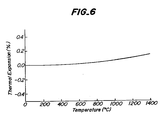
- Fig. 6 is a thermal expansion curve of the zirconyl phosphate-zircon composite body in Example 3. It is seen that the sintered body did not soften in a temperature range from room temperature to 1,400°C.
- Zirconyl phosphate, zircon, magnesia, mullite, aluminum phosphate, alumina, spinel, kaolin and cordierite which had preliminarily been adjusted in grain size were mixed according to a compounding recipe shown in Table 4.
- the zirconyl phosphate was adjusted in grain size by using a vibration mill, a pot mill or an attritor mill which was filled with ZrO2 sintered grinding media having about 5 mm in diameter.
- ZrO2 sintered grinding media stabilized with MgO or Y2O3 was used.
- the chemical compositions of the grinding media used are shown in Table 2. Chemical analysis values of the starting materials used are shown in Table 3.
- the sintered bodies aimed at by the present invention in which the coefficient of thermal expansion in a temperature range from room temperature to 1,400°C was not more than 30 ⁇ 10 ⁇ 7/°C and a melting point was not less than 1,600°C could be obtained when the sintered body consisted of 58.2 to 65.3% by weight of ZrO2, 17.4 to 37.1% by weight of P2O5, 1.6 to 19.0% by weight of SiO2, and the balance being MgO and Al2O3 in a total amount of not more than 2.5% by weight, and contained zirconyl phosphate and zircon as a main crystalline phase and a secondary crystalline phase, respectively.
- Such sintered bodies could be obtained by sintering a formulated mixture in which 0.1 to 5 parts by weight of cordierite was added to 100 parts by weight of a batch mixture in which 5 to 50% by weight of zircon was added to zirconyl phosphate under firing conditions shown in Table 4. It is necessary that with respect to the chemical composition, ZrO2, P2O5, SiO2, and MgO+Al2O3 are 58.2 to 65.3% by weight, 17.4 to 37.1% by weight, 1.6 to 19.0% by weight, and not more than 2.5% by weight, respectively.
- ZrO2 exceeds 65.3% by weight, m-ZrO2 precipitates to result in high expansion, while if it is less than 58.2% by weight, ZrP2O7 precipitates to result in high expansion. Also, if P2O5 is more than 37.1% by weight, ZrP2O7 precipitates to result in high expansion, while if it is less than 17.4% by weight, m-ZrO2 precipitates to result in high expansion. If SiO2 exceeds 19.0% by weight, an amount of zircon precipitated exceeds 50% by weight to result in high expansion, while if it is less than 1.6% by weight, the amount of precipitated zircon is less than 5% by weight, so that an effect of improving strength cannot fully be obtained.
- the amount of precipitated zircon is particularly desirably 5 to 35% by weight.
- the chemical composition is that ZrO2, P2O5, SiO2, and MgO+Al2O3 are 58.2 to 64.7% by weight, 22.5 to 37.1% by weight, 1.6 to 14.1% by weight, and not more than 2.5% by weight, respectively, and the coefficient of thermal expansion in a temperature range from room temperature to 1,400°C is as low as not more than 20 ⁇ 10 ⁇ 7/°C.
- Fig. 8 shows relation between the addition amount of zircon and the coefficient of thermal expansion
- Fig. 9 does the relation between the addition amount of zircon and the four point flexural strength.
- Fig. 10 showing the relation between the self-weight softening percentage at 1,300°C and the total amount of oxides of an alkali metal and an alkaline earth metal excluding MgO in the zirconyl phosphate-zircon composite sintered bodies
- Fig. 11 showing relation between the self-weight softening percentage and the total amount of MgO and Al2O3, the total amount of the oxides of the alkali metal and the alkaline earth metal in the sintered body excluding MgO exceeds 0.5% by weight or the total amount of MgO and Al2O3 exceeds 2.5% by weight
- the self-weight softening percentage at 1,300°C increases and the heat resistance lowers.
- the total amount of the oxides of the alkali metal and the alkaline earth metal contained in each of the zirconyl phosphate starting material and the zircon starting material is not more than 0.5% by weight and the total amount of the oxides of the alkali metal and the alkaline earth metal in the cordierite starting material excluding MgO is not more than 1% by weight.
- Fig. 13 shows an X-ray diffraction pattern of a zirconyl phosphate-zircon complex sintered body in Example 33. It is seen that a main component of the crystalline phase is zirconyl phosphate and a secondary crystalline phase is zircon ("ZR" denotes peaks of zircon).
- Fig. 14 shows a thermal expansion curve of the zirconyl phosphate-zircon complex sintered body in Example 33. It is seen that the sintered body did not soften at a temperature range from room temperature to 1,400°C.
- Zirconyl phosphate, zircon, magnesia, mullite, aluminum phosphate, alumina, spinel, kaolin, and Nb2O5 which had been adjusted in grain size were mixed according to a compounding recipe shown in Table 6.
- the grain size of the zirconyl phosphate was adjusted by using a vibration mill, a pot mill, or an attritor mill which was filled with ZrO2 sintered grinding media of about 5 mm in diameter.
- ZrO2 sintered grinding media ZrO2 stabilized with MgO or Y2O3 was used.
- the chemical composition of the grinding media used was shown in Table 2 as in the same as in the above Examples. Table 3 shows chemical analysis values of the starting materials used.
- the sintered body was machined in a form of 3 ⁇ 4 ⁇ 40 mm as a flexural strength test piece shown in JIS R 1601 (1981), and in the same manners as in the aforementioned examples, coefficient of thermal expansion, four point flexural strength, self-weight softening percentage, open porosity, and melting point were measured.
- the coefficient of thermal expansion was measured by using a push rod indicating type thermal expansion meter employing a high purity alumina sintered body.
- the sintered bodies aimed at by the present invention in which the coefficient of thermal expansion in the temperature range from room temperature to 1,400°C was not more than 30 ⁇ 10 ⁇ 7 and the melting point was not less than 1,600°C could be obtained when ZrO2, P2O5, SiO2, and Nb2O5 were contained in amounts of 58.8 to 65.3% by weight, 17.6 to 37.1% by weight, 1.5 to 16.4% by weight, and 0.1 to 4% by weight, respectively, and zirconyl phosphate and zircon were contained as a main crystalline phase and secondary crystalline phase, respectively.
- Such sintered bodies could be obtained by firing a formulated mixture in which 0.1 to 4 parts by weight of Nb2O5 was added to 100 parts by weight of a batch mixture in which 5 to 50% by weight of zircon was added to zirconyl phosphate under firing conditions shown in Table 5.
- ZrO2, P2O5, SiO2, and Nb2O5 are 58.8 to 65.3% by weight, 17.6 to 37.1% by weight, 1.5 to 16.4% by weight, and 0.1 to 4% by weight, respectively.
- ZrO2 exceeds 65.3% by weight, m-ZrO2 precipitates to result in high expansion, while if it is less than 58.8% by weight, ZrP2O7 precipitates to result in high expansion.
- P2O5 exceeds 37.1% by weight
- ZrP2O7 precipitates to result in high expansion, while if it is less than 17.6% by weight
- m-ZrO2 precipitates to result in high expansion.
- SiO2 exceeds 16.4% by weight, an amount of zircon precipitated exceeds 50% by weight to result in high expansion, while if it is less than 1.5% by weight, the amount of zircon precipitated is less than 5% by weight, so that an effect of improving strength cannot fully be obtained.
- the amount of zircon precipitated is particularly desirably 5 to 35% by weight.
- the chemical composition is that ZrO2, P2O5, SiO2, and Nb2O5 are 58.5 to 64.7% by weight, 22.7 to 37.1% by weight, 1.5 to 11.5% by weight, and 0.1 to 4% by weight, respectively, and the coefficient of thermal expansion in a temperature range from room temperature to 1,400°C is as low as not more than 20 ⁇ 10 ⁇ 7/°C.
- Fig. 15 shows relation between the addition amount of zircon and the coefficient of thermal expansion
- Fig. 16 does relation between the addition amount of zircon and the four point flexural strength.
- Fig. 17 showing relation between the self-weight softening percentage at 1,300°C and the total amount of oxides of an alkali metal and an alkaline earth metal in the zirconyl phosphate-zircon complex sintered bodies
- Fig. 18 showing relation between the self-weight softening percentage at 1,300°C and the amount of Nb2O5
- the self weight softening percentage at 1,300°C increases and the heat resistance lowers.
- the total amount of the oxides of the alkali metal and the alkaline earth metal contained in the zirconyl phosphate starting material, the zircon starting material, and the Nb2O5 starting material is not more than 0.5% by weight.
- the sintered body undergoes serious damages, because of increased coefficient of thermal expansion of the sintered body due to the precipitation of monoclinic ZrO2, rapid shrinkage due to the phase transformation of ZrO2 from the monoclinic system to the tetragonal system, and rapid expansion due to the phase transformation of ZrO2 from the tetragonal phase to the monoclinic system.
- the sintered body cannot be practically used.
- Fig. 19 shows relation between the molar ratio of ZrO2/P2O5 and the coefficient of thermal expansion.
- Fig. 20 shows an X-ray diffraction pattern of a zirconyl phosphate-zircon complex sintered body in Example 63. It is seen that a main component of the crystalline phase is zirconyl phosphate and a secondary crystalline phase is zircon (ZR denotes peak of zircon).
- Fig. 21 shows a thermal expansion curve of the zirconyl phosphate-zircon complex sintered body in Example 63. It is seen that the sintered body did not soften in a temperature range from room temperature to 1,400°C.
- the heat resisting low expansion ceramic materials in which the coefficient of thermal expansion in a temperature range from room temperature to 1,400°C is not more than 30 ⁇ 10 ⁇ 7/°C and the melting point is not less than 1,600°C can be obtained when a chemical composition in which ZrO2, P2O5 and SiO2, and optionally further MgO and Al2O3 or Nb2O5 are contained in a specific amounts, and zirconyl phosphate and zircon are contained as the main crystalline phase and the secondary crystalline phase, respectively.
- the complex sintered bodies according to the present invention have sufficiently wide practical applicability, for instance, when the moldings are shaped in a honeycomb structure by extrusion molding or the like, they are used as rotary heat regenerating type ceramic heat exchangers, heat conductive type heat exchangers, etc. Further, when the moldings are shaped by a slip casting or, a press molding, an injection molding, or the like, the complex sintered bodies are used as heat insulating materials for use in housings of ceramic turbocharger rotors, or engine manifolds.
Landscapes
- Chemical & Material Sciences (AREA)
- Engineering & Computer Science (AREA)
- Ceramic Engineering (AREA)
- Manufacturing & Machinery (AREA)
- Materials Engineering (AREA)
- Structural Engineering (AREA)
- Organic Chemistry (AREA)
- Composite Materials (AREA)
- Compositions Of Oxide Ceramics (AREA)
Claims (20)
- Corps composite en phosphate de zirconyle-zircon à faible dilatation et résistant à la chaleur qui contient du phosphate de zirconyle et du zircon en tant que phase cristalline principale et phase cristalline secondaire, respectivement, où le coefficient de dilatation thermique dans une plage de températures comprise entre la température ambiante et 1.400°C n'est pas supérieur à 3x10⁻⁷/°C et le point de fusion n'est pas inférieur à 1.600°C.
- Corps composite en phosphate de zirconyle-zircon à faible dilatation et résistant à la chaleur selon la revendication 1,qui contient 58,2 à 65,4% en poids de ZrO₂, 17,4 à 37,1% en poids de P₂O₅ et 1,5 à 19,0% en poids de SiO₂ dans la composition chimique.
- Corps composite en phosphate de zirconyle-zircon à faible dilatation et résistant à la chaleur selon la revendication 1, qui contient 58,2 à 64,8% en poids de ZrO₂, 22,5 à 37,1% en poids de P₂O₅ et 1,5 à 14,1% en poids de SiO₂ dans la composition chimique et contient du phosphate de zirconyle et du zircon comme phase cristalline principale et phase cristalline secondaire , respectivement, où le coefficient de dilatation thermique dans la plage de températures comprise entre la température ambiante et 1.400°C ne dépasse pas 20x10⁻⁷/°C.
- Corps composite en phosphate de zirconyle-zircon à faible dilatation et résistant à la chaleur selon la revendication 1, dont la composition chimique consiste essentiellement en 61,3 à 65,4% en poids de ZrO₂, 18,3 à 37,1% en poids de P₂O₅ et 1,6 à 16,4% en poids de SiO₂.
- Corps composite en phosphate de zirconyle-zircon à faible dilatation et résistant à la chaleur selon la revendication 1, qui contient 61,3% à 64,8% en poids de ZrO₂, 23,7 à 37,1% en poids de P₂O₅ et 1,6 à 11,5% en poids de SiO₂ dans sa composition chimique et qui contient du phosphate de zirconyle et du zircon comme phase cristalline principale et phase cristalline secondaire , respectivement, où le coefficient de dilatation thermique dans la plage des températures comprise entre la température ambiante et 1.400°C ne dépasse pas 20x10⁻7/°C.
- Corps composite en phosphate de zirconyle-zircon à faible dilatation et résistant à la chaleur selon la revendication 1, où la quantité totale des oxydes d'un métal alcalin et d'un métal alcalino-terreux ne dépasse pas 0,5% en poids.
- Corps composite en phosphate de zirconyle-zircon à faible dilatation et résistant à la chaleur selon la revendication 1, qui contient 58,2 à 65,3% en poids de ZrO₂, 17,4 à 37,1% en poids de P₂O₅, 1,6 à 19,0% en poids de SiO₂, le reste étant MgO et Al₂O₃ en une quantité totale ne dépassant pas 2,5% en poids.
- Corps composite en phosphate de zirconyle-zircon à faible dilatation et résistant à la chaleur selon la revendication 7, qui contient 58,2 à 64,7% en poids de ZrO₂, 22,5 à 37,1% en poids de P₂O₅, 1,6 à 14,1 % en poids de SiO₂, le reste étant MgO et Al₂O₃ en une quantité totale ne dépassant pas 2,5% en poids, ou le coefficient de dilatation thermique dans la plage des températures comprise entre la température ambiante et 1.400°C n'est pas supérieur à 20x10⁻⁷/°C.
- Corps composite en phosphate de zirconyle-zircon à faible dilatation et résistant à la chaleur selon la revendication 7, où la quantité totale des oxydes d'un métal alcalin et d'un métal alcalino-terreux à l'exclusion de MgO ne dépasse pas 0,5% en poids.
- Corps composite en phosphate de zirconyle-zircon à faible dilatation et résistant à la chaleur selon la revendication 1, qui a une composition chimique consistant essentiellement en 58,8 à 65,3% en poids de ZrO₂, 17,6 à 37,1% en poids de P₂O₅, 1,5 à 16,4% en poids de SiO₂ et 0,1 à 7% en poids de Nb₂O₅.
- Corps composite en phosphate de zirconyle-zircon à faible dilatation et résistant à la chaleur selon la revendication 10, qui a la composition chimique consistant essentiellement en 58,8 à 64,7% en poids de ZrO₂, 22,7 à 37,1% en poids de P₂O₅, 1,5 à 11,5% en poids de SiO₂ et 0,1 à 4% en poids de Nb₂O₅, où le coefficient de dilatation thermique à la plage de températures comprise entre la température ambiante et 1.400°C ne dépasse pas 20x10⁻7/°C.
- Corps composite en phosphate de Zirconyle-zircon à faible dilatation et résistant à la chaleur selon la revendication 10, où la quantité totale des oxydes d'un métal alcalin et d'un métal alcalino-terreux ne dépasse pas 0,5% en poids.
- Procédé de production d'un corps composite en phosphate de zirconyle-zircon contenant du phosphate de zirconyle et du zircon comme phase cristalline principale et phase cristalline secondaire,respectivement, où le coefficient de dilatation thermique dans une plage de températures comprise entre la température ambiante et 1.400°C ne dépasse pas 30x10⁻⁷/°C et le point de fusion n'est pas inférieur à 1.600°C, ledit procédé comprenant l'addition de 5 à 50% en poids de zircon (ZrSiO₄) à du phosphate de zirconyle [(ZrO)₂P₂O₇] pour obtenir un mélange en lot et le frittage du mélange en lot.
- Procédé de production d'un corps composite en phosphate de zirconyle-zircon selon la revendication 13, où la quantité d'addition du zircon est comprise entre 5 et 35% en poids et le coefficient de dilatation thermique de la plage des températures comprise entre la température ambiante et 1.400°C ne dépasse pas 20x10⁻⁷/°C.
- Procédé de production d'un corps composite en phosphate de zirconyle-zircon selon la revendication 13, où le phosphate de zirconyle et le zircon,qui au total ne contiennent pas plus de 0,5% en poids d'oxydes d'un métal alcalin et d'un métal alcalino-terreux, sont utilisés.
- Procédé de production d'un corps composite en phosphate de zirconyle-zircon selon la revendication 13, où on ajoute' 0,1 à 5 parties en poids de cordiérite (2MgO·2A1₂O₃·5SiO₂) à 100 parties en poids du mélange en lot et le mélange ainsi obtenu est fritté.
- Procédé de production d'un corps composite en phosphate de zirconyle-zircon selon la revendication 16, où la matière première de Nb₂O₅ ne contenant pas plus de 0,5% en poids des oxydes du métal alcalin et des oxydes du métal alcalino-terreux dans la quantité totale est utilisée.
- Procédé de production d'un corps composite en phosphate de zirconyle-zircon selon la revendication 16, où on ajoute 0,1 à 4 parties en poids de Nb₂O₅ à 100 parties en poids du mélange en lot puis on fritte le mélange ainsi obtenu.
- Procédé de production d'un corps composite en phosphate de zirconyle-zircon selon la revendication 18, où on utilise une matière première de cordiérite ne contenant pas plus de 1% en poids des oxydes du métal alcalin et du métal alcalino-terreux à l'exclussion de MgO.
- Procédé de production d'un corps composite en phosphate de zirconyle-zircon selon la revendication 13, où le rapport molaire de ZrO₂/P₂O₅ dans une matière première de phosphate de zirconyle est de 1,8 à 2,00.
Applications Claiming Priority (6)
| Application Number | Priority Date | Filing Date | Title |
|---|---|---|---|
| JP215010/86 | 1986-09-13 | ||
| JP61215010A JPS6374958A (ja) | 1986-09-13 | 1986-09-13 | 耐熱低膨脹リン酸ジルコニル・ジルコン複合焼結体およびその製造方法 |
| JP62129873A JPH064510B2 (ja) | 1987-05-28 | 1987-05-28 | 耐熱低膨脹リン酸ジルコニル・ジルコン複合焼結体およびその製造方法 |
| JP129873/87 | 1987-05-28 | ||
| JP62129874A JPH064511B2 (ja) | 1987-05-28 | 1987-05-28 | 耐熱低膨脹リン酸ジルコニル・ジルコン複合焼結体およびその製造方法 |
| JP129874/87 | 1987-05-28 |
Publications (3)
| Publication Number | Publication Date |
|---|---|
| EP0260893A2 EP0260893A2 (fr) | 1988-03-23 |
| EP0260893A3 EP0260893A3 (en) | 1989-08-30 |
| EP0260893B1 true EP0260893B1 (fr) | 1992-04-08 |
Family
ID=27316014
Family Applications (1)
| Application Number | Title | Priority Date | Filing Date |
|---|---|---|---|
| EP87308063A Expired EP0260893B1 (fr) | 1986-09-13 | 1987-09-11 | Corps composites résistants à la chaleur et à dilatation basse en phosphate de zirconyle-silicate de zirconium et leur procédé de fabrication |
Country Status (3)
| Country | Link |
|---|---|
| US (1) | US4883781A (fr) |
| EP (1) | EP0260893B1 (fr) |
| DE (1) | DE3778102D1 (fr) |
Families Citing this family (13)
| Publication number | Priority date | Publication date | Assignee | Title |
|---|---|---|---|---|
| US4925816A (en) * | 1987-08-29 | 1990-05-15 | Ngk Insulators, Ltd. | Novel solid solution, heat-resistant sintered body and method of producing the same |
| US5039644A (en) * | 1989-01-10 | 1991-08-13 | Corning Incorporated | Phosphate-containing ceramic structures for catalyst support and fluid filtering |
| US5488018A (en) * | 1989-04-21 | 1996-01-30 | Limaye; Santosh Y. | Ultra low thermal expansion, highly thermal shock resistant ceramic |
| JPH0717439B2 (ja) * | 1989-09-07 | 1995-03-01 | 日本碍子株式会社 | 耐熱性リン酸塩―ジルコン複合体及びその製造方法 |
| US5217934A (en) * | 1989-09-07 | 1993-06-08 | Ngk Insulators, Ltd. | Heat resistive phosphate-zircon composite bodies and process for producing same |
| JPH0717440B2 (ja) * | 1989-09-07 | 1995-03-01 | 日本碍子株式会社 | 耐熱性リン酸塩焼結体およびその製造法 |
| JPH0639322B2 (ja) * | 1990-01-11 | 1994-05-25 | 日本碍子株式会社 | リン酸塩化合物と焼結体及びその製造法 |
| US5102836A (en) * | 1990-06-06 | 1992-04-07 | Center For Innovative Technology | Ceramic materials with low thermal conductivity and low coefficients of thermal expansion |
| US5268199A (en) * | 1993-04-02 | 1993-12-07 | The Center Of Innovative Technology | Alkali corrosion resistant coatings and ceramic foams having superfine open cell structure and method of processing |
| FR2907116B1 (fr) * | 2006-10-16 | 2008-12-19 | Saint Gobain Ct Recherches | Produit fritte a base de zircon+nb2o5 ou ta2o5 |
| RU2440957C1 (ru) * | 2010-07-12 | 2012-01-27 | Федеральное Государственное Бюджетное Образовательное Учреждение Высшего Профессионального Образования "Нижегородский Государственный Университет Им. Н.И. Лобачевского" | Способ получения титан-, цирконий-, гафний-, германий- и оловосодержащих керамик |
| CN113480308B (zh) * | 2021-07-02 | 2022-07-19 | 中南大学 | 一种耐高温抗烧蚀低温化学键合磷酸基可陶瓷化材料及其制备方法 |
| CN117385485B (zh) * | 2023-12-07 | 2024-02-23 | 天津包钢稀土研究院有限责任公司 | 稀土基宽光谱被动降温中空隔热纤维及其制备方法和应用 |
Family Cites Families (2)
| Publication number | Priority date | Publication date | Assignee | Title |
|---|---|---|---|---|
| US4587172A (en) * | 1984-06-01 | 1986-05-06 | The Perkin-Elmer Corporation | Mirror substrate of atomically substituted Na Zr2 PO12 low expansion ceramic material |
| JPS61219753A (ja) * | 1985-03-22 | 1986-09-30 | 山井 巌 | 低熱膨張性リン酸ジルコニルセラミツクスの製造法 |
-
1987
- 1987-09-09 US US07/094,743 patent/US4883781A/en not_active Expired - Lifetime
- 1987-09-11 DE DE8787308063T patent/DE3778102D1/de not_active Expired - Fee Related
- 1987-09-11 EP EP87308063A patent/EP0260893B1/fr not_active Expired
Also Published As
| Publication number | Publication date |
|---|---|
| US4883781A (en) | 1989-11-28 |
| EP0260893A2 (fr) | 1988-03-23 |
| EP0260893A3 (en) | 1989-08-30 |
| DE3778102D1 (de) | 1992-05-14 |
Similar Documents
| Publication | Publication Date | Title |
|---|---|---|
| EP0037868B2 (fr) | Procédé pour la préparation de matériaux céramiques ayant une faible expansion thermique | |
| US4307198A (en) | Low-expansion ceramics and method of producing the same | |
| EP0210813B1 (fr) | Céramiques à base de titanate d'aluminium-mullite | |
| US5346870A (en) | Aluminum titanate ceramic and process for producing the same | |
| EP0278456B1 (fr) | Composition à faible expansion thermique à base de ZrTiO4-Al2TiO5-ZrO2 | |
| CA1059160A (fr) | Methode pour la preparation des pieces de cordierite sans fissures, faite d'un seul bloc polycristallin | |
| EP0260893A2 (fr) | Corps composites résistants à la chaleur et à dilatation basse en phosphate de zirconyle-silicate de zirconium et leur procédé de fabrication | |
| EP0202107B1 (fr) | Corps céramiques à basse expansion et leur procédé de fabrication | |
| EP0306242B1 (fr) | Matériaux résistant à la chaleur et méthode pour les fabriquer | |
| EP0416823B1 (fr) | Corps frittés résistants à la chaleur et leur procédé de fabrication | |
| EP0506475A2 (fr) | Structure en titanate d'aluminium et son procédé de préparation | |
| US4895814A (en) | Process for producing alumina silica sintered ceramics having improved high-temperature strength | |
| EP0294115B1 (fr) | Corps frittés en phosphate de zirconyle et leur procédé de fabrication | |
| EP0437067B1 (fr) | Composés de phosphate, corps frittés de ces composés et manufacture de ces corps frittés | |
| US5217934A (en) | Heat resistive phosphate-zircon composite bodies and process for producing same | |
| JPH064511B2 (ja) | 耐熱低膨脹リン酸ジルコニル・ジルコン複合焼結体およびその製造方法 | |
| EP0416796B1 (fr) | Corps composites résistants à la chaleur basse en phosphate-silicate de zirconium et leur procédé de fabrication | |
| KR910009890B1 (ko) | 신규한 고용상, 내열성 소결체 및 그 제조방법 | |
| JPH0520385B2 (fr) | ||
| JPH064510B2 (ja) | 耐熱低膨脹リン酸ジルコニル・ジルコン複合焼結体およびその製造方法 | |
| JP2500809B2 (ja) | 耐熱性リン酸塩化合物焼結体及びその製造方法 | |
| JPH0547498B2 (fr) | ||
| JPH0149665B2 (fr) |
Legal Events
| Date | Code | Title | Description |
|---|---|---|---|
| PUAI | Public reference made under article 153(3) epc to a published international application that has entered the european phase |
Free format text: ORIGINAL CODE: 0009012 |
|
| AK | Designated contracting states |
Kind code of ref document: A2 Designated state(s): BE DE FR GB SE |
|
| PUAL | Search report despatched |
Free format text: ORIGINAL CODE: 0009013 |
|
| AK | Designated contracting states |
Kind code of ref document: A3 Designated state(s): BE DE FR GB SE |
|
| 17P | Request for examination filed |
Effective date: 19900210 |
|
| 17Q | First examination report despatched |
Effective date: 19910805 |
|
| GRAA | (expected) grant |
Free format text: ORIGINAL CODE: 0009210 |
|
| AK | Designated contracting states |
Kind code of ref document: B1 Designated state(s): BE DE FR GB SE |
|
| REF | Corresponds to: |
Ref document number: 3778102 Country of ref document: DE Date of ref document: 19920514 |
|
| ET | Fr: translation filed | ||
| PLBE | No opposition filed within time limit |
Free format text: ORIGINAL CODE: 0009261 |
|
| STAA | Information on the status of an ep patent application or granted ep patent |
Free format text: STATUS: NO OPPOSITION FILED WITHIN TIME LIMIT |
|
| 26N | No opposition filed | ||
| EAL | Se: european patent in force in sweden |
Ref document number: 87308063.4 |
|
| REG | Reference to a national code |
Ref country code: GB Ref legal event code: IF02 |
|
| PGFP | Annual fee paid to national office [announced via postgrant information from national office to epo] |
Ref country code: GB Payment date: 20050901 Year of fee payment: 19 |
|
| PGFP | Annual fee paid to national office [announced via postgrant information from national office to epo] |
Ref country code: SE Payment date: 20050921 Year of fee payment: 19 Ref country code: FR Payment date: 20050921 Year of fee payment: 19 |
|
| PGFP | Annual fee paid to national office [announced via postgrant information from national office to epo] |
Ref country code: DE Payment date: 20050924 Year of fee payment: 19 |
|
| PGFP | Annual fee paid to national office [announced via postgrant information from national office to epo] |
Ref country code: BE Payment date: 20050928 Year of fee payment: 19 |
|
| PG25 | Lapsed in a contracting state [announced via postgrant information from national office to epo] |
Ref country code: SE Free format text: LAPSE BECAUSE OF NON-PAYMENT OF DUE FEES Effective date: 20060912 |
|
| PG25 | Lapsed in a contracting state [announced via postgrant information from national office to epo] |
Ref country code: BE Free format text: LAPSE BECAUSE OF NON-PAYMENT OF DUE FEES Effective date: 20060930 |
|
| PG25 | Lapsed in a contracting state [announced via postgrant information from national office to epo] |
Ref country code: DE Free format text: LAPSE BECAUSE OF NON-PAYMENT OF DUE FEES Effective date: 20070403 |
|
| EUG | Se: european patent has lapsed | ||
| GBPC | Gb: european patent ceased through non-payment of renewal fee |
Effective date: 20060911 |
|
| REG | Reference to a national code |
Ref country code: FR Ref legal event code: ST Effective date: 20070531 |
|
| PG25 | Lapsed in a contracting state [announced via postgrant information from national office to epo] |
Ref country code: GB Free format text: LAPSE BECAUSE OF NON-PAYMENT OF DUE FEES Effective date: 20060911 |
|
| BERE | Be: lapsed |
Owner name: *NGK INSULATORS LTD Effective date: 20060930 |
|
| PG25 | Lapsed in a contracting state [announced via postgrant information from national office to epo] |
Ref country code: FR Free format text: LAPSE BECAUSE OF NON-PAYMENT OF DUE FEES Effective date: 20061002 |