EP0260927A2 - Verfahren zur Herstellung von kornorientierten Silizium-Stahlblechen mit sehr niedrigen Walzverlusten - Google Patents
Verfahren zur Herstellung von kornorientierten Silizium-Stahlblechen mit sehr niedrigen Walzverlusten Download PDFInfo
- Publication number
- EP0260927A2 EP0260927A2 EP87308134A EP87308134A EP0260927A2 EP 0260927 A2 EP0260927 A2 EP 0260927A2 EP 87308134 A EP87308134 A EP 87308134A EP 87308134 A EP87308134 A EP 87308134A EP 0260927 A2 EP0260927 A2 EP 0260927A2
- Authority
- EP
- European Patent Office
- Prior art keywords
- steel sheet
- electron beam
- silicon steel
- grain oriented
- oriented silicon
- Prior art date
- Legal status (The legal status is an assumption and is not a legal conclusion. Google has not performed a legal analysis and makes no representation as to the accuracy of the status listed.)
- Granted
Links
Images


Classifications
-
- C—CHEMISTRY; METALLURGY
- C23—COATING METALLIC MATERIAL; COATING MATERIAL WITH METALLIC MATERIAL; CHEMICAL SURFACE TREATMENT; DIFFUSION TREATMENT OF METALLIC MATERIAL; COATING BY VACUUM EVAPORATION, BY SPUTTERING, BY ION IMPLANTATION OR BY CHEMICAL VAPOUR DEPOSITION, IN GENERAL; INHIBITING CORROSION OF METALLIC MATERIAL OR INCRUSTATION IN GENERAL
- C23C—COATING METALLIC MATERIAL; COATING MATERIAL WITH METALLIC MATERIAL; SURFACE TREATMENT OF METALLIC MATERIAL BY DIFFUSION INTO THE SURFACE, BY CHEMICAL CONVERSION OR SUBSTITUTION; COATING BY VACUUM EVAPORATION, BY SPUTTERING, BY ION IMPLANTATION OR BY CHEMICAL VAPOUR DEPOSITION, IN GENERAL
- C23C26/00—Coating not provided for in groups C23C2/00 - C23C24/00
-
- C—CHEMISTRY; METALLURGY
- C21—METALLURGY OF IRON
- C21D—MODIFYING THE PHYSICAL STRUCTURE OF FERROUS METALS; GENERAL DEVICES FOR HEAT TREATMENT OF FERROUS OR NON-FERROUS METALS OR ALLOYS; MAKING METAL MALLEABLE, e.g. BY DECARBURISATION OR TEMPERING
- C21D8/00—Modifying the physical properties of ferrous metals or ferrous alloys by deformation combined with, or followed by, heat treatment
- C21D8/12—Modifying the physical properties of ferrous metals or ferrous alloys by deformation combined with, or followed by, heat treatment during manufacturing of articles with special electromagnetic properties
- C21D8/1294—Modifying the physical properties of ferrous metals or ferrous alloys by deformation combined with, or followed by, heat treatment during manufacturing of articles with special electromagnetic properties involving a localised treatment
-
- H—ELECTRICITY
- H01—ELECTRIC ELEMENTS
- H01F—MAGNETS; INDUCTANCES; TRANSFORMERS; SELECTION OF MATERIALS FOR THEIR MAGNETIC PROPERTIES
- H01F1/00—Magnets or magnetic bodies characterised by the magnetic materials therefor; Selection of materials for their magnetic properties
- H01F1/01—Magnets or magnetic bodies characterised by the magnetic materials therefor; Selection of materials for their magnetic properties of inorganic materials
- H01F1/03—Magnets or magnetic bodies characterised by the magnetic materials therefor; Selection of materials for their magnetic properties of inorganic materials characterised by their coercivity
- H01F1/12—Magnets or magnetic bodies characterised by the magnetic materials therefor; Selection of materials for their magnetic properties of inorganic materials characterised by their coercivity of soft-magnetic materials
- H01F1/14—Magnets or magnetic bodies characterised by the magnetic materials therefor; Selection of materials for their magnetic properties of inorganic materials characterised by their coercivity of soft-magnetic materials metals or alloys
- H01F1/147—Alloys characterised by their composition
- H01F1/14766—Fe-Si based alloys
- H01F1/14775—Fe-Si based alloys in the form of sheets
- H01F1/14783—Fe-Si based alloys in the form of sheets with insulating coating
Definitions
- This invention relates to a method of producing an extra-low iron loss grain oriented silicon steel sheet, and more particularly it is to conduct refinement of magnetic domains and hence advantageous improvement of iron loss properties by subjecting a coating layer formed after finish annealing or a mirror finished steel sheet surface after finish annealing to CVD, ion plating or iron implantation process with nitride, carbide, oxide or the like, forming an insulation coating on the resulting tension layer and then subjecting the coating to electron beam (EB) irradiation in a direction crossing the rolling direction.
- EB electron beam
- the grain oriented silicon steel sheet wherein secondary recrystallized grains are highly aligned in ⁇ 110 ⁇ 001> orientation, namely Goss orientation, is mainly used as a core for transformer and other electrical machinery and equipment.
- the magnetic flux density represented by B10 value
- the iron loss represented by W 17/50 value
- Such a magnetic domain refinement is effective for the grain oriented silicon steel sheet not subjected to the strain relief annealing in the manufacture of stacked lamination-core type transformers.
- the strain relief annealing is performed after the magnetic domain refinement, so that the local microstrain produced by laser irradiation on purpose is released by the annealing treatment to make the width of magnetic domains wide and consequently the laser irradiating effect is lost.
- Japanese Patent Application Publication No. 52-24,499 discloses a method of producing an extra-low iron loss grain oriented silicon steel sheet wherein the surface of the grain oriented silicon steel sheet is subjected to a mirror finishing after the finish annealing or a metal plating is applied to the mirror finished surface or further an insulation coating is baked thereon.
- the mirror finishing for improving the iron loss does not sufficiently contribute to the reduction of iron loss in comparison with remarkable cost-up of the manufacturing step.
- the adhesion property to the insulation coating indispensably applied and baked after the mirror finishing is not yet adopted in the present manufacturing step.
- Japanese Patent laid open No. 59-229,419 proposes a method wherein a heat energy is locally applied to the surface of the silicon steel sheet to form a heat strain zone.
- a heat energy is locally applied to the surface of the silicon steel sheet to form a heat strain zone.
- the effect based on the preferential formation of such a local heat strain zone is lost by high temperature annealing above 600°C.
- a method of introducing artificial grain boundary into the silicon steel sheet having a secondary grain size of not less than 3 mm in Japanese Patent laid open No. 58-144,424 and a method of irradiating plasma flame to the grain oriented silicon steel sheet after the finish annealing in Japanese Patent laid open No. 62-96,617. In the latter methods, however, the effect is lost in case of the material for wound-core type transformer subjected to the strain relief annealing.
- a method of producing an extra-low iron loss grain oriented silicon steel sheet which comprises forming an insulation coating composed mainly of a phosphate and colloidal silica on a grain oriented silicon steel sheet after finish annealing, and then irradiating electron beam onto the resulting insulation coating in a direction crossing a rolling direction of the sheet.
- an inert gas such as Ar, N2 or the like is introduced into the vicinity of electron beam irradiated zone of the coating.
- a method of producing an extra-low iron loss grain oriented silicon steel sheet which comprises removing an oxide layer from a surface of a grain oriented silicon steel sheet after finish annealing, subjecting the steel sheet surface to finish polishing into a mirror state having a center-line average roughness Ra of not more than 0.4 ⁇ m, irradiating electron beam to the mirror finished surface in a direction substantially perpendicular to a rolling direction of the sheet, and forming a thin tension coat of at least one layer composed of at least one of nitrides and/or carbides of Ti, Zr, Hf, V, Nb, Ta, Cr, Mo, W, Co, Ni, Al, B and Si and oxides of Al, Ni, Cu, W, Si and Zn through CVD, ion plating or ion implantation process.
- a method of producing an extra-low iron loss grain oriented silicon steel sheet which comprises removing an oxide layer from a surface of a grain oriented silicon steel sheet after finish annealing, subjecting the steel sheet surface to finish polishing into a mirror state having a center-line average roughness Ra of not more than 0.4 ⁇ m, forming a thin tension coat of at least one layer composed of at least one of nitrides and/or carbides of Ti, Zr, Hf, V, Nb, Ta, Cr, Mo, W, Mn, Co, Ni, Al, B and Si and oxides of Al, Ni, Cu, W, Si and Zn through CVD, ion plating or ion implantation process, and irradiating electron beam in a direction crossing a rolling direction of the sheet before or after the formation of an insulation coating composed mainly of a phosphate and colloidal silica.
- a method of producing an extra-low iron loss grain oriented silicon steel sheet which comprises removing an oxide layer from a surface of a grain oriented silicon steel sheet after finish annealing, subjecting the steel sheet surface to finish polishing into a mirror state having a center-line average roughness Ra of not more than 0.4 ⁇ m, forming a thin tension coat of at least one layer composed of at least one of nitrides and/or carbides of Ti, Zr, Hf, V, Nb, Ta, Cr, Mo, W, Mn, Co, Ni, Al, B and Si and oxides of Al, Ni, Cu, W, Si and Zn, and irradiating electron beam in a direction crossing a rolling direction of the sheet before or after the formation of an insulation coating having an electric conductivity of not less than 1010 ⁇ cm and Selected from at least one of SiO2, Si3N4, SiC, Al2O3 and BN.
- an inert gas such as Ar, N2 or the like is introduced into the vicinity of electron beam irradiated zone of the insulation coating.
- an apparatus for continuously reducing iron loss in a grain oriented silicon steel sheet comprising a vacuum treating unit provided with an electron beam irradiation device for irradiating electron beam to the silicon steel sheet in a direction crossing a rolling direction of the sheet, and a pair of exhaust unit rows arranged at entrance and delivery sides of said treating unit and adjusted to gradually increase the vacuum degree toward said treating unit.
- the vacuum treating unit is provided with a high vacuum chamber for raising the vacuum degree at the electron beam irradiated zone.
- a continuously cast slab of silicon steel containing C: 0.046% by weight (simply shown as % hereinafter), Si: 3.44%, Mn: 0.068%, Se: 0.021%, Sb: 0.025% and Mo: 0.013% was heated at 1,350°C for 4 hours and then hot rolled to obtain a hot rolled steel sheet of 2.0 mm in thickness.
- the hot rolled steel sheet was subjected to a normalized annealing at 900°C for 3 minutes, which was then subjected to a cold rolling two times through an intermediate annealing at 950°C for 3 minutes to obtain a final cold rolled steel sheet of 0.23 mm in thickness.
- test sheets there were provided two test sheets, one of which was the finish annealed steel sheet not subjected to EB irradiation (c) and the other of which was the steel sheet provided thereon with the insulation coating after the finish annealing and not subjected to EB irradiation (d).
- the remaining finish annealed steel sheet was lightly pickled (in 10% solution of HCl) and subjected to a chemical polishing with a mixed solution of 3% HF and H2O2 into a mirror state having a center-line average roughness of 0.03 ⁇ m, which was then divided into four specimens and treated under the following conditions:
- the magnetic properties in the sheets (a) and (b) after the EB irradiation to the usual finish annealed grain oriented silicon steel sheet have B10 value of 1.90 ⁇ 1.91 T and W 17/50 value of 0.82 ⁇ 0.83 W/kg, wherein the W 17/50 value is raised by 0.05 ⁇ 0.06 W/kg as compared with the magnetic properties in the cases (c) and (d) not subjected to EB irradiation.
- the magnetic properties in the sheets (f) and (h) when the finish annealed steel sheet is polished and subjected to ion plating for TiN coat and further to EB irradiation have B10 value of 1.91 ⁇ 1.92 T and W 17/50 value of 0.65 ⁇ 0.66 W/kg, wherein the W 17/50 value is raised by 0.05 ⁇ 0.07 W/kg as compared with the magnetic properties in the cases (e) and (g) not subjected to EB irradiation.
- products having an extra-low iron loss can be obtained by irradiating electron beam to the finish annealed grain oriented silicon steel sheet after the formation of insulation coating, or by polishing the surface of the finish annealed grain oriented silicon steel sheet to a mirror state, forming a thin tension coat of TiN thereon, forming an insulation coating and then performing EB irradiation.
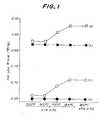
- Fig. 1 shows a change of iron loss property when the products after the treatments (a), (b), (f) and (h) in Table 1 are subjected to high temperature annealing. As seen from Fig. 1, in the cases (b) and (h) of Table 1, no degradation of iron loss property occurs even in the high temperature annealing treatment.
- a continuously cast slab of silicon steel containing C: 0.043%, Si: 3.41%, Mn: 0.066%, Se: 0.020%, Sb: 0.023% and Mo: 0.012% was heated at 1,350°C for 4 hours and then hot rolled to obtain a hot rolled steel sheet of 2.0 mm in thickness.
- the hot rolled steel sheet was subjected to a normalized annealing at 900°C for 3 minutes and further to a cold rolling two times through an intermediate annealing at 950°C for 3 minutes to obtain a final cold rolled steel sheet of 0.23 mm in thickness.
- the cold rolled steel sheet was subjected to decarburization and primary recrystallization annealing in a wet hydrogen atmosphere at 820°C, it was divided into two coils, to which was applied a slurry of an annealing separator (A) composed mainly of MgO or an annealing separator (B) composed of inert Al2O3 (70%), MgO (25%), TiO2 (4%) and SrSO4 (1%).
- the thus coated coil was subjected to a secondary recrystallization annealing at 850°C for 50 hours and further to a purification annealing in a dry hydrogen atmosphere at 1,200°C for 6 hours.
- an insulation coating composed mainly of a phosphate and colloidal silica was formed on the coil treated with the annealing separator (A).
- the coil treated with the annealing separator (B) was pickled to remove an oxide layer from the surface thereof and subjected to an electrolytic polishing into a mirror state having a center-line average roughness of 0.1 ⁇ m, to which was formed a TiN thin coat of 1.0 ⁇ m in thickness by means of a continuous ion plating apparatus (HCD process) and then an insulation coating composed mainly of a phosphate and colloidal silica was formed thereon.
- HCD process continuous ion plating apparatus
- Each of these treated steel sheets (A) and (B) was subjected to EB irradiation in a direction perpendicular to the rolling direction (acceleration voltage: 60 kV, acceleration current: 1.5 mA, beam diameter: 0.1 mm, beam scanning space: 5 mm).
- the coil was subjected to an annealing treatment in a nitrogen gas atmosphere at 800°C for 5 hours.
- the magnetic properties of the resulting products are shown in the following Table 2.
- the magnetic properties when the usual finish annealed grain oriented silicon steel sheet is subjected to EB irradiation have B10 value of 1.91 T and W 17/50 value of 0.83 W/kg, which are raised by 0.01 T and 0.05 W/kg as compared with those in the treatment condition (c).
- discharge phenomenon occurs on the insulation coating in the course of the EB irradiation.
- the W 17/50 value is raised by 0.08 W/kg, and the occurrence of discharge on the insulation coating becomes small in the course of the EB irradiation.
- the magnetic properties in case of the treatment condition (d) that EB irradiation is performed after the formation of TiN coat on the polished steel sheet through ion plating have B10 value of 1.92 T and W 17/50 value of 0.68 W/kg, which are raised by 0.01 T and 0.05 W/kg as compared with those in the case of the treatment condition (f).
- discharge phenomenon occurs on the insulation coating in the course of the EB irradiation.
- the W 17/50 value is raised by 0.08 W/kg and the occurrence of discharge on the insulation coating becomes small in the course of the EB irradiation.
- the discharge property in the irradiation and the magnetic properties can be improved by irradiating electron beam to the insulation coating formed on the grain oriented silicon steel sheet and simultaneously introducing Ar gas into the vicinity of EB irradiated zone.
- the extra-low iron loss grain oriented silicon steel sheet products can be obtained with an improved discharge property by polishing the surface of the grain oriented silicon steel sheet into a mirror state, forming a thin tension coat of TiN on the mirror finished surface, forming an insulation coating thereon and irradiating electron beam to the insulation ooating, during which Ar gas is introduced into the vicinity of EB irradiated zone.
- a continuously cast slab of silicon steel containing C: 0.043%, Si: 3.32%, Mn: 0.066%, Se: 0.020%, Sb: 0.023% and Mo: 0.013% was heated at 1,360°C for 5 hours and then hot rolled to obtain a hot rolled steel sheet of 2.2 mm in thickness.
- the hot rolled steel sheet was subjected to a normalized annealing at 900°C for 3 minutes and further to a cold rolling two times through an intermediate annealing at 950°C for 3 minutes to obtain a final cold rolled steel sheet of 0.23 mm in thickness.
- the steel sheet was pickled to remove an oxide layer from the surface and subjected to an electrolytic polishing into a mirror state having a center-line average roughness of 0.1 ⁇ m, onto which was formed a TiN thin coat of 1.0 ⁇ m in thickness by means of a continuous ion plating apparatus (HCD process).
- HCD process continuous ion plating apparatus
- the steel sheet was subjected to any one of the treatments (a) ⁇ (l) as shown in the following Table 3. That is, in the treatments (a), (d), (g) and (j), electron beam was irradiated to the TiN thin coat in a direction perpendicular to the rolling direction at a space of 7 mm (acceleration voltage: 60 kV, acceleration current: 0.7 mA, beam diameter: 0.1 mm). Thereafter, an insulation coating composed mainly of a phosphate and colloidal silica was formed on the thin coat in the treatment (a), while an insulation coating of Si3N4, Al2O3 or BN was formed on the thin coat in the treatment (d), (g) or (j).
- the TiN thin coat (thickness: 1 ⁇ m) was formed through ion plating process, and then the insulation coating composed mainly of a phosphate and colloidal silica was formed thereon in case of the treatment (b) or the insulation coating composed of Si3N4, Al2O3 or BN was formed in case of the treatment (e), (h) or (k), and thereafter electron beam was irradiated at a space of 7 mm in a direction perpendicular to the rolling direction (acceleration voltage: 60 kV, acceleration current: 0.7 mA, beam diameter: 0.1 mm) and further the strain relief annealing was carried out at 800°C for 2 hours.
- the W 17/50 value is largely enhanced by 0.04 ⁇ 0.06 W/kg as compared with the treatments (c), (f), (i) and (l).
- the reason why the iron loss property is largely improved by the EB irradiation is due to the fact that different tension states are formed on the coating by the EB irradiation as seen from Figs. 2a and 2b.
- the specific resistance of the insulation coating is not less than 1 ⁇ 1010 ⁇ cm.
- a base metal there may be used any of conventionally well-known silicon steel compositions, a typical example of which includes:
- the components having a given base metal composition are melted in the conventionally well-known steel making furnace such as LD converter, electric furnace, open hearth or the like and then cast into a slab. It is a matter of course that vacuum treatment or vacuum dissolution may be applied during the melting.
- the resulting hot rolled steel sheet is subjected to a normalized annealing at a temperature of 800 ⁇ 1,100°C. Then, the thus treated steel sheet is cold rolled to a final product thickness of 0.15 mm ⁇ 0.35 mm by a heavy cold rolling at once or by a two-times cold rolling through an intermediate annealing usually performed at 850°C ⁇ 1,050°C. In the latter case, the draft is about 50% ⁇ 80% in the first cold rolling and about 50% ⁇ 85% in the second cold rolling.
- the final cold rolled steel sheet is degreased and subjected to decarburization and primary recrystallization annealing in a wet hydrogen atmosphere at 750°C ⁇ 850°C.
- the thus treated surface of the steel sheet is coated with an annealing separator composed mainly of MgO.
- the annealing separator composed mainly of MgO is generally applied when the formation of forsterite layer is indispensable after the finish annealing.
- the feature that the forsterite layer is not formed is effective for simplifying the subsequent mirror finishing of the steel sheet surface. In the latter case, therefore, it is preferable to use an annealing separator composed of a mixture of MgO and not less than 50% of Al2O3, ZrO2, TiO2 or the like.
- a secondary recrystallization annealing is performed for sufficiently growing secondary recrystallized grains with ⁇ 110 ⁇ 001> orientation.
- this treatment is carried out by box annealing wherein the temperature of the steel sheet is rapidly raised to more than 1,000°C and then held at that temperature for a given time.
- the isothermal annealing at a temperature of 820°C ⁇ 900°C is carried out in order to highly grow the secondary recrystallized texture with ⁇ 110 ⁇ 001> orientation.
- a slow temperature-rise annealing at a rate of 0.5 ⁇ 15°C/hr may be performed.
- an insulation coating composed mainly of a phosphate and colloidal silica is formed on the steel sheet surface.
- electron beam is irradiated to the insulation coating in a direction crossing the rolling direction of the sheet, preferably a direction inclined at an angle of 60° ⁇ 90° with respect to the rolling direction, at a space of about 3 ⁇ 15 mm.
- the EB irradiation conditions are acceleration voltage of 10 ⁇ 100 kV, acceleration current of 0.005 ⁇ 10 mA and beam diameter of 0.005 ⁇ 1 mm. It is effective to irradiate the electron beam in form of dot or line.
- an inert gas such as Ar, N2 or the like is introduced into the vicinity of the EB irradiated zone for improving the discharge property.
- the forsterite layer or oxide layer produced on the steel sheet surface after the purification annealing is removed from this surface by pickling with a strong acid such as sulfuric acid, nitric acid, hydrofluoric acid or the like, or by a mechanical removing process such as cutting, grinding or the like, whereby the magnetic properties are further improved.
- a strong acid such as sulfuric acid, nitric acid, hydrofluoric acid or the like
- a mechanical removing process such as cutting, grinding or the like
- the steel sheet surface is rendered into a mirror finished state having a center-line average roughness Ra of not more than 0.4 ⁇ m by the conventional process such chemical polishing, electropolishing or the like.
- a thin coat of at least one layer composed of at least one of nitrides and/or carbides of Ti, Zr, V, Nb, Ta, Cr, Mo, W, Mn, Co, Ni, Al, B and Si and oxides of Al, Ni, Cu, W, Si and Zn is formed on the steel sheet surface through CVD, ion plating or ion implantation process.
- the electron beam is irradiated to the thin coat in a direction crossing the rolling direction, preferably a direction inclined at an angle of 60° ⁇ 90° with respect to the rolling direction, at a space of about 3 ⁇ 15 mm under the same conditions as previously mentioned, if necessary.
- an insulation coating composed mainly of a phosphate and colloidal silica is formed thereon, or an insulation coating having a specific resistance of not less than 1010 ⁇ cm and selected from SiO2, Si3N4, SiC, Al2O3 and BN is formed through CVD, ion plating or ion implantation process.
- an insulation coating is subjected to EB irradiation in a direction crossing the rolling direction, preferably a direction inclined at an angle of 60° ⁇ 90° with respect to the rolling direction, at a space of about 3 ⁇ 15 mm under the same conditions as mentioned above.
- the thus treated silicon steel sheet may be subJected to strain relief annealing and flattening heat treatment at a temperature above 600°C without degrading the iron loss properties.
- the irradiation of electron beam to the surface of the grain oriented silicon steel sheet in a direction crossing the rolling direction may be performed by using a batch type apparatus, it is efficient to perform the EB irradiation by means of a continuously treating apparatus as shown in Fig. 3.
- numeral 1 is an uncoiler
- numeral 2 a vacuum treating unit
- numerals 3 and 4 exhaust unit rows arranged at entrance and delivery sides of the vacuum treating unit 2.
- Each of these exhaust unit rows 3, 4 consists of plural exhaust units 3a, 3b, 3c, 3d, 3e or 4a, 4b, 4c, 4d, 4e adjusted to gradually increase the vacuum degree toward the vacuum treating unit 2.
- Numeral 5 is a coiler, numeral 6 a shear, numerals 7a ⁇ 7c rotary vacuum pumps, numeral 8 a combination of mechanical booster pump and rotary vacuum pump, and numeral 9 a combination of oil diffusion pump and rotary vacuum pump.
- Numeral 10 is a device for irradiating electron beam 11.
- a high vacuum chamber 12 may be arranged in the vacuum treating unit 2 in order to more increase the vacuum degree in the electron beam irradiating zone as shown in Fig. 4.
- exhaust ports 13 connecting to oil diffusion pump and rotary vacuum pump for further vacuumizing the irradiation path of electron beam.
- the irradiation of electron beam to the silicon steel sheet after the finish annealing is performed under vacuum as follows.
- the grain oriented silicon steel sheet S coiled after the final treatment is decoiled from the uncoiler 1 and passed through the exhaust unit row 3 of continuous air-to-air system to introduce into the vacuum treating unit 2.
- electron beam 11 is scanned at a space of 3 ⁇ 15 mm in a direction crossing the rolling direction of the sheet by means of the electron beam irradiating device 10.
- the vacuum degree is low, vacuum discharge is frequently caused to attenuate the effective treatment of electron beam and hence impede the reduction of iron loss in the steel sheet.
- the vacuum degree in the zone of irradiating electron beam to the steel sheet is made higher than that of the vacuum treating unit 2 as shown in Fig. 4. That is, when the vacuum degree of the vacuum treating unit 2 is 10 ⁇ 3 ⁇ 10 ⁇ 4 mmHg, the vacuum degree of the shadowed zone 14 is sufficient to be about l ⁇ 10 ⁇ 4 ⁇ 10 ⁇ 6 mmHg.
- numeral 15 is a pipe for introducing an inert gas such as Ar, N2 or the like, through which the inert gas may be introduced into the vicinity of EB irradiated zone on the insulation coating in the silicon steel sheet to effectively reduce the occurrence of discharge.
- an inert gas such as Ar, N2 or the like
- the steel sheet subjected to the EB irradiation is passed from the delivery of the vacuum treating unit 2 through the exhaust unit row 4, which is adjusted to gradually increase the vacuum degree toward the vacuum treating unit 2, to the atmosphere and then wound on the coiler 5.
- the magnetic domain refinement is effectively performed to improve the iron loss property.
- the thus treated steel sheet was wound on an uncoiler in the form of coil (about 8 tons) and then passed through the continuously treating apparatus shown in Fig. 3 at a line speed of 30 m/min, at where electron beam was irradiated to the steel sheet in its widthwise direction under such conditions that the acceleration voltage was 45 kV, the acceleration current was 120 mA, the scanning space was 8 mm, the beam diameter was 0.1 mm and the vacuum degree of the shadowed zone 14 was 10 ⁇ 5 mmHg.
- a hot rolled silicon steel sheet containing C: 0.055%, Si: 3.25%, Mn: 0.075%, Al: 0.025%, S: 0.030%, Sn: 0.1% and Cu: 0.05% was subjected to a cold rolling two times through an intermediate annealing at 1,000°C for 3 minutes to obtain a cold rolled steel sheet of 0.20 mm in thickness.
- the cold rolled steel sheet was subjected to a decarburization treatment at 850°C, a secondary recrystallization annealing by raising temperature from 850°C to 1,050°C at a rate of 15°C/hr, and a purification annealing at 1,200°C for 8 hours to obtain a grain oriented silicon steel sheet.
- a hot rolled silicon steel sheet containing C: 0.045%, Si: 3.40%, Mn: 0.066%, Mo: 0.020%, Se: 0.020% and Sb: 0.025% was subjected to a normalized annealing at 900°C for 3 minutes and further to a cold rolling two times through an intermediate annealing at 950°C to obtain a final cold rolled steel sheet of 0.23 mm in thickness.
- the steel sheet was coated with a slurry of an annealing separator composed mainly of MgO, and subjected to a secondary recrystallization annealing at 850°C for 50 hours and further to a purification annealing in a dry hydrogen atmosphere at 1,200°C for 8 hours.
- an annealing separator composed mainly of MgO
- a hot rolled silicon steel sheet containing C: 0.052%, Si: 3.46%, Mn: 0.077%, Al: 0.024%, S: 0.0020%, Cu: 0.1% and Sn: 0.06% was subjected to a normalized annealing at 1,130°C for 3 minutes, quenched and then warm rolled at 300°C to obtain a final cold rolled steel sheet of 0.20 mm in thickness.
- the steel sheet was coated with a slurry of an annealing separator composed of Al2O3 (80%), MgO (15%) and ZrO2 (5%) and subjected to a secondary recrystallization annealing by raising temperature from 850°C to 1,150°C at a rate of 10°C/hr and further to a purification annealing in a dry hydrogen atmosphere at 1,200°C for 8 hours.
- an annealing separator composed of Al2O3 (80%), MgO (15%) and ZrO2 (5%)
- the steel sheet surface was rendered into a mirror state by chemical polishing with a mixed solution of 3% HF and H2O2, and then a thin coat (thickness: 0.5 ⁇ 1.9 ⁇ m) selected from nitrides of (1) BN, (2) Ti(CN), (3) Si3N4, (4) VN, (5) ZrN, (6) Cr2N, (7) AlN and (8) HfN, carbides of (9) ZrC, (10) HfC, (11) SiC, (12) TaC, (13) ZrC and (14) MnC and oxides of (15) ZnO, (16) NiO, (17) SiO2, (18) WO, (19) Al2O3 and (20) CuO was formed thereon through CVD, ion plating (HCD process) or ion implantation process. Thereafter, an insulation coating composed mainly of a phosphate and colloidal silica was formed thereon.
- a hot rolled silicon steel sheet containing C: 0.044%, Si: 3.38%, Mn: 0.072%, Se: 0.020%, Sb: 0.026% and Mo: 0.15% was subjected to a normalized annealing at 1,000°C for 1 minute and further to a cold rolling two times through an intermediate annealing at 950°C for 3 minutes to obtain a final cold rolled steel sheet of 0.18 mm in thickness.
- the steel sheet was coated with a slurry of an annealing separator composed of Al2O3 (70%) and MgO (30%) and subjected to a secondary recrystallization annealing at 850°C for 50 hours and further to a purification annealing in a dry hydrogen atmosphere at 1,200°C for 10 hours.
- an annealing separator composed of Al2O3 (70%) and MgO (30%)
- the steel sheet surface was rendered into a mirror state by chemical polishing with a mixed solution of 3% HF and H2O2, and then a thin tension coat (thickness: 0.1 ⁇ m) selected from (1) TiN, (2) NbN, (3) Mo2N, (4) W2N, (5) CoN, (6) NiN, (7) TiC, (8) NbC, (9) Mo2C, (10) WC, (11) CoC, (12) NiC, (13) VC, (14) CrC and (15) AlC was formed thereon through ion plating process (HCD process). Further, an insulation coating composed mainly of a phosphate and colloidal silica was formed thereon.
- a thin tension coat thinness: 0.1 ⁇ m
- a hot rolled silicon steel sheet containing C: 0.043%, Si: 3.42%, Mn: 0.068%, Mo: 0.012%, Se: 0.020% and Sb: 0.023% was subjected to a normalized annealing at 900°C for 3 minutes and further to a cold rolling two times through an intermediate annealing at 950°C to obtain a final cold rolled steel sheet of 0.23 mm in thickness.
- the steel sheet was coated with a slurry of an annealing separator composed mainly of MgO and subjected to a secondary recrystallization annealing at 850°C for 50 hours and further to a purification annealing in a dry hydrogen atmosphere at 1,200°C for 8 hours.
- an annealing separator composed mainly of MgO
- a hot rolled silicon steel sheet containing C: 0.055%, Si: 3.42%, Mn: 0.075%, Al: 0.025%, S: 0.0025%, Cu: 0.1% and Sn: 0.06% was subjected to a normalized annealing at 1,130°C for 3 minutes, quenched and warm rolled at 300°C to obtain a final cold rolled steel sheet of 0.20 mm in thickness.
- the steel sheet was coated with a slurry of an annealing separator composed of Al2O3 (80%), MgO (15%) and ZrO2 (5%) and subjected to a secondary recrystallization annealing by raising temperature from 850°C to 1,150°C at a rate of 10°C/hr and further to a purification annealing in a dry hydrogen atmosphere at 1,200°C for 8 hours.
- an annealing separator composed of Al2O3 (80%), MgO (15%) and ZrO2 (5%)
- the steel sheet surface was rendered into a mirror state by chemical polishing with a mixed solution of 3% HF and H2O2, and a thin coat (0.5 ⁇ 1.9 ⁇ m) selected from nitrides of (1) BN, (2) Ti(CN), (3) Si3N4, (4) VN, (5) ZrN, (6) Cr2N, (7) AlN and (8) HfN, carbides of (9) ZrC, (10) HfC, (11) SiC, (12) TaC, (13) ZrC and (14) MnC and oxides of (15) ZnO, (16) NiO, (17) SiO2, (18) WO, (19) Al2O3 and (20) CuO was formed thereon through CVD, ion plating (HCD process) or ion implantation process. Then, an insulation coating composed mainly of a phosphate and colloidal silica was formed thereon.
- electron beam was linearly irradiated at a space of 8 mm in a direction perpendicular to the rolling direction of the sheet (acceleration voltage: 50 kV, acceleration current: 0.8 mA, beam diameter: 0.05 mm), during which Ar gas was introduced into the vicinity of EB irradiated zone of the insulation coating, and further the strain relief annealing was carried out at 800°C for 2 hours.
- a slab of silicon steel containing C: 0.042%, Si: 3.32%, Mn: 0.048%, S: 0.031%, B: 0.0028% and N: 0.0062% was heated at 1,300°C for 4 hours and then hot rolled to obtain a hot rolled steel sheet of 1.8 mm in thickness. Then, the steel sheet was subjected to a normalized annealing at 950°C for 3 minutes and further to a warm rolling at 350°C to obtain a final cold rolled 06 steel sheet of 0.23 mm in thickness.
- the steel sheet was coated with a slurry of an annealing separator composed of MgO (35%), Al2O3 (62%) and TiO2 (3%) and subjected to a secondary recrystallization annealing by raising temperature from 850°C to 1,050°C at a rate of 10°C/hr and further to a purification annealing in a dry hydrogen atmosphere at 1,250°C for 4 hours.
- an annealing separator composed of MgO (35%), Al2O3 (62%) and TiO2 (3%)
- HCD process ion plating
- electron beam was irradiated at a space of 6 mm in a direction perpendicular to the rolling direction of the sheet (acceleration voltage: 65 kV, acceleration current: 1.0 mA, beam diameter: 0.15 mm).
- the strain relief annealing was carried out at 850°C for 2 hours.
- the magnetic properties of the resulting product were B10: 1.92T and W 17/50 : 0.63 W/kg.
- a slab of silicon steel containing C: 0.062%, Si: 3.36%, Mn: 0.079%, acid soluble Al: 0.029%, Se: 0.021% and N: 0.069% was heated at 1,420°C for 8 hours and then hot rolled to obtain a hot rolled steel sheet of 2.0 mm in thickness.
- the hot rolled steel sheet was subjected to a cold rolling two times through an intermediate annealing at 1,000°C for 3 minutes to obtain a final cold rolled steel sheet of 0.20 mm in thickness.
- the temperature rising from 500°C to 900°C was performed by rapid heating treatment of 15°C/sec and the temperature dropping from 900°C to 500°C after the intermediate annealing was performed by rapid cooling treatment of 18°C/sec.
- the steel sheet was coated with a slurry of an annealing separator composed of MgO (40%) and Al2O3 (60%) and subjected to a secondary recrystallization annealing by raising temperature from 850°C to 1,100°C at a rate of 8°C/hr and further to a purification annealing in a dry hydrogen atmosphere at 1,220°C for 6 hours.
- an annealing separator composed of MgO (40%) and Al2O3 (60%)
- the steel sheet was subjected to anyone of treatments (a) ⁇ (o) as shown in the following Table 7. That is, in the treatments (a), (d), (g), (j) and (m), electron beam was irradiated to the thin coat at a space of 7 mm in a direction perpendicular to the rolling direction of the sheet (acceleration voltage: 65 kV, acceleration current: 1.2 mA, beam diameter: 0.15 mm), and then an insulation coating of SiO2, Si3N4, Al2O3, BN or SiC+SiO2 was formed thereon.
Landscapes
- Chemical & Material Sciences (AREA)
- Engineering & Computer Science (AREA)
- Physics & Mathematics (AREA)
- Organic Chemistry (AREA)
- Mechanical Engineering (AREA)
- Metallurgy (AREA)
- Materials Engineering (AREA)
- Electromagnetism (AREA)
- Chemical Kinetics & Catalysis (AREA)
- Dispersion Chemistry (AREA)
- Power Engineering (AREA)
- Manufacturing & Machinery (AREA)
- Thermal Sciences (AREA)
- Crystallography & Structural Chemistry (AREA)
- Manufacturing Of Steel Electrode Plates (AREA)
Applications Claiming Priority (8)
| Application Number | Priority Date | Filing Date | Title |
|---|---|---|---|
| JP21583586A JPS6372862A (ja) | 1986-09-16 | 1986-09-16 | 超低鉄損一方向性珪素鋼板の製造方法 |
| JP215835/86 | 1986-09-16 | ||
| JP240189/86 | 1986-10-11 | ||
| JP24018986A JPS6396218A (ja) | 1986-10-11 | 1986-10-11 | 超低鉄損一方向性珪素鋼板の製造方法 |
| JP16123/87 | 1987-01-28 | ||
| JP62016123A JPH0672266B2 (ja) | 1987-01-28 | 1987-01-28 | 超低鉄損一方向性珪素鋼板の製造方法 |
| JP2738687 | 1987-02-10 | ||
| JP27386/87 | 1987-02-10 |
Publications (3)
| Publication Number | Publication Date |
|---|---|
| EP0260927A2 true EP0260927A2 (de) | 1988-03-23 |
| EP0260927A3 EP0260927A3 (en) | 1988-09-21 |
| EP0260927B1 EP0260927B1 (de) | 1993-04-28 |
Family
ID=27456504
Family Applications (1)
| Application Number | Title | Priority Date | Filing Date |
|---|---|---|---|
| EP87308134A Expired - Lifetime EP0260927B1 (de) | 1986-09-16 | 1987-09-15 | Verfahren zur Herstellung von kornorientierten Silizium-Stahlblechen mit sehr niedrigen Walzverlusten |
Country Status (3)
| Country | Link |
|---|---|
| US (2) | US4909864A (de) |
| EP (1) | EP0260927B1 (de) |
| DE (1) | DE3785632T2 (de) |
Cited By (16)
| Publication number | Priority date | Publication date | Assignee | Title |
|---|---|---|---|---|
| EP0367467A1 (de) * | 1988-10-26 | 1990-05-09 | Kawasaki Steel Corporation | Kornorientierte Siliziumstahlbleche mit niedrigen Wattverlusten und Verfahren zur Herstellung derselben |
| EP0423623A1 (de) * | 1989-10-14 | 1991-04-24 | Nippon Steel Corporation | Verfahren zur Herstellung eines gewickelten Kernes mit niedrigen Kernverlusten |
| EP0331497A3 (de) * | 1988-03-03 | 1991-08-21 | Allegheny Ludlum Corporation | Verfahren zum Verbessern der Ummagnetisierungseigenschaften von Elektroblechen |
| EP0331498A3 (de) * | 1988-03-03 | 1991-09-18 | Allegheny Ludlum Corporation | Verfahren zum Vermindern der Eisenverluste in Elektroblechen durch Schaffung hitzebeständiger, verfeinerter Bereichsstrukturen |
| EP0520476A3 (en) * | 1991-06-28 | 1993-09-01 | Kawasaki Steel Corporation | Continuous electron beam irradiation of metal strip |
| EP0438592A4 (en) * | 1988-02-16 | 1993-10-20 | Nippon Steel Corporation | Production method of unidirectional electromagnetic steel sheet having excellent iron loss and high flux density |
| EP0571705A3 (de) * | 1992-05-29 | 1994-02-02 | Kawasaki Steel Co | |
| EP0611829A1 (de) * | 1993-02-15 | 1994-08-24 | Kawasaki Steel Corporation | Verfahren zum Herstellen von rauscharmen kornorientierten Siliziumstahlblechern mit niedrigen Wattverlusten und mit hervorragenden Formeigenschaften |
| EP0971374A4 (de) * | 1997-12-24 | 2003-06-25 | Kawasaki Steel Co | Kornorientiertes siliziumstahlblech mit sehr geringem eisenverlust und herstellungsverfahren desselben |
| EP0910101A4 (de) * | 1997-04-03 | 2005-12-28 | Jfe Steel Corp | Unidirektionale siliziumstahlplatte mit aussergewöhnlichem eisenverlust |
| CN104755637A (zh) * | 2012-11-08 | 2015-07-01 | 新日铁住金株式会社 | 激光加工装置以及激光照射方法 |
| EP2602344A4 (de) * | 2010-08-06 | 2017-05-31 | JFE Steel Corporation | Orientierte elektromagnetische stahlplatte |
| EP2602340A4 (de) * | 2010-08-06 | 2017-08-02 | JFE Steel Corporation | Orientiertes elektromagnetisches stahlblech und herstellungsverfahren dafür |
| CN109983159A (zh) * | 2016-11-28 | 2019-07-05 | 杰富意钢铁株式会社 | 方向性电磁钢板和方向性电磁钢板的制造方法 |
| EP3533902A4 (de) * | 2016-12-21 | 2019-09-04 | JFE Steel Corporation | Kornorientiertes elektrostahlblech und verfahren zur herstellung eines kornorientierten elektrostahlblechs |
| EP3913088A4 (de) * | 2019-01-16 | 2022-09-21 | Nippon Steel Corporation | Verfahren zur herstellung eines kornorientierten elektromagnetischen stahlblechs |
Families Citing this family (14)
| Publication number | Priority date | Publication date | Assignee | Title |
|---|---|---|---|---|
| US5053625A (en) * | 1988-08-04 | 1991-10-01 | Minnesota Mining And Manufacturing Company | Surface characterization apparatus and method |
| US5223048A (en) * | 1988-10-26 | 1993-06-29 | Kawasaki Steel Corporation | Low iron loss grain oriented silicon steel sheets and method of producing the same |
| EP0565029B1 (de) * | 1992-04-07 | 1999-10-20 | Nippon Steel Corporation | Kornorientiertes Siliziumstahlblech mit geringen Eisenverlusten und Herstellungsverfahren |
| CA2094673C (en) * | 1992-10-01 | 2000-10-24 | Joseph R. Lovin | Hydronic cooling of particle accelerator window |
| DE4409691A1 (de) * | 1994-03-22 | 1995-09-28 | Ebg Elektromagnet Werkstoffe | Verfahren zur Herstellung von Elektroblechen mit einem Glasüberzug |
| DE19816158A1 (de) * | 1998-04-09 | 1999-10-14 | G K Steel Trading Gmbh | Verfahren zur Herstellung von korn-orientierten anisotropen, elektrotechnischen Stahlblechen |
| GB2413694A (en) | 2004-04-30 | 2005-11-02 | Ims Nanofabrication Gmbh | Particle-beam exposure apparatus |
| WO2007048433A1 (en) * | 2005-10-28 | 2007-05-03 | Carl Zeiss Sms Gmbh | Charged particle beam exposure system |
| JP5593942B2 (ja) | 2010-08-06 | 2014-09-24 | Jfeスチール株式会社 | 方向性電磁鋼板およびその製造方法 |
| EP2762578B1 (de) * | 2011-09-28 | 2017-03-22 | JFE Steel Corporation | Kornorientiertes elektrisches stahlblech und herstellungsverfahren dafür |
| US11236427B2 (en) | 2017-12-06 | 2022-02-01 | Polyvision Corporation | Systems and methods for in-line thermal flattening and enameling of steel sheets |
| DE102018216457A1 (de) * | 2018-09-26 | 2020-03-26 | Thyssenkrupp Ag | Beschichtung von kornorientiertem Elektroband durch CVD |
| US11211243B2 (en) | 2018-11-21 | 2021-12-28 | Taiwan Semiconductor Manufacturing Company, Ltd. | Method of filling gaps with carbon and nitrogen doped film |
| CN113366125B (zh) | 2019-01-31 | 2023-01-20 | 杰富意钢铁株式会社 | 方向性电磁钢板和使用该方向性电磁钢板的铁芯 |
Family Cites Families (18)
| Publication number | Priority date | Publication date | Assignee | Title |
|---|---|---|---|---|
| US2989633A (en) * | 1956-02-08 | 1961-06-20 | Standard Oil Co | Apparatus and process for radiation |
| US3081485A (en) * | 1958-11-20 | 1963-03-19 | Steigerwald Karl Heinz | Process and apparatus for treating synthetic plastic materials |
| US3325620A (en) * | 1963-02-07 | 1967-06-13 | Temescal Metallurgical Corp | Furnace |
| US3564238A (en) * | 1967-05-08 | 1971-02-16 | Deering Milliken Res Corp | Irradiation apparatus in combination web handling means |
| US3676673A (en) * | 1969-08-18 | 1972-07-11 | Ppg Industries Inc | Apparatus for irradiation in a controlled atmosphere |
| US3634645A (en) * | 1970-04-21 | 1972-01-11 | Westinghouse Electric Corp | Work treating with electron beam |
| JPS5652117B2 (de) * | 1973-11-17 | 1981-12-10 | ||
| JPS5518566A (en) * | 1978-07-26 | 1980-02-08 | Nippon Steel Corp | Improving method for iron loss characteristic of directional electrical steel sheet |
| US4252413A (en) * | 1978-10-05 | 1981-02-24 | Energy Sciences Inc. | Method of and apparatus for shielding inert-zone electron irradiation of moving web materials |
| US4363677A (en) * | 1980-01-25 | 1982-12-14 | Nippon Steel Corporation | Method for treating an electromagnetic steel sheet and an electromagnetic steel sheet having marks of laser-beam irradiation on its surface |
| US4482811A (en) * | 1982-09-30 | 1984-11-13 | Radiation Dynamics, Inc. | Apparatus for guiding cable through a radiation chamber with reduced leakage therefrom |
| US4554029A (en) * | 1982-11-08 | 1985-11-19 | Armco Inc. | Local heat treatment of electrical steel |
| GB8324643D0 (en) * | 1983-09-14 | 1983-10-19 | British Steel Corp | Production of grain orientated steel |
| DE3539731C2 (de) * | 1984-11-10 | 1994-08-04 | Nippon Steel Corp | Kornorientiertes Elektrostahlblech mit stabilen, gegen das Spannungsfreiglühen beständigen magnetischen Eigenschaften und Verfahren und Vorrichtung zu seiner Herstellung |
| WO1986004929A1 (fr) * | 1985-02-22 | 1986-08-28 | Kawasaki Steel Corporation | Procede de production de plaques d'acier au silicium unidirectionnelles avec une perte de fer extremement faible |
| JPS61201732A (ja) * | 1985-03-05 | 1986-09-06 | Kawasaki Steel Corp | 熱安定性、超低鉄損一方向性珪素鋼板の製造方法 |
| JPS6229107A (ja) * | 1985-07-30 | 1987-02-07 | Kawasaki Steel Corp | 超低鉄損一方向性珪素鋼板の製造方法 |
| US4845370A (en) * | 1987-12-11 | 1989-07-04 | Radiation Dynamics, Inc. | Magnetic field former for charged particle beams |
-
1987
- 1987-09-10 US US07/095,527 patent/US4909864A/en not_active Expired - Lifetime
- 1987-09-15 EP EP87308134A patent/EP0260927B1/de not_active Expired - Lifetime
- 1987-09-15 DE DE8787308134T patent/DE3785632T2/de not_active Expired - Fee Related
-
1989
- 1989-11-30 US US07/444,050 patent/US4985635A/en not_active Expired - Fee Related
Cited By (22)
| Publication number | Priority date | Publication date | Assignee | Title |
|---|---|---|---|---|
| EP0438592A4 (en) * | 1988-02-16 | 1993-10-20 | Nippon Steel Corporation | Production method of unidirectional electromagnetic steel sheet having excellent iron loss and high flux density |
| EP0331497A3 (de) * | 1988-03-03 | 1991-08-21 | Allegheny Ludlum Corporation | Verfahren zum Verbessern der Ummagnetisierungseigenschaften von Elektroblechen |
| EP0331498A3 (de) * | 1988-03-03 | 1991-09-18 | Allegheny Ludlum Corporation | Verfahren zum Vermindern der Eisenverluste in Elektroblechen durch Schaffung hitzebeständiger, verfeinerter Bereichsstrukturen |
| EP0367467A1 (de) * | 1988-10-26 | 1990-05-09 | Kawasaki Steel Corporation | Kornorientierte Siliziumstahlbleche mit niedrigen Wattverlusten und Verfahren zur Herstellung derselben |
| US5146063A (en) * | 1988-10-26 | 1992-09-08 | Kawasaki Steel Corporation | Low iron loss grain oriented silicon steel sheets and method of producing the same |
| EP0423623A1 (de) * | 1989-10-14 | 1991-04-24 | Nippon Steel Corporation | Verfahren zur Herstellung eines gewickelten Kernes mit niedrigen Kernverlusten |
| EP0520476A3 (en) * | 1991-06-28 | 1993-09-01 | Kawasaki Steel Corporation | Continuous electron beam irradiation of metal strip |
| EP0571705A3 (de) * | 1992-05-29 | 1994-02-02 | Kawasaki Steel Co | |
| EP0611829A1 (de) * | 1993-02-15 | 1994-08-24 | Kawasaki Steel Corporation | Verfahren zum Herstellen von rauscharmen kornorientierten Siliziumstahlblechern mit niedrigen Wattverlusten und mit hervorragenden Formeigenschaften |
| EP0910101A4 (de) * | 1997-04-03 | 2005-12-28 | Jfe Steel Corp | Unidirektionale siliziumstahlplatte mit aussergewöhnlichem eisenverlust |
| EP0971374A4 (de) * | 1997-12-24 | 2003-06-25 | Kawasaki Steel Co | Kornorientiertes siliziumstahlblech mit sehr geringem eisenverlust und herstellungsverfahren desselben |
| EP2602344A4 (de) * | 2010-08-06 | 2017-05-31 | JFE Steel Corporation | Orientierte elektromagnetische stahlplatte |
| EP2602340A4 (de) * | 2010-08-06 | 2017-08-02 | JFE Steel Corporation | Orientiertes elektromagnetisches stahlblech und herstellungsverfahren dafür |
| US9799432B2 (en) | 2010-08-06 | 2017-10-24 | Jfe Steel Corporation | Grain oriented electrical steel sheet |
| CN104755637A (zh) * | 2012-11-08 | 2015-07-01 | 新日铁住金株式会社 | 激光加工装置以及激光照射方法 |
| US9607744B2 (en) | 2012-11-08 | 2017-03-28 | Nippon Steel & Sumitomo Metal Corporation | Laser processing apparatus and laser irradiation method |
| CN109983159A (zh) * | 2016-11-28 | 2019-07-05 | 杰富意钢铁株式会社 | 方向性电磁钢板和方向性电磁钢板的制造方法 |
| EP3546614A4 (de) * | 2016-11-28 | 2019-10-02 | JFE Steel Corporation | Kornorientiertes elektromagnetisches stahlblech und verfahren zur herstellung des kornorientierten elektromagnetischen stahlblechs |
| US11781196B2 (en) | 2016-11-28 | 2023-10-10 | Jfe Steel Corporation | Grain-oriented electromagnetic steel sheet and method of producing grain-oriented electromagnetic steel sheet |
| EP3533902A4 (de) * | 2016-12-21 | 2019-09-04 | JFE Steel Corporation | Kornorientiertes elektrostahlblech und verfahren zur herstellung eines kornorientierten elektrostahlblechs |
| US10968521B2 (en) | 2016-12-21 | 2021-04-06 | Jfe Steel Corporation | Grain-oriented electrical steel sheet and production method for grain-oriented electrical steel sheet |
| EP3913088A4 (de) * | 2019-01-16 | 2022-09-21 | Nippon Steel Corporation | Verfahren zur herstellung eines kornorientierten elektromagnetischen stahlblechs |
Also Published As
| Publication number | Publication date |
|---|---|
| DE3785632T2 (de) | 1993-08-05 |
| EP0260927B1 (de) | 1993-04-28 |
| US4985635A (en) | 1991-01-15 |
| EP0260927A3 (en) | 1988-09-21 |
| US4909864A (en) | 1990-03-20 |
| DE3785632D1 (de) | 1993-06-03 |
Similar Documents
| Publication | Publication Date | Title |
|---|---|---|
| US4985635A (en) | Method of producing extra-low iron loss grain oriented silicon steel sheets | |
| EP0193324B1 (de) | Kornorientierte Siliciumstahlbleche mit ganz niedrigen Eisenverlusten | |
| US4713123A (en) | Method of producing extra-low iron loss grain oriented silicon steel sheets | |
| KR960010811B1 (ko) | 자성이 우수한 입자배향 전기 강 시트의 제조방법 | |
| EP1279747B1 (de) | Verfahren zur Herstellung von kornorientierten Elektrostahlblechen | |
| KR101070064B1 (ko) | 자속 밀도가 높은 방향성 전자기 강판의 제조 방법 | |
| JP3952606B2 (ja) | 磁気特性および被膜特性に優れた方向性電磁鋼板およびその製造方法 | |
| EP0926250B1 (de) | Unidirektionales elektromagnetisches stahlblech mit hervorragenden film- und magnetischen eigenschaften, herstellungsverfahren und entkohlungsglühungskonfiguration dafür | |
| JPH0672266B2 (ja) | 超低鉄損一方向性珪素鋼板の製造方法 | |
| EP0339475B1 (de) | Kornorientiertes Elektrostahlblech mit hoher Flussdichte und mit verbesserter Wattverlust-Charakteristik sowie dessen Herstellung | |
| EP0488726A2 (de) | Dünnes, entkohltes, kornorientiertes Siliziumstahlblech mit verbesserten magnetischen und Beschichtungseigenschaften | |
| KR960010595B1 (ko) | 1차 막이 최소화되고 자성이 뛰어나며 운용성이 우수한 배향 전기 강판의 제조방법 | |
| EP0292150B1 (de) | Verfahren zur Herstellung kornorientierter Siliciumstahlbleche mit hervorragenden magnetischen Eigenschaften | |
| EP0910101A1 (de) | Unidirektionale siliziumstahlplatte mit aussergewöhnlichem eisenverlust | |
| EP0307905B1 (de) | Verfahren zur Herstellung von kornorientierten Elektrostahlblechen mit sehr hoher magnetischer Flussdichte | |
| EP0528419B2 (de) | Verfahren zur Herstellung von kornorientiertem Siliziumstahlblech mit niedrigem Eisenverlust | |
| EP0752480B9 (de) | Verfahren zur Herstellung von kornorientierten Siliziumstahlblechen mit ausgezeichneten magnetischen Eigenschaften | |
| JP2002241906A (ja) | 被膜特性および磁気特性に優れた方向性電磁鋼板 | |
| RU2768094C1 (ru) | Способ производства листа электротехнической стали с ориентированной зеренной структурой | |
| JPH1017931A (ja) | 方向性電磁鋼板の製造方法 | |
| JPH0327633B2 (de) | ||
| JPS6332850B2 (de) | ||
| JP4374108B2 (ja) | 方向性電磁鋼板の製造方法 | |
| KR20250093741A (ko) | 무방향성 전기강판 및 그 제조방법 | |
| KR100515461B1 (ko) | 초저철손일방향성규소강판 |
Legal Events
| Date | Code | Title | Description |
|---|---|---|---|
| PUAI | Public reference made under article 153(3) epc to a published international application that has entered the european phase |
Free format text: ORIGINAL CODE: 0009012 |
|
| AK | Designated contracting states |
Kind code of ref document: A2 Designated state(s): DE FR GB IT SE |
|
| PUAL | Search report despatched |
Free format text: ORIGINAL CODE: 0009013 |
|
| AK | Designated contracting states |
Kind code of ref document: A3 Designated state(s): DE FR GB IT SE |
|
| 17P | Request for examination filed |
Effective date: 19880916 |
|
| 17Q | First examination report despatched |
Effective date: 19891212 |
|
| GRAA | (expected) grant |
Free format text: ORIGINAL CODE: 0009210 |
|
| ITF | It: translation for a ep patent filed | ||
| AK | Designated contracting states |
Kind code of ref document: B1 Designated state(s): DE FR GB IT SE |
|
| PG25 | Lapsed in a contracting state [announced via postgrant information from national office to epo] |
Ref country code: SE Effective date: 19930428 |
|
| REF | Corresponds to: |
Ref document number: 3785632 Country of ref document: DE Date of ref document: 19930603 |
|
| ET | Fr: translation filed | ||
| PLBE | No opposition filed within time limit |
Free format text: ORIGINAL CODE: 0009261 |
|
| STAA | Information on the status of an ep patent application or granted ep patent |
Free format text: STATUS: NO OPPOSITION FILED WITHIN TIME LIMIT |
|
| 26N | No opposition filed | ||
| REG | Reference to a national code |
Ref country code: GB Ref legal event code: IF02 |
|
| PGFP | Annual fee paid to national office [announced via postgrant information from national office to epo] |
Ref country code: FR Payment date: 20030909 Year of fee payment: 17 |
|
| PGFP | Annual fee paid to national office [announced via postgrant information from national office to epo] |
Ref country code: GB Payment date: 20030910 Year of fee payment: 17 |
|
| PGFP | Annual fee paid to national office [announced via postgrant information from national office to epo] |
Ref country code: DE Payment date: 20030925 Year of fee payment: 17 |
|
| PG25 | Lapsed in a contracting state [announced via postgrant information from national office to epo] |
Ref country code: GB Free format text: LAPSE BECAUSE OF NON-PAYMENT OF DUE FEES Effective date: 20040915 |
|
| PG25 | Lapsed in a contracting state [announced via postgrant information from national office to epo] |
Ref country code: DE Free format text: LAPSE BECAUSE OF NON-PAYMENT OF DUE FEES Effective date: 20050401 |
|
| GBPC | Gb: european patent ceased through non-payment of renewal fee |
Effective date: 20040915 |
|
| PG25 | Lapsed in a contracting state [announced via postgrant information from national office to epo] |
Ref country code: FR Free format text: LAPSE BECAUSE OF NON-PAYMENT OF DUE FEES Effective date: 20050531 |
|
| REG | Reference to a national code |
Ref country code: FR Ref legal event code: ST |
|
| PG25 | Lapsed in a contracting state [announced via postgrant information from national office to epo] |
Ref country code: IT Free format text: LAPSE BECAUSE OF NON-PAYMENT OF DUE FEES Effective date: 20050915 |