EP0260941A2 - Antifungizides, deodorierendes Fasermaterial - Google Patents
Antifungizides, deodorierendes Fasermaterial Download PDFInfo
- Publication number
- EP0260941A2 EP0260941A2 EP87308179A EP87308179A EP0260941A2 EP 0260941 A2 EP0260941 A2 EP 0260941A2 EP 87308179 A EP87308179 A EP 87308179A EP 87308179 A EP87308179 A EP 87308179A EP 0260941 A2 EP0260941 A2 EP 0260941A2
- Authority
- EP
- European Patent Office
- Prior art keywords
- fibers
- deodorant
- fiber
- fiber material
- fungus
- Prior art date
- Legal status (The legal status is an assumption and is not a legal conclusion. Google has not performed a legal analysis and makes no representation as to the accuracy of the status listed.)
- Withdrawn
Links
- 239000002781 deodorant agent Substances 0.000 title claims abstract description 125
- 239000002657 fibrous material Substances 0.000 title claims abstract description 62
- 239000000835 fiber Substances 0.000 claims abstract description 154
- 239000000463 material Substances 0.000 claims abstract description 86
- 239000002245 particle Substances 0.000 claims abstract description 47
- 229910052802 copper Inorganic materials 0.000 claims abstract description 46
- 239000010949 copper Substances 0.000 claims abstract description 46
- RYGMFSIKBFXOCR-UHFFFAOYSA-N Copper Chemical compound [Cu] RYGMFSIKBFXOCR-UHFFFAOYSA-N 0.000 claims abstract description 45
- 229920001577 copolymer Polymers 0.000 claims abstract description 30
- 229920002994 synthetic fiber Polymers 0.000 claims abstract description 9
- 239000012209 synthetic fiber Substances 0.000 claims abstract description 9
- 239000000470 constituent Substances 0.000 claims description 58
- 229920000642 polymer Polymers 0.000 claims description 33
- 239000000203 mixture Substances 0.000 claims description 27
- 229920001169 thermoplastic Polymers 0.000 claims description 25
- 239000002861 polymer material Substances 0.000 claims description 14
- 230000002093 peripheral effect Effects 0.000 claims description 12
- 229920000098 polyolefin Polymers 0.000 claims description 11
- 239000011159 matrix material Substances 0.000 claims description 10
- 150000001735 carboxylic acids Chemical class 0.000 claims description 9
- 229920000728 polyester Polymers 0.000 claims description 9
- VGGSQFUCUMXWEO-UHFFFAOYSA-N Ethene Chemical compound C=C VGGSQFUCUMXWEO-UHFFFAOYSA-N 0.000 claims description 5
- 239000005977 Ethylene Substances 0.000 claims description 5
- 239000004952 Polyamide Substances 0.000 claims description 5
- 230000001788 irregular Effects 0.000 claims description 5
- 229920002647 polyamide Polymers 0.000 claims description 5
- 150000008064 anhydrides Chemical class 0.000 claims description 4
- VIKNJXKGJWUCNN-XGXHKTLJSA-N norethisterone Chemical compound O=C1CC[C@@H]2[C@H]3CC[C@](C)([C@](CC4)(O)C#C)[C@@H]4[C@@H]3CCC2=C1 VIKNJXKGJWUCNN-XGXHKTLJSA-N 0.000 claims description 4
- SMZOUWXMTYCWNB-UHFFFAOYSA-N 2-(2-methoxy-5-methylphenyl)ethanamine Chemical compound COC1=CC=C(C)C=C1CCN SMZOUWXMTYCWNB-UHFFFAOYSA-N 0.000 claims description 3
- NIXOWILDQLNWCW-UHFFFAOYSA-N 2-Propenoic acid Natural products OC(=O)C=C NIXOWILDQLNWCW-UHFFFAOYSA-N 0.000 claims description 3
- CERQOIWHTDAKMF-UHFFFAOYSA-N Methacrylic acid Chemical compound CC(=C)C(O)=O CERQOIWHTDAKMF-UHFFFAOYSA-N 0.000 claims description 3
- JAHNSTQSQJOJLO-UHFFFAOYSA-N 2-(3-fluorophenyl)-1h-imidazole Chemical compound FC1=CC=CC(C=2NC=CN=2)=C1 JAHNSTQSQJOJLO-UHFFFAOYSA-N 0.000 claims description 2
- OFOBLEOULBTSOW-UHFFFAOYSA-N Propanedioic acid Natural products OC(=O)CC(O)=O OFOBLEOULBTSOW-UHFFFAOYSA-N 0.000 claims description 2
- 239000002253 acid Substances 0.000 claims description 2
- 125000004432 carbon atom Chemical group C* 0.000 claims description 2
- HNEGQIOMVPPMNR-IHWYPQMZSA-N citraconic acid Chemical compound OC(=O)C(/C)=C\C(O)=O HNEGQIOMVPPMNR-IHWYPQMZSA-N 0.000 claims description 2
- 229940018557 citraconic acid Drugs 0.000 claims description 2
- VZCYOOQTPOCHFL-UPHRSURJSA-N maleic acid Chemical compound OC(=O)\C=C/C(O)=O VZCYOOQTPOCHFL-UPHRSURJSA-N 0.000 claims description 2
- 239000011976 maleic acid Substances 0.000 claims description 2
- 238000002844 melting Methods 0.000 claims description 2
- 230000008018 melting Effects 0.000 claims description 2
- LVHBHZANLOWSRM-UHFFFAOYSA-N methylenebutanedioic acid Natural products OC(=O)CC(=C)C(O)=O LVHBHZANLOWSRM-UHFFFAOYSA-N 0.000 claims description 2
- VZCYOOQTPOCHFL-UHFFFAOYSA-N trans-butenedioic acid Natural products OC(=O)C=CC(O)=O VZCYOOQTPOCHFL-UHFFFAOYSA-N 0.000 claims description 2
- 229920006149 polyester-amide block copolymer Polymers 0.000 claims 1
- 229920001059 synthetic polymer Polymers 0.000 abstract 1
- 239000002131 composite material Substances 0.000 description 76
- -1 for example Inorganic materials 0.000 description 42
- 230000000694 effects Effects 0.000 description 24
- 229920006242 ethylene acrylic acid copolymer Polymers 0.000 description 19
- 238000000034 method Methods 0.000 description 19
- 230000000052 comparative effect Effects 0.000 description 18
- 238000012360 testing method Methods 0.000 description 15
- 239000005020 polyethylene terephthalate Substances 0.000 description 12
- 229920000139 polyethylene terephthalate Polymers 0.000 description 11
- 239000011358 absorbing material Substances 0.000 description 9
- QGZKDVFQNNGYKY-UHFFFAOYSA-N Ammonia Chemical compound N QGZKDVFQNNGYKY-UHFFFAOYSA-N 0.000 description 8
- 239000004743 Polypropylene Substances 0.000 description 8
- 235000019645 odor Nutrition 0.000 description 8
- 239000004698 Polyethylene Substances 0.000 description 7
- 239000007789 gas Substances 0.000 description 7
- 230000002070 germicidal effect Effects 0.000 description 7
- 229920000573 polyethylene Polymers 0.000 description 7
- 229920001155 polypropylene Polymers 0.000 description 7
- 238000002788 crimping Methods 0.000 description 6
- 239000004744 fabric Substances 0.000 description 6
- GETQZCLCWQTVFV-UHFFFAOYSA-N trimethylamine Chemical compound CN(C)C GETQZCLCWQTVFV-UHFFFAOYSA-N 0.000 description 6
- LSDPWZHWYPCBBB-UHFFFAOYSA-N Methanethiol Chemical class SC LSDPWZHWYPCBBB-UHFFFAOYSA-N 0.000 description 5
- 241000223238 Trichophyton Species 0.000 description 5
- 229920006226 ethylene-acrylic acid Polymers 0.000 description 5
- 238000002074 melt spinning Methods 0.000 description 5
- 238000009987 spinning Methods 0.000 description 5
- 230000003068 static effect Effects 0.000 description 5
- 239000000126 substance Substances 0.000 description 5
- FERIUCNNQQJTOY-UHFFFAOYSA-N Butyric acid Chemical compound CCCC(O)=O FERIUCNNQQJTOY-UHFFFAOYSA-N 0.000 description 4
- 229910021529 ammonia Inorganic materials 0.000 description 4
- 238000005406 washing Methods 0.000 description 4
- 241000894006 Bacteria Species 0.000 description 3
- RWSOTUBLDIXVET-UHFFFAOYSA-N Dihydrogen sulfide Chemical compound S RWSOTUBLDIXVET-UHFFFAOYSA-N 0.000 description 3
- 229920000297 Rayon Polymers 0.000 description 3
- 238000009960 carding Methods 0.000 description 3
- 229910000037 hydrogen sulfide Inorganic materials 0.000 description 3
- VXNZUUAINFGPBY-UHFFFAOYSA-N 1-Butene Chemical compound CCC=C VXNZUUAINFGPBY-UHFFFAOYSA-N 0.000 description 2
- WSSSPWUEQFSQQG-UHFFFAOYSA-N 4-methyl-1-pentene Chemical compound CC(C)CC=C WSSSPWUEQFSQQG-UHFFFAOYSA-N 0.000 description 2
- OKTJSMMVPCPJKN-UHFFFAOYSA-N Carbon Chemical compound [C] OKTJSMMVPCPJKN-UHFFFAOYSA-N 0.000 description 2
- 229920000742 Cotton Polymers 0.000 description 2
- PPBRXRYQALVLMV-UHFFFAOYSA-N Styrene Chemical compound C=CC1=CC=CC=C1 PPBRXRYQALVLMV-UHFFFAOYSA-N 0.000 description 2
- GWEVSGVZZGPLCZ-UHFFFAOYSA-N Titan oxide Chemical compound O=[Ti]=O GWEVSGVZZGPLCZ-UHFFFAOYSA-N 0.000 description 2
- 229920006243 acrylic copolymer Polymers 0.000 description 2
- 235000014113 dietary fatty acids Nutrition 0.000 description 2
- WQOXQRCZOLPYPM-UHFFFAOYSA-N dimethyl disulfide Chemical compound CSSC WQOXQRCZOLPYPM-UHFFFAOYSA-N 0.000 description 2
- 239000000194 fatty acid Substances 0.000 description 2
- 229930195729 fatty acid Natural products 0.000 description 2
- 238000010438 heat treatment Methods 0.000 description 2
- 229920001903 high density polyethylene Polymers 0.000 description 2
- 239000007788 liquid Substances 0.000 description 2
- 229920001684 low density polyethylene Polymers 0.000 description 2
- 238000004519 manufacturing process Methods 0.000 description 2
- 239000000155 melt Substances 0.000 description 2
- 229910052751 metal Inorganic materials 0.000 description 2
- 239000002184 metal Substances 0.000 description 2
- 229910017464 nitrogen compound Inorganic materials 0.000 description 2
- 150000002830 nitrogen compounds Chemical class 0.000 description 2
- 239000002504 physiological saline solution Substances 0.000 description 2
- 229920001200 poly(ethylene-vinyl acetate) Polymers 0.000 description 2
- 150000003464 sulfur compounds Chemical class 0.000 description 2
- XLYOFNOQVPJJNP-UHFFFAOYSA-N water Substances O XLYOFNOQVPJJNP-UHFFFAOYSA-N 0.000 description 2
- RNFJDJUURJAICM-UHFFFAOYSA-N 2,2,4,4,6,6-hexaphenoxy-1,3,5-triaza-2$l^{5},4$l^{5},6$l^{5}-triphosphacyclohexa-1,3,5-triene Chemical compound N=1P(OC=2C=CC=CC=2)(OC=2C=CC=CC=2)=NP(OC=2C=CC=CC=2)(OC=2C=CC=CC=2)=NP=1(OC=1C=CC=CC=1)OC1=CC=CC=C1 RNFJDJUURJAICM-UHFFFAOYSA-N 0.000 description 1
- 240000001548 Camellia japonica Species 0.000 description 1
- QMMFVYPAHWMCMS-UHFFFAOYSA-N Dimethyl sulfide Chemical compound CSC QMMFVYPAHWMCMS-UHFFFAOYSA-N 0.000 description 1
- VYPSYNLAJGMNEJ-UHFFFAOYSA-N Silicium dioxide Chemical compound O=[Si]=O VYPSYNLAJGMNEJ-UHFFFAOYSA-N 0.000 description 1
- 241000191940 Staphylococcus Species 0.000 description 1
- 229910021536 Zeolite Inorganic materials 0.000 description 1
- IKHGUXGNUITLKF-XPULMUKRSA-N acetaldehyde Chemical compound [14CH]([14CH3])=O IKHGUXGNUITLKF-XPULMUKRSA-N 0.000 description 1
- 238000012644 addition polymerization Methods 0.000 description 1
- 239000000654 additive Substances 0.000 description 1
- 238000005349 anion exchange Methods 0.000 description 1
- 230000000844 anti-bacterial effect Effects 0.000 description 1
- 239000011230 binding agent Substances 0.000 description 1
- 238000007664 blowing Methods 0.000 description 1
- 238000005282 brightening Methods 0.000 description 1
- 238000005341 cation exchange Methods 0.000 description 1
- 229920002301 cellulose acetate Polymers 0.000 description 1
- 239000003795 chemical substances by application Substances 0.000 description 1
- 230000001276 controlling effect Effects 0.000 description 1
- 238000001816 cooling Methods 0.000 description 1
- 230000003247 decreasing effect Effects 0.000 description 1
- HNPSIPDUKPIQMN-UHFFFAOYSA-N dioxosilane;oxo(oxoalumanyloxy)alumane Chemical compound O=[Si]=O.O=[Al]O[Al]=O HNPSIPDUKPIQMN-UHFFFAOYSA-N 0.000 description 1
- 238000005108 dry cleaning Methods 0.000 description 1
- 238000001035 drying Methods 0.000 description 1
- 150000004665 fatty acids Chemical class 0.000 description 1
- 239000003063 flame retardant Substances 0.000 description 1
- 229930195733 hydrocarbon Natural products 0.000 description 1
- 150000002430 hydrocarbons Chemical class 0.000 description 1
- 239000003456 ion exchange resin Substances 0.000 description 1
- 229920003303 ion-exchange polymer Polymers 0.000 description 1
- NLYAJNPCOHFWQQ-UHFFFAOYSA-N kaolin Chemical class O.O.O=[Al]O[Si](=O)O[Si](=O)O[Al]=O NLYAJNPCOHFWQQ-UHFFFAOYSA-N 0.000 description 1
- 239000007769 metal material Substances 0.000 description 1
- 238000002156 mixing Methods 0.000 description 1
- 239000004745 nonwoven fabric Substances 0.000 description 1
- 239000000049 pigment Substances 0.000 description 1
- 229920001707 polybutylene terephthalate Polymers 0.000 description 1
- 229920002959 polymer blend Polymers 0.000 description 1
- 230000002265 prevention Effects 0.000 description 1
- 230000001105 regulatory effect Effects 0.000 description 1
- 239000000741 silica gel Substances 0.000 description 1
- 229910002027 silica gel Inorganic materials 0.000 description 1
- 239000003381 stabilizer Substances 0.000 description 1
- 239000000758 substrate Substances 0.000 description 1
- 239000012815 thermoplastic material Substances 0.000 description 1
- 239000004408 titanium dioxide Substances 0.000 description 1
- 210000002268 wool Anatomy 0.000 description 1
- 239000002759 woven fabric Substances 0.000 description 1
- 239000010457 zeolite Substances 0.000 description 1
Images
Classifications
-
- D—TEXTILES; PAPER
- D02—YARNS; MECHANICAL FINISHING OF YARNS OR ROPES; WARPING OR BEAMING
- D02G—CRIMPING OR CURLING FIBRES, FILAMENTS, THREADS, OR YARNS; YARNS OR THREADS
- D02G3/00—Yarns or threads, e.g. fancy yarns; Processes or apparatus for the production thereof, not otherwise provided for
- D02G3/44—Yarns or threads characterised by the purpose for which they are designed
- D02G3/449—Yarns or threads with antibacterial properties
-
- A—HUMAN NECESSITIES
- A46—BRUSHWARE
- A46D—MANUFACTURE OF BRUSHES
- A46D1/00—Bristles; Selection of materials for bristles
-
- A—HUMAN NECESSITIES
- A46—BRUSHWARE
- A46D—MANUFACTURE OF BRUSHES
- A46D1/00—Bristles; Selection of materials for bristles
- A46D1/006—Antimicrobial, disinfectant bristles, handle, bristle-carrier or packaging
-
- A—HUMAN NECESSITIES
- A46—BRUSHWARE
- A46D—MANUFACTURE OF BRUSHES
- A46D1/00—Bristles; Selection of materials for bristles
- A46D1/02—Bristles details
- A46D1/023—Bristles with at least a core and at least a partial sheath
-
- D—TEXTILES; PAPER
- D01—NATURAL OR MAN-MADE THREADS OR FIBRES; SPINNING
- D01F—CHEMICAL FEATURES IN THE MANUFACTURE OF ARTIFICIAL FILAMENTS, THREADS, FIBRES, BRISTLES OR RIBBONS; APPARATUS SPECIALLY ADAPTED FOR THE MANUFACTURE OF CARBON FILAMENTS
- D01F1/00—General methods for the manufacture of artificial filaments or the like
- D01F1/02—Addition of substances to the spinning solution or to the melt
- D01F1/10—Other agents for modifying properties
- D01F1/103—Agents inhibiting growth of microorganisms
-
- D—TEXTILES; PAPER
- D01—NATURAL OR MAN-MADE THREADS OR FIBRES; SPINNING
- D01F—CHEMICAL FEATURES IN THE MANUFACTURE OF ARTIFICIAL FILAMENTS, THREADS, FIBRES, BRISTLES OR RIBBONS; APPARATUS SPECIALLY ADAPTED FOR THE MANUFACTURE OF CARBON FILAMENTS
- D01F8/00—Conjugated, i.e. bi- or multicomponent, artificial filaments or the like; Manufacture thereof
- D01F8/04—Conjugated, i.e. bi- or multicomponent, artificial filaments or the like; Manufacture thereof from synthetic polymers
-
- Y—GENERAL TAGGING OF NEW TECHNOLOGICAL DEVELOPMENTS; GENERAL TAGGING OF CROSS-SECTIONAL TECHNOLOGIES SPANNING OVER SEVERAL SECTIONS OF THE IPC; TECHNICAL SUBJECTS COVERED BY FORMER USPC CROSS-REFERENCE ART COLLECTIONS [XRACs] AND DIGESTS
- Y10—TECHNICAL SUBJECTS COVERED BY FORMER USPC
- Y10S—TECHNICAL SUBJECTS COVERED BY FORMER USPC CROSS-REFERENCE ART COLLECTIONS [XRACs] AND DIGESTS
- Y10S428/00—Stock material or miscellaneous articles
- Y10S428/907—Resistant against plant or animal attack
-
- Y—GENERAL TAGGING OF NEW TECHNOLOGICAL DEVELOPMENTS; GENERAL TAGGING OF CROSS-SECTIONAL TECHNOLOGIES SPANNING OVER SEVERAL SECTIONS OF THE IPC; TECHNICAL SUBJECTS COVERED BY FORMER USPC CROSS-REFERENCE ART COLLECTIONS [XRACs] AND DIGESTS
- Y10—TECHNICAL SUBJECTS COVERED BY FORMER USPC
- Y10T—TECHNICAL SUBJECTS COVERED BY FORMER US CLASSIFICATION
- Y10T428/00—Stock material or miscellaneous articles
- Y10T428/29—Coated or structually defined flake, particle, cell, strand, strand portion, rod, filament, macroscopic fiber or mass thereof
-
- Y—GENERAL TAGGING OF NEW TECHNOLOGICAL DEVELOPMENTS; GENERAL TAGGING OF CROSS-SECTIONAL TECHNOLOGIES SPANNING OVER SEVERAL SECTIONS OF THE IPC; TECHNICAL SUBJECTS COVERED BY FORMER USPC CROSS-REFERENCE ART COLLECTIONS [XRACs] AND DIGESTS
- Y10—TECHNICAL SUBJECTS COVERED BY FORMER USPC
- Y10T—TECHNICAL SUBJECTS COVERED BY FORMER US CLASSIFICATION
- Y10T428/00—Stock material or miscellaneous articles
- Y10T428/29—Coated or structually defined flake, particle, cell, strand, strand portion, rod, filament, macroscopic fiber or mass thereof
- Y10T428/2913—Rod, strand, filament or fiber
- Y10T428/2927—Rod, strand, filament or fiber including structurally defined particulate matter
-
- Y—GENERAL TAGGING OF NEW TECHNOLOGICAL DEVELOPMENTS; GENERAL TAGGING OF CROSS-SECTIONAL TECHNOLOGIES SPANNING OVER SEVERAL SECTIONS OF THE IPC; TECHNICAL SUBJECTS COVERED BY FORMER USPC CROSS-REFERENCE ART COLLECTIONS [XRACs] AND DIGESTS
- Y10—TECHNICAL SUBJECTS COVERED BY FORMER USPC
- Y10T—TECHNICAL SUBJECTS COVERED BY FORMER US CLASSIFICATION
- Y10T428/00—Stock material or miscellaneous articles
- Y10T428/29—Coated or structually defined flake, particle, cell, strand, strand portion, rod, filament, macroscopic fiber or mass thereof
- Y10T428/2913—Rod, strand, filament or fiber
- Y10T428/2929—Bicomponent, conjugate, composite or collateral fibers or filaments [i.e., coextruded sheath-core or side-by-side type]
-
- Y—GENERAL TAGGING OF NEW TECHNOLOGICAL DEVELOPMENTS; GENERAL TAGGING OF CROSS-SECTIONAL TECHNOLOGIES SPANNING OVER SEVERAL SECTIONS OF THE IPC; TECHNICAL SUBJECTS COVERED BY FORMER USPC CROSS-REFERENCE ART COLLECTIONS [XRACs] AND DIGESTS
- Y10—TECHNICAL SUBJECTS COVERED BY FORMER USPC
- Y10T—TECHNICAL SUBJECTS COVERED BY FORMER US CLASSIFICATION
- Y10T428/00—Stock material or miscellaneous articles
- Y10T428/29—Coated or structually defined flake, particle, cell, strand, strand portion, rod, filament, macroscopic fiber or mass thereof
- Y10T428/2913—Rod, strand, filament or fiber
- Y10T428/2929—Bicomponent, conjugate, composite or collateral fibers or filaments [i.e., coextruded sheath-core or side-by-side type]
- Y10T428/2931—Fibers or filaments nonconcentric [e.g., side-by-side or eccentric, etc.]
-
- Y—GENERAL TAGGING OF NEW TECHNOLOGICAL DEVELOPMENTS; GENERAL TAGGING OF CROSS-SECTIONAL TECHNOLOGIES SPANNING OVER SEVERAL SECTIONS OF THE IPC; TECHNICAL SUBJECTS COVERED BY FORMER USPC CROSS-REFERENCE ART COLLECTIONS [XRACs] AND DIGESTS
- Y10—TECHNICAL SUBJECTS COVERED BY FORMER USPC
- Y10T—TECHNICAL SUBJECTS COVERED BY FORMER US CLASSIFICATION
- Y10T428/00—Stock material or miscellaneous articles
- Y10T428/29—Coated or structually defined flake, particle, cell, strand, strand portion, rod, filament, macroscopic fiber or mass thereof
- Y10T428/2913—Rod, strand, filament or fiber
- Y10T428/2933—Coated or with bond, impregnation or core
- Y10T428/294—Coated or with bond, impregnation or core including metal or compound thereof [excluding glass, ceramic and asbestos]
-
- Y—GENERAL TAGGING OF NEW TECHNOLOGICAL DEVELOPMENTS; GENERAL TAGGING OF CROSS-SECTIONAL TECHNOLOGIES SPANNING OVER SEVERAL SECTIONS OF THE IPC; TECHNICAL SUBJECTS COVERED BY FORMER USPC CROSS-REFERENCE ART COLLECTIONS [XRACs] AND DIGESTS
- Y10—TECHNICAL SUBJECTS COVERED BY FORMER USPC
- Y10T—TECHNICAL SUBJECTS COVERED BY FORMER US CLASSIFICATION
- Y10T428/00—Stock material or miscellaneous articles
- Y10T428/29—Coated or structually defined flake, particle, cell, strand, strand portion, rod, filament, macroscopic fiber or mass thereof
- Y10T428/2913—Rod, strand, filament or fiber
- Y10T428/2973—Particular cross section
-
- Y—GENERAL TAGGING OF NEW TECHNOLOGICAL DEVELOPMENTS; GENERAL TAGGING OF CROSS-SECTIONAL TECHNOLOGIES SPANNING OVER SEVERAL SECTIONS OF THE IPC; TECHNICAL SUBJECTS COVERED BY FORMER USPC CROSS-REFERENCE ART COLLECTIONS [XRACs] AND DIGESTS
- Y10—TECHNICAL SUBJECTS COVERED BY FORMER USPC
- Y10T—TECHNICAL SUBJECTS COVERED BY FORMER US CLASSIFICATION
- Y10T428/00—Stock material or miscellaneous articles
- Y10T428/29—Coated or structually defined flake, particle, cell, strand, strand portion, rod, filament, macroscopic fiber or mass thereof
- Y10T428/2913—Rod, strand, filament or fiber
- Y10T428/2973—Particular cross section
- Y10T428/2976—Longitudinally varying
Definitions
- the present invention relates to an anti-fungus, deodorant fiber material. More particularly, the present invention relates to an anti-fungus, deodorant fiber material having an enhanced anti-fungus and deodorant property and improved durability, especially a resistance to washing.
- the offensive odors are caused by nitrogen compounds, for example, ammonia and amine compounds, sulfur compounds, for example, hydrogen sulfide and mercaptan compounds; aldehyde compounds, ketone compounds, fatty acids, and hydrocarbons.
- ammonia methyl mercaptan, hydrogen sulfide, methyl sulfide, trimethylamine, acetaldehyde, styrene, and methyl disulfide are designated as offensive odorous substances and are specifically regulated.
- organic absorbing materials for example, activated carbon, silica gel, zeolite, and activated china clay and organic absorbing materials, for example, ion-exchange resins, and liquid absorbing materials comprising, as a main component, an abstract from camellia plants, are used as an offensive odor-absorbing material.
- organic absorbing materials for example, activated carbon, silica gel, zeolite, and activated china clay
- organic absorbing materials for example, ion-exchange resins, and liquid absorbing materials comprising, as a main component, an abstract from camellia plants
- polyethylene fibrous materials having cation-exchange radicals and/or anion-exchange radicals introduced into polymers located in the surface portion of the fibers are used as an offensive odor-absorbing material.
- the conventional absorbing materials are effective only for specific offensive odors generated from specific substances. Also, some of the conventional offensive odor-absorbing materials have a poor fiber-forming property; i.e., even if the absorbing materials are formed into fibers, the resultant fibers have an offensive odor-absorbing area located only on the surfaces of the fibers, and therefore, exhibit a small absorbing capacity and a poor durability in use.
- An object of the present invention is to provide an anti-fungus, deodorant fiber material having excellent deodorant and anti-fungus effects.
- Another object of the present invention is to provide an anti-fungus, deodorant fiber material having an enhanced durability in use, especially a resistance to washing, and satisfactory mechanical properties.
- Still another object of the present invention is to provide an anti-fungus, deodorant fiber material which can be produced with a high productivity.
- the anti-fungus, deodorant fiber material of the present invention which comprises synthetic fibers, 8% or more based on the weight of the fiber material, of a deodorant material consisting of at least one copolymer of ethylene with at least one type of comonomer selected from ethylenically unsaturated carboxylic acids and anhydrides thereof, and 1% or more, based on the weight of the fiber material, of and an anti-fungus material consisting of fine copper particles, the deodorant material and the anti-fungus material being contained together or separately from each other in the fibers.
- the anti-fungus, deodorant fiber material of the present invention comprises synthetic fibers containing a deodorant material and an anti-fungus material.
- the deodorant material and the anti-fungus material are contained together in the synthetic fibers. Alternatively, the deodorant material and the anti-fungus material are contained separately from each other in the fibers so that the anti-fungus deodorant fiber material comprises a first type of fibers containing the deodorant material and a second type of fibers containing the anti-fungus material.
- the deodorant material usable for the present invention consists of at least one direct copolymer of ethylene with at least one type of comonomer selected from ethylenically unsaturated carboxylic acids and anhydrides thereof.
- the deodorant material may be a mixture of at least one copolymer defined above with at least one fiber-forming polymer.
- the fiber-forming polymer is preferably selected from polyester, polyamide and polyolefin polymers.
- the ethylenically unsaturated carboxylic acids usable for the present invention preferably have 3 to 15 carbon atoms and are preferably selected from the group consisting of acrylic acid, methacrylic acid, maleic acid, itaconic acid, citraconic acid, hymic acid, bi-cyclo(2,2,2)octa-5-ene-2,3-dicarboxylic acid, 1,2,3,4,5,8,9,10-octahydronaphthalene-2,3-dicarboxylic acid, bi-cyclo(2,2,1)octa-7-ene-2,3,5,6-tetracarboxylic acid, and 7-oxa-bi-cyclo(2,2,1)hepta-5-ene-2,3- dicarboxylic acid.
- More preferable ethylenically unsaturated carboxylic acids for the present invention are acrylic acid and methacrylic acid.
- the copolymer can be prepared by directly copolymerizing ethylene with the ethylenically unsaturated carboxylic acid or anhydride thereof by a known addition polymerization method so that the resultant copolymer is provided with side chains containing at least one carboxyl radicals.
- the direct copolymer of the ethylenically unsaturated carboxylic acid and ethylene preferably contains the carboxyl radicals in an amount of from 0.2 to 6 milli equivalent per gram of the copolymer, more preferably 0.3 to 5 milli equivalent/g, still more preferably 0.4 to 4 milli equivalent/g.
- the deodorant material may be contained in a mixture of the copolymer with a fiber-forming polymer, for example, a polyolefin polymer.
- the polyolefin polymer enhances the deodorant property, mechanical strength and fiber-forming property of the deodorant material, and is preferably selected from low density polyethylenes, high density polyethylenes, polypropylenes, ethylene-propylene copolymers, polybutene-1, poly-4-methylpentene-1, and ethylene-vinyl acetate copolymers.
- the copolymer in the mixture of the copolymer with the polyolefin polymer, is in an amount of 100 parts by weight or less based on 100 parts by weight of the polyolefin polymer.
- the deodorant copolymer is contained in an amount of 8% by weight or more, preferably from 10% to 80%, based on the weight of the fiber material.
- the resultant fiber material exhibits an unsatisfactory deodorant effect.
- the anti-fungus material consists of fine copper particles contained in the synthetic fibers.
- the fine copper particles preferably have a 50 mesh size or smaller, i.e., will pass through a 50 mesh screen. If the copper particles have a size larger than 50 mesh, it is difficult to evenly disperse the particles in the fibers and the resultant fiber material exhibits an unsatisfactory anti-fungus deodorant effect.
- the fiber material of the present invention contains the fine copper particles in an amount of 1% or more, more preferably from 2% to 40%, based on the weight of the fiber material.
- the resultant fiber material exhibits an unsatisfactory deodorant, anti-fungus effect.
- the fine copper particles are in the form of dispersoids dispersed in a matrix consisting of a thermoplastic polymer material.
- the matrix thermoplastic polymer material for the fine copper particles comprises at least one selected from polyester, polyamide and polyolefin polymers, for example, high density polyethylenes, low density polyethylenes, polypropylenes, ethylene-propylene copolymer, poly-butene-1, poly-4-methylpentene-1, and ethylene-vinyl acetate copolymers.
- the first fibers preferably comprise the deodorant material and a first thermoplastic polymer material
- the second fibers preferably comprise the anti-fungus material and a second thermoplastic polymer material
- the first fibers and the second fibers should be evenly blended with each other.
- the first fibers and the second fibers are blended in a ratio of from 90:10 to 50:50 by weight, preferably 85:15 to 60:40 by weight.
- the deodorant material and the first thermoplastic polymer are contained in a ratio of from 80:20 to 20:80.
- the first thermoplastic polymer to be contained in the first fibers is preferably selected from polyester polymers, for example, polyethylene terephthalate polymers and polybutylene terephthalate polymers.
- the most preferable first thermoplastic polymer is a polyester polymer having a melting temperature of 170°C or more, for example, polyethylene terephthalate polymer.
- the deodorant material is contained therein in such a manner that at least one deodorant filamentary constituent consisting of the deodorant material and at least one support filamentary constituent consisting of the first thermoplastic polymer material extend substantially in parallel to the longitudinal axis of the first fiber and are bonded to each other to form a body of fiber, and the deodorant filamentary constituent forms at least one portion of the periphery of the first fiber.
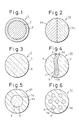
- the deodorant filamentary constituent and the support filamentary constituent may be in a core-in-sheath structure in which the core is formed by the support filamentary constituent and the sheath is formed by the deodorant filamentary constituent and covers the core, as indicated in Fig. 1.
- a core 2 consisting of the support filamentary constituent (the first thermoplastic polymer) is covered by a sheath 3 consisting of the deodorant filamentary constituent (deodorant material), and the core 2 and the sheath 3 are bonded to each other to form a fiber body.
- the core-in-sheath type composite fiber 1 the entire periphery of the fiber is formed by the deodorant material sheath.
- the first fiber usable for the present invention may have a bimetal structure as shown in Fig. 2.
- a composite fiber 1a is composed of a support filamentary constituent 2a consisting of a first thermoplastic polymer and a deodorant filamentary constituent 3a consisting of a deodorant material.
- the support and deodorant filamentary constituents 2a and 3a extend substantially in parallel to each other and to the longitudinal axis of the first fiber 1a and are bonded to each other in a side-by-side relationship.
- a half of the periphery of the fiber 1a is formed by the deodorant filamentary constituent 3a.
- the first fiber may be composed of one or more support filamentary constituents and one or more deodorant constituents bonded to each other, as long as at least a portion of the peripheral surface of the first fiber is formed by the deodorant filamentary constituents.
- the first fiber may have a circular regular cross-sectional profile or a non-circular irregular cross-sectional profile, for example, a tri-lobal cross-sectional profile, which provides an increased peripheral surface of the fibers.
- the first fibers preferably contain the deodorant copolymer in an amount of 10% to 90%, more preferably, 20% to 80%, based on the weight of the first fibers.
- the first fibers usable for the present invention can be produced by any known composite fiber-forming method.
- each second fiber the anti-fungus material is dispersed in a second thermoplastic polymer material.
- the second thermoplastic polymer material comprises at least one member selected from polyolefin polymers, for example, polyethylene, polypropylene and ethylene propylene copolymers.
- a preferable second thermoplastic polymer material consists of a polyethylene.
- each second fiber the anti-fungus material comprising fine copper particles is preferably distributed in an amount of 5% by weight or more in at least the peripheral surface portions of the second fiber.
- the anti-fungus material may be evenly distributed throughout the second fiber or may be locally distributed in the peripheral surface portions of the second fiber.
- Each second fiber containing the anti-fungus material preferably has an irregular non-circular cross-sectional profile, for example, a trilobal cross-sectional profile, which provides a relatively large peripheral surface area of the fiber.
- the second fiber is a thick-and-thin type of fiber having a cross-sectional area varying along the longitudinal axis thereof. This type of fiber has a relatively large peripheral surface area thereof.
- the copper particles in the second fiber have a 50 mesh size or smaller.
- the second fibers usable for the present invention can be produced by known blended polymer fiber-forming methods.
- the first and second fibers may contain conventional additives, such as pigments, for example, titanium dioxide, a flame-retardant, stabilizer, and a fluorescent brightening agent.
- pigments for example, titanium dioxide, a flame-retardant, stabilizer, and a fluorescent brightening agent.
- the anti-fungus material comprising fine copper particles may be evenly dispersed in the deodorant material as shown in Fig. 3.
- a number of fine copper particles 5 are evenly dispersed in a matrix 6 consisting of the deodorant material.
- the deodorant, anti-fungus fiber is composed of at least one anti-fungus filamentary constituent containing the anti-fungus material dispersed in a matrix consisting of a thermoplastic polymer material and at least one deodorant filamentary constituent consisting essentially of the deodorant material.
- the anti-fungus and deodorant filamentary constituents extend substantially in parallel to the longitudinal axis of the fiber and are bonded to each other to form a body of a composite fiber, of which at least a portion of the peripheral surface is formed by the deodorant filamentary constituent.
- a fiber 4a is composed of an anti-fungus filamentary constituent 7 consisting of a thermoplastic polymer matrix 8 and fine copper particles 5 dispersed in the matrix 8 and two deodorant filamentary constituents 9 consisting of the deodorant material.
- the anti-fungus and deodorant filamentary constituents 7 and 9 extend along the longitudinal axis of the fiber 4a and are bonded to each other in a three-layered structure to form a body of composite layer so that the side ends 10a and 10b of the anti-fungus filamentary constituent 7 are exposed to the outside of the fiber 4a and form portions of the peripheral surface of the fiber 4a.
- the deodorant filamentary constituents 9 and the anti-fungus filamentary constituent 7 are preferably in a weight ratio of 95:5 to 20:80, more preferably, 95:5 to 50:50.
- Another type of composite fiber may be composed of one deodorant filamentary constituent and one anti-fungus filamentary constituent bonded to each other in a bimetal structure as shown in Fig. 2.
- the core 7a is formed by an anti-fungus filamentary constituent comprising the fine copper particles 5 dispersed in a matrix 8 consisting of the thermoplastic polymer material and the sheath 9a is formed by a deodorant filamentary constituent comprising the deodorant material.
- a plurality of islands 7b are formed by anti-fungus filamentary constituents comprising the fine copper particles 5 dispersed in a matrix 8 consisting of the thermoplastic polymer material and the sheath 9b is formed by a deodorant filamentary constituent comprising the deodorant material.
- the anti-fungus material is dispersed in both the deodorant and anti-fungus filamentary constituents.
- both the anti-fungus material and the deodorant material are contained in at least one filamentary constituent and the remaining at least one filamentary constituent is free from the anti-fungus material and the deodorant material.
- at least a portion of the peripheral surface of the composite fiber should be formed by the filamentary constituent containing the anti-fungus and deodorant materials.
- the composite fiber containing both the deodorant material and the anti-fungus material may have a circular cross-sectional profile or an irregular non-circular cross-sectional profile having a ratio D/d of 1.1 or more, wherein D represents a diameter of a circumcircle of the cross-sectional profile and d represents a diameter of an inscribed circle of the cross-sectional profile.
- the polymer-blend fibers or composite fibers containing both the deodorant material and the anti-fungus material can be produced by any known fiber- forming method.
- any known fiber- forming method for example, usual orifice type melt-spinning methods, burst fiber-forming methods in which a gas is dissolved in a polymer melt and the dissolved gas-containing polymer melt is extruded through a slit of die to form net-shaped fibers, or the fiber-forming method disclosed in Japanese Unexamined Patent Publication No. 58-91804 can be applied to the production of the fiber usable for the present invention.
- a deodorant material is melted in a first extruder and is extruded through a die of the first extruder; a thermoplastic polymer material blended with the anti-fungus material (the fine copper particles) is melted in a second extruder and is extruded through a die of the second extruder; at least one stream of the extruded deodorant material melt and at least one stream of the extruded anti-fungus material-containing thermoplastic material melt are introduced into a static mixer (for example, a Kenics type static mixer) and are incorporated to provide a composite stream of the above-mentioned melts in the static mixer; and the composite stream is extruded through an I type die.
- the resultant composite filament bundle is drawn at a draw ratio of, for example, 1.2 to 25 2.0, and the drawn filaments are crimped by a crimping machine or heat-crimping device.
- the mixing operation of the deodorant material melt with the anti-fungus material-containing polymer melt and the thickness (denier) of the resultant composite fibers can be easily controlled by adjusting the number of static mixer elements to an appropriate level and by controlling the size of a mesh-like metal net used as a thick and thin fiber-spinning orifice and the draw ratio to appropriate levels.
- the mesh-like metal net is formed by a metallic material which will produce heat when an electric current is applied thereto.
- the method for producing the composite fibers usable for the present invention is not limited to the above-described methods.
- the fiber containing the deodorant material and the anti-fungus material preferably have a non-circular cross-sectional profile having a ratio D/d (irregularity coefficient) of 1.1 or more.
- D/d interleukin/d
- the ratio D/d and the thickness (cross-sectional area) of the fibers irregularly vary along the longitudinal axis thereof.
- the fiber material of the present invention, the deodorant, anti-fungus fibers are preferably in the form of short cut fibers having a length of 20 to 100 mm and a crimp number of 5 crimps/25 mm to 25 crimps/25 mm.
- the fiber material of the present invention may be in the form of a spun yarn consisting of the short cut deodorant, anti-fungus fibers or a multifilament yarn consisting of deodorant, anti-fungus multifilaments.
- the fiber material of the present invention may be in the form of a woven fabric, knitted fabric, or a nonwoven fabric comprising the deodorant, anti-fungus short cut fibers or multifilaments.
- the fiber material of the present invention preferably consists of the deodorant anti-fungus fibers only.
- the fiber material of the present invention may contain additional fibers, for example, cotton, wool, viscose rayon, cellulose acetate fibers, polyamide fibers, polyester fibers, polyacrylic fibers, and polyolefin fibers, in addition to the deodorant, anti-fungus fibers.
- additional fibers for example, cotton, wool, viscose rayon, cellulose acetate fibers, polyamide fibers, polyester fibers, polyacrylic fibers, and polyolefin fibers, in addition to the deodorant, anti-fungus fibers.
- the ethylene-ethylenically unsaturated carboxylic acid copolymer must be in a content of 8% or more based on the entire weight of the fiber material and the copper particles must be in a content of 1% or more based on the entire weight of the fiber material.
- the fiber material of the present invention has an excellent deodorant effect on various offensive odors, satisfactory mechanical properties, processability, and durability, and an anti-fungus or germicidal effect. Therefore, the deodorant, anti-fungus fiber material of the present invention is useful for various medical and hygienic materials, for example, sanitary napkins and paper diapers, various types of filter materials, fillings in thick bedquilts or bedclothes, waddings, felt materials, blankets, carpet substrates, interior materials in buildings or cars, insoles of shoes, lining materials, mats for pets, deodorant materials for refrigerators, brassieres, girdles, body suits, pad materials, for example, bust pads, hip pads, and side pads, and sleeping wear.
- various medical and hygienic materials for example, sanitary napkins and paper diapers, various types of filter materials, fillings in thick bedquilts or bedclothes, waddings, felt materials, blankets, carpet substrates, interior materials in buildings or cars, insoles
- the deodorant, anti-fungus effect of the fiber material of the present invention has an excellent resistance to washing and dry cleaning. Also, the fiber material of the present invention can discharge the absorbed offensive odor of, for example, ammonia, trimethylamine, or n-butyric acid, by washing and drying.
- the deodorant, anti-fungus fiber material can be repeatedly used over a long period of time without decreasing the deodorant, anti-fungus effect thereof.
- the fiber material of the present invention exhibits an excellent deodorant effect and a superior anti-fungus effect, because the above-mentioned effects are derived from chemical deodorant and anti-fungus actions of the specific ethylene-ethylenically unsaturated carboxylic acid copolymer and the fine copper particles, not from physical odor-absorbing actions thereof, and the fiber material is in the form of a number of fine fibers having a large peripheral surface area which exhibits the deodorant, anti-fungus actions.
- the fiber material of the present invention can eliminate offensive odors derived from nitrogen compounds, for example, ammonia and trimethylamine, and aliphatic fatty acid compounds, for example, n-butyric acid, which are eliminated mainly by the ethylene-ethylenically unsaturated carboxylic acid copolymer, from sulfur compounds, for example, hydrogen sulfide and methylmercaptan, and from other substances.
- nitrogen compounds for example, ammonia and trimethylamine
- aliphatic fatty acid compounds for example, n-butyric acid
- the fiber-forming property of the ethylene-ethylenically unsaturated carboxylic acid copolymer can be improved by using another fiber-forming polymer, for example, polyethylene terephthalate polymer, as a cooperator.
- the copolymer is effective as a binder and can be firmly bonded with another polymer.
- the fine copper powder exhibits a germicidal or bactericidal action and prevents or restricts the propagation of offensive odor-generating bacteria.
- the degree of deodorant effect was evaluated in the following manner.
- a desiccator having a capacity of 4 liters was charged with 10 g of a deodorant material, and the pressure in the desiccator was reduced.
- a predetermined amount of a testing gas or liquid was introduced into the desiccator. The pressure in the desiccator was then returned to the same level as the ambient atmospheric pressure.
- the content of the testing gas in the desiccator was represented as an initial concentration thereof.
- the initial concentration of the testing gas in the desiccator was adjusted to a level of 200 to 300 ppm.
- the desiccator was then left at the ambient atmospheric temperature for 3 hours, and subsequently, the concentration of the testing gas was measured. This concentration is represented as a final concentration of the testing gas in the desiccator.
- the degree of deodorant effect was calculated in accordance with the following equation:
- bimetal type composite fibers were produced by a known bimetal type composite filament melt-spinning apparatus as disclosed in Japanese Unexamined Patent Publication No. 58-70712, from ethylene-acrylic acid copolymer chips (Trademark: Yukalon EAA A 201M, made by Mitsubishi Yuka Co.) and blend chips of a polypropylene (Trademark: S-115M, made by Ube Industries, Ltd.) with fine copper particles having a 50 mesh size or smaller in the amount shown in Table 1.
- the ethylene-acrylic acid copolymer chips were melted and extruded at a predetermined extruding rate at a temperature of 210°C to 250°C by an extruder, and separately, the polypropylene blend chips containing the copper particles were melted and extruded at a predetermined extruding rate at a temperature of 220°C to 260°C by another extruder.
- the extruded copolymer melt and blend melt were incorporated and introduced into an adaptor connected to the above-mentioned two extruders having a Kenics type static mixer having 8 elements, at a temperature of 250°C.
- the resultant composite streams of the melts were extruded through an uneven spinneret consisting of a 60 mesh plain weave metallic net.
- the extruded melt streams were cooled and solidified by blowing cooling air thereto, and the solidified composite filaments were taken up at a speed of 6 m/min.
- the temperature of the spinneret was controlled at a predetermined level by applying an electric current of about 50 A to the metallic net to generate Joule heat.
- the resultant bimetal type composite filaments were drawn at a draw ratio of 1.3 to 2.5 on a drawing plate controlled at a temperature of 85°C.
- a filamentary constituent consisting of the ethylene-acrylic acid copolymer and another filamentary constituent consisting of a polypropylene-copper particle blend extended along the longitudinal axis of the composite filaments were bonded to each other to the form of a bimetal. Therefore, a portion of the peripheral surface of each composite filament was formed by the ethylene-acrylic acid copolymer filamentary constituent.
- the composite filaments had an irregular cross-sectional profile which had a ratio D/d of 1.4 or more. Also, the cross-sectional area and the ratio D/d varied along the longitudinal axis of the composite filament.
- the drawn composite filaments were cut into a length of 95 mm and the resultant composite fibers were heat-treated at a temperature of 100°C for 10 minutes to generate cubic crimps on the fibers.
- the deodorant, anti-fungus composite fibers of Example 2 were subjected to a germicidal test wherein the composite fibers were brought into contact with a physiological saline containing colibacillus and staphylococcus, at room temperature. The number of bacteria in the physiological saline was measured before the test and 2 hours after the contact with the bacteria.
- the above-mentioned composite fibers were opened into the form of a web by a carding machine and heat-treated with hot air at a temperature of 150°C.
- the resultant web had a weight of 250 g/m2.
- the web exhibited the same deodorant effects as those indicated in Table 1 and the same germicidal effects as those indicated in Table 2.
- a core-in-sheath type composite fiber was produced in each of Examples 4 to 6 and Comparative Examples 3 and 4 from a core constituent consisting of the same ethylene-acrylic acid copolymer as that mentioned in Example 1, and a sheath constituent consisting of the same polypropylene blend containing the copper particles as that described in Example 1.
- Use was made of an extruder for a core-in-sheath type composite fiber, a spinneret having 15 spinning holes having a diameter of 0.3 mm, and a take up speed of 500 m/min.
- the undrawn filament yarn was drawn at a draw ratio of 1.3 to 2.5 in hot water at a temperature of 70°C.
- the drawn filament yarn was crimped and cut in the same manner as mentioned in Example 1.
- Example 5 The composite fibers in Example 5 were subjected to the same anti-fungus test as mentioned in Example 1. The results are shown in Table 4.
- the resultant drawn composite filaments were cut to a length of 51 mm and the resultant short cut fibers were subjected to hot air treatment at a temperature of 90°C for 5 minutes to generate cubic crimps on the fibers at a crimp number of 10 crimps/25 mm.
- the crimped short cut composite fibers were blended with polyethylene terephthalate short cut fibers having a thickness of 4 denier, a length of 64 mm, and a crimp number of 13 crimps/25 mm so that the resultant blend contained the ethylene-acrylic acid copolymer and the fine copper particles in the contents shown in Table 5.
- the blend was converted to a spun yarn having a yarn number count of 20.
- the resultant composite filament yarn was crimped and then cut.
- the resultant short cut fibers had a length of 51 m and a crimp number of 12 crimps/25 mm.
- the short cut fibers were blended with viscose rayon short cut fibers having a thickness of 2 denier, a length of 51 mm, and a crimp number of 10 crimps/25 mm so that the resultant blend contained the ethylene acrylic acid copolymer and the fine copper particles in the contents shown in Table 6.
- the blend was converted to a spun yarn having a yarn number count of 20.
- Example 13 the same procedures for producing the drawn bimetal type composite filament yarn as described in Example 1 were carried out except that, in the bimetal type composite filament melt-spinning apparatus, the ethylene-acrylic acid copolymer was extruded by an extruder at a extruding rate of 300 g/min and, in place of the polyethylene-copper particles mixture, a polyethylene (Trademark: S-115M, made by Ube Industries, Ltd.) was extruded by another extruder at a extruding rate of 75 g/min.
- a polyethylene Trademark: S-115M, made by Ube Industries, Ltd.
- the resultant ethylene-acrylic acid copolymer-containing composite filaments each had an average thickness of 12 denier, a tensile strength at 1.2 g/d, an ultimate elongation of 50°C, and a ratio D/d of about 1.4.
- polymer chips consisting of a mixture of 40 parts by weight of electrolytic copper particles having a 300 mesh size or smaller with 60 parts by weight of a polypropylene (Trademark: S-115M, made by Ube Industries, Ltd.) were melted and extruded by an extruder at an extruding rate of 240 g/min, polyethylene chips (Trademark: Noblen MK-40, made by Mitsubishi Kasei Kogyo K.K.) were melted and extruded by another extruder at an extruding rate of 60 g/min, and the melted mixture and polyethylene were incorporated and melt spun in the same manner as mentioned in Example 1.
- the resultant copper particle-containing composite filaments were drawn at a draw ratio of 2.0 on a heating plate controlled to a temperature of 120°C.
- the resultant drawn composite filaments each had an average thickness of 6.8 denier, a tensile strength of 1.5 g/d, and an ultimate elongation of 45%.
- the drawn composite filaments were cut to a length of 51 mm and heat-treated by hot air at a temperature of 100°C to generate cubic crimps on the fibers.
- the short cut ethylene-acrylic acid copolymer-containing composite fibers and the short cut copper particle-containing composite fibers were blended with short cut polyethylene terephthalate fibers having a thickness of 6 denier and a length of 51 mm so that the resultant blend contained the ethylene-acrylic acid copolymer and the copper particles in the contents indicated in Table 7.
- the blend was converted to a spun yarn having a yarn number count of 20 by an ordinary short cotton spinning method.
- core-in-sheath type composite filaments were produced from 60 parts by weight of a core constituent consisting of a polyethylene terephthalate made by Teijin Ltd. and having an intrinsic viscosity of 0.64 and 40 parts by weight of a sheath constituent consisting of an ethylene-acrylic acid copolymer (Trademark: Yukalon EAA XA 211 S1, made by Mitsubishi Yuka Co.) by an ordinary core-in-sheath type composite filament-melt spinning apparatus having 20 spinning holes at a take-up speed of 1000 m/min.
- the polyethylene terephthalate core constituent was melted at a temperature of 270°C to 295°C.
- the ethylene-acrylic acid copolymer sheath constituent was melted at a temperature of 210°C to 250°C.
- the taken-up composite filaments were drawn at a draw ratio of 3.0 in hot water at a temperature of 75°C.
- the drawn composite filaments were crimped by an ordinary crimping machine and then cut to a length of 51 mm.
- the resultant ethylene-acrylic copolymer-containing short cut composite fibers had an average thickness of 6.0 denier, a tensile strength of 3.2 g/d, and an ultimate elongation of 40%.
- the undrawn bimetal type composite filaments were drawn at a draw ratio of 2.5 on a heating plate at a temperature of 120°C.
- the drawn composite filaments were crimped by an ordinary stuffing box type crimping machine, and then cut to a length of 51 mm.
- the resultant copper particle-containing short cut composite fibers had an average thickness of 7.0 denier, a tensile strength of 1.8 g/d, and an ultimate elongation of 45%.
- the above-described ethylene-acrylic acid copolymer-containing composite fibers and the copper particle-containing composite fibers were blended with polyethylene terephthalate short cut fibers having a thickness of 6.0 denier and a length of 51 mm so that the resultant blend contained the ethylene-acrylic acid copolymer and the copper particles in the contents indicated in Table 8.
- the blend was converted to a spun yarn having a yarn number count of 20 by an ordinary short cotton-spinning machine.
- the resultant spun yarn exhibited the deodorant effects shown in Table 8.
- Example 17 The spun yarn of Example 17 was subjected to the germicidal test as described in Example 1. The results were as shown in Table 9.
- the resultant drawn composite filament yarns were knitted together with false-twisted polyethylene terephthalate multifilament textured yarns to provide knitted fabrics each having a weight of 200 g/m2 and each containing the ethylene-acrylic acid copolymer and the copper particles in the contents indicated in Table 10.
- the resultant drawn composite filaments were crimped at a crimp number of 12 crimps/25 mm by an ordinary crimping machine and were cut to a length of 51 mm.
- the resultant short cut fibers in an amount of 50 parts by weight were blended with 50 parts by weight of viscose rayon short cut fibers having a thickness of 2 denier, a length of 51 mm, and a crimp number of 12 crimps/25 mm.
- the blend was converted to a spun yarn having a yarn number count of 30.
- the spun yarn was converted, together with a polyethylene terephthalate spun yarn having a yarn number count of 30, to a union twill fabric, so that the resultant union fabric contained the ethylene-acrylic acid copolymer and the copper particles in the contents indicated in Table 11.
- Example 26 to 29 the same procedures as those respectively described in Examples 16 to 19 were carried out except that two or more of the resultant blend spun yarns containing the ethylene-acrylic acid copolymer-containing core-in-sheath type composite fibers, the copper particle-containing bimetal-type composite fibers, and the polyethylene terephthalate fibers were used together to produce a union plain weave having a weight of 180 g/m2 and containing the ethylene-acrylic acid copolymer and the copper particles in the contents indicated in Table 12.
- Example 27 The union plain weave of Example 27 was subjected to the germicidal test as described in Example 1.
- the resultant drawn composite filaments were crimped at a crimp number of 12 crimps/25 mm by an ordinary gear-crimping machine and then were cut to a length of 51 mm.
- One or more types of the resultant short cut composite fibers were blended with polyethylene terephthalate short cut fibers having a thickness of 4 denier, a length of 76 m, and a crimp number of 18 crimps/25 mm, so that the resultant blend contained the ethylene-acrylic copolymer and the copper particles in the contents indicated in Table 14.
- the blend was converted to a web by a carding machine.
- the web was heat-treated with hot air at a temperature of 150°C.
- the heat-treated web had a weight of 200 g/m2.
- Examples 33 to 36 the same procedures as those respectively described in Examples 16 to 19 were carried out except that the ethylene-acrylic acid-containing core-in-sheath type composite fibers, the copper particle-containing bimetal type composite fibers, and the polyethylene terephthalate fibers were blended together so that the resultant blend contained the ethylene-acrylic acid copolymer and the copper particles in the content indicated in Table 15.
- the blend was connected to a web having a weight of 200 g/m2 by an ordinary carding machine.
- Example 34 exhibited the germicidal effects as indicated in Table 16.
Landscapes
- Engineering & Computer Science (AREA)
- Textile Engineering (AREA)
- Chemical & Material Sciences (AREA)
- Chemical Kinetics & Catalysis (AREA)
- General Chemical & Material Sciences (AREA)
- Manufacturing & Machinery (AREA)
- Mechanical Engineering (AREA)
- Multicomponent Fibers (AREA)
- Disinfection, Sterilisation Or Deodorisation Of Air (AREA)
- Artificial Filaments (AREA)
Applications Claiming Priority (8)
| Application Number | Priority Date | Filing Date | Title |
|---|---|---|---|
| JP21777486 | 1986-09-16 | ||
| JP21777586 | 1986-09-16 | ||
| JP217775/86 | 1986-09-16 | ||
| JP21777786 | 1986-09-16 | ||
| JP217774/86 | 1986-09-16 | ||
| JP217777/86 | 1986-09-16 | ||
| JP217776/86 | 1986-09-16 | ||
| JP21777686 | 1986-09-16 |
Publications (2)
| Publication Number | Publication Date |
|---|---|
| EP0260941A2 true EP0260941A2 (de) | 1988-03-23 |
| EP0260941A3 EP0260941A3 (de) | 1989-11-08 |
Family
ID=27476844
Family Applications (1)
| Application Number | Title | Priority Date | Filing Date |
|---|---|---|---|
| EP87308179A Withdrawn EP0260941A3 (de) | 1986-09-16 | 1987-09-16 | Antifungizides, deodorierendes Fasermaterial |
Country Status (2)
| Country | Link |
|---|---|
| US (1) | US4784909A (de) |
| EP (1) | EP0260941A3 (de) |
Cited By (2)
| Publication number | Priority date | Publication date | Assignee | Title |
|---|---|---|---|---|
| EP0436725A4 (en) * | 1989-07-31 | 1993-01-27 | Toyo Seikan Kaisha, Ltd. | Method of producing antibacterial polymer and its use |
| WO2005010263A1 (en) * | 2003-07-24 | 2005-02-03 | E.I. Dupont De Nemours And Company | Multiple component spunbond web |
Families Citing this family (24)
| Publication number | Priority date | Publication date | Assignee | Title |
|---|---|---|---|---|
| JPS63179934A (ja) * | 1987-01-21 | 1988-07-23 | Daicel Chem Ind Ltd | 防臭、防かび性樹脂シ−ト |
| US5277974A (en) * | 1987-10-02 | 1994-01-11 | Unitaka Ltd. | Heat-bondable filament and nonwoven fabric made of said filament |
| JP2754262B2 (ja) * | 1989-10-02 | 1998-05-20 | チッソ株式会社 | 易加工性繊維およびこれを用いた成形体 |
| AU692049B2 (en) * | 1995-02-15 | 1998-05-28 | Japan Envirochemicals, Ltd. | Deodorizable fibers and method of producing the same |
| JP3374079B2 (ja) * | 1998-06-22 | 2003-02-04 | 萩原工業株式会社 | 防黴抗菌エアフィルタ |
| US6723428B1 (en) * | 1999-05-27 | 2004-04-20 | Foss Manufacturing Co., Inc. | Anti-microbial fiber and fibrous products |
| US20050136100A1 (en) * | 1999-05-27 | 2005-06-23 | Foss Manufacturing Co., Inc. | Hollow anti-microbial fibers and fibrous products |
| AU2003251382A1 (en) * | 2002-05-24 | 2003-12-12 | Michel Joyce | Article of clothing with moisture absorbent portion |
| ATE554842T1 (de) * | 2002-09-16 | 2012-05-15 | Triomed Innovations Corp | Elektrostatisch geladenes filtermedium mit eingearbeitetem wirkstoff |
| US8480797B2 (en) | 2005-09-12 | 2013-07-09 | Abela Pharmaceuticals, Inc. | Activated carbon systems for facilitating use of dimethyl sulfoxide (DMSO) by removal of same, related compounds, or associated odors |
| US8435224B2 (en) | 2005-09-12 | 2013-05-07 | Abela Pharmaceuticals, Inc. | Materials for facilitating administration of dimethyl sulfoxide (DMSO) and related compounds |
| EP2324838A1 (de) | 2005-09-12 | 2011-05-25 | Abela Pharmaceuticals, Inc. | Zusammensetzungen mit Dimethyl-Sulfoxid |
| JP5399072B2 (ja) | 2005-09-12 | 2014-01-29 | アベラ ファーマスーティカルズ インコーポレイテッド | ジメチルスルホキシド(dmso)若しくは関連化合物、又はそれに関連する臭気を除去するシステム |
| US8026407B2 (en) * | 2006-08-01 | 2011-09-27 | 3M Innovative Properties Company | Antimicrobial compression bandage |
| CN201039770Y (zh) * | 2007-03-12 | 2008-03-26 | 陈宏任 | 多功能机能性健康养生自净鞋材 |
| WO2009057134A2 (en) | 2007-07-03 | 2009-05-07 | Aditya Birla Science & Technology Co. Ltd. | A viscose fiber with modified property and a process for making therefor |
| BRPI0722265B1 (pt) | 2007-11-07 | 2018-06-26 | Noveko Trading 2008 Llc | Fibra multifuncional, e tecido produzido a partir da mesma |
| BRPI0921494A2 (pt) | 2008-11-03 | 2018-10-30 | Prad Reasearch And Development Ltd | método de planejamento de uma operação de amostragem para uma formação subterrãnea, método de contolar uma operação de amostragem de formação subterrânea, método de controlar uma operação de perfuração para uma formação subterrãnea, e método de realizar uma amostragem durante a operação de perfuração. |
| AU2010313253B2 (en) | 2009-10-30 | 2015-02-19 | Abela Pharmaceuticals, Inc. | Dimethyl sulfoxide (DMSO) and methylsulfonylmethane (MSM) formulations to treat osteoarthritis |
| JP5651244B2 (ja) * | 2011-07-06 | 2015-01-07 | 米津ブラシ株式会社 | 炭素繊維束の製造方法 |
| US8935858B2 (en) | 2012-10-08 | 2015-01-20 | Michelle Cloutier | Rolled garment storage |
| CA2930579C (en) * | 2015-05-21 | 2021-08-03 | Gidon Fisher | Antimicrobial and wicking materials and methods of making the same |
| US11993873B2 (en) * | 2019-09-09 | 2024-05-28 | Massachusetts Institute Of Technology | Reversible textile transformation |
| EP4043626A4 (de) * | 2019-11-26 | 2023-11-22 | Murata Manufacturing Co., Ltd. | Faden |
Family Cites Families (9)
| Publication number | Priority date | Publication date | Assignee | Title |
|---|---|---|---|---|
| US4010308A (en) * | 1953-05-04 | 1977-03-01 | Wiczer Sol B | Filled porous coated fiber |
| US3547688A (en) * | 1967-01-04 | 1970-12-15 | Gagliardi Research Corp | Microbiocidal complexes of aziridinyl compounds and biocidal metal salts and their use in rendering textiles or other substrates durably microbiocidal |
| GB1199115A (en) * | 1968-03-22 | 1970-07-15 | Ici Ltd | Producing Sheath/Core Conjugate Polyester Filaments |
| CA944520A (en) * | 1969-03-26 | 1974-04-02 | Toray Industries, Inc. | Spontaneously crimping synthetic composite filament and process of manufacturing the same |
| CA957214A (en) * | 1970-12-24 | 1974-11-05 | Teijin Limited | Conjugate fiber |
| US3959556A (en) * | 1973-04-10 | 1976-05-25 | Morrison Willard L | Antimicrobial blended yarns and fabrics comprised of naturally occurring fibers |
| US4343853A (en) * | 1980-03-06 | 1982-08-10 | Morrison Willard L | Antimicrobially treated fabric construction |
| JPS601018B2 (ja) * | 1980-11-18 | 1985-01-11 | 昭和薬品化工株式会社 | 歯垢除去ならびに歯肉マツサージ用具 |
| DE3408131A1 (de) * | 1984-03-06 | 1985-09-12 | Chemiefaser Lenzing Ag, Lenzing | Desodorierendes und mikrobistatisches fasermaterial |
-
1987
- 1987-09-16 EP EP87308179A patent/EP0260941A3/de not_active Withdrawn
- 1987-09-16 US US07/097,155 patent/US4784909A/en not_active Expired - Fee Related
Cited By (4)
| Publication number | Priority date | Publication date | Assignee | Title |
|---|---|---|---|---|
| EP0436725A4 (en) * | 1989-07-31 | 1993-01-27 | Toyo Seikan Kaisha, Ltd. | Method of producing antibacterial polymer and its use |
| WO2005010263A1 (en) * | 2003-07-24 | 2005-02-03 | E.I. Dupont De Nemours And Company | Multiple component spunbond web |
| US7008888B2 (en) | 2003-07-24 | 2006-03-07 | E. I. Du Pont De Nemours And Company | Multiple component spunbond web |
| US7238634B2 (en) | 2003-07-24 | 2007-07-03 | E. I. Du Pont De Nemours And Company | Multiple component spunbond web |
Also Published As
| Publication number | Publication date |
|---|---|
| US4784909A (en) | 1988-11-15 |
| EP0260941A3 (de) | 1989-11-08 |
Similar Documents
| Publication | Publication Date | Title |
|---|---|---|
| US4784909A (en) | Anti-fungus, deodorant fiber material | |
| KR101061028B1 (ko) | 고분자 혼성체 섬유, 섬유구조체, 고분자 혼성체 펠릿 및 그들의 제조방법 | |
| US7097904B2 (en) | Porous fiber | |
| US5047448A (en) | Antimicrobial-shaped article and a process for producing the same | |
| CN100419144C (zh) | 具有潜在三维卷曲性能的机器卷曲的合成纤维及其生产方法 | |
| JP4100327B2 (ja) | 複合繊維 | |
| GB2125458A (en) | Non-woven fabrics | |
| CN100363541C (zh) | 纳米纤维集合体、聚合物合金纤维、混合纤维、纤维结构体以及它们的制造方法 | |
| JP3071594B2 (ja) | 芯鞘型消臭抗菌性複合繊維 | |
| EP0035796B1 (de) | Thermoplastische synthetische Fasern und Verfahren zu deren Herstellung | |
| JP2002061060A (ja) | 不織布及び不織布加工品 | |
| EP0413280A2 (de) | Polyamid-Polyester-Verbundfaser und Verfahren zur Herstellung derselben | |
| JP4507389B2 (ja) | ポリオレフィン系繊維とこれを用いた不織布及び吸収性物品 | |
| JPS63190018A (ja) | 消臭性繊維構造物 | |
| JP4238929B2 (ja) | ポリマーアロイ繊維およびその製造方法、並びにそれを用いた繊維製品 | |
| JP3297492B2 (ja) | 鞘芯型複合繊維 | |
| EP0162564A2 (de) | Faser für Isoliermaterial, Vliesstoffgebilde, Wattierungsstruktur und netzförmigen Faserstoff | |
| WO2006054816A1 (en) | A multi-filament with excellent absorption-dry property and antibiotic property | |
| JPS63190013A (ja) | 消臭性繊維構造物 | |
| JPH1053922A (ja) | 無機機能性付与剤含有ポリエステル繊維及びその製造方法 | |
| CN101003681A (zh) | 多孔纤维 | |
| JP2905629B2 (ja) | 消臭防臭繊維 | |
| JP3420699B2 (ja) | 機能性エアフィルタ | |
| JP4270202B2 (ja) | ナノファイバー集合体 | |
| JPS63190011A (ja) | 消臭性繊維構造物 |
Legal Events
| Date | Code | Title | Description |
|---|---|---|---|
| PUAI | Public reference made under article 153(3) epc to a published international application that has entered the european phase |
Free format text: ORIGINAL CODE: 0009012 |
|
| AK | Designated contracting states |
Kind code of ref document: A2 Designated state(s): DE FR GB |
|
| RIN1 | Information on inventor provided before grant (corrected) |
Inventor name: EMI, SHINGO Inventor name: MITAMURA,TAMIO |
|
| PUAL | Search report despatched |
Free format text: ORIGINAL CODE: 0009013 |
|
| AK | Designated contracting states |
Kind code of ref document: A3 Designated state(s): DE FR GB |
|
| 17P | Request for examination filed |
Effective date: 19900504 |
|
| 17Q | First examination report despatched |
Effective date: 19910911 |
|
| STAA | Information on the status of an ep patent application or granted ep patent |
Free format text: STATUS: THE APPLICATION IS DEEMED TO BE WITHDRAWN |
|
| 18D | Application deemed to be withdrawn |
Effective date: 19920122 |
|
| RIN1 | Information on inventor provided before grant (corrected) |
Inventor name: MITAMURA,TAMIO Inventor name: EMI, SHINGO |