EP0261408A2 - Laser mit monolitisch integrierten, planaren Elementen und Verfahren zu deren Herstellung - Google Patents
Laser mit monolitisch integrierten, planaren Elementen und Verfahren zu deren Herstellung Download PDFInfo
- Publication number
- EP0261408A2 EP0261408A2 EP87112176A EP87112176A EP0261408A2 EP 0261408 A2 EP0261408 A2 EP 0261408A2 EP 87112176 A EP87112176 A EP 87112176A EP 87112176 A EP87112176 A EP 87112176A EP 0261408 A2 EP0261408 A2 EP 0261408A2
- Authority
- EP
- European Patent Office
- Prior art keywords
- substrate
- layer
- gallium
- aluminum
- arsenide
- Prior art date
- Legal status (The legal status is an assumption and is not a legal conclusion. Google has not performed a legal analysis and makes no representation as to the accuracy of the status listed.)
- Granted
Links
Images

Classifications
-
- H—ELECTRICITY
- H01—ELECTRIC ELEMENTS
- H01S—DEVICES USING THE PROCESS OF LIGHT AMPLIFICATION BY STIMULATED EMISSION OF RADIATION [LASER] TO AMPLIFY OR GENERATE LIGHT; DEVICES USING STIMULATED EMISSION OF ELECTROMAGNETIC RADIATION IN WAVE RANGES OTHER THAN OPTICAL
- H01S5/00—Semiconductor lasers
- H01S5/02—Structural details or components not essential to laser action
- H01S5/026—Monolithically integrated components, e.g. waveguides, monitoring photo-detectors, drivers
-
- H—ELECTRICITY
- H01—ELECTRIC ELEMENTS
- H01S—DEVICES USING THE PROCESS OF LIGHT AMPLIFICATION BY STIMULATED EMISSION OF RADIATION [LASER] TO AMPLIFY OR GENERATE LIGHT; DEVICES USING STIMULATED EMISSION OF ELECTROMAGNETIC RADIATION IN WAVE RANGES OTHER THAN OPTICAL
- H01S5/00—Semiconductor lasers
- H01S5/20—Structure or shape of the semiconductor body to guide the optical wave ; Confining structures perpendicular to the optical axis, e.g. index or gain guiding, stripe geometry, broad area lasers, gain tailoring, transverse or lateral reflectors, special cladding structures, MQW barrier reflection layers
- H01S5/22—Structure or shape of the semiconductor body to guide the optical wave ; Confining structures perpendicular to the optical axis, e.g. index or gain guiding, stripe geometry, broad area lasers, gain tailoring, transverse or lateral reflectors, special cladding structures, MQW barrier reflection layers having a ridge or stripe structure
- H01S5/227—Buried mesa structure ; Striped active layer
-
- H—ELECTRICITY
- H01—ELECTRIC ELEMENTS
- H01S—DEVICES USING THE PROCESS OF LIGHT AMPLIFICATION BY STIMULATED EMISSION OF RADIATION [LASER] TO AMPLIFY OR GENERATE LIGHT; DEVICES USING STIMULATED EMISSION OF ELECTROMAGNETIC RADIATION IN WAVE RANGES OTHER THAN OPTICAL
- H01S5/00—Semiconductor lasers
- H01S5/30—Structure or shape of the active region; Materials used for the active region
- H01S5/32—Structure or shape of the active region; Materials used for the active region comprising PN junctions, e.g. hetero- or double- heterostructures
-
- H—ELECTRICITY
- H01—ELECTRIC ELEMENTS
- H01S—DEVICES USING THE PROCESS OF LIGHT AMPLIFICATION BY STIMULATED EMISSION OF RADIATION [LASER] TO AMPLIFY OR GENERATE LIGHT; DEVICES USING STIMULATED EMISSION OF ELECTROMAGNETIC RADIATION IN WAVE RANGES OTHER THAN OPTICAL
- H01S5/00—Semiconductor lasers
- H01S5/02—Structural details or components not essential to laser action
- H01S5/0201—Separation of the wafer into individual elements, e.g. by dicing, cleaving, etching or directly during growth
- H01S5/0205—Separation of the wafer into individual elements, e.g. by dicing, cleaving, etching or directly during growth during growth of the semiconductor body
-
- H—ELECTRICITY
- H01—ELECTRIC ELEMENTS
- H01S—DEVICES USING THE PROCESS OF LIGHT AMPLIFICATION BY STIMULATED EMISSION OF RADIATION [LASER] TO AMPLIFY OR GENERATE LIGHT; DEVICES USING STIMULATED EMISSION OF ELECTROMAGNETIC RADIATION IN WAVE RANGES OTHER THAN OPTICAL
- H01S5/00—Semiconductor lasers
- H01S5/04—Processes or apparatus for excitation, e.g. pumping, e.g. by electron beams
- H01S5/042—Electrical excitation ; Circuits therefor
- H01S5/0421—Electrical excitation ; Circuits therefor characterised by the semiconducting contacting layers
- H01S5/0422—Electrical excitation ; Circuits therefor characterised by the semiconducting contacting layers with n- and p-contacts on the same side of the active layer
-
- H—ELECTRICITY
- H01—ELECTRIC ELEMENTS
- H01S—DEVICES USING THE PROCESS OF LIGHT AMPLIFICATION BY STIMULATED EMISSION OF RADIATION [LASER] TO AMPLIFY OR GENERATE LIGHT; DEVICES USING STIMULATED EMISSION OF ELECTROMAGNETIC RADIATION IN WAVE RANGES OTHER THAN OPTICAL
- H01S5/00—Semiconductor lasers
- H01S5/20—Structure or shape of the semiconductor body to guide the optical wave ; Confining structures perpendicular to the optical axis, e.g. index or gain guiding, stripe geometry, broad area lasers, gain tailoring, transverse or lateral reflectors, special cladding structures, MQW barrier reflection layers
- H01S5/22—Structure or shape of the semiconductor body to guide the optical wave ; Confining structures perpendicular to the optical axis, e.g. index or gain guiding, stripe geometry, broad area lasers, gain tailoring, transverse or lateral reflectors, special cladding structures, MQW barrier reflection layers having a ridge or stripe structure
- H01S5/2201—Structure or shape of the semiconductor body to guide the optical wave ; Confining structures perpendicular to the optical axis, e.g. index or gain guiding, stripe geometry, broad area lasers, gain tailoring, transverse or lateral reflectors, special cladding structures, MQW barrier reflection layers having a ridge or stripe structure in a specific crystallographic orientation
-
- H—ELECTRICITY
- H01—ELECTRIC ELEMENTS
- H01S—DEVICES USING THE PROCESS OF LIGHT AMPLIFICATION BY STIMULATED EMISSION OF RADIATION [LASER] TO AMPLIFY OR GENERATE LIGHT; DEVICES USING STIMULATED EMISSION OF ELECTROMAGNETIC RADIATION IN WAVE RANGES OTHER THAN OPTICAL
- H01S5/00—Semiconductor lasers
- H01S5/20—Structure or shape of the semiconductor body to guide the optical wave ; Confining structures perpendicular to the optical axis, e.g. index or gain guiding, stripe geometry, broad area lasers, gain tailoring, transverse or lateral reflectors, special cladding structures, MQW barrier reflection layers
- H01S5/22—Structure or shape of the semiconductor body to guide the optical wave ; Confining structures perpendicular to the optical axis, e.g. index or gain guiding, stripe geometry, broad area lasers, gain tailoring, transverse or lateral reflectors, special cladding structures, MQW barrier reflection layers having a ridge or stripe structure
- H01S5/227—Buried mesa structure ; Striped active layer
- H01S5/2275—Buried mesa structure ; Striped active layer mesa created by etching
Definitions
- This invention is directed to semiconductor lasers, specifically monolithically integrated lasers, and to processes for their manufacture.
- planar surfaces i.e., surfaces having the low levels of relief common to semiconductor devices fabricated using planar processing.
- Planar surfaces exhibit a relief variance of a micrometer ( ⁇ m) or less.
- Botez "Laser Diodes are Power-Packed", IEEE Spectrum, June 1985, pp. 43-53, provides a state of the art survey of laser diodes as discrete elements. Positivie index lasers are disclosed and schematically illustrated.
- a laser can be formed by planar processing. Such lasers are formed by introducing along a substrate surface N and P conductivity type ions in laterally spaced regions so that an active region is created therebetween. While such lasers are ideal in terms of achieving an overall planar surface for a chip, emission efficiency of such lasers is relatively low.
- Lasers which consist of a plurality of superimposed semiconductive layers.
- Lasers can be formed with only three superimposed layers, superimposed N and P conductivity type layers with an active layer intervening.
- Efficient lasers are typically formed with five or more superimposed layers.
- this invention is directed to a process comprising (i) providing a monocrystalline substrate, (ii) epitaxially growing on the substrate a laterally restricted lasing region comprising superimposed P and N conductivity type cladding layers, an active layer therebetween, and a capping layer adjacent the major surface having greater than 1019 conductivity imparting ions per cm3, laterally offset from the lasing region providing on the substrate a semiconductive surface layer having a conductivity imparting ion concentration less than that of the capping layer, the substrate and the layers together forming a monocrystalline III-V compound structure, wherein the group V ions are arsenic and the group III ions are at least one of gallium and aluminum, and (iii) providing conductive means at the compound structure surface for providing a conduction path between the surface layer and the capping layer; such process being capable of offering the advantage of selective deposition of the waveguiding III-V compound at desited sites.
- Additional advantages which can be realized include forming waveguides with planar surfaces, avoiding etching of large areas of the device or epitaxial deposition onto other areas after the waveguide is formed in order to achieve the desired planar surface structure.
- the above advantages can be realized while at the same time choosing the initial composition of the substrate to achieve desired positive index waveguide and electrical isolation characteristics.
- the process is characterized in that (a) the substrate adjacent one major surface intended to separate the lasing region and the surface layer is formed of monocrystalline gallium aluminum arsenide having a resistivity greater than 105 ohm-cm and (b) the capping layer, the surface layer, and the separating substrate surface are formed to present a planar surface by the steps including (c) providing on the one major surface a protective layer defining an opening, (d) through the opening creating a channel in the substrate to expose an unprotected portion of the substrate beneath the one major surface, (e) epitaxially depositing the laser region layers on only the unprotected substrate portion, at least the active layer being comprised of gallium arsenide or gallium aluminum arsenide of a higher refractive index than the substrate monocrystalline gallium aluminum arsenide, (f) terminating epitaxial deposition when the lasing region forms with the one major surface an overall planar surface, (g) forming the surface layer to present
- a further advantage is that the substrate portion separating the lasing region and the laterally offset surface layer along the planar surface requires no special modification to isolate adjacent layers and provide positive waveguiding. Another advantage is that the substrate adjacent the planar surface is better suited for electrical isolation and for the integration of additional circuit components.
- the device is characterized in that the substrate forms with the capping layer and the surface layer a planar surface of the monocrystalline III-V compound structure, the conductiv means is located on the planar surface, and the substrate comprises monocrystalline gallium aluminum arsenide of a single conductivity type having a resistivity of greater than 105 ohm-cm isolating the surface layer from the lasing region and providing positive index wave guiding at its interface with the active layer.
- FIG. 1 is shown a detail of an exemplary preferred semiconductor device 100 according to the present invention containing a laser monolithically integrated with a field effect transistor.
- the device in the detail shown is comprised of a monocrystalline III-V compound structure consisting of a substrate 102, a lasing region 108, and a surface layer 222.
- the lasing region and the surface layer are epitaxially grown in channels 110 and 210, respectively, of the substrate.
- a first major surface 124 of the substrate and the upper surfaces of the lasing region and the surface layer together form an overall planar surface of the device while the substrate alone forms a second major surface 126 of the device.
- a first electrode 128 serves as an ohmic contact to the second major surface.
- An insulative layer 130 overlies the planar surface provided by the lasing region, surface layer, and substrate.
- the insulative layer contains first and second apertures 132 and 232 overlying the las
- a second electrode 134 contacts the upper surface of the lasing region through the first aperture and extends over the intervening portion of the insulative layer to contact one extremity of the surface layer through the second aperture, thereby conductively joining the lasing region with the surface layer.
- a third electrode 224 overlies the insulative layer and contacts the opposite extremity of the surface layer through the second electrode.
- a gate electrode 226 contacts the surface layer at a location mediate its extremities within the second aperture. The surface layer and the electrodes therefor together form a field effect transistor in the preferred embodiment shown.
- the second and third electrodes form ohmic contact with the surface layer and act as source and drain electrodes for the field effect transistor.
- the gate electrodes forms a Schottky barrier interface with the surface layer.
- the substrate 102 in one preferred form is comprised of a more conductive portion 104 typically formed of gallium arsenide containing at least 5 X 10¹⁷ and preferably from 1 to 3 X 10¹⁸ N conductivity type ions per cubic centimeter.
- An isolating portion 106 of the substrate is comprised of an aluminum gallium arsenide layer epitaxially grown on the more conductive portion of the substrate.
- the isolating portion contains sufficient aluminum to reduce its refractive index below that of the active layers of the lasing regions, which it laterally confines, so that it forms with the lasing region a positive index waveguide.
- the isolating portion preferably contains about 30 to 60 mole percent aluminum, mole percentages being based on the total group III ions present, except as otherwise indicated.
- at least the portion of the sub strate adjacent the first major surface exhibits a resistivity of greater than 105 ohm-cm, preferably greater than 107 ohm-cm.
- Suitable resistivity levels can be achieved by known gallium arsenide deposition techniques, such as by gallium arsenide deposition at temperatures of 550 to 650°C and/or in an atmosphere containing from 2 to 10 ppm of oxygen. Since the insulating portion need not be relied upon for current conduction, the majority charge carriers can be of either N or P conductivity type or the insulating portion can be substantially intrinsic.
- the surface layer is of either N or P conductivity type and is preferably of a conductivity type opposite that of said substrate so that the surface layer and substrate form a junction at their interface.
- the surface layer preferably contains a dopant impurity concentration of from about 1014 to 1017 ions per cm3.
- an electrically insulative barrier layer 136 Overlying the second, third, and gate electrodes is an electrically insulative barrier layer 136. It should be noted that though neither the second and third electrodes nor the barrier layer are shown deposited on a zero relief surface, each are presented with planar surfaces, since the relief variance introduced by providing a apertures through the insulative layer is well within the relief range of a planar surface.
- the electrodes and the insulative and barrier layers can be of any convenient conventional composition. Both gold-zinc alloys and titanium nitride are typical electrode materials for forming ohmic contacts to III-V compound monocrystalline structures. Schottky barrier contacts are typically formed using gold or aluminum at the interface with a III-V compound monocrystalline structure.
- the gate elec trode instead of forming a Schottky barrier interface with the surface layer the gate elec trode can be separated from the surface layer by an interposed portion of the insulative layer. In this instance the gate electrode materials can be chosen from among the same materials used to form the source and drain electrodes.
- the insulative barrier layer is entirely optional, since the device can be mounted in a hermetically sealed housing, if desired.
- the barrier layer can take the form of a passivating layer, such as a borosilicate glass.
- the insulative layer can take the form of a chemically vapor deposited insulative material, such as silica or silicon nitride. Additional conductive and/or insulative layers, not shown, can overlie the barrier layer, depending upon the requirements of other, optional device components, not shown.
- the substrate portion adjacent the first major surface is particularly suited to the placement of additional, optional circuit components, if desired.
- the lasing region lying entirely within the channel 110 formed by the substrate, has its lateral extent defined by the isolating portion of the substrate and its lower wall 112 defined by the more conductive portion of the substrate. Adjacent the lower channel wall the lasing region is shown comprised of a gallium arsenide lower capping layer 114, typically having an N type conductivity ion concentration of from 1017 to 5 X 10¹⁸ ions per cubic centimeter. Lying immediately above the lower capping layer is lower cladding layer 116 of N conductivity type. Lying above the lower cladding type is upper cladding layer 118 of P conductivity type.
- Each cladding layer can be comprised of aluminum arsenide or gallium aluminum arsenide containing up to 90 mole percent gallium.
- the cladding layers each typically have a conductivity imparting ion concentration of from 1016 to 1018 ions per cubic centimeter, but typically each contain somewhat lower conductivity imparting ion concentration than the capping layer with which it is in contact.
- Interposed between the upper and lower cladding layers is an active layer 120.
- the active layer normally contains a lower conductivity imparting ion concentration than either of the cladding layers it contacts. That is, the cladding layer normally contains less than 1018 conductivity imparting ions per cubic centimeter and can be as nearly intrinsic as can be conveniently realized.
- the active layer contains less aluminum than either of the cladding layers and less aluminum that the isolating portion of the substrate.
- Capping layer 122 is in contact with the upper cladding layer.
- the upper capping layer is preferably comprised of gallium arsenide having a P type conductivity imparting ion concentration of greater than 1019 ions per cubic centimeter.
- the lower capping and cladding layers can alternatively be of P conductivity type with the upper capping and cladding layers in this instance being of N conductivity type.
- the upper surfaces of the upper capping and surface layers lie along the planar surface of the semiconductor device within a ⁇ m and typically within about 3000 Angstroms of the plane of the first major surface of the substrate. As shown the first major surface of the substrate and the upper surfaces of the capping and surface layers are in their ideal coplanar relationship.
- a monocrystalline gallium arsenide wafer is provided having properties corresponding to those of the conductive portion 104 of the substrate.
- the wafer thickness is chosen to make efficient use of material while permitting manipulation during processing without damage. While in practice a plurality of identical semiconductive devices are formed in laterally offset relation on a single wafer, the description which follows is in terms of forming a single device, since the process steps are the same.
- the isolating portion is typically grown to a thickness of from about 3 to 10 ⁇ m, optimally from about 4 to 8 ⁇ m. Formation of the substrate can be achieved by any convenient conventional means.
- a protective layer 140 is formed on the first major surface 124 of the isolating portion 106 of the substrate 102.
- the protective layer forming material can be selected from among a variety of known materials which are stable at required processing temperatures and which can be readily removed in at least selected areas. Examples of such materials are silica (SiO2), silicon nitride (Si3N4), and refractory metals as well as their oxides and silicides-e.g., tungsten, tungsten oxide, and tungsten silicide.
- the layer need be no thicker than is required to assure pin hole free coverage of the first major surface and in any event is less than about 3000 Angstroms in thickness, preferably from about 500 to 2000 Angstroms in thickness.
- the protective layer overlies the entire first major surface.
- an opening 142 is first formed in the protective layer, and the substrate is then etched through the opening to form the channel 110.
- the opeining in the protective layer can be formed by conventional photomasking and etching steps.
- the protective layer can be overcoated with a layer of a conventional photoresist, imagewise exposed, and developed to define an opening in the photoresist layer corresponding to the location of the opening in the protective layer desired.
- the protective layer can then be etched through the openings in the photomask to define the desired openings.
- suitable conventional etching techniques are known, as illustrated by the various etching techniques outlined in Sugishima et al U.S. Patent 4,352,724.
- washing step After every material removal step, regard severelyless of whether the material being removed is from the substrate itself or an associated conductive or insulative layer, it is conventional practice to follow up immediately with a washing step to assure maintenance of the high levels of cleanliness required for successful semiconductor device yields. Typically deionized water is used for washing. To avoid repetitive references to washing, it is to be understood that a washing step, though not specifically described, preferably follows each step calling for removal of any material, particularly any step calling for material removal by etching.
- the protective layer is comparatively thin, it is normally immaterial whether isotropic or anisotropic etching conditions are employed to form the opening. The same comment does not apply to forming the channel.
- the side walls of the channel are shown to be perpendicular to the first major surface of the substrate. However, alternative orientations are possible and can be employed to advantage. To appreciate the alternatives some appreciation of the substrate crystal structure is required.
- the Group III-V compounds which form the substrate and lasing regions all form essentially similar cubic crystal lattices of the zinc blende type, and their lattice constants are essentially similar-e.g., 5.63 Angstroms for gallium arsenide and 5.66 Angstroms for aluminum arsenide.
- the common crystalline class and the close similarity in lattice spacings facilitates epitaxial deposition of materials differing in the selection of aluminum or gallium as the Group III ions.
- the major surfaces of the substrate lie in ⁇ 100 ⁇ crystallographic planes.
- the substrate can be etched essentially isotropically through the opening in the protective layer, with a certain amount of undercutting of the protective layer occurring.
- anisotropic etching can be achieved which reduces undercutting of the protective layer.
- Under anisotropic etching conditions the lateral walls of the channel are defined by the more thermodynamically stable crystallographic planes of the crystal structure.
- the ⁇ 111 ⁇ crystallographic planes are the most stable and can be revealed selectively by anisotropic etching to form the side walls of the channel. Any conventional anisotropic etchant can be employed.
- One preferred anisotropic etchant capable of efficiently revealing ⁇ 111 ⁇ channel side walls is a 5:1:1 volume ratio mixture of H2O:H2SO4:H2O2.
- Another suitable anisotropic etchant is a 2 percent by weight bromine dissolved in methanol.
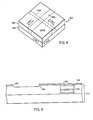
- Figure 3A illustrates the channel side walls which result when the channel longitudinal axis is oriented parallel to one set of ⁇ 110> vectors on the ⁇ 100 ⁇ crystallographic plane forming the first major surface
- Figure 3B illustrates the channel side walls which result when the channel longitudinal axis is oriented parallel to a second set of ⁇ 110> vectors on the ⁇ 100 ⁇ crystallographic plane forming the first major surface, where the two sets of ⁇ 110> vectors are mutually perpendicular.
- the direction of ⁇ 110> vectors on a ⁇ 100 ⁇ crystal surface can be determined by light diffraction patterns on the crystal surface, as is well understood.
- discrimination between the two sets of ⁇ 110> vectors for purposes of choosing the side wall orientation of the channel created by etching requires a trial etching step in an expendable area of the substrate wafer being processed.
- FIG 3A a structure is shown similar to the right hand portion of Figure 2, with like elements assigned like reference numbers.
- the difference in the Figure 3A structure is the configuration of the channel 110a.
- the channel is formed by two opposed side walls 144a and 144b and a bottom wall 144c.
- the bottom wall is shown lying along the interface of the substrate portions 104 and 106-i.e., in a ⁇ 100 ⁇ crystallographic plane.
- the side walls diverge linearly from the protective layer opening toward the substrate portion 104 and then curve back to join the bottom wall.
- the linear portion of each side wall lies in a different ⁇ 111 ⁇ crystallographic plane.
- Dashed line 146 shows the lower boundary of the channel at an intermediate stage of etching.
- the regions 148a and 148b are not normally removed by etching, but should be removable if the rate of etching along the bottom wall is slowed, as by introducing an etch resistant layer in the substrate during its formation.
- the rounding of the channel side walls at their intersection with the bottom wall is advantageous in that the necessity of epitaxy at the areally constricted oblique intersections of the ⁇ 111 ⁇ and ⁇ 100 ⁇ planes is avoided, thereby facilitating epitaxy on all channel walls.
- FIG. 3B a somewhat broader opening 142a is shown, since the side walls 150a and 150b of the channel 110b converge toward the channel bottom wall 152.
- Dashed line 154 represents the bottom wall at an intermediate stage of etching. It is to be noted that in this instance side walls entirely conform to ⁇ 111 ⁇ crystallographic planes and that the angles of intersection of the side walls and the bottom wall are obtuse, which facilitates epitaxial deposition at the intersections of the ⁇ 100 ⁇ and ⁇ 111 ⁇ crystallographic planes.
- the substrate surfaces formed by ⁇ 110 ⁇ crystallographic planes are more thermodynamically stable during etching than the surfaces formed by ⁇ 100 ⁇ crystallographic planes.
- etching would be expected to proceed anisotropically, deepening the channel bottom wall while exhibiting little undercutting of the protective layer.
- the next step is to deposit epitaxially III-V compound selectively in the channel formed so that deposition occurs only in the channel and not on the protective layer.
- epitaxially III-V compound selectively in the channel formed so that deposition occurs only in the channel and not on the protective layer.
- a preferred procedure for depositing III-V compound only on the unprotected or exposed surfaces of the substrate lying in the channel employs selected conditions of organometallic vapor phase epitaxy.
- the substrate in any one of the forms shown in Figures 2, 3A, or 3B is placed in a vacuum chamber where it is heated to a temperature in the range of from 500 to 800°C, preferably in the range of from 650 to 750°C.
- the pressure in the vacuum chamber is reduced to less than 50 torr., preferably less than 10 torr.
- an atmosphere is provided in the vacuum chamber comprised of arsine (AsH3) and one or a mixture of organo-aluminum and organo-gallium gases-e.g., trimethyl or triethyl aluminum or gallium.
- the alluminum and gallium ratio are dictated by the ratio of these metals desired in the epitaxy being deposited on the substrate.
- a molar excess of the arsine gas is maintained.
- a molar ratio of vapor phase arsine to total vapor phase aluminum and gallium of from about 2:1 to 100:1 is maintained.
- Deposition is continued until the epitaxy deposited in the channel forms with the first major surface of the substrate an overall planar surface-e.g., until the surface of the eiptaxy in the lasing region lies within about a ⁇ m of the first major surface of the substrate, preferably within about 3000 Angstroms of the first major surface.
- N or P dopant materials are introduced along with the other gases.
- N type dopants such as silicon, selenium, sulfur, tellurium, tin, and germanium
- vapor phase compounds such as silane, hydrogen selenide, germanium hydride, dialkyl telluride, or tetraalkyl tin
- P type dopants such zinc, cadmium, beryllium, and magnesium
- alkyl in each instance is independently methyl or ethyl.
- edge contouring of the successive epitaxially deposited layers is observed, the contouring effect is not incompatible with obtaining the desired final planar surface configuration. Since contouring results from interaction with the substrate channel walls, once epitaxy covers these walls, the successive deposition favors restoring planarity to the upper surface of the epitaxy. Edge contours of lasing region layers can be minimized by maintaining the channel depth small in relation to its width. Where the channel is initially bounded by side walls lying in ⁇ 110 ⁇ crystallographic planes, the slower deposition onto walls of this crystallographic orientation favors the deposition of flat layers essentially free of edge contours, as shown in Figure 1.
- the lasing region epitaxy is grown just to or slightly below the first major surface of the substrate to form a planar surface extension of the first major surface-i.e., a surface that lies within about a ⁇ m and preferably within about 3000 Angstroms of the first major surface.
- a planar surface extension of the first major surface i.e., a surface that lies within about a ⁇ m and preferably within about 3000 Angstroms of the first major surface.
- the surface layer 222 can be formed by selective site epitaxial deposition employing a variation of the process described above for forming the lasing region.
- the next objective is to prevent further III-V compound epitaxy at this location while forming the surface layer. This can be achieved merely by closing the opening 142 with additional material of the type used to form the protective layer 140. This can be done locally over the first lasing region or uniformly over the entire upper surface of the device.
- a second protective layer 156 over the entire first major surface 124 of the substrate and the capping layer of the lasing regionl.
- opening 158 and channel 210 are formed similarly as described above with reference to opening 142 and channel 110, with the notable difference that the channel 210 will normally be much shallower than the channel 110.
- the channel 210 typically has a depth no greater than the thickness of cladding layer 118 and capping layer 122.
- the surface layer 222 can then be epitaxially grown selectively in the channel 210.
- the protective layer or layers used for directing epitaxy can remain as permanent layers of the completed device or can be removed and replaced by an insulative layer, such as layer 130 in Figure 1.
- the insulative and protective layers can be used together. It is to be noted that the insulative layer 130 as shown in Figure 1 covers portions of the lasing region to limit the lateral contact of the second electrode with the lasing region. This arrangement can be used to advantage to combine gain guiding with positive index guiding.
- the substrate containing the lasing region intended to form the semiconductor device is typically cleaved from a wafer of which it forms a part during fabrication so that two parallel smooth mirror edges intersect the channels containing the lasing regions. These mirror edges interact with the lasing regions to increase the emission efficiency of the completed device.
- the lasing region contains five separate layers as shown in Figure 1.
- the capping layer 114 for example, can be omitted. It is also possible to form laser regions with superimposed active layers separated by one or more intervening cladding layers.
- the substrate 102 has been shown to be comprised of both conductive portion 104 and isolating portion 106; however, only the isolating portion is essential.
- a unitary substrate can be formed in which a wafer having the composition of the isolating portion is provided and etched to form channels therein without any intervening step of epitaxially deposition of additional III-V compound thereon.
- the surface layer can be used to form other useful integrated circuit components, if desired.
- the surface layer can be used to introduce a controlled resistance connecting the second and third electrodes. By bringing the second and third electrodes into close lateral spacing on the surface layer a capacitor can be formed.
- both the gate and third electrodes can be eliminated and the second electrode extended over the entire width of the surface layer.
- the surface layer can form a storage stage of charge coupled device. It is also possible to omit the third and gate electrodes and to terminate the second electrode short of the surface layer and in contact with the surface layer. In this instance the surface layer can function to complete a photodiode.
- other useful integrated components can be completed by the surface, if desired.
Landscapes
- Physics & Mathematics (AREA)
- Condensed Matter Physics & Semiconductors (AREA)
- General Physics & Mathematics (AREA)
- Electromagnetism (AREA)
- Optics & Photonics (AREA)
- Geometry (AREA)
- Semiconductor Lasers (AREA)
Applications Claiming Priority (2)
| Application Number | Priority Date | Filing Date | Title |
|---|---|---|---|
| US908743 | 1986-09-18 | ||
| US06/908,743 US4891093A (en) | 1986-09-18 | 1986-09-18 | Processes for the manufacture of laser including monolithically integrated planar devices |
Publications (3)
| Publication Number | Publication Date |
|---|---|
| EP0261408A2 true EP0261408A2 (de) | 1988-03-30 |
| EP0261408A3 EP0261408A3 (en) | 1989-01-11 |
| EP0261408B1 EP0261408B1 (de) | 1992-11-11 |
Family
ID=25426183
Family Applications (1)
| Application Number | Title | Priority Date | Filing Date |
|---|---|---|---|
| EP87112176A Expired EP0261408B1 (de) | 1986-09-18 | 1987-08-21 | Laser mit monolitisch integrierten, planaren Elementen und Verfahren zu deren Herstellung |
Country Status (5)
| Country | Link |
|---|---|
| US (1) | US4891093A (de) |
| EP (1) | EP0261408B1 (de) |
| JP (1) | JPS6387783A (de) |
| CA (1) | CA1279920C (de) |
| DE (1) | DE3782599T2 (de) |
Cited By (2)
| Publication number | Priority date | Publication date | Assignee | Title |
|---|---|---|---|---|
| US5048049A (en) * | 1988-09-22 | 1991-09-10 | Siemens Aktiengesellschaft | Turnable distributed feedback-laser |
| EP0704913A3 (de) * | 1994-09-28 | 1997-03-19 | Nippon Telegraph & Telephone | Optische Halbleitervorrichtung und Herstellungsverfahren |
Families Citing this family (7)
| Publication number | Priority date | Publication date | Assignee | Title |
|---|---|---|---|---|
| US5013682A (en) * | 1986-10-22 | 1991-05-07 | Texas Instruments Incorporated | Method for selective epitaxy using a WSI mask |
| US5145807A (en) * | 1988-05-11 | 1992-09-08 | Mitsubishi Kasei Corporation | Method of making semiconductor laser devices |
| DE3910288A1 (de) * | 1989-03-30 | 1990-10-04 | Standard Elektrik Lorenz Ag | Verfahren zur herstellung monolithisch integrierter optoelektronischer module |
| US4971928A (en) * | 1990-01-16 | 1990-11-20 | General Motors Corporation | Method of making a light emitting semiconductor having a rear reflecting surface |
| US5625636A (en) * | 1991-10-11 | 1997-04-29 | Bryan; Robert P. | Integration of photoactive and electroactive components with vertical cavity surface emitting lasers |
| JPH10255645A (ja) * | 1997-03-11 | 1998-09-25 | Agency Of Ind Science & Technol | 冷電子放出素子 |
| US6670211B2 (en) * | 2000-06-08 | 2003-12-30 | The Furukawa Electric Co., Ltd. | Semiconductor laser device |
Family Cites Families (12)
| Publication number | Priority date | Publication date | Assignee | Title |
|---|---|---|---|---|
| US3579055A (en) * | 1968-08-05 | 1971-05-18 | Bell & Howell Co | Semiconductor laser device and method for it{3 s fabrication |
| US4033796A (en) * | 1975-06-23 | 1977-07-05 | Xerox Corporation | Method of making buried-heterostructure diode injection laser |
| JPS5826834B2 (ja) * | 1979-09-28 | 1983-06-06 | 株式会社日立製作所 | 半導体レ−ザ−装置 |
| US4532694A (en) * | 1981-06-11 | 1985-08-06 | Honeywell Inc. | Method of fabricating emitter/detector-in-a-well for the integration of electronic and optoelectronic components |
| US4484332A (en) * | 1982-06-02 | 1984-11-20 | The United States Of America As Represented By The Secretary Of The Air Force | Multiple double heterojunction buried laser device |
| JPS5941317A (ja) * | 1982-08-31 | 1984-03-07 | Mitsui Toatsu Chem Inc | プロピレン―エチレンブロック共重合体の製造法 |
| US4509996A (en) * | 1982-11-05 | 1985-04-09 | International Standard Electric Corporation | Injection laser manufacture |
| US4566171A (en) * | 1983-06-20 | 1986-01-28 | At&T Bell Laboratories | Elimination of mask undercutting in the fabrication of InP/InGaAsP BH devices |
| EP0132408A3 (de) * | 1983-07-26 | 1986-04-16 | Jim Auclair | Verfahren und Vorrichtung zur Züchtung von Schichten und zur Herstellung von Überzügen auf einem Substrat |
| US4577321A (en) * | 1983-09-19 | 1986-03-18 | Honeywell Inc. | Integrated quantum well lasers for wavelength division multiplexing |
| US4645687A (en) * | 1983-11-10 | 1987-02-24 | At&T Laboratories | Deposition of III-V semiconductor materials |
| US4660208A (en) * | 1984-06-15 | 1987-04-21 | American Telephone And Telegraph Company, At&T Bell Laboratories | Semiconductor devices employing Fe-doped MOCVD InP-based layer for current confinement |
-
1986
- 1986-09-18 US US06/908,743 patent/US4891093A/en not_active Expired - Fee Related
-
1987
- 1987-07-30 CA CA000543400A patent/CA1279920C/en not_active Expired - Fee Related
- 1987-08-21 EP EP87112176A patent/EP0261408B1/de not_active Expired
- 1987-08-21 DE DE8787112176T patent/DE3782599T2/de not_active Expired - Fee Related
- 1987-09-18 JP JP62234730A patent/JPS6387783A/ja active Pending
Cited By (4)
| Publication number | Priority date | Publication date | Assignee | Title |
|---|---|---|---|---|
| US5048049A (en) * | 1988-09-22 | 1991-09-10 | Siemens Aktiengesellschaft | Turnable distributed feedback-laser |
| EP0704913A3 (de) * | 1994-09-28 | 1997-03-19 | Nippon Telegraph & Telephone | Optische Halbleitervorrichtung und Herstellungsverfahren |
| US5783844A (en) * | 1994-09-28 | 1998-07-21 | Nippon Telegraph And Telephone Corporation | Optical semiconductor device |
| US6790697B2 (en) | 1994-09-28 | 2004-09-14 | Nippon Telegraph And Telephone Corporation | Optical semiconductor device and method of fabricating the same |
Also Published As
| Publication number | Publication date |
|---|---|
| EP0261408B1 (de) | 1992-11-11 |
| DE3782599D1 (de) | 1992-12-17 |
| EP0261408A3 (en) | 1989-01-11 |
| CA1279920C (en) | 1991-02-05 |
| JPS6387783A (ja) | 1988-04-19 |
| US4891093A (en) | 1990-01-02 |
| DE3782599T2 (de) | 1993-06-03 |
Similar Documents
| Publication | Publication Date | Title |
|---|---|---|
| US4788159A (en) | Process for forming a positive index waveguide | |
| CA1276276C (en) | Semiconductor devices employing ti-doped group iii-v epitaxial layer | |
| EP0233725B1 (de) | Opto-elektronisches Bauelement und Verfahren zu seiner Herstellung | |
| US6201823B1 (en) | Gallium nitride based compound semiconductor laser and method of forming the same | |
| US5360754A (en) | Method for the making heteroepitaxial thin layers and electronic devices | |
| WO1992008243A1 (en) | Selective-emitting lasers | |
| JPH04337689A (ja) | オプトエレクトロニクス半導体装置及びその製造方法 | |
| KR920003445B1 (ko) | 광전자집적회로 및 그 제조방법 | |
| US5470785A (en) | Method of manufacturing buried heterostructure semiconductor laser | |
| EP0261408B1 (de) | Laser mit monolitisch integrierten, planaren Elementen und Verfahren zu deren Herstellung | |
| US4648940A (en) | Process for manufacturing a semiconductor laser having a buried ribbon | |
| US4503539A (en) | Semiconductor laser | |
| US5953581A (en) | Methods for manufacturing group III nitride compound semiconductor laser diodes | |
| US4888085A (en) | Processes for their manufacture of monolithically integrated planar lasers differing in emission wavelengths | |
| US5465266A (en) | Index-guided laser on a ridged (001) substrate | |
| US5146467A (en) | Semiconductor laser device | |
| EP0266826A1 (de) | Halbleiterlaser und Verfahren zu dessen Fabrikation | |
| EP0312401B1 (de) | Halbleiteranordnungen und Herstellungsverfahren | |
| JPS62160785A (ja) | モノリシツク半導体構造およびその製造方法 | |
| US5400356A (en) | Index-guided laser on grooved (001) substrate | |
| JP3424634B2 (ja) | 窒化物半導体レーザ素子 | |
| US4926432A (en) | Semiconductor laser device | |
| Bellavance et al. | Room‐temperature mesa lasers grown by selective liquid phase epitaxy | |
| US4329661A (en) | Terraced substrate semiconductor laser | |
| CA1282874C (en) | Semiconductor devices employing high resistivity in p-based epitaxial layer forcurrent confinement |
Legal Events
| Date | Code | Title | Description |
|---|---|---|---|
| PUAI | Public reference made under article 153(3) epc to a published international application that has entered the european phase |
Free format text: ORIGINAL CODE: 0009012 |
|
| AK | Designated contracting states |
Kind code of ref document: A2 Designated state(s): BE DE FR GB NL |
|
| PUAL | Search report despatched |
Free format text: ORIGINAL CODE: 0009013 |
|
| AK | Designated contracting states |
Kind code of ref document: A3 Designated state(s): BE DE FR GB NL |
|
| 17P | Request for examination filed |
Effective date: 19890621 |
|
| 17Q | First examination report despatched |
Effective date: 19911007 |
|
| GRAA | (expected) grant |
Free format text: ORIGINAL CODE: 0009210 |
|
| AK | Designated contracting states |
Kind code of ref document: B1 Designated state(s): BE DE FR GB NL |
|
| REF | Corresponds to: |
Ref document number: 3782599 Country of ref document: DE Date of ref document: 19921217 |
|
| ET | Fr: translation filed | ||
| PG25 | Lapsed in a contracting state [announced via postgrant information from national office to epo] |
Ref country code: GB Effective date: 19930821 |
|
| PG25 | Lapsed in a contracting state [announced via postgrant information from national office to epo] |
Ref country code: BE Effective date: 19930831 |
|
| PLBE | No opposition filed within time limit |
Free format text: ORIGINAL CODE: 0009261 |
|
| STAA | Information on the status of an ep patent application or granted ep patent |
Free format text: STATUS: NO OPPOSITION FILED WITHIN TIME LIMIT |
|
| 26N | No opposition filed | ||
| BERE | Be: lapsed |
Owner name: EASTMAN KODAK CY (A NEW JERSEY CORP.) Effective date: 19930831 |
|
| PG25 | Lapsed in a contracting state [announced via postgrant information from national office to epo] |
Ref country code: NL Effective date: 19940301 |
|
| NLV4 | Nl: lapsed or anulled due to non-payment of the annual fee | ||
| GBPC | Gb: european patent ceased through non-payment of renewal fee |
Effective date: 19930821 |
|
| PG25 | Lapsed in a contracting state [announced via postgrant information from national office to epo] |
Ref country code: FR Effective date: 19940429 |
|
| PG25 | Lapsed in a contracting state [announced via postgrant information from national office to epo] |
Ref country code: DE Effective date: 19940503 |
|
| REG | Reference to a national code |
Ref country code: FR Ref legal event code: ST |