EP0261501A2 - Halogenhaltige Ether - Google Patents
Halogenhaltige Ether Download PDFInfo
- Publication number
- EP0261501A2 EP0261501A2 EP87113156A EP87113156A EP0261501A2 EP 0261501 A2 EP0261501 A2 EP 0261501A2 EP 87113156 A EP87113156 A EP 87113156A EP 87113156 A EP87113156 A EP 87113156A EP 0261501 A2 EP0261501 A2 EP 0261501A2
- Authority
- EP
- European Patent Office
- Prior art keywords
- compounds
- general formula
- fluoropolymers
- mixture
- integer
- Prior art date
- Legal status (The legal status is an assumption and is not a legal conclusion. Google has not performed a legal analysis and makes no representation as to the accuracy of the status listed.)
- Granted
Links
- 0 C*CC1C(C2)CC2C1 Chemical compound C*CC1C(C2)CC2C1 0.000 description 3
Classifications
-
- C—CHEMISTRY; METALLURGY
- C08—ORGANIC MACROMOLECULAR COMPOUNDS; THEIR PREPARATION OR CHEMICAL WORKING-UP; COMPOSITIONS BASED THEREON
- C08J—WORKING-UP; GENERAL PROCESSES OF COMPOUNDING; AFTER-TREATMENT NOT COVERED BY SUBCLASSES C08B, C08C, C08F, C08G or C08H
- C08J3/00—Processes of treating or compounding macromolecular substances
- C08J3/02—Making solutions, dispersions, lattices or gels by other methods than by solution, emulsion or suspension polymerisation techniques
- C08J3/09—Making solutions, dispersions, lattices or gels by other methods than by solution, emulsion or suspension polymerisation techniques in organic liquids
- C08J3/091—Making solutions, dispersions, lattices or gels by other methods than by solution, emulsion or suspension polymerisation techniques in organic liquids characterised by the chemical constitution of the organic liquid
- C08J3/095—Oxygen containing compounds
-
- C—CHEMISTRY; METALLURGY
- C07—ORGANIC CHEMISTRY
- C07C—ACYCLIC OR CARBOCYCLIC COMPOUNDS
- C07C43/00—Ethers; Compounds having groups, groups or groups
- C07C43/02—Ethers
- C07C43/03—Ethers having all ether-oxygen atoms bound to acyclic carbon atoms
- C07C43/04—Saturated ethers
- C07C43/12—Saturated ethers containing halogen
- C07C43/123—Saturated ethers containing halogen both carbon chains are substituted by halogen atoms
-
- C—CHEMISTRY; METALLURGY
- C07—ORGANIC CHEMISTRY
- C07C—ACYCLIC OR CARBOCYCLIC COMPOUNDS
- C07C43/00—Ethers; Compounds having groups, groups or groups
- C07C43/02—Ethers
- C07C43/03—Ethers having all ether-oxygen atoms bound to acyclic carbon atoms
- C07C43/04—Saturated ethers
- C07C43/12—Saturated ethers containing halogen
- C07C43/126—Saturated ethers containing halogen having more than one ether bond
-
- C—CHEMISTRY; METALLURGY
- C08—ORGANIC MACROMOLECULAR COMPOUNDS; THEIR PREPARATION OR CHEMICAL WORKING-UP; COMPOSITIONS BASED THEREON
- C08J—WORKING-UP; GENERAL PROCESSES OF COMPOUNDING; AFTER-TREATMENT NOT COVERED BY SUBCLASSES C08B, C08C, C08F, C08G or C08H
- C08J2327/00—Characterised by the use of homopolymers or copolymers of compounds having one or more unsaturated aliphatic radicals, each having only one carbon-to-carbon double bond, and at least one being terminated by a halogen; Derivatives of such polymers
- C08J2327/02—Characterised by the use of homopolymers or copolymers of compounds having one or more unsaturated aliphatic radicals, each having only one carbon-to-carbon double bond, and at least one being terminated by a halogen; Derivatives of such polymers not modified by chemical after-treatment
- C08J2327/12—Characterised by the use of homopolymers or copolymers of compounds having one or more unsaturated aliphatic radicals, each having only one carbon-to-carbon double bond, and at least one being terminated by a halogen; Derivatives of such polymers not modified by chemical after-treatment containing fluorine atoms
Definitions
- the invention relates to compounds of the general formula (I) in which can be independent of each other R f F or perfluoroalkyl with 1-3 C atoms, preferably F or CF3 and particularly preferably F, X is hydrogen, F, Br, Cl, preferably hydrogen, F, Br, n is an integer from 1-10, preferably from 1-6, in particular from 1-5, m is an integer from 0-5, preferably from 0-3, in particular from 0-2 and R f ⁇ -CF2-O-CFBr-CF2Br (a) or where R f ⁇ , X ⁇ , n ⁇ and m ⁇ have the same meaning we have R f , X, n and m, with the proviso that in the case of R f ⁇ equal to (a) and equal to F m at least 1, preferably 1, and that in the case of R f ⁇ equal to (b) X and X ⁇ are not simultaneously F and m + m ⁇ must be at least 1, preferably 2, 3 or 4.
- Kolbe electrolysis compounds of the general will. When using two different carboxylic acids, Kolbe products can also be produced that are not symmetrical:
- the compounds according to the invention can be used as intermediates and as heat-transferring liquids. However, they are preferably used as solvents for fluoropolymers, for example those as described in DE-OS 2 905 457 and DE-OS 3 036 410, in EP-A-00 66 369 and EP-A-00 88 285 and are described in WO 81/01158.
- the group (B) is preferably -COOR.
- These recurring units (C) can, if appropriate, form the fluoropolymer in a mixture with one another.
- E F, CF3, -O-CF2-CF2-CF3 or and especially F.
- these recurring units may be in a mixture.
- the content of (C) in the case of bi- or terpolymers is 10 to 50 mol%, preferably 13 to 45 mol%, based on the total polymer.
- examples include tetrafluoroethylene, trifluorochloroethylene, hexafluoropropene, perfluoro (propyl vinyl ether) and perfluoropropoxy (propyl vinyl ether).
- the molecular weight (number average) of the fluoropolymers is generally between 50,000 and 1,000,000, preferably between 100,000 and 500,000 Equivalent weight (if groups (A) and / or (B) are present) is 400 to 1800, preferably 450 to 1500.
- the solutions of the fluoropolymers can be prepared at temperatures from 20 ° C. to the boiling point of the corresponding solvent, preferably at temperatures from 50 ° C. to 10 ° C. below the boiling point. If necessary, work can also be carried out under superatmospheric pressure in order to achieve higher temperatures. In general, however, normal pressure is preferred. It is advantageous to udgl.
- the dissolving process by stirring. to support the solution and to use the fluoropolymer in as finely divided a form as possible.
- the concentration (the solids content) of the solutions obtained is usually between 0.5 and 30% by weight, preferably between 1 and 25% by weight.
- solutions obtained in this way are notable in particular for their stability owing to the lack of functional groups in the solvent, the ability of the solvent to dissolve polymers with or without polar groups equally well, their high solids content owing to the good dissolving properties of the solvents and the fact from that molded bodies (membranes) can be produced from them without major thermal stress on the fluoropolymer.
- the solutions can be used in a wide variety of fields, as described, for example, in DE-OS 2,905,467 and DE-OS 3,036,410 and EP-A-00 66 369. They are preferably used for the manufacture or repair of membranes, in particular for liquid penetration processes such as those used in ultra- or hyperfiltration, dialysis (reverse osmosis) Electrolysis, especially of aqueous saline solutions, as well as occur in fuel cells. Other areas of application include membranes for ion exchange processes, for mass transport and for catalytic purposes.
- the acid fluorides of the formula (3) were saponified with aqueous potassium hydroxide solution with ice cooling and the neutral salt solution was evaporated in vacuo.
- the dry salt was pyrolyzed at 200-250 ° C, and the resulting vinyl ether was condensed in a cold trap (-78 ° C). Distillation gave the vinyl ethers (4) in yields greater than 80%.
- the vinyl ether was placed in a glass flask equipped with a magnetic stirrer, reflux condenser and dropping funnel. With exposure to a daylight lamp, bromine was added dropwise until no discoloration occurred. The internal temperature was kept between 20 and 100 ° C. by cooling with ice. The mixture was worked up either by washing with sodium hydroxide solution and water and then drying over P2O5 with subsequent distillation or by direct distillation of the reaction mixture.
Landscapes
- Chemical & Material Sciences (AREA)
- Organic Chemistry (AREA)
- General Chemical & Material Sciences (AREA)
- Dispersion Chemistry (AREA)
- Health & Medical Sciences (AREA)
- Chemical Kinetics & Catalysis (AREA)
- Medicinal Chemistry (AREA)
- Polymers & Plastics (AREA)
- Organic Low-Molecular-Weight Compounds And Preparation Thereof (AREA)
- Addition Polymer Or Copolymer, Post-Treatments, Or Chemical Modifications (AREA)
- Manufacture Of Macromolecular Shaped Articles (AREA)
Abstract

Rf F oder Perfluoralkyl,
X Wasserstoff, F, Br, Cl,
n eine ganze Zahl von 1 - 10,
m eine ganze Zahl von 0 - 5 und
Rfʹ -CF₂-O-CFBr-CF₂Br (a) oder (b) darstellen,
worin Rfʺ, Xʹ, nʹ und mʹ die gleiche Bedeutung haben wie Rf, X, n und m mit der Maßgabe, daß im Falle von Rfʹ gleich (a) und X gleich F m mindestens 1 sein muß, und daß im Falle von Rfʹ gleich (b) X und Xʹ nicht gleichzeitig gleich F sind und m + mʹ mindestens 1 sein muß, die sich insbesondere als Lösungsmittel für Fluorpolymere eignen.
Description
- Verbindungen der allgemeinen Formel (α)


- Auch Verbindungen der allgemeinen Formel (β)
CF₃-(CF₂)n-O-CFBr-CF₂Br (β),
mit n = 2 (Izv. Akad. Nauk SSSR, Ser.Khim 1984 2319, C.A. 102 131499s) oder n = 4 (DE-OS 2 614 333) gehören bereits zum Stand der Technik. Sie werden durch Bromierung der zugrundeliegenden Vinylether erhalten. - Bekannt sind schließlich auch Verbindungen der allgemeinen Formel (γ)

- Die Erfindung betrifft Verbindungen der allgemeinen Formel (I)

Rf F oder Perfluoralkyl mit 1-3 C-Atomen, vorzugsweise F oder CF₃ und besonders bevorzugt F,
X Wasserstoff, F, Br, Cl, vorzugsweise Wasserstoff, F, Br,
n eine ganze Zahl von 1-10, vorzugsweise von 1-6, insbesondere von 1-5,
m eine ganze Zahl von 0-5, vorzugsweise von 0-3, insbesondere von 0-2 und
Rfʹ -CF₂-O-CFBr-CF₂Br (a) oder
mit der Maßgabe, daß im Falle von Rfʹ gleich (a) und gleich F m mindestens 1, vorzugsweise 1, sein muß, und das im Falle von Rfʹ gleich (b) X und Xʹ nicht gleichzeitig gleich F sind und m + mʹ mindestens 1, vorzugsweise 2, 3 oder 4 sein muß. - Während beispielsweise Verbindungen wie

- Als Beispiele für Verbindungen der obigen Formel (I) seien genannt:


- Die Herstellung der erfindungsgemäßen Verbindungen erfolgt analog bekannten Sytheseverfahren. Verbindungen der allgemeinen Formel (I), in denen Rfʹ für CF₂-O-CFB-CF₂Br steht, können beispielsweise erhalten werden durch Addition von Brom an ungesättigte Verbindungen der allgemeinen Formel (II)

- Die Verbindungen der allgemeinen Formel II (Rfʺʺ= -CF₂-O-CF=CF₂) sind z.B. durch die nachstehende Reaktionsfolge leicht herstellbar:

- Bezüglich näherer Einzelheiten sei auf Angew. Chem. 97, 164 (1985) sowie auf R.E. Banks, Preparation, Properties, and Ind. Appl. of Organofluorine Compound Ellis Horwood Ltd. 1982, Seite 257 verwiesen.
- Durch Kolbe-Elektrolyse können Verbindungen der allgemeinen


- Die erfindungsgemäßen Verbindungen können als Zwischenprodukte sowie als wärmeübertragende Flüssigkeiten eingesetzt werden. Vorzugsweise finden sie jedoch als Lösungsmittel für Fluorpolymere Verwendung, beispielsweise solche, wie sie in der DE-OS 2 905 457 und der DE-OS 3 036 410, in der EP-A-00 66 369 und der EP-A-00 88 285 sowie in der WO 81/01158 beschrieben sind.
- Bevorzugt enthalten diese Fluorpolymere die Gruppen
-SO₂F (A)
und/oder
-CG (B)
(G = Stickstoff, -OOR oder -ON(R)₂, wobei R C₁-C₁₀-Alkyl, Aryl, Aralkyl, vorzugsweise C₁-C₈-Alkyl darstellt)
wobei die Gruppen (B) bevorzugt sind. Vorzugsweise bedeutet die Gruppe (B) -COOR. - Besonders bevorzugt sind hier Fluorpolymere zu nennen, welche die wiederkehrenden Einheiten mit der allgemeinen Formel (C) entweder allein oder zusammen mit anderen wiederkehrenden Einheiten enthalten:

v= 0 oder 1, vorzugsweise 1,
w= 1 - 7, vorzugsweise 2 - 5,
Aʹ und Bʹ= unabhängig voneinander F oder CF₃, vorzugweise Aʹ= CF₃ und Bʹ= F und
D- Wasserstoff, Cl, Br, CG (G die gleiche Bedeutung wie oben) und weniger bevorzugt SO₂F bedeuten. - Diese wiederkehrenden Einheiten (C) können ggf. in Mischung untereinander das Fluorpolymere aufbauen. Vorzugsweise finden sich in diesem jedoch zusätzlich noch wiederkehrende Einheiten der allgemeinen Formel (D)
-CF₂-CFE- (D)
worin E für Cl, F, Rf oder ORf (Rf= CF₃ oder ggf. durch O-Atome unterbrochener C₂-C₈-Perfluoralkylrest) steht. Bevorzugt bedeutet E= F, CF₃, -O-CF₂-CF₂-CF₃ oder

- Auch hier können diese wiederkehrenden Einheiten ggf. in Mischung vorliegen. Bevorzugt im Rahmen dieser Fluorpolymeren sind solche, welche aus der wiederkehrenden Einheit (C)

- Beispiele für zu den wiederkehrenden Einheiten (C) führenden Monomeren sind:
CF₂= CFOCF₂CF₂SO₂F,
CF₂=CFO(CF₂1-6COOCH₃, CF₂=CF(CF₂)0-8COOCH₃

CF₂=CF-O-CF₂CF(CF₃)O(CF₂)₃COOCH₃,
CF₂=CF-O-CF₂CF(CF₃)OCF₂COOCH₃. - Im Zusammenhang mit der wiederkehrenden Einheit (D) sind als Beispiele Tetrafluorethylen, Trifluorchlorethylen, Hexafluorpropen, Perfluor(propylvinylether) und Perfluorpropoxy(propylvinylether) zu nennen.
- Die Herstellung derartiger aus (C) und ggf. (D) bestehender Fluorpolymerer ist beispielsweise in der EP-A-00 88 285 und der EP-A-0 171 696 beschrieben.
- Das Molekulargewicht (Zahlenmittel) der Fluorpolymeren liegt im allgemeinen zwischen 50000 und 1000000, vorzugsweise zwischen 100000 und 500000. Das Äquivalentgewicht (bei Vorhandensein der Gruppen (A) und/oder (B)) beträgt 400 bis 1800, vorzugsweise 450 bis 1500.
- Die Herstellung der Lösungen der Fluorpolymeren kann bei Temperaturen von 20°C bis zum Siedepunkt des entsprechenden Lösungsmittels, vorzugsweise bei Temperaturen von 50°C bis 10°C unterhalb des Siedepunktes erfolgen. Gegebenenfalls kann dabei auch unter überatmosphärischem Druck gearbeitet werden, um höhere Temperaturen zu erzielen. Im allgemeinen ist jedoch Normaldruck bevorzugt. Es ist von Vorteil, den Lösevorgang durch Rühren udgl. der Lösung zu unterstützen und das Fluorpolymere in möglichst feinverteilter Form einzusetzen. Die Konzentration (der Feststoffgehalt) der erhaltenen Lösungen liegt üblicherweise zwischen 0,5 und 30 Gew.-%, vorzugsweise zwischen 1 und 25 Gew.-%.
- Die so erhaltenen Lösungen zeichnen sich vor allem durch ihre Stabilität aufgrund des Fehlens von funktionellen Gruppen im Lösungsmittel, der Fähigkeit des Lösungsmittels, Polymere mit oder ohne polare Gruppen gleichermaßen gut zu lösen, ihrem hohen Feststoffgehalt wegen der guten Löse-Eigenschaften der Lösungsmittel und des Umstandes aus, daß daraus Formkörper (Membranen) ohne größere thermische Belastung des Fluorpolymeren hergestellt werden können.
- Die Lösungen können auf den verschiedensten Gebieten eingestzt werden, wie sie beispielsweise in der DE-OS 2.905.467 und der DE-OS 3.036.410 sowie der EP-A-00 66 369 beschrieben sind. Bevorzugt werden sie zur Herstellung oder Repartur von Membranen insbesondere für Flüssigkeitsdurchdringungsprozesse benutzt, wie sie bei der Ultra- bzw. Hyperfiltration, Dialyse (umgekehrte Osmose) Elektrolyse, insbesondere von wäßrigen Kochsalzlösungen, sowie in Brennstoffzellen auftreten. Als weitere Einsatzgebiete kommen Membranen für Ionenaustauschprozesse, für Massentransporte sowie für katalytische Zwecke in Betracht.
- In einem Glaskolben oder Glasautoklaven, der mit einem Flügelrührer ausgestattet ist, wurde das betreffende Carbonsäurefluorid und der Katalysator vorgelegt. Unter intensivem Rühren wurde dann Hexafluorpropenepoxid aufgedrückt, wobei das Gas unter exothermer Reaktion aufgenommen wurde. Durch Kühlung wurde die Innentemperatur bei 20 - 40°C gehalten. Nach dem Ende der Reaktion wurde das Gemisch destilliert. Die Reaktion verlief nach der Gleichung

- Die Säurefluoride der Formel (3) wurden mit wäßriger Kalilauge unter Eiskühlung verseift und die neutrale Salzlösung im Vakuum eingedampft. Das trockene Salz wurde bei 200 - 250°C pyrolysiert, und der entstehende Vinylether in einer kältefalle (-78°C) kondensiert. Die Destillation ergab die Vinylether (4) mit Ausbeuten größer als 80 %.

- In einem Glaskolben, der mit einem Magnetrührer, Rückflußkühler und Tropftrichter ausgestattet war, wurde der Vinylether vorgelegt. Unter Belichtung mit einer Tageslichtlampe tropfte man so lange Brom zu, bis keine Entfärbung mehr auftrat. Die Innentemperatur wurde durch Kühlung mit Eis zwischen 20 und 100°C gehalten. Die Aufarbeitung des Ansatzes erfolgte entweder durch Waschen mit Natronlauge und Wasser und anschließende Trocknung über P₂O₅ mit nachfolgender Destillation oder durch direkte Destillation des Reaktionsgemisches.

- Die Kolbe-Produkte der allgemeinen Formel

- a) In einer Glastopfelektrolysezelle mit Platinanode und kathode (je 50 cm²) wurden 331 g
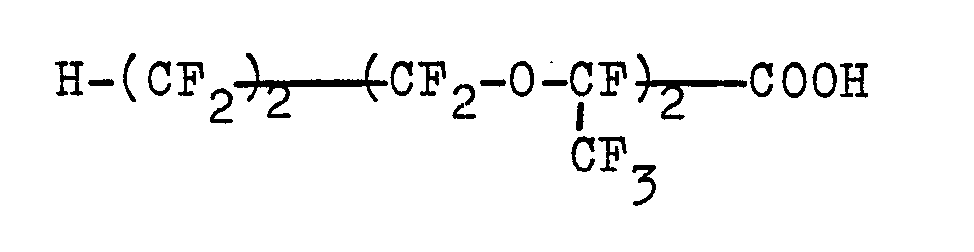

- b) Aus


- c) In der gleichen Elektrolysezelle wie in Beispiel II a) wurde ein Gemisch von 108 g


- d) Ebenso wurde ein Gemisch aus 97,8 g

Nach Aufarbeitung und Destillation wurden erhalten:
-
- 1) 10 g eines Fluorpolymeren aus Tetrafluorethylen (TFE) und ω-Hydroperfluor-(propylvinylether) (HPPVE), das gemäß Beispiel 1 der EP-A-0 171 696 hergestellt worden war und 21,5 Mol-% HPPVE enthielt, wurden in 90 g des Lösungsmittels mit der Formel

- 2) Das Fluorpolymere gemäß Beispiel 1 wurde nach dem in Beispiel 1 der EP-A 00 88 285 beschriebenen Verfahren in die Methylesterform überführt. 10 g eines solchen fluorpolymeren wurden danach 5 Stunden bei 150°C in 80 g des in Beispiel 1 verwendeten Lösungsmittels gerührt. Man erhielt eine völlig klare Lösung mit einem Feststoffgehalt von 11,1 Gew.-%. Aus einer solchen Lösung wurden Filme hergestellt, die nach der Hydrolyse mit NaOH z.B. als Ionenaustauschermembranen bei der Chloralkali-Elektrolyse Verwendung finden. Wurde eine solche Membran in eine Elektrolyse-Zelle, die mit einer Titan-Streckmetallanode und einer V4A-Kathode versehen war, eingebaut, so erhielt man bei einer Stromdichte von 3000 A/m², einer Anolytkonzentration von 205 g NaCl/1H₂O und einer Laugenlkonzentration von 36 % NaOH eine Stromausbeute von 94 % und eine Zellspannung von 3,45 V.
- 3) Zu 5 g des Copolymeren aus Beispiel 2 wurden 50 g des Lösungsmittels der Formel

- 4) (Vergleich): Zu 5 g des Coppolymeren aus Beispiel 2 wurden 150 g des Lösungsmittels der Formel

- 5) (Vergleich): Zu 10 g des Copolymeren aus Beispiel 1 wurden 200 g CF₃-CF₂-CF₂-O-CFBr-CF₂Br (Kp. 112°C) gegeben. Man rührte 7 Stunden bei 110°C. Die aus der erhaltenen Lösung hergestellten Folien waren im Gegensatz zu denen aus Beispiel 1 trübe und wiesen eine sehr geringe mechanische Festigkeit auf.
- 6) Zu je 5 g eines Terpolymeren aus TFE, Perfluorpropylvinylether (PPVE) und HPPVE wurden 70 g H-(CF₂)₃-O-CF(CF₃)-O-(CF₂)₃-H (Ansatz I) bzw. 100 g CF₃-CF₂-CF₂-O-CFBr-CF₂Br (Ansatz II-Vergleich) gegeben. Ansatz I wurde 3 Stunden bei 95 °C gerührt. Ansatz II wurde 3 Stunden bei 105°C gerührt. Die beiden erhaltenen Lösungen wurden zu Folien vergossen: Ansatz I ergab schöne, klare und mechanisch stabile Folien; die Folien aus Ansatz II waren sehr trübe und wiesen ungenügende mechanische Festigkeit auf.
Claims (7)

Rf F oder Perfluoralkyl mit 1-3 C-Atomen,
X Wasserstoff, F, Br, Cl,
n eine ganze Zahl von 1 - 10,
m eine ganze Zahl von 0 - 5 und
Rfʹ -CF₂-O-CFBr-CF₂Br (a) oder


Applications Claiming Priority (2)
| Application Number | Priority Date | Filing Date | Title |
|---|---|---|---|
| DE3631560 | 1986-09-17 | ||
| DE19863631560 DE3631560A1 (de) | 1986-09-17 | 1986-09-17 | Halogenhaltige ether |
Publications (3)
| Publication Number | Publication Date |
|---|---|
| EP0261501A2 true EP0261501A2 (de) | 1988-03-30 |
| EP0261501A3 EP0261501A3 (en) | 1989-10-25 |
| EP0261501B1 EP0261501B1 (de) | 1993-03-31 |
Family
ID=6309735
Family Applications (1)
| Application Number | Title | Priority Date | Filing Date |
|---|---|---|---|
| EP87113156A Expired - Lifetime EP0261501B1 (de) | 1986-09-17 | 1987-09-09 | Halogenhaltige Ether |
Country Status (3)
| Country | Link |
|---|---|
| EP (1) | EP0261501B1 (de) |
| CA (1) | CA1314057C (de) |
| DE (2) | DE3631560A1 (de) |
Cited By (3)
| Publication number | Priority date | Publication date | Assignee | Title |
|---|---|---|---|---|
| EP0589214A1 (de) * | 1992-09-23 | 1994-03-30 | Hoechst Aktiengesellschaft | Verfahren zur Herstellung von perfluorierten Bromalkanen oder Ethergruppen enthaltenden perfluorierten Bromalkanen |
| WO1995032174A1 (en) * | 1994-05-20 | 1995-11-30 | Minnesota Mining And Manufacturing Company | Omega-hydrofluoroalkyl ethers, precursor carboxylic acids and derivatives thereof, and their preparation and application |
| WO2000049068A1 (en) * | 1999-02-18 | 2000-08-24 | E.I. Du Pont De Nemours And Company | Fluoropolymer finishing process |
Family Cites Families (6)
| Publication number | Priority date | Publication date | Assignee | Title |
|---|---|---|---|---|
| FR1323803A (fr) * | 1962-03-29 | 1963-04-12 | Du Pont | Polymères d'époxyde de perfluorooléfines |
| FR1373014A (fr) * | 1963-03-26 | 1964-09-25 | Du Pont | Nouveaux polyéthers fluorocarbonés à atomes d'hydrogène terminaux |
| GB1038365A (en) * | 1963-05-16 | 1966-08-10 | Du Pont | Novel perfluoroolefin epoxide polyethers |
| GB1529514A (en) * | 1975-04-02 | 1978-10-25 | Du Pont | Catalytic reaction of hexafluoropropylene epoxide with a ketone or acid fluoride |
| US4420638A (en) * | 1982-03-02 | 1983-12-13 | E. I. Du Pont De Nemours And Company | Fluorinated ether-ketones |
| DE3631561A1 (de) * | 1986-09-17 | 1988-03-31 | Hoechst Ag | Loesungen von fluorpolymeren und deren verwendung |
-
1986
- 1986-09-17 DE DE19863631560 patent/DE3631560A1/de not_active Withdrawn
-
1987
- 1987-09-09 EP EP87113156A patent/EP0261501B1/de not_active Expired - Lifetime
- 1987-09-09 DE DE8787113156T patent/DE3785121D1/de not_active Expired - Fee Related
- 1987-09-16 CA CA000547011A patent/CA1314057C/en not_active Expired - Fee Related
Cited By (13)
| Publication number | Priority date | Publication date | Assignee | Title |
|---|---|---|---|---|
| EP0589214A1 (de) * | 1992-09-23 | 1994-03-30 | Hoechst Aktiengesellschaft | Verfahren zur Herstellung von perfluorierten Bromalkanen oder Ethergruppen enthaltenden perfluorierten Bromalkanen |
| US6214253B1 (en) | 1994-05-20 | 2001-04-10 | 3M Innovative Properties Company | Omega-hydrofluoroalkyl ethers, precursor carboxylic acids and derivatives thereof, and their preparation and application |
| US5658962A (en) * | 1994-05-20 | 1997-08-19 | Minnesota Mining And Manufacturing Company | Omega-hydrofluoroalkyl ethers, precursor carboxylic acids and derivatives thereof, and their preparation and application |
| US6024176A (en) * | 1994-05-20 | 2000-02-15 | 3M Innovative Properties Company | Omega-hydrofluoroalkyl ethers, precursor carboxylic acids and derivatives thereof, and their preparation and application |
| US6204299B1 (en) | 1994-05-20 | 2001-03-20 | Minnesota Mining And Manufacturing Company | Omega-hydrofluoroalkyl ethers, precursor carboxylic acids and derivatives thereof, and their preparation and application |
| WO1995032174A1 (en) * | 1994-05-20 | 1995-11-30 | Minnesota Mining And Manufacturing Company | Omega-hydrofluoroalkyl ethers, precursor carboxylic acids and derivatives thereof, and their preparation and application |
| US6361713B1 (en) | 1994-05-20 | 2002-03-26 | 3M Innovative Properties Company | Omega-hydrofluoroalkyl ethers, precursor carboxylic acids and derivatives thereof, and their preparation and application |
| US6491983B2 (en) | 1994-05-20 | 2002-12-10 | 3M Innovative Properties Company | Omega-hydrofluoroalkyl ethers, precursor carboxylic acids and derivatives thereof, and their preparation and application |
| CN1110473C (zh) * | 1994-05-20 | 2003-06-04 | 美国3M公司 | 从制品上除去污染物的方法 |
| EP1170275A3 (de) * | 1994-05-20 | 2004-04-14 | Minnesota Mining And Manufacturing Company | Omega-hydrofluoralkylether, Vorläuferkarbonsäure und ihre Derivate, sowie ihre Herstellung und Verwendung |
| US6863211B2 (en) | 1994-05-20 | 2005-03-08 | 3M Innovative Properties Company | Omega-hydrofluoroalkyl ethers, precursor carboxylic acids and derivatives thereof, and their preparation and application |
| WO2000049068A1 (en) * | 1999-02-18 | 2000-08-24 | E.I. Du Pont De Nemours And Company | Fluoropolymer finishing process |
| US6416698B1 (en) | 1999-02-18 | 2002-07-09 | E. I. Du Pont De Nemours And Company | Fluoropolymer finishing process |
Also Published As
| Publication number | Publication date |
|---|---|
| CA1314057C (en) | 1993-03-02 |
| EP0261501A3 (en) | 1989-10-25 |
| DE3785121D1 (de) | 1993-05-06 |
| EP0261501B1 (de) | 1993-03-31 |
| DE3631560A1 (de) | 1988-04-14 |
Similar Documents
| Publication | Publication Date | Title |
|---|---|---|
| EP0260587B1 (de) | Lösungen von Fluorpolymeren und deren Verwendung | |
| DE3046501C2 (de) | Fluorierte Vinyletherverbindungen und Verfahren zu ihrer Herstellung | |
| DE2650979C2 (de) | Verfahren zur Herstellung eines fluorierten Copolymeren mit Ionenaustauschgruppen | |
| DE60224554T2 (de) | Fluorsulfonylverbindungen und verfahren zur herstellung von davon abgeleiteten verbindungen | |
| DE2560151B1 (de) | Fluorkohlenstoffpolymerisate und funktionelle Gruppen enthaltende,dichte Kationenaustauschermembran fuer die Elektrolyse einer waessrigen Natriumchloridloesung | |
| DE836796C (de) | Verfahren zur elektrochemischen Herstellung von Fluorcarbonsaeurefluoriden und ihren Derivaten | |
| DE69110037T2 (de) | Verfahren zur herstellung von perfluoropolyethern. | |
| DE2228609A1 (de) | Monomere, insbesondere monomere fuer die herstellung von polyketonen, und verfahren zu ihrer herstellung | |
| EP0347669A2 (de) | Verfahren zur Herstellung von aromatischen Polyethersulfonen | |
| DE68918965T2 (de) | Organisches Polymer-Material und Ionenaustausch-Membran, die aus dem Material hergestellt ist. | |
| DE2100649A1 (de) | Polytetrafluoräthylenemulsionen und Verfahren zu deren Herstellung | |
| EP0261501B1 (de) | Halogenhaltige Ether | |
| EP0088285B1 (de) | Verfahren zur Herstellung von Carboxylgruppen enthaltenden Fluorkohlenstoffpolymerisaten sowie einige Ausgangsstoffe hierfür und die bei dem Verfahren als Zwischenprodukte auftretenden Fluorsulfatoverbindungen | |
| EP0308838B1 (de) | Verfahren zur Herstellung von fluorierten Acrylsäuren und ihren Derivaten | |
| EP0355726B1 (de) | Verfahren zur elektrolytischen Decarboxylierung einer Perfluorcarbonsäure oder deren löslichen Salzen und anschliessende Dimerisierung der dabei entstehenden Radikale | |
| EP0087737B1 (de) | Perfluorierte Vinylether mit einem sekundären Wasserstoffatom, Polymere daraus, sowie Verfahren zur Herstellung der Monomeren | |
| DE2659581A1 (de) | Fluorierte kationenaustauschermembran und deren verwendung | |
| EP0047950B1 (de) | Omega-Fluorsulfato-perfluorcarbonsäurederivate und Verfahren zu deren Herstellung | |
| DE2523402C2 (de) | ||
| DE2817373A1 (de) | Fluorhaltige ionenaustauscherpolymere mit carboxylgruppen | |
| EP0071064B1 (de) | Verfahren zur Herstellung von alpha, omega-Bis-fluorsulfato-perfluoralkanen | |
| DE60312515T2 (de) | Verfahren zur herstellung fluorierter fluorsulfonylalkyl-vinyl-ether | |
| DE3224428A1 (de) | Perfluorketovinylaether, verfahren zu deren herstellung und deren verwendung | |
| EP0100498B1 (de) | Verfahren zur Herstellung von Dichlormilchsäure oder dem Nitril oder Amid der Dichlormilchsäure | |
| DE2239800C3 (de) | Tertiäre Perfluoraminoäther und Verfahren zu deren Herstellung |
Legal Events
| Date | Code | Title | Description |
|---|---|---|---|
| PUAI | Public reference made under article 153(3) epc to a published international application that has entered the european phase |
Free format text: ORIGINAL CODE: 0009012 |
|
| AK | Designated contracting states |
Kind code of ref document: A2 Designated state(s): BE DE FR GB IT NL |
|
| PUAL | Search report despatched |
Free format text: ORIGINAL CODE: 0009013 |
|
| AK | Designated contracting states |
Kind code of ref document: A3 Designated state(s): BE DE FR GB IT NL |
|
| 17P | Request for examination filed |
Effective date: 19900208 |
|
| 17Q | First examination report despatched |
Effective date: 19911202 |
|
| GRAA | (expected) grant |
Free format text: ORIGINAL CODE: 0009210 |
|
| AK | Designated contracting states |
Kind code of ref document: B1 Designated state(s): BE DE FR GB IT NL |
|
| REF | Corresponds to: |
Ref document number: 3785121 Country of ref document: DE Date of ref document: 19930506 |
|
| ITF | It: translation for a ep patent filed | ||
| GBT | Gb: translation of ep patent filed (gb section 77(6)(a)/1977) |
Effective date: 19930614 |
|
| ET | Fr: translation filed | ||
| PGFP | Annual fee paid to national office [announced via postgrant information from national office to epo] |
Ref country code: DE Payment date: 19931118 Year of fee payment: 7 |
|
| PLBE | No opposition filed within time limit |
Free format text: ORIGINAL CODE: 0009261 |
|
| STAA | Information on the status of an ep patent application or granted ep patent |
Free format text: STATUS: NO OPPOSITION FILED WITHIN TIME LIMIT |
|
| 26N | No opposition filed | ||
| PGFP | Annual fee paid to national office [announced via postgrant information from national office to epo] |
Ref country code: FR Payment date: 19940812 Year of fee payment: 8 |
|
| PGFP | Annual fee paid to national office [announced via postgrant information from national office to epo] |
Ref country code: GB Payment date: 19940819 Year of fee payment: 8 |
|
| PGFP | Annual fee paid to national office [announced via postgrant information from national office to epo] |
Ref country code: BE Payment date: 19940902 Year of fee payment: 8 |
|
| PGFP | Annual fee paid to national office [announced via postgrant information from national office to epo] |
Ref country code: NL Payment date: 19940930 Year of fee payment: 8 |
|
| PG25 | Lapsed in a contracting state [announced via postgrant information from national office to epo] |
Ref country code: DE Effective date: 19950601 |
|
| PG25 | Lapsed in a contracting state [announced via postgrant information from national office to epo] |
Ref country code: GB Effective date: 19950909 |
|
| PG25 | Lapsed in a contracting state [announced via postgrant information from national office to epo] |
Ref country code: BE Effective date: 19950930 |
|
| BERE | Be: lapsed |
Owner name: HOECHST A.G. Effective date: 19950930 |
|
| PG25 | Lapsed in a contracting state [announced via postgrant information from national office to epo] |
Ref country code: NL Effective date: 19960401 |
|
| GBPC | Gb: european patent ceased through non-payment of renewal fee |
Effective date: 19950909 |
|
| PG25 | Lapsed in a contracting state [announced via postgrant information from national office to epo] |
Ref country code: FR Effective date: 19960531 |
|
| NLV4 | Nl: lapsed or anulled due to non-payment of the annual fee |
Effective date: 19960401 |
|
| REG | Reference to a national code |
Ref country code: FR Ref legal event code: ST |
|
| PG25 | Lapsed in a contracting state [announced via postgrant information from national office to epo] |
Ref country code: IT Free format text: LAPSE BECAUSE OF NON-PAYMENT OF DUE FEES;WARNING: LAPSES OF ITALIAN PATENTS WITH EFFECTIVE DATE BEFORE 2007 MAY HAVE OCCURRED AT ANY TIME BEFORE 2007. THE CORRECT EFFECTIVE DATE MAY BE DIFFERENT FROM THE ONE RECORDED. Effective date: 20050909 |