EP0261590A2 - Verfahren zur Herstellung von Metalloxiden oder Metallmischoxiden - Google Patents
Verfahren zur Herstellung von Metalloxiden oder Metallmischoxiden Download PDFInfo
- Publication number
- EP0261590A2 EP0261590A2 EP87113599A EP87113599A EP0261590A2 EP 0261590 A2 EP0261590 A2 EP 0261590A2 EP 87113599 A EP87113599 A EP 87113599A EP 87113599 A EP87113599 A EP 87113599A EP 0261590 A2 EP0261590 A2 EP 0261590A2
- Authority
- EP
- European Patent Office
- Prior art keywords
- solution
- metal oxide
- water
- ammonia
- aqueous solution
- Prior art date
- Legal status (The legal status is an assumption and is not a legal conclusion. Google has not performed a legal analysis and makes no representation as to the accuracy of the status listed.)
- Granted
Links
Images


Classifications
-
- C—CHEMISTRY; METALLURGY
- C01—INORGANIC CHEMISTRY
- C01B—NON-METALLIC ELEMENTS; COMPOUNDS THEREOF; METALLOIDS OR COMPOUNDS THEREOF NOT COVERED BY SUBCLASS C01C
- C01B13/00—Oxygen; Ozone; Oxides or hydroxides in general
- C01B13/14—Methods for preparing oxides or hydroxides in general
- C01B13/34—Methods for preparing oxides or hydroxides in general by oxidation or hydrolysis of sprayed or atomised solutions
-
- B—PERFORMING OPERATIONS; TRANSPORTING
- B01—PHYSICAL OR CHEMICAL PROCESSES OR APPARATUS IN GENERAL
- B01J—CHEMICAL OR PHYSICAL PROCESSES, e.g. CATALYSIS OR COLLOID CHEMISTRY; THEIR RELEVANT APPARATUS
- B01J10/00—Chemical processes in general for reacting liquid with gaseous media other than in the presence of solid particles, or apparatus specially adapted therefor
- B01J10/002—Chemical processes in general for reacting liquid with gaseous media other than in the presence of solid particles, or apparatus specially adapted therefor carried out in foam, aerosol or bubbles
-
- B—PERFORMING OPERATIONS; TRANSPORTING
- B01—PHYSICAL OR CHEMICAL PROCESSES OR APPARATUS IN GENERAL
- B01J—CHEMICAL OR PHYSICAL PROCESSES, e.g. CATALYSIS OR COLLOID CHEMISTRY; THEIR RELEVANT APPARATUS
- B01J19/00—Chemical, physical or physico-chemical processes in general; Their relevant apparatus
- B01J19/08—Processes employing the direct application of electric or wave energy, or particle radiation; Apparatus therefor
- B01J19/10—Processes employing the direct application of electric or wave energy, or particle radiation; Apparatus therefor employing sonic or ultrasonic vibrations
-
- B—PERFORMING OPERATIONS; TRANSPORTING
- B01—PHYSICAL OR CHEMICAL PROCESSES OR APPARATUS IN GENERAL
- B01J—CHEMICAL OR PHYSICAL PROCESSES, e.g. CATALYSIS OR COLLOID CHEMISTRY; THEIR RELEVANT APPARATUS
- B01J19/00—Chemical, physical or physico-chemical processes in general; Their relevant apparatus
- B01J19/26—Nozzle-type reactors, i.e. the distribution of the initial reactants within the reactor is effected by their introduction or injection through nozzles
-
- C—CHEMISTRY; METALLURGY
- C01—INORGANIC CHEMISTRY
- C01F—COMPOUNDS OF THE METALS BERYLLIUM, MAGNESIUM, ALUMINIUM, CALCIUM, STRONTIUM, BARIUM, RADIUM, THORIUM, OR OF THE RARE-EARTH METALS
- C01F7/00—Compounds of aluminium
- C01F7/02—Aluminium oxide; Aluminium hydroxide; Aluminates
- C01F7/34—Preparation of aluminium hydroxide by precipitation from solutions containing aluminium salts
- C01F7/36—Preparation of aluminium hydroxide by precipitation from solutions containing aluminium salts from organic aluminium salts
-
- C—CHEMISTRY; METALLURGY
- C01—INORGANIC CHEMISTRY
- C01G—COMPOUNDS CONTAINING METALS NOT COVERED BY SUBCLASSES C01D OR C01F
- C01G25/00—Compounds of zirconium
- C01G25/02—Oxides
-
- C—CHEMISTRY; METALLURGY
- C01—INORGANIC CHEMISTRY
- C01G—COMPOUNDS CONTAINING METALS NOT COVERED BY SUBCLASSES C01D OR C01F
- C01G49/00—Compounds of iron
- C01G49/02—Oxides; Hydroxides
- C01G49/06—Ferric oxide [Fe2O3]
-
- C—CHEMISTRY; METALLURGY
- C01—INORGANIC CHEMISTRY
- C01G—COMPOUNDS CONTAINING METALS NOT COVERED BY SUBCLASSES C01D OR C01F
- C01G51/00—Compounds of cobalt
- C01G51/04—Oxides
-
- C—CHEMISTRY; METALLURGY
- C01—INORGANIC CHEMISTRY
- C01G—COMPOUNDS CONTAINING METALS NOT COVERED BY SUBCLASSES C01D OR C01F
- C01G53/00—Compounds of nickel
- C01G53/04—Oxides
-
- B—PERFORMING OPERATIONS; TRANSPORTING
- B01—PHYSICAL OR CHEMICAL PROCESSES OR APPARATUS IN GENERAL
- B01J—CHEMICAL OR PHYSICAL PROCESSES, e.g. CATALYSIS OR COLLOID CHEMISTRY; THEIR RELEVANT APPARATUS
- B01J2219/00—Chemical, physical or physico-chemical processes in general; Their relevant apparatus
- B01J2219/00049—Controlling or regulating processes
- B01J2219/00051—Controlling the temperature
- B01J2219/00074—Controlling the temperature by indirect heating or cooling employing heat exchange fluids
- B01J2219/00087—Controlling the temperature by indirect heating or cooling employing heat exchange fluids with heat exchange elements outside the reactor
-
- B—PERFORMING OPERATIONS; TRANSPORTING
- B01—PHYSICAL OR CHEMICAL PROCESSES OR APPARATUS IN GENERAL
- B01J—CHEMICAL OR PHYSICAL PROCESSES, e.g. CATALYSIS OR COLLOID CHEMISTRY; THEIR RELEVANT APPARATUS
- B01J2219/00—Chemical, physical or physico-chemical processes in general; Their relevant apparatus
- B01J2219/00049—Controlling or regulating processes
- B01J2219/00051—Controlling the temperature
- B01J2219/00121—Controlling the temperature by direct heating or cooling
-
- C—CHEMISTRY; METALLURGY
- C01—INORGANIC CHEMISTRY
- C01P—INDEXING SCHEME RELATING TO STRUCTURAL AND PHYSICAL ASPECTS OF SOLID INORGANIC COMPOUNDS
- C01P2002/00—Crystal-structural characteristics
- C01P2002/02—Amorphous compounds
-
- C—CHEMISTRY; METALLURGY
- C01—INORGANIC CHEMISTRY
- C01P—INDEXING SCHEME RELATING TO STRUCTURAL AND PHYSICAL ASPECTS OF SOLID INORGANIC COMPOUNDS
- C01P2002/00—Crystal-structural characteristics
- C01P2002/30—Three-dimensional structures
- C01P2002/34—Three-dimensional structures perovskite-type (ABO3)
-
- C—CHEMISTRY; METALLURGY
- C01—INORGANIC CHEMISTRY
- C01P—INDEXING SCHEME RELATING TO STRUCTURAL AND PHYSICAL ASPECTS OF SOLID INORGANIC COMPOUNDS
- C01P2004/00—Particle morphology
- C01P2004/50—Agglomerated particles
-
- C—CHEMISTRY; METALLURGY
- C01—INORGANIC CHEMISTRY
- C01P—INDEXING SCHEME RELATING TO STRUCTURAL AND PHYSICAL ASPECTS OF SOLID INORGANIC COMPOUNDS
- C01P2004/00—Particle morphology
- C01P2004/60—Particles characterised by their size
- C01P2004/61—Micrometer sized, i.e. from 1-100 micrometer
-
- C—CHEMISTRY; METALLURGY
- C01—INORGANIC CHEMISTRY
- C01P—INDEXING SCHEME RELATING TO STRUCTURAL AND PHYSICAL ASPECTS OF SOLID INORGANIC COMPOUNDS
- C01P2006/00—Physical properties of inorganic compounds
- C01P2006/12—Surface area
Definitions
- the present invention relates to a process for the production of powders from metal oxides or mixed metal oxides with excellent flowability and high bulk density.
- metal salt solutions are broken down into fine droplets using ultrasound, which are then converted into stable metal hydroxide gel particles in an ammonia gas atmosphere. These solidified gel particles are collected and, after drying, converted into the corresponding metal oxides or mixed metal oxides.
- spherical particles which are particularly suitable for use in nuclear technology, can be produced with diameters between 50 and 2500 ⁇ m and a narrow particle size range. Solutions or melts are converted into drops by a vibrator system at frequencies of 50 - 2500 Hz, which are then chemically or physically solidified into spherical particles. The drop or particle size depends on the frequency of the vibrator and the flow rate of the liquid.
- the aim of the present invention is to produce substances with a very small grain diameter and a narrow grain spectrum and to collect the spherical particles produced without the interposition of a liquid phase. At the same time, the process-technically complex regeneration cycles should be avoided and a high liquid throughput should be achievable.
- a process has now been found for producing a metal oxide or mixed metal oxide, in which an aqueous solution of at least one water-soluble, salt-like compound of a polyvalent metal is finely divided in an inert gas atmosphere, the resulting droplets with ammonia brings containing gas into contact until the hydroxide (s) of the polyvalent metal (s) has (at least partially) precipitated and the resulting small gel beads containing metal hydroxide and water are collected, which is characterized in that the aqueous solution used is finely distributed by ultrasound, an inert gas laminar flow is generated radially symmetrically around the outlet opening for the solution, which is aligned parallel to the direction of exit of the solution and the solidified gel spheres are dried and converted into the metal oxide or metal mixed oxide by heating .
- One advantage of using ultrasound is that it is largely independent of the physical properties (e.g. viscosity) of the metal salt solution. These properties have only a slight influence on the size of the divided drops, so that, for example, the concentration can be varied over a wide range.
- physical properties e.g. viscosity
- any water-soluble metal salt compound can be used as the salt of a polyvalent metal are used, which forms poorly soluble compounds with ammonia. Solutions of 2-, 3- or 4-valent metals are preferred.
- metal salt solutions are of particular interest for technical ceramics: Aluminum solutions (for Al2O3) Aluminum titanium solutions (for aluminum titanate) Aluminum solutions with additions of calcium or magnesium solutions or other known sintering aids Zircon solutions (for ZrO2) Zircon solutions with additions of calcium, magnesium or yttrium solutions to influence the crystal structure of zirconium dioxide or any mixtures of these solutions.
- metal salt solutions can also be sprayed, such as: V, Cr, Mo, W, Mn, Fe, Co, Ni salt solutions.
- organic compounds such as e.g. Acetates or formates or nitrates especially. Because of their high decomposition temperature, sulfates, carbonates and phosphates are less suitable. Halides can be sprayed but should not be used because of their corrosive properties towards metal equipment.
- the concentration of the metal salt solution used is not critical and is only limited by the solubility of the salts. Metal salt solutions in concentrations of 0.01 to 1 mol / l can be atomized without problems. If zirconium salt solutions are used, the concentration can be increased up to 5 mol / l.
- additives can be added to the solution. These additives are said to completely decompose and volatilize during subsequent calcination under oxidative conditions (oxygen-containing atmosphere).
- Organic, water-soluble polymeric compounds for example PVA, polyacrylamide are possible as additives.
- the upper limit for the concentrations of these additives was found to be 30 g / l in the case of PVA and 10 g / l in the case of polyacrylamide. Particularly large BET surfaces are achieved with the addition of 0.1 to 1 g / l PVA or 0.1 to 1 g / l polyacrylamide.
- FIG. 1 shows a device in which the metal salt solution is divided into fine droplets by means of an ultrasonic atomizer.
- the solution is filled into the storage vessel (1) of the atomization arrangement and introduced into the atomizer (4) via feed line (2) through a metering device (3).
- the frequency of the ultrasonic atomizer used determines the droplet size. It should be at least 19 kHz. As a guideline, a frequency of 20 - 40 kHz produces particles with a diameter of around 100 ⁇ m, a frequency of 1MHz produces particles with a diameter of around 10 - 50 ⁇ m.
- the frequency is controlled by the frequency generator (5). Since the droplets contain both water and "eliminable" anions in addition to the metal ions, the powder particles are in some cases up to a factor of 3 smaller after being converted into the oxide.
- the solution is atomized at the opening of the transducer.
- the area of the transducer opening is flushed with an inert gas which does not react with the sprayed metal salt solutions, e.g. air, nitrogen or argon.
- the inert gas is expediently introduced through the feed line (6) into a container which is formed from two concentrically arranged tubes (19) and (22) which are connected on one side to a planar cover (24).
- the inner tube (19) protrudes from the outer tube (22).
- the two tube ends are provided with an annular cover (25) which tapers conically towards the center of the tube, the inner, circular opening of which is larger than the atomizer (4) projecting into it, so that an annular gap (23) is formed.
- An axial projection of the container is shown in FIG. 3, looking from below onto the container.
- the inert gas fills the outer space (21) formed by the two tubes (19) and (22) and penetrates into the inner space (20) via inlet openings (18).
- the inert gas cloud emerges from the gap (23) arranged in a ring around the atomizer and out of the inner tube (19).
- the inert gas cloud is superimposed in the nebulization zone (7) on an inert gas laminar flow (10) perpendicular to the nebulization plane, which significantly improves the nebulization process.
- the inert gas emerges from a plurality of openings (8) in the cover (25) arranged rotationally symmetrically around the ultrasonic atomizer (4).
- the laminar flow ensures that the atomizing cloud expands only slightly perpendicular to the direction of flow. It also shields the atomizer from the outside and at the same time drives the droplets towards the reaction zone (9), which contains ammonia gas. A few centimeters (approx.
- ammonia gas is blown into the reaction vessel (14) in a radially symmetrical manner through the feed lines (11).
- the mixing of the mist of solution droplets and inert gas with ammonia gas leads to the droplets reacting rapidly with the ammonia.
- This reaction causes because of the released heat of reaction a water withdrawal in the droplets and thus a transformation into the gel state within a short time (5 to 10 seconds) and over a fall distance of only a few centimeters.
- the rate of conversion is affected by the temperature in the reaction zone. Since the reaction with the ammonia is an exothermic reaction, a temperature increase is registered until an equilibrium temperature is reached (approx. 50 ° C).
- the temperature in the reaction zone (9) can be influenced by cooling or heating (not shown) the walls of the reaction vessel (14) or the solution to be sprayed. Due to their weight, the gel droplets fall into a collecting vessel (12) below the vibrator. This dropping of the droplets is supported by the gas flow as it runs from the fogging zone in the direction of the collecting vessel underneath. The gas leaves the reaction vessel (14) through opening (13). At room temperature, a fall distance of 200 mm (oscillator opening - collecting vessel) is sufficient to achieve solidified balls.
- FIG. 2 Another preferred embodiment of the invention is shown in FIG. 2.
- a standing wave (17) generated by ultrasound is used for atomization.
- the solution is introduced from the storage vessel (1) through the line (2) via a metering direction (3) into the standing shaft.
- the area of the outlet opening for the metal salt solution is flushed with an inert gas.
- the inert gas cloud is superimposed in the same way with a laminar flow.
- the standing wave is generated by selecting the direction of propagation of the ultrasound perpendicular to the direction of flow of the liquid jet and reflecting the ultrasound wave on a wall (15).
- the reflection wall is movably arranged so that it can be directed onto the To be able to move the sound source in or out (using the adjusting screw (16)).
- the formation of such a standing wave can be recognized by the fact that it is optimally atomized. The best results are obtained if the liquid jet is adjusted so that it is torn in the area of an oscillating jet, since the sound energy is greatest here.
- the subsequent processing of the gel balls determines the agglomerate and powder properties.
- the first step in working up the beads is expediently washing the ammonium salts out of the gel beads with demineralized or distilled water. If these ammonium salts are volatile or easily decomposable, washing out is not necessary.
- the drying of the balls which can take place, for example, at a temperature of 70 - 90 ° C and a holding time of 5 - 20 hours.
- the rotary evaporator is particularly suitable for these processing steps. Firstly, the washing process can be carried out faster and secondly, the drying time can be reduced to 1/2 - 2 hours. The result is a uniform, almost spherical and well poured granulate.
- This processing step is followed by the calcination step, in which non-eliminated anionic or organic constituents are driven off and the hydroxides are converted into the oxides. If organic components are present, the calcination is carried out under oxidative conditions in an oxygen-containing atmosphere, preferably at temperatures between 400 and 800 ° C.
- the calcination temperature determines the BET surface area of the end products, since the organic ones Components evaporate during calcination and leave free pores. However, the higher the temperature, the more the particles tend to sinter further together, so that the pore volume and thus the surface decrease. While BET surfaces of up to 300 m2 / g can be achieved at calcining temperatures of up to 400 ° C, the BET surface values at calcining temperatures of up to 800 ° C are 10 - 20 m2 / g.
- Tetragonal ZrO2 is obtained at a calcination temperature of at least 400 ° C.
- a minimum temperature of 600 ° C. is preferred.
- a maximum temperature of 800 ° C should not be exceeded due to the then expected small BET surface area.
- a maximum temperature of 750 ° C. is preferred, better still 650 ° C.
- ⁇ -Al2O3 is obtained at calcination temperatures of at least 200 ° C.
- a maximum temperature of 750 ° C, preferably 500 ° C, should not be exceeded.
- the upper limit of the calcination temperature is 400 ° C, more preferably 300 ° C.
- the following examples were carried out in an apparatus according to FIG. 1. However, an apparatus according to FIG. 2 can also be used with the same success.
- the selection of the oscillation system (ultrasonic atomizer or standing wave) had no influence on the resulting products.
- the vibrating head used had a length of 23 mm and a diameter of 15 mm. (Manufacturer: Fa Lechler, Fellbach, model 100.060.3K).
- the reaction vessel (14) had one Diameter of 300 mm and a height of 350 mm.
- the collecting vessel had a diameter of 200 mm.
- nitrogen was used as the inert gas, which flowed through the apparatus at a throughput rate of 1-2 l / h.
- the ammonia gas throughput was 2-5 l / h.
- the collected gel beads were washed with demineralized water and then dried on a rotary evaporator.
- aqueous solution was sprayed which contained 1 mol / l Zr (NO3) 4 and 30 g / l polyvinyl alcohol (PVA 18/8: manufacturer: Hoechst AG).
- the liquid throughput was 1 l / h.
- the washed and dried powder was then calcined for 15 hours at 600 ° C in an oxygen-containing atmosphere.
- the resulting zirconia had a tetragonal crystal structure and a BET surface area of 22 m2 / g.
- the particle size of the powder was between 10 and 50 ⁇ m.
- Al (OH) 2 (CH3COO) aluminum hydroxyacetate
- the washed and dried powder was then calcined at 200 ° C for 15 hours.
- the Debye-Scherrer recordings showed that Al2O3 was present in the ⁇ modification.
- the agglomerate size was 30-100 ⁇ m.
- the BET surface area was approx. 150 m2 / g.
- Aqueous were used to produce the oxides mentioned Metal salt solutions of NiSO4, Fe (NO3) 3 or Co (NO3) 2 used with 0.35 mol / l each and sprayed with a throughput of 1 l / h.
- the resulting gel beads were washed, dried and then calcined at 100 ° C. for about 20 hours. As a result of the low calcination temperature, the crystallization of the metal oxides was completely suppressed, so that X-ray amorphous oxides were formed.
- the agglomerate size was between 50 and 150 ⁇ m and the BET surface area values were approx. 230 m2 / g.
- lead zirconate which can be used as a raw material for the piezoceramic
- the gel beads obtained were washed, dried and then calcined at 600 ° C for 15 hours.
- lead zirconate (PbZrO3) with a perovskite structure and a BET surface area of 9.6 m2 / g.
- the agglomerate size was approx. 50 ⁇ m.
- a 15% by weight aqueous solution consisting of a mixture of one mole of aluminum nitrate (Al (NO3) 3) and one mole of titanium (III) chloride (TiCl3) was filled. This solution was then sprayed with a liquid throughput of 1 l / h. The washed and dried powder was then calcined at 600 ° C for 12 hours.
- the structure of aluminum titanate (Al2TiO5) could be demonstrated on the finished product by means of powder diffractometry.
- the BET surface area was approx. 12 m2 / g and the agglomerate size was 50-100 ⁇ m.
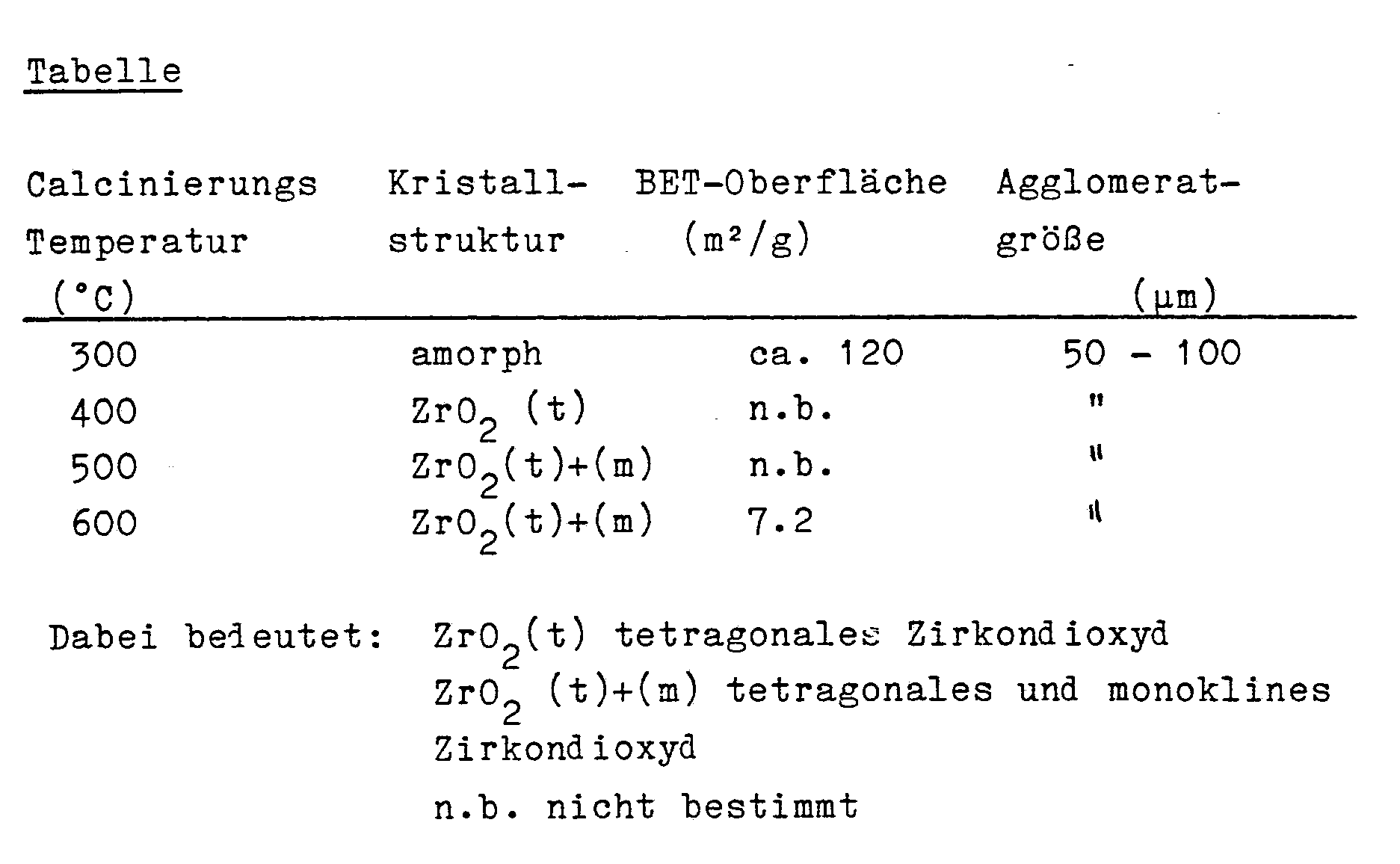
- zirconium dioxide containing yttrium To produce zirconium dioxide containing yttrium, an aqueous solution of 0.35 mol / l zirconium nitrate (Zr (NO3) 4 5H2O) and 0.02 mol / l yttrium nitrate (Y (NO3) 3 ⁇ 5H2O) was sprayed. The washed and dried powder was calcined at four different temperatures for 20 hours each, and the temperature dependence of the BET surfaces and the resulting crystal structure was investigated.
- Zr (NO3) 4 5H2O zirconium nitrate
- Y (NO3) 3 ⁇ 5H2O 0.02 mol / l yttrium nitrate
Landscapes
- Chemical & Material Sciences (AREA)
- Organic Chemistry (AREA)
- Inorganic Chemistry (AREA)
- Chemical Kinetics & Catalysis (AREA)
- General Health & Medical Sciences (AREA)
- Health & Medical Sciences (AREA)
- Dispersion Chemistry (AREA)
- Toxicology (AREA)
- Life Sciences & Earth Sciences (AREA)
- Geology (AREA)
- Inorganic Compounds Of Heavy Metals (AREA)
- Compounds Of Iron (AREA)
- Oxygen, Ozone, And Oxides In General (AREA)
- Compounds Of Alkaline-Earth Elements, Aluminum Or Rare-Earth Metals (AREA)
Abstract
Description
- Die vorliegende Erfindung betrifft ein Verfahren zur Herstellung von Pulvern aus Metalloxiden oder Metallmischoxiden mit ausgezeichneter Rieselfähigkeit und hoher Schüttdichte. Bei diesem Verfahren werden Metallsalzlösungen unter Verwendung von Ultraschall in feine Tröpfchen zerteilt, die dann in einer Ammoniakgasatmosphäre in stabile Metallhydroxid-Gelteilchen umgewandelt werden. Diese verfestigten Gelteilchen werden aufgefangen und nach Trocknen in die entsprechenden Metalloxide oder Metallmischoxide überführt.
- Es ist bereits bekannt (DE-AS 24 59 445) Thorium- bzw. Uransalzlösungen mittels eines in Oszillation versetzten Flüssigkeitsstrahls in feine Tropfen zu zerteilen und diese Tropfen dann durch Fällung der Hydroxyde in einer Ammoniakgasatmosphäre teilweise zu verfestigen, bevor sie in eine Ammoniaklösung eintauchen. Die in die Oxide überführten Kügelchen haben Durchmesser von 200 - 500 µm.
- Gemäß einem anderen Verfahren (DE-OS 30 35 331) lassen sich kugelförmige Teilchen, die sich speziell für den Einsatz in der Nukleartechnik eignen, mit Durchmessern zwischen 50 und 2500 µm und einem engen Kornspektrum herstellen. Dabei werden Lösungen oder Schmelzen durch ein Vibratorsystem bei Frequenzen von 50 - 2500 Hz in Tropfen umgewandelt, die anschließend chemisch oder physikalisch zu sphärischen Teilchen verfestigt werden. Die Tropfen- bzw. Teilchengröße hängt ab von der Frequenz des Vibrators und der Durchflußrate der Flüssigkeit.
- Zur Verfestigung der Tröpfchen sind auch andere Verfahren bekannt, bei denen entweder durch Wasserentzug (Sol-Gel- Verfahren nach US-PS 3 290 122) oder durch Reaktion von polymeren Zusätzen mit einem alkalischen Medium (DE-PS 12 12 841) die Tropfen verfestigt werden. Gemeinsam bei all diesen Verfahren ist das Einbringen der - teilweise schon "vorverfestigten" - Tropfen in eine flüssige Phase, in der dann die Verfestigung beendet wird.
- Alle diese Verfahren weisen Nachteile auf, die entweder in der erreichbaren minimalen Korngröße (Korngrößen von nur wenigen µm Durchmesser sind nicht herstellbar), dem relativ breiten Kornspektrum oder in der Zwischenschaltung von meist organischen Sperrflüssigkeiten liegen, bei deren Durchschreiten die Tropfen Fremdstoffe aufnehmen können, die somit in die Produkte gelangen. Außerdem werden diese - meist organischen - Phasen durch Adsorptionsvorgänge an den Tropfen verbraucht, so daß sie ständig ergänzt werden müssen. Ein weiterer Nachteil bei dem Einsatz von flüssigen Sperrphasen besteht in der mit dem Wasserentzug im Tropfen einhergehenden Wasseranreicherung in der alkalischen Phase. Um den Prozeß über längere Zeit unter konstanten Bedingungen betreiben zu können, sind Regenerationskreisläufe erforderlich, in denen der Wasseranteil wieder reduziert wird.
- Ziel der vorliegenden Erfindung ist es, Substanzen mit sehr geringem Korndurchmesser und engem Kornspektrum herzustellen und die erzeugten kugelförmigen Teilchen ohne Zwischenschaltung einer flüssigen Phase aufzufangen. Gleichzeitig sollen die verfahrenstechnisch aufwendigen Regenerationskreisläufe vermieden werden und ein hoher Flüssigkeitsdurchsatz erreichbar sein.
- Es wurde nun ein Verfahren zur Herstellung eines Metalloxids oder Metallmischoxids gefunden, wobei man eine wäßrige Lösung mindestens einer wasserlöslichen, salzartigen Verbindung eines mehrwertigen Metalls in einer Inertgasatmosphäre fein verteilt, die erhaltenen Tröpfchen solange mit einem Ammoniak enthaltenden Gas in Kontake bringt, bis das Hydroxid (die Hydroxide) des (der) mehrwertigen Metalls (Metalle) mindestens teilweise ausgefällt ist (sind) und man die entstehenden kleine Gelkügelchen, die Metallhydroxid und Wasser enthalten, auffängt, das dadurch gekennzeichnet ist, daß die eingesetzte wäßrige Lösung duch Ultraschall fein verteilt wird, man radialsymmetrisch um die Austrittsöffnung für die Lösung einen Inertgas-Laminar-Flow erzeugt, der parallel zur Austrittsrichtung der Lösung ausgerichtet ist und man die verfestigten Gelkügelchen trocknet und durch Erhitzen in das Metalloxid bzw. Metallmischoxid unwandelt.
- Aufgrund der hohen Frequenz (mindestens 19 kHz) und Schallintensität (ca. 10 W/cm²) des verwendeten Ultraschalls erreichen die Schwingungsbewegungen der Flüssigkeitstropfen so große Geschwindigkeiten (ca. 30 cm/sek.) und so große Beschleunigungswerte (ca. das 100.000-fache der Erdbeschleunigung), daß die einzelnen Tropfen zerreißen und Partikel mit nur wenigen µm Durchmesser bilden. Gleichzeitig wird jedoch ein sehr enges Kornspektrum eingehalten.
- Ein Vorteil in der Anwendung von Ultraschall liegt in der weitgehenden Unabhängigkeit von den physikalischen Eigenschaften (z.B. der Viskosität) der Metallsalzlösung. Diese Eigenschaften üben nur noch geringen Einfluß auf die Größe der zerteilten Tropfen aus, so daß beispielsweise die Konzentration in weiten Bereichen variiert werden kann.
- Es war zwar zu erwarten, das die Teilchengröße mit zunehmender Frequenz abnimmt; es war jedoch völlig überraschend, daß trotz der kleinen Teilchengröße, die mit dem Ultraschallzerstäuber erreicht wurde, Durchsatzmengen von mindestens einem Liter pro Stunde und Zerstäubereinheit erzielt werden konnten.
- Gemäß der Erfindung kann als Salz eines mehrwertigen Metalls prinzipiell jede wasserlösliche Metallsalz-Verbindung eingesetzt werden, die mit Ammoniak schwerlösliche Verbindungen bildet. Bevorzugt sind Lösungen von 2-, 3- oder 4-wertigen Metallen.
- Für die technische Keramik von besonderem Interesse sind beispielsweise die folgenden Metallsalzlösungen:
Aluminiumlösungen (für Al₂O₃)
Aluminium-Titanlösungen (für Aluminiumtitanat)
Aluminiumlösungen mit Zusätzen von Calcium- oder Magnesiumlösungen oder anderen bekannten Sinterhilfsmitteln
Zirkonlösungen (für ZrO₂)
Zirkonlösungen mit Zusätzen von Calcium-, Magnesium- oder Yttriumlösungen zur Beeinflussung der Kristallstruktur von Zirkondioxid
oder beliebige Mischungen dieser Lösungen. - Versprühbar sind aber auch andere Metallsalzlösungen wie z.B: V-, Cr-, Mo-, W-, Mn-, Fe-, Co-, Ni-Salzlösungen.
- Wegen der besonders leichten Umsetzung zum Oxid bieten sich als anionische Komponenten vor allem organische Verbindungen wie z.B. Acetate oder Formiate oder aber Nitrate besonders an. Wegen ihrer hohen Zersetzungstemperatur sind Sulfate, Carbonate und Phosphate weniger geeignet. Halogenide können versprüht werden, sollten jedoch wegen ihrer korrosiven Eigenschaften gegenüber Metallapparaturen möglichst nicht eingesetzt werden.
- Die Konzentration der eingesetzten Metallsalzlösung ist nicht kritisch und wird nur durch die Löslichkeit der Salze beschränkt. Es können Metallsalzlösungen in Konzentrationen von 0,01 bis 1 Mol/l problemlos zerstäubt werden. Setzt man Zirkoniumsalzlösungen ein, so kann die Konzentration bis zu 5 Mol/l erhöht werden.
- Zur Erhöhung der BET-Oberfläche und zur Steuerung der Härte der Agglomerate (dies entspricht der Härte der Kügelchen nach dem Calcinieren) können der Lösung verschiedene Zusätze beigemischt werden. Diese Zusätze sollen sich beim späteren Calcinieren unter oxidativen Bedingungen (Sauerstoff enthaltende Atmosphäre) vollständig zersetzen und verflüchtigen. Als Zusätze sind organische, wasserlösliche polymere Verbindungen (z.B.PVA, Polyacrylamid) möglich.
- Als Obergrenze für die Konzentrationen dieser Zusätze erwiesen sich im Falle von PVA 30 g/l und im Falle von Polyacrylamid 10 g/l. Besonders große BET-Oberflächen erreicht man bei einem Zusatz von 0,1 bis 1 g/l PVA, bzw. 0,1 bis 1 g/l Polyacrylamid.
- Das erfindungsgemäße Verfahren wird im Folgenden an den Figuren 1 und 2 näher erläutert, die bevorzugte Ausgestaltungen der Erfindung darstellen. Figur 1 zeigt eine Vorrichtung, bei der die Metallsalz-Lösung mittels eines Ultraschallzerstäubers in feine Tröpfchen zerteilt wird.
- Die Lösung wird in das Vorratsgefäß (1) der Zerstäubungsanordnung gefüllt und über Zuleitung (2) durch eine Dosiereinrichtung (3) in den Zerstäuber (4) eingebracht. Die Frequenz des verwendeten Ultraschallzerstäubers bestimmt die Tröpfchengröße. Sie sollte mindestens 19 kHz betragen. Als Richtwert kann gelten, daß eine Frequenz von 20 - 40 kHz Teilchen mit Durchmessern um 100 µm, eine Frequenz von 1MHz Teilchen mit Durchmessern von etwa 10 - 50 µm erzeugt. Die Frequenz wird über den Frequenzgenerator (5) geregelt. Da die Tröpfchen neben den Metallionen sowohl Wasser als auch "eliminierbare" Anionen enthalten, sind die Pulverteilchen nach dem Überführen ins Oxid zum Teil um bis zu einem Faktor 3 kleiner.
- Die Lösung wird an der Schwingeröffnung vernebelt. Um ein einwandfreies Vernebeln der Lösung sicherzustellen und um die Rückbildung von größeren Tropfen an dem Ultraschallschwinger bzw. an der Austrittsöffnung für die Lösung zu vermeiden, wird der Bereich der Schwingeröffnung mit einem Inertgas gespült, welches nicht mit den versprühten Metallsalzlösungen reagiert, z.B. Luft, Stickstoff oder Argon. Das Inertgas wird zweckmäßigerweise durch die Zuleitung (6) in einen Behälter eingeleitet, der aus zwei konzentrisch angeordneten Rohren (19) und (22) gebildet wird, die auf einer Seite mit einer planaren Abdeckung (24) verbunden sind. Auf der anderen Seite ragt das innere Rohr (19) aus dem äußeren Rohr (22) heraus. Auf dieser Seite sind die beiden Rohrenden mit einer ringförmigen, zum Rohrmittelpunkt hin konisch zulaufenden Abdeckung (25) versehen, wobei deren innere, kreisförmige Öffnung größer ist als der in sie hineinragende Zerstäuber (4), so daß ein ringförmiger Spalt (23) entsteht. In Figur 3 ist eine axiale Projektion des Behälters gezeigt, mit Blickrichtung von unten auf den Behälter. Das Inertgas füllt den von den beiden Rohren (19) und (22) gebildeten äußeren Raum (21) und dringt über Einlaßöffnungen (18) in den inneren Raum (20). Die Inertgaswolke dringt aus dem ringförmig um den Zerstäuber angeordneten Spalt (23) aus dem inneren Rohr (19) heraus.
- Der Inertgaswolke wird in der Vernebelungszone (7) ein Inertgas-Laminar-Flow (10) senkrecht zur Vernebelungsebene überlagert, der den Vernebelungsvorgang wesentlich verbessert. Dabei tritt das Inertgas aus mehreren rotationssymmetrisch um den Ultraschallzerstäuber (4) angeordneten Öffnungen (8) in der Abdeckung (25). Der Laminar-Flow sorgt dafür, daß die Zerstäubungswolke sich nur geringfügig senkrecht zur Strömungsrichtung ausdehnt, außerdem schirmt er den Zerstäuber nach außen ab und treibt gleichzeitig die Tröpfchen in Richtung Reaktionszone (9), die Ammoniakgas enthält. Einige Zentimeter (ca. 5 cm) unterhalb des Ultraschallschwingers wird durch die Zuleitungen (11) radialsymmetrisch Ammoniakgas in das Reaktionsgefäß (14) eingeblasen. Die Durchmischung des Nebels aus Lösungströpfchen und Inertgas mit Ammoniakgas führt dazu, daß die Tröpfchen rasch mit dem Ammoniak reagieren. Diese Reaktion bewirkt wegen der frei werdenden Reaktionswärme einen Wasserentzug in den Tröpfchen und so eine Umwandlung in den Gelzustand binnen kurzer Zeit (5 bis 10 Sekunden) und über eine Fallstrecke von nur wenigen Zentimetern. Die Umwandlungsgeschwindigkeit wird durch die Temperatur in der Reaktionszone beeinflußt. Da die Reaktion mit dem Ammoniak eine exotherme Reaktion ist, wird bis zum Erreichen einer Gleichgewichtstemperatur (ca. 50°C) ein Temperaturanstieg registriert. Durch Kühlen oder Aufheizen (nicht gezeichnet) der Wände des Reaktionsgefäßes (14) bzw. der zu versprühenden Lösung kann die Temperatur in der Reaktionszone (9) beeinflußt werden. Die Geltröpfchen fallen aufgrund ihres Gewichts in ein Auffanggefäß (12) unterhalb des Schwingers. Unterstützt wird dieses Herunterfallen der Tröpfchen durch die Gasströmung, wenn diese von der Abnebelungszone in Richtung des darunter befindlichen Auffanggefäßes verläuft. Das Gas verläßt das Reaktionsgefäß (14) durch Öffnung (13). Bei Raumtempertur reicht eine Fallstrecke von 200 mm (Schwingeröffnung - Auffanggefäß) aus um verfestigte Kugeln zu erzielen.
- Eine andere bevorzugte Ausgestaltung der Erfindung ist in Fig. 2 dargestellt. Hier wird zur Zerstäubung eine mittels Ultraschall erzeugte stehende Welle (17) benutzt. Die Lösung wird aus dem Vorratsgefäß (1) durch die Leitung (2) über eine Dosierrichtung (3) in die stehende Welle eingebracht. Analog zu der oben beschriebenen Vorgehensweise wird auch im Falle der Flüssigkeitszerstäubung mittels stehender Welle der Bereich der Austrittsöffnung für die Metallsalz-Lösung mit einem Inertgas gespült. In gleicher Weise geschieht die Überlagerung der Inertgaswolke mit einem Laminar-Flow. Die stehende Welle wird erzeugt, indem man die Ausbreitungsrichtung des Ultraschalls senkrecht zur Fließrichtung des Flüssigkeitsstrahls wählt und die Ultraschallwelle an einer Wand (15) reflektiert. Da zur Erzeugung einer stehenden Welle diese in einem Knotenpunkt reflektiert werden muß (Phasensprung um λ/2), ist die Reflexionswand beweglich angeordnet, um sie auf die Schallquelle zu- oder fortbewegen zu können (mittels Justierschraube (16)). In der Praxis erkennt man die Ausbildung einer solchen stehenden Welle daran, das der optimal vernebelt. Die besten Ergebnisse erzielt man, wenn der Flüssigkeitsstrahl so justiert wird, daß er im Bereich eines Schwingungsstrahl zerrissen wird, da hier die Schallenergie am größten ist.
- Die nachfolgende Aufarbeitung der Gelkugeln bestimmt die Agglomerat- und Pulvereigenschaften. Der erste Schritt der Aufarbeitung der Gekügelchen ist zweckmäßigerweise das Auswaschen der Ammoniumsalze aus den Gelkugeln mit entmineralisiertem oder destilliertem Wasser. Handelt es sich bei diesen Ammoniumsalzen um leicht flüchtige oder leicht zersetzbare Salze, so kann das Auswaschen entfallen.
- Daran schließt sich das Trocknen der Kugeln an, das z.B. bei einer Temperatur von 70 - 90°C und einer Haltezeit von 5 - 20 Stunden erfolgen kann. Besonders geeignet für diese Aufarbeitungsschritte ist der Rotationsverdampfer. Erstens kann der Waschvorgang schneller durchgeführt werden und zweitens kann die Trocknungsdauer auf 1/2 - 2 Stunden verkürzt werden. Dabei erhält man ein gleichmäßiges nahezu kugelförmiges und gut rieselförmiges Granulat. An diesen Verarbeitungsschritt schließt sich der Calzinierungsschritt an, bei dem nicht eliminierte anionische bzw. organische Bestandteile ausgetrieben werden und die Hydroxide in die Oxide umgewandelt werden. Das Calcinieren erfolgt - wenn organische Bestandteile vorhanden sind - unter oxidativen Bedingungen in einer Sauerstoff enthaltenden Atmosphäre, vorzugsweise bei Temperaturen zwischen 400 und 800°C und bei Verweilzeiten von 2 - 10 Stunden. Es kann jedoch ohne weiteres auch unter reduktiven Bedingungen oder unter Vakuum erfolgen. Enthielten die getrockneten Gelkügelchen organische Zusätze, so bestimmt die Calcinierungstemperatur die BET-Oberfläche der Endprodukte, da die organischen Bestandteile sich während des Calcinierens verflüchtigen und freie Poren hinterlassen. Je höher die Temperatur ist, desto mehr neigen die Teilchen jedoch dazu weiter zusammenzusintern, so daß das Porenvolumen und damit die Oberfläche abnimmt. Während bei Calcinierungstemperaturen bis zu 400°C BET-Oberflächen von bis zu 300 m²/g erzielt werden können, liegen die BET-Oberflächenwerte bei Calcinierungstemperaturen von maximal 800°C bei 10 - 20 m²/g.
- Überraschenderweise lassen sich mit dem erfindungsgemäßen Verfahren die kristallographischen Hochtemperatur-Modifikationen von ZrO₂ und Al₂O₃ herstellen, die sonst nur unter hohem energetischen Aufwand darstellbar sind. Tetragonales ZrO₂ erhält man bei einer Calcinierungstemperatur vom mindestens 400°C. Bevorzugt ist eine Mindesttemperatur von 600°C. Eine Höchsttemperatur von 800°C sollte aufgrund der dann zu erwartenden geringen BET-Oberfläche nicht überschritten werden. Bevorzugt ist eine Höchsttemperatur von 750°C, besser noch 650°C.
γ-Al₂O₃ erhält man bei Calcinierungstemperaturen von mindestens 200°C. Eine Höchsttemperatur von 750°C, bevorzugt 500°C, sollte nicht überschritten werden. Insbesondere liegt die Obergrenze der Calcinierungstemperatur bie 400°C, noch besser bei 300°C. - Die Erfindung wird durch die folgenden Beispiele näher erläutert.
- Die folgenden Beispiele wurden in einer Apparatur gemäß Figur 1 durchgeführt. Verwendbar ist mit gleichem Erfolg aber auch eine Apparatur gemäß Figur 2. Die Auswahl des Schwingsystems (Ultraschallzerstäuber oder stehende Welle) hatte keinen Einfluß auf die entstehenden Produkte. Der eingesetzte Schwingkopf hatte eine Länge von 23 mm und einen Durchmesser von 15 mm. (Hersteller: Fa Lechler, Fellbach, Modell 100.060.3K). Das Reaktionsgefäß (14) hatte einen Durchmesser von 300 mm und eine Höhe von 350 mm. Das Auffanggefäß hatte einen Durchmesser von 200 mm.
- In allen Ausführungsbeispielen wurde Stickstoff als Inertgas eingesetzt, das mit einer Durchsatzrate von 1-2 l/h durch die Apparatur strömte. Der Ammoniakgasdurchsatz betrug 2-5 1/h.
- Die aufgefangenen Gelkügelchen wurden mit entmineralisiertem Wasser gewaschen und anschließend in einem Rotationsverdampfer getrocknet.
- Es wurde eine wäßrige Lösung versprüht, die 1 Mol/l Zr(NO₃)₄ und 30 g/l Polyvinylakohol (PVA 18/8: Hersteller: Hoechst AG) enthielt. Der Flüssigkeitsdurchsatz betrug 1 l/h. Das gewaschene und getrocknete Pulver wurde dann 15 Stunden bei 600°C in sauerstoffhaltiger Atmosphäre calciniert. Das resultierende Zirkondioxyd hatte tetragonale Kristallstruktur und eine BET-Oberfläche von 22 m²/g. Die Teilchengröße des Pulvers lag zwischen 10 und 50 µm.
- Es wurde eine wäßrige Lösung von Aluminiumhydroxyacetat (Al(OH)₂(CH₃COO)) in einer Konzentration von 0,35 Mol/l bei einem Flüssigkeitsdurchsatz von 1 l/h versprüht. Das gewaschene und getrocknete Pulver wurde dann 15 Stunden bei 200°C calciniert. Die Debye-Scherrer-Aufnahmen zeigten, daß Al₂O₃ in der γ-Modifikation vorlag. Die Agglomeratgröße lag bei 30 - 100 µm. Die BET-Oberfläche betrug ca. 150 m²/g.
- Zur Herstellung der genannten Oxyde wurden wäßrige Metallsalzlösungen von NiSO₄, Fe(NO₃)₃ bzw. Co(NO₃)₂ mit jeweils 0,35 Mol/l verwendet und mit einem Durchsatz von 1 l/h versprüht.
- Die entstandenen Gelkügelchen wurden gewaschen, getrocknet und anschließend ca. 20 Stunden bei 100°C calciniert. Infolge der niedrigen Calcinierungstemperatur wurde die Kristallisation der Metalloxyde vollständig unterdrückt, so daß röntgenamorphe Oxyde entstanden. Die Agglomeratgröße lag zwischen 50 und 150 µm und die BET-Oberflächenwerte betrugen ca. 230 m²/g.
- Zur Herstellung von Bleizirkonat, das als Rohstoff für die Piezokeramik eingesetzt werden kann, wurde eine wässrige Lösung von 0,35 Mol/l Bleinitrat (Pb(NO₃)₂) und 0,35 Mol/l Zirkonnitrat (Zr(NO₃)₄ 5H₂O) versprüht. Die erhaltenen Gelkügelchen wurde gewaschen, getrocknet und dann 15 Stunden bei 600°C calciniert. Es entstand Bleizirkonat (PbZrO₃) mit Perowskit-Struktur und einer BET-Oberfläche von 9,6 m²/g. Die Agglomeratgröße lag bei ca. 50 µm.
- In den Vorratsbehälter der Versprühapparatur wurde eine 15-gew.-%ige wässrige Lösung aus einer Mischung aus einem Mol Aluminiumnitrat (Al(NO₃)₃) und einem Mol Titan (III)-Chlorid (TiCl₃) gefüllt. Diese Lösung wurde dann mit einem Flüssigkeitsdurchsatz von 1 l/h versprüht. Das gewaschene und getrocknete Pulver wurde dann 12 Stunden bei 600°C calciniert. Mittels Pulverdiffraktometrie konnte am fertigen Produkt die Struktur von Aluminiumtitanat (Al₂TiO₅) nachgewiesen werden. Die BET-Oberfläche betrug ca. 12 m²/g und die Agglomeratgröße lag bei 50-100 µm.
- Zur Herstellung von yttriumhaltigem Zirkondioxyd wurde eine wässrige Lösung aus 0,35 Mol/l Zirkonnitrat (Zr(NO₃)₄ 5H₂O) und 0,02 Mol/l Yttriumnitrat (Y (NO₃)₃·5H₂O) versprüht. Das gewaschene und getrocknete Pulver wurde bei vier verschiedenen Temperaturen jeweils 20 Stunden calciniert, und die Temperaturabhängigkeit der BET-Oberflächen und der resultierenden Kristallstruktur untersucht.
Claims (14)
Applications Claiming Priority (2)
| Application Number | Priority Date | Filing Date | Title |
|---|---|---|---|
| DE3632396 | 1986-09-24 | ||
| DE19863632396 DE3632396A1 (de) | 1986-09-24 | 1986-09-24 | Verfahren zur herstellung von metalloxiden oder metallmischoxiden |
Publications (3)
| Publication Number | Publication Date |
|---|---|
| EP0261590A2 true EP0261590A2 (de) | 1988-03-30 |
| EP0261590A3 EP0261590A3 (en) | 1988-11-09 |
| EP0261590B1 EP0261590B1 (de) | 1990-09-05 |
Family
ID=6310221
Family Applications (1)
| Application Number | Title | Priority Date | Filing Date |
|---|---|---|---|
| EP87113599A Expired - Lifetime EP0261590B1 (de) | 1986-09-24 | 1987-09-17 | Verfahren zur Herstellung von Metalloxiden oder Metallmischoxiden |
Country Status (4)
| Country | Link |
|---|---|
| US (1) | US4925647A (de) |
| EP (1) | EP0261590B1 (de) |
| JP (1) | JPS6389407A (de) |
| DE (2) | DE3632396A1 (de) |
Cited By (5)
| Publication number | Priority date | Publication date | Assignee | Title |
|---|---|---|---|---|
| EP0397644A1 (de) * | 1989-05-09 | 1990-11-14 | Maschinenfabrik Andritz Actiengesellschaft | Verfahren zur Herstellung von Katalysatoren |
| WO1990015020A3 (en) * | 1989-06-09 | 1991-03-07 | Worcester Polytech Inst | High-temperature aerosol decomposition process and products produced |
| EP0417628A1 (de) * | 1989-09-09 | 1991-03-20 | Hoechst Aktiengesellschaft | Verfahren zur Herstellung eines Supraleiters durch Fällung |
| DE4115172A1 (de) * | 1991-05-09 | 1992-11-12 | Nukem Gmbh | Verfahren zur herstellung von pulver aus stabilisiertem zirkonoxid |
| DE4237272A1 (de) * | 1992-11-04 | 1994-05-05 | Nukem Gmbh | Verfahren zur Herstellung von stabilisiertem Hafniumoxidpulver oder Hafniumoxid enthaltendem Pulver |
Families Citing this family (19)
| Publication number | Priority date | Publication date | Assignee | Title |
|---|---|---|---|---|
| DE3855246T2 (de) * | 1987-07-06 | 1996-12-05 | Sumitomo Electric Industries | Supraleitende dünne Schicht und Verfahren zu ihrer Herstellung |
| US5039636A (en) * | 1990-08-10 | 1991-08-13 | Hercules Incorporated | Preparation of aluminum titanate from an organometallic oligomer |
| JPH0751444B2 (ja) * | 1991-02-20 | 1995-06-05 | インスティチュート・オブ・ヌクリアー・エナージィ・リサーチ・チャイニーズ・アトミック・エナージィ・カウンシル・タイワン・アール・オー・シー | ウラニル化合物をaduを経てuo2に転化する方法 |
| DK168738B1 (da) * | 1991-04-30 | 1994-05-30 | Topsoe Haldor As | Keramisk binder, fremstilling og anvendelse deraf |
| US5212258A (en) * | 1991-10-29 | 1993-05-18 | E. I Du Pont De Nemours And Company | Aramid block copolymers |
| US5268337A (en) * | 1991-11-18 | 1993-12-07 | The Johns Hopkins University | Ceramic oxide powders and the formation thereof |
| IL107932A0 (en) * | 1992-12-08 | 1994-04-12 | Miroevski Piotr Ravilevich | Method and apparatus for producing a silicon based binding composition and product prepared therefrom |
| US5384294A (en) * | 1993-11-30 | 1995-01-24 | The United States Of America As Represented By The Secretary Of The Air Force | Sol-gel derived lead oxide containing ceramics |
| US7157406B2 (en) * | 1994-12-17 | 2007-01-02 | Basf Aktiengesellschaft | Catalysts or carriers which consist essentially of monoclinic zirconium dioxide |
| US6162530A (en) * | 1996-11-18 | 2000-12-19 | University Of Connecticut | Nanostructured oxides and hydroxides and methods of synthesis therefor |
| JP2001509467A (ja) * | 1997-07-10 | 2001-07-24 | メルク パテント ゲゼルシャフト ミット ベシュレンクテル ハフトング | 金属酸化物の超微粉体の製造方法 |
| US6139814A (en) * | 1997-11-10 | 2000-10-31 | Ford Global Technologies, Inc. | Thermally stable, high-surface-area metal oxides made by organic templating |
| DE19928392A1 (de) * | 1999-06-22 | 2000-12-28 | Merck Patent Gmbh | Sprühpyrolyse- oder Sprühtrocknungsverfahren sowie Vorrichtung zur Durchführung |
| US20020032123A1 (en) * | 2000-02-23 | 2002-03-14 | Ford Global Technologies, Inc. | Exhaust gas catalyst and method of manufacturing same |
| DE10327429A1 (de) * | 2003-06-18 | 2005-01-05 | Abb Patent Gmbh | Ultraschall-Stehwellen-Zerstäuberanordnung |
| JP2007031550A (ja) * | 2005-07-26 | 2007-02-08 | Menicon Co Ltd | 大気圧プラズマ表面処理方法 |
| KR101017079B1 (ko) * | 2007-11-07 | 2011-02-25 | 한국과학기술연구원 | 전극활물질의 제조방법과 이에 의하여 제조된 전극활물질을포함하는 리튬전지 |
| WO2011075370A1 (en) * | 2009-12-18 | 2011-06-23 | 3M Innovative Properties Company | Systems and methods for making monolithic gel bodies |
| CN117732376B (zh) * | 2023-12-21 | 2024-08-02 | 山东钝钰新材料有限公司 | 一种氧化锆的生产设备及其生产工艺 |
Family Cites Families (21)
| Publication number | Priority date | Publication date | Assignee | Title |
|---|---|---|---|---|
| US1333020A (en) * | 1919-10-30 | 1920-03-09 | Halvorsen Birger Fjeld | Method for the production of alumina |
| US1507993A (en) * | 1922-02-27 | 1924-09-09 | Norsk Hydro Elektrisk | Process for the production of alumina and nitrates |
| US1652119A (en) * | 1923-06-13 | 1927-12-06 | Norsk Hydroelek Sk Kvaelstofak | Process for the production of alumina from aluminum nitrates |
| US2667404A (en) * | 1951-08-30 | 1954-01-26 | Universal Oil Prod Co | Manufacture of alumina particles |
| US2737444A (en) * | 1952-06-21 | 1956-03-06 | Norton Co | Aluminum oxide catalyst carrying material and process of making same |
| US3222231A (en) * | 1962-09-18 | 1965-12-07 | Atlantic Res Corp | Process for producing finely divided rounded particles |
| GB1067095A (en) * | 1964-01-21 | 1967-05-03 | Snam Spa | Production of balls or spheres of refractory materials |
| DE1212841B (de) * | 1964-01-21 | 1966-03-17 | Snam Spa | Verfahren zur Herstellung von Kugeln aus schwer zusammenballenden, feuerfesten Materialien auf chemischem Weg |
| US3290122A (en) * | 1964-07-28 | 1966-12-06 | Sam D Clinton | Process for preparing oxide gel microspheres from sols |
| US4043507A (en) * | 1971-05-05 | 1977-08-23 | United Kingdom Atomic Energy Authority | Apparatus for the formation of liquid droplets |
| US4018881A (en) * | 1971-07-15 | 1977-04-19 | Exxon Research And Engineering Company | High surface area alumina and method for the preparation thereof |
| US3933679A (en) * | 1972-01-14 | 1976-01-20 | Gulf Oil Corporation | Uniform microspheroidal particle generating method |
| US4102651A (en) * | 1972-10-14 | 1978-07-25 | Davy Powergas Gmbh | Ultrasonic atomizer for waste sulfuric acid and use thereof in acid cracking furnaces |
| JPS5627308B2 (de) * | 1972-10-14 | 1981-06-24 | ||
| IT1051330B (it) * | 1974-12-16 | 1981-04-21 | Hobeg Hochtemperaturreaktor | Procedimento per la fabbricazione di particelle sferiche di combusti bile e fertilizzante nucleare |
| ZA803358B (en) * | 1979-06-08 | 1981-06-24 | Sono Tek Corp | Ultrasonic fuel atomizer |
| DE3035331C2 (de) * | 1980-09-19 | 1982-11-11 | Nukem Gmbh, 6450 Hanau | Vorrichtung zur Herstellung kugelförmiger Teilchen |
| DE3035845C2 (de) * | 1980-09-23 | 1986-05-22 | Gesellschaft zur Förderung der industrieorientierten Forschung an den Schweizerischen Hochschulen und weiteren Institutionen, Bern | Verfahren und Vorrichtung zur Herstellung von Mikrokugeln durch interne Gelierung von Mischfeed-Tropfen |
| US4465234A (en) * | 1980-10-06 | 1984-08-14 | Matsushita Electric Industrial Co., Ltd. | Liquid atomizer including vibrator |
| US4723708A (en) * | 1986-05-09 | 1988-02-09 | Sono-Tek Corporation | Central bolt ultrasonic atomizer |
| DE3713253A1 (de) * | 1986-07-23 | 1988-02-04 | Bosch Gmbh Robert | Ultraschallzerstaeuberanlage |
-
1986
- 1986-09-24 DE DE19863632396 patent/DE3632396A1/de not_active Withdrawn
-
1987
- 1987-09-17 DE DE8787113599T patent/DE3764752D1/de not_active Expired - Fee Related
- 1987-09-17 EP EP87113599A patent/EP0261590B1/de not_active Expired - Lifetime
- 1987-09-22 US US07/099,909 patent/US4925647A/en not_active Expired - Fee Related
- 1987-09-22 JP JP62236374A patent/JPS6389407A/ja active Pending
Cited By (6)
| Publication number | Priority date | Publication date | Assignee | Title |
|---|---|---|---|---|
| EP0397644A1 (de) * | 1989-05-09 | 1990-11-14 | Maschinenfabrik Andritz Actiengesellschaft | Verfahren zur Herstellung von Katalysatoren |
| US5036037A (en) * | 1989-05-09 | 1991-07-30 | Maschinenfabrik Andritz Aktiengesellschaft | Process of making catalysts and catalysts made by the process |
| WO1990015020A3 (en) * | 1989-06-09 | 1991-03-07 | Worcester Polytech Inst | High-temperature aerosol decomposition process and products produced |
| EP0417628A1 (de) * | 1989-09-09 | 1991-03-20 | Hoechst Aktiengesellschaft | Verfahren zur Herstellung eines Supraleiters durch Fällung |
| DE4115172A1 (de) * | 1991-05-09 | 1992-11-12 | Nukem Gmbh | Verfahren zur herstellung von pulver aus stabilisiertem zirkonoxid |
| DE4237272A1 (de) * | 1992-11-04 | 1994-05-05 | Nukem Gmbh | Verfahren zur Herstellung von stabilisiertem Hafniumoxidpulver oder Hafniumoxid enthaltendem Pulver |
Also Published As
| Publication number | Publication date |
|---|---|
| EP0261590B1 (de) | 1990-09-05 |
| JPS6389407A (ja) | 1988-04-20 |
| EP0261590A3 (en) | 1988-11-09 |
| US4925647A (en) | 1990-05-15 |
| DE3632396A1 (de) | 1988-03-31 |
| DE3764752D1 (de) | 1990-10-11 |
Similar Documents
| Publication | Publication Date | Title |
|---|---|---|
| EP0261590B1 (de) | Verfahren zur Herstellung von Metalloxiden oder Metallmischoxiden | |
| DE69323825T2 (de) | Verfahren zur Herstellung von Silber Pulver durch Aerosol Zersetzung | |
| DE69317846T2 (de) | Verfahren zur Herstellung von Palladium- und Palladiumoxid-Pulver durch Aerosol-Zersetzung | |
| US5122360A (en) | Method and apparatus for the production of metal oxide powder | |
| AT502777B1 (de) | Verfahren zur herstellung von partikeln aus einem keramischen werkstoff | |
| DE69724655T2 (de) | Zirkonium-cerium-verbundoxid, verfahren zur herstellung und cokatalysator zur reingung von abgas | |
| DE3689106T2 (de) | Zerknirschungsfeste Katalysatoren, Katalysator-Vorläufer und Katalysatorträger. | |
| DE3526674C2 (de) | Verfahren zur Herstellung einer eine Perowskit-Verbindung enthaltenden Masse und Verfahren zur Herstellung eines im wesentlichen aus einer Perowskit-Verbindung bestehenden Sinterkörpers | |
| EP0585264B1 (de) | Verfahren zur herstellung von pulver aus teilstabilisiertem zirkonoxid | |
| DE69112514T3 (de) | Wärmebeständige Übergangsalumina und Verfahren zu deren Herstellung. | |
| DE69529861T2 (de) | Dispergierbare Zusammensetzung auf Basis von einem Seltenerdmetall, Verfahren zur deren Herstellung und Verfahren zur Herstellung einer kolloidale Suspension. | |
| DE60303717T2 (de) | Verfahren zur Herstellung hoch-kristallisierter Oxidpulver | |
| WO1992007653A1 (de) | Verfahren zur herstellung von aluminiumoxidkugeln | |
| DE3780771T2 (de) | Durch ultraschallvibration erzeugte sphaerische teilchen mit enger groessenverteilung. | |
| EP0124704B1 (de) | Verfahren zur Herstellung eines cyanursäurearmen Isocyansäure-Ammoniak-Gasgemisches und Vorrichtung zur Durchführung des Verfahrens | |
| DE19624923C1 (de) | Verfahren zur Herstellung eines Katalysators sowie danach hergestellter Katalysator | |
| DE2830101A1 (de) | Verfahren zur herstellung von katalysatoren zur kohlenwasserstoff-umwandlung | |
| DE3126854C2 (de) | Verfahren und Vorrichtung zur Herstellung kugelförmiger Teilchen aus spontan reagierenden flüssigen Komponenten | |
| EP0587672B1 (de) | Verfahren zur herstellung nanoskaliger oxidteilchen | |
| DE3717831A1 (de) | Verfahren zum herstellen eines sinterkoerpers | |
| EP0687246B1 (de) | Verfahren zur herstellung von stabilisiertem hafniumoxidpulver oder hafniumoxid enthaltendem pulver | |
| DE3407059C2 (de) | ||
| DE3150555C2 (de) | Phosphor-Vanadium-Sauerstoff-Katalysator und Verfahren zu seiner Herstellung | |
| DE4405202A1 (de) | Verfahren zur Herstellung kugelförmiger Teilchen | |
| DE69014631T2 (de) | Aluminiumoxidschäume und verfahren zur herstellung davon. |
Legal Events
| Date | Code | Title | Description |
|---|---|---|---|
| PUAI | Public reference made under article 153(3) epc to a published international application that has entered the european phase |
Free format text: ORIGINAL CODE: 0009012 |
|
| AK | Designated contracting states |
Kind code of ref document: A2 Designated state(s): DE FR GB |
|
| PUAL | Search report despatched |
Free format text: ORIGINAL CODE: 0009013 |
|
| RHK1 | Main classification (correction) |
Ipc: B01J 2/08 |
|
| AK | Designated contracting states |
Kind code of ref document: A3 Designated state(s): DE FR GB |
|
| 17P | Request for examination filed |
Effective date: 19890121 |
|
| 17Q | First examination report despatched |
Effective date: 19891201 |
|
| GRAA | (expected) grant |
Free format text: ORIGINAL CODE: 0009210 |
|
| AK | Designated contracting states |
Kind code of ref document: B1 Designated state(s): DE FR GB |
|
| REF | Corresponds to: |
Ref document number: 3764752 Country of ref document: DE Date of ref document: 19901011 |
|
| ET | Fr: translation filed | ||
| GBT | Gb: translation of ep patent filed (gb section 77(6)(a)/1977) | ||
| PLBE | No opposition filed within time limit |
Free format text: ORIGINAL CODE: 0009261 |
|
| STAA | Information on the status of an ep patent application or granted ep patent |
Free format text: STATUS: NO OPPOSITION FILED WITHIN TIME LIMIT |
|
| PGFP | Annual fee paid to national office [announced via postgrant information from national office to epo] |
Ref country code: FR Payment date: 19910815 Year of fee payment: 5 |
|
| PGFP | Annual fee paid to national office [announced via postgrant information from national office to epo] |
Ref country code: GB Payment date: 19910822 Year of fee payment: 5 |
|
| 26N | No opposition filed | ||
| PGFP | Annual fee paid to national office [announced via postgrant information from national office to epo] |
Ref country code: DE Payment date: 19911114 Year of fee payment: 5 |
|
| PG25 | Lapsed in a contracting state [announced via postgrant information from national office to epo] |
Ref country code: GB Effective date: 19920917 |
|
| GBPC | Gb: european patent ceased through non-payment of renewal fee |
Effective date: 19920917 |
|
| PG25 | Lapsed in a contracting state [announced via postgrant information from national office to epo] |
Ref country code: FR Effective date: 19930528 |
|
| PG25 | Lapsed in a contracting state [announced via postgrant information from national office to epo] |
Ref country code: DE Effective date: 19930602 |
|
| REG | Reference to a national code |
Ref country code: FR Ref legal event code: ST |