EP0261884A1 - Herstellung einer Gliedprothese und Materialien, die dazu benötigt werden - Google Patents
Herstellung einer Gliedprothese und Materialien, die dazu benötigt werden Download PDFInfo
- Publication number
- EP0261884A1 EP0261884A1 EP87308274A EP87308274A EP0261884A1 EP 0261884 A1 EP0261884 A1 EP 0261884A1 EP 87308274 A EP87308274 A EP 87308274A EP 87308274 A EP87308274 A EP 87308274A EP 0261884 A1 EP0261884 A1 EP 0261884A1
- Authority
- EP
- European Patent Office
- Prior art keywords
- stump
- shape
- disc
- prosthesis
- replica
- Prior art date
- Legal status (The legal status is an assumption and is not a legal conclusion. Google has not performed a legal analysis and makes no representation as to the accuracy of the status listed.)
- Granted
Links
- 239000000463 material Substances 0.000 title claims abstract description 29
- 238000004519 manufacturing process Methods 0.000 title claims abstract description 13
- 238000000465 moulding Methods 0.000 claims abstract description 28
- 238000000034 method Methods 0.000 claims abstract description 22
- 210000003414 extremity Anatomy 0.000 claims abstract description 16
- 238000005266 casting Methods 0.000 claims abstract description 12
- 210000002414 leg Anatomy 0.000 claims abstract description 7
- 210000004417 patella Anatomy 0.000 claims abstract description 7
- 239000003190 viscoelastic substance Substances 0.000 claims abstract description 6
- 210000002303 tibia Anatomy 0.000 claims abstract description 5
- 239000011505 plaster Substances 0.000 claims description 9
- 230000001681 protective effect Effects 0.000 claims description 4
- 230000000712 assembly Effects 0.000 claims description 2
- 238000000429 assembly Methods 0.000 claims description 2
- 230000000994 depressogenic effect Effects 0.000 abstract description 2
- 230000015572 biosynthetic process Effects 0.000 abstract 1
- LFQSCWFLJHTTHZ-UHFFFAOYSA-N Ethanol Chemical compound CCO LFQSCWFLJHTTHZ-UHFFFAOYSA-N 0.000 description 5
- 210000003127 knee Anatomy 0.000 description 4
- 239000007788 liquid Substances 0.000 description 4
- 210000000426 patellar ligament Anatomy 0.000 description 4
- 229920000642 polymer Polymers 0.000 description 4
- 238000007493 shaping process Methods 0.000 description 4
- 238000001879 gelation Methods 0.000 description 3
- 239000004014 plasticizer Substances 0.000 description 3
- 210000001519 tissue Anatomy 0.000 description 3
- 239000000853 adhesive Substances 0.000 description 2
- 239000011324 bead Substances 0.000 description 2
- 210000000988 bone and bone Anatomy 0.000 description 2
- 244000309466 calf Species 0.000 description 2
- 239000004927 clay Substances 0.000 description 2
- DOIRQSBPFJWKBE-UHFFFAOYSA-N dibutyl phthalate Chemical compound CCCCOC(=O)C1=CC=CC=C1C(=O)OCCCC DOIRQSBPFJWKBE-UHFFFAOYSA-N 0.000 description 2
- 238000009826 distribution Methods 0.000 description 2
- 239000000499 gel Substances 0.000 description 2
- 150000002734 metacrylic acid derivatives Chemical class 0.000 description 2
- 239000000203 mixture Substances 0.000 description 2
- 210000005036 nerve Anatomy 0.000 description 2
- 239000004033 plastic Substances 0.000 description 2
- 229920003023 plastic Polymers 0.000 description 2
- 229920001483 poly(ethyl methacrylate) polymer Polymers 0.000 description 2
- -1 poly(ethylmethacrylate) Polymers 0.000 description 2
- 238000001356 surgical procedure Methods 0.000 description 2
- 150000001252 acrylic acid derivatives Chemical class 0.000 description 1
- 230000037396 body weight Effects 0.000 description 1
- 229920005549 butyl rubber Polymers 0.000 description 1
- 238000005352 clarification Methods 0.000 description 1
- 238000005520 cutting process Methods 0.000 description 1
- 229920001971 elastomer Polymers 0.000 description 1
- 239000012467 final product Substances 0.000 description 1
- 239000006260 foam Substances 0.000 description 1
- 239000006261 foam material Substances 0.000 description 1
- 229920001821 foam rubber Polymers 0.000 description 1
- 239000000017 hydrogel Substances 0.000 description 1
- 230000005764 inhibitory process Effects 0.000 description 1
- 230000007794 irritation Effects 0.000 description 1
- 239000010410 layer Substances 0.000 description 1
- 210000003407 lower extremity of femur Anatomy 0.000 description 1
- 238000005259 measurement Methods 0.000 description 1
- 125000002496 methyl group Chemical group [H]C([H])([H])* 0.000 description 1
- 229920006173 natural rubber latex Polymers 0.000 description 1
- 238000002559 palpation Methods 0.000 description 1
- XNGIFLGASWRNHJ-UHFFFAOYSA-L phthalate(2-) Chemical compound [O-]C(=O)C1=CC=CC=C1C([O-])=O XNGIFLGASWRNHJ-UHFFFAOYSA-L 0.000 description 1
- 229920000728 polyester Polymers 0.000 description 1
- 229920006267 polyester film Polymers 0.000 description 1
- 229920000573 polyethylene Polymers 0.000 description 1
- 229920000915 polyvinyl chloride Polymers 0.000 description 1
- 239000004800 polyvinyl chloride Substances 0.000 description 1
- 238000002360 preparation method Methods 0.000 description 1
- 230000002035 prolonged effect Effects 0.000 description 1
- 239000011241 protective layer Substances 0.000 description 1
- 230000000717 retained effect Effects 0.000 description 1
- 238000000926 separation method Methods 0.000 description 1
- 229920002379 silicone rubber Polymers 0.000 description 1
- 239000004945 silicone rubber Substances 0.000 description 1
- 210000004872 soft tissue Anatomy 0.000 description 1
- 238000003860 storage Methods 0.000 description 1
- 229920002994 synthetic fiber Polymers 0.000 description 1
- 229920001059 synthetic polymer Polymers 0.000 description 1
Images
Classifications
-
- A—HUMAN NECESSITIES
- A61—MEDICAL OR VETERINARY SCIENCE; HYGIENE
- A61F—FILTERS IMPLANTABLE INTO BLOOD VESSELS; PROSTHESES; DEVICES PROVIDING PATENCY TO, OR PREVENTING COLLAPSING OF, TUBULAR STRUCTURES OF THE BODY, e.g. STENTS; ORTHOPAEDIC, NURSING OR CONTRACEPTIVE DEVICES; FOMENTATION; TREATMENT OR PROTECTION OF EYES OR EARS; BANDAGES, DRESSINGS OR ABSORBENT PADS; FIRST-AID KITS
- A61F2/00—Filters implantable into blood vessels; Prostheses, i.e. artificial substitutes or replacements for parts of the body; Appliances for connecting them with the body; Devices providing patency to, or preventing collapsing of, tubular structures of the body, e.g. stents
- A61F2/50—Prostheses not implantable in the body
- A61F2/5044—Designing or manufacturing processes
- A61F2/5046—Designing or manufacturing processes for designing or making customized prostheses, e.g. using templates, finite-element analysis or CAD-CAM techniques
-
- A—HUMAN NECESSITIES
- A61—MEDICAL OR VETERINARY SCIENCE; HYGIENE
- A61F—FILTERS IMPLANTABLE INTO BLOOD VESSELS; PROSTHESES; DEVICES PROVIDING PATENCY TO, OR PREVENTING COLLAPSING OF, TUBULAR STRUCTURES OF THE BODY, e.g. STENTS; ORTHOPAEDIC, NURSING OR CONTRACEPTIVE DEVICES; FOMENTATION; TREATMENT OR PROTECTION OF EYES OR EARS; BANDAGES, DRESSINGS OR ABSORBENT PADS; FIRST-AID KITS
- A61F2/00—Filters implantable into blood vessels; Prostheses, i.e. artificial substitutes or replacements for parts of the body; Appliances for connecting them with the body; Devices providing patency to, or preventing collapsing of, tubular structures of the body, e.g. stents
- A61F2/50—Prostheses not implantable in the body
- A61F2/78—Means for protecting prostheses or for attaching them to the body, e.g. bandages, harnesses, straps, or stockings for the limb stump
- A61F2/80—Sockets, e.g. of suction type
-
- A—HUMAN NECESSITIES
- A61—MEDICAL OR VETERINARY SCIENCE; HYGIENE
- A61F—FILTERS IMPLANTABLE INTO BLOOD VESSELS; PROSTHESES; DEVICES PROVIDING PATENCY TO, OR PREVENTING COLLAPSING OF, TUBULAR STRUCTURES OF THE BODY, e.g. STENTS; ORTHOPAEDIC, NURSING OR CONTRACEPTIVE DEVICES; FOMENTATION; TREATMENT OR PROTECTION OF EYES OR EARS; BANDAGES, DRESSINGS OR ABSORBENT PADS; FIRST-AID KITS
- A61F2/00—Filters implantable into blood vessels; Prostheses, i.e. artificial substitutes or replacements for parts of the body; Appliances for connecting them with the body; Devices providing patency to, or preventing collapsing of, tubular structures of the body, e.g. stents
- A61F2/50—Prostheses not implantable in the body
- A61F2/5044—Designing or manufacturing processes
- A61F2/5046—Designing or manufacturing processes for designing or making customized prostheses, e.g. using templates, finite-element analysis or CAD-CAM techniques
- A61F2002/5053—Designing or manufacturing processes for designing or making customized prostheses, e.g. using templates, finite-element analysis or CAD-CAM techniques using a positive or a negative model, e.g. casting model or mould
Definitions
- the particular prosthesis in question is the so-called Patella Tendon Borne form which is widely used for below-the-knee amputee patients.
- Patella Tendon Borne form which is widely used for below-the-knee amputee patients.
- the success of such a prosthesis rests heavily on the quality of the fit of a custom made stump cup in the prosthesis into which the limb stump is to be received.
- the cup is too small the prosthesis is unacceptable.
- Difficulty also arises if, in compensation to avoid undersizing, the cup is too big.
- This difficulty arises from the fact that it is normally intended for the patient's body weight in the relevant limb to be taken on the patella tendon and the calf but, if the cup is oversized, the stump can sink into the cup to subject the end of the bone to load.
- This is very painful, as are pressures on the front of the tibia and on the protuberances at the sides of the condyles, and also on areas of tissue
- the usual mode of production with a view to obtaining a good fit for the cup is referred to as the wrap cast technique because it entails first taking an accurate impression of the stump by wrapping a plaster bandage therearound to form a cast. During this wrapping, and while the plaster is setting, the soft tissue of the stump is manipulated by the prosthetist into an acceptable disposition for the purposes of subsequent use of the prosthesis, and this operation is most important in determining the final anatomical shape of the cup. After the cast is set, it is used as a mould in which a replica of the manipulated stump is cast. The cup is then made up on this replica, but only after the replica has been rectified in order that the cup is enlarged relative to the original replica in appropriate areas whereby the bone end and other sensitive parts of the stump will not be subjected to undesirable pressure.
- the prosthetist can both take castings and rectify in the same procedure.
- clay is built up on the stump in the areas to be relieved from pressure in the cup, and then a complex pressure jacket is applied to the limb and an impression of the stump taken.
- This technique is time consuming, complicated, user-sensitive, and not in common usage.
- An object of the present invention is to ameliorate the difficulties of this situation.
- a method of making a limb prosthesis for an amputee patient which comprises rectifying the limb stump by the application thereto of at least one moulding of viscoelastic material precast to a predetermined shape and then taking an impression of the rectified stump, which impression determines the shape of a stump-receiving cup in said prosthesis.
- the invention provides an assembly of separate mouldings of viscoelastic material individually precast to a respective predetermined shape for use in the method of the invention.
- the material of the invention is to be substantially stable in use, at least to the extent that it does not flow from its appointed position during manipulation by the prosthetist.
- the material should be sufficiently flexible to allow underlying tissue to be manipulated during wrap casting.
- the material should adhere well to skin, without causing irritation, or to a suitable protective film material wrapped around the stump, and such adhesion should not break down during wrap casting.
- the material should preferably not adhere to, nor inhibit the setting of, plaster bandage or other material used in forming a rectified cast, although difficulty in this respect may be obviated by using an outer protective layer of a suitable film material.
- This last material is made by adding a mixture of plasticiser, dibutyl phthalate, and ethanol to beads of poly(ethylmethacrylate). The result is a liquid which is mobile for about 5 minutes whereafter gelation becomes apparent and is complete in about 20 minutes.
- the rate of gelation is controllable by way of the alcohol/plasticiser ratio and the molecular weight of the polymer, and the stiffness of the final product material is controllable by way of the polymer/liquid ratio.
- PEM of molecular weight 40,000 was used as beads of diameter less than 150 ⁇ m.
- the related liquid comprised 15% ethanol and 85% phthalate, and the polymer/ liquid ratio was 100 ml to 100 g.
- plasticisers can be used, as can other methacrylates and related polymers such as acrylates. However. among the methacrylates the methyl form is not suitable.
- the final mixture be poured, before gelation, into moulds in the form of suitably shaped depressions representing the desired range and formed in spaced but compact distribution in a tray of polythene or other readily formable material from which the mouldings can be peeled for use.
- the tray is suitably of a stackable form whereby a number thereof can be packaged for storage and/or distribution without the precast shapes being subjected to prolonged force which may cause distortion.
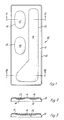
- the assembly of Figures 1-3 comprises a tray 10 of suitable material and composed of a rectangular platform 11 having a downwardly turned rim 12 around its periphery.
- the platform is formed with three dished zones 13-15 in which viscoelastic material of the above-mentioned gel kind is cast up to the top surface level of the platform, the resultant mouldings being denoted respectively 16-18.
- the overall depth of the dished zones is no more than half that of the tray rim, and the rim is outwardly stepped at or just below the depth of the zones so that the assembly is stackable with others of like form and with a clearance between the zones, from one tray to the next.
- Zone 13 involves two different shapes.
- Zone 13 conforms to a first one of these shapes, which shape is seen in plan as that of a strip having one end portion transversely extended along one side, with the extension preferably being of generally progressively increasing width towards the adjacent strip end.
- the other shape for zones 14 and 15 is that of an oval disc as seen in plan.
- Each shape has a cross-sectional shaping which is decreasingly tapered towards its periphery to give a flared form.
- the mould shapes can have prescribed proportions.
- the disc shape has length and width in a ratio of about 2:1, while the strip shape has an overall length about 4 times that of the disc, but a similar width to the disc for both the main body of the strip and the extension, and a similar length to the disc for the extension.
- the mould shapes are all of similar overall thickness of lesser order than the smallest of the above dimensions, with the thickness being in a ratio of about 1:7, say, with the disc width.
- the disc mould shape For use in relation to a leg of an adult the disc mould shape has overall dimensions of about 40x20x3 mm and a range of reduced dimensions can be produced for use in relation to children.
- strip shape is asymmetric and as illustrated is intended for use in relation to a right leg. Application to a left leg will involve a mirror image shaping.
- mould shapes and their proportions are well suited to disposition in a compacted array with the discs effectively nested within the 'angle' of the strip, as shown, and this is advantageous in terms of economy in production of the tray.
- the assembly per se is preferably covered, after the cast material is cured, with a protective plastics film or other suitable material which is readily peeled off or removed immediately prior to use of the moulds.
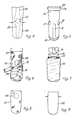
- Figure 4 shows a subject amputated right leg stump 20 and indicates in broken outline the lower end of the femur 21, the patella 22, and the shortened tibia 23.
- the width of the stump is measured with a suitable instrument at the level of the tibial condyles, the relevant width being indicated by the opposed horizontal arrows in Figure 4.
- the stump is closely covered with a thin layer 24 of an appropriate plastics material such as self-adhesive polyester film to extend to above the knee where it is held by an elastic band 25, as shown in Figure 5.
- the mouldings 16-18 are then located in position, again as shown in Figure 5, on the covered stump where they are retained by natural adhesion.
- the discs are respectively located over the sides of the tibial condyles, with the disc lengths extending fore-and-aft.
- the strip moulding is located along the front of the stump over the tibia with the extended strip end lowermost and the extension directed inwardly of the stump.
- the upper end of the strip is to terminate just below the patella but this may require the strip to be cut to length at such end because the strip moulding length suitably allows for the maximum likely stump length following surgery.
- a preformed cushioning cap 26 is placed over the lower end of the covered stump as shown in Figure 5, a wet thin sock 27 of knitted or similar form is located over the covered stump, mou ldings and cap, and the sock is marked with an indelible pencil to indicate the position and extent of the patella such as by a circle 28, the sock and its marking being indicated in Figure 6.
- the prepared stump is wrap cast with a plaster bandage 29 as indicated in Figure 6.
- the stump is held slightly bent at the knee during this operation and the prosthetist manipulates the tissue as during the conventional wrap casting technique.
- the wrapped cast 30 is removed by withdrawal from the stump with the knee further bent as indicated by Figure 7, and the cap 26 removed. This cast is then itself used as a mould into which fresh plaster is poured.
- the first cast is separated by cutting into the same to the depth of the sock where the casts are readily separated.
- the second cast 31 is exposed with a coarse surface finish and carries with it an adequate amount of the sock marking 28 to indicate the relative position of the patella as shown in Figure 8.
- This second cast is finished by removing, as appropriate, plaster to enhance the depressed shaping immediately below the patella and also behind the knee where the calf flares inwardly; the surface is smoothed overall; and it is checked in respect of its condylar width as shown by arrows again.
- the resultant replica 32 of the rectified stump is thereafter used in a conventional manner in the production of the cup in an artificial limb for the stump.
- the stump covering can be of various materials compatible with the skin and mouldings and it can be presented in the form of a bag or a protective film sheet such as of the widely available pvc self-adhesive type.
- the sock facilitates demarcation and separation of the two casts and is suitably of knitted synthetic fibre material.
- the cap is a conventional item of commercially available form, typically of coarse skeleton polyester foam material.
- plaster is clearly an appropriate material for the casts for reason of its well-established suitability for such purposes, but alternatives can be used if desired.
Landscapes
- Health & Medical Sciences (AREA)
- Engineering & Computer Science (AREA)
- Biomedical Technology (AREA)
- Cardiology (AREA)
- Oral & Maxillofacial Surgery (AREA)
- Transplantation (AREA)
- Heart & Thoracic Surgery (AREA)
- Vascular Medicine (AREA)
- Life Sciences & Earth Sciences (AREA)
- Animal Behavior & Ethology (AREA)
- General Health & Medical Sciences (AREA)
- Public Health (AREA)
- Veterinary Medicine (AREA)
- Manufacturing & Machinery (AREA)
- Prostheses (AREA)
Applications Claiming Priority (2)
| Application Number | Priority Date | Filing Date | Title |
|---|---|---|---|
| GB868622454A GB8622454D0 (en) | 1986-09-18 | 1986-09-18 | Limb prosthesis production |
| GB8622454 | 1986-09-18 |
Publications (2)
| Publication Number | Publication Date |
|---|---|
| EP0261884A1 true EP0261884A1 (de) | 1988-03-30 |
| EP0261884B1 EP0261884B1 (de) | 1990-08-29 |
Family
ID=10604369
Family Applications (1)
| Application Number | Title | Priority Date | Filing Date |
|---|---|---|---|
| EP19870308274 Expired EP0261884B1 (de) | 1986-09-18 | 1987-09-18 | Herstellung einer Gliedprothese und Materialien, die dazu benötigt werden |
Country Status (4)
| Country | Link |
|---|---|
| EP (1) | EP0261884B1 (de) |
| DE (1) | DE3764595D1 (de) |
| ES (1) | ES2016976B3 (de) |
| GB (2) | GB8622454D0 (de) |
Cited By (17)
| Publication number | Priority date | Publication date | Assignee | Title |
|---|---|---|---|---|
| EP0650708A1 (de) * | 1992-10-13 | 1995-05-03 | Carl Anthony Caspers | Protheseneinlage und Verfahren zum Herstellen einer Einlage und eines Prothesenschaftes |
| US5549709A (en) * | 1995-07-26 | 1996-08-27 | Caspers; Carl A. | Hypobarically-Controlled artificial limb for amputees |
| US5735906A (en) * | 1995-07-26 | 1998-04-07 | Caspers; Carl A. | Hypobarically-controlled artificial limb with detents for amputees |
| US6508842B1 (en) | 1999-06-03 | 2003-01-21 | Barbara J. Caspers | Socket liner for artificial limb |
| US6554868B1 (en) | 1999-06-03 | 2003-04-29 | Carl A. Caspers | Vacuum pump and shock absorber for artificial limb |
| US6726726B2 (en) | 1999-06-03 | 2004-04-27 | Otto Bock Healthcare Lp | Vacuum apparatus and method for managing residual limb volume in an artificial limb |
| US6974484B2 (en) | 1999-06-03 | 2005-12-13 | Otto Bock Healthcare Lp | Osmotic membrane and vacuum system for artificial limb |
| EP1854621A1 (de) | 2006-05-09 | 2007-11-14 | Otto Bock HealthCare IP GmbH & Co. KG | Verfahren zum Giessen eines Prothesenschaftes |
| US9364348B2 (en) | 2013-03-01 | 2016-06-14 | Ossur Hf | Vacuum suspension system |
| US9486335B2 (en) | 2012-04-30 | 2016-11-08 | Ossur Hf | Prosthetic device, system and method for increasing vacuum attachment |
| US9757256B2 (en) | 2014-07-01 | 2017-09-12 | Ossur Hf | Pump mechanism for vacuum suspension system |
| US9889025B2 (en) | 2012-02-14 | 2018-02-13 | Ossur Hf | Vacuum assisted suspension system |
| US9943421B2 (en) | 2015-05-21 | 2018-04-17 | Ossur Iceland Ehf | Membrane pump system for use with a prosthetic system |
| US10028845B2 (en) | 2015-01-08 | 2018-07-24 | Ossur Iceland Ehf | Pump mechanism |
| US10179055B2 (en) | 2015-05-29 | 2019-01-15 | Ossur Iceland Ehf | Pump system for use with a prosthetic device |
| US10413429B2 (en) | 2015-08-27 | 2019-09-17 | Ossur Iceland Ehf | Pump system |
| US10512554B2 (en) | 2016-08-26 | 2019-12-24 | Ossur Iceland Ehf | Pump system |
Families Citing this family (8)
| Publication number | Priority date | Publication date | Assignee | Title |
|---|---|---|---|---|
| NO180103C (no) * | 1994-09-19 | 1997-02-19 | Dag Joerstad | Fremgangsmåte for direktetilpasning av proteser |
| US7922775B2 (en) | 1999-06-03 | 2011-04-12 | Otto Bock Healthcare Lp | Pulsating pressure chamber and method for fluid management |
| US6926742B2 (en) | 1999-06-03 | 2005-08-09 | Otto Bock Healthcare Lp | Plate/socket attachment for artificial limb vacuum pump |
| US6645253B2 (en) | 1999-06-03 | 2003-11-11 | Carl A. Caspers | Vacuum pump and shock absorber for artificial limb |
| US20040098136A1 (en) | 1999-06-03 | 2004-05-20 | Caspers Carl A. | Socket liner for artificial limb with permanent attachment to socket |
| USD429335S (en) | 1999-09-03 | 2000-08-08 | Caspers-Schneider Technologies, Inc. | Prosthetic liner reinforcement patch |
| DE202006007460U1 (de) | 2006-05-09 | 2007-09-13 | Otto Bock Healthcare Products Gmbh | Protheseninnenschaftsystem |
| WO2008132606A2 (en) | 2007-04-27 | 2008-11-06 | Otto Bock Healthcare Ip Gmbh & Co. Kg | Pneumatic connector for prosthetic socket |
Citations (3)
| Publication number | Priority date | Publication date | Assignee | Title |
|---|---|---|---|---|
| US2424278A (en) * | 1945-10-08 | 1947-07-22 | Paul W Kunkel | Method of forming sockets for artificial limbs |
| US2664572A (en) * | 1952-10-27 | 1954-01-05 | Blevens Emmett | Artificial limb |
| US3393407A (en) * | 1965-12-16 | 1968-07-23 | Edward J. Kandel | Artificial limb with end-bearing socket and method of making |
Family Cites Families (1)
| Publication number | Priority date | Publication date | Assignee | Title |
|---|---|---|---|---|
| GB367334A (en) * | 1929-10-12 | 1932-02-18 | Desoutter Brothers Ltd | Improvements in the manufacture of artificial limbs and other orthopaedic devices |
-
1986
- 1986-09-18 GB GB868622454A patent/GB8622454D0/en active Pending
-
1987
- 1987-09-18 GB GB8722052A patent/GB2195256B/en not_active Expired - Lifetime
- 1987-09-18 EP EP19870308274 patent/EP0261884B1/de not_active Expired
- 1987-09-18 DE DE8787308274T patent/DE3764595D1/de not_active Expired - Lifetime
- 1987-09-18 ES ES87308274T patent/ES2016976B3/es not_active Expired - Lifetime
Patent Citations (3)
| Publication number | Priority date | Publication date | Assignee | Title |
|---|---|---|---|---|
| US2424278A (en) * | 1945-10-08 | 1947-07-22 | Paul W Kunkel | Method of forming sockets for artificial limbs |
| US2664572A (en) * | 1952-10-27 | 1954-01-05 | Blevens Emmett | Artificial limb |
| US3393407A (en) * | 1965-12-16 | 1968-07-23 | Edward J. Kandel | Artificial limb with end-bearing socket and method of making |
Non-Patent Citations (1)
| Title |
|---|
| COMPUTER SYSTEMS, vol. 6, no. 10, October 1986, pages 15,16, Bromley, GB; "Shape a leg" * |
Cited By (37)
| Publication number | Priority date | Publication date | Assignee | Title |
|---|---|---|---|---|
| EP0650708A1 (de) * | 1992-10-13 | 1995-05-03 | Carl Anthony Caspers | Protheseneinlage und Verfahren zum Herstellen einer Einlage und eines Prothesenschaftes |
| EP1010407A1 (de) * | 1992-10-13 | 2000-06-21 | Carl Anthony Caspers | Protheseneinlage und Verfahren zum Herstellen einer Einlage und eines Prothesenschaftes |
| US5549709A (en) * | 1995-07-26 | 1996-08-27 | Caspers; Carl A. | Hypobarically-Controlled artificial limb for amputees |
| US5735906A (en) * | 1995-07-26 | 1998-04-07 | Caspers; Carl A. | Hypobarically-controlled artificial limb with detents for amputees |
| US5904722A (en) * | 1996-06-11 | 1999-05-18 | Caspers; Carl A. | Hypobarically-controlled, double-socket artificial limb with mechanical interlock |
| US6554868B1 (en) | 1999-06-03 | 2003-04-29 | Carl A. Caspers | Vacuum pump and shock absorber for artificial limb |
| US6726726B2 (en) | 1999-06-03 | 2004-04-27 | Otto Bock Healthcare Lp | Vacuum apparatus and method for managing residual limb volume in an artificial limb |
| US6761742B2 (en) | 1999-06-03 | 2004-07-13 | Otto Bock Healthcare Lp | Vacuum pump and shock absorber for artificial limb |
| US6974484B2 (en) | 1999-06-03 | 2005-12-13 | Otto Bock Healthcare Lp | Osmotic membrane and vacuum system for artificial limb |
| US6508842B1 (en) | 1999-06-03 | 2003-01-21 | Barbara J. Caspers | Socket liner for artificial limb |
| EP1854621A1 (de) | 2006-05-09 | 2007-11-14 | Otto Bock HealthCare IP GmbH & Co. KG | Verfahren zum Giessen eines Prothesenschaftes |
| US9889025B2 (en) | 2012-02-14 | 2018-02-13 | Ossur Hf | Vacuum assisted suspension system |
| US10617537B2 (en) | 2012-02-14 | 2020-04-14 | Ossur Hf | Vacuum assisted suspension system |
| US11058561B2 (en) | 2012-04-30 | 2021-07-13 | Ossur Hf | Prosthetic device, system and method for increasing vacuum attachment |
| US10369018B2 (en) | 2012-04-30 | 2019-08-06 | Ossur Hf | Prosthetic device, system and method for increasing vacuum attachment |
| US9486335B2 (en) | 2012-04-30 | 2016-11-08 | Ossur Hf | Prosthetic device, system and method for increasing vacuum attachment |
| US9615946B2 (en) | 2012-04-30 | 2017-04-11 | Ossur Hf | Prosthetic device, system and method for increasing vacuum attachment |
| USRE50679E1 (en) | 2012-04-30 | 2025-12-02 | Ossur Hf | Prosthetic device, system and method for increasing vacuum attachment |
| US11141294B2 (en) | 2012-04-30 | 2021-10-12 | Ossur Hf | Prosthetic device, system and method for increasing vacuum attachment |
| US9364348B2 (en) | 2013-03-01 | 2016-06-14 | Ossur Hf | Vacuum suspension system |
| US9820873B2 (en) | 2013-03-01 | 2017-11-21 | Ossur Hf | Vacuum suspension system |
| US9757256B2 (en) | 2014-07-01 | 2017-09-12 | Ossur Hf | Pump mechanism for vacuum suspension system |
| US10729568B2 (en) | 2014-07-01 | 2020-08-04 | Ossur Hf | Pump mechanism for vacuum suspension system |
| US12465505B2 (en) | 2015-01-08 | 2025-11-11 | Ossur Iceland Ehf | Pump mechanism |
| US11679012B2 (en) | 2015-01-08 | 2023-06-20 | Ossur Iceland Ehf | Pump mechanism |
| US10028845B2 (en) | 2015-01-08 | 2018-07-24 | Ossur Iceland Ehf | Pump mechanism |
| US10695198B2 (en) | 2015-01-08 | 2020-06-30 | Ossur Iceland Ehf | Pump mechanism |
| US11246725B2 (en) | 2015-05-21 | 2022-02-15 | Ossur Iceland Ehf | Pump system |
| US10561508B2 (en) | 2015-05-21 | 2020-02-18 | Ossur Iceland Ehf | Vacuum pump system with heel pump for a prosthetic leg |
| US9943421B2 (en) | 2015-05-21 | 2018-04-17 | Ossur Iceland Ehf | Membrane pump system for use with a prosthetic system |
| US10179055B2 (en) | 2015-05-29 | 2019-01-15 | Ossur Iceland Ehf | Pump system for use with a prosthetic device |
| US11357647B2 (en) | 2015-08-27 | 2022-06-14 | Ossur Iceland Ehf | Pump system |
| US10413429B2 (en) | 2015-08-27 | 2019-09-17 | Ossur Iceland Ehf | Pump system |
| US12220329B2 (en) | 2015-08-27 | 2025-02-11 | Ossur Iceland Ehf | Pump system |
| US10512554B2 (en) | 2016-08-26 | 2019-12-24 | Ossur Iceland Ehf | Pump system |
| US11376139B2 (en) | 2016-08-26 | 2022-07-05 | Ossur Iceland Ehf | Pump system |
| US12004972B2 (en) | 2016-08-26 | 2024-06-11 | Ossur Iceland Ehf | Pump system |
Also Published As
| Publication number | Publication date |
|---|---|
| GB2195256B (en) | 1990-08-29 |
| EP0261884B1 (de) | 1990-08-29 |
| DE3764595D1 (de) | 1990-10-04 |
| GB2195256A (en) | 1988-04-07 |
| GB8722052D0 (en) | 1987-10-28 |
| ES2016976B3 (es) | 1990-12-16 |
| GB8622454D0 (en) | 1986-10-22 |
Similar Documents
| Publication | Publication Date | Title |
|---|---|---|
| EP0261884B1 (de) | Herstellung einer Gliedprothese und Materialien, die dazu benötigt werden | |
| US4735754A (en) | Method for fabricating artificial body parts | |
| US7429346B2 (en) | Method of forming a temporary prosthetic joint using a disposable mold | |
| US4225982A (en) | Molded syme foot with attached stump socket | |
| US4955920A (en) | Molding for manufacturing an inner conical recess for receiving an amputated extremity and process therefor | |
| CA1332261C (en) | Structure for enhanced retention of artificial limbs and method of fabrication | |
| US5258036A (en) | Body part mold and method of making | |
| US4600551A (en) | Method for producing breast prostheses and supports | |
| WO1996000048A1 (en) | Custom formed natural fit artificial breast appliance | |
| US5993487A (en) | Integrated keel-pylon prosthesis | |
| US4521193A (en) | Method and kit for constructing an aesthetic and functional temporary denture | |
| EP2705810B1 (de) | Verfahren zur Herstellung eines negativen Abgusses für Gelenkprothesen und entsprechende Vorrichtung | |
| US20040226115A1 (en) | Method and kit for preparing a last for footwear | |
| Kumar et al. | Finger prosthesis with an alternative approach | |
| EP0985388A2 (de) | Herstellungsverfahren für ein künstliches Glied | |
| US2894288A (en) | Foot molding | |
| Lange | The Lange silicone partial foot prosthesis | |
| GB2243324A (en) | Prosthesis production | |
| US3823208A (en) | Method of making a permanent prosthetic socket | |
| CN110897767A (zh) | 一种假肢石膏阴型调型的方法 | |
| Bhaskaran et al. | Enhancing retention and esthetics of fabricated silicone finger prosthesis using stump reduction technique and customized acrylic nail: A unique approach | |
| GB2107170A (en) | Orthopaedic footwear | |
| RU2796783C1 (ru) | Способ изготовления гильзы экзопротеза голени | |
| SU1674833A1 (ru) | Способ изготовлени контактно-опорного элемента приемной гильзы протеза нижней конечности | |
| EP3013282B1 (de) | Beinprothese und verfahren zu deren herstellung |
Legal Events
| Date | Code | Title | Description |
|---|---|---|---|
| PUAI | Public reference made under article 153(3) epc to a published international application that has entered the european phase |
Free format text: ORIGINAL CODE: 0009012 |
|
| AK | Designated contracting states |
Kind code of ref document: A1 Designated state(s): DE ES FR GB IT |
|
| 17P | Request for examination filed |
Effective date: 19880624 |
|
| 17Q | First examination report despatched |
Effective date: 19900206 |
|
| GRAA | (expected) grant |
Free format text: ORIGINAL CODE: 0009210 |
|
| AK | Designated contracting states |
Kind code of ref document: B1 Designated state(s): DE ES FR GB IT |
|
| ITF | It: translation for a ep patent filed | ||
| ET | Fr: translation filed | ||
| REF | Corresponds to: |
Ref document number: 3764595 Country of ref document: DE Date of ref document: 19901004 |
|
| PLBE | No opposition filed within time limit |
Free format text: ORIGINAL CODE: 0009261 |
|
| STAA | Information on the status of an ep patent application or granted ep patent |
Free format text: STATUS: NO OPPOSITION FILED WITHIN TIME LIMIT |
|
| PGFP | Annual fee paid to national office [announced via postgrant information from national office to epo] |
Ref country code: ES Payment date: 19910813 Year of fee payment: 5 |
|
| PGFP | Annual fee paid to national office [announced via postgrant information from national office to epo] |
Ref country code: GB Payment date: 19910815 Year of fee payment: 5 |
|
| 26N | No opposition filed | ||
| PGFP | Annual fee paid to national office [announced via postgrant information from national office to epo] |
Ref country code: DE Payment date: 19910826 Year of fee payment: 5 |
|
| PGFP | Annual fee paid to national office [announced via postgrant information from national office to epo] |
Ref country code: FR Payment date: 19910829 Year of fee payment: 5 |
|
| ITTA | It: last paid annual fee | ||
| REG | Reference to a national code |
Ref country code: GB Ref legal event code: 732 |
|
| ITPR | It: changes in ownership of a european patent |
Owner name: CESSIONE;BRITISH TECHNOLOGY GROUP LIMITED |
|
| PG25 | Lapsed in a contracting state [announced via postgrant information from national office to epo] |
Ref country code: GB Effective date: 19920918 |
|
| PG25 | Lapsed in a contracting state [announced via postgrant information from national office to epo] |
Ref country code: ES Free format text: LAPSE BECAUSE OF THE APPLICANT RENOUNCES Effective date: 19920919 |
|
| GBPC | Gb: european patent ceased through non-payment of renewal fee |
Effective date: 19920918 |
|
| PG25 | Lapsed in a contracting state [announced via postgrant information from national office to epo] |
Ref country code: FR Effective date: 19930528 |
|
| REG | Reference to a national code |
Ref country code: ES Ref legal event code: PC2A Owner name: BRITISH TECHNOLOGY GROUP LIMITED |
|
| REG | Reference to a national code |
Ref country code: FR Ref legal event code: ST |
|
| PG25 | Lapsed in a contracting state [announced via postgrant information from national office to epo] |
Ref country code: DE Effective date: 19940503 |
|
| REG | Reference to a national code |
Ref country code: ES Ref legal event code: FD2A Effective date: 19991007 |
|
| PG25 | Lapsed in a contracting state [announced via postgrant information from national office to epo] |
Ref country code: IT Free format text: LAPSE BECAUSE OF NON-PAYMENT OF DUE FEES;WARNING: LAPSES OF ITALIAN PATENTS WITH EFFECTIVE DATE BEFORE 2007 MAY HAVE OCCURRED AT ANY TIME BEFORE 2007. THE CORRECT EFFECTIVE DATE MAY BE DIFFERENT FROM THE ONE RECORDED. Effective date: 20050918 |