EP0262302B1 - Masse d'étanchéité murale, mélange à sec et procédé de préparation - Google Patents
Masse d'étanchéité murale, mélange à sec et procédé de préparation Download PDFInfo
- Publication number
- EP0262302B1 EP0262302B1 EP87108338A EP87108338A EP0262302B1 EP 0262302 B1 EP0262302 B1 EP 0262302B1 EP 87108338 A EP87108338 A EP 87108338A EP 87108338 A EP87108338 A EP 87108338A EP 0262302 B1 EP0262302 B1 EP 0262302B1
- Authority
- EP
- European Patent Office
- Prior art keywords
- diaphragm wall
- blast furnace
- ready mixed
- mixed material
- furnace slag
- Prior art date
- Legal status (The legal status is an assumption and is not a legal conclusion. Google has not performed a legal analysis and makes no representation as to the accuracy of the status listed.)
- Expired - Lifetime
Links
Classifications
-
- C—CHEMISTRY; METALLURGY
- C04—CEMENTS; CONCRETE; ARTIFICIAL STONE; CERAMICS; REFRACTORIES
- C04B—LIME, MAGNESIA; SLAG; CEMENTS; COMPOSITIONS THEREOF, e.g. MORTARS, CONCRETE OR LIKE BUILDING MATERIALS; ARTIFICIAL STONE; CERAMICS; REFRACTORIES; TREATMENT OF NATURAL STONE
- C04B28/00—Compositions of mortars, concrete or artificial stone, containing inorganic binders or the reaction product of an inorganic and an organic binder, e.g. polycarboxylate cements
- C04B28/02—Compositions of mortars, concrete or artificial stone, containing inorganic binders or the reaction product of an inorganic and an organic binder, e.g. polycarboxylate cements containing hydraulic cements other than calcium sulfates
- C04B28/08—Slag cements
-
- C—CHEMISTRY; METALLURGY
- C04—CEMENTS; CONCRETE; ARTIFICIAL STONE; CERAMICS; REFRACTORIES
- C04B—LIME, MAGNESIA; SLAG; CEMENTS; COMPOSITIONS THEREOF, e.g. MORTARS, CONCRETE OR LIKE BUILDING MATERIALS; ARTIFICIAL STONE; CERAMICS; REFRACTORIES; TREATMENT OF NATURAL STONE
- C04B2111/00—Mortars, concrete or artificial stone or mixtures to prepare them, characterised by specific function, property or use
- C04B2111/00474—Uses not provided for elsewhere in C04B2111/00
- C04B2111/00663—Uses not provided for elsewhere in C04B2111/00 as filling material for cavities or the like
- C04B2111/00698—Uses not provided for elsewhere in C04B2111/00 as filling material for cavities or the like for cavity walls
-
- C—CHEMISTRY; METALLURGY
- C04—CEMENTS; CONCRETE; ARTIFICIAL STONE; CERAMICS; REFRACTORIES
- C04B—LIME, MAGNESIA; SLAG; CEMENTS; COMPOSITIONS THEREOF, e.g. MORTARS, CONCRETE OR LIKE BUILDING MATERIALS; ARTIFICIAL STONE; CERAMICS; REFRACTORIES; TREATMENT OF NATURAL STONE
- C04B2111/00—Mortars, concrete or artificial stone or mixtures to prepare them, characterised by specific function, property or use
- C04B2111/00474—Uses not provided for elsewhere in C04B2111/00
- C04B2111/00767—Uses not provided for elsewhere in C04B2111/00 for waste stabilisation purposes
- C04B2111/00775—Uses not provided for elsewhere in C04B2111/00 for waste stabilisation purposes the composition being used as waste barriers or the like, e.g. compositions used for waste disposal purposes only, but not containing the waste itself
Definitions
- sealing walls In order to prevent pollutants, particularly in the groundwater, from escaping from landfills or the underground of chemical factories, they are enclosed with vertical sealing walls that extend to the depths of impermeable layers of soil.
- Such sealing walls are in particular designed as so-called diaphragm walls, for their production in the vocational step method with the help of a special gripper deep holes of rectangular cross-section with a length / width ratio of approximately 2.00 - 4.00 / 0.4 - 1.00 m to the required depth, so-called lamellae.
- the primary lamellae which were initially created at a slightly smaller distance than the opening width of the special gripper, are followed at a later time by the excavation of secondary lamellae, which form a closed wall, the so-called diaphragm wall, by overlapping the primary lamellae. So that the soil from the walls of these slats does not collapse, a support suspension is filled into the slats during excavation in order to support the earth walls with hydrostatic pressure.
- Sealing wall materials are self-curing thixotropic suspensions made of swellable clay minerals and cement, which remain in the lamellae in the so-called "single-phase process" for the production of the sealing slit walls after the excavation work has been completed and slowly harden here.
- Sealing wall materials for the single-phase process generally contain 40-60% by weight calcium bentonite and 40-60% by weight cements as solids. It is known as cement to use blast furnace cements in addition to Portland cement. Mixtures of calcium and / or magnesium and / or sodium bentonite correspond to the prior art. Depending on the requirements, inert solids can also be added.
- sealing wall materials for the single-phase process have been produced in such a way that in a first stage a suspension is produced from the swellable clay mineral with a layered grid structure and water. This mixing process is carried out with the aid of high-energy mixing systems in order to separate the layers of the lattice structure from one another with the aid of the water and to distribute them as evenly as possible. Nevertheless, the freshly mixed bentonite suspension generally has to swell for about 4 hours in order to obtain the desired thixotropic properties. The cement is then added in a second mixing process. The sealing wall mass produced in this way for the single-phase process is then pumped from a storage container into the lamellae of the diaphragm wall to be created (Dipl.-Ing.
- the invention has set itself the task of simplifying the mixing system and the process and to produce the diaphragm wall material in one step instead of in two stages with the intermediate swelling process.
- the single-stage manufacture of sealing wall materials for the single-phase process is achieved by a special composition of the finely ground solids, which are adjusted to a certain water / solids value with water.
- the following solids are selected in the amounts listed below: 20-70, in particular 30-60 parts by weight of a swellable clay mineral, 20-79.5, preferably 30-59.5 parts by weight of blast furnace slag, 0.3 to 8, preferably 1 to 5 parts by weight of an exciter for the blast furnace slag which forms hydroxyl ions, in particular calcium hydroxide, 0-3, preferably 0.5-2 parts by weight of soda and 0-25, preferably 2-15 parts by face of limestone powder or other inert fillers.
- the swellable clay minerals with layered lattice structure suitable for bulkhead materials are known. It is particularly kaolinite, attapulgite, bentonite and montmorillonite. According to the invention, these are preferably used in the calcium form but also in mixtures of calcium and / or sodium and / or magnesium bentonite.
- Blast furnace slag is mostly sold as granules. It usually consists of about 35 - 48% CaO, 30 - 38% SiO2, 6 - 18% Al2O3 and small amounts of MgO, MnO and iron oxides.
- the blast furnace slag must be ground to a Blaine fineness of at least 1000 cm2 / g in order to be sufficiently reactive. It is preferably brought to a Blaine fineness of 2000 to 3000 cm2 / g. This is an average to be sought for economic reasons, because larger finenesses result in significantly higher grinding costs.
- the blast furnace slag can be partially replaced by other latent hydraulic materials, such as tress. It is also possible to replace part of the blast furnace slag with inert fillers, in particular limestone or limestone, provided that this does not affect the important characteristic values of the bulkhead mass mentioned at the outset.
- Calcium hydroxide-forming exciters for the blast furnace slag are known. These are in particular Portland cement clinker and calcium oxide or hydroxide. Because these are also used in finely ground form, Portland cement clinker, for example, is preferably added in the form of Portland cement, iron Portland cement, blast furnace cement, oil shale cement or road cement. This allows the exciter to be metered in more easily.
- the blast furnace slag contained in the cements mentioned or other latent hydraulic or inert substances are counted towards the proportion of blast furnace slag.
- the properties of the sealant are apparently strongly influenced by the precise dosage of the calcium hydroxide-forming exciter.
- the solids of the sealing wall composition according to the invention are preferably not used individually, but already as a finely ground dry or ready mixture.
- the finely divided solids are preferably processed in the form of the prefabricated dry mixture using an energy-intensive mixing process, in particular under the action of high shear forces, with the required amount of water.
- This intensive mixing with water can be carried out using the same systems which are customary for the production of sealing wall suspensions in the two-stage or multi-stage process described above, namely using so-called Supraton or Supramix systems.
- the sealing wall composition according to the invention is set to a water / hard stiff value (W / F value) of 1 to 3.5, preferably 1.2 to 2.
- additives which influence the flow behavior during the mixing process, the consistency or setting can also be added to the dry mixtures or bulkhead compositions according to the invention.
- the sealing wall compositions according to the invention meet all the properties required, such as low filtrate water release, long processability and low water permeability with 28-day strengths in the order of 1.5 N / mm2.
- the quality of the diaphragm wall mass can be easily adapted to the needs and consumption on site and the influence of the thixotropy is less than with conventional diaphragm wall masses, so that even higher amounts of solids (approx. 500 - 600 kg / m3 diaphragm wall mass) can be processed in the single phase process and thereby better sealing values can be achieved.
Landscapes
- Chemical & Material Sciences (AREA)
- Engineering & Computer Science (AREA)
- Ceramic Engineering (AREA)
- Chemical Kinetics & Catalysis (AREA)
- Inorganic Chemistry (AREA)
- Materials Engineering (AREA)
- Structural Engineering (AREA)
- Organic Chemistry (AREA)
- Sealing Material Composition (AREA)
- Curing Cements, Concrete, And Artificial Stone (AREA)
- Glass Compositions (AREA)
Claims (14)
- Mélange à sec pour la production en une seule étape de masses pour murs d'étanchéité, caractérisé en ce qu'il contient un mélange finement broyé dela quantité de carbonate de sodium ou la quantité de charge inerte ne devant pas être nulle.
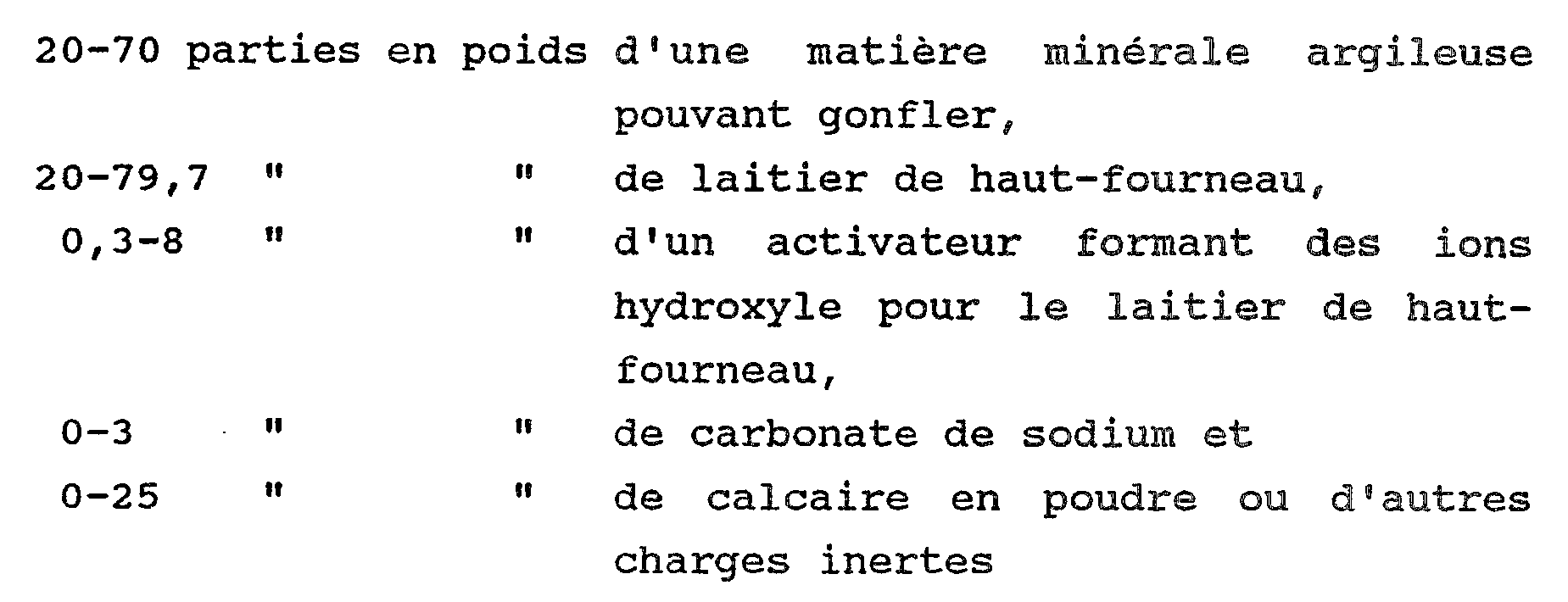
- Mélange à sec suivant la revendication 1, caractérisé en ce qu'il contient

- Mélange à sec suivant la revendication 1 ou 2, caractérisé en ce qu'un clinker de ciment Portland est utilisé comme activateur formant des ions hydroxyle pour le laitier de haut-fourneau.
- Mélange à sec suivant l'une des revendications 1 à 3, caractérisé en ce que le laitier de haut-fourneau est partiellement remplacé par d'autres substances hydrauliques latentes.
- Mélange à sec suivant l'une des revendications 1 à 4, caractérisé en ce qu'on utilise, comme matière minérale argileuse pouvant gonfler, la bentonite sous la forme calcique ainsi que des mélanges de bentonite sous les formes calcique, magnésienne et/ou sodique.
- Mélange à sec suivant l'une des revendications 1 à 5, caractérisé en ce que le clinker de ciment Portland est ajouté sous forme de ciment Portland, de ciment Portland de fer, de ciment pour haut-fourneau ou de ciment au trass.
- Mélange à sec suivant l'une des revendications 1 à 6, caractérisé en ce que le laitier de haut-fourneau est broyé à un degré de finesse d'au moins 1000, de préférence de 2000 à 3000 cm²/g selon Blaine.
- Masse étanche destinée au procédé à phase unique pour la production de rideaux souterrains étanches, caractérisée en ce quela quantité de carbonate de sodium ou la quantité de charges inertes ne devant pas être nulle,

sous une forme finement broyée, sont réglées avec de l'eau à une valeur eau/matière solide de 1 à 3,5, de préférence de 1,2 à 2. - Masse pour murs d'étanchéité suivant la revendication 8, caractérisée en ce que les matières solides sont présentes en les quantités suivantes :
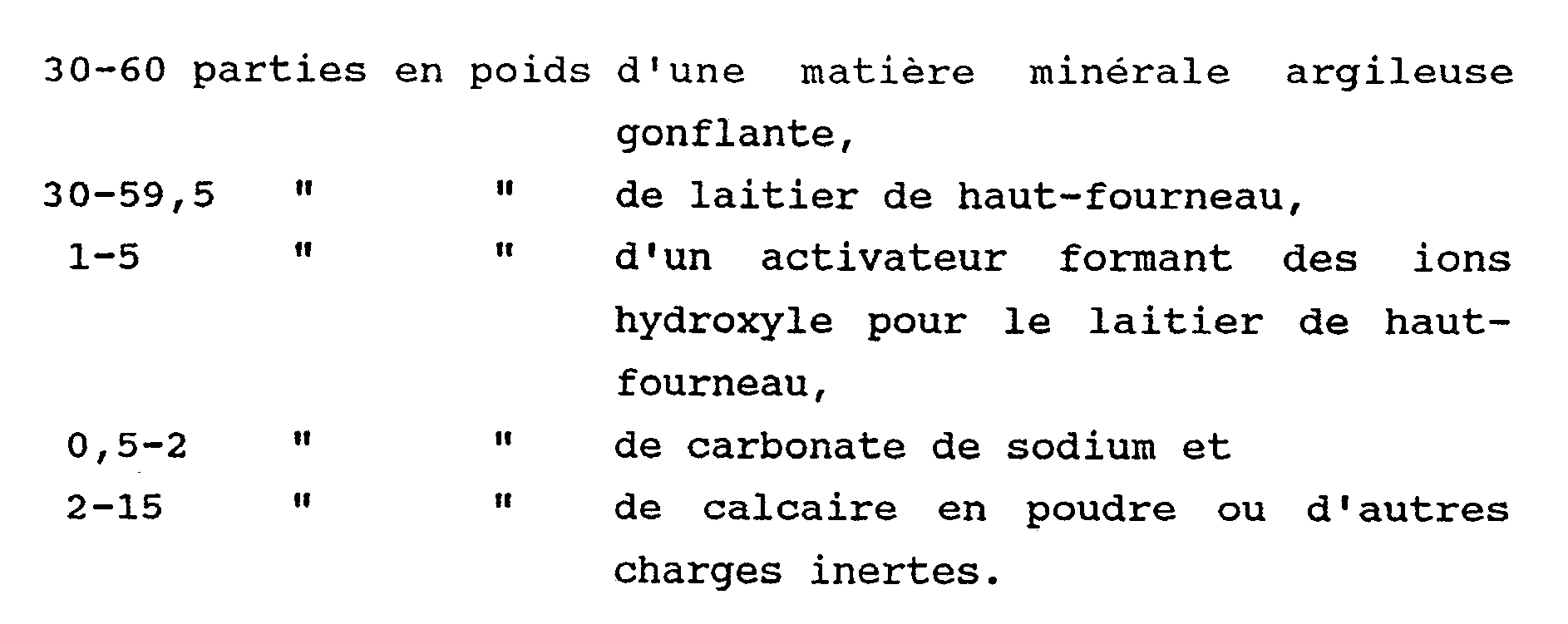
- Masse pour murs d'étanchéité suivant la revendication 8 ou 9, caractérisée en ce qu'un clinker de ciment Portland est utilisé comme activateur formant des ions hydroxyle pour le laitier de haut-fourneau.
- Masse pour murs d'étanchéité suivant l'une des revendications 8 à 10, caractérisée en ce qu'on utilise comme matière minérale argileuse gonflante, la bentonite sous la forme calcique ainsi que des mélanges de bentonite sous les formes calcique, magnésienne et/ou sodique.
- Masse pour murs d'étanchéité suivant l'une des revendications 8 à 11, caractérisée en ce que les matières solides sont introduites sous forme du mélange à sec suivant l'une des revendications 1 à 7.
- Procédé de production d'une masse pour murs d'étanchéité suivant l'une des revendications 8 à 12, caractérisée en ce qu'on met en oeuvre les matières solides finement divisées par un processus de mélange très énergétique, notamment sous l'action de grandes forces de cisaillement, avec la quantité nécessaire d'eau.
- Procédé de production de rideaux souterrains étanches par le procédé à phase unique, caractérisé en ce qu'on charge la masse pour murs d'étanchéité selon l'une des revendications 8 à 12 dans les lamelles immédiatement après sa production.
Priority Applications (1)
| Application Number | Priority Date | Filing Date | Title |
|---|---|---|---|
| AT87108338T ATE63735T1 (de) | 1986-10-03 | 1987-06-10 | Dichtwandmasse, trockenmischung und verfahren zu ihrer herstellung. |
Applications Claiming Priority (2)
| Application Number | Priority Date | Filing Date | Title |
|---|---|---|---|
| DE3633736 | 1986-10-03 | ||
| DE19863633736 DE3633736A1 (de) | 1986-04-01 | 1986-10-03 | Dichtwandmasse, trockenmischung und verfahren zu ihrer herstellung |
Publications (3)
| Publication Number | Publication Date |
|---|---|
| EP0262302A2 EP0262302A2 (fr) | 1988-04-06 |
| EP0262302A3 EP0262302A3 (en) | 1989-05-03 |
| EP0262302B1 true EP0262302B1 (fr) | 1991-05-22 |
Family
ID=6311005
Family Applications (1)
| Application Number | Title | Priority Date | Filing Date |
|---|---|---|---|
| EP87108338A Expired - Lifetime EP0262302B1 (fr) | 1986-10-03 | 1987-06-10 | Masse d'étanchéité murale, mélange à sec et procédé de préparation |
Country Status (3)
| Country | Link |
|---|---|
| EP (1) | EP0262302B1 (fr) |
| AT (1) | ATE63735T1 (fr) |
| DE (1) | DE3770231D1 (fr) |
Families Citing this family (9)
| Publication number | Priority date | Publication date | Assignee | Title |
|---|---|---|---|---|
| IT1241120B (it) * | 1990-04-18 | 1993-12-29 | Contento Trade Sas Di C M P | Conglomerato per edilizia rurale e stradale e procedimento per la sua preparazione |
| DE4121776A1 (de) * | 1991-07-01 | 1993-01-28 | Dyckerhoff Ag | Mittel zur herstellung einer dichtwandmasse sowie verfahren zur herstellung einer dichtwandmasse daraus |
| WO1993016965A1 (fr) * | 1992-02-27 | 1993-09-02 | Pretoria Portland Cement Company Limited | Materiau de liaison geopolymere |
| DE4213348C1 (de) * | 1992-04-23 | 1993-12-09 | Heidelberger Zement Ag | Bindemittelmischung zur einstufigen Herstellung von Dichtwänden |
| DE4405323C3 (de) * | 1994-02-21 | 2001-02-01 | Reinhard Haese | Verfahren zur Bindung von organischen und anderen Stoffen, verbunden mit einer Absenkung der Eluat-Werte bezüglich TOC (total organic carbon) und anderer Stoffe bei der Deponierung von Abfällen |
| DE19526396C2 (de) * | 1995-07-19 | 2000-11-02 | Dyckerhoff Ag | Baugrubenverbau, Verfahren zu seiner Herstellung sowie Baustoffgemenge dafür |
| DE10002827C2 (de) * | 2000-01-24 | 2003-01-23 | Anneliese Zementwerke Ag | Verfahren zur Herstellung eines pumpfähigen Dichtwandkonzentrats und dessen Verwendungen |
| NL1017858C2 (nl) * | 2001-04-17 | 2002-10-18 | Insulinde Recycling B V | Werkwijze voor de vorming van in hoofdzaak verticale, voor water ondoorlatende wanden, en gestabiliseerde montmorilloniet-klei voor toepassing in de werkwijze. |
| PL2632871T3 (pl) * | 2010-10-29 | 2018-07-31 | Heidelbergcement Ag | Aktywator hydrauliczny do piasku hutniczego |
Family Cites Families (3)
| Publication number | Priority date | Publication date | Assignee | Title |
|---|---|---|---|---|
| FR2442917A1 (fr) * | 1978-11-30 | 1980-06-27 | Lafaure Henri | Procede d'etancheite de sols |
| FR2544735A1 (fr) * | 1983-04-19 | 1984-10-26 | Portier Jean Louis | Coulis dilue ameliore par reducteurs de chaux solubles |
| DE3411009A1 (de) * | 1984-03-24 | 1985-09-26 | Klaus Dipl.-Ing. 4100 Duisburg Schumann | Verfahren zum herstellen von schnellbindendem moertel am verwendungsort |
-
1987
- 1987-06-10 AT AT87108338T patent/ATE63735T1/de not_active IP Right Cessation
- 1987-06-10 DE DE8787108338T patent/DE3770231D1/de not_active Expired - Lifetime
- 1987-06-10 EP EP87108338A patent/EP0262302B1/fr not_active Expired - Lifetime
Also Published As
| Publication number | Publication date |
|---|---|
| EP0262302A2 (fr) | 1988-04-06 |
| DE3770231D1 (de) | 1991-06-27 |
| EP0262302A3 (en) | 1989-05-03 |
| ATE63735T1 (de) | 1991-06-15 |
Similar Documents
| Publication | Publication Date | Title |
|---|---|---|
| EP0239740B1 (fr) | Masse d'écran imperméable, mélange sec et procédé pour sa préparation | |
| DE3322492C2 (fr) | ||
| DE3873533T2 (de) | Schlacke enthaltende giessmoertelzusammensetzung. | |
| DE19603805C2 (de) | Hüttensandfreie Dichtwandmassen und Verfahren zu deren Herstellung | |
| DE3633736A1 (de) | Dichtwandmasse, trockenmischung und verfahren zu ihrer herstellung | |
| DE69023419T2 (de) | Injektionsschlamm zum Verfestigen von gerissenen Strukturen. | |
| DE69601896T2 (de) | Sehr flüssige Betonzusammensetzung | |
| EP0522347B1 (fr) | Produit pour la fabrication d'une masse de paroi étanche | |
| DE3800776C2 (fr) | ||
| DE102019213361A1 (de) | Verfahren zur Herstellung von hydrothermal gehärteten Poren- oder Schaumbetonformkörpern und mittels des Verfahrens hergestellter Poren- oder Schaumbetonformkörper | |
| EP0262302A2 (fr) | Masse d'étanchéité murale, mélange à sec et procédé de préparation | |
| EP0234504A2 (fr) | Masse d'étanchéité pour traitement du sol | |
| EP0139838B1 (fr) | Masse d'étanchéité résistant aux agents polluants | |
| EP0347655B1 (fr) | Procédé de fabrication d'un liant hydraulique ayant une prise rapide après gachage à l'eau | |
| CH678018A5 (fr) | ||
| DE3934085C2 (fr) | ||
| EP0495244B1 (fr) | Méthode pour produire une paroi étanche, moulée en tranchée | |
| DE3843625C3 (de) | Verfahren zur Herstellung von nach dem Anmachen mit Wasser schnellerstarrenden, hydraulischen Bindemittelmischungen mit einstellbar hoher Frühfestigkeit und definierter Wasserfestigkeit der daraus hergestellten erhärteten Massen | |
| DE3537812C2 (fr) | ||
| DE19537616C2 (de) | Natriumbentonitfreie Injektionsmittelsuspension | |
| EP0755992B1 (fr) | Compositions injectable, et suspensions lors de l'injection | |
| AT394858B (de) | Verfahren zur herstellung von suspensionen aus zement, sio2 und caco3 zur injektion in boeden od.dgl., und danach hergestellte erzeugnisse | |
| DE4312570C2 (de) | Wässrige, thixotrope, Bindemittel und Bentonit enthaltende Aufschlämmung für Schlitzwände | |
| AT393381B (de) | Bindemittelgemisch zur herstellung von dichtenden schichten | |
| EP0169508A2 (fr) | Matériau de construction à base de phospho-hémihydrate, procédé pour sa fabrication et son utilisation |
Legal Events
| Date | Code | Title | Description |
|---|---|---|---|
| PUAI | Public reference made under article 153(3) epc to a published international application that has entered the european phase |
Free format text: ORIGINAL CODE: 0009012 |
|
| AK | Designated contracting states |
Kind code of ref document: A2 Designated state(s): AT BE CH DE FR IT LI LU NL |
|
| PUAL | Search report despatched |
Free format text: ORIGINAL CODE: 0009013 |
|
| RHK1 | Main classification (correction) |
Ipc: C04B 28/08 |
|
| AK | Designated contracting states |
Kind code of ref document: A3 Designated state(s): AT BE CH DE FR IT LI LU NL |
|
| 17P | Request for examination filed |
Effective date: 19890429 |
|
| 17Q | First examination report despatched |
Effective date: 19900725 |
|
| GRAA | (expected) grant |
Free format text: ORIGINAL CODE: 0009210 |
|
| AK | Designated contracting states |
Kind code of ref document: B1 Designated state(s): AT BE CH DE FR IT LI LU NL |
|
| REF | Corresponds to: |
Ref document number: 63735 Country of ref document: AT Date of ref document: 19910615 Kind code of ref document: T |
|
| ITF | It: translation for a ep patent filed | ||
| ET | Fr: translation filed | ||
| REF | Corresponds to: |
Ref document number: 3770231 Country of ref document: DE Date of ref document: 19910627 |
|
| PLBE | No opposition filed within time limit |
Free format text: ORIGINAL CODE: 0009261 |
|
| STAA | Information on the status of an ep patent application or granted ep patent |
Free format text: STATUS: NO OPPOSITION FILED WITHIN TIME LIMIT |
|
| 26N | No opposition filed | ||
| EPTA | Lu: last paid annual fee | ||
| PGFP | Annual fee paid to national office [announced via postgrant information from national office to epo] |
Ref country code: NL Payment date: 20040530 Year of fee payment: 18 |
|
| PG25 | Lapsed in a contracting state [announced via postgrant information from national office to epo] |
Ref country code: NL Free format text: LAPSE BECAUSE OF NON-PAYMENT OF DUE FEES Effective date: 20060101 |
|
| NLV4 | Nl: lapsed or anulled due to non-payment of the annual fee |
Effective date: 20060101 |
|
| PGFP | Annual fee paid to national office [announced via postgrant information from national office to epo] |
Ref country code: AT Payment date: 20060606 Year of fee payment: 20 |
|
| PGFP | Annual fee paid to national office [announced via postgrant information from national office to epo] |
Ref country code: FR Payment date: 20060612 Year of fee payment: 20 |
|
| PGFP | Annual fee paid to national office [announced via postgrant information from national office to epo] |
Ref country code: IT Payment date: 20060630 Year of fee payment: 20 Ref country code: DE Payment date: 20060630 Year of fee payment: 20 |
|
| PGFP | Annual fee paid to national office [announced via postgrant information from national office to epo] |
Ref country code: BE Payment date: 20060712 Year of fee payment: 20 |
|
| PGFP | Annual fee paid to national office [announced via postgrant information from national office to epo] |
Ref country code: CH Payment date: 20060929 Year of fee payment: 20 |
|
| PGFP | Annual fee paid to national office [announced via postgrant information from national office to epo] |
Ref country code: LU Payment date: 20061106 Year of fee payment: 20 |
|
| REG | Reference to a national code |
Ref country code: CH Ref legal event code: PL |
|
| BE20 | Be: patent expired |
Owner name: *ANNELIESE ZEMENTWERKE A.G. Effective date: 20070610 |