EP0262310A1 - Verfahren zur Isomerisierung unverzweigter funktionalisierter Verbindungen mit endständigen Doppelbindungen - Google Patents
Verfahren zur Isomerisierung unverzweigter funktionalisierter Verbindungen mit endständigen Doppelbindungen Download PDFInfo
- Publication number
- EP0262310A1 EP0262310A1 EP87109437A EP87109437A EP0262310A1 EP 0262310 A1 EP0262310 A1 EP 0262310A1 EP 87109437 A EP87109437 A EP 87109437A EP 87109437 A EP87109437 A EP 87109437A EP 0262310 A1 EP0262310 A1 EP 0262310A1
- Authority
- EP
- European Patent Office
- Prior art keywords
- iii
- rhodium
- carbon
- isomerization
- compounds
- Prior art date
- Legal status (The legal status is an assumption and is not a legal conclusion. Google has not performed a legal analysis and makes no representation as to the accuracy of the status listed.)
- Withdrawn
Links
- 150000001875 compounds Chemical class 0.000 title claims abstract description 14
- 238000006317 isomerization reaction Methods 0.000 title claims description 32
- 238000000034 method Methods 0.000 title claims description 23
- 230000008569 process Effects 0.000 title claims description 13
- 239000011203 carbon fibre reinforced carbon Substances 0.000 claims abstract description 17
- 239000002253 acid Substances 0.000 claims abstract description 13
- 150000001336 alkenes Chemical class 0.000 claims abstract description 13
- 125000000524 functional group Chemical group 0.000 claims abstract description 12
- PZSJYEAHAINDJI-UHFFFAOYSA-N rhodium(3+) Chemical compound [Rh+3] PZSJYEAHAINDJI-UHFFFAOYSA-N 0.000 claims abstract description 10
- OKTJSMMVPCPJKN-UHFFFAOYSA-N Carbon Chemical group [C] OKTJSMMVPCPJKN-UHFFFAOYSA-N 0.000 claims abstract description 9
- 150000002148 esters Chemical class 0.000 claims abstract description 9
- 150000007513 acids Chemical class 0.000 claims abstract description 5
- HSSMNYDDDSNUKH-UHFFFAOYSA-K trichlororhodium;hydrate Chemical compound O.Cl[Rh](Cl)Cl HSSMNYDDDSNUKH-UHFFFAOYSA-K 0.000 claims abstract description 5
- MILUBEOXRNEUHS-UHFFFAOYSA-N iridium(3+) Chemical class [Ir+3] MILUBEOXRNEUHS-UHFFFAOYSA-N 0.000 claims abstract description 3
- 239000000203 mixture Substances 0.000 claims description 23
- 229910021604 Rhodium(III) chloride Inorganic materials 0.000 claims description 16
- 238000006243 chemical reaction Methods 0.000 claims description 16
- SONJTKJMTWTJCT-UHFFFAOYSA-K rhodium(iii) chloride Chemical compound [Cl-].[Cl-].[Cl-].[Rh+3] SONJTKJMTWTJCT-UHFFFAOYSA-K 0.000 claims description 16
- RTZKZFJDLAIYFH-UHFFFAOYSA-N Diethyl ether Chemical compound CCOCC RTZKZFJDLAIYFH-UHFFFAOYSA-N 0.000 claims description 7
- 150000002576 ketones Chemical class 0.000 claims description 6
- XLYOFNOQVPJJNP-UHFFFAOYSA-N water Substances O XLYOFNOQVPJJNP-UHFFFAOYSA-N 0.000 claims description 6
- IJGRMHOSHXDMSA-UHFFFAOYSA-N Atomic nitrogen Chemical compound N#N IJGRMHOSHXDMSA-UHFFFAOYSA-N 0.000 claims description 4
- 229910052799 carbon Inorganic materials 0.000 claims description 4
- 229910052741 iridium Inorganic materials 0.000 claims description 4
- GKOZUEZYRPOHIO-UHFFFAOYSA-N iridium atom Chemical compound [Ir] GKOZUEZYRPOHIO-UHFFFAOYSA-N 0.000 claims description 4
- 239000002904 solvent Substances 0.000 claims description 4
- 125000004432 carbon atom Chemical group C* 0.000 claims description 3
- LFQSCWFLJHTTHZ-UHFFFAOYSA-N Ethanol Chemical compound CCO LFQSCWFLJHTTHZ-UHFFFAOYSA-N 0.000 claims description 2
- 150000001408 amides Chemical class 0.000 claims description 2
- 150000001735 carboxylic acids Chemical class 0.000 claims description 2
- 150000004677 hydrates Chemical class 0.000 claims description 2
- 239000011261 inert gas Substances 0.000 claims description 2
- 229910052500 inorganic mineral Inorganic materials 0.000 claims description 2
- 239000011707 mineral Substances 0.000 claims description 2
- 150000002825 nitriles Chemical class 0.000 claims description 2
- 229910052757 nitrogen Inorganic materials 0.000 claims description 2
- MMRXYMKDBFSWJR-UHFFFAOYSA-K rhodium(3+);tribromide Chemical compound [Br-].[Br-].[Br-].[Rh+3] MMRXYMKDBFSWJR-UHFFFAOYSA-K 0.000 claims description 2
- KXAHUXSHRWNTOD-UHFFFAOYSA-K rhodium(3+);triiodide Chemical compound [Rh+3].[I-].[I-].[I-] KXAHUXSHRWNTOD-UHFFFAOYSA-K 0.000 claims description 2
- VXNYVYJABGOSBX-UHFFFAOYSA-N rhodium(3+);trinitrate Chemical compound [Rh+3].[O-][N+]([O-])=O.[O-][N+]([O-])=O.[O-][N+]([O-])=O VXNYVYJABGOSBX-UHFFFAOYSA-N 0.000 claims description 2
- YWFDDXXMOPZFFM-UHFFFAOYSA-H rhodium(3+);trisulfate Chemical compound [Rh+3].[Rh+3].[O-]S([O-])(=O)=O.[O-]S([O-])(=O)=O.[O-]S([O-])(=O)=O YWFDDXXMOPZFFM-UHFFFAOYSA-H 0.000 claims description 2
- 150000004820 halides Chemical class 0.000 claims 1
- 239000011877 solvent mixture Substances 0.000 claims 1
- -1 rhodium(III) halides Chemical class 0.000 abstract description 3
- 239000007795 chemical reaction product Substances 0.000 abstract description 2
- LRHPLDYGYMQRHN-UHFFFAOYSA-N N-Butanol Chemical compound CCCCO LRHPLDYGYMQRHN-UHFFFAOYSA-N 0.000 description 22
- 239000003054 catalyst Substances 0.000 description 19
- 239000000243 solution Substances 0.000 description 12
- FRPZMMHWLSIFAZ-UHFFFAOYSA-N 10-undecenoic acid Chemical compound OC(=O)CCCCCCCCC=C FRPZMMHWLSIFAZ-UHFFFAOYSA-N 0.000 description 9
- GRAORJFMGCQWRN-UHFFFAOYSA-N Butyl undecylenate Chemical compound CCCCOC(=O)CCCCCCCCC=C GRAORJFMGCQWRN-UHFFFAOYSA-N 0.000 description 9
- 238000004821 distillation Methods 0.000 description 9
- QTBSBXVTEAMEQO-UHFFFAOYSA-N Acetic acid Chemical compound CC(O)=O QTBSBXVTEAMEQO-UHFFFAOYSA-N 0.000 description 8
- 239000000047 product Substances 0.000 description 8
- GIEMHYCMBGELGY-UHFFFAOYSA-N 10-undecen-1-ol Chemical compound OCCCCCCCCCC=C GIEMHYCMBGELGY-UHFFFAOYSA-N 0.000 description 6
- 238000004611 spectroscopical analysis Methods 0.000 description 6
- KHAVLLBUVKBTBG-UHFFFAOYSA-N caproleic acid Natural products OC(=O)CCCCCCCC=C KHAVLLBUVKBTBG-UHFFFAOYSA-N 0.000 description 5
- MHOVAHRLVXNVSD-UHFFFAOYSA-N rhodium atom Chemical class [Rh] MHOVAHRLVXNVSD-UHFFFAOYSA-N 0.000 description 5
- QBERHIJABFXGRZ-UHFFFAOYSA-M rhodium;triphenylphosphane;chloride Chemical compound [Cl-].[Rh].C1=CC=CC=C1P(C=1C=CC=CC=1)C1=CC=CC=C1.C1=CC=CC=C1P(C=1C=CC=CC=1)C1=CC=CC=C1.C1=CC=CC=C1P(C=1C=CC=CC=1)C1=CC=CC=C1 QBERHIJABFXGRZ-UHFFFAOYSA-M 0.000 description 5
- DCKVNWZUADLDEH-UHFFFAOYSA-N sec-butyl acetate Chemical compound CCC(C)OC(C)=O DCKVNWZUADLDEH-UHFFFAOYSA-N 0.000 description 5
- 229960002703 undecylenic acid Drugs 0.000 description 5
- 238000005160 1H NMR spectroscopy Methods 0.000 description 4
- QAOWNCQODCNURD-UHFFFAOYSA-N Sulfuric acid Chemical compound OS(O)(=O)=O QAOWNCQODCNURD-UHFFFAOYSA-N 0.000 description 4
- 229910052703 rhodium Inorganic materials 0.000 description 4
- 239000010948 rhodium Substances 0.000 description 4
- 229910021626 Tin(II) chloride Inorganic materials 0.000 description 3
- CKQGCFFDQIFZFA-UHFFFAOYSA-N Undecyl acetate Chemical compound CCCCCCCCCCCOC(C)=O CKQGCFFDQIFZFA-UHFFFAOYSA-N 0.000 description 3
- 229960000583 acetic acid Drugs 0.000 description 3
- 230000008901 benefit Effects 0.000 description 3
- 230000000694 effects Effects 0.000 description 3
- 239000011541 reaction mixture Substances 0.000 description 3
- 235000011150 stannous chloride Nutrition 0.000 description 3
- 239000007858 starting material Substances 0.000 description 3
- AXZWODMDQAVCJE-UHFFFAOYSA-L tin(II) chloride (anhydrous) Chemical compound [Cl-].[Cl-].[Sn+2] AXZWODMDQAVCJE-UHFFFAOYSA-L 0.000 description 3
- FRPZMMHWLSIFAZ-UHFFFAOYSA-M 10-undecenoate Chemical compound [O-]C(=O)CCCCCCCCC=C FRPZMMHWLSIFAZ-UHFFFAOYSA-M 0.000 description 2
- VEXZGXHMUGYJMC-UHFFFAOYSA-N Hydrochloric acid Chemical compound Cl VEXZGXHMUGYJMC-UHFFFAOYSA-N 0.000 description 2
- PXHVJJICTQNCMI-UHFFFAOYSA-N Nickel Chemical compound [Ni] PXHVJJICTQNCMI-UHFFFAOYSA-N 0.000 description 2
- KDLHZDBZIXYQEI-UHFFFAOYSA-N Palladium Chemical compound [Pd] KDLHZDBZIXYQEI-UHFFFAOYSA-N 0.000 description 2
- NBIIXXVUZAFLBC-UHFFFAOYSA-N Phosphoric acid Chemical compound OP(O)(O)=O NBIIXXVUZAFLBC-UHFFFAOYSA-N 0.000 description 2
- HEDRZPFGACZZDS-MICDWDOJSA-N Trichloro(2H)methane Chemical compound [2H]C(Cl)(Cl)Cl HEDRZPFGACZZDS-MICDWDOJSA-N 0.000 description 2
- 230000009471 action Effects 0.000 description 2
- 239000002585 base Substances 0.000 description 2
- 230000015572 biosynthetic process Effects 0.000 description 2
- WAUUBMJGDPEQML-UHFFFAOYSA-N butyl undec-2-enoate Chemical compound CCCCCCCCC=CC(=O)OCCCC WAUUBMJGDPEQML-UHFFFAOYSA-N 0.000 description 2
- 150000001732 carboxylic acid derivatives Chemical class 0.000 description 2
- 150000001733 carboxylic acid esters Chemical class 0.000 description 2
- 230000021615 conjugation Effects 0.000 description 2
- LDHQCZJRKDOVOX-NSCUHMNNSA-N crotonic acid Chemical compound C\C=C\C(O)=O LDHQCZJRKDOVOX-NSCUHMNNSA-N 0.000 description 2
- 239000003205 fragrance Substances 0.000 description 2
- 229910052751 metal Inorganic materials 0.000 description 2
- 239000002184 metal Substances 0.000 description 2
- 150000002894 organic compounds Chemical class 0.000 description 2
- 239000012074 organic phase Substances 0.000 description 2
- 230000035484 reaction time Effects 0.000 description 2
- 150000003284 rhodium compounds Chemical class 0.000 description 2
- 238000000926 separation method Methods 0.000 description 2
- 239000000126 substance Substances 0.000 description 2
- IGBBVTAVILYDIO-MDZDMXLPSA-N trans-undec-2-enoic acid Chemical compound CCCCCCCC\C=C\C(O)=O IGBBVTAVILYDIO-MDZDMXLPSA-N 0.000 description 2
- 239000011995 wilkinson's catalyst Substances 0.000 description 2
- MBVAQOHBPXKYMF-LNTINUHCSA-N (z)-4-hydroxypent-3-en-2-one;rhodium Chemical compound [Rh].C\C(O)=C\C(C)=O.C\C(O)=C\C(C)=O.C\C(O)=C\C(C)=O MBVAQOHBPXKYMF-LNTINUHCSA-N 0.000 description 1
- VCVAXEYHJAFRGM-UHFFFAOYSA-N 10-Undecenyl acetate Chemical compound CC(=O)OCCCCCCCCCC=C VCVAXEYHJAFRGM-UHFFFAOYSA-N 0.000 description 1
- GYXGAEAOIFNGAE-UHFFFAOYSA-N 2-propan-2-ylidenebutanedioic acid Chemical compound CC(C)=C(C(O)=O)CC(O)=O GYXGAEAOIFNGAE-UHFFFAOYSA-N 0.000 description 1
- OZYYQTRHHXLTKX-UHFFFAOYSA-N 7-octenoic acid Chemical compound OC(=O)CCCCCC=C OZYYQTRHHXLTKX-UHFFFAOYSA-N 0.000 description 1
- BMTAFVWTTFSTOG-UHFFFAOYSA-N Butylate Chemical compound CCSC(=O)N(CC(C)C)CC(C)C BMTAFVWTTFSTOG-UHFFFAOYSA-N 0.000 description 1
- UXVMQQNJUSDDNG-UHFFFAOYSA-L Calcium chloride Chemical compound [Cl-].[Cl-].[Ca+2] UXVMQQNJUSDDNG-UHFFFAOYSA-L 0.000 description 1
- WQEXBUQDXKPVHR-SNAWJCMRSA-N Dimethyl citraconate Chemical compound COC(=O)\C=C(/C)C(=O)OC WQEXBUQDXKPVHR-SNAWJCMRSA-N 0.000 description 1
- 229930194542 Keto Chemical group 0.000 description 1
- 238000005481 NMR spectroscopy Methods 0.000 description 1
- PMZURENOXWZQFD-UHFFFAOYSA-L Sodium Sulfate Chemical compound [Na+].[Na+].[O-]S([O-])(=O)=O PMZURENOXWZQFD-UHFFFAOYSA-L 0.000 description 1
- ACIAHEMYLLBZOI-ZZXKWVIFSA-N Unsaturated alcohol Chemical compound CC\C(CO)=C/C ACIAHEMYLLBZOI-ZZXKWVIFSA-N 0.000 description 1
- 239000000654 additive Substances 0.000 description 1
- 150000001298 alcohols Chemical class 0.000 description 1
- 150000001299 aldehydes Chemical class 0.000 description 1
- 239000003513 alkali Substances 0.000 description 1
- 229910000147 aluminium phosphate Inorganic materials 0.000 description 1
- 150000001412 amines Chemical class 0.000 description 1
- 125000004429 atom Chemical group 0.000 description 1
- AWZWFDYHRBVVRW-UHFFFAOYSA-K benzonitrile trichlororhodium Chemical compound Cl[Rh](Cl)Cl.N#Cc1ccccc1.N#Cc1ccccc1.N#Cc1ccccc1 AWZWFDYHRBVVRW-UHFFFAOYSA-K 0.000 description 1
- WFGFUMLJADNANX-UHFFFAOYSA-N but-3-enoic acid Chemical compound [CH2]\C=C\C(O)=O WFGFUMLJADNANX-UHFFFAOYSA-N 0.000 description 1
- 239000001110 calcium chloride Substances 0.000 description 1
- 229910001628 calcium chloride Inorganic materials 0.000 description 1
- 150000001721 carbon Chemical group 0.000 description 1
- 125000003178 carboxy group Chemical group [H]OC(*)=O 0.000 description 1
- 238000012512 characterization method Methods 0.000 description 1
- 239000000470 constituent Substances 0.000 description 1
- 230000009849 deactivation Effects 0.000 description 1
- 230000001419 dependent effect Effects 0.000 description 1
- WQEXBUQDXKPVHR-PLNGDYQASA-N dimethyl (z)-2-methylbut-2-enedioate Chemical compound COC(=O)\C=C(\C)C(=O)OC WQEXBUQDXKPVHR-PLNGDYQASA-N 0.000 description 1
- 125000005610 enamide group Chemical group 0.000 description 1
- 230000032050 esterification Effects 0.000 description 1
- 238000005886 esterification reaction Methods 0.000 description 1
- 150000002170 ethers Chemical class 0.000 description 1
- 238000000605 extraction Methods 0.000 description 1
- 239000007789 gas Substances 0.000 description 1
- 239000012362 glacial acetic acid Substances 0.000 description 1
- ZESIVAZXTCESRN-UHFFFAOYSA-N henicosa-1,20-dien-11-one Chemical compound C=CCCCCCCCCC(=O)CCCCCCCCC=C ZESIVAZXTCESRN-UHFFFAOYSA-N 0.000 description 1
- 238000007210 heterogeneous catalysis Methods 0.000 description 1
- 238000007172 homogeneous catalysis Methods 0.000 description 1
- 229930195733 hydrocarbon Natural products 0.000 description 1
- 150000002430 hydrocarbons Chemical class 0.000 description 1
- 125000002887 hydroxy group Chemical group [H]O* 0.000 description 1
- 150000003949 imides Chemical class 0.000 description 1
- 230000006698 induction Effects 0.000 description 1
- 150000002503 iridium Chemical class 0.000 description 1
- 150000002504 iridium compounds Chemical class 0.000 description 1
- 125000000468 ketone group Chemical group 0.000 description 1
- 238000004519 manufacturing process Methods 0.000 description 1
- 125000002496 methyl group Chemical group [H]C([H])([H])* 0.000 description 1
- 229910052759 nickel Inorganic materials 0.000 description 1
- 229910000510 noble metal Inorganic materials 0.000 description 1
- 229910052763 palladium Inorganic materials 0.000 description 1
- 239000012071 phase Substances 0.000 description 1
- 239000010970 precious metal Substances 0.000 description 1
- VBTUKWMZFVTMOF-UHFFFAOYSA-K pyridine;trichlororhodium Chemical compound Cl[Rh](Cl)Cl.C1=CC=NC=C1.C1=CC=NC=C1.C1=CC=NC=C1 VBTUKWMZFVTMOF-UHFFFAOYSA-K 0.000 description 1
- 239000012429 reaction media Substances 0.000 description 1
- 238000011084 recovery Methods 0.000 description 1
- 230000009467 reduction Effects 0.000 description 1
- 238000010992 reflux Methods 0.000 description 1
- FCQRKDSALKMOGU-UHFFFAOYSA-K rhodium(3+);triphenylphosphane;trichloride Chemical compound Cl[Rh](Cl)Cl.C1=CC=CC=C1P(C=1C=CC=CC=1)C1=CC=CC=C1.C1=CC=CC=C1P(C=1C=CC=CC=1)C1=CC=CC=C1.C1=CC=CC=C1P(C=1C=CC=CC=1)C1=CC=CC=C1 FCQRKDSALKMOGU-UHFFFAOYSA-K 0.000 description 1
- 150000003839 salts Chemical class 0.000 description 1
- 229910052938 sodium sulfate Inorganic materials 0.000 description 1
- 235000011152 sodium sulphate Nutrition 0.000 description 1
- 238000001228 spectrum Methods 0.000 description 1
- 125000001424 substituent group Chemical group 0.000 description 1
- 239000000758 substrate Substances 0.000 description 1
- LDHQCZJRKDOVOX-UHFFFAOYSA-N trans-crotonic acid Natural products CC=CC(O)=O LDHQCZJRKDOVOX-UHFFFAOYSA-N 0.000 description 1
- 229910052723 transition metal Inorganic materials 0.000 description 1
- 150000003623 transition metal compounds Chemical class 0.000 description 1
- 150000003624 transition metals Chemical class 0.000 description 1
- AOEDDOCNTZLDDD-UHFFFAOYSA-N undec-10-enoic acid Chemical compound OC(=O)CCCCCCCCC=C.OC(=O)CCCCCCCCC=C AOEDDOCNTZLDDD-UHFFFAOYSA-N 0.000 description 1
- SKBIQKQBLQHOSU-UHFFFAOYSA-N undec-2-en-1-ol Chemical compound CCCCCCCCC=CCO SKBIQKQBLQHOSU-UHFFFAOYSA-N 0.000 description 1
- 238000010626 work up procedure Methods 0.000 description 1
Images






Classifications
-
- C—CHEMISTRY; METALLURGY
- C07—ORGANIC CHEMISTRY
- C07C—ACYCLIC OR CARBOCYCLIC COMPOUNDS
- C07C49/00—Ketones; Ketenes; Dimeric ketenes; Ketonic chelates
- C07C49/20—Unsaturated compounds containing keto groups bound to acyclic carbon atoms
- C07C49/203—Unsaturated compounds containing keto groups bound to acyclic carbon atoms with only carbon-to-carbon double bonds as unsaturation
-
- C—CHEMISTRY; METALLURGY
- C07—ORGANIC CHEMISTRY
- C07C—ACYCLIC OR CARBOCYCLIC COMPOUNDS
- C07C29/00—Preparation of compounds having hydroxy or O-metal groups bound to a carbon atom not belonging to a six-membered aromatic ring
- C07C29/56—Preparation of compounds having hydroxy or O-metal groups bound to a carbon atom not belonging to a six-membered aromatic ring by isomerisation
-
- C—CHEMISTRY; METALLURGY
- C07—ORGANIC CHEMISTRY
- C07C—ACYCLIC OR CARBOCYCLIC COMPOUNDS
- C07C45/00—Preparation of compounds having >C = O groups bound only to carbon or hydrogen atoms; Preparation of chelates of such compounds
- C07C45/61—Preparation of compounds having >C = O groups bound only to carbon or hydrogen atoms; Preparation of chelates of such compounds by reactions not involving the formation of >C = O groups
- C07C45/67—Preparation of compounds having >C = O groups bound only to carbon or hydrogen atoms; Preparation of chelates of such compounds by reactions not involving the formation of >C = O groups by isomerisation; by change of size of the carbon skeleton
-
- C—CHEMISTRY; METALLURGY
- C07—ORGANIC CHEMISTRY
- C07C—ACYCLIC OR CARBOCYCLIC COMPOUNDS
- C07C51/00—Preparation of carboxylic acids or their salts, halides or anhydrides
- C07C51/347—Preparation of carboxylic acids or their salts, halides or anhydrides by reactions not involving formation of carboxyl groups
- C07C51/353—Preparation of carboxylic acids or their salts, halides or anhydrides by reactions not involving formation of carboxyl groups by isomerisation; by change of size of the carbon skeleton
-
- C—CHEMISTRY; METALLURGY
- C07—ORGANIC CHEMISTRY
- C07C—ACYCLIC OR CARBOCYCLIC COMPOUNDS
- C07C67/00—Preparation of carboxylic acid esters
- C07C67/30—Preparation of carboxylic acid esters by modifying the acid moiety of the ester, such modification not being an introduction of an ester group
- C07C67/333—Preparation of carboxylic acid esters by modifying the acid moiety of the ester, such modification not being an introduction of an ester group by isomerisation; by change of size of the carbon skeleton
Definitions
- the invention relates to a process for the isomerization of unbranched, functional group-bearing alkenes with one or two terminal carbon-carbon double bonds by shifting the same to obtain the carbon skeleton by the action of simple or complex salts of rhodium or iridium.
- Unsaturated organic compounds with an unbranched carbon chain are of considerable importance as fragrances.
- the smell of both such compounds and mixtures obtained from them is characteristically dependent on the exact chemical structure and thus also on the position of the carbon-carbon double bonds in the fragrance molecule.
- To adjust the odor nuances it is therefore desirable to have a range of similar compounds and corresponding mixtures which differ in the respective position of the double bond.
- As starting materials for the production of such products there are technically in particular those compounds in which the carbon-carbon double bond is located at the end of the carbon chain of the molecule (terminal position).
- 10-undecenoic acid (undecylenic acid) and its derivatives such as 10-undecenoic acid alkyl ester, 10-undecenol and its esters, but also comparable compounds with carbon chains of other lengths, for example 7-octenoic acid and its derivatives (EP-OS 0 069 339).
- Hydrocarbons were primarily used as substrates for known isomerization reactions.
- functionalized alkenes experience a shift in the carbon-carbon double bonds, for example the conversion of but-3-enoic acid to but-2-enoic acid (crotonic acid) by tris (triphenylphosphine) rhodium (I) chloride / Tin (II) chloride (DE-OS 20 49 937), of dimethyl itaconic acid in dimethyl mesaconate and dimethyl citraconate by the same catalyst (H. Singer et al., Tetrahedron 28 , 5769 (1972); M. Sakai et al., J. Chem. Soc. Jpn.
- the prior art includes processes for the isomerization of nonfunctionalized and functionalized alkenes, including those with a terminal carbon-carbon double bond, by transition metal compounds which are catalytically active in a homogeneous phase, with the formation of products or product mixtures which, as the main constituent, contain those isomers in which the Carbon-carbon double bond is conjugated to the functional group.
- Rhodium (III) halides such as rhodium (III) chloride, rhodium (III) bromide, rhodium (III) iodide and / or other rhodium (III) salts such as rhodium (III) nitrate, rhodium (III ) sulfate or their hydrates, especially rhodium (III) chloride hydrate (RhCl3 ⁇ 3 H2O) as catalysts.
- rhodium (III) halides such as rhodium (III) chloride, rhodium (III) bromide, rhodium (III) iodide and / or other rhodium (III) salts such as rhodium (III) nitrate, rhodium (III ) sulfate or their hydrates, especially rhodium (III) chloride hydrate (RhCl3 ⁇ 3 H2O)
- rhodium (III) complexes for example tris (triphenylphosphine) rhodium (III) chloride, tris (benzonitrile) rhodium (III) chloride, tris (pyridine) rhodium (III) chloride and rhodium (III) acetylacetonate as well as the rhodium ( III) complexes of analog iridium (III) compounds are suitable.
- the catalyst is homogeneously dissolved for isomerization. It is used in a concentration of 0.01 to 10.0 g / kg of reaction solution, preferably 0.1 to 1 g / kg of reaction solution.
- a particular advantage of the process according to the invention is that the catalysts used are derivatives of a single metal (rhodium or iridium) and it is not necessary to add an activity-increasing catalyst, such as for tris (triphenylphosphine) rhodium (I) chloride Tin (II) chloride is the case (DE-OS 20 49 937; H. Singer et al., Tetrahedron 28 (1972) 5769). In this way it is possible to considerably simplify the process for recovering the precious metal, since the separation of another metal is not necessary.
- the functionalized compounds with a terminal double bond which are suitable for isomerization by the process according to the invention carry at least one hetero substituent on the carbon skeleton, for example hydroxyl, keto, carboxyl functions or carboxylic ester groups or combinations thereof.
- aldehydes are not suitable since they deactivate the catalyst.
- Alpha-omega-alkenols, their esters, alpha-omega-alkene-carboxylic acids or alpha-omega-alkene-carboxylic acid esters or di (omega-alkenyl) ketones with an unbranched alkene carbon chain are preferably used. Between the terminal carbon-carbon double bond and the carbon bearing a functional group there are 5 to 15, preferably 6 to 10, in particular 7 or 8, carbon atoms.
- the process according to the invention permits the isomerization of functionalized terminal alkenes in the presence and in the absence of solvents.
- Suitable solvents for the homogeneously catalyzed isomerization are alcohols, ethers, ketones, esters, amides, nitriles, carboxylic acids, water or mixtures thereof.
- These additives can also be used to modify the functional groups during isomerization.
- an unsaturated carboxylic acid can be esterified with an alcohol to form the corresponding ester or an unsaturated alcohol can be esterified with a carboxylic acid during the isomerization. Both reactions, isomerization and esterification thus take place simultaneously.
- the catalyst can be separated from the reaction vessel, for example by extraction with dilute acids, but preferably by distillation of the reaction products.
- the separation by distillation has the advantage that the catalyst recovered in this way can be used directly for further isomerizations.
- sales-wide operation of the isomerization it did Surprisingly, it was found to be advantageous to distill off only up to about 80% of the reaction mixture used and then to replace it with a corresponding amount of starting material. This makes it possible to limit the deactivation of the catalyst that occurs in the course of the process. It is thus readily possible to use a catalyst used once for the isomerization for several reaction batches in succession.
- the original activity can be recovered in a simple manner by adding an amount corresponding to the deactivated portion, usually 10 to 80%, preferably 25 to 60%, of the catalyst originally used.
- an amount corresponding to the deactivated portion usually 10 to 80%, preferably 25 to 60%, of the catalyst originally used.
- the isomerization is carried out in a temperature range from 70 to 160 ° C., preferably at 100 to 130 ° C. It can be carried out batchwise or in continuous operation. Depending on the concentration of the catalyst used and the reaction temperature, a reaction time of 1 to 24 hours is generally required for a conversion> 95%. The selectivity is> 95% even with high sales.
- the presence of bases such as alkali or amines in the reaction mixture leads to a reduction in the reaction rate and to a loss of activity of the catalyst.
- a strong acid for example a mineral acid such as sulfuric acid, hydrochloric acid or phosphoric acid, can compensate for the action of the bases and accelerate the isomerization.
- the acid is added in amounts of 0.1 to 5%, based on the reaction solution.
- the isomerization can also be carried out under an inert gas, preferably nitrogen. Surprisingly, the invention However, isomerization can also be carried out in the presence of air, although it is known that oxygen-terminated alkenes are oxidized in the presence of rhodium (III) salts, in particular rhodium (III) chloride hydrate, and converted into ketones (RS Drago et al., J. Am Chem. Soc. 107: 2898 (1985)).
- rhodium (III) salts in particular rhodium (III) chloride hydrate
Landscapes
- Chemical & Material Sciences (AREA)
- Organic Chemistry (AREA)
- Chemical Kinetics & Catalysis (AREA)
- Engineering & Computer Science (AREA)
- Oil, Petroleum & Natural Gas (AREA)
- Organic Low-Molecular-Weight Compounds And Preparation Thereof (AREA)
- Low-Molecular Organic Synthesis Reactions Using Catalysts (AREA)
- Catalysts (AREA)
Abstract
Zur Isomerisierung unverzweigter funktionalisierter Alkene mit terminaler Kohlenstoff-Kohlenstoff-Doppelbindung unter Erhalt des Kohlenstoffgerüstes behandelt man diese in Gegenwart von Rhodium(III)- oder Iridium(III)verbindungen bei Temperaturen von 70 bis 160 °C. Als funktionalisierte Verbindungen mit endständiger Doppelbindung setzt man Alpha- Omega-Alkenole, deren Ester, Alpha-Omega-Alkencarbonsäuren und deren Ester ein, als Rhodium(III)verbindungen vorzugsweise Rhodium(III)halogenide, insbesondere Rhodium(III)chloridhydrat. Die Reaktionsprodukte enthalten die Kohlenstoff-Kohlenstoff-Doppelbindung nicht in Konjugation zur funktionellen Gruppe.
Description
- Die Erfindung betrifft ein Verfahren zur Isomerisierung unverzweigter, funktionelle Gruppen tragender Alkene mit einer oder zwei endständigen Kohlenstoff-Kohlenstoff-Doppelbindungen durch Verschiebung derselben unter Erhalt des Kohlenstoff-Gerüstes durch Einwirkung von einfachen oder komplexen Salzen des Rhodiums oder Iridiums.
- Ungesättigten organischen Verbindungen mit unverzweigter Kohlenstoffkette kommt als Riechstoffen eine erhebliche Bedeutung zu. Dabei ist der Geruch sowohl einzelner solcher Verbindungen als auch daraus erhaltener Gemische in charakteristischer Weise von der genauen chemischen Struktur und damit auch von der Lage der Kohlenstoff-Kohlenstoff-Doppelbindungen im Riechstoff-Molekül abhängig. Zur Einstellung von Geruchs-Nuancen ist es somit wünschenswert, über eine Palette ähnlicher, sich in der jeweiligen Stellung der Doppelbindung unterscheidender Verbindungen und entsprechender Gemische zu verfügen. Als Ausgangsmaterialien zur Herstellung derartiger Produkte stehen technisch insbesondere solche Verbinbungen zur Verfügung, in welchen sich die Kohlenstoff-Kohlenstoff-Doppelbindung am Ende der Kohlenstoffkette des Moleküls befindet (terminale Position). Dazu zählen beispielsweise 10-Undecensäure (Undecylensäure) sowie deren Abkömmlinge wie 10-Undecensäurealkylester, 10-Undecenol und dessen Ester, aber auch vergleichbare Verbindungen mit Kohlenstoffketten anderer Länge, beispielsweise 7-Octensäure und deren Derivate (EP-OS 0 069 339).
- Zur Isomerisierung organischer Verbindungen durch Verschiebung der Kohlenstoff-Kohlenstoff-Doppelbindungen existieren bereits seit langer Zeit zahlreiche Methoden von teilweise erheblicher wirtschaftlicher Bedeutung. Die hierbei vornehmlich angewandten Verfahren bedienen sich jedoch entweder der heterogenen Katalyse, hoher Temperatur und Drucke oder aber stark alkalischer Reaktionsmedien. Daher sind solche Verfahren üblicherweise nicht zur Umsetzung empfindlicher, funktionelle Gruppen tragender Alkene geeignet.
- In neuerer Zeit sind jedoch auch Verfahren zur Isomerisierung von Alkenen mittels homogener Katalyse durch Übergangsmetallkomplexe entwickelt worden. Neben Verbindungen des Nickels und des Palladiums sind hierzu insbesondere Rhodium-Verbindungen untersucht worden, von welchen vor allem das Tris(triphenylphosphin)-rhodium(I)chlorid (Wilkinson-Katalysator) eine gewisse Bedeutung erlangt hat. Auch andere Rhodium(I)-Komplexe sowie Verbindungen des dreiwertigen Rhodiums und entsprechende Iridiumverbindungen finden als Isomerisierungs-Katalysatoren Verwendung (R. S. Dickson, Homogeneons Catalysers with Compounds of Rhodium and Iridium, Dordrecht 1985, S. 14 bis 18).
- Als Substrate bekannter Isomerisierungsreaktionen wurden vornehmlich Kohlenwasserstoffe eingesetzt. Daneben sind jedoch einige Beispiele bekannt, in welchen funktionalisierte Alkene eine Verschiebung der Kohlenstoff-Kohlenstof-Doppelbindungen erfuhren, beispielsweise die Umwandlung von But-3-ensäure in But-2-ensäure (Crotonsäure) durch Tris(triphenylphosphin)-rhodium(I)chlorid/Zinn(II)chlorid (DE-OS 20 49 937), von Itaconsäuredimethylester in Mesaconsäuredimethylester und Citraconsäuredimethylester durch den gleichen Katalysator (H. Singer et al., Tetrahedron 28, 5769 (1972); M. Sakai et al., J. Chem. Soc. Jpn. 1981, 1283), von Alpha-Beta-ungesättigten Ketonen in andere mit höherer Substituentenzahl an der Kohlenstoff-Kohlenstoff-Doppelbindungen durch Rhodium(III)chlorid (P. Grieco et al., Tetrahedron Lett. 1978, 2545; P. Grieco et al., J. Am. Chem. Soc. 98, 7102 (1976)), sowie von N-Alkylamiden und -imiden zu Enamiden durch den Wilkinson-Katalysator oder Rhodium(III)chlorid (J. K. Stille et al., J. org. Chem. 45, 2139 (1980)).
- Auch die Isomerisierung von Penten-4-säuremethylester mit dem Katalysatorsystem Tris(triphenylphosphin)-rhodium(I)chlorid/Zinn(II)-chlorid wurde untersucht, wobei gezeigt werden konnte, daß stets der konjugierte Alpha-Beta-ungesättigte Carbonsäureester bevorzugt gebildet wird.
- Zum Stand der Technik gehören demnach Verfahren zur Isomerisierung nicht funktionalisierter und funktionalisierter Alkene, auch solchen mit terminaler Kohlenstoff-Kohlenstoff-Doppelbindung, durch in homogener Phase katalytisch wirksame Übergangsmetallverbindungen unter Bildung von Produkten bzw. Produktgemischen, welche als Hauptbestandteil dasjenige Isomere enthalten, in welchen die Kohlenstoff-Kohlenstoff-Doppelbindung in Konjugation zur funktionellen Gruppe steht.
- Von den gewünschten Produkten war jedoch zu fordern, daß sie die Kohlenstoff-Kohlenstoff-Doppelbindung weder am Ende des Moleküls noch in einer zur funktionellen Gruppen konjugierten Stellung aufweisen. Vertreter dieser Verbindungsklasse sind bekannt, beispielsweise 2-Undecensäure (English and Gregory, J. Am. Chem. Soc. 69 (1947) 2121), 2-Undecensäurebutylester (Colland, Helv. Chim. Acfa 26 (1943) 1157) oder 2-Undecenol (Swift et al., J. Am. Chem. Soc. 71 (1949) 1512) und können u. a. kernresonanzspeletroskopisch leicht nachgewiesen werden (R. R. Fraser und D. E. McGreer, Can. J. Chem. 39 (1961) 505; D. H. Williams und I. Fleming, Spektroskopische Methoden zur Strukturaufklärung, Stuttgart, 1975).
- Hieraus ergab sich die Aufgabe, ein einfaches und wirtschaftliches Verfahren zur finden, nach welchem funktionalisierte Alkene mit innenständiger, jedoch nicht in Konjugation zu einer funktionellen Gruppe stehenden Doppelbindung durch Isomerisierung geeigneter Edukte mit terminaler Doppelbindung erhalten werden können.
- Diese Aufgabe wird erfindungsgemäß entsprechend den Angaben der Patentansprüche gelöst.
- Dem Stand der Technik entsprechend war davon auszugehen, daß von den möglichen Isomerisierungsprodukten dasjenige mit konjugierter Doppelbindung das thermodynamisch stabilste ist und ihm demzufolge eine entsprechend hohe Bildungstendenz zukommt. Überraschend wurde jedoch gefunden, daß bei der Isomerisierung unverzweigter funktionalisierter Alkene mit terminaler Kohlenstoff-Kohlenstoff-Doppelbindung, welche vorzugsweise durch wenigstens 5, insbesondere 7 bis 9 Kohlenstoff- Atome vom funktionalisierten Kohlenstoff-Atom entfernt ist, durch Rhodium(III)verbindungen, insbesondere Rhodium(III)chloridhydrat (RhCl₃ · 3 H₂O) Produkte erhalten werden, in welchen die Kohlenstoff-Kohlenstoff-Doppelbindung nicht in Konjugation zur funktionellen Gruppe steht. Selbst bei vergleichsweise langen Reaktionszeiten werden keine Anzeichen für die Bildung von Produkten gefunden, in denen die Doppelbindung in Konjugation zur funktionellen Gruppen steht.
- Zur Durchführung des erfindungsgemäßen Verfahrens setzt man vorzugsweise Rhodium(III)halogenide wie Rhodium(III)chlorid, Rhodium(III)bromid, Rhodium(III)iodid und/oder andere Rhodium(III)salze wie Rhodium(III)nitrat, Rhodium(III)sulfat oder deren Hydrate, insbesondere Rhodium(III)chloridhydrat (RhCl₃ · 3 H₂O) als Katalysatoren ein. Auch andere Rhodium(III)-Komplexe, beispielsweise Tris(triphenylphosphin)rhodium(III)chlorid, Tris(benzonitril)rhodium(III)chlorid, Tris(pyridin)rhodium(III)chlorid und Rhodium(III)acetylacetonat sowie die den Rhodium(III)-Komplexen analogen Iridium(III)verbindungen sind geeignet.
- Zur Isomerisierung wird der Katalysator homogen gelöst. Man setzt ihn in einer Konzentration von 0.01 bis 10.0 g/kg Reaktionslösung, bevorzugt 0.1 bis 1 g/kg Reaktionslösung, ein.
- Ein besonderer Vorteil des erfindungsgemäßen Verfahrens ist es, daß die eingesetzten Katalysatoren Derivate jeweils eines einzigen Metalls (Rhodium oder Iridium) sind und es nicht erforderlich ist, einen aktivitätssteigernden Katalysator zuzusetzen, wie dies beispielsweise für Tris(triphenylphosphin)rhodium(I)-chlorid mit Zinn(II)-chlorid der Fall ist (DE-OS 20 49 937; H. Singer et al., Tetrahedron 28 (1972) 5769). Auf diese Weise ist es möglich, das Verfahren zur Rückgewinnung des Edelmetalls wesentlich zu vereinfachen, da die Abtrennung eines anderen Metalls nicht erforderlich ist.
- Überraschend wurde darüber hinaus gefunden, daß bei der Verwendung von Rhodium(III)salzen die Isomerisierung terminaler funktionalisierter Alkene keine ausgedehnte Induktionsperiode geringer Katalysator-Akti vität zu Beginn der Reaktion auftritt, wie dies vom Katalysatorsystem Rhodium(III)chlorid/Zinn(II)chlorid bekannt ist (H. Singer et al., Tetrahedron 28, 5769 (1972)).
- Die zur Isomerisierung nach dem erfindungsgemäßen Verfahren geeigneten funktionalisierten Verbindungen mit endständiger Doppelbindung tragen wenigstens einen Heterosubstituenten am Kohlenstoff-Gerüst, beispielsweise Hydroxyl-, Keto-, Carboxyl-Funktionen oder Carbonsäureester-Gruppen oder auch deren Kombinationen.
- Nicht geeignet sind jedoch Aldehyde, da diese den Katalysator desaktivieren. Bevorzugt setzt man Alpha-Omega-Alkenole, deren Ester, Alpha-Omega-Alken-Carbonsäuren oder Alpha-Omega-Alken-Carbonsäureester oder Di(Omega-alkenyl)Ketone mit unverzweigter Alkenkohlenkette ein. Zwischen der terminalen Kohlenstoff-Kohlenstoff-Doppelbindung und dem eine funktionelle Gruppe tragenden Kohlenstoff befinden sich 5 bis 15, bevorzugt 6 bis 10, insbesondere 7 oder 8, Kohlenstoffatome.
- Das erfindungsgemäße Verfahren gestattet die Isomerisierung funktionalisierter terminaler Alkene in Gegenwart und in Abwesenheit von Lösemitteln. Geeignete Lösemittel für die homogen-katalysierte Isomerisierung sind Alkohole, Ether, Ketone, Ester, Amide, Nitrile, Carbonsäuren, Wasser oder deren Gemische. Mit diesen Zusätzen kann man während der Isomerisierung die funktionellen Gruppen auch abwandeln. Beispielsweise kann eine ungesättigte Carbonsäure mit einem Alkohol zum entsprechenden Ester verestert werden oder ein ungesättigter Alkohol kann mit einer Carbonsäure während der Isomerisierung verestert werden. Beide Reaktionen, Isomerisierung und Veresterung laufen somit gleichzeitig ab.
- Nach der Isomerisierung kann der Katalysator beispielsweise durch Extraktion mit verdünnten Säuren, vorzugsweise jedoch durch Destillation der Reaktionsprodukte aus dem Reaktionsgefäß abgetrennt werden. Die destillative Abtrennung hat den Vorteil, daß solchermaßen zurückgewonnener Katalysator direkt für weitere Isomerisierungen eingesetzt werden kann. Bei absatzweitem Betrieb der Isomerisierung hat es sich überraschend als günstig erwiesen, nur etwa bis zu 80 % des eingesetzten Reaktionsgemisches abzudestillieren und dieses dann durch eine entsprechende Menge Ausgangsmaterial zu ersetzen. Dadurch gelingt es, die im Prozeßverlauf auftretende Desaktivierung des Katalysators einzuschränken. Es ist somit ohne weiteres möglich, einen einmal zur Isomerisierung eingesetzten Katalysator für mehrere Reaktionsansätze hintereinander zu verwenden.
- Die ursprüngliche Aktivität läßt sich dabei in einfacher Weise wieder zurückgewinnen, indem man eine dem desaktivierten Anteil entsprechenden Menge, gewöhnlich 10 bis 80 %, vorzugsweise 25 bis 60 % des ursprünglich eingesetzten Katalysators, erneut zusetzt. Ein besonderer Vorteil dieser Verfahrensweise ergibt sich aus der dadurch erzielten Anreicherung von Katalysator-Rückständen aus mehreren Folgeansätzen im Sumpf eines Reaktionsgefäßes und der dadurch möglichen wirtschaftlicheren Rückgewinnung des eingesetzten Edelmetalls.
- Die Isomerisierung führt man in einem Temperaturbereich von 70 bis 160 °C durch, bevorzugt bei 100 bis 130 °C. Sie kann absatzweise oder auch im kontinuierlichen Betrieb erfolgen. In Abhängigkeit von der Konzentration des eingesetzten Katalysators und der Reaktionstemperatur ist für einen Umsatz > 95 % im allgemeinen eine Reaktionszeit von 1 bis 24 Stunden erforderlich. Die Selekti ät liegt auch bei hohen Umsätzen bei > 95 %.
- Die Anwesenheit von Basen wie Alkali oder Aminen im Reaktionsgemisch führt zur Verminderung der Reaktionsgeschwindigkeit und zum Aktivitätsverlust des Katalysators. Durch Zugabe geringer Mengen einer starken Säure, beispielsweise einer Mineralsäure wie Schwefelsäure, Salzsäure oder Phosphorsäure kann man die Wirkung der Basen kompensieren und die Isomerisierung beschleunigen.
Im allgemeinen setzt man die Säure in Mengen von 0.1 bis 5 %, bezogen auf die Reaktionslösung zu. - Die Isomerisierung kann man auch unter einem Inertgas, vorzugsweise Stickstoff, durchführen. Überraschenderweise kann die erfindungsgemäße Isomerisierung jedoch auch in Gegenwart von Luft ausgeführt werden, obwohl bekannt ist, daß Sauerstoff terminale Alkene in Gegenwart von Rhodium(III)-Salzen, insbesondere Rhodium(III)chloridhydrat, oxidiert und in Ketone überführt (R. S. Drago et al., J. Am. Chem. Soc. 107, 2898 (1985)).
- 48 g (0.2 Mol) 10-Undecensäurebutylester wurden mit einer Lösung von 53 mg RhCl₃ · 3 H₂O in 50 ml n-Butanol und 2 g konz. Schwefelsäure versetzt und auf 120 °C erhitzt. Der Reaktionsverlauf wurde stündlich durch gaschromatographische Untersuchung entnommener Proben verfolgt. Nach 5 h war die Zusammensetzung des Reaktionsgemisches praktisch konstant. Man ließ abkühlen, setzte 500 ml Diethylester zu und wusch mit verdünnter Essigsäure und Wasser. Die organische Phase wurde über Calciumchlorid getrocknet, eingeengt und destilliert. Bei 89 bis 92 °C/0.05 mbar erhielt man 37.7 g (79 %) eines Gemisches isomerer Undecensäurebutylester. Der Anteil an 10-Undecensäurebutylester wurde protonenresonanzspektroskopisch zu < 5 % bestimmt. 2-Undecensäurebutylester wurde nicht nachgewiesen.
- 480 g (2 Mol) 10-Undecensäurebutylester wurden mit einer Lösung von 53 mg RhCl₃ · 3 H₂O in 50 ml n-Butanol versetzt und 24 h auf 120 °C erhitzt. Danach arbeitete man destillativ auf und erhielt bei 108 bis 113 °C/0.4 bis 0.6 mbar eine Hauptfraktion von 444 g (93 %) isomerer Undecensäurebutylester mit einem protonenresonanzspektroskopisch bestimmten Anteil an 10-Undecensäurebutylester von < 5 %. Der bei der Destillation aus dem Sumpf gewonnene Rückstand (6 g) enthielt den Katalysator und wurde ohne besondere Vorkehrungen 18 Tage an der Luft bei Raumtemperatur aufbewahrt. Danach wurden erneut 480 g (2 Mol) 10-Undecensäurebutylester und 50 ml n-Butanol zugesetzt und das erhaltene Gemisch 20 h auf 120 °C erhitzt. Die anschließende Destillation ergab bei 94 bis 104 °C/0.2 mbar eine Hauptfraktion von 465 g (97 %), deren Zusammensetzung protonenresonanzspektroskopisch zu 53 % isomerisierter Undecensäurebutylester und 47 % 10-Undecensäurebutylester ermittelt wurde.
- Zu 12.0 kg (50 Mol) 10-Undecensäurebutylester setzte man eine Lösung von 1.3 g RhCl₃ · 3 H₂O in 1.25 l n-Butanol und erhitzte 24 h auf 120 °C. Durch Destillation gewann man anschließend bei 119 bis 126 °C/2 mbar 11.3 kg (94 %) isomerisierten Undecensäurebutylester (< 5 % 10-Undecensäurebutylester gem. ¹H-NMR). Den Rückstand versetzte man erneut mit 12.0 kg (50 Mol) 10-Undecensäurebutylester und einer Lösung von 0.5 g RhCl₃ · 3 H₂O in 1.25 l n-Butanol. Nach 24 h bei 120 °C ergab die destillative Aufarbeitung wie oben 11.7 kg (98 %) isomerisierten Undecensäurebutylester (Gehalt an 10-Undecensäurebutylester gem. ¹H-NMR: 7 %).
- 36.8 g (0.2 Mol) 10-Undecensäure wurden mit einer Lösung von 53 mg RhCl₃ · 3 H₂O in 1 ml Wasser versetzt und auf 100 °C erwärmt. Auf eine Rückführung des aus dem Reaktionsraum entweichenden Wassers wurde verzichtet. Nach 6 h gewann man durch Destillation bei 105 bis 107 °C/0.07 mbar 29.8 g (81 %) eines Gemisches isomerer Undecensäuren. Protonenresonanzspektroskopisch wurde der Gehalt an 10-Un u < 10 % bestimmt. 2-Undecensäure wurde nicht nachgewiesen.
- Zu 73.6 g (0.4 Mol) 10-Undecensäure gab man eine Lösung von 106 mg RhCl₃ · 3 H₂O in 100 ml n-Butanol und erhitzte 6 h auf 100 °C. Danach zog man überschüssiges n-Butanol ab und destillierte den Rückstand im Vakuum. Bei 98 bis 100 °C/0.06 mbar erhielt man 77 g (80 %) eines Gemisches isomerer Undecensäurebutylester mit < 4 % 10-Undecensäurebutylester.
- Zu 17.0 g (0.1 Mol) 10-Undecenol gab man eine Lösung von 26 mg RhCl₃ · 3 H₂O in 30 ml n-Butanol und erhitzte 4 h zum Rückfluß. Nach Abziehen des n-Butanols erhielt man bei 77 bis 81 °C/0.02 mbar 14.9 g (88 %) isomerisierter Undecenole, deren Gehalt an 10-Undecenol protonenresonanzspektroskopisch zu < 4 % bestimmt wurde.
- Eine Lösung von 53 mg RhCl₃ · 3 H₂O in 60 mol Eisessig wurde mit 34.0 g (0.2 Mol) 10-Undecenol versetzt und 6 h auf 100 °C erhitzt. Durch destillative Aufarbeitung erhielt man bei 70 bis 75 °C/0.2 mbar 30.2 g (89 %) ein Gemisch isomerer Undecenylacetate mit < 4 % 10-Undecenylacetat (gem. ¹H-NMR).
- Eine Lösung aus 30.6 g (0.1 Mol) 1,20-Heneicosadien-11-on (Schmp. 50 bis 52 °C) und 53 mg RhCl₃ · 3 H₂O in 60 ml n-Butanol wurde 6 h auf 100 °C erhitzt. Danach destillierte man das n-Butanol ab, nahm den Rückstand in Ether auf und extrahierte mit verdünnter Essigsäure und Wasser. Nach dem Trocknen der organischen Phase mit Natriumsulfat zog man den Ether ab und erhielt so 27.0 g (88 %) eines Gemisches isomerer Heneicosadien-11-one (Schmp. 43 bis 46 °C).
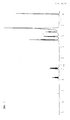
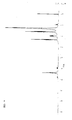
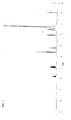
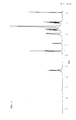
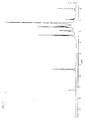
- Zur eindeutigen Charakterisierung der beschriebenen Verbindungen werden je ein Protonenresonanzspektrum und ein Gaschromatogramm folgender Stoffe abgebildet:
- 1. 10-Undecensäurebutylester Abb. 1 + 10
- 2. Gemisch isomerer Undecensäurebutylester Abb. 2 + 11
- 3. 10-Undecensäure Abb. 3 + 12
- 4. Gemisch isomerer Undecensäuren Abb. 4 + 13
- 5. 10-Undecenol Abb. 5 + 14
- 6. Gemisch isomerer Undecenole Abb. 6 + 15
- 7. Gemisch isomerer Undecylacetate Abb. 7 + 16
- 8. 1,20-Heneicosadien-11-on Abb. 8 + 17
- 9. Gemisch isomerer Heneicosadien-11-one Abb. 9 + 18
- (¹H-NMR in CDCl₃, Delta-Skala; GC auf 25 m Sil 05, 100 bis 300 °C)
Claims (9)
1. Verfahren zur Isomerisierung unverzweigter funktionalisierter Alkene mit terminaler Kohlenstoff-Kohlenstoff-Doppelbindung unter Erhalt des Kohlenstoffgerüstes, wobei die Kohnlenstoff-Kohlenstoff-Doppelbindung nicht in Konjugation zur funktionellen Gruppe steht,
dadurch gekennzeichnet,
daß man die funktionalisierten Verbindungen mit endständigen Doppelbindungen in Gegenwart von Rhodium(III)- oder Iridium(III)verbindungen in einer Konzentration von 0.01 bis 10.0 g/kg Reaktionslösung bei Temperaturen von 70 bis 160 °C isomerisiert.
dadurch gekennzeichnet,
daß man die funktionalisierten Verbindungen mit endständigen Doppelbindungen in Gegenwart von Rhodium(III)- oder Iridium(III)verbindungen in einer Konzentration von 0.01 bis 10.0 g/kg Reaktionslösung bei Temperaturen von 70 bis 160 °C isomerisiert.
2. Verfahren nach Anspruch 1,
dadurch gekennzeichnet,
daß man als funktionalisierte Verbindungen mit endständiger Doppelbindung Alpha-Omega-Alkenole, deren Ester, Alpha-Omega-Alkencarbonsäuren oder Alpha-Omega-Alkencarbonsäureester oder Di-(Omega-alkenyl)-Ketone mit unverzweigter Alken-Kohlenstoffkette einsetzt.
dadurch gekennzeichnet,
daß man als funktionalisierte Verbindungen mit endständiger Doppelbindung Alpha-Omega-Alkenole, deren Ester, Alpha-Omega-Alkencarbonsäuren oder Alpha-Omega-Alkencarbonsäureester oder Di-(Omega-alkenyl)-Ketone mit unverzweigter Alken-Kohlenstoffkette einsetzt.
3. Verfahren nach Anspruch 1 und 2,
dadurch gekennzeichnet,
daß man funktionalisierte Verbindungen mit terminaler Kohlenstoff-Kohlenstoff-Doppelbindung einsetzt, bei denen sich zwischen der terminalen Kohlenstoff-Kohlenstoff-Doppelbindung und dem eine funktionelle Gruppe tragenden Kohlenstoff 5 bis 15 Kohlenstoffatome, vorzugsweise 6 bis 10, insbesondere 7 bis 8 Kohlenstoffatome befinden.
dadurch gekennzeichnet,
daß man funktionalisierte Verbindungen mit terminaler Kohlenstoff-Kohlenstoff-Doppelbindung einsetzt, bei denen sich zwischen der terminalen Kohlenstoff-Kohlenstoff-Doppelbindung und dem eine funktionelle Gruppe tragenden Kohlenstoff 5 bis 15 Kohlenstoffatome, vorzugsweise 6 bis 10, insbesondere 7 bis 8 Kohlenstoffatome befinden.
4. Verfahren nach einem der Ansprü
dadurch gekennzeichnet,
daß man als Rhodium(III)verbindungen Rodium(III)halogenide wie Rhodium(III)chlorid, Rhodium(III)bromid und/oder Rhodium(III)jodid und/oder andere Rhodium(III)salze wie Rhodium(III)nitrat, Rhodium(III)sulfat oder deren Hydrate, insbesondere Rhodium(III)chlorid-hydrat einsetzt.
dadurch gekennzeichnet,
daß man als Rhodium(III)verbindungen Rodium(III)halogenide wie Rhodium(III)chlorid, Rhodium(III)bromid und/oder Rhodium(III)jodid und/oder andere Rhodium(III)salze wie Rhodium(III)nitrat, Rhodium(III)sulfat oder deren Hydrate, insbesondere Rhodium(III)chlorid-hydrat einsetzt.
5. Verfahren nach einem der Ansprüche 1 bis 4,
dadurch gekennzeichnet,
daß man die Isomerisierung bei Temperaturen von 100 bis 130 °C durchführt.
dadurch gekennzeichnet,
daß man die Isomerisierung bei Temperaturen von 100 bis 130 °C durchführt.
6. Verfahren nach einem der Ansprüche 1 bis 5,
dadurch gekennzeichnet,
daß man die Isomerisierung in homogener Phase, vorzugsweise in Gegenwart eines Lösemittels oder eines Lösemittelgemisches durchführt.
dadurch gekennzeichnet,
daß man die Isomerisierung in homogener Phase, vorzugsweise in Gegenwart eines Lösemittels oder eines Lösemittelgemisches durchführt.
7. Verfahren nach einem der Ansprüche 1 bis 6,
dadurch gekennzeichnet,
daß man als Lösemittel einen Alkohol, Ether, Ketone, Amide, Nitrile, Ester, Carbonsäuren, Wasser oder ein Gemisch von ihnen einsetzt.
dadurch gekennzeichnet,
daß man als Lösemittel einen Alkohol, Ether, Ketone, Amide, Nitrile, Ester, Carbonsäuren, Wasser oder ein Gemisch von ihnen einsetzt.
8. Verfahren nach einem der Ansprüche 1 bis 7,
dadurch gekennzeichnet,
daß man die Isomerisierung in Gegenwart von 0,1 bis 5 % einer starken Säure, vorzugsweise einer Mineralsäure, bezogen auf die Reaktionslösung, durchführt.
dadurch gekennzeichnet,
daß man die Isomerisierung in Gegenwart von 0,1 bis 5 % einer starken Säure, vorzugsweise einer Mineralsäure, bezogen auf die Reaktionslösung, durchführt.
9. Verfahren nach einem der Ansprüche 1 bis 8,
dadurch gekennzeichnet,
daß man die Isomerisierung unter einem Inertgas, vorzugsweise Stickstoff, oder Luft durchführt.
dadurch gekennzeichnet,
daß man die Isomerisierung unter einem Inertgas, vorzugsweise Stickstoff, oder Luft durchführt.
Applications Claiming Priority (2)
| Application Number | Priority Date | Filing Date | Title |
|---|---|---|---|
| DE19863629512 DE3629512A1 (de) | 1986-08-29 | 1986-08-29 | Verfahren zur isomerisierung unverzweigter funktionalisierter verbindungen mit endstaendigen doppelbindungen |
| DE3629512 | 1986-08-29 |
Publications (1)
| Publication Number | Publication Date |
|---|---|
| EP0262310A1 true EP0262310A1 (de) | 1988-04-06 |
Family
ID=6308528
Family Applications (1)
| Application Number | Title | Priority Date | Filing Date |
|---|---|---|---|
| EP87109437A Withdrawn EP0262310A1 (de) | 1986-08-29 | 1987-07-01 | Verfahren zur Isomerisierung unverzweigter funktionalisierter Verbindungen mit endständigen Doppelbindungen |
Country Status (3)
| Country | Link |
|---|---|
| EP (1) | EP0262310A1 (de) |
| JP (1) | JPS6368529A (de) |
| DE (1) | DE3629512A1 (de) |
Cited By (3)
| Publication number | Priority date | Publication date | Assignee | Title |
|---|---|---|---|---|
| EP0312735A3 (de) * | 1987-10-17 | 1990-06-27 | Hüls Aktiengesellschaft | Verfahren zur Herstellung von beta-Isophoron aus alpha-Isophoron |
| EP0374687A3 (de) * | 1988-12-12 | 1991-11-13 | E.I. Du Pont De Nemours And Company | Isomerisierung von Carbonsäuren |
| RU2123490C1 (ru) * | 1993-03-25 | 1998-12-20 | Рон-Пуленк Шими | Способ изомеризации карбоновых кислот |
Families Citing this family (1)
| Publication number | Priority date | Publication date | Assignee | Title |
|---|---|---|---|---|
| US20020002306A1 (en) * | 2000-02-15 | 2002-01-03 | Yasushi Kadowaki | Method for producing fumaric acid esters |
Citations (2)
| Publication number | Priority date | Publication date | Assignee | Title |
|---|---|---|---|---|
| FR1456900A (fr) * | 1964-09-23 | 1966-07-08 | Int Flavors & Fragrances Inc | Procédé d'isomérisation de terpènes par catalyse |
| DE2049937A1 (en) * | 1970-10-10 | 1972-04-13 | Rhodium or ruthenium complexes and metal halides - as isomerisation catalysts for conjugated diene prodn |
-
1986
- 1986-08-29 DE DE19863629512 patent/DE3629512A1/de not_active Withdrawn
-
1987
- 1987-07-01 EP EP87109437A patent/EP0262310A1/de not_active Withdrawn
- 1987-08-28 JP JP62213195A patent/JPS6368529A/ja active Pending
Patent Citations (2)
| Publication number | Priority date | Publication date | Assignee | Title |
|---|---|---|---|---|
| FR1456900A (fr) * | 1964-09-23 | 1966-07-08 | Int Flavors & Fragrances Inc | Procédé d'isomérisation de terpènes par catalyse |
| DE2049937A1 (en) * | 1970-10-10 | 1972-04-13 | Rhodium or ruthenium complexes and metal halides - as isomerisation catalysts for conjugated diene prodn |
Cited By (3)
| Publication number | Priority date | Publication date | Assignee | Title |
|---|---|---|---|---|
| EP0312735A3 (de) * | 1987-10-17 | 1990-06-27 | Hüls Aktiengesellschaft | Verfahren zur Herstellung von beta-Isophoron aus alpha-Isophoron |
| EP0374687A3 (de) * | 1988-12-12 | 1991-11-13 | E.I. Du Pont De Nemours And Company | Isomerisierung von Carbonsäuren |
| RU2123490C1 (ru) * | 1993-03-25 | 1998-12-20 | Рон-Пуленк Шими | Способ изомеризации карбоновых кислот |
Also Published As
| Publication number | Publication date |
|---|---|
| JPS6368529A (ja) | 1988-03-28 |
| DE3629512A1 (de) | 1988-03-03 |
Similar Documents
| Publication | Publication Date | Title |
|---|---|---|
| DE1695753C3 (de) | Verfahren zur Herstellung von 6,6disubstituierten 2,2-Dimethyl-4-oxopiperidinen | |
| EP0263259B1 (de) | Verfahren und Katalysatorsystem zur Trimerisierung von Acetylen und Acetylenverbindungen | |
| WO2003066558A2 (de) | Herstellung von alkenonen | |
| EP0146859B1 (de) | Verfahren zur Herstellung von 4-substituierten But-3-en-1-carbonsäuren und von deren Estern | |
| DE3007592C2 (de) | Verfahren zur Herstellung von substituierten Olefinen | |
| DE2630981C2 (de) | 4-&beta;,&beta;-Dichlor- und 4-&beta;,&beta;-Dibromvinyl-3,3-dimethylbutyrolactone, Verfahren zu ihrer Herstellung und deren Verwendung zur Herstellung von Estern der 3-&beta;,&beta;-Dichlor- oder 3-&beta;,&beta;-Dibrom-vinyl-2,2-dimethylcyclopropancarbonsäure | |
| DE3629512A1 (de) | Verfahren zur isomerisierung unverzweigter funktionalisierter verbindungen mit endstaendigen doppelbindungen | |
| EP0295549B1 (de) | Verfahren zur Herstellung von 5-Formylvaleriansäureestern | |
| EP0269046B1 (de) | Verfahren zur Isomerisierung von 2-Pentensäureestern zu 3-Pentensäureestern | |
| EP0295551A2 (de) | Verfahren zur Herstellung von Adipinsäure | |
| DE602005005354T2 (de) | Verfahren zur herstellung von 1,4-dialkyl-2,3-diol-1,4-butandion | |
| DE1927233B2 (de) | Verfahren zur Herstellung von aliphatischen oder araliphatischen Carbonsäuren und bzw. oder Lactonen oder Estern | |
| DE2703640C2 (de) | ||
| EP0010656A1 (de) | Verfahren zur Herstellung von 4-Acyloxy-2-methyl-crotonaldehyden | |
| EP1028103B1 (de) | Verfahren zur Herstellung von 2,3,5-Trimethylhydrochinondiestern | |
| DE69116499T2 (de) | Verfahren zur Herstellung von Alpha-Hydroxyketonen | |
| DE2513198C3 (de) | Verfahren zur Herstellung von Estern primärer Allylalkohol | |
| EP0124725A1 (de) | Verfahren zur Herstellung von Lactonen | |
| CH634811A5 (en) | Process for the oxidation of alkaryl compounds | |
| EP1525176B1 (de) | Verfahren zur herstellung von makrocyclischen ketonen durch dieckmann-kondensation in der gasphase | |
| EP0841332A1 (de) | Verfahren zur Herstellung von Alpha-Methylen-Beta-Methyl-Gamma-Butyrolacton und als Zwischenprodukt wertvolle 4-Hydroxy-Butyraldehyde sowie 2-Hydroxy-3-Methylen-4-Methyltetrahydrofuran | |
| DE3226684C2 (de) | Makrocyclische Carbonylverbindungen, Verfahren zu ihrer Herstellung und Verwendung als Ausgangsprodukte zur Herstellung ungesättigter bicyclischer Kohlenwasserstoffe | |
| DE69303392T2 (de) | Verfahren zur Herstellung von 2-Methyl-1-Naphthol | |
| EP2360136A1 (de) | Hestellung von alkenonen | |
| DE3237605C2 (de) |
Legal Events
| Date | Code | Title | Description |
|---|---|---|---|
| PUAI | Public reference made under article 153(3) epc to a published international application that has entered the european phase |
Free format text: ORIGINAL CODE: 0009012 |
|
| AK | Designated contracting states |
Kind code of ref document: A1 Designated state(s): BE CH DE FR GB IT LI NL |
|
| 17P | Request for examination filed |
Effective date: 19880704 |
|
| 17Q | First examination report despatched |
Effective date: 19890420 |
|
| STAA | Information on the status of an ep patent application or granted ep patent |
Free format text: STATUS: THE APPLICATION HAS BEEN WITHDRAWN |
|
| 18W | Application withdrawn |
Withdrawal date: 19890707 |
|
| RIN1 | Information on inventor provided before grant (corrected) |
Inventor name: KAUFHOLD, MANFRED, DR. Inventor name: BICKERT, PETER, DR. |