EP0262462A2 - Méthode pour l'interprétation de documents d'après des formulaires - Google Patents
Méthode pour l'interprétation de documents d'après des formulaires Download PDFInfo
- Publication number
- EP0262462A2 EP0262462A2 EP87112983A EP87112983A EP0262462A2 EP 0262462 A2 EP0262462 A2 EP 0262462A2 EP 87112983 A EP87112983 A EP 87112983A EP 87112983 A EP87112983 A EP 87112983A EP 0262462 A2 EP0262462 A2 EP 0262462A2
- Authority
- EP
- European Patent Office
- Prior art keywords
- level
- model
- analysis
- document
- models
- Prior art date
- Legal status (The legal status is an assumption and is not a legal conclusion. Google has not performed a legal analysis and makes no representation as to the accuracy of the status listed.)
- Withdrawn
Links
Images


Classifications
-
- G—PHYSICS
- G06—COMPUTING OR CALCULATING; COUNTING
- G06F—ELECTRIC DIGITAL DATA PROCESSING
- G06F16/00—Information retrieval; Database structures therefor; File system structures therefor
- G06F16/30—Information retrieval; Database structures therefor; File system structures therefor of unstructured textual data
- G06F16/36—Creation of semantic tools, e.g. ontology or thesauri
-
- G—PHYSICS
- G06—COMPUTING OR CALCULATING; COUNTING
- G06F—ELECTRIC DIGITAL DATA PROCESSING
- G06F40/00—Handling natural language data
- G06F40/10—Text processing
- G06F40/166—Editing, e.g. inserting or deleting
- G06F40/174—Form filling; Merging
-
- G—PHYSICS
- G06—COMPUTING OR CALCULATING; COUNTING
- G06V—IMAGE OR VIDEO RECOGNITION OR UNDERSTANDING
- G06V10/00—Arrangements for image or video recognition or understanding
- G06V10/40—Extraction of image or video features
- G06V10/42—Global feature extraction by analysis of the whole pattern, e.g. using frequency domain transformations or autocorrelation
- G06V10/422—Global feature extraction by analysis of the whole pattern, e.g. using frequency domain transformations or autocorrelation for representing the structure of the pattern or shape of an object therefor
- G06V10/426—Graphical representations
-
- G—PHYSICS
- G06—COMPUTING OR CALCULATING; COUNTING
- G06V—IMAGE OR VIDEO RECOGNITION OR UNDERSTANDING
- G06V30/00—Character recognition; Recognising digital ink; Document-oriented image-based pattern recognition
- G06V30/40—Document-oriented image-based pattern recognition
- G06V30/41—Analysis of document content
- G06V30/412—Layout analysis of documents structured with printed lines or input boxes, e.g. business forms or tables
-
- G—PHYSICS
- G06—COMPUTING OR CALCULATING; COUNTING
- G06V—IMAGE OR VIDEO RECOGNITION OR UNDERSTANDING
- G06V30/00—Character recognition; Recognising digital ink; Document-oriented image-based pattern recognition
- G06V30/40—Document-oriented image-based pattern recognition
- G06V30/41—Analysis of document content
- G06V30/414—Extracting the geometrical structure, e.g. layout tree; Block segmentation, e.g. bounding boxes for graphics or text
Definitions
- the present invention relates to a method for interpreting form-based documents, in which case a preferably computer-controlled interpretation device is provided for carrying out the method, which contains a database with data-stored document models and at least one working memory, into which a document to be interpreted after recording in a manner known per se, Processing and grammar analysis in the form of a document graph is imported.
- the present invention has for its object to provide a method of the type mentioned.
- a model of each type of form which is known to the system is present in an interpretation device E in the form of a graph.
- the graph nodes give individual lines, areas, fixed and as User entry expected text elements, line connectors, special symbols, etc. again.
- the edges between the nodes indicate the local neighborhood between the elements. Attributes give form parameters, proportions etc. again.
- the graph is organized hierarchically.
- a control controls the analysis process. It is specified in the form of a control graph.
- the control is structured hierarchically.
- the top level (superordinate control part) regulates the competition of the models in the analysis
- the second level (form-specific control parts) regulates the activity of each individual model.
- the structure of these control parts is closely linked to the model graph.
- Each form-specific control part forms a petri net-like structure in accordance with the structure of the form. Deeper levels of control regulate details.
- the decision about the document type is made on the basis of a quality measure.
- Semantic information is assigned to the partial areas of the models. When the model is mapped onto the captured image pattern, this information is transferred to its partial pattern. Processing is preferably carried out in a parallel computer system. For this purpose, a computer is provided for the individual steps of primitive extraction, for each model for individual partial patterns, etc. The computers are assigned to their task dynamically.
- the method according to the invention provides that recognition of the type of form read in in the form of the document graph (D) and recognition of the meaning of user entries in the form F is achieved by referring to the symbolic description of the document in the form of the document.
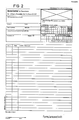
- Graphs D successively different models M of different forms F stored in a knowledge base are depicted, see FIG. 1.
- the models M are displayed one after the other on the document graph D in a competition of the models M. That form type is recognized as considered, whose model M has the highest quality grade in the illustration.
- the models M of the individual form types are read in before the actual operating phase of the method in a training phase of the interpretation device E with the help of an operator in a manner known per se.
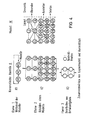
- the competition of the models M is regulated according to the invention by a control flow plan K, see FIG. 4.
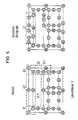
- each model M consists of a layout part L and a semantic part S, see FIG. 3, that when the models M are depicted on the document graph D parts of the model layout part L are assigned to the corresponding parts of the extracted document graph by means of pointers that in this illustration the semantics of individual areas of the model M are transferred to corresponding areas of the document graph D and that the semantics also apply to those of the relevant user of the form F parts of the text entered are transferred within this area.
- Each of the models M is represented in the form of a graph with nodes and edges, this form of representation being implemented in the interpretation device E in the form of a data structure in a manner known per se.
- the layout part L reproduces all fixed parts of the relevant background pattern of a form F in the form of nodes, the node lines LN, connection points V, intermediate lines LN, areas FL, fixed text parts TX and possibly special symbols.
- the edges or pointers show neighborhoods between elements such as lines Ln, connecting points V, intermediate lines LN, areas FL, fixed text parts TX and special symbols.
- the semantic part S consists of graph nodes in which attributes are entered, which attributes reflect the meaning of a form area.
- Each semantic node is connected via a logic layout edge to a layout node, the one Form area represents.
- the nodes that represent areas contain information about expected, variable user entries.
- the node and edge attributes each provide information about line length, line thickness, surface shape and much more.
- the layout part L is structured hierarchically, an upper part L1 representing higher-level terms such as lines and areas, and the lower part L2 the associated ideal primitives (edge or area primitives), see FIG. 3. Between the upper ones Part L1 and the lower part L2 are clearly linked by a branching system of the two levels in which the two parts lie.
- the information of the semantic part S is entered in the layout node as a string.
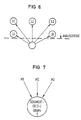
- Each node of the layout model contains references to comparison elements, with the aid of which the true position of the element in document D is calculated during an analysis to be carried out, see FIG. 6.
- the control flow plan K is predefined and hierarchically structured. It controls the analysis process.
- the hierarchical structure of the control flow plan K is divided into three levels, cf. FIG. 4, a first level K1 controlling the competition of the models M in the mapping onto the document graph D and this first level K1 being all models M1, M2, M3 ... is assigned together, with a second level K2 splitting into several partial control flow plans and each of which is specific to a particular model, e.g. B. M1, is adjusted and a target control of the analysis processes for recognizing individual form elements, such as lines, areas, etc. regulates, and wherein a third level K3 handles detailed orders for the second level K2.
- Each model M is represented by control nodes in the first level K1, which control nodes are cycled through.
- the control nodes initiate a step in the second level K2 with each analysis run.
- a quality report is delivered to the first level K1 for each analysis step.
- the total current quality of each model M is assessed and compared with the current overall quality of the other models M. Poorly assessed models M are overrun during the subsequent run of the analysis, which advantageously enables time-saving imaging of the remaining models M on the document graph.
- the form-specific control part in the second level K2 controls the analysis in such a way that the elements to be recorded are controlled continuously from top to bottom.
- the form-specific control part on the second level K2 is closely linked to the layout of the recognizing form type.
- Elements lying next to one another are arranged in parallel branches of the control flow plan, whereby a control flow plan is based on the model of a Petri network and such elements lying next to one another form an analysis front in their entirety, see FIG. 6.
- This Petri network is preferably processed using a multi-computer system, the adjacent elements of the analysis front are each processed in different computer units.
- a step-by-step course of the analysis is defined for each form F in the second level K2.
- the control flow chart K controls the analysis in such a way that the analysis front runs from top to bottom in relation to the document graph D.
- Each control node has tasks for getting the element type to be searched from the layout model, for defining comparison elements behind the analysis front, i.e. for elements that have already been recognized and assigned to model M, see FIG. 6, for calculating analysis parameters (location , Length, rotational position ...) from the already known comparison elements, see FIG. 6, for triggering the analysis method for recognizing the element sought in the document graph D, for assigning the recognized element to the corresponding element of the model M and for assessing the recognition quality of the element concerned and reporting back the recorded quality to the first level K1.
- An overall quality assessment is carried out using the first level K1.
- a search order (for example "Search line!) Is broken down into individual orders which specifically process individual descriptors, surface elements, fine-border elements, squares, etc.
- An element in a first level of the layout L dissolves into individual primitives in the hierarchically lower level, see FIG. 3.
- ideal model elements of the lower level of the layout L namely L2
- mapped to the corresponding elements of the document graph D The respective mapping is done by pointers within the relevant model nodes or the document graph.
- a sequence of primitive elements in the document graph D is assigned to an element of the model level 1, namely the layout level L1 (for example an area FL5).
- the form-specific control flow plan is automatically derived from the layout part of the model for its analysis.
- This form-specific control flow plan extends the second level K2 of the overall control flow plan. It is also represented by a node in the first level K1.
- the automatic derivation of the control flow plan takes place by horizontal elements of the model lying side by side being mapped in control nodes of adjacent branches of the form-specific control flow plan and in this way forming a line of an analysis front. Vertical Adjacent elements of the model are shown in chronological successive analysis fronts of the control flow plan.
Landscapes
- Engineering & Computer Science (AREA)
- Theoretical Computer Science (AREA)
- Physics & Mathematics (AREA)
- Computer Vision & Pattern Recognition (AREA)
- General Physics & Mathematics (AREA)
- Multimedia (AREA)
- Artificial Intelligence (AREA)
- General Engineering & Computer Science (AREA)
- Computational Linguistics (AREA)
- Data Mining & Analysis (AREA)
- Databases & Information Systems (AREA)
- Computer Graphics (AREA)
- Geometry (AREA)
- Health & Medical Sciences (AREA)
- Audiology, Speech & Language Pathology (AREA)
- General Health & Medical Sciences (AREA)
- Machine Translation (AREA)
- Document Processing Apparatus (AREA)
Applications Claiming Priority (2)
| Application Number | Priority Date | Filing Date | Title |
|---|---|---|---|
| DE3633294 | 1986-09-30 | ||
| DE3633294 | 1986-09-30 |
Publications (2)
| Publication Number | Publication Date |
|---|---|
| EP0262462A2 true EP0262462A2 (fr) | 1988-04-06 |
| EP0262462A3 EP0262462A3 (fr) | 1991-02-27 |
Family
ID=6310739
Family Applications (1)
| Application Number | Title | Priority Date | Filing Date |
|---|---|---|---|
| EP19870112983 Withdrawn EP0262462A3 (fr) | 1986-09-30 | 1987-09-04 | Méthode pour l'interprétation de documents d'après des formulaires |
Country Status (2)
| Country | Link |
|---|---|
| EP (1) | EP0262462A3 (fr) |
| JP (1) | JPS6395576A (fr) |
Cited By (5)
| Publication number | Priority date | Publication date | Assignee | Title |
|---|---|---|---|---|
| WO1989011703A1 (fr) * | 1988-05-20 | 1989-11-30 | Eastman Kodak Company | Reconnaissance de documents et indexage automatique pour la reconnaissance optique de caracteres |
| EP0411231A3 (en) * | 1989-08-04 | 1991-07-31 | International Business Machines Corporation | Method for compressing and decompressing forms by means of very large symbol matching |
| DE4216893A1 (de) * | 1991-05-21 | 1992-11-26 | Hitachi Ltd | Verfahren zur eingabe von zeichendaten |
| DE4307577A1 (en) * | 1992-03-10 | 1993-09-23 | Hitachi Ltd | Document information processing system for FAX transmissions - has information stored and used with databank of stored information to provide correct code data for generating transmission |
| US5666549A (en) * | 1992-03-10 | 1997-09-09 | Hitachi, Ltd. | Method and system for processing a document transmitted via facsimile in an initially input form stored in a knowledge base |
Family Cites Families (1)
| Publication number | Priority date | Publication date | Assignee | Title |
|---|---|---|---|---|
| JP2559356B2 (ja) * | 1984-08-24 | 1996-12-04 | 株式会社日立製作所 | 文書画像処理方法 |
-
1987
- 1987-09-04 EP EP19870112983 patent/EP0262462A3/fr not_active Withdrawn
- 1987-09-29 JP JP62247736A patent/JPS6395576A/ja active Pending
Cited By (8)
| Publication number | Priority date | Publication date | Assignee | Title |
|---|---|---|---|---|
| WO1989011703A1 (fr) * | 1988-05-20 | 1989-11-30 | Eastman Kodak Company | Reconnaissance de documents et indexage automatique pour la reconnaissance optique de caracteres |
| US4949392A (en) * | 1988-05-20 | 1990-08-14 | Eastman Kodak Company | Document recognition and automatic indexing for optical character recognition |
| EP0411231A3 (en) * | 1989-08-04 | 1991-07-31 | International Business Machines Corporation | Method for compressing and decompressing forms by means of very large symbol matching |
| US5182656A (en) * | 1989-08-04 | 1993-01-26 | International Business Machines Corporation | Method for compressing and decompressing forms by means of very large symbol matching |
| DE4216893A1 (de) * | 1991-05-21 | 1992-11-26 | Hitachi Ltd | Verfahren zur eingabe von zeichendaten |
| DE4307577A1 (en) * | 1992-03-10 | 1993-09-23 | Hitachi Ltd | Document information processing system for FAX transmissions - has information stored and used with databank of stored information to provide correct code data for generating transmission |
| US5666549A (en) * | 1992-03-10 | 1997-09-09 | Hitachi, Ltd. | Method and system for processing a document transmitted via facsimile in an initially input form stored in a knowledge base |
| DE4307577C2 (de) * | 1992-03-10 | 2000-12-28 | Hitachi Ltd | Verfahren und Vorrichtung zur Dokumentenverarbeitung |
Also Published As
| Publication number | Publication date |
|---|---|
| EP0262462A3 (fr) | 1991-02-27 |
| JPS6395576A (ja) | 1988-04-26 |
Similar Documents
| Publication | Publication Date | Title |
|---|---|---|
| DE69325204T2 (de) | Verfahren und Vorrichtung zum Weiterentwickeln einer Anfangssammlung von Handschriftprototypen zu einer anwender-spezifischen Sammlung | |
| DE2946360C2 (fr) | ||
| DE3416939C2 (fr) | ||
| DE3911465C2 (de) | Verfahren zur automatischen Konfiguration technischer Systeme aus Komponenten | |
| DE69131687T2 (de) | Verfahren zur Ressourcenverteilung und -planung, und System dafür | |
| DE69523567T2 (de) | Verfahren zur handschrift-eingangsaufteilung | |
| EP1183619A2 (fr) | Reseau semantique d'ordre n, operant en fonction d'une situation | |
| EP1238364A2 (fr) | Procede de traitement de structures de donnees | |
| DE3401060A1 (de) | Verfahren zum grafischen darstellen eines gebildes | |
| DE19507780A1 (de) | Vorrichtung zur verteilten Bildverarbeitung | |
| DE3839675C2 (de) | Optimierer für ein parameterabhängiges Steuerungssystem | |
| EP0262462A2 (fr) | Méthode pour l'interprétation de documents d'après des formulaires | |
| DE69118736T2 (de) | Operationskontrollapparat | |
| DE60217729T2 (de) | Verfahren zum erkennen eines elektronischen geräts in einem mehrfachsteuersystem | |
| WO1997040442A1 (fr) | Procede et dispositif de commande pour une commande graphique d'operations dans un systeme de gestion d'un reseau | |
| DE4027348A1 (de) | Baumodell einer menschlichen schnittstelle | |
| DE60208415T2 (de) | Verfahren zur optimierung von testdaten | |
| DE19703964C1 (de) | Verfahren zur Transformation einer zur Nachbildung eines technischen Prozesses dienenden Fuzzy-Logik in ein neuronales Netz | |
| DE10213582A1 (de) | Datenberechnungsvorrichtung und Verfahren zur Anwendung der Datenberechnungsvorrichtung zur Einstellung einer elektronischen Steuereinrichtung | |
| DE3853137T2 (de) | Abfragevorrichtung. | |
| EP1297458A2 (fr) | Procede pour etablir automatiquement un plan de travail | |
| DE102009050681A1 (de) | Verfahren und Vorrichtung zum Erkennen und Klassifizieren von Dokumentteilen eines rechnerverfügbaren Dokuments durch schrittweises Lernen aus mehreren Trainingsmengen | |
| DE602005002846T2 (de) | Verfahren zur Datenverarbeitung und assoziiertes Softwareprogramm | |
| EP0220467B1 (fr) | Procédé de description symbolique uniforme d'épreuves de documents en forme de structures de données dans un automate | |
| DE4119717A1 (de) | Dokumentlayoutverarbeitungsverfahren und vorrichtung zu dessen durchfuehrung |
Legal Events
| Date | Code | Title | Description |
|---|---|---|---|
| PUAI | Public reference made under article 153(3) epc to a published international application that has entered the european phase |
Free format text: ORIGINAL CODE: 0009012 |
|
| AK | Designated contracting states |
Kind code of ref document: A2 Designated state(s): DE FR GB IT NL |
|
| PUAL | Search report despatched |
Free format text: ORIGINAL CODE: 0009013 |
|
| AK | Designated contracting states |
Kind code of ref document: A3 Designated state(s): DE FR GB IT NL |
|
| 17P | Request for examination filed |
Effective date: 19910325 |
|
| 17Q | First examination report despatched |
Effective date: 19920713 |
|
| STAA | Information on the status of an ep patent application or granted ep patent |
Free format text: STATUS: THE APPLICATION IS DEEMED TO BE WITHDRAWN |
|
| 18D | Application deemed to be withdrawn |
Effective date: 19930126 |
|
| RIN1 | Information on inventor provided before grant (corrected) |
Inventor name: SCHERL, WOLFGANG, DR. |