EP0262498A2 - Diamin-platin (II)-Komplexverbindungen mit einem hydroxylierten 2-Phenyl-Indolring - Google Patents
Diamin-platin (II)-Komplexverbindungen mit einem hydroxylierten 2-Phenyl-Indolring Download PDFInfo
- Publication number
- EP0262498A2 EP0262498A2 EP87113384A EP87113384A EP0262498A2 EP 0262498 A2 EP0262498 A2 EP 0262498A2 EP 87113384 A EP87113384 A EP 87113384A EP 87113384 A EP87113384 A EP 87113384A EP 0262498 A2 EP0262498 A2 EP 0262498A2
- Authority
- EP
- European Patent Office
- Prior art keywords
- formula
- group
- hydrogen
- compounds
- acid
- Prior art date
- Legal status (The legal status is an assumption and is not a legal conclusion. Google has not performed a legal analysis and makes no representation as to the accuracy of the status listed.)
- Granted
Links
Classifications
-
- C—CHEMISTRY; METALLURGY
- C07—ORGANIC CHEMISTRY
- C07F—ACYCLIC, CARBOCYCLIC OR HETEROCYCLIC COMPOUNDS CONTAINING ELEMENTS OTHER THAN CARBON, HYDROGEN, HALOGEN, OXYGEN, NITROGEN, SULFUR, SELENIUM OR TELLURIUM
- C07F15/00—Compounds containing elements of Groups 8, 9, 10 or 18 of the Periodic Table
- C07F15/0006—Compounds containing elements of Groups 8, 9, 10 or 18 of the Periodic Table compounds of the platinum group
- C07F15/0086—Platinum compounds
- C07F15/0093—Platinum compounds without a metal-carbon linkage
-
- A—HUMAN NECESSITIES
- A61—MEDICAL OR VETERINARY SCIENCE; HYGIENE
- A61P—SPECIFIC THERAPEUTIC ACTIVITY OF CHEMICAL COMPOUNDS OR MEDICINAL PREPARATIONS
- A61P35/00—Antineoplastic agents
Definitions
- British Patent 2,111,478 relates to tumor inhibiting indole derivatives of the following formula wherein R 1 is hydrogen, a hydroxy group or a C 2 -C 6 alkanoyloxy group, R 2 is hydrogen, a hydroxyl group, a CrCs alkanoyloxy group or a halogen atom, R 3 is a C 1 -C 6 alkyl group, R 4 is hydrogen or a C 1 -C 6 alkyl group, R 5 is a hydroxy group or a C 2 -C 6 alkanoyloxy group, Re is hydrogen or a halogen atom and R 7 is hydrogen or a halogen atom.
- tumor-inhibiting ethylenediamine-platinum (II) complexes are known, in which a CH2 group of ethylenediamine is substituted by a benzyl radical, phenylethyl radical, thienylmethyl radical, indolylmethyl radical or imidazolylmethyl radical (DE-OS 36 05 191), or in which both CH 2 groups of Ethylene diamine contain a phenyl radical or a substituted phenyl radical (DE-OS 34 05 611; DE-OS 36 04 866).
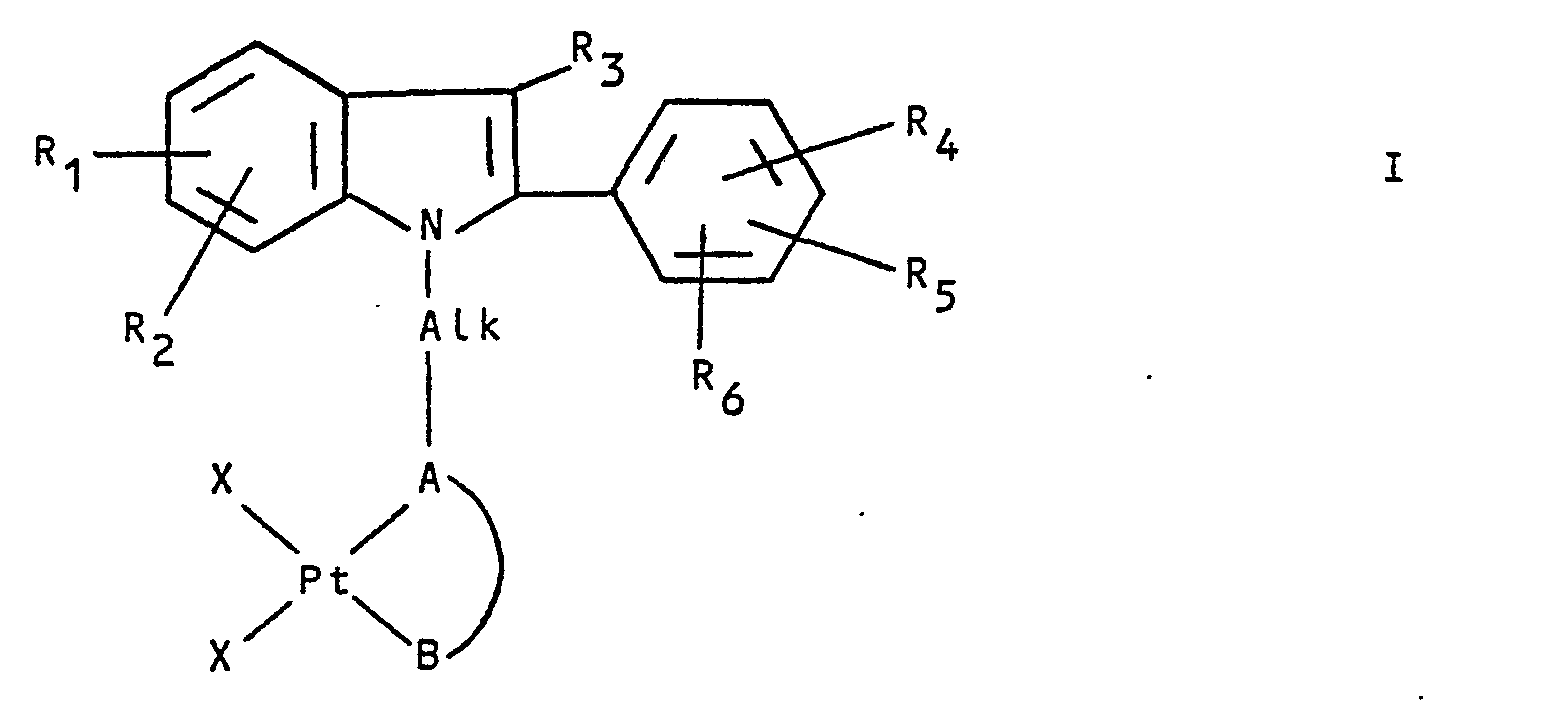
- the invention relates to new diamine-platinum (II) complex compounds with a hydroxylated 2-phenyl-indole ring, which can be used as active pharmaceutical ingredients.
- the new compounds according to the invention have a pronounced antitumor activity with good tolerability.
- the effect is particularly evident in the following animal and cell culture models: Transplanted hormone-dependent MXT breast cancer of the BDF-1 mouse. Estrogen-dependent dimethylbenzanthracene-induced breast carcinoma of the SD rat. Human hormone-dependent MCF-7 breast cancer cells.
- the surprising inventive advance of the compounds according to the invention is that they represent platinum complexes which have a very high affinity for the estrogen receptor and which have a selective effect on tumors containing estrogen receptors, such as breast carcinoma.
- an estrogen receptor-affine molecule with a cytostatic diamine platinum grouping in such a way that the affinity for the receptor and the cytostatic effect are retained.
- the platinum complexes according to the invention have, for example, a high binding affinity for the estrogen receptor from calf uteri.
- the relative binding affinities are on the order of 1-15% of the affinity of estradiol.
- the complexes on the uterus of the mouse show no estrogenic effect.
- it was even possible to demonstrate a clear anti-estrogenic effect (compounds according to Examples 2 and 5).
- a strong tumor-inhibiting effect was found on the transplanted hormone-dependent MXT breast carcinoma of the mouse.
- the inhibitory effect of the compound according to Example 1 at a dose of 20 mg / kg is 89% after 6 weeks of treatment.
- the inhibitory effect of the compound according to Example 2 under the same conditions is 77%.
- the C 1 -C 6 alkyl groups, C 2 -C 6 alkanoyloxy groups occurring in the individual radicals R 1 to R 7 and the alkylene bridge Alk can be straight or branched.
- the alkyl groups preferably consist of 1, 2, 3 or 4 carbon atoms, the alkanoyloxy groups preferably of 2-4 carbon atoms (in particular, this is the acetoxy group).
- the radical R 3 is preferably methyl
- the radical R 7 is preferably hydrogen, methyl, ethyl or phenyl.
- the radical R 1 is preferably in the 5 or 6 position of the indole ring.
- the radical R 4 is preferably in the 4 position of the phenyl ring, the radicals R 5 and R 6 are preferably in the 2 and / or 6 position.
- the alkylene bridge Alk consists for example of 4 to 8 CHr groups, preferably 5, 6 or 7 CH 2 groups. If 4 adjacent CH 2 groups of Alk by a 1,4-phenylene ring are replaced, it can be 4 adjacent CH 2 groups that are not bound to an N atom, or the phenylene ring. can also be linked directly to an N atom or to both N atoms, in the latter case the bridge Alk being the 1,4-phenylene ring.
- the rest R 2 is, for example, in the 4-position of the indole ring.
- Halogen substituents are in particular chlorine, bromine and / or fluorine.
- the radicals X represent the known and customary physiologically compatible and pharmaceutically usable anions of mono- or polyvalent acids.
- the anions of the following acids are suitable: HBr, HCl, HJ, HF, HNO 3 , H 2 SO 4 (SO 4 - ); H 3 PO 4 (HPO 4 -); H 2 C0 3 (CO 3 -); Kampersulfonic acid, aliphatic or aromatic sulfonic acids, for example C 1 -C 6 alkyl sulfonic acids (for example methanesulfonic acid, ethane, propane or hexanesulfonic acid), benzene or naphthalenesulfonic acid, which are optionally mono- or disubstituted by methyl groups (toluenesulfonic acid, especially o- or p-toluenesulfonic acid); aliphatic C 1 -C 4 monocarboxylic acids which are optionally mono-, di- or tri
- Glycerol phosphoric acids (the phosphoric acid residue being bound to one of the terminal or to the middle glycerol oxygen atom) such as aD, L-glycerol-phosphoric acid, ß-glycerol phosphoric acid; N-phosphono-acetyl aspartic acid.
- acids which form the anions X are amino acids or amino acid derivatives whose basic amino group is neutralized by an acid group.
- amino acids with the following structure: wherein R 'is hydrogen, a phenyl radical, an indolyl- (3) -methyl radical, imidazolyl- (4) -methyl radical, a Ci-Cio-alkyl group or a Ci-Cio-alkyl group which is substituted by a hydroxyl group, a carboxy group, a C 1 -C 6 alkoxy group, a mercapto group, a C 1 -C 6 alkylthio group, a phenyl group, a hydroxyphenyl group, a CrCe alkanoylamino group or a C 1 -C 6 alkoxycarbonyl group.
- the basic amino group in the 2-position is neutralized (acylated) by a customary amino acid protective group, for example by a C 2 -C 6 -alkanol radical or the butyloxycarbonyl radical.
- R ' is an alkyl group in the above formula, it is preferably a C 1 -C 6 alkyl group.
- which, for example, in the 2-, 3-, 4-, 5- or 6-position (counting begins at the point of attachment of the alkyl radical to the residual molecule) is a C 2 -C 6 -alkanoyiamino group, an imidazolyl- (4) -methyl radical or one Contains indolyl- (3) -methyl radical.
- amino acids are: leucine (preferably D and L form), valine (preferably D and L form), phenylalanine (preferably D and L form), phenylglycine (preferably D and L form), Alanine (preferably D and L forms), isoleucine (preferably D and L forms), asparagine (preferably D and L forms), lysine (preferably D and L forms), tryptophan (preferably D and L form), tyrosine (preferably D and L form), ornithine (preferably D and L form).
- the basic amino groups are blocked by a customary acylamino protective group, in particular by the acetyl group or the butyloxycarbonyl group.
- Formula I also includes the possible enantiomers and diastereomers. If the compounds are racemates, they can be split into the optically active isomers in a manner known per se, for example by means of an optically active acid. However, it is also possible to use enantiomeric or, if appropriate, also diastereomeric starting materials from the outset, in which case a corresponding purely optically active or diastereomeric compound is then obtained as the end product. Additional forms can arise from different enantiomeric or diastereomeric forms of the radicals X.
- the compounds of formula I can optionally contain water and can then also be present as diaquo complexes, where 2 molecules of water are complexly bound to the platinum; the anion X or the anions X neutralize the double positive charge of the Pt ++ cation in these cases as well.
- the compounds of the formula I according to the invention are always the cis compounds.
- the starting amine 11 is used, for example, as a racemate, as a pure right- or left-handed form or in another diastereomeric form.
- the process for the preparation of the compounds I according to the invention is carried out in a solvent or suspending agent at temperatures between 10 and 80 ° C., preferably 20 to 50 ° C., in particular 35 to 45 ° C.
- Suitable solvents are: water, C 1 -C 6 -alkanols (methanol, ethanol, tert.- Butanol), tetrahydrofuran, dioxane, lower.
- Dialkyl sulfoxides for example dimethyl sulfoxide
- C 1 -C 4 mono- or dialkyl amides of C i -C 4 alkanecarboxylic acids for example dimethylformamide
- ethylene glycol dimethyl ether diethylene glycol dimethyl ether
- diethylene glycol dimethyl ether diethylene glycol dimethyl ether
- mixtures of these solvents in particular mixtures with water.
- the two reaction components are preferably used in equimolar amounts.
- the pH of the reaction solution should be between 5.5 and 8, preferably at pH 7.
- the pH is adjusted in particular by adding alkali, preferably aqueous sodium hydroxide solution or potassium hydroxide solution or, for example, also using sodium carbonate or by adding acids, preferably aqueous hydrochloric acid.
- tetrahalo-platinum (II) compounds are suitable as tetrahalo-platinum (II) compounds (acid and complex salts). If platinum (II) halides are used as the starting component, the same halogen atoms can be used.
- Possible monovalent cations are: alkali ions, especially sodium and potassium; however, lithium, rubidium, cesium can also be used, as can NH 4 + , NR 4 + , PR 4 + or AsR 4 + , in which R is a C 1 -C 6 -alkyl radical or a phenyl radical.
- Divalent cations can be: alkaline earth ions, in particular Mg 2+ and Ca 2+ , but also Zn 2+ .
- suitable platinum (II) halides are PtC1 2 , PtBr 2 and PtJ2.
- Compound II is used either in the form of the diamine or in the form of an acid addition salt: for example as a monohydrochloride or dihydrochloride, mono- or dihydrobromide, mono- or dihydroiodide or as a salt with another customary acid, such as sulfuric acid, nitric acid, perchloric acid.
- the acids whose anions form the radicals X are also suitable.
- the diamine can be used in the form of the acetate or diacetate, potassium chloride (for example 2 moles per 1 mole of compound II) being added, if appropriate, before the reaction components are mixed.
- Diamine II can also be used in the form of the carbonate.
- the ligands X can be replaced by other ligands, for example by means of silver halide precipitation.
- halogen chlorine, bromine or iodine
- silver nitrate for example aqueous silver nitrate solution
- silver salt an ionic diaquo complex of the formula I is obtained, where each X represents a water molecule which is then charged twice positively and is neutralized by 2 NO 3 anions.
- the weakly bound ligand water can easily be obtained from this complex by more affine anions (for example CI-, Br-) in the form of NaCl, KCI, NaBr, KBr, malonate 2 -, chloroacetate (-) , oxalate 2- , 1.1 -Cyclobutanedicarboxylic acid anion 2 - and the other specified acid residues X, used in the form of the acids or their salts, especially their alkali salts.
- affine anions for example CI-, Br-
- the same compounds can also be obtained by reacting equimolar amounts of HX and nitrate-free platinum complex (the latter using anion exchangers in the hydroxide form, for example Dowex 1-8X).
- the leaving group for example SO 4 2- or oxalate anion 2 -
- alkaline earth metal salts which contain the desired X ligand (for example glyceric acid) , possible, provided the resulting complex is water-soluble and thus allows the difficultly water-soluble alkaline earth metal sulfate or oxalate to be separated off.
- X ligands suitable for this process are preferably the anions of hydroxycarboxylic acids, sulfonic acids, haloacetic acids, nitric acid.
- the solvents or suspending agents which have been specified for the preparation process of the compounds I are also suitable for the exchange reaction (water and dimethylformamide and also methanol, ethanol, tert-butanol) are particularly suitable.
- the exchange reaction is carried out, for example, in a pH range between 3 and 7.
- unknown starting substances of the formula II can be prepared as indicated in the individual examples, or analogously thereto.
- This reaction is, for example, in a conventional manner in an inert solvent 70-1 50 ° C.
- the mixture is then reduced in a conventional manner, the double bond of the thus obtained Schiff's base and any existing ether groups are cleaved.
- Hydroxy groups present in starting materials of the formula II or their precursors can be acylated by C 2 -C 6 -alkanoyl groups.
- This acylation can be carried out, for example, using C 2 -C 6 -alkanoyl halides or the anhydrides of the saturated aliphatic C 2 -C 6 -monocarboxylic acids at temperatures between 10 and 80 ° C., in particular 20 to 30 ° C., in the presence of customary acid-binding substances.
- Particularly suitable acid-binding substances are aliphatic tertiary amines, such as, for example, diisopropylethylamine.
- Suitable inert solvents or suspending agents for the acylation are: lower aliphatic halogenated hydrocarbons (chloroform), aprotic solvents such as amides, C 1 -C 4 alkylamides and C 1 -C 4 dialkylamides of aliphatic C 1 -C 4 carboxylic acids (dimethylformamide , Dimethylacetamide), N-methyl-pyrrolidone, dimethyl sulfoxide or mixtures of these agents.
- chloroform lower aliphatic halogenated hydrocarbons
- aprotic solvents such as amides, C 1 -C 4 alkylamides and C 1 -C 4 dialkylamides of aliphatic C 1 -C 4 carboxylic acids (dimethylformamide , Dimethylacetamide), N-methyl-pyrrolidone, dimethyl sulfoxide or mixtures of these agents.
- This acylation can also be carried out, for example, in a two-phase system, for example water / chloroform, the acylated platinum (II) complex obtained with the aid of an anion exchanger separating insoluble and the mixture of acid chloride and tertiary amine (diisopropylethylamine) being in the chloroform phase .
- Suitable acid halides are preferably the corresponding chlorides, bromides and optionally iodides.
- Possible anhydrides are: benzoic anhydride and the anhydrides of C 1 -C 6 carboxylic acids, for example symmetrical acid anhydrides such as acetic anhydride, propionic anhydride, butyric anhydride.
- the compounds according to the invention are suitable for the production of pharmaceutical compositions.
- the pharmaceutical compositions or medicaments can contain one or more of the compounds according to the invention or else mixtures thereof with other pharmaceutically active substances.
- the usual pharmaceutical carriers and auxiliaries can be used to produce the pharmaceutical preparations.
- the drugs can be used, for example, enterally, parenterally (for example intravenously, intramuscularly, subcutaneously) or orally.
- administration can take the form of tablets, capsules, pills, coated tablets or suppositories.
- Examples of possible liquids are: oily or aqueous solutions or suspensions (for example in sesame or olive oil), emulsions, injectable aqueous and oily solutions or suspensions.
- dry ampoules containing the compound I according to the invention as an active ingredient can be produced, the contents of such dry ampoules being dissolved, for example, in physiological saline or mixtures of physiological saline and, for example, liquid polyethylene glycols before use.
- the compounds according to the invention have a good tumor-inhibiting effect on the transplantable hormone-dependent MXT breast carcinoma of the BDF-1 mouse or rat.
- the tumor weight is greatly reduced (for example by 89%) compared to the control.
- the lowest, already effective dose in the animal experiment given above is, for example, 10 mg / kg subcutaneously.
- a general dose range for the effect for example: 1 - 50 mg / kg subcutaneously, in particular 5 - 30 mg.
- the direction of action of the compounds according to the invention is comparable to the action of the known active pharmaceutical ingredient estramustine phosphate; however, in contrast, the compounds according to the invention have a high affinity for the estrogen receptor.
- Indications for which the compounds according to the invention can be considered hormone-dependent breast carcinoma, prostate carcinoma, endometrial carcinoma, melanoma. Contraindications: pregnancy
- the pharmaceutical preparations generally contain between 10 to 500 mg, preferably 20 to 200 mg or 20 to 50 mg of the active component (s) according to the invention.
- the administration can take place, for example, in the form of tablets, capsules, pills, dragées, suppositories, ointments, jellies, creams, powders, dusting powder, aerosols or in liquid form.
- Possible liquid application forms are, for example: oily or alcoholic or aqueous solutions as well as suspensions and emulsions.
- Preferred forms of use are tablets which contain between 20 and 50 mg or solutions which contain between 0.2 and 2 percent by weight of active substance.
- 1 to 3 tablets containing 10 to 50 mg of active substance 3 times a day or, for example for intravenous injection, 1 to 3 times a day, an ampoule of 5 to 20 ml content containing 25 to 100 mg of substance are recommended.
- the minimum daily dose is, for example, 50 mg; the maximum daily dose for oral administration should not exceed 500 mg.
- the acute toxicity of the compounds according to the invention on the mouse is above 20, for example, with subcutaneous application mg / kg.
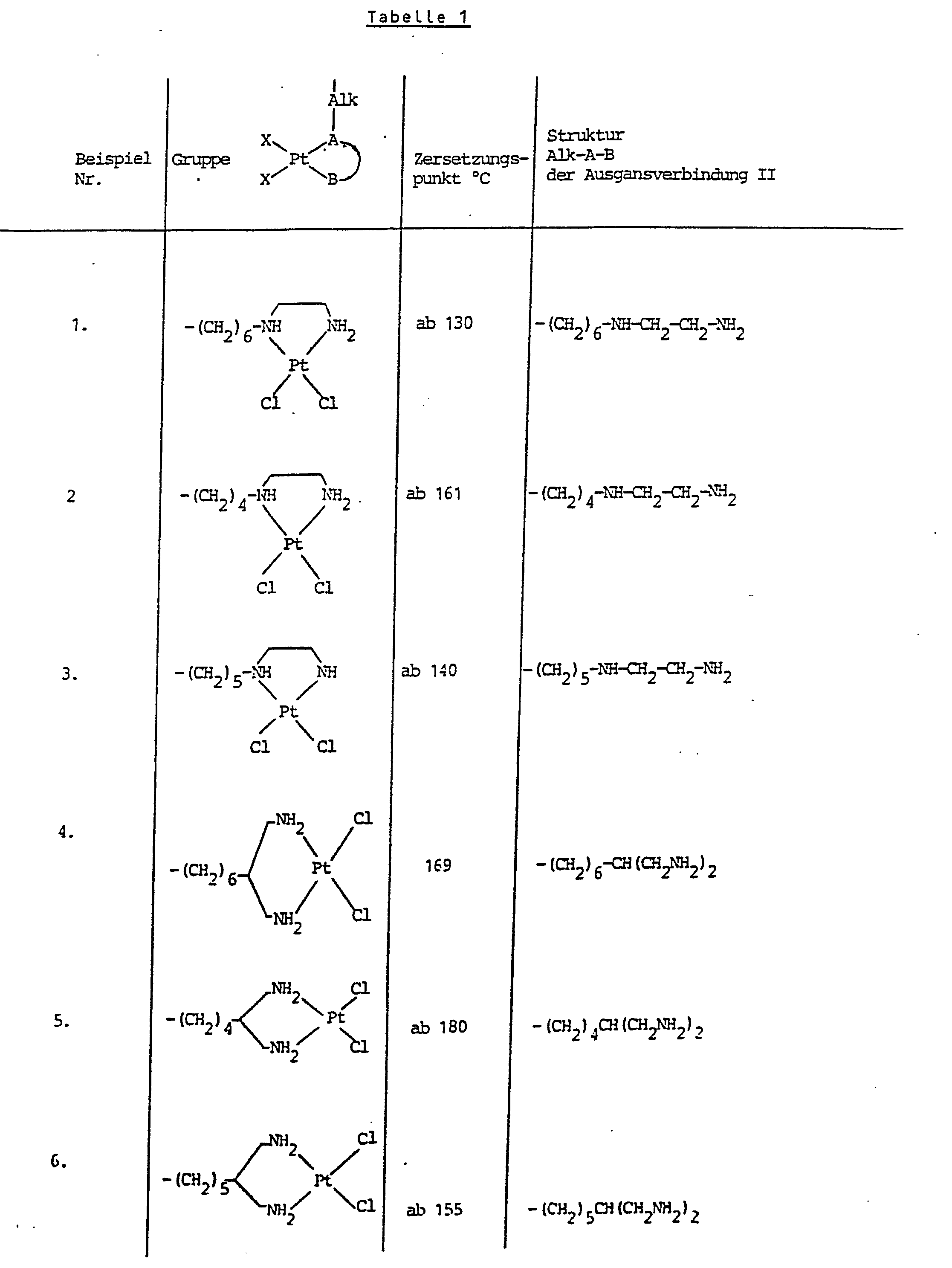
- the compounds prepared are listed in Table 1.
- the indole part has the following structure for the compounds in Table 1:
- the crude product is refluxed in a Soxhleth apparatus for 3 to 5 hours with 200 ml of triethylamine and filtered hot. After the solvent has been stripped off, the residue is suspended in H 2 0 and suction filtered (decomposition point 112-114 ° C.).
- This ether cleavage is carried out analogously for the starting materials for the other examples.
- the starting materials for Examples 2, 3 and 7 can be obtained analogously.
- the precipitate is filtered off with suction, the filtrate is dried over KOH and K 2 CO and the solvents are rotated off.
- the product thus obtained is a colorless to slightly yellow-colored, viscous oil.
- the reaction can be followed by IR spectroscopy on the disappearance of the CN band at 2265 cm -1 and the appearance of the NHz band at 3380 cm -1 .
- the methoxy groups are split off in the same way as in Example 1.
- Table 2 relates to compounds with different indole parts.
- the alk-diamino-dichloroplating group in Examples 15-17 has the same structure as in Example 1:
- tablets according to Example 1 are coated in a known manner with the aid of a spraying device with a gastric or small intestine-soluble film which consists of a suitable polymeric film former such as, for example, esters of acrylates or methacrylates and suitable auxiliaries such as wetting agents, plasticizers, dyes, lubricants etc. can exist.
- a suitable polymeric film former such as, for example, esters of acrylates or methacrylates
- suitable auxiliaries such as wetting agents, plasticizers, dyes, lubricants etc.
- 2 kg of the compound according to Example 1 are crystallized out under sterile conditions, dried and sterile ground in a suitable mill (for example Condux mill).
- the grain size of the fillable substance should be between 50 ⁇ m and 250 ⁇ m.
- the sterile, ground active ingredient is filled with a suitable screw dosing device at 100 mg in 40 ml injection bottles.
- the dry substance is dissolved in 10 ml of a suitable solvent (for example polyethylene glycol 400 / 0.9% aqueous sodium chloride solution 1: 1).
- a corresponding ampoule with solvents is provided for each injection bottle.
- a 10 ml injection bottle contains 100 mg of active ingredient.
- One ampoule contains 10 ml of solvent.
Landscapes
- Organic Chemistry (AREA)
- Chemical & Material Sciences (AREA)
- Health & Medical Sciences (AREA)
- Life Sciences & Earth Sciences (AREA)
- General Health & Medical Sciences (AREA)
- Nuclear Medicine, Radiotherapy & Molecular Imaging (AREA)
- General Chemical & Material Sciences (AREA)
- Pharmacology & Pharmacy (AREA)
- Chemical Kinetics & Catalysis (AREA)
- Animal Behavior & Ethology (AREA)
- Medicinal Chemistry (AREA)
- Public Health (AREA)
- Veterinary Medicine (AREA)
- Pharmaceuticals Containing Other Organic And Inorganic Compounds (AREA)
- Indole Compounds (AREA)
- Organic Low-Molecular-Weight Compounds And Preparation Thereof (AREA)
- Nitrogen Condensed Heterocyclic Rings (AREA)
- Plural Heterocyclic Compounds (AREA)
- Acyclic And Carbocyclic Compounds In Medicinal Compositions (AREA)
Abstract

Description
- Die britische Patentschrift 2 111 478 betrifft tumorhemmende Indol-Derivate der folgenden Formel

- Weiterhin sind tumorhemmende Ethylendiamin-platin(II)-Komplexe bekannt, worin eine CH2-Gruppe des Ethylendiamins durch einen Benzylrest, Phenylethylrest, Thienylmethylrest, Indolylmethylrest oder Imidazolylmethylrest substituiert ist (DE-OS 36 05 191), oder worin beide CH2-Gruppen des Ethylendiamins einen Phenylrest beziehungsweise einen substituierten Phenylrest enthalten (DE-OS 34 05 611; DE-OS 36 04 866).
- Die Erfindung betrifft neue Diamin-platin(II)-Komplexverbindungen mit einem hydroxylierten 2-Phenyl-Indolring, die als Arzneimittelwirkstoffe verwendbar sind.
- Die neuen erfindungsgemäßen Verbindungen besitzen eine ausgeprägte Antitumorwirkung bei guter Verträglichkeit. Die Wirkung zeigt sich insbesondere bei folgenden Tier-und Zellkutturmodellen: Transplantiertes hormonabhängiges MXT-Mammacarcinom der BDF-1-Maus. Östrogenabhängiges dimethylbenzanthraceninduziertes Mammacarcinom der SD-Ratte. Menschliche hormonabhängige MCF-7 Brustkrebszellen.
- Der überraschende erfinderische Fortschritt der erfindungsgemäßen Verbindungen liegt darin, daß diese Platinkomplexe darstellen, die eine sehr hohe Affinität zum Östrogenrezeptor aufweisen und eine selektive Wirkung an östrogenrezeptorhaltigen Tumoren wie dem Mammacarcinom entfalten. Es ist damit erstmals gelungen, ein östrogenrezeptoraffines Molekül mit einer cytostatisch wirksamen Diaminplatingruppierung so zu verknüpfen, daß die Affinität zum Rezeptor und die cytostatische Wirkung erhalten bleiben.
- Die erfindungsgemäßen Platinkomplexe besitzen zum Beispiel eine hohe Bindungsaffinität zum Östrogenrezeptor aus Kalbsuteri. Die relativen Bindungsaffinitäten liegen in der Größenordnung von 1-15 % der Affinität des Östradiols. Trotz der starken Bindung an den Östrogenrezeptor zeigen die Komplexe am Uterus der Maus jedoch keine östrogene Wirkung. In einigen Fällen konnte sogar eine deutliche antiöstrogene Wirkung nachgewiesen werden (Verbindungen gemäß den Beispielen 2 und 5). Am transplantierten hormonabhängigen MXT-Mammacarcinom der Maus wurde eine starke tumorhemmende Wirkung gefunden. So beträgt zum Beispiel die Hemmwirkung der Verbindung gemäß Beispiel 1 bei einer Dosis von 20 mg/kg 89 % nach 6 Wochen Behandlung. Die Hemmwirkung der Verbindung gemäß Beispiel 2 unter den gleichen Bedingungen ist 77 %.
- Die folgenden Angaben betreffen Ausgestaltungen der Erfindung hinsichtlich der Substituenten R, der Alkylenbrücke Alk, der Gruppe A - B sowie der Säureanionen X.
- Die in den einzelnen Resten R1 bis R7 vorkommenden C1-C6-Alkylgruppen, C2-C6-Alkanoyloxygruppen sowie die Alkylenbrücke Alk können gerade oder verzweigt sein. Die Alkylgruppen bestehen vorzugsweise aus 1, 2, 3 oder 4 C-Atomen, die Alkanoyloxygruppen vorzugsweise aus 2 - 4 C-Atomen (insbesondere handelt es sich hier um die Acetoxygruppe). Der Rest R3 ist vorzugsweise Methyl, der Rest R7 vorzugsweise Wasserstoff, Methyl, Ethyl oder Phenyl. Der Rest R1 befindet sich vorzugsweise in der 5-oder 6-Stellung des Indolringes. Der Rest R4 befindet sich vorzugsweise in der 4-Stellung des Phenylringes, die Reste R5 und R6 vorzugsweise in 2-und/oder 6-Stellung. Die Alkylenbrücke Alk besteht beispielsweise aus 4 bis 8 CHrGruppen, vorzugsweise 5, 6 oder 7 CH2-Gruppen. Falls 4 benachbarte CH2-Gruppen von Alk durch einen 1,4-Phenylenring ersetzt sind, kann es sich hierbei um 4 benachbarte CH2-Gruppen handeln, die nicht an ein N-Atom gebunden sind, oder der Phenylenring. kann auch direkt an ein N-Atom oder mit beiden N-Atomen verknüpft sein, wobei im letzteren Falle die Brücke Alk den 1,4-Phenylenring darstellt.
- Der Rest R2 befindet sich beispielsweise in der 4-Stellung des Indolringes.
- Weitere Beispiele für die Gruppe Alk mit einem Phenylenring sind:




- Die Reste X stellen die bekannten und üblichen physiologisch verträglichen und pharmazeutisch verwendbaren Anionen ein-oder mehrwertiger Säuren dar. Insbesondere kommen beispielsweise die Anionen folgender Säuren in Frage: HBr, HCI, HJ, HF, HN03, H2SO4 (SO4 -); H3P04 (HPO4--); H2C03 (CO3 -); Kampfersulfonsäure, aliphatische oder aromatische Sulfonsäuren, beispielsweise C1-C6-Alkylsulfonsäuren (zum Beispiel Methansulfonsäure, Ethan-, Propan-oder Hexansulfonsäure), Benzol-oder Naphthalinsulfonsäure, die gegebenenfalls ein-oder zweifach durch Methylgruppen substituiert sind (Toluolsulfonsäure, insbesondere o-oder p-Toluolsulfonsäure); aliphatische C1-C4-Monocarbonsäuren, die gegebenenfalls ein-, zwei-oder dreifach durch Halogenatome (insbesondere Cl, F) substituiert sind (zum Beispiel Ameisensäure, Essigsäure, Propionsäure, Chloressigsäure, Dichloressigsäure, Trifluoressigsäure, Trichloressigsäure); aliphatische C2-C11-Dicarbonsäuren, die gegebenenfalls eine Doppelbindung enthalten (zum Beispiel Oxalsäure, Malonsäure, 2-Amino-Malonsäure, Malonsäure, welche in 2-Stellung durch eine Benzylgruppe oder eine oder zwei C1-C4-Alkylgruppen substituiert ist, Maleinsäure, Fumarsäure, Bernsteinsäure); aliphatische Monohydroxy-und Dihydroxy-Monocarbonsäuren- mit 2 bis 6, insbesondere 2 bis 3 Kohlenstoffatomen, wobei es sich vorzugsweise um a-Monohydroxycarbonsäuren handelt wie Milchsäure, Glycerinsäure oder Glykolsäure; aliphatische Monohydroxy-und Dihydroxy-, Di-und Tricarbonsäuren mit 3 bis 8 Kohlenstoffatomen, insbesondere 3 bis 6 Kohlenstoffatomen wie Äpfelsäure, Weinsäure, Malonsäure, die an dem mittelständigen C-Atom durch eine Hydroxygruppe und gegebenenfalls eine C1-C4-Alkylgruppe substituiert sein kann, Isozitronensäure oder Zitronensäure; Phthalsäure, die gebenenfalls durch eine Carboxygruppe (insbesondere in 4-Stellung) substituiert ist; Gluconsäure; Glucuronsäure; die natürlichen a-Aminosäuren (zum Beispiel L-Asparaginsäure); 1,1-Cyclobutandicarbonsäure; Organophosphorsäuren, wie Aldose-und Ketosephosphorsäuren (beispielsweise die entsprechenden Mono-und Diphosphorsäuren) zum Beispiel Aldose-6-phosphorsäuren wie D-oder L-Glucose-6-phosphorsäure, a-D-Glucose-1-phosphorsäure, D-Fructose-6-phosphorsäure, D-Galactose-6-phosphor-säure, D-Ribose-5-phosphorsäure, D-Fructose-1,6-di-. phosphorsäuren; Glycerinphosphorsäuren (wobei der Phosphorsäurerest an einem der endständigen oder an dem mittelständigen Glycerinsauerstoffatom gebunden ist) wie a-D,L-Glycerin-phosphorsäure, ß-Glycerinphosphorsäure; N-Phosphono-acetyl-Asparaginsäure.
- Ebenfalls kommen als Säuren, die die Anionen X bilden, Aminosäuren beziehungsweise Aminosäurederivate, deren basische Aminogruppe durch eine Säuregruppe neutralisiert ist, in Frage. Es handelt sich hierbei zum Beispiel um Aminosäuren der folgenden Struktur:

- Die basische Aminogruppe in 2-Stellung ist hierbei durch eine übliche Aminosäureschutzgruppe neutralisiert (acyliert), beispielsweise durch einen C2-C6-Alkanolrest oder den Butyloxycarbonylrest. Falls in der obigen Formel R' eine Alkylgruppe ist, handelt es sich vorzugsweise um eine C1-C6-Alkylgruppe. die zum Beispiel in 2-, 3-, 4-, 5-oder 6-Stellung (Zählung beginnt an der Verknüpfungsstelle des Alkylrestes mit dem Restmolekül) eine C2-C6-Alkanoyiaminogruppe, einen Imidazolyl-(4)-methylrest oder einen Indolyl-(3)-methylrest enthält. Einzelbeispiele für solche Aminosäuren sind: Leucin (vorzugsweise D-und L-Form), Valin (vorzugsweise D-und L-Form), Phenylalanin (vorzugsweise D-und L-Form), Phenylglycin (vorzugsweise D-und L-Form), Alanin (vorzugsweise D-und L-Form), Isoleucin (vorzugsweise D-und L-Form), Asparagin (vorzugsweise D-und L-Form), Lysin (vorzugsweise D-und L-Form), Tryptophan (vorzugsweise D-und L-Form), Tyrosin (vorzugsweise D-und L-Form), Ornithin (vorzugsweise D-und L-Form).
- Hierbei sind die basischen Aminogruppen durch eine übliche Acylaminoschutzgruppe blockiert, insbesondere durch die Acetylgruppe oder die Butyloxycarbonylgruppe.
- Die Formel I umfaßt auch die möglichen Enantiomere und Diastereomere. Falls die Verbindungen Racemate sind, können diese in an sich bekannter Weise, zum Beispiel mittels einer optisch aktiven Säure in die optisch aktiven Isomere gespalten werden. Es ist aber auch möglich, von vornherein enantiomere oder gegebenenfalls auch diastereomere Ausgangsstoffe einzusetzen, wobei dann als Endprodukt eine entsprechende reine optisch aktive beziehungsweise diastereomere Verbindung erhalten wird. Zusätzliche Formen können durch verschiedene enantiomere beziehungsweise diastereomere Formen der Reste X entstehen.
- Die Verbindungen der Formel I können gegebenenfalls Wasser enthalten und können dann auch als Diaquokomplexe vorliegen, wo 2 Moleküle Wasser komplex an das Platin gebunden sind; das Anion X beziehungsweise die Anionen X neutralisieren auch in diesen Fällen die 2fache positive Ladung des Pt++- Kations.
- Hinsichtlich des Platinatoms handelt es sich bei den erfindungsgemäßen Verbindungen der Formel I stets um die cis-Verbindungen.
- Das Ausgangsamin 11 wird beispielsweise als Racemat, als reine rechts-beziehungsweise linksdrehende Form oder in einer sonstigen diastereomeren Form eingesetzt.
- Diese Konfiguration bleibt bei der Herstellung des Platinkomplexes erhalten.
- Das Verfahren zur Herstellung der erfindungsgemäßen Verbindungen I wird in einem Lösungsmittel oder Suspensionsmittel bei Temperaturen zwischen 10 und 80° C, vorzugsweise 20 bis 50° C, insbesondere 35 bis 45° C durchgeführt.
- Als Lösungsmittel kommen beispielsweise in Frage: Wasser, C1-C6-Alkanole (Methanol, Ethanol, tert.-Butanol), Tetrahydrofuran, Dioxan, niedere. Dialkylsulfoxide (zum Beispiel Dimethylsulfoxid), C1-C4-Mono-oder Dialkylamide von Ci-C4-Alkancarbonsäuren (zum Beispiel Dimethylformamid), Ethylenglykoldimethylether, Diethylenglykoldimethylether sowie Gemische dieser Lösungsmittel, insbesondere Mischungen mit Wasser.
- Die beiden Reaktionskomponenten (Platin-Verbindung und Verbindung II) werden vorzugsweise in äquimolaren Mengen eingesetzt. Der pH-Wert der Reaktionslösung soll zwischen 5,5 und 8, vorzugsweise bei pH 7 liegen. Die Einstellung des pH-Wertes erfolgt insbesondere durch Zusatz von Alkali, vorzugsweise wäßriger Natronlauge oder Kalilauge oder beispielsweise auch mittels Natriumcarbonat beziehungsweise durch Zusatz von Säuren, vorzugsweise wäßriger Salzsäure.
- Als Tetrahalogen-platin(II)-Verbindungen (Säure sowie Komplexsalze) kommen die entsprechenden Tetrachloro-, Tetrabromo-und Tetrajodo-Verbindungen in Frage. Falls Platin(II)-halogenide als Ausgangskomponente eingesetzt werden, kommen die gleichen Halogenatome in Frage.
- Als einwertige Kationen kommen in Betracht: Alkali-lonen, insbesondere Natrium und Kalium; es können aber auch die Lithium, Rubidium, Cäsium verwendet werden, ebenso NH4 +, NR4 +, PR4 + oder AsR4 +, in denen R ein C1-C6-Alkylrest oder ein Phenylrest ist. Zweiwertige Kationen können sein: Erdalkali-lonen, insbesondere Mg2+ und Ca2+, aber auch Zn2+. Als Platin(II)-halogenide kommen beispielsweise PtC12, PtBr2 und PtJ2 in Frage.
- Die Verbindung II wird entweder in Form des Diamins oder in Form eines Säureadditionssalzes eingesetzt: zum Beispiel als Monohydrochlorid oder Dihydrochlorid, Mono-oder Dihydrobromid, Mono-oder Dihydrojodid oder als Salz mit einer anderen üblichen Säure, wie Schwefelsäure, Salpetersäure, Perchlorsäure. Insbesondere kommen auch die Säuren in Frage, deren Anionen die Reste X bilden. Weiterhin kann das Diamin in Form des Acetats beziehungsweise Diacetats eingesetzt werden, wobei gegebenenfalls vor dem Mischen der Reaktionskomponenten Kaliumchlorid (beispielsweise 2 Mol pro 1 Mol Verbindung II) zugesetzt wird. Ebenso kann das Diamin II in Form des Carbonats eingesetzt werden.
- Der Austausch der Liganden X gegen andere Liganden kann beispielsweise mittels der Silberhalogenidfällung erfolgen. Hierzu wird beispielsweise eine Dihalogeno-diamino-platin(II)-Verbindung der Formel I, worin X Halogen (Chlor, Brom oder Jod) bedeutet in einem Lösungs-oder Suspensionsmittel bei Temperaturen zwischen 0 bis 90° C, vorzugsweise 10 bis 50° C, insbesondere 30 bis 40° C, vorzugsweise 40° C mit den Silbersalzen einer anderen Säure, die der Bedeutung X entspricht, umgesetzt. Man kann hierbei aber auch als Silbersalz Silbernitrat (zum Beispiel wäßrige Silbernitrat-Lösung} verwenden und erhält einen ionischen Diaquokomplex der Formel I, wobei jedes X ein Wassermolekül darstellt, der dann 2fach positiv geladen ist, und durch 2 NO 3 -Anionen neutralisiert wird.
- Aus diesem Komplex läßt sich der schwach gebundene Ligand Wasser leicht durch affinere Anionen (zum Beispiel CI-, Br-) in Form von NaCl, KCI, NaBr, KBr, Malonat2-, Chloracetat(-), Oxalat2-, 1,1-Cyclobutandicarbonsäure-Anion2- sowie die übrigen angegebenen Säurereste X verdrängen, angewandt in Form der Säuren oder ihrer Salze, insbesondere ihrer Alkalisalze.
- Die gleichen Verbindungen lassen sich auch durch Umsetzung äquimolarer Mengen von HX und Nitratfreiem Platinkomplex (letzterer unter Verwendun von Anionenaustauschern in der Hydroxidform, zum Beispiel Dowex 1 - 8X) gewinnen.
- Ein Austausch der Abgangsgruppe (zum Beispiel SO4 2--beziehungsweise Oxalatanion2-) ist im Falle der Sulfato-beziehungsweise Oxalato-diaminoplatin(II)-Verbindungen auch durch Umsetzung mit Erdalkalisalzen, die den gewünschten X-Liganden (zum Beispiel Glycerinsäure) enthalten, möglich, sofern der entstehende Komplex wasserlöslich ist und damit die Abtrennung des schwer wasserlöslichen Erdalkalisulfats oder -oxalats erlaubt.
- Für dieses Verfahren geeignete X-Liganden sind vorzugsweise die Anionen von Hydroxycarbonsäuren, Sulfonsäuren, Halogenessigsäuren, Salpetersäure.
- Die Lösungs-beziehungsweise Suspensionsmittel, die für das Herstellungsverfahren der Verbindungen I angegeben wurden, kommen auch für die Austauschreaktion in Frage (insbesondere eignen sich Wasser und Dimethylformamid sowie ferner Methanol, Ethanol, tert.-Butanol). Die Austauschreaktion wird beispielsweise in einem pH-Bereich zwischen 3 und 7 durchgeführt.
- Die Herstellung von nichtbekannten Ausgangssubstanzen der Formel II kann zum Beispiel so erfolgen wie bei den einzelnen Beispielen angegeben ist, beziehungsweise analog hierzu.
- Beispielsweise kann die Herstellung solcher Ausgangsverbindungen auf folgende Weise erfolgen:
- Die entsprechende Indolverbindung mit den angegebenen Bedeutungen von R1 bis R6 (Hydroxygruppen sind zweckmäßig veräthert, zum Beispiel methyliert) wird in üblicher Weise mittels NaH oder einer äquivalenten Alkaliverbindung/Alkalimetall in das Derivat überführt, wo der Wasserstoff des Indolstickstoffs durch ein Alkalimetall ersetzt ist. Dieses Indol-Derivat wird dann in einem Lösungs-oder Suspensionsmittel bei Temperaturen zwischen -70 und +80° C mit einer Verbindung Hal-Alk-Hal (Hal zum Beispiel Brom) umgesetzt; die so erhaltene Verbindung, welche am Indolstickstoff die Gruppe Alk-Hal enthält, wird nun in einem Lösungs-oder Suspensionsmittel (zum Beispiel niedere Alkohole, niedere Dialkylether oder auch Amin HA-B) bei Temperaturen zwischen 10 und 150° C mit einem Amin HA-B umgesetzt. Zum Schluß werden gegebenenfalls vorhandene Ethergruppen (Methylgruppen) in üblicher Weise abgespalten (zum Beispiel mittels BBr3 in einem halogenierten Kohlenwasserstoff bei 0 bis 50° C). Anstelle der Umsetzung mit dem Amin HA-B kann das Halogenatom der Gruppe Alk-Hal auch durch die NH2-Gruppe ersetzt werden (zum Beispiel durch übliche Reaktion mit Phthalimidkalium in einem organischen Dialkylamid bei Temperaturen zwischen 50 und 180° C). Die Einführung der Gruppe A-B erfolgt dann durch Umsetzung mit einem entsprechenden Aldehyd oder Keton (der Strukturteil H2N-CH2 beziehungsweise H2N-CHR7 von HA-B ist dann die Gruppe CH = 0 beziehungsweise CR7=O).
- Diese Umsetzung erfolgt zum Beispiel in üblicher Weise in einem inerten Lösungsmittel zwischen 70 und 150° C. Anschließend wird in üblicher Weise die Doppelbindung der so erhaltenen Schiff'schen Base reduziert und eventuell vorhandene Ethergruppen werden abgespalten.
- Wenn die Gruppe A -B die Bedeutung H2N-CH2- C H-CH2-NH2 hat, erfolgt die Herstellung der entsprechenden Ausgangssubstanzen zum Beispiel wie folgt:
- Übliche Umsetzung von Malonsäuredinitril in Gegenwart von NaH mit dem entsprechenden Indol-Derivat, wo der Indolstickstoff die Gruppe AlkHal enthält, in einem inerten Mittel bei Temperaturen zwischen 0 und 80° C, Reduktion der beiden Nitrilgruppen zu Aminogruppen (zum Beispiel mittels komplexen Alkalihydriden des Aluminiums oder Bors bei Temperaturen zwischen 0 und 150° C) und gegebenenfalls anschließende Abspaltung von Ethergruppen.
- In Ausgangsstoffen der Formel II beziehungsweise deren Vorstufen können vorhandene Hydroxygruppen durch C2-C6-Alkanoylgruppen acyliert werden. Diese Acylierung kann beispielsweise mittels C2-C6-Alkanoylhalogeniden oder den Anhydriden der gesättigten aliphatischen C2-C6-Monocarbonsäuren bei Temperaturen zwischen 10 und 80° C, insbesondere 20 bis 30° C in Anwesenheit üblicher säurebindender Stoffe erfolgen. Insbesondere kommen als säurebindende Stoffe aliphatische tertiäre Amine, wie zum Beispiel Diisopropylethylamin in Betracht. Als inerte Lösungs-beziehungsweise Suspensionsmittel für die Acylierung kommen beispielsweise in Frage: niedere aliphatische Halogenkohlenwasserstoffe (Chloroform), aprotische Lösungsmittel wie Amide, C1-C4 Alkylamide und C1-C4-Dialkylamide aliphatischer C1-C4-Carbonsäuren (Dimethylformamid, Dimethylacetamid), N-Methyl-pyrrolidon, Dimethylsulfoxid oder Mischungen dieser Mittel.
- Man kann diese Acylierung zum Beispiel aber auch in einem Zweiphasensystem beispielsweise Wasser/Chloroform durchführen, wobei der unter Zuhilfenahme eines Anionenaustauschers gewonnene acylierte Platin(II)-Komplex sich unlöslich abscheidet und das Gemisch von Säurechlorid und tertiärem Amin (Diisopropylethylamin) sich in der Chloroformphase befindet. Als Säurehalogenide kommen vorzugsweise die entsprechenden Chloride, Bromide und gegebenenfalls Jodide in Betracht. Als Anhydride kommen in Frage: Benzoesäureanhydrid sowie die Anhydride von C1-C6-Carbonsäuren, zum Beispiel symmetrische Säureanhydride wie Acetanhydrid, Propionsäureanhydrid, Buttersäureanhydrid.
- Gegebenenfalls ist es unter Umständen zweckmäßig, vor einer solchen Acylierung vorhandene freie Aminogruppen mit abspaltbaren Schutzgruppen zu versehen. Es kommen hierbei die in der Peptidsynthese üblichen Schutzgruppen in Frage (zum Beispiel tert.-Butyloxycarbonylgruppe, 2-Nitro-phenylsulfenylgruppe). Nach der Acylierung werden diese Schutzgruppen in bekannter Weise abgespalten.
- Die erfindungsgemäßen Verbindungen sind zur Herstellung pharmazeutischer Zusammensetzungen geeignet. Die pharmazeutischen Zusammensetzungen beziehungsweise Medikamente können eine oder mehrere der erfindungsgemäßen Verbindungen oder auch Mischungen derselben mit anderen pharmazeutisch wirksamen Stoffen enthalten. Zur Herstellung der pharmazeutischen Zubereitungen können die üblichen pharmazeutischen Träger-und Hilfsstoffe verwendet werden. Die Arzneimittel können zum Beispiel enteral, parenteral (zum Beispiel intravenös, intramuskulär, subkutan) oder oral angewendet werden. Beispielsweise kann die Verabreichung in Form von Tabletten, Kapseln, Pillen, Dragees oder Zäpfchen erfolgen. Als Liquida kommen zum Beispiel in Frage: ölige oder wäßrige Lösungen oder Suspensionen (zum Beispiel in Sesam-oder Olivenöl), Emulsionen, injizierbare wäßrige und ölige Lösungen oder Suspensionen. Weiterhin können beispielsweise Trockenampullen, welche als Wirkstoff die erfindungsgemäße Verbindung I enthalten, hergestellt werden, wobei vor Gebrauch der Inhalt solcher Trockenampullen zum Beispiel in physiologischer Kochsalzlösung oder Gemischen aus physiologischer Kochsalzlösung und beispielsweise flüssigen Polyethylenglykolen aufgelöst wird.
- Die erfindungsgemäßen Verbindungen zeigen zum Beispiel am transplantierbaren hormonabhängigen MXT-Mammacarcinom der BDF-1-Maus beziehunsweise Ratte eine gute tumorhemmende Wirkung. Beispielsweise wird an diesem Versuchsmodell bei einer Dosis von 20 mg/kg Körpergewicht bei der Maus das Tumorgewicht gegenüber der Kontrolle stark (zum Beispiel um 89 %) verringert.
- Die niedrigste, bereits wirksame Dosis in dem oben angegebenen Tierversuch ist beispielsweise 10 mg/kg subcutan.
- Als allgemeiner Dosisbereich für die Wirkung (Tierversuch wie oben) kommt beispielsweise in Frage: 1 - 50 mg/kg subcutan, insbesondere 5 - 30 mg.
- Die Wirkungsrichtung der erfindungsgemäßen Verbindungen ist - mit der Wirkung des bekannten Arzneimittelwirkstoffs Estramustinphosphat vergleichbar; jedoch besitzen die erfindungsgemäßen Verbindungen im Gegensatz hierzu eine hohe Affinität zum Östrogenrezeptor.
- Indikationen, für die die erfindungsgemäßen Verbindungen in Betracht kommen können: Hormonabhängiges Mammacarcinom, Prostatacarcinom, Endometriumscarcinom, Melanom. Kontraindikationen: Schwangerschaft
- Die pharmazeutischen Zubereitungen enthalten im allgemeinen zwischen 10 bis 500 mg, vorzugsweise 20 bis 200 mg beziehungsweise 20 bis 50 mg der erfindungsgemäßen aktiven Komponente(n).
- Die Verarbreichung kann beispielsweise in Form von Tabletten, Kapseln, Pillen, Dragees, Zäpfchen, Salben, Gelees, Cremes, Puder, Stäubepulver, Aerosolen oder in flüssiger Form erfolgen.
- Als flüssige Anwendungsformen kommen zum Beispiel in Frage: Ölige oder alkoholische beziehungsweise wässrige Lösungen sowie Suspensionen und Emulsionen. Bevorzugte Anwendungsformen sind Tabletten, die zwischen 20 und 50 mg oder Lösungen, die zwischen 0,2 bis 2 Gewichtsprozent an aktiver Substanz enthalten.
- Die Einzeldosis der erfindungsgemäßen aktiven Komponenten kann beispielsweise liegen
- a) bei oralen Arzneiformen zwischen 10 und 500 vorzugsweise 20 - 200 mg
- b) bei parenteralen Arzneiformen (zum Beispiel intravenös, intramuskulär) zwischen 10 und 200 mg vorzugsweise 20 und 100 mg.
- Beispielsweise können 3mal täglich 1 bis 3 Tabletten mit einem Gehalt von 10 bis 50 mg wirksamer Substanz oder zum Beispiel bei intravenöser Injektion 1 bis 3mal täglich eine Ampulle von 5 bis 20 ml Inhalt mit 25 bis 100 mg Substanz empfohlen werden. Bei oraler Verabreichung ist die minimale tägliche Dosis beispielsweise 50 mg; die maximale tägliche Dosis bei oraler Verarbreichung soll nicht über 500 mg liegen.
- Die akute Toxizität der erfindungsgemäßen Verbindungen an der Maus (ausgedrückt durch die LD 50 mg/kg; Methode nach Miller und Tainter: Proc. Soc. Exper. Biol. a. Med. 57 (1944) 261) liegt beispielsweise bei subcutaner Applikation oberhalb 20 mg/kg.
- -(Die Dosen sind jeweils bezogen auf die freie Base)-
- Man löst 1.01 mmol des entsprechenden Diaminoindols der Formel 11 in 10 ml Dimethylformamid, rührt langsam und erwärmt auf 40°C. Nun werden 1.01 mmol K2PtCl4 in einem 10 ml Dimethylformamid-H20-Gemisch (5:2 VolumenNolumen) gelöst und mit einer Pipette langsam zugetropft. Unter Lichtausschluß rührt man 24 Stunden und versetzt dann mit 2 ml Dimethylsulfoxid bis eine leichte Gelbfärbung auftritt. Nach weiteren 2 Stunden Rühren wird das Lösungsmittelgemisch im Ölpumpenvakuum abgezogen. Der braune ölige Rückstand wird mit Wasser versetzt bis blaßgelbe Kristalle ausfallen. Es wird abgesaugt und mehrmals mit Ethanol nachgewaschen. Zur Reinigung nimmt man in Dimethylformamid auf und fällt mit Ethanol/Wasser (1:1 VolumenNolumen) aus, saugt ab und trocknet mehrere Tage. Unter Umständen muß die Umfällung mehrmals wiederholt werden um die Komplexverbindung rein zu erhalten.
- Die hergestellten Verbindungen sind in der Tabelle 1 aufgeführt. Der Indol-Teil hat für die Verbindungen der Tabelle 1 die folgende Struktur: -


- In 40 ml absolutem Dimethylformamid werden 12.5 mmol (300 mg) NaH vorgelegt und auf 0°C gekühlt. Unter kräftigem Rühren werden 7.5 mmol des in 25 ml absolutem Dimethylformamid gelösten 5-Methoxy-2-(4-methoxyphenyl)-3-methyl-indols langsam zugetropft und 30 Minuten bei 0°C gerührt. Diese Suspension wird nun unter Rühren und Eiskühlung zu einer Lösung von 11.0 mmol 1,6-Dibromhexan in 25 ml absolutem Dimethylformamid zugetropft und 30 Minuten bei 0°C gerührt. Mit Wasser wird das überschüssige NaH vernichtet, anschließend noch 2.5 Stunden bei Zimmertemperatur gerührt. Es wird mit Dichlormethan ausgeschüttelt, über MgS04 getrocknet und die Lösungsmittel abgezogen. Das braune, ölige Rohprodukt wird an Kieselgel mit Dichlormethan chromatographiert und aus Ethanol umkristallisiert. Ausbeute 84%. F. 60°C.
- Unter Stickstoff-Atmosphäre werden 6.0 mmol Ethylendiamin in 40 ml wasserfreiem Methanol gelöst. Nun werden 4.0 mmol der zuvor hergestellten 1-(6-Bromhexyl)-indolverbindung, in 80 ml absolutem Methanol, bei Raumtemperatur zugetropft. Es wird 12 Stunden unter Rückfluß erhitzt. Nach dem Abkühlen wird mit CH2Cl2 und H20 extrahiert. Nach dem Trocknen über Na2SO4 wird das Lösungsmittel abgezogen; das verbleibende farblose Öl wird anschließend im Hochvakuum destillilativ gereinigt.
- Unter Stickstoffatmosphäre und Trockeneis/Acetonkühlung löst man 4.0 mmol des zuvor erhaltenen Dimethoxyindolderivates in 100 ml wasserfreiem Dichlormethan. Man rührt 10 Minuten und tropft dann 10.0 mmol BBr3 (gelöst in 15 ml wasserfreiem Dichlormethan) zu. Man rührt über Nacht und läßt die Reaktionsmischung auf Raumtemperatur kommen. Anschließend wird 2 Stunden unter Rückfluß erhitzt. Unter Eiskühlung und Stickstoffstrom wird nun tropfenweise mit Methanol versetzt bis die stürmische Reaktion abgeklungen ist. Nach Abziehen des Lösungsmittels wird das zurückbleibende Öl mit gesättigter NaHCO2-Lösung versetzt und der anfallende Niederschlag abgesaugt. Das Rohprodukt wird in einer Soxhlethapparatur 3 - 5 Stunden mit 200 ml Triethylamin unter Rückfluß erhitzt und heiß filtriert. Nach Abziehen des Lösungsmittels wird der Rückstand in H20 suspendiert und abgesaugt (Zersetzungspunkt 112 -114°C).
- Diese Etherspaltung wird bei den Ausgangsstoffen für die anderen Beispiele analog durchgeführt. Analog können die Ausgangsstoffe für die Beispiele 2, 3 und 7 erhalten werden.
- Herstellung der Ausgangsverbindung für Beispiel 4:
- Unter Stickstoff-Atmosphäre und Eiskühlung werden 5.0 mmol NaH in 30 ml absolutem Tetrahydrofuran suspendiert. Sodann werden 5.0 mmol Malonsäuredinitril in 30 ml absolutem Tetrahydrofuran gelöst und langsam zugetropft. Bei Raumtemperatur wird nun 1-(6-Bromhexyl)-5-methoxy-2-(4-methoxyphenyl)-3-methyl-indol, das zuvor in 30 ml absolutem Tetrahydrofuran gelöst wurde, langsam eingetropft. Nun rührt man noch 15 Minuten bei Raumtemperatur und versetzt anschließend mit 20 ml Wasser. Man extrahiert mit Ether und Wasser, trocknet über MgS04 und destilliert die Lösungsmittel ab. Das braune ölige Rohprodukt wird an Kieselgel mit Dichlormethan und Dichlormethan/Essigester (10:1 Volumen/Volumen) chromatographiert. Die Umkristallisation erfolgt aus Ether. Ausbeute: 48 %, F. 93 - 95° C.
- In 40 ml absolutem Tetrahydrofuran werden 9.5 mmol LiAIH4 unter Eiskühlung suspendiert. Dazu werden 2.5 mmol des in 30 ml absolutem Tetrahydrofuran gelösten Dinitrils unter kräftigem Rühren langsam zugetropft. Man kocht das Reaktionsgemisch 30 Stunden bei 100° C unter Rückfluß. Nach dem Abkühlen wird unter Eiskühlung mit 60 ml Ether versetzt, und-zur Vernichtung von überschüssigem LiAIH4 mit Wasser versetzt.
- Man saugt vom Niederschlag ab, trocknet das Filtrat über KOH und K2CO und rotiert die Lösungsmittel ab. Das so erhaltene Produkt ist ein farbloses bis schwach gelbgefärbtes, zähflüssiges Öl. Die Umsetzung kann IR-spektroskopisch am Verschwinden der CN-Bande bei 2265 cm-1 und dem Erscheinen der NHz-Bande bei 3380 cm-1 verfolgt werden.
- Ausbeute: 80 %.
- Durch Abspaltung der beiden Methoxygruppen (analog wie für Beispiel 1 angegeben) erhält man die Ausgangsverbindung II für das Beispiel 4:
- 1-Amino-2-aminomethyl-6-[5-hydroxy-2-(4-hydroxyphenyl)-3-methyl-indol-1-yl]-octan.
- Die Ausgangsstoffe für die Beispiele 5 und 6 können analog hergestellt werden.
- Herstellung der Ausgangsverbindung für Beispiel 8:
- 8.0 mmol 1-(6-Bromhexyl)-5-methoxy-2-(4-methoxyphenyl)-3-methyl-indol und 8.8 mmol Phthalamid-Kalium werden in 100 ml wasserfreiem Dimethylformamid 2 Stunden unter Rückfluß erhitzt. Nach dem Abkühlen wird mit Dichlormethan und H20 ausgeschüttelt. Anschließend wird über Na2S04 getrocknet und das Lösungsmittel abdestilliert. Der Rückstand wird an Kieselgel mit Dichlormethan chromatographiert. Zur Freisetzung des Amins werden die erhaltenen farblosen Kristalle in 50 ml Ethanol (99 %) aufgenommen und mit Hydrazin-Hydrat in 20 ml Ethanol versetzt. Nun wird 2 Stunden unter Rückfluß erwärmt; nach dem Abkühlen wird mit 40 ml 2 N HCI-Lösung angesäuert und vom Niederschlag abgesaugt. Nach dem Abdestillieren des Lösungsmittels wird mit 40 m( 2 N NaOH alkalisch gemacht und dreimal mit Essigester extrahiert. Anschließend wird über Na2S04 getrocknet und an Kieselgel mit Dichlormethan/Essigester (10:1, VolumenNolumen) chromatographiert. Man erhält ein farbloses bis gelbgefärbtes zähflüssiges Öl.
- Darstellung der Schiff'schen Base:
- 10.0 mmol 2-Pyridinaldehyd werden mit 11.0 mmol des nach 1. erhaltenen 6-Aminohexyl-indols in 60 ml trockenem Benzol vorgelegt und in einer Soxhlethapparatur mit wasserfreiem CaS04 24 Stunden unter Rückfluß erhitzt. Nach Abziehen des Lösungsmittels wird das als zähes Öl anfallende Kondensationsprodukt in Diethylether aufgenommen und über Na2S04 getrocknet. Durch Kugelrohrdestillation im Hochvakuum erhält man die reine Schiff'sche Base als gelbes zähflüssiges Öl.
- Reduktion der Schiff'schen Base zum Amin:
- Eine auf -10° C gekühlte Lösung von 10.0 mmol der Schiff'schen Base in 40 ml wasserfreiem Methanol wird mit 12.0 mmol NaBH4 versetzt. Innerhalb von 2 Stunden läßt man auf Raumtemperatur erwärmen und rührt anschließend 12 Stunden bei 50° C. Nach Abziehen des Methanols gibt man 20 ml H20 zu, schüttelt dreimal mit Ether aus und trocknet Na2S04. Nach Kugelrohrdestillation im Hochvakuum erhält man das Amin als gelbes zähflüssiges Öl.
- Abspaltung der Methoxygruppen erfolgt in gleicher Weise wie bei Beispiel 1.
- Die Ausgangsstoffe der Formel II für die übrigen Beispiele der Tabelle 1 können analog erhalten werden.
- Tabelle 2 betrifft Verbindungen mit verschiedenem Indolteil. Die Alk-diamino-dichlorplatingruppe hat bei den Beispielen 15 - 17 dieselbe Struktur wie bei Beispiel 1:

- Bei den Beispielen 18 und 19 hat die Alk-diamino-chloroplatingruppe dieselbe Struktur wie bei Beispiel 2:


- 200g der Verbindung gemäß Beispiel 2, 500 g Lactose, 360 g mikronisierte Cellulose, 130 g Maisstärke und 10 g Magnesiumstearat werden durch ein Sieb mit einer Maschenweite von 1,0 mm gegeben und in einem geeigneten Mischer homogenisiert. Diese Masse wird in bekannter Weise zu Tabletten von 120 mg verpreßt. 1 Tablette enthält 20 mg Wirkstoff.
- Zur Herstellung überzogener Tabletten werden Tabletten entsprechend Beispiel 1 in bekannter Weise mit Hilfe einer Sprüheinrichtung mit einem magen-oder dünndarmlöslichen Film überzogen, der aus einem geeigneten polymeren Filmbildner wie zum Beispiel Estern von Acrylaten oder Methacrylaten und geeigneten Hilfsstoffen wie Netzmittel, Weichmachern, Farbstoffen, Gleitmitteln usw. bestehen kann. Die Tabletten können auch in bekannter Weise zu Dragees verarbeitet werden.
- 2 kg der Verbindung gemäß Beispiel 1 werden unter sterilen Bedingungen auskristallisiert, getrocknet und in einer geeigneten Mühle (zum Beispiel Condux Mühle) steril gemahlen. Die Korngröße der abfüllfähigen Substanz sollte zwischen 50 um und 250 um liegen. Der sterile, gemahlene Wirkstoff wird mit einem geeigneten Schneckendosiergerät-zu 100 mg in 40 ml Injektionsflaschen abgefüllt. Zur intravenösen Anwendung wird die Trockensubstanz in 10 ml eines geeigneten Lösungsmittels (zum Beispiel Polyethylenglycol 400/0,9 %ige wäßrige Kochsalz-Lösung 1:1) gelöst. Zu jeder Injektionsflasche wird einer entsprechende Ampulle mit Lösungsmitteln bereitgestellt. Eine 10 ml Injektionsflasche enthält 100 mg Wirkstoff. Eine Ampulle enthält 10 ml Lösungsmittel.
Claims (7)


dadurch gekennzeichnet,
daß man eine Tetrahalogeno-platin(II)-säure, ein Tetrahalogeno-platin(II)-Komplexsalz mit zwei einwertigen oder einem zweiwertigen Kation oder ein Platin(II)-halogenid mit einer Verbindung der Formel

dadurch gekennzeichnet,
daß mindestens eine Verbindung der Formel I mit gebräuchlichen pharmazeutischen Trägerstoffen und/oder Verdünnungsmitteln beziehungsweise sonstigen Hilfsstoffen zu pharmazeutischen Zubereitungen verarbeitet beziehungsweise in eine therapeutisch anwendbare Form gebracht wird.
dadurch gekennzeichnet,
daß man Verbindungen der Formel I, worin die chemischen Symbole R1 bis R6, Alk, X sowie der Strukturteil A-B die in Anspruch 1 angegebene Bedeutung haben, beziehungsweise deren Salze mit physiologisch unbedenklichen Säuren zusammen mit üblichen Träger-und/oder Verdünnungs-beziehungsweise Hilfsstoffen bei Temperaturen zwischen 20 und 100° C vermischt beziehungsweise homogenisiert, die so erhaltene Mischung zur Herstellung von Zubereitungen, die in der Dosierungseinheit 10 bis 500 mg Wirkstoff der Formel 1 enthalten, in Hohlzellen entsprechender Größe ausgießt oder in Kapseln entsprechender Größe abfüllt oder granuliert und dann gegebenenfalls unter Zusatz von weiteren üblichen Hilfsstoffen zu Tabletten verpreßt.
dadurch gekennzeichnet,
daß man Verbindungen der Formel I, worin die chemischen Symbole R1 bis R6, Alk, X sowie der Strukturteil A-B die in Anspruch 1 angegebene Bedeutung haben, beziehungsweise deren Salze mit physiologisch unbedenklichen Säuren mit einem oder mehreren der folgenden Stoffe: Stärke, Cellulose, Lactose, Formalin-Casein, modifizierte Stärke. Magnesiumstearat, Calciumhydrogenphosphat, hochdisperse Kieselsäure, Talkum vermischt, die erhaltene Mischung, gegebenenfalls mit einer wässrigen Lösung, die als Bestandteil mindestens einen der Hilfsstoffe Gelatine, Stärke, Polysorbat, Vinylpyrrolidon-Vinylacetat-Copolymerisat und/oder Polyoxyethylensorbitanmonooleat enthält, granuliert, das Granulat gegebenenfalls mit einem oder mehreren der oben genannten Hilfsstoffe homogenisiert, und diese Mischung zu Tabletten verpreßt, die in der Dosierungseinheit 10 bis 500 mg Wirkstoff der Formel I enthalten.
dadurch gekennzeichnet,
daß man Verbindungen der Formel I oder deren Salze mit physiologisch unbedenklichen Säuren nach Zusatz von Sojalecithin bei Temperaturen zwischen 33 - 37° C in geschmolzenem Hartfett suspendiert und homogenisiert und anschließend die Mischung in Hohlzellen ausgießt, wobei die Dosierungseinheit 10 bis 500 mg Wirkstoff enthält.
dadurch gekennzeichnet,
daß man Verbindungen der Formel I oder deren Salze mit physiologisch unbedenklichen Säuren in Pflanzenöl bei Temperaturen zwischen 30 - 100° C auflöst, und die so erhaltene Lösung mit soviel Pflanzenöl auffüllt, daß die Endlösung 0,05 bis 2 Gewichtsprozent an Wirkstoff der Formel I enthält.
Priority Applications (1)
| Application Number | Priority Date | Filing Date | Title |
|---|---|---|---|
| AT87113384T ATE53217T1 (de) | 1986-10-03 | 1987-09-14 | Diamin-platin (ii)-komplexverbindungen mit einem hydroxylierten 2-phenyl-indolring. |
Applications Claiming Priority (2)
| Application Number | Priority Date | Filing Date | Title |
|---|---|---|---|
| DE3633673 | 1986-10-03 | ||
| DE3633673 | 1986-10-03 |
Publications (3)
| Publication Number | Publication Date |
|---|---|
| EP0262498A2 true EP0262498A2 (de) | 1988-04-06 |
| EP0262498A3 EP0262498A3 (en) | 1988-07-06 |
| EP0262498B1 EP0262498B1 (de) | 1990-05-30 |
Family
ID=6310963
Family Applications (1)
| Application Number | Title | Priority Date | Filing Date |
|---|---|---|---|
| EP87113384A Expired - Lifetime EP0262498B1 (de) | 1986-10-03 | 1987-09-14 | Diamin-platin (II)-Komplexverbindungen mit einem hydroxylierten 2-Phenyl-Indolring |
Country Status (15)
| Country | Link |
|---|---|
| US (2) | US4992553A (de) |
| EP (1) | EP0262498B1 (de) |
| JP (1) | JPS6391365A (de) |
| AT (3) | ATE53217T1 (de) |
| AU (1) | AU577230B2 (de) |
| DE (1) | DE3762972D1 (de) |
| DK (1) | DK518887A (de) |
| ES (1) | ES2016313B3 (de) |
| FI (1) | FI874302A7 (de) |
| GR (1) | GR3000523T3 (de) |
| HU (1) | HUT45075A (de) |
| IL (1) | IL84062A0 (de) |
| NO (1) | NO874139L (de) |
| PT (1) | PT85844B (de) |
| ZA (1) | ZA877431B (de) |
Cited By (1)
| Publication number | Priority date | Publication date | Assignee | Title |
|---|---|---|---|---|
| EP0348341A3 (de) * | 1988-06-23 | 1991-08-28 | Schering Aktiengesellschaft | Aminoalkylindole, Verfahren zu deren Herstellung und diese enthaltende pharmazeutische Präparate |
Families Citing this family (2)
| Publication number | Priority date | Publication date | Assignee | Title |
|---|---|---|---|---|
| AU775373B2 (en) | 1999-10-01 | 2004-07-29 | Immunogen, Inc. | Compositions and methods for treating cancer using immunoconjugates and chemotherapeutic agents |
| US7138520B2 (en) * | 2003-01-13 | 2006-11-21 | Massachusetts Institute Of Technology | Coordination complexes having tethered therapeutic agents and/or targeting moieties, and methods of making and using the same |
Family Cites Families (8)
| Publication number | Priority date | Publication date | Assignee | Title |
|---|---|---|---|---|
| NL8204067A (nl) * | 1982-10-21 | 1984-05-16 | Tno | Platina-diaminecomplexen, werkwijze voor het bereiden daarvan, werkwijze voor het bereiden van een geneesmiddel met toepassing van een dergelijk platinadiaminecomplex voor de behandeling van kanker, alsmede aldus verkregen gevormd geneesmiddel. |
| SE8204505L (sv) * | 1981-09-08 | 1983-03-09 | Occidental Chem Co | Elektropletering for avsettning av tenn-blylegeringar pa olika underlag |
| US4543360A (en) * | 1981-09-10 | 1985-09-24 | Degussa Aktiengesellschaft | 2-(Hydroxy-phenyl)-indoles and process for their production |
| GB2147578A (en) * | 1983-10-06 | 1985-05-15 | Tanabe Seiyaku Co | Novel organic platinum complex and process for the preparation thereof |
| DE3405611A1 (de) * | 1983-02-18 | 1984-08-23 | Degussa Ag, 6000 Frankfurt | (1,2-diphenyl-ethylendiamin)-platin(ii)-komplexverbindungen |
| US4540169A (en) * | 1983-10-03 | 1985-09-10 | Xerox Corporation | Cassette sheet feed apparatus |
| ZA86704B (en) * | 1985-02-23 | 1986-10-29 | Asta Werke Ag Chem Fab | Tumor retarding(1-benzyl-ethylenediamine9-platin(ii)-complexes |
| DE3605191A1 (de) * | 1985-02-23 | 1986-08-28 | Asta-Werke Ag Chemische Fabrik, 4800 Bielefeld | Tumorhemmende (1-benzyl-ethylendiamin)-platin(ii)-komplexe |
-
1987
- 1987-09-14 DE DE8787113384T patent/DE3762972D1/de not_active Expired - Lifetime
- 1987-09-14 EP EP87113384A patent/EP0262498B1/de not_active Expired - Lifetime
- 1987-09-14 AT AT87113384T patent/ATE53217T1/de not_active IP Right Cessation
- 1987-09-14 ES ES87113384T patent/ES2016313B3/es not_active Expired - Lifetime
- 1987-09-30 JP JP62244450A patent/JPS6391365A/ja active Pending
- 1987-10-01 NO NO874139A patent/NO874139L/no unknown
- 1987-10-01 AU AU79266/87A patent/AU577230B2/en not_active Expired - Fee Related
- 1987-10-01 AT AT0250387A patent/AT390058B/de not_active IP Right Cessation
- 1987-10-01 FI FI874302A patent/FI874302A7/fi not_active Application Discontinuation
- 1987-10-01 PT PT85844A patent/PT85844B/pt not_active IP Right Cessation
- 1987-10-01 IL IL84062A patent/IL84062A0/xx unknown
- 1987-10-02 HU HU874451A patent/HUT45075A/hu unknown
- 1987-10-02 DK DK518887A patent/DK518887A/da not_active Application Discontinuation
- 1987-10-02 ZA ZA877431A patent/ZA877431B/xx unknown
- 1987-10-08 AT AT0259187A patent/AT387383B/de not_active IP Right Cessation
-
1989
- 1989-11-20 US US07/438,984 patent/US4992553A/en not_active Expired - Fee Related
-
1990
- 1990-05-31 GR GR90400287T patent/GR3000523T3/el unknown
- 1990-06-07 US US07/536,272 patent/US5130308A/en not_active Expired - Fee Related
Cited By (1)
| Publication number | Priority date | Publication date | Assignee | Title |
|---|---|---|---|---|
| EP0348341A3 (de) * | 1988-06-23 | 1991-08-28 | Schering Aktiengesellschaft | Aminoalkylindole, Verfahren zu deren Herstellung und diese enthaltende pharmazeutische Präparate |
Also Published As
| Publication number | Publication date |
|---|---|
| US5130308A (en) | 1992-07-14 |
| GR3000523T3 (en) | 1991-07-31 |
| DK518887A (da) | 1988-04-04 |
| NO874139D0 (no) | 1987-10-01 |
| FI874302A7 (fi) | 1988-04-04 |
| DK518887D0 (da) | 1987-10-02 |
| ATA250387A (de) | 1989-08-15 |
| AT390058B (de) | 1990-03-12 |
| HUT45075A (en) | 1988-05-30 |
| ATA259187A (de) | 1988-06-15 |
| NO874139L (no) | 1988-04-05 |
| ES2016313B3 (es) | 1990-11-01 |
| EP0262498B1 (de) | 1990-05-30 |
| JPS6391365A (ja) | 1988-04-22 |
| FI874302A0 (fi) | 1987-10-01 |
| ATE53217T1 (de) | 1990-06-15 |
| PT85844B (pt) | 1990-07-31 |
| ZA877431B (en) | 1988-05-25 |
| AU577230B2 (en) | 1988-09-15 |
| AU7926687A (en) | 1988-04-14 |
| PT85844A (de) | 1987-11-01 |
| AT387383B (de) | 1989-01-10 |
| EP0262498A3 (en) | 1988-07-06 |
| US4992553A (en) | 1991-02-12 |
| DE3762972D1 (de) | 1990-07-05 |
| IL84062A0 (en) | 1988-03-31 |
Similar Documents
| Publication | Publication Date | Title |
|---|---|---|
| EP0324154B1 (de) | 1,2-Bis(aminomethyl)cyclobutan-Platin-Komplexe | |
| DE3887194T2 (de) | Antitumor-Platinkomplexe, deren Herstellung und deren therapeutische Verwendung. | |
| DE69123428T2 (de) | Inhibitor von lebererkrankungen | |
| DE3438440A1 (de) | Platin-diamin-komplex | |
| DD253625A5 (de) | Verfahren zur herstellung von (1-benzyl-ethylendiamin)-platin (ii)-komplexen | |
| DE3425404C2 (de) | Verwendung von Germaniumsesquisulfiden als Antineoplastikum | |
| DE60105028T2 (de) | Ruthenium (ii) verbindungen in der krebsbehandlung | |
| EP0262498B1 (de) | Diamin-platin (II)-Komplexverbindungen mit einem hydroxylierten 2-Phenyl-Indolring | |
| DE68912263T2 (de) | 4-Methyl-5[2-(4-phenyl-1-piperazinyl)-ethyl]-Thiazolderivate, ihre Herstellung und Zusammenstellungen, die sie enthalten. | |
| DE4111249A1 (de) | Neue im ethylenteil substituierte phenylalkyl-ethylendiamin-platin(ii oder iv)-derivate und phenylalkyl-ethylendiamine | |
| DE69903974T2 (de) | Anthraquinone antikrebs-arzneimitteln | |
| DE69326479T2 (de) | Methotrexat-derivate | |
| EP0116955B1 (de) | (1,2-Diphenyl-ethylendiamin)-platin(II)-Komplexverbindungen | |
| DE1927759A1 (de) | Neue basische Derivate des Benzoxazolin-2-ons und Verfahren zur Herstellung derselben | |
| WO2004099224A1 (de) | Carboplatin-artige platin (ii)- komplexe | |
| DE69005676T2 (de) | Platinkomplexe und Antitumormittel, die diese als Wirkstoffe enthalten. | |
| EP0193055B1 (de) | Tumorhemmende (1,2-Diphenyl-ethylendiamin)-platin(II)-Komplexe | |
| DE69514418T2 (de) | Platinkomplex und diese enthaltende Arzneimittel für die Behandlung von bösartigen Tumoren | |
| DE3730746A1 (de) | Diamin-platin(ii)-komplexverbindungen mit einem hydroxylierten 2-phenyl-indolring | |
| EP1517911B1 (de) | Tumorhemmende platin(ii)-oxalato-komplexe | |
| DE69308009T2 (de) | Derivate des 5,6,7,9-Tetrahydro-1,2,3-trimethoxy-9-oxo-benzo(alpha)heptalens | |
| DE68920304T2 (de) | 5-substituierte uridinderivate und zwischenprodukte. | |
| CH516593A (de) | Verfahren zur Herstellung von neuen Estern von a-Aminobenzyl-penicillin | |
| DE2560038C2 (de) | H2-Chloräthyl)-1 nitroso-3-(hydroxycyclohexyl)harnstoffe, dieselben enthaltende Arzneimittel und Verfahren zur Herstellung der ersteren | |
| DE2626559C2 (de) | cis-Dichloro-dipeptidester-platin(II)-Komplexe, Verfahren zu ihrer Herstellung und diese Verbindungen enthaltende Arzneimittel |
Legal Events
| Date | Code | Title | Description |
|---|---|---|---|
| PUAI | Public reference made under article 153(3) epc to a published international application that has entered the european phase |
Free format text: ORIGINAL CODE: 0009012 |
|
| 17P | Request for examination filed |
Effective date: 19870914 |
|
| AK | Designated contracting states |
Kind code of ref document: A2 Designated state(s): AT BE CH DE ES FR GB GR IT LI LU NL SE |
|
| PUAL | Search report despatched |
Free format text: ORIGINAL CODE: 0009013 |
|
| AK | Designated contracting states |
Kind code of ref document: A3 Designated state(s): AT BE CH DE ES FR GB GR IT LI LU NL SE |
|
| 17Q | First examination report despatched |
Effective date: 19890321 |
|
| ITF | It: translation for a ep patent filed | ||
| GRAA | (expected) grant |
Free format text: ORIGINAL CODE: 0009210 |
|
| AK | Designated contracting states |
Kind code of ref document: B1 Designated state(s): AT BE CH DE ES FR GB GR IT LI LU NL SE |
|
| REF | Corresponds to: |
Ref document number: 53217 Country of ref document: AT Date of ref document: 19900615 Kind code of ref document: T |
|
| REF | Corresponds to: |
Ref document number: 3762972 Country of ref document: DE Date of ref document: 19900705 |
|
| ET | Fr: translation filed | ||
| GBT | Gb: translation of ep patent filed (gb section 77(6)(a)/1977) | ||
| REG | Reference to a national code |
Ref country code: GR Ref legal event code: FG4A Free format text: 3000523 |
|
| REG | Reference to a national code |
Ref country code: GR Ref legal event code: FG4A Free format text: 3000683 |
|
| PLBE | No opposition filed within time limit |
Free format text: ORIGINAL CODE: 0009261 |
|
| STAA | Information on the status of an ep patent application or granted ep patent |
Free format text: STATUS: NO OPPOSITION FILED WITHIN TIME LIMIT |
|
| 26N | No opposition filed | ||
| PGFP | Annual fee paid to national office [announced via postgrant information from national office to epo] |
Ref country code: SE Payment date: 19910809 Year of fee payment: 5 |
|
| PGFP | Annual fee paid to national office [announced via postgrant information from national office to epo] |
Ref country code: LU Payment date: 19910814 Year of fee payment: 5 |
|
| PGFP | Annual fee paid to national office [announced via postgrant information from national office to epo] |
Ref country code: DE Payment date: 19910816 Year of fee payment: 5 |
|
| PGFP | Annual fee paid to national office [announced via postgrant information from national office to epo] |
Ref country code: GR Payment date: 19910827 Year of fee payment: 5 |
|
| PGFP | Annual fee paid to national office [announced via postgrant information from national office to epo] |
Ref country code: CH Payment date: 19910902 Year of fee payment: 5 |
|
| PGFP | Annual fee paid to national office [announced via postgrant information from national office to epo] |
Ref country code: ES Payment date: 19910903 Year of fee payment: 5 |
|
| PGFP | Annual fee paid to national office [announced via postgrant information from national office to epo] |
Ref country code: GB Payment date: 19910904 Year of fee payment: 5 |
|
| PGFP | Annual fee paid to national office [announced via postgrant information from national office to epo] |
Ref country code: AT Payment date: 19910910 Year of fee payment: 5 |
|
| PGFP | Annual fee paid to national office [announced via postgrant information from national office to epo] |
Ref country code: BE Payment date: 19910927 Year of fee payment: 5 |
|
| ITTA | It: last paid annual fee | ||
| PGFP | Annual fee paid to national office [announced via postgrant information from national office to epo] |
Ref country code: NL Payment date: 19910930 Year of fee payment: 5 Ref country code: FR Payment date: 19910930 Year of fee payment: 5 |
|
| EPTA | Lu: last paid annual fee | ||
| PG25 | Lapsed in a contracting state [announced via postgrant information from national office to epo] |
Ref country code: LU Free format text: LAPSE BECAUSE OF NON-PAYMENT OF DUE FEES Effective date: 19920914 Ref country code: GB Effective date: 19920914 Ref country code: AT Effective date: 19920914 |
|
| PG25 | Lapsed in a contracting state [announced via postgrant information from national office to epo] |
Ref country code: SE Effective date: 19920915 Ref country code: ES Free format text: LAPSE BECAUSE OF EXPIRATION OF PROTECTION Effective date: 19920915 |
|
| PG25 | Lapsed in a contracting state [announced via postgrant information from national office to epo] |
Ref country code: LI Effective date: 19920930 Ref country code: CH Effective date: 19920930 Ref country code: BE Effective date: 19920930 |
|
| BERE | Be: lapsed |
Owner name: ASTA PHARMA A.G. Effective date: 19920930 |
|
| PG25 | Lapsed in a contracting state [announced via postgrant information from national office to epo] |
Ref country code: GR Free format text: THE PATENT HAS BEEN ANNULLED BY A DECISION OF A NATIONAL AUTHORITY Effective date: 19930331 |
|
| PG25 | Lapsed in a contracting state [announced via postgrant information from national office to epo] |
Ref country code: NL Effective date: 19930401 |
|
| GBPC | Gb: european patent ceased through non-payment of renewal fee |
Effective date: 19920914 |
|
| NLV4 | Nl: lapsed or anulled due to non-payment of the annual fee | ||
| PG25 | Lapsed in a contracting state [announced via postgrant information from national office to epo] |
Ref country code: FR Effective date: 19930528 |
|
| REG | Reference to a national code |
Ref country code: CH Ref legal event code: PL |
|
| PG25 | Lapsed in a contracting state [announced via postgrant information from national office to epo] |
Ref country code: DE Effective date: 19930602 |
|
| REG | Reference to a national code |
Ref country code: FR Ref legal event code: ST |
|
| REG | Reference to a national code |
Ref country code: GR Ref legal event code: MM2A Free format text: 3000523 |
|
| EUG | Se: european patent has lapsed |
Ref document number: 87113384.9 Effective date: 19930406 |
|
| REG | Reference to a national code |
Ref country code: GR Ref legal event code: MM2A Free format text: 3000683 |
|
| REG | Reference to a national code |
Ref country code: ES Ref legal event code: FD2A Effective date: 19990601 |
|
| PG25 | Lapsed in a contracting state [announced via postgrant information from national office to epo] |
Ref country code: IT Free format text: LAPSE BECAUSE OF NON-PAYMENT OF DUE FEES;WARNING: LAPSES OF ITALIAN PATENTS WITH EFFECTIVE DATE BEFORE 2007 MAY HAVE OCCURRED AT ANY TIME BEFORE 2007. THE CORRECT EFFECTIVE DATE MAY BE DIFFERENT FROM THE ONE RECORDED. Effective date: 20050914 |