EP0262832B1 - Procédé et méthode pour teinter les lentilles de contact - Google Patents
Procédé et méthode pour teinter les lentilles de contact Download PDFInfo
- Publication number
- EP0262832B1 EP0262832B1 EP87308123A EP87308123A EP0262832B1 EP 0262832 B1 EP0262832 B1 EP 0262832B1 EP 87308123 A EP87308123 A EP 87308123A EP 87308123 A EP87308123 A EP 87308123A EP 0262832 B1 EP0262832 B1 EP 0262832B1
- Authority
- EP
- European Patent Office
- Prior art keywords
- lens
- pad
- transfer
- lenses
- mount
- Prior art date
- Legal status (The legal status is an assumption and is not a legal conclusion. Google has not performed a legal analysis and makes no representation as to the accuracy of the status listed.)
- Expired - Lifetime
Links
- 238000000034 method Methods 0.000 title claims abstract description 22
- 208000016339 iris pattern Diseases 0.000 claims abstract description 16
- 238000002791 soaking Methods 0.000 claims description 5
- 239000007788 liquid Substances 0.000 claims description 4
- 239000011148 porous material Substances 0.000 claims description 2
- 210000000554 iris Anatomy 0.000 description 8
- 230000008020 evaporation Effects 0.000 description 3
- 238000001704 evaporation Methods 0.000 description 3
- 230000003100 immobilizing effect Effects 0.000 description 3
- 239000003973 paint Substances 0.000 description 3
- 239000000463 material Substances 0.000 description 2
- 210000001747 pupil Anatomy 0.000 description 2
- 241000905358 Actaea pachypoda Species 0.000 description 1
- 206010037867 Rash macular Diseases 0.000 description 1
- FAPWRFPIFSIZLT-UHFFFAOYSA-M Sodium chloride Chemical compound [Na+].[Cl-] FAPWRFPIFSIZLT-UHFFFAOYSA-M 0.000 description 1
- 239000000853 adhesive Substances 0.000 description 1
- 230000001070 adhesive effect Effects 0.000 description 1
- 239000003570 air Substances 0.000 description 1
- 239000012080 ambient air Substances 0.000 description 1
- QVGXLLKOCUKJST-UHFFFAOYSA-N atomic oxygen Chemical compound [O] QVGXLLKOCUKJST-UHFFFAOYSA-N 0.000 description 1
- 238000004140 cleaning Methods 0.000 description 1
- 238000004040 coloring Methods 0.000 description 1
- 210000004087 cornea Anatomy 0.000 description 1
- 230000007547 defect Effects 0.000 description 1
- 238000004519 manufacturing process Methods 0.000 description 1
- 230000000873 masking effect Effects 0.000 description 1
- 229910052760 oxygen Inorganic materials 0.000 description 1
- 239000001301 oxygen Substances 0.000 description 1
- 230000002093 peripheral effect Effects 0.000 description 1
- 230000035699 permeability Effects 0.000 description 1
- 238000002360 preparation method Methods 0.000 description 1
- 239000002994 raw material Substances 0.000 description 1
- 239000011780 sodium chloride Substances 0.000 description 1
- 239000007787 solid Substances 0.000 description 1
- 229910001220 stainless steel Inorganic materials 0.000 description 1
- 239000010935 stainless steel Substances 0.000 description 1
- 230000000007 visual effect Effects 0.000 description 1
- XLYOFNOQVPJJNP-UHFFFAOYSA-N water Substances O XLYOFNOQVPJJNP-UHFFFAOYSA-N 0.000 description 1
- 238000004018 waxing Methods 0.000 description 1
- 230000037303 wrinkles Effects 0.000 description 1
Images

Classifications
-
- B—PERFORMING OPERATIONS; TRANSPORTING
- B29—WORKING OF PLASTICS; WORKING OF SUBSTANCES IN A PLASTIC STATE IN GENERAL
- B29D—PRODUCING PARTICULAR ARTICLES FROM PLASTICS OR FROM SUBSTANCES IN A PLASTIC STATE
- B29D11/00—Producing optical elements, e.g. lenses or prisms
- B29D11/00865—Applying coatings; tinting; colouring
- B29D11/00894—Applying coatings; tinting; colouring colouring or tinting
- B29D11/00903—Applying coatings; tinting; colouring colouring or tinting on the surface
-
- B—PERFORMING OPERATIONS; TRANSPORTING
- B29—WORKING OF PLASTICS; WORKING OF SUBSTANCES IN A PLASTIC STATE IN GENERAL
- B29D—PRODUCING PARTICULAR ARTICLES FROM PLASTICS OR FROM SUBSTANCES IN A PLASTIC STATE
- B29D11/00—Producing optical elements, e.g. lenses or prisms
-
- B—PERFORMING OPERATIONS; TRANSPORTING
- B41—PRINTING; LINING MACHINES; TYPEWRITERS; STAMPS
- B41M—PRINTING, DUPLICATING, MARKING, OR COPYING PROCESSES; COLOUR PRINTING
- B41M1/00—Inking and printing with a printer's forme
- B41M1/26—Printing on other surfaces than ordinary paper
- B41M1/30—Printing on other surfaces than ordinary paper on organic plastics, horn or similar materials
-
- G—PHYSICS
- G02—OPTICS
- G02C—SPECTACLES; SUNGLASSES OR GOGGLES INSOFAR AS THEY HAVE THE SAME FEATURES AS SPECTACLES; CONTACT LENSES
- G02C7/00—Optical parts
- G02C7/02—Lenses; Lens systems ; Methods of designing lenses
- G02C7/04—Contact lenses for the eyes
- G02C7/046—Contact lenses having an iris pattern
-
- B—PERFORMING OPERATIONS; TRANSPORTING
- B29—WORKING OF PLASTICS; WORKING OF SUBSTANCES IN A PLASTIC STATE IN GENERAL
- B29L—INDEXING SCHEME ASSOCIATED WITH SUBCLASS B29C, RELATING TO PARTICULAR ARTICLES
- B29L2011/00—Optical elements, e.g. lenses, prisms
- B29L2011/0016—Lenses
- B29L2011/0041—Contact lenses
Definitions
- the present invention relates to a method for tinting contact lenses, more particularly, soft contact lenses. It also refers to a system for tinting such lenses.
- Tinting of contact lenses has been known for some years.
- a kit is available, which permits manufacturers as well as practitioners to tint contact lenses of the HEMA-type material by masking the pupil area and any other, e.g., peripheral, area that should remain clear, and applying a few drops of tint of the desired hue to the unmasked lens surface, letting it react with the latter for a specified period of time, and then rinsing off the excess tint.
- Some tints require a fixing solution. While this method is relatively simple, results are invariably poor: the solidly colored areas of the irises impart to the eyes the glassy, artificial look of doll's eyes. Real irises are of course never of a solid color, being streaky and even blotchy.
- tinted contact lens provides an iris pattern of acceptable naturalness which is printed onto the contact lens.
- the firm producing this lens has, however, not yet succeeded to achieve full control over hues and, therefore, reproducibility of the process they are using is rather poor. If one lens of a pair of lenses should get lost, it is rather difficult to obtain a matching lens.
- WO 85/04679 describes a method of tinting contact lenses in which a printing pad is first pressed against an inked printing plate carrying an iris pattern, and is then pressed against the surface of a contact lens to apply a coloured iris pattern to the lens.
- the lens may be mounted on a chuck or spindle, or a series of lenses on a conveyor may be passed through the printing station.
- the usual way of holding a lens in position on the mount during the colouring process is by waxing or by mechanical clamping means.
- This the invention achieves by providing a method for tinting contact lenses, comprising the steps of: providing at least one transfer-pad printer, including a suitable ink of the desired tint; providing at least one printing block carrying an iris pattern; pre-soaking said contact lenses in a soaking liquid; placing said pre-soaked contact lenses onto lens mounts; letting said pre-soaked lenses dry for a predetermined time while placed on said mounts, whereby said lenses are shrunk thereonto; aligning a thus mounted lens with the pad of said transfer-pad printer; inking said printing block; causing said pad to pick up said iris pattern from said inked block, and causing said pad to make contact with said mounted lens, thereby transferring said iris pattern as picked up from said block to said mounted contact lens.
- the invention further provides a system for tinting contact lenses, comprising: a transfer-pad printer adapted to pick up a pattern from an inked printing block and transfer said pattern to a lens; at least one lens mount adapted to fixedly hold a lens in a defined position, and means to produce alignment between said lens mount and said transfer pad prior to said pattern transfer from said pad to said lens, characterised in that the top surface of said at least one lens mount is convexly curved, and the radius of the curvature of said top surface is slightly smaller than the radius of curvature of the base curve of said lens, thereby facilitating the shrinking of said lens onto said top surface.
- the invention thus resides in temporarily immobilizing a lens during the crucial imprinting stage by shrinking the lens onto the mount, thereby immobilizing it in a reliable, safe and gentle manner.
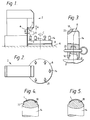
- a transfer pad printer 2 provided with a pad 4 movable vertically in direction of double arrow A, and a printing-block holder 6 on which is mounted the block carrying the iris pattern (to be described further below) and which can move horizontally in direction of double arrow B.
- an index table 8 rotatable in direction of arrow C.
- index table 8 is provided with tapering projections 10 defining what will be referred to as "stations", all of which projections are located on a circle the center of which lies on the axis of rotation of the index table 8.
- Both the transfer-pad printer 2 and the index table 8 are mounted on a common base 12, their mutual relationship being such that whenever the table 8 indexes, the center line 9 of one of the projections 10 is in accurate alignment with the center line 11 of the pad 4.
- the indexing movement of the table 8 is coordinated with the up-and-down movement of the pad 4 and the in-and-out movement of the block holder 6.
- lens mounts 14 mounted on the projections 10 are lens mounts 14 (see Fig. 3), advantageously made of stainless steel, which, at their lower end, have a female taper 16 matching the tapering projections 10 integral with the indexing table 8.
- Their upper ends 18 are convexly spherical and have a radius of curvature R which is slightly smaller than the radius of curvature of the concave base curve of the (properly wetted) lens i.e., that surface of the contact lens that floats on the cornea. The reason for this difference in radii will be explained further below.
- the matching tapers of the projection 10 and the female taper 16 ensure that the center of curvature of the upper end 18 of all lens mounts 14 is always located on their center line 9 which, in its turn, whenever a lens mount 14 is moved below the pad 4, is always aligned with the center line 11 of the pad 4.
- a pin 20, pushed into a hole drilled through both the projection 10 and the mount 14 locks the mount in position during the actual tinting operation.
- a lens L to be tinted is removed from the bottle in which it has been soaked for, e.g., 24 hours in saline or any other suitable soaking solution, and is placed onto the spherical end 18 of one of the lens mounts 14 which, at this stage, are not yet mounted on the index table 8.
- the difference in radii being intentionally exaggerated, is clearly seen.
- the centering groove 22 which, being of the same diameter as the fully soaked lens, serves as a reference circle for manually centering the lens L, to make sure that the center line 9 of the lens mount 14 passes through the center of the circular edge of the lens L.
- the lens L is left on the mount 14 for a specified period of time, to allow a certain percentage of water to evaporate from the lens. It is during this evaporation process that the lens shrinks onto, and clings to, the mount 14 obviating the need for adhesive pitch or wax.
- the evaporation time period is of importance, as too wet a lens will not properly stick to the mount, and might develop air pockets and wrinkles which will obviously interfere with the printing or transfer process which requires a hard and smooth supporting surface. Too dry a lens on the other hand will not only cause the iris diameter to be of incorrect size, but the tint will not take, as the lens pores into which the ink must be absorbed are large enough only when the lens material has swelled to a certain size.
- the following factors must be taken into account: 1) the raw material of the lens; 2) ambient air conditions: 3) diameter of the printed iris, and 4) the additional time required for mounting the lens mount 14 on the index table and performing the actual printing step.
- the transfer-pad printer 2 which operates as follows: In a first stroke, the pad 4 picks up the pattern from the inked block mounted in the block holder 6 which, at this stage, projects from the printer as indicated by the dash-dotted lines in Fig. 1. Having picked up the pattern, the pad moves up again, the block holder 6 is withdrawn, clearing the path for the pad 4 to move down again and, in this second working stroke, to place the pattern onto the lens that has previously been moved by the index table 8 from the "waiting" to the "printing" position.
- the table 8 which has several stations is coordinated in its indexing steps with the movements of the printer 2 and may move only in the time period between the upstroke of the pad 4 after printing and the withdrawal of the block holder 6 in preparation for the next printing stroke.
- the lens Having been imprinted, and, over a specified time, soaked in the printed pattern, the lens, together with its mount 14 to which it still adheres, is transferred to an ultrasonic bath, in which the excess paint is removed.
- the mount 14 is suspended upside down with the aid of a suspending pin inserted into the hole provided for the immobilizing pin 20.
- the lens again absorbs liquid, swells and simply drops off the mount 14.
- the lens Having been removed from the bath, the lens is carefully tested for print quality and possible manufacturing defects and is then re-bottled. The bottle is sealed, labeled and, finally, autoclaved for sterileness of its contents.
- Figs 6 to 9 represent examples of enlarged iris patterns as produced by the method according to the invention. As can be seen, the patterns differ in the diameters of the irises as well as of the pupils.
- the black represents the tint
- the white the transparent portions through which the original iris color shows, producing the characteristic streaks, blotches and dots.
- the ink used is of a high viscosity and as patterns picked up by the pad 4 are always of the same tint density (the "doctor knife” of the printer always removing any excess ink from the block), and the pressure on the pad 4 is always the same (for a given tint), reproducibility is ensured.
Landscapes
- Health & Medical Sciences (AREA)
- Engineering & Computer Science (AREA)
- Ophthalmology & Optometry (AREA)
- Physics & Mathematics (AREA)
- Manufacturing & Machinery (AREA)
- Mechanical Engineering (AREA)
- General Physics & Mathematics (AREA)
- Optics & Photonics (AREA)
- General Health & Medical Sciences (AREA)
- Eyeglasses (AREA)
- Coloring (AREA)
- Organic Low-Molecular-Weight Compounds And Preparation Thereof (AREA)
- Printing Methods (AREA)
Claims (12)
- Procédé pour teinter des lentilles de contact (L), comprenant les phases consistant :
à prévoir au moins une machine d'impression (2) à tampon de report, comportant une encre appropriée de la teinte désirée;
à prévoir au moins un cliché (6) portant un dessin d'iris;
à prévoir une imbibition préalable de ces lentilles de contact (L) dans un liquide d'imbibition;
à placer ces lentilles de contact (L) ayant subi une imbibition préalable, sur des montures de lentille (14);
à laisser sécher ces lentilles (L) ayant subi une imbibition préalable pendant une période de temps prédéterminée, tandis qu'elles se trouvent sur les montures susdites (14), de sorte que ces lentilles se contractent sur ces montures;
à aligner une lentille (L) ainsi montée, avec le tampon (4) de la machine d'impression (2) à tampon de report;
à encrer le cliché susdit (6);
à amener le tampon précité (4) à prélever ce dessin d'iris depuis le cliché encré précité (6), et
à amener ce tampon (4) en contact avec la lentille montée alignée, en transférant de la sorte le dessin d'iris précité, tel que prélevé du cliché (6), vers ladite lentille de contact montée. - Procédé suivant la revendication 1, dans lequel les lentilles précitées (L) sont centrées sur lesdites montures de lentille (14), par rapport à des caractéristiques de référence (22) prévues sur ces montures, avant la contraction des lentilles précitées sur celles-ci.
- Procédé suivant la revendication 2, dans lequel la caractéristique de référence de chaque monture de lentille (14) se présente sous la forme d'une rainure de centrage (22) prévue sur la surface convexe (18) de la monture de lentille précitée.
- Procédé suivant l'une quelconque des revendications précédentes, comprenant la phase supplémentaire de prévision d'une table d'indexage (a) destinée à recevoir les montures de lentille précitées (14), cette table d'indexage comportant au moins deux postes servant, de manière cyclique, à titre de poste de travail lorsque cette table est mise en alignement avec le tampon précité (4), et à titre de poste de déchargement et de rechargement par la suite.
- Procédé suivant l'une quelconque des revendications précédentes, dans lequel le dessin d'iris susdit, après transfert sur la lentille montée susdite, est admis à s'imbiber dans les pores de la lentille (L) pendant une période prédéterminée de temps, avant son enlèvement depuis ladite monture (14).
- Procédé suivant la revendication 5, dans lequel, après la période prédéterminée susdite d'imbibition, la lentille montée est placée dans un bain à ultrasons dans lequel tout excès d'encre quelconque est enlevé de la lentille, et cette lentille absorbe du liquide de manière à ce qu'elle soit amenée à gonfler et à se séparer de la monture susdite (14).
- Système pour teinter des lentilles de contact, comprenant :
une machine d'impression à tampon de report (2) capable de prélever un dessin depuis un cliché encré (6) et à reporter ce dessin sur une lentille;
au moins une monture de lentille (14) capable de maintenir de manière fixe une lentille (L) dans une position déterminée, et
des moyens (8, 10) destinés à créer un alignement entre la monture de lentille susdite (14) et le tampon de report précité (4) avant le report du dessin précité depuis le tampon vers la lentille,
caractérisé en ce que la surface supérieure (18) d'au moins une monture de lentille (14) est courbée pour être convexe, et le rayon de courbure (R) de cette surface supérieure (18) est légèrement plus petit que le rayon de courbure de la courbe de base de la lentille précitée (L), en facilitant de la sorte la contraction de cette lentille sur cette surface supérieure. - Système suivant la revendication 7, comprenant en outre un bain à ultrasons pour l'enlèvement de l'excès d'encre depuis la lentille.
- Système suivant la revendication 7 ou la revendication 8, comprenant en outre un autoclave.
- Système suivant l'une quelconque des revendications 7 à 9, dans lequel les moyens de mise en alignement comprennent une table d'indexage rotative (8) comportant plusieurs postes indexables (10) et destinée à fonctionner de concert avec la machine d'impression à tampon de transfert susdite (2).
- Système suivant la revendication 10, dans lequel on prévoit plusieurs montures de lentille (14) présentant une forme essentiellement cylindrique, la partie inférieure (16) de chacune de ces montures pouvant être attachée à l'un des postes indexables précités (10), la surface supérieure (18) de ces montures présentant une courbure convexe avec un rayon de courbure (R) qui est légèrement inférieur au rayon de courbure de la courbe de base des lentilles précitées (L).
- Système suivant la revendication 11, dans lequel la surface supérieure convexe (18) de chaque monture de lentille (14) comporte une rainure de centrage (22) facilitant la mise en place des lentilles susdites (L) sur les surfaces supérieures précitées dans une position concentrique au centre géométrique des postes précités (10).
Priority Applications (1)
| Application Number | Priority Date | Filing Date | Title |
|---|---|---|---|
| AT87308123T ATE80090T1 (de) | 1986-09-16 | 1987-09-15 | Verfahren und methode zum anfaerben von kontaktlinsen. |
Applications Claiming Priority (2)
| Application Number | Priority Date | Filing Date | Title |
|---|---|---|---|
| IL80039 | 1986-09-16 | ||
| IL80039A IL80039A0 (en) | 1986-09-16 | 1986-09-16 | Method and system for tinting contact lenses |
Publications (3)
| Publication Number | Publication Date |
|---|---|
| EP0262832A2 EP0262832A2 (fr) | 1988-04-06 |
| EP0262832A3 EP0262832A3 (en) | 1989-09-06 |
| EP0262832B1 true EP0262832B1 (fr) | 1992-09-02 |
Family
ID=11057137
Family Applications (1)
| Application Number | Title | Priority Date | Filing Date |
|---|---|---|---|
| EP87308123A Expired - Lifetime EP0262832B1 (fr) | 1986-09-16 | 1987-09-15 | Procédé et méthode pour teinter les lentilles de contact |
Country Status (13)
| Country | Link |
|---|---|
| US (2) | US4811662A (fr) |
| EP (1) | EP0262832B1 (fr) |
| KR (1) | KR960008586B1 (fr) |
| AT (1) | ATE80090T1 (fr) |
| AU (1) | AU588131B2 (fr) |
| BR (1) | BR8705190A (fr) |
| CA (1) | CA1299821C (fr) |
| DE (1) | DE3781491T2 (fr) |
| ES (1) | ES2035075T3 (fr) |
| GR (1) | GR3006164T3 (fr) |
| IL (1) | IL80039A0 (fr) |
| NZ (1) | NZ221785A (fr) |
| ZA (1) | ZA876883B (fr) |
Cited By (1)
| Publication number | Priority date | Publication date | Assignee | Title |
|---|---|---|---|---|
| US7726237B2 (en) | 2005-03-18 | 2010-06-01 | Novartis Ag | Printing apparatus for making colored contact lenses |
Families Citing this family (29)
| Publication number | Priority date | Publication date | Assignee | Title |
|---|---|---|---|---|
| US5120121A (en) * | 1988-07-21 | 1992-06-09 | Allergan, Inc. | Colored lens |
| US5034166A (en) * | 1988-07-21 | 1991-07-23 | Allergan, Inc. | Method of molding a colored contact lens |
| CA2009668A1 (fr) | 1989-02-16 | 1990-08-16 | Ashok R. Thakrar | Verres de contact teintes et methode de fabrication |
| WO1991006886A1 (fr) | 1989-11-01 | 1991-05-16 | Schering Corporation | Verre de contact colore ayant un aspect tres naturel |
| JP2951105B2 (ja) * | 1992-05-08 | 1999-09-20 | 株式会社メニコン | コンタクトレンズ用マーキング装置 |
| US5271874A (en) * | 1992-11-04 | 1993-12-21 | Wesley-Jessen Corporation | Method for molding a hydrophilic contact lens |
| US5266077A (en) * | 1992-11-09 | 1993-11-30 | Ciba-Geigy Corporation | Method for tinting a hydrophilic contact lens |
| US5352245A (en) * | 1992-11-20 | 1994-10-04 | Ciba-Geigy Corporation | Process for tinting contact lens |
| AR013512A1 (es) * | 1997-09-24 | 2000-12-27 | Novartis Ag | Metodo para fabricar una lente de contacto astigmatica |
| US6123021A (en) * | 1998-12-09 | 2000-09-26 | Cameron; Robert | Multiple color printer for printing on small objects |
| US6393981B1 (en) | 1998-12-09 | 2002-05-28 | Robert Cameron | Multiple color printer having vertically moveable print pad |
| US6488375B2 (en) | 1999-10-28 | 2002-12-03 | Ocular Sciences, Inc. | Tinted contact lens and method for making same |
| US7048375B2 (en) * | 1999-11-01 | 2006-05-23 | Praful Doshi | Tinted lenses and methods of manufacture |
| ATE315795T1 (de) | 1999-11-01 | 2006-02-15 | Praful Doshi | Getönte kontaktlinse aus kunststoff und verfahren zu deren herstellung |
| US7267846B2 (en) * | 1999-11-01 | 2007-09-11 | Praful Doshi | Tinted lenses and methods of manufacture |
| US6880932B2 (en) * | 1999-11-01 | 2005-04-19 | Praful Doshi | Tinted lenses and methods of manufacture |
| US6827440B2 (en) | 2000-01-03 | 2004-12-07 | Wesley Jessen Company | Colored contact lens with a more natural appearance |
| US6767097B2 (en) | 2001-03-29 | 2004-07-27 | Daniel G. Streibig | Colored contact lens and method of making same |
| US6733126B2 (en) | 2001-06-29 | 2004-05-11 | Daniel G. Streibig | Colored contact lens and method of making same |
| US6655804B2 (en) * | 2001-06-29 | 2003-12-02 | Daniel G. Streibig | Colored contact lens and method of making same |
| US20030085934A1 (en) * | 2001-11-07 | 2003-05-08 | Tucker Robert Carey | Ink-jet printing system for printing colored images on contact lenses |
| US20030165015A1 (en) * | 2001-12-05 | 2003-09-04 | Ocular Sciences, Inc. | Coated contact lenses and methods for making same |
| US7464192B2 (en) * | 2002-09-10 | 2008-12-09 | Silicon Storage Technology, Inc. | Programmable serial interface for a semiconductor circuit |
| US20040091613A1 (en) * | 2002-11-13 | 2004-05-13 | Wood Joe M. | Methods for the extraction of contact lenses |
| US7278736B2 (en) * | 2004-02-25 | 2007-10-09 | Novartis Ag | Contact lenses imparting a vivacious appearance to the eye |
| US7799249B2 (en) | 2005-08-09 | 2010-09-21 | Coopervision International Holding Company, Lp | Systems and methods for producing silicone hydrogel contact lenses |
| US7731873B2 (en) * | 2005-08-09 | 2010-06-08 | Coopervision International Holding Company, Lp | Contact lens mold assemblies and systems and methods of producing same |
| CN102133800A (zh) * | 2010-01-21 | 2011-07-27 | 精华光学股份有限公司 | 虹膜隐形眼镜的制造方法 |
| CN114643775B (zh) * | 2022-05-20 | 2022-08-02 | 苏州茂特斯自动化设备有限公司 | 一种隐形眼镜自动移印机 |
Family Cites Families (15)
| Publication number | Priority date | Publication date | Assignee | Title |
|---|---|---|---|---|
| GB803485A (en) * | 1955-12-09 | 1958-10-29 | Malkin And Company Ltd F | Improvements in and relating to the decoration of ceramic or other ware |
| US4019436A (en) * | 1976-06-16 | 1977-04-26 | Martin Handweiler | Technique for producing a pre-distorted design format for use in transfer printing |
| FR2408464A1 (fr) * | 1977-11-09 | 1979-06-08 | Brenot Claude | Dispositif d'impression par report au coussin |
| DE3219890A1 (de) * | 1982-05-27 | 1983-12-01 | Toyo Contact Lens Co., Ltd., Nagoya, Aichi | Verfahren zum markieren weicher kontaktlinsen |
| AU564462B2 (en) * | 1982-11-11 | 1987-08-13 | Hydron Limited | Lens tinting |
| CA1233302A (fr) * | 1983-04-11 | 1988-03-01 | Miles W. Press | Articles en plastique hydrogel colores et methode de coloration |
| EP0177606A4 (fr) * | 1984-04-06 | 1988-02-08 | Barnes Hind Inc | Coloration de verres de contact. |
| US4543882A (en) * | 1984-07-16 | 1985-10-01 | Ryder Francis E | Contact lens marking fixture |
| US4705307A (en) * | 1984-09-21 | 1987-11-10 | James B. N. Morris | Tubular goods joint |
| US4716829A (en) * | 1985-02-11 | 1988-01-05 | American Can Company | Method for removing solids from substrates and preventing solids build-up thereon |
| US4733959A (en) * | 1985-05-01 | 1988-03-29 | Optatint, Inc. | Apparatus and method for tinting hydrophilic contact lenses |
| AU588921B2 (en) * | 1985-09-20 | 1989-09-28 | Hydron Limited | Opaque tinting process |
| US4705370A (en) * | 1986-02-27 | 1987-11-10 | Johnson Carl S | Apparatus for custom tinting soft contact lenses by dispenser of lenses |
| US4719657A (en) * | 1986-03-27 | 1988-01-19 | Bausch & Lomb Incorporated | Method of forming iris variegation patterns on contact lenses |
| US4663186A (en) * | 1986-04-24 | 1987-05-05 | International Business Machines Corporation | Screenable paste for use as a barrier layer on a substrate during maskless cladding |
-
1986
- 1986-09-16 IL IL80039A patent/IL80039A0/xx not_active IP Right Cessation
-
1987
- 1987-09-11 NZ NZ221785A patent/NZ221785A/xx unknown
- 1987-09-11 US US07/095,206 patent/US4811662A/en not_active Expired - Fee Related
- 1987-09-14 ZA ZA876883A patent/ZA876883B/xx unknown
- 1987-09-15 DE DE8787308123T patent/DE3781491T2/de not_active Expired - Fee Related
- 1987-09-15 AT AT87308123T patent/ATE80090T1/de active
- 1987-09-15 AU AU78426/87A patent/AU588131B2/en not_active Ceased
- 1987-09-15 CA CA000546923A patent/CA1299821C/fr not_active Expired - Fee Related
- 1987-09-15 ES ES198787308123T patent/ES2035075T3/es not_active Expired - Lifetime
- 1987-09-15 EP EP87308123A patent/EP0262832B1/fr not_active Expired - Lifetime
- 1987-09-16 BR BR8705190A patent/BR8705190A/pt unknown
- 1987-09-16 KR KR87010288A patent/KR960008586B1/ko not_active Expired - Lifetime
-
1988
- 1988-12-27 US US07/289,939 patent/US4872405A/en not_active Expired - Fee Related
-
1992
- 1992-11-05 GR GR920402484T patent/GR3006164T3/el unknown
Cited By (1)
| Publication number | Priority date | Publication date | Assignee | Title |
|---|---|---|---|---|
| US7726237B2 (en) | 2005-03-18 | 2010-06-01 | Novartis Ag | Printing apparatus for making colored contact lenses |
Also Published As
| Publication number | Publication date |
|---|---|
| BR8705190A (pt) | 1988-05-24 |
| IL80039A0 (en) | 1986-12-31 |
| KR960008586B1 (en) | 1996-06-28 |
| AU7842687A (en) | 1988-03-24 |
| EP0262832A3 (en) | 1989-09-06 |
| DE3781491D1 (de) | 1992-10-08 |
| NZ221785A (en) | 1989-01-27 |
| US4872405A (en) | 1989-10-10 |
| AU588131B2 (en) | 1989-09-07 |
| CA1299821C (fr) | 1992-05-05 |
| US4811662A (en) | 1989-03-14 |
| ES2035075T3 (es) | 1993-04-16 |
| EP0262832A2 (fr) | 1988-04-06 |
| KR880004339A (ko) | 1988-06-03 |
| ZA876883B (fr) | 1988-03-17 |
| DE3781491T2 (de) | 1993-03-04 |
| ATE80090T1 (de) | 1992-09-15 |
| GR3006164T3 (fr) | 1993-06-21 |
Similar Documents
| Publication | Publication Date | Title |
|---|---|---|
| EP0262832B1 (fr) | Procédé et méthode pour teinter les lentilles de contact | |
| EP0297758B1 (fr) | Lentille de contact colorée et ses méthodes de fabrication | |
| US20080273073A1 (en) | System and method for application of ink formulations onto ophthalmic lenses | |
| EP1797474B1 (fr) | Procede de tampongraphie permettant de fabriquer des verres de contact colores | |
| EP0442782B1 (fr) | Machine à imprimer un oeuf | |
| AU2028592A (en) | Pad printing coating composition and printing process | |
| EP0472303B1 (fr) | Coulage de lentilles de contact | |
| EP0158999B1 (fr) | Lentille de contact pour changer la couleur des yeux | |
| EP0177606A1 (fr) | Coloration de verres de contact | |
| EP1866159B1 (fr) | Machine d'impression au tampon pour la fabrication de lentilles de contact colorées | |
| GB1559035A (en) | Apparatus for the preparation of eye glass lenses prior tothe shaping and/or bevelling thereof | |
| WO2014137089A1 (fr) | Dispositif de fixation de moule supérieur d'une lentille de contact cosmétique | |
| JPS6473314A (en) | Method and system of coloring contact lens |
Legal Events
| Date | Code | Title | Description |
|---|---|---|---|
| PUAI | Public reference made under article 153(3) epc to a published international application that has entered the european phase |
Free format text: ORIGINAL CODE: 0009012 |
|
| AK | Designated contracting states |
Kind code of ref document: A2 Designated state(s): AT BE CH DE ES FR GB GR IT LI LU NL SE |
|
| PUAL | Search report despatched |
Free format text: ORIGINAL CODE: 0009013 |
|
| AK | Designated contracting states |
Kind code of ref document: A3 Designated state(s): AT BE CH DE ES FR GB GR IT LI LU NL SE |
|
| 17P | Request for examination filed |
Effective date: 19900222 |
|
| 17Q | First examination report despatched |
Effective date: 19910618 |
|
| GRAA | (expected) grant |
Free format text: ORIGINAL CODE: 0009210 |
|
| AK | Designated contracting states |
Kind code of ref document: B1 Designated state(s): AT BE CH DE ES FR GB GR IT LI LU NL SE |
|
| PG25 | Lapsed in a contracting state [announced via postgrant information from national office to epo] |
Ref country code: SE Effective date: 19920902 |
|
| REF | Corresponds to: |
Ref document number: 80090 Country of ref document: AT Date of ref document: 19920915 Kind code of ref document: T |
|
| PGFP | Annual fee paid to national office [announced via postgrant information from national office to epo] |
Ref country code: GR Payment date: 19920929 Year of fee payment: 6 |
|
| PGFP | Annual fee paid to national office [announced via postgrant information from national office to epo] |
Ref country code: NL Payment date: 19920930 Year of fee payment: 6 Ref country code: FR Payment date: 19920930 Year of fee payment: 6 |
|
| PGFP | Annual fee paid to national office [announced via postgrant information from national office to epo] |
Ref country code: DE Payment date: 19921005 Year of fee payment: 6 |
|
| REF | Corresponds to: |
Ref document number: 3781491 Country of ref document: DE Date of ref document: 19921008 |
|
| PGFP | Annual fee paid to national office [announced via postgrant information from national office to epo] |
Ref country code: CH Payment date: 19921012 Year of fee payment: 6 |
|
| PGFP | Annual fee paid to national office [announced via postgrant information from national office to epo] |
Ref country code: BE Payment date: 19921028 Year of fee payment: 6 |
|
| PGFP | Annual fee paid to national office [announced via postgrant information from national office to epo] |
Ref country code: LU Payment date: 19921103 Year of fee payment: 6 |
|
| ITF | It: translation for a ep patent filed | ||
| ET | Fr: translation filed | ||
| PGFP | Annual fee paid to national office [announced via postgrant information from national office to epo] |
Ref country code: AT Payment date: 19930222 Year of fee payment: 6 |
|
| EPTA | Lu: last paid annual fee | ||
| PGFP | Annual fee paid to national office [announced via postgrant information from national office to epo] |
Ref country code: ES Payment date: 19930331 Year of fee payment: 6 |
|
| REG | Reference to a national code |
Ref country code: ES Ref legal event code: FG2A Ref document number: 2035075 Country of ref document: ES Kind code of ref document: T3 |
|
| REG | Reference to a national code |
Ref country code: GR Ref legal event code: FG4A Free format text: 3006164 |
|
| PLBE | No opposition filed within time limit |
Free format text: ORIGINAL CODE: 0009261 |
|
| STAA | Information on the status of an ep patent application or granted ep patent |
Free format text: STATUS: NO OPPOSITION FILED WITHIN TIME LIMIT |
|
| 26N | No opposition filed | ||
| PGFP | Annual fee paid to national office [announced via postgrant information from national office to epo] |
Ref country code: GB Payment date: 19930913 Year of fee payment: 7 |
|
| PG25 | Lapsed in a contracting state [announced via postgrant information from national office to epo] |
Ref country code: LU Free format text: LAPSE BECAUSE OF NON-PAYMENT OF DUE FEES Effective date: 19930915 Ref country code: AT Effective date: 19930915 |
|
| PG25 | Lapsed in a contracting state [announced via postgrant information from national office to epo] |
Ref country code: ES Free format text: LAPSE BECAUSE OF EXPIRATION OF PROTECTION Effective date: 19930916 |
|
| PG25 | Lapsed in a contracting state [announced via postgrant information from national office to epo] |
Ref country code: LI Effective date: 19930930 Ref country code: CH Effective date: 19930930 Ref country code: BE Effective date: 19930930 |
|
| BERE | Be: lapsed |
Owner name: MED OPTICS CORP. Effective date: 19930930 |
|
| PG25 | Lapsed in a contracting state [announced via postgrant information from national office to epo] |
Ref country code: GR Free format text: THE PATENT HAS BEEN ANNULLED BY A DECISION OF A NATIONAL AUTHORITY Effective date: 19940331 |
|
| PG25 | Lapsed in a contracting state [announced via postgrant information from national office to epo] |
Ref country code: NL Effective date: 19940401 |
|
| NLV4 | Nl: lapsed or anulled due to non-payment of the annual fee | ||
| PG25 | Lapsed in a contracting state [announced via postgrant information from national office to epo] |
Ref country code: FR Free format text: LAPSE BECAUSE OF NON-PAYMENT OF DUE FEES Effective date: 19940531 |
|
| REG | Reference to a national code |
Ref country code: CH Ref legal event code: PL |
|
| PG25 | Lapsed in a contracting state [announced via postgrant information from national office to epo] |
Ref country code: DE Effective date: 19940601 |
|
| REG | Reference to a national code |
Ref country code: FR Ref legal event code: ST |
|
| PG25 | Lapsed in a contracting state [announced via postgrant information from national office to epo] |
Ref country code: GB Effective date: 19940915 |
|
| REG | Reference to a national code |
Ref country code: GR Ref legal event code: MM2A Free format text: 3006164 |
|
| GBPC | Gb: european patent ceased through non-payment of renewal fee |
Effective date: 19940915 |
|
| REG | Reference to a national code |
Ref country code: ES Ref legal event code: FD2A Effective date: 19990601 |
|
| PG25 | Lapsed in a contracting state [announced via postgrant information from national office to epo] |
Ref country code: IT Free format text: LAPSE BECAUSE OF NON-PAYMENT OF DUE FEES Effective date: 20050915 |