EP0262861A2 - Vorrichtung zur Beschichtung von Substraten - Google Patents
Vorrichtung zur Beschichtung von Substraten Download PDFInfo
- Publication number
- EP0262861A2 EP0262861A2 EP87308417A EP87308417A EP0262861A2 EP 0262861 A2 EP0262861 A2 EP 0262861A2 EP 87308417 A EP87308417 A EP 87308417A EP 87308417 A EP87308417 A EP 87308417A EP 0262861 A2 EP0262861 A2 EP 0262861A2
- Authority
- EP
- European Patent Office
- Prior art keywords
- carrier
- hollow cylinder
- carriers
- substrates
- vacuum
- Prior art date
- Legal status (The legal status is an assumption and is not a legal conclusion. Google has not performed a legal analysis and makes no representation as to the accuracy of the status listed.)
- Withdrawn
Links
Images


Classifications
-
- C—CHEMISTRY; METALLURGY
- C23—COATING METALLIC MATERIAL; COATING MATERIAL WITH METALLIC MATERIAL; CHEMICAL SURFACE TREATMENT; DIFFUSION TREATMENT OF METALLIC MATERIAL; COATING BY VACUUM EVAPORATION, BY SPUTTERING, BY ION IMPLANTATION OR BY CHEMICAL VAPOUR DEPOSITION, IN GENERAL; INHIBITING CORROSION OF METALLIC MATERIAL OR INCRUSTATION IN GENERAL
- C23C—COATING METALLIC MATERIAL; COATING MATERIAL WITH METALLIC MATERIAL; SURFACE TREATMENT OF METALLIC MATERIAL BY DIFFUSION INTO THE SURFACE, BY CHEMICAL CONVERSION OR SUBSTITUTION; COATING BY VACUUM EVAPORATION, BY SPUTTERING, BY ION IMPLANTATION OR BY CHEMICAL VAPOUR DEPOSITION, IN GENERAL
- C23C14/00—Coating by vacuum evaporation, by sputtering or by ion implantation of the coating forming material
- C23C14/22—Coating by vacuum evaporation, by sputtering or by ion implantation of the coating forming material characterised by the process of coating
- C23C14/56—Apparatus specially adapted for continuous coating; Arrangements for maintaining the vacuum, e.g. vacuum locks
- C23C14/564—Means for minimising impurities in the coating chamber such as dust, moisture, residual gases
- C23C14/566—Means for minimising impurities in the coating chamber such as dust, moisture, residual gases using a load-lock chamber
Definitions
- the concept of continuously coating substrates has long been a desirable mode of operation and there are machines which can continuously sputter a coating of material (such as aluminum) onto a substrate.
- the present invention is described in connection with coating aluminium onto compact disk substrates.
- the present apparatus can be used to advantage in coating other types of substrates.
- coating compact disk substrates heretofore in the prior art, it has been done by batch systems as well as by continuous systems which are best exemplified by a system developed by a European Company.
- the continuous machine is approximately twenty-two feet long. That prior art system is composed of one long single chamber which has many pumping stages to achieve the required low pressure as the substrates move therethrough.
- the European system is housed in a "clean room" so that the chamber does not become contaminated which in turn would contaminate the substrates and provide inferior coatings.
- Substrates passing through the European prior art system are held in rectangular blocks and are arranged in a horizontal train as they pass through the single chamber.
- the sealing endeavor is extremely difficult because a large volume of air is entrapped around each rectangular carrier, which results in high leakage and accordingly many pumping stations are required.
- the seals which surround the blocks wear out rapidly because of the long horizontal excursion and require relatively frequent replacement.
- the European system has some undesirable aspects in that it is costly because of its size and its complexity. In addition it is costly because of the necessity of a large clean room.
- the prior art operation is a critical operation because of the many vacuum pumping stations in a single chamber. In a preferred embodiment the present apparatus is approximately seven feet long.
- the present apparatus is flexible (can be wheeled anywhere) and the present system does not require a clean room.
- the present apparatus (in a preferred embodiment) has a circular rotatable table with apertures located therein toward the table's outer rim.
- the apparatus is ideally located in close proximity to the output station of a molding press so that a compact disk substrate coming from a molding press is directly loaded into one of the apertures in the rotatable table. If the press fabricates a compact disk substrate every certain number of seconds, for instance, every nine seconds, then the movement of the loading table is synchronized to have an empty aperture available to the molding press every nine seconds. In this way one substrate is coated and leaves the coating machine every nine seconds.
- a hood is located, or disposed, over the area between the molding press output station and the aperture location on the loading table which receives such substrates.
- a “clean air” blower is located adjacent to, or within, the hood and that blower blows "clean air” across the area including the press output section and the loading table. In this way, the clean substrates from the press are kept clean without the expense and inflexibility which are dictated by the necessity of a large and completely enclosing "clean room.”
- each substrate is held by a carrier.
- the carrier is circular in shape and has O-ring around the periphery thereof.
- the carriers holding the substrates are pushed from the apertures in the loading table into a vertical hollow cylinder.
- the O-rings are squeezed as they pass through the hollow cylinder and thus they form a seal to prevent gasses from passing between the wall of the hollow cylinder and the O-ring.
- the hollow cylinder has apertures therein at two sections and at those two sections there are vacuum chambers mounted to surround those apertures.
- These two vacuum chambers pump the cylinder sections down and create vacuum conditions in those sections thereby causing substrates passing through those sections to be pumped and degassed.
- the degassed substrates are advanced in a step-like motion and each eventually exists from the vertical hollow cylinder into a coating chamber.
- the coating chamber is a vacuum stage but it is not held at the low vacuum condition that the last vacuum stage along the hollow cylinder is held. Accordingly, the gas in the coating chamber attempts to escape into the vertical hollow cylinder but the seals effected by the O-rings prevents the gas from escaping.
- the entry of air and contaminants into the coating chamber is minimized because of the sealing effect of the O-rings and further because the gas pressure "push" is in the opposite direction (i.e. from the coating chamber toward the last vacuum stage along the hollow cylinder).
- each carrier In the coating chamber each carrier is lifted from the exit position of the hollow cylinder and moved toward the coating station.
- each substrate can be first cleaned at a cleaning station before it gets to the coating station.
- Each substrate is advanced in a step-like fashion and remains in a coating position in the coating station for a specific time since the step movement is synchronized to permit the same.
- the coating is slightly delayed until the substrate is fully into position and then the coating is fully effected. Thereafter the coated substrate is pushed down a second hollow cylinder back into atmosphere and onto the loading table and lifted therefrom.
- FIGS 1A and 1B there is shown a carrier 11.
- the carrier has an upper outer ledge 13. Beneath the upper ledge 13, as can be gleaned from Figure 1B, there is formed an upper channel 15.
- the upper channel 15 (as will become more meaningful in the discussion of Figure 3) serves to work with a lifting device to lift the carrier from the hollow cylinder exit onto the rails of a transport apparatus.
- below channel 15 there is formed a lower channel 17 into which there is located an O-ring 19.
- O-ring 19 acts to effect a seal when the carrier 11 is pushed into the vertical hollow cylinder.
- the O-ring is squeezed and its elastic nature forces it against the wall of the cylinder thereby creating a seal.
- other forms of gaskets or seal devices can be employed in place of the O-rings.
- FIG. 1B there is large aperture 21 formed at the top of the carrier 11.
- the aperture has two step ledges 23 and 25.
- the ledge 25 has an associate ledge 27 while ledge 23 has an associate ledge 29.
- the vertical walls 31 and 33 which provide the step configuration between the ledges 23 and 25 and 29 and 27, respectively, provide a means to hold the compact disk 35 in horizontal position.
- the compact disk 35 is fitted into the upper aperture and more precisely to rest on the ledges 25 and 27 and to be secured therein by the vertical walls 31 and 33.
- an open space 37 below the compact disk 35 is an open space 37.
- the open space 37 provides a means for readily degassing the compact disk substrate on the lower side.
- entering the space 37 is a channel 39. It should also be noted that entering the aperture 21 is a shorter channel 41. While in the sectional view of Figure 1B there is only shown one channel 39 and one channel 41, actually there are many such channels (i.e. there are many channels similar to channel 39 and many channels similar to channel 41.) As will be better understood (when we discuss the movement of the carrier through the vertical horizontal cylinder), when the carriers get to the vacuum stages, which lie along the hollow cylinder, the degassing of the substrate is accomplished on the lower side through the space 37 and the channels 39 and on the upper side through the aperture 21 and the channels 41.
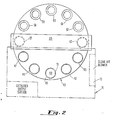
- FIG. 2 depicts the rotating load and unload table 43.
- the load and unload table 43 has a plurality of apertures such as apertures 45, 46 and 47 around the outer section of the table.
- the apertures are formed to be completely open through the table in the area 49 and yet have a ledge 51 which is formed to hold the lower ledge 53 of the carrier (see ledge 53 in Figure 1B).
- the carrier fits into the aperture, such as aperture 45, with ledge 53 coming in abutment with the ledge 51.
- a piston is able to push through the open area 49 come in contact with the surface 55 (shown in Figure 1B) in order to lift the entire carrier out of the aperture 45.
- the driving mechanism for the load/unload table is not shown and in the preferred embodiment it is a Geneva Indexing System but it could be other forms of motor driven devices which will step the load/unload table in a clockwise direction.
- Figure 2 it can be seen that there is a molding press output station shown in phantom. The substrates are taken from the press output station and loaded into a carrier which is sitting in the position shown by the aperture 46. Shortly after a substrate is loaded into a carrier, at position 46, that carrier is advanced to the position shown by the aperture 4/. This of course provides an "empty slot" in the carrier which is in the position 46 and which is awaiting the reception of a new substrate from the press.
- the load/unload table is advanced one more step so that the carrier which was first loaded in position 46 is now in position 57.
- the last mentioned carrier will be lifted from the table at position 57 and pushed into the hollow cylinder as will be explained more completely hereinafter.
- the apertures remain empty on the excursion along positions 58, 59, 60, 61 and 62 so that they are ready to receive a carrier at the output position 63.
- the carrier loaded into position 63 is holding a substrate that has been coated. As will become more meaningful hereinafter the substrates are coated, the carriers are pushed downward through a hollow cylinder at position 63 and are loaded one at a time into a waiting empty aperture in the load/unload table 43.
- An unloaded carrier is advanced to positions 65 and 67 and may be lifted from the table at position 6/, or a subsequent position, by the operator of the system or automatically as the case may be.
- An empty carrier i.e. without a substrate is present at the aperture position 45 to await loading of a compact disk substrate at position 46 and the operation repeats itself.
- the coating chamber 69 straddles the load/unload table and as will become more meaningful from the discussion of Figure 3, the carriers are pushed vertically into the coating chamber 69 and are then moved from left to right (as viewed in Figure 2) and are pushed downward out of the coating chamber 69 at the position 63.
- Figure 2 is shown in a simple form and it should be understood that there are support braces, mechanisms for pumping the loading chamber down into a suitable vacuum condition, and further devices to effect the coating experience itself as a spluttering device or means for creating a plasma all of which are not shown. None of these devices are shown in order that concepts that of the present invention can be more clearly understood.
- a hood 71 which spans the area in which the apertures 46 and 47 as well as the press output station are located.
- the hood 71 has a blower 73 which blows "clean air” across the area so that the substrates which come from the press output station and are placed in a carrier at position 46 do not become contaminated.
- the hood 71 may be a Class 100 unit utilizing Hepa filters but could be a commercial hood such as the kind that are sold by Laminaire Corporation.
- the hood 71, along with the "clean air" blower 73, effects a relatively small local clean room characteristic for the present device but reduces the expenses that go along with an actual large clean room setting as is required by the prior art systems.
- FIG. 3 depicts a schematic side view of the present apparatus.
- a coating chamber 69 which is supported by two support braces 75 and 77.
- the wall of the chamber 69 is “broken away” to show the exit position 79 of the hollow cylinder 81.
- the "broken away” section also shows the transport arrangement 83 and the entry position 85 of the hollow cylinder 87.
- the load/unload table 43 is driven by an indexing device 89 which is fastened to the table 43 by the plate 91.
- the lower ledge 53 (which was discussed in connection with the discussion of Figure 1) is shown resting on the ledge 51 (which was discussed in connection with the discussion of Figure 2.
- the lower surface 55 is awaiting contact with the piston 93.
- the piston 93 is driven by a piston driving mechanism 95 which in the preferred embodiment is an air cylinder manufactured by Lin Act Co. but other forms of piston driving mechanisms can be used.
- the piston 93 is driven upward to come in contact with the surface 55 and in response thereto the carrier 97 is driven into the hollow cylinder 81.
- the O-ring 19 is shown protruding from the carrier 97 so that as the carrier 97 is pushed into the hollow cylinder 81 the O-ring will be squeezed inward but will be providing a force outward to form a seal between the wall 99 and the O-ring 19.
- the carrier 97 will be advanced to the position 101 and will remain at that position in response to the friction of the O-ring against the side walls as well as the pressure differential between atmospheric pressure being applied to the bottom of the carrier and a lesser pressure being effected in the section 103 of the hollow cylinder because of the vacuum pump down station 105. While it appears from the drawing that only one carrier would be held in sections 101 and 103, in the preferred embodiment the vertical hollow cylinder will hold a number of such carriers. When the next carrier which is similar to the carrier 97 is pushed by the piston 93 into the hollow cylinder 81 it advances the previous carrier one space forward toward the section 103.
- Section 103 in the preferred embodiment is of sufficient depth to accommodate three carriers. While the carriers are in the section 103, the air is pumped out so that section 103 has a vacuum of about 100 Torr.
- a train of carriers is advanced along the hollow cylinder 81.
- Such carriers leave the area 103 they are partially pumped and degassed and they pass through a nonporous section of the hollow cylinder 81 into a second vacuum section 107.
- the second vacuum section 107 there is a plurality of apertures in the hollow cylinder 81 which enable the second vacuum pump station 109 to pump the section 107 to a lower pressure condition.
- the vacuum condition in the section 107 is 5 ⁇ 10 ⁇ 5 Torr which enables a greater degassing effect to take place (on the compact disk substrates present in section 107) then was accomplished in section 103.
- staged vacuum pump downs is well understood and that is what is accomplished in the vacuum step down between the sections 103 and 107.
- the apertures in sections 103 and 107 are arranged so that bridging will not take place between the second vacuum stage and the first vacuum stage.
- the pump 105 is an Alcotell Direct Two Stage Pump while the pump 109 is a CT-7 cryopump manufactured by CTI Company. It should be understood that other equivalent high vacuum pumps can be employed.
- the carriers continue to advance out of the vacuum section 107 into the nonporous section 111 and on into the loading chamber 69 heading toward the exit position 79.
- the coating chamber 69 is pumped through the pumping mechanism 113 to a vacuum condition of 1 to 4 Torr.
- the vacuum condition in coating chamber 69 is obtained by balancing the injection of Argon gas while pumping through a throttling aperture. Gas quantities and pumping speed are selected to minimize contamination. Accordingly, there is a higher pressure of gas in the coating chamber 69 than there is in the vacuum section 107 and the gas attempts to escape through the vertical hollow cylinder 81.
- the carriers advance rightward until they reach the exit position 85.
- a carrier is pushed off the rails (115) and come to rest against the top of a previously unloaded carrier.
- the piston 123 is moved downward by the piston drive mechanism 125 and it pushes the carrier into vertical chamber 87. Accordingly there is a train of carriers located in the hollow cylinder 87 and this train is pushed downward as was described in connection with the pushing up of the carriers in the vertical hollow cylinder 81.
- carriers emerge from the hollow cylinder 87 at the exit position 127 and are loaded back onto the load/unload table 43.
- a cleaning station can be located along the transport mechanism prior to compact disk substrate reaching the coating position under hood 117.
- the hood mechanism 129 shown in phantom along with the plasma generator 131 can be installed so that substrates located on a carrier (in the position of carrier 133) can be cleaned by ion cleaning.
- Such cleaning insures that those surfaces can be in the proper condition to be coated when they come under the hood 117.
- the substrates are directly loaded from the press onto the load/unload table 43 as earlier described then the degassing of such substrates is sufficient to put the substrates in a condition to be coated without the necessity of ion cleaning.
- ion cleaning may be necessary and such ion cleaning can take place in the coating chamber without disrupting the continuous flow of the substrates through the system.
- the mechanism to lift the carriers from the vertical hollow cylinder 81 is shown.
- the device 133 is U shaped.
- the U shaped device 133 has a pair of arms.
- the U shaped device 133 is held by an arm 139 which is connected to a transfer mechanism not shown.
- the energization of the transfer mechanism is synchronized to the movement of the load/unload table and hence when a train of carriers has been moved by the piston, as described earlier, and the top most carrier 96 is in the position shown in Figure 3, then the transfer mechanism is energized.
- the arm 139 moves rightward pushing the U shaped device 133 the engage the top most carrier 96. This can be understood from Figure 3.
- the coating source which is responsive to voltage, is deactivated.
- the coating source is activated and the material is coated onto the substrate 121.
- the present apparatus provides a means to continuously, in a step like fashion, coat substrates in a system which is: portable; relatively inexpensive; includes the viable aspects of the clean room; and can accommodate a substrate supply means such as a molding press. It should be borne in mind that the speed of the load/unload table can be changed to accommodate different substrate input rates. It should also be understood that while the entire discussion has been in connection with a compact disk substrate other forms of substrates could be used.
- the present system enables the degassing of the substrates, which is so necessary, to take effect during a vertical excursion by employing the technique of employing carriers which not only carry the substrates but create a seal. With such a technique a two staged pump down can be readily accomplished. In addition the pressure gradient between the coating chamber and the last degassing chamber is reversed to flush contaminants and prevent contaminants from entering the coating chamber.
Landscapes
- Chemical & Material Sciences (AREA)
- Chemical Kinetics & Catalysis (AREA)
- Engineering & Computer Science (AREA)
- Materials Engineering (AREA)
- Mechanical Engineering (AREA)
- Metallurgy (AREA)
- Organic Chemistry (AREA)
- Physical Vapour Deposition (AREA)
- Manufacturing Optical Record Carriers (AREA)
Applications Claiming Priority (2)
| Application Number | Priority Date | Filing Date | Title |
|---|---|---|---|
| US913714 | 1986-09-30 | ||
| US06913714 US4733631B1 (en) | 1986-09-30 | 1986-09-30 | Apparatus for coating substrate devices |
Publications (2)
| Publication Number | Publication Date |
|---|---|
| EP0262861A2 true EP0262861A2 (de) | 1988-04-06 |
| EP0262861A3 EP0262861A3 (de) | 1988-09-28 |
Family
ID=25433517
Family Applications (1)
| Application Number | Title | Priority Date | Filing Date |
|---|---|---|---|
| EP87308417A Withdrawn EP0262861A3 (de) | 1986-09-30 | 1987-09-23 | Vorrichtung zur Beschichtung von Substraten |
Country Status (5)
| Country | Link |
|---|---|
| US (1) | US4733631B1 (de) |
| EP (1) | EP0262861A3 (de) |
| JP (1) | JPS63166969A (de) |
| CA (1) | CA1281178C (de) |
| IL (1) | IL84042A0 (de) |
Cited By (1)
| Publication number | Priority date | Publication date | Assignee | Title |
|---|---|---|---|---|
| EP0589416A1 (de) * | 1992-09-21 | 1994-03-30 | Nissin Electric Company, Limited | Schichtbildende Vorrichtung |
Families Citing this family (34)
| Publication number | Priority date | Publication date | Assignee | Title |
|---|---|---|---|---|
| US5327624A (en) * | 1986-07-16 | 1994-07-12 | Mitsubishi Denki Kabushiki Kaisha | Method for forming a thin film on a semiconductor device using an apparatus having a load lock |
| JPS63128710A (ja) * | 1986-11-19 | 1988-06-01 | Mitsubishi Electric Corp | 反応炉 |
| US4808291A (en) * | 1987-09-09 | 1989-02-28 | Denton Vacuum Inc. | Apparatus for coating compact disks |
| DE3735284A1 (de) * | 1987-10-17 | 1989-04-27 | Leybold Ag | Vorrichtung nach dem karussell-prinzip zum beschichten von substraten |
| US4857160A (en) * | 1988-07-25 | 1989-08-15 | Oerlikon-Buhrle U.S.A. Inc. | High vacuum processing system and method |
| DE68919671T2 (de) * | 1989-01-24 | 1995-04-06 | Braink Ag | Universelle Kaltkathoden-Ionenerzeugungs- und -beschleunigungsvorrichtung. |
| US5186718A (en) * | 1989-05-19 | 1993-02-16 | Applied Materials, Inc. | Staged-vacuum wafer processing system and method |
| DE3942387A1 (de) * | 1989-12-21 | 1991-06-27 | Florian Fischer | Transportsystem, insbesondere zum transportieren von siliziumeinkristallen durch das becken eines forschungsreaktors |
| US5393349A (en) * | 1991-08-16 | 1995-02-28 | Tokyo Electron Sagami Kabushiki Kaisha | Semiconductor wafer processing apparatus |
| WO1994000868A1 (en) | 1992-06-26 | 1994-01-06 | Materials Research Corporation | Transport system for wafer processing line |
| US6361618B1 (en) | 1994-07-20 | 2002-03-26 | Applied Materials, Inc. | Methods and apparatus for forming and maintaining high vacuum environments |
| US5651868A (en) * | 1994-10-26 | 1997-07-29 | International Business Machines Corporation | Method and apparatus for coating thin film data storage disks |
| US5667592A (en) * | 1996-04-16 | 1997-09-16 | Gasonics International | Process chamber sleeve with ring seals for isolating individual process modules in a common cluster |
| US5943230A (en) * | 1996-12-19 | 1999-08-24 | Applied Materials, Inc. | Computer-implemented inter-chamber synchronization in a multiple chamber substrate processing system |
| US6312525B1 (en) | 1997-07-11 | 2001-11-06 | Applied Materials, Inc. | Modular architecture for semiconductor wafer fabrication equipment |
| US20050272254A1 (en) * | 1997-11-26 | 2005-12-08 | Applied Materials, Inc. | Method of depositing low resistivity barrier layers for copper interconnects |
| WO1999027579A1 (en) * | 1997-11-26 | 1999-06-03 | Applied Materials, Inc. | Damage-free sculptured coating deposition |
| US7253109B2 (en) * | 1997-11-26 | 2007-08-07 | Applied Materials, Inc. | Method of depositing a tantalum nitride/tantalum diffusion barrier layer system |
| US6077404A (en) * | 1998-02-17 | 2000-06-20 | Applied Material, Inc. | Reflow chamber and process |
| US6440261B1 (en) | 1999-05-25 | 2002-08-27 | Applied Materials, Inc. | Dual buffer chamber cluster tool for semiconductor wafer processing |
| USD446506S1 (en) | 1999-11-30 | 2001-08-14 | Applied Materials, Inc. | Monolith processing system platform |
| US6558509B2 (en) * | 1999-11-30 | 2003-05-06 | Applied Materials, Inc. | Dual wafer load lock |
| USD436609S1 (en) | 1999-11-30 | 2001-01-23 | Applied Materials, Inc. | Transfer chamber |
| USD437333S1 (en) | 1999-11-30 | 2001-02-06 | Applied Materials, Inc. | Process chamber tray |
| USD441348S1 (en) | 1999-11-30 | 2001-05-01 | Applied Materials, Inc. | Process chamber lid |
| US6264804B1 (en) | 2000-04-12 | 2001-07-24 | Ske Technology Corp. | System and method for handling and masking a substrate in a sputter deposition system |
| US6413381B1 (en) | 2000-04-12 | 2002-07-02 | Steag Hamatech Ag | Horizontal sputtering system |
| US6415865B1 (en) | 2001-03-08 | 2002-07-09 | Halliburton Energy Serv Inc | Electron transfer agents in well acidizing compositions and methods |
| US6653260B2 (en) | 2001-12-07 | 2003-11-25 | Halliburton Energy Services, Inc. | Electron transfer system for well acidizing compositions and methods |
| US20060063680A1 (en) * | 2002-07-26 | 2006-03-23 | Metal Oxide Technologies, Inc. | System and method for joining superconductivity tape |
| US20070196011A1 (en) * | 2004-11-22 | 2007-08-23 | Cox Damon K | Integrated vacuum metrology for cluster tool |
| US20070134821A1 (en) * | 2004-11-22 | 2007-06-14 | Randhir Thakur | Cluster tool for advanced front-end processing |
| US8425687B2 (en) * | 2009-02-10 | 2013-04-23 | Tel Nexx, Inc. | Wetting a workpiece surface in a fluid-processing system |
| CN110616407A (zh) * | 2018-11-29 | 2019-12-27 | 爱发科豪威光电薄膜科技(深圳)有限公司 | 装卸片装置以及磁控溅射镀膜设备 |
Family Cites Families (7)
| Publication number | Priority date | Publication date | Assignee | Title |
|---|---|---|---|---|
| US3525638A (en) * | 1967-09-20 | 1970-08-25 | Ibm | Magnetostriction control in magnetic thin films |
| GB1321861A (en) * | 1970-01-13 | 1973-07-04 | Ultra Electronics Ltd | Vacuum deposition |
| JPS5664441A (en) * | 1979-10-30 | 1981-06-01 | Chiyou Lsi Gijutsu Kenkyu Kumiai | Manufacture of semiconductor device |
| US4293249A (en) * | 1980-03-03 | 1981-10-06 | Texas Instruments Incorporated | Material handling system and method for manufacturing line |
| US4501766A (en) * | 1982-02-03 | 1985-02-26 | Tokyo Shibaura Denki Kabushiki Kaisha | Film depositing apparatus and a film depositing method |
| JPS6063375A (ja) * | 1983-09-14 | 1985-04-11 | Canon Inc | 気相法堆積膜製造装置 |
| SE456570B (sv) * | 1986-01-20 | 1988-10-17 | Applied Vacuum Scandinavia Ab | Sett att transportera alster vid en tillverknings- och/eller efterbehandlingsprocess |
-
1986
- 1986-09-30 US US06913714 patent/US4733631B1/en not_active Expired - Lifetime
-
1987
- 1987-09-23 EP EP87308417A patent/EP0262861A3/de not_active Withdrawn
- 1987-09-25 JP JP62242409A patent/JPS63166969A/ja active Pending
- 1987-09-29 CA CA000548078A patent/CA1281178C/en not_active Expired - Lifetime
- 1987-09-30 IL IL84042A patent/IL84042A0/xx unknown
Cited By (3)
| Publication number | Priority date | Publication date | Assignee | Title |
|---|---|---|---|---|
| EP0589416A1 (de) * | 1992-09-21 | 1994-03-30 | Nissin Electric Company, Limited | Schichtbildende Vorrichtung |
| US5482607A (en) * | 1992-09-21 | 1996-01-09 | Nissin Electric Co., Ltd. | Film forming apparatus |
| US5674368A (en) * | 1992-09-21 | 1997-10-07 | Nissin Electric Co., Ltd. | Film forming apparatus |
Also Published As
| Publication number | Publication date |
|---|---|
| JPS63166969A (ja) | 1988-07-11 |
| US4733631A (en) | 1988-03-29 |
| US4733631B1 (en) | 1993-03-09 |
| IL84042A0 (en) | 1988-02-29 |
| CA1281178C (en) | 1991-03-12 |
| EP0262861A3 (de) | 1988-09-28 |
Similar Documents
| Publication | Publication Date | Title |
|---|---|---|
| US4733631A (en) | Apparatus for coating substrate devices | |
| US3973665A (en) | Article delivery and transport apparatus for evacuated processing equipment | |
| US5425611A (en) | Substrate handling and processing system | |
| KR890002837B1 (ko) | 연속 스퍼터 장치 | |
| US5223001A (en) | Vacuum processing apparatus | |
| JP3455468B2 (ja) | 真空処理装置及び方法 | |
| US4405435A (en) | Apparatus for performing continuous treatment in vacuum | |
| US4062319A (en) | Vacuum treating apparatus | |
| US4808291A (en) | Apparatus for coating compact disks | |
| US6250869B1 (en) | Three chamber load lock apparatus | |
| CN109300806B (zh) | 真空处理设备 | |
| US4979464A (en) | Apparatus for treating wafers in the manufacture of semiconductor elements | |
| US7682454B2 (en) | Perimeter partition-valve with protected seals and associated small size process chambers and multiple chamber systems | |
| JP4620863B2 (ja) | 基板処理装置、基板の移動方法、基板搬送装置及び基板処理モジュールの清掃方法 | |
| US5651868A (en) | Method and apparatus for coating thin film data storage disks | |
| US4676884A (en) | Wafer processing machine with evacuated wafer transporting and storage system | |
| EP0287384A2 (de) | Niederschlags- und Behandlungsvorrichtung | |
| EP0647352A1 (de) | Transportsystem fuer eine bearbeitungsstrasse fuer halbleiterplatten | |
| KR970072152A (ko) | 반도체장치의 제조방법과 반도체제조장치 및 그 세정방법 | |
| GB2051136A (en) | Method and apparatus for introducing workpieces into a very low pressure processing zone | |
| KR100444098B1 (ko) | 진공처리장치 | |
| US5259942A (en) | Device for transferring a workpiece into and out from a vacuum chamber | |
| US4478174A (en) | Vacuum coating vessel with movable shutter plate | |
| US5538560A (en) | Vacuum coating apparatus | |
| JPH06268044A (ja) | クリーン搬送方法及び装置 |
Legal Events
| Date | Code | Title | Description |
|---|---|---|---|
| PUAI | Public reference made under article 153(3) epc to a published international application that has entered the european phase |
Free format text: ORIGINAL CODE: 0009012 |
|
| AK | Designated contracting states |
Kind code of ref document: A2 Designated state(s): CH DE FR GB LI SE |
|
| PUAL | Search report despatched |
Free format text: ORIGINAL CODE: 0009013 |
|
| AK | Designated contracting states |
Kind code of ref document: A3 Designated state(s): CH DE FR GB LI SE |
|
| 17P | Request for examination filed |
Effective date: 19890317 |
|
| 17Q | First examination report despatched |
Effective date: 19900529 |
|
| STAA | Information on the status of an ep patent application or granted ep patent |
Free format text: STATUS: THE APPLICATION IS DEEMED TO BE WITHDRAWN |
|
| 18D | Application deemed to be withdrawn |
Effective date: 19910726 |
|
| RIN1 | Information on inventor provided before grant (corrected) |
Inventor name: BOYARSKY, DAVID Inventor name: VAUGHAN, ROBERT T. |