EP0262988A2 - Fabrication d'une pâte - Google Patents
Fabrication d'une pâte Download PDFInfo
- Publication number
- EP0262988A2 EP0262988A2 EP87308780A EP87308780A EP0262988A2 EP 0262988 A2 EP0262988 A2 EP 0262988A2 EP 87308780 A EP87308780 A EP 87308780A EP 87308780 A EP87308780 A EP 87308780A EP 0262988 A2 EP0262988 A2 EP 0262988A2
- Authority
- EP
- European Patent Office
- Prior art keywords
- sulphite
- pulping
- lignocellulose
- pulp
- liquor
- Prior art date
- Legal status (The legal status is an assumption and is not a legal conclusion. Google has not performed a legal analysis and makes no representation as to the accuracy of the status listed.)
- Withdrawn
Links
Images

Classifications
-
- D—TEXTILES; PAPER
- D21—PAPER-MAKING; PRODUCTION OF CELLULOSE
- D21C—PRODUCTION OF CELLULOSE BY REMOVING NON-CELLULOSE SUBSTANCES FROM CELLULOSE-CONTAINING MATERIALS; REGENERATION OF PULPING LIQUORS; APPARATUS THEREFOR
- D21C3/00—Pulping cellulose-containing materials
- D21C3/22—Other features of pulping processes
- D21C3/222—Use of compounds accelerating the pulping processes
-
- D—TEXTILES; PAPER
- D21—PAPER-MAKING; PRODUCTION OF CELLULOSE
- D21C—PRODUCTION OF CELLULOSE BY REMOVING NON-CELLULOSE SUBSTANCES FROM CELLULOSE-CONTAINING MATERIALS; REGENERATION OF PULPING LIQUORS; APPARATUS THEREFOR
- D21C3/00—Pulping cellulose-containing materials
- D21C3/02—Pulping cellulose-containing materials with inorganic bases or alkaline reacting compounds, e.g. sulfate processes
- D21C3/022—Pulping cellulose-containing materials with inorganic bases or alkaline reacting compounds, e.g. sulfate processes in presence of S-containing compounds
Definitions
- This invention relates to pulp and paper manufacture and has been devised particularly although not solely to provide methods of manufacture of high strength lignocellulosic pulps, and the lignocellulosic pulps manufactured thereby.
- lignocellulosic materials such as wood an objective is to selectively dissolve or soften the lignin component therein in order to release the fibrous cellulosic component with the minimum of attack thereof.
- the lignocellulosic materials are digested by contact with a pulping liquor at elevated temperature for a substantially predetermined time.
- the pulping liquors used in lignocellulosic pumping may be conveniently grouped in accordance with the main chemical process by which delignification is achieved.
- One group of pulping liquors essentially require the presence of an alkali as the principal deignifying agent, being usually one or more of the alkali metal hydroxides, of which sodium hydroxide is the common alkali used.
- the use of this group of pulping liquors relies upon selective attack of the lignin component of the lignocellulose by alkali to achieve delignification. Processes using this group of pulping liquors are known in the industry as alkaline pumping.
- alkaline earth metals such as calcium for example, have been used in pulping liquors which may loosely fall into this group, but sodium hydroxide is the common caustic used.
- Another group of pulping liquors essentially require the presence of sulphur in the form of a sulphite or bisulphite as the principal delignifying agent, sodium sulphite or sodium bisulphite being the most common compounds used.
- the use of this group of pulping liquors relies upon sulphonation of the lignin component of the lignocellulose by the sulphite or bisulphite as the fundamental reaction to achieve delignification. This delignification may be conducted under either acidic or basic conditions, sodium bisulphite being the common sulphite used for acidic sulphonation and sodium sulphite for basic sulphonation.
- the kraft or sulphate process has advantages (when compared with the soda process) of producing pulps of increased strength and yield and at increased rates of delignification but the high levels of sulphur contained in the pulping liquor continue to be of concern from the viewpoint of nuisance and pollution. There remained therefore, an interest in the soda process in spite of the inferior pulp quality and slower delignification rate which results, mainly because it offers advantages of less pollution and a simpler chemical recovery system.
- the compounds borohydride and hydrazine inhibited degradation of the carbohydrate to protect the cellulosic fibres and thus improve the selectivityof delignification.
- Both borohydride and hydrazine can provide increased yields but they are unstable in the conditions existing in the alkaline pulping process. Relatively large addition levels are therefore required to be effective, since thse compounds are themselves destroyed during the process and the protection which they provide is lost. The cost of these compounds and the large addition levels required, make their commercial use uneconomic.
- Soda/Anthraquinone of Soda/AQ pulping.
- Soda/AQ pulping is applied by the pulp and paper industry to processes when the principal delignifying agent is sodium hydroxide andwhere the additive is an anthraquinone, including anthraquinone per se and derivatives of anthraquinone.
- the Soda/AQ pulping process results in a pulp product which compares favourably with the kraft process in all respects except that the tear strength of paper resulting therefrom, is significantly inferior.
- the discovery is used in the NS/AQ (neutral sulphite/anthraquinone) process where sodium sulphite is the delignification compound and in the AS/AQ (alkaline sulphite/anthraquinone) process where sodium sulphite and sodium hydroxide are both used together in large amounts as joint delignification compounds.
- NS/AQ neutral sulphite/anthraquinone
- AS/AQ alkaline sulphite/anthraquinone
- the AS/AQ process produces pulp which approaches that of kraft, but at the very least has a relatively unproven liquor regeneration system although the pulping rate is similar to kraft pulping.
- the NS/AQ process has a slower pulping rate and is therefore recognised as more suited to semi-chemical pulping, (often called the NSSC/AQ process), where a lesser degree of delignification is used, and higher pulp yields are obtained.
- NS/AQ pulp is any match for kraft of course; it has a substantially lower tear for example.
- the kraft process is renowned for the strength of the packaging paper produced from the pulp, which is also used as a reinforced fibre in other papers such as newsprint, printing and writing papers for example.
- Soda/AQ pulping produces pulp incapable of matching the tear strength of kraft pulp when manufactured into paper products.
- the inferior tear strength of Soda/AQ pulps has been confirmed by many workers since.
- a pulping liquor for use in the digestion of lignocellulose, in the manufacture of lignocellulosic pulp including an alkali metal hydroxide delignification agent and a sulphite, said sulphite being present in amounts of between 0.1% and 15% expressed as Na2SO3 by mass on oven dry mass of said lignocellulose.
- a pulping liquor for use in the digestion of lignocellulose, in the manufacture of lignocellulosic pulp including an alkali metal hydroxide delignification agent and a sulphite, said sulphite being present in amounts of between 0.1% and 10% expressed as Na2SO3 by mass on oven dry mass of said lignocellulose.
- a method for use in the manufacture of lignocellulosic pulp including digesting lignocellulose in contact with an aqueous pulping liquor containing alkali metal hydroxide as a principle delignifying agent, in the presence of a redox agent selected from anthraquinones and anthrahydroquinones and/or derivatives thereof, and a sulphite, said sulphite being present in amounts of between 0.1% and 15% expressed as Na2SO3 by mass on oven dry mass of said lignocellulose.
- a method of use in the manufacture of lignocellulosic pulp including digesting lignocellulose in contact with an aqueous pulping liquor containing alkali metal hydroxide as a principle delignifying agent, in the presence of a redox agent selected from anthraquinones and anthrahydroquinones and/or derivatives thereof, and a sulphite, said sulphite being present in amounts of between 0.1% and 10% exprssed as Na2SO3 by mass on oven dry mass of said lignocellulose.
- a method for use in the manufacture of lignocellulosic pulp including one stage in which lignocellulose is digested in a liquor containing between 0.1% and 15% of a sulphite and another further stage in which said lignocellulose is digested in a liquor containing an alkali metal hydroxide as a delignification agent, said sulphite being expressed as a percent Na2SO3 by mass on oven dry mass of said lignocellulose.
- a method for use in the manufacture of lignocellulosic pulp including one stage in which lignocellulose is digested in a liquor containing between 0.1% and 15% of a sulphite and another further stage in which said lignocellulose is digested in a liquor containing an alkali metal hydroxide as a delignification agent, said sulphite being expressed as a percent Na2SO3 by mass on oven dry mass of said lignocellulose; liquor in at least one of said stages including a redox agent selected from anthraquinones, anthrahydroquinones and/or derivatives thereof.
- redox agent any appropriate redox agent can be used, although there are advantages to be gained from the redox agent being selected from anthraquinone, anthrahydroquinones and/or derivatives thereof.
- preferred redox agents may be defined as being selected from anthraquinones, anthrahydroquinones and/or derivatives thereof, including those which contain the anthraquinone structure, including anthraquinones, anthrahydroquinones, their homologues, and/or derivatives, including alkyl, alkoxy, hydroxy, amino, halo, sulphonate, or carboxy derivatives and including also anthraquinone, anthrahydroquinone, anthroquinonemonosulphonate, tetrahydroanthraquinone, sodium or potassium salts thereof, and tautomeric forms of any of these compounds.
- lignocellulosic pulp comparable to Kraft pulp, may be prepared by the digestion of lignocellulose, such as wood, in contact with an aqueous pulping liquor, containing an alkali metal hydroxide and which includes a predetermined or desired amount of sulphite.
- the sulphite is present in the liquor in an amount of between 0.1% to 15%, expressed as Na2SO3 by mass on the oven dry mass of the lignocellulose. In some forms of the invention however, the amount can be present from between 0.1% and 10%.
- the pulping liquor includes an alkali metal hydroxide as the principal delignification agent and one or more redox agents, such as for example selected from anthraquinones and anthrahydroquinones and derivatives thereof.
- the pulping liquor including an alkali metal hydroxide, and including a predetermined or desired amount of sulphite provides a substantially improved product and acts to overcome or minimise the inferior tear strength, which usually results from manufacture by for example known Soda/AQ processes.
- the sulphite component may be included in a liquor used as a pre-treatment to the lignocellulose prior to digestion with alkali metal hydroxide so that two separate liquors may be used for example, to facilitate chemical recovery.
- at least one of said liquors also contains a redox agent which may be a preferred redox agent such as anthraquinone and anthrahydroquinone and derivatives thereof.
- the main processes to which the invention may be applied include chemical pulping processes of either the liquid or vapor phase types, with or without pre-treatment of the lignocellulose.
- lignocellulose is delignified to a greater or lesser degree prior to mechanical attrition with or without additional heat and/or pressure, including for example, various semi-chemical, chemi-mechanical and chemi-thermomechanical pulping processes.
- the invention is particularly suited to chemical pulping processes of either the liquid phase or vapor phase type as an alternative to the kraft process, and in a preferred form may broadly be described as an improvement on the Soda/AQ process, the improvement being due to the presence of a sulphite additive as well as a redox agent additives selected from anthraquinones and anthrahydroquinones and derivatives thereof to improve the selectivity of delignification and enhance pulp strength.
- Preferred sulphite additives are the alkali metal sulphites and of these a more preferred sulphite is sodium sulphite, Na2SO3.
- the principal delignification agent is an alkali metal hydroxide, being a hydroxide of lithium, potassium or sodium used either separately or in combination, the preferred hydroxide being sodium hydroxide. It should be appreciated however, that other delignifying agents can be used if desired.
- the pulping liquor may also contain weaker alkali such as carbonates of the alkali metals, lithium, potassium or sodium, and also hydroxides of the alkaline earth metals magnesium or calcium, these weaker alkalis being useful as buffering agents for example.
- weaker alkali such as carbonates of the alkali metals, lithium, potassium or sodium
- hydroxides of the alkaline earth metals magnesium or calcium these weaker alkalis being useful as buffering agents for example.
- Redox agents used in the present invention are preferably selected from anthraquinones, anthrahydroquinones and derivatives of any of these compounds. Other redox agents can be used if desired however.
- redox agents examples only of suitable redox agents are anthraquinone, anthrahydroquinone, and sodium or potassium salts of anthraquinone or anthrahydroquinone derivatives such as anthraquinonemonosulphonate and tetrahydroanthraquinone for example.
- Anthraquinone and sodium tetrahydroanthraquinone are preferred redox agents, but other derivatives and tautomeric forms may be used.
- the present invention may be employed in the production of pulps from a range of plant lignocellulose sources, but will be described herein with reference to the pulping of wood, particularly softwood chips, and by way of example only, the pulping of Pinus radiata wood chips.
- the present invention may be employed in the production of pulps from other wood species however, including both softwood and hardwood species.
- the Soda/AQ process is now well proven technology and undoubtedly one of the most promising alternatives to the kraft process for producing chemical pulp, a major factor limiting its commercialisation is that the pulps produced by this process are not as strong as their kraft equivalents. This we believe is due to attack on the carbohydrate component of the fibre.
- the alkali metal hydroxide remains the principal delignifying agent with the sulphite being added primarily to stabilise the carbohydrate component of the fibre in addition to the stabilising/delignifying function already provided by the redox agent such as an anthraquinone type compound.
- the three chips samples were found to have the following moisture contents and density:
- the pulps manufactured for the bleaching study were prepared in a 10 litre Weverk rotary digester using 1000 grams (oven dry) of chips. All other pulping was done in a six unit Stalsvats rotary digester using 200 grams (oven dry) of chips in each bomb. The liquor to wood ratio was 2.5 : 1 for the pretreatments and 4 : 1 for the kraft and Soda/AQ digestions. All of the bombs (vessels) were evacuated and flushed with nitrogen prior to the digestions.
- High yield pulps were defibred in a laboratory Bauer disc refiner prior to Kappa number determination.
- Low lignin pulps were defibred with a propeller stirrer operating at 1425 rev/min for 10 minutes and then passed through a 0.25 mm slotted Packer screen and the total and screened yields determined.
- Kappa numbers of the screened pulps were determined by a half-scale modification of Appita standard method P201 m-59.
- the handsheet properties were determined after beating for 2,000, 4,000, 8,000 and 16,000 revolutions in a PF1 mill at 10% consistency with an applied load of 1.8 kg/cm using standard Appita procedures. Appita is the Technical Association of the Australian and New Zealand Pulp and Paper Industry.
- Bleaching using a D C EDED sequence was done on 120 g (o.d.) pulp samples using polyethylene bags for all bleaching stages. Spent bleaching liquors from the D C , D1 and D2 stages were analysed for residual available chlorine by titrating against 0.1 N Na2S2O3. After the D2 stage the pulp was washed with SO2. Pulp brightness was measured according to SCAN standard C11 : 75 at 457 mm with a Zeiss "Elrepha" reflectometer. Aged brightness was measured after 1 hours at 105°C.
- the invention may for example be used with the normal range of liquor to wood ratios in either vapour phase or liquid phase digestions, using digesters of either continuous or batch types, and both softwood and hardwood species of wood may be processes.
- the pre-treatment experiments we included 0.05% of the redox agent anthraquinone (% mass on oven dry wood) and digested the wood chips in the pre-treatment liquor at a top temperature of 175°C. With an H factor of 1560 the resultant yield was 68.4% and the Kappa number was found to be 125.6.
- the pre-treatment liquor contained 14.0% sodium sulphite (% mass on oven dry wood), and the delignification agent used in the second stage was sodium hydroxide.
- the pretreatment liquor composition is not narrowly critical and the abovementioned composition is by way of example only, in order to illustrate the invention, and is not intended to be limiting.
- the two stage sulphite pre-treated pulp now had the same or similar tearing strength to the kraft control.
- the sulphite pre-treatment had achieved the improvement in tearing strength without reduction in the other strength properties.
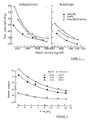
- FIG. 3 shows a comparison of Tear Index for kraft, Soda/AQ, the pulps manufactured in accordance with the methods of the invention both before and after bleaching.
- Three pulps were prepared by way of example from Pinus radiata chips, these being conventional kraft, Soda/AQ and the pulp of the present invention, all having comparable Kappa numbers between 28 and 30.
- the brightness range of the pulps after bleaching was in the range 87.1 to 87.7 with the pulp of the present invention being 87.3.
- the aged brightness of the pulps after bleaching was in the range of 84.9 to 85.8 with the pulp of the present invention being 85.2.
- the present invention therefore provides a high strength bleachable grade pulp with properties similar to conventional kraft pulp.
- sulphite addition be as low as practicable to simplify the pulping liquor chemical recovery, and for this reason, in a more preferred form of the invention a sulphite addition level of between 0.1% and 10% calculated as Na2SO3 addition by mass on oven dry wood is used.
- the amount of redox agent to be used is within the range 0.01% by mass and 5% by mass calculation on the basis of the anthraquinone structure (not the derivative) and expressed as per cent on oven dry wood.
- a preferred addition range of the redox agent is 0.01% to 2% by mass expressed as percent on oven dry wood of the anthraquinone structure.
- the sulphite has an influence over the delignification rate as well as providing the improvement in strength properties, the delignification rate increasing with increasing amounts of sulphite so that less alkali need be employed for the same rate of delignification.
- the alkali metal hydroxide used as the principal delignifying agent in the invention may also be varied to suit, and in accordance with normal pulpmill practise, and at least within the range 15% to 21% (expressed as NaOH on oven dry wood) has been found not to influence the tear strength of pulps made in accordance with the methods of the invention.
- alkali metal hydroxide within the range of 12% to 26% is used as the principal delignifying agent, the alkali metal hydroxide being expressed as per cent NaOH by mass on oven dry wood mass.
- a weak alkali such as sodium carbonate may be included in the pulping liquor for the purpose of providing a buffer for neutralizing wood acids and thereby to control pH of the pulping liquor.
- alkali metal hydroxide provides the principal delignifying agent in the present invention
- buffer compounds such as sodium carbonate may be included if desired.
- the first stage liquor may contain sodium carbonate to provide a buffer and thereby control pH.
- Both the first and second stage liquors may contain any one or more of the alkali compounds selected from alkali metal hydroxides, alkali metal carbonates, alkaline earth metal hydroxides and alkaline earth metal carbonates, as may the liquor when only one stage is used, provided that the principle delignifying agent in at least one stage is one or more alkali metal hydroxide.
- alkali metal hydroxide remains the principal delignifying agent preferably in combination with a preferred redox agent as defined hereinbefore.
- Sulphite particularly sodium sulphite is a relatively inexpensive non-toxic compound which can overcome the tear strength deficiency in the Soda/AQ pulping process to commercial advantage, while at the same time providing benefits to the process in addition to those provided by the preferred redox agents alone.
Landscapes
- Chemical & Material Sciences (AREA)
- Inorganic Chemistry (AREA)
- Paper (AREA)
Applications Claiming Priority (2)
| Application Number | Priority Date | Filing Date | Title |
|---|---|---|---|
| NZ217786 | 1986-10-02 | ||
| NZ21778686 | 1986-10-02 |
Publications (2)
| Publication Number | Publication Date |
|---|---|
| EP0262988A2 true EP0262988A2 (fr) | 1988-04-06 |
| EP0262988A3 EP0262988A3 (fr) | 1988-06-29 |
Family
ID=19921815
Family Applications (1)
| Application Number | Title | Priority Date | Filing Date |
|---|---|---|---|
| EP87308780A Withdrawn EP0262988A3 (fr) | 1986-10-02 | 1987-10-02 | Fabrication d'une pâte |
Country Status (5)
| Country | Link |
|---|---|
| EP (1) | EP0262988A3 (fr) |
| BR (1) | BR8705254A (fr) |
| FI (1) | FI874289A7 (fr) |
| PT (1) | PT85862B (fr) |
| ZA (1) | ZA877379B (fr) |
Cited By (6)
| Publication number | Priority date | Publication date | Assignee | Title |
|---|---|---|---|---|
| US6325892B1 (en) | 1998-09-23 | 2001-12-04 | University Of New Brunswick | Method of delignifying sulphite pulp with oxygen and borohydride |
| ES2195750A1 (es) * | 2000-11-28 | 2003-12-01 | Praxair Technology Inc | Metodo para mejorar el rendimiento y blanqueabilidad de pastas lignocelulosicas. |
| ES2319035A1 (es) * | 2006-04-13 | 2009-05-01 | Andritz Inc | Sistemas y procesos de formacion de pulpa alcalina de maderas duras. |
| WO2013164234A1 (fr) * | 2012-05-03 | 2013-11-07 | Annikki Gmbh | Procédé de production de cellulose à faible teneur en lignine à partir d'un matériau lignocellulosique |
| US9200406B2 (en) | 2005-03-31 | 2015-12-01 | Valmet Technologies, Inc. | Production of pulp using a gaseous organic agent as heating and reaction-accelerating media |
| CN115976865A (zh) * | 2021-10-14 | 2023-04-18 | 中国科学院大连化学物理研究所 | 一种化学法制备木质纤维素本色浆联产木质素磺酸盐的方法 |
Family Cites Families (6)
| Publication number | Priority date | Publication date | Assignee | Title |
|---|---|---|---|---|
| US1651665A (en) * | 1927-12-06 | And edward p | ||
| US2528351A (en) * | 1950-08-17 | 1950-10-31 | Hardwood By Products Inc | Alkaline sulfite digestion of hardwood |
| FR2357490A1 (fr) * | 1976-07-06 | 1978-02-03 | Eparco Sa | Activateur biologique pour fosses septiques |
| CA1110413A (fr) * | 1977-12-14 | 1981-10-13 | Oji Paper Co., Ltd. | Methode pour reduire la matiere lignocellulosique en pate |
| JPS55163291A (en) * | 1979-05-31 | 1980-12-19 | Oji Paper Co | Alkaline sulfite pulping method |
| JPS56118988A (en) * | 1980-02-18 | 1981-09-18 | Oji Paper Co | Alkali sulfite pulping method |
-
1987
- 1987-09-30 ZA ZA877379A patent/ZA877379B/xx unknown
- 1987-09-30 FI FI874289A patent/FI874289A7/fi not_active Application Discontinuation
- 1987-10-02 EP EP87308780A patent/EP0262988A3/fr not_active Withdrawn
- 1987-10-02 PT PT85862A patent/PT85862B/pt unknown
- 1987-10-02 BR BR8705254A patent/BR8705254A/pt unknown
Cited By (8)
| Publication number | Priority date | Publication date | Assignee | Title |
|---|---|---|---|---|
| US6325892B1 (en) | 1998-09-23 | 2001-12-04 | University Of New Brunswick | Method of delignifying sulphite pulp with oxygen and borohydride |
| ES2195750A1 (es) * | 2000-11-28 | 2003-12-01 | Praxair Technology Inc | Metodo para mejorar el rendimiento y blanqueabilidad de pastas lignocelulosicas. |
| US9200406B2 (en) | 2005-03-31 | 2015-12-01 | Valmet Technologies, Inc. | Production of pulp using a gaseous organic agent as heating and reaction-accelerating media |
| ES2319035A1 (es) * | 2006-04-13 | 2009-05-01 | Andritz Inc | Sistemas y procesos de formacion de pulpa alcalina de maderas duras. |
| ES2319035B1 (es) * | 2006-04-13 | 2010-02-10 | Andritz Inc | Sistemas y procesos de formacion de pulpa alcalina de maderas duras. |
| RU2414555C2 (ru) * | 2006-04-13 | 2011-03-20 | Андритц Инк. | Способ и установка для щелочной варки целлюлозы из древесины твердых пород |
| WO2013164234A1 (fr) * | 2012-05-03 | 2013-11-07 | Annikki Gmbh | Procédé de production de cellulose à faible teneur en lignine à partir d'un matériau lignocellulosique |
| CN115976865A (zh) * | 2021-10-14 | 2023-04-18 | 中国科学院大连化学物理研究所 | 一种化学法制备木质纤维素本色浆联产木质素磺酸盐的方法 |
Also Published As
| Publication number | Publication date |
|---|---|
| FI874289A0 (fi) | 1987-09-30 |
| FI874289L (fi) | 1988-04-03 |
| ZA877379B (en) | 1989-04-26 |
| PT85862B (en) | 1990-01-12 |
| EP0262988A3 (fr) | 1988-06-29 |
| BR8705254A (pt) | 1988-05-24 |
| FI874289A7 (fi) | 1988-04-03 |
| PT85862A (en) | 1987-11-01 |
Similar Documents
| Publication | Publication Date | Title |
|---|---|---|
| US4294653A (en) | Process for manufacturing chemimechanical cellulose pulp in a high yield within the range from 65 to 95% | |
| AU2007253774C1 (en) | Methods for carbonate pretreatment and pulping of cellulosic material | |
| CA2634202C (fr) | Materiau fibreux lignocellulosique a base de bois | |
| US6464827B1 (en) | Method of digesting wood with an alkaline liquor by adding an acidic agent to precipitate dissociated lignin | |
| US4507172A (en) | Kraft pulping process | |
| NO143298B (no) | Friserapparat. | |
| US3691008A (en) | Two-stage soda-oxygen pulping | |
| US4091749A (en) | Alkaline pulping of lignocellulosic material with amine pretreatment | |
| Kirçi et al. | A new modified pulping process alternative to sulphate method “Alkali-Sulfite-Antraquinone-Ethanol (ASAE)” | |
| US3951732A (en) | Delignification and bleaching of wood pulp with oxygen in the presence of triethanolamine | |
| US4384921A (en) | Alkaline sulfite pulping process with sodium aluminate and anthraquinone | |
| US8758557B2 (en) | Process for producing fibrous material from wood | |
| US3520773A (en) | Alkaline pulping processes with chemical pretreatment | |
| US4329200A (en) | Method and system for selective alkaline defiberization and delignification | |
| JPH0217675B2 (fr) | ||
| US2947657A (en) | Extraction of cellulose from vegetable matter | |
| PT85862B (en) | Manufacture of pulp | |
| Lundqvist et al. | Removal of non-process elements from hardwood chips prior to kraft cooking | |
| AU671159B2 (en) | Improved bleaching of high consistency lignocellulosic pulp | |
| Forouzanfar et al. | Study on production of fluting paper from poplar pulp mixed with hardwood NSSC pulp | |
| US3954553A (en) | Non-sulfur pulping process for corrugating medium using sodium carbonate and sodium hydroxide | |
| US3161562A (en) | Pulping cellulose material with an alkaline cooking liquor containing hydrazine | |
| US3401076A (en) | Increasing kraft pulp yield with hydroxylamine | |
| PATT et al. | 3 The ASAM Process | |
| CA1194656A (fr) | Methode de preparation de la liqueur de sulfite de cuisson neutre avec apport d'anthraquinone pour la production de la pate de papier |
Legal Events
| Date | Code | Title | Description |
|---|---|---|---|
| PUAI | Public reference made under article 153(3) epc to a published international application that has entered the european phase |
Free format text: ORIGINAL CODE: 0009012 |
|
| AK | Designated contracting states |
Kind code of ref document: A2 Designated state(s): AT BE CH DE ES FR GB GR IT LI LU NL SE |
|
| PUAL | Search report despatched |
Free format text: ORIGINAL CODE: 0009013 |
|
| AK | Designated contracting states |
Kind code of ref document: A3 Designated state(s): AT BE CH DE ES FR GB GR IT LI LU NL SE |
|
| STAA | Information on the status of an ep patent application or granted ep patent |
Free format text: STATUS: THE APPLICATION IS DEEMED TO BE WITHDRAWN |
|
| 18D | Application deemed to be withdrawn |
Effective date: 19880630 |
|
| RIN1 | Information on inventor provided before grant (corrected) |
Inventor name: FULLERTON, TERRY J. |