EP0263073A2 - Cationic disazo dyes - Google Patents
Cationic disazo dyes Download PDFInfo
- Publication number
- EP0263073A2 EP0263073A2 EP87810562A EP87810562A EP0263073A2 EP 0263073 A2 EP0263073 A2 EP 0263073A2 EP 87810562 A EP87810562 A EP 87810562A EP 87810562 A EP87810562 A EP 87810562A EP 0263073 A2 EP0263073 A2 EP 0263073A2
- Authority
- EP
- European Patent Office
- Prior art keywords
- formula
- alkyl
- hydrogen
- methyl
- independently
- Prior art date
- Legal status (The legal status is an assumption and is not a legal conclusion. Google has not performed a legal analysis and makes no representation as to the accuracy of the status listed.)
- Granted
Links
Classifications
-
- C—CHEMISTRY; METALLURGY
- C09—DYES; PAINTS; POLISHES; NATURAL RESINS; ADHESIVES; COMPOSITIONS NOT OTHERWISE PROVIDED FOR; APPLICATIONS OF MATERIALS NOT OTHERWISE PROVIDED FOR
- C09B—ORGANIC DYES OR CLOSELY-RELATED COMPOUNDS FOR PRODUCING DYES, e.g. PIGMENTS; MORDANTS; LAKES
- C09B44/00—Azo dyes containing onium groups
- C09B44/02—Azo dyes containing onium groups containing ammonium groups not directly attached to an azo group
- C09B44/08—Azo dyes containing onium groups containing ammonium groups not directly attached to an azo group from coupling components containing heterocyclic rings
-
- Y—GENERAL TAGGING OF NEW TECHNOLOGICAL DEVELOPMENTS; GENERAL TAGGING OF CROSS-SECTIONAL TECHNOLOGIES SPANNING OVER SEVERAL SECTIONS OF THE IPC; TECHNICAL SUBJECTS COVERED BY FORMER USPC CROSS-REFERENCE ART COLLECTIONS [XRACs] AND DIGESTS
- Y10—TECHNICAL SUBJECTS COVERED BY FORMER USPC
- Y10S—TECHNICAL SUBJECTS COVERED BY FORMER USPC CROSS-REFERENCE ART COLLECTIONS [XRACs] AND DIGESTS
- Y10S534/00—Organic compounds -- part of the class 532-570 series
- Y10S534/01—Mixtures of azo compounds
Definitions
- the invention relates to new cationic disazo dyes free of sulfonic acid groups, processes for their preparation and their use as dyes, in particular for dyeing textile materials and in particular paper.
- R 1 , R 2 and R 3 each independently represent an optionally substituted alkyl radical, for example methyl, ethyl, n- or isopropyl, n-, sec- or tert-butyl, straight-chain or branched pentyl or hexyl, cyclopentyl or cyclohexyl , where these radicals can be substituted, for example by hydroxy, phenyl or alkoxy. Examples of such substituted radicals are hydroxymethyl, hydroxyethyl, methoxyethyl, ethoxyethyl, propoxypropyl or benzyl.
- R 1 and R 2 can also represent a heterocyclic radical together with the nitrogen atom connecting them, for example a pyrrolidine, piperidine, morpholine or piperazine radical, or R 1 , R 2 and R 3 together with the nitrogen atom connecting them form a heterocyclic radical , for example a pyridinium or monoquaternized triethylenediamine residue.
- R 1 is preferably methyl or hydroxyethyl and R 2 and R 3 independently of one another are each C 1 -C 3 alkyl, in particular each methyl.
- A represents an alkylene radical with 2 to 6 C atoms, preferably an unbranched radical, e.g. Ethylene, propylene, butylene, pentylene or hexylene.
- A is preferably ethylene or butylene and in particular propylene.
- V and X each independently represent hydrogen, C 1 -C 4 alkyl or alkoxy, these being the latter groups can be substituted by hydroxy, halogen, such as bromine or especially chlorine, cyano or C I -C 4 alkoxy.
- V is preferably hydrogen and X is hydrogen, methyl or methoxy.
- Y represents hydrogen, C 1 -C 4 alkyl or alkoxy, halogen, such as bromine or chlorine, or cyan. Y is preferably hydrogen, methyl, methoxy or chlorine.
- Z is hydrogen, C 1 -C 4 alkyl or alkoxy, halogen, such as bromine or chlorine, cyano or a group of the formula -NH-CHO, -NH-CO-NH 2 , -NH-CO-NHQ or -NH -CO- (O) m -O, where m is zero or 1 and Q is optionally substituted C 1 -C 4 alkyl or phenyl.
- substituents for the alkyl groups Q are halogen, such as chlorine or bromine, or especially groups of the formulas into consideration, wherein R 1 , R 2 and R 3 have the meanings given above and An e is an anion.
- suitable substituents for the phenyl group Q are: C 1 -C 4 alkyl or alkoxy, halogen or nitro.
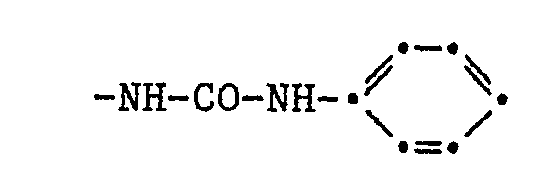
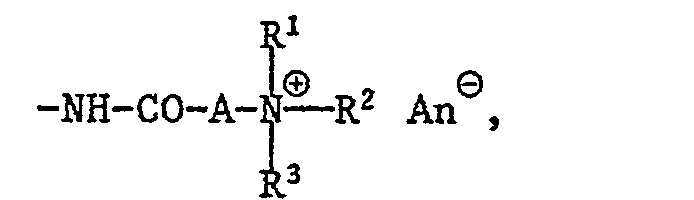
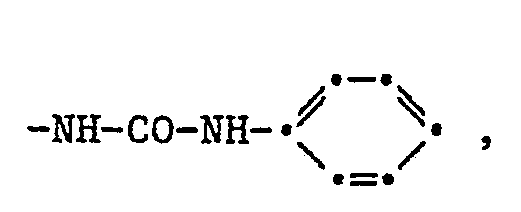
- Z is preferably methyl, ethyl, methoxy, ethoxy, acetylamino, propionylamino, methoxycarbonylamino, ethoxycarbonylamino or a group of the formula -NH-CHO, -NH-CO-NH 2 , or wherein A is ethylene, propylene or butylene, R 1 is methyl or hydroxyethyl and R 2 and R 3 are each independently of the other C 1 -C 3 alkyl.
- R 4 and R 5 each independently represent hydrogen, optionally substituted alkyl or optionally substituted phenyl.
- R 4 and / or R 5 represent an optionally substituted alkyl group, this includes, for example, a methyl, ethyl, n- or isopropyl, n-, sec- or tert-butyl, a straight-chain or branched one
- pentyl or hexyl or a cyclohexyl radical which can be substituted one or more times, for example by -OH, C 1 -C 4 alkoxy or Ci-C 4 hydroxyalkoxy.
- Suitable substituted alkyl radicals are: methoxymethyl, ethoxymethyl, ethoxyethyl, ethoxypropyl, n-propoxymethyl, iso-propoxymethyl, butoxymethyl, butoxyethyl, butoxypropyl, ethoxypentyl, methoxybutyl, ethoxypentyl and 2-hydroxyethoxypentyl.
- R 4 and / or R 5 are optionally substituted phenyl
- the phenyl may be unsubstituted or monosubstituted or polysubstituted by the same or different radicals.
- radicals are: C 1 -C 4 -alkyl, which is to be understood as methyl, ethyl, n- or isopropyl or n-, sec- or tert-butyl, C 1 -C 4 -alkoxy which in this application generally comprises methoxy, ethoxy, n- or iso-propoxy or n-, sec- or tert-butoxy, halogen such as fluorine, chlorine or bromine or nitro.
- R 4 and / or R 5 as phenyl is preferably phenyl which is unsubstituted or substituted by 1 to 3 C 1 -C 4 -alkyl, chlorine or methoxy groups, unsubstituted phenyl being particularly preferred.
- R 4 and R 5 are preferably hydrogen or C 1 -C 4 alkyl and particularly preferably hydrogen or methyl.
- Anions ane include both inorganic and organic anions; Examples include: halide, such as chloride, bromide or iodide, sulfate, methyl sulfate, boron tetrafluoride, aminosulfonate, perchlorate, carbonate, bicarbonate, phosphate, phosphoromolybdate, phosphorus tungstate, phosphorus tungsten molybdate, Benzenesulfonate, naphthalenesulfonate, 4-chlorobenzenesulfonate, oxalate, maleinate, acetate, propionate, lactate, succinate, chloroacetate, tartrate, methanesulfonate or benzoate ions, or complex anions such as that of double chlorine salts.
- halide such as chloride, bromide or iodide
- sulfate sulfate, methyl sulfate, boron tetrafluoride
- the anion is generally determined by the manufacturing process.
- the chlorides, hydrogen sulfates, sulfates, methosulfates, phosphates, formates, lactates or acetates are preferably present.
- the anions can be exchanged for other anions in a known manner.
- R 1 , R 2 and R 2 are each methyl
- a propylene, V and X are each hydrogen
- Y 3 O
- R 4 and R 5 are each hydrogen or methyl and the other symbols are the above have the meanings listed.
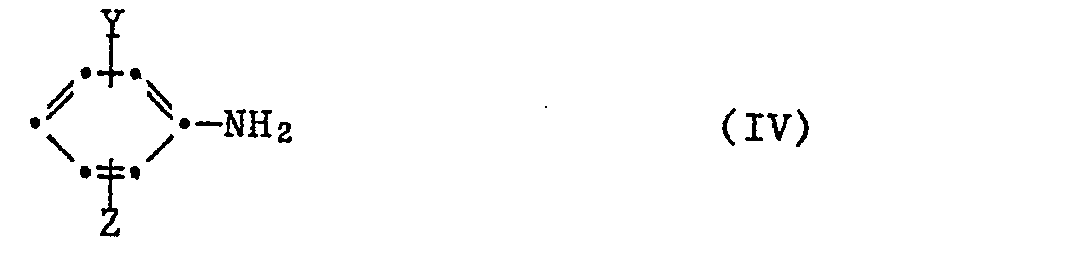
- the disazo dyes of the formula (I) are prepared in a manner known per se, for example by adding an amine of the formula diazotized with a coupling component of the formula implemented, the aminoazo compound obtained again diazotized and with a coupling component of the formula implement, the meanings and preferences given above apply to R 1 , R 2 , R 3 , A, V, X, Y, Z, Y 1 , Y 2 , Y 3 , R 4 , R 5 , n and Ane.
- the compounds of the formulas II, 111 and IV are known or can be obtained in a known manner.
- the azo compounds of the formula (I) are used both as powder or. Granulate preparations as well as in the form of concentrated solutions. Powder preparations are made in the usual way with setting materials such as sodium sulfate, phosphate, chloride, acetate in the presence of dustproofing agents, or the azo compounds are marketed directly as spray drying preparations.
- Concentrated dye solutions can be of an aqueous or aqueous / organic type, with customary and easily degradable additives being preferred, such as organic acids, preferably acetic acid, formic acid, lactic acid, citric acid, amides such as formamide, dimethylformamide, urea, alcohols such as glycol, diglycol, diglycol ether, preferably methyl or ethyl ether.
- the azo compounds of the formula (I) are used above all as dyes for dyeing and printing textile materials, paper, leather and for preparing inks. Natural and synthetic materials which can be dyed cationically are suitable as textile materials.
- These textile materials are preferably dyed in an aqueous, neutral or acidic medium by the exhaust process, if appropriate under pressure or by the continuous process.
- the textile material can be in a wide variety of forms, for example as fiber, thread, fabric, knitted fabric, piece goods and finished goods, such as shirts or pullovers.
- the dyes according to the invention can be used to produce level dyeings or prints which are distinguished by very good general fastness properties, above all a very high degree of exhaustion and good water fastness properties.
- the new azo compounds of the formula (I) can also be used for dyeing and printing natural and regenerated cellulose materials, especially cotton and viscose, which also gives strong colorations.
- the new azo compounds of the formula (I) have good drapeability, a good degree of exhaustion on these textile materials and the dyeings obtained have very good fastness properties, especially wet fastness properties.
- a preferred use of the new azo compounds of the formula (I) is in the application for dyeing paper of all types, especially bleached unsized and sized lignin-free paper, it being possible to start with bleached or unbleached cellulose and hardwood or softwood pulp such as Birch and / or pine sulfite and / or sulfate pulp can be used. These compounds are particularly suitable for dyeing unsized paper (e.g. napkins, tablecloths, hygienic papers) as a result of their very high affinity for this substrate.
- unsized paper e.g. napkins, tablecloths, hygienic papers
- the new azo compounds of the formula (I) absorb very well on these substrates, the waste water remaining practically colorless.
- the dyeings obtained are distinguished by good general fastness properties, such as good light fastness with high clarity and color strength and wet fastness, ie they show no tendency to bleed out when colored paper is brought into contact with moist white paper in the wet state. In addition, they have good alum, acid and alkali fastness.
- Wet fastness refers not only to water, but also to milk, fruit juices and sweetened mineral water; because of their good alcohol resistance They are also resistant to alcoholic beverages. This property is particularly desirable for serviettes and tablecloths, for example, where it is foreseeable that the colored paper will be in contact with other surfaces such as textiles, paper and when wet (e.g. soaked with water, alcohol, surfactant solution, etc.) The like comes, which must be protected against pollution.
- the abbreviation RKN represents a quality designation and indicates the degree of purity of the cellulose; the abbreviation SR (Schopper-Riegler) indicates the degree of grinding.
- Example 4 49.6 parts of 5-nitroisophthaloyl dichloride are dissolved in 180 parts of toluene and added dropwise to the solution of 42.9 parts of dimethylaminopropylamine in 80 parts of toluene, the temperature rising to 70 °. After dropping, the internal temperature is raised to 100 ° and held for 6 hours. After cooling to room temperature, the solvent is decanted off, the residue is dissolved in 100 parts of water and adjusted to pH 12 with sodium hydroxide solution. It is taken up in ethyl acetate, washed with brine and evaporated. The yellow oil obtained is dissolved in 90 parts of water, then 44.8 parts of dimethyl sulfate are added dropwise at 20-25 ° C.
- Example 1 B 10.8 parts of this compound are dissolved in 45 parts of water and then carried out as described in Example 1 B).
- the dye of the formula is obtained which comes in the form of a powder that is soluble in water or dilute acids and colors paper in yellow-orange tones.
- the paper dyeings show good light and wet fastness properties.
- Example 24 50 parts of chemically bleached beech sulfite are mixed with 50 parts of bleached RKN 15 (freeness 22 ° SR) and 2 parts of the dye according to Example 1 in water (pH 6, water hardness 10 ° dH, temperature 20 °, liquor ratio 1:40 ). After stirring for 15 minutes, paper sheets are produced on a Frank sheet former.
- the paper is colored in a very intense golden yellow shade.
- the wastewater is completely colorless.
- the degree of extension reaches practically 1000/0.
- the light and wet fastness properties are excellent.
- Example 25 A paper web is made from bleached beech sulfite (22 ° SR) on a continuously operating laboratory paper machine. Ten seconds before the headbox, an aqueous solution of the dyestuff according to Example 1 is metered continuously into the thin material under strong turbulence (0.5% color, liquor ratio 1: 400, water hardness 10 ° dH, pH 6, temperature 20 °).
- a strong orange shade of medium intensity is created on the paper web.
- the wastewater is completely colorless.
- Example 26 10 T of cotton fabric (bleached mercerized cotton) are in a laboratory tree dyeing machine in 200 T of a liquor (water hardness 10 ° dH, pH 4.3, 3 circulations of the dyeing liquor per minute) containing 0.05 T of the dye according to Example 1, colored. The temperature is increased from 20 ° to 100 ° in 60 minutes, then kept constant for 15 minutes.
- a liquor water hardness 10 ° dH, pH 4.3, 3 circulations of the dyeing liquor per minute
- the dye liquor has been completely removed.
- a strong orange color is created on the cotton fabric, which is characterized by good light fastness and very good wet fastness.
Landscapes
- Chemical & Material Sciences (AREA)
- Organic Chemistry (AREA)
- Coloring (AREA)
- Paper (AREA)
- Organic Low-Molecular-Weight Compounds And Preparation Thereof (AREA)
- Luminescent Compositions (AREA)
Abstract
Die neuen Disazofarbstoffe der im Anspruch 1 angegebenen Formel (I) eignen sich zum Färben und Bedrucken, insbesondere von Papier aller Arten.The new disazo dyes of the formula (I) specified in claim 1 are suitable for dyeing and printing, in particular of paper of all types.
Description
Die Erfindung betrifft neue kationische von Sulfonsäuregruppen freie Disazofarbstoffe, Verfahren zu deren Herstellung sowie deren Verwendung als Farbstoffe, insbesondere zum Färben von Textilmaterialien und insbesondere Papier.The invention relates to new cationic disazo dyes free of sulfonic acid groups, processes for their preparation and their use as dyes, in particular for dyeing textile materials and in particular paper.
Die neuen Disazofarbstoffe entsprechen der Formel

- Rl, R2 und R3 unabhängig voneinander je einen gegebenenfalls substituierten Alkylrest oder R1 und R2 zusammen mit dem sie verbindenden Stickstoffatom oder R1, R2 und R3 zusammen mit dem sie verbindenden Stickstoffatom einen heterocyclischen Rest,
- A einen Alkylenrest mit 2 bis 6 C-Atomen,
- V und X unabhängig voneinander Wasserstoff, gegebenenfalls durch Hydroxy, Halogen, Cyan oder C1-C4-Alkoxy substituiertes Ci-C4-Alkyl oder C1-C4-Alkoxy,
- Y Wasserstoff, C1-C4-Alkyl oder -Alkoxy, Halogen, Cyan,
- Z Wasserstoff, Ci-C4-Alkyl oder -Alkoxy, Halogen, Cyan, eine Gruppe der Formel -NH-CHO, -NH-CO-NH2, -NH-CO-NH-Q oder -NH-CO-(O)mQ, worin m Null oder 1 und Q gegebenenfalls substituiertes C1-C4-Alkyl oder Phenyl bedeutet, K eine Kupplungskomponente der Formel

- Y1 und Y2 unabhängig voneinander =O, =NH oder =N-G1-C4-Alkyl,
- Y3 =0, =S, =NR oder =N-CN, wobei R Wasserstoff oder C1-C4-Alkyl ist,
- R4 und R5 unabhängig voneinander je Wasserstoff, gegebenenfalls substituiertes Alkyl oder gegebenenfalls substituiertes Phenyl bedeuten,
- n 1 oder 2 und
- Ane ein Anion darstellt.
- R 1 , R 2 and R 3 independently of one another each have an optionally substituted alkyl radical or R 1 and R 2 together with the nitrogen atom connecting them or R 1 , R 2 and R 3 together with the nitrogen atom connecting them represent a heterocyclic radical,
- A is an alkylene radical with 2 to 6 carbon atoms,
- V and X are independently hydrogen, optionally substituted by hydroxy, halogen, cyano or C 1 -C 4 alkoxy-substituted Ci-C 4 alkyl or C 1 -C 4 alkoxy,
- Y is hydrogen, C 1 -C 4 alkyl or alkoxy, halogen, cyan,
- Z is hydrogen, Ci-C 4 alkyl or alkoxy, halogen, cyano, a group of the formula - NH-CHO, -NH-CO-NH 2 , -NH-CO-NH-Q or -NH-CO- (O ) m Q, where m is zero or 1 and Q is optionally substituted C 1 -C 4 alkyl or phenyl, K is a coupling component of the formula
- Y 1 and Y 2 independently of one another = O, = NH or = NG 1 -C 4 alkyl,
- Y 3 = 0, = S, = N R or = NC N , where R is hydrogen or C 1 -C 4 alkyl,
- R 4 and R 5 each independently represent hydrogen, optionally substituted alkyl or optionally substituted phenyl,
- n 1 or 2 and
- Ane represents an anion.
In der obigen Formel II ist für die Kupplungskomponente nur eine tautomere Form angegeben, auch die anderen tautomeren Formen sollen jedoch durch diese Formel mit umfasst sein.In the above formula II, only one tautomeric form is specified for the coupling component, but the other tautomeric forms are also intended to be encompassed by this formula.
Rl, R2 und R3 stellen unabhängig voneinander je einen gegebenenfalls substituierten Alkylrest dar, beispielsweise Methyl, Ethyl, n- oder iso-Propyl, n-, sec- oder tert-Butyl, geradkettiges oder verzweigtes Pentyl oder Hexyl, Cyclopentyl oder Cyclohexyl, wobei diese Reste substituiert sein können, z.B. durch Hydroxy, Phenyl oder Alkoxy. Beispiele für solche substituierten Reste sind Hydroxymethyl, Hydroxyethyl, Methoxyethyl, Ethoxyethyl, Propoxypropyl oder Benzyl.R 1 , R 2 and R 3 each independently represent an optionally substituted alkyl radical, for example methyl, ethyl, n- or isopropyl, n-, sec- or tert-butyl, straight-chain or branched pentyl or hexyl, cyclopentyl or cyclohexyl , where these radicals can be substituted, for example by hydroxy, phenyl or alkoxy. Examples of such substituted radicals are hydroxymethyl, hydroxyethyl, methoxyethyl, ethoxyethyl, propoxypropyl or benzyl.
R1 und R2 können auch zusammen mit dem sie verbindenden Stickstoffatom einen heterocyclischen Rest darstellen, beispielsweise einen Pyrrolidin-, Piperidin-, Morpholin- oder Piperazinrest, oder R1, R2 und R3 bilden zusammen mit dem sie verbindenden Stickstoffatom einen heterocyclischen Rest, z.B. einen Pyridinium- oder monoquaternierten Triethylendiaminrest.R 1 and R 2 can also represent a heterocyclic radical together with the nitrogen atom connecting them, for example a pyrrolidine, piperidine, morpholine or piperazine radical, or R 1 , R 2 and R 3 together with the nitrogen atom connecting them form a heterocyclic radical , for example a pyridinium or monoquaternized triethylenediamine residue.
Vorzugsweise bedeutet R1 Methyl oder Hydroxyethyl und R2 und R3 unabhängig voneinander je C1-C3-Alkyl, insbesondere je Methyl.R 1 is preferably methyl or hydroxyethyl and R 2 and R 3 independently of one another are each C 1 -C 3 alkyl, in particular each methyl.
A bedeutet einen Alkylenrest mit 2 bis 6 C-Atomen, vorzugsweise einen unverzweigten Rest, z.B. Ethylen, Propylen, Butylen, Pentylen oder Hexylen. Vorzugsweise bedeutet A Ethylen oder Butylen und insbesondere Propylen.A represents an alkylene radical with 2 to 6 C atoms, preferably an unbranched radical, e.g. Ethylene, propylene, butylene, pentylene or hexylene. A is preferably ethylene or butylene and in particular propylene.
V und X bedeuten unabhängig voneinander je Wasserstoff, C1-C4-Alkyl oder -Alkoxy, wobei diese letztgenannten Gruppen durch Hydroxy, Halogen, wie Brom oder vor allem Chlor, Cyan oder CI-C4-Alkoxy substituiert sein können. Vorzugsweise ist V Wasserstoff und X Wasserstoff, Methyl oder Methoxy.V and X each independently represent hydrogen, C 1 -C 4 alkyl or alkoxy, these being the latter groups can be substituted by hydroxy, halogen, such as bromine or especially chlorine, cyano or C I -C 4 alkoxy. V is preferably hydrogen and X is hydrogen, methyl or methoxy.
Y bedeutet Wasserstoff, C1-C4-Alkyl oder-Alkoxy, Halogen, wie Brom oder Chlor, oder Cyan. Vorzugsweise bedeutet Y Wasserstoff, Methyl, Methoxy oder Chlor.Y represents hydrogen, C 1 -C 4 alkyl or alkoxy, halogen, such as bromine or chlorine, or cyan. Y is preferably hydrogen, methyl, methoxy or chlorine.
Z bedeutet Wasserstoff, C1-C4-Alkyl oder -Alkoxy, Halogen, wie Brom oder Chlor, Cyan oder eine Gruppe der Formel -NH-CHO, -NH-CO-NH2, -NH-CO-NHQ oder -NH-CO-(O)m-O, worin m Null oder 1 und Q gegebenenfalls substituiertes C1-C4-Alkyl oder Phenyl bedeutet. Als Substituenten für die Alkylgruppen Q kommen z.B. Halogen, wie Chlor oder Brom, oder vor allem Gruppen der Formeln

Vorzugsweise bedeutet Z Methyl, Ethyl, Methoxy, Ethoxy, Acetylamino, Propionylamino, Methoxycarbonylamino, Ethoxycarbonylamino oder eine Gruppe der Formel -NH-CHO, -NH-CO-NH2,


Bei der Definition der Kupplungskomponente K der oben aufgeführten Formel (II) bedeuten R4 und R5 unabhängig voneinander je Wasserstoff, gegebenenfalls substituiertes Alkyl oder gegebenenfalls substituiertes Phenyl.In the definition of the coupling component K of the formula (II) listed above, R 4 and R 5 each independently represent hydrogen, optionally substituted alkyl or optionally substituted phenyl.
Stellen R4 und/oder R5 eine gegebenenfalls substituierte Alkylgruppe dar, so ist darunter z.B. ein Methyl-, Ethyl-, n- oder iso-Propyl-, n-, sec.- oder tert.-Butyl-, ein geradkettiger oder verzweigter Pentyl- oder Hexyl-oder ein Cyclohexylrest zu verstehen, der einfach oder mehrfach z.B. durch -OH, C1-C4-Alkoxy oder Ci-C4-Hydroxyalkoxy substituiert sein kann.If R 4 and / or R 5 represent an optionally substituted alkyl group, this includes, for example, a methyl, ethyl, n- or isopropyl, n-, sec- or tert-butyl, a straight-chain or branched one To understand pentyl or hexyl or a cyclohexyl radical, which can be substituted one or more times, for example by -OH, C 1 -C 4 alkoxy or Ci-C 4 hydroxyalkoxy.
Beispiele für geeignete substituierte Alkylreste sind: Methoxymethyl, Ethoxymethyl, Ethoxyethyl, Ethoxypropyl, n-Propoxymethyl, iso-Propoxymethyl, Butoxymethyl, Butoxyethyl, Butoxypropyl, Ethoxypentyl, Methoxybutyl, Ethoxypentyl und 2-Hydroxyethoxypentyl.Examples of suitable substituted alkyl radicals are: methoxymethyl, ethoxymethyl, ethoxyethyl, ethoxypropyl, n-propoxymethyl, iso-propoxymethyl, butoxymethyl, butoxyethyl, butoxypropyl, ethoxypentyl, methoxybutyl, ethoxypentyl and 2-hydroxyethoxypentyl.
Bedeuten R4 und/oder R5 gegebenenfalls substituiertes Phenyl, so kann es sich um unsubstituiertes oder einfach oder mehrfach mit gleichen oder verschiedenen Resten substituiertes Phenyl handeln.If R 4 and / or R 5 are optionally substituted phenyl, the phenyl may be unsubstituted or monosubstituted or polysubstituted by the same or different radicals.
Als derartige Rest kommen z.B. in Frage: C1-C4-Alkyl, worunter Methyl, Ethyl, n- oder iso-Propyl oder n-, sec.- oder tert.-Butyl zu verstehen ist, C1-C4-Alkoxy, welches in dieser Anmeldung generell, Methoxy, Ethoxy, n- oder iso-Propoxy oder n-, sec.- oder tert.-Butoxy umfasst, Halogen wie Fluor, Chlor oder Brom oder Nitro. Vorzugsweise handelt es sich bei R4 und/oder R5 als Phenyl um unsubstituiertes oder mit 1 bis 3 C1-C4-Alkyl, Chlor oder Methoxygruppen substituiertes Phenyl, wobei insbesondere die Bedeutung unsubstituiertes Phenyl bevorzugt ist.Examples of such radicals are: C 1 -C 4 -alkyl, which is to be understood as methyl, ethyl, n- or isopropyl or n-, sec- or tert-butyl, C 1 -C 4 -alkoxy which in this application generally comprises methoxy, ethoxy, n- or iso-propoxy or n-, sec- or tert-butoxy, halogen such as fluorine, chlorine or bromine or nitro. R 4 and / or R 5 as phenyl is preferably phenyl which is unsubstituted or substituted by 1 to 3 C 1 -C 4 -alkyl, chlorine or methoxy groups, unsubstituted phenyl being particularly preferred.
R4 und R5 stehen bevorzugt für Wasserstoff oder C1-C4-Alkyl und besonders bevorzugt für Wasserstoff oder Methyl.R 4 and R 5 are preferably hydrogen or C 1 -C 4 alkyl and particularly preferably hydrogen or methyl.
Y1 und/oder Y2 stehen vorzugsweise für die funktionelle Gruppe =0 oder =NH, wobei es ausserdem bevorzugt ist, dass Y1 und Y2 gleich sind. Y1 und Y2 sind besonders bevorzugt gleich und bedeuten jeweils =0.Y 1 and / or Y 2 preferably represent the functional group = 0 or = NH, it also being preferred that Y 1 and Y 2 are the same. Y 1 and Y 2 are particularly preferably the same and each mean = 0 .
Y3 stellt bevorzugt die Gruppe =0, = S, = NH oder =N-CN und insbesondere bevorzugt die Gruppe =0 dar.Y 3 preferably represents the group = 0, = S, = NH or = N-CN and particularly preferably the group = 0.
In einer besonders bevorzugten Ausführungsform der erfindungsgemässen Azofarbstoffe stehen Yl, Y2 und Y3 jeweils für =O.In a particularly preferred embodiment of the azo dyes according to the invention, Y 1 , Y 2 and Y 3 each represent = O.
Als Anionen Ane kommen sowohl anorganische wie organische Anionen in Frage; beispielsweise sind genannt: Halogenid-, wie Chlorid-, Bromid- oder Jodid-, Sulfat-, Methylsulfat-, Bortetrafluorid-, Aminosulfonate-, Perchlorat-, Carbonat-, Bicarbonat-, Phosphat-, Phosphormolybdat-, Phosphorwolframat-, Phosphorwolframmolybdat-, Benzolsulfonat-, Naphthalinsulfonat-, 4-Chlorbenzolsulfonat-, Oxalat-, Maleinat-, Acetat-, Propionat-, Lactat-, Succinat-, Chloracetat-, Tartrat-, Methansulfonat- oder Benzoationen, oder komplexe Anionen, wie das von Chlorzinkdoppelsalzen.Anions ane include both inorganic and organic anions; Examples include: halide, such as chloride, bromide or iodide, sulfate, methyl sulfate, boron tetrafluoride, aminosulfonate, perchlorate, carbonate, bicarbonate, phosphate, phosphoromolybdate, phosphorus tungstate, phosphorus tungsten molybdate, Benzenesulfonate, naphthalenesulfonate, 4-chlorobenzenesulfonate, oxalate, maleinate, acetate, propionate, lactate, succinate, chloroacetate, tartrate, methanesulfonate or benzoate ions, or complex anions such as that of double chlorine salts.
Das Anion ist im allgemeinen durch das Herstellungsverfahren vorgegeben. Vorzugsweise liegen die Chloride, Hydrogensulfate, Sulfate, Methosulfate, Phosphate, Formiate, Lactate oder Acetate vor. Die Anionen können in bekannter Weise gegen andere Anionen ausgetauscht werden.The anion is generally determined by the manufacturing process. The chlorides, hydrogen sulfates, sulfates, methosulfates, phosphates, formates, lactates or acetates are preferably present. The anions can be exchanged for other anions in a known manner.
Eine bevorzugte Ausführungsform der Erfindung betrifft Azofarbstoffe der Formel (I), worin
- R1 Methyl oder hydroxyethyl,
- R2 und R3 unabhängig voneinanderje C1-C3-Alkyl,
- A Ethylen, Propylen oder Butylen,
- V Wasserstoff,
- X Wasserstoff, Methyl oder Methoxy,
- Y Wasserstoff, Methyl, Methoxy oder Chlor,
- Z Methyl, Methoxy, Ethyl, Ethoxy, Acetylamino, Propionylamino, Methoxycarbonylamino, Ethoxycarbonylamino oder eine Gruppe der Formel -NH-CHO, -NH-CO-NH2,


- K eine Kupplungskomponente der Formel

- Y1 und Y2 unabhängig voneinander je = 0 oder = NH,
- Y3 =0, =S, =NH oder =N-CN,
- R4 und R5 unabhängig voneinander Wasserstoff oder C1-C4-Alkyl bedeuten,
- n 1 oder 2 und
- Ano ein Anion bedeutet.
- R 1 is methyl or hydroxyethyl,
- R 2 and R 3 are each independently of one another C 1 -C 3 alkyl,
- A ethylene, propylene or butylene,
- V hydrogen,
- X is hydrogen, methyl or methoxy,
- Y is hydrogen, methyl, methoxy or chlorine,
- Z is methyl, methoxy, ethyl, ethoxy, acetylamino, propionylamino, methoxycarbonylamino, ethoxycarbonylamino or a group of the formula -NH-CHO, -NH-CO-NH 2 ,
- K is a coupling component of the formula
- Y 1 and Y 2 independently of one another each = 0 or = NH,
- Y 3 = 0, = S, = NH or = N -CN,
- R 4 and R 5 independently of one another are hydrogen or C 1 -C 4 alkyl,
- n 1 or 2 and
- Ano means an anion.
Unter diesen sind diejenigen besonders bevorzugt, bei denen R1, R2 und R2 je Methyl, A Propylen, V und X je Wasserstoff, Y3 = O, R4 und R5 je Wasserstoff oder Methyl bedeuten und die übrigen Symbole die vorstehend aufgeführten Bedeutungen aufweisen.Among these, those are particularly preferred in which R 1 , R 2 and R 2 are each methyl, A propylene, V and X are each hydrogen, Y 3 = O, R 4 and R 5 are each hydrogen or methyl and the other symbols are the above have the meanings listed.
Die Herstellung der Disazofarbstoffe der Formel (I) erfolgt in an sich bekannter Art und Weise, beispielsweise indem man ein Amin der Formel


Die Verbindungen der Formeln II, 111 und IV sind bekannt oder können auf bekannte Art und Weise erhalten werden.The compounds of the formulas II, 111 and IV are known or can be obtained in a known manner.
Die Azoverbindungen der Formel (I) werden sowohl als Pulver-bzw. Granulat-Präparationen als auch in Form von konzentrierten Lösungen zum Einsatz gebracht. Pulver-Präparationen werden in üblicher Weise mit Stellmaterialien wie Natriumsulfat, -phosphat, -chlorid-, -acetat in Gegenwart von Entstaubungsmitteln eingestellt, oder die Azoverbindungen werden direkt als Sprühtrocknungspräparationen in den Handel gebracht. Konzentrierte Farbstofflösungen können wässriger oder wässrig/organischer Art sein, wobei übliche und möglichst gut abbaubare Zusätze bevorzugt werden wie organische Säuren, vorzugsweise, Essigsäure, Ameisensäure, Milchsäure, Zitronensäure, Amide wie Formamid, Dimethylformamid, Harnstoff, Alkohole wie Glykol, Diglykol, Diglykoläther, vorzugsweise Methyl- oder Aethyläther.The azo compounds of the formula (I) are used both as powder or. Granulate preparations as well as in the form of concentrated solutions. Powder preparations are made in the usual way with setting materials such as sodium sulfate, phosphate, chloride, acetate in the presence of dustproofing agents, or the azo compounds are marketed directly as spray drying preparations. Concentrated dye solutions can be of an aqueous or aqueous / organic type, with customary and easily degradable additives being preferred, such as organic acids, preferably acetic acid, formic acid, lactic acid, citric acid, amides such as formamide, dimethylformamide, urea, alcohols such as glycol, diglycol, diglycol ether, preferably methyl or ethyl ether.
Verwendung finden die Azoverbindungen der Formel (I) vor allem als Farbstoffe zum Färben und Bedrucken von Textilmaterialien, Papier, Leder und zur Bereitung von Tinten. Als Textilmaterialien kommen natürliche und synthetische kationisch anfärbbare Materialien in Frage. Bevorzugt werden die neuen Azoverbindungen zum Färben und Bedrucken von Papier, Halbkartons und Kartons in der Masser und In der Oberfläche, sowie von Textilmaterialien, die z.B. vorteilhaft aus Homo- oder Mischpolymerisaten des Acryinitrils bestehen oder aus synthetischen Polyamiden oder Polyestern, welche durch saure Gruppen modifiziert sind, eingesetzt. Man färbt diese Textilmaterialien vorzugsweise in wässrigem, neutralem oder saurem Medium nach dem Ausziehverfahren, gegebenenfalls unter Druck oder nach dem Kontinueverfahren. Das Textilmaterial kann dabei in verschiedenartigster Form vorliegenden, beispielsweise als Faser, Faden, Gewebe, Gewirke, Stückware und Fertigware, wie Hemden oder Pullover.The azo compounds of the formula (I) are used above all as dyes for dyeing and printing textile materials, paper, leather and for preparing inks. Natural and synthetic materials which can be dyed cationically are suitable as textile materials. The new azo compounds for dyeing and printing paper, semi-cardboard and cardboard in the bulk and in the surface, as well as textile materials, e.g. advantageously consist of homopolymers or copolymers of acrylonitrile or synthetic polyamides or polyesters modified by acidic groups. These textile materials are preferably dyed in an aqueous, neutral or acidic medium by the exhaust process, if appropriate under pressure or by the continuous process. The textile material can be in a wide variety of forms, for example as fiber, thread, fabric, knitted fabric, piece goods and finished goods, such as shirts or pullovers.
Mit den erfindungsgemässen Farbstoffen lassen sich egale Färbungen bzw. Drucke herstellen, die sich durch sehr gute Allgemeinechtheiten vor allem einen sehr hohen Ausziehgrad und gute Wasserechtheiten auszeichnen.The dyes according to the invention can be used to produce level dyeings or prints which are distinguished by very good general fastness properties, above all a very high degree of exhaustion and good water fastness properties.
Des Weiteren können die neuen Azoverbindungen der Formel (I) auch zum Färben und Bedrucken von natürlichen und regenerierten Cellulosematerialien, vor allem von Baumwolle und Viscose verwendet werden, wobei man ebenfalls farbstarke Ausfärbungen erhält.Furthermore, the new azo compounds of the formula (I) can also be used for dyeing and printing natural and regenerated cellulose materials, especially cotton and viscose, which also gives strong colorations.
Die neuen Azoverbindungen der Formel (I) haben auf diesen Textilmaterialien ein gutes Ziehvermögen, einen guten Ausziehgrad und die erhaltenen Färbungen weisen sehr gute Echtheiten, vor allem Nassechtheiten auf.The new azo compounds of the formula (I) have good drapeability, a good degree of exhaustion on these textile materials and the dyeings obtained have very good fastness properties, especially wet fastness properties.
Eine bevorzugte Verwendung der neuen Azoverbindungen der Formel (I) liegt in der Anwendung zum Färben von Papier aller Arten, vor allem von gebleichtem ungeleimtem und geleimtem ligninfreiem Papier, wobei von gebleichtem oder ungebleichtem Zeiistoff ausgegangen werden kann und Laub- oder Nadelholz-Zellstoff, wie Birken- und/oder Kiefernsulfit und/oder Sulfat-Zellstoff verwendet werden kann. Ganz besonders geeignet sind diese Verbindungen zum Färben von ungeleimtem Papier (z.B. Servietten, Tischdecken, hygienischen Papieren) als Folge ihrer sehr hohen Affinität zu diesem Substrat.A preferred use of the new azo compounds of the formula (I) is in the application for dyeing paper of all types, especially bleached unsized and sized lignin-free paper, it being possible to start with bleached or unbleached cellulose and hardwood or softwood pulp such as Birch and / or pine sulfite and / or sulfate pulp can be used. These compounds are particularly suitable for dyeing unsized paper (e.g. napkins, tablecloths, hygienic papers) as a result of their very high affinity for this substrate.
Die neuen Azoverbindungen der Formel (I) ziehen auf diese Substrate sehr gut auf, wobei die Abwässer praktisch farblos bleiben.The new azo compounds of the formula (I) absorb very well on these substrates, the waste water remaining practically colorless.
Man erhält Färbungen in gelben, gelb-orangen oder roten Nuancen.Colorings in yellow, yellow-orange or red shades are obtained.
Die erhaltenen Färbungen zeichnen sich durch gute Allgemeinechtheiten aus, wie eine gute Lichtechtheit bei gleichzeitig hoher Klarheit und Farbstärke und Nassechtheit, d.h. sie zeigen keine Neigung zum Ausbluten, wenn gefärbtes Papier in nassem Zustand mit feuchtem weissem Papier in Berührung gebracht wird. Darüber hinaus weisen sie eine gute Alaun-, Säure- und Alkali-Echtheit auf. Die Nassechtheit bezieht sich nicht nur auf Wasser, sondern auch auf Milch, Fruchtsäfte und gesüsstes Mineralwasser; wegen ihrer guten Alkoholechtheit sind sie auch gegen alkoholische Getränkte beständig. Diese Eigenschaft ist z.B. besonder für Servietten und Tischdecken erwünscht, bei denen vorhersehbar ist, dass das gefärbte Papier in nassem Zustand (z.B. getränkt mit Wasser, Alkohol, Tensid-Lösung etc....) in Berührung mit anderen Flächen wie Textilien, Papier und dergleichen kommt, die gegen Verschmutzung geschützt werden müssen.The dyeings obtained are distinguished by good general fastness properties, such as good light fastness with high clarity and color strength and wet fastness, ie they show no tendency to bleed out when colored paper is brought into contact with moist white paper in the wet state. In addition, they have good alum, acid and alkali fastness. Wet fastness refers not only to water, but also to milk, fruit juices and sweetened mineral water; because of their good alcohol resistance They are also resistant to alcoholic beverages. This property is particularly desirable for serviettes and tablecloths, for example, where it is foreseeable that the colored paper will be in contact with other surfaces such as textiles, paper and when wet (e.g. soaked with water, alcohol, surfactant solution, etc.) The like comes, which must be protected against pollution.
Die hohe Affinität für Papier und die grosse Ausziehgeschwindigkeit der neuen Farbstoffe ist für das Kontinue-Färben von Papier von grossem Vorteil.The high affinity for paper and the high extraction speed of the new dyes are of great advantage for the continuous dyeing of paper.
Die folgenden Beispiele veranschaulichen die Erfindung, ohne sie darauf zu limitieren. Teile (T) sind - sofern nichts anderes angegeben - Gewichtsteile und die Temperaturen sind in Grad Celsius angegeben.The following examples illustrate the invention without limiting it. Unless otherwise stated, parts (T) are parts by weight and the temperatures are given in degrees Celsius.
Die Abkürzung RKN stellt eine Qualitätsbezeichnung dar und gibt den Reinheitsgrad der Cellulose an; die Abkürzung SR (Schopper-Riegler) gibt den Mahlgrad an.The abbreviation RKN represents a quality designation and indicates the degree of purity of the cellulose; the abbreviation SR (Schopper-Riegler) indicates the degree of grinding.
-
a) Zu einer Lösung von 84 Teilen p-Nitrobenzoylchlorid in 260 Teilen Toluol werden 95,1 Teile Dimethylaminopropylamin innerhalb von 15 Minuten zugetropf Die Temperatur steigt dabei exotherm auf 95°. Nach dem Absinken der Temperatur auf 30° werden 200 Teile Wasser zugegeben, auf 10°C gekühlt, das ausgefallene Produkt abgesaugt, mit Wasser salzfrei gewaschen und unter Vakuum bei 60° getrocknet. Das Produkt wird dann zur Quaternierung in 960 Teilen Toluol verrührt und danach werden 47,8 Teile Dimethylsulfat zugetropft. Die Temperatur steigt dabei auf 50° (exotherm). Anschliessend wird auf 75° erwärmt und diese Temperatur 8 Stunden beibehalten. Nach Abkühlen auf Raumtemperatur wird das weisse quaternierte Produkt abgesaugt, mit Toluol gewaschen und bei 60° unter Vakuum getrocknet. Zur Hydrierung wird es in Anwesenheit von Palladiumkohle in 320 Teilen Methanol suspendiert und mit Wasserstoff hydriert. Nach Beendigung der Reduktion wird der Katalysator abgesaugt und das Methanol unter Vakuum abdestilliert. Der harzige Rückstand entpricht der Formel

-
B) 7,7 Teile der gemäss A) hergestellten Verbindung werden in 35 Teilen Wasser gelöst, mit 30 Teilen Eis und 7 Teilen 32 %iger Salzsäure versetzt und mit 20,8 Teilen 1n n Natriumnitrilösung bei 0 - 5° diazotiert. Dann werden 2,4-Teile 2,5-Dimethylanilin in 42 Teilen 3,5 O/oiger Salzsäure gelöst und in die Diazolösung getropft. Durch Einstreuen von krist. Na-acetat wird das Kupplungsgemisch auf einen pH-Wert von 3,5 - 4 gestellt. Sobald keine Diazolösung mehr nachweisbar ist, wird die Suspension mit Kochsalz versetzt, bis eine Tüpfelprobe praktisch farblosen Auslauf zeigt. Danach wird der Niederschlag filtriert und mit Salzlösung gewaschen. Der vorliegende Monoazofarbstoff wird in 200 Teilen Wasser suspendiert, dann werden 7 Teile 32 0/oige Salzsäure zugesetzt und bei 0 - 5° mit 19,2 Teilen 1n n Natriumnitritlösung diazotiert. Bei 0 -10° wird die Diazolösung zu einer Lösung von 2,4 Teilen Barbitursäure in 100 Teilen Wasser und 15 Teilen 30 o/oiger Natronlauge getropft, wobei ein pH-Wert von 6 - 7 durch Zugabe von Natronlauge gehalten wird. Man rührt 4 Stunden, setzt dann 160 Teile Ethanol zu, rührt weitere 2 Stunden, saugt den ausgefallenen Farbstoff ab, wäscht mit Ethanol, dann mit Aceton und trocknet im Vakuum bei 60°. Der Farbstoff, entsprechend der Formel
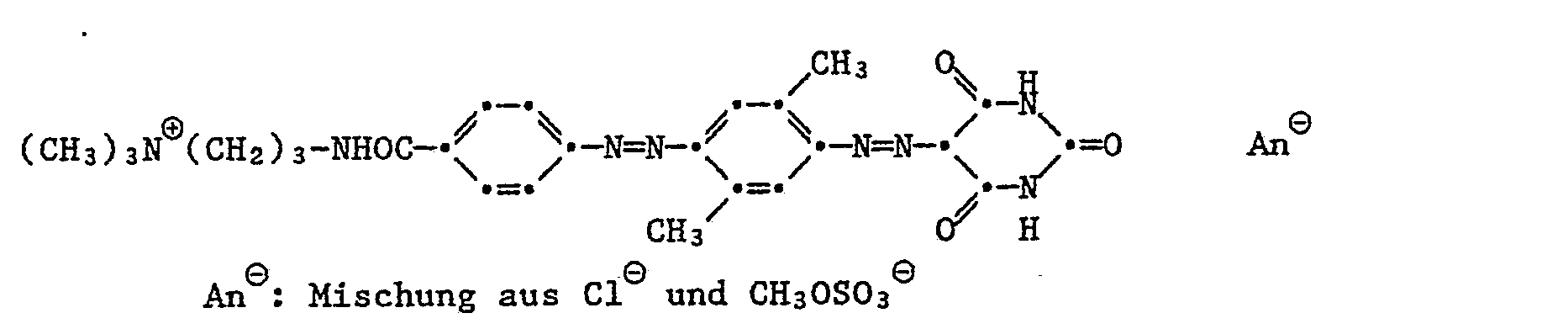
Beispiel 2: Arbeitet man wie im Beispiel 1 A) beschrieben, verwendet jedoch anstelle von p-Nitrobenzoylchlorid die gleiche Menge m-Nitrobenzoylchlorid, so erhält man die Verbindung der Formel

Von dieser Verbindung setzt man 7 Teile ein und arbeitet wie im Beispiel 1 B) beschrieben. Man erhält den Farbstoff der Formel

A) Zu einer Lösung von 47 Teilen p-Nitrobenzoylchlorid in 174 Teilen Toluol tropft man innerhalb von 15 Minuten 65,7 Teile Diethylaminopropylamin. Die Temperatur steigt dabei exotherm auf 90°. Nach dem Absinken der Temperatur auf 35° werden 100 Teile Wasser zugesetzt und verrührt. Man wartet, bis sich die Phasen getrennt haben, wäscht die organische Phase mit Wasser, trocknet und dampft ein. Der Rückstand wird in 87 Teilen Toluol gelöst und anschliessend wie im Beispiel 1A) beschrieben durch Zutropfen von 42 Teilen Dimethylsulfat quaterniert, danach hydriert und aufgearbeitet. Man erhält die Verbindung der Formel

Von dieser Verbindung setzt man 8,3 Teile ein und arbeitet wie im Beispiel 1 B) beschrieben. Man erhält den Farbstoff der Formel

Beispiel 4: 49,6 Teile 5-Nitroisophthalsäuredichlorid werden in 180 Teilen Toluol gelöst und zu der Lösung von 42,9 Teilen Dimethylaminopropylamin in 80 Teilen Toluol getropft, wobei die Temperatur auf 70° ansteigt. Nach dem Zutropfen erhöht man die Innentemperatur auf 100° und hält diese während 6 Stunden. Nach Abkühlen auf Raumtemperatur wird das Lösungsmittel abdekantiert, der Rückstand in 100 Teilen Wasser gelöst und mit Natronlauge auf pH 12 gestellt. Er wird in Essigsäureethylester aufgenommen mit Salzlösung gewaschen und eingedampft. Das erhaltene gelbe Oel wird in 90 Teilen Wasser gelöst, dann werden bei 20 - 25° 44,8 Teile Dimethylsulfat in ca. 45 Min. zugetropft, wobei gleichzeitig durch Zudosieren von 4n Natronlauge ein pH von 10 - 11 eingehalten wird. Man rührt 4 Stunden bei diesem pH-Wert nach. Die vorliegende Lösung wird mit 325 Teilen Ethanol und 260 Teilen Wasser verdünnt und über Palladiumkohle hydriert. Nach Beendigung der Redaktion wird der Katalysator abgesaugt und die Lösung im Vakuum eingedampft. Man erhält die Verbindung der Formel

10,8 Teile dieser Verbindung löst man in 45 Teilen Wasser und arbeitet anschliessend wie im Beispiel 1 B) beschrieben. Man erhält den Farbstoff der Formel

Verwendet man bei ansonsten gleichem Vorgehen wie im Beispiel 1 beschrieben äquivalente Mengen der in Spalte 2 der folgenden Tabelle aufgeführten Anilinderivate und der in Spalte 3 aufgeführten Kupplungskomponenten, so erhält man Farbstoffe der Formel


Verwendet man bei ansonsten gleichem Vorgehen wie im Beispiel 4 beschrieben äquivalente Mengen der in Spalte 2 der folgenden Tabelle aufgeführten Anilinderivate und der in Spalte 3 aufgeführten Kupplungskomponenten, so erhält man Farbstoffe der Formel


Verwendet man bei ansonsten gleichem Vorgehen wie im Beispiel 3 beschrieben äquivalente Mengen in der Spalte 2 der folgenden Tabelle aufgeführten Anilinderivate und der in Spalte 3 aufgeführten Kupplungskomponenten, so erhält man Farbstoffe der Formel


Beispiel 24: Man vermischt 50 T chemisch gebleichte Buche Sulfit mit 50 T gebleichtem RKN 15 (Mahlgrad 22° SR) und 2 T des Farbstoffes gemäss Beispiel 1 in Wasser (pH 6, Wasserhärts 10° dH, Temperatur 20°, Flottenverhältnis 1:40). Nach 15 minütigem Rühren werden Papierblätter auf einem Frank-Blattbildner hergestellt.Example 24: 50 parts of chemically bleached beech sulfite are mixed with 50 parts of bleached RKN 15 (freeness 22 ° SR) and 2 parts of the dye according to Example 1 in water (pH 6, water hardness 10 ° dH, temperature 20 °, liquor ratio 1:40 ). After stirring for 15 minutes, paper sheets are produced on a Frank sheet former.
Das Papier ist in einer sehr intensiven Goldgelbnuance gefärbt. Das Abwasser ist völlig farblos. Der Ausziehgrad erreicht praktisch 1000/0. Die Licht- und Nassechtheiten sind ausgezeichnet.The paper is colored in a very intense golden yellow shade. The wastewater is completely colorless. The degree of extension reaches practically 1000/0. The light and wet fastness properties are excellent.
Beispiel 25: Es wird eine Papierbahn aus gebleichtem Buche-Sulfit (22° SR) auf einer kontinuierlich arbeitenden Labor-Papiermaschine hergestellt. Zehn Sekunden vor dem Stoffauflauf wird eine wässrige Lösung des Farbstoffe gemäss Beispiel 1 unter starker Turbulenz dem Dünnstoff kontinuierlich zudosiert (0,5%ige Färbung, Flottenverhältnis 1:400, Wasserhärts 10° dH, pH 6, Temperatur 20°).Example 25: A paper web is made from bleached beech sulfite (22 ° SR) on a continuously operating laboratory paper machine. Ten seconds before the headbox, an aqueous solution of the dyestuff according to Example 1 is metered continuously into the thin material under strong turbulence (0.5% color, liquor ratio 1: 400, water hardness 10 ° dH, pH 6, temperature 20 °).
Es entsteht auf der Papierbahn eine farbstarke Orangenuance von mittlerer Intensität. Das Abwasser ist völlig farblos.A strong orange shade of medium intensity is created on the paper web. The wastewater is completely colorless.
Beispiel 26: 10 T Baumwollgewebe (gebleichte mercerisierte Baumwolle) werden in einem Labor-Baumfärbeapparat in 200 T einer Flotte (Wasserhärte 10° dH, pH 4, 3 Umwälzungen der Färbeflotte pro Minute) die 0,05 T des Farbstoffes gemäss Beispiel 1 enthält, gefärbt. Die Temperatur wird in 60 Minuten von 20° auf 100° erhöht, dann während 15 Minuten konstant gehalten.Example 26: 10 T of cotton fabric (bleached mercerized cotton) are in a laboratory tree dyeing machine in 200 T of a liquor (water hardness 10 ° dH, pH 4.3, 3 circulations of the dyeing liquor per minute) containing 0.05 T of the dye according to Example 1, colored. The temperature is increased from 20 ° to 100 ° in 60 minutes, then kept constant for 15 minutes.
Die Färbeflotte ist völlig ausgezogen. Es entsteht auf dem Baumwollgewebe eine farbstarke orange Färbung, welche sich durch eine gute Lichtechtheit und eine sehr gute Nassechtheit auszeichnet.The dye liquor has been completely removed. A strong orange color is created on the cotton fabric, which is characterized by good light fastness and very good wet fastness.
Färbt man bei gleicher Arbeitsweise ein Textilgewebe aus Regenerat-Cellulose (Viskose), so erhält man auch auf diesem Material mit dem Farbstoff des Beispiels 1 eine farbstarke gelb-orange Färbung, die eine gute Lichtechtheit und sehr gute Nassechtheit besitzt.If a textile fabric made from regenerated cellulose (viscose) is dyed using the same procedure, a strong yellow-orange dyeing is obtained on this material with the dye of Example 1, which has good lightfastness and very good wetfastness.
Claims (21)







Applications Claiming Priority (2)
| Application Number | Priority Date | Filing Date | Title |
|---|---|---|---|
| CH396086 | 1986-10-03 | ||
| CH3960/86 | 1986-10-03 |
Publications (3)
| Publication Number | Publication Date |
|---|---|
| EP0263073A2 true EP0263073A2 (en) | 1988-04-06 |
| EP0263073A3 EP0263073A3 (en) | 1990-08-08 |
| EP0263073B1 EP0263073B1 (en) | 1993-09-29 |
Family
ID=4267161
Family Applications (1)
| Application Number | Title | Priority Date | Filing Date |
|---|---|---|---|
| EP87810562A Expired - Lifetime EP0263073B1 (en) | 1986-10-03 | 1987-09-28 | Cationic disazo dyes |
Country Status (4)
| Country | Link |
|---|---|
| US (1) | US4873319A (en) |
| EP (1) | EP0263073B1 (en) |
| JP (1) | JP2562151B2 (en) |
| DE (1) | DE3787608D1 (en) |
Cited By (1)
| Publication number | Priority date | Publication date | Assignee | Title |
|---|---|---|---|---|
| EP0434623A1 (en) * | 1989-12-22 | 1991-06-26 | Ciba-Geigy Ag | Cationic azo dyes |
Families Citing this family (4)
| Publication number | Priority date | Publication date | Assignee | Title |
|---|---|---|---|---|
| DE4028630A1 (en) * | 1990-09-08 | 1992-03-12 | Basf Ag | DISAZO DYES, THEIR CLUTCH COMPONENTS FROM THE RANGE OF HYDROXYSULFONYLNAPHTHALINE STEMS |
| GB0602687D0 (en) * | 2006-02-10 | 2006-03-22 | Avecia Inkjet Ltd | Ink-jet printing using disazo dyes |
| JP2009013291A (en) * | 2007-07-04 | 2009-01-22 | Sumitomo Chemical Co Ltd | Azo compound or salt thereof |
| CN114315803B (en) * | 2021-12-23 | 2023-05-30 | 上海应用技术大学 | Synthesis method of red disazo organic pigment |
Family Cites Families (7)
| Publication number | Priority date | Publication date | Assignee | Title |
|---|---|---|---|---|
| US2130358A (en) * | 1937-04-07 | 1938-09-20 | Eastman Kodak Co | Azo compounds and process for coloring therewith |
| US2216446A (en) * | 1939-05-25 | 1940-10-01 | Eastman Kodak Co | Polyazo compounds and material colored therewith |
| US2945849A (en) * | 1957-03-04 | 1960-07-19 | Bayer Ag | Disazo compounds containing a quaternary ammonium group |
| US3337523A (en) * | 1961-04-21 | 1967-08-22 | Sandoz Ltd | Basic monoazo and disazo dyestuffs containing a hydrazinium group |
| US3341512A (en) * | 1963-09-09 | 1967-09-12 | Geigy Ag J R | Benzene-azo-barbituric acid dyestuffs |
| US4062836A (en) * | 1975-02-03 | 1977-12-13 | Ciba-Geigy Corporation | Disperse phenylazophenylazobarbituric acid dyestuffs |
| DE2915323A1 (en) * | 1978-04-26 | 1979-11-08 | Sandoz Ag | BASIC OR CATIONIC MONOAZO OR DISAZO COMPOUNDS CONTAINING SULPHONIC ACID GROUPS |
-
1987
- 1987-09-25 US US07/100,853 patent/US4873319A/en not_active Expired - Lifetime
- 1987-09-28 EP EP87810562A patent/EP0263073B1/en not_active Expired - Lifetime
- 1987-09-28 DE DE87810562T patent/DE3787608D1/en not_active Expired - Fee Related
- 1987-10-02 JP JP62248220A patent/JP2562151B2/en not_active Expired - Lifetime
Cited By (2)
| Publication number | Priority date | Publication date | Assignee | Title |
|---|---|---|---|---|
| EP0434623A1 (en) * | 1989-12-22 | 1991-06-26 | Ciba-Geigy Ag | Cationic azo dyes |
| US5241054A (en) * | 1989-12-22 | 1993-08-31 | Ciba-Geigy Corporation | Cationic azo dyes |
Also Published As
| Publication number | Publication date |
|---|---|
| DE3787608D1 (en) | 1993-11-04 |
| EP0263073B1 (en) | 1993-09-29 |
| US4873319A (en) | 1989-10-10 |
| JP2562151B2 (en) | 1996-12-11 |
| EP0263073A3 (en) | 1990-08-08 |
| JPS6390569A (en) | 1988-04-21 |
Similar Documents
| Publication | Publication Date | Title |
|---|---|---|
| EP0176472A1 (en) | Methine azo compounds | |
| EP0116513B1 (en) | Water soluble triazine compounds | |
| EP0306452B1 (en) | Cationic disazo stilbene dyes | |
| EP0263073B1 (en) | Cationic disazo dyes | |
| DE3223436A1 (en) | TRIAZINE COMPOUNDS | |
| EP0145656B1 (en) | Cationic compounds | |
| EP0434623B1 (en) | Cationic azo dyes | |
| EP0212553B1 (en) | Process for dyeing paper | |
| EP0038299B1 (en) | Cationic compounds | |
| EP0184991B1 (en) | Cationic phthalocyanine compounds | |
| EP0122458B1 (en) | Azo compounds | |
| DE3537629C2 (en) | Oxazine compounds, their production and use | |
| EP0284567B1 (en) | Cationic azo dyes | |
| EP0084372B1 (en) | Benzothiazole compounds, process for their preparation and their use as dyestuffs for textile materials, paper, leather and inks | |
| EP0294330B1 (en) | Cationic disazo dyes | |
| EP0016726B1 (en) | Basic or quaternised azodyestuffs of the 2-(4'-azophenyl) benzothiazole series, process for their preparation and their use in dyeing and printing textile material, paper and leather | |
| EP0094642A1 (en) | Mixture of cationic compounds | |
| DE3234785C2 (en) | ||
| DE3821627A1 (en) | New cationic diazo dyestuff cpds. prepn. and use as ink and dye - e.g. benzanilide-4,4'-diazo-bis -4-4-acetyl:acetamido-3'-(N,N,N -trimethylaminopropyl)-benzamide chloride-metho:sulphate | |
| EP0088418B1 (en) | Quinophthalone compounds, process for their preparation and their use in the dyeing and printing of textile materials, paper, leather and for the preparation of inks | |
| DE3412668A1 (en) | Organic compounds | |
| EP0757083A2 (en) | Cationic thiazolazo and benzothiazolazo dyestuffs | |
| EP0292433B1 (en) | Cationic compounds | |
| DE3420777A1 (en) | AZO CONNECTIONS | |
| DE19500203A1 (en) | Cationically bridged tetrakisazo dyes with different couplers, their production and use |
Legal Events
| Date | Code | Title | Description |
|---|---|---|---|
| PUAI | Public reference made under article 153(3) epc to a published international application that has entered the european phase |
Free format text: ORIGINAL CODE: 0009012 |
|
| AK | Designated contracting states |
Kind code of ref document: A2 Designated state(s): CH DE FR GB IT LI |
|
| 17P | Request for examination filed |
Effective date: 19870930 |
|
| PUAL | Search report despatched |
Free format text: ORIGINAL CODE: 0009013 |
|
| AK | Designated contracting states |
Kind code of ref document: A3 Designated state(s): CH DE FR GB IT LI |
|
| 17Q | First examination report despatched |
Effective date: 19920115 |
|
| GRAA | (expected) grant |
Free format text: ORIGINAL CODE: 0009210 |
|
| ITF | It: translation for a ep patent filed | ||
| AK | Designated contracting states |
Kind code of ref document: B1 Designated state(s): CH DE FR GB IT LI |
|
| ET | Fr: translation filed | ||
| REF | Corresponds to: |
Ref document number: 3787608 Country of ref document: DE Date of ref document: 19931104 |
|
| GBT | Gb: translation of ep patent filed (gb section 77(6)(a)/1977) |
Effective date: 19931118 |
|
| PLBE | No opposition filed within time limit |
Free format text: ORIGINAL CODE: 0009261 |
|
| STAA | Information on the status of an ep patent application or granted ep patent |
Free format text: STATUS: NO OPPOSITION FILED WITHIN TIME LIMIT |
|
| 26N | No opposition filed | ||
| ITTA | It: last paid annual fee | ||
| REG | Reference to a national code |
Ref country code: CH Ref legal event code: PUE Owner name: CIBA-GEIGY AG TRANSFER- CIBA SC HOLDING AG |
|
| REG | Reference to a national code |
Ref country code: FR Ref legal event code: TP |
|
| REG | Reference to a national code |
Ref country code: GB Ref legal event code: 732E |
|
| REG | Reference to a national code |
Ref country code: CH Ref legal event code: PFA Free format text: CIBA SC HOLDING AG TRANSFER- CIBA SPECIALTY CHEMICALS HOLDING INC. |
|
| REG | Reference to a national code |
Ref country code: FR Ref legal event code: CD |
|
| PGFP | Annual fee paid to national office [announced via postgrant information from national office to epo] |
Ref country code: CH Payment date: 20000803 Year of fee payment: 14 |
|
| PGFP | Annual fee paid to national office [announced via postgrant information from national office to epo] |
Ref country code: FR Payment date: 20010727 Year of fee payment: 15 |
|
| PGFP | Annual fee paid to national office [announced via postgrant information from national office to epo] |
Ref country code: DE Payment date: 20010810 Year of fee payment: 15 |
|
| PGFP | Annual fee paid to national office [announced via postgrant information from national office to epo] |
Ref country code: GB Payment date: 20010823 Year of fee payment: 15 |
|
| PG25 | Lapsed in a contracting state [announced via postgrant information from national office to epo] |
Ref country code: LI Free format text: LAPSE BECAUSE OF NON-PAYMENT OF DUE FEES Effective date: 20010930 Ref country code: CH Free format text: LAPSE BECAUSE OF NON-PAYMENT OF DUE FEES Effective date: 20010930 |
|
| REG | Reference to a national code |
Ref country code: GB Ref legal event code: IF02 |
|
| REG | Reference to a national code |
Ref country code: CH Ref legal event code: PL |
|
| PG25 | Lapsed in a contracting state [announced via postgrant information from national office to epo] |
Ref country code: GB Free format text: LAPSE BECAUSE OF NON-PAYMENT OF DUE FEES Effective date: 20020928 |
|
| PG25 | Lapsed in a contracting state [announced via postgrant information from national office to epo] |
Ref country code: DE Free format text: LAPSE BECAUSE OF NON-PAYMENT OF DUE FEES Effective date: 20030401 |
|
| GBPC | Gb: european patent ceased through non-payment of renewal fee |
Effective date: 20020928 |
|
| PG25 | Lapsed in a contracting state [announced via postgrant information from national office to epo] |
Ref country code: FR Free format text: LAPSE BECAUSE OF NON-PAYMENT OF DUE FEES Effective date: 20030603 |
|
| REG | Reference to a national code |
Ref country code: FR Ref legal event code: ST |
|
| PG25 | Lapsed in a contracting state [announced via postgrant information from national office to epo] |
Ref country code: IT Free format text: LAPSE BECAUSE OF NON-PAYMENT OF DUE FEES;WARNING: LAPSES OF ITALIAN PATENTS WITH EFFECTIVE DATE BEFORE 2007 MAY HAVE OCCURRED AT ANY TIME BEFORE 2007. THE CORRECT EFFECTIVE DATE MAY BE DIFFERENT FROM THE ONE RECORDED. Effective date: 20050928 |