EP0263074A2 - Mischkristalle aus verlackten Azofarbstoffen - Google Patents
Mischkristalle aus verlackten Azofarbstoffen Download PDFInfo
- Publication number
- EP0263074A2 EP0263074A2 EP87810563A EP87810563A EP0263074A2 EP 0263074 A2 EP0263074 A2 EP 0263074A2 EP 87810563 A EP87810563 A EP 87810563A EP 87810563 A EP87810563 A EP 87810563A EP 0263074 A2 EP0263074 A2 EP 0263074A2
- Authority
- EP
- European Patent Office
- Prior art keywords
- mixed crystals
- formula
- alkyl
- crystals according
- another
- Prior art date
- Legal status (The legal status is an assumption and is not a legal conclusion. Google has not performed a legal analysis and makes no representation as to the accuracy of the status listed.)
- Granted
Links
Classifications
-
- C—CHEMISTRY; METALLURGY
- C09—DYES; PAINTS; POLISHES; NATURAL RESINS; ADHESIVES; COMPOSITIONS NOT OTHERWISE PROVIDED FOR; APPLICATIONS OF MATERIALS NOT OTHERWISE PROVIDED FOR
- C09B—ORGANIC DYES OR CLOSELY-RELATED COMPOUNDS FOR PRODUCING DYES, e.g. PIGMENTS; MORDANTS; LAKES
- C09B67/00—Influencing the physical, e.g. the dyeing or printing properties of dyestuffs without chemical reactions, e.g. by treating with solvents grinding or grinding assistants, coating of pigments or dyes; Process features in the making of dyestuff preparations; Dyestuff preparations of a special physical nature, e.g. tablets, films
- C09B67/0033—Blends of pigments; Mixtured crystals; Solid solutions
- C09B67/0046—Mixtures of two or more azo dyes
- C09B67/0051—Mixtures of two or more azo dyes mixture of two or more monoazo dyes
-
- C—CHEMISTRY; METALLURGY
- C09—DYES; PAINTS; POLISHES; NATURAL RESINS; ADHESIVES; COMPOSITIONS NOT OTHERWISE PROVIDED FOR; APPLICATIONS OF MATERIALS NOT OTHERWISE PROVIDED FOR
- C09B—ORGANIC DYES OR CLOSELY-RELATED COMPOUNDS FOR PRODUCING DYES, e.g. PIGMENTS; MORDANTS; LAKES
- C09B69/00—Dyes not provided for by a single group of this subclass
- C09B69/02—Dyestuff salts, e.g. salts of acid dyes with basic dyes
-
- Y—GENERAL TAGGING OF NEW TECHNOLOGICAL DEVELOPMENTS; GENERAL TAGGING OF CROSS-SECTIONAL TECHNOLOGIES SPANNING OVER SEVERAL SECTIONS OF THE IPC; TECHNICAL SUBJECTS COVERED BY FORMER USPC CROSS-REFERENCE ART COLLECTIONS [XRACs] AND DIGESTS
- Y10—TECHNICAL SUBJECTS COVERED BY FORMER USPC
- Y10S—TECHNICAL SUBJECTS COVERED BY FORMER USPC CROSS-REFERENCE ART COLLECTIONS [XRACs] AND DIGESTS
- Y10S534/00—Organic compounds -- part of the class 532-570 series
- Y10S534/01—Mixtures of azo compounds
Definitions
- the present invention relates to mixed crystals of lacquered azo dyes of the pyrazolone series, processes for their preparation and their use for coloring high molecular weight organic material.
- Metal and amine salts of azo compounds of the pyrazolone series are known.
- metal salts are described in DE-OS 26 16 981 and DE-OS 33 18 073 and in EP-A 73 972 ammonium salts of azo dyes of the pyrazolone series containing sulfonic acid groups. Such compounds are used as pigments for coloring plastics.
- mixed crystals of lacquered azo dyes of the pyrazolone series are pigments which, owing to their good texture, are distinguished by good dispersibility and furthermore have good heat, light and weather resistance and, in particular, surprisingly high color strength, opacity and pure color tone.
- the present invention accordingly relates to mixed crystals of at least two mutually different compounds of the formula 1 wherein R -CHa, -COOCH 3 , -COOC 2 H 5 , -NHCO-C 1 -C 4 alkyl or -CONH-C 1 -C 4 alkyl, M ⁇ and M ⁇ 1 independently of one another an alkali, alkaline earth -, or heavy metal cation or NH ⁇ 4 , X, Y, X 'and Y' independently of one another hydrogen, halogen, -CH 3 , -C 2 Hs, -OCH 3 , -OC 2 H 5 , -N0 2 or the group of Formula -NHCO-Ci-C 4 alkyl, characterized in that in the compounds of formula 1 forming the mixed crystals at least two of the cations M ⁇ and M ⁇ 1 are different from one another and that the X-ray diffraction diagrams of the mixed crystals differ from the X-ray dif
- C 1 -C 4 -alkyl in the residues -NHCO-C 1 -C 4 -alkyl and -CONH-C i -C 4 -alkyl is, for example, methyl, ethyl, n-propyl, isopropyl, n-butyl and tert.- Butyl, but especially methyl.
- X, Y, X 'and Y' are halogen, they are fluorine, chlorine, bromine and iodine, in particular chlorine and bromine, but preferably chlorine.
- Cations M ⁇ and M ⁇ 1 are for example Li ⁇ , (Sr / 2) ⁇ , (Ba / 2) ⁇ , (Mg / 2) ⁇ , (Mn / 2) ⁇ , (Ni / 2) ⁇ , (Co / 2) ⁇ , (Cu / 2) ⁇ (Zn / 2) ⁇ and in particular Na ⁇ , K ⁇ , NH 4 ⁇ and (Ca / 2) ⁇ .
- the mixed crystals according to the invention are produced, for example, (a) by recrystallization of an amine of the formula IV, for example by diazotization with the aqueous solution of a nitrite of the formula M 1 ⁇ NO 2 ⁇ and reaction of the diazo compound obtained with a coupling component of the formula V.
- crude pigment obtained in an aqueous acidic solvent mixture where R, M ⁇ , M , X, Y, X 'and Y' have the meaning given above.
- M and Mi salts are: nitrates, nitrites, sulfates, alkali hydroxides and preferably chlorides and in particular acetates of the above-mentioned cations M ⁇ and M, respectively .
- the disulfonic acids of the formula Vi can be prepared by processes known per se.
- a further variant (c) for the production of preferred mixed crystals according to the invention consists of a component of the formula suspended in water with an M salt with different M ⁇ , for example in a molar ratio of 1: 2, at temperatures between 60 and 100 ° C., preferably between 75 and 85 ° C, and with constant stirring.
- a variant (d) for the preparation of mixed crystals according to the invention of two different compounds of formula 1, wherein M ⁇ and M 9 are the same, is the two individual components of the formula I which at by their cations Mounterborgen together by for pigments recrystallize known methods.
- Mixed crystals are characterized by their X-ray diffraction diagram, which differs both from that of the individual components of the mixed crystal and from that of their physical mixture.
- the X-ray diffraction diagram of the mixed crystals according to the invention is characterized by lines other than those which characterize the X-ray diffraction diagrams of the corresponding physical mixture and the corresponding individual components.
- the recrystallization or thermal treatment takes place according to methods customary for pigments.
- it is a thermal aftertreatment in water or in an organic solvent, optionally under pressure.
- Organic solvents e.g. benzenes substituted by halogen atoms, alkyl or nitro groups, such as xylenes, chlorobenzene, o-dichlorobenzene or nitrobenzene, and pyridine bases, such as pyridine, picoline or quinoline, also ketones such as cyclohexanone, alcohols, such as isopropanol, butanols or pentanols, ethers, such as ethylene glycol monomethyl or monoethyl ether, amides such as dimethylformamide or N-methylpyrrolidone, and dimethyl sulfoxide or sulfolane.
- the aftertreatment can also be carried out in water, if appropriate under pressure, in the presence of organic solvents and / or with the addition of surface
- the mixed crystals according to the invention can be used as pigments for coloring high molecular weight organic material.
- High molecular weight organic materials that can be colored or pigmented with the mixed crystals according to the invention are e.g. Cellulose ethers and esters, such as ethyl cellulose, nitrocellulose, cellulose acetate, cellulose butyrate, natural resins or synthetic resins, such as polymerization resins or condensation resins, such as aminoplasts, in particular urea and melamine-formaldehyde resins, alkyd resins, phenoplasts, polycarbonates, polyolefins, polystamides, polyvinyl chloride , Polyester, ABS, polyphenylene oxides, rubber, casein, silicone and silicone resins, individually or in mixtures.
- Cellulose ethers and esters such as ethyl cellulose, nitrocellulose, cellulose acetate, cellulose butyrate
- natural resins or synthetic resins such as polymerization resins or condensation resins, such as aminoplasts, in particular urea and melamine-formaldehy
- the mixed crystals according to the invention are particularly suitable for coloring polyvinyl chloride and polyolefins, such as polyethylene and polypropylene.
- the high-molecular organic compounds mentioned can be present individually or in mixtures as plastic compositions, melts or in the form of spinning solutions, lacquers, paints or printing inks. Depending on the intended use, it proves advantageous to use the mixed crystals according to the invention as toners or in the form of preparations.
- the mixed crystals according to the invention can be used in an amount of 0.01 to 30% by weight, preferably 0.1 to 10% by weight.
- the pigmentation of the high molecular weight organic substances with the mixed crystals according to the invention takes place, for example, in such a way that such mixed crystals, if appropriate in the form of master batches, are added to these substrates using rolling mills, mixing or grinding apparatus.
- the pigmented material is then processed using methods known per se, such as calendering, pressing, Extrusion, painting, casting or injection molding, brought into the desired final shape.
- plasticizers it is often desirable to incorporate so-called plasticizers into the high-molecular compounds before the molding in order to produce non-rigid moldings or to reduce their brittleness.
- esters of phosphoric acid, phthalic acid or sebacic acid can serve as such.
- the plasticizers can be incorporated into the polymers before or after the incorporation of the mixed crystals according to the invention.
- fillers or other coloring constituents such as white, colored or black pigments, to the high molecular weight organic substances in addition to the mixed crystals according to the invention.
- the high molecular weight organic materials and the mixed crystals according to the invention are optionally finely dispersed or dissolved together with additives, such as fillers, other pigments, siccatives or plasticizers, in a common organic solvent or solvent mixture.
- additives such as fillers, other pigments, siccatives or plasticizers
- the mixed crystals according to the invention are distinguished by good general pigment properties, such as good dispersibility, high color strength and purity, good resistance to migration, heat, light and weather and good opacity.
- Example 1 2.6 parts of 2-amino-4,5-dichlorobenzenesulfonic acid calcium salt and 2.7 parts of 1- (3-sulfophenyl) -3-methyl-5-pyrazolone are mixed in the mixture of 55 parts by volume of dimethylformamide, 55 Share dest. Water and 55 parts by volume of acetic acid dissolved at 30 ° C. 2.55 parts by volume of 4N sodium nitrite solution are added dropwise to the orange solution at 26 ° C. in 10 minutes. An orange precipitation occurs, the temperature rises to 28 ° C. After 5 hours of stirring, the temperature drops to 23 ° C. The orange suspension is sucked off.
- the X-ray diffraction pattern of this mixed crystal differs both from that of the individual components of the mixed crystal and from that of their physical mixture.
- the diffraction pattern is recorded on film in order to determine the network plane spacings (d values).
- the table below shows the d values of the strongest lines (d> 3.0 ⁇ ), together with the relative line intensities estimated by the eye.
- Example 2 6.1 parts of the azo compound of the formula VII are dissolved in 80 parts of deionized water at 70 ° C. A dark orange solution is created. This is mixed with the solution of 0.8 parts of calcium acetate and 0.8 parts of sodium acetate in 20 parts of distilled water within 5 minutes.
- This product largely corresponds to the product obtained according to Example 3 and dyes polyvinyl chloride and polyethylene in strong yellow shades.
- the for this product as in example 1 The specific d values described are listed in the table below.
- Example 7 2.4 parts of 2-amino-4,5-dichlorobenzenesulfonic acid are stirred in 50 parts of deionized water for 10 minutes, and 1.145 parts of 900% tert-butyl nitrite are added. The beige suspension is stirred for one hour at room temperature and 2.8 parts of 90.1% 1- (3-sulfophenyl) -3-methyl-5-pyrrolidone and a solution of 0.8 parts of calcium acetate and 0. Add 8 parts of sodium acetate in 50 parts of distilled water. An orange precipitate forms. The orange suspension is stirred for 5 hours at room temperature, 2 hours at 80 ° C. and filtered hot. The residue is washed with deionized water and dried in vacuo at 60 ° C. 5.25 parts (95% of theory) of an orange powder are obtained which have largely the same properties as the product of Example 1.
- Examples 8-35 Starting from the amines (column 2), coupling components (column 3) and cations (column 4) listed in the table below, further mixed crystals according to the invention can be obtained.
- Example 36 12.1 parts of 2-amino-4,5-dichlorobenzene sulfonic acid are dissolved in 90 parts of deionized water and 5.1 parts by volume of 30 0 / cent sodium hydroxide solution. The clear reddish-violet solution is mixed with 8.9 parts by volume of 37% hydrochloric acid. The resulting white, thick suspension is cooled to 5 ° C. and 12.5 parts by volume of 4N sodium nitrite solution are added within 10 minutes. The solution of 1.4.4 parts of 1- (3-sulfophenyl) -3-methyl-5-pyrazolone, 100 parts of distilled water and 10.1 parts by volume of 30% sodium hydroxide solution is added dropwise to the slightly beige suspension obtained over the course of 5 minutes .
- Example 37 2.6 parts of 2-amino-4,5-dichlorobenzenesulfonic acid calcium salt and 2.7 parts of 1- (3-sulfophenyl) -3-methyl-5-pyrazolone sodium salt are mixed in the mixture of 55 parts by volume of dimethylformamide , 55 parts of distilled water and 55 parts by volume of acetic acid at 30 ° C.
- the orange solution is at 26 ° C in 10 minutes with 2.55 parts by volume of 4N sodium nitrite solution. There is an orange precipitation.
- the residue is pressed off well, washed with 100 parts of deionized water and dried in vacuo at 60 ° C. 4.3 parts of an orange powder are obtained.
- Example 38 0.6 g of the product obtained according to Example 1 are mixed together with 67 g of polyvinyl chloride, 33 g of dioctyl phthalate, 2 g of dibutyltin dilaurate and 2 g of titanium dioxide and processed on a roller mill at 160 ° C. for 15 minutes to form a thin film.
- the yellow PVC film produced in this way is strong in color, resistant to migration and light.
- Example 39 A mixture consisting of 1.0 g of the product obtained according to Example 1, 1.0 g of antioxidant (®IRGANOX 1010, CIBA-GEIGY AG) and 1000 g of polyethylene-HD granules (®VESTOLEN A 60-16, HUELS) is premixed in a glass bottle on a roller bench for 15 minutes. The mixture is then extruded in two passages on a single-screw extruder. The granules obtained in this way are injection-molded into plates on an injection molding machine (Allround Aarburg 200) at 220 ° C. and pressed in at 180 ° C. for 5 minutes. The press plate has strong yellow shades with excellent durability.
- 1.0 g of antioxidant (®IRGANOX 1010, CIBA-GEIGY AG)
- polyethylene-HD granules ®VESTOLEN A 60-16, HUELS
Landscapes
- Chemical & Material Sciences (AREA)
- Organic Chemistry (AREA)
- Chemical Kinetics & Catalysis (AREA)
- Compositions Of Macromolecular Compounds (AREA)
- Inks, Pencil-Leads, Or Crayons (AREA)
- Coloring (AREA)
- Paints Or Removers (AREA)
Abstract

- R -CH3. -COOCH3. -COOC2H5, -NHCO-C1-C4-Alkyl oder -CONH-C1-C4-Alkyl, M⊖ und M⊕ 1 unabhängig voneinander ein Alkali-, Erdalkali-oder Schwermetallkation oder NH⊕ 4, X, Y, X' und Y' unabhängig voneinander Wasserstoff, Halogen, -CH3, -C2Hs, -OCH3, -OC2Hs, -N02 oder dei Gruppe der Formel -NHCO-C1-C4-Alkyl bedeuten, dadurch gekennzeichnet, dass in den die Mischkristalle bildenden Verbindungen der Formel I mindestens zwei der Kationen M⊕ und M voneinander verschieden sind und dass sich die Röntgenbeugungsdiagramme der Mischkristalle von den Röntgenbeugungsdiagrammen der Einzelkomponenten und von deren Summe unterschieden.
Description
- Die vorliegende Erfindung betrifft Mischkristalle aus verlackten Azofarbstoffen der Pyrazolonreihe, Verfahren zu deren Herstellung und ihre Verwendung zum Färben von hochmolekularem organischem Material.
- Metall- und Aminsalze von Azoverbindungen der Pyrazolonreihe sind bekannt. So werden beispielsweise in den DE-OS 26 16 981 und DE-OS 33 18 073 Metallsalze und in der EP-A 73 972 Ammoniumsalze von sulfosäuregruppenhaltigen Azofarbstoffen der Pyrazolonreihe beschrieben. Derartige Verbindungen werden als Pigmente zum Färben von Kunststoffen eingesetzt.
- Es wurde nun gefunden, dass Mischkristalle aus verlackten Azofarbstoffen der Pyrazolonreihe Pigmente darstellen, die dank ihrer guten Textur sich durch gute Dispergierbarkeit auszeichnen und ferner gute Hitze-, Licht- und Wetterbeständigkeit und insbesondere überraschend hohe Farbstärke, Deckkraft und reinen Farbton zeigen.
- Gegenstand der vorliegenden Erfindung sind demnach Mischkristalle aus mindestens zwei voneinander verschiedenen Verbindungen der Formel 1

- C1-C4-Alkyl in den Resten -NHCO-C1-C4-Alkyl und -CONH-Ci-C4-Alkyl ist z.B. Methyl, Ethyl, n-Propyl, Isopropyl, n-Butyl und tert.-Butyl, insbesondere aber Methyl.
- Stellen X, Y, X' und Y' Halogen dar, so handelt es sich dabei um Fluor, Chlor, Brom und lod, insbesondere um Chlor und Brom, bevorzugt aber um Chlor.
- Kationen M⊕ und M⊕1 sind z.B. Li⊕, (Sr/2)⊕, (Ba/2)⊕, (Mg/2)⊕, (Mn/2)⊕, (Ni/2)⊕, (Co/2)⊕, (Cu/2)⊕ (Zn/2)⊕ und insbesondere Na⊕, K⊕, NH4⊕ und (Ca/2)⊕.
- Von besonderem Interesse sind Mischkristalle aus mindestens zwei voneinander verschiedenen Verbindungen der Formel II

- Bevorzugt sind Mischkristalle aus mindestens zwei voneinander verschiedenen Verbindungen der Formel III
 unabhängig voneinander die oben angegebene Bedeutung haben.
- Besonders bevorzugt sind Mischkristalle aus mindestens zwei voneinander verschiedenen Verbindungen der Formel 111, worin Me und Munabhängig voneinander K⊕, NH4 ⊕ und insbesondere Na⊕ oder (Ca/2)+bedeuten.

- Die Herstellung der erfindungsgemässen Mischkristalle erfolgt z.B. (a) durch Rekristallisation eines beispielsweise durch Diazotierung eines Amins der Formel IV

M1 ⊕NO2 ⊖
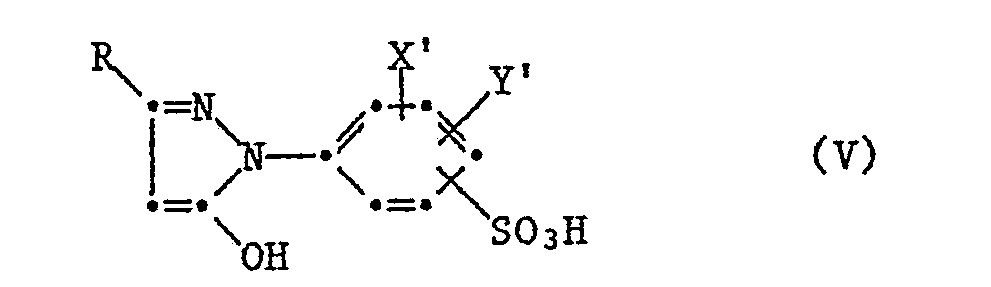
und Umsetzung der erhaltenen Diazoverbindung mit einer Kupplungskomponente der Formel V , X, Y, X' und Y' die oben angegebene Bedeutung haben.
 - Beispiele für die der Formel IV zugrunde liegenden Amine sind:
- 2-Amino-benzolsulfonsäure, 2-Amino-5-acetylamino-benzolsulfonsäure, 2-Amino-5-ethoxy-benzolsulfonsäure, 2-Amino-5-chlor-benzolsulfonsäure, 2-Amino-5-methoxy-benzolsulfonsäure, 2-Amino-5-methyl-benzolsulfonsäure, 2-Amino-5-nitro-benzolsulfonsäure, 2-Amino-4,5-dichlor-benzolsulfonsäure, 2-Amino-4-methyl-5-chlor-benzolsulfonsäure, 2-Amino-4-chlor-5-methyl-benzolsulfonsäure, 2-Amino-3,5-dichlor-benzolsulfonsäure, 2-Amino-3-methyl-5-chlor-benzolsulfonsäure, 2-Amino-3,5-dinitro-benzolsulfonsäure, 2-Amino-3-chlor-5-nitro-benzolsulfonsäure, 2-Amino-3,5-dimethyl-benzolsulfonsäure, 2-Amino-4-acetylamino-benzolsulfonsäure, 2-Amino-4-chlor-benzolsulfonsäure.
- Beispiele für Kupplungskomponenten der Formel V sind:
- 1-(2'-Sulfophenyl)-3-methyl-5-pyrazolon, 1-(4',5'-Dichlor-2'-sulfophenyl)-3-methyl-5-pyrazolon, 1-(3'-Sulfophenyl)-3-methyl-5-pyrazolon, 1-(6'-Chlor-3'-sulfophenyl)-3-methyl-5-pyrazolon, 1-(4'-Sulfo phenyl)-3-methyl-5-pyrazolon, 1-(2'-Chlor-6'-methyl-4'-sulfopheny!)-3-methyl-5-pyrazolon, 1-(2'-Methyl-4'-sulfophenyl)-3-methyl-pyrazolon, 1-(2',5'-Dichlor-4'-sulfophenyl)-3-methyl-5-pyrazolon, 1-(3'-Sulfophenyl)-3-carbomethoxy-5-pyrazolon, 1-(2',5'-Dichlor-4'-sulfophenyl)-3-carbomethoxy-5-pyrazolon, 1-(3'-Sulfophenyl)-3-carboethoxy-5-pyrazolon, 1-(2',5'-Dichlor-4'-sulfophenyl)-3-carboethoxy-5-pyrazolon, 1-(3'-Sulfophenyl)-3-amino-5-pyra- zolon, 1-(2',5'-Dichlor-4'-sulfophenyl)-3-amino-5-pyrazolon, 1-(3'-Sulfophenyl)-3-acetylamino-5-pyrazolon, 1-(2',5'-Dichlor-4'-sulfophenyl)-3-acetylamino-5-pyrazolon.
- Man kann (b) auch eine Disulfonsäure der Formel Vi

- Beispiele für M- und Mi-Salze sind: Nitrate, Nitrite, Sulfate, Alkalihydroxide und bevorzugt Chloride und insbesondere Acetate der obenerwähnten Kationen M⊕ bzw. M.
- Die Disulfonsäuren der Formel Vi können nach an sich bekannten Verfahren hergestellt werden.
- Eine weitere Variante (c) zur Herstellung von bevorzugten erfindungsgemässen Mischkristallen besteht darin, eine in Wasser suspendierte Komponente der Formel mit einem M-Salz mit unterschiedlichem M⊕ z.B. im Molverhältnis 1:2, bei Temperaturen zwischen 60 und 100°C, bevorzugt zwischen 75 und 85°C, und unter ständigem Rühren, umzusetzen.
- Eine Variante (d) zur Herstellung der erfindungsgemäßen Mischkristalle aus zwei voneinander verschiedenen Verbindungen der Formel 1, worin M⊕ und M 9 gleich sind, besteht darin, die zwei Einzelkomponenten der Formel I, die sich durch ihre Kationen Mounterscheiden, gemeinsam nach für Pigmente an sich bekannten Methoden zu rekristallisieren.
- Einzelkomponenten der Formel worin M⊕ und Mgleich sind sind bekannt und können z.B. wie in der DE-OS 26 16 981 beschrieben hergestellt werden.
- Mischkristalle werden durch ihr Röntgenbeugungsdiagramm gekennzeichnet, welches sich sowohl von demjenigen der Einzelkomponenten des Mischkristalls als auch von demjenigen ihres physikalischen Gemisches unterscheidet.
- Das Röntgenbeugungsdiagramm der erfindungsgemässen Mischkristalle ist durch andere Linien gekennzeichnet als diejenigen, welche die Röntgenbeugungsdiagramme des entsprechenden physikalischen Gemischs und der entsprechenden Einzelkomponenten charakterisieren.
- Die Rekristallisation bzw. thermische Behandlung geschieht nach für Pigmente üblichen Methoden. Im allgemeinen handelt es sich um eine thermische Nachbehandlung in Wasser oder in einem organischen Lösungsmittel, gegebenenfalls unter Druck. Vorzugsweise verwendet man organische Lösungsmitel, z.B. durch Halogenatome, Alkyl- oder Nitrogruppen substituierte Benzole, wie Xylole, Chlorbenzol, o-Dichlorbenzol oder Nitrobenzol, sowie Pyridinbasen, wie Pyridin, Picolin oder Chinolin, ferner Ketone wie Cyclohexanon, Alkohole, wie Isopropanol, Butanole oder Pentanole, Ether, wie Ethylenglykolmonomethyl- oder -monoethylether, Amide, wie Dimethylformamid oder N-Methylpyrrolidon, sowie Dimethylsulfoxid oder Sulfolan. Man kann die Nachbehandlung auch in Wasser, gegebenenfalls unter Druck, in Gegenwart von organischen Lösungsmitteln und/oder mit Zusatz von oberflächenaktiven Substanzen durchführen.
- Die erfindungsgemässen Mischkristalle können als Pigmente zum Färben von hochmolekularem organischem Material verwendet werden.
- Hochmolekulare organische Materialien, die mit den erfindungsgemässen Mischkristallen gefärbt bzw. pigmentiert werden können, sind z.B. Celluloseether und -ester, wie Ethylcellulose, Nitrocellulose, Celluloseacetat, Cellulosebutyrat, natürliche Harze oder Kunstharze, wie Polymerisationsharze oder Kondensationsharze, wie Aminoplaste, insbesondere Harnstoff- und Melamin-Formaldehydharze, Alkydharze, Phenoplaste, Polycarbonate, Polyolefine, Polystyrol, Polyvinylchlorid, Polyamide, Polyurethane, Polyester, ABS, Polyphenylenoxide, Gummi, Casein, Silikon und Silikonharze, einzeln oder in Mischungen.
- Besonders geeignet sind die erfindungsgemässen Mischkristalle zum Einfärben von Polyvinylchlorid und Polyolefinen, wie Polyethylen und Polypropylen.
- Die erwähnten hochmolekularen organischen Verbindungen können einzeln oder in Gemischen als plastische Massen, Schmelzen oder in Form von Spinnlösungen, Lacken, Anstrichstoffen oder Druckfarben vorliegen. Je nach Verwendungszweck erweist es sich als vorteilhaft, die erfindungsgemässen Mischkristalle als Toner oder in Form von Präparaten einzusetzen.
- Bezogen auf das zu pigmentierende hochmolekulare organische Material kann man die erfindungsgemässen Mischkristalle in einer Menge von 0,01 bis 30 Gew.%, vorzugsweise von 0,1 bis 10 Gew.%, einsetzen. Die Pigmentierung der hochmolekularen organischen Substanzen mit den erfindungsgemässen Mischkristallen erfolgt beispielsweise derart, dass man solche Mischkristalle gegebenenfalls in Form von Master batches diesen Substraten unter Verwendung von Walzwerken, Misch-oder Mahlapparaten zumischt. Das pigmentierte Material wird hierauf nach an sich bekannten Verfahren, wie Kalandrieren, Pressen, Strangpressen, Streichen, Giessen oder Spritzgiessen, in die gewünschte endgültige Form gebracht. Oft ist es erwünscht, zur Herstellung von nicht starren Formlingen oder zur Verringerung ihrer Sprödigkeit den hochmolekularen Verbindungen vor der Verformung sogenannte Weichmacher einzuverleiben. Als solche können z.B. Ester der Phosphorsäure, Phthalsäure oder Sebacinsäure dienen. Die Weichmacher können vor oder nach der Einverleibung der erfindungsgemässen Mischkristalle in die Polymeren eingearbeitet werden. Zwecks Erzielung verschiedener Farbtöne ist es ferner möglich, den hochmolekularen organischen Stoffen neben den erfindungsgemässen Mischkristallen noch Füllstoffe bzw. andere farbgebende Bestandteile, wie Weiss-, Bunt- oder Schwarzpigmente, in beliebigen Mengen zuzufügen.
- Zum Pigmentieren von Lacken, Anstrichstoffen und Druckfarben werden die hochmolekularen organischen Materialien und die erfindungsgemässen Mischkristalle gegebenenfalls zusammen mit Zusatzstoffen, wie Füllmitteln, anderen Pigmente, Siccativen oder Weichmachern, in einem gemeinsamen organischen Lösungsmittel oder Lösungsmittelgemisch fein dispergiert bzw. gelöst. Man kann dabei so verfahren, dass man die einzelnen Komponenten für sich oder auch mehrere gemeinsam dispergiert bzw. löst, und erst hierauf alle Komponenten zusammenbringt.
- In Färbungen, beispielsweise von Polyvinylchlorid oder Polyolefinen, zeichnen sich die erfindungsgemässen Mischkristalle durch gute allgemeine Pigmenteigenschaften, wie gute Dispergierbarkeit, hohe Farbstärke und Reinheit, gute Migrations-, Hitze-, Licht- und Wetterbeständigkeit sowie gute Deckkraft aus.
- Die nachfolgenden Beispiele erläutern die Erfindung. Darin bedeuten Teile Gewichtsteile, sofern nichts anderes angegeben ist.
- Beispiel 1: 2,6 Teile 2-Amino-4,5-dichlor-benzolsulfonsäure-Calciumsalz und 2,7 Teile 1-(3-Sulfophenyl)-3-methyl-5-pyrazolon werden in der Mischung aus 55 Volumenteilen Dimethylformamid, 55 Teilen dest. Wasser und 55 Volumenteilen Essigsäure bei 30°C gelöst. Die orange Lösung wird bei 26°C in 10 Minuten tropfenweise mit 2,55 Volumenteilen 4N-Natriumnitritlösung versetzt. Es fällt ein oranger Niederschlag aus, die Temperatur steigt auf 28°C. Nach 5 Stunden Rühren sinkt die Temperatur auf 23°C. Die orange Suspension wird abgenutscht. Der Rückstand wird gut abgepresst, mit 100 Teilen entionisiertem Wasser gewaschen und im Vakuum bei 60°C getrocknet. Man erhält 4,5 Teile eines orangen Pulvers, das anschliessend in 100 Volumenteilen sec.-Butylalkohol-Wasser (1:1) während 2 Stunden rekristallisiert wird. Das so erhaltene intensiv-orange Pulver entspricht der Summenformel
C16H10Cl2N4O7S2NaCa/2 H20
Analyse, Ber. (in %): C 33,93 H 2,20 CI 12,50 N, 9,89 S 11,32 Ca 3,54 Na 4.06
Gef. (in %): C 34,03 H 2,21 Cl 12,51 N 9,90 S 11,27 Ca 3,91 Na 4,10 - Das Röntgenbeugungsdiagramm dieses Mischkristalls unterscheidet sich sowohl von demjenigen der Einzelkomponenten des Mischkristalls als auch von demjenigen ihres physikalischen Gemisches.
- Zur Bestimmung der Netzebenenabstände (d-Werte) wird das Beugungsbild auf Film registriert. Die Aufnahme erfolgt in Transmission mit einer Guinier-Kamera (®Enraf-Nonius Guinier-de Wolff - Kamera Nr. 11) mit Cu-K-alpha-Strahlung (Wellenlänge = 1,54178 A). In der nachfolgenden Tabelle sind die d-Werte der stärksten Linien (d > 3,0 Ä) angegeben, zusammen mit den von Auge geschätzten relativen Linienintensitäten.


- Beispiel 3: 6,7 Teile 410/oiges Dinatriumsalz der Verbindung der Formel III (M⊕ = M= Na⊕) und 4,4 Teile 44%iges Dicalciumsalz (M⊕ = M= (Ca/2)⊕) werden in 100 Teilen destilliertem Wasser auf 80°C erhitzt. Die sich verdickende orange Suspension wird 16 Stunden bei dieser Temperatur gerührt, auf Raumtemperatur abgekühlte, zur besseren Filtration mit der Lösung von 0,6 Teilen Natriumchlorid und 0,6 Teilen Calciumchlorid in 10 Teilen destilliertem Wassers versetzt und abgenutscht. Der Rückstand wird mit entionisiertem Wasser gewaschen und im Vakuum bei 60°C getrocknet. Man erhält 4,6 Teile eines orangen Pulvers, das die gleichen Eigenschaften, wie das Produkt von Beispiel 1 aufweist.

- In der nachfolgenden Tabelle werden die gemäss der in Beispiel 1 beschriebenen Methode für dieses Produkt bestimmten d-Werte aufgeführt.

- Beispiel 4: 5,45 Teile Calciumsalz der Verbindung der Formel III (M⊕ = M= (Ca/2)e) werden in 80 Teilen entionisertem Wasser auf 80° C erhitzt. Die orange Suspension wird mit der Lösung von 1,2 Teilen NaCl in 20 Teilen Wasser versetzt. Man rührt 16 Stunden bei 80°C und nutscht heiss ab. Der Rückstand wird mit 100 Teilen Wasser gewaschen und im Vakuum bei 60° C getrocknet. Die Ausbeute beträgt 5,2 Teile (94,1 % d. Th.) eines orangen Pulvers.
- Dieses Produkt entspricht weitgehend dem nach Beispiel 3 erhaltenen Produkt und färbt Polyvinylchlorid und Polyethylen in farbstarken beständigen gelben Tönen. Die für dieses Produkt wie in Beispiel 1 beschrieben bestimmten d-Werte sind in der nachfolgenden Tabelle aufgeführt.

- Beispiel 5: 15,35 Teile 360/oiges Dinatriumsalz der Verbindung der Formel III (M⊕ = M= Na⊕) werden in 80 Teilen entionisiertem Wasser auf 80° C erhitzt und mit der Lösung von 0,75 Teilen Calciumchlorid in 20 Teilen destilliertem Wasser versetzt. Es findet eine Verdickung statt. Die dicke orange Suspension wird 16 Stunden bei 80°C gerührt und heiss filtriert. Der Rückstand wird mit entionsiertem Wasser gewaschen und im Vakuum bei 60°C getrocknet. Die Ausbeute beträgt 5,5 Teile (100 % d. Th.) eines orangen Pulvers mit ähnlichen Eigenschaften, wie das Produkt von Beispiel 1.

- Beispiel 6 11,5 Teile 47%iges Diammoniumsalz der Verbindung der Formel III (M⊕ = M= NH
 ), 21 Teile Natriumchlorid und 12 Teile Calciumchlorid werden in 160 Teile entionisiertem Wasser auf 79°C erhitzt, 16 Stunden bei dieser Temperatur gerührt und wie in Beispiel 5 aufgearbeitet. Man erhält 5,25 Teile (95,2 % d. Th) eines orangen Pulvers mit ähnlichen Eigenschaften wie das Produkt von Beispiel 1.

- Beispiel 7: 2,4 Teile 2-Amino-4,5-dichlor-benzolsulfonsäure werden in 50 Teilen entionisiertem Wasser 10 Minuten verrührt und mit 1,145 Teilen 900/oigem tert.-Butylnitrit versetzt. Man rührt die beige Suspension eine Stunde bei Raumtemperatur und gibt nacheinander 2,8 Teile 90,1%iges 1-(3-Sulfophenyl)-3-methyl-5-pyrzo- lon und eine Lösung aus 0,8 Teilen Calciumacetat und 0,8 Teilen Natriumacetat in 50 Teilen destilliertem Wasser zu. Es entsteht ein oranger Niederschlag. Man rührt die orange Suspension 5 Stunden bei Raumtemperatur, 2 Stunden bei 80° C und filtriert sie heiss. Der Rückstand wird mit entionisiertem Wasser gewaschen und im Vakuum bei 60°C getrocknet. Man erhält 5,25 Teile (95 % d. Th.) eines orangen Pulvers welches weitgehend die gleichen Eigenschaften wie das Produkt von Beispiel 1 besitzt.

- Beispiele 8-35: In analoger Weise kann man, ausgehend von den in der nachfolgenden Tabelle aufgeführten Aminen (Kolonne 2), Kupplungskomponenten (Kolonne 3) und Kationen (Kolonne 4), zu weiteren erfindungsgemässen Mischkristallen gelangen.


- Beispiel 36: 12,1 Teile 2-Amino-4,5-dichlorbenzolsulfonsäure werden in 90 Teilen entionisertem Wasser und 5,1 Volumenteilen 300/oiger Natriumhydroxidlösung gelöst. Die klare rotstichig-violette Lösung wird mit 8,9 Volumenteilen 37%iger Salzsäure versetzt. Die entstehende weisse, dicke Suspension wird auf 5°C abgekühlt und innerhalb von 10 Minuten mit 12,5 Volumenteilen 4N-Natriumnitritlösung versetzt. Zur erhaltenen leicht beigen Suspension tropft man innerhalb von 5 Minuten die Lösung aus 1,4,4 Teilen 1-(3-Sulfophenyl)-3-methyl-5-pyrazolon, 100 Teilen destilliertem Wasser und 10,1 Volumenteilen 30%iger Natriumhydroxidlösung zu. Die erhaltene orange Suspension, deren pH-Wert 6 beträgt, wird während 2 Stunden gerührt. Die Temperatur der Suspension steigt dabei von 5° auf 22° C. Danach erwärmt man diese Suspension auf 80° C, gibt 11,3 Teile Calciumchlorid zu, rührt 16 Stunden bei 80° C und filtriert heiss. Der erhaltene Rückstand wird mit 100 Volumenteilen entionisertem Wasser gewaschen und im Vakuum bei 60°C getrocknet. Man erhält 27,1 Teile (99 %, d. Th.) eines Produktes, welches strukturell und qualitativ praktisch gleich wie die Produkte der Beispiele 1 bis 7 ist.

- Beispiel 37: 2,6 Teile 2-Amino-4,5-dichlor-benzolsulfonsäure-Calciumsalz und 2,7 Teile 1-(3-Sulfophenyl)-3-methyl-5-pyrazolon-Natriumsalz werden in der Mischung aus 55 Volumenteilen Dimethylformamid, 55 Teilen destilliertem Wasser und 55 Volumenteilen Essigsäure bei 30°C gelöst. Die orange Lösung wird bei 26°C in 10 Minuten tropfenweise mit 2,55 Volumenteilen 4N-Natriumnitritlösung versetzt. Es fällt ein oranger Niederschlag aus. Die Temperatur steigt auf 29° C. Nach 5 Stunden Rühren sinkt die Temperatur auf 23° C. Der Rückstand wird gut abgepresst, mit 100 Teilen entionisiertem Wasser gewaschen und im Vakuum bei 60° C getrocknet. Man erhält 4,3 Teile eines orangen Pulvers.

- Beispiel 38: 0,6 g des gemäss Beispiel 1 erhaltenen Produktes werden mit 67 g Polyvinylchlorid, 33 g Dioctylphthalat, 2 g Dibutylzinndilaurat und 2 g Titandioxid zusammengemischt und auf dem Walzenstuhl während 15 Minuten bei 160°C zu einer dünnen Folie verarbeitet. Die so erzeugte gelbe PVC-Folie ist farbstark, migrations- und lichtbeständig.
- Beispiel 39: Eine Mischung bestehend aus 1,0 g des nach Beispiel 1 erhaltenen Produktes, 1,0 g Antioxydans (®IRGANOX 1010, CIBA-GEIGY AG) und 1000 g Polyethylen-HD Granulat (®VESTOLEN A 60-16, HUELS) wird während 15 Minuten in einer Glasflasche auf einer Rollbank vorgemischt. Danach wird die Mischung in zwei Passagen auf einem Einwellenextruder extrudiert. Das so erhaltene Granulat wird auf der Spritzgussmaschine (Allround Aarburg 200) bei 220°C zu Platten verspritzt und 5 Minuten bei 180°C nachgepresst. Die Pressplatte weisen farbstarke gelbe Nuancen mit ausgezeichneten Beständigkeit auf.
Claims (11)


M1 ⊕NO2⊖
und Umsetzung der erhaltenen Diazoverbindung mit einer Kupplungskomponente der Formel V

Applications Claiming Priority (2)
| Application Number | Priority Date | Filing Date | Title |
|---|---|---|---|
| CH396186 | 1986-10-03 | ||
| CH3961/86 | 1986-10-03 |
Publications (3)
| Publication Number | Publication Date |
|---|---|
| EP0263074A2 true EP0263074A2 (de) | 1988-04-06 |
| EP0263074A3 EP0263074A3 (de) | 1991-08-28 |
| EP0263074B1 EP0263074B1 (de) | 1994-03-02 |
Family
ID=4267184
Family Applications (1)
| Application Number | Title | Priority Date | Filing Date |
|---|---|---|---|
| EP87810563A Expired - Lifetime EP0263074B1 (de) | 1986-10-03 | 1987-09-28 | Mischkristalle aus verlackten Azofarbstoffen |
Country Status (5)
| Country | Link |
|---|---|
| US (1) | US4980458A (de) |
| EP (1) | EP0263074B1 (de) |
| JP (1) | JPS6390572A (de) |
| CA (1) | CA1303026C (de) |
| DE (1) | DE3789185D1 (de) |
Cited By (4)
| Publication number | Priority date | Publication date | Assignee | Title |
|---|---|---|---|---|
| EP0553965A1 (de) * | 1992-01-30 | 1993-08-04 | Zeneca Limited | Azopyrazolonverbindung mit charakteristischem Röntgenbeugungsspektrum |
| WO2002059217A1 (en) * | 2001-01-24 | 2002-08-01 | Ciba Specialty Chemicals Holding Inc. | Single-phase mixed crystals of laked monoazo dyes |
| WO2002048266A3 (de) * | 2000-12-13 | 2002-10-24 | Basf Ag | Transparente grünstichig gelbe pyrazolonazopigmente |
| WO2008101612A1 (de) * | 2007-02-20 | 2008-08-28 | Clariant Finance (Bvi) Limited | Pigmentzusammensetzung auf basis von c.i. pigment yellow 191 |
Families Citing this family (9)
| Publication number | Priority date | Publication date | Assignee | Title |
|---|---|---|---|---|
| DE3833226A1 (de) * | 1988-09-30 | 1990-04-05 | Hoechst Ag | Monoazopigment, verfahren zu seiner herstellung und seine verwendung |
| US5746821A (en) * | 1995-02-13 | 1998-05-05 | Engelhard Corporation | Pigment compositions |
| US5669967A (en) * | 1996-05-30 | 1997-09-23 | Engelhard Corporation | Pigment compositions |
| US6235100B1 (en) * | 1999-06-24 | 2001-05-22 | Engelhard Corporation | Metallized azo yellow pigments |
| US6294012B1 (en) | 1999-11-15 | 2001-09-25 | Engelhard Corporation | High strength monoazo yellow pigment |
| DE10032315A1 (de) * | 2000-07-04 | 2002-01-17 | Clariant Gmbh | Neue Kristallmodifikationen von C.I. Pigment Yellow 191 und Verfahren zu ihrer Herstellung |
| US6375733B1 (en) | 2000-08-28 | 2002-04-23 | Engelhard Corporation | Heat stable monoazo magenta pigment compositions |
| CN104962101B (zh) * | 2015-06-26 | 2017-08-29 | 嘉兴科隆化工有限公司 | 一种食品塑料包装用安全环保型红光黄颜料py191:1的工业化生产方法 |
| JP7586359B1 (ja) * | 2024-03-27 | 2024-11-19 | artience株式会社 | 顔料組成物およびその製造方法、ならびにその使用 |
Family Cites Families (17)
| Publication number | Priority date | Publication date | Assignee | Title |
|---|---|---|---|---|
| US935830A (en) * | 1909-10-05 | Farbenfab Vorm Bayer F & Co | Azo dye. | |
| US969428A (en) * | 1909-12-18 | 1910-09-06 | Farbenfab Vorm Bayer F & Co | Greenish-yellow dye. |
| US1098600A (en) * | 1913-08-07 | 1914-06-02 | Synthetic Patents Co Inc | Yellow azo dyestuffs. |
| US1701248A (en) * | 1926-08-19 | 1929-02-05 | Grasselli Dyestuff Corp | Yellow monoazo dyestuffs fast to light and process of preparing them |
| US1730179A (en) * | 1927-05-10 | 1929-10-01 | Gen Aniline Works Inc | Yellow monoazo dyestuff |
| US1830300A (en) * | 1929-03-18 | 1931-11-03 | Pyridium Corp | Method of obtaining hydroxy-phenyl-azo-alpha-alpha-diamino-pyridines |
| US2237768A (en) * | 1937-07-28 | 1941-04-08 | Du Pont | Production of azo colors |
| US2457823A (en) * | 1944-12-01 | 1949-01-04 | Ilford Ltd | Production of pyrazolone azo dyes |
| US2842537A (en) * | 1953-12-30 | 1958-07-08 | Gen Aniline & Film Corp | Pyrazolone dyestuffs |
| US2937165A (en) * | 1956-12-28 | 1960-05-17 | American Cyanamid Co | Spirit soluble yellow dye |
| AU416323B2 (en) * | 1966-09-09 | 1971-08-18 | Stange Co | Azo dyes |
| CH561255A5 (de) * | 1970-02-10 | 1975-04-30 | Ciba Geigy Ag | |
| US3905952A (en) * | 1972-10-30 | 1975-09-16 | Du Pont | Orange phenylazoazobenzene acid dye |
| DE2616981C2 (de) * | 1976-04-17 | 1983-12-08 | Basf Ag, 6700 Ludwigshafen | Pyrazolon-Azofarbstoffe ihre Herstellung und Verwendung |
| DE3133404A1 (de) * | 1981-08-24 | 1983-03-10 | Basf Ag, 6700 Ludwigshafen | Sulfonsaeuregruppenhaltige verlackte azofarbstoffe |
| DE3318073A1 (de) * | 1983-05-18 | 1984-11-22 | Basf Ag, 6700 Ludwigshafen | Pyrazolonazofarbstoffe |
| DE3543512A1 (de) * | 1985-12-10 | 1987-06-11 | Bayer Ag | Azofarblacke |
-
1987
- 1987-09-28 EP EP87810563A patent/EP0263074B1/de not_active Expired - Lifetime
- 1987-09-28 DE DE87810563T patent/DE3789185D1/de not_active Expired - Fee Related
- 1987-10-01 CA CA000548338A patent/CA1303026C/en not_active Expired - Lifetime
- 1987-10-02 JP JP62248221A patent/JPS6390572A/ja active Pending
-
1989
- 1989-05-08 US US07/349,907 patent/US4980458A/en not_active Expired - Fee Related
Cited By (10)
| Publication number | Priority date | Publication date | Assignee | Title |
|---|---|---|---|---|
| EP0553965A1 (de) * | 1992-01-30 | 1993-08-04 | Zeneca Limited | Azopyrazolonverbindung mit charakteristischem Röntgenbeugungsspektrum |
| WO2002048266A3 (de) * | 2000-12-13 | 2002-10-24 | Basf Ag | Transparente grünstichig gelbe pyrazolonazopigmente |
| US6784286B2 (en) | 2000-12-13 | 2004-08-31 | Basf Aktiengesellschaft | Transparent greenish yellow pyrazolone pigments |
| CN1304485C (zh) * | 2000-12-13 | 2007-03-14 | 巴斯福股份公司 | 透明黄绿色的吡唑啉酮偶氮颜料 |
| KR100826861B1 (ko) * | 2000-12-13 | 2008-05-06 | 바스프 에스이 | 투명한 녹황색계 피라졸론아조 안료 |
| WO2002059217A1 (en) * | 2001-01-24 | 2002-08-01 | Ciba Specialty Chemicals Holding Inc. | Single-phase mixed crystals of laked monoazo dyes |
| US6913640B2 (en) | 2001-01-24 | 2005-07-05 | Ciba Specialty Chemicals | Single-phase mixed crystals of laked monoazo dyes |
| WO2008101612A1 (de) * | 2007-02-20 | 2008-08-28 | Clariant Finance (Bvi) Limited | Pigmentzusammensetzung auf basis von c.i. pigment yellow 191 |
| US7824488B2 (en) | 2007-02-20 | 2010-11-02 | Clariant Finance (Bvi) Limited | Pigment composition based on C.I. pigment yellow 191 |
| CN101652431B (zh) * | 2007-02-20 | 2013-07-10 | 科莱恩金融(Bvi)有限公司 | 基于c.i.颜料黄191的颜料组合物 |
Also Published As
| Publication number | Publication date |
|---|---|
| DE3789185D1 (de) | 1994-04-07 |
| EP0263074B1 (de) | 1994-03-02 |
| JPS6390572A (ja) | 1988-04-21 |
| CA1303026C (en) | 1992-06-09 |
| US4980458A (en) | 1990-12-25 |
| EP0263074A3 (de) | 1991-08-28 |
Similar Documents
| Publication | Publication Date | Title |
|---|---|---|
| EP0256983B1 (de) | Feste Lösungen von Pyrrolo-[3,4-c]-pyrrolen | |
| DE69228280T2 (de) | Oxidationsverfahren zur Herstellung von Chinacridonpigmenten | |
| EP0225553B1 (de) | Azofarblacke | |
| EP0224445A2 (de) | Pyrrolo-pyrrol Pigmentpräparate, Verfahren zu deren Herstellung sowie ihre Verwendung | |
| EP0263074B1 (de) | Mischkristalle aus verlackten Azofarbstoffen | |
| EP3470471B1 (de) | Methinfarbstoffe | |
| EP3470467B1 (de) | Methinfarbstoffe zum färben von kunststoffen | |
| EP0277914B1 (de) | Feste Lösungen von Pyrrolo-[3,4-c]-pyrrolen mit Chinacridonen | |
| EP0748851A2 (de) | Pigmentzusammensetzungen aus Diketopyrrolopyrrolen | |
| EP3470472A1 (de) | Neue methinfarbstoffe | |
| EP0603132B1 (de) | Mischkristalle von sulfonierten Diketopyrrolopyrrolen | |
| EP0241413B1 (de) | Neue Aminsalze von Azoverbindungen | |
| EP3489229A1 (de) | Neue methinfarbstoffe | |
| EP3048138A1 (de) | Gelbe Methinfarbstoffe | |
| DE60019517T2 (de) | Katalytisches Oxidationsverfahren zur Herstellung von Chinacridonpigmenten unter Verwendung eines Polyalkylenglykolmediums | |
| EP0376158B1 (de) | Mischkristallpigmente der Anthanthronreihe, Verfahren zu ihrer Herstellung und ihre Verwendung | |
| EP0359708B1 (de) | Monoazoverbindungen mit langkettigen Alkylresten | |
| EP0172512B1 (de) | Azinpigmente | |
| EP0591105A2 (de) | Bisazo-, Bisazomethin- und Azo-azomethinverbindungen | |
| EP0358604B1 (de) | Disazoverbindungen mit langkettigen Alkylester- oder Alkylamidresten | |
| EP1343847B1 (de) | Transparente grünstichig gelbe pyrazolonazopigmente | |
| CH404034A (de) | Verfahren zur Herstellung von linearen Chinacridin-dionen | |
| EP0000737B1 (de) | Monoazopigmente der Acetoacetylaminobenzimidazolonreihe, Verfahren zu deren Herstellung, und deren Verwendung zum Pigmentieren von hochmolekularem organischem Material | |
| EP0442846A2 (de) | Disazoverbindungen mit langkettigen Alkylester- oder Alkylamidresten | |
| EP0022076B1 (de) | Iminoisoindolinonfarbstoffe, Verfahren zu deren Herstellung und deren Verwendung |
Legal Events
| Date | Code | Title | Description |
|---|---|---|---|
| PUAI | Public reference made under article 153(3) epc to a published international application that has entered the european phase |
Free format text: ORIGINAL CODE: 0009012 |
|
| 17P | Request for examination filed |
Effective date: 19870930 |
|
| AK | Designated contracting states |
Kind code of ref document: A2 Designated state(s): CH DE FR GB IT LI NL |
|
| PUAL | Search report despatched |
Free format text: ORIGINAL CODE: 0009013 |
|
| AK | Designated contracting states |
Kind code of ref document: A3 Designated state(s): CH DE FR GB IT LI NL |
|
| 17Q | First examination report despatched |
Effective date: 19930315 |
|
| GRAA | (expected) grant |
Free format text: ORIGINAL CODE: 0009210 |
|
| AK | Designated contracting states |
Kind code of ref document: B1 Designated state(s): CH DE FR GB IT LI NL |
|
| REF | Corresponds to: |
Ref document number: 3789185 Country of ref document: DE Date of ref document: 19940407 |
|
| ITF | It: translation for a ep patent filed | ||
| GBT | Gb: translation of ep patent filed (gb section 77(6)(a)/1977) |
Effective date: 19940415 |
|
| ET | Fr: translation filed | ||
| PGFP | Annual fee paid to national office [announced via postgrant information from national office to epo] |
Ref country code: FR Payment date: 19940802 Year of fee payment: 8 |
|
| PGFP | Annual fee paid to national office [announced via postgrant information from national office to epo] |
Ref country code: NL Payment date: 19940930 Year of fee payment: 8 |
|
| PLBE | No opposition filed within time limit |
Free format text: ORIGINAL CODE: 0009261 |
|
| STAA | Information on the status of an ep patent application or granted ep patent |
Free format text: STATUS: NO OPPOSITION FILED WITHIN TIME LIMIT |
|
| 26N | No opposition filed | ||
| PGFP | Annual fee paid to national office [announced via postgrant information from national office to epo] |
Ref country code: GB Payment date: 19950816 Year of fee payment: 9 |
|
| PGFP | Annual fee paid to national office [announced via postgrant information from national office to epo] |
Ref country code: DE Payment date: 19950817 Year of fee payment: 9 |
|
| PGFP | Annual fee paid to national office [announced via postgrant information from national office to epo] |
Ref country code: CH Payment date: 19951201 Year of fee payment: 9 |
|
| PG25 | Lapsed in a contracting state [announced via postgrant information from national office to epo] |
Ref country code: NL Effective date: 19960401 |
|
| PG25 | Lapsed in a contracting state [announced via postgrant information from national office to epo] |
Ref country code: FR Effective date: 19960531 |
|
| NLV4 | Nl: lapsed or anulled due to non-payment of the annual fee |
Effective date: 19960401 |
|
| REG | Reference to a national code |
Ref country code: FR Ref legal event code: ST |
|
| PG25 | Lapsed in a contracting state [announced via postgrant information from national office to epo] |
Ref country code: GB Effective date: 19960928 |
|
| PG25 | Lapsed in a contracting state [announced via postgrant information from national office to epo] |
Ref country code: LI Effective date: 19960930 Ref country code: CH Effective date: 19960930 |
|
| REG | Reference to a national code |
Ref country code: CH Ref legal event code: PL |
|
| GBPC | Gb: european patent ceased through non-payment of renewal fee |
Effective date: 19960928 |
|
| PG25 | Lapsed in a contracting state [announced via postgrant information from national office to epo] |
Ref country code: DE Effective date: 19970603 |
|
| PG25 | Lapsed in a contracting state [announced via postgrant information from national office to epo] |
Ref country code: IT Free format text: LAPSE BECAUSE OF NON-PAYMENT OF DUE FEES;WARNING: LAPSES OF ITALIAN PATENTS WITH EFFECTIVE DATE BEFORE 2007 MAY HAVE OCCURRED AT ANY TIME BEFORE 2007. THE CORRECT EFFECTIVE DATE MAY BE DIFFERENT FROM THE ONE RECORDED. Effective date: 20050928 |