EP0263253A2 - Méthode pour la radiodiffusion de messages écrits sur une sous-porteuse associée à une fréquence porteuse radiophonique - Google Patents
Méthode pour la radiodiffusion de messages écrits sur une sous-porteuse associée à une fréquence porteuse radiophonique Download PDFInfo
- Publication number
- EP0263253A2 EP0263253A2 EP87110895A EP87110895A EP0263253A2 EP 0263253 A2 EP0263253 A2 EP 0263253A2 EP 87110895 A EP87110895 A EP 87110895A EP 87110895 A EP87110895 A EP 87110895A EP 0263253 A2 EP0263253 A2 EP 0263253A2
- Authority
- EP
- European Patent Office
- Prior art keywords
- message
- characters
- character
- transmission
- groups
- Prior art date
- Legal status (The legal status is an assumption and is not a legal conclusion. Google has not performed a legal analysis and makes no representation as to the accuracy of the status listed.)
- Granted
Links
- 238000000034 method Methods 0.000 title claims description 15
- 230000005540 biological transmission Effects 0.000 claims abstract description 15
- 238000010586 diagram Methods 0.000 description 4
- 238000001514 detection method Methods 0.000 description 2
- 238000012986 modification Methods 0.000 description 2
- 230000004048 modification Effects 0.000 description 2
- 230000015572 biosynthetic process Effects 0.000 description 1
- 238000004891 communication Methods 0.000 description 1
- 239000004973 liquid crystal related substance Substances 0.000 description 1
- 230000000750 progressive effect Effects 0.000 description 1
- 230000005236 sound signal Effects 0.000 description 1
- 238000003786 synthesis reaction Methods 0.000 description 1
- 230000001755 vocal effect Effects 0.000 description 1
Images
Classifications
-
- H—ELECTRICITY
- H04—ELECTRIC COMMUNICATION TECHNIQUE
- H04H—BROADCAST COMMUNICATION
- H04H20/00—Arrangements for broadcast or for distribution combined with broadcast
- H04H20/28—Arrangements for simultaneous broadcast of plural pieces of information
- H04H20/33—Arrangements for simultaneous broadcast of plural pieces of information by plural channels
- H04H20/34—Arrangements for simultaneous broadcast of plural pieces of information by plural channels using an out-of-band subcarrier signal
-
- H—ELECTRICITY
- H04—ELECTRIC COMMUNICATION TECHNIQUE
- H04H—BROADCAST COMMUNICATION
- H04H2201/00—Aspects of broadcast communication
- H04H2201/10—Aspects of broadcast communication characterised by the type of broadcast system
- H04H2201/13—Aspects of broadcast communication characterised by the type of broadcast system radio data system/radio broadcast data system [RDS/RBDS]
Definitions
- the present invention relates to a method for transmitting text messages on a subcarrier associated with a radiophonic carrier frequency, and more in particular for transmitting messages longer than the length normally allowed within the RDS system (EBU Tech. 3244-E).
- Sound radio-broadcasting systems for additional services have been proposed and produced on an international level wherein a digital signal, which is detectable and decodable by auxiliary devices built into user radio receivers, is associated with the audio signal of a given station, to visualize on a display of the receiver alphanumeric information such as the broadcasting station or network, the programme identification, the time of the day, road traffic information, or others.
- This service parallel to the broadcasting of the audio programme, is allowed by the use of a subcarrier modulated at low speed by the data stream.
- a subcarrier modulated at low speed by the data stream According to the specification of the European Broadcasting Union (ref. EBU Tech. 3244-E, "Specifications of the radio data system RDS for VHF/FM sound broadcasting", March 1984), known as “RDS” and adopted by the CCIR (International Radio-broadcasting Advisory Committee), a subcarrier shifted by 57 KHz with respect to the carrier frequency, modulated with a data streaming rate of 1187.5 baud, is used. With this low transmission rate the occupied bandwidth is very narrow, and it is thus possible to place the subcarrier next to the main carrier without unduly compromising the quality of the audio programme and without appreciable extension in the overall occupied bandwidth.
- the RDS specification provides the transmission of a succession of groups of 104 bits divided into four blocks of 26 bits each, ten whereof constitute a checkword for the detection and correction of any errors occurring in the reception of that block, while the other 16 bits are useful information. Since the RDS system adopts extended coding with 8 bits per character, each block therefore contains 2 characters.
- the RDS system various types of groups can be transmitted, and are differentiated according to the type of information they contain and the coding convention which governs them.
- the first block of each group always contains a programme identification, while the three successive blocks may contain various information, such as the time of the day, traffic broadcasts, etc., as described above, and every type of information is supplied according to a preset format.
- the second block of each group includes a four-bit code which identifies the type of group.
- Radiotext The transmission of text messages (Radiotext) is provided among the various types of information.
- Radiotext messages are intended to be displayed on an alphanumeric display, for example a liquid-crystal display built into the receiver, or can be used, for example on receivers on board automotive vehicles, by a voice synthesizer adapted to provide the user, on demand, with a synthesized verbal communication of the message or can be sent to a printer associated with the receiver.
- Radiotext messages could also be symbolic instructions intended for a digital computer or the like.
- the last two available blocks of the group for a total of four characters, are interpreted as text, while the second block contains, besides the group type identifier code, an address composed of four bits.
- the message is split into four-character segments which are each transmitted on a successive group of the broadcast, associating a progressively increasing address to each.
- the receiver can thus reconstruct a message having a maximum length of 64 characters.
- a 64-character text is less than one line of a normal typewritten page, and is therefore extremely short. It is desirable in many cases to be able to broadcast even longer messages, for example the equivalent of one or two typewritten pages. This could be done by defining a new type of group, distinct from the Radiotext group and identified by an appropriate code, with a message segment addressing criterion which allows the listing of a greater number of segments.
- the aim of the invention is therefore to provide a method to allow, in full compatibility with the convention existing on the RDS system, the transmission of messages longer than 64 characters, and more in particular of messages in the order of one or two typewritten pages.
- Another object is to provide said method so that a receiver equipped with a multi-language voice synthesizer can automatically translate correctly messages written in different languages.
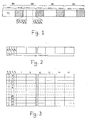
- Figure 1 symbolically illustrates a group of Radiotext-type information bits according to the convention of the abovementioned RDS system.
- the group comprises four blocks, BA, BB, BC, BD, each comprising a "data" portion of 16 bits consisting of useful information, and a "corr” portion of 10 bits (in broken lines in the figure) which constitutes an error detection and correction code (checkword), according to methods known in the field.
- the first block BA contains a two-character information PI which identifies the network which is broadcasting.
- the block BA is uniform in all the types of groups of the RDS system.
- the first four bits T1, T2, T3, T4 of the second block BB constitute an identification code for the group type, to allow the receiver (or, more precisely, its associated decoders) to correctly interpret the data contained in the two subsequent blocks BC and BD.
- the RDS specification has the four digits "0010" as identifier.
- the last four bits S1, S2, S3, S4 of the block BB constitute a message segment address according to the RDS specification.
- the messages are split into segments of four characters each, which are broadcast in the blocks BC and BD of successive Radiotext groups, and said four address bits assume increasing values (for example "0000", "0001", "0010", etc.) in the successive groups which contain the message. It can thus be seen that 16 groups can be broadcast, giving a total of 64 characters per message.
- the other bits still available in the block BB are used by the RDS specification to transmit information such as the programme type, according to methods not related to the invention.
- the 64-character message which can be transmitted according to the RDS specification is composed of a prefix of four characters, P1, P2, P3, P4, which is followed by a sequence of 60 useful characters, that is to say, belonging to the actual message. This is illustrated in the diagram of figure 2.
- a long message for example a message of a few hundred characters, is then split into 60-character portions, said prefix P1, P2, P3, P4 (which will be described in detail hereinafter) is placed before each of them, and the resulting 64-character sequence is normally transmitted as a message element according to the RDS specification, with which the message element is absolutely compatible.
- the four-character prefix according to the invention is composed only of characters related to columns 0 and 1 in the coding of the ISO 646 code-table. As is known, such characters, so-called “non-printable” characters, are used as control and protocol characters in ASCII-code transmissions.
- the characters of the prefix are composed as described hereinafter.
- the character P1 is the message identifier, only two configurations being assignable thereto, and it keeps the same configuration in the successive groups which constitute a same message, changing its configuration when the message changes.
- Such configurations can be selected as desired, except for the characters known as SI, SO and ESC (hexadecimal 0/15, 0/14 and 1/11).
- Said two possible configurations are preferably those knonw as DLE (hexadecimal 1/0) and NAK (hexadecimal 1/5). This choice ensures a minimum Hamming distance of 2 with respect to the already-assigned control characters SI, SO and ESC.
- the character P2 is a language identifier, to notify the decoding circuits of the receiver about the language in which the message is written.
- the characters SI and SO are excluded from the configurations which can be assigned to the character P2 for the reasons described above Thus it is possible to indicate up to 30 different languages.
- the language identifier is mostly intended for use by possible voice synthesizers, and therefore generally refers only to natural languages, such as Italian, French, English, etc., one must not neglect the possibility that in certain applications the message may be, for example, a symbolic program which can be used by a microcomputer or the like, and therefore the term "language” must be understood also in the meaning of programming language or other artificial syntax specification.
- the character P3 is a continuity index, that is to say a progressive order number of the Radiotext message element being broadcast. It can assume all the values defined above, for a total of 32 (see figure 3).
- the character P4 is the message length indicator. It represents the number of message elements which compose the complete message, and keeps the same value in successive groups for the entire duration of the message.
- the decoder associated with the receiver to receive messages encoded according to the invention, must contain, in addition to the devices which perform the normal decoding process provided by the conventional RDS system, a device for decoding the prefix contained in the first four characters of the blocks BC and BD of the Radiotext group, interpreting them as above.
- the groups of the Radiotext message element successive to the first are treated conventionally by the decoder, using the segment address provided by the RDS specification.
- the decoder again examines the prefix, checking every time, among other things, that the message identifier is still the same.
- the additional decoder will use the language identification character to set the synthesizer appropriately.
- the use of the method according to the invention has the considerable advantage of being totally compatible with the current convention of the Radiotext groups of the RDS specification.
- the receiver not equipped with said additional decoding device receives short messages, that is to say up to 60 characters, normally, and is not affected by the prefix, which in any case cannot be displayed.
- Radiotext-type group may be used in a variation wherein only the block BD is used for the message, while the block BC contains other types of information, which do not relate to the invention.
- each group contains only two characters, and the message element can comprise a maximum of 32 characters instead of 64.
- An appropriate bit added to the segment address S1, S2, S3, S4 is provided by the RDS system to indicate which of the two variations is adopted on a case-by-case basis.
Landscapes
- Engineering & Computer Science (AREA)
- Signal Processing (AREA)
- Circuits Of Receivers In General (AREA)
Applications Claiming Priority (2)
| Application Number | Priority Date | Filing Date | Title |
|---|---|---|---|
| IT2195886 | 1986-10-10 | ||
| IT21958/86A IT1197499B (it) | 1986-10-10 | 1986-10-10 | Procedimento per la trasmissione di massaggi di testo su una sottoportante associata a una frequenza portante radiofonica |
Publications (3)
| Publication Number | Publication Date |
|---|---|
| EP0263253A2 true EP0263253A2 (fr) | 1988-04-13 |
| EP0263253A3 EP0263253A3 (en) | 1989-04-05 |
| EP0263253B1 EP0263253B1 (fr) | 1992-12-23 |
Family
ID=11189399
Family Applications (1)
| Application Number | Title | Priority Date | Filing Date |
|---|---|---|---|
| EP87110895A Expired EP0263253B1 (fr) | 1986-10-10 | 1987-07-28 | Méthode pour la radiodiffusion de messages écrits sur une sous-porteuse associée à une fréquence porteuse radiophonique |
Country Status (3)
| Country | Link |
|---|---|
| EP (1) | EP0263253B1 (fr) |
| DE (1) | DE3783194T2 (fr) |
| IT (1) | IT1197499B (fr) |
Cited By (16)
| Publication number | Priority date | Publication date | Assignee | Title |
|---|---|---|---|---|
| DE4219994C1 (fr) * | 1992-06-22 | 1993-07-29 | Telefunken Fernseh Und Rundfunk Gmbh, 3000 Hannover, De | |
| ES2048085A2 (es) * | 1992-01-15 | 1994-03-01 | Coca Rodriguez | Sistema para visualizar se\ales codificadas enviadas por una emisora de radio. |
| WO1995007122A1 (fr) * | 1993-09-10 | 1995-03-16 | Figaro Systems, Inc. | Appareil et procede de visualisation de livret electronique |
| EP0725501A1 (fr) * | 1995-02-03 | 1996-08-07 | Robert Bosch Gmbh | Dispositif pour la présentation audible d'informations numériques codées de trafic utilisant un synthétiseur de paroles |
| WO1996025815A1 (fr) * | 1995-02-13 | 1996-08-22 | Philips Electronics N.V. | Systeme pour transmettre un message en paquets, emetteur et recepteur utilises dans ce systeme et procedes d'emission et de reception d'un message en paquets |
| BE1008964A3 (nl) * | 1994-11-18 | 1996-10-01 | Philips Electronics Nv | Werkwijze voor overdracht van informatie, een informatiedrager, alsmede een inrichting voor ontvangen en een inrichting voor verzenden van informatie. |
| US5572201A (en) * | 1994-08-05 | 1996-11-05 | Federal Signal Corporation | Alerting device and system for abnormal situations |
| EP0756261A1 (fr) * | 1995-07-26 | 1997-01-29 | Philips Patentverwaltung GmbH | Récepteur radio RDS-TMC |
| EP0756259A1 (fr) * | 1995-07-26 | 1997-01-29 | Philips Patentverwaltung GmbH | Récepteur radio RDS-TMC |
| EP0756260A1 (fr) * | 1995-07-26 | 1997-01-29 | Philips Patentverwaltung GmbH | Récepteur radio RDS-TMC |
| EP0757454A1 (fr) * | 1995-07-29 | 1997-02-05 | Philips Patentverwaltung GmbH | Récepteur de radiodiffusion avec réception des signaux RDS-TMC |
| WO1997015998A1 (fr) * | 1995-10-24 | 1997-05-01 | Philips Electronics N.V. | Systeme de diffusion radio, emetteur et recepteur destines a ce systeme, et procede et signal de diffusion radio |
| WO1997034275A3 (fr) * | 1996-03-12 | 1997-11-06 | Philips Electronics Nv | Support d'informations contenant des donnees d'emplacement geographique |
| EP0984416A3 (fr) * | 1998-08-29 | 2000-12-13 | Robert Bosch Gmbh | Procédé de rattachement de descriptions numériques de réseaux de circulation routière et une base de données de lieux |
| WO2001031862A1 (fr) * | 1999-10-22 | 2001-05-03 | Koninklijke Philips Electronics N.V. | Codage invisible pour commande de débit |
| EP1879312A3 (fr) * | 2006-07-13 | 2011-05-18 | Kabushiki Kaisha Kenwood | Récepteur de radiodiffusion, procédé de réception de radiodiffusion et programme |
Families Citing this family (4)
| Publication number | Priority date | Publication date | Assignee | Title |
|---|---|---|---|---|
| IT1231784B (it) * | 1989-05-15 | 1992-01-14 | Telesia Spa | Dispositivo portatile personale di ricezione e presentazione di informazioni trasmesse via radio, integrato con orologio |
| DE3938457C2 (de) * | 1989-11-20 | 1993-12-02 | Grundig Emv | RDS-Rundfunkempfänger mit einer Einrichtung zur Länderspezifischen Auswertung von RDS-Daten |
| US5739869A (en) * | 1993-09-10 | 1998-04-14 | Figaro, Inc. | Electronic libretto display apparatus and method |
| JP3591843B2 (ja) * | 1995-05-08 | 2004-11-24 | コーニンクレッカ フィリップス エレクトロニクス エヌ ヴィ | 異なったパケット形式識別子を使用するパケットにおけるデータを送信および受信するシステムおよび方法 |
-
1986
- 1986-10-10 IT IT21958/86A patent/IT1197499B/it active
-
1987
- 1987-07-28 DE DE8787110895T patent/DE3783194T2/de not_active Expired - Fee Related
- 1987-07-28 EP EP87110895A patent/EP0263253B1/fr not_active Expired
Non-Patent Citations (3)
| Title |
|---|
| FUNKSCHAU, vol. 58, no. 1, January 1986, pages 43-47, Munich, DE; "Radio-Daten-System: Neue Entwicklung auf Hörfunkwellen" * |
| NHK LABORATORIES NOTE, no. 293, December 1983, pages 2-13, Tokyo, JP; T. YAMAMOTO et al.: "An experimental system of FM data-broadcasting" * |
| SPECIFICATIONS OF THE EUROPEAN BROADCASTING UNION, ref. EBU 3244-E, March 1984, pages 1-60, Brussels, BE; "Specifications of the radio data system RDS for VHF/FM sound broadcasting" * |
Cited By (18)
| Publication number | Priority date | Publication date | Assignee | Title |
|---|---|---|---|---|
| ES2048085A2 (es) * | 1992-01-15 | 1994-03-01 | Coca Rodriguez | Sistema para visualizar se\ales codificadas enviadas por una emisora de radio. |
| DE4219994C1 (fr) * | 1992-06-22 | 1993-07-29 | Telefunken Fernseh Und Rundfunk Gmbh, 3000 Hannover, De | |
| CN1059060C (zh) * | 1992-06-22 | 2000-11-29 | 汤姆森电子消费品销售有限公司 | 一种调谐接收机的方法及采用这种方法的接收机 |
| WO1995007122A1 (fr) * | 1993-09-10 | 1995-03-16 | Figaro Systems, Inc. | Appareil et procede de visualisation de livret electronique |
| US5572201A (en) * | 1994-08-05 | 1996-11-05 | Federal Signal Corporation | Alerting device and system for abnormal situations |
| BE1008964A3 (nl) * | 1994-11-18 | 1996-10-01 | Philips Electronics Nv | Werkwijze voor overdracht van informatie, een informatiedrager, alsmede een inrichting voor ontvangen en een inrichting voor verzenden van informatie. |
| EP0725501A1 (fr) * | 1995-02-03 | 1996-08-07 | Robert Bosch Gmbh | Dispositif pour la présentation audible d'informations numériques codées de trafic utilisant un synthétiseur de paroles |
| WO1996025815A1 (fr) * | 1995-02-13 | 1996-08-22 | Philips Electronics N.V. | Systeme pour transmettre un message en paquets, emetteur et recepteur utilises dans ce systeme et procedes d'emission et de reception d'un message en paquets |
| EP0756259A1 (fr) * | 1995-07-26 | 1997-01-29 | Philips Patentverwaltung GmbH | Récepteur radio RDS-TMC |
| EP0756260A1 (fr) * | 1995-07-26 | 1997-01-29 | Philips Patentverwaltung GmbH | Récepteur radio RDS-TMC |
| EP0756261A1 (fr) * | 1995-07-26 | 1997-01-29 | Philips Patentverwaltung GmbH | Récepteur radio RDS-TMC |
| EP0757454A1 (fr) * | 1995-07-29 | 1997-02-05 | Philips Patentverwaltung GmbH | Récepteur de radiodiffusion avec réception des signaux RDS-TMC |
| WO1997015998A1 (fr) * | 1995-10-24 | 1997-05-01 | Philips Electronics N.V. | Systeme de diffusion radio, emetteur et recepteur destines a ce systeme, et procede et signal de diffusion radio |
| US6754477B2 (en) | 1995-10-24 | 2004-06-22 | Koninklijke Philips Electronics N.V. | Radio broadcasting service, a transmitter and a receiver for use in such a system, a radio broadcasting method and a radio broadcasting signal, in which a data signal accompanying a program signal includes data of a data service and information pertaining to the data service |
| WO1997034275A3 (fr) * | 1996-03-12 | 1997-11-06 | Philips Electronics Nv | Support d'informations contenant des donnees d'emplacement geographique |
| EP0984416A3 (fr) * | 1998-08-29 | 2000-12-13 | Robert Bosch Gmbh | Procédé de rattachement de descriptions numériques de réseaux de circulation routière et une base de données de lieux |
| WO2001031862A1 (fr) * | 1999-10-22 | 2001-05-03 | Koninklijke Philips Electronics N.V. | Codage invisible pour commande de débit |
| EP1879312A3 (fr) * | 2006-07-13 | 2011-05-18 | Kabushiki Kaisha Kenwood | Récepteur de radiodiffusion, procédé de réception de radiodiffusion et programme |
Also Published As
| Publication number | Publication date |
|---|---|
| DE3783194T2 (de) | 1993-07-15 |
| EP0263253B1 (fr) | 1992-12-23 |
| IT1197499B (it) | 1988-11-30 |
| IT8621958A0 (it) | 1986-10-10 |
| EP0263253A3 (en) | 1989-04-05 |
| DE3783194D1 (de) | 1993-02-04 |
Similar Documents
| Publication | Publication Date | Title |
|---|---|---|
| EP0263253B1 (fr) | Méthode pour la radiodiffusion de messages écrits sur une sous-porteuse associée à une fréquence porteuse radiophonique | |
| US5584051A (en) | Radio broadcast transmission system and receiver for incompatible signal formats, and method therefor | |
| KR950007496B1 (ko) | 무선 교통 정보 디코더 | |
| US5345606A (en) | RDS radio receiver with user-definable-region filtering | |
| US20010043584A1 (en) | Process for transmitting messages by digital sound broadcasting and receiver for carrying out this process | |
| KR100436315B1 (ko) | Dab데이타시퀀스의포맷변환을위한dab수신기,장치및방법 | |
| US5065452A (en) | Digital traffic news evaluation method | |
| JPH10502224A (ja) | デジタルデータとデジタル付加データの伝送方法およびデジタルデータとデジタル付加データの再生方法 | |
| EP0448618B1 (fr) | Systeme radio rds perfectionne | |
| US5444720A (en) | Method for the transmission of items of auxiliary information in an AM radio broadcast signal | |
| KR100429701B1 (ko) | 수신기에서디지털식으로부호화된교통메세지를관리하기위한장치 | |
| US5956628A (en) | Receiving for receiving FM text-based multiplex broadcasts | |
| EP3029864A1 (fr) | Affichage rapide d'informations relatives à des émetteurs dans un récepteur FM comportant un seul syntoniseur | |
| US6404408B1 (en) | Enhanced radio graphic data system | |
| US5515372A (en) | Method and apparatus for radio data control | |
| JPH10503346A (ja) | 異なったパケット形式識別子を使用するパケットにおけるデータを送信および受信するシステムおよび方法 | |
| KR100547811B1 (ko) | 디지털 방송시스템에서의 부가방송 서비스 방법 및 장치 | |
| US5960328A (en) | FM radio receiver and signal processing device used therein | |
| EP0514624A2 (fr) | Récepteur radio avec RDS | |
| JP2536879B2 (ja) | ラジオデ―タ受信機 | |
| KR100478543B1 (ko) | 교통안내송신방법및그에이용되는수신기 | |
| EP0833468B1 (fr) | Récepteur pour la réception de programmes radiophoniques multiplexés, comportant des données audiophoniques et des données supplémentaires | |
| KR102916149B1 (ko) | 한글 문자 데이터의 확장이 가능한 fm 라디오방송용 rds 엔코더 | |
| CA2540976A1 (fr) | Procede et dispositif pour transmettre des donnees supplementaires relatives a des frequences d'emission numeriques alternatives, dans un systeme de transmission radio analogique | |
| KR101259110B1 (ko) | 디지털 방송 신호 수신기 및 디지털 방송 신호 처리 방법 |
Legal Events
| Date | Code | Title | Description |
|---|---|---|---|
| PUAI | Public reference made under article 153(3) epc to a published international application that has entered the european phase |
Free format text: ORIGINAL CODE: 0009012 |
|
| AK | Designated contracting states |
Kind code of ref document: A2 Designated state(s): DE FR GB NL SE |
|
| PUAL | Search report despatched |
Free format text: ORIGINAL CODE: 0009013 |
|
| AK | Designated contracting states |
Kind code of ref document: A3 Designated state(s): DE FR GB NL SE |
|
| 17P | Request for examination filed |
Effective date: 19890506 |
|
| 17Q | First examination report despatched |
Effective date: 19920427 |
|
| GRAA | (expected) grant |
Free format text: ORIGINAL CODE: 0009210 |
|
| AK | Designated contracting states |
Kind code of ref document: B1 Designated state(s): DE FR GB NL SE |
|
| REF | Corresponds to: |
Ref document number: 3783194 Country of ref document: DE Date of ref document: 19930204 |
|
| ET | Fr: translation filed | ||
| PLBE | No opposition filed within time limit |
Free format text: ORIGINAL CODE: 0009261 |
|
| STAA | Information on the status of an ep patent application or granted ep patent |
Free format text: STATUS: NO OPPOSITION FILED WITHIN TIME LIMIT |
|
| 26N | No opposition filed | ||
| EAL | Se: european patent in force in sweden |
Ref document number: 87110895.7 |
|
| PGFP | Annual fee paid to national office [announced via postgrant information from national office to epo] |
Ref country code: GB Payment date: 19990615 Year of fee payment: 13 |
|
| PGFP | Annual fee paid to national office [announced via postgrant information from national office to epo] |
Ref country code: SE Payment date: 19990629 Year of fee payment: 13 |
|
| PGFP | Annual fee paid to national office [announced via postgrant information from national office to epo] |
Ref country code: FR Payment date: 19990630 Year of fee payment: 13 |
|
| PGFP | Annual fee paid to national office [announced via postgrant information from national office to epo] |
Ref country code: NL Payment date: 19990730 Year of fee payment: 13 |
|
| PGFP | Annual fee paid to national office [announced via postgrant information from national office to epo] |
Ref country code: DE Payment date: 19990925 Year of fee payment: 13 |
|
| PG25 | Lapsed in a contracting state [announced via postgrant information from national office to epo] |
Ref country code: GB Free format text: LAPSE BECAUSE OF NON-PAYMENT OF DUE FEES Effective date: 20000728 |
|
| PG25 | Lapsed in a contracting state [announced via postgrant information from national office to epo] |
Ref country code: SE Free format text: LAPSE BECAUSE OF NON-PAYMENT OF DUE FEES Effective date: 20000729 |
|
| PG25 | Lapsed in a contracting state [announced via postgrant information from national office to epo] |
Ref country code: NL Free format text: LAPSE BECAUSE OF NON-PAYMENT OF DUE FEES Effective date: 20010201 |
|
| EUG | Se: european patent has lapsed |
Ref document number: 87110895.7 |
|
| GBPC | Gb: european patent ceased through non-payment of renewal fee |
Effective date: 20000728 |
|
| PG25 | Lapsed in a contracting state [announced via postgrant information from national office to epo] |
Ref country code: FR Free format text: LAPSE BECAUSE OF NON-PAYMENT OF DUE FEES Effective date: 20010330 |
|
| NLV4 | Nl: lapsed or anulled due to non-payment of the annual fee |
Effective date: 20010201 |
|
| REG | Reference to a national code |
Ref country code: FR Ref legal event code: ST |
|
| PG25 | Lapsed in a contracting state [announced via postgrant information from national office to epo] |
Ref country code: DE Free format text: LAPSE BECAUSE OF NON-PAYMENT OF DUE FEES Effective date: 20010501 |