EP0263300A1 - Procédé et dispositif pour la fabrication d'un ressort hélicoidal - Google Patents
Procédé et dispositif pour la fabrication d'un ressort hélicoidal Download PDFInfo
- Publication number
- EP0263300A1 EP0263300A1 EP87112672A EP87112672A EP0263300A1 EP 0263300 A1 EP0263300 A1 EP 0263300A1 EP 87112672 A EP87112672 A EP 87112672A EP 87112672 A EP87112672 A EP 87112672A EP 0263300 A1 EP0263300 A1 EP 0263300A1
- Authority
- EP
- European Patent Office
- Prior art keywords
- rod
- spring
- heating
- winding
- austenite phase
- Prior art date
- Legal status (The legal status is an assumption and is not a legal conclusion. Google has not performed a legal analysis and makes no representation as to the accuracy of the status listed.)
- Withdrawn
Links
- 238000000034 method Methods 0.000 title claims description 8
- 238000004519 manufacturing process Methods 0.000 title description 3
- 238000010438 heat treatment Methods 0.000 claims abstract description 15
- 238000004804 winding Methods 0.000 claims abstract description 12
- 229910001566 austenite Inorganic materials 0.000 claims abstract description 8
- 229910000639 Spring steel Inorganic materials 0.000 claims abstract description 4
- 238000010791 quenching Methods 0.000 claims abstract description 3
- 230000000171 quenching effect Effects 0.000 claims abstract description 3
- 238000005496 tempering Methods 0.000 claims description 4
- 210000000078 claw Anatomy 0.000 claims description 2
- 239000002344 surface layer Substances 0.000 claims description 2
- XLYOFNOQVPJJNP-UHFFFAOYSA-N water Substances O XLYOFNOQVPJJNP-UHFFFAOYSA-N 0.000 claims description 2
- 238000000137 annealing Methods 0.000 abstract 1
- 239000000463 material Substances 0.000 description 10
- 229910000831 Steel Inorganic materials 0.000 description 9
- 239000010959 steel Substances 0.000 description 9
- 230000006835 compression Effects 0.000 description 4
- 238000007906 compression Methods 0.000 description 4
- 229910000734 martensite Inorganic materials 0.000 description 4
- 238000005096 rolling process Methods 0.000 description 4
- 238000001953 recrystallisation Methods 0.000 description 3
- 238000007493 shaping process Methods 0.000 description 3
- 238000001816 cooling Methods 0.000 description 2
- 238000006073 displacement reaction Methods 0.000 description 2
- VNWKTOKETHGBQD-UHFFFAOYSA-N methane Chemical compound C VNWKTOKETHGBQD-UHFFFAOYSA-N 0.000 description 2
- 230000003647 oxidation Effects 0.000 description 2
- 238000007254 oxidation reaction Methods 0.000 description 2
- 230000000930 thermomechanical effect Effects 0.000 description 2
- 230000006978 adaptation Effects 0.000 description 1
- 238000006243 chemical reaction Methods 0.000 description 1
- 238000005261 decarburization Methods 0.000 description 1
- 230000001419 dependent effect Effects 0.000 description 1
- 230000000694 effects Effects 0.000 description 1
- 238000002474 experimental method Methods 0.000 description 1
- 230000002349 favourable effect Effects 0.000 description 1
- 239000000835 fiber Substances 0.000 description 1
- 239000000203 mixture Substances 0.000 description 1
- 239000003345 natural gas Substances 0.000 description 1
- 229910001562 pearlite Inorganic materials 0.000 description 1
- 230000008092 positive effect Effects 0.000 description 1
- 230000036316 preload Effects 0.000 description 1
- 230000002441 reversible effect Effects 0.000 description 1
- 230000002269 spontaneous effect Effects 0.000 description 1
Images

Classifications
-
- B—PERFORMING OPERATIONS; TRANSPORTING
- B21—MECHANICAL METAL-WORKING WITHOUT ESSENTIALLY REMOVING MATERIAL; PUNCHING METAL
- B21F—WORKING OR PROCESSING OF METAL WIRE
- B21F3/00—Coiling wire into particular forms
-
- C—CHEMISTRY; METALLURGY
- C21—METALLURGY OF IRON
- C21D—MODIFYING THE PHYSICAL STRUCTURE OF FERROUS METALS; GENERAL DEVICES FOR HEAT TREATMENT OF FERROUS OR NON-FERROUS METALS OR ALLOYS; MAKING METAL MALLEABLE, e.g. BY DECARBURISATION OR TEMPERING
- C21D9/00—Heat treatment, e.g. annealing, hardening, quenching or tempering, adapted for particular articles; Furnaces therefor
- C21D9/02—Heat treatment, e.g. annealing, hardening, quenching or tempering, adapted for particular articles; Furnaces therefor for springs
Definitions
- the invention relates to a method and a device for producing a coil spring from a rod or wire made of spring steel with a constant circular cross section by heating the rod to austenitizing temperature, winding the rod in the stable austenite phase (at austenitizing temperature), hardening the spring thus formed by quenching in a suitable medium, such as oil or water, and tempering the hardened spring.
- thermoformed coil springs which are mainly made from steels according to DIN 17 221.
- the primary material used in this case is unrefined, rolled, drawn, ground or turned round steel in rod form with diameters of approx. 8 - 60 mm.
- the rods are usually austenitized in natural gas-heated, temperature-controlled walking beam furnaces, i.e., heated to temperatures between 820 and 860 ° C depending on the steel composition. This temperature range is also the one in which the springs are first formed and from which they are quenched or hardened in oil immediately after the shaping.
- the shaping itself takes place on winding machines, in which the rod material is wound around a shaft, the so-called winding mandrel.
- a guide roller arranged parallel to the winding mandrel and having a helical groove for guiding the spring bar is often used to control the pitch of the windings.
- HTMB high-temperature thermomechanical treatment. It is about the sensible combination of a heat treatment with a deformation of the material, e.g. It is used for the so-called controlled rolling of high-strength, weldable sheets.
- Controlled rolling is a treatment of the steel in which the final rolling temperature and the degree of deformation are set so that they lead to recrystallization with the finest possible austenite grain.
- the deformation of the stable austenite is followed by a targeted cooling of the rolling stock with conversion in the pearlite, intermediate or martensite stage.
- the favorable mechanical properties of a steel after HTM treatment result mainly from the grain refinement achieved with it, which is expressed in particular in the significantly improved toughness behavior and at the same time increased yield strength of the material.
- significantly higher strengths can be achieved with an HTM-treated steel that is also converted in the martensite stage with the same toughness.
- HTM-treated steel also has extremely fine and evenly distributed carbide deposits. It is highly resistant to brittle fracture and has an often usable texture.
- the relationship between the yield point 6, a steel and its grain size is mentioned by the well-known and experimentally often confirmed Hall-Petch equation described.
- the object of the invention is to provide a method with a device with which a substantial improvement in the mechanical properties of the material can be achieved in the case of thermoformed coil springs.
- This object is achieved in that after heating and before winding in the stable austenite phase by rotating about its longitudinal axis, plastic deformation is forced while maintaining its outer shape.
- all conditions for an optimal thermomechanical treatment are fulfilled, namely the heating of the rod material to the austenitizing temperature, the necessary strong plastic deformation of the austenitized rod and the - rapid cooling of the wound spring in an oil bath to convert the structure in the martensite stage.
- a y R of 0.45 is to be realized with a rod with a diameter of 12.5 mm and a length of 2800 mm, with dimensions such as those found in common automobile chassis coil springs, then it can be calculated that its two ends are around 32 revolutions must be turned against each other.
- P is the angle of rotation and n is the number of revolutions.
- the described grain refinement is the most important but not the only advantage that the twisting of the austenitized spring bars brings.
- This treatment also has a very positive effect on the durability of the springs due to the helical alignment of the grains (texture) in the rods.
- the twisting treatment also proves to be extremely useful in that the glow skin formed on the bars during the heating by oxidation completely flakes off.
- the glow skin will only come loose when the springs are wound, i.e. when the springs are shaped. Experience has shown that it is partially rolled into the rod surface, leaving harmful notches.
- the torsion treatment creates internal stresses in the spring bars, which, as tests have shown, lead to springback or. Reverse effects lead. If, for example, a compression spring with a pitch to the right is formed from a spring bar that has been turned to the right, then as a result of the spring-back in the hardened state, it has significantly larger turns than specified by the winding tool (the guide roller). If, on the other hand, a compression spring with a left-hand pitch is wound from a "clockwise" rod, this results in turn spacings that are smaller than those in the guide roller. The total length or total height of the spring is thus larger in the first example and smaller than the predetermined one in the second case.
- the springback effect of the twisted rods can be used to advantage in many ways. Among other things, this makes it possible for the first time to manufacture thermoformed compression springs with considerable internal preload.
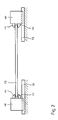
- the twisting device according to FIG. 2 consists of two drive units 10 with clamping elements 11 (gripping claws) and is also a heating device at the same time.
- the electrical current is fed to the rod 12 treated therein via the tensioning elements 11.
- the drive units 10 are displaceably arranged on guide rails 13 for the purpose of adaptation to different rod lengths. Particularly advantageous with this connection of heating and deformation is the possibility of leaving the spring rod 12 in the device for a certain small period of time at a constant temperature after twisting , with the aim of obtaining an optimally fine-grained structure during the recrystallization of the material.
Landscapes
- Engineering & Computer Science (AREA)
- Chemical & Material Sciences (AREA)
- Mechanical Engineering (AREA)
- Physics & Mathematics (AREA)
- Thermal Sciences (AREA)
- Crystallography & Structural Chemistry (AREA)
- Materials Engineering (AREA)
- Metallurgy (AREA)
- Organic Chemistry (AREA)
- Heat Treatment Of Articles (AREA)
- Springs (AREA)
Applications Claiming Priority (2)
| Application Number | Priority Date | Filing Date | Title |
|---|---|---|---|
| DE19863633058 DE3633058C1 (de) | 1986-09-29 | 1986-09-29 | Verfahren und Vorrichtung zur Herstellung einer Schraubenfeder |
| DE3633058 | 1986-09-29 |
Publications (1)
| Publication Number | Publication Date |
|---|---|
| EP0263300A1 true EP0263300A1 (fr) | 1988-04-13 |
Family
ID=6310598
Family Applications (1)
| Application Number | Title | Priority Date | Filing Date |
|---|---|---|---|
| EP87112672A Withdrawn EP0263300A1 (fr) | 1986-09-29 | 1987-08-31 | Procédé et dispositif pour la fabrication d'un ressort hélicoidal |
Country Status (2)
| Country | Link |
|---|---|
| EP (1) | EP0263300A1 (fr) |
| DE (1) | DE3633058C1 (fr) |
Cited By (4)
| Publication number | Priority date | Publication date | Assignee | Title |
|---|---|---|---|---|
| EP0526689A1 (fr) * | 1991-07-23 | 1993-02-10 | Krupp Brüninghaus GmbH | Procédé de fabrication de ressort de compression hélicoidal |
| WO2004087968A3 (fr) * | 2003-04-04 | 2005-04-28 | Thyssen Krupp Automotive Ag | Procede de traitement thermo-mecanique de l'acier |
| CN1332058C (zh) * | 2003-01-10 | 2007-08-15 | 西北工业大学 | 棒状超细晶材料的制备方法 |
| CN101956777A (zh) * | 2009-07-14 | 2011-01-26 | 上海中洲特种合金材料有限公司 | 镍基合金圆柱螺旋扭转弹簧的热处理方法 |
Families Citing this family (1)
| Publication number | Priority date | Publication date | Assignee | Title |
|---|---|---|---|---|
| DE102014214592B4 (de) * | 2014-07-24 | 2018-07-12 | Volkswagen Aktiengesellschaft | Schraubenfeder aus Federstahl und Verfahren zur Herstellung einer Schraubenfeder |
Citations (6)
| Publication number | Priority date | Publication date | Assignee | Title |
|---|---|---|---|---|
| US2082580A (en) * | 1933-10-24 | 1937-06-01 | Spencer Mfg Company | Bodies for withstanding alternating stresses and manufacture thereof |
| DE676746C (de) * | 1935-11-09 | 1939-06-10 | Bosch Gmbh Robert | Verfahren zur Herstellung einer Schraubenfeder aus verwundenem Draht |
| DE1758510A1 (de) * | 1968-06-15 | 1971-01-21 | Brueninghaus Gmbh Stahlwerke | Verfahren zur Herstellung von austenitformgehaerteten Schraubenfedern und Anlage zur Ausfuehrung des Verfahrens |
| DE2020270A1 (de) * | 1970-04-25 | 1971-11-11 | Erdmann Jesnitzer Friedrich Pr | Verfahren zur Erhoehung der Festigkeitswerte von unlegierten und legierten Metallen |
| DE1945597A1 (de) * | 1968-09-13 | 1972-03-02 | Ford Werke Ag | Verfahren zur Herstellung verbesserter ermuedungsbestaendiger Staehle |
| SU688528A1 (ru) * | 1977-06-27 | 1979-09-30 | Yasenchuk Pavel D | Способ изготовлени пружин |
-
1986
- 1986-09-29 DE DE19863633058 patent/DE3633058C1/de not_active Expired
-
1987
- 1987-08-31 EP EP87112672A patent/EP0263300A1/fr not_active Withdrawn
Patent Citations (6)
| Publication number | Priority date | Publication date | Assignee | Title |
|---|---|---|---|---|
| US2082580A (en) * | 1933-10-24 | 1937-06-01 | Spencer Mfg Company | Bodies for withstanding alternating stresses and manufacture thereof |
| DE676746C (de) * | 1935-11-09 | 1939-06-10 | Bosch Gmbh Robert | Verfahren zur Herstellung einer Schraubenfeder aus verwundenem Draht |
| DE1758510A1 (de) * | 1968-06-15 | 1971-01-21 | Brueninghaus Gmbh Stahlwerke | Verfahren zur Herstellung von austenitformgehaerteten Schraubenfedern und Anlage zur Ausfuehrung des Verfahrens |
| DE1945597A1 (de) * | 1968-09-13 | 1972-03-02 | Ford Werke Ag | Verfahren zur Herstellung verbesserter ermuedungsbestaendiger Staehle |
| DE2020270A1 (de) * | 1970-04-25 | 1971-11-11 | Erdmann Jesnitzer Friedrich Pr | Verfahren zur Erhoehung der Festigkeitswerte von unlegierten und legierten Metallen |
| SU688528A1 (ru) * | 1977-06-27 | 1979-09-30 | Yasenchuk Pavel D | Способ изготовлени пружин |
Non-Patent Citations (1)
| Title |
|---|
| SOVIET INVENTIONS ILLUSTRATED, Sektion Chemie, Woche C21, Zusammenfasssungsnr. M24 P52, Derwent Publications Ltd., London, GB; & SU - A - 688 528 (P D YASENCHUK) 30.09.79 * |
Cited By (5)
| Publication number | Priority date | Publication date | Assignee | Title |
|---|---|---|---|---|
| EP0526689A1 (fr) * | 1991-07-23 | 1993-02-10 | Krupp Brüninghaus GmbH | Procédé de fabrication de ressort de compression hélicoidal |
| CN1332058C (zh) * | 2003-01-10 | 2007-08-15 | 西北工业大学 | 棒状超细晶材料的制备方法 |
| WO2004087968A3 (fr) * | 2003-04-04 | 2005-04-28 | Thyssen Krupp Automotive Ag | Procede de traitement thermo-mecanique de l'acier |
| CN100564549C (zh) * | 2003-04-04 | 2009-12-02 | 泰森克鲁普汽车股份公司 | 用于钢材热机处理的方法 |
| CN101956777A (zh) * | 2009-07-14 | 2011-01-26 | 上海中洲特种合金材料有限公司 | 镍基合金圆柱螺旋扭转弹簧的热处理方法 |
Also Published As
| Publication number | Publication date |
|---|---|
| DE3633058C1 (de) | 1987-07-30 |
Similar Documents
| Publication | Publication Date | Title |
|---|---|---|
| DE2917287C2 (de) | Verfahren zum Herstellen von Schraubenfedern, Torsionsstäben oder dergleichen aus Federstahldraht | |
| DE10315418B3 (de) | Verfahren zur thermomechanischen Behandlung von Stahl | |
| EP2192201B1 (fr) | Acier à ressort, élément de ressort et procédé de fabrication d'un élément de ressort | |
| DE2408388A1 (de) | Unter verdrehen gezogener draht sowie verfahren und vorrichtung zu dessen herstellung | |
| DE102011004732B4 (de) | Hochfeste Ventilfeder für einen Fahrzeugmotor und Verfahren zur Herstellung derselben | |
| CH637162A5 (de) | Verfahren zur festigkeitsverguetung von kohlenstoffstahl und niedrig legiertem stahl. | |
| EP3189165A1 (fr) | Procédé de production de ressorts d'acier formés à froid | |
| EP1613449B1 (fr) | Procede de fabrication de ressorts helicoidaux ou de stabilisateurs | |
| DE102008044191A1 (de) | Blattfedermaterial und Herstellungsverfahren desselben | |
| DE69203228T2 (de) | Metalldraht aus einem stahlsubstrat mit kaltgehärteter geglühter martensitischer struktur und beschichtung. | |
| CH637161A5 (de) | Verfahren zur erhoehung der mechanischen festigkeiten von stahl. | |
| DE69119837T2 (de) | Verfahren zur herstellung von ziehdraht | |
| DE60130752T2 (de) | Verfahren zum herstellen von einem teil eines walzlagers | |
| DE3633058C1 (de) | Verfahren und Vorrichtung zur Herstellung einer Schraubenfeder | |
| DE3702634A1 (de) | Stahlstift fuer ein befestigungsmittel und verfahren zu dessen herstellung | |
| DE1433810B2 (de) | Verfahren zur Verbesserung der Zugfestigkeit und der Streckgrenze von Stabstahl | |
| DE2530470C2 (fr) | ||
| DE3012191C2 (de) | Vorrichtung zum Herstellen warmgeformter Federn | |
| DE2439784A1 (de) | Verfahren zur herstellung von geripptem betonstahl, insbesondere fuer bewehrungsmatten und nach diesem verfahren hergestellter betonstahl | |
| AT396073B (de) | Verfahren zum warmwalzen und waermebehandeln von stabfoermigem material | |
| DE1483022C2 (de) | Verfahren zur Herstellung von Drehstäben | |
| AT291323B (de) | Verfahren zur Herstellung von Federdrähten aus warmfesten legierten Stählen | |
| DE2851142C2 (de) | Verfahren zur Herstellung eines hochfesten Federstahls | |
| DE2601625B2 (de) | Verfahren und Vorrichtung zum Vergüten dünnwandiger Großrohre aus Stahl | |
| CH671348A5 (fr) |
Legal Events
| Date | Code | Title | Description |
|---|---|---|---|
| PUAI | Public reference made under article 153(3) epc to a published international application that has entered the european phase |
Free format text: ORIGINAL CODE: 0009012 |
|
| AK | Designated contracting states |
Kind code of ref document: A1 Designated state(s): ES FR GB IT |
|
| STAA | Information on the status of an ep patent application or granted ep patent |
Free format text: STATUS: THE APPLICATION IS DEEMED TO BE WITHDRAWN |
|
| 18D | Application deemed to be withdrawn |
Effective date: 19881014 |
|
| RIN1 | Information on inventor provided before grant (corrected) |
Inventor name: WIENAND, JOSEF, DIPL.-ING. Inventor name: KUEHNERT, BERTHOLD Inventor name: BROSCHEIT, KLAUS Inventor name: NITSCHKE, WERNER Inventor name: BEIHAMMER, HORST, DIPL.-ING. |