EP0263507A2 - Verfahren zur Herstellung einer photographischen Emulsion, die tafelförmige Körner mit enger Korngrössenverteilung enthält - Google Patents
Verfahren zur Herstellung einer photographischen Emulsion, die tafelförmige Körner mit enger Korngrössenverteilung enthält Download PDFInfo
- Publication number
- EP0263507A2 EP0263507A2 EP87114625A EP87114625A EP0263507A2 EP 0263507 A2 EP0263507 A2 EP 0263507A2 EP 87114625 A EP87114625 A EP 87114625A EP 87114625 A EP87114625 A EP 87114625A EP 0263507 A2 EP0263507 A2 EP 0263507A2
- Authority
- EP
- European Patent Office
- Prior art keywords
- tabular
- silver nitrate
- grains
- emulsion
- silver halide
- Prior art date
- Legal status (The legal status is an assumption and is not a legal conclusion. Google has not performed a legal analysis and makes no representation as to the accuracy of the status listed.)
- Granted
Links
Images
Classifications
-
- G—PHYSICS
- G03—PHOTOGRAPHY; CINEMATOGRAPHY; ANALOGOUS TECHNIQUES USING WAVES OTHER THAN OPTICAL WAVES; ELECTROGRAPHY; HOLOGRAPHY
- G03C—PHOTOSENSITIVE MATERIALS FOR PHOTOGRAPHIC PURPOSES; PHOTOGRAPHIC PROCESSES, e.g. CINE, X-RAY, COLOUR, STEREO-PHOTOGRAPHIC PROCESSES; AUXILIARY PROCESSES IN PHOTOGRAPHY
- G03C1/00—Photosensitive materials
- G03C1/005—Silver halide emulsions; Preparation thereof; Physical treatment thereof; Incorporation of additives therein
- G03C1/0051—Tabular grain emulsions
-
- G—PHYSICS
- G03—PHOTOGRAPHY; CINEMATOGRAPHY; ANALOGOUS TECHNIQUES USING WAVES OTHER THAN OPTICAL WAVES; ELECTROGRAPHY; HOLOGRAPHY
- G03C—PHOTOSENSITIVE MATERIALS FOR PHOTOGRAPHIC PURPOSES; PHOTOGRAPHIC PROCESSES, e.g. CINE, X-RAY, COLOUR, STEREO-PHOTOGRAPHIC PROCESSES; AUXILIARY PROCESSES IN PHOTOGRAPHY
- G03C1/00—Photosensitive materials
- G03C1/005—Silver halide emulsions; Preparation thereof; Physical treatment thereof; Incorporation of additives therein
- G03C1/015—Apparatus or processes for the preparation of emulsions
- G03C2001/0156—Apparatus or processes for the preparation of emulsions pAg value; pBr value; pCl value; pI value
-
- G—PHYSICS
- G03—PHOTOGRAPHY; CINEMATOGRAPHY; ANALOGOUS TECHNIQUES USING WAVES OTHER THAN OPTICAL WAVES; ELECTROGRAPHY; HOLOGRAPHY
- G03C—PHOTOSENSITIVE MATERIALS FOR PHOTOGRAPHIC PURPOSES; PHOTOGRAPHIC PROCESSES, e.g. CINE, X-RAY, COLOUR, STEREO-PHOTOGRAPHIC PROCESSES; AUXILIARY PROCESSES IN PHOTOGRAPHY
- G03C1/00—Photosensitive materials
- G03C1/005—Silver halide emulsions; Preparation thereof; Physical treatment thereof; Incorporation of additives therein
- G03C1/035—Silver halide emulsions; Preparation thereof; Physical treatment thereof; Incorporation of additives therein characterised by the crystal form or composition, e.g. mixed grain
- G03C2001/03511—Bromide content
-
- G—PHYSICS
- G03—PHOTOGRAPHY; CINEMATOGRAPHY; ANALOGOUS TECHNIQUES USING WAVES OTHER THAN OPTICAL WAVES; ELECTROGRAPHY; HOLOGRAPHY
- G03C—PHOTOSENSITIVE MATERIALS FOR PHOTOGRAPHIC PURPOSES; PHOTOGRAPHIC PROCESSES, e.g. CINE, X-RAY, COLOUR, STEREO-PHOTOGRAPHIC PROCESSES; AUXILIARY PROCESSES IN PHOTOGRAPHY
- G03C1/00—Photosensitive materials
- G03C1/005—Silver halide emulsions; Preparation thereof; Physical treatment thereof; Incorporation of additives therein
- G03C1/035—Silver halide emulsions; Preparation thereof; Physical treatment thereof; Incorporation of additives therein characterised by the crystal form or composition, e.g. mixed grain
- G03C2001/0357—Monodisperse emulsion
-
- G—PHYSICS
- G03—PHOTOGRAPHY; CINEMATOGRAPHY; ANALOGOUS TECHNIQUES USING WAVES OTHER THAN OPTICAL WAVES; ELECTROGRAPHY; HOLOGRAPHY
- G03C—PHOTOSENSITIVE MATERIALS FOR PHOTOGRAPHIC PURPOSES; PHOTOGRAPHIC PROCESSES, e.g. CINE, X-RAY, COLOUR, STEREO-PHOTOGRAPHIC PROCESSES; AUXILIARY PROCESSES IN PHOTOGRAPHY
- G03C5/00—Photographic processes or agents therefor; Regeneration of such processing agents
- G03C5/16—X-ray, infrared, or ultraviolet ray processes
- G03C2005/168—X-ray material or process
-
- G—PHYSICS
- G03—PHOTOGRAPHY; CINEMATOGRAPHY; ANALOGOUS TECHNIQUES USING WAVES OTHER THAN OPTICAL WAVES; ELECTROGRAPHY; HOLOGRAPHY
- G03C—PHOTOSENSITIVE MATERIALS FOR PHOTOGRAPHIC PURPOSES; PHOTOGRAPHIC PROCESSES, e.g. CINE, X-RAY, COLOUR, STEREO-PHOTOGRAPHIC PROCESSES; AUXILIARY PROCESSES IN PHOTOGRAPHY
- G03C2200/00—Details
- G03C2200/43—Process
-
- G—PHYSICS
- G03—PHOTOGRAPHY; CINEMATOGRAPHY; ANALOGOUS TECHNIQUES USING WAVES OTHER THAN OPTICAL WAVES; ELECTROGRAPHY; HOLOGRAPHY
- G03C—PHOTOSENSITIVE MATERIALS FOR PHOTOGRAPHIC PURPOSES; PHOTOGRAPHIC PROCESSES, e.g. CINE, X-RAY, COLOUR, STEREO-PHOTOGRAPHIC PROCESSES; AUXILIARY PROCESSES IN PHOTOGRAPHY
- G03C5/00—Photographic processes or agents therefor; Regeneration of such processing agents
- G03C5/16—X-ray, infrared, or ultraviolet ray processes
-
- Y—GENERAL TAGGING OF NEW TECHNOLOGICAL DEVELOPMENTS; GENERAL TAGGING OF CROSS-SECTIONAL TECHNOLOGIES SPANNING OVER SEVERAL SECTIONS OF THE IPC; TECHNICAL SUBJECTS COVERED BY FORMER USPC CROSS-REFERENCE ART COLLECTIONS [XRACs] AND DIGESTS
- Y10—TECHNICAL SUBJECTS COVERED BY FORMER USPC
- Y10S—TECHNICAL SUBJECTS COVERED BY FORMER USPC CROSS-REFERENCE ART COLLECTIONS [XRACs] AND DIGESTS
- Y10S430/00—Radiation imagery chemistry: process, composition, or product thereof
- Y10S430/167—X-ray
Definitions
- This invention relates to a process for preparing a photographic emulsion containing tabular silver halide grains. More particularly this invention relates to a process for preparing a photographic emulsion wherein the tabular silver halide grains have a narrow size distribution.
- Tabular silver halide grains are widely known. They have been extensively studied in the literature since photographic emulsions containing these grains appeared to offer some significant advantages over photographic emulsions containing round or globular grains (e.g., splash prepared types).
- tabular grains are large, flat silver halide grains that are prepared by employing long ripening times or by balanced double jet (BDJ) precipitation methods.
- BDJ balanced double jet
- Commercial emulsions using tabular grains are conventionally made by using a BDJ process.
- the tabular grains usually have triangular parallel crystal faces each of which is usually larger than any other crystal face of the grain and are conventionally defined by their aspect ratio (AR) which is the ratio of the diameter of the grain to the thickness.
- AR aspect ratio
- Tabular grains of varying thicknesses and AR's have been found to be useful in photographic systems. Larger AR grains, e.g., at least 8:1, have diameters of at least 0.6 ⁇ m and thicknesses of less than 0.3 ⁇ m. These larger tabular grains have certain commercial advantages apparent to those of normal skill in the art. For example, they have a larger surface area and thus can accept more sensitizing dye. Since these tabular grains usually are dye sensitized, when emulsions using such tabular grains are present in medical x-ray elements an increase in sharpness can result.
- the covering power is usually greater and thus the emulsion can be coated at a lower coating weight and is therefore less costly.
- grain growth conditions which promote tabularity have not promoted narrow grain size distribution. It is therefore desired to prepare photographic emulsions containing tabular grains having a narrow size distribution.
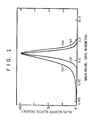
- FIG. 1 are curves comparing the tabular grain size distribution of emulsions made according to known procedure (Curve A) and according to this invention (Curve B).
- the curves are made by plotting the volume-weighted relative frequency at which the grains occur vs. the grain volume in cubic micrometers ( ⁇ m3).
- ⁇ m3 cubic micrometers
- the width of the curve is a direct indication of the dispersity of the sizes.
- Curve A showing a relatively wide grain size distribution illustrates a dispersity of 2.0 or above.
- Curve B showing a relatively narrow distribution of grain volumes illustrates a dispersity of about 1.52.
- the process of this invention results in photographic emulsions containing tabular silver halide grains which have a narrow size distribution when compared to tabular grains prepared according to known processes.
- the resultant narrow size distribution could not have been predicted from the state of the art and is achieved by using a silver halide solvent such as ammonia, ammonia derivatives, etc. and by stopping the initial silver nitrate addition for a time period of 0.5 to 60 minutes at a bromide ion concentration in the range of 0.005 N to 0.05 normal (N).
- the emulsion containing the final tabular grains may be ripened further by the addition of a thiocyanate salt ripening agent, e.g., alkali metal thiocyanate, for a period of about 1 to 20 minutes.
- a thiocyanate salt ripening agent e.g., alkali metal thiocyanate
- the tabular silver halide grains are of the silver bromide or silver bromoiodide types.
- the grains have an average thickness of about 0.05 to 0.5 ⁇ m, preferably 0.05 to 0.2 ⁇ m; an average grain volume of 0.05 to 1.0 ⁇ m3, preferably 0.1 to 0.3 ⁇ m3; and a mean apsect ratio of greater than 2:1, preferably greater than 5 to 1.
- the grain characteristics described above of the silver halide emulsions of this invention can be readily ascertained by procedures well known to those skilled in the art.
- the term "aspect ratio” refers to the ratio of the diameter of the grain to its thickness.
- The"diameter" of the grain is in turn defined as the diameter of a circle having and area equal to the projected area of the grain as viewed in a photomicrograph or an electron micrograph of an emulsion sample. From shadowed electron micrographs of emulsion samples it is possible to determine the thickness and diameter of each grain. From this the aspect ratio of each tabular grain can be calculated, and the aspect ratios of all the tabular grains in the sample can be averaged to obtain their mean aspect ratio.
- the mean aspect ratio is the average of individual tabular grain aspect ratios. In practice it is usually simpler to obtain an average thickness and an average diameter of the tabular grains and to calculate the mean aspect ratio as the ratio of these two averages. Whether the averaged individual aspect ratios or the averages of thickness and diameter are used to determine the mean aspect ratio, within the tolerances of grain measurements contemplated, the mean aspect ratios obtained do not significantly differ.
- Grain size dispersities of a tabular grain can be described by measuring V ⁇ g° which is essentially [1 plus (standard deviation of the volumes/mean volume)] and which is measured by apparatus similar to that taight by Holland et al. P.S. and E, volume 17, No. 3 (1973), page 295 et seq. Normally the above determinations are made using tabular grains which are in the grain diameter range of 0.5 to 2.5 ⁇ m and appear tabular at 2,500 times magnification. As illustrated in FIG. 1, tabular grains prepared according to this invention have a grain size distribution approximately 27% narrower than that of tabular grains prepared by known methods.
- the following procedure is used.
- a dispersing medium/bromide mixture wherein the initial bromide ion concentration is 0.08 to 0.25 N, which is the known range to produce tabular grains.
- the bromide ion concentration is 0.1 to 0.2 N.
- the bromide salt present is typically in the form of an aqueous salt solution, e.g., one or more soluble ammonium, alkali metal, e.g., sodium, potassium; alkaline earth metal, e.g., magnesium or calcium.
- Suitable dispersing media initially present in the reaction vessel include water and a peptizer, e.g., gelatin, including alkali-treated gelatin (cattle bone or hide gelatin), acid-treated gelatin (pigskin gelatin), gelatin derivatives, e.g., acetylated gelatin, phthalated gelatin, etc.; protein derivatives, cellulose derivatives, e.g., cellulose esters; polysaccharides, e.g., dextran, gum arabic, zein, casein, pectin, collagen derivatives, agar-agar, arrowroot, albumin, etc. Mixtures of peptizers may be used.
- a preferred peptizer is gelatin or a gelatin derivative.
- the temperature of the contents in the reaction vessel is preferably in the range of 40 to 80°C.
- the pH of the contents in the vessel is in the range of 3.0 to 7.0.
- Silver nitrate is then added at a steady rate into the reaction vessel containing the dispersing medium/bromide mixture whereby tabular seed grains begin to form.
- the pH is maintained in the aforementioned range.
- a basic silver halide solvent solution is added to the reaction vessel to achieve about 0.02 to 0.2 N of the solvent in the vessel.
- the preferred solvent solution is ammonia producing a normality in the range of 0.02 to 0.2 N.
- the percentage of silver nitrate added to ensure proper size tabular seed grains ranges from 2 to 30%, preferably 7 to 15%, based on the total weight of silver nitrate.
- the initial silver nitrate addition is stopped for a time period of 0.5 to 60 minutes, preferably 1 to 5 minutes. During this period the tabular seed grains are permitted to ripen.
- ammonia, ammonia derivative or some other basic silver halide solvent is used and it is desired to neutralize at least some of the basic compound present.
- all the basic compound is neutralized for the narrowest size distribution. This can be accomplished by adding an acid compound, e.g., acetic acid, sulfuric acid, nitric acid, hydrochloric acid, etc.
- the pH achieved is in the range 5.8 to 9.0, preferably 5.8 to 7.5.
- the neutralizing step occurs before the final silver nitrate and halide additions are made.
- Silver nitrate addition is resumed by continually adding silver nitrate into the vessel together with a halide compound which introduces additional bromide ions or bromoiodide ions by a balanced double jet (BDJ) procedure known to those skilled in the art thereby maintaining the desired bromide ion concentration. It is in this step that the tabular grain achieve their final volume and narrow size distribution and other desired properties including mean aspect ratio.
- BDJ balanced double jet
- the amount of iodide present in the emulsion is in the range of about 0.01 to 10.0 mol percent, preferably 0.01 to 2.0 mol percent based on total silver.
- the tabular grains may be further ripened, e.g., for a time period of 1 to 20 minutes by the addition of a thiocyanate salt to the emulsion.
- a thiocyanate salt include alkali metal thiocyanates and ammonium thiocyanate, e.g., in an amount of 0.1 to 20 g salt/mole silver halide.
- Other ripening agents can include thioether, etc., as well as others known to those skilled in the art.
- the tabular grain emulsions are preferably washed to remove soluble salts. Washing techniques are known to those skilled in the art. The washing is advantageous in terminating ripening of the tabular grains after completion of precipitation to avoid increasing their thickness and reducing their aspect ratio. While substantially all the grains are tabular in form the emulsion is not affected by the presence of a minor amount of nontabular grains. The percentage of tabular grains is determined primarily at the initial seeding stage and is substantially unchanged during subsequent stages of grain preparation.
- the emulsion containing tabular grains prepared according to this invention is generally fully dispersed and bulked up with gelatin or other dispersion of peptizer described above and subjected to any of the known methods for achieving optimum sensitivity.
- optimum chemical sensitization is achieved by the addition of sulfur and gold.
- Other sensitizers include: selenium, tellurium, platinum, palladium, iridium, osmium, rhodium, rhenium or phosphorous sensitizers or combinations thereof, used at 10 ⁇ 8 to 10 ⁇ 10 N silver (pAg 8 to 10), pH of 6.0 to 7.0 and temperatures from 50 to 60°C.
- Chemical sensitization can occur in the presence of modifiers, e.g., compounds known to suppress fog and increase speed when present during chemical sensitization, such as azaindenes, azapyridazines, azapyrimidines, benzothiazolium salts, and sensitizers having one or more heterocyclic nuclei.
- modifiers e.g., compounds known to suppress fog and increase speed when present during chemical sensitization, such as azaindenes, azapyridazines, azapyrimidines, benzothiazolium salts, and sensitizers having one or more heterocyclic nuclei.
- the tabular grain silver halide emulsions are also spectrally sensitized.
- Tabular grains of different aspect ratios cen be made according to the described process; for example, large, thin tabular grains or, alternatively, thicker, smaller tabular grains can be prepared.
- Useful sensitizing dyes are those dyes that exhibit absorption maxima in the blue and minus blue (i.e., green and red) portions of the visible spectrum.
- spectral sensitizing dyes can be employed which improve spectral response beyond the visible spectrum, e.g., infrared absorbing spectral sensitizers. Examples of dyes include those disclosed in U.S. Patent No. 4,425,426 col. 16, line 52 to col. 19, line 42 which is incorporated herein by reference.
- Other materials commonly employed in combination with hydrophilic colloid peptizers as vehicles include synthetic polymeric peptizers, carriers and/or binders such as poly(vinyl lactams), acrylamide polymers, polyvinyl alcohol and its derivatives, polyvinyl acetals, polymers of alkyl and sulfoalkyl acrylates and methacrylates, hydrolyzed polyvinyl acetates, polyamides, polyvinyl pyridine, acrylic acid polymers, maleic anhydride copolymers, polyalkylene oxides, methacrylamide copolymers, maleic acid copolymers, vinylamine copolymers, methacrylic acid copolymers, sulfoalkylacrylamide copolymers, polyalkyleneimine copolymers, polyamines, N,N-dialkylaminoalkyl acrylates, vinyl imidazole copolymers
- the tabular grain emulsions are useful in photographic film elements.
- An emulsion can be coated in the normal manner on any of the conventional supports, e.g., preferably polyethylene terephthalate subbed in a conventional manner. Any of the other supports known to the art can also be used. Coating, wetting aides, antifoggants, antistatic agents, etc., common to most silver halide elements, can also be used in the preparation of the film elements.
- elements prepared from the emulsions made using the process of this invention are eminently suitable for use in x-ray elements, usually the elements are coated on both side of the support which usually is tinted with a blue dye as is known to those skilled in the x-ray art.
- the support may, and preferably does, have the conventional resin-type sub aplied to the support and the sublayer is then usually overcoated with a thin substratum of gelatin over which the emulsion is than applied.
- the emulsion may be applied at coating weights of less than 5 g Ag/m2, preferably less than 4 g Ag/m2, for example, and then an abrasion layer of hardened gelatin applied thereto to provide protection for the silver containing layers.
- This element is conventionally exposed in a typical cassette with a pair of x-ray intensifying screens as is well known. Of course, this is only a preferred element employing emulsions of this invention.
- the emulsion can be used conveniently in any of the well-known photosensitive systems as noted below. A preferred mode of the invention is described in Example 2.
- Photographic silver halide film elements having at least one layer of an emulsion containing the tabular silver halide grains having narrow size distribution prepared according to the process of this invention are useful in conventional areas of photography.
- the photographic elements are particularly useful as x-ray films, e.g., support coated on each side, in cooperation with x-ray intensifying screens. Sensitization can be in the green or blue portion of the spectrum.
- Other uses include: graphic arts films, color photographic films, etc.
- the resultant grains were characterized as predominantly tabular with a mean volume of 0.34 ⁇ m3, a thickness of about 0.15 ⁇ m and an AR of 11.
- the dispersity of this emulsion was 1.91.
- the grain size distribution of the emulsion as measured was bimodal with a large peak at about 0.4 ⁇ m3 volume and a smaller one at about 0.016 ⁇ m3 volume.
- Double jet addition of 3N AgNO3 and 3N KBr was resumed at 10 ml/min, with the AgNO3 rate increasing 1.25 ml/min each minute and the KBr rate increasing to maintain a growth bromide concentration of 0.02N BR ⁇ .
- the AgNO3 flow reached 55 ml/m, that rate was maintained until 1.5 liters of 3N AgNO3 had been added.
- 140 ml of 3.2% NaSCN and 3 ml glacial acetic acid were added and the emulsion ripened 10 minutes. This emulsion was predominantly tabular with a very narrow grain size distribution; Mean Volume 0.24 ⁇ m3; Thickness 0.24 ⁇ m; AR 5; Dispersity 1.44.
- a blue spectral sensitizing dye N,N ⁇ -(2-(3-methyl(-2- thiazolino)vinyl)-1,4-phenylene diamine), methyl sulfate salt as is known to those skilled in the art.
- Example 3 The procedure was similar to Example 3 except that AgNO3 addition was halted upon yielding a bromide ion concentration of 0.02 N, and the emulsion ripened 3 minutes before double jet growth was begun.
- Example 4 The procedure was similar to Example 4 except that 30 ml of 12.ON NH4OH was added to the emulsion when Br ⁇ concentration reached 0.028 N during seeding. The ammonia remained through the AgNO3 addition process, but was neutralized to about pH 5.8 using 226 ml of 1.5N H2SO4 before adding the NaSCN-water mixture.
- Example 5 The procedure was similar to Example 5 except that the ammonia was neutralized to a pH of about 5.6 using 223 ml of 1.5N H2SO4 after the 3-minute ripening with no AgNO3 addition but before double jet growth. These differences are summarized in Table 2 below.
- the grains produced in the above mixes were measured to have the following properties: All of the above emulsions were comparably tabular in habit, but the emulsions of Example 3 and 4 had strongly bimodal grain size distributions.
- the emulsion of Example 5 had a single but relatively broad grain size distribution, while the emulsion of Example 6 had a single narrow grain size distribution.
Landscapes
- Chemical & Material Sciences (AREA)
- Chemical Kinetics & Catalysis (AREA)
- Engineering & Computer Science (AREA)
- Materials Engineering (AREA)
- Physics & Mathematics (AREA)
- General Physics & Mathematics (AREA)
- Silver Salt Photography Or Processing Solution Therefor (AREA)
Applications Claiming Priority (2)
| Application Number | Priority Date | Filing Date | Title |
|---|---|---|---|
| US917504 | 1986-10-10 | ||
| US06/917,504 US4722886A (en) | 1986-10-10 | 1986-10-10 | Process for preparing a photographic emulsion containing tabular grains having narrow size distribution |
Publications (3)
| Publication Number | Publication Date |
|---|---|
| EP0263507A2 true EP0263507A2 (de) | 1988-04-13 |
| EP0263507A3 EP0263507A3 (en) | 1988-08-03 |
| EP0263507B1 EP0263507B1 (de) | 1990-04-25 |
Family
ID=25438886
Family Applications (1)
| Application Number | Title | Priority Date | Filing Date |
|---|---|---|---|
| EP87114625A Expired EP0263507B1 (de) | 1986-10-10 | 1987-10-07 | Verfahren zur Herstellung einer photographischen Emulsion, die tafelförmige Körner mit enger Korngrössenverteilung enthält |
Country Status (9)
| Country | Link |
|---|---|
| US (1) | US4722886A (de) |
| EP (1) | EP0263507B1 (de) |
| JP (1) | JPS63107813A (de) |
| AU (1) | AU579528B2 (de) |
| BR (1) | BR8705422A (de) |
| CA (1) | CA1316036C (de) |
| DE (1) | DE3762465D1 (de) |
| DK (1) | DK529387A (de) |
| NO (1) | NO874223L (de) |
Cited By (4)
| Publication number | Priority date | Publication date | Assignee | Title |
|---|---|---|---|---|
| EP0391560A1 (de) * | 1989-04-03 | 1990-10-10 | Minnesota Mining And Manufacturing Company | Verfahren zur Herstellung photographischer, tafelförmige Körner enthaltender Emulsionen |
| EP0443475A3 (en) * | 1990-02-19 | 1992-05-20 | Konica Corporation | Silver-halide photographic light-sensitive material |
| US5262294A (en) * | 1990-02-19 | 1993-11-16 | Konica Corporation | Silver halide photographic light sensitive material |
| EP0610597A1 (de) * | 1993-01-13 | 1994-08-17 | Fuji Photo Film Co., Ltd. | Verfahren zur Herstellung einer Tafelkorn-Silberhalogenidemulsion |
Families Citing this family (23)
| Publication number | Priority date | Publication date | Assignee | Title |
|---|---|---|---|---|
| CA1316035C (en) * | 1986-10-10 | 1993-04-13 | Sterling Diagnostic Imaging, Inc. | Process for preparing a photographic emulsion containing tabular grains exhibiting high speed |
| JP2559264B2 (ja) * | 1987-12-17 | 1996-12-04 | 富士写真フイルム株式会社 | ハロゲン化銀乳剤及びその製造方法 |
| US5035990A (en) * | 1989-11-28 | 1991-07-30 | E. I. Du Pont De Nemours And Company | Radiographic elements with improved covering power |
| US5013641A (en) * | 1989-12-19 | 1991-05-07 | Eastman Kodak Company | Formation of tabular silver halide emulsions utilizing high pH digestion |
| US5248587A (en) * | 1990-10-23 | 1993-09-28 | Eastman Kodak Company | Low temperature growth emulsion making process |
| US5104786A (en) * | 1990-10-29 | 1992-04-14 | Eastman Kodak Company | Plug-flow process for the nucleation of silver halide crystals |
| US5147771A (en) * | 1991-05-14 | 1992-09-15 | Eastman Kodak Company | Process of preparing a reduced dispersity tabular grain emulsion |
| US5210013A (en) * | 1991-05-14 | 1993-05-11 | Eastman Kodak Company | Very low coefficient of variation tabular grain emulsion |
| US5147773A (en) * | 1991-05-14 | 1992-09-15 | Eastman Kodak Company | Process of preparing a reduced dispersity tabular grain emulsion |
| US5171659A (en) * | 1991-05-14 | 1992-12-15 | Eastman Kodak Company | Process of preparing a reduced dispersity tabular grain emulsion |
| FR2676554A1 (fr) * | 1991-05-14 | 1992-11-20 | Kodak Pathe | Procede d'obtention de grains tabulaires monodisperses. |
| US5147772A (en) * | 1991-05-14 | 1992-09-15 | Eastman Kodak Company | Process of preparing a reduced dispersity tabular grain emulsion |
| US5254453A (en) * | 1992-04-16 | 1993-10-19 | Eastman Kodak Company | Process for preparing narrow size distribution small tabular grains |
| US5385815A (en) | 1992-07-01 | 1995-01-31 | Eastman Kodak Company | Photographic elements containing loaded ultraviolet absorbing polymer latex |
| US5318888A (en) * | 1992-09-16 | 1994-06-07 | E. I. Du Pont De Nemours And Company | Large tabular grains with novel size distribution and process for rapid manufacture |
| US5358840A (en) * | 1993-07-22 | 1994-10-25 | Eastman Kodak Company | Tabular grain silver iodobromide emulsion of improved sensitivity and process for its preparation |
| EP0695968A3 (de) | 1994-08-01 | 1996-07-10 | Eastman Kodak Co | Viskositätsverminderung in einer photographischen Schmelze |
| DE69517372T2 (de) | 1994-08-26 | 2001-02-15 | Eastman Kodak Co., Rochester | Tafelkornemulsionen mit verbesserter Sensibilisierung |
| DE69518502T2 (de) * | 1995-03-29 | 2001-04-19 | Tulalip Consultoria Comercial Sociedade Unipessoal S.A., Funchal | Verfahren zur Herstellung von Emulsionen mit monodispersen Silberhalogenidtafelkörnern |
| DE69519154T2 (de) * | 1995-03-29 | 2001-04-05 | Eastman Kodak Co. (A New Jersey Corp.), Rochester | Verfahren zur Herstellung von Emulsionen mit monodispersen Silberhalogenidtafelkörnern |
| US5830629A (en) * | 1995-11-01 | 1998-11-03 | Eastman Kodak Company | Autoradiography assemblage using transparent screen |
| US5750327A (en) * | 1996-06-20 | 1998-05-12 | Eastman Kodak Company | Mixed ripeners for silver halide emulsion formation |
| ITSV20020053A1 (it) * | 2002-10-31 | 2004-05-01 | Allaix Roberto C O Ferrania S P A Uff Brevetti | Emulsione di granuli tabulari agli alogenuri d'argento. |
Family Cites Families (7)
| Publication number | Priority date | Publication date | Assignee | Title |
|---|---|---|---|---|
| DE156345C (de) * | 1903-09-05 | |||
| US4434226A (en) * | 1981-11-12 | 1984-02-28 | Eastman Kodak Company | High aspect ratio silver bromoiodide emulsions and processes for their preparation |
| US4414304A (en) * | 1981-11-12 | 1983-11-08 | Eastman Kodak Company | Forehardened high aspect ratio silver halide photographic elements and processes for their use |
| US4386156A (en) * | 1981-11-12 | 1983-05-31 | Eastman Kodak Company | Silver bromide emulsions of narrow grain size distribution and processes for their preparation |
| US4425426A (en) * | 1982-09-30 | 1984-01-10 | Eastman Kodak Company | Radiographic elements exhibiting reduced crossover |
| JPS613134A (ja) * | 1984-06-15 | 1986-01-09 | Fuji Photo Film Co Ltd | ハロゲン化銀乳剤の製造方法およびハロゲン化銀写真感光材料 |
| CA1316035C (en) * | 1986-10-10 | 1993-04-13 | Sterling Diagnostic Imaging, Inc. | Process for preparing a photographic emulsion containing tabular grains exhibiting high speed |
-
1986
- 1986-10-10 US US06/917,504 patent/US4722886A/en not_active Expired - Lifetime
-
1987
- 1987-10-06 CA CA000548682A patent/CA1316036C/en not_active Expired - Fee Related
- 1987-10-07 DE DE8787114625T patent/DE3762465D1/de not_active Expired - Lifetime
- 1987-10-07 EP EP87114625A patent/EP0263507B1/de not_active Expired
- 1987-10-09 NO NO874223A patent/NO874223L/no unknown
- 1987-10-09 JP JP62253954A patent/JPS63107813A/ja active Granted
- 1987-10-09 DK DK529387A patent/DK529387A/da not_active Application Discontinuation
- 1987-10-09 BR BR8705422A patent/BR8705422A/pt not_active IP Right Cessation
- 1987-10-09 AU AU79515/87A patent/AU579528B2/en not_active Ceased
Cited By (4)
| Publication number | Priority date | Publication date | Assignee | Title |
|---|---|---|---|---|
| EP0391560A1 (de) * | 1989-04-03 | 1990-10-10 | Minnesota Mining And Manufacturing Company | Verfahren zur Herstellung photographischer, tafelförmige Körner enthaltender Emulsionen |
| EP0443475A3 (en) * | 1990-02-19 | 1992-05-20 | Konica Corporation | Silver-halide photographic light-sensitive material |
| US5262294A (en) * | 1990-02-19 | 1993-11-16 | Konica Corporation | Silver halide photographic light sensitive material |
| EP0610597A1 (de) * | 1993-01-13 | 1994-08-17 | Fuji Photo Film Co., Ltd. | Verfahren zur Herstellung einer Tafelkorn-Silberhalogenidemulsion |
Also Published As
| Publication number | Publication date |
|---|---|
| DE3762465D1 (de) | 1990-05-31 |
| AU579528B2 (en) | 1988-11-24 |
| EP0263507B1 (de) | 1990-04-25 |
| AU7951587A (en) | 1988-04-14 |
| BR8705422A (pt) | 1988-05-24 |
| JPH0541977B2 (de) | 1993-06-25 |
| JPS63107813A (ja) | 1988-05-12 |
| NO874223L (no) | 1988-04-11 |
| EP0263507A3 (en) | 1988-08-03 |
| NO874223D0 (no) | 1987-10-09 |
| US4722886A (en) | 1988-02-02 |
| CA1316036C (en) | 1993-04-13 |
| DK529387A (da) | 1988-04-11 |
| DK529387D0 (da) | 1987-10-09 |
Similar Documents
| Publication | Publication Date | Title |
|---|---|---|
| EP0263507B1 (de) | Verfahren zur Herstellung einer photographischen Emulsion, die tafelförmige Körner mit enger Korngrössenverteilung enthält | |
| EP0895120B1 (de) | Verfahren zur Herstellung einer Silberhalogenidemulsion | |
| US4150994A (en) | Process for the manufacture of photographic silver halide emulsions containing silver halide crystals of the twinned type | |
| EP0178097A2 (de) | Lichtempfindliche, photographische Silberhalogenidemulsion | |
| US4801522A (en) | Process for preparing a photographic emulsion containing tabular grains exhibiting high speed | |
| EP0588338B1 (de) | Verfahren zur schnellen Herstellung von grossen Tafelkörnern mit neuer Grössenverteilung | |
| EP0072714A2 (de) | Silberhalogenidfällungsverfahren, in welchem dem Reaktionsgefäss ein Teil des Dispergiermittels entzogen wird | |
| US5035992A (en) | Process for the stabilization of high-chloride crystals with modified crystal habit using bromide shells | |
| EP0263508B1 (de) | Verfahren zur Herstellung einer photographischen Emulsion aus hochempfindlichen T-Körnern | |
| JP3042712B2 (ja) | セレン及びイリジウムドープした乳剤 | |
| JPH05204068A (ja) | 感光性ハロゲン化銀乳剤の製造方法 | |
| US5141846A (en) | Method for preparing photographic emulsion | |
| EP0723186B1 (de) | Herstellung von tafelförmigen Silberhalogenidemulsionen in Gegenwart von polaren aprotischen Lösungsmitteln und/oder Alkoholen | |
| US5476761A (en) | Preparation method of regular silver (halide) bromide or silver bromoiodide light-sensitive emulsions and material comprising said emulsions | |
| EP0102320B1 (de) | Verfahren zur Herstellung von Silberhalogenidemulsionen | |
| EP0754965B1 (de) | Tafelförmige Silberhalogenidemulsionen, ein Verfahren zu deren Herstellung, und photographische Erzeugnisse | |
| WO1991018320A1 (en) | Silver halide grains having small twin-plane separations | |
| EP0174018B1 (de) | Nach der Einfacheinlaufmethode hergestellte Emulsionen gleichmässiger Korngrössenverteilung | |
| EP0649051A1 (de) | Herstellungsverfahren für lichtempfindliche Silberhalogenidemulsion und diese Emulsionen enthaltendes Material | |
| US4678744A (en) | Splash-prepared silver halide emulsions with a uniform particle size distribution | |
| JP2838533B2 (ja) | ハロゲン化銀写真感光材料 | |
| JPH01188848A (ja) | ハロゲン化銀写真乳剤の製造方法 | |
| JPH11271898A (ja) | ハロゲン化銀乳剤の製造方法 | |
| JP2000258862A (ja) | ハロゲン化銀種粒子、該種粒子を用いて作製されたハロゲン化銀乳剤及びハロゲン化銀感光材料 | |
| WO1991012566A1 (en) | Photographic silver halide material and process for forming reversal images |
Legal Events
| Date | Code | Title | Description |
|---|---|---|---|
| PUAI | Public reference made under article 153(3) epc to a published international application that has entered the european phase |
Free format text: ORIGINAL CODE: 0009012 |
|
| AK | Designated contracting states |
Kind code of ref document: A2 Designated state(s): BE CH DE FR GB IT LI LU NL SE |
|
| PUAL | Search report despatched |
Free format text: ORIGINAL CODE: 0009013 |
|
| AK | Designated contracting states |
Kind code of ref document: A3 Designated state(s): BE CH DE FR GB IT LI LU NL SE |
|
| 17P | Request for examination filed |
Effective date: 19880924 |
|
| 17Q | First examination report despatched |
Effective date: 19890328 |
|
| GRAA | (expected) grant |
Free format text: ORIGINAL CODE: 0009210 |
|
| AK | Designated contracting states |
Kind code of ref document: B1 Designated state(s): BE CH DE FR GB IT LI LU NL SE |
|
| ITF | It: translation for a ep patent filed | ||
| REF | Corresponds to: |
Ref document number: 3762465 Country of ref document: DE Date of ref document: 19900531 |
|
| ET | Fr: translation filed | ||
| PLBE | No opposition filed within time limit |
Free format text: ORIGINAL CODE: 0009261 |
|
| STAA | Information on the status of an ep patent application or granted ep patent |
Free format text: STATUS: NO OPPOSITION FILED WITHIN TIME LIMIT |
|
| 26N | No opposition filed | ||
| ITTA | It: last paid annual fee | ||
| PGFP | Annual fee paid to national office [announced via postgrant information from national office to epo] |
Ref country code: SE Payment date: 19920915 Year of fee payment: 6 Ref country code: CH Payment date: 19920915 Year of fee payment: 6 |
|
| PGFP | Annual fee paid to national office [announced via postgrant information from national office to epo] |
Ref country code: LU Payment date: 19921027 Year of fee payment: 6 |
|
| PGFP | Annual fee paid to national office [announced via postgrant information from national office to epo] |
Ref country code: NL Payment date: 19921031 Year of fee payment: 6 |
|
| EPTA | Lu: last paid annual fee | ||
| PG25 | Lapsed in a contracting state [announced via postgrant information from national office to epo] |
Ref country code: LU Free format text: LAPSE BECAUSE OF NON-PAYMENT OF DUE FEES Effective date: 19931007 |
|
| PG25 | Lapsed in a contracting state [announced via postgrant information from national office to epo] |
Ref country code: SE Effective date: 19931008 |
|
| PG25 | Lapsed in a contracting state [announced via postgrant information from national office to epo] |
Ref country code: LI Effective date: 19931031 Ref country code: CH Effective date: 19931031 |
|
| PG25 | Lapsed in a contracting state [announced via postgrant information from national office to epo] |
Ref country code: NL Effective date: 19940501 |
|
| NLV4 | Nl: lapsed or anulled due to non-payment of the annual fee | ||
| REG | Reference to a national code |
Ref country code: CH Ref legal event code: PL |
|
| EUG | Se: european patent has lapsed |
Ref document number: 87114625.4 Effective date: 19940510 |
|
| REG | Reference to a national code |
Ref country code: GB Ref legal event code: 732E |
|
| REG | Reference to a national code |
Ref country code: FR Ref legal event code: TP |
|
| PGFP | Annual fee paid to national office [announced via postgrant information from national office to epo] |
Ref country code: BE Payment date: 19981216 Year of fee payment: 12 |
|
| PG25 | Lapsed in a contracting state [announced via postgrant information from national office to epo] |
Ref country code: BE Free format text: LAPSE BECAUSE OF NON-PAYMENT OF DUE FEES Effective date: 19991031 |
|
| BERE | Be: lapsed |
Owner name: E.I. DU PONT DE NEMOURS AND CY Effective date: 19991031 |
|
| PGFP | Annual fee paid to national office [announced via postgrant information from national office to epo] |
Ref country code: GB Payment date: 20000911 Year of fee payment: 14 Ref country code: DE Payment date: 20000911 Year of fee payment: 14 |
|
| PGFP | Annual fee paid to national office [announced via postgrant information from national office to epo] |
Ref country code: FR Payment date: 20000915 Year of fee payment: 14 |
|
| PG25 | Lapsed in a contracting state [announced via postgrant information from national office to epo] |
Ref country code: GB Free format text: LAPSE BECAUSE OF NON-PAYMENT OF DUE FEES Effective date: 20011007 |
|
| REG | Reference to a national code |
Ref country code: GB Ref legal event code: IF02 |
|
| GBPC | Gb: european patent ceased through non-payment of renewal fee |
Effective date: 20011007 |
|
| PG25 | Lapsed in a contracting state [announced via postgrant information from national office to epo] |
Ref country code: FR Free format text: LAPSE BECAUSE OF NON-PAYMENT OF DUE FEES Effective date: 20020628 |
|
| PG25 | Lapsed in a contracting state [announced via postgrant information from national office to epo] |
Ref country code: DE Free format text: LAPSE BECAUSE OF NON-PAYMENT OF DUE FEES Effective date: 20020702 |
|
| REG | Reference to a national code |
Ref country code: FR Ref legal event code: ST |
|
| PG25 | Lapsed in a contracting state [announced via postgrant information from national office to epo] |
Ref country code: IT Free format text: LAPSE BECAUSE OF NON-PAYMENT OF DUE FEES;WARNING: LAPSES OF ITALIAN PATENTS WITH EFFECTIVE DATE BEFORE 2007 MAY HAVE OCCURRED AT ANY TIME BEFORE 2007. THE CORRECT EFFECTIVE DATE MAY BE DIFFERENT FROM THE ONE RECORDED. Effective date: 20051007 |