EP0263596A2 - Lenkrolle - Google Patents
Lenkrolle Download PDFInfo
- Publication number
- EP0263596A2 EP0263596A2 EP87307895A EP87307895A EP0263596A2 EP 0263596 A2 EP0263596 A2 EP 0263596A2 EP 87307895 A EP87307895 A EP 87307895A EP 87307895 A EP87307895 A EP 87307895A EP 0263596 A2 EP0263596 A2 EP 0263596A2
- Authority
- EP
- European Patent Office
- Prior art keywords
- rotary yoke
- locking member
- axle
- caster
- fixed bracket
- Prior art date
- Legal status (The legal status is an assumption and is not a legal conclusion. Google has not performed a legal analysis and makes no representation as to the accuracy of the status listed.)
- Withdrawn
Links
Images






Classifications
-
- B—PERFORMING OPERATIONS; TRANSPORTING
- B62—LAND VEHICLES FOR TRAVELLING OTHERWISE THAN ON RAILS
- B62B—HAND-PROPELLED VEHICLES, e.g. HAND CARTS OR PERAMBULATORS; SLEDGES
- B62B9/00—Accessories or details specially adapted for children's carriages or perambulators
-
- B—PERFORMING OPERATIONS; TRANSPORTING
- B60—VEHICLES IN GENERAL
- B60B—VEHICLE WHEELS; CASTORS; AXLES FOR WHEELS OR CASTORS; INCREASING WHEEL ADHESION
- B60B33/00—Castors in general ; Anti-clogging castors
- B60B33/02—Castors in general ; Anti-clogging castors with disengageable swivel action, i.e. comprising a swivel locking mechanism
-
- B—PERFORMING OPERATIONS; TRANSPORTING
- B60—VEHICLES IN GENERAL
- B60B—VEHICLE WHEELS; CASTORS; AXLES FOR WHEELS OR CASTORS; INCREASING WHEEL ADHESION
- B60B33/00—Castors in general ; Anti-clogging castors
-
- B—PERFORMING OPERATIONS; TRANSPORTING
- B62—LAND VEHICLES FOR TRAVELLING OTHERWISE THAN ON RAILS
- B62B—HAND-PROPELLED VEHICLES, e.g. HAND CARTS OR PERAMBULATORS; SLEDGES
- B62B7/00—Carriages for children; Perambulators, e.g. dolls' perambulators
- B62B7/04—Carriages for children; Perambulators, e.g. dolls' perambulators having more than one wheel axis; Steering devices therefor
- B62B7/14—Carriages for children; Perambulators, e.g. dolls' perambulators having more than one wheel axis; Steering devices therefor with detachable or rotatably-mounted body
-
- B—PERFORMING OPERATIONS; TRANSPORTING
- B62—LAND VEHICLES FOR TRAVELLING OTHERWISE THAN ON RAILS
- B62B—HAND-PROPELLED VEHICLES, e.g. HAND CARTS OR PERAMBULATORS; SLEDGES
- B62B2301/00—Wheel arrangements; Steering; Stability; Wheel suspension
- B62B2301/04—Wheel arrangements; Steering; Stability; Wheel suspension comprising a wheel pivotable about a substantially vertical axis, e.g. swivelling castors
- B62B2301/046—Wheel arrangements; Steering; Stability; Wheel suspension comprising a wheel pivotable about a substantially vertical axis, e.g. swivelling castors with means restricting the rotation about that axis
- B62B2301/0463—Wheel arrangements; Steering; Stability; Wheel suspension comprising a wheel pivotable about a substantially vertical axis, e.g. swivelling castors with means restricting the rotation about that axis by blocking the rotation at a position
-
- B—PERFORMING OPERATIONS; TRANSPORTING
- B62—LAND VEHICLES FOR TRAVELLING OTHERWISE THAN ON RAILS
- B62B—HAND-PROPELLED VEHICLES, e.g. HAND CARTS OR PERAMBULATORS; SLEDGES
- B62B2301/00—Wheel arrangements; Steering; Stability; Wheel suspension
- B62B2301/04—Wheel arrangements; Steering; Stability; Wheel suspension comprising a wheel pivotable about a substantially vertical axis, e.g. swivelling castors
- B62B2301/046—Wheel arrangements; Steering; Stability; Wheel suspension comprising a wheel pivotable about a substantially vertical axis, e.g. swivelling castors with means restricting the rotation about that axis
- B62B2301/0465—Wheel arrangements; Steering; Stability; Wheel suspension comprising a wheel pivotable about a substantially vertical axis, e.g. swivelling castors with means restricting the rotation about that axis by urging the wheel into a position, e.g. into a straight forward position
Definitions
- This invention relates to a caster attached to an object to be moved to make it easy for said object to change the direction of its travel.
- casters are sometimes are attached to transport devices such as baby carriages or objects to be moved.
- Fig. 1 is a diagrammatic view of a baby carriage whose push rod can be switched between back-to-face push mode and face-to-face push mode and whose front wheels are provided with casters for swiveling motion.
- the illustrated baby carriage 1 comprises a pair of front legs disposed on opposite sides and rotatably supporting front wheels 2 at their lower ends through axles 6, a pair of rear legs 5 disposed on opposite sides and rotatably supporting rear wheels 4 at their lower ends through axles 7, and a push rod 10.
- the push rod 10 is turnably installed so that it can be switched between back-to-face push mode and face-to-face push mode.
- the position of the push rod 10 shown in solid line in Fig. 1 corresponds to back-to-face push mode
- the position of the push rod 10 shown in phantom line corresponds to face-to-face push mode.
- Casters 8 are attached to the lower ends of the pair of front legs 3. Each caster 8 is turnable around a rotational axis 9 and rotatably supports the front wheel 2 through the horizontal axle 6 at a position horizontally deviated from the rotational axis 9.
- the axles of the front wheels 2 are positioned rearwardly of the rotational axes 9 of the casters 8 as viewed in the direction of travel.
- the casters 8 suitably swivel to facilitate the change of direction of travel.
- FIG. 2 and 3 are diagrammatic views showing a baby carriage 1 whose push rod 10 can be switched between back-to-face push mode and face-to-face push mode and whose front and rear wheels 2 and 3 are both swivelable by casters 8 and 11.
- the push rod 10 is in back-to-face push mode, while in Fig. 3 it is in face-to-face push mode.
- Each front wheel 2 is supported by a caster 8 which is swivelable around a rotational axis 9, while each rear wheel 4 is supported by a caster 11 which is swivelable around a rotational axis 12.
- the axles 6 of the front wheels 2 are positioned rearwardly of the rotational axes 9 of the casters 8 as viewed in the direction of travel.
- the axles 7 of the rear wheels 4 are also positioned rearwardly of the rotational axes 12 of the casters 11 as viewed in the direction of travel.
- the casters 8 and 11 are turned through 180°. Therefore, as shown in Fig. 3, the axles 6 of the front wheels 2 are positioned rearwardly of the rotational axes 9 of the casters 8 as viewed in the direction of travel, and the axles 7 of the rear wheels 4 are positioned rearwardly of the rotational axes 12 of the casters 11 as viewed in the direction of travel.
- Any baby carriage of the construction shown in Figs. 2 and 3 has higher operability than the baby carriage of the construction shown in Figs. 2 and 3 in that whether the push rod 10 is switched to back-to-face or face-to-face push mode, the wheels which are positioned forward as viewed in the direction of travel swivel.
- an object of the invention is to provide a caster designed so that it is brought into its locked state which automatically inhibits its swiveling when it is in predetermined positional relationship. For example, if such casters are attached to the baby carriage shown in Figs. 2 and 3, those casters which are positioned rearward as viewed in the direction of travel are automatically locked to be inhibited from swiveling while those casters which are positioned forward as viewed in the direction of travel are allowed to swivel.
- a caster comprises a fixed bracket fixedly attached to an object to be moved on said caster, a rotary yoke supported on said fixed bracket for rotation around a vertical axis, and a wheel rotatably supported on said rotary yoke through a horizontal axle.
- the axle is adapted to move in a predetermined range in a horizontal plane in a direction which is at right angles to said axle.
- the rotary yoke includes an automatic locking member adapted to move between first and second positions in response to the movement of the axle.
- the fixed bracket is provided with rotation inhibiting means adapted to engage the automatic locking member or rotary yoke to inhibit the rotation of the rotary yoke when said fixed bracket and said rotary yoke are in predetermined positional relationship and when the automatic locking member is in the first position.
- a caster according to a second aspect of the invention includes, besides the aforesaid structural requirements, the following requirement. That is, the rotary yoke includes, besides said automatic locking member, a manual locking member adapted to be switched between two positions by hand or by foot and, when in one position, to engage the fixed bracket for inhibiting the rotation of said rotary yoke.
- a caster according to a third aspect of the invention includes, besides the structural requirements of the caster according to the first aspect, the following requirement. That is, the rotary yoke includes, besides the automatic locking member, a brake member adapted to be switched between two positions by being operated by hand or by foot and, when in one position, to engage the wheel for inhibiting the rotation of said wheel.
- a caster according to a fourth aspect of the invention includes, besides the structural requirements of the caster according to the first aspect, the following requirement. That is, the rotary yoke includes, besides the automatic locking member, a manual locking member adapted to be switched between two positions by being operated by hand or by foot and, when in one position, to engage the fixed bracket for inhibiting the rotation of said rotary yoke, and a brake member adapted to be switched between two positions by being operated by hand or by foot and, when in one position, to engage the wheel for inhibiting the rotation of said wheel.
- a caster comprises a fixed bracket fixedly attached to an object to be moved on said caster, a rotary yoke supported on said fixed bracket for rotation around a vertical axis, and a wheel rotatably supported on said rotary yoke through a horizontal axle.
- the rotary yoke includes an automatic locking member turnably attached at its lower portion and adapted to be displaced between first and second positions.
- the axle extends centrally through the automatic locking member.
- the rotary yoke is formed with a elongated opening extending horizontally in a direction at right angles to the axle.
- the axle is held in said elongated opening and horizontally movable therein.
- the fixed bracket is formed with a recess adapted to engage the upper portion of the automatic locking member for inhibiting the rotation of the rotary yoke when the fixed bracket and rotary yoke are in predetermined positional relationship.
- casters according to the invention are employed as the casters 8 and 11 which support the front and rear wheels 2 and 4, respectively. Since the casters 8 and 9 function in the same manner, the operation of only the casters 11 will be described.
- each rear wheel 4 is movable in a predetermined range in a horizontal plane in a direction at right angles to said axle 7. Therefore, when the baby carriage 1 is operated for travel in back-to-face push mode as shown in Fig. 2, the rear wheel 7 is positioned relatively remote from the rotational axis 12.
- the automatic locking member is movable between the first and second positions in response to the movement of the axle 7. Concretely, when the axle 7 is positioned relatively remote from the rotational axis 12 of the caster 11, the automatic locking member is in the first position. On the other hand, when the axle 7 is positioned relatively toward the rotational axis 12, the automatic locking member is in the second position.
- the rotation inhibiting means provided on the fixed bracket is adapted to engage the automatic locking member or rotary yoke to inhibit the rotation of the rotary yoke when the fixed bracket and rotary yoke are in predetermined positional relationship and when the automatic locking member is in the first position.
- the rotation of the rotary yoke is inhibited. In the state shown in Fig. 2, therefore, the caster 1 is in the locked state, inhibiting the swiveling of the rear wheel 4.
- the caster 8 is not locked, allowing the front wheel 2 to swivel.
- the caster 11 positioned forward as viewed in the direction of travel is allowed to swivel, while the caster 8 positioned rearward as viewed in the direction of travel is locked, so that the swiveling of the front wheel 2 is inhibited. Therefore, even when the baby carriage 1 is operated for travel in face-to-face push mode, only the rear wheel 4 which is now positioned forward as viewed in the direction of travel is allowed to swivel.
- casters according to the invention are attached to the front and rear legs of a baby carriage which can be switched between two modes, i.e., back-to-face and face-to-face push modes, the casters which are positioned rearward as viewed in the direction of travel are automatically locked; therefore, it is possible to operate the baby carriage in a stabilized manner.
- the rotary yoke includes a manual locking member besides the automatic locking member.
- a manual locking member besides the automatic locking member.
- the rotary yoke includes, besides the automatic locking member, a brake member which inhibits the rotation of the wheel.
- the rotary yoke includes a manual locking member, a brake member, and an automatic locking member. Because of the caster having many such functions, the utility of the caster is enhanced to a great degree.
- the casters of the invention are applied not only to baby carriages but also to other movable objects such as load carrying vehicles.
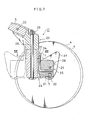
- Fig. 6 is a front view, in section, of a caster according to the invention attached to a rear leg of a baby carriage
- Fig. 7 is a front view, in section, of a caster according to the invention attached to a rear leg of a baby carriage.
- a caster 8 comprises a fixed bracket 15 fixedly attached at its upper end to a front leg 3 of a baby carriage by a pin 14, a rotary yoke 16 rotatably supported by said fixed bracket 15, and a wheel 2 rotatably supported on the rotary yoke 16 through a horizontal axle 6.
- the rotary yoke 16 is formed with a pair of projecting walls 19 extending rearward.
- An automatic locking member 17 is turnably installed between said pair of projecting walls 19 by a pin 18.
- a support shaft 20 extends vertically through the rotary yoke 16 and fixed bracket 15.
- a nut 21 is threadedly attached to the upper end of said support shaft 20, thereby preventing the support shaft 20 from slipping off.
- the rotary yoke 16, held on the support shaft 20 is allowed to turn relative to the fixed bracket 15.
- a caster 11 shown therein comprises a fixed bracket 23 fixedly attached at its upper end to a rear leg 5 of a baby carriage by a pin 22, a rotary yoke 24 rotatably supported by said fixed bracket 23, and a wheel 4 rotatably supported on the rotary yoke 24 through a horizontal axle 7.
- the rotary yoke 24 is formed with a pair of projecting walls 27 and an automatic locking member 25 is turnably installed between said pair of projecting walls 27 by a pin 26.
- a support shaft 28, like the support shaft 20 shown in Fig. 6, extends vertically through the rotary yoke 24 and fixed bracket 23, and a nut 29 is threadedly attached to the upper end of said support shaft 28.
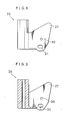
- Figs. 8 and 9 show the rotary yoke 24.
- Each of the pair of projecting walls 27 is formed with a round through-hole 30 for receiving the pin 26 shown in Fig. 7. Further, as shown, each of the pair of projecting walls 27 is formed with an elongated opening 31 extending horizontally toward the rotational axis of the rotary yoke 24.
- Figs. 10 and 11 show the automatic locking member 25.
- a round hole 32 shown in Fig. 11 serves to receive the pin 28 shown in Fig. 7.
- the automatic locking member 25 is formed with a vertical elongated opening 33.
- the automatic locking member 25 has an L-shaped rod 34 integral therewith.
- the rotary yoke 16 and automatic locking member 17 shown in Fig. 6 are of the same configuration as those shown in Figs. 8 through 11. That is, the automatic locking member 17 has an L-shaped rod 35 integral therewith. Further, the automatic locking member 17 is formed with a vertical elongated opening 33, and each of the pair of projecting walls 17 is formed with an elongated opening 31 which extends horizontally toward the rotational axis of the rotary yoke 16.
- the axle 7 of the rear wheel 4 extends through the elongated openings 31 formed in the pair of projecting walls 27 and the elongated opening 33 in the automatic locking member 25. Therefore, the axle 7 is horizontally movable toward the rotational axis of the rotary yoke 24.
- the axle 7 is positioned relatively remote from the rotational axis of the rotary yoke 24.
- the automatic locking member 25 is turned around the axis of the pin 26.
- the state established after the automatic locking member 25 has turned is shown in phantom lines.
- Fig. 12 is an end view taken along the line XII-XII in Fig. 6, and Fig. 13 is an end view taken along the line XIII-XIII in Fig. 7.
- the fixed bracket 15 attached to the front leg 3 of the baby carriage has an engaging recess 36 in its front portion adapted to receive the rod 35 of the automatic locking member 17.
- the fixed bracket 23 attached to the rear leg 5 of the baby carriage has an engaging recess 37 in its rear portion adapted to receive the rod 34 of the automatic locking member 25.
- the rod 35 moves on the outer surface of the fixed bracket 23 as the rotary yoke 24 is turned. Further, the outer surfaces of the fixed brackets 15 and 23 are smoothly curved so as not to interfere with the movement of the rods 35 and 34, respectively.
- the baby carriage 1 is being operated for travel in back-to-face push mode as shown in Fig. 2.
- the axles 6 and 7 of the front and rear wheels 2 and 4 are positioned relatively remote from the rotational axes of the rotary yokes, respectively.
- the rod 35 of the automatic locking member 17 of the caster 8 for the front wheel 2 is positioned on the smooth outer curved surface of the fixed bracket 15, as shown in Fig. 12. Therefore, the caster 8 for the front wheel 2 is allowed to swivel.
- the rod 34 of the automatic locking member 25 for the caster 11 for the rear wheel 11 is engaged with the engaging recess 37 of the fixed bracket 23. As a result, the caster 11 is in the locked state and inhibited from swiveling.
- the baby carriage 1 when the baby carriage 1 is operated for travel in back-to-face push mode as shown in Fig. 2, the caster 8 for the front wheel 2 is allowed to swivel but that the caster 11 for the rear wheel 4 is inhibited from swiveling. Therefore, the baby carriage 1 can be operated for travel in a stabilized manner.
- the rod 35 of the automatic locking member 17 for the front wheel 2 positioned rearward as viewed in the direction of travel fits in the engaging recess 36 of the fixed bracket 15, as shown in dotted line. Therefore, the caster 8 is locked and inhibited from swiveling.
- the baby carriage 1 when the baby carriage 1 is in face-to-face push mode as shown in Fig. 3, the casters 11 for the rear wheels 4 positioned forward as viewed in the direction of travel are allowed to swivel, while the casters 8 for the front wheels 2 positioned rearward as viewed in the direction of travel are automatically locked. Therefore, the baby carriage 1 can be operated for travel in a stabilized manner.
- engaging recesses 36 and 37 have been employed as rotation inhibiting means for inhibiting the rotation of the rotary yokes.
- other forms may be contemplated. One form will now be described by way of example.
- the illustrated caster comprises a fixed bracket 38, a rotary yoke 39 rotatably supported by said fixed bracket 38, and an automatic locking member 42.
- the rotary yoke 39 is formed with a pair of projecting walls 40.
- the automatic locking member 42 is turnably installed between said pair of projecting walls 40.
- each of the pair of projecting walls 40 is formed with an elongated opening 44 extending toward the rotational axis of the rotary yoke 39.
- An axle 43 extends through said elongated openings 44 and the automatic locking member 42.
- a locking pin 45 is housed in the fixed bracket 38.
- the locking pin 45. is constantly urged downward by a spring 46.
- the rotary yoke 39 is formed with a horizontal plate 47 for supporting the lower end of the locking pin 45.
- Fig. 15 is a sectional view taken along the line XV-XV in Fig. 14. As shown, the horizontal plate 47 is formed with a slot 48 for receiving the locking pin 45 when the fixed bracket 38 and the rotary yoke 39 come in predetermined positional relationship.
- the automatic locking member 42 is adapted to lie under the slot 48.
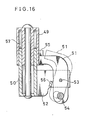
- Fig. 16 is a front view, in section, of another embodiment of a caster.
- the illustrated caster is designed so that a rotary yoke 50 is rotatably supported by a fixed bracket 49 and is vertically movable relative to the fixed bracket 49. That is , the rotary yoke 50 is constantly urged downward by a spring 57 but is movable upward from the illustrated state against the force of the spring 57.
- the rotary yoke 50 is formed with a projecting wall 52.
- An automatic locking member 51 is turnably attached to the projecting wall 52 by a pin 53.
- An axle 54 in this embodiment, is not supported by the projecting wall 52 but it is directly supported by the automatic locking member 51.
- the fixed bracket 49 is formed with an engaging recess 55 engageable with the automatic locking member 51.
- the automatic locking member 51 is engaged with the engaging recess 55, thereby inhibiting the rotation of the rotary yoke 50.
- the axle 54 is moved from this state horizontally toward the rotational axis of the rotary yoke 50, the state of engagement between the automatic locking member 51 and the engaging recess 55 is canceled, thereby allowing the rotary yoke 50 to rotate.
- Fig. 17 is a front view, in section, of another embodiment of a caster.
- a rotary yoke 59 rotatably held by a fixed bracket 58 is formed with a projecting wall 60.
- the projecting wall 60 is formed with an elongated opening 63 extending horizontally toward the rotational axis of the rotary yoke 59.
- An axle 62 extends through the elongated opening 63.
- An automatic locking member 61 is fixedly attached to the axle 62.
- the rotary yoke 59 is formed with a through-hole 64 for supporting the horizontally extending automatic locking member 61 so that the latter is horizontally movable. Therefore, the automatic locking member 61 horizontally moves in response to horizontal movement of the axle 62.
- the fixed bracket 58 is formed with an engaging recess 65 engageable with the automatic locking member 61.
- the automatic locking member 61 is engaged with the engaging recess 65, thereby inhibiting the rotary yoke 59 from rotating.
- the axle 62 is moved form this state horizontally toward the rotational axis of the rotary yoke 59, the automatic locking member 61 is also moved, so that its engagement with the engaging recess 65 is canceled. Therefore, the rotary yoke 59 is allowed to rotate.
- Fig. 18 is a front view, in section, of still another embodiment.
- the illustrated caster unlike the preceding embodiments, has a manual locking member 74 and a brake member 79 in addition to an automatic locking member 68.
- a rotary yoke 67 rotatably held by a fixed bracket 66 is formed with a rearwardly projection wall 69 and a forwardly projecting wall 87.
- One projecting wall 69 has an automatic locking member 68 turnably attached thereto by a pin 70.
- the automatic locking member 68 is adapted to turn in response to horizontal movement of an axle 71 supporting a wheel 72.
- the fixed bracket 66 is formed with an engaging recess 73 engageable with the automatic locking member 68.
- a description of the operative relationship between the illustrated automatic locking member 68 and the engaging recess 73 is omitted since it is the same as that in the embodiment previously described with reference to Figs. 6 through 13.
- the other projecting wall 87 of the rotary yoke 67 has the manual locking member 74 turnably attached thereto by a pin 75.
- the manual locking member 74 is switched between two positions by being operated by hand or by foot; in one position it engages the fixed bracket 66 to inhibit the rotation of the rotary yoke 67. This will now be described in more detail.
- the manual locking member 74 is formed with an inverted V-shaped guide groove 76.
- the projecting wall 87 turnably supporting said manual locking member 74 is formed with a vertical elongated opening 77.
- a pin 85 extends through the guide groove 76 and elongated opening 77.
- a spring 82 is installed between the pins 85 and 75, constantly urging the pin 85 downward.
- the manual locking member 74 is not engaged with the fixed bracket 66.
- the pin 85 comes to be positioned at the left-hand end of the guide groove 76.
- the front end 78 of the manual locking member 74 engages the engaging recess 73 of the fixed bracket 66.
- the rotary yoke 67 is inhibited form rotating.
- the manual locking member 74 is operated to lock the caster.
- the brake member 79 is switched between two positions by being operated by hand or by foot; when in one position, it engages the wheel 72 to inhibit its rotation. As shown, the brake member 79 is formed with an elongated opening 80. Further, the front end of the brake member 79 is fixedly provided with a pin 81 extending parallel to the axle 71. A pin 84 is positioned in the elongated opening 80 in the brake member 79. The pin 84 is fixedly provided on the projecting wall 69 of the rotary yoke 67.
- the projecting wall 69 is formed with a guide groove 85 engageable with the pin 81.
- a spring 83 is installed between the pin 81 fixedly provided on the front end portion of the brake member 79 and the pin 84 fixedly provided on the projecting wall 69, thereby ensuring firm engagement between the pin 81 and the guide groove 85.
- the brake member 79 In the illustrated state, the brake member 79 is not inhibiting the rotation of the axle 72.
- the pin 81 on the brake member 79 fits between two spokes 86 of the wheel 72, as shown in phantom lines, thereby inhibiting the rotation of the wheel 72.
- the provision of the brake member 79 on the caster makes it unnecessary to provide the baby carriage with separate means for inhibiting the rotation of the wheel; thus, the utility of the baby carriage is enhanced.
- manual locking member 74 and the brake member 79 are not limited to the illustrated constructions but other various forms may be contemplated.
- a caster which is the same as the embodiment shown in Fig. 18 except that the brake member 79 is omitted or a caster which is the same as the embodiment shown in Fig. 18 except that the manual locking member 74 is omitted may be contemplated.
- FIG. 19 is a front view, in section, of another embodiment according to the invention attached to a rear leg of a baby carriage.
- a caster 120 comprises a fixed bracket 123 fixedly attached at its upper end to a rear leg 122 of a baby carriage by a pin 121, a rotary yoke 124 rotatably supported by said fixed bracket 123, and a wheel 132 rotatably supported on the rotary yoke 124 through a horizontal axle 130.
- a support shaft 128 extends vertically through the rotary yoke 124 and fixed bracket 123.
- a nut 129 is threadedly attached to the upper end of said support shaft 128, thereby preventing the support shaft 128 from slipping off.
- the rotary yoke 124, held on the support shaft 128, is allowed to turn relative to the fixed bracket 123.
- the rotary yoke 124 is formed with a pair of projecting walls 125 extending rearward.
- An automatic locking member 127 is turnably installed between said pair of projecting walls 125 by a pin 126.
- the axle 130 supporting the wheel 132 extends centrally through the automatic locking member 127.
- Each of the pair of projecting walls 125 of the rotary yoke 124 is formed with an elongated opening 131 extending horizontally toward the rotational axis of the rotary yoke 124.
- the axle 130 is held in the elongated opening 131 and movable horizontally therein. In the state shown in Fig. 19, the axle 130 is positioned relatively remote from the rotational axis of the rotary yoke 124.
- the fixed bracket 123 is integrally formed with a rear extension 133 extending rearward.
- the rear extension 133 is formed with a notch 134 to avoid contact with the automatic locking member 127 when the latter is in the position shown in phantom lines in Fig. 19. Therefore, when the automatic locking member 127 is in the phantom line position, there is no possibility of the rotation of the rotary yoke 124 being interfered with by the presence of the rear extension 133.
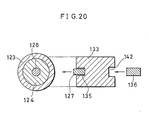
- Fig. 20 is an end view taken along the line XX-XX in Fig. 19.
- the rear extension 133 of the fixed bracket 123 is formed with a recess 135 engageable with the upper portion of the automatic locking member 127.
- the rotation of the rotary yoke 124 relative to the fixed bracket 123 is inhibited.
- the axle 130 of the wheel 132 is positioned relatively remote from the rotational axis of the rotary yoke 124. Further, the upper portion of the automatic locking member 127 is received in the recess 135. Therefore, the caster 120 is locked and thereby inhibited from swiveling.
- the rotary yoke 124 swivels through 180° until the axle 130 of the rear wheel 132 is positioned rearwardly of the rotational axis of the caster 120 as viewed in the direction of travel. In this state, since the automatic locking member 127 is not engaged with the fixed bracket 123, the caster 120 is allowed to swivel.
- the illustrated caster 120 has a brake member 136 in addition to the automatic locking member 127.
- the brake member 136 is switched between two positions by hand or by foot; in one position it engages the wheel 132 to inhibit its rotation.
- the brake member 136 is formed with an elongated opening 137.
- a pin 138 extending parallel to the axle 130 is fixedly provided on the front end of the brake member 136.
- a pin 139 is positioned in the elongated opening 137 in the brake member 136. The pin 139 is fixedly installed between the pair of projecting walls 125 of the rotary yoke 124.
- each of the projecting walls 125 is formed with a V-shaped guide groove 143 engageable with the pin 138.
- a spring 140 is installed between the pin 138 fixedly provided on the front end portion of the brake member 136 and the pin 139 fixedly provided on the projecting walls 125, thereby ensuring reliable engagement between the pin 139 and the guide groove 143.
- the pin 138 is positioned at the left-hand end of the V-shaped guide groove 143. In this state, the brake member 136 is not inhibiting the rotation of the wheel 132.
- the pin 138 of the brake member 136 is positioned at the right-hand end of the V-shaped guide groove 143, as shown in phantom lines. In this position, the pin 138 fits between two spokes of the wheel 132, thereby inhibiting the rotation of the wheel 143.
- the rear extension 133 of the fixed bracket 123 is formed with an engaging recess 142 engageable with the brake member 136. It is arranged that when the brake member 136 is in the phantom line position shown in Fig. 19, it engages the engaging recess 142. In the state of the brake member 136 being engaged with the engaging recess 142, the rotation of the rotary yoke 124 is inhibited, so that the caster 120 cannot swivel. That is, when the brake member 136 is in the phantom line position shown in Fig. 19, it inhibits not only the rotation of the wheel 132 but also the rotation of the rotary yoke 124.
- the baby carriage can be reliably held stopped, a fact which is desirable from the standpoint of safety.
- only one engaging recess 142 engageable with the brake member 136 is provided.
- a plurality of such engaging recesses may be provided in a circle with the center at the rotational axis of the rotary yoke 124.
Landscapes
- Engineering & Computer Science (AREA)
- Mechanical Engineering (AREA)
- Chemical & Material Sciences (AREA)
- Combustion & Propulsion (AREA)
- Transportation (AREA)
- Health & Medical Sciences (AREA)
- Public Health (AREA)
- Carriages For Children, Sleds, And Other Hand-Operated Vehicles (AREA)
- Handcart (AREA)
- Vehicle Body Suspensions (AREA)
- Body Structure For Vehicles (AREA)
Applications Claiming Priority (4)
| Application Number | Priority Date | Filing Date | Title |
|---|---|---|---|
| JP23762086A JPH0818481B2 (ja) | 1986-10-06 | 1986-10-06 | キヤスタ |
| JP237620/86 | 1986-10-06 | ||
| JP1986176343U JPS6380201U (de) | 1986-11-17 | 1986-11-17 | |
| JP176343/86 | 1986-11-17 |
Publications (2)
| Publication Number | Publication Date |
|---|---|
| EP0263596A2 true EP0263596A2 (de) | 1988-04-13 |
| EP0263596A3 EP0263596A3 (de) | 1988-12-07 |
Family
ID=26497304
Family Applications (1)
| Application Number | Title | Priority Date | Filing Date |
|---|---|---|---|
| EP87307895A Withdrawn EP0263596A3 (de) | 1986-10-06 | 1987-09-07 | Lenkrolle |
Country Status (5)
| Country | Link |
|---|---|
| US (1) | US4845805A (de) |
| EP (1) | EP0263596A3 (de) |
| KR (1) | KR910000131B1 (de) |
| CN (1) | CN1005326B (de) |
| AU (1) | AU600526B2 (de) |
Cited By (3)
| Publication number | Priority date | Publication date | Assignee | Title |
|---|---|---|---|---|
| EP0477592A1 (de) * | 1990-09-27 | 1992-04-01 | Combi Corporation | Lenkrolle für Wagen |
| GB2309633A (en) * | 1996-01-30 | 1997-08-06 | Kenneth Frederick Cooper | Castor swivel lock mechanism |
| EP1905615A1 (de) * | 2006-09-28 | 2008-04-02 | Wonderland Nurserygoods Co., Ltd. | Drehblockiervorrichtung für ein Kinderwagenrad |
Families Citing this family (5)
| Publication number | Priority date | Publication date | Assignee | Title |
|---|---|---|---|---|
| US5975545A (en) * | 1998-04-01 | 1999-11-02 | Hu; Stephen | Structure of wheel seat for a baby stroller |
| JP4738608B2 (ja) * | 2000-02-17 | 2011-08-03 | コンビ株式会社 | ベビーカー用キャスター |
| GB2378423A (en) * | 2001-08-06 | 2003-02-12 | Michael Colin John Swanborough | Direction stabilizer for hand propelled trolley |
| US8991854B2 (en) | 2013-05-02 | 2015-03-31 | Artsana Usa, Inc. | Folding travel stroller latch and wheel positioning system |
| GB2515794B (en) * | 2013-07-04 | 2015-06-10 | Velofeet Ltd | Improvements Relating to Vehicles |
Family Cites Families (13)
| Publication number | Priority date | Publication date | Assignee | Title |
|---|---|---|---|---|
| GB971199A (en) * | 1962-10-24 | 1964-09-30 | Flexello Castors & Wheels Ltd | Improvements in castors |
| US3636586A (en) * | 1969-12-11 | 1972-01-25 | American Hospital Supply Corp | Caster and swivel lock assembly |
| GB1449292A (en) * | 1973-09-04 | 1976-09-15 | Thomas Ltd Martin | Castors |
| US4037291A (en) * | 1976-08-19 | 1977-07-26 | American Hospital Supply Corporation | Caster and swivel lock assembly |
| EP0023432A3 (de) * | 1979-07-30 | 1981-08-05 | Norman Anthony Fisher | Laufrollen |
| FR2489215A1 (fr) * | 1980-09-02 | 1982-03-05 | Comapric Sa | Agencement de roue pivotante |
| JPS6030124Y2 (ja) * | 1980-12-17 | 1985-09-10 | 葛西株式会社 | うば車の自在キヤスタ−係止装置 |
| US4494272A (en) * | 1981-07-21 | 1985-01-22 | Natsuo Morita | Reversible caster device having brake mechanism |
| JPS58218402A (ja) * | 1982-06-14 | 1983-12-19 | Natsuo Morita | 車輪装置 |
| JPS6025803A (ja) * | 1983-07-22 | 1985-02-08 | Kassai Inc | キヤスタ |
| JPS6093504U (ja) * | 1983-12-01 | 1985-06-26 | アップリカ葛西株式会社 | キヤスタ |
| JPS6099166U (ja) * | 1983-12-13 | 1985-07-06 | アップリカ葛西株式会社 | 乳母車のキヤスタ |
| DE3532594A1 (de) * | 1985-09-12 | 1987-03-19 | Perego Pines Gmbh | Kinderwagen |
-
1987
- 1987-08-28 US US07/090,656 patent/US4845805A/en not_active Expired - Fee Related
- 1987-09-07 EP EP87307895A patent/EP0263596A3/de not_active Withdrawn
- 1987-09-29 KR KR1019870010803A patent/KR910000131B1/ko not_active Expired
- 1987-09-29 AU AU79074/87A patent/AU600526B2/en not_active Ceased
- 1987-09-30 CN CN87106715.3A patent/CN1005326B/zh not_active Expired
Cited By (5)
| Publication number | Priority date | Publication date | Assignee | Title |
|---|---|---|---|---|
| EP0477592A1 (de) * | 1990-09-27 | 1992-04-01 | Combi Corporation | Lenkrolle für Wagen |
| US5191675A (en) * | 1990-09-27 | 1993-03-09 | Combi Corporation | Caster mechanism for carriage |
| GB2309633A (en) * | 1996-01-30 | 1997-08-06 | Kenneth Frederick Cooper | Castor swivel lock mechanism |
| EP1905615A1 (de) * | 2006-09-28 | 2008-04-02 | Wonderland Nurserygoods Co., Ltd. | Drehblockiervorrichtung für ein Kinderwagenrad |
| US7784151B2 (en) | 2006-09-28 | 2010-08-31 | Wonderland Nurserygoods Co., Ltd. | Swivel locking device for stroller wheel |
Also Published As
| Publication number | Publication date |
|---|---|
| US4845805A (en) | 1989-07-11 |
| CN1005326B (zh) | 1989-10-04 |
| EP0263596A3 (de) | 1988-12-07 |
| CN87106715A (zh) | 1988-04-27 |
| KR910000131B1 (ko) | 1991-01-21 |
| AU7907487A (en) | 1988-04-14 |
| AU600526B2 (en) | 1990-08-16 |
| KR880004989A (ko) | 1988-06-27 |
Similar Documents
| Publication | Publication Date | Title |
|---|---|---|
| US4779879A (en) | Baby carriage | |
| US4805259A (en) | Caster | |
| US5517718A (en) | Caster assembly with automatic swivel lock/unlock | |
| US3751758A (en) | Caster and swivel lock assembly | |
| US4037291A (en) | Caster and swivel lock assembly | |
| CA2217814C (en) | Automatically guided vehicle | |
| US5829096A (en) | Locking caster | |
| EP0477592B1 (de) | Lenkrolle für Wagen | |
| US4706328A (en) | Pivoted caster wheel and yoke brake having a detent | |
| GB2143729A (en) | Caster | |
| EP0263596A2 (de) | Lenkrolle | |
| US4453287A (en) | Caster for baby carriages | |
| JP2010012910A (ja) | キャスター | |
| JPH08507737A (ja) | キャスタホイール付き輸送手段を牽引する自動ロッキング機構 | |
| GB2361179A (en) | Swivel castor with load dependent locking element | |
| US4779304A (en) | Caster having a rotary yoke locking mechanism | |
| US4870715A (en) | Caster including spring operated brake | |
| JP2005119521A (ja) | 搬送台車 | |
| US20030090074A1 (en) | Steering and handling device for moving roll cages | |
| GB2106378A (en) | Castors | |
| JP3297827B2 (ja) | 自動旋回規制キャスター及びそのキャスター装備品 | |
| JP2521821B2 (ja) | キャスタ― | |
| JP3142806B2 (ja) | キャスタ | |
| JPS6393602A (ja) | キヤスタ | |
| JP2556788Y2 (ja) | キャスタ |
Legal Events
| Date | Code | Title | Description |
|---|---|---|---|
| PUAI | Public reference made under article 153(3) epc to a published international application that has entered the european phase |
Free format text: ORIGINAL CODE: 0009012 |
|
| AK | Designated contracting states |
Kind code of ref document: A2 Designated state(s): DE ES FR GB IT |
|
| PUAL | Search report despatched |
Free format text: ORIGINAL CODE: 0009013 |
|
| AK | Designated contracting states |
Kind code of ref document: A3 Designated state(s): DE ES FR GB IT |
|
| 17P | Request for examination filed |
Effective date: 19890314 |
|
| 17Q | First examination report despatched |
Effective date: 19900607 |
|
| STAA | Information on the status of an ep patent application or granted ep patent |
Free format text: STATUS: THE APPLICATION IS DEEMED TO BE WITHDRAWN |
|
| 18D | Application deemed to be withdrawn |
Effective date: 19910828 |
|
| RIN1 | Information on inventor provided before grant (corrected) |
Inventor name: KASSAI, KENZOU |