EP0263602A2 - Multifunktionneller Druckkopf mit Ionenprojektion mit Hilfe eines Gasstrahls - Google Patents
Multifunktionneller Druckkopf mit Ionenprojektion mit Hilfe eines Gasstrahls Download PDFInfo
- Publication number
- EP0263602A2 EP0263602A2 EP87308030A EP87308030A EP0263602A2 EP 0263602 A2 EP0263602 A2 EP 0263602A2 EP 87308030 A EP87308030 A EP 87308030A EP 87308030 A EP87308030 A EP 87308030A EP 0263602 A2 EP0263602 A2 EP 0263602A2
- Authority
- EP
- European Patent Office
- Prior art keywords
- marking
- multifunction
- marking head
- photosensor
- ionographic
- Prior art date
- Legal status (The legal status is an assumption and is not a legal conclusion. Google has not performed a legal analysis and makes no representation as to the accuracy of the status listed.)
- Withdrawn
Links
Images


Classifications
-
- H—ELECTRICITY
- H04—ELECTRIC COMMUNICATION TECHNIQUE
- H04N—PICTORIAL COMMUNICATION, e.g. TELEVISION
- H04N1/00—Scanning, transmission or reproduction of documents or the like, e.g. facsimile transmission; Details thereof
- H04N1/04—Scanning arrangements, i.e. arrangements for the displacement of active reading or reproducing elements relative to the original or reproducing medium, or vice versa
- H04N1/207—Simultaneous scanning of the original picture and the reproduced picture with a common scanning device
-
- B—PERFORMING OPERATIONS; TRANSPORTING
- B41—PRINTING; LINING MACHINES; TYPEWRITERS; STAMPS
- B41J—TYPEWRITERS; SELECTIVE PRINTING MECHANISMS, i.e. MECHANISMS PRINTING OTHERWISE THAN FROM A FORME; CORRECTION OF TYPOGRAPHICAL ERRORS
- B41J2/00—Typewriters or selective printing mechanisms characterised by the printing or marking process for which they are designed
- B41J2/385—Typewriters or selective printing mechanisms characterised by the printing or marking process for which they are designed characterised by selective supply of electric current or selective application of magnetism to a printing or impression-transfer material
- B41J2/41—Typewriters or selective printing mechanisms characterised by the printing or marking process for which they are designed characterised by selective supply of electric current or selective application of magnetism to a printing or impression-transfer material for electrostatic printing
- B41J2/415—Typewriters or selective printing mechanisms characterised by the printing or marking process for which they are designed characterised by selective supply of electric current or selective application of magnetism to a printing or impression-transfer material for electrostatic printing by passing charged particles through a hole or a slit
-
- G—PHYSICS
- G03—PHOTOGRAPHY; CINEMATOGRAPHY; ANALOGOUS TECHNIQUES USING WAVES OTHER THAN OPTICAL WAVES; ELECTROGRAPHY; HOLOGRAPHY
- G03G—ELECTROGRAPHY; ELECTROPHOTOGRAPHY; MAGNETOGRAPHY
- G03G15/00—Apparatus for electrographic processes using a charge pattern
- G03G15/05—Apparatus for electrographic processes using a charge pattern for imagewise charging, e.g. photoconductive control screen or optically activated charging means
Definitions
- This invention relates to a fluid jet assisted ion projection marking apparatus.
- a fluid jet assisted ion projection printer of the type utilized herein, is disclosed in our US-A- 4,463,363.
- an imaging charge is placed upon a moving receptor sheet, such as paper, by means of a linear array of closely spaced minute air "nozzles".
- the charge comprising ions of a single polarity (preferably positive)
- Selective control of the modulating electrodes in the array will enable spots of charge and absence of charge to be deposited on the receptor sheet for subsequent development.
- the modulating electrodes may be incorporated in an inexpensive and compact integrated marking head array which also includes multiplexed driver circuitry and thin film transistor switching elements. Data potentials are selectively imposed upon the modulating electrodes. Such an arrangement is disclosed in our US-A- 4,584,592.
- a latching circuit including a switching element electrically connects the marking electrodes directly to a source of reference potential.
- a fluid jet assisted ion projection copier is disclosed in our EP-A- 0 224 324.
- the marking head array incorporates modulating electrodes and photosensors which may either directly drive the electrodes or indirectly drive the electrodes through an amplification circuit.
- Two types of thin film sensors are disclosed.
- One, a gap-type exhibits a photoconductive gain of about 5, but has a characteristically slow response time.
- the other, a sandwich type has a photoconductive gain of unity, but has a very fast photocurrent response time.
- An amplification circuit requiring at least three sources of reference potential (high, low and ground) is disclosed therein for enabling practical use of the low gain sandwich type photosensor.
- an integral marking head for a multifunction ionographic marking apparatus comprising a substrate upon which is formed a plurality of closely spaced ion transport modulation electrodes, each being switchable between a marking state and a non-marking state and each having associated therewith: a first information circuit for transmitting marking signals to said modulation electrode from an external source, when said marking head is in a PRINT mode, a second information circuit for transmitting marking signals to said modulation electrode from a substrate supported signal generator, when said marking head is in COPY mode, a third information circuit for transmitting signals from said substrate supported signal generator to an external receiver, when said marking head is in a SCAN mode, and wherein each of said modulation electrodes and said first, second and third information circuits are integrally formed upon said substrate as thin film elements.
- the multifunction marking head array incorporates, on a page-wide substrate, an image sensor array, a modulation electrode array, function switching electronics and data input-output electronics. All of the elements may be implemented monolithically on the substrate, preferably in thin film amorphous silicon and materials compatible with its processing.
- the operation would be as described in the aforesaid US-A- 4,584,592 and the image sensor array would not be operational.
- the image sensor array In the COPY mode, the image sensor array would generate a photo-induced current in response to light reflected from an illuminated document, and the photo-induced current would, in turn, drive the modulating electrodes to produce a copy of the document.
- the image sensor array In the SCAN mode, the image sensor array again would generate a photo-induced current in response to light reflected from an illuminated document, and the photo-induced current would be detected and amplified by data input-output electronics for either storage or transmission to a remote site.
- the present invention may be carried out, in one form, by providing a multifunction fluid jet assisted ionographic marking apparatus for placing electrostatic charges upon a charge receptor surface in a PRINT and in a COPY mode of operation and for sending signals to an external circuit, in a SCAN mode of operation.
- the apparatus includes an integral marking head comprising a substrate upon which is formed a plurality of closely spaced modulation electrodes, each being switchable between a marking state, covering a range of controlled densities, and a non-marking state and each having associated therewith mode responsive information loading circuits also formed upon the substrate.
- a first information circuit transmits marking signals to the modulation electrode from an external source, when the marking head is in a PRINT mode, and a second information circuit transmits marking signals to the modulation electrode from a substrate supported signals generator, in the form of a photosensor, when the marking head is in a COPY mode.
- a third information circuit also formed upon the substrate, transmits signals from the signal generator to an external receiver, when the marking head is in a SCAN mode.
- a first switch selectively connects the first information circuit to the modulation electrode when the PRINT mode is invoked and a second switch selectively connects the second information circuit to the modulation electrode when the COPY mode is invoked. Both switches are closed when the SCAN mode is invoked. All of the modulation electrodes and circuit elements, including bus lines, photosensors, switches and other elements on the marking head are integrally formed upon the substrate as thin film elements.
- An inlet channel 22 extends along the chamber substantially parallel to wire 14, to deliver pressurized transport fluid (preferably air) into the chamber 12 from a suitable source, schematically illustrated by the tube 24.
- An outlet channel 26, from the chamber 12, also extends substantially parallel to wire 14, at a location opposed to inlet channel 22, for conducting the ion laden transport fluid to the exterior of the housing 10.
- the outlet channel 26 comprises two portions, a first portion 28 directed substantially radially outwardly from the chamber and a second portion 30 angularly disposed to the first portion.
- the second portion 30 is formed by the unsupported extension of a marking head 32 spaced from and secured to the housing by insulating shim 34.
- ion laden transport fluid passes through portion 30 of the outlet channel, it flows over an array of ion modulation electrodes 36, each extending in the direction of the fluid flow, and each integrally formed on the marking head 32.
- ion modulation electrodes 36 By selectively controlling the potential on modulation electrodes 36 the ion-laden fluid stream may be rendered intelligible.
- a transfer system may be employed, wherein the imagewise charge pattern is deposited upon an insulating intermediate surface such as a dielectric drum or belt, the charge pattern is made visible by development upon the dielectric surface, and then the developed image is transferred to a final image receptor sheet.
- the multifunction marking head 32 shown schematically, in one form, in Figure 2, comprises thin film elements supported upon a planar substrate 54. These elements include an array of modulation electrodes 36 extending along one edge of the substrate. A number of data lines 56 and a number of address lines 58 (one shown) controlling thin film switching elements 60, represent the data entry or information loading circuit of the PRINT mode, in which marking is accomplished by the direct application of data voltages sent from external IC data bus drivers 62. The address lines 58 receive signals from external IC address bus drivers 64.
- the information loading circuit for the COPY mode includes an array of copy enable thin film switches 66, all of which are simultaneously driven by an externally controlled copy enable bus line 68.
- a high voltage (V+) bus line 70 and a low voltage (V-) bus line 72 are also provided across the substrate 54.
- Self-biasing photosensor amplification circuits each include a load resistor (R L ) 74, a feedback resistor (R F ) 76 and a photosensor 78, connected in series between buses 70 and 72, and a thin film transistor 80 connected in parallel with the feedback resistor 76 and photosensor 78.
- the potential (V G ) at node 81, between the feedback resistor and the photosensor, is imposed on the gate 82 of the transistor 80.
- both the copy enable switch 66 and the address switch 60 are turned ON so that charge stored at node 83 may be transmitted to an external receiver 84 via the data lines 56. Therefore, the output of the amplification circuit is available not only to drive the COPY mode modulation electrodes, but is also available in the SCAN mode. This arrangement minimizes the need for external amplification in the SCAN signal receiver.
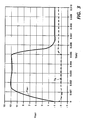
- V G Due to the approximately ten-fold gain of transistor 80, a small change in V G causes a substantially greater change in V OUT .
- V G does not change very much, V OUT will respond generally linearly with respect to the photosensor current which, in turn, is “linearly” responsive to the amount of illumination falling on the sensor. The “linearly” will have about a 10% deviation.
- the output may be made more linear, and simultaneously faster, by increasing the amplifier gain.
- a gain of 100 is easily achieved by adding one more stage so that each 1 volt change in V G of the first stage transistor will cause a 100 volt change in V OUT of the second stage transistor.
- a greater number of smaller photosensors will be required. Each of these will generate less photocurrent for the same illumination intensity.
- Ganging would enable a 0.1 volt gate voltage to generate a 10 volt output and thereby enable the same speed as now obtained, with higher spot density.
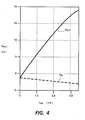
- Schottky diode photosensors exhibit a very fast response time, being limited by the transit time of the carriers through the thickness of the thin amorphous silicon layer. For a document being copied at the speed of 5 cm per second and having a resolution of 120 pixels per cm, one pixel will be scanned in 1.6 milliseconds. To be on the safe side, a sensor used under these conditions should be fast enough to generate full current in a maximum of 1 millisecond.
- the Schottky diode photosensors contemplated for use will ordinarily respond in about 1 microsecond, clearly fast enough for the present application. In this case, the response time of the self-biased amplification circuit is limited by the circuit itself and not by the photosensor.
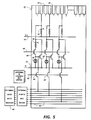
- FIG. 5 An alternative arrangement of the circuit elements of the multifunction marking head is illustrated in Figure 5.
- the marking head is identified as 85 and similar elements are identified with the same number as in the Figure 2 embodiment, with a prime ( ⁇ ) attached.
- Each modulation electrode 36 ⁇ has associated therewith circuitry for enabling the marking head to be used selectively in a PRINT, COPY or SCAN mode.
- This embodiment is based on the inverter circuit printer head embodiment of Figure 4 of co-pending patent application Serial No. 861,472, referenced above.
- the PRINT mode information loading circuit is of the inverter type. It includes, for each modulation electrode, a high voltage (on the order of 20 volts) bus line 70 ⁇ (V+), resistors 74 ⁇ and 76 ⁇ , a copy enable thin film switch 66 ⁇ , a thin film address switch 60 ⁇ controlled by address bus 58 ⁇ , and data line 56 ⁇ .
- the address switch 60 ⁇ is ON and the copy enable switch 66 ⁇ is OFF. This arrangement allows low voltage data signals to be used, as fully described in the co-pending application.
- the COPY mode information loading circuit comprises a self-biasing amplification circuit which includes the high voltage bus line 70 ⁇ (V+), a low voltage bus line 72 ⁇ (V-), load resistor 74 ⁇ (R L ), feedback resistor 76 ⁇ (R F ), photosensor 78 ⁇ , and thin film transistor 80 ⁇ . It is identical in configuration and operation to the Figure 2 circuit.
- the address switch 60 ⁇ is ON and the copy enable switch 66 ⁇ is OFF.
- the photosensor signal will pass directly to the data line 56 ⁇ for transmittal to an external receiver 84 ⁇ . It should be noted that there will be no amplification of the photosensor signal, as there is in the Figure 2 configuration, because the output of the photosensor is connected directly to the data line. The very low level output voltages generated by the photosensor will require subsequent amplification.
Landscapes
- Physics & Mathematics (AREA)
- General Physics & Mathematics (AREA)
- Engineering & Computer Science (AREA)
- Multimedia (AREA)
- Signal Processing (AREA)
- Facsimile Heads (AREA)
- Printers Or Recording Devices Using Electromagnetic And Radiation Means (AREA)
- Dot-Matrix Printers And Others (AREA)
Applications Claiming Priority (2)
| Application Number | Priority Date | Filing Date | Title |
|---|---|---|---|
| US06/906,068 US4737805A (en) | 1986-09-11 | 1986-09-11 | Multifunction ionographic marking apparatus |
| US906068 | 1986-09-11 |
Publications (2)
| Publication Number | Publication Date |
|---|---|
| EP0263602A2 true EP0263602A2 (de) | 1988-04-13 |
| EP0263602A3 EP0263602A3 (de) | 1989-03-22 |
Family
ID=25421885
Family Applications (1)
| Application Number | Title | Priority Date | Filing Date |
|---|---|---|---|
| EP87308030A Withdrawn EP0263602A3 (de) | 1986-09-11 | 1987-09-11 | Multifunktionneller Druckkopf mit Ionenprojektion mit Hilfe eines Gasstrahls |
Country Status (7)
| Country | Link |
|---|---|
| US (1) | US4737805A (de) |
| EP (1) | EP0263602A3 (de) |
| JP (1) | JPS6371361A (de) |
| CN (1) | CN1010711B (de) |
| BR (1) | BR8704715A (de) |
| CA (1) | CA1285600C (de) |
| MX (1) | MX159959A (de) |
Cited By (1)
| Publication number | Priority date | Publication date | Assignee | Title |
|---|---|---|---|---|
| EP0389122A3 (de) * | 1989-03-21 | 1992-01-15 | Hewlett-Packard Company | Lese-/Druckgerät und Verfahren dafür |
Families Citing this family (18)
| Publication number | Priority date | Publication date | Assignee | Title |
|---|---|---|---|---|
| US4998213A (en) * | 1987-06-15 | 1991-03-05 | Fuji Xerox Co., Ltd. | Recording apparatus |
| US4899186A (en) * | 1989-06-19 | 1990-02-06 | Xerox Corporation | Ionographic device with pin array coronode |
| US4972212A (en) * | 1989-06-22 | 1990-11-20 | Xerox Corporation | Method and apparatus for controlling ion trajectory perturbations in ionographic devices |
| US4996425A (en) * | 1989-08-10 | 1991-02-26 | Xerox Corporation | Method and apparatus for increasing corona efficiency in an ionographic imaging device |
| US4951071A (en) * | 1989-10-25 | 1990-08-21 | Xerox Corporation | Resistive nib ionographic imaging head |
| US4973994A (en) * | 1989-10-30 | 1990-11-27 | Xerox Corporation | Method and apparatus for controlling ion trajectory perturbations in ionographic devices |
| US5081476A (en) * | 1990-04-04 | 1992-01-14 | Xerox Corporation | Ionographic printhead gating control for controlling charge density image defects due to surface velocity variations |
| US5150135A (en) * | 1990-08-20 | 1992-09-22 | Xerox Corporation | Current sensing development control system for an ionographic printing machine |
| US5231428A (en) * | 1990-12-11 | 1993-07-27 | Xerox Corporation | Imaging device which compensates for fluctuations in the speed of an image receiving surface |
| US5206669A (en) * | 1991-12-02 | 1993-04-27 | Xerox Corporation | Apparatus and method for selectively delivering an ion stream |
| US5225856A (en) * | 1991-12-23 | 1993-07-06 | Xerox Corporation | Method and apparatus for correction of blooming artifacts in ionographic devices |
| US5250960A (en) * | 1991-12-31 | 1993-10-05 | Xerox Corporation | System and method employing multiple pulses per pixel to reproduce an image |
| JP2547916B2 (ja) * | 1992-01-08 | 1996-10-30 | 株式会社東芝 | 画像形成装置 |
| JP3233463B2 (ja) * | 1992-09-25 | 2001-11-26 | 株式会社東芝 | 像形成体、この像形成体を含む像担持体及びこの像形成体を組み込んだ画像形成装置並びに画像形成方法 |
| JPH0772767A (ja) * | 1993-06-15 | 1995-03-17 | Xerox Corp | 対話型ユーザ支援システム |
| US5903804A (en) * | 1996-09-30 | 1999-05-11 | Science Applications International Corporation | Printer and/or scanner and/or copier using a field emission array |
| JP4196586B2 (ja) * | 2002-04-30 | 2008-12-17 | 富士ゼロックス株式会社 | 発光素子アレイチップ、光書き込みヘッドおよび光書き込みヘッドの駆動方法 |
| WO2016018303A1 (en) * | 2014-07-30 | 2016-02-04 | Hewlett-Packard Development Company, L.P. | Ion writing unit with air flow |
Family Cites Families (7)
| Publication number | Priority date | Publication date | Assignee | Title |
|---|---|---|---|---|
| US4356347A (en) * | 1980-08-25 | 1982-10-26 | Xerox Corporation | Integrated stylus array for printer operation |
| DE3269826D1 (en) * | 1981-08-17 | 1986-04-17 | Xerox Corp | Imaging device |
| US4477175A (en) * | 1982-12-20 | 1984-10-16 | Xerox Corporation | Multi-function reproduction machine |
| EP0156622B1 (de) * | 1984-03-22 | 1988-06-01 | Kabushiki Kaisha Toshiba | Ionenflussmodulator |
| US4584592A (en) * | 1984-08-13 | 1986-04-22 | Xerox Corporation | Marking head for fluid jet assisted ion projection imaging systems |
| JPS61151557A (ja) * | 1984-12-26 | 1986-07-10 | Toshiba Corp | イオン流変調装置 |
| US4646163A (en) * | 1985-10-07 | 1987-02-24 | Xerox Corporation | Ion projection copier |
-
1986
- 1986-09-11 US US06/906,068 patent/US4737805A/en not_active Expired - Lifetime
-
1987
- 1987-07-23 CA CA000542855A patent/CA1285600C/en not_active Expired - Lifetime
- 1987-08-12 MX MX7726A patent/MX159959A/es unknown
- 1987-09-04 JP JP62221825A patent/JPS6371361A/ja active Pending
- 1987-09-10 BR BR8704715A patent/BR8704715A/pt not_active IP Right Cessation
- 1987-09-11 EP EP87308030A patent/EP0263602A3/de not_active Withdrawn
- 1987-09-11 CN CN87106250A patent/CN1010711B/zh not_active Expired
Cited By (1)
| Publication number | Priority date | Publication date | Assignee | Title |
|---|---|---|---|---|
| EP0389122A3 (de) * | 1989-03-21 | 1992-01-15 | Hewlett-Packard Company | Lese-/Druckgerät und Verfahren dafür |
Also Published As
| Publication number | Publication date |
|---|---|
| CN1010711B (zh) | 1990-12-05 |
| CN87106250A (zh) | 1988-07-06 |
| JPS6371361A (ja) | 1988-03-31 |
| CA1285600C (en) | 1991-07-02 |
| MX159959A (es) | 1989-10-17 |
| BR8704715A (pt) | 1988-05-03 |
| US4737805A (en) | 1988-04-12 |
| EP0263602A3 (de) | 1989-03-22 |
Similar Documents
| Publication | Publication Date | Title |
|---|---|---|
| US4737805A (en) | Multifunction ionographic marking apparatus | |
| US4571603A (en) | Deformable mirror electrostatic printer | |
| EP0082281B1 (de) | Elektrofotografischer Drucker und Verfahren zum elektrofotografischen Drucken | |
| SU1367869A3 (ru) | Электронно-копировальный прибор (его варианты) | |
| US4794412A (en) | Vertical line width control ionographic system | |
| US4466020A (en) | Integrated imaging bar | |
| US7643525B2 (en) | Current driver and power control for electrophotographic devices | |
| US5651017A (en) | Drive circuit for high-speed modulation of a laser diode | |
| US4646163A (en) | Ion projection copier | |
| GB2123248A (en) | Dual mode facsimile apparatus | |
| US4830468A (en) | Liquid crystal print bar having a single backplane electrode | |
| US5764667A (en) | Current steering circuit | |
| US4706128A (en) | Image reading and converting apparatus | |
| US5430749A (en) | Laser diode driving circuit | |
| US5155618A (en) | Light signal generating device using electro-optical light shutter array | |
| US20020057250A1 (en) | Methods and apparatus for imaging electronic paper | |
| US4176942A (en) | Electrophotographic copying apparatus | |
| US5025321A (en) | Facsimile machine using thin film electroluminescent device | |
| US4823284A (en) | High speed VLSI based serial to multiplexed data translator | |
| EP0037225B1 (de) | Kopiergerät | |
| JP2944043B2 (ja) | 多数の光弁を用いる感光媒体の画像露光のための方法及び装置 | |
| US5666591A (en) | Image forming apparatus utilizing discharge current of charger | |
| US3409899A (en) | Photoresponsive electrostatic image recording apparatus with charging electrode matrix array | |
| US6124872A (en) | Optical writing device with controlled driving voltages | |
| JP3312760B2 (ja) | 端面発光型el素子の駆動装置 |
Legal Events
| Date | Code | Title | Description |
|---|---|---|---|
| PUAI | Public reference made under article 153(3) epc to a published international application that has entered the european phase |
Free format text: ORIGINAL CODE: 0009012 |
|
| AK | Designated contracting states |
Kind code of ref document: A2 Designated state(s): DE FR GB |
|
| PUAL | Search report despatched |
Free format text: ORIGINAL CODE: 0009013 |
|
| AK | Designated contracting states |
Kind code of ref document: A3 Designated state(s): DE FR GB |
|
| 17P | Request for examination filed |
Effective date: 19890915 |
|
| 17Q | First examination report despatched |
Effective date: 19911008 |
|
| STAA | Information on the status of an ep patent application or granted ep patent |
Free format text: STATUS: THE APPLICATION IS DEEMED TO BE WITHDRAWN |
|
| 18D | Application deemed to be withdrawn |
Effective date: 19920422 |
|
| RIN1 | Information on inventor provided before grant (corrected) |
Inventor name: TUAN, HSING CHIEN Inventor name: WEISFIELD, RICHARD LESLIE |