EP0263623A2 - Procédé pour améliorer l'adhésion entre un revêtement sur un article en verre et un matériau en polyvinyl de butyral - Google Patents
Procédé pour améliorer l'adhésion entre un revêtement sur un article en verre et un matériau en polyvinyl de butyral Download PDFInfo
- Publication number
- EP0263623A2 EP0263623A2 EP87308455A EP87308455A EP0263623A2 EP 0263623 A2 EP0263623 A2 EP 0263623A2 EP 87308455 A EP87308455 A EP 87308455A EP 87308455 A EP87308455 A EP 87308455A EP 0263623 A2 EP0263623 A2 EP 0263623A2
- Authority
- EP
- European Patent Office
- Prior art keywords
- coating
- glass
- polyvinyl butyral
- layer
- glass article
- Prior art date
- Legal status (The legal status is an assumption and is not a legal conclusion. Google has not performed a legal analysis and makes no representation as to the accuracy of the status listed.)
- Granted
Links
Images
Classifications
-
- B—PERFORMING OPERATIONS; TRANSPORTING
- B32—LAYERED PRODUCTS
- B32B—LAYERED PRODUCTS, i.e. PRODUCTS BUILT-UP OF STRATA OF FLAT OR NON-FLAT, e.g. CELLULAR OR HONEYCOMB, FORM
- B32B17/00—Layered products essentially comprising sheet glass, or glass, slag, or like fibres
- B32B17/06—Layered products essentially comprising sheet glass, or glass, slag, or like fibres comprising glass as the main or only constituent of a layer, next to another layer of a specific material
- B32B17/10—Layered products essentially comprising sheet glass, or glass, slag, or like fibres comprising glass as the main or only constituent of a layer, next to another layer of a specific material of synthetic resin
- B32B17/10005—Layered products essentially comprising sheet glass, or glass, slag, or like fibres comprising glass as the main or only constituent of a layer, next to another layer of a specific material of synthetic resin laminated safety glass or glazing
- B32B17/1055—Layered products essentially comprising sheet glass, or glass, slag, or like fibres comprising glass as the main or only constituent of a layer, next to another layer of a specific material of synthetic resin laminated safety glass or glazing characterized by the resin layer, i.e. interlayer
- B32B17/10688—Adjustment of the adherence to the glass layers
-
- B—PERFORMING OPERATIONS; TRANSPORTING
- B32—LAYERED PRODUCTS
- B32B—LAYERED PRODUCTS, i.e. PRODUCTS BUILT-UP OF STRATA OF FLAT OR NON-FLAT, e.g. CELLULAR OR HONEYCOMB, FORM
- B32B17/00—Layered products essentially comprising sheet glass, or glass, slag, or like fibres
- B32B17/06—Layered products essentially comprising sheet glass, or glass, slag, or like fibres comprising glass as the main or only constituent of a layer, next to another layer of a specific material
- B32B17/10—Layered products essentially comprising sheet glass, or glass, slag, or like fibres comprising glass as the main or only constituent of a layer, next to another layer of a specific material of synthetic resin
- B32B17/10005—Layered products essentially comprising sheet glass, or glass, slag, or like fibres comprising glass as the main or only constituent of a layer, next to another layer of a specific material of synthetic resin laminated safety glass or glazing
- B32B17/10009—Layered products essentially comprising sheet glass, or glass, slag, or like fibres comprising glass as the main or only constituent of a layer, next to another layer of a specific material of synthetic resin laminated safety glass or glazing characterized by the number, the constitution or treatment of glass sheets
- B32B17/10036—Layered products essentially comprising sheet glass, or glass, slag, or like fibres comprising glass as the main or only constituent of a layer, next to another layer of a specific material of synthetic resin laminated safety glass or glazing characterized by the number, the constitution or treatment of glass sheets comprising two outer glass sheets
-
- B—PERFORMING OPERATIONS; TRANSPORTING
- B32—LAYERED PRODUCTS
- B32B—LAYERED PRODUCTS, i.e. PRODUCTS BUILT-UP OF STRATA OF FLAT OR NON-FLAT, e.g. CELLULAR OR HONEYCOMB, FORM
- B32B17/00—Layered products essentially comprising sheet glass, or glass, slag, or like fibres
- B32B17/06—Layered products essentially comprising sheet glass, or glass, slag, or like fibres comprising glass as the main or only constituent of a layer, next to another layer of a specific material
- B32B17/10—Layered products essentially comprising sheet glass, or glass, slag, or like fibres comprising glass as the main or only constituent of a layer, next to another layer of a specific material of synthetic resin
- B32B17/10005—Layered products essentially comprising sheet glass, or glass, slag, or like fibres comprising glass as the main or only constituent of a layer, next to another layer of a specific material of synthetic resin laminated safety glass or glazing
- B32B17/10165—Functional features of the laminated safety glass or glazing
- B32B17/10174—Coatings of a metallic or dielectric material on a constituent layer of glass or polymer
-
- B—PERFORMING OPERATIONS; TRANSPORTING
- B32—LAYERED PRODUCTS
- B32B—LAYERED PRODUCTS, i.e. PRODUCTS BUILT-UP OF STRATA OF FLAT OR NON-FLAT, e.g. CELLULAR OR HONEYCOMB, FORM
- B32B17/00—Layered products essentially comprising sheet glass, or glass, slag, or like fibres
- B32B17/06—Layered products essentially comprising sheet glass, or glass, slag, or like fibres comprising glass as the main or only constituent of a layer, next to another layer of a specific material
- B32B17/10—Layered products essentially comprising sheet glass, or glass, slag, or like fibres comprising glass as the main or only constituent of a layer, next to another layer of a specific material of synthetic resin
- B32B17/10005—Layered products essentially comprising sheet glass, or glass, slag, or like fibres comprising glass as the main or only constituent of a layer, next to another layer of a specific material of synthetic resin laminated safety glass or glazing
- B32B17/1055—Layered products essentially comprising sheet glass, or glass, slag, or like fibres comprising glass as the main or only constituent of a layer, next to another layer of a specific material of synthetic resin laminated safety glass or glazing characterized by the resin layer, i.e. interlayer
- B32B17/10761—Layered products essentially comprising sheet glass, or glass, slag, or like fibres comprising glass as the main or only constituent of a layer, next to another layer of a specific material of synthetic resin laminated safety glass or glazing characterized by the resin layer, i.e. interlayer containing vinyl acetal
-
- H—ELECTRICITY
- H05—ELECTRIC TECHNIQUES NOT OTHERWISE PROVIDED FOR
- H05B—ELECTRIC HEATING; ELECTRIC LIGHT SOURCES NOT OTHERWISE PROVIDED FOR; CIRCUIT ARRANGEMENTS FOR ELECTRIC LIGHT SOURCES, IN GENERAL
- H05B3/00—Ohmic-resistance heating
- H05B3/84—Heating arrangements specially adapted for transparent or reflecting areas, e.g. for demisting or de-icing windows, mirrors or vehicle windshields
- H05B3/86—Heating arrangements specially adapted for transparent or reflecting areas, e.g. for demisting or de-icing windows, mirrors or vehicle windshields the heating conductors being embedded in the transparent or reflecting material
-
- H—ELECTRICITY
- H05—ELECTRIC TECHNIQUES NOT OTHERWISE PROVIDED FOR
- H05B—ELECTRIC HEATING; ELECTRIC LIGHT SOURCES NOT OTHERWISE PROVIDED FOR; CIRCUIT ARRANGEMENTS FOR ELECTRIC LIGHT SOURCES, IN GENERAL
- H05B2203/00—Aspects relating to Ohmic resistive heating covered by group H05B3/00
- H05B2203/013—Heaters using resistive films or coatings
Definitions
- This invention relates to a method of improving the adhesion between a coating on a glass article and a polyvinyl butyral material.
- this application is directed to a method of improving the adhesion between an electrically conductive coating on a glass vision unit and a polyvinyl butyral material.
- the electrically conductive coating in a glass vision unit is generally transparent for radiation in the visible wave length band.
- Such glass vision units can be utilised as electrically conductive windshields which are known in today's automotive market.
- the electrically conductive windshields are manufactured from two glass templates, the outer one of which faces the outside of the vehicle and the inner one of which faces the inside of the vehicle.
- the two glass templates are laminated together to form a windshield by utilisation of a polyvinyl butyal interlayer.
- the laminating of the glass and the vinyl material is known in the art and no further discussion thereof will be undertaken herein.
- an electrically heated windshield In an electrically heated windshield (EHW), the surface of the outer glass template in contact with the polyvinyl butyral interlayer has an electrically conductive coating thereon.
- a preferred coating for an EHW is actually a three-layer coating consisting of an initial layer of zinc oxide, a middle layer of silver, and a third layer of zinc oxide.
- the electrically conductive coating is connected to appropriate bus bars as, for example, is shown in US Patent 4,543,466, which issued on September 24 1985, entitled "Bus Bar Arrangement for Uniformly Heating a Trapezoidally-Shaped Electrically heated Windshield".
- a method of improving the adhesion between a coating on a glass article and a polyvinyl butyral material which comprises the steps of subjecting the coating on the glass article to a coating operation in which a thin layer of chromium oxide is placed thereover and bonding said chromium oxide coated glass article to the polyvinyl butyral material in a bonding operation employing heat and pressure.
- a preferred method of carrying out the invention is one wherein the method is employed to improve the adhesion between an electrically conductive coating on a glass vision unit and the vinyl material.
- an electrically conductive coating is generally transparent to radiation in the visible wave length range and is placed on a glass vision unit such as a vehicle windshield to form an electrically heated windshield for the vehicle.
- the electrically conductive coating forming the electrically heated windshield is subjected to a coating operation in which a thin layer of chromium oxide is placed over the electrically conductive coating.
- the thin layer of chromium oxide is a layer which is a complex of chromium metal and chromium oxides (CrO, CrO2, CrO3 and Cr2O3).
- the chromium oxide coated electrically heated windshield is bonded to the polyvinyl butyral material in a bonding operation employing heat and pressure.
- the method forming an electrically heated windshield is carried out by the application of a chromium oxide layer having a thickness from about 25 angstroms to about 100 angstroms.
- the electrically conductive coating on the glass vision is a three-layer coating.
- the first layer of the coating is zinc oxide
- the intermediate layer is a silver coating
- the third layer is once again a zinc oxide coating.
- the thin layer of chromium oxide in the preferred embodiment is placed over a layer of zinc oxide which forms the upper layer of the electrically conductive coating on the glass vision unit.
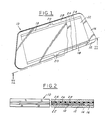
- FIG 1 there is shown electrically heated windshield, generally identified by the numeral 10, as manufactured utilising the teachings of the method of the invention.
- an outer glass template 12 is provided which forms the outside of the electrically heated windshield 10.
- This outer glass template has an outwardly facing surface 14 and an inwardly facing surface 16 shown only in Figure 2.
- the outwardly facing surface 14 forms the outer surface of the electrically heated windshield 10.
- the outer glass template has a thickness of about 0.070 inch and is formed from a soda/line glass in a known glass forming operation.
- the glass template may be bent if it is desired to have a curved windshield. Since the bending of glass templates is well known in the art, no further discussion thereof will be undertaken herein.
- bus bars 18-18 and terminal areas 20-20 are made from a silver ceramic material as is well known in the art.
- the silver ceramic in a suitable vehicle is silk screen printed on the inwardly facing surface 16 of the outer glass template 12 and then heated so as to bond the silver ceramic material to the glass and drive off the vehicle, thereby forming the bus bars 18-18 and the terminal areas 20-20.
- the silver ceramic areas generally have a thickness of 0.001 inch.
- the next coating applied to the inwardly facing surface 16 of the outer glass template 12 is a conductive coating 22.
- the conductive coating overlies and extends between the bus bars 18-18 over a great majority of the surface area of the outer glass template 12.
- the electrically conductive coating is preferably applied by a magnetron sputtering operation.
- This coating normally has a thickness of 0.4 x 106 inch and in accordance with the teachings of this preferred embodiment of the invention, the materials used as target materials in the magnetron sputtering device are zinc and silver.
- the resulting coating which is applied to the windshield is a multi-layer coating consisting of a layer of zinc oxide, a layer of silver, followed by a layer of zinc oxide, which forms a coating which is electrically conductive.
- electrically conductive we mean that an electrical current, either AC or DC, can be passed across the silver coating. Electrical leads, not shown, are bonded to the terminal areas 20-20 so that the electrical energy may be applied to the conductive coating 20.
- the adhesion between the conductive coating 22 and a layer of polyvinylbutyral material is improved by coating the conductive coating 22 with a thin layer of chromium oxide 24.
- this coating is applied by a magnetron sputter coating operation which is carried out in a five micron oxygen atmosphere.
- This coating operation may be carried out right after the conductive coating is placed on the inwardly facing surface 16 of the outer galss template.
- a chromium oxide layer we mean a layer which consists essentially of chromium metal and chromium oxides (CrO, CrO2, CrO3 and Cr2O3).
- this layer has a thickness of a range from about 25 angstroms to about 100 angstroms, which is in a range from 1 X 10 ⁇ 7 inch to about 4 X 10 ⁇ 7 inch.
- the chromium oxide layer 24 preferably covers all of the conductive coating 22 but it may, in fact, cover over the entire inwardly facing surface of the outer glass template. If desired, the chrome oxide coating may be applied by other means such as chemical vapor deposition, electron beam evaporation, or combinations thereof as known in the art.
- the exact composition of the chrome oxide layer is not critical. As long as the layer consists essentially of chromium metal and the chromium oxides discussed above in some relative proportion to one another, the chromium oxide layer is effective to increase the adhesion between polyvinyl butyral material thereto.
- a layer of polyvinyl butyral material 26, having a thickness of about 0.030 inches is laid against the chrome oxide layer 24 and an inner glass template 28 is laid thereover.
- the bonding of the inner glass template 28 and the polyvinyl butyral interlayer 26 to the chrome coating 24 and associated layers on the outer glass template 12 is carried out in a bonding operation which employs heat and pressure.
- the bonding operation employs heat and pressure which cures the polyvinyl butyral material and makes it transparent.
- Suitable bonding operations may be carried out in oil or air autoclaves in which the autoclaving material is heated to a temperature in the range of 280-310°F and a pressure in the range from 200-300 lbs. per square inch. Generally, these higher pressures are applied for a period of 10-20 minutes during an autoclaving cycle which takes 45-60 minutes. Skilled artisans are aware of the autoclaving of laminated windshields. The method of our invention for improving the adhesion between a coating on a glass article and a polyvinyl butyral are intended to be carried out with normal autoclaving procedures.
- the degree of improvement of the adhesion between the polyvinyl butyral material to a surface of a glass article having a coating thereon, such as a transparent and electrically conductive coating, is demonstrated in the following test procedure.
- the test procedure carried out is a so-called pummel test.
- a glass sample which has been laminated is soaked at 0°F for a period of about two hours.
- the so-treated sample is then removed and subjected to a constant pummeling by means of a hydraulic hammer.
- a reading of "0" is given to the test sample. If all of the glass is retained in bonding contact with the polyvinyl butyral material, a "10" is given to the test sample.
- the method of this invention may be used to make coated laminated glass for architechtural purposes.
- Such glass has a coating thereon for solar control purposes and is laminated to increase its strength.
Landscapes
- Joining Of Glass To Other Materials (AREA)
- Laminated Bodies (AREA)
Applications Claiming Priority (2)
| Application Number | Priority Date | Filing Date | Title |
|---|---|---|---|
| US91583586A | 1986-10-06 | 1986-10-06 | |
| US915835 | 1986-10-06 |
Publications (3)
| Publication Number | Publication Date |
|---|---|
| EP0263623A2 true EP0263623A2 (fr) | 1988-04-13 |
| EP0263623A3 EP0263623A3 (en) | 1989-01-18 |
| EP0263623B1 EP0263623B1 (fr) | 1992-01-29 |
Family
ID=25436324
Family Applications (1)
| Application Number | Title | Priority Date | Filing Date |
|---|---|---|---|
| EP19870308455 Expired EP0263623B1 (fr) | 1986-10-06 | 1987-09-24 | Procédé pour améliorer l'adhésion entre un revêtement sur un article en verre et un matériau en polyvinyl de butyral |
Country Status (4)
| Country | Link |
|---|---|
| EP (1) | EP0263623B1 (fr) |
| CA (1) | CA1279565C (fr) |
| DE (1) | DE3776479D1 (fr) |
| MX (1) | MX169152B (fr) |
Cited By (4)
| Publication number | Priority date | Publication date | Assignee | Title |
|---|---|---|---|---|
| US5061568A (en) * | 1989-12-20 | 1991-10-29 | Monsanto Company | Solar screening assembly |
| US5271994A (en) * | 1989-12-09 | 1993-12-21 | Saint Gobain Vitrage International | Electrically heatable automobile glazing of laminated glass |
| US5427861A (en) * | 1991-08-12 | 1995-06-27 | Monsanto Company | Laminated glazing panel having improved resistance to light exposure |
| US5506037A (en) * | 1989-12-09 | 1996-04-09 | Saint Gobain Vitrage International | Heat-reflecting and/or electrically heatable laminated glass pane |
Family Cites Families (1)
| Publication number | Priority date | Publication date | Assignee | Title |
|---|---|---|---|---|
| US4463047A (en) * | 1981-10-02 | 1984-07-31 | Optical Coating Laboratory, Inc. | Flexible selective energy control sheet and assembly using the same |
-
1987
- 1987-09-10 CA CA000546568A patent/CA1279565C/fr not_active Expired - Lifetime
- 1987-09-24 EP EP19870308455 patent/EP0263623B1/fr not_active Expired
- 1987-09-24 DE DE8787308455T patent/DE3776479D1/de not_active Expired - Lifetime
- 1987-09-29 MX MX859787A patent/MX169152B/es unknown
Cited By (4)
| Publication number | Priority date | Publication date | Assignee | Title |
|---|---|---|---|---|
| US5271994A (en) * | 1989-12-09 | 1993-12-21 | Saint Gobain Vitrage International | Electrically heatable automobile glazing of laminated glass |
| US5506037A (en) * | 1989-12-09 | 1996-04-09 | Saint Gobain Vitrage International | Heat-reflecting and/or electrically heatable laminated glass pane |
| US5061568A (en) * | 1989-12-20 | 1991-10-29 | Monsanto Company | Solar screening assembly |
| US5427861A (en) * | 1991-08-12 | 1995-06-27 | Monsanto Company | Laminated glazing panel having improved resistance to light exposure |
Also Published As
| Publication number | Publication date |
|---|---|
| EP0263623B1 (fr) | 1992-01-29 |
| CA1279565C (fr) | 1991-01-29 |
| DE3776479D1 (de) | 1992-03-12 |
| EP0263623A3 (en) | 1989-01-18 |
| MX169152B (es) | 1993-06-23 |
Similar Documents
| Publication | Publication Date | Title |
|---|---|---|
| US4844985A (en) | Electrically heated transparent glass article and method of making | |
| CA1253064A (fr) | Methode de fabrication d'un pare-brise chauffe a l'electricite | |
| US6261398B1 (en) | Process for producing a curved laminated safety glass sheet | |
| US4718932A (en) | Method for making an electrically heatable windshield | |
| US5153062A (en) | Process and device for producing laminated safety glass and laminated safety glass produced thereby | |
| US5073450A (en) | Laminated glazing unit | |
| US5443669A (en) | Process for producing a laminated glass pane, especially for a motor vehicle | |
| CA1281356C (fr) | Vitre stratifiee rechauffee a l'electricite | |
| US4786784A (en) | Method for producing an electrically heated window assembly and resulting article | |
| US4465736A (en) | Selectively light transmitting film and preformed laminar structure | |
| US4668270A (en) | Method of making an electrically heated, glass vision unit | |
| CN107107570B (zh) | 用于制备具有在载体箔上的红外反射涂层的复合玻璃板的方法 | |
| US5902505A (en) | Heat load reduction windshield | |
| US10464292B2 (en) | Transparent pane with electrically conductive coating | |
| JPH04331747A (ja) | 積層ガラスの電気加熱式自動車グレイジング | |
| KR940010815B1 (ko) | 전기적 가열가능 투명체 및 그의 제작방법 | |
| JPS5939388B2 (ja) | ガラスシ−ト組体 | |
| US5506037A (en) | Heat-reflecting and/or electrically heatable laminated glass pane | |
| MX2014008319A (es) | Panel transparente con recubrimiento electricamente conductor. | |
| US4952258A (en) | Process for producing laminated safety glass | |
| CN1196700A (zh) | 层压安全玻璃板的制造方法和用于制造的基片及其应用 | |
| JPS62216945A (ja) | 少なくとも1枚の導電性面状被覆を備えた基板を有する透明板ガラス及びその製法 | |
| JP2003507305A (ja) | 窓ガラス | |
| CN1077854C (zh) | 具有传感器的层压窗格玻璃 | |
| US3893234A (en) | Edge improvement for window with electrically conductive layer |
Legal Events
| Date | Code | Title | Description |
|---|---|---|---|
| PUAI | Public reference made under article 153(3) epc to a published international application that has entered the european phase |
Free format text: ORIGINAL CODE: 0009012 |
|
| AK | Designated contracting states |
Kind code of ref document: A2 Designated state(s): DE FR GB |
|
| RIN1 | Information on inventor provided before grant (corrected) |
Inventor name: HYMORE RONALD RAY Inventor name: AMBERGER, CHARLES JAMES Inventor name: PHARMS, EURENE PAUL |
|
| PUAL | Search report despatched |
Free format text: ORIGINAL CODE: 0009013 |
|
| AK | Designated contracting states |
Kind code of ref document: A3 Designated state(s): DE FR GB |
|
| 17P | Request for examination filed |
Effective date: 19890626 |
|
| 17Q | First examination report despatched |
Effective date: 19910321 |
|
| GRAA | (expected) grant |
Free format text: ORIGINAL CODE: 0009210 |
|
| AK | Designated contracting states |
Kind code of ref document: B1 Designated state(s): DE FR GB |
|
| ET | Fr: translation filed | ||
| REF | Corresponds to: |
Ref document number: 3776479 Country of ref document: DE Date of ref document: 19920312 |
|
| REG | Reference to a national code |
Ref country code: GB Ref legal event code: 746 |
|
| PLBE | No opposition filed within time limit |
Free format text: ORIGINAL CODE: 0009261 |
|
| STAA | Information on the status of an ep patent application or granted ep patent |
Free format text: STATUS: NO OPPOSITION FILED WITHIN TIME LIMIT |
|
| 26N | No opposition filed | ||
| REG | Reference to a national code |
Ref country code: FR Ref legal event code: DL |
|
| REG | Reference to a national code |
Ref country code: FR Ref legal event code: TP Ref country code: FR Ref legal event code: CD |
|
| PGFP | Annual fee paid to national office [announced via postgrant information from national office to epo] |
Ref country code: DE Payment date: 20000830 Year of fee payment: 14 |
|
| PGFP | Annual fee paid to national office [announced via postgrant information from national office to epo] |
Ref country code: GB Payment date: 20000901 Year of fee payment: 14 |
|
| PGFP | Annual fee paid to national office [announced via postgrant information from national office to epo] |
Ref country code: FR Payment date: 20000929 Year of fee payment: 14 |
|
| PG25 | Lapsed in a contracting state [announced via postgrant information from national office to epo] |
Ref country code: GB Free format text: LAPSE BECAUSE OF NON-PAYMENT OF DUE FEES Effective date: 20010924 |
|
| REG | Reference to a national code |
Ref country code: GB Ref legal event code: IF02 |
|
| PG25 | Lapsed in a contracting state [announced via postgrant information from national office to epo] |
Ref country code: DE Free format text: LAPSE BECAUSE OF NON-PAYMENT OF DUE FEES Effective date: 20020501 |
|
| GBPC | Gb: european patent ceased through non-payment of renewal fee |
Effective date: 20010924 |
|
| PG25 | Lapsed in a contracting state [announced via postgrant information from national office to epo] |
Ref country code: FR Free format text: LAPSE BECAUSE OF NON-PAYMENT OF DUE FEES Effective date: 20020531 |
|
| REG | Reference to a national code |
Ref country code: FR Ref legal event code: ST |