EP0263693A2 - Microcapteur - Google Patents
Microcapteur Download PDFInfo
- Publication number
- EP0263693A2 EP0263693A2 EP87308884A EP87308884A EP0263693A2 EP 0263693 A2 EP0263693 A2 EP 0263693A2 EP 87308884 A EP87308884 A EP 87308884A EP 87308884 A EP87308884 A EP 87308884A EP 0263693 A2 EP0263693 A2 EP 0263693A2
- Authority
- EP
- European Patent Office
- Prior art keywords
- dye
- cellulose
- groups
- sensor
- optical fiber
- Prior art date
- Legal status (The legal status is an assumption and is not a legal conclusion. Google has not performed a legal analysis and makes no representation as to the accuracy of the status listed.)
- Granted
Links
Images
Classifications
-
- G—PHYSICS
- G01—MEASURING; TESTING
- G01N—INVESTIGATING OR ANALYSING MATERIALS BY DETERMINING THEIR CHEMICAL OR PHYSICAL PROPERTIES
- G01N21/00—Investigating or analysing materials by the use of optical means, i.e. using sub-millimetre waves, infrared, visible or ultraviolet light
- G01N21/62—Systems in which the material investigated is excited whereby it emits light or causes a change in wavelength of the incident light
- G01N21/63—Systems in which the material investigated is excited whereby it emits light or causes a change in wavelength of the incident light optically excited
- G01N21/64—Fluorescence; Phosphorescence
- G01N21/6428—Measuring fluorescence of fluorescent products of reactions or of fluorochrome labelled reactive substances, e.g. measuring quenching effects, using measuring "optrodes"
- G01N21/643—Measuring fluorescence of fluorescent products of reactions or of fluorochrome labelled reactive substances, e.g. measuring quenching effects, using measuring "optrodes" non-biological material
-
- G—PHYSICS
- G01—MEASURING; TESTING
- G01N—INVESTIGATING OR ANALYSING MATERIALS BY DETERMINING THEIR CHEMICAL OR PHYSICAL PROPERTIES
- G01N21/00—Investigating or analysing materials by the use of optical means, i.e. using sub-millimetre waves, infrared, visible or ultraviolet light
- G01N21/62—Systems in which the material investigated is excited whereby it emits light or causes a change in wavelength of the incident light
- G01N21/63—Systems in which the material investigated is excited whereby it emits light or causes a change in wavelength of the incident light optically excited
- G01N21/64—Fluorescence; Phosphorescence
- G01N21/6428—Measuring fluorescence of fluorescent products of reactions or of fluorochrome labelled reactive substances, e.g. measuring quenching effects, using measuring "optrodes"
- G01N2021/6434—Optrodes
-
- G—PHYSICS
- G01—MEASURING; TESTING
- G01N—INVESTIGATING OR ANALYSING MATERIALS BY DETERMINING THEIR CHEMICAL OR PHYSICAL PROPERTIES
- G01N21/00—Investigating or analysing materials by the use of optical means, i.e. using sub-millimetre waves, infrared, visible or ultraviolet light
- G01N21/62—Systems in which the material investigated is excited whereby it emits light or causes a change in wavelength of the incident light
- G01N21/63—Systems in which the material investigated is excited whereby it emits light or causes a change in wavelength of the incident light optically excited
- G01N21/64—Fluorescence; Phosphorescence
- G01N21/6428—Measuring fluorescence of fluorescent products of reactions or of fluorochrome labelled reactive substances, e.g. measuring quenching effects, using measuring "optrodes"
- G01N2021/6439—Measuring fluorescence of fluorescent products of reactions or of fluorochrome labelled reactive substances, e.g. measuring quenching effects, using measuring "optrodes" with indicators, stains, dyes, tags, labels, marks
-
- G—PHYSICS
- G01—MEASURING; TESTING
- G01N—INVESTIGATING OR ANALYSING MATERIALS BY DETERMINING THEIR CHEMICAL OR PHYSICAL PROPERTIES
- G01N21/00—Investigating or analysing materials by the use of optical means, i.e. using sub-millimetre waves, infrared, visible or ultraviolet light
- G01N21/75—Systems in which material is subjected to a chemical reaction, the progress or the result of the reaction being investigated
- G01N21/77—Systems in which material is subjected to a chemical reaction, the progress or the result of the reaction being investigated by observing the effect on a chemical indicator
- G01N21/78—Systems in which material is subjected to a chemical reaction, the progress or the result of the reaction being investigated by observing the effect on a chemical indicator producing a change of colour
- G01N21/80—Indicating pH value
Definitions
- This invention is directed to an event sensor, as for instance a pH sensor and a process for the preparation of such a sensor.
- the sensor utilizes a dye which is sensitive to an event.
- the dye is attached to a finely divided polymeric material as for instance cellulose.
- the polymeric material, bearing the dye thereon, is dissolved in a solvent and is deposited on an optical surface of an optical fiber.
- the polymeric material, bearing the dye is regenerated from the solution to form a solid matrix of the polymeric material, bearing the dye, on the optical surface of the optical fiber.
- the determination of an event is very important in many situations.
- One of these is the determination of the pH of biological specimens, as for instance, blood.
- the pH of the blood is indicative of many physiologically important conditions of a patient.
- event sensors In constructing event sensors it is necessary to construct them of a material which is permeable to an indicator of the event being measured.
- the material For a pH sensor, the material must be permeable to ionic species. This severely limits the types of material which may be used for such sensors.
- Glass pH electrodes have been used for years for pH determinations. These glass electrodes have to be dipped into a solution for determination of the pH of the solution. In a medical situation, such as a patient recovering from a myocardial infarction, it would be advantageous to be able to measure the pH event in real time, that is continuously. Unfortunately this is not possible with glass electrodes. With glass electrodes, at best, only intermittent measurements can be made. Each of the seperate measurements requires withdrawal of an aliquot of blood from the patient and sending the blood sample to the laboratory for the determination of the pH of the patient's blood. Aside from the requirement of having to continuously withdraw the aliquots of blood, this procedure is time consuming and as such it does not give a true reflection of the patient's condition in real time.
- a prior known sensor uses the fluorescent properties of a dye in conjunction with the ionic permeability of a preformed integral cellulose membrane sheet.
- the cellulose membrane is chemically treated so as to introduce covalent bondable groups onto the membrane.
- the dye is then covalently bonded to these groups to adhere the dye to the membrane.
- a small disk is cut from the membrane sheet and is attached to a cassette in association with an optical fiber bundle also attached to the cassette.
- the dye is excited by excitation light imposed on the dye along the fibers, it under goes fluorescence, emitting a wavelength of light at a different wavelength than the excitation wavelength. The emission light is measured as an indication of the pH.
- the dye is evenly distributed across the membrane sheet such that there will be reproducibility between individual disks cut from the membrane sheet. Aside from evenly disbursing the dye molecules across the membrane, it is also important to insure that the dye molecules are placed with respect to one another such that there is a sufficient concentration to be responsive to pH changes in the solution being measured. Because of these considerations, it is necessary to perform quality control procedures on each disk cut from the membrane to insure that the distribution of the dye on the cellulose membrane is sufficient to render the individual disk useful as a pH sensor.
- cellulose membranes utilize a commercial cellulose membrane as for instance a cellulose membrane suitable for use as a dialysis membrane.
- the intact membrane is first treated with cyanogen bromide followed by a condensation with an appropriate amine, for instance hexamethylenediamine. This yields a compound which has a primary amino functional group which is reacted with the dye, to attach the dye to the membrane.
- This method does not lend itself easily to the fabrication of a microsensor on an optical fiber tip which is on the order of 0.006 inches in diameter.
- This invention provides a micro sensor for sensing an event such as a pH.
- the sensor of the invention is capable of being constructed in a size of the size domain of an optical fiber.
- the sensor of the invention is capable of being easily and inexpensively manufactured.
- the dye bearing polymer is then dissolved in a solvent.
- a quantity of the solvated dye bearing polymer is then deposited onto an optical surface of an optical fiber and the dye bearing polymer is regenerated from the solvent to form a solid matrix of the regenerated dye bearing polymer on the optical surface of the optical fiber.
- the micro sensor is a pH sensor
- the polymer is powdered cellulose and the attachment sites on the cellulose comprise substituent groups on the cellulose.
- the dye is attached to at least some of the substituent groups on the cellulose to form a dye substituted cellulose.
- the event sensitive dye is chosen to be a pH sensitive dye.
- 1e dye can be attached to the substituent groups on the cellulose by covalently bonding the dye to at least some of the substituent groups on cellulose. Further essentially any substituent groups on the cellulose not having the dye attached thereto can be reacted with a blocking agent so as to render the blocked substituent groups essentially pH insensitive.
- the substituents groups on the cellulose are C2-C20 aminoalkyl groups and the dye is attached to the aminoalkyl groups on the cellulose by covalently bonding the dye to at least some of the aminoalkyl substituents on t
- any remaining aminoalkyl groups on the cellulose not having the dye attached thereto can be blocked by reacting with a blocking group so as to render the blocked aminoalkyl groups essentially pH insensitive.
- the blocking can be accomplished by reacting with an acylating agent such as an acetylating agent.
- the dye is hydroxypyrenetrisulfonic acid or an acceptable salt thereof such as a physiological acceptable salt.
- This dye is a known dye for use in sensing pH.
- the dye can be substituted onto the cellulose by reacting the hydroxypyrenetrisulfonic acid to form at least a mono-sulfonyl chloride derivative of the hydroxypyrenetrisulfonic acid and reacting the mono-sulfonyl chloride with the aminoalkylcellulose to attach the dye to the cellulose by forming sulfonamide linkages between the dye and the aminoalkylcellulose.
- the aminoalkyl cellulose can be aminoethylcellulose.
- the process can be enhanced by adding a quantity of a permeability enhancing agent to the solution of the dye containing cellulose.
- the permeability enhancing agent would be selected from small molecular weight water soluble hydrophilic compounds such as sugars, polyols and the like. Suitable for the permeability enhancing agent is glycerol.
- cellulose When cellulose is used for the polymer it can be regenerated by acid treating the deposited quantity of the solvated dye substituted cellulose located on the optical fiber. This can be accomplished by dipping the deposit of the solvated dye bearing cellulose on the end of the fiber into an acid bath. To enhance the ionic permeability of the sensor, a quantity of glycerol can be added to the acid bath prior to dipping the solvated dye bearing cellulose into the bath.
- An illustrative process for forming a pH sensor comprises selecting a quantity of powdered cellulose having a plurality of substituent aminoalkyl groups thereon, reacting the aminoalkyl groups on the cellulose with a quantity of a pH sensitive dye so as to covalently bond the dye to at least some of the aminoalkyl groups on the cellulose to form a dye substituted cellulose, dissolving the dye substituted cellulose in a solvent and depositing a quantity of the solvated dye substituted cellulose onto an optical surface of an optical fiber, and then regenerating the dye substituted cellulose from the solvent by acid treating the deposited quantity of the solvated dye substituted cellulose on the optical fiber to form a solid matrix of regenerated dye substituted cellulose on the optical fiber.
- the solid matrix of the regenerated dye bearing polymer as for instance a cellulose matrix
- An advantageous event sensor of the invention includes a) an optical fiber having an optical surface, b) a matrix of regenerated polymeric material formed in situ on the optical surface of the optical fiber by depositing a droplet of the polymeric material in solution in a carrier solvent on the fiber and regenerating the polymeric material from the solution by treating the carrier solvent with a regeneration reagent to form the matrix of the polymeric material on the fiber, and c) a plurality of event sensing dye groups attached to the polymeric material.
- the improved microsensors of the invention are constructed so as to have a even dispersion of a dye throughout a supporting polymeric material.
- the dye is initially bound to a divided polymeric material. This material is then taken up in solution and a drop of the solution is deposited on an optical surface of an optical fiber.
- the polymeric material is then regenerated into a solid, forming a matrix on the optical surface of the optical fiber. Dispersed in the matrix is the dye. This allows for the creation of a microsensor having the dye evenly dispersed throughout the matrix of the supporting material.
- the finely divided polymer By utilizing a finely divided polymer and attaching the dye to this finely divided polymer, the finely divided polymer can then be mixed or otherwise homogenized to insure that the dye is evenly dispersed throughout the polymer. This allows for portions of the polymer to be utilized at different instances of time while only requiring a single quality control test on an aliquot of the batch.
- a micro pH sensor is constructed.
- the supporting polymeric material be water insoluble, such that it is not degraded by the test solution whose pH is being determined. Further it has to be permeable to ions in order for ions from the test solution to cross through the polymer and interact with an appropriate dye located within the interior of a matrix of the polymer.
- a further characteristic of the polymer once it has the dye attached thereto is that it must be solubilized so as to be transferable to an optical surface of an optical fiber. Once the polymer with the dye attached thereto is solubilized, a small aliquot of the solution of the polymer with the dye attached thereto can be located on the optical surface of the optical fiber. Regeneration of the solid polymer from the solution then yields a solid matrix of the polymer having the dye located therein, which is correctly positioned on the optical surface of the optical fiber.
- the polymer is chosen to be a water insoluble, ionic permeable polymer.
- Macromolecular hydrophilic polymers which have these general characteristics are useful.
- Such polymeric material would include cellulose, high molecular weight polyvinylalcohol, (i.e. PVA), polyurethanes, polyacrylamides, polyhydroxyalkyl acrylates, polyvinyl pyrrolidones, hydrophilic polyamides, and polyesters.
- PVA high molecular weight polyvinylalcohol
- the polyvinylalcohol would be chosen such that its molecular weight is sufficiently high to render it water insoluble. Solubilization of the polyvinylalcohol would be accomplished via a mixture of water/alcohol as would be appropriate for the particular polyvinylalcohol utilized.
- Coupling of the dye to the polymeric material can be accomplished either by direct coupling of the dye to reactive sites on the polymeric material, as for instance, hydroxyl group on either cellulose or polyvinyl alcohol, or through indirect coupling utilizing a substituent group which in itself is coupled to the polymeric material.
- alkylamines could be first joined to the polymeric material.
- an alkylamine would be joined to a hydroxyl group on the cellulose backbone by forming an ether between the alkyl portion of the alkylamine and cellulose backbone. This leaves the amino functionality of the alkylamine available for reaction with the dye to join the dye to the polymeric matrix or backbone.
- the dye could be joined to the polymeric material either directly or through a substituent group utilizing secondary bonding techniques such as hydrogen bonding or the like, it is preferred to form a covalent bond between the dye and the attachment point, either directly on a polymeric material or indirectly through a substituent group. This assures that the dye is fixedly and irreversibly bound to the polymeric material for improved performance of the sensor.
- the substituent group would be chosen such that either it will not interfere with the measurement being taken or any unreactive substituent group used are capable of being blocked. For instance, if cellulose is utilized and an aminoethyl group is used as the substituent group and the concentration of the dye was chosen such that less than all of the aminoethyl groups are reacted with the dye, the remaining aminoethyl groups are appropriately blocked as, for instance, with an acyl blocking group to essentially neutralize any charge on the unreacted amino groups such that they do not interfere with the measurement being taken, as for instance, a pH measurement.
- suitable for the substituent groups would be C2 to C20 aminoalkyls. These aminoalkyl groups could be straight chain, branched chain, cyclo or aromatic. They could include substitution groups located thereon which are hydrophilic such as -OH, -NO2, carboxyl, sulfonate or the like. Generally the aminoalkly group will be C2 to C8 with the C2 and C3 aminoalkyl groups being preferred, i.e, aminoethyl or aminopropyl. For ease of blocking of any excess aminoalkyl groups, acetyl can be chosen as a convenient blocking group.
- acyl blocking groups are conveniently utilized for blocking functional groups such as amino groups.
- Other blocking groups could be utilized to block such amino groups or other functional groups as long as they convert a chargeable species such as the basic amino species of the amino group to a neutral species such that if the sensor is being utilized as a pH sensor, any basic or acidic properties of the substituent groups do not interfere with the pH measurement.
- the starting material for the matrix will be a solid, finely divided polymeric material, as for instance, a powdered material.
- a different state as for example a liquid material, could be initially utilized, reacting with the dye and further treated so as to be able to form a solid state material once the dye bearing polymeric material is located on the optical surface of an optical fiber.
- utilization of a solid powder polymeric material is preferred.
- the dye can be added to the polymeric material utilizing either a solid state reaction or a solution reaction.
- the state of this dye bearing polymeric material should be such that a homogeneous mixture can be formed.
- homogenous properties in the final event sensor can be obtained.
- the dye will be chosen such that it is either an absorption dye or a fluorescent dye.
- dyes such as hydroxypyrenetrisulfonic acid or its salts, fluorecein or beta-methylumbelliferone can be utilized. These dyes are all very useful for the physiological pH range of blood, as for instance, from about 7.0 to about 8.0. It is recognized that other pH ranges might be chosen as a sensing pH range, or other events other than pH sensing might be chosen. For these other pH ranges or other events, appropriate dyes which are indicative of these events would be chosen, as for instance, if a lower pH range was to be measured, a dye having characteristics of that lower pH range would be chosen.
- the polymeric material must be susceptible to transmitting ionic species across it such that these ionic species can react with the dye.
- the pH within the matrix of the sensor itself may not be exactly the same as the pH of the test solution, but it will be such that it tracks the pH of the test solution. Thus, as the pH of the test solution goes up, so does the internal pH within the sensor and as the pH of the test solution goes down, so does the internal pH within the matrix of the sensor.
- the dye bearing polymeric material is then solubilized in a suitable solvent.
- the solvent of choice will depend upon the polymeric material itself. In any event, upon solubilization of the dye bearing polymeric material, further homogenization of the dye bearing material takes place by virtue of the solubilization procedure itself.
- a convenient regeneration method is acid regeneration of the cellulose. This is easily accomplished and is easily facilitated for manufacturing reasons by simply adding a drop of a fairly viscous solution of the cellulose material onto the optical surface on the end of an optical fiber and dipping that end of the optical fiber into an acid bath. This regenerates the cellulose matrix forming a solid matrix of the dye bearing regenerated cellulose on the end of the fiber. This is much easier than attempting to adhere a preformed disk or matrix on the very small end of an optical fiber.
- solubilized polymeric material can be added to the existing regenerated material already on the optical surface of an optical fiber.
- the further addition is followed by a further regeneration acid dip.
- This allows for the build up of a final matrix of a precise dimension. Since the solubilized cellulose adheres to both the regenerated cellulose matrix and to the glass of the optical fiber, it is possible to repeatedly add new aliquots of solubilized cellulose onto the existing regenerated cellulose to stepwise build up a sensor of any desired dimension.
- cellulose will be utilized as the polymeric material.
- Aminoethylated cellulose is commercially available in a powdered form, as for instance for Sigma Chemical, St. Louis, MO. Normally if commercial aminoethylcellulose is utilized, the material as received from the manufacturer will be first treated to generate free amine groups. This is easily accomplished by simply treating with a sodium bicarbonate solution and drying. The activated aminoethylcellulose should be protected from C02 in the atmosphere in order to prevent formation of carbonate salts of aminoethylcellulose.
- aminoethylcellulose is then treated with an appropriate dye.
- an appropriate dye For the purposes of illustration of a pH sensor of this invention, hydroxypyrenetrisulfonic acid will be utilized as the dye. It is of course realized that this material could be used as the free acid or as a suitable salt as, for instance an alkali or an alkali earth salts.
- HPTS hydroxypyrenetrisulfonic acid
- a suitable active species would be a sulfonic acid chloride.
- the HPTS is first acetylated to protect the hydroxy function of the HPTS and then it is converted to a suitable acid chloride. Normally for HPTS, this reaction with aminoethylcellulose will be conducted to yield the mono substituted HPTS.
- the acid chloride derivative of the HPTS is reacted with aminoethylcellulose to covalently bond the dye to the cellulose backbone material utilizing sulfonylamido linkages.
- hydrochloric acid is generated as a byproduct. This byproduct hydrochloric acid tends to react with other amine groups on the aminoethylcellulose.
- the dye can be stepwise reacted with the aminoethylcellulose by first treating with a first batch of the HPTS acid chloride followed by treating this product to convert any amino hydrochlorides back to the free amine groups, and further reacting with additional HPTS acid chloride.
- the desired amount of dye which is to be loaded onto the cellulose can be controlled by either stoichiometric control of the amount of dye which is in fact added to any particular amount of cellulose or by stepwise control by repeated treatments adding first one molecule of the dye and concurrently generating an amine hydrochloride on a further amine group, effectly blocking it against reaction with the dye, followed by regeneration of the free amine from the amine hydrochloride and then adding a second dye group. It is, of course, realized that this could be repeated as many times as is necessary to add increasing amounts of the dye to the aminoethylcellulose.
- any remaining amino groups are blocked so as to prevent free primary amines from interfering with the pH measurement of the pH sensor.
- This can be conveniently done by acylating these amines, for instance by utilizing an acetyl blocking group.
- a further basic material for instance pyridine, may be present.
- the dye bearing cellulose is then taken up into solution.
- three basic types of solutions can be formed. The first of these are based on inorganic complexes, the second is based upon organic complexes and the third utilizes hemi esters or sulfur complexes.
- metallic ions such as zinc, copper, nickel, iron, cobalt or cadmium would be utilized. These can be utilized in conjunction with other liquids such as aqueous ethylenediamine.
- Typical inorganic solutions for solubilizing a dye bearing cellulose might be copper hydroxide in concentrated ammonia, copper hydroxide in aqueous ethylenediamine, cobalt hydroxide in aqueous ethylenediamine, nickel hydroxide in aqueous ethylenediamine, cadmium hydroxide in aqueous ethylenediamine, nickel hydroxide in concentrated ammonia or iron tartrate in alkali hydroxide.
- Typical organic solvents for solubilizing dye bearing cellulose might by 16 1/2% methylamine in dimethylsulfoxide, N-methylmorphine N-oxide or quaternary ammonium bases.
- Suitable hemi esters or half esters would be a hemisuccinate.
- Suitable complex sulfur intermediates would be the viscose process, dimethylsulfoxide plus carbon disulfide plus an amine or sulfur dioxide in an amine system.
- the cellulose can be regenerated by acid treatment.
- acid treatment typically would entail utilizing a diluted acid such as the common mineral acids, as, for instance, sulfuric acid.
- permeability enhancing agents can be added. These generally will be added either in the solvent for the polymeric material, the regeneration solution for the polymeric material or both of these. Suitable for such permeability enhancing material are small molecular weight molecules which are hydrophilic and are water soluble. Such compounds might include sugars and polyol and the like. For instance, glycerol can be added to both a solvent solution for the cellulose and to an acid regeneration bath. Another specific suitable permeability enhancing agents would be low molecular weight water soluble PVA.
- the dye bearing matrix of the polymeric material on the optical fiber can be overcoated with a suitable coating or overcoating material serving to enhance certain properties of the sensor.
- An overcoat material would be chosen so as to be ionic permeable as is the polymeric matrix.
- Suitable for an overcoating material would be cellulose which is impregnated with carbon black or the like.
- the senor on the end of an optical fiber is positioned in the appropriate test solution. If a fluorescent dye is utilized, an excitation light wavelength from a light source is channeled down the fiber toward the sensor. The light strikes the dye, the dyes fluoresces and emits an emission light wavelength. Interaction of the event indicator with the dye modulates the fluorescence. The emission light is then channeled back up the fiber to a light sensor for electrical readout of the same.
- This procedure is similar to that described in Lubbers et al, U.S. patent Re. 31,879 and Heitzmann, U.S. patent 4,557,900. For brevity of this specification, reference is made to these patents for details of this procedure. For this reason, the entire disclosures of Lubbers et al, U.S. patent Re. 31,879 and Heitzmann, U.S. patent 4,557,900 are herein incorporated by reference.
- the overcoat is chosen to be opaque to the excitation and emission light wavelengths.
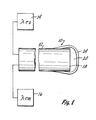
- Fig. 1 shows a suitable physical sensor 10 of the invention.
- An optical fiber 12 is connected to an appropriate light transmitting apparatus 14.
- the light transmitting apparatus 12 generates the excitation light ⁇ ex .
- the optical fiber 12 is also connected to a light receiving apparatus 16.
- the light receiving apparatus 16 receives and analyzes the emission light ⁇ em from the fluorescent dye as is described in the above referenced Lubbers et al and Heinzmann patents.
- a dye bearing polymeric matrix 20 Located on the optical surface 18 of the fiber 12 is a dye bearing polymeric matrix 20, as for instance, a cellulose matrix containing HPTS as a fluorescent dye therein.
- the matrix 20 adheres to the optical surface 18 and slightly down along the sides 22 of the end of the fiber 12.
- An overcoating 24 can then be applied over the totality of the matrix 20 and down further along the side 22 of the fiber 12.
- the optical fiber 12 bearing the matrix 20 and the overcoat 24 thereon is placed in an appropriate solution.
- Excitation light of an appropriate wavelength from the light transmitting apparatus 14 is fed to the fiber 12. This interacts with the dye in the matrix 20 causing the dye to fluoresce.
- the emission light from the fluorescence is fed to light receiving apparatus 16.
- the sensor 10, as is evident from Fig. 1 is of a size domain approximately that of the optical fiber 12. Thus, typically, the sensor 10 would only be slightly larger than a typical 125 micron diameter fiber.
- the thickness of the matrix 20 would be chosen so as to be approximately three to four mils (0.004 inches) thick.
- the dried filter cake is then retreated a second time in 100 mls of dimethylformamide with 100 mg of acetoxy-pyrenetrisulfonic acid chloride for 45 minutes. After the second treatment it is filtered and the cake washed with 2.5% sodium bicarbonate followed by two water washes. The product is stored over a dessicant under high vacuum to dry the same.
- An inorganic zinc based solvent is prepared by dissolving 4.15 grams of zinc chloride in 100 mls of water. 50 mls of 2.2 M sodium hydroxide solution is added dropwise with stirring over ten minutes. The resulting product is centrifuged at 2,000 RPMs in a Beckman TO-6 Centrifuge for ten minutes. The supernatant is decanted and 50 mls of .5M sodium hydroxide is added to the precipitate. This is agitated with a glass rod, recentrifuged and decanted again. This procedure is repeated twice more. 50 mls of cold 40% aqueous ethylenediamine and 1 gram of glycerol are added to the final precipitate. This is mixed together by shaking. The product is then blanketed with nitrogen and stored in a refrigerator.
- Example 7 1 drop of the mixture of Example 7 is added to the end of a clean fiber tip of an optical fiber. This is dipped into a 5% sulfuric acid, 5% glycerol solution for 5 minutes to regenerate the cellulose. The fiber having the regenerated cellulose matrix located thereon is then rinsed with 1% sodium bicarbonate, 5% glycerol solution for 30 seconds. The thickness of the sensor is then measured wet. The desired thickness is 3 to 4 mils when wet. If the sensor is not of the desired thickness, a further drop of the product of Example 7 is added and the sensor is once again dipped into the sulfuric acid, glycerol bath. The sensor is once again washed with sodium bicarbonate and the thickness measured. A further amount of the sensor matrix can be regenerated on the sensor if, again, the desired thickness has not been reached.
- the dye will be utilized in a ratio of from about 1 mg of dye to about 20 mg of dye per 1 gram of cellulose. At about 10 mgs of dye per 1 gram of cellulose, a dye molecule is attached to about 5% of the average NH2 sites on the cellulose.
Landscapes
- Health & Medical Sciences (AREA)
- Immunology (AREA)
- Life Sciences & Earth Sciences (AREA)
- Physics & Mathematics (AREA)
- Chemical & Material Sciences (AREA)
- Nuclear Medicine, Radiotherapy & Molecular Imaging (AREA)
- Chemical Kinetics & Catalysis (AREA)
- Optics & Photonics (AREA)
- Molecular Biology (AREA)
- Analytical Chemistry (AREA)
- Biochemistry (AREA)
- General Health & Medical Sciences (AREA)
- General Physics & Mathematics (AREA)
- Pathology (AREA)
- Investigating Or Analysing Materials By The Use Of Chemical Reactions (AREA)
Applications Claiming Priority (2)
| Application Number | Priority Date | Filing Date | Title |
|---|---|---|---|
| US06/917,913 US4798738A (en) | 1986-10-10 | 1986-10-10 | Micro sensor |
| US917913 | 1986-10-10 |
Publications (3)
| Publication Number | Publication Date |
|---|---|
| EP0263693A2 true EP0263693A2 (fr) | 1988-04-13 |
| EP0263693A3 EP0263693A3 (en) | 1990-03-14 |
| EP0263693B1 EP0263693B1 (fr) | 1993-06-02 |
Family
ID=25439498
Family Applications (1)
| Application Number | Title | Priority Date | Filing Date |
|---|---|---|---|
| EP87308884A Expired - Lifetime EP0263693B1 (fr) | 1986-10-10 | 1987-10-07 | Microcapteur |
Country Status (3)
| Country | Link |
|---|---|
| US (2) | US4798738A (fr) |
| EP (1) | EP0263693B1 (fr) |
| DE (1) | DE3786054T2 (fr) |
Cited By (14)
| Publication number | Priority date | Publication date | Assignee | Title |
|---|---|---|---|---|
| US4925268A (en) * | 1988-07-25 | 1990-05-15 | Abbott Laboratories | Fiber-optic physiological probes |
| DE3923950A1 (de) * | 1989-07-19 | 1991-01-31 | Biotechnolog Forschung Gmbh | Faseroptische sensoranordnung zur bestimmung eines analyts, insbesondere von glucose |
| US5000901A (en) * | 1988-07-25 | 1991-03-19 | Abbott Laboratories | Fiber-optic physiological probes |
| US5028395A (en) * | 1989-07-20 | 1991-07-02 | Commissariat A L'energie Atomique | Active chemical sensor with optical fiber and its production process |
| EP0340018A3 (fr) * | 1988-04-28 | 1991-08-28 | Minnesota Mining And Manufacturing Company | Composition, appareil et méthode pour la détection de composants ioniques |
| US5119463A (en) * | 1991-04-09 | 1992-06-02 | Abbott Laboratories | Compound optical probe employing single optical waveguide |
| US5127077A (en) * | 1988-07-25 | 1992-06-30 | Abbott Laboratories | Fiber-optic physiological probes |
| EP0539967A1 (fr) * | 1991-10-31 | 1993-05-05 | Minnesota Mining And Manufacturing Company | Capteurs et procédés d'analyse |
| EP0539968A1 (fr) * | 1991-10-31 | 1993-05-05 | Minnesota Mining And Manufacturing Company | Capteurs basés sur un état exciplex et procédés d'analyse |
| EP0546472A1 (fr) * | 1991-12-07 | 1993-06-16 | Hoechst Aktiengesellschaft | Dispositif de mesure pour déterminer la concentration des composés inorganiques et organiques d'un échantillon |
| US5409666A (en) * | 1991-08-08 | 1995-04-25 | Minnesota Mining And Manufacturing Company | Sensors and methods for sensing |
| WO1996013711A1 (fr) * | 1994-10-31 | 1996-05-09 | Minnesota Mining And Manufacturing Company | Detecteur ionique et procede de production |
| WO2000029832A1 (fr) * | 1998-11-16 | 2000-05-25 | Tufts University | Detecteur a fibre optique pour mesure a long terme d'un analysat dans des fluides |
| US6139799A (en) * | 1997-12-16 | 2000-10-31 | Optical Sensors Incorporated | Membranes and optical sensors made therewith having improved barrier properties |
Families Citing this family (136)
| Publication number | Priority date | Publication date | Assignee | Title |
|---|---|---|---|---|
| US5354825A (en) * | 1985-04-08 | 1994-10-11 | Klainer Stanley M | Surface-bound fluorescent polymers and related methods of synthesis and use |
| US5252494A (en) * | 1986-06-25 | 1993-10-12 | Trustees Of Tufts College | Fiber optic sensors, apparatus, and detection methods using controlled release polymers and reagent formulations held within a polymeric reaction matrix |
| US4886338A (en) * | 1986-10-10 | 1989-12-12 | Minnesota Mining And Manufacturing Company | Optical fiber event sensor |
| US5462052A (en) * | 1987-01-30 | 1995-10-31 | Minnesota Mining And Manufacturing Co. | Apparatus and method for use in measuring a compositional parameter of blood |
| AT388248B (de) * | 1987-07-20 | 1989-05-26 | Avl Verbrennungskraft Messtech | Deckschicht, vorzugsweise zur probenseitigen anbringung an optischen ionensensoren |
| US5124129A (en) * | 1988-07-29 | 1992-06-23 | Mallinckrodt Medical, Inc. | Carbon dioxide indicator |
| US5057277A (en) * | 1988-10-17 | 1991-10-15 | Hewlett-Packard Company | Chemically sensitive, dimensionally-stable organosilicon material composition |
| US5096671A (en) * | 1989-03-15 | 1992-03-17 | Cordis Corporation | Fiber optic chemical sensors incorporating electrostatic coupling |
| EP0413499A3 (en) * | 1989-08-16 | 1991-07-24 | Puritan-Bennett Corporation | Sensor element and method for making the same |
| JPH03122553A (ja) * | 1989-10-04 | 1991-05-24 | Olympus Optical Co Ltd | 光センサー |
| US5063178A (en) * | 1990-03-19 | 1991-11-05 | Medex, Inc. | Freeze-dried blood gas sensor |
| US5175016A (en) * | 1990-03-20 | 1992-12-29 | Minnesota Mining And Manufacturing Company | Method for making gas sensing element |
| US5109442A (en) * | 1990-03-28 | 1992-04-28 | Fiberchem Inc. | Waterproof optical fiber chemical sensor and method of making same |
| US5081041A (en) * | 1990-04-03 | 1992-01-14 | Minnesota Mining And Manufacturing Company | Ionic component sensor and method for making and using same |
| US5288644A (en) * | 1990-04-04 | 1994-02-22 | The Rockefeller University | Instrument and method for the sequencing of genome |
| US5143066A (en) * | 1990-05-08 | 1992-09-01 | University Of Pittsburgh | Optical fiber sensors for continuous monitoring of biochemicals and related method |
| US5124130A (en) * | 1990-05-22 | 1992-06-23 | Optex Biomedical, Inc. | Optical probe |
| US5650329A (en) * | 1990-08-23 | 1997-07-22 | Awc. Inc. | Acid indicators |
| CA2053449A1 (fr) * | 1990-10-16 | 1992-04-17 | Henry K. Hui | Microdetecteur de ph a fibre optique et sa methode de fabrication |
| US5105305A (en) * | 1991-01-10 | 1992-04-14 | At&T Bell Laboratories | Near-field scanning optical microscope using a fluorescent probe |
| US5273716A (en) * | 1991-01-14 | 1993-12-28 | Electric Power Research Institute, Inc. | pH optrode |
| US5275160A (en) * | 1991-01-14 | 1994-01-04 | The General Hospital Corporation | Probes for radiance dosimetry |
| US5320814A (en) * | 1991-01-25 | 1994-06-14 | Trustees Of Tufts College | Fiber optic array sensors, apparatus, and methods for concurrently visualizing and chemically detecting multiple analytes of interest in a fluid sample |
| US5250264A (en) * | 1991-01-25 | 1993-10-05 | Trustees Of Tufts College | Method of making imaging fiber optic sensors to concurrently detect multiple analytes of interest in a fluid sample |
| US5244813A (en) * | 1991-01-25 | 1993-09-14 | Trustees Of Tufts College | Fiber optic sensor, apparatus, and methods for detecting an organic analyte in a fluid or vapor sample |
| US5244636A (en) * | 1991-01-25 | 1993-09-14 | Trustees Of Tufts College | Imaging fiber optic array sensors, apparatus, and methods for concurrently detecting multiple analytes of interest in a fluid sample |
| DE4121426A1 (de) * | 1991-06-28 | 1993-01-14 | Basf Ag | Chemischer sensor |
| US5296381A (en) * | 1991-08-08 | 1994-03-22 | Minnesota Mining & Manufacturing Co. | Sensing elements and methods for making and using same |
| US5335305A (en) * | 1991-12-19 | 1994-08-02 | Optex Biomedical, Inc. | Optical sensor for fluid parameters |
| AT399229B (de) * | 1992-04-23 | 1995-04-25 | Avl Verbrennungskraft Messtech | Sensoranordnung zur direkten oder indirekten optischen bestimmung physikalischer oder chemischer parameter |
| US5262192A (en) * | 1992-04-27 | 1993-11-16 | Puritan-Bennett Corporation | Method and compositions for manufacture of chemical sensors |
| US5266271A (en) * | 1992-05-22 | 1993-11-30 | Puritan-Bennett Corporation | Microsensor copolymer and method of manufacture |
| US5342190A (en) * | 1992-07-22 | 1994-08-30 | Optex Biomedical, Inc. | Apparatus for emplacing viscous material in a cavity |
| US6256522B1 (en) | 1992-11-23 | 2001-07-03 | University Of Pittsburgh Of The Commonwealth System Of Higher Education | Sensors for continuous monitoring of biochemicals and related method |
| US5326531A (en) * | 1992-12-11 | 1994-07-05 | Puritan-Bennett Corporation | CO2 sensor using a hydrophilic polyurethane matrix and process for manufacturing |
| US5583051A (en) * | 1993-02-03 | 1996-12-10 | The United States Of America As Represented By The Department Of Energy | Use of a fiber optic probe for organic species determination |
| CA2093676C (fr) * | 1993-04-08 | 2004-08-31 | K. Anwer Mehkeri | Methode d'analyse des elements-ultratraces contenus dans l'eau |
| AT399595B (de) * | 1993-06-09 | 1995-06-26 | Avl Verbrennungskraft Messtech | Lumineszenzoptischer indikator zur bestimmung der aktivität von alkalimetallionen in einer probenlösung |
| US5483958A (en) * | 1994-01-25 | 1996-01-16 | United States Of America As Represented By The Secretary Of The Department Of Health And Human Services | Fluorescent-tipped dosimeter probe |
| US5512490A (en) * | 1994-08-11 | 1996-04-30 | Trustees Of Tufts College | Optical sensor, optical sensing apparatus, and methods for detecting an analyte of interest using spectral recognition patterns |
| US5641458A (en) * | 1995-06-15 | 1997-06-24 | Shockley, Jr.; H. David | Flow through cell assembly |
| GB9604542D0 (en) * | 1996-03-02 | 1996-05-01 | Kodak Ltd | An optical chemical sensor |
| US5997818A (en) * | 1997-02-27 | 1999-12-07 | Minnesota Mining And Manufacturing Company | Cassette for tonometric calibration |
| ATE306844T1 (de) * | 1997-02-27 | 2005-11-15 | Terumo Cardiovascular Sys | Kassette zur messung von blut-parametern |
| US5822137A (en) * | 1997-02-27 | 1998-10-13 | Minnesota Mining & Manufacturing Co. | Assembly for retaining optical components |
| US6009339A (en) * | 1997-02-27 | 1999-12-28 | Terumo Cardiovascular Systems Corporation | Blood parameter measurement device |
| US20030027126A1 (en) | 1997-03-14 | 2003-02-06 | Walt David R. | Methods for detecting target analytes and enzymatic reactions |
| US7622294B2 (en) * | 1997-03-14 | 2009-11-24 | Trustees Of Tufts College | Methods for detecting target analytes and enzymatic reactions |
| US6327410B1 (en) * | 1997-03-14 | 2001-12-04 | The Trustees Of Tufts College | Target analyte sensors utilizing Microspheres |
| US6023540A (en) | 1997-03-14 | 2000-02-08 | Trustees Of Tufts College | Fiber optic sensor with encoded microspheres |
| US6406845B1 (en) | 1997-05-05 | 2002-06-18 | Trustees Of Tuft College | Fiber optic biosensor for selectively detecting oligonucleotide species in a mixed fluid sample |
| US7115884B1 (en) | 1997-10-06 | 2006-10-03 | Trustees Of Tufts College | Self-encoding fiber optic sensor |
| US7348181B2 (en) | 1997-10-06 | 2008-03-25 | Trustees Of Tufts College | Self-encoding sensor with microspheres |
| US6210910B1 (en) | 1998-03-02 | 2001-04-03 | Trustees Of Tufts College | Optical fiber biosensor array comprising cell populations confined to microcavities |
| US6023961A (en) * | 1998-04-02 | 2000-02-15 | Reliance Electric Industrial Company | Micro-viscosity sensor and lubrication analysis system employing the same |
| US6196057B1 (en) | 1998-04-02 | 2001-03-06 | Reliance Electric Technologies, Llc | Integrated multi-element lubrication sensor and lubricant health assessment |
| US6546785B1 (en) | 1998-04-02 | 2003-04-15 | Rockwell Automation Technologies, Inc. | System and method for dynamic lubrication adjustment for a lubrication analysis system |
| US6286363B1 (en) * | 1998-04-02 | 2001-09-11 | Reliance Electric Technologies, Llc | Integrated multi-element lubrication sensor and health lubricant assessment system |
| US6324899B1 (en) | 1998-04-02 | 2001-12-04 | Reliance Electric Technologies, Llc | Bearing-sensor integration for a lubrication analysis system |
| US6922576B2 (en) * | 1998-06-19 | 2005-07-26 | Becton, Dickinson And Company | Micro optical sensor device |
| US7060431B2 (en) | 1998-06-24 | 2006-06-13 | Illumina, Inc. | Method of making and decoding of array sensors with microspheres |
| US6535753B1 (en) * | 1998-08-20 | 2003-03-18 | Microsense International, Llc | Micro-invasive method for painless detection of analytes in extra-cellular space |
| US7612020B2 (en) | 1998-12-28 | 2009-11-03 | Illumina, Inc. | Composite arrays utilizing microspheres with a hybridization chamber |
| US6429027B1 (en) | 1998-12-28 | 2002-08-06 | Illumina, Inc. | Composite arrays utilizing microspheres |
| US6355431B1 (en) | 1999-04-20 | 2002-03-12 | Illumina, Inc. | Detection of nucleic acid amplification reactions using bead arrays |
| US20030215821A1 (en) * | 1999-04-20 | 2003-11-20 | Kevin Gunderson | Detection of nucleic acid reactions on bead arrays |
| US20060275782A1 (en) * | 1999-04-20 | 2006-12-07 | Illumina, Inc. | Detection of nucleic acid reactions on bead arrays |
| EP2360270B1 (fr) | 1999-05-20 | 2016-11-09 | Illumina, Inc. | Décodage combinatoire d'analyses aléatoires d'acide nucléique |
| US6544732B1 (en) | 1999-05-20 | 2003-04-08 | Illumina, Inc. | Encoding and decoding of array sensors utilizing nanocrystals |
| US8481268B2 (en) | 1999-05-21 | 2013-07-09 | Illumina, Inc. | Use of microfluidic systems in the detection of target analytes using microsphere arrays |
| US8080380B2 (en) * | 1999-05-21 | 2011-12-20 | Illumina, Inc. | Use of microfluidic systems in the detection of target analytes using microsphere arrays |
| ATE542916T1 (de) * | 1999-08-18 | 2012-02-15 | Illumina Inc | Methoden zur erzeugung von oligonukleotidlösungen |
| EP1212599A2 (fr) | 1999-08-30 | 2002-06-12 | Illumina, Inc. | Procedes permettant d'ameliorer la detection de signaux dans un jeu d'echantillons |
| US7167615B1 (en) | 1999-11-05 | 2007-01-23 | Board Of Regents, The University Of Texas System | Resonant waveguide-grating filters and sensors and methods for making and using same |
| US7955794B2 (en) * | 2000-09-21 | 2011-06-07 | Illumina, Inc. | Multiplex nucleic acid reactions |
| AU3806701A (en) | 2000-02-07 | 2001-08-14 | Illumina Inc | Nucleic acid detection methods using universal priming |
| US6913884B2 (en) * | 2001-08-16 | 2005-07-05 | Illumina, Inc. | Compositions and methods for repetitive use of genomic DNA |
| US7361488B2 (en) * | 2000-02-07 | 2008-04-22 | Illumina, Inc. | Nucleic acid detection methods using universal priming |
| AU2001238068A1 (en) * | 2000-02-07 | 2001-08-14 | Illumina, Inc. | Nucleic acid detection methods using universal priming |
| US7582420B2 (en) | 2001-07-12 | 2009-09-01 | Illumina, Inc. | Multiplex nucleic acid reactions |
| US7611869B2 (en) * | 2000-02-07 | 2009-11-03 | Illumina, Inc. | Multiplexed methylation detection methods |
| US20050214825A1 (en) * | 2000-02-07 | 2005-09-29 | John Stuelpnagel | Multiplex sample analysis on universal arrays |
| US8076063B2 (en) * | 2000-02-07 | 2011-12-13 | Illumina, Inc. | Multiplexed methylation detection methods |
| US6770441B2 (en) * | 2000-02-10 | 2004-08-03 | Illumina, Inc. | Array compositions and methods of making same |
| AU2001239760B2 (en) * | 2000-02-10 | 2005-11-24 | Illumina, Inc. | Array of individual arrays as substrate for bead-based simultaneous processing of samples and manufacturing method therefor |
| ATE412774T1 (de) * | 2000-02-16 | 2008-11-15 | Illumina Inc | Parallele genotypisierung mehrerer patientenproben |
| US6485962B1 (en) * | 2000-04-05 | 2002-11-26 | Echo Technologies | Methods for signal enhancement in optical microorganism sensors |
| US20050158702A1 (en) * | 2000-09-05 | 2005-07-21 | Stuelpnagel John R. | Cellular arrays comprising encoded cells |
| US20040018491A1 (en) * | 2000-10-26 | 2004-01-29 | Kevin Gunderson | Detection of nucleic acid reactions on bead arrays |
| US7470420B2 (en) | 2000-12-05 | 2008-12-30 | The Regents Of The University Of California | Optical determination of glucose utilizing boronic acid adducts |
| WO2003069333A1 (fr) | 2002-02-14 | 2003-08-21 | Illumina, Inc. | Traitement des donnees automatique dans des matrices organisees de façon aleatoire |
| US20040109853A1 (en) * | 2002-09-09 | 2004-06-10 | Reactive Surfaces, Ltd. | Biological active coating components, coatings, and coated surfaces |
| US20090238811A1 (en) * | 2002-09-09 | 2009-09-24 | Mcdaniel C Steven | Enzymatic Antimicrobial and Antifouling Coatings and Polymeric Materials |
| US20040259105A1 (en) * | 2002-10-03 | 2004-12-23 | Jian-Bing Fan | Multiplex nucleic acid analysis using archived or fixed samples |
| CA2513985C (fr) * | 2003-01-21 | 2012-05-29 | Illumina Inc. | Moniteur de reactions chimiques |
| US6943768B2 (en) | 2003-02-21 | 2005-09-13 | Xtellus Inc. | Thermal control system for liquid crystal cell |
| US7581434B1 (en) | 2003-09-25 | 2009-09-01 | Rockwell Automation Technologies, Inc. | Intelligent fluid sensor for machinery diagnostics, prognostics, and control |
| WO2005119223A1 (fr) * | 2004-04-14 | 2005-12-15 | Bioprocessors Corp. | Compositions de matieres utiles en tant qu'indicateurs du ph et procedes connexes |
| DE102004033303A1 (de) * | 2004-04-16 | 2005-11-03 | Endress + Hauser Conducta Gesellschaft für Mess- und Regeltechnik mbH + Co. KG | Vorrichtung zur Bestimmung und/oder Überwachung eines in einem fluiden Prozessmedium enthaltenen Analyten |
| GB2420849B (en) * | 2004-12-02 | 2007-06-27 | Schlumberger Holdings | Optical pH sensor |
| US20060246576A1 (en) | 2005-04-06 | 2006-11-02 | Affymetrix, Inc. | Fluidic system and method for processing biological microarrays in personal instrumentation |
| US8062221B2 (en) | 2005-09-30 | 2011-11-22 | Nellcor Puritan Bennett Llc | Sensor for tissue gas detection and technique for using the same |
| US20070083094A1 (en) * | 2005-10-11 | 2007-04-12 | Colburn Joel C | Medical sensor and technique for using the same |
| US20070106134A1 (en) | 2005-11-10 | 2007-05-10 | O'neil Michael P | Medical sensor and technique for using the same |
| US7837654B2 (en) * | 2005-12-15 | 2010-11-23 | The United States Of America As Represented By The Secretary Of The Army | Precision sensing and treatment delivery device for promoting healing in living tissue |
| US20080003667A1 (en) * | 2006-05-19 | 2008-01-03 | Affymetrix, Inc. | Consumable elements for use with fluid processing and detection systems |
| US8420405B2 (en) * | 2006-09-25 | 2013-04-16 | Covidien Lp | Carbon dioxide detector having borosilicate substrate |
| US8431087B2 (en) * | 2006-09-25 | 2013-04-30 | Covidien Lp | Carbon dioxide detector having borosilicate substrate |
| US8449834B2 (en) * | 2006-09-25 | 2013-05-28 | Covidien Lp | Carbon dioxide detector having borosilicate substrate |
| US8431088B2 (en) * | 2006-09-25 | 2013-04-30 | Covidien Lp | Carbon dioxide detector having borosilicate substrate |
| US7992561B2 (en) * | 2006-09-25 | 2011-08-09 | Nellcor Puritan Bennett Llc | Carbon dioxide-sensing airway products and technique for using the same |
| US8396524B2 (en) * | 2006-09-27 | 2013-03-12 | Covidien Lp | Medical sensor and technique for using the same |
| US8095196B2 (en) * | 2006-12-19 | 2012-01-10 | Terumo Cardiovascular Systems | Microsensor needle for pH measurement in tissue |
| AU2008213677A1 (en) | 2007-02-06 | 2008-08-14 | Glumetrics, Inc. | Optical systems and methods for rationmetric measurement of blood glucose concentration |
| US7751863B2 (en) | 2007-02-06 | 2010-07-06 | Glumetrics, Inc. | Optical determination of ph and glucose |
| JP5517919B2 (ja) * | 2007-05-10 | 2014-06-11 | グルメトリクス、 インク. | 即時血管内グルコース測定のための平衡非消費蛍光センサー |
| EP2150814A2 (fr) * | 2007-05-10 | 2010-02-10 | Glumetrics, Inc. | Dispositif et procédés de calibrage de détecteurs d'analytes |
| WO2009067626A1 (fr) | 2007-11-21 | 2009-05-28 | Glumetrics, Inc. | Utilisation d'un capteur intravasculaire à l'équilibre pour parvenir à une maîtrise précise de la glycémie |
| US20090165801A1 (en) * | 2007-12-31 | 2009-07-02 | Nellcor Puritan Bennett Llc | Carbon dioxide detector having an acrylic based substrate |
| US20090246797A1 (en) * | 2008-03-28 | 2009-10-01 | Nellcor Puritan Bennett Llc | Medical device for the assessment of internal organ tissue and technique for using the same |
| WO2009129186A2 (fr) | 2008-04-17 | 2009-10-22 | Glumetrics, Inc. | Capteur pour déploiement intra-vasculaire percutané sans canule à demeure |
| GB0913258D0 (en) | 2009-07-29 | 2009-09-02 | Dynex Technologies Inc | Reagent dispenser |
| US9523701B2 (en) | 2009-07-29 | 2016-12-20 | Dynex Technologies, Inc. | Sample plate systems and methods |
| WO2011034931A2 (fr) * | 2009-09-15 | 2011-03-24 | Reactive Surface, Ltd. | Peintures et revêtements anti-salissures |
| EP2483679A4 (fr) * | 2009-09-30 | 2013-04-24 | Glumetrics Inc | Capteurs dotés de revêtements thromborésistants |
| US8467843B2 (en) * | 2009-11-04 | 2013-06-18 | Glumetrics, Inc. | Optical sensor configuration for ratiometric correction of blood glucose measurement |
| US20110152658A1 (en) * | 2009-12-17 | 2011-06-23 | Glumetrics, Inc. | Identification of aberrant measurements of in vivo glucose concentration using temperature |
| DE102011101207B3 (de) * | 2011-05-11 | 2012-05-10 | Sartorius Stedim Biotech Gmbh | Fluoreszenzfarbstoff für pH-Sensor |
| US20190212311A1 (en) | 2013-01-11 | 2019-07-11 | Smith & Nephew Plc | Ph and moisture indicator devices and formulations |
| GB201317746D0 (en) | 2013-10-08 | 2013-11-20 | Smith & Nephew | PH indicator |
| EP3167007A1 (fr) | 2014-07-10 | 2017-05-17 | Smith & Nephew PLC | Améliorations de et associées à des matériaux polymères |
| GB201600747D0 (en) | 2016-01-14 | 2016-03-02 | Smith & Nephew | Improvements in and relating to devices |
| GB201600746D0 (en) | 2016-01-14 | 2016-03-02 | Smith & Nephew | Improvements in and relating to polymer materials |
| US20190261897A1 (en) * | 2017-11-28 | 2019-08-29 | Alan D. Kersey | Apparatus and method for assessment of cancer margin |
| CN108572165B (zh) * | 2018-06-19 | 2019-09-24 | 南京大学 | 一种pH平板光极荧光传感膜、制备方法及应用 |
| CN114088701B (zh) * | 2021-12-06 | 2024-12-31 | 南京大学 | 一种可重复使用的酸碱指示材料及其制备方法 |
Family Cites Families (14)
| Publication number | Priority date | Publication date | Assignee | Title |
|---|---|---|---|---|
| US3449080A (en) * | 1964-10-29 | 1969-06-10 | Johnson & Johnson | Device for determining sodium or chloride concentration in body fluids |
| US3904373A (en) * | 1973-10-26 | 1975-09-09 | Gerald Bruce Harper | Indicators covalently bound to insoluble carriers |
| DE2508637C3 (de) * | 1975-02-28 | 1979-11-22 | Max-Planck-Gesellschaft Zur Foerderung Der Wissenschaften E.V., 3400 Goettingen | Anordnung zur optischen Messung von Blutgasen |
| US4200110A (en) * | 1977-11-28 | 1980-04-29 | United States Of America | Fiber optic pH probe |
| US4321057A (en) * | 1979-09-20 | 1982-03-23 | Buckles Richard G | Method for quantitative analysis using optical fibers |
| US4577109A (en) * | 1980-10-06 | 1986-03-18 | Regents Of The University Of California | Remote multi-position information gathering system and method |
| US4557900A (en) * | 1982-09-28 | 1985-12-10 | Cardiovascular Devices, Inc. | Optical sensor with beads |
| AT380957B (de) * | 1982-12-06 | 1986-08-11 | List Hans | Sensorelement fuer fluoreszenzoptische messungen, sowie verfahren zu seiner herstellung |
| US4543335A (en) * | 1982-12-20 | 1985-09-24 | Miles Laboratories, Inc. | Device and method for the quantitative determination of heparin in mammalian blood plasma |
| US4473650A (en) * | 1982-12-27 | 1984-09-25 | Miles Laboratories, Inc. | Use of strong organic acid polyelectrolyte salts in test means, test device and method for determining the ionic strength or specific gravity of a liquid sample |
| US4548907A (en) * | 1983-09-14 | 1985-10-22 | Allied Corporation | Fluorescent fluid determination method and apparatus |
| JPS6069251A (ja) * | 1983-09-26 | 1985-04-19 | Yamaha Motor Co Ltd | 自動二輪車用エンジンの変速装置 |
| US4803049A (en) * | 1984-12-12 | 1989-02-07 | The Regents Of The University Of California | pH-sensitive optrode |
| US4762799A (en) * | 1985-09-13 | 1988-08-09 | Fisher Scientific Company | Method and device for fluorescence determination of alkali metal cations |
-
1986
- 1986-10-10 US US06/917,913 patent/US4798738A/en not_active Expired - Lifetime
-
1987
- 1987-10-07 EP EP87308884A patent/EP0263693B1/fr not_active Expired - Lifetime
- 1987-10-07 DE DE8787308884T patent/DE3786054T2/de not_active Expired - Fee Related
-
1988
- 1988-04-28 US US07/188,414 patent/US4999306A/en not_active Expired - Lifetime
Cited By (23)
| Publication number | Priority date | Publication date | Assignee | Title |
|---|---|---|---|---|
| EP0340018A3 (fr) * | 1988-04-28 | 1991-08-28 | Minnesota Mining And Manufacturing Company | Composition, appareil et méthode pour la détection de composants ioniques |
| US4925268A (en) * | 1988-07-25 | 1990-05-15 | Abbott Laboratories | Fiber-optic physiological probes |
| US5000901A (en) * | 1988-07-25 | 1991-03-19 | Abbott Laboratories | Fiber-optic physiological probes |
| US5127077A (en) * | 1988-07-25 | 1992-06-30 | Abbott Laboratories | Fiber-optic physiological probes |
| DE3923950A1 (de) * | 1989-07-19 | 1991-01-31 | Biotechnolog Forschung Gmbh | Faseroptische sensoranordnung zur bestimmung eines analyts, insbesondere von glucose |
| US5028395A (en) * | 1989-07-20 | 1991-07-02 | Commissariat A L'energie Atomique | Active chemical sensor with optical fiber and its production process |
| US5119463A (en) * | 1991-04-09 | 1992-06-02 | Abbott Laboratories | Compound optical probe employing single optical waveguide |
| US5409666A (en) * | 1991-08-08 | 1995-04-25 | Minnesota Mining And Manufacturing Company | Sensors and methods for sensing |
| US5498549A (en) * | 1991-08-08 | 1996-03-12 | Minnesota Mining And Manufacturing Company | Sensors and methods for sensing |
| EP0539968A1 (fr) * | 1991-10-31 | 1993-05-05 | Minnesota Mining And Manufacturing Company | Capteurs basés sur un état exciplex et procédés d'analyse |
| EP0539967A1 (fr) * | 1991-10-31 | 1993-05-05 | Minnesota Mining And Manufacturing Company | Capteurs et procédés d'analyse |
| AU662169B2 (en) * | 1991-10-31 | 1995-08-24 | Minnesota Mining And Manufacturing Company | Exciplex-based sensors and methods for sensing |
| AU662925B2 (en) * | 1991-10-31 | 1995-09-21 | Minnesota Mining And Manufacturing Company | Sensors and methods for sensing |
| EP0546472A1 (fr) * | 1991-12-07 | 1993-06-16 | Hoechst Aktiengesellschaft | Dispositif de mesure pour déterminer la concentration des composés inorganiques et organiques d'un échantillon |
| WO1996013711A1 (fr) * | 1994-10-31 | 1996-05-09 | Minnesota Mining And Manufacturing Company | Detecteur ionique et procede de production |
| US5591400A (en) * | 1994-10-31 | 1997-01-07 | Minnesota Mining And Manufacturing Company | Method for producing an ionic sensor |
| EP0936458A1 (fr) * | 1994-10-31 | 1999-08-18 | Minnesota Mining And Manufacturing Company | Détecteur ionique et procédé de production |
| US6139799A (en) * | 1997-12-16 | 2000-10-31 | Optical Sensors Incorporated | Membranes and optical sensors made therewith having improved barrier properties |
| US6159536A (en) * | 1997-12-16 | 2000-12-12 | Optical Sensors Incorporated | Method for making an optical sensor having improved barrier properties |
| US6162494A (en) * | 1997-12-16 | 2000-12-19 | Optical Sensors, Inc. | Method for making an optical sensor having improved barrier properties |
| US6441057B1 (en) | 1997-12-16 | 2002-08-27 | Optical Sensors Incorporated | Optical sensor membranes having improved barrier properties |
| WO2000029832A1 (fr) * | 1998-11-16 | 2000-05-25 | Tufts University | Detecteur a fibre optique pour mesure a long terme d'un analysat dans des fluides |
| US6285807B1 (en) | 1998-11-16 | 2001-09-04 | Trustees Of Tufts College | Fiber optic sensor for long-term analyte measurements in fluids |
Also Published As
| Publication number | Publication date |
|---|---|
| US4999306A (en) | 1991-03-12 |
| EP0263693B1 (fr) | 1993-06-02 |
| US4798738A (en) | 1989-01-17 |
| EP0263693A3 (en) | 1990-03-14 |
| DE3786054D1 (de) | 1993-07-08 |
| DE3786054T2 (de) | 1993-09-09 |
Similar Documents
| Publication | Publication Date | Title |
|---|---|---|
| US4798738A (en) | Micro sensor | |
| US4886338A (en) | Optical fiber event sensor | |
| JP2655545B2 (ja) | イオン成分を検出するための組成物、装置および方法 | |
| US5273716A (en) | pH optrode | |
| US7968714B2 (en) | Optical determination of glucose utilizing boronic acid adducts | |
| EP0450519B1 (fr) | Senseur ionique et procédé de fabrication et d'usage de celui-ci | |
| EP3078714A1 (fr) | Colorants fluorescents hpts monosubstitués et bisusbtitués cys-ma pour une utilisation dans des capteurs d'analytes | |
| US7060503B2 (en) | Detection of Analytes in aqueous environments | |
| CA2436590A1 (fr) | Determination optique de glucose au moyen d'adduits d'acide borique | |
| EP2054476A2 (fr) | Colorants fluorescents pour une utilisation dans la détection du glucose | |
| WO1999067640A1 (fr) | Biocapteur optique declenche | |
| JP2001512693A (ja) | 尿素検出用蛍光ポリマー性センサ | |
| WO2002054045A2 (fr) | Reactif pour la determination optique de luminescence d'un analyte | |
| EP0936458B1 (fr) | Détecteur d'ions | |
| JP2015509803A (ja) | センサー | |
| US6613282B2 (en) | Optical-chemical sensor | |
| JP2006514680A (ja) | 固相サッカライド検出化合物 | |
| CN115605760A (zh) | 用于co2感测的聚合物基质 | |
| CN121673183A (zh) | 具有pH依赖性吸收和荧光的染料 |
Legal Events
| Date | Code | Title | Description |
|---|---|---|---|
| PUAI | Public reference made under article 153(3) epc to a published international application that has entered the european phase |
Free format text: ORIGINAL CODE: 0009012 |
|
| AK | Designated contracting states |
Kind code of ref document: A2 Designated state(s): DE FR GB |
|
| RAP1 | Party data changed (applicant data changed or rights of an application transferred) |
Owner name: MINNESOTA MINING AND MANUFACTURING COMPANY |
|
| PUAL | Search report despatched |
Free format text: ORIGINAL CODE: 0009013 |
|
| AK | Designated contracting states |
Kind code of ref document: A3 Designated state(s): DE FR GB |
|
| 17P | Request for examination filed |
Effective date: 19900830 |
|
| 17Q | First examination report despatched |
Effective date: 19911223 |
|
| GRAA | (expected) grant |
Free format text: ORIGINAL CODE: 0009210 |
|
| AK | Designated contracting states |
Kind code of ref document: B1 Designated state(s): DE FR GB |
|
| REF | Corresponds to: |
Ref document number: 3786054 Country of ref document: DE Date of ref document: 19930708 |
|
| ET | Fr: translation filed | ||
| PLBE | No opposition filed within time limit |
Free format text: ORIGINAL CODE: 0009261 |
|
| STAA | Information on the status of an ep patent application or granted ep patent |
Free format text: STATUS: NO OPPOSITION FILED WITHIN TIME LIMIT |
|
| 26N | No opposition filed | ||
| REG | Reference to a national code |
Ref country code: GB Ref legal event code: IF02 |
|
| PGFP | Annual fee paid to national office [announced via postgrant information from national office to epo] |
Ref country code: FR Payment date: 20040921 Year of fee payment: 18 |
|
| PGFP | Annual fee paid to national office [announced via postgrant information from national office to epo] |
Ref country code: GB Payment date: 20040927 Year of fee payment: 18 |
|
| PGFP | Annual fee paid to national office [announced via postgrant information from national office to epo] |
Ref country code: DE Payment date: 20041029 Year of fee payment: 18 |
|
| PG25 | Lapsed in a contracting state [announced via postgrant information from national office to epo] |
Ref country code: GB Free format text: LAPSE BECAUSE OF NON-PAYMENT OF DUE FEES Effective date: 20051007 |
|
| PG25 | Lapsed in a contracting state [announced via postgrant information from national office to epo] |
Ref country code: DE Free format text: LAPSE BECAUSE OF NON-PAYMENT OF DUE FEES Effective date: 20060503 |
|
| GBPC | Gb: european patent ceased through non-payment of renewal fee |
Effective date: 20051007 |
|
| PG25 | Lapsed in a contracting state [announced via postgrant information from national office to epo] |
Ref country code: FR Free format text: LAPSE BECAUSE OF NON-PAYMENT OF DUE FEES Effective date: 20060630 |
|
| REG | Reference to a national code |
Ref country code: FR Ref legal event code: ST Effective date: 20060630 |