EP0263695B1 - Medikationstablett und zugehöriger Einsatz - Google Patents
Medikationstablett und zugehöriger Einsatz Download PDFInfo
- Publication number
- EP0263695B1 EP0263695B1 EP19870308886 EP87308886A EP0263695B1 EP 0263695 B1 EP0263695 B1 EP 0263695B1 EP 19870308886 EP19870308886 EP 19870308886 EP 87308886 A EP87308886 A EP 87308886A EP 0263695 B1 EP0263695 B1 EP 0263695B1
- Authority
- EP
- European Patent Office
- Prior art keywords
- pockets
- apertures
- time period
- medication
- volume
- Prior art date
- Legal status (The legal status is an assumption and is not a legal conclusion. Google has not performed a legal analysis and makes no representation as to the accuracy of the status listed.)
- Expired
Links
Images
Classifications
-
- A—HUMAN NECESSITIES
- A61—MEDICAL OR VETERINARY SCIENCE; HYGIENE
- A61J—CONTAINERS SPECIALLY ADAPTED FOR MEDICAL OR PHARMACEUTICAL PURPOSES; DEVICES OR METHODS SPECIALLY ADAPTED FOR BRINGING PHARMACEUTICAL PRODUCTS INTO PARTICULAR PHYSICAL OR ADMINISTERING FORMS; DEVICES FOR ADMINISTERING FOOD OR MEDICINES ORALLY; BABY COMFORTERS; DEVICES FOR RECEIVING SPITTLE
- A61J7/00—Devices for administering medicines orally, e.g. spoons; Pill counting devices; Arrangements for time indication or reminder for taking medicine
- A61J7/04—Arrangements for time indication or reminder for taking medicine, e.g. programmed dispensers
Definitions
- This invention relates to new and useful improvements in medication carriers and inserts therefore.
- the carrier consists of two sheets of substantially rigid plastic hinged together along one longtitudinal edge thereof.
- the front panel is provided with a plurality of substantially rectangular cutouts to receive corresponding pockets formed in the insert which is also of plastic but of a much thinner material and which is provided with a corresponding number of depressions when viewed from the rear surface thereof, to receive the medication in the form of pills or capsules.
- a relatively thin sheet of foil or other sealing material is then adhesively secured to the back of the insert covering the open bases of the recesses and sealing the medication in place and the insert material, where it is displaced to form the pockets or recesses, engages through the apertures within the front panel of the carrier so that the medication for various times of the day and various days of the week etc. is clearly visible in these projecting pockets, it being understood of course that the insert is usually made of clear plastic.
- all of the pockets are of the same size and the carrier and insert may be designed to carry the medication for one week, two weeks, 28 days or the like.
- the three free edges of the carrier are normally detachably secured together by well known press stud means or the like and corresponding dispensing apertures in the back panel permit the relatively thin pocket of the insert to be pushed downwardly from the front panel thus breaking the foil and ejecting the medication through the aperture in the back panel.
- a regime of medication often requires a different quantity of pills, caplets, capsules or the like at different times of the day.
- the majority of various types of medication is required first thing in the morning with perhaps lighter quantities at lunch time, sometimes slightly more at supper time and again a further increase at bed time and because of the size of the pills, caplets, or capsules of certain medications are relatively large, forming the pockets of the same size as is conventional, often presents difficulties in engaging the required dosage in a standard sized pocket and although larger pockets may be found, this would necessitate an increase in the overall size of both the carrier and the insert which is not only expensive but undesirable due to the inconvenience which would result in handling, storage and the like.
- the sizes may be required to have the largest volume or size at bed time, slightly less at breakfast time and the lunch time and supper time sizes substantially the same but smaller than the breakfast time size.
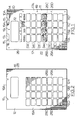
- Figure 1 is a front elevation of the carrier of the present invention.
- Figure 2 is a rear elevation of the carrier of Figure 1.
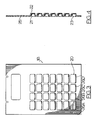
- Figure 3 is a rear side elevation of the insert.
- Figure 4 is a side view of the insert.
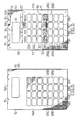
- Figure 5 is a view similar to Figure 1 illustrating the preferred embodiment.
- Figure 6 is a view similar to Figure 3 illustrating the preferred embodiment.
- reference character 10 shows a carrier having a front panel 11 formed of relatively rigid plastic and having a plurality of substantially rectangular apertures formed therethrough and in the present embodiment, it will be noted that there are four columns 11A, 11B, 11C and 11D of seven apertures each although of course it will be appreciated that more or less apertures may be provided if desired.
- a larger carrier may be provided to carry prepackaged medication for a greater number of days or a smaller carrier for a lesser number of days.
- a larger rectangular aperture 12 may be provided above the columns of apertures to carry information relative to the patient, doctor or the like and a plurality of recesses 13 may be formed along the upper edge 14 which, in conjunction with the rear panel, enables the carriers may hung on convenient hooks or the like as will hereinafter be described.
- the rear panel 12 of the carrier is similar to the front panel and is provided with a similar number of columns of rectangular apertures 12A, 12B, 12C and 12D having the same size and configuration as the front panel and this rear panel is hinged along one vertical edge 16 to a corresponding vertical edge 17 of the front panel, preferably, by means of a living hinge (shown in phantom at 28) so that the two panels can be folded open to receive an insert collectively designated 18 whereupon the panels may be folded closed and detachably secured by plastic snap fasteners or the like 19 along the other opposite edges 16A and 17A.
- the apertures 12A, 12B, 12C and 12D in the rear, panel 12 correspond to the apertures 11A, 11B, 11C and 11D in the front panel 11, and are in registration therewith when the two panels are in a closed position.
- the insert collectively designated 18 is made of transparent plastic and of a thinner material than the carrier and may be stamped out to provide a plurality of pockets 20 matching the apertures in columns 11A, 11B, 11C and 11D in the front panel into which the pockets engage when the insert is placed between the two panels of the carrier and the carrier is closed.
- the pockets may be of transparent plastic upon a substrate of cardboard or the like.
- pockets 20 when first formed in the plastic sheet 18 are open based as at 21 so that medication in the form of pills, capsules or the like 22 may be placed therein whereupon a thin sheet of foil or the like, indicated in phantom by reference character 23 in Figure 4, is adhesively or otherwise secured over the rear side 25 of the insert thus sealing medication within the individual pockets 20.
- the individual columns 26A, 26B, 26C and 26D contain pockets 20 of different sizes as do the panels 10 and 12 of the carrier (11A, 11B, 11C, 11D and 12A, 12B, 12C, 12D).
- the pockets in column 26A are the largest and may extend approximately 32 m/m in length and 17 m/m in height.
- the pockets in column 26B may be, for example, 25 m/m wide and 17 m/m high, the pockets in column 26C may be 27 m/m wide and 17 m/m high and the pockets in column 26D may be 30 m/m wide and 17 m/m high. These four different sizes are represented in Figures 1, 2 and 3.
- the apertures in the carrier panels 11 and 12 are of similar dimensions to the pockets in the insert and the spacing between the apertures (and pockets) is sufficient so that a standard overall dimension or sized carrier and insert may be utilized.
- the medication for each period and each day is placed in the various pockets 20 of the insert whereupon the foil sheet 23 is secured on the back of sheet to temporarily close the pockets.
- the insert is then engaged between the panels of the carrier with the pockets 20 protruding upwardly through the apertures within the front panel and being maintained in place by the snap engagement of the rear panel with the corresponding edges of the front panel.
- the relatively thin plastic forming the insert enables the relevant pocket to be pushed downwardly through the corresponding aperture in columns 11A, 11B, 11C or 11D of the front panel thus breaking the frangible foil cover of that particular pocket thereby ejecting the medication through the corresponding aperture in columns 12A, 12B, 12C or 12D in the rear panel and into a small container (not shown) for presentation to the patient.
- the various apertures in the columns may be marked by the day of the week vertically and by the times of medication horizontally so that a glance will show the, exact status of the dispensing of medication at any one time, the major advantage of the present invention being the different sizes of the pockets for different periods during the day at which medication should be given and the pictorial identification 27 for each time period.
- FIGS 5 and 6 are similar to Figures 1 and 3 but show the preferred embodiment.
- the four vertical columns 11A, 11B, 11C and 11D are shown having different areas.
- 11D is shown with the largest area, (E.G. 32 m/m ⁇ 17 m/m) 11A with the second largest area (E.G. 30 m/m ⁇ 17 m/m) and the intermediate apertures 11B and 11C are substantially similar in area and have the third largest area (E.G. 27 m/m ⁇ 17 m/m).
- Figure 3 shows the front view of the insert 18 but with the pockets 26A, 26B, 26C and 26D also varying in volume corresponding with the apertures 11A, 11B, 11C and 11D through which they extend when the insert in engaged between the front and rear panels as hereinbefore described.
- pocket 26D is the largest
- pocket 26A is the second largest
- pockets 26B and 26C are similar and are the third largest.
- the second vertical column from the left is indicated as "Noon" and shows the sun substantially in the center of the rectangle preferably upon a blue background.
- the third column from the left is marked either "Supper” or “Tea Time” depending upon the country in which the carriers are being used. This shows a setting sun on the right hand side of the rectangle and preferably with an orange background.
- the fourth and final column from the left is marked "Bed Time” and shows a crescent moon and a plurality of stars in white preferable upon a black background.
- the areas of the rectangles in which the pictorial indicia are shown, are substantially similar to the areas of the apertures in the columns above and below which the pictorial indicia is placed.
- each horizontal column of apertures and preferably on the left hand side of the front panel, there is provided further indicia preferably in the form of a rectangle with an arrowhead indicating the horizontal column and marked successively Sunday, Monday, Tuesday, Wednesday, Thursday, Friday and Saturday.
- both pictorial and written indicia indicate the capsule of pocket of medication which should be taken at each particular time period and it will be appreciated that depression of the flexible transparent material forming the pocket, through the relevant aperture in the front panel, breaks the membrane on the rear side of the insert thus ejecting the medication through the corresponding apertures in the rear panel into a cup or other receptacle.
- the different sizes of the pockets enables varying quantities and sizes of medication for the various time periods to be incorporated in a standard sized carrier.
- the upper edge 19A may be provided with slotted apertures 15 registering with the recesses 13 in the front panel thus enabling the carriers to be suspended from the carrier holders or the like.
Landscapes
- Health & Medical Sciences (AREA)
- Engineering & Computer Science (AREA)
- Medical Informatics (AREA)
- Life Sciences & Earth Sciences (AREA)
- Animal Behavior & Ethology (AREA)
- General Health & Medical Sciences (AREA)
- Public Health (AREA)
- Veterinary Medicine (AREA)
- Medical Preparation Storing Or Oral Administration Devices (AREA)
Claims (8)
- Medikamentierungs-Träger (10) mit einer im wesentlichen rechteckigen vorderen Tafel (11) und einer rechteckigen rückwärtigen Tafel (10a), die längs einer gemeinsamen Kante (16, 17) gelenkig miteinander verbunden sind zum lösbaren Öffnen und Schließen der Tafeln gegeneinander, die vordere Tafel hat eine Vielzahl von Öffnungen (11a, 11b, 11c, 11d) durch die Tafel hindurch,
in der rückwärtigen Tafel (10a) sind eine Vielzahl von durchgehenden Medikamentenausgabeöffnungen (12a, 12b, 12c, 12d) geformt, entsprechend den öffnungen in der vorderen Tafel, mit Mitteln (19) zum lösbaren Verbinden der beiden Tafeln miteinander, wobei die Öffnungen in der vorderen Tafel im wesentlichen ausgerichtet sind mit den Ausgabeöffnungen der rückwärtigen Tafel, dadurch gekennzeichnet, daß
diese Vielzahl von Öffnungen angeordnet sind in sieben horizontalen Reihen und vier vertikalen Spalten
und daß die vordere Tafel eine Informations-Display-Öffnung (12) hat
und erste Indizes für die Wochentage vertikal untereinander längs eines Randes der vorderen Tafel trägt,
die Indizes sind ausgerichtet mit den entsprechenden horizontalen Reihen von Öffnungen,
zweite Indizes zeigen die Tageszeit an, zu der ein Medikament bzw. Medikamente eingenommen werden sollten,
die besagten weiteren Indizes sind horizontal beabstandet gegenüber der obersten und untersten horizontalen Reihe von Öffnungen in der vorderen Tafel und ausgerichtet mit entsprechenden vertikalen Spalten von Öffnungen,
die Fläche jeder Öffnung (11a, 11d) in der äußersten vertikalen Spalten ist größer als die Fläche jeder Öffnung in den beiden mittleren Spalten, derart daß die Flächen variieren mit der durchschnittlichen Menge und Große der zu den entsprechenden Tageszeiten erforderlichen Medikamente. - Der Träger gemäß Anspruch 1, wobei die besagten zweiten Indizes je ein Piktogramm (27) der Tageszeit einschließen.
- Träger gemäß Anspruch 1 oder 2, in welchem die zweiten Indizes anzeigen eine Morgen-Zeitspanne, eine Mittags-Zeitspanne, eine Zubettgeh-Zeitspanne und eine Zeitspanne zwischen der Mittags-Zeit und Zubettgeh-Zeit, die besagten Öffnungen für die Morgen-Zeit haben die größte Fläche, die Öffnungen für die Zubettgeh-Zeit haben die zweitgrößte Fläche, die Öffnungen für die Mittags-Zeit haben die drittgrößte Fläche und die Öffnungen für die Zwischen-Zeit haben die viertgrößte Fläche.
- Träger nach Anspruch 1 oder 2, wobei die zweiten Indizes einschließen eine Morgen-Zeit, eine Mittags-Zeit, eine Bett-Zeit und eine Zwischen-Zeit zwischen der Mittags-Zeit und der Zubett-Zeit, die Öffnungen für die Bett-Zeit haben die größte Fläche, die Öffnungen für die Morgen-Zeit haben die zweitgrößte Fläche und die Öffnungen für die anderen beiden Zeitspannen haben eine im wesentlichen einander gleiche Fläche und haben die drittgrößte Fläche.
- Träger nach einem der vorhergehenden Ansprüche, mit einem Einsatz (18) für den Träger, der Einsatz ist im wesentlichen rechteckig und hat eine Vielzahl von Reihen von offenen Taschen geformt darin, angeordnet in sieben horizontalen Reihen und vier vertikalen Spalten (26a, 26b, 26c, 26d), das Volumen jeder Tasche (26a, 26d) in den beiden äußersten vertikalen Spalten von Taschen ist größer als das Volumen jeder Tasche (26b, 26d) in den beiden mittleren Spalten, so daß das Volumen sich ändert mit der durchschnittlichen Menge und Größe von zu entsprechenden Tageszeiten erforderlichen Medikamenten,
der besagte Einsatz ist vorgesehen zwischen der vorderen und der rückwärtigen Tafel (11, 12) des Trägers, wobei sich die Taschen durch die entsprechenden Öffnungen (11a, 11b, 11c, 11d) in der vorderen Tafel (11) hindurch erstrecken und brechbare Mittel (23) lösbar die offene Basis (21) jeder Tasche abdichten zur selektiven Aufnahme von Medikamenten bzw. Medikamentierung darin, Depression (Druck) auf die Taschen durch die Öffnungen der vorderen Tafel bricht die brechbaren Mittel, welche die offenen Basen der besagten Taschen lösbar sichern, wobei die in dem besagten Taschen enthaltenen Medikamente durch die Ausgabeöffnungen (12a, 12b, 12c, 12d) der rückwärtigen Tafel hindurch ausgegeben werden. - Die Erfindung gemäß Anspruch 5, wobei die zweiten Indizes anzeigen eine Morgen-Zeit, eine Mittags-Zeit, eine Bett-Zeit und eine Zwischen-Zeit zwischen Mittags-Zeit und Bett-Zeit, die besagten Taschen (20) für die Morgen-Zeit haben das größte Volumen, die Taschen für die Bett-Zeit haben das zweitgrößte Volumen, die Taschen für die Mittags-Zeit haben das drittgrößte Volumen und die Taschen für die Zwischenzeit haben das viertgrößte Volumen.
- Die Erfindung nach Anspruch 5, wobei die zweiten Indizes anzeigen eine Morgen-Zeit, eine Mittags-Zeit, eine Bett-Zeit und eine Zeit zwischen der besagten Morgen-Zeit und der Bett-Zeit, die Taschen (20) für die Bett-Zeit haben das größte Volumen, die Taschen für die Morgen-Zeit haben das zweitgrößte Volumen, die Taschen für die anderen beiden Zeiten sind im wesentlichen ähnlich oder gleich im Volumen und haben das kleinste Volumen.
- Medikamentierungsausgabe-Einsatz (18) zur Verwendung mit einem mit Öffnungen versehenen Träger (10) gemäß Anspruch 1, der besagte Einsatz umfaßt einen im wesentlichen rechteckigen, ebenen Boden und hat in sieben horizontalen Reihen achtundzwanzig Taschen (20) mit offener Basis darin gebildet vier vertikale (26a, 26b, 26c, 26d) Reihen und Brech-Mittel (23) lösbar abdichtend die offenen Basen (21) der Taschen zum wahlweisen Einschließen von Medikamentationen darin, durch Druck auf je eine Tasche brechen die Sollbruchstellen der öffenbaren Basis je einer Tasche und geben dabei die in der Tasche enthaltenen Medikamente aus, das Volumen jeder Tasche in den äußersten vertikalen Spalten des Einsatzes ist größer als das Volumen in jeder Tasche in den zwei mittleren Spalten, so daß das Taschenvolumen sich ändert mit der durchschnittlichen Menge an zu verschiedenen Zeiten des Tages erforderlichen Medikamenten.
Applications Claiming Priority (2)
| Application Number | Priority Date | Filing Date | Title |
|---|---|---|---|
| GB8624188 | 1986-10-08 | ||
| GB868624188A GB8624188D0 (en) | 1986-10-08 | 1986-10-08 | Medication carrier & insert |
Publications (3)
| Publication Number | Publication Date |
|---|---|
| EP0263695A2 EP0263695A2 (de) | 1988-04-13 |
| EP0263695A3 EP0263695A3 (en) | 1989-02-15 |
| EP0263695B1 true EP0263695B1 (de) | 1992-12-30 |
Family
ID=10605456
Family Applications (1)
| Application Number | Title | Priority Date | Filing Date |
|---|---|---|---|
| EP19870308886 Expired EP0263695B1 (de) | 1986-10-08 | 1987-10-07 | Medikationstablett und zugehöriger Einsatz |
Country Status (4)
| Country | Link |
|---|---|
| EP (1) | EP0263695B1 (de) |
| AU (1) | AU7942487A (de) |
| CA (1) | CA1310936C (de) |
| GB (1) | GB8624188D0 (de) |
Families Citing this family (8)
| Publication number | Priority date | Publication date | Assignee | Title |
|---|---|---|---|---|
| GB8905017D0 (en) * | 1989-03-04 | 1989-04-19 | Gordon Alan J | Packaging medicines |
| GB2266880A (en) * | 1992-05-16 | 1993-11-17 | Neal Charles Bryant | Blister package |
| JP2662206B2 (ja) * | 1995-07-20 | 1997-10-08 | 日本イーライリリー株式会社 | 錠剤用容器 |
| CA2194134A1 (en) | 1996-12-30 | 1998-05-16 | Jean Provost | Medicine dispensing device |
| GB0315172D0 (en) * | 2003-06-28 | 2003-08-06 | Aslett Donald | Dispensing pack |
| US7481331B2 (en) | 2005-09-09 | 2009-01-27 | Manrex Limited | Dispensing container for a blister pack of medications |
| KR101062304B1 (ko) | 2009-09-10 | 2011-09-05 | 박상덕 | 블리스터용 호일과 그 제조장치 및 그 제조방법 |
| AU2016201131B2 (en) | 2015-03-30 | 2020-04-02 | Manrex Limited | Dispensing container for blister pack of medication |
Family Cites Families (4)
| Publication number | Priority date | Publication date | Assignee | Title |
|---|---|---|---|---|
| FR1558465A (de) * | 1967-12-20 | 1969-02-28 | ||
| DE2905739A1 (de) * | 1979-02-15 | 1980-08-28 | Helmut Zanker | Variable verpackungseinheit fuer arzneimittel |
| US4534468A (en) * | 1983-12-19 | 1985-08-13 | Nuckols Walter S | Calendar-oriented pill dispenser |
| US4664262A (en) * | 1985-11-26 | 1987-05-12 | White Pamela J | Pill dispensing system |
-
1986
- 1986-10-08 GB GB868624188A patent/GB8624188D0/en active Pending
-
1987
- 1987-10-01 CA CA000548378A patent/CA1310936C/en not_active Expired - Lifetime
- 1987-10-07 AU AU79424/87A patent/AU7942487A/en not_active Abandoned
- 1987-10-07 EP EP19870308886 patent/EP0263695B1/de not_active Expired
Also Published As
| Publication number | Publication date |
|---|---|
| GB8624188D0 (en) | 1986-11-12 |
| CA1310936C (en) | 1992-12-01 |
| AU7942487A (en) | 1988-04-14 |
| EP0263695A3 (en) | 1989-02-15 |
| EP0263695A2 (de) | 1988-04-13 |
Similar Documents
| Publication | Publication Date | Title |
|---|---|---|
| US6041932A (en) | Vitamin organizing, storing and dispensing system | |
| US4905388A (en) | Organizer and reminder device for pills, medicines and the like | |
| EP0454705B1 (de) | Abgabebehälter für pillen, tabletten und kapseln | |
| US3381808A (en) | Dispensing package | |
| US4693371A (en) | Medication dispenser and container | |
| US5489025A (en) | Unit-dose medication dispenser and multiple-dispenser frame therefor | |
| US4211329A (en) | Extender and header card for medicinal dispensing device | |
| US4058916A (en) | Object retaining and display calendar | |
| US6681935B1 (en) | Method of providing a therapeutic regimen and prefabricated container therefor | |
| US4573580A (en) | Unit dose medication dispenser | |
| US4171584A (en) | Sign assembly | |
| US4889237A (en) | Pill container calendar | |
| US3931885A (en) | Medicine dispensing system | |
| US3099352A (en) | Calendar reminder and dispensing device | |
| US4420083A (en) | Pill bottles | |
| US20140251863A1 (en) | Push button pill container with register and methods | |
| US20140251862A1 (en) | Pill containers with registers and methods | |
| US20220008290A1 (en) | Medicine container, method of assembling the container, and method of dispensing the medicine from the container | |
| EP0263695B1 (de) | Medikationstablett und zugehöriger Einsatz | |
| US20040251165A1 (en) | Medication organizer system | |
| WO2005023672A1 (en) | Dispensing apparatus | |
| EP0541643B1 (de) | Tablettenpackung | |
| US4288065A (en) | Extender and header card for medicinal dispensing device and fixture base converter for filling the same | |
| GB2389355A (en) | Dispensing pack having compartments | |
| JP7322316B1 (ja) | 収納容器 |
Legal Events
| Date | Code | Title | Description |
|---|---|---|---|
| PUAI | Public reference made under article 153(3) epc to a published international application that has entered the european phase |
Free format text: ORIGINAL CODE: 0009012 |
|
| AK | Designated contracting states |
Kind code of ref document: A2 Designated state(s): BE GB LU NL |
|
| TCNL | Nl: translation of patent claims filed | ||
| PUAL | Search report despatched |
Free format text: ORIGINAL CODE: 0009013 |
|
| AK | Designated contracting states |
Kind code of ref document: A3 Designated state(s): BE GB LU NL |
|
| 17P | Request for examination filed |
Effective date: 19890811 |
|
| 17Q | First examination report despatched |
Effective date: 19910123 |
|
| GRAA | (expected) grant |
Free format text: ORIGINAL CODE: 0009210 |
|
| AK | Designated contracting states |
Kind code of ref document: B1 Designated state(s): BE GB LU NL |
|
| PG25 | Lapsed in a contracting state [announced via postgrant information from national office to epo] |
Ref country code: BE Effective date: 19921230 |
|
| PG25 | Lapsed in a contracting state [announced via postgrant information from national office to epo] |
Ref country code: LU Free format text: LAPSE BECAUSE OF NON-PAYMENT OF DUE FEES Effective date: 19931031 |
|
| PLBE | No opposition filed within time limit |
Free format text: ORIGINAL CODE: 0009261 |
|
| STAA | Information on the status of an ep patent application or granted ep patent |
Free format text: STATUS: NO OPPOSITION FILED WITHIN TIME LIMIT |
|
| 26N | No opposition filed | ||
| REG | Reference to a national code |
Ref country code: GB Ref legal event code: IF02 |
|
| PGFP | Annual fee paid to national office [announced via postgrant information from national office to epo] |
Ref country code: NL Payment date: 20061017 Year of fee payment: 20 |
|
| PGFP | Annual fee paid to national office [announced via postgrant information from national office to epo] |
Ref country code: GB Payment date: 20061025 Year of fee payment: 20 |
|
| REG | Reference to a national code |
Ref country code: GB Ref legal event code: PE20 |
|
| NLV7 | Nl: ceased due to reaching the maximum lifetime of a patent |
Effective date: 20071007 |
|
| PG25 | Lapsed in a contracting state [announced via postgrant information from national office to epo] |
Ref country code: NL Free format text: LAPSE BECAUSE OF EXPIRATION OF PROTECTION Effective date: 20071007 |
|
| PG25 | Lapsed in a contracting state [announced via postgrant information from national office to epo] |
Ref country code: GB Free format text: LAPSE BECAUSE OF EXPIRATION OF PROTECTION Effective date: 20071006 |