EP0264028A2 - Echangeur de chaleur à courants de circulation perpendiculaires - Google Patents
Echangeur de chaleur à courants de circulation perpendiculaires Download PDFInfo
- Publication number
- EP0264028A2 EP0264028A2 EP87114313A EP87114313A EP0264028A2 EP 0264028 A2 EP0264028 A2 EP 0264028A2 EP 87114313 A EP87114313 A EP 87114313A EP 87114313 A EP87114313 A EP 87114313A EP 0264028 A2 EP0264028 A2 EP 0264028A2
- Authority
- EP
- European Patent Office
- Prior art keywords
- heat exchanger
- hollow
- exchanger according
- blood
- threads
- Prior art date
- Legal status (The legal status is an assumption and is not a legal conclusion. Google has not performed a legal analysis and makes no representation as to the accuracy of the status listed.)
- Withdrawn
Links
Images


Classifications
-
- A—HUMAN NECESSITIES
- A61—MEDICAL OR VETERINARY SCIENCE; HYGIENE
- A61M—DEVICES FOR INTRODUCING MEDIA INTO, OR ONTO, THE BODY; DEVICES FOR TRANSDUCING BODY MEDIA OR FOR TAKING MEDIA FROM THE BODY; DEVICES FOR PRODUCING OR ENDING SLEEP OR STUPOR
- A61M5/00—Devices for bringing media into the body in a subcutaneous, intra-vascular or intramuscular way; Accessories therefor, e.g. filling or cleaning devices, arm rests
- A61M5/44—Devices for bringing media into the body in a subcutaneous, intra-vascular or intramuscular way; Accessories therefor, e.g. filling or cleaning devices, arm rests having means for cooling or heating the devices or media
-
- F—MECHANICAL ENGINEERING; LIGHTING; HEATING; WEAPONS; BLASTING
- F28—HEAT EXCHANGE IN GENERAL
- F28D—HEAT-EXCHANGE APPARATUS, NOT PROVIDED FOR IN ANOTHER SUBCLASS, IN WHICH THE HEAT-EXCHANGE MEDIA DO NOT COME INTO DIRECT CONTACT
- F28D7/00—Heat-exchange apparatus having stationary tubular conduit assemblies for both heat-exchange media, the media being in contact with different sides of a conduit wall
- F28D7/0041—Heat-exchange apparatus having stationary tubular conduit assemblies for both heat-exchange media, the media being in contact with different sides of a conduit wall the conduits for only one medium being tubes having parts touching each other or tubes assembled in panel form
-
- F—MECHANICAL ENGINEERING; LIGHTING; HEATING; WEAPONS; BLASTING
- F28—HEAT EXCHANGE IN GENERAL
- F28F—DETAILS OF HEAT-EXCHANGE AND HEAT-TRANSFER APPARATUS, OF GENERAL APPLICATION
- F28F21/00—Constructions of heat-exchange apparatus characterised by the selection of particular materials
- F28F21/06—Constructions of heat-exchange apparatus characterised by the selection of particular materials of plastics material
- F28F21/062—Constructions of heat-exchange apparatus characterised by the selection of particular materials of plastics material the heat-exchange apparatus employing tubular conduits
-
- F—MECHANICAL ENGINEERING; LIGHTING; HEATING; WEAPONS; BLASTING
- F28—HEAT EXCHANGE IN GENERAL
- F28F—DETAILS OF HEAT-EXCHANGE AND HEAT-TRANSFER APPARATUS, OF GENERAL APPLICATION
- F28F21/00—Constructions of heat-exchange apparatus characterised by the selection of particular materials
- F28F21/06—Constructions of heat-exchange apparatus characterised by the selection of particular materials of plastics material
- F28F21/067—Details
-
- A—HUMAN NECESSITIES
- A61—MEDICAL OR VETERINARY SCIENCE; HYGIENE
- A61M—DEVICES FOR INTRODUCING MEDIA INTO, OR ONTO, THE BODY; DEVICES FOR TRANSDUCING BODY MEDIA OR FOR TAKING MEDIA FROM THE BODY; DEVICES FOR PRODUCING OR ENDING SLEEP OR STUPOR
- A61M2205/00—General characteristics of the apparatus
- A61M2205/36—General characteristics of the apparatus related to heating or cooling
- A61M2205/366—General characteristics of the apparatus related to heating or cooling by liquid heat exchangers
Definitions
- the invention relates to a cross-flow heat exchanger for transferring heat from one fluid substance to another fluid substance through the wall of substantially straight and essentially parallel to each other continuously open hollow filaments, in which the end regions of the hollow filaments are each cast in a casting compound block ,
- the two sealing compound blocks are connected in a fluid-tight manner to a housing jacket surrounding the hollow threads, the housing jacket has a connecting piece for supplying and a connecting piece for discharging the fluid substance flowing around the hollow threads, and the two connecting pieces are arranged in a plane running perpendicular to the longitudinal axis of the heat exchanger.
- Such a cross-flow heat exchanger is known from DE-OS 31 29 064.
- fluid substance is understood to mean a liquid, a liquid mixture, a vapor, a steam mixture, a gas, a gas mixture or a mixture of these substances; this includes, for example, solutions and liquids with living organisms, such as blood, fermenting drinks, etc.
- the object is achieved to provide a cross-flow heat exchanger with improved usage properties compared to this, in particular in the medical field.
- the invention consists in a cross-flow heat exchanger of the type described in the introduction, in which the two connecting pieces for the fluid material flowing around the hollow filaments are arranged in such a way that their longitudinal axes form an angle with one another deviating from 180 °.
- This arrangement has the effect, in a particularly advantageous manner, of lengthening the flow path and thus the dwell time of the fluid substance flowing around the hollow filaments in the heat exchanger, and consequently increasing the heat energy which can be transmitted through the hollow filaments.
- This effect can be further enhanced by a partition wall arranged between the inflow area and the outflow area for the fluid substance flowing around the hollow filaments, which helps avoid a short circuit between the two named areas.
- the increase in heat transfer per hollow fiber which can be achieved in this way leads to a saving in hollow fiber material.
- the arrangement of the two connecting pieces is preferably such that their longitudinal axes are essentially parallel to one another run. This makes it easier to connect a supply line and a discharge line, for example by attaching hoses to the connecting pieces. In the case of transparent lines, this makes it easier to control the fluid flow. This can also result in advantages for packaging and transport, since the space requirement of this embodiment of the heat exchanger according to the invention is generally smaller.
- the length of the free, i.e. of the non-poured section of the hollow filaments not to be dimensioned too large and dimensioned in a ratio not exceeding a certain dimension to the hydraulic diameter of the connecting piece.
- the length of the free section of the hollow filaments that is to say one of the two fluid substances, around which the hollow filaments flow, in relation to the cross section of the hollow filament bundle, that is to say the cross section of the housing jacket, should not exceed a certain dimension. It has proven to be particularly advantageous if the length of the section of the hollow filaments which is not cast in is not greater than the hydraulic diameter of the cross section of the housing jacket.
- the hydraulic diameter of the connecting piece in turn should preferably be at least 1/4 of the length of the free section of the hollow fibers.
- A cross-sectional area
- U circumference of the Flow channel
- the length of the free section of the hollow filaments is only 10 to 40 mm. It follows from this that the heat exchanger according to the invention is preferably disc-shaped, the number of hollow filaments being 10,000 or 20,000 or more.
- An advantage of the relatively short length of the hollow filaments of the heat exchanger according to the invention is that the pressure loss in the hollow filaments is relatively small. This means that blood can be conveyed through the hollow threads of the heat exchanger according to the invention in a very gentle manner using only a low pressure. Nevertheless, it is possible, if desired, to use blood as the fluid substance flowing around the hollow threads.
- the heat exchanger according to the invention is preferably equipped with biocompatible hollow fibers, for example those made of polycarbonate, PVDF or polysulfone.
- the wall thickness of the hollow threads is preferably 5 to 20% of their inside diameter and is advantageously in the range from 10 ⁇ m to 120 ⁇ m.
- the inside diameter of the hollow filaments of the heat exchanger according to the invention is therefore preferably in the range from 200 to 600 ⁇ m.
- the hollow filaments of the heat exchanger according to the invention are preferably impermeable at least to the fluid substances participating in the heat transfer.
- a hollow fiber mat is preferably used to manufacture the hollow fiber bundle.
- This is a hollow thread arrangement in woven form, in which hollow threads arranged parallel to one another and preferably at equal distances from one another are held in the arrangement described above, for example by adhesive strips running transversely to their longitudinal axes or by (textile) threads introduced by means of a weaving or knitting method . Methods for producing such hollow fiber mats and these themselves are known.
- a hollow fiber bundle is obtained consisting of essentially straight and parallel hollow fibers, in which the hollow fibers are held at defined distances from one another, the mutual distance in the circumferential direction being different from that in the radial direction. It has proven to be advantageous to dimension the lateral distance in the circumferential direction so that it is larger is than the outside diameter of the hollow filaments.
- the distance between the above-mentioned adhesive strips or (textile) threads holding the hollow threads at a distance is preferably such that the holding means mentioned are either no longer contained in the finished cast hollow fiber bundle or are located in the potting compound blocks, so that the free flow through them of the hollow fiber bundle is not hindered by it.
- the housing casing is preferably produced by injection molding.
- the connecting pieces can have a cross section that increases towards the housing jacket, that is to say they can be designed like a diffuser.
- the dimensions of the connecting piece can correspond approximately to the length of the non-cast section of the hollow filaments and half the width or half the diameter of the hollow filament bundle.
- a cylindrical core can be arranged at least in the region of the free sections of the hollow filaments.
- the hollow thread mat can be wrapped around this core.
- a cap is preferably arranged at both ends of the heat exchanger according to the invention, which cap is the distribution space or the collecting space for the aforementioned fluid material forms.
- the end regions of the housing shell preferably have a smaller circumference than the regions directly adjoining them. This can make it easier to put on the caps.
- the caps are preferably also formed as injection molded parts.
- the heat exchanger according to the invention is preferably provided with at least one such cap.
- the caps which are suitable for this can have a connecting piece which opens tangentially or which is arranged in the region of the longitudinal axis of the cap and thus also of the heat exchanger and opens in the longitudinal direction.
- the heat exchanger according to the invention can also be used as a basic unit of a system which can be built up or built up according to the modular principle. This means that several heat exchangers according to the invention can be assembled into a larger unit by series connection or one or more heat exchangers according to the invention - in particular in the medical field - can form a system with other devices.
- the assembly of several heat exchangers according to the invention or one or more Heat exchanger according to the invention with one or more other devices in any order, including alternating order, is most conveniently done in such a way that the parts mentioned are strung together on the front side, leaving out the otherwise usual caps, in such a way that a space forming a chamber between the hollow fiber ends of adjacent units or devices is left and the housing shells are connected to each other with a fluid-tight effect to the outside, for example by a sleeve-like ring covering the ends of the housing shell.
- Such a connection can also be used as a screw connection, snap lock or the like. be trained.
- the flow cross sections of adjacent units or devices are preferably of the same size, in particular if the fluid substance flowing through the hollow threads is blood or another body fluid or fluid to be treated gently.
- the heat exchanger according to the invention has proven particularly useful in combination with a blood oxygenator, in which the oxygen transfer into the blood and the removal of carbon dioxide from the blood take place through the wall of continuously open hollow threads, the end regions of which are cast in a casting compound block, each with a housing jacket surrounding the hollow threads are connected in a fluid-tight manner, in which the housing jacket has at least one opening for the supply or removal of oxygen or blood, in the case of which, in the region of its longitudinal axis, a distributor body which extends over the entire length of the hollow fibers for the uniform over the entire free length of the hollow fibers Supply or discharge of oxygen or blood arranged is, in which the hollow threads are microporous and have continuous pores open to the outside, in which the hollow threads are arranged uniformly distributed over the entire cross section of the sealing compound blocks into the edge region extending towards the housing shell, and in which between the non-cast-in region of the outer hollow threads and the housing casing has at least one free space with an annular cross section, into which the at
- the heat exchanger according to the invention is connected in series with such a blood oxygenator, it can be advantageous to use a cap with a tangentially opening connecting piece for supplying the blood flowing through the hollow threads and a cap designed like a diffuser for the removal of the blood which has escaped from the hollow threads.
- the blood flow cross sections of the two parts connected in series are of the same size and there are no constrictions or extensions of the blood-carrying parts between the parts mentioned.
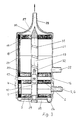
- the cross-flow heat exchanger according to the invention shown in FIGS. 1 and 2 has the following parts: A multiplicity (a bundle) of continuously open hollow fibers 1 arranged essentially parallel to one another, the end regions of which are cast in a casting compound block 2 or 3, the casting compound blocks 2 and 3, which are connected in a fluid-tight manner to the housing jacket 4 surrounding the hollow threads 1, and the two Connection pieces 5 and 6, one of which is provided for the supply and one for the discharge of the fluid substance flowing around the hollow threads 1, the two connection pieces 5 and 6 being arranged in a plane running perpendicular to the longitudinal axis 7 of the heat exchanger, in such a way that that the longitudinal axes 8 and 9 of the connecting pieces 5 and 6 run essentially parallel to each other.
- the cylindrical core 10 is arranged, the length of which corresponds to the total length of the hollow filaments 1 and not only to the length of the free, not cast-in sections of the hollow filaments 1.
- the end regions 11 and 12 of the housing shell 4 have a smaller circumference than the regions 13 and 14 immediately adjoining them.
- the hollow threads 1 are uniformly distributed over the entire cross section of the sealing compound blocks 2 and 3 as far as into the edge region extending towards the housing shell 4 arranged.
- the housing shell 4 is designed so that it can be manufactured together with the connecting piece 5 and 6 as a complete part in an injection molding process. As can be seen from FIG.
- the arrangement of the connecting pieces 5 and 6 shown there causes a considerable lengthening of the flow path and thus of the residence time of the fluid substance flowing around the hollow threads 1 in the heat exchanger.
- a short circuit between the two areas mentioned is avoided by the partition wall 15 arranged between the inflow area and the outflow area for the fluid substance flowing around the hollow filaments 1, and the previously described effect is thus further enhanced.
- FIGS. 1 and 2 also clearly show, in this embodiment the length of the free, not cast-in section of each hollow thread 1 is smaller than the diameter the hollow fiber bundle 1 and thus also the housing shell 4, so that the heat exchanger is disc-shaped.
- FIG. 3 shows the heat exchanger according to FIGS. 1 and 2 together with a blood oxygenator with which it is coupled together via the sleeve-like connecting ring 16 and is therefore connected in series on the blood side.
- the heat exchanger in Fig. 3 is rotated by 90 °, so that only one of the two connecting pieces 5 and 6 can be seen.
- An intermediate space forming the chamber 17 is left between the hollow thread ends of the heat exchanger and those of the oxygenator.
- the blood flow cross-section of the heat exchanger and that of the oxygenator are dimensioned the same size, and the chamber 17 is designed such that there are no constrictions or widenings of the blood-carrying channel formed by the chamber 17.
- the blood oxygenator consists of the continuously open hollow fibers 18 which cause the oxygen transfer into the blood and the removal of carbon dioxide from the blood through their wall, the end regions of which are cast in a casting compound block 19 or 20, and the housing jacket 21 with which the casting compound blocks 19 and 20 are fluid-tight are connected; the housing jacket 21 has the connecting piece 22 for the supply or discharge of the oxygen;
- the blood oxygenator has the distributor body 23, which extends over the entire length of its hollow threads 18, for the removal or supply of oxygen evenly over the entire free length of the hollow threads 18. The oxygen is then removed or supplied via the spiral-shaped channel 31 arranged on the outside of the distributor body 23, which opens into the channel 32, which is guided to the outside.
- the hollow threads 18 are microporous and have continuous pores open to the outside.
- the hollow threads 18 are also uniformly distributed over the entire cross section of the potting compound blocks 19 and 20 up to the edge region extending towards the housing shell 21, the housing shell 21 being designed such that the free space 24 between the outer hollow threads 18 and the housing shell 21 is formed with an annular cross section, in which the connecting piece 22 opens.
- the cap 25 is arranged with the connecting piece 26 opening in the area of the outer periphery of the hollow thread bundle 1 of the heat exchanger.
- the diffuser-like cap 27 is arranged with the connecting piece 28 opening in the longitudinal direction in the region of its longitudinal axis in order to discharge the blood which has emerged from the hollow threads 18 of the oxygenator.
- the cap 25 forms the distribution space 29 for the blood flowing through the hollow threads 1, while the cap 27 forms the collecting space 30 for the blood emerging from the hollow threads 18.
- the chamber 17 acts both as a collecting space for the blood emerging from the hollow threads 1 and as a distribution space for the blood entering the hollow threads 18.
- the arrangement and configuration of the heat exchanger and blood oxygenator shown in FIG. 3 can be placed in a particularly advantageous manner, as shown, with the flat cap 25 facing down on any substantially horizontal, flat surface, since there are no devices for fastening or hanging the device requirement.
- the hollow fibers 1 and 18 are filled from bottom to top and thus a uniform displacement of the gas contained in the distributor space 29, the hollow threads 1, the chamber 17, the hollow threads 18 and the collecting space 30, the so-called venting takes place.
- FIG. 4 shows the heat exchanger according to FIGS. 1 and 2, the heat exchanger in this embodiment being provided with a cap 25 and a cap 27, as shown in FIG. 3 and described in detail above.
- the other parts result from their position numbers from the description of FIGS. 1 to 3.
- the same caps can be used instead of different ones, that is to say, for example, either two caps corresponding to the cap 25 or two caps corresponding to the cap 27.
- at least one cap can also be used for the connecting piece for the fluid flowing through the hollow threads tangentially opens into the distributor or collecting space in the region of the longitudinal axis of the heat exchanger or of the blood oxygenator.
- FIG. 5 shows an embodiment of the heat exchanger with connecting pieces 5 and 6 widening towards the housing jacket 4.
- this corresponds to a diffuser-like configuration.
- the height of the connecting pieces 5 and 6 can be dimensioned correspondingly to the length of the free, not cast-in section of the hollow filaments be so that there is a rectangular flow cross-section, which causes an extremely uniform distribution of the fluid flowing around the hollow fibers over all hollow fibers.
- a heat exchanger that has proven itself in series connection with a blood oxygenator (similar to FIG. 3) has the following features: Number of hollow threads: 15 680 Length of the hollow threads: 40 mm Free, not cast length of the hollow threads: 28 mm Inner diameter of the hollow threads: 380 ⁇ m Wall thickness of the hollow filaments: 50 ⁇ m Diameter of the bundle of hollow fibers: 93.5 mm Inner diameter of the casing: 93.5 mm Core diameter: 18 mm Inner diameter of the connecting piece: 9.6 mm Degree of filling of the hollow fiber bundle: 42.9%
Landscapes
- Engineering & Computer Science (AREA)
- Physics & Mathematics (AREA)
- General Engineering & Computer Science (AREA)
- Mechanical Engineering (AREA)
- Health & Medical Sciences (AREA)
- Thermal Sciences (AREA)
- Biomedical Technology (AREA)
- Life Sciences & Earth Sciences (AREA)
- Animal Behavior & Ethology (AREA)
- General Health & Medical Sciences (AREA)
- Public Health (AREA)
- Veterinary Medicine (AREA)
- Hematology (AREA)
- Heart & Thoracic Surgery (AREA)
- Anesthesiology (AREA)
- Vascular Medicine (AREA)
- External Artificial Organs (AREA)
- Infusion, Injection, And Reservoir Apparatuses (AREA)
Applications Claiming Priority (2)
| Application Number | Priority Date | Filing Date | Title |
|---|---|---|---|
| DE3634845 | 1986-10-13 | ||
| DE19863634845 DE3634845A1 (de) | 1986-10-13 | 1986-10-13 | Kreuzstrom-waermeaustauscher |
Publications (2)
| Publication Number | Publication Date |
|---|---|
| EP0264028A2 true EP0264028A2 (fr) | 1988-04-20 |
| EP0264028A3 EP0264028A3 (fr) | 1989-05-24 |
Family
ID=6311634
Family Applications (1)
| Application Number | Title | Priority Date | Filing Date |
|---|---|---|---|
| EP87114313A Withdrawn EP0264028A3 (fr) | 1986-10-13 | 1987-10-01 | Echangeur de chaleur à courants de circulation perpendiculaires |
Country Status (3)
| Country | Link |
|---|---|
| EP (1) | EP0264028A3 (fr) |
| JP (1) | JPS63102765A (fr) |
| DE (1) | DE3634845A1 (fr) |
Family Cites Families (9)
| Publication number | Priority date | Publication date | Assignee | Title |
|---|---|---|---|---|
| SE308773B (fr) * | 1965-10-14 | 1969-02-24 | Axel Kistner Ab | |
| DE2111387A1 (de) * | 1971-03-03 | 1972-09-07 | Karl Fischer App U Rohrleitung | Rohrbuendel-Waermeaustauscher |
| BE793747A (fr) * | 1972-01-08 | 1973-05-02 | Luder Friedrich K | Element de construction de paroi et paroi transportable construite a l'aide de tels elements |
| BE793624A (fr) * | 1972-01-10 | 1973-05-02 | Baxter Laboratories Inc | Dispositif pour le transfert de masses, presentant une membrane de diffision tubulaire enroulee |
| DE2646358C2 (de) * | 1976-10-14 | 1982-05-13 | Dr. Eduard Fresenius, Chemisch-pharmazeutische Industrie KG Apparatebau KG, 6380 Bad Homburg | Hohlfaserdialysator |
| DE2850008A1 (de) * | 1978-11-17 | 1980-05-29 | Biprokwas | Waermeaustauscher |
| DE3129064A1 (de) * | 1981-07-23 | 1983-02-10 | Akzo Gmbh, 5600 Wuppertal | Verfahren und vorrichtung zur blutoxygenation |
| JPS6057872B2 (ja) * | 1981-11-18 | 1985-12-17 | テルモ株式会社 | 熱交換器内蔵中空糸型人工肺 |
| CA1259870A (fr) * | 1984-10-01 | 1989-09-26 | Eiichi Hamada | Echangeur thermique avec dispositif d'oxygenation du sang |
-
1986
- 1986-10-13 DE DE19863634845 patent/DE3634845A1/de not_active Withdrawn
-
1987
- 1987-10-01 EP EP87114313A patent/EP0264028A3/fr not_active Withdrawn
- 1987-10-13 JP JP62256442A patent/JPS63102765A/ja active Pending
Also Published As
| Publication number | Publication date |
|---|---|
| DE3634845A1 (de) | 1988-04-21 |
| EP0264028A3 (fr) | 1989-05-24 |
| JPS63102765A (ja) | 1988-05-07 |
Similar Documents
| Publication | Publication Date | Title |
|---|---|---|
| DE69522780T2 (de) | Blutoxygenator | |
| DE69232436T2 (de) | Gewebekartuschen mit spiralförmig gewickelten Hohlfasermembranen und Module mit strömungsableitenden Einbauten | |
| DE69314934T2 (de) | Tropfenkammer und/oder Expansionskammer mit integriertem Filter und Herstellungsverfahren von einer solchen | |
| EP0892670B1 (fr) | Dispositif de filtrage et de separation de fluides en mouvement | |
| EP0285812B1 (fr) | Ensemble à couches multiples à fibres creuses | |
| DE2634451A1 (de) | Stuetzsieb fuer stoffaustauschvorrichtungen | |
| DE2542438C3 (de) | Dialysator | |
| DE2746542C2 (de) | Hohlfasermodul | |
| EP0264696A2 (fr) | Appareil échangeur de masse | |
| DE3641467A1 (de) | Oxygenator mit verbessertem waermeaustausch | |
| EP1218040A1 (fr) | Module a membranes pour hemodiafiltration avec predilution ou postdilution integree du sang | |
| DD231289A5 (de) | Blutoxygenerator unter verwendung einer hohlfasermembran | |
| DE3686337T2 (de) | Massenuebertragungsvorrichtung mit einer spiralfoermigen gewickelten mikroporoesen hohlfasermembran. | |
| DE2757838A1 (de) | Vorrichtung mit hohlfasern zur fraktionierung von fluiden | |
| DE2846582C2 (de) | Vorrichtung zur Membranfiltration | |
| EP3090768A1 (fr) | Dispositif doté de section d'admission destiné au traitement d'un liquide biologique | |
| EP3436183B1 (fr) | Dispositif d'échange de substance et procédé de fabrication | |
| DE3781153T2 (de) | Vorrichtung zum austausch von ionen, molekuelen, gas, fluessigkeiten und/oder waerme zwischen fluiden. | |
| DE2733280A1 (de) | Dialysegeraet und -verfahren | |
| DE69401085T2 (de) | Blutoxygenator mit Hohlfasern | |
| EP1595558A1 (fr) | Oxygénateur intraveineux | |
| DE2529977C3 (de) | Vorrichtung mit Membranen auf rohrförmigen Abstützungen zum Behandeln von Fluiden | |
| DE2839937A1 (de) | Hohlfaserdialysator mit dialysatfuehrung | |
| DE69712319T2 (de) | Ausbildung eines kernes für blut-oxygenatoren | |
| DE3733542A1 (de) | Vorrichtung zum stoffaustausch |
Legal Events
| Date | Code | Title | Description |
|---|---|---|---|
| PUAI | Public reference made under article 153(3) epc to a published international application that has entered the european phase |
Free format text: ORIGINAL CODE: 0009012 |
|
| AK | Designated contracting states |
Kind code of ref document: A2 Designated state(s): AT BE CH DE ES FR GB GR IT LI LU NL SE |
|
| PUAL | Search report despatched |
Free format text: ORIGINAL CODE: 0009013 |
|
| AK | Designated contracting states |
Kind code of ref document: A3 Designated state(s): AT BE CH DE ES FR GB GR IT LI LU NL SE |
|
| 17P | Request for examination filed |
Effective date: 19891114 |
|
| 17Q | First examination report despatched |
Effective date: 19910222 |
|
| STAA | Information on the status of an ep patent application or granted ep patent |
Free format text: STATUS: THE APPLICATION IS DEEMED TO BE WITHDRAWN |
|
| 18D | Application deemed to be withdrawn |
Effective date: 19920125 |
|
| RIN1 | Information on inventor provided before grant (corrected) |
Inventor name: WOLLBECK, RUDI Inventor name: BAURMEISTER, ULRICH, DR. |