EP0264066A2 - Kosmetische Haar- und Hautbehandlungsmittel - Google Patents
Kosmetische Haar- und Hautbehandlungsmittel Download PDFInfo
- Publication number
- EP0264066A2 EP0264066A2 EP87114698A EP87114698A EP0264066A2 EP 0264066 A2 EP0264066 A2 EP 0264066A2 EP 87114698 A EP87114698 A EP 87114698A EP 87114698 A EP87114698 A EP 87114698A EP 0264066 A2 EP0264066 A2 EP 0264066A2
- Authority
- EP
- European Patent Office
- Prior art keywords
- hair
- quaternary ammonium
- alkyl
- water
- anion
- Prior art date
- Legal status (The legal status is an assumption and is not a legal conclusion. Google has not performed a legal analysis and makes no representation as to the accuracy of the status listed.)
- Withdrawn
Links
Classifications
-
- A—HUMAN NECESSITIES
- A61—MEDICAL OR VETERINARY SCIENCE; HYGIENE
- A61K—PREPARATIONS FOR MEDICAL, DENTAL OR TOILETRY PURPOSES
- A61K8/00—Cosmetics or similar toiletry preparations
- A61K8/18—Cosmetics or similar toiletry preparations characterised by the composition
- A61K8/30—Cosmetics or similar toiletry preparations characterised by the composition containing organic compounds
- A61K8/40—Cosmetics or similar toiletry preparations characterised by the composition containing organic compounds containing nitrogen
- A61K8/45—Derivatives containing from 2 to 10 oxyalkylene groups
-
- A—HUMAN NECESSITIES
- A61—MEDICAL OR VETERINARY SCIENCE; HYGIENE
- A61Q—SPECIFIC USE OF COSMETICS OR SIMILAR TOILETRY PREPARATIONS
- A61Q19/00—Preparations for care of the skin
-
- A—HUMAN NECESSITIES
- A61—MEDICAL OR VETERINARY SCIENCE; HYGIENE
- A61Q—SPECIFIC USE OF COSMETICS OR SIMILAR TOILETRY PREPARATIONS
- A61Q5/00—Preparations for care of the hair
-
- A—HUMAN NECESSITIES
- A61—MEDICAL OR VETERINARY SCIENCE; HYGIENE
- A61Q—SPECIFIC USE OF COSMETICS OR SIMILAR TOILETRY PREPARATIONS
- A61Q5/00—Preparations for care of the hair
- A61Q5/12—Preparations containing hair conditioners
Definitions
- Human hair is damaged by changing exogenous influences. Damage to the hair structure can be physical, e.g. by combing, brushing and topping or washing your hair. Another damage is observed when bleaching, dyeing or perming the hair. Microbiological influences can also negatively influence the hair structure. In order to minimize these influences, it is common to use hair treatment agents in the form of hair rinsing agents or conditioning agents. When using these preparations, the combability of wet and dry hair is also made considerably easier and at the same time the static charge is reduced. These cosmetic hair treatment agents can be used in aqueous or aqueous-alcoholic solution or in the form of emulsions and / or suspensions.
- cationic compounds generally quaternary ammonium compounds
- These surfactants have a high degree of substantivity to the hair and the resulting mono- or multimolecular film gives the desired cosmetic properties.
- the cationic surfactants most used for the production of hair treatment agents belong to the groups of alkyltrimethylammonium chlorides or bromides, to dialkyldimethylammonium chlorides or to alkyldimethylbenzylammonium chlorides.
- water-soluble cationic polymers are also used alone or in combination with the aforementioned quaternary ammonium compounds.
- cationic surfactants used, however, have a number of disadvantages, such as too poor combability of wet hair, weighting or accumulation on the hair, unfavorable dermatological or toxicological properties and difficult formulation, ie insufficient increase in consistency.
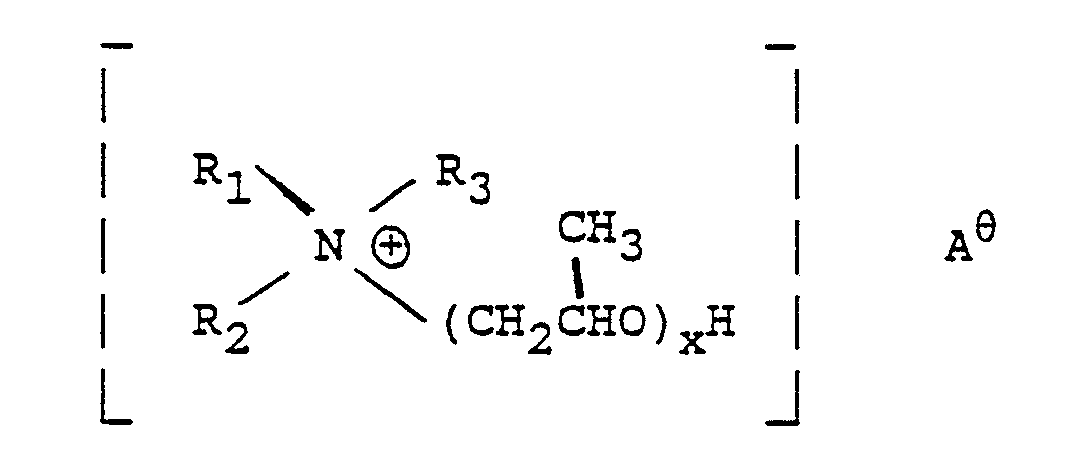
- the invention thus relates to treatment agents for hair and also for the skin containing a quaternary ammonium compound of the formula wherein R1 and R2 may be the same or different and C8-C22-alkyl or C8-C22-alkenyl, R3 C1-C3-alkyl, x is a number from 1 to 3 and A ⁇ is the anion of a C2-C6-carboxylic acid, the 1st can contain up to 3 hydroxyl groups, or mean the hydrogen phosphate anion.
- R1 and R2 are C12-C18 alkyl, R3 is methyl, x is a number from 1.5 to 2.5 A ⁇ the anion of lactic acid, citric acid or tartaric acid.
- the quaternary ammonium compounds of the above formula can be prepared analogously to the process described in US Pat. No. 4,409,109.
- oxpropylated quaternary ammonium compounds can be used to prepare hair treatment compositions which, in addition, contain the components conventionally used, such as consistency agents, fat components, preservatives, perfume oils, dyes, light stabilizers and other cosmetic active ingredients, emulsified or dispersed in water or dissolved in alcohols.
- the described quaternaries Ammonium compounds have the following advantages when used in conditioning hair rinsing agents, hair setting agents or hair dryer lotions.
- the combability of wet hair is tested in vivo on at least 6 test persons with hair that has been damaged as far as possible.
- Another advantage of the oxpropylated quaternary ammonium compounds is their freedom from foam in aqueous dilution. This is of particular advantage when used in hair conditioning agents, since a high level of foaming simulates the presence of residual amounts of shampoo for the consumer, which in turn leads to a time-consuming and disruptive rinsing out of the hair treatment after its use.
- a high level of foaming simulates the presence of residual amounts of shampoo for the consumer, which in turn leads to a time-consuming and disruptive rinsing out of the hair treatment after its use.
- no foaming effect is observed in comparison with the customary cetyltrimethylammonium chloride.
- the foam behavior can also be determined in vitro using the so-called whipped foam method in accordance with DIN 53 902.
- An aqueous solution containing 0.1% active substance with a water hardness of 20 ° dH is beaten 25 times at 20 ° C under standardized conditions.
- the foam volume of a cetyltrimethylammonium chloride solution is 740 cm3, while the oxpropylated quart. Ammonium compounds show no foaming effect.
- the preferred form of hair treatment agent is a dispersion containing the quaternary ammonium compounds and additional consistency agents, e.g. Cetyl alcohol and / or stearyl alcohol.
- additional consistency agents e.g. Cetyl alcohol and / or stearyl alcohol.
- the oxpropylated quaternary ammonium compounds to be used according to the invention can be incorporated into the hair rinsing agents in a manner known per se. 0.5-10% of the oxpropylated quaternary ammonium compounds, alone or in combination with other quaternary ammonium compounds, are dispersed in water or water / alcohol mixtures together with the customarily used dyes, fragrances, hair cosmetic active ingredients and preservatives.
- the substances according to the invention can also be incorporated into hair cosmetic preparations which are not rinsed out with water after use. This applies, for example, to hair lotions, which can contain about 0.05 to 0.1% of the oxypropylated quaternary ammonium compounds mentioned, or to hair setting agents, blow-drying agents in liquid, cream-like preparation or as aerosols with a content of about 0.1 to 1% of these compounds .
- the substances according to the invention can also be used for the production of cosmetic emulsions for skin care. Due to the substantive character of the substances, an improved feeling on the skin is achieved after application and at the same time a stabilizing effect in the finished preparations is achieved due to the emulsifying effect.
- Hair rinse aid 3.0% distearylmethyl poly (oxypropyl) 2-3 ammonium lactate 1.5% cetyl stearyl alcohol + 3 moles of ethylene oxide 3.0% cetyl alcohol 0.3% perfume oil ad 100% water
- Blow dryer 0.2% distearylmethyl poly (oxypropyl) 2-3 ammonium lactate 15% isopropyl alcohol 0.2% polyvinyl pyrrolidone 0.1% perfume oil ad 100% water
- Aerosol hair treatment agent 0.1% distearylmethyl poly (oxypropyl) 2-3 ammonium lactate 0.1% cetyl trimethyl ammonium bromide 0.7% cetylstearyl alcohol ad 100% water
- the above mixture is filled in a known manner with a propellant into an aerosol container.
- Liquid skin care product 1.0% distearylmethyl poly (oxypropyl) 2-3 ammonium lactate 3.0% tetraethylene glycol polyglyceryl di-stearate 10.0% paraffin oil 10.0% isopropyl palmitate 0.1% perfume oil ad 100% water
- Creamy skin care product 2.0% distearylmethyl poly (oxypropyl) 2-3 ammonium lactate 6.0% tetraethylene glycol polyglyceryl di-stearate 15.0% paraffin oil 5.0% isopropyl myristate ad 100% water
Landscapes
- Health & Medical Sciences (AREA)
- Life Sciences & Earth Sciences (AREA)
- Animal Behavior & Ethology (AREA)
- General Health & Medical Sciences (AREA)
- Public Health (AREA)
- Veterinary Medicine (AREA)
- Birds (AREA)
- Epidemiology (AREA)
- Dermatology (AREA)
- Cosmetics (AREA)
Abstract
Description
- Die Humanhaare werden durch wechselnde exogene Einflüsse geschädigt. Die Schädigung der Haarstruktur kann physikalisch, z.B. durch Kämmen, Bürsten und Toupieren oder beim Haarewaschen erfolgen. Eine weitere Schädigung wird beim Bleichen, Färben oder Dauerwellen der Haare beobachtet. Auch mikrobiologische Einflüsse können die Haarstruktur negativ beeinflussen. Um diese Einflüsse zu minimieren, ist es üblich, Haarbehandlungsmittel in Form von Haarnachspülmitteln oder Konditionierungsmitteln zu verwenden. Bei Anwendung dieser Präparate wird außerdem die Kämmbarkeit der nassen und trockenen Haare wesentlich erleichtert und gleichzeitig die statische Aufladung verringert. Diese kosmetischen Haarbehandlungsmittel können in wäßriger oder wäßrig-alkoholischer Lösung angewandt werden oder auch in Form von Emulsionen und/oder Suspensionen.
- Es ist bekannt, daß zur Herstellung solcher kosmetischen Haarbehandlungsmittel am besten kationische Verbindungen, im allgemeinen quartäre Ammoniumverbindungen geeignet sind. Diese Tenside besitzen eine hohe Substantivität zum Haar und der entstehende mono- bzw. multimolekulare Film ergibt die gewünschten kosmetischen Eigenschaften. Die am meisten zur Herstellung von Haarbehandlungsmitteln verwendeten kationischen Tenside gehören in die Gruppen der Alkyltrimethylammoniumchloride bzw. -bromide, zu den Dialkyldimethylammoniumchloriden oder zu den Alkyldimethylbenzylammoniumchloriden.
- Daneben werden auch noch wasserlösliche kationische Polymere allein oder in Kombination mit den vorgenannten quartären Ammoniumverbindungen eingesetzt.
- Ein Großteil dieser verwendeten kationischen Tenside besitzt jedoch eine Reihe von Nachteilen, wie z.B. zu schwache Kämmbarkeit des nassen Haares, Beschwerung bzw. Akkumulation auf dem Haar, ungünstige dermatologische bzw. toxikologische Eigenschaften und schwierige Rezeptierung d.h. nicht ausreichende Erhöhung der Konsistenz.
- Es wurde nun gefunden, daß überraschenderweise mit den nachstehend aufgeführten oxpropylierten quartären Ammoniumverbindungen Mittel hergestellt werden können, die diese Nachteile nicht besitzen. Gegenstand der Erfindung sind somit Behandlungsmittel für Haare und auch für die Haut mit einem Gehalt einer quartären Ammonium-Verbindung der Formel

- Vorzugsweise bedeuten R₁ und R₂ C₁₂-C₁₈-Alkyl, R₃ Methyl, x eine Zahl von 1,5 bis 2,5 Aϑ das Anion der Milchsäure, Citronensäure oder Weinsäure. Die quartären Ammonium-Verbindungen der obigen Formel lassen sich herstellen analog zu dem in US-PS 4 409 109 beschriebenen Verfahren.
- Mit diesen oxpropylierten quartären Ammoniumverbindungen lassen sich Haarbehandlungsmittel herstellen, die daneben noch die üblicherweise verwendeten Komponenten, wie Konsistenzgeber, Fettkomponenten, Konservierungsmittel, Parfümöle, Farbstoffe, Lichtschutzmittel u.a. kosmetische Wirkstoffe emulgiert oder dispergiert in Wasser oder gelöst in Alkoholen enthalten. Die beschriebenen quartären Ammoniumverbindungen haben bei der Anwendung in konditionierenden Haarnachspülmitteln, Haarfestigern oder Fönlotionen folgende Vorteile.
- Die Prüfung der Kämmbarkeit von nassem Haar erfolgt in-vivo an mindestens 6 Testpersonen mit möglichst vorgeschädigtem Haar.
- Die Durchführung erfolgt durch praxisgerechtes zweimaliges Waschen der Haare der Versuchspersonen unter standardisierten Bedingungen und anschließendes leichtes Trocknen. Das Haar der Probanden wird in der Mitte des Kopfes gescheitelt und mit jeweils 10 ml wäßriger Lösung behandelt, die die quart. Ammoniumverbindungen in einer Konzentration von 0,1 % enthält. Die Einwirkungszeit bei Raumtemperatur beträgt 5 Minuten. Anschließend wird mit handwarmen Leitungswasser 2 Minuten gespült und entsprechend der Praxis das Haar mit Handtüchern von der überschüssigen Wassermenge befreit. Unter Verwendung von 2 gleichen Kämmen werden die zu vergleichenden Seiten synchron gekämmt und der auftretende Wiederstand festgestellt. Es zeigte sich, daß bei Verwendung der erfindungsgemäßen Substanzen im Vergleich zu den handelsüblichen quart. Ammoniumverbindungen eine sehr gute Kämmbarkeit des nassen Humanhaares gegeben ist.
- Auch die Kämmbarkeit des anschließend getrockneten Haares ist sehr gut. Das gleiche gilt für die sogenannten Frisiereigenschaften der Haare. (siehe Tabelle 1)

- Ein weiterer Vorteil der oxpropylierten quartären Ammoniumverbindungen ist ihre Schaumfreiheit in wäßriger Verdünnung. Von besonderem Vorteil ist dies bei der Anwendung in Haarkonditionierungsmitteln, da eine hohe Schaumbildung dem Verbraucher das Vorhandensein von Restmengen Shampoos vortäuscht, was wiederum zu einem zeitaufwendigen und störenden verstärkten Ausspülen der Haarkur nach deren Anwendung führt. Beim Einsatz der oxpropylierten quartären Ammoniumverbindungen wird im Vergleich zu dem praxisüblichen Cetyltrimethylammoniumchlorid keine Schaumwirkung beobachtet.
- In-vitro läßt sich das Schaumverhalten auch nach der sogenannten Schlagschaummethode entsprechend der DIN 53 902 bestimmen. Eine 0,1 % Aktivsubstanz enthaltende wäßrige Lösung mit einer Wasserhärte von 20 °dH wird bei 20°C unter standardisierten Bedingungen 25 mal geschlagen. Das Schaumvolumen einer Cetyltrimethylammoniumchloridlösung beträgt hierbei 740 cm³, während die oxpropylierte quart. Ammoniumverbindungen keinerlei Schaumwirkung zeigt.
- Die bevorzugte Form von Haarbehandlungsmitteln ist eine Dispersion, enthaltend die quartären Ammoniumverbindungen und zusätzliche Konsistenzgeber, wie z.B. Cetylalkohol und/oder Stearylalkohol. Durch die Verwendung dieser Konsistenzgeber wird eine praxisgerechte Viskosität erreicht, die einerseits die Dosierung erleichtert und anderseits eine bessere Verteilung auf den Haaren ermöglicht. Die Einarbeitung dieser Substanzen ist technologisch aufwendig und die Endviskosität stellt sich z.T. erst nach längerer Zeit auf das Maximum ein.
- Bei den erfindungsgemäßen oxpropylierten quartären Ammoniumverbindungen wurde gefunden, daß es möglich ist, mittel- bis hochviskose Haarspülmittel herzustellen, ohne daß zusätzliche Konsistenzgeber erforderlich sind. Beispielsweise wurden bie 20°C mit einem Brookfield-Viskosimeter folgende Viskositätswerte in Abhängigkeit von der Konzentration gefunden:
1 % Wirksubstanz gelöst in Wasser: 1140 mPas
2 % Wirksubstanz gelöst in Wasser: 2050 mPas
3 % Wirksubstanz gelöst in Wasser: 2180 mPas
5 % Wirksubstanz gelöst in Wasser: 2810 mPas - Die erfindungsgemäß zu verwendenden oxpropylierten quartären Ammoniumverbindungen können in an sich bekannter Weise in die Haarspülmittel eingearbeitet werden. Dabei werden 0,5 - 10 % der oxpropylierten quartären Ammoniumverbindungen allein oder in Kombination mit anderen quartären Ammoniumverbindungen zusammen mit dem üblicherweise verwendeten Farbstoffen, Duftstoffen, haarkosmetischen Wirkstoffen und Konservierungsmitteln in Wasser bzw. Wasser/Alkohol-Mischungen dispergiert.
- Auch in haarkosmetischen Präparaten, die nach der Anwendung nicht mit Wasser ausgespült werden, können die erfindungsgemäßen Substanzen eingearbeitet werden. Dies betrifft beispielsweise Haarwässer, die etwa 0,05 bis 0,1 % der genannten oxpropylierten quartären Ammonium-Verbindungen enthalten können, oder Haarfestiger, Fönwellmittel in flüssiger, cremeförmiger Zubereitung oder als Aerosole mit einem Gehalt von etwa 0,1 bis 1 % dieser Verbindungen.
- Prinzipiell ist die Verwendung der erfindungsgemäßen Substanzen auch zur Herstellung von kosmetischen Emulsionen zur Pflege der Haut möglich. Durch den substantiven Charakter der Substanzen wird ein verbessertes Hautgefühl nach der Anwendung erzielt und gleichzeitig aufgrund der Emulgierwirkung eine stabilisierende Wirkung in den Fertigpräparaten erreicht.
- Die Anwendung der oxpropylierten quartären Ammoniumverbindungen wird in den nachstehenden Beispielen weiter erläutert. Sofern nicht anders angegeben, beziehen sich alle Mengen auf das Gewicht.
- Haarnachspülmittel
3,0 % Distearylmethylpoly-(oxypropyl)2-3ammoniumlactat
1,5 % Cetyl-stearylalkohol + 3 Mol Ethylenoxid
3,0 % Cetylalkohol
0,3 % Parfümöl
ad 100 % Wasser - Haarbehandlungsmittel ohne Konsistenzgeber
3,0 % Distearylmethylpoly-(oxypropyl)2-3ammoniumlactat
0,2 % Parfümöl
ad 100 % Wasser - Fönwellmittel
0,2 % Distearylmethylpoly- (oxypropyl)2-3ammoniumlactat
15 % Isopropylalkohol
0,2 % Polyvinylpyrrolidon
0,1 % Parfümöl
ad 100 % Wasser - Haarnachbehandlungsmittel
2,0 % Distearylmethylpoly-(oxypropyl)2-3ammoniumlactat
1,0 % Pentaoxäthylammoniumlactat
3,5 % Cetylalkohol
ad 100 % Wasser - Haarnachspülmittel
2,5 % Distearylmethylpoly-(oxypropyl)2-3ammoniumlactat
0,5 % Behenyltrimethylammoniumchlorid
3,0 % Cetylalkohol
ad 100 % Wasser - Aerosolförmiges Haarnachbehandlungsmittel
0,1 % Distearylmethylpoly-(oxypropyl)2-3ammoniumlactat
0,1 % Cetyltrimethylammoniumbromid
0,7 % Cetylstearylalkohol
ad 100 % Wasser - Abfüllung der obigen Mischung in bekannter Weise mit einem Treibmittel in Aerosolbehälter.
- Flüssiges Hautpflegemittel
1,0 % Distearylmethylpoly-(oxypropyl)2-3ammoniumlactat
3,0 % Tetraethylenglykol-polyglyceryl-di-stearat
10,0 % Paraffinöl
10,0 % Isopropylpalmitat
0,1 % Parfümöl
ad 100 % Wasser - Cremeförmiges Hautpflegemittel
2,0 % Distearylmethylpoly-(oxypropyl)2-3ammoniumlactat
6,0 % Tetraethylenglykol-polyglyceryl-di-stearat
15,0 % Paraffinöl
5,0 % Isopropylmyristat
ad 100 % Wasser
Claims (2)

Applications Claiming Priority (2)
| Application Number | Priority Date | Filing Date | Title |
|---|---|---|---|
| DE3634417 | 1986-10-09 | ||
| DE19863634417 DE3634417A1 (de) | 1986-10-09 | 1986-10-09 | Kosmetische haarbehandlungsmittel |
Publications (2)
| Publication Number | Publication Date |
|---|---|
| EP0264066A2 true EP0264066A2 (de) | 1988-04-20 |
| EP0264066A3 EP0264066A3 (de) | 1988-07-27 |
Family
ID=6311385
Family Applications (1)
| Application Number | Title | Priority Date | Filing Date |
|---|---|---|---|
| EP87114698A Withdrawn EP0264066A3 (de) | 1986-10-09 | 1987-10-08 | Kosmetische Haar- und Hautbehandlungsmittel |
Country Status (4)
| Country | Link |
|---|---|
| US (1) | US4781918A (de) |
| EP (1) | EP0264066A3 (de) |
| JP (1) | JPS6396119A (de) |
| DE (1) | DE3634417A1 (de) |
Families Citing this family (3)
| Publication number | Priority date | Publication date | Assignee | Title |
|---|---|---|---|---|
| WO1996025917A1 (en) * | 1995-02-22 | 1996-08-29 | Bausch & Lomb Incorporated | Skin care composition |
| US5804205A (en) * | 1996-02-26 | 1998-09-08 | Bausch & Lomb Incorporated | Skin care compositions |
| US5958397A (en) * | 1996-07-22 | 1999-09-28 | Schering-Plough Healthcare Products, Inc. | Method and composition for protecting against jellyfish stings |
Family Cites Families (8)
| Publication number | Priority date | Publication date | Assignee | Title |
|---|---|---|---|---|
| US3740421A (en) * | 1966-09-19 | 1973-06-19 | Basf Wyandotte Corp | Polyoxyethylene-polyoxypropylene aqueous gels |
| DE2436467A1 (de) * | 1974-07-29 | 1976-02-12 | Henkel & Cie Gmbh | Hautpflege- und hautschutzmittel mit einem gehalt an haut-feuchthaltemitteln |
| DE2539349C2 (de) * | 1975-09-04 | 1985-04-11 | Hoechst Ag, 6230 Frankfurt | Wäschenachbehandlungsmittel |
| JPS56412A (en) * | 1979-06-16 | 1981-01-06 | Sugiaki Kusatake | Construction process for revetment or retaining wall, and its block |
| CA1172652A (en) * | 1979-07-02 | 1984-08-14 | James M. Richmond | Fabric softening compounds and method |
| FR2471777A1 (fr) * | 1979-12-21 | 1981-06-26 | Oreal | Nouveaux agents cosmetiques a base de polymeres polycationiques, et leur utilisation dans des compositions cosmetiques |
| US4369037A (en) * | 1980-11-19 | 1983-01-18 | Kao Soap Co., Ltd. | Hair treatment cosmetics containing cationic keratin derivatives |
| DE3374305D1 (en) * | 1982-07-05 | 1987-12-10 | Basf Ag | Process for the preparation of quaternary ammonium salts |
-
1986
- 1986-10-09 DE DE19863634417 patent/DE3634417A1/de not_active Withdrawn
-
1987
- 1987-10-07 US US07/106,058 patent/US4781918A/en not_active Expired - Fee Related
- 1987-10-08 EP EP87114698A patent/EP0264066A3/de not_active Withdrawn
- 1987-10-08 JP JP62252645A patent/JPS6396119A/ja active Pending
Also Published As
| Publication number | Publication date |
|---|---|
| US4781918A (en) | 1988-11-01 |
| EP0264066A3 (de) | 1988-07-27 |
| DE3634417A1 (de) | 1988-04-14 |
| JPS6396119A (ja) | 1988-04-27 |
Similar Documents
| Publication | Publication Date | Title |
|---|---|---|
| DE3719293C2 (de) | Konditionierende Haarspülung | |
| DE2629922C2 (de) | ||
| DE3140160C3 (de) | Polyethylenglykolderivate, Verfahren zu deren Herstellung, sowie kosmetische und pharmazeutische Mittel, welche diese Verbindungen enthalten | |
| EP1328242B1 (de) | Verwendung von kreatin, kreatinin und/oder cyclokreatin zur stärkung und verbesserung der haarstruktur | |
| EP0290741B1 (de) | Neue makromolekulare, oberflächenaktive, quaternäre, N-substituierte Chitosanderivate sowie kosmetisches Mittel auf der Basis dieser neuen Chitosanderivate | |
| DE3781647T2 (de) | Haarfestigungszubereitung die kationische organische polymere und polydiorganosiloxane enthaelt. | |
| DE2808830C2 (de) | ||
| DE3602746A1 (de) | Haarbehandlungsmittel und verfahren zur verbesserung des zustandes der haare | |
| DE112017002170T5 (de) | Haarstärkende Zusammensetzung und ein Kit zur Stärkung von Haaren | |
| DE19525821A1 (de) | Haarbehandlungsmittel sowie Verfahren zu dessen Herstellung | |
| DE69933320T2 (de) | Alkalische haarkonditionierende Zusammensetzungen enthaltend kationaktiven Guar | |
| DE3819625A1 (de) | Stabile haarglanz-konditionierungsmittelzusammensetzung | |
| EP1037591B1 (de) | Kosmetische mittel enthaltend eine spezielle wirkstoffkombination | |
| EP0714654A1 (de) | Mittel und Verfahren zur dauerhaften Haarverformung | |
| DE69109973T2 (de) | Haarkosmetische Zusammensetzung. | |
| DE69004016T3 (de) | Kosmetische Haarzubereitung. | |
| EP0616518B1 (de) | Mittel zur festigung der haare | |
| DE3228444A1 (de) | Haarpflegemittel | |
| EP0648103B1 (de) | Haarbehandlungsmittel | |
| DE69926133T2 (de) | Haarpflegezusammensetzung | |
| EP0144688B1 (de) | Haarkurmittel und Verfahren zur Haarbehandlung | |
| EP0662815B1 (de) | Haarbehandlungsmittel | |
| DE3780502T2 (de) | Haarkosmetisches mittel. | |
| AT391804B (de) | Kosmetische mittel auf der basis von kationischen polymeren | |
| EP1727518B1 (de) | Verwendung von mitteln zur kosmetischen behandlung von menschlichen haaren |
Legal Events
| Date | Code | Title | Description |
|---|---|---|---|
| PUAI | Public reference made under article 153(3) epc to a published international application that has entered the european phase |
Free format text: ORIGINAL CODE: 0009012 |
|
| AK | Designated contracting states |
Kind code of ref document: A2 Designated state(s): CH DE FR GB LI |
|
| PUAL | Search report despatched |
Free format text: ORIGINAL CODE: 0009013 |
|
| AK | Designated contracting states |
Kind code of ref document: A3 Designated state(s): CH DE FR GB LI |
|
| STAA | Information on the status of an ep patent application or granted ep patent |
Free format text: STATUS: THE APPLICATION HAS BEEN WITHDRAWN |
|
| 18W | Application withdrawn |
Withdrawal date: 19881210 |
|
| RIN1 | Information on inventor provided before grant (corrected) |
Inventor name: RENG, ALWIN Inventor name: HOFINGER, MANFRED, DR. Inventor name: QUACK, JOCHEN MEINHARD, DR. |