EP0264097A2 - Selektive durchlässige Zeolith-Adsorbens und daraus hergestelltes Dichtungsmittel - Google Patents
Selektive durchlässige Zeolith-Adsorbens und daraus hergestelltes Dichtungsmittel Download PDFInfo
- Publication number
- EP0264097A2 EP0264097A2 EP87114905A EP87114905A EP0264097A2 EP 0264097 A2 EP0264097 A2 EP 0264097A2 EP 87114905 A EP87114905 A EP 87114905A EP 87114905 A EP87114905 A EP 87114905A EP 0264097 A2 EP0264097 A2 EP 0264097A2
- Authority
- EP
- European Patent Office
- Prior art keywords
- zeolite
- fluid
- oxygen
- nitrogen
- adsorbent
- Prior art date
- Legal status (The legal status is an assumption and is not a legal conclusion. Google has not performed a legal analysis and makes no representation as to the accuracy of the status listed.)
- Granted
Links
Images
Classifications
-
- B—PERFORMING OPERATIONS; TRANSPORTING
- B01—PHYSICAL OR CHEMICAL PROCESSES OR APPARATUS IN GENERAL
- B01J—CHEMICAL OR PHYSICAL PROCESSES, e.g. CATALYSIS OR COLLOID CHEMISTRY; THEIR RELEVANT APPARATUS
- B01J20/00—Solid sorbent compositions or filter aid compositions; Sorbents for chromatography; Processes for preparing, regenerating or reactivating thereof
- B01J20/02—Solid sorbent compositions or filter aid compositions; Sorbents for chromatography; Processes for preparing, regenerating or reactivating thereof comprising inorganic material
- B01J20/10—Solid sorbent compositions or filter aid compositions; Sorbents for chromatography; Processes for preparing, regenerating or reactivating thereof comprising inorganic material comprising silica or silicate
- B01J20/16—Alumino-silicates
- B01J20/18—Synthetic zeolitic molecular sieves
-
- E—FIXED CONSTRUCTIONS
- E06—DOORS, WINDOWS, SHUTTERS, OR ROLLER BLINDS IN GENERAL; LADDERS
- E06B—FIXED OR MOVABLE CLOSURES FOR OPENINGS IN BUILDINGS, VEHICLES, FENCES OR LIKE ENCLOSURES IN GENERAL, e.g. DOORS, WINDOWS, BLINDS, GATES
- E06B3/00—Window sashes, door leaves, or like elements for closing wall or like openings; Layout of fixed or moving closures, e.g. windows in wall or like openings; Features of rigidly-mounted outer frames relating to the mounting of wing frames
- E06B3/66—Units comprising two or more parallel glass or like panes permanently secured together
- E06B3/677—Evacuating or filling the gap between the panes ; Equilibration of inside and outside pressure; Preventing condensation in the gap between the panes; Cleaning the gap between the panes
Definitions
- the present invention relates to an improved zeolite adsorbent.
- the present invention also relates to sealants incorporating the improved zeolite adsorbent.
- sealants have varied uses, one of which is in the fabrication of thermally insulating multiple glazed structures such as insulated glass.
- Zeolites are well known adsorbents, which have been used between glass panes, either alone or in a sealant.
- the zeolite is disposed along the periphery of the space enclosed by the panes, and the zeolite adsorbs water vapor from the space between the panes.
- Zeolite functions as a "molecular sieve". Specifically, zeolite has pores into which the material being adsorbed passes. The pores have apertures of a size sufficient to pass the molecules of the material being adsorbed but small enough to block materials not adsorbed.
- U.S. Patents 4,151,690, 4,141,186 and 4,144,196 disclose such molecular sieve zeolites.
- zeolites have pore aperture sizes of 3 to 10 angstroms. However, zeolites with aperture sizes 4 angstroms or greater, when used in an insulating window, adsorb gaseous components in the air space, such as oxygen and nitrogen, as well as the water vapor which is desired to be absorbed. These zeolites then outgas the oxygen and nitrogen when the temperature rises or the pressure lowers. These zeolites, when used in a sealant between glass panes in a window, adsorb the oxygen and nitrogen when cooled (as during night) and then release the gases when the glass is heated (as during the day). This causes large pressure variations in the enclosed air space, which can lead to problems with the windows such as excessive deflection or inflection. This outgassing can also lead to a loss of adhesion between the glass panes and the sealant because agglomeration of the gases permits small bubbles to form which migrate to the adhesive interface.
- U.S. Patents Nos. 4,144,186 and 4,144,196 attempt to solve this problem by using zeolite adsorbents with pore apertures of 3 angstroms or less in size so that oxygen and nitrogen molecules cannot enter into the pores, thus preventing the adsorption and thus desorption of these gases.
- U.S. Patent No. 4,151,690 contemplates the use of zeolite adsorbents with larger pore aperture sizes, which have been pretreated by preadsorption of a low molecular weight polar material to partially suppress the undesirable adsorption of the gases.
- An object of the present invention is to provide a molecular sieve zeolite adsorbent which has pore apertures of 4 angstroms or greater in size and which is free of the problems associated with the constant adsorption and desorption of gases. This is effected by heating the zeolite to drive out (or "outgas") the nitrogen and oxygen in its pores, and allowing it to cool while surrounded and covered by a fluid coating which is essentially impermeable to oxygen and nitrogen yet permits water vapor to slowly pass therethrough into the pores of the zeolite.
- the coated zeolite has a greater capacity to adsorb water vapor, which is desired, but does not adsorb any significant amount of oxygen or nitrogen. Outgassing the zeolite also places less nitrogen and oxygen into the system where the zeolite is being used as an adsorbent. Therefore, the zeolite never then desorbs these gases.
- the molecular sieve zeolite is in a particulate form.
- the particles have a plurality of pores throughout, some pores being adjacent the surface.
- the pores adjacent the surface have apertures at the surface large enough to permit entry of oxygen and nitrogen molecules as well as molecules of water vapor.
- the fluid coating on the surface of the zeolite extends over and covers the pore apertures, but does not penetrate the pores.
- the coating may be any fluid which will coat the zeolite particles without being adsorbed into the pores, which is relatively permeable to water vapor, and which is essentially impermeable to nitrogen and oxygen (has a low solubility).
- the fluid provides a barrier blocking the entry of oxygen and nitrogen into the pores.
- any water vapor which comes in contact with the fluid solvates in the fluid and is transmitted through the fluid, into the pores of the zeolite, at a slow transmission rate.
- the zeolite with the fluid coating in accordance with the present invention may be used as a part of a sealant composition which is used between the glass panels of a double glazed window.
- the sealant is made by first mixing the molecular sieve zeolite particles with the fluid which may preferably be paraffinic oil. Approximately equal parts by weight of zeolite powder and oil are mixed together to form a slurry. The percentage of oil must be high enough so that the oil is the continuous phase, i.e. at least 50% by volume. The slurry is slowly heated under mild agitation and is kept heated for a sufficient time to outgas most of the oxygen and nitrogen that may have been trapped in the pores of the zeolite. The material is then cooled to room temperature. The fluid at room temperature is essentially impermeable to nitrogen and oxygen and prevents nitrogen and oxygen from reentering the pores of the zeolite.
- the fluid which may preferably be paraffinic oil.
- the zeolite particles with the coating thereon are mixed with other components of a sealant material, and the resulting material is then extruded to form the desired sealant.
- the present invention relates to a zeolite adsorbent and sealants prepared therefrom useful for various purposes and especially useful for structural sealants used in the fabrication of thermal insulating multiple glazed windows.
- Zeolite is a known material which has the characteristic of being an excellent adsorbent. Zeolite is available commercially from various companies, including Union Carbide, W.R. Grace Company, and others.
- the zeolite as used in the present invention is in a particle form, of a mesh size of less than 100.
- the zeolite particles have a large number of pores on the surface and throughout the mass of the zeolite. The pores are of a given diameter, slightly below the surface of the zeolite, with a smaller pore aperture extending through the surface.
- Zeolite which is usable for dessicating insulating glass units is available with pore aperture sizes ranging from 3 angstroms to 10 angstroms.
- zeolite When zeolite is used as an adsorbent, it functions by drawing molecules of whatever material is to be adsorbed, such as gas or water vapor, through the apertures of the pores and into the pores themselves, where the molecules are retained. Although the interaction of the zeolite with the gas and vapor molecules is not fully understood, it is believed that there is an electrical charge on the zeolite material, and a charge of opposite polarity on the molecules of the material being adsorbed, thus causing an attraction of the molecules into the pores of the zeolite.
- molecules of whatever material such as gas or water vapor
- zeolite can be used as an adsorbent for different types of materials, and these materials may have molecules of different sizes, the particular zeolite to be used in any particular application must have pore apertures of a size large enough to permit passage of the molecules of the particular material to be absorbed.
- zeolite adsorbents One known use for zeolite adsorbents is to function as a desiccant to draw water vapor out of the air space between two panes of glass in a double glazed window.
- the zeolite must have pore apertures large enough to admit molecules of water vapor.
- it is desirable that the zeolite not adsorb molecules of nitrogen and oxygen, the main gaseous components of air, from the air enclosed within the double glazed window.
- Zeolites having pore apertures of 4 angstroms or greater in size will not exclude molecules of nitrogen and oxygen.
- the present invention contemplates the use of zeolite which, although it has pore apertures which are 4 angstroms or greater in size and thus are large enough to admit nitrogen and oxygen molecules, will not do so because there is a layer of gas impermeable fluid on the zeolite, extending across and covering the pore apertures on the surface of the zeolite.
- the fluid is, however, able to pass water vapor molecules. Therefore, the desired characteristics of both passage of water vapor and exclusion of nitrogen and oxygen are provided.
- the fluid used in the present invention must have the following characteristics. First, it must be able to coat zeolite particles without being adsorbed into the pores when properly mixed with the zeolite material. Second, it must be permeable to water vapor, preferably at a very low rate. Third, it must be essentially impermeable to nitrogen and oxygen, which are the main gaseous components of air. Many fluids may be useful in the present invention. These include paraffinic oils, naphthenic oils, and aromatic oils; phthalates such as butyl benzyl phthalate; polymeric polyesters such as Santicizer #278 from Monsanto; polybutene; rubber process oils; and silicone fluids.
- Sun Par #2280 a refined petroleum product available from Sun Oil Co. This oil has a composition of 73% paraffinic carbon atoms, 23% naphthenic carbon atoms, and 4% aromatic carbon atoms.
- a 4-angstrom molecular sieve zeolite (95 parts by weight) and a 10-angstrom molecular sieve zeolite (95 parts by weight) were combined with 206 parts by weight of Sun Par #2280 and mixed for five minutes to insure a uniform slurry or dispersion of the ingredients.
- the percentage of zeolite used must be low enough so that the fluid is the continuous phase, i.e., no more than about 50% by volume. Any lesser amount of zeolite may be used if desired.
- the slurry was slowly heated for about 15 minutes to a temperature of about 325°F under mild agitation. The mixture was maintained at 325°F for an additional 30 minutes and then cooled to room temperature.
- the heating causes oxygen and nitrogen to be outgassed or removed from the zeolite.
- the oil prevents the oxygen and nitrogen from reentering the zeolite.
- some water vapor in the zeolite is also driven out, and no significant amount immediately reenters the zeolite because the pore apertures of the zeolite are covered with the layer of fluid which has a very slow moisture vapor transmission rate.
- zeolite material Although only one zeolite material may be used, it is often preferred to use a mixture of two or more zeolites. For example, equal parts by weight of a first zeolite having a pore aperture size of about 4 angstroms, and a second zeolite having a pore aperture size of about 10 angstroms, are used together. This use of two or more zeolites having different pore aperture sizes is sometimes preferred because there may be present some large diameter impurities such as low molecular weight polymer fractions, which can detract from the sealant's performance because of their volatility. These are adsorbed by large pore size molecular sieves.
- the zeolite adsorbent allows the controlled passage of water vapor.
- the water vapor penetrates or solvates in the fluid and passes through the fluid and into the zeolite pores.
- the nitrogen and oxygen cannot significantly pass through the fluid and are thereby excluded from entering the zeolite pores. Thus, there is very little adsorption of gases into the coated zeolites.
- this improved zeolite adsorbent is in multipaned insulating windows.
- a thermally insulated window is constructed using two or more panes of glass sealed at the edges, an air space is created between the panes of glass.
- This air space will contain air at ambient pressure.
- the air of course, contains such components as nitrogen, oxygen and water vapor.
- the improved zeolite of the present invention may be used alone as a dessicant or it may be incorporated into the sealant material which is used at the edge of the window to seal between the panes of glass.
- the zeolite When the zeolite is mixed with the other ingredients of the sealant material while the sealant is being manufactured, it becomes disposed within the matrix of the sealant material in such a manner as to be able to adequately function as an adsorbent for the air within the window. The air, of course, contacts the exposed surface of the sealant, and the water vapor is adsorbed from the air at that location.
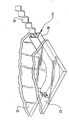
- Fig. 1 illustrates a composite structure A comprising a first member 10 and second member 12 having facing, generally parallel surfaces, spaced a finite distance from each other.
- the composite structure A also includes means for maintaining members 10, 12 in the spaced relationship and for effecting a seal between the facing surfaces thereof.
- a sealant and spacer strip designated generally as 14, maintains the members 10, 12 in spaced relationship and provides the seal.
- Members 10, 12 as illustrated are formed of glass, and the composite structure A is a double glazed insulating glass window.
- the invention has applicability in the environment of an unrestricted variety of constructions and/or structural materials, including without limitation cement, concrete, brick, stone, metals, plastics and wood.
- the sealant and spacer strip 14 comprises an elongated ribbon 16 of deformable sealant, enveloping and having embedded therein a spacer means 18 which extend longitudinally of ribbon 16.
- the spacer means 18 is an undulating sheet of relatively rigid material which may conveniently be formed of aluminum. It will be noted that all of the surfaces and edges of the spacer means 18 are in intimate contact with ribbon 16 of sealant. Such a spacer strip is shown in U.S. Patent 4,431,691.
- the sealant 16 includes the improved zeolite of the present invention.
- a typical range of ingredients for a sealant is as follows: 400 to 600 parts butyl; 150 to 350 parts hydrocarbon resin; 10 to 15 parts zinc oxide; 100 parts carbon black; 100 parts aromatic resin; and 5 to 6 parts silane.
- the fluid used in forming the slurry of zeolite and fluid, as described above, is also an ingredient of the sealant formulation, and functions as a plasticizer.
- the amount of zeolite/fluid slurry used in the sealant may vary depending on how much adsorbent capability is needed and on how much fluid is needed in the sealant.
- the slurry of coated zeolite, in the amounts and prepared as described above, is combined with the sealant ingredients in a sigma blade mixer for one hour and fifteen minutes.
- the temperature of the mix rises to 260°F as a result of internal friction.
- a vacuum of 25 inches of mercury is applied during the last 20 minutes of the mixing process.
- Slugs of the resulting material are made, and are extruded into sealant strips, incorporating an aluminum swiggle strip as described in U.S. Patent 4,431,691.
- the sealant material in strip form is then coiled and sealed in cans.
- test samples of this sealant which incorporates the improved zeolite adsorbent, and of a standard sealant were pressed between glass and aluminum prior to conditioning at 135°F and 100% relative humidity for 24 hours.
- the sample of the standard sealant outgassed, forming bubbles at the interface between the glass and the sealant.
- the sealant of the present invention did not outgas or form any bubbles, and there was no loss of adhesion between the glass and the sealant.
- the present invention provides an improved zeolite adsorbent having the desirable characteristics of (a) a lack of gases such as nitrogen and oxygen, so as to minimize outgassing and re-adsorption of gases during periods of temperature or pressure fluctuation; (b) a lower capability to adsorb gases such as nitrogen and oxygen from air such as the air space in a double-paned glass window because the pore apertures of the zeolite are covered with a layer of fluid which is essentially impermeable to oxygen and nitrogen; and (c) an ability to slowly adsorb water vapor from the surrounding air and retain it in the pores of the zeolite, thus reducing condensation on the inner surfaces of the panes of glass in a double-paned glass window.
- gases such as nitrogen and oxygen
- outgas or “outgassed” refers to zeolite which has been heated to drive out gases and water vapor from the pores of the zeolite.
Landscapes
- Chemical & Material Sciences (AREA)
- Organic Chemistry (AREA)
- Structural Engineering (AREA)
- Civil Engineering (AREA)
- Inorganic Chemistry (AREA)
- Analytical Chemistry (AREA)
- Engineering & Computer Science (AREA)
- Chemical Kinetics & Catalysis (AREA)
- Solid-Sorbent Or Filter-Aiding Compositions (AREA)
- Silicates, Zeolites, And Molecular Sieves (AREA)
- Oxygen, Ozone, And Oxides In General (AREA)
- Drying Of Gases (AREA)
- Joining Of Glass To Other Materials (AREA)
- Sealing Material Composition (AREA)
Priority Applications (1)
| Application Number | Priority Date | Filing Date | Title |
|---|---|---|---|
| AT87114905T ATE93816T1 (de) | 1986-10-16 | 1987-10-13 | Selektive durchlaessige zeolith-adsorbens und daraus hergestelltes dichtungsmittel. |
Applications Claiming Priority (2)
| Application Number | Priority Date | Filing Date | Title |
|---|---|---|---|
| US06/919,503 US4745711A (en) | 1986-10-16 | 1986-10-16 | Selectively permeable zeolite adsorbents and sealants made therefrom |
| US919503 | 1986-10-16 |
Publications (3)
| Publication Number | Publication Date |
|---|---|
| EP0264097A2 true EP0264097A2 (de) | 1988-04-20 |
| EP0264097A3 EP0264097A3 (en) | 1990-05-23 |
| EP0264097B1 EP0264097B1 (de) | 1993-09-01 |
Family
ID=25442205
Family Applications (1)
| Application Number | Title | Priority Date | Filing Date |
|---|---|---|---|
| EP87114905A Expired - Lifetime EP0264097B1 (de) | 1986-10-16 | 1987-10-13 | Selektive durchlässige Zeolith-Adsorbens und daraus hergestelltes Dichtungsmittel |
Country Status (9)
| Country | Link |
|---|---|
| US (1) | US4745711A (de) |
| EP (1) | EP0264097B1 (de) |
| JP (1) | JPS63104649A (de) |
| AT (1) | ATE93816T1 (de) |
| CA (1) | CA1313174C (de) |
| DE (1) | DE3787243T2 (de) |
| DK (1) | DK539187A (de) |
| MX (1) | MX169522B (de) |
| ZA (1) | ZA877786B (de) |
Cited By (3)
| Publication number | Priority date | Publication date | Assignee | Title |
|---|---|---|---|---|
| EP0515913A1 (de) * | 1991-05-27 | 1992-12-02 | H. SEUS GmbH & Co. SYSTEMTECHNIK KG | Molekularsieb |
| US7537383B2 (en) | 2004-11-05 | 2009-05-26 | Emitec Gesellschaft Fuer Emissionstechnologie Mbh | Protective element for a measuring probe and corresponding measuring probe, honeycomb body and motor vehicle |
| WO2020067877A1 (en) | 2018-09-28 | 2020-04-02 | Strongbond B.V. | Silyl modified polymer two-component composition comprising a zeolite booster |
Families Citing this family (18)
| Publication number | Priority date | Publication date | Assignee | Title |
|---|---|---|---|---|
| US5079054A (en) * | 1989-07-03 | 1992-01-07 | Ominiglass Ltd. | Moisture impermeable spacer for a sealed window unit |
| ATE152499T1 (de) * | 1992-12-10 | 1997-05-15 | Thermix Gmbh Isolationssysteme | Abstandhalter |
| US5851609A (en) * | 1996-02-27 | 1998-12-22 | Truseal Technologies, Inc. | Preformed flexible laminate |
| US5863857A (en) * | 1996-06-24 | 1999-01-26 | Adco Products, Inc. | Adsorbent containing composition for use in insulating glass units |
| US6212756B1 (en) | 1998-08-14 | 2001-04-10 | Truseal Technologies, Inc. | Dispensable non-adhesive desiccated matrix system for insulating glass units |
| US7493739B2 (en) * | 2000-10-20 | 2009-02-24 | Truseal Technologies, Inc. | Continuous flexible spacer assembly having sealant support member |
| US10316661B2 (en) | 2008-11-20 | 2019-06-11 | Emseal Joint Systems, Ltd. | Water and/or fire resistant tunnel expansion joint systems |
| US9637915B1 (en) | 2008-11-20 | 2017-05-02 | Emseal Joint Systems Ltd. | Factory fabricated precompressed water and/or fire resistant expansion joint system transition |
| US9631362B2 (en) | 2008-11-20 | 2017-04-25 | Emseal Joint Systems Ltd. | Precompressed water and/or fire resistant tunnel expansion joint systems, and transitions |
| US11180995B2 (en) | 2008-11-20 | 2021-11-23 | Emseal Joint Systems, Ltd. | Water and/or fire resistant tunnel expansion joint systems |
| US8365495B1 (en) | 2008-11-20 | 2013-02-05 | Emseal Joint Systems Ltd. | Fire and water resistant expansion joint system |
| US10851542B2 (en) | 2008-11-20 | 2020-12-01 | Emseal Joint Systems Ltd. | Fire and water resistant, integrated wall and roof expansion joint seal system |
| US9670666B1 (en) | 2008-11-20 | 2017-06-06 | Emseal Joint Sytstems Ltd. | Fire and water resistant expansion joint system |
| US9739050B1 (en) | 2011-10-14 | 2017-08-22 | Emseal Joint Systems Ltd. | Flexible expansion joint seal system |
| US8341908B1 (en) | 2009-03-24 | 2013-01-01 | Emseal Joint Systems Ltd. | Fire and water resistant expansion and seismic joint system |
| US8813450B1 (en) | 2009-03-24 | 2014-08-26 | Emseal Joint Systems Ltd. | Fire and water resistant expansion and seismic joint system |
| US9068297B2 (en) | 2012-11-16 | 2015-06-30 | Emseal Joint Systems Ltd. | Expansion joint system |
| US9074416B1 (en) | 2014-05-30 | 2015-07-07 | Rey Nea | Spacers for insulated glass |
Family Cites Families (13)
| Publication number | Priority date | Publication date | Assignee | Title |
|---|---|---|---|---|
| US3182017A (en) * | 1963-04-05 | 1965-05-04 | Union Oil Co | Separation of naphthenes from hydrocarbon mixtures using 7 a. to 12 a. molecular sieves |
| BE755703A (fr) * | 1969-09-04 | 1971-03-03 | Bayer Ag | Agents d'adsorption, en particulier pour l'emploi dans un vitrage isolant a plusieurs feuilles |
| US3791910A (en) * | 1972-03-07 | 1974-02-12 | Ppg Industries Inc | Multiple glazed unit |
| US3832254A (en) * | 1972-12-14 | 1974-08-27 | Ppg Industries Inc | Method of making a multiple glazed unit having a thermoplastic,spacer-dehydrator element |
| US3969223A (en) * | 1973-12-10 | 1976-07-13 | Universal Oil Products Company | Olefin separation process |
| FR2294314A1 (fr) * | 1974-12-11 | 1976-07-09 | Saint Gobain | Intercalaire pour vitrages multiples |
| US4144196A (en) * | 1975-08-11 | 1979-03-13 | Schoofs Richard J | Adsorbent for use in double glazed windows |
| US4431691A (en) * | 1979-01-29 | 1984-02-14 | Tremco, Incorporated | Dimensionally stable sealant and spacer strip and composite structures comprising the same |
| US4309281A (en) * | 1979-12-19 | 1982-01-05 | Mobil Oil Corporation | Selective sorption by zeolites |
| US4386012A (en) * | 1980-05-02 | 1983-05-31 | Uop Inc. | Zeolite molecular sieve adsorbent for use in an aqueous system |
| US4528281A (en) * | 1983-03-16 | 1985-07-09 | Calgon Carbon Corporation | Carbon molecular sieves and a process for their preparation and use |
| US4477583A (en) * | 1983-06-09 | 1984-10-16 | Mobil Oil Corporation | Silica-modified catalyst and use for selective production of para-dialkyl substituted benzenes |
| US4622249A (en) * | 1985-04-15 | 1986-11-11 | Ppg Industries, Inc. | Multiple pane unit having a flexible spacing and sealing assembly |
-
1986
- 1986-10-16 US US06/919,503 patent/US4745711A/en not_active Expired - Fee Related
-
1987
- 1987-10-13 AT AT87114905T patent/ATE93816T1/de not_active IP Right Cessation
- 1987-10-13 DE DE87114905T patent/DE3787243T2/de not_active Expired - Fee Related
- 1987-10-13 EP EP87114905A patent/EP0264097B1/de not_active Expired - Lifetime
- 1987-10-15 DK DK539187A patent/DK539187A/da not_active Application Discontinuation
- 1987-10-15 CA CA000549380A patent/CA1313174C/en not_active Expired - Fee Related
- 1987-10-16 JP JP62259813A patent/JPS63104649A/ja active Pending
- 1987-10-16 MX MX008867A patent/MX169522B/es unknown
- 1987-10-16 ZA ZA877786A patent/ZA877786B/xx unknown
Cited By (4)
| Publication number | Priority date | Publication date | Assignee | Title |
|---|---|---|---|---|
| EP0515913A1 (de) * | 1991-05-27 | 1992-12-02 | H. SEUS GmbH & Co. SYSTEMTECHNIK KG | Molekularsieb |
| US7537383B2 (en) | 2004-11-05 | 2009-05-26 | Emitec Gesellschaft Fuer Emissionstechnologie Mbh | Protective element for a measuring probe and corresponding measuring probe, honeycomb body and motor vehicle |
| WO2020067877A1 (en) | 2018-09-28 | 2020-04-02 | Strongbond B.V. | Silyl modified polymer two-component composition comprising a zeolite booster |
| NL2021734B1 (en) * | 2018-09-28 | 2020-05-07 | Strongbond B V | Silyl modified polymer composition with improved booster |
Also Published As
| Publication number | Publication date |
|---|---|
| EP0264097B1 (de) | 1993-09-01 |
| ATE93816T1 (de) | 1993-09-15 |
| DK539187A (da) | 1988-04-17 |
| CA1313174C (en) | 1993-01-26 |
| EP0264097A3 (en) | 1990-05-23 |
| MX169522B (es) | 1993-07-09 |
| ZA877786B (en) | 1988-08-31 |
| DE3787243D1 (de) | 1993-10-07 |
| DE3787243T2 (de) | 1994-04-07 |
| DK539187D0 (da) | 1987-10-15 |
| JPS63104649A (ja) | 1988-05-10 |
| US4745711A (en) | 1988-05-24 |
Similar Documents
| Publication | Publication Date | Title |
|---|---|---|
| US4835130A (en) | Selectively permeable zeolite adsorbents and sealants made therefrom | |
| US4745711A (en) | Selectively permeable zeolite adsorbents and sealants made therefrom | |
| CA1056216A (en) | Adsorbent for use in double glazed windows | |
| CA2153988C (en) | Thermally broken insulating glass spacer with desiccant | |
| EP0906378B1 (de) | Reaktive schmelzklebstoff-zusammensetzung für isolierglas | |
| US5441779A (en) | Insulated assembly incorporating a thermoplastic barrier member | |
| KR100496751B1 (ko) | 일체형 다중창유리 창유니트 및 창틀 | |
| US5509984A (en) | Method of applying pumpable disiccated mastic for an insulating glass unit | |
| JPS61242933A (ja) | 多重ガラス窓ユニツト | |
| CA1060716A (en) | Hermetic seals in multiple pane windows | |
| US12492594B2 (en) | Glass panel unit, method for manufacturing glass panel unit, composite getter material, and getter paste | |
| US5632122A (en) | Pumpable desiccated mastic | |
| US5863857A (en) | Adsorbent containing composition for use in insulating glass units | |
| US4315668A (en) | Permeation barrier for display cells | |
| CA1329732C (en) | Sealant with uniform spacer particles | |
| JPS6050736B2 (ja) | 二重ガラス窓 | |
| US20220018178A1 (en) | Insulating glass unit with desiccant material, and/or associated methods | |
| WO1996008541A1 (en) | Adsorbent/organic matrix composition using saturated olefin polymers | |
| EP0100653A2 (de) | Isolierglasfenster | |
| US5935891A (en) | High-loading adsorbent/organic matrix composites | |
| US7132059B2 (en) | Ambient applied desiccant matrix composition | |
| Mendelsohn et al. | Collector Sealants and Breathing. | |
| EP1731705A2 (de) | Integrierte mehrfachverglaste Fenstereinheit und Flügel | |
| SE418689B (sv) | Adsorptionsmedel for att hindra kondensation pa den invendiga ytan av ett tetat isolerande glas samt anvendning av adsorptionsmedlet |
Legal Events
| Date | Code | Title | Description |
|---|---|---|---|
| PUAI | Public reference made under article 153(3) epc to a published international application that has entered the european phase |
Free format text: ORIGINAL CODE: 0009012 |
|
| AK | Designated contracting states |
Kind code of ref document: A2 Designated state(s): AT BE DE FR GB NL SE |
|
| PUAL | Search report despatched |
Free format text: ORIGINAL CODE: 0009013 |
|
| AK | Designated contracting states |
Kind code of ref document: A3 Designated state(s): AT BE DE FR GB NL SE |
|
| 17P | Request for examination filed |
Effective date: 19900928 |
|
| 17Q | First examination report despatched |
Effective date: 19910515 |
|
| GRAA | (expected) grant |
Free format text: ORIGINAL CODE: 0009210 |
|
| AK | Designated contracting states |
Kind code of ref document: B1 Designated state(s): AT BE DE FR GB NL SE |
|
| REF | Corresponds to: |
Ref document number: 93816 Country of ref document: AT Date of ref document: 19930915 Kind code of ref document: T |
|
| ET | Fr: translation filed | ||
| REF | Corresponds to: |
Ref document number: 3787243 Country of ref document: DE Date of ref document: 19931007 |
|
| PLBE | No opposition filed within time limit |
Free format text: ORIGINAL CODE: 0009261 |
|
| STAA | Information on the status of an ep patent application or granted ep patent |
Free format text: STATUS: NO OPPOSITION FILED WITHIN TIME LIMIT |
|
| 26N | No opposition filed | ||
| PGFP | Annual fee paid to national office [announced via postgrant information from national office to epo] |
Ref country code: GB Payment date: 19941003 Year of fee payment: 8 |
|
| EAL | Se: european patent in force in sweden |
Ref document number: 87114905.0 |
|
| PG25 | Lapsed in a contracting state [announced via postgrant information from national office to epo] |
Ref country code: GB Effective date: 19951013 |
|
| GBPC | Gb: european patent ceased through non-payment of renewal fee |
Effective date: 19951013 |
|
| PGFP | Annual fee paid to national office [announced via postgrant information from national office to epo] |
Ref country code: BE Payment date: 19961114 Year of fee payment: 10 |
|
| PGFP | Annual fee paid to national office [announced via postgrant information from national office to epo] |
Ref country code: AT Payment date: 19971030 Year of fee payment: 11 |
|
| PG25 | Lapsed in a contracting state [announced via postgrant information from national office to epo] |
Ref country code: BE Free format text: LAPSE BECAUSE OF NON-PAYMENT OF DUE FEES Effective date: 19971031 |
|
| PGFP | Annual fee paid to national office [announced via postgrant information from national office to epo] |
Ref country code: FR Payment date: 19971117 Year of fee payment: 11 |
|
| PGFP | Annual fee paid to national office [announced via postgrant information from national office to epo] |
Ref country code: SE Payment date: 19971121 Year of fee payment: 11 |
|
| PGFP | Annual fee paid to national office [announced via postgrant information from national office to epo] |
Ref country code: DE Payment date: 19971125 Year of fee payment: 11 |
|
| PGFP | Annual fee paid to national office [announced via postgrant information from national office to epo] |
Ref country code: NL Payment date: 19971130 Year of fee payment: 11 |
|
| BERE | Be: lapsed |
Owner name: TREMCO INC. Effective date: 19971031 |
|
| PG25 | Lapsed in a contracting state [announced via postgrant information from national office to epo] |
Ref country code: AT Free format text: LAPSE BECAUSE OF NON-PAYMENT OF DUE FEES Effective date: 19981013 |
|
| PG25 | Lapsed in a contracting state [announced via postgrant information from national office to epo] |
Ref country code: SE Free format text: LAPSE BECAUSE OF NON-PAYMENT OF DUE FEES Effective date: 19981014 |
|
| PG25 | Lapsed in a contracting state [announced via postgrant information from national office to epo] |
Ref country code: NL Free format text: LAPSE BECAUSE OF NON-PAYMENT OF DUE FEES Effective date: 19990501 |
|
| EUG | Se: european patent has lapsed |
Ref document number: 87114905.0 |
|
| PG25 | Lapsed in a contracting state [announced via postgrant information from national office to epo] |
Ref country code: FR Free format text: LAPSE BECAUSE OF NON-PAYMENT OF DUE FEES Effective date: 19990630 |
|
| NLV4 | Nl: lapsed or anulled due to non-payment of the annual fee |
Effective date: 19990501 |
|
| REG | Reference to a national code |
Ref country code: FR Ref legal event code: ST |
|
| PG25 | Lapsed in a contracting state [announced via postgrant information from national office to epo] |
Ref country code: DE Free format text: LAPSE BECAUSE OF NON-PAYMENT OF DUE FEES Effective date: 19990803 |