EP0264357B1 - Alliage réfractaire austénitique et son procédé de fabrication - Google Patents
Alliage réfractaire austénitique et son procédé de fabrication Download PDFInfo
- Publication number
- EP0264357B1 EP0264357B1 EP87890201A EP87890201A EP0264357B1 EP 0264357 B1 EP0264357 B1 EP 0264357B1 EP 87890201 A EP87890201 A EP 87890201A EP 87890201 A EP87890201 A EP 87890201A EP 0264357 B1 EP0264357 B1 EP 0264357B1
- Authority
- EP
- European Patent Office
- Prior art keywords
- weight
- workpiece
- values
- temperature
- alloys
- Prior art date
- Legal status (The legal status is an assumption and is not a legal conclusion. Google has not performed a legal analysis and makes no representation as to the accuracy of the status listed.)
- Expired - Lifetime
Links
Images





Classifications
-
- C—CHEMISTRY; METALLURGY
- C22—METALLURGY; FERROUS OR NON-FERROUS ALLOYS; TREATMENT OF ALLOYS OR NON-FERROUS METALS
- C22C—ALLOYS
- C22C38/00—Ferrous alloys, e.g. steel alloys
- C22C38/18—Ferrous alloys, e.g. steel alloys containing chromium
- C22C38/40—Ferrous alloys, e.g. steel alloys containing chromium with nickel
- C22C38/50—Ferrous alloys, e.g. steel alloys containing chromium with nickel with titanium or zirconium
-
- C—CHEMISTRY; METALLURGY
- C21—METALLURGY OF IRON
- C21D—MODIFYING THE PHYSICAL STRUCTURE OF FERROUS METALS; GENERAL DEVICES FOR HEAT TREATMENT OF FERROUS OR NON-FERROUS METALS OR ALLOYS; MAKING METAL MALLEABLE, e.g. BY DECARBURISATION OR TEMPERING
- C21D8/00—Modifying the physical properties of ferrous metals or ferrous alloys by deformation combined with, or followed by, heat treatment
-
- C—CHEMISTRY; METALLURGY
- C22—METALLURGY; FERROUS OR NON-FERROUS ALLOYS; TREATMENT OF ALLOYS OR NON-FERROUS METALS
- C22C—ALLOYS
- C22C19/00—Alloys based on nickel or cobalt
- C22C19/03—Alloys based on nickel or cobalt based on nickel
- C22C19/05—Alloys based on nickel or cobalt based on nickel with chromium
Definitions
- the invention relates to a process for the production of high-temperature, essentially austenitic alloys or workpieces or components made of the same, which are intended for use at elevated temperatures, for example in the range above 50 ° C., with at least 15% by weight.
- the invention relates to high-temperature, essentially austenitic alloys or primary materials, semi-finished products, workpieces, components or the like made from these alloys, which are intended for use at elevated temperatures in the range of over 550 ° C., with at least 15 % By weight of chromium, at least 25% by weight of nickel and / or cobalt, up to 18% by weight of molybdenum, up to 0 ⁇ , 15% by weight of carbon and / or nitrogen and carbide- and nitride-forming elements and at most 60 ⁇ % By weight of iron and impurities due to melting.
- Alloys of this type are particularly suitable for components in systems with high continuous operating temperatures. You should be at These, possibly also changing, high temperatures maintain their strength and dimensional stability as well as further corrosion resistance over the longest possible periods of use and are used in particular for pipelines, pressure vessels, reactors, heat exchangers, motors, turbines, fittings and the like, especially in the chemical and petroleum industry , as well as in energy generation and driving and aircraft drives.
- Such improvements in properties can be obtained, for example, by specifically modifying the alloy constituents and their proportions, or by deliberately changing the structure or substructure of the grain and matrix.
- Workpieces and components that have the alloys initially specified globally with their basic components, to which a number of known and commercially available high-temperature alloys can be expected, can be in the production state intended for use, usually after solution annealing and controlled cooling based on their basic character, often have an economically viable service life at the appropriate temperatures.
- the operating time of the systems and / or the level of the operating temperature are limited by the time-expansion behavior of the alloys.
- the alloy having high nitrogen contents is cooled after passing through a high temperature area to dissolve as large a quantity of nitrogen as possible and cold formed with a high degree of deformation and then annealed so that precipitates form and an ultra-fine-grained recrystallized structure is formed.
- the object of the invention is to provide a method for the production of high-temperature alloys and such alloys for the broad range of applications described, even within the framework of the compositional criteria mentioned at the outset, the materials which have high heat resistance in comparison with previously significantly improved long-term properties such as service life and, in particular, significantly less Creep rate or reduced long-term expansion at the longer service life without adversely affecting their manufacturability and / or the other properties.
- the invention thus relates to a method for producing high-temperature, essentially austenitic alloys or workpieces or components made of the same, which are intended for use at elevated temperatures, for example in the range above 550 ° C., with at least 15% by weight.
- the step of hot aging after the introduction of a large number of dislocations into the crystals of the material by means of the cold working which follows the solution annealing is essential, since secondary particles are guaranteed under defined conditions by growing the particles at the dislocations. It is thus evenly fixed in all the volume units of the workpiece intended for higher loads achieved by cold forming dislocations in the grains of the austenitic matrix, with this essentially homogeneous, fixed internal state of stress per se achieving increased strength while maintaining ductility.
- Rotating and / or components with different cross sections can have different material stresses during operation at high temperatures.
- the variant of introducing the cold deformation particularly into the areas which are mechanically highly stressed during later use is favorable.
- Typical times for economical hot aging are about 1-48 hours. Particularly pronounced high-temperature properties are achieved if, in the austenitic matrix of the alloys, at least in the volumetric areas of the workpieces or components intended for increased mechanical stress, secondary particles of carbides and / or nitrides and / or carbonitrides with a single particle volume of 10 ⁇ 3 to 10 ⁇ 6 are eliminated nm3 in a homogeneous distribution with a density of more than 10 ⁇ 11 particles / mm3 and the alloys compared to the values after the solution heat treatment at a temperature above the homologous temperature of 0 ⁇ .5 at least twice the values of the service life until fracture at stresses up to 150 ⁇ N / mm2 and at least three times the service life up to Reaching 1% creep at tensions up to 150 ⁇ N / mm2 in each case when tested according to DIN 50 ⁇ 118 as well as increased values of tensile strength and at least 20 ⁇ % increased values of 0, 2 proof strength, with at least constant ductility.
- the materials according to the invention or components made from them have, as has surprisingly been shown, an increased service life that goes far beyond the increase in creep rupture strength to be expected in the case of customary production and separation of particles in the matrix, and in particular a significantly improved creep resistance. In some cases, it was even possible to observe ten times the service life of the alloys that had previously been achieved in solution annealing. By setting the finely dispersed particle excretions with densities of 10 ⁇ 11 - 10 ⁇ 12 / mm3 - as was unexpectedly shown - there is a disproportionate effect of the combination of particle size and distribution on the intracrystalline creep processes at the high temperatures, surprisingly increasing the tensile strength the ductility of the alloy does not deteriorate.
- the workpieces or components formed with the alloy according to the invention have the above-mentioned structure and long-term properties over their entire volume, as is advantageous, for example, in the case of pipes, reactors and containers which are used at high temperatures.
- the homologous temperature is the value from the ratio of the temperature to the melting temperature of the alloy in degrees Kelvin.
- the lower limit of the test voltages in the tests was 10 ⁇ to 25 N / mm2.
- Homogeneous distribution of the particles means that there is essentially the same number of particles in each volume element, at least in the areas of the workpieces which are subject to higher mechanical stresses. However, they can be spatially isotropic or anisotropically distributed.
- the alloy with a composition of in% by weight 0 ⁇ , 0 ⁇ 4 - 0 ⁇ , 18 C, to 1 Si, to 1.5 Mn, 19 -23 Cr, 30 ⁇ -34 Ni, 0 ⁇ , 1 -0 ⁇ , 6 Ti, to 0 ⁇ , 6 Al, remainder Fe and melting-related impurities at the temperatures of their later use, in particular at 750 ⁇ - 850 ⁇ ° C with test voltages of up to 150 ⁇ N / mm2 compared to the corresponding values in the solution-annealed state at least 3 -fold values of the service life until breakage and at least 5 times, in particular at least 10 times, values of the service life until the 1% creep is reached.
- This very broadly applicable alloy provides a synergism in terms of heat resistance properties based on composition, particle size and density.
- an alloy with increased heat resistance has proven to be advantageous, which is characterized in that it has a composition of in% by weight 0 ⁇ , 0 ⁇ 5 - 0 ⁇ , 1 C, 0 ⁇ , 5 -1 Si, 0 ⁇ , 5 - 1 Mn , 19 -23 Cr, 15 -19 Fe, 1 -2 Co, 0 ⁇ , 5 -1.5 W, 8 -10 ⁇ Mo, balance Ni and melting-related impurities at the temperatures of their later use, in particular bi 750 ⁇ - 850 ⁇ ° C at test voltages of up to 150 ⁇ N / mm2 compared to the corresponding values in the solution-annealed state at least 3 times the service life values and at least 5 times, in particular at least 8 times the values of the service life until the 1% creep is reached.
- This material is particularly suitable for turbine blades.
- the elongation at break at 800 ° C was 45% with a strength of 250 N / mm2 for the solution-annealed material only, and 261 N / mm2 for the 47% according to the invention.
- the 0.2% proof stress increased by 22.6% in the alloy according to the invention.
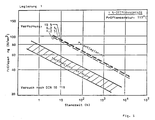
- Tube strip samples are taken and subjected to the test according to DIN 50118 at a test voltage of 70 N / mm2 at 800 ° C.
- the graphs in FIGS. 7 and 8 show the results of the creep rupture strength and 1% time-elastic limit obtained.
- the advantageous effect is demonstrated by comparing the test values of strip samples of the pipe material which was not subjected to cold deformation with subsequent hot aging (continuous lines) with those (broken lines) which had the secondary separation structure provided according to the invention.
- the curves show the substantial increase in the service life up to the break with a factor of approx. 5 and the 1% time-elastic limit with a factor of approx. 13 of the parts produced according to the invention compared to the alloy in the solution-annealed state at different test temperatures.
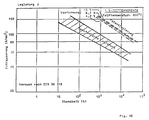
- the graphs of FIGS. 9 and 10 show the results of the creep rupture strength and 1% time-elastic limit obtained.
- the advantageous effect is demonstrated by comparing the test values of samples of the solution-annealed forging material, which was not subjected to cold deformation with subsequent hot aging (continuous lines), with those (broken lines) which had the secondary separation structure provided according to the invention.
- the curves show the substantial increase in the service life up to the break with a factor of approx. 4 and the 1% time-elastic limit with a factor of approx. 10 of the material produced according to the invention compared to the alloy in the solution-annealed state at different test temperatures.
- the elongation at break at 800 ° C was 53% for the solution-annealed alloy with a strength at 800 ° C of 410 N / mm2, for the inventive 53% at 429 N / mm2. A 21.5% higher 0.2% proof stress was determined for the alloy according to the invention.
- Table 2 shows the quotients found in each case for the alloys from creep rupture strength “deformed” to “undeformed” (Qs) and from the service life until the 1% creep elongation is reached “deformed” to “undeformed” (Qz) in each case at 800 ° C.
Landscapes
- Chemical & Material Sciences (AREA)
- Engineering & Computer Science (AREA)
- Mechanical Engineering (AREA)
- Materials Engineering (AREA)
- Metallurgy (AREA)
- Organic Chemistry (AREA)
- Physics & Mathematics (AREA)
- Thermal Sciences (AREA)
- Crystallography & Structural Chemistry (AREA)
- Heat Treatment Of Articles (AREA)
- Powder Metallurgy (AREA)
Claims (8)
- Procédé de fabrication d'alliages réfractaires, essentiellement austénitiques, ainsi que de pièces ou d'éléments à base de ces alliages, qui sont prévus pour être employés à des températures élevées, au-delà de 550°C par exemple, et qui comportent, quant à leur pourcentage en poids, 15 % de chrome au moins, 25 % de nickel et/ou de cobalt au moins, jusqu'à 18 % de molybdène, jusqu'à 0,15 % de carbone et/ou d'azote, ainsi que des éléments générateurs de carbures et de nitrures et 60 % au plus de fer et d'impuretés entraînées par la fusion, tandis qu'après celle-ci, ont lieu dans la composition respective et solidification souhaitées un façonnage selon un préformage souhaité de la pièce ou de l'élément et au minimum un processus de recuit d'homogénéisation, au stade solidus comportant un refroidissement subséquent, une mise à la forme par déformation à froid et un durcissement secondaire à chaud, procédé dans lequel, après le traitement par recuit d'homogénéisation au stade solidus à une température de plus de 900°C au moins, la pièce en cours de traitement est soumise à une miss à la forms par déformation à froid comportant un degré de façonnage, total de 1 % au moins et de 10 % au plus et concernant pour l'essentiel l'ensemble de la pièce ou de l'élément et au minimum les zones, qui, lors de l'emploi ultérieur, sont exposées aux sollicitations mécaniques les plus sévères, après quoi, a lieu un durcissement secondaire à chaud de la pièce ou de l'élément à des températures d'an moins 550°C pendant un laps de temps d'une heure au moins.
- Procédé selon la revendication 1, caractérisé en ce que le traitement par recuit d'homogénéisation au stade solidus est effectué à une température de plus de 1100°C.
- Procédé selon la revendication 1 ou 2, caractérisé en ce que la pièce en cours de traitement par recuit d'homogénéisation au stade solidus est soumise à une mise à la forme par déformation à froid entraînant pour l'essentiel sa configuration et ses dimensions finales.
- Procédé selon l'une des revendications 1 à 3, caractérisé en ce que la mise à la forme par déformation à froid de la pièce en cours de traitement est effectué avec un degré de façonnage de 3 à 10 %.
- Procédé selon l'une des revendications 1 à 4, caractérisé en ce que le durcissement secondaire à chaud de la pièce ou de l'élément a lieu dans une zone de températures comprises entre 700 et 950°C.
- Alliages réfractaires obtenus par voies métallurgiques de fusion, essentiellement austénitiques ou ébauches, demi-produits, pièces, éléments ou analogues à base de ces alliages, qui sont prévus pour être employés à des températures élevées, au-delà de 550°C par exemple, et qui comportent, quant à leur pourcentage en poids, 15 % de chrome au moins, 25 % de nickel et/ou de cobalt au moins, jusqu'à 18 % de molybdène, jusqu'à 0,15 % de carbone et/ou d'azote, ainsi que des éléments générateurs de carbures et de nitrures et 60 % au plus de fer et d'impuretés entraînées par la fusion, obtenus selon un procédé conforme à l'uns des revendications 1 à 5, caractérisé en ce que dans la matrice austénitique des alliages, au moins dans les zones de pièces ou d'éléments prévues pour être, lors de l'emploi, soumises à des sollicitations mécaniques sévères, il existe, secrétées de manière intracristalline secondaire, des particules de carbure et/ou de nitrures et/ou de carbonitrures d'un volume individuel de 10³ à 10⁶ nm³, en répartition homogène, sous une densité supérieure à 10¹¹ particules /mm³ et en ce qu'après traitement par recuit d'homogénéisation au stade solidus pour une température s'élevant de la moitié au-dessus de la température homologue, les alliages présentent, par rapport aux valeurs correspondantes, lors du contrôle respectif selon la norme DIN 50 118, uns durabilité deux fois supérieure au moins jusqu'à rupture, pour des tensions allant jusqu'à 150 N/nm², ainsi que trois fois supérieurs au moins jusqu'à obtention de 1 % d'allongement de fluage pour des tensions allant jusqu'à 150 N /mm² et présentent des valeurs accrues de résistance à la rupture et une valeur ajoutée de 20 % au moins de la limite d'élasticité 0,2 pour une ductilité au minimum constante.
- Alliage selon la revendication 6, caractérisé en ce que pour une composition, quant au pourcentage en poids, de 0,04 - 0,10 C, jusqu'à 1. Si jusqu'à 1,5 Mn, 19-23 Cr, 30-34 Ni, 0,1 à 0,6 Ti, jusqu'à 0,6 Al, pour le reste du fer et des impuretés entraînées par la fusion, par rapport aux valeur correspondantes, il présente à l'état traité par recuit d'homogénéisation au stade solidus, pour une température d'emploi de 750 à 850°C et une tension allant jusqu'à 150 N/mm², une durabilité au moins trois fois supérieure jusqu'à rupture et cinq fois supérieure au moins jusqu'à obtention de 1 % d'allongement de fluage.
- Alliage selon la revendication 6, caractérisé en ce que pour une composition, quant au pourcentage en poids, de 0,05-0,1 C, 0,5-1 Si, 0,5-1 Mn, 19-23 Cr, 15-19 Fe, 1-2 Co, 0,5-1,5 W, 8-10 Mo, pour le reste Ni et des impuretés entraînées par la fusion, par rapport aux valeurs correspondantes, il présente à l'état traité par recuit d'homogénéisation au stade solidus, pour une température d'emploi de 750 à 850°C et des tensions de contrôle allant jusqu'à 150 N/mm², une durabilité au moins trois fois supérieurs jusqu'à rupture et cinq fois supérieure jusqu'à obtention de 1 % d'allongement de fluage.
Applications Claiming Priority (2)
| Application Number | Priority Date | Filing Date | Title |
|---|---|---|---|
| AT0239986A AT391484B (de) | 1986-09-08 | 1986-09-08 | Hochwarmfeste, austenitische legierung und verfahren zu ihrer herstellung |
| AT2399/86 | 1986-09-08 |
Publications (3)
| Publication Number | Publication Date |
|---|---|
| EP0264357A2 EP0264357A2 (fr) | 1988-04-20 |
| EP0264357A3 EP0264357A3 (en) | 1989-04-26 |
| EP0264357B1 true EP0264357B1 (fr) | 1992-07-29 |
Family
ID=3533639
Family Applications (1)
| Application Number | Title | Priority Date | Filing Date |
|---|---|---|---|
| EP87890201A Expired - Lifetime EP0264357B1 (fr) | 1986-09-08 | 1987-09-02 | Alliage réfractaire austénitique et son procédé de fabrication |
Country Status (3)
| Country | Link |
|---|---|
| EP (1) | EP0264357B1 (fr) |
| AT (1) | AT391484B (fr) |
| DE (1) | DE3780749D1 (fr) |
Families Citing this family (1)
| Publication number | Priority date | Publication date | Assignee | Title |
|---|---|---|---|---|
| EP4509619A4 (fr) * | 2022-04-11 | 2026-03-18 | Nippon Steel Corp | Matériau d'alliage |
Family Cites Families (6)
| Publication number | Priority date | Publication date | Assignee | Title |
|---|---|---|---|---|
| US3645726A (en) * | 1965-05-26 | 1972-02-29 | Int Nickel Co | Resistance to stress-corrosion cracking in nickel alloys |
| FR2415149A1 (fr) * | 1978-01-19 | 1979-08-17 | Creusot Loire | Alliage a base de fer a haute limite elastique resistant a la corrosion par l'eau de mer |
| US4359349A (en) * | 1979-07-27 | 1982-11-16 | The United States Of America As Represented By The United States Department Of Energy | Method for heat treating iron-nickel-chromium alloy |
| JPS59173249A (ja) * | 1983-03-19 | 1984-10-01 | Nippon Steel Corp | オ−ステナイト系耐熱合金 |
| DE3407307A1 (de) * | 1984-02-24 | 1985-08-29 | Mannesmann AG, 4000 Düsseldorf | Verwendung einer korrosionsbestaendigen austenitischen eisen-chrom-nickel-stickstoff-legierung fuer mechanisch hoch beanspruchte bauteile |
| DE3407305A1 (de) * | 1984-02-24 | 1985-08-29 | Mannesmann AG, 4000 Düsseldorf | Verwendung einer korrosionsbestaendigen austenitischen legierung fuer mechanisch hoch beanspruchte, schweissbare bauteile |
-
1986
- 1986-09-08 AT AT0239986A patent/AT391484B/de not_active IP Right Cessation
-
1987
- 1987-09-02 EP EP87890201A patent/EP0264357B1/fr not_active Expired - Lifetime
- 1987-09-02 DE DE8787890201T patent/DE3780749D1/de not_active Expired - Lifetime
Also Published As
| Publication number | Publication date |
|---|---|
| EP0264357A3 (en) | 1989-04-26 |
| AT391484B (de) | 1990-10-10 |
| EP0264357A2 (fr) | 1988-04-20 |
| DE3780749D1 (de) | 1992-09-03 |
| ATA239986A (de) | 1990-04-15 |
Similar Documents
| Publication | Publication Date | Title |
|---|---|---|
| DE69203791T2 (de) | Verfahren zur Herstellung eines Werkstuckes aus einer Titanlegierung mit einer modifizierten Warmverarbeitungsstufe und hergestelltes Werkstuck. | |
| DE68915095T2 (de) | Legierung auf Nickelbasis und Verfahren zu ihrer Herstellung. | |
| DE2264997C2 (de) | Ausscheidungshärtbare Eisen-Nickel-Legierung | |
| DE69226946T2 (de) | Austenitischer manganstahlblech mit hoher verformbarkeit, festichkeit und schweissbarkeit und verfahren | |
| DE3018537C2 (fr) | ||
| DE1964992C3 (de) | Verfahren zur Erhöhung der Duktilität und Zeitstandfestigkeit einer Nickelknetlegierung sowie Anwendung des Verfahrens | |
| DE60316212T2 (de) | Nickelbasislegierung, heissbeständige Feder aus dieser Legierung und Verfahren zur Herstellung dieser Feder | |
| DE69019578T2 (de) | Baustahl mit hoher Festigkeit und guter Bruchzähigkeit. | |
| EP3942084A1 (fr) | Alliage de nickel à bonne résistance à la corrosion et à résistance élevée à la traction et procédé de fabrication de demi-produits | |
| DE60302108T2 (de) | Ausscheidungsgehärtete Kobalt-Nickel-Legierung mit guter Wärmebeständigkeit sowie zugehörige Herstellungsmethode | |
| DE68907678T2 (de) | Legierung auf Nickel-Basis. | |
| DE1558521B2 (de) | Verwendung einer nickel-chromknetlegierung als superplastischer werkstoff | |
| DE2730452A1 (de) | Nickel-chrom-eisen-legierung | |
| DE69414529T2 (de) | Superlegierung auf Fe-Basis | |
| DE1558668C3 (de) | Verwendung von kriechfesten, nichtrostenden austenitischen Stählen zur Herstellung von Blechen | |
| DE1458330B2 (de) | Verwendung einer zaehen, ausscheidungshaertbaren, rostfreien, chrom-, nickel- und aluminiumhaltigen stahllegierung | |
| DE2606632A1 (de) | Kohlenstoffstahl von sehr hohem kohlenstoffgehalt und verfahren zur herstellung desselben | |
| WO1999015708A1 (fr) | Alliage a base d'aluminium et procede permettant de le soumettre a un traitement thermique | |
| DE68904325T2 (de) | Oxiddispersionsgehaertete legierung mit guter festigkeit im mittleren temperaturbereich. | |
| DE69106372T2 (de) | Legierung mit niedrigem wärmeausdehnungskoeffizient und daraus hergestellter gegenstand. | |
| AT399165B (de) | Legierung auf chrombasis | |
| EP0325760A1 (fr) | Pièce à usiner d'un superalliage à base de nickel à durcissement par dispersion d'oxydes | |
| DE2649529A1 (de) | Umformbare legierung auf kobalt- nickel-chrom-basis und verfahren zu seiner herstellung | |
| DE1922314A1 (de) | Verfahren zur Verguetung von Legierungen | |
| DE69805495T2 (de) | Martensit-aushärtender Stahl ohne Kobalt |
Legal Events
| Date | Code | Title | Description |
|---|---|---|---|
| PUAI | Public reference made under article 153(3) epc to a published international application that has entered the european phase |
Free format text: ORIGINAL CODE: 0009012 |
|
| 17P | Request for examination filed |
Effective date: 19870914 |
|
| AK | Designated contracting states |
Kind code of ref document: A2 Designated state(s): BE CH DE FR GB IT LI LU NL SE |
|
| PUAL | Search report despatched |
Free format text: ORIGINAL CODE: 0009013 |
|
| RAP1 | Party data changed (applicant data changed or rights of an application transferred) |
Owner name: BOEHLER GESELLSCHAFT M.B.H. |
|
| AK | Designated contracting states |
Kind code of ref document: A3 Designated state(s): BE CH DE FR GB IT LI LU NL SE |
|
| 17Q | First examination report despatched |
Effective date: 19910125 |
|
| ITF | It: translation for a ep patent filed | ||
| RIN1 | Information on inventor provided before grant (corrected) |
Inventor name: MITTER, WERNER, DR. Inventor name: DANZER, ROBERT, DR. Inventor name: DEGISCHER, HANS-PETER, DR. Inventor name: AIGNER, HERBERT, DIPL.-ING. |
|
| GRAA | (expected) grant |
Free format text: ORIGINAL CODE: 0009210 |
|
| AK | Designated contracting states |
Kind code of ref document: B1 Designated state(s): BE CH DE FR GB IT LI LU NL SE |
|
| PG25 | Lapsed in a contracting state [announced via postgrant information from national office to epo] |
Ref country code: FR Effective date: 19920729 |
|
| PG25 | Lapsed in a contracting state [announced via postgrant information from national office to epo] |
Ref country code: SE Effective date: 19920903 |
|
| REF | Corresponds to: |
Ref document number: 3780749 Country of ref document: DE Date of ref document: 19920903 |
|
| PG25 | Lapsed in a contracting state [announced via postgrant information from national office to epo] |
Ref country code: LU Free format text: LAPSE BECAUSE OF NON-PAYMENT OF DUE FEES Effective date: 19920930 Ref country code: LI Free format text: LAPSE BECAUSE OF NON-PAYMENT OF DUE FEES Effective date: 19920930 Ref country code: CH Free format text: LAPSE BECAUSE OF NON-PAYMENT OF DUE FEES Effective date: 19920930 Ref country code: BE Effective date: 19920930 |
|
| GBT | Gb: translation of ep patent filed (gb section 77(6)(a)/1977) | ||
| PG25 | Lapsed in a contracting state [announced via postgrant information from national office to epo] |
Ref country code: GB Effective date: 19921029 |
|
| EN | Fr: translation not filed | ||
| BERE | Be: lapsed |
Owner name: BOHLER G.M.B.H. Effective date: 19920930 |
|
| PG25 | Lapsed in a contracting state [announced via postgrant information from national office to epo] |
Ref country code: NL Effective date: 19930401 |
|
| PLBI | Opposition filed |
Free format text: ORIGINAL CODE: 0009260 |
|
| NLV4 | Nl: lapsed or anulled due to non-payment of the annual fee | ||
| REG | Reference to a national code |
Ref country code: CH Ref legal event code: PL |
|
| 26 | Opposition filed |
Opponent name: THYSSEN STAHL AG Effective date: 19930428 |
|
| GBPC | Gb: european patent ceased through non-payment of renewal fee |
Effective date: 19921029 |
|
| PG25 | Lapsed in a contracting state [announced via postgrant information from national office to epo] |
Ref country code: DE Effective date: 19930901 |
|
| RDAG | Patent revoked |
Free format text: ORIGINAL CODE: 0009271 |
|
| STAA | Information on the status of an ep patent application or granted ep patent |
Free format text: STATUS: PATENT REVOKED |
|
| 27W | Patent revoked |
Effective date: 19940623 |
|
| EUG | Se: european patent has lapsed |
Ref document number: 87890201.4 Effective date: 19930406 |