EP0264568B1 - Reihenweise Anordnung von Systemereignissen in einem Multiprozessorsystem - Google Patents
Reihenweise Anordnung von Systemereignissen in einem Multiprozessorsystem Download PDFInfo
- Publication number
- EP0264568B1 EP0264568B1 EP87111951A EP87111951A EP0264568B1 EP 0264568 B1 EP0264568 B1 EP 0264568B1 EP 87111951 A EP87111951 A EP 87111951A EP 87111951 A EP87111951 A EP 87111951A EP 0264568 B1 EP0264568 B1 EP 0264568B1
- Authority
- EP
- European Patent Office
- Prior art keywords
- execution
- reference point
- checkpoint
- processes
- point
- Prior art date
- Legal status (The legal status is an assumption and is not a legal conclusion. Google has not performed a legal analysis and makes no representation as to the accuracy of the status listed.)
- Expired - Lifetime
Links
Images

Classifications
-
- G—PHYSICS
- G06—COMPUTING OR CALCULATING; COUNTING
- G06F—ELECTRIC DIGITAL DATA PROCESSING
- G06F9/00—Arrangements for program control, e.g. control units
- G06F9/06—Arrangements for program control, e.g. control units using stored programs, i.e. using an internal store of processing equipment to receive or retain programs
- G06F9/46—Multiprogramming arrangements
- G06F9/466—Transaction processing
Definitions
- the present invention relates to multi-processing systems having a plurality of computer processors, and more particularly relates to a serialisation mechanism to manage the serial ordering of system events, for example the referencing of data objects.
- serialisation mechanisms it is frequently necessary in multi-processing systems to have serialisation mechanisms to manage the serial ordering of system events, for example the referencing of shared data objects. These mechanisms may be critical to preserve the integrity of data, for example where a shared data object is to be destroyed.
- the circuit maintains the addressability of an invalidated page frame until execution is completed for all current instructions in all processors.
- the circuit utilises pairs of addressability registers, associated availability control triggers and other circuit elements to ensure the preservation of the invalidated page frame until all current instructions in all processors are completed.
- the present invention provides a serialisation mechanism that may be implemented entirely in software, eliminating the need for special purpose registers and other hardware, whilst adding only minimal overhead to an existing control program.
- Locks add a significant amount of overhead to the system control program. It is desirable to eliminate their use where possible.
- the present invention provides in a multiprocessing system, adapted to run under a control program, a first method for serialising system events characterised by the steps of permitting processes to begin and terminate certain intervals of execution, said intervals representing system events without explicit indication thereof; monitoring one or more points of execution of the control program, at least one of which points occurs regularly in each process execution and which is not contained in any of said certain intervals of that process; establishing a system reference point which occurs after each process in the system has passed said at least one point of execution at least once since the last such system reference point; and determining the termination of execution of any currently active intervals by waiting for two of said system reference points to subsequently occur.
- the present invention further provides, in a multiprocessing system having a control program, in which data objects are shared among processes and shared access references are permitted to those data objects without the requirement of a shared lock, a second method for preventing invalid references to a data object by any process when a requested operation requiring exclusive access to said data object is performed by another process, comprising the steps of:
- the present invention thus has applicability to, for example, access to shared data objects, and permits shared access to data objects without the use of locks, thus eliminating a potentially very large amount of overhead from the use of such locks.
- references to data objects on a shared basis are serialised without the need of any lock whatsoever.
- MP Defer keeps track of references to an object by processors in a multiprocessing system, by monitoring a point in the operation of the control program at which no references by processes using MP shared access are allowed, except conventional serialised references, i.e., references which rely on locks for serialisation. This is termed a process checkpoint.
- MP Shared References For operations requiring exclusive access, for example the destruction of a data object, it is necessary to get conventional exclusive access to the object by a lock if necessary and to prevent any subsequent references by processes using MP shared access ("MP Shared References") to the object. This is accomplished by deleting any pointers to the object or by changing any pointers to the object to another copy of the object. It may be necessary to apply normal locking or serialisation for this as the pointers may be part of other data objects. Then, it is necessary to wait until any previous references to the object by operations using MP shared access are complete. This is done quite easily in the embodiment, and is described in more detail below. The operation requiring exclusive access to the object may then be performed.
- a unit of MP deferred work is delayed until after two MP checkpoints have occurred. This ensures that all processors have passed through a process checkpoint at least once since the MP deferred work was scheduled and, therefore, that there are no longer any references to that object.
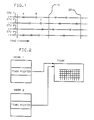
- This is illustrated in Fig. 1.
- an MP checkpoint is a cumulative event. It is the result of each relevant process checking in at a process checkpoint. Once all processors have checked in in this manner, an MP checkpoint is declared. However, having passed a process checkpoint a processor is not prevented from making a reference to the data object of concern. Thus, in Fig. 1, at point A processor 1 passes a process checkpoint denoted by an "x".
- processor 1 makes a reference to the data object of concern, denoted by an "o".
- subsequent MP Shared references are prevented.
- the next MP checkpoint 10 is passed, and it is clear that even though subsequent MP Shared references to the data object were prevented, it cannot be guaranteed that the other processors completed their references to the data object of concern.
- processor 1 could in fact be referencing the object at MP checkpoint 10. However this guarantee can be given following the next MP checkpoint 20.
- the MP defer work function is invoked to defer work for a period of two MP checkpoints to ensure no previous MP shared references are still held. This function queues the work to be processed by the MP checkpoint processing function. This is discussed in more detail below in connection with the exemplary algorithms for implementation.
- MP checkpoint determination is done on a periodic basis. A check is made to see if all process checkpoint flags are set, i.e. all processors have passed through a process checkpoint since the last MP checkpoint. If they have, then an MP checkpoint is designated, the process checkpoint flags are reset and any deferred work for which two MP checkpoints have occurred is processed.
- Serialisation may be implemented in conjunction with either of two methods.
- the first method is the simpler and more straightforward of the two.
- the second method is one that was actually implemented in conjunction the IBM VM/XA Systems Facility Release 2, which took advantage of existing code that provided convenient process points to use as process checkpoints.
- the MP defer work function is
- the MP determination algorithm is if all process checkpoint flags set then designate MP checkpoint by updating queues transfer q1 to q2 transfer q0 to q1 reset process checkpoint flags dispatch work on q2 endif
- the MP defer work function is
- the MP determination algorithm is tentatively designate MP checkpoint by transferring q0a to qOp do for all actual process checkpoint flags if actual process checkpoint flag set then reset actual process checkpoint flag set shadow process checkpoint flag endif enddo if all shadow process checkpoint flags set then MP checkpoint occurred transfer q1 to q2 transfer q0p to q1 reset shadow process checkpoint flags dispatch work on q2 endif
- q2, q1, and q0p contain the deferred work when the MP checkpoint is designated to have occurred.
- the MP checkpoint is designated earlier than the point that it was recognised because of the requirement that the MP checkpoint occur before any process checkpoint flags get reset.
- q0a is not included in the adjustment of the queues in MP checkpoint processing since q0a is empty at tentative MP checkpoint designation and if it is non-empty then its contents are defers occurring after the MP checkpoint.
- Serialisation was implemented in connection with the VM/XA SF control program in the enhancement of the "SET CPTRACE" command to permit tracing by an individual USERID. This new command is implemented in connection with a trace facility. This implementation is explained in detail below to assist the reader in understanding how to apply serialisation.
- a trace facility is a facility which permits a control program to keep track of all events of a particular kind for a period of time extending back by a predetermined time, on a continuing basis, and stores them in a table. This provides a tool to determine what went wrong if a system has a sudden failure (a "crash"). After a crash, the table wherein the designated events were recorded can be analysed to derive a history of events for the specified time period immediately preceding the crash.
- Examples of the kind of event information stored by a trace facility are information concerning what VMDBKs, virtual machine descriptor blocks, are dispatched, information concerning what task is dispatched, and information concerning the address of a piece of work that is dispatched. That information provides the history of the "dispatcher" portion of the control program.
- Other kinds of information stored by the trace facility are system interruptions, program checks, machine checks and I/O interrupts.
- the kinds of data that are gathered and stored by the trace facility may be individually tailored by a user.
- the means by which this selection, of filtering, is effected is a trace code table. By setting certain bits on or off in the table, selected data can be stored or not stored, as the case may be.
- the trace code table is therefore a data block which embodies the selection criteria associated with a particular virtual machine. More detailed information about the trace facility and the trace code tables may be found in the IBM System/370 Extended Architecture, Principles of Operation , the CP Commands manual, the Diagnosis Guide and the CP Diagnosis Reference manual. Vols. I and II, for the IBM VM/XA Systems Facility Release 2, available from IBM Corporation (Document Nos. SA22-7085, GC19-6215-3, LY27-8044-1, LY27-8045, and LY27-8046, respectively).
- a trace code table may be the common table or a private table, as specified by the SET CPTRACE command.
- the common trace code table is a set of trace criteria used as a common trace setting for most of the system users.
- a private trace code table is a special set of trace criteria used as a trace setting for a specific user for collecting trace information specific to that user.
- a private table is created and destroyed by the SET CPTRACE command.
- the common table is a permanent table and is neither created nor destroyed.
- Fig. 2 illustrates the status of a system having two users, each represented in the system by their respective VMDBKs 1 and 2.
- VMDBK of each user is a field containing a pointer to the common TTABK, trace code table.
- the system operator may have concerns which cause him to want to have separate trace criteria for user 2.
- the system operator therefore executes a command to create a separate, private trace code table.
- the system status following the execution of this command is illustrated in Fig. 3.
- User 2's VMDBK pointer field to TTABK contains a value pointing to the private TTABK just created.
- VM/XA the disclosed entry to the dispatcher and the setting of a flag therein, is considered the process checkpoint.
- MP checkpoint determination is in unresponsive processor detection, a timer driven routine which checks the process checkpoints to detect unresponsive processors, ones which do not set process check points on a timely basis.
- MP defer work is a new routine which places a CPEBK, a unit of work, onto a MP defer queue.
Landscapes
- Engineering & Computer Science (AREA)
- Software Systems (AREA)
- Theoretical Computer Science (AREA)
- Physics & Mathematics (AREA)
- General Engineering & Computer Science (AREA)
- General Physics & Mathematics (AREA)
- Hardware Redundancy (AREA)
- Multi Processors (AREA)
Claims (5)
- Bei einem zum Arbeiten unter einem Steuerprogramm angepaßten Multiverarbeitungssystem ein Verfahren zum Serialisieren von Systemereignissen, gekennzeichnet durch die Schritte:
a) Ermöglichen, dass Prozesse gewisse Ausführungsintervalle beginnen und beenden, wobei die Intervalle Systemereignisse ohne ihre explizite Anzeige darstellen,b) Überwachen eines oder mehrerer Ausführungspunkte (A, C) des Steuerprogrammes, wobei zumindest einer dieser Punkte regelmäßig in jeder Prozeßausführung auftritt und dieser in keinem der gewissen Intervalle jenes Prozesses enthalten ist,c) Festsetzen eines Systemreferenzpunktes (20), der auftritt, nachdem jeder Prozeß in dem System den zumindest einen Ausführungspunkt (A, C) zumindest einmal seit dem letzten solchen Systemreferenzpunkt (10) überschritten hat undd) Bestimmen der Ausführungsbeendigung irgendeines im Augenblick aktiven Intervalles durch warten auf zwei der Systemreferenzpunkte (10, 20) , daß sie anschließend auftreten: - Bei einem Multiverarbeitungssytem mit einem Steuerprogramm, in welchem Datenobjekte unter Prozessen gemeinsam benutzt sind und gemeinsam benutzte Zugriffsreferenzen auf jene Datenobjekte ohne die Forderung einer gemeinsam benutzten Sperre zugelassen sind , ein Verfahren zum Verhindern ungültiger Referenzen auf ein Datenobjekt durch irgendeinen Prozeß, wenn eine geforderte Operation, die einen exklusiven Zugriff auf das Datenobjekt erfordert, durch einen anderen Prozeß durchgeführt wird, welches die folgenden Schritte aufweist:
a) Überwachen eines Ausführungspunktes (A, C) des allen Prozessen (CPU1, CPU2) in dem System gemeinsamen Steuerprogramms, der regelmäßig in der Prozeß-Ausführung auftritt und durch den keine Referenzen auf irgendein Datenobjekt durch irgendeinen Prozeß, ausgenommenen Referenzen unter Verwendung von Sperren, aufrechterhalten werden können,b) Festsetzen eines Systemreferenzpunktes (20), der auftritt, nachdem jeder Prozeß in dem System den Ausführungspunkt (A, C) zumindest einmal seit dem letzten solchen Systemreferenzpunkt (10) überschritten hat, durch periodisches Bestimmen, welche Prozesse den überwachten Ausführungspunkt seit dein letzten Systemreferenzpunkt (20) überschritten haben, wenn bestimmt wird, daß alle Systemprozesse (CPU1, CPU2] den Systemrefenzpunkt so überschritten haben,c) Fordern einer Operation, die einen exklusiven Zugriff auf ein ausgewähltes Datenobjekt erfordert,d) Verhindern einer anschließenden Referenz durch andere Prozesse auf das ausgewählte Datenobjekt,e) Warten, bis zwei Systemreferenzpunkte aufgetreten sind undf) anschließendes Durchführen der geforderten Operation. - Verfahren nach Anspruch 2, bei welchem der Schritt zum Überwachen durch Setzen einer Booleschen Variable in einem Speicherbereich des Systems durchgeführt wird, wenn bestimmt wird, daß der Ausführungspunkt für jeden Prozeß überschritten wurde.
- Verfahren nach Anspruch 3, bei welchem der Schritt zum Festsetzen eines Systemreferenzpunktes durch periodisches Bestimmen durchgeführt wird, ob alle Boolesche Variablen für jeden Prozeß in dem System seit dem letzten Systemreferenzpunkt gesetzt wurden.
- Verfahren nach Anspruch 4, bei welchem der Schritt zum Festsetzen eines Systemreferenzpunktes ferner zuerst durch Rücksetzen aller Booleschen Variablen, nachdem bestimmt wurde , daß alle Booleschen Variablen für jeden Prozeß in dem System seit dem letzten Systemreferenzpunkt gesetzt wurden und sodann durch Festsetzen des augenblicklichen Systemreferenzpunktes durchgeführt wird.
Applications Claiming Priority (2)
| Application Number | Priority Date | Filing Date | Title |
|---|---|---|---|
| US06/920,002 US4809168A (en) | 1986-10-17 | 1986-10-17 | Passive serialization in a multitasking environment |
| US920002 | 1986-10-17 |
Publications (3)
| Publication Number | Publication Date |
|---|---|
| EP0264568A2 EP0264568A2 (de) | 1988-04-27 |
| EP0264568A3 EP0264568A3 (en) | 1988-09-21 |
| EP0264568B1 true EP0264568B1 (de) | 1991-12-18 |
Family
ID=25443000
Family Applications (1)
| Application Number | Title | Priority Date | Filing Date |
|---|---|---|---|
| EP87111951A Expired - Lifetime EP0264568B1 (de) | 1986-10-17 | 1987-08-18 | Reihenweise Anordnung von Systemereignissen in einem Multiprozessorsystem |
Country Status (4)
| Country | Link |
|---|---|
| US (1) | US4809168A (de) |
| EP (1) | EP0264568B1 (de) |
| JP (1) | JPS63109541A (de) |
| DE (1) | DE3775332D1 (de) |
Families Citing this family (41)
| Publication number | Priority date | Publication date | Assignee | Title |
|---|---|---|---|---|
| US5062039A (en) * | 1988-09-07 | 1991-10-29 | International Business Machines Corp. | Sharing of workspaces in interactive processing using workspace name tables for linking of workspaces |
| US5129084A (en) * | 1989-06-29 | 1992-07-07 | Digital Equipment Corporation | Object container transfer system and method in an object based computer operating system |
| US5029169A (en) * | 1989-07-11 | 1991-07-02 | Bell Communications Research, Inc. | Methods and apparatus for fault detection |
| US5261099A (en) * | 1989-08-24 | 1993-11-09 | International Business Machines Corp. | Synchronous communications scheduler allowing transient computing overloads using a request buffer |
| JPH07101410B2 (ja) * | 1990-01-17 | 1995-11-01 | インターナショナル、ビジネス、マシーンズ、コーポレーション | データ処理ネットワークにおいて逐次化手段の試験のため命令流の実行を同期させる方法 |
| US5247672A (en) * | 1990-02-15 | 1993-09-21 | International Business Machines Corporation | Transaction processing system and method with reduced locking |
| US5280619A (en) * | 1990-05-17 | 1994-01-18 | Texas Instruments Incorporated | System for accessing shared data using a serialization graph constructed from a history file showing completed locking dependencies between transactions |
| US5109512A (en) * | 1990-05-31 | 1992-04-28 | International Business Machines Corporation | Process for dispatching tasks among multiple information processors |
| US5418937A (en) * | 1990-11-30 | 1995-05-23 | Kabushiki Kaisha Toshiba | Master-slave type multi-processing system with multicast and fault detection operations having improved reliability |
| US5276835A (en) * | 1990-12-14 | 1994-01-04 | International Business Machines Corporation | Non-blocking serialization for caching data in a shared cache |
| US5287473A (en) * | 1990-12-14 | 1994-02-15 | International Business Machines Corporation | Non-blocking serialization for removing data from a shared cache |
| JPH07191944A (ja) * | 1991-09-11 | 1995-07-28 | Internatl Business Mach Corp <Ibm> | 多重プロセッサによる多数の資源への命令におけるデッドロックを防止するためのシステムおよび方法 |
| US5430860A (en) * | 1991-09-17 | 1995-07-04 | International Business Machines Inc. | Mechanism for efficiently releasing memory lock, after allowing completion of current atomic sequence |
| JP2781092B2 (ja) * | 1991-11-06 | 1998-07-30 | 富士通株式会社 | システム間排他制御方式 |
| US5640563A (en) * | 1992-01-31 | 1997-06-17 | International Business Machines Corporation | Multi-media computer operating system and method |
| US5388266A (en) * | 1992-03-30 | 1995-02-07 | International Business Machines Corporation | Management of data objects used intain state information for shared data at a local complex |
| US5392433A (en) * | 1992-09-25 | 1995-02-21 | International Business Machines Corporation | Method and apparatus for intraprocess locking of a shared resource in a computer system |
| US5675796A (en) * | 1994-04-08 | 1997-10-07 | Microsoft Corporation | Concurrency management component for use by a computer program during the transfer of a message |
| US5560018A (en) * | 1994-12-16 | 1996-09-24 | International Business Machines Corporation | Providing external interrupt serialization compatibility in a multiprocessing environment for software written to run in a uniprocessor environment |
| US6182108B1 (en) | 1995-01-31 | 2001-01-30 | Microsoft Corporation | Method and system for multi-threaded processing |
| US6247039B1 (en) | 1996-05-17 | 2001-06-12 | Sun Microsystems, Inc. | Method and apparatus for disposing of objects in a multi-threaded environment |
| AU3733897A (en) * | 1996-07-22 | 1998-02-10 | Cabletron Systems, Inc. | Method and apparatus for coordination of a shared object in a distributed system |
| JPH10320205A (ja) * | 1997-05-20 | 1998-12-04 | Fujitsu Ltd | 情報処理装置 |
| US6026401A (en) * | 1997-10-14 | 2000-02-15 | International Business Machines Corporation | Locking tool data objects in a framework environment |
| US6119219A (en) * | 1998-04-30 | 2000-09-12 | International Business Machines Corporation | System serialization with early release of individual processor |
| US6079013A (en) * | 1998-04-30 | 2000-06-20 | International Business Machines Corporation | Multiprocessor serialization with early release of processors |
| US6356946B1 (en) | 1998-09-02 | 2002-03-12 | Sybase Inc. | System and method for serializing Java objects in a tubular data stream |
| US6295602B1 (en) * | 1998-12-30 | 2001-09-25 | Spyrus, Inc. | Event-driven serialization of access to shared resources |
| US6438559B1 (en) | 1999-04-02 | 2002-08-20 | Sybase, Inc. | System and method for improved serialization of Java objects |
| GB2348718A (en) * | 1999-04-07 | 2000-10-11 | Ibm | Data processing system having a centralised trace facility with dynamic tracing |
| US6487622B1 (en) | 1999-10-28 | 2002-11-26 | Ncr Corporation | Quorum arbitrator for a high availability system |
| US7472230B2 (en) * | 2001-09-14 | 2008-12-30 | Hewlett-Packard Development Company, L.P. | Preemptive write back controller |
| US8244622B2 (en) * | 2002-06-05 | 2012-08-14 | The Nasdaq Omx Group, Inc. | Order matching process and method |
| US9311673B2 (en) * | 2002-06-05 | 2016-04-12 | Nasdaq, Inc. | Security transaction matching |
| US7895112B2 (en) * | 2002-06-05 | 2011-02-22 | The Nasdaq Omx Group, Inc. | Order book process and method |
| US8849767B1 (en) * | 2005-04-13 | 2014-09-30 | Netapp, Inc. | Method and apparatus for identifying and eliminating duplicate data blocks and sharing data blocks in a storage system |
| US20070067770A1 (en) * | 2005-09-16 | 2007-03-22 | Thomasson Christopher M | System and method for reduced overhead in multithreaded programs |
| JP2009025939A (ja) * | 2007-07-18 | 2009-02-05 | Renesas Technology Corp | タスク制御方法及び半導体集積回路 |
| US10262365B2 (en) | 2012-04-16 | 2019-04-16 | Nasdaq Technology Ab | Method and a computerized exchange system for processing trade orders |
| US10877992B2 (en) | 2017-11-30 | 2020-12-29 | International Business Machines Corporation | Updating a database |
| US11175802B2 (en) * | 2018-09-21 | 2021-11-16 | Sap Se | Configuration object deletion manager |
Family Cites Families (10)
| Publication number | Priority date | Publication date | Assignee | Title |
|---|---|---|---|---|
| US3573736A (en) * | 1968-01-15 | 1971-04-06 | Ibm | Interruption and interlock arrangement |
| US3947823A (en) * | 1973-12-26 | 1976-03-30 | International Business Machines Corp. | Means for coordinating asynchronous main store accesses in a multiprocessing system using virtual storage |
| US4318174A (en) * | 1975-12-04 | 1982-03-02 | Tokyo Shibaura Electric Co., Ltd. | Multi-processor system employing job-swapping between different priority processors |
| US4224664A (en) * | 1976-05-07 | 1980-09-23 | Honeywell Information Systems Inc. | Apparatus for detecting when the activity of one process in relation to a common piece of information interferes with any other process in a multiprogramming/multiprocessing computer system |
| US4189771A (en) * | 1977-10-11 | 1980-02-19 | International Business Machines Corporation | Method and means for the detection of deadlock among waiting tasks in a multiprocessing, multiprogramming CPU environment |
| US4354227A (en) * | 1979-11-19 | 1982-10-12 | International Business Machines Corp. | Fixed resource allocation method and apparatus for multiprocessor systems having complementarily phased cycles |
| US4384324A (en) * | 1980-05-06 | 1983-05-17 | Burroughs Corporation | Microprogrammed digital data processing system employing tasking at a microinstruction level |
| JPS58169659A (ja) * | 1982-03-30 | 1983-10-06 | Fujitsu Ltd | 共用ロツク制御方式 |
| JPS6079460A (ja) * | 1983-10-07 | 1985-05-07 | Nec Corp | 密結合多重演算装置における制御方式 |
| US4604694A (en) * | 1983-12-14 | 1986-08-05 | International Business Machines Corporation | Shared and exclusive access control |
-
1986
- 1986-10-17 US US06/920,002 patent/US4809168A/en not_active Expired - Fee Related
-
1987
- 1987-08-18 DE DE8787111951T patent/DE3775332D1/de not_active Expired - Lifetime
- 1987-08-18 EP EP87111951A patent/EP0264568B1/de not_active Expired - Lifetime
- 1987-09-17 JP JP62231257A patent/JPS63109541A/ja active Granted
Non-Patent Citations (1)
| Title |
|---|
| "An Introduction to Database Systems", C.J. Date, Addison-Wesley, 1985, pages 85, 86 and 96. * |
Also Published As
| Publication number | Publication date |
|---|---|
| EP0264568A2 (de) | 1988-04-27 |
| US4809168A (en) | 1989-02-28 |
| DE3775332D1 (de) | 1992-01-30 |
| JPH0528853B2 (de) | 1993-04-27 |
| JPS63109541A (ja) | 1988-05-14 |
| EP0264568A3 (en) | 1988-09-21 |
Similar Documents
| Publication | Publication Date | Title |
|---|---|---|
| EP0264568B1 (de) | Reihenweise Anordnung von Systemereignissen in einem Multiprozessorsystem | |
| US4663709A (en) | Control system for tightly-coupled multiprocessing units | |
| US5442758A (en) | Apparatus and method for achieving reduced overhead mutual exclusion and maintaining coherency in a multiprocessor system utilizing execution history and thread monitoring | |
| US4387427A (en) | Hardware scheduler/dispatcher for data processing system | |
| US5742785A (en) | Posting multiple reservations with a conditional store atomic operations in a multiprocessing environment | |
| Goodman | Cache consistency and sequential consistency | |
| US5623670A (en) | Method and apparatus for crash safe enforcement of mutually exclusive access to shared resources in a multitasking computer system | |
| JP2514299B2 (ja) | プロセスレベルプログラミングのための割込み処理の直列化方法 | |
| US8990510B2 (en) | Read-copy update system and method | |
| US5937187A (en) | Method and apparatus for execution and preemption control of computer process entities | |
| US6697834B1 (en) | Mutual exculsion system and method for restarting critical sections of code when preempted during a critical section | |
| EP1031925B1 (de) | Kooperative Verarbeitung von Aufgaben in einem Multithread-Rechnersystem | |
| EP0887730A1 (de) | Verfahren zum Erzeugen von exklusivem Zugang zu Betriebsmitteln in einem Multiprozessor-Rechnersystem | |
| US20080243887A1 (en) | Exclusion control | |
| Michael et al. | Relative performance of preemption-safe locking and non-blocking synchronization on multiprogrammed shared memory multiprocessors | |
| DE10063915A1 (de) | Informationsverarbeitungsgerät, das eine Mehrzweckverarbeitung und Transaktionsverarbeitung ausführt | |
| WO1992003779A1 (en) | Method of efficient communication between coprocessors | |
| EP0445954A2 (de) | Synchronisierung nebeneinander laufender Prozesse in einem Rechnersystem | |
| Son | Scheduling real-time transactions | |
| Son et al. | Predictability and consistency in real-time database systems | |
| JP3422504B2 (ja) | タスク間排他制御方法 | |
| JP2590282B2 (ja) | システム実行履歴収集処理方式 | |
| Islam et al. | Uniform Co-Scheduling Using Object-Oriented Design Techniques. | |
| JP3764282B2 (ja) | プログラム制御システムの制御装置 | |
| Unger et al. | Jade virtual time implementation manual |
Legal Events
| Date | Code | Title | Description |
|---|---|---|---|
| PUAI | Public reference made under article 153(3) epc to a published international application that has entered the european phase |
Free format text: ORIGINAL CODE: 0009012 |
|
| AK | Designated contracting states |
Kind code of ref document: A2 Designated state(s): DE FR GB IT |
|
| PUAL | Search report despatched |
Free format text: ORIGINAL CODE: 0009013 |
|
| AK | Designated contracting states |
Kind code of ref document: A3 Designated state(s): DE FR GB IT |
|
| 17P | Request for examination filed |
Effective date: 19880823 |
|
| 17Q | First examination report despatched |
Effective date: 19900320 |
|
| GRAA | (expected) grant |
Free format text: ORIGINAL CODE: 0009210 |
|
| AK | Designated contracting states |
Kind code of ref document: B1 Designated state(s): DE FR GB IT |
|
| PG25 | Lapsed in a contracting state [announced via postgrant information from national office to epo] |
Ref country code: IT Free format text: LAPSE BECAUSE OF FAILURE TO SUBMIT A TRANSLATION OF THE DESCRIPTION OR TO PAY THE FEE WITHIN THE PRESCRIBED TIME-LIMIT;WARNING: LAPSES OF ITALIAN PATENTS WITH EFFECTIVE DATE BEFORE 2007 MAY HAVE OCCURRED AT ANY TIME BEFORE 2007. THE CORRECT EFFECTIVE DATE MAY BE DIFFERENT FROM THE ONE RECORDED. Effective date: 19911218 |
|
| ET | Fr: translation filed | ||
| REF | Corresponds to: |
Ref document number: 3775332 Country of ref document: DE Date of ref document: 19920130 |
|
| PLBE | No opposition filed within time limit |
Free format text: ORIGINAL CODE: 0009261 |
|
| STAA | Information on the status of an ep patent application or granted ep patent |
Free format text: STATUS: NO OPPOSITION FILED WITHIN TIME LIMIT |
|
| 26N | No opposition filed | ||
| PGFP | Annual fee paid to national office [announced via postgrant information from national office to epo] |
Ref country code: GB Payment date: 19950726 Year of fee payment: 9 |
|
| PGFP | Annual fee paid to national office [announced via postgrant information from national office to epo] |
Ref country code: FR Payment date: 19950807 Year of fee payment: 9 |
|
| PGFP | Annual fee paid to national office [announced via postgrant information from national office to epo] |
Ref country code: DE Payment date: 19950821 Year of fee payment: 9 |
|
| PG25 | Lapsed in a contracting state [announced via postgrant information from national office to epo] |
Ref country code: GB Effective date: 19960818 |
|
| GBPC | Gb: european patent ceased through non-payment of renewal fee |
Effective date: 19960818 |
|
| PG25 | Lapsed in a contracting state [announced via postgrant information from national office to epo] |
Ref country code: FR Effective date: 19970430 |
|
| PG25 | Lapsed in a contracting state [announced via postgrant information from national office to epo] |
Ref country code: DE Effective date: 19970501 |
|
| REG | Reference to a national code |
Ref country code: FR Ref legal event code: ST |