EP0264786A2 - Festkörperkondensator mit einem elektrisch leitfähigen Polymeren als Bestandteil des Festelektrolyten - Google Patents
Festkörperkondensator mit einem elektrisch leitfähigen Polymeren als Bestandteil des Festelektrolyten Download PDFInfo
- Publication number
- EP0264786A2 EP0264786A2 EP87114955A EP87114955A EP0264786A2 EP 0264786 A2 EP0264786 A2 EP 0264786A2 EP 87114955 A EP87114955 A EP 87114955A EP 87114955 A EP87114955 A EP 87114955A EP 0264786 A2 EP0264786 A2 EP 0264786A2
- Authority
- EP
- European Patent Office
- Prior art keywords
- solid
- capacitor according
- state capacitor
- dielectric
- conductive polymer
- Prior art date
- Legal status (The legal status is an assumption and is not a legal conclusion. Google has not performed a legal analysis and makes no representation as to the accuracy of the status listed.)
- Ceased
Links
Images
Classifications
-
- H—ELECTRICITY
- H01—ELECTRIC ELEMENTS
- H01G—CAPACITORS; CAPACITORS, RECTIFIERS, DETECTORS, SWITCHING DEVICES, LIGHT-SENSITIVE OR TEMPERATURE-SENSITIVE DEVICES OF THE ELECTROLYTIC TYPE
- H01G9/00—Electrolytic capacitors, rectifiers, detectors, switching devices, light-sensitive or temperature-sensitive devices; Processes of their manufacture
- H01G9/004—Details
- H01G9/022—Electrolytes; Absorbents
- H01G9/025—Solid electrolytes
-
- H—ELECTRICITY
- H01—ELECTRIC ELEMENTS
- H01G—CAPACITORS; CAPACITORS, RECTIFIERS, DETECTORS, SWITCHING DEVICES, LIGHT-SENSITIVE OR TEMPERATURE-SENSITIVE DEVICES OF THE ELECTROLYTIC TYPE
- H01G11/00—Hybrid capacitors, i.e. capacitors having different positive and negative electrodes; Electric double-layer [EDL] capacitors; Processes for the manufacture thereof or of parts thereof
- H01G11/22—Electrodes
- H01G11/30—Electrodes characterised by their material
- H01G11/48—Conductive polymers
-
- H—ELECTRICITY
- H01—ELECTRIC ELEMENTS
- H01G—CAPACITORS; CAPACITORS, RECTIFIERS, DETECTORS, SWITCHING DEVICES, LIGHT-SENSITIVE OR TEMPERATURE-SENSITIVE DEVICES OF THE ELECTROLYTIC TYPE
- H01G11/00—Hybrid capacitors, i.e. capacitors having different positive and negative electrodes; Electric double-layer [EDL] capacitors; Processes for the manufacture thereof or of parts thereof
- H01G11/54—Electrolytes
- H01G11/56—Solid electrolytes, e.g. gels; Additives therein
-
- C—CHEMISTRY; METALLURGY
- C08—ORGANIC MACROMOLECULAR COMPOUNDS; THEIR PREPARATION OR CHEMICAL WORKING-UP; COMPOSITIONS BASED THEREON
- C08G—MACROMOLECULAR COMPOUNDS OBTAINED OTHERWISE THAN BY REACTIONS ONLY INVOLVING UNSATURATED CARBON-TO-CARBON BONDS
- C08G2261/00—Macromolecular compounds obtained by reactions forming a carbon-to-carbon link in the main chain of the macromolecule
- C08G2261/30—Monomer units or repeat units incorporating structural elements in the main chain
- C08G2261/31—Monomer units or repeat units incorporating structural elements in the main chain incorporating aromatic structural elements in the main chain
- C08G2261/312—Non-condensed aromatic systems, e.g. benzene
-
- Y—GENERAL TAGGING OF NEW TECHNOLOGICAL DEVELOPMENTS; GENERAL TAGGING OF CROSS-SECTIONAL TECHNOLOGIES SPANNING OVER SEVERAL SECTIONS OF THE IPC; TECHNICAL SUBJECTS COVERED BY FORMER USPC CROSS-REFERENCE ART COLLECTIONS [XRACs] AND DIGESTS
- Y02—TECHNOLOGIES OR APPLICATIONS FOR MITIGATION OR ADAPTATION AGAINST CLIMATE CHANGE
- Y02E—REDUCTION OF GREENHOUSE GAS [GHG] EMISSIONS, RELATED TO ENERGY GENERATION, TRANSMISSION OR DISTRIBUTION
- Y02E60/00—Enabling technologies; Technologies with a potential or indirect contribution to GHG emissions mitigation
- Y02E60/13—Energy storage using capacitors
Definitions
- the invention relates to a solid-state capacitor with a positive and a negative electrode, a dielectric and a solid electrolyte, and to a method for producing the solid electrolyte in a dear-like solid-state capacitor.
- Electrolytic capacitors with wet electrolytes have a number of disadvantages, e.g. Temperature dependency of the electrical values, unfavorable frequency behavior of the impedance, unsatisfactory residual current behavior and in particular permeation can be observed which reduces the life of the capacitor.
- the solvent can evaporate in an uncontrolled manner, which can lead to the explosive destruction of the capacitor.
- attempts have been made to replace the wet electrolyte with a solid electrolyte.
- manganese dioxide has been used as a solid electrolyte.
- manganese dioxide has negative effects on the oxide layers of metals which are frequently used as a dielectric, so that a very complex post-oxidation is necessary.
- Solid-state capacitors in which salts of 7,7,8,8-tetracyanoquinodimethane (TCNQ) are used as the solid electrolyte instead of manganese dioxide, have a number of advantages over capacitors with wet electrolytes.
- TCNQ salt is usually applied in the molten state to the oxidized metal surface, which serves as a dielectric. Since TCNQ salts have a relatively high melting temperature and decompose in the molten state after a few seconds, losing their conductivity, a corresponding production process is relatively difficult and complex. TCNQ salts are also expensive and toxic.
- capacitors which contain a polyacrylonitrile which contains LiClO4 as the solid electrolyte.
- electrically conductive polymers they should not really be referred to as such, since the polymer itself does not contribute to the electrical conductivity in such systems.
- a solid-state capacitor with a positive and a negative electrode, a dielectric and a solid electrolyte which is characterized in that the solid electrolyte contains an intrinsically conductive polymer as an essential component.
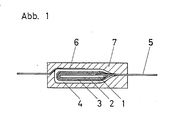
- the drawing shows an embodiment of a capacitor according to the invention in section.
- An oxidized aluminum plate 1 is surrounded by a polypyrrole layer 2.
- Contact is made to the outside via the positive or negative connection strips 5 or 6.
- the element is surrounded by an epoxy resin housing 7.
- the electrically conductive polymers which are used in the capacitors according to the invention are so-called intrinsically conductive polymers, i.e. Polymers whose conductivity is based on electron migration in the polymer and not on the electrical conductivity of salts. In the conductive (doped) state, these polymers contain embedded counterions of only one charge type, but not embedded salts, in order to achieve charge neutrality.
- the intrinsically conductive polymers used according to the invention are simply referred to below as electrically conductive polymers.
- p- and n-type polymers are suitable as electrically conductive polymers.
- the electrical conductivities of the polymers are generally in the range from 10 ⁇ 3 to 104 S / cm, preferably in the range from 10 ⁇ 3 to 5 ⁇ 103 S / cm and particularly preferably in the range from 10 ⁇ 2 to 103 S / cm.
- Preferred electrically (intrinsically) conductive polymers are doped (complexed, intercalated) pyrrole, aniline, furan or thiophene polymers, but other electrically conductive polymers known per se, such as polyacetylenes and poly-p-phenylenes, are in principle also suitable. P-doped polymers of pyrrole and aniline have proven to be particularly advantageous.
- the polymers of pyrrole include e.g. very generally homo- and copolymers of pyrrole and substituted pyrroles, and copolymers of these monomers with other comonomers.
- Such pyrrole polymers preferably contain 50 to 99% by weight of pyrrole and 1 to 50% by weight of substituted pyrroles and / or other comonomers.
- the second group of particularly preferred polymers are polymers of aniline, i.e. Homopolymers of aniline or substituted aniline derivatives or copolymers of these monomers with other monomers.
- Such polymers and their properties are known per se and e.g. E.M. Genies et al, Mol. Cryst. Liq. Cryst. (1985), Vol. 121, pp. 181-186, A.G. McDiarmid et al, l.c. Vol. 121, pp. 173-180.
- the capacitors according to the invention contain a metallic positive electrode and an oxide layer thereon as a dielectric.
- the capacitors according to the invention can have the form of a wound capacitor with a metal foil, in particular an aluminum foil as the positive electrode and an oxide layer thereon as the dielectric. Between this metal foil provided with a dielectric oxide layer and another Metal foil, which serves as a negative electrode, is arranged at least one separating film coated with the conductive polymer, preferably made of carbonized paper.
- capacitors according to the invention can also be produced in the form of so-called chip capacitors.
- an oxide layer is applied as a dielectric on a metal plate, preferably made of aluminum or a metallic sintered body, preferably a tantalum sintered body.
- a layer of electrically conductive polymers is applied to the dielectric oxide layer of this metal plate or metallic sintered body.
- the thickness of this layer is generally in the range from 10 ⁇ 2 to 200 microns, preferably from 0.1 to 150 microns and in particular from 1 to 100 microns. In some cases, layer thicknesses of 10 to 100 ⁇ m, in particular 20 to 100 ⁇ m, have proven to be advantageous.
- the capacitor elements Regardless of the special structure of the capacitor, it has generally been found that it is advantageous to provide the capacitor elements with a sealing sheath.
- the main purpose of this is to exclude the ingress of air humidity and oxygen, which can have negative effects on the electrically conductive polymers and the capacitor as such.
- the process according to the invention for producing solid-state capacitors according to claims 1-11 or their components is characterized in that the electrode materials, the dielectric and / or a separating film are coated with monomers which are capable of forming an electrically conductive polymer and an oxidizing agent and the Monomers polymerized thereby.
- the solvent is advantageously evaporated off after the polymerization.
- the electrically conductive polymer is produced in the presence of a film of carbonizable or carbonized paper.
- a film of carbonizable or carbonized paper This can be done, for example, by exposing a conventional, dry capacitor winding with a paper thickness of preferably 30 to 50 ⁇ m over a period of 20 to 30 hours to a temperature of 300 ° C., the carbonizable paper forming the separating film being carbonized.
- the electrical resistance of the Condenser paper lowers and on the other hand facilitates the introduction of a polymer layer between the two metal foils.
- the monomer dissolved in a suitable solvent can then be applied, for example by immersing the winding element in the corresponding solution.
- the oxidizing agent can be applied in a similar manner, but it is also sufficient to apply a solution of a suitable oxidizing agent to the end face of the winding, which solution then diffuses into the interior of the winding.
- the capacitor element After polymerization and optionally drying, i.e. Removal of the solvent, the capacitor element can be equipped with a sealing sleeve. To do this, insert it into an aluminum cup, for example, and coat it with epoxy resin.
- the electrically conductive polymer which forms the essential component of the solid electrolyte, is applied to an oxide layer of a capacitor according to the invention, which serves as a dielectric.
- this can be done by contacting the oxidized surface with the monomer and a suitable oxidizing agent.
- a suitable oxidizing agent e.g., benzyl sulfate
- the coating process can optionally be repeated several times.
- a graphite and / or a conductive silver coating can then be applied as a cathodic connection to the layer of electrically conductive polymers.
- housings made of essentially gas-impermeable plastics can be used for this purpose.
- Oxygen-containing oxidizing agents are advantageously used as oxidizing agents for the production of the electrically conductive polymers, which oxidizing agents can generally be used in amounts of 0.1 to 2 mol, based on 1 mol of the compound to be polymerized. Larger amounts of oxidizing agent are not necessary and also not advantageous, since on the one hand the above-mentioned amount is usually sufficient to convert the entire monomers into polymers and, on the other hand, an excessive amount of oxidizing agent can lead to uneven polymerization.
- peroxo acids and their salts such as peroxodisulfuric acid and their alkali and ammonium salts
- peroxoborates, perchlorates or peroxochromates such as sodium perborate, potassium dichromate or iron perchlorate and copper perchlorate
- Permanganates such as potassium permanganate are also suitable if small amounts of acids are added to them.
- Hydrogen peroxide can also be used as an oxidizing agent, the presence of conductive salts generally being very advantageous here.
- Other suitable oxidizing agents are strong Lewis acids such as FeCl3, AsF5 and SbF5.
- conductive salts are KHSO4, Na2SO4, HCOOH, LiClO4, HClO4, NEtClO4, NBu4ClO4, KAlF3, NaAlF6, KBF4, K2ZrF6, H2SO4, NOPF6, KAsF6 and NaPF6.
- concentration of these conductive salts is advantageously such that at least 1 mol of these conductive salts are used per 3 mol of the monomers used.
- the concentration of the monomers in these solvents is generally in the range from 10 ⁇ 5 to 10 ⁇ 1, preferably from 5 ⁇ 10 ⁇ 4 to 10 ⁇ 2 and the concentration of the oxidizing agent is measured according to the above criteria.
- Water / methanol mixtures have been found to be particularly preferred for the polymerization from the liquid phase, and sodium peroxodisulfate as the oxidizing agent.
- Solution A was prepared from 5 vol% pyrrole and 95 vol% methanol.
- solution B 0.5 g of sodium peroxodisulfate (Na2S2O8) was dissolved in 3 ml of water and 7 ml of methanol.
- An aluminum plate measuring 4 ⁇ 4 mm with welded-on contact strips was electrochemically oxidized using a method known per se, corresponding to the anode foil of a 40 V capacitor.
- One drop each of the two solutions A and B was placed on the metal plate prepared in this way. After about 10 minutes the polymerization was complete and the solvent was evaporated.
- This coating process was carried out a total of 3 times, a 30 to 40 ⁇ m thick polypyrrole layer having a conductivity of approximately 0.2 S / cm being obtained.
- the polypyrrole layer was provided with a graphite and conductive silver coating and a connecting strip.
- the capacitor element obtained was then sealed with an epoxy resin coating (the construction of this capacitor corresponds to that shown in the figure).
- the solid-state capacitor had a capacitance of 2.0 ⁇ F and a loss factor of 0.06 at 100 Hz and 20 ° C.
- the residual current after one minute at a voltage of 10 V was 1.3 ⁇ A.
- An electrolytic capacitor of comparable geometry with liquid electrolytes had a capacitance of 2.0 ⁇ F, a loss factor of 0.107 and a residual current of 0.8 ⁇ A under the same measuring conditions.
Landscapes
- Engineering & Computer Science (AREA)
- Power Engineering (AREA)
- Chemical & Material Sciences (AREA)
- Chemical Kinetics & Catalysis (AREA)
- Electrochemistry (AREA)
- Microelectronics & Electronic Packaging (AREA)
- Materials Engineering (AREA)
- Polyoxymethylene Polymers And Polymers With Carbon-To-Carbon Bonds (AREA)
- Primary Cells (AREA)
- Conductive Materials (AREA)
- Secondary Cells (AREA)
- Electric Double-Layer Capacitors Or The Like (AREA)
Abstract
Description
- Die Erfindung betrifft einen Festkörperkondensator mit einer positiven und einer negativen Elektrode, einem Dielektrikum und einem Festelektrolyten sowie ein Verfahren zur Herstellung des Festelektrolyten in einem dearartigen Festkörperkondensator.
- Elektrolytkondensatoren mit Naßelektrolyten weisen eine Reihe von Nachteilen auf, z.B. Temperaturabhängigkeit der elektrischen Werte, ungünstiges Frequenzverhalten des Scheinwiderstandes, nichtzufriedenstellendes Reststromverhalten und insbesondere ist eine Permeation zu beobachten, die die Lebensdauer des Kondensators verringert. Darüber hinaus kann bei Überlastung von Naßelektrolytkondensatoren das Lösungsmittel unkontrolliert verdampfen, was zur explosionsartigen Zerstörung des Kondensators führen kann. Zur Vermeidung dieser Nachteile wurde versucht, den Naßelektrolyten durch einen Festelektrolyten zu ersetzen. So ist beispielsweise Mangandioxid als Festelektrolyt eingesetzt worden. Mangandioxid hat jedoch negative Auswirkungen auf die häugig als Dielektrikum verwendeten Oxidschichten von Metallen, so daß eine sehr aufwendige Nachoxidation notwendig wird.
- Festkörperkondensatoren, bei denen anstelle von Mangandioxid Salze von 7,7,8,8-Tetracyanochinodimethan (TCNQ) als Festelektrolyt verwendet werden, weisen eine Reihe von Vorteilen gegenüber Kondensatoren mit Naßelektrolyten auf. Bei ihrer Herstellung ergeben sich jedoch Schwierigkeiten. Üblicherweise wird das TCNQ-Salz in geschmolzenem Zustand auf die oxidierte Metalloberfläche, die als Dielektrikum dient, aufgebracht. Da TCNQ-Salze eine relativ hohe Schmelztemperatur haben und sich in geschmolzenem Zustand nach wenigen Sekungen zersetzen, wobei sie ihre Leitfähigkeit verlieren, ist ein entsprechendes Herstllungsverfahren relativ schwierig und aufwendig. Ferner sind TCNQ-Salze teuer und toxisch.
- In der US-PS 4 609 671 werden Kondensatoren beschrieben, die als Festelektrolyt ein Polyacrylnitril enthalten, welches LiClO₄ enthält. Zwar werden derartige Systeme als elektrisch leitfähige Polymere bezeichnet, doch sind sie eigentlich nich als solche zu bezeichnen, da das Polymer selbst in derartigen Systemen zur elektrischen Leitfähigkeit nichts beiträgt.
- Die in der US-PS 4 609 671 beschriebenen Kondensatoren weisen den Nachteil auf, daß das dort verwendete Polymer nur schlecht oder mit großem Aufwand in der erforderlichen Form fein verteilt werden kann, um als Festelektrolyt geeignet zu sein.
- Aufgabe der vorliegenden Erfindung war es daher, einen Festkörperkondensator der eingangs genannten Art zu schaffen, der nicht nur gute elektrische Daten und eine ausreichende Lebensdauer aufweist, sondern sich auch auf einfache und preiswerte Weise herstellen läßt.
- Diese Aufgabe wird durch einen Festkörperkondensator mit einer positiven und einer negativen Elektrode, einem Dielektrikum und einem Festelektrolyten gelöst, der dadurch gekennzeichnet ist, daß der Festelektrolyt als wesentlichen Bestandteil ein intrinsisch leitfähiges Polymer enthält.
- Bevorzugte Ausführungsformen erfindungsgemäßer Kondensatoren sind den Unteransprüchen zu entnehmen.
- Die Zeichnung zeigt eine Ausführungsform eines erfindungsgemäßen Kondensatores im Schnitt. Ein oxidiertes Aluminiumplättchen 1 ist von einer Polypyrrolschicht 2 umgeben. Auf dieser Schicht 2 befindet sich ein Graphitüberzug 3 und darüber ein Leitsilberüberzug 4. Über den positiven bzw. negativen Anschlußstreifen 5 bzw. 6 erfolgt die Kontakiertung nach außen. Das Element ist von einem Epoxiharzgehäuse 7 umgeben.
- Bei den elektrisch leitfähigen Polymeren, die in den erfindungsgemäßen Kondensatoren eingesetzt werden, handelt es sich um sogenannte intrinsisch leitfähige Polymere, d.h. Polylmere, deren Leitfähigkeit auf einer Elektronenwanderung im Polymer beruht und nicht auf der elektrischen Leitfähigkeit von Salzen. Im leitfähigen (dotierten) Zustand enthalten diese Polymeren zur Erzielung der Ladungsneutralität eingelagerte Gegenionen nur einer Ladungsart, nicht jedoch eingelagerte Salze.
- Von diesen intrinsisch leitfähigen Polymeren sind Systeme zu unterscheiden, deren Leitfähigkeit auf der durch die Ionen eines Salzes hervorgerufenen Leitfähigkeit beruht und die auf bzw. in einem elektrisch nicht leitenden Polymer, welches quasi als Matrix dient, aufgebracht oder eingelagert sind. In diesen Systemen trägt das Polymer selbt zur elektrischen Leitfähigkeit nichts bei; würde man (was praktisch unmöglich ist) in derartige Polymere wie bei den intrinsisch leitfähigen Systemen nur Gegenionen einer Ladungsart einbringen, so würde überhaupt keine Leitfähigkeit resultieren. Derartige Polymer/Salz-Systeme sind eigentlich nicht als elektrisch leitfähige Polymere zu bezeichnen.
- Aus diesem Grund werden im folgenden die erfindungsgemäß verwendeten intrinsisch leitfähigen Polymeren einfach als elektrisch leitfähige Polymere bezeichnet.
- Als elektrisch leitfähige Polymere eignen sich grundsätzlich p- als auch n-leitende Polymere. Die elektrischen Leitfähigkeiten der Polymeren liegen im allgemeinen im Bereich von 10⁻³ bis zu 10⁴ S/cm, vorzugsweise im Bereich von 10⁻³ bis 5·10³ S/cm und besonders bevorzugt im Bereich von 10⁻² bis 10³ S/cm.
- Bevorzugte elektrisch (intrinsisch) leitfähige Polymere sind dotierte (komplexierte, interkalierte) Pyrrol-, Anilin-, Furan- oder Thiophen- polymere, doch eignen sich grundsätzlich auch andere, an sich bekannte elektrische leitfähige Polymere, wie Polyacetylene und Poly-p-phenylene. Als besonders vorteilhaft haben sich p-dotierte Polymere des Pyrrols und des Anilins erwiesen.
- Zu den Polymeren des Pyrrols zählen z.B. ganz allgemein Homo- und Copolymere von Pyrrol und substituierten Pyrrolen sowie Copolymere dieser Monomeren mit anderen Comonomeren. Nur beispielhaft seien als Monomere Pyrrol und an den C-Atomen Halogen- oder C₁-C₈-Alkyl- oder Alkoxysubstituierte Pyrrole sowie als Comonomere Cylcopentadien, Acetylen, Imidazol, Thiazol, Furan, Thiophen und Pyrazin genannt, wie sie z.B. in der EP-A 36 118 beschrieben werden.
- Vorzugseweise enthalten derartige Pyrrolpolymere 50 bis 99 Gew.% Pyrrol und 1 bis 50 Gew.% substituierte Pyrrole und/oder andere Comonomere.
- Die zweite Gruppe von besonders bevorzugten Polymeren sind Polymere des Anilins, d.h. Homopolymere von Anilin oder substituierten Anilinderivaten oder Copolymere dieser Monomeren mit anderen Monomeren. Derartige Polymere sowie ihre Eigenschaften sind an sich bekannt und z.B. E.M. Genies et al, Mol. Cryst. Liq. Cryst. (1985), Vol. 121, S. 181-186, A.G. McDiarmid et al, l.c. Vol. 121, S. 173-180 beschrieben.
- Gemäß einer bevorzugten Ausführungsform enthalten die erfindungsgemäßen Kondensatoren eine metallische positive Elektrode und eine darauf befindliche Oxidschicht als Dielektrikum.
- So können die erfindungsgemäßen Kondensatoren z.B. die Form eines Wickelkondensators mit einer Metallfolie, insbesondere einer Aluminiumfolie als positiven Elektrode und einer sich darauf befindenden Oxidschicht als Dielektrikum haben. Zwischen dieser mit einer dielektrischen Oxidschicht versehenen Metallfolie und einer weiteren Metallfolie, die als negativ Elektrode dient, ist mindestens eine mit dem leitfähigen Polymer beschichtete Trennfolie, vorzugsweise aus karbonisiertem Papier angeordnet.
- Weiterhin sind die erfindungsgemäßen Kondensatoren auch in Form sogenannter Chip-Kondensatoren herstellbar.
- Dabei wird auf einem Metallplättchen, vorzugsweise aus Aluminium oder einem metallischen Sinterkörper, vorzugsweise einem Tantalsinterkörper, eine Oxidschicht als Dielektrikum aufgebracht. Auf der dielektrischen Oxidschicht dieses Metallplättchens oder metallischen Sinterkörpers ist eine Schicht aus elektrisch leitfähigen Polymeren aufgetragen. Die Dicke dieser Schicht liegt im allgemeinen im Bereich von 10⁻² bis 200 µm, vorzugsweise von 0,1 bis 150 µm und insbesondere von 1 bis 100 µm. In einigen Fällen haben sich Schichtdicken von 10 bis 100, insbesondere von 20 bis 100 µm als vorteilhaft erwiesen.
- Unabhängig vom speziellen Aufbau des Kondensators hat es sich allgemein herausgestellt, daß es von Vorteil ist, die Kondensatorelemente mit einer versiegelnden Hülle zu versehen. Dies hat hauptsächlich den Zweck, das Eindringen von Luftfeuchtigkeit und Sauerstoff auszuschließen, welche negative Einflüsse auf die elektrisch leitfähigen Polymeren und den Kondensator als solchen haben können.
- Das erfindungsgemäße Verfahren zur Herstellung von Festkörperkondensatoren gemäß den Ansprüchen 1 - 11 oder deren Bauelementen ist dadurch gekennzeichnet, daß man die Elektrodenmaterialien, das Dielektrikum und/oder eine Trennfolie mit Monomeren, die ein elektrisch leitfähiges Polymer zu bilden vermögen, und einem Oxidationsmittel beschichtet und die Monomeren dadurch polymerisiert.
- Bei der Polymerisation aus flüssiger Phase wird vorteilhaft im Anschluß an die Polymerisation das Lösungsmittel verdampft.
- Gemäß einer bevorzugten Ausführugnsform des Verfahrens, welches zur Herstellung des Festelektrolyten in Kondensatoren gemäß den Ansprüchen 5 und 6 eingesetzt werden kann, wird das elektrisch leitfähige Polymer in Gegenwart einer Folie aus karbonisierbaren oder karbonisiertem Papier hergestellt. Dies kann z.B. derart erfolgen, daß ein herkömmlicher, trockener Kondensatorwickel mit einer Papierdicke von vorzugsweise 30 bis 50 µm über einen Zeitraum von 20 bis 30 Stunden einer Temperatur von 300°C ausgesetzt wird, wobei das die Trennfolie bildende karbonisierbare Papier karbonisiert wird. Dadurch wird zum einen der elektrische Widerstand des Kondensatorpapiers erniedrigt und zum anderen das Einbringen einer Polymerschicht zwischen die beiden Metallfolien erleichtert.
- Anschließend kann dann das in einem geeigneten Lösungsmittel gelöste Monomer aufgebracht werden, beispielsweise indem man das Wickelelement in die entsprechende Lösung eintaucht. Die Aufbringung des Oxidationsmittels kann auf ähnliche Weise erfolgen, es ist jedoch auch ausreichend, auf die Stirnfläche des Wickels eine Lösung eines geeigneten Oxidationsmittels aufzubringen, welche anschließend in das Innere des Wickels diffundiert.
- Nach erfolgter Polymerisation und gegebenenfalls Trocknung, d.h. Entfernung des Lösungsmittels, kann das Kondensatorelement mit einer versiegelnden Hülle ausgestattet werden. Dazu führt man es beispielsweise in einen Aluminiumbecher ein und umhüllt es mit Epoxidharz.
- In einer Abwandlung des vorstehend beschriebenen Verfahrens ist es grundsätzlich auch möglich, das elektrisch leitfähige Polymer vor der Karbonisierung des Papiers aufzubringen und anschließend die Karbonisierung von Papier mit darauf aufgebrachtem elektrisch leitfähigem Polymer durchzuführen.
- Gemäß einer weiteren Ausführungsform des erfindungsgemäßen Verfahrens wird das elektrisch leitfähige Polymer, welches den wesentlichen Bestandteil des Festelektrolyten bildet, auf einer als Dielektrikum dienenden Oxidschicht eines erfindungsgemäßen Kondensators aufgebracht.
- Dies kann ganz allgemein dadurch erfolgen, daß die oxidierte Oberfläche mit dem Monomer und einem geeigneten Oxidationsmittel in Kontakt gebracht wird. Auch in diesem Fall ist es vorteilhaft, bei Durchführung der Polymerisation in flüssiger Phase das Lösungsmittel nach erfolgter Polymerisation zu verdampfen, z.B. durch Vakuumtrocknung.
- Abhängig von der gewünschten Schichtdicke des leitfähigen Polymers auf der Oxidschicht kann der Beschichtungsprozeß gegebenenfalls mehrmals wiederholt werden. Anschließend kann als kathodische Verbindung auf die Schicht aus elektrisch leitfähigen Polymeren ein Graphit- und/oder ein Leitsilberüberzug aufgebracht werden.
- Auch in diesem Fall ist es von Vorteil, das Kondensatorelement nach erfolgter Aufbringung des elektrisch leitfähigen Polymeren zu versiegeln, um Einwirkungen von Luftfeuchtigkeit und Sauerstoff weitgehend auszuschließen. Zu diesem Zweck können beispielsweise Gehäuse aus im wesentlichen gasundurchlässigen Kunststoffen verwendet werden.
- Als Oxidationsmittel für die Herstellung der elektrisch leitfähigen Polymeren verwendet man vorteilhaft Sauerstoff enthaltende Oxidationsmittel, die, bezogen auf 1 mol der zu polymerisierenden Verbindung, im allgemeinen in Mengen von 0,1 bis 2 mol Verwendung finden können. Größere Mengen an Oxidationsmittel sind nicht erforderlich und auch nicht vorteilhaft, da zum einen die vorstehend genannte Menge in der Regel ausreicht, die gesamten Monomeren in Polymere umzuwandeln und zum anderen ein zu großer Überschuß an Oxidationsmittel zu einer ungleichmäßigen Polymerisation führen kann.
- Von den Oxidationsmitteln haben sich insbesondere Peroxosäuren und deren Salze, wie die Peroxodischwefelsäure und deren Alkali- und Ammoniumsalze bewährt. Vorzugsweise werden auch Peroxoborate, Perchlorate oder Peroxochromate, wie Natriumperborat, Kaliumdichromat oder Eisenperchlorat und Kupferperchlorat, verwendet. Außerdem sind auch Permanganate, wie Kaliumpermanganat geeignet, wenn man diesen geringe Mengen Säuren zusetzt. Auch Wasserstoffperoxid kann als Oxidationsmittel verwendet werden, wobei hier in der Regel die Anwesenheit von Leitsalzen sehr vorteilhaft ist. Weitere geeignete Oxidationsmittel sind starke Lewis-Säuren wie FeCl₃, AsF₅ und SbF₅.
- Bei der Verwendung von Oxidationsmitteln, deren reduzierte Formen gleichzeitig als Gegenionen im elektrisch leitfähigen Polymer geeignet sind, erübrigt sich die Anwesenheit von Leitsalzen (häufig auch als Komplexierungsmittel oder Dotierungsmittel bezeichnet). Es ist jedoch auch möglich, andere Oxidationsmittel zu verwenden und die Polymerisation in Gegenwart von derartigen Leitsalzen durchzuführen. Als Beispiele für Leitsalze seien KHSO₄, Na₂SO₄, HCOOH, LiClO₄, HClO₄, NEtClO₄, NBu₄ClO₄, KAlF₃, NaAlF₆, KBF₄, K₂ZrF₆, H₂SO₄, NOPF₆, KAsF₆ und NaPF₆ genannt. Die Konzentration dieser Leitsalze ist vorteilhaft so bemessen, daß auf 3 mol der eingesetzten Monomeren mindestens 1 mol dieser Leitzalze verwendet werden.
- Vorstehend wurden Verfahren beschrieben, in denen die Herstellung des elektrisch leitfähigen Polymeren aus flüssiger Phase durchgeführt wird. Als Lösungsmittel haben sich dabei Wasser, gegebenenfalls in Abmischung mit organischen, mit Wasser mischbaren Lösungsmitteln bewährt. Andereseits können auch organische Lösungsmittel, wie Dimethylsulfoxid, Methanol, Acetonitril, Ethylencarbonat, Propylencarbonat, Dioxan, Dimethoxyethan, Dimethylsulfit oder Tetrahydrofuran sowie deren Mischungen eingesetzt werden, solange gewährleistet ist, daß eine entsprechende Menge Oxidationsmittel, welche zur Polymerisation der Monomeren ausreicht, in diesen Lösungsmitteln vorhanden ist.
- Die Konzentration der Monomeren in diesen Lösungsmitteln liegt im allgemeinen im Bereich von 10⁻⁵ bis 10⁻¹, vorzugsweise von 5·10⁻⁴ bis 10⁻² und die Konzentration der Oxidationsmittel wird entsprechend nach den vorstehenden Kriterien bemessen.
- Als besonders bevorzugt für die Polymerisation aus flüssiger Phase haben sich Wasser/Methanolmischungen als Lösungsmittel und Natriumperoxodisulfat als Oxidationsmittel herausgestellt.
- Vorstehend wurde die Herstellung der elektrisch leitfähigen Polymeren, die den wesentlichen Bestandteil des Festelektrolyten bilden, durch Polylmerisation in flüssiger Phase beschrieben. Grundsätzlich ist es jedoch auch möglich, aus der Gasphase zu polymerisieren, d.h. Monomer und Oxidationsmittel über die Gasphase auf den entsprechenden Träger aufzubringen. Es ist möglich, sowohl Monomere als auch Oxidationsmittel über die Gasphase aufzubringen; es kann jedoch auch nur Monomer oder Oxidationsmittel in dieser Weise aufgebracht werden. Falls beide Komponenten über die Gasphase aufgebracht werden, ist es in der Regel vorteilhaft, wenn auch nicht unbedingt erforderlich, dieses in zeitlichem Abstand durchzuführen.
- Es wurde eine Lösung A aus 5 Vol% Pyrrol und 95 Vol% Methanol hergestellt.
- Zur Herstellung der Lösung B wurden 0,5 g Natriumperoxodisulfat (Na₂S₂O₈) in 3 ml Wasser und 7 ml Methanol gelöst.
- Ein Aluminiumplättchen der Größe 4 × 4 mm mit angeschweißten Kontaktstreifen wrude nach einem an sich bekannten Verfahren elektrochemisch oxidiert entsprechend der Anodenfolie eines 40 V-Kondensators. Auf das so vorbereitete Metallplättchen wurde jeweils ein Tropfen der beiden Lösungen A und B gegeben. Nach etwa 10 Minuten war die Polymerisation abgeschlossen und das Lösungsmittel wurde verdampft.
- Dieser Beschichtungsprozeß wurde insgesamt 3mal durchgeführt, wobei eine 30 bis 40 µm dicke Polypyrrolschicht mit einer Leitfähigkeit von etwa 0,2 S/cm erhalten wurde.
- Nach einer abschließenden Vakuumtrocknung bei 20°C wurde die Polypyrrolschicht mit einem Graphit- und Leitsilberüberzug und einem Anschlußstreifen versehen. Das erhaltene Kondensatorelement wurde anschließend mit einem Epoxiharzüberzug versiegelt (der Aufbau dieses Kondensators entspricht dem in der Figur gezeigten).
- Der Festkörperkondensator hatte eine Kapazität von 2,0 µF und einen Verlustfaktor von 0,06 bei 100 Hz und 20°C. Der Reststrom nach einer Minute bei einer Spannung von 10 V betrug 1,3 µA. Ein Elektrolytkondensator vergleichbarer Geometrie mit flüssigen Elektrolyten besaß bei gleichen Meßbedingungen eine Kapazität von 2,0 µF, eine Verlustfaktor von 0,107 und einen Reststrom von 0,8 µA.
Claims (15)
Applications Claiming Priority (2)
| Application Number | Priority Date | Filing Date | Title |
|---|---|---|---|
| DE3636100 | 1986-10-23 | ||
| DE19863636100 DE3636100A1 (de) | 1986-10-23 | 1986-10-23 | Festkoerperkondensator mit einem elektrisch leitfaehigen polymeren als bestandteil des festelektrolyten |
Publications (2)
| Publication Number | Publication Date |
|---|---|
| EP0264786A2 true EP0264786A2 (de) | 1988-04-27 |
| EP0264786A3 EP0264786A3 (de) | 1988-10-05 |
Family
ID=6312331
Family Applications (1)
| Application Number | Title | Priority Date | Filing Date |
|---|---|---|---|
| EP87114955A Ceased EP0264786A3 (de) | 1986-10-23 | 1987-10-13 | Festkörperkondensator mit einem elektrisch leitfähigen Polymeren als Bestandteil des Festelektrolyten |
Country Status (4)
| Country | Link |
|---|---|
| US (1) | US4803596A (de) |
| EP (1) | EP0264786A3 (de) |
| JP (1) | JPH01169914A (de) |
| DE (1) | DE3636100A1 (de) |
Cited By (5)
| Publication number | Priority date | Publication date | Assignee | Title |
|---|---|---|---|---|
| EP0283239A1 (de) * | 1987-03-20 | 1988-09-21 | Nitsuko Corporation | Elektrolytische Kondensatoren mit einer Festelektrolytschicht und ihre Herstellung |
| EP0285728A1 (de) * | 1987-04-07 | 1988-10-12 | Nitsuko Corporation | Festelektrolytkondensator und Verfahren zu seiner Herstellung |
| EP0340512A3 (en) * | 1988-04-30 | 1990-02-21 | Bayer Ag | Solid electrolyte and electrolytic capacitor using the same |
| EP0342998A3 (en) * | 1988-05-20 | 1990-11-22 | Sanyo Electric Co., Ltd. | Solid electrolytic capacitor |
| AU648925B2 (en) * | 1991-10-21 | 1994-05-05 | Matsushita Electric Industrial Co., Ltd. | Electrolytic capacitor and method for producing the same |
Families Citing this family (46)
| Publication number | Priority date | Publication date | Assignee | Title |
|---|---|---|---|---|
| US4934033A (en) * | 1987-01-23 | 1990-06-19 | Nitsuko Corporation | Method of manufacturing a solid electrolytic capacitor |
| DE68918486T2 (de) * | 1988-03-31 | 1995-05-18 | Matsushita Electric Ind Co Ltd | Festelektrolytkondensator und Verfahren zu seiner Herstellung. |
| US4959753A (en) * | 1988-09-09 | 1990-09-25 | Matsushita Electric Industrial Co., Ltd. | Solid electrolytic capacitor and method of manufacturing the same |
| DE3839218A1 (de) * | 1988-11-19 | 1990-05-23 | Hoechst Ag | Dimensionsstabiler verbundkoerper |
| EP0409124A3 (en) * | 1989-07-19 | 1991-09-11 | Matsushita Electric Industrial Co., Ltd. | Electrically conducting polymer, method for preparing the same and electrolytic capacitor comprising the same |
| DE4029110A1 (de) * | 1989-10-02 | 1991-04-11 | Roederstein Kondensatoren | Verfahren zur herstellung von kondensatoren sowie nach diesem verfahren hergestellte kondensatoren |
| US5119274A (en) * | 1989-12-29 | 1992-06-02 | Matsushita Electric Industrial Co., Ltd. | Solid capacitor |
| EP0471242A3 (en) * | 1990-08-13 | 1992-03-18 | Siemens Aktiengesellschaft | Solid electrolytic capacitor |
| JP2973499B2 (ja) * | 1990-09-13 | 1999-11-08 | 松下電器産業株式会社 | チップ型固体電解コンデンサ |
| US5223002A (en) * | 1991-10-31 | 1993-06-29 | Sprague Electric Company | Method of making polyaniline solid electrolyte capacitor |
| US5982609A (en) * | 1993-03-22 | 1999-11-09 | Evans Capacitor Co., Inc. | Capacitor |
| US5469325A (en) * | 1993-03-22 | 1995-11-21 | Evans Findings Co. | Capacitor |
| JP2580980B2 (ja) * | 1993-10-20 | 1997-02-12 | 日本電気株式会社 | タンタル固体電解コンデンサ及びその製造方法 |
| JP2765453B2 (ja) * | 1993-11-04 | 1998-06-18 | 日本電気株式会社 | 固体電解コンデンサの製造方法 |
| JP2937716B2 (ja) * | 1993-11-18 | 1999-08-23 | 日本電気株式会社 | タンタル固体電解コンデンサ及びその製造方法 |
| US5628801A (en) * | 1994-05-02 | 1997-05-13 | Specialized Conductives Pty. Limited | Electrolyte capacitor and method of making the same |
| KR19980081610A (ko) * | 1997-04-23 | 1998-11-25 | 우치가사키이사오 | 고체전해콘덴서의 전해질형성용 조성물 및 고체전해콘덴서 |
| JP3251208B2 (ja) * | 1997-07-24 | 2002-01-28 | 富山日本電気株式会社 | 固体電解コンデンサの製造方法 |
| JP3119604B2 (ja) * | 1997-09-01 | 2000-12-25 | 富山日本電気株式会社 | 固体電解コンデンサの製造方法 |
| US6351370B1 (en) | 1998-03-19 | 2002-02-26 | Showa Denko K.K. | Solid electrolytic capacitor and method for producing the same |
| US6344966B1 (en) | 1998-09-08 | 2002-02-05 | Showa Denko K.K. | Solid electrolytic capacitor and method for producing the same |
| US6466421B1 (en) | 1998-05-21 | 2002-10-15 | Showa Denko K.K. | Solid electrolytic capacitor and method for producing the same |
| US6208502B1 (en) | 1998-07-06 | 2001-03-27 | Aerovox, Inc. | Non-symmetric capacitor |
| US6663796B1 (en) | 1998-12-25 | 2003-12-16 | Showa Denko K.K. | Electrical conducting polymer, solid electrolytic capacitor and manufacturing method thereof |
| US6660188B1 (en) | 1999-04-13 | 2003-12-09 | Showa Denko K.K. | Electrical conducting polymer, solid electrolytic capacitor and manufacturing method thereof |
| US6517892B1 (en) | 1999-05-24 | 2003-02-11 | Showa Denko K.K. | Solid electrolytic capacitor and method for producing the same |
| CN1226759C (zh) * | 1999-07-08 | 2005-11-09 | Avx有限公司 | 固态电容器及其制造方法 |
| JP2001148328A (ja) * | 1999-11-19 | 2001-05-29 | Nec Corp | 固体電解コンデンサの製造方法 |
| US6421227B2 (en) | 1999-12-10 | 2002-07-16 | Showa Denko K.K. | Solid electrolytic multilayer capacitor |
| DE10005123B4 (de) * | 2000-02-07 | 2005-10-20 | Becromal Spa | Stromkollektorelektrode und Verfahren zu ihrer Herstellung |
| US6430032B2 (en) * | 2000-07-06 | 2002-08-06 | Showa Denko K. K. | Solid electrolytic capacitor and method for producing the same |
| AU2001286477A1 (en) * | 2000-08-14 | 2002-02-25 | Pharmacia Corporation | Process for the preparation of water soluble polypyrrole |
| TW583226B (en) * | 2002-12-17 | 2004-04-11 | Ind Technology Res Inst Materi | Formulation in preparing solid electrolytic capacitor and process thereof |
| TWI223294B (en) * | 2003-03-11 | 2004-11-01 | Ind Tech Res Inst | Solid-state electrolytic capacitor and its manufacturing method |
| US20040231119A1 (en) * | 2003-05-21 | 2004-11-25 | Brenneman Keith R. | Method of electrolytic deposition of an intrinsically conductive polymer upon a non-conductive substrate |
| JP4315038B2 (ja) * | 2004-03-29 | 2009-08-19 | パナソニック株式会社 | 固体電解コンデンサ |
| JP3974645B2 (ja) * | 2005-03-30 | 2007-09-12 | 昭和電工株式会社 | 固体電解コンデンサ素子、その製造方法、及び固体電解コンデンサ |
| TWI465503B (zh) | 2011-07-08 | 2014-12-21 | Eternal Materials Co Ltd | 電解質材料調配物、由此形成之電解質材料組合物及其用途 |
| TWI460203B (zh) | 2011-12-30 | 2014-11-11 | Eternal Materials Co Ltd | 電解質材料調配物、由此形成之電解質材料組合物及其用途 |
| TWI464934B (zh) | 2011-12-30 | 2014-12-11 | Eternal Materials Co Ltd | 電解質材料調配物、由此形成之電解質材料聚合物及其用途 |
| TWI567130B (zh) | 2012-08-01 | 2017-01-21 | 長興材料工業股份有限公司 | 導電性高分子複合物及其製備方法與用途 |
| US9627147B2 (en) | 2012-10-28 | 2017-04-18 | Polym Technology Corporation | Composition and method for forming electroactive coating comprising conjugated heteroaromatic polymer, capacitor and antistatic object comprising the electroactive coating, and solid electrolytic capacitor and method for fabricating the same |
| US10519328B2 (en) | 2012-10-28 | 2019-12-31 | Polym Technology Corporation | Composition and method for forming electroactive polymer solution or coating comprising conjugated heteroaromatic polymer, electroactive polymer solution, objects comprising the electroactive coating, and solid electrolytic capacitor and method for fabricating the same |
| US9859062B2 (en) | 2012-10-28 | 2018-01-02 | Polym Technology Corporation | Composition and method for forming electroactive polymer solution or coating comprising conjugated heteroaromatic polymer, electroactive polymer solution, capacitor and antistatic object comprising the electroactive coating, and solid electrolytic capacitor and method for fabricating the same |
| CN108504261A (zh) | 2017-03-13 | 2018-09-07 | 博九通科技股份有限公司 | 电活性聚合物溶液或涂层、形成其的组合物及方法、包含其的物件,以及电容器及其制法 |
| CN114530337B (zh) * | 2022-03-08 | 2023-08-01 | 广西大学 | 一种高性能的固态电致变色超级电容器 |
Family Cites Families (18)
| Publication number | Priority date | Publication date | Assignee | Title |
|---|---|---|---|---|
| US3214648A (en) * | 1961-06-19 | 1965-10-26 | Sprague Electric Co | Organic semiconductor solid capacitor |
| US3340444A (en) * | 1964-03-03 | 1967-09-05 | Kimberly Clark Co | Electrolytic device comprising fibrous ionically permeable spacer |
| GB1116328A (en) * | 1967-03-17 | 1968-06-06 | Standard Telephones Cables Ltd | Solid electrolytic capacitors |
| US3586923A (en) * | 1968-01-20 | 1971-06-22 | Matsushita Electric Industrial Co Ltd | Electrolytic capacitor and method for manufacturing solid electrolyte |
| US3483438A (en) * | 1968-02-02 | 1969-12-09 | Gen Electric | Capacitor having electrode coated with conductive solid polymer electrolyte |
| SU320209A1 (ru) * | 1970-04-20 | 1976-08-05 | Способ изготовлени оксидно-полупроводниковых конденсаторов | |
| JPS5739042B2 (de) * | 1974-03-26 | 1982-08-19 | ||
| DE2914784A1 (de) * | 1979-04-11 | 1980-10-30 | Siemens Ag | Aluminium-festelektrolytkondensator |
| US4442187A (en) * | 1980-03-11 | 1984-04-10 | University Patents, Inc. | Batteries having conjugated polymer electrodes |
| JPS58123715A (ja) * | 1982-01-18 | 1983-07-23 | 三洋電機株式会社 | 固体電解コンデンサの製造方法 |
| DE3318857A1 (de) * | 1983-05-25 | 1984-11-29 | Basf Ag, 6700 Ludwigshafen | Verfahren zur herstellung von polypyrrolen und nach diesem verfahren erhaltene filmfoermige produkte |
| JPS6037114A (ja) * | 1983-08-09 | 1985-02-26 | 昭和電工株式会社 | 固体電解コンデンサ |
| US4609971A (en) * | 1983-08-11 | 1986-09-02 | North American Philips Corporation | Electrolytic capacitor with polymer conductor |
| JPS60244017A (ja) * | 1984-05-18 | 1985-12-03 | 日通工株式会社 | 固体電解コンデンサの製造方法 |
| DE3419552A1 (de) * | 1984-05-25 | 1985-11-28 | Standard Elektrik Lorenz Ag, 7000 Stuttgart | Verfahren zur herstellung von elektrolytkondensatoren |
| JPS612315A (ja) * | 1984-06-15 | 1986-01-08 | 日通工株式会社 | 固体電解コンデンサ |
| JPS6147625A (ja) * | 1984-08-14 | 1986-03-08 | 昭和電工株式会社 | 固体電解コンデンサ |
| JPS61163622A (ja) * | 1985-01-14 | 1986-07-24 | 昭和電工株式会社 | 固体電解コンデンサ |
-
1986
- 1986-10-23 DE DE19863636100 patent/DE3636100A1/de not_active Ceased
-
1987
- 1987-10-13 EP EP87114955A patent/EP0264786A3/de not_active Ceased
- 1987-10-16 JP JP62259860A patent/JPH01169914A/ja active Pending
- 1987-10-23 US US07/111,604 patent/US4803596A/en not_active Expired - Lifetime
Cited By (5)
| Publication number | Priority date | Publication date | Assignee | Title |
|---|---|---|---|---|
| EP0283239A1 (de) * | 1987-03-20 | 1988-09-21 | Nitsuko Corporation | Elektrolytische Kondensatoren mit einer Festelektrolytschicht und ihre Herstellung |
| EP0285728A1 (de) * | 1987-04-07 | 1988-10-12 | Nitsuko Corporation | Festelektrolytkondensator und Verfahren zu seiner Herstellung |
| EP0340512A3 (en) * | 1988-04-30 | 1990-02-21 | Bayer Ag | Solid electrolyte and electrolytic capacitor using the same |
| EP0342998A3 (en) * | 1988-05-20 | 1990-11-22 | Sanyo Electric Co., Ltd. | Solid electrolytic capacitor |
| AU648925B2 (en) * | 1991-10-21 | 1994-05-05 | Matsushita Electric Industrial Co., Ltd. | Electrolytic capacitor and method for producing the same |
Also Published As
| Publication number | Publication date |
|---|---|
| JPH01169914A (ja) | 1989-07-05 |
| EP0264786A3 (de) | 1988-10-05 |
| DE3636100A1 (de) | 1988-05-05 |
| US4803596A (en) | 1989-02-07 |
Similar Documents
| Publication | Publication Date | Title |
|---|---|---|
| DE3636100A1 (de) | Festkoerperkondensator mit einem elektrisch leitfaehigen polymeren als bestandteil des festelektrolyten | |
| DE69417118T2 (de) | Festelektrolytkondensator und Herstellungsverfahren | |
| DE69731918T2 (de) | Herstellungsverfahren eines Festelektrolytkondensators | |
| EP0123827B1 (de) | Verfahren zur Herstellung von elektrisch leitfähigen feinteiligen Pyrrolpolymerisaten | |
| DE3811415C2 (de) | ||
| EP0195381B1 (de) | Verbundwerkstoff aus porösen Werkstoffen und elektrisch leitfähigen Polymeren | |
| EP0129698B1 (de) | Verfahren zur Herstellung von Polypyrrolen und nach diesem Verfahren erhaltene filmförmige Produkte | |
| DE68926984T2 (de) | Festelektrolytkondensator und Verfahren zu seiner Herstellung | |
| EP0193800A2 (de) | Verbundelektrode | |
| EP0132709A1 (de) | Verfahren zur Herstellung von feinteiligen elektrisch leitfähigen Pyrrol-Polymerisaten | |
| EP0155383B1 (de) | Verfahren zur Verbesserung der Langzeitstabilität der elektrischen Leitfähigkeit von Pyrrol-Polymerisaten | |
| DE69737225T2 (de) | Herstellungverfahren für einen Festelektrolytkondensator | |
| DE3244900A1 (de) | Batterie oder elektrochemischer speicher auf basis von elektrochemisch oxidierbaren und/oder reduzierbaren polymeren | |
| DE3635257A1 (de) | Galvanisches element | |
| DE69511225T2 (de) | Festelektrolytkondensator mit wärmebeständigem Polyanilin und Verfahren zur Herstellung desselben | |
| EP0129070A2 (de) | Verfahren zur Herstellung von Poly(heteroaromaten) und nach diesem Verfahren erhaltene filmförmige Produkte | |
| DE3627242A1 (de) | Verfahren zur herstellung eines elektrisch leitenden polymeren | |
| DE3615975A1 (de) | Polyaniline, verfahren zu ihrer herstellung und sie enthaltende zellen | |
| DE3805795A1 (de) | Elektrische zelle | |
| EP0471242A2 (de) | Festelektrolytkondensator | |
| EP0295676A2 (de) | Durch oxidative Polymerisation erhältliche Polymere | |
| EP0195380B1 (de) | Verfahren zur Herstellung von elektrisch leitfähigen Schaumstoffen | |
| EP0234546B1 (de) | Folien aus elektrisch leitfähigen Polymeren | |
| DE69317618T2 (de) | Herstellungsverfahren von Elektrolytkondensatoren mit einer leitfähigen Polymer-Kathodenschicht und niedrigem Leckstrom | |
| EP0241728A1 (de) | Filme aus elektrisch leitfähigen Polymeren sowie mit diesen Filmen beschichtete Elektrodenmaterialen |
Legal Events
| Date | Code | Title | Description |
|---|---|---|---|
| PUAI | Public reference made under article 153(3) epc to a published international application that has entered the european phase |
Free format text: ORIGINAL CODE: 0009012 |
|
| AK | Designated contracting states |
Kind code of ref document: A2 Designated state(s): DE FR GB IT NL SE |
|
| PUAL | Search report despatched |
Free format text: ORIGINAL CODE: 0009013 |
|
| AK | Designated contracting states |
Kind code of ref document: A3 Designated state(s): DE FR GB IT NL SE |
|
| 17P | Request for examination filed |
Effective date: 19890325 |
|
| 17Q | First examination report despatched |
Effective date: 19910418 |
|
| RAP1 | Party data changed (applicant data changed or rights of an application transferred) |
Owner name: BASF AKTIENGESELLSCHAFT |
|
| APAB | Appeal dossier modified |
Free format text: ORIGINAL CODE: EPIDOS NOAPE |
|
| STAA | Information on the status of an ep patent application or granted ep patent |
Free format text: STATUS: THE APPLICATION HAS BEEN REFUSED |
|
| 18R | Application refused |
Effective date: 19970420 |
|
| APAF | Appeal reference modified |
Free format text: ORIGINAL CODE: EPIDOSCREFNE |
|
| RIN1 | Information on inventor provided before grant (corrected) |
Inventor name: MUENSTEDT, HELMUT, DR. DIPL.-PHYS. Inventor name: MOEHWALD, HELMUT, DR. DIPL.-CHEM. Inventor name: FEISST, KLAUS Inventor name: HELWIG, GERHARD, DR. DIPL.-PHYS. Inventor name: BAUR, OTTMAR |