EP0264866A2 - Méthode pour la détermination de la présence de substances diagnostiquement pertinentes, notamment les anticorps ou antigènes, par la méthode "ELISA" utilisant l'évaluation photométrique - Google Patents
Méthode pour la détermination de la présence de substances diagnostiquement pertinentes, notamment les anticorps ou antigènes, par la méthode "ELISA" utilisant l'évaluation photométrique Download PDFInfo
- Publication number
- EP0264866A2 EP0264866A2 EP87115218A EP87115218A EP0264866A2 EP 0264866 A2 EP0264866 A2 EP 0264866A2 EP 87115218 A EP87115218 A EP 87115218A EP 87115218 A EP87115218 A EP 87115218A EP 0264866 A2 EP0264866 A2 EP 0264866A2
- Authority
- EP
- European Patent Office
- Prior art keywords
- titer
- dilution
- test
- signal
- sample
- Prior art date
- Legal status (The legal status is an assumption and is not a legal conclusion. Google has not performed a legal analysis and makes no representation as to the accuracy of the status listed.)
- Withdrawn
Links
Images

Classifications
-
- G—PHYSICS
- G01—MEASURING; TESTING
- G01N—INVESTIGATING OR ANALYSING MATERIALS BY DETERMINING THEIR CHEMICAL OR PHYSICAL PROPERTIES
- G01N33/00—Investigating or analysing materials by specific methods not covered by groups G01N1/00 - G01N31/00
- G01N33/48—Biological material, e.g. blood, urine; Haemocytometers
- G01N33/50—Chemical analysis of biological material, e.g. blood, urine; Testing involving biospecific ligand binding methods; Immunological testing
- G01N33/53—Immunoassay; Biospecific binding assay; Materials therefor
- G01N33/569—Immunoassay; Biospecific binding assay; Materials therefor for microorganisms, e.g. protozoa, bacteria, viruses
- G01N33/56983—Viruses
-
- G—PHYSICS
- G01—MEASURING; TESTING
- G01N—INVESTIGATING OR ANALYSING MATERIALS BY DETERMINING THEIR CHEMICAL OR PHYSICAL PROPERTIES
- G01N33/00—Investigating or analysing materials by specific methods not covered by groups G01N1/00 - G01N31/00
- G01N33/48—Biological material, e.g. blood, urine; Haemocytometers
- G01N33/50—Chemical analysis of biological material, e.g. blood, urine; Testing involving biospecific ligand binding methods; Immunological testing
- G01N33/53—Immunoassay; Biospecific binding assay; Materials therefor
-
- G—PHYSICS
- G01—MEASURING; TESTING
- G01N—INVESTIGATING OR ANALYSING MATERIALS BY DETERMINING THEIR CHEMICAL OR PHYSICAL PROPERTIES
- G01N33/00—Investigating or analysing materials by specific methods not covered by groups G01N1/00 - G01N31/00
- G01N33/48—Biological material, e.g. blood, urine; Haemocytometers
- G01N33/50—Chemical analysis of biological material, e.g. blood, urine; Testing involving biospecific ligand binding methods; Immunological testing
- G01N33/53—Immunoassay; Biospecific binding assay; Materials therefor
- G01N33/543—Immunoassay; Biospecific binding assay; Materials therefor with an insoluble carrier for immobilising immunochemicals
-
- G—PHYSICS
- G01—MEASURING; TESTING
- G01N—INVESTIGATING OR ANALYSING MATERIALS BY DETERMINING THEIR CHEMICAL OR PHYSICAL PROPERTIES
- G01N33/00—Investigating or analysing materials by specific methods not covered by groups G01N1/00 - G01N31/00
- G01N33/48—Biological material, e.g. blood, urine; Haemocytometers
- G01N33/50—Chemical analysis of biological material, e.g. blood, urine; Testing involving biospecific ligand binding methods; Immunological testing
- G01N33/53—Immunoassay; Biospecific binding assay; Materials therefor
- G01N33/569—Immunoassay; Biospecific binding assay; Materials therefor for microorganisms, e.g. protozoa, bacteria, viruses
- G01N33/56911—Bacteria
-
- G—PHYSICS
- G01—MEASURING; TESTING
- G01N—INVESTIGATING OR ANALYSING MATERIALS BY DETERMINING THEIR CHEMICAL OR PHYSICAL PROPERTIES
- G01N33/00—Investigating or analysing materials by specific methods not covered by groups G01N1/00 - G01N31/00
- G01N33/48—Biological material, e.g. blood, urine; Haemocytometers
- G01N33/50—Chemical analysis of biological material, e.g. blood, urine; Testing involving biospecific ligand binding methods; Immunological testing
- G01N33/53—Immunoassay; Biospecific binding assay; Materials therefor
- G01N33/576—Immunoassay; Biospecific binding assay; Materials therefor for hepatitis
- G01N33/5761—Hepatitis B
- G01N33/5764—Hepatitis B surface antigen
Definitions
- the invention relates to a method for determining the presence of diagnostically relevant substances, in particular antibodies or antigens, in test liquids, preferably by the ELISA method, by photometric evaluation of the samples produced from the test liquids with colored enzymatically labeled antigen / antibody complexes, in which only one a single test dilution of the sample is prepared, an antigen / antibody binding reaction is initiated in this test dilution, preferably one reactant is fixed to a solid surface, and the antigen-antibody complex is subjected to an enzymatically induced color reaction to produce a color solution, and from the absorbance measured on this color solution is determined using reference data measured beforehand to determine a titer corresponding to the final dilution titer.
- the invention is used for the detection and continuous quantification of diagnostically relevant substances, a single sample batch being sufficient for the examination of the sample.
- the enzyme-linked immunosorbent assay (ELISA), the radio-immunoassay (RIA), nucleic acid hybridization, nephelometry or other determination methods can be used as a test.
- ELISA enzyme-linked immunosorbent assay
- RIA radio-immunoassay
- nucleic acid hybridization nephelometry or other determination methods
- nephelometry nephelometry or other determination methods
- diagno Relevant substances are considered, for example, antigens, antibodies of the different immunoglobulin classes, nucleic acids or metabolic products of medical importance.
- the common quantification methods of diagnostically relevant substances can be traced back to two basic principles.
- the substance to be determined can be quantified using a reference curve that was previously constructed from samples with a known substance content.
- the alternative is to titrate the substance to be determined using endpoint dilution.
- the latter approach is always recommended if the reference curve mentioned above is difficult to create or can only be used unsatisfactorily in the case of samples to be tested undiluted or only slightly diluted. This is the case, for example, when determining test-specific antibodies in the ELISA.
- a “specific color signal” also means, for example, radioactive decay (counts) or relative scattered light signal, corresponding to other tests.
- the ELISA method is a well-known enzyme immunoassay that is used to detect antibodies or antigens in parasitic, bacterial or viral infections.
- the invention serves to improve the evaluation of color solutions, which are brought into contact, for example, by bringing the serum to be tested for specific antibodies into contact special test dilution with antigens fixed to microtitration plates with subsequent enzymatic detection of the antibody / antigen complexes which may have formed.
- the invention relates to the photometric evaluation of such solutions, in which the extinction or optical density of the solution thus prepared is measured, which is a measure of the enzymatically labeled color-forming immune complexes formed in the solution.
- a serum is assessed as positive if the extinction of the solution formed as described exceeds a certain limit or threshold. Discussions about this type of evaluation can be found e.g. B. in immune. Infection. 9, 33-39, 1981.
- the sample dilution at which the sample dilution curve intersects the specified limit value indicates the final dilution for the antibody to be determined, this final dilution being the reciprocal of the antibody titer (final dilution titer).
- the antibody is therefore quantified by specifying the sample dilution in which the detection limit is reached.
- the measured extinction values or optical densities are often not used in the directly measured numerical value for the measuring points of the sample dilution curve, but rather a measured value correction is usually carried out.
- the type of correction can consist in the subtraction of the measured value of a suitable control carried out in the ELISA (buffer, negative serum) or a parallel preparation of the serum to be determined with control antigen fixed to the microtitration plate or a start absorbance when observing color development kinetics.
- a correction factor which results in a suitable manner from a standard carried along, or the specification of a quotient or index, which is obtained by dividing the directly measured measured value by that of a negative sample carried along, is possible.
- This corrected measured value is referred to below as a specific color signal and is the basis for the specification of the final dilution titer.
- the absorbance which was measured in the ELISA at a serum dilution of 1: 800, is compared with the same absorbance in the reference curve, which the absorbance found on a series of sera in the test dilution 1: 800 as a function of the final dilution titer indicates.
- This reference curve was constructed graphically as the mean of the measured values on a large number of sera. Van Loon et al. in J. Clin. Pathol. 34, 1981, 665-669, in which the absorbance values are replaced by the specific color signals which are obtained by subtracting the absorbance of a negative control serum diluted to 1: 800 from the absorbance of the test serum. In this way, the deviations of experimentally measured sera from the reference curve could be improved, at least in some cases. In other cases, however, the improvement was so small that comparison with a negative control serum was unnecessary.
- test dilution of 1: 800 which is suitable and recommended for this method is very high, so that both the sensitivity of the method becomes too low (see weakly positive serum in FIG. 1) and pipetting errors increase.
- working with a reference curve is troublesome in practice or requires a computer for automatic measurement data evaluation.
- the object of the invention is to provide a method for the quantitative determination of antibodies or antigens z. B. to create in the ELISA, in which the lowest possible dilution of the sample to be examined can be used and the titer determination in a simple manner, for. B. can be carried out by means of a calculator.
- a (1) is determined, which is equated to the final dilution titer obtainable by dilution series, the "titer" in formula (1) being the reciprocal of the final dilution at which the signal A OD corresponds to the limit value signal at the detection limit compared to negative control samples, and the values for alpha and beta at a defined test dilution for the respective combination of immunologically reactive surface and enzyme-labeled immunoglobulin or antigen as a detector can be determined experimentally separately using the same reaction and fixation conditions by series of tests on samples with known final dilution titer of the analyte.
- the specific color signal defined above is preferably used in formula (1) as signal A OD for the absorbance.
- test dilutions in the range from undiluted to 1: 800 can be used as test dilutions, with a test dilution of only 1: 150 being preferred. In the latter case, the test dilution is still so low that a high sensitivity of the immunoassay method is guaranteed; on the other hand, the experiments have shown that results that are relatively reproducible can be obtained with a test dilution of 1: 150.
- alpha is in the range from 3.0 to 3.6 and for beta in the range from 0.10 to 0.27.
- alpha and beta forms the basis for the advantageous application of the method according to the invention in practice.
- the evaluation ie the titer determination of the test sample, can be carried out very simply.
- the values for alpha and beta can e.g. B. can be determined by the reagent manufacturer on the basis of test series on a large number of test samples, by measuring the specific color signal at the desired test dilution on these sera and additionally determining the titer in a manner known per se by endpoint dilution.
- suitable values for alpha and beta are then searched for by iterative adaptation, for which the correspondence between the titer T meas measured by endpoint dilution and the titer T calculated from formula (1) after the specific color signal has been inserted is included Optimum is achieved.
- the associated titers T are calculated, for example, using initially arbitrarily assumed numerical values for alpha and beta using formula (1) from the specific color signal of each sample.
- the titer T mess is determined by endpoint dilution .
- alpha and beta are then changed step by step and then the calculated titer for each serum sample is compared with the measured titer. This iteration process continues until the match is satisfactory.
- alpha and beta depend not only on the type of diagnostic test, but also on the production batches of the immunologically reactive solid phase used and the conjugate.
- the two constants must correspond accordingly chend for the practical use of the method z.
- B. each be newly determined for the combination of a test plate and a conjugate batch, but then allow series measurements on samples that are to be examined with good reproducibility and for practice very good accuracy.
- test samples in the test dilution 1: 150 were made to react with the fixed antigens, the unbound antibodies were washed out, an enzyme was bound to the antibody / antigen complexes formed by means of a conjugate solution, the excess conjugate solution was washed out, and the staining was carried out using a chromogenic substrate solution effected via the enzyme and then terminated the reaction with a stop solution.
- the samples thus produced which were colored depending on the content of the virus-specific antibodies, were then evaluated by determining their optical density or extinction A OD photometrically (at a defined wavelength).
- Figure 1 shows a graph of the specific color signal A OD as a function of different sample dilutions (sample dilutions ⁇ 1) for three positive sera A, B and C and for a negative serum D.
- the exemplary representations show curves that only in areas of higher test dilutions, for example 1: 800, are to be parallelized. This is the basis for the creation of a suitable reference curve according to van Loon.
- sample A kinking of the sample dilution curve in a serum with a high antibody titer (example A) represents the prozone effect known from the literature, it is it is not entirely clear why the dilution curves are flattened in the lower area near the final dilution titer.
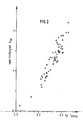
- the dependence of the specific color signal A OD on 58 sera in a dilution of 1: 150 is plotted as a function of the titer T mess determined by final dilution.
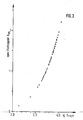
- FIG. 3 shows the titer that was calculated according to formula (1) from the absorbance A OD at optimal values for alpha and beta. The small spread of this curve results from the mathematical preparation.
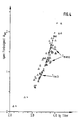
- FIG. 4 clearly shows that the titer value curve calculated according to formula (1) excellently averages the measured values. It follows from this that an optimal prediction of the final dilution titer can be achieved with the method of the invention.
- Column 1 of the table gives measurement values of the specific color signal on samples in a test dilution of 1: 150 for 60 sera.
- Column 2 shows the titer T mess measured by final dilution series for the same sera.
- T mess / T rech The quotient T mess / T rech is given below, namely weighted according to "too small” (less than 0.8), “approximately equal to 1” (in the range of 0.8 - 1.25) and “too large” ( greater than 1.25).
Landscapes
- Health & Medical Sciences (AREA)
- Life Sciences & Earth Sciences (AREA)
- Immunology (AREA)
- Engineering & Computer Science (AREA)
- Molecular Biology (AREA)
- Biomedical Technology (AREA)
- Chemical & Material Sciences (AREA)
- Urology & Nephrology (AREA)
- Hematology (AREA)
- Medicinal Chemistry (AREA)
- Cell Biology (AREA)
- Biotechnology (AREA)
- Food Science & Technology (AREA)
- Microbiology (AREA)
- Physics & Mathematics (AREA)
- Analytical Chemistry (AREA)
- Biochemistry (AREA)
- General Health & Medical Sciences (AREA)
- General Physics & Mathematics (AREA)
- Pathology (AREA)
- Virology (AREA)
- Tropical Medicine & Parasitology (AREA)
- Communicable Diseases (AREA)
- Investigating Or Analysing Biological Materials (AREA)
- Investigating Or Analysing Materials By The Use Of Chemical Reactions (AREA)
- Investigating Or Analysing Materials By Optical Means (AREA)
- Nitrogen And Oxygen Or Sulfur-Condensed Heterocyclic Ring Systems (AREA)
- Peptides Or Proteins (AREA)
Applications Claiming Priority (4)
| Application Number | Priority Date | Filing Date | Title |
|---|---|---|---|
| DE3636271 | 1986-10-24 | ||
| DE3636271 | 1986-10-24 | ||
| DE3639279A DE3639279C3 (de) | 1986-10-24 | 1986-11-17 | Verfahren zur quantitativen Bestimmung von Antikörpern oder Antigenen nach der ELISA-Methode durch photometrische Auswertung |
| DE3639279 | 1986-11-17 |
Publications (2)
| Publication Number | Publication Date |
|---|---|
| EP0264866A2 true EP0264866A2 (fr) | 1988-04-27 |
| EP0264866A3 EP0264866A3 (fr) | 1990-12-27 |
Family
ID=25848767
Family Applications (1)
| Application Number | Title | Priority Date | Filing Date |
|---|---|---|---|
| EP19870115218 Withdrawn EP0264866A3 (fr) | 1986-10-24 | 1987-10-17 | Méthode pour la détermination de la présence de substances diagnostiquement pertinentes, notamment les anticorps ou antigènes, par la méthode "ELISA" utilisant l'évaluation photométrique |
Country Status (5)
| Country | Link |
|---|---|
| EP (1) | EP0264866A3 (fr) |
| JP (1) | JP2595267B2 (fr) |
| AU (1) | AU602170B2 (fr) |
| MX (1) | MX168603B (fr) |
| NO (1) | NO170908C (fr) |
Cited By (3)
| Publication number | Priority date | Publication date | Assignee | Title |
|---|---|---|---|---|
| EP0374686A3 (en) * | 1988-12-17 | 1990-08-16 | Behringwerke Aktiengesellschaft | Method to ensure correctness and reproducibility of measured data in immunometric tests |
| EP0391330A3 (fr) * | 1989-04-07 | 1992-02-12 | BEHRINGWERKE Aktiengesellschaft | Procédé pour déterminer des anticorps contre des agents causant des maladies infectieuses, moyen pour ce procédé et son utilisation |
| US5306622A (en) * | 1987-05-29 | 1994-04-26 | Boehringer Mannheim Gmbh | Heterogeneous immunoassay process |
Family Cites Families (4)
| Publication number | Priority date | Publication date | Assignee | Title |
|---|---|---|---|---|
| DE3122305A1 (de) * | 1981-06-05 | 1983-01-05 | Vladimir Florin 3004 Isernhagen Niculescu | "immunologisch-diagnostisches verfahren zum nachweis und zur bestimmung von antikoerpern" |
| JPS58113758A (ja) * | 1981-12-26 | 1983-07-06 | Shimadzu Corp | 免疫グロブリンの分析方法 |
| JPS58211659A (ja) * | 1982-06-03 | 1983-12-09 | Nitsusui Seiyaku Kk | 免疫比濁法による血清crpの簡易迅速定量法 |
| JPS6276464A (ja) * | 1985-09-30 | 1987-04-08 | Shimadzu Corp | 多項目自動分析装置 |
-
1987
- 1987-10-17 EP EP19870115218 patent/EP0264866A3/fr not_active Withdrawn
- 1987-10-22 NO NO874405A patent/NO170908C/no not_active IP Right Cessation
- 1987-10-23 MX MX896487A patent/MX168603B/es unknown
- 1987-10-23 AU AU80084/87A patent/AU602170B2/en not_active Ceased
- 1987-10-23 JP JP62266667A patent/JP2595267B2/ja not_active Expired - Lifetime
Cited By (4)
| Publication number | Priority date | Publication date | Assignee | Title |
|---|---|---|---|---|
| US5306622A (en) * | 1987-05-29 | 1994-04-26 | Boehringer Mannheim Gmbh | Heterogeneous immunoassay process |
| EP0374686A3 (en) * | 1988-12-17 | 1990-08-16 | Behringwerke Aktiengesellschaft | Method to ensure correctness and reproducibility of measured data in immunometric tests |
| AU648499B2 (en) * | 1988-12-17 | 1994-04-28 | Behringwerke Aktiengesellschaft | Process for improving the accuracy and reproducibility of data measured in immunometric tests |
| EP0391330A3 (fr) * | 1989-04-07 | 1992-02-12 | BEHRINGWERKE Aktiengesellschaft | Procédé pour déterminer des anticorps contre des agents causant des maladies infectieuses, moyen pour ce procédé et son utilisation |
Also Published As
| Publication number | Publication date |
|---|---|
| AU602170B2 (en) | 1990-10-04 |
| NO874405L (no) | 1988-04-25 |
| MX168603B (es) | 1993-06-01 |
| NO874405D0 (no) | 1987-10-22 |
| AU8008487A (en) | 1988-04-28 |
| NO170908C (no) | 1992-12-23 |
| JP2595267B2 (ja) | 1997-04-02 |
| JPS63115060A (ja) | 1988-05-19 |
| EP0264866A3 (fr) | 1990-12-27 |
| NO170908B (no) | 1992-09-14 |
Similar Documents
| Publication | Publication Date | Title |
|---|---|---|
| DE2920276C2 (de) | Nephelometrisches Immunbestimmungsverfahren und Nephelometer zur Durchführung des Verfahrens | |
| DE68924064T2 (de) | Verfahren zur Bestimmung eines oder mehrerer Analyte durch Anwendung verschiedene Typen von Partikeln, welche durchflusszytometrisch unterschieden sind. | |
| DE3781672T2 (de) | Indirekte kolorimetrische detektion eines analyten in einer probe unter zuhilfenahme des verhaeltnisses von lichtsignalen. | |
| DE3006899C2 (fr) | ||
| DE68921650T2 (de) | Immunoassays. | |
| DE69412137T2 (de) | Sensoreinrichtung zum sandwichtest | |
| DE69025940T2 (de) | Durch Silber intensiviertes, auf Goldmarkierung beruhendes Immuntestverfahren | |
| DE2503627A1 (de) | Verfahren zum nachweis von antigenen oder antikoerpern | |
| DE2262413A1 (de) | Direkte radioimmunpruefung auf antigene und ihre antikoerper | |
| EP0576879B1 (fr) | Procédé pour le détermination analytique de la concentration d'un composant d'un échantillon médicinal | |
| DE60117699T2 (de) | Analyseverfahren durch spezifisches binden und vorrichtung, die das verfahren einsetzt | |
| DE2409273A1 (de) | Verfahren und vorrichtung zum messen von antigen-antikoerper-reaktionen | |
| DE2602068C2 (de) | Reagens zur Unlöslichmachung eines Antigen/Antikörper-Komplexes | |
| DE2406959A1 (de) | Anordnung zur bestimmung von antigenen | |
| DE69024453T2 (de) | Verbessertes Kalibrierungsverfahren | |
| EP0957360B1 (fr) | Elimination de perturbanions par facteurs rhumatismaux | |
| EP0263401B1 (fr) | Essai immunométrique | |
| EP0243655B1 (fr) | Procédé et réactif pour la détermination d'un partenaire réactionnel d'une réaction immunologique | |
| DE69523027T2 (de) | Kalibrierung und Prüfung von Immunoassays zur Verminderung von Störungen | |
| DE3639279C3 (de) | Verfahren zur quantitativen Bestimmung von Antikörpern oder Antigenen nach der ELISA-Methode durch photometrische Auswertung | |
| EP0264866A2 (fr) | Méthode pour la détermination de la présence de substances diagnostiquement pertinentes, notamment les anticorps ou antigènes, par la méthode "ELISA" utilisant l'évaluation photométrique | |
| DE68907365T2 (de) | Verfahren zur Bestimmung des Vorhandenseins leichter Ketten in Urinproben, Komplex von Vorbereitungen zur Erledigung des Verfahrens und damit verbundenes Reagenz. | |
| EP0366092B1 (fr) | Procédé pour déterminer des anticorps antigène- et classes-spécifiques et réactif pour ce procédé | |
| DE68918286T2 (de) | Verfahren zum testen einer immunologisch aktiven substanz und dafür geeignetes reagenz. | |
| DE4309529A1 (de) | Analytisches Verfahren und Vorrichtung |
Legal Events
| Date | Code | Title | Description |
|---|---|---|---|
| PUAI | Public reference made under article 153(3) epc to a published international application that has entered the european phase |
Free format text: ORIGINAL CODE: 0009012 |
|
| AK | Designated contracting states |
Kind code of ref document: A2 Designated state(s): AT BE CH DE ES FR GB IT LI LU NL SE |
|
| PUAL | Search report despatched |
Free format text: ORIGINAL CODE: 0009013 |
|
| AK | Designated contracting states |
Kind code of ref document: A3 Designated state(s): AT BE CH DE ES FR GB IT LI LU NL SE |
|
| 17P | Request for examination filed |
Effective date: 19901221 |
|
| 17Q | First examination report despatched |
Effective date: 19911011 |
|
| STAA | Information on the status of an ep patent application or granted ep patent |
Free format text: STATUS: THE APPLICATION HAS BEEN WITHDRAWN |
|
| 18W | Application withdrawn |
Withdrawal date: 19920408 |
|
| RIN1 | Information on inventor provided before grant (corrected) |
Inventor name: DOPATKA, HANS-DETLEF, DR. |