EP0266047A2 - Verfahren zur Herstellung von Benzinkomponenten aus Olefinen - Google Patents
Verfahren zur Herstellung von Benzinkomponenten aus Olefinen Download PDFInfo
- Publication number
- EP0266047A2 EP0266047A2 EP87308212A EP87308212A EP0266047A2 EP 0266047 A2 EP0266047 A2 EP 0266047A2 EP 87308212 A EP87308212 A EP 87308212A EP 87308212 A EP87308212 A EP 87308212A EP 0266047 A2 EP0266047 A2 EP 0266047A2
- Authority
- EP
- European Patent Office
- Prior art keywords
- alkenes
- feed
- etherification
- ethers
- water
- Prior art date
- Legal status (The legal status is an assumption and is not a legal conclusion. Google has not performed a legal analysis and makes no representation as to the accuracy of the status listed.)
- Withdrawn
Links
Images

Classifications
-
- C—CHEMISTRY; METALLURGY
- C07—ORGANIC CHEMISTRY
- C07C—ACYCLIC OR CARBOCYCLIC COMPOUNDS
- C07C41/00—Preparation of ethers; Preparation of compounds having groups, groups or groups
- C07C41/01—Preparation of ethers
- C07C41/05—Preparation of ethers by addition of compounds to unsaturated compounds
- C07C41/06—Preparation of ethers by addition of compounds to unsaturated compounds by addition of organic compounds only
-
- C—CHEMISTRY; METALLURGY
- C10—PETROLEUM, GAS OR COKE INDUSTRIES; TECHNICAL GASES CONTAINING CARBON MONOXIDE; FUELS; LUBRICANTS; PEAT
- C10L—FUELS NOT OTHERWISE PROVIDED FOR; NATURAL GAS; SYNTHETIC NATURAL GAS OBTAINED BY PROCESSES NOT COVERED BY SUBCLASSES C10G OR C10K; LIQUIFIED PETROLEUM GAS; USE OF ADDITIVES TO FUELS OR FIRES; FIRE-LIGHTERS
- C10L1/00—Liquid carbonaceous fuels
- C10L1/02—Liquid carbonaceous fuels essentially based on components consisting of carbon, hydrogen, and oxygen only
- C10L1/023—Liquid carbonaceous fuels essentially based on components consisting of carbon, hydrogen, and oxygen only for spark ignition
-
- Y—GENERAL TAGGING OF NEW TECHNOLOGICAL DEVELOPMENTS; GENERAL TAGGING OF CROSS-SECTIONAL TECHNOLOGIES SPANNING OVER SEVERAL SECTIONS OF THE IPC; TECHNICAL SUBJECTS COVERED BY FORMER USPC CROSS-REFERENCE ART COLLECTIONS [XRACs] AND DIGESTS
- Y02—TECHNOLOGIES OR APPLICATIONS FOR MITIGATION OR ADAPTATION AGAINST CLIMATE CHANGE
- Y02P—CLIMATE CHANGE MITIGATION TECHNOLOGIES IN THE PRODUCTION OR PROCESSING OF GOODS
- Y02P30/00—Technologies relating to oil refining and petrochemical industry
- Y02P30/20—Technologies relating to oil refining and petrochemical industry using bio-feedstock
Definitions
- This invention relates to a process for the preparation of products suitable for addition to a motor gasoline which process comprises a combination of steps comprising (a) the hydration and oligomerisation of C3 to C6 alkenes, and (b) etherification of branched alkenes.
- the steps (a) and (b) can be performed in either order and optionally unreacted gas is alkylated in an alkylation step (c).
- Our copending European Patent Application No 196902 discloses a process for the hydration and oligomerisation of one or more C3 to C6 olefins to produce a reaction product containing oligomers of the alkenes, ethers and optionally alcohols which comprises passing a feed containing C3 to C6 alkenes and water in a molar ratio of water to alkene of from 1:3 to 1:90 over an acid hydration catalyst under hydration conditions.
- the present invention provides a process in which the hydration and oligomerisation process is combined with an etherification step to produce a further product suitable for use in a motor gasoline.
- a process for the production of gasoline range products from C3 to C6 alkenes comprises the following steps.
- step (a) precedes step (b) or visa versa the process can also include a third step, hereafter referred to as step (c) in which alkenes are reacted with isobutane (either added or already present) in an alkylation step to produce high octane alkylate.
- step (c) in which alkenes are reacted with isobutane (either added or already present) in an alkylation step to produce high octane alkylate.
- step (a) precedes step (b) and the alkenes from step (a) are passed to step (b).
- the feed to step (b) contains at least 10% by wt of branched alkenes.
- step (b) is operated in a manner to increase the amount of branched ethers in by at least 10% by wt preferably by at least 25% by wt.
- Unreacted alkenes can be separated from the liquid product of step (a) and passed to the alkylation step.
- step (a) can be carried out as described in our copending European Patent Application No 196902.
- the feed to the first step of the process whether step (a) or (b) can conveniently be provided by refinery process streams a substantial proportion of which comprise C3 to C5, more preferably C3 and/or C4, alkenes such as, for example, C3/C4 streams from catalytic cracking.
- references to a feed containing C3 to C6 alkenes should not be taken to mean that only alkenes of this carbon number range are present.
- ethylene can be present in amounts up to 10% or 15% by weight of the feed.
- the feed to the first step of the claimed process can also contain alkanes and many refinery streams such as a C3/C4 cut from a cat. cracker will be such a mixture.
- C3 to C6 alkenes intended to mean that alkenes of every carbon number from C3 to C6 will be present.
- the feed can contain one or more alkenes in this carbon number range. Most commonly available streams will be mixtures.
- the feed to the first step can conveniently be a mixture of alkenes and alkanes of carbon number C3 to C6 and preferably contains at least 95% by weight of such compounds, more preferably at least 98%. More preferably the feed contains at least 95% by weight of alkenes and alkanes of carbon number C3 to C5.
- alkanes can be up to 60% by weight or even 70% but since alkanes are unreactive in step (a) their content is preferably less than 50% by weight of the feed.
- the content of n -alkanes is preferably below 40% by weight, more preferably below 25%.
- Isobutane can be present and if present in an amount sufficient to provide a molar ratio of isobutane to alkenes of at least 1:2 in the feed to the alkylation step (c), it will not be necessary to add isobutane before step (c) although it may be preferred to do so in order to adjust the molar ratio to about 1:1.
- isobutane can be present in an amount up to 60% by weight, although preferably it will not exceed 50% by weight.
- alkenes exceeds 50% more preferably 60%.
- refinery process streams consisting exclusively of alkenes are not usual, and the most commonly available feeds will comprise mixtures of alkenes and alkanes.
- Particularly suitable feeds are those containing at least 95% of C3 and C4 alkenes and alkanes.
- Such a feed can contain from 20 to 85%, preferably 25 to 75% by weight of C3 and C4 alkenes and 5 to 65% by wt of C3 and C4 alkanes (including isoalkanes).
- the feed can comprise at least 95% by weight of C3 or C4 alkenes and alkanes.
- a feed containing at least 95% by wt of C4 compounds con contain from 20 to 80% C4 alkenes and 5 to 50% of C4 alkanes (including isobutane).
- any conventional acid hydration catalyst may be used.
- Suitable catalysts include (A) cation-exchangeable layered clay in which there is a metal cation, (B) hydrogen ion-exchanged layered clays, (C) stabilised pillared interlayered clay and (D) cation exchanged organic resins.
- Catalysts of the type (A), (B) and (C) are known and are described, for example, in published European Patent Applications 0031687, 0031252, 0083970 and 0116469.
- Catalysts of type (D) are also known and some are commercially available.
- the acid hydration catalyst is a cation exchange organic resin, more preferably one containing sulphonic acid groups.
- the molar ratio of water to alkene in the feed is from 1:4 to 1:50 and more preferably in the case of a butene from 1:20 to 1:50 and in the case of a propene 1:5 to 1:20.
- step (a) has unexpected advantages in that it can be controlled so as (i) to produce a liquid reaction product which contains at least 40% by weight of oligomers but less than 5% by wt of products of carbon number 12 and higher and also (ii) to produce a liquid reaction product containing less than 0.5% by weight of water, preferably less than 0.2%.
- This latter advantage is particularly significant in that the product can be added direct to a gasoline basestock without any intermediate drying step.
- step (a) is preferably operated with an alkene to water molar ratio of from 4:1 to 50:1, a temperature within the range 120 to 180°C, a pressure of from 20 to 100 bar absolute and an LHSV of feed from 0.5 to 10.
- step (a) The reference to hydration conditions in step (a) is not intended to mean that hydration is the only reaction occurring in step (a). Other reactions take place such as oligomerisation and etherification.
- oligomers is intended to include dimers.
- the molar proportions of reactants and reaction conditions in step (a) can be selected so as (i) to produce a liquid reaction product containing from 70 to 99% by weight of oligomers, from 1 to 30% by weight of ethers and up to 10% by weight of alcohols or (ii) to produce a liquid reaction product containing from 40 to 70% by weight of oligomers, from 20 to 50% by weight of ethers and from 10 to 40% by weight of alcohols.
- the ethers are typical dialkyl ethers and at least one of the alkyl group is usually branched.
- the liquid product from step (a) can be added to any gasoline for example a straight run gasoline, a cat cracked spirit or mixtures thereof.
- the gasoline has, before the addition of the additive composition a Research Octane Number (RON) of from 80 to 105, more preferably 90 to 98, and a Motor Octane Number (MON) of from 75 to 95, more preferably from 80 to 88.
- the gasoline may contain the following proportions of olefins, aromatics and saturates: Aromatics 20 to 60% volume Saturates 20 to 70% volume Olefins 0 to 30% volume
- liquid product we mean a product which is liquid at 20°C and one atmosphere pressure.
- the liquid product from step (a) possesses high Blending Research Octane Number and Blending Motor Octane Number which generally increase with increasing amounts of oxygenated components. Typical values are in the range 100 to 116 for Research Octane Number and 95 to 106 for Motor Octane Number in one gasoline basestock. The Blending Octane Numbers obtained will vary with the composition of the gasoline used as basestock.
- the etherification step (b) precedes step (a) and olefinic hydrocarbons depleted in branched olefins are passed to step (a) from step (b).
- the C3 to C6 alkenes contain isobutene and the isobutene is reacted with methanol to form methyl tertiary butyl ether in step (b) and the olefinic hydrocarbons depleted in isobutene passed from step (b) to step (a).
- branched olefin or branched alkene we mean an olefin or alkene which contains branching at a carbon atom bearing a double bond i.e. contains the structure
- the catalyst for step (b) is preferably the same as that for step (a).
- the C1 to C6 alcohol is methanol or a higher alcohol such as ethanol, propanol, butanol or the like and is added to the product from step (a) at a point intermediate steps (a) and (b).
- the conditions for the etherification step (b) can be:- Temperature 50 to 130°C, preferably 70 to 100°C Methanol content of feed 0.1 to 100 vol % of product from step (a) preferably 10 to 40 vol %.
- LHSV from 1 to 10 preferably 2 to 5.
- the feed to the alkylation step contains C4 alkenes optionally together with C3 alkenes and/or C5 alkenes.
- the alkylation step (c) can be carried out under the following conditions: temperature from 10 to 50°C pressure from 5 to 40 bar
- the catalyst is conveniently hydrofluoric acid or sulphuric acid.
- the feed contains isobutane and the steps (a) and (b) are controlled so that the molar ratio of isobutane to C3 to C5 alkenes in the product from the second step (after removal of liquid product) is in the range 1:2 to 2:1 and this product is passed to step (c).
- Figure 1 illustrates one mode of operation in which three steps comprising (a) oligomerisation/etherification/hydration, (b) etherification and (c) alkylation are carried out in that order and
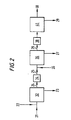
- Figure 2 illustrates an alternative mode of operation in which the etherification step precedes the oligomerisation/etherification hydration step.
- a feed from a cat. cracker containing C3 to C5 olefins from which butadiene and the bulk of the isobutene have been consumed by other processes and having the composition set forth in Table 1 is passed with added water through line 2 to the hydration/etherification/oligomerisation unit 4.
- the unit 4 contains a bed of Rohm & Haas XE-386 ion exchange resin.
- the alkene:water molar ratio is 42:1.
- the temperature in the bed ranges from 126°C to 146°C at the end of the bed.
- the reaction pressure is 80 bar and the LHSV is 2. Under these conditions 42.5% of the alkenes are converted to liquid products.
- the degassed liquid product contains about 96% wt oligomers of butenes (with a C8:C12 alkene weight ratio of 20:1 and no higher oligomers than C12), and 4.0% oxygenates (1.2% secondary butanol and 2.8% disecondary-butyl ether). No water is detected in the liquid product.
- unreacted gases which comprise mainly C3, C4 and C5 alkenes and alkanes are separated from the liquid product and passed to alkylation unit 16 via line 13.
- the unreacted gases are passed with the liquid product via line 6 to etherification unit 8.
- the liquid product from the unit 4 together with methanol added via line 7 pass via line 6 to the etherification unit 8 where the oligomers (particularly oligomers of C4 alkenes containing a tertiary carbon atom with a double bond) are reacted with the added methanol to form the corresponding ethers.
- the liquid reaction product is withdrawn via line 12.
- C3 and C4 alkenes are separated from the liquid product and passed together with added isobutane to an alkylation unit 16 via line 15.
- Methanol can be removed from the liquid product from unit 8 and recycled via line 14.
- a guard bed (not shown) situated immediately before the alkylation unit removes any oxygen-containing compounds.
- the feed to the etherification unit 8 has a molar ratio of oligomers:methanol of 2:1.
- the conditions in the etherification unit are as follows: temperature of the bed 80 to 85°C at end of bed pressure 80 bar space velocity 2.
- the catalyst consists of a bed of Rohm & Haas XE-386 ion exchange resin. Under the above conditions 5% of the oligomers are converted to the corresponding methyl ethers and withdrawn via line 12 together with other unreacted product from unit 4. The B MON of the degassed product is increased by 4 B MON in comparison with the B MON of product from unit 4.
- C3, C4 and C5 alkenes and alkanes are separated from the product from unit 4 and passed via line 13 to the alkylation unit 16.
- the effluent from unit 8 contains methanol and liquid etherified product.
- the methanol can be separated and recycled via line 14 to the feed to unit 8. There therefore need be no direct connection between units 8 and 16 in this mode of operation.
- Isobutane is added via line 17 to give a molar ratio of isobutane to total olefins (C3, C4 and C5 alkenes) of 1:1.
- the conditions in the alkylation unit 16 are as follows: temperature 35°C pressure 30 bar catalyst HF added continuously with recycle.
- composition of the alkylate is found to be at least 80% eg 95% of C8 branched alkanes and C4 byproduct (mainly n butane).
- Example 1 is an example of both steps (a) and (b) of the process of claim 1.
- Example 2 is an example of step (b) of the process of claim 1.
- a butanes/butenes feedstock, containing 63.7% alkenes of composition shown in Table 2 and water in the alkenes:water molar ratio of 40:1 were passed through a two stage two reactor system with an overall LHSV of 2 at a reaction pressure of 80 bar.
- the first reactor contained 30 ml of dried Amberlite XE-386, a strongly acidic resin catalyst produced by the Rohm and Haas Company, maintained at a temperature of ca 130 to 140°C.
- the cooled products from the first reactor, together with added methanol (in an amount corresponding to a molar ratio of methanol to alkenes in the feedstock entering the first reactor of 1:10) were passed through a second reactor containing 30 ml of dried Amberlite XE-386 maintained at a reaction temperature of ca 80-85°C.
- the products leaving the second reactor are cooled and pass through a pressure relief valve to the liquid product collecting pot at room temperature. It is known that some products are lost in the gases passing to vent. Warming the liquid products to 65°C to remove dissolved feedstock gave liquid products corresponding to an alkenes conversion of 40%; the analysis of which is shown in the Table. The products contain some methoxyoctanes which probably increase the octane quality of the products.
- a feedstock consisting of hydrocarbons and a small amount of oxygenates, prepared by oligomerising and hydrating a C3/C4 catalytic cracker stream as described in European Patent Application No 196902 and with the analysis shown in Table 2 and methanol were combined in the weight ratio of 12:1 and passed over 30 ml of dried Amberlite XE-386 with an LHSV of 2 at a reaction temperature of 73-85°C and reaction pressure of 30 bar. The products passed through a pressure relief valve and the liquid products collected at atmospheric pressure.
- the major hydrocarbon products had a composition shown in the Table, and contained significant amounts of methoxyalkanes of carbon numbers of C6 to C10 which should increase the octane quality of the products.
- a second very minor product phase ( ⁇ 1%) consisting of 85% methanol and 15% water was also obtained which could be recycled if desired.
- Unreacted materials together with any byproducts leave unit 32 as stream 24 and are passed through a methanol remover 34 and then as stream 25 to which a water stream 26 is added and passed to unit 36 where the alkenes are oligomerised/hydrated/etherified to form a liquid product which is withdrawn as stream 27.
- Unreacted materials and byproducts are passed as stream 28 via guard bed 38 to remove oxygenates to alkylation unit 40 where isobutane is reacted with C4 olefins to produce C8 isoalkanes which are withdrawn as stream 29.
- Unreacted n -butane is withdrawn as stream 30.
Landscapes
- Chemical & Material Sciences (AREA)
- Organic Chemistry (AREA)
- Oil, Petroleum & Natural Gas (AREA)
- Engineering & Computer Science (AREA)
- Chemical Kinetics & Catalysis (AREA)
- General Chemical & Material Sciences (AREA)
- Organic Low-Molecular-Weight Compounds And Preparation Thereof (AREA)
- Low-Molecular Organic Synthesis Reactions Using Catalysts (AREA)
- Production Of Liquid Hydrocarbon Mixture For Refining Petroleum (AREA)
Applications Claiming Priority (2)
| Application Number | Priority Date | Filing Date | Title |
|---|---|---|---|
| GB868623260A GB8623260D0 (en) | 1986-09-26 | 1986-09-26 | Gasoline components |
| GB8623260 | 1986-09-26 |
Publications (2)
| Publication Number | Publication Date |
|---|---|
| EP0266047A2 true EP0266047A2 (de) | 1988-05-04 |
| EP0266047A3 EP0266047A3 (de) | 1988-10-26 |
Family
ID=10604885
Family Applications (1)
| Application Number | Title | Priority Date | Filing Date |
|---|---|---|---|
| EP87308212A Withdrawn EP0266047A3 (de) | 1986-09-26 | 1987-09-16 | Verfahren zur Herstellung von Benzinkomponenten aus Olefinen |
Country Status (6)
| Country | Link |
|---|---|
| EP (1) | EP0266047A3 (de) |
| JP (1) | JPS63101486A (de) |
| AU (1) | AU605176B2 (de) |
| GB (1) | GB8623260D0 (de) |
| NO (1) | NO874006L (de) |
| ZA (1) | ZA877056B (de) |
Cited By (6)
| Publication number | Priority date | Publication date | Assignee | Title |
|---|---|---|---|---|
| EP0454304A1 (de) * | 1990-04-04 | 1991-10-30 | Mobil Oil Corporation | Verfahren zur Umwandlung von leichten Olefinen zu ätherreichem Benzin |
| RU2144018C1 (ru) * | 1998-08-04 | 2000-01-10 | Товарищество с ограниченной ответственностью "НИЦ НХТ" | Способ получения ди- и тримеров алкенов c3 - c5 и/или их смесей со спиртами |
| WO2001079146A1 (en) * | 2000-04-14 | 2001-10-25 | Fortum Oyj | Process for producing ether |
| RU2177930C1 (ru) * | 2000-05-10 | 2002-01-10 | Общество с ограниченной ответственностью "НТЦ ХТ" | Способ получения олигомеров алкенов |
| RU2180652C1 (ru) * | 2000-06-29 | 2002-03-20 | Общество с ограниченной ответственностью "НТЦ ХТ" | Способ получения высокооктановых смесей |
| WO2016109372A1 (en) * | 2014-12-30 | 2016-07-07 | Shell Oil Company | An oxygenate conversion process |
Families Citing this family (4)
| Publication number | Priority date | Publication date | Assignee | Title |
|---|---|---|---|---|
| GB8507971D0 (en) * | 1985-03-27 | 1985-05-01 | British Petroleum Co Plc | Fuel composition |
| ZA889603B (en) * | 1987-12-30 | 1990-08-29 | Mobil Oil Corp | Process for the production of ethers |
| JPH04203269A (ja) * | 1990-11-29 | 1992-07-23 | Yazaki Corp | 高圧ケーブル装置 |
| JPH07211433A (ja) * | 1993-11-30 | 1995-08-11 | Yazaki Corp | シールドケースを備えたシリーズギャップ付点火装置 |
Family Cites Families (6)
| Publication number | Priority date | Publication date | Assignee | Title |
|---|---|---|---|---|
| US4100220A (en) * | 1977-06-27 | 1978-07-11 | Petro-Tex Chemical Corporation | Dimerization of isobutene |
| EP0036260B2 (de) * | 1980-03-07 | 1988-12-14 | The British Petroleum Company p.l.c. | Herstellung einer Komponente für ein Motorbrennstoffgemisch |
| GB8507971D0 (en) * | 1985-03-27 | 1985-05-01 | British Petroleum Co Plc | Fuel composition |
| LU86280A1 (fr) * | 1986-01-29 | 1987-09-03 | Labofina Sa | Procede de production d'essence |
| GB8623259D0 (en) * | 1986-09-26 | 1986-10-29 | British Petroleum Co Plc | Gasoline components |
| GB2417290B (en) * | 2004-08-19 | 2008-10-22 | Connaught Motor Co Ltd | Reducing knock in internal combustion engines with an additional power source |
-
1986
- 1986-09-26 GB GB868623260A patent/GB8623260D0/en active Pending
-
1987
- 1987-09-16 EP EP87308212A patent/EP0266047A3/de not_active Withdrawn
- 1987-09-18 ZA ZA877056A patent/ZA877056B/xx unknown
- 1987-09-22 AU AU78823/87A patent/AU605176B2/en not_active Ceased
- 1987-09-24 NO NO874006A patent/NO874006L/no unknown
- 1987-09-25 JP JP62239066A patent/JPS63101486A/ja active Pending
Cited By (6)
| Publication number | Priority date | Publication date | Assignee | Title |
|---|---|---|---|---|
| EP0454304A1 (de) * | 1990-04-04 | 1991-10-30 | Mobil Oil Corporation | Verfahren zur Umwandlung von leichten Olefinen zu ätherreichem Benzin |
| RU2144018C1 (ru) * | 1998-08-04 | 2000-01-10 | Товарищество с ограниченной ответственностью "НИЦ НХТ" | Способ получения ди- и тримеров алкенов c3 - c5 и/или их смесей со спиртами |
| WO2001079146A1 (en) * | 2000-04-14 | 2001-10-25 | Fortum Oyj | Process for producing ether |
| RU2177930C1 (ru) * | 2000-05-10 | 2002-01-10 | Общество с ограниченной ответственностью "НТЦ ХТ" | Способ получения олигомеров алкенов |
| RU2180652C1 (ru) * | 2000-06-29 | 2002-03-20 | Общество с ограниченной ответственностью "НТЦ ХТ" | Способ получения высокооктановых смесей |
| WO2016109372A1 (en) * | 2014-12-30 | 2016-07-07 | Shell Oil Company | An oxygenate conversion process |
Also Published As
| Publication number | Publication date |
|---|---|
| ZA877056B (en) | 1989-04-26 |
| AU605176B2 (en) | 1991-01-10 |
| EP0266047A3 (de) | 1988-10-26 |
| NO874006D0 (no) | 1987-09-24 |
| NO874006L (no) | 1988-03-28 |
| AU7882387A (en) | 1988-03-31 |
| JPS63101486A (ja) | 1988-05-06 |
| GB8623260D0 (en) | 1986-10-29 |
Similar Documents
| Publication | Publication Date | Title |
|---|---|---|
| EP1032550B1 (de) | Verfahren zur oligomerisierung von isobuten | |
| US5895830A (en) | Process for oligomer production and saturation | |
| US4797133A (en) | Process for recovery of butene-1 from mixed C4 hydrocarbons | |
| US4935577A (en) | Hydrocarbon processes comprised of catalytic distillation using Lewis acid promoted inorganic oxide catalyst systems | |
| US4423251A (en) | Process employing sequential isobutylene hydration and etherification | |
| KR20010032080A (ko) | 비분지형 부텐의 올리고머화에 의한 사실상 비분지형의옥텐 및 도데센의 제조 방법 | |
| US6011191A (en) | Process for the production of hydrocarbons with a high octane number by the selective dimerization of isobutene | |
| EP0745576B1 (de) | Verfahren zur gemeinsamen Herstellung von Ethern und Kohlenwasserstoffen mit hoher Oktanzahl | |
| EP0266047A2 (de) | Verfahren zur Herstellung von Benzinkomponenten aus Olefinen | |
| WO1986005776A1 (en) | Process for the hydration and oligomerisation of olefins | |
| US4357147A (en) | Diisopropyl ether reversion and oligomerization in isopropanol production | |
| EP0509162B1 (de) | Umwandlung von lichten Kohlenwasserstoffen in Ether enthaltende Benzine | |
| WO2008069987A2 (en) | Production of butenes and derivatives therefrom from dry ethanol | |
| US4405822A (en) | Diisopropyl ether hydration in isopropanol production | |
| US4352945A (en) | Diisopropyl ether reversion in isopropanol production | |
| EP0232385B1 (de) | Neuer katalyst für motorbrennstoffalkylierung und verfahren für dessen verwendung | |
| US5024679A (en) | Olefins etherification and conversion to liquid fuels with paraffins dehydrogenation | |
| US5113024A (en) | Process for product separation in the production of di-isopropyl ether | |
| EP0261871A2 (de) | Verfahren zur Herstellung von Benzinbestandteilen aus Olefinen | |
| EP0382956B1 (de) | Verfahren zur direkten Etherifizierung eines Dehydrierungsausflussstromes | |
| US5227534A (en) | Ether production with multi-stage reaction of olefins | |
| EP0424445B1 (de) | Heterogenes isoparaffin/olefin-alkylierungsverfahren | |
| EP0458048B1 (de) | Herstellung von Diisopropyläther | |
| US4957709A (en) | Reactor system for olefin conversion and etherification | |
| EP0313905B1 (de) | Verfahren zur direkten Hydratation von geradkettigen Olefinen |
Legal Events
| Date | Code | Title | Description |
|---|---|---|---|
| PUAI | Public reference made under article 153(3) epc to a published international application that has entered the european phase |
Free format text: ORIGINAL CODE: 0009012 |
|
| AK | Designated contracting states |
Kind code of ref document: A2 Designated state(s): AT BE CH DE FR GB IT LI LU NL SE |
|
| PUAL | Search report despatched |
Free format text: ORIGINAL CODE: 0009013 |
|
| 17P | Request for examination filed |
Effective date: 19880901 |
|
| AK | Designated contracting states |
Kind code of ref document: A3 Designated state(s): AT BE CH DE FR GB IT LI LU NL SE |
|
| 17Q | First examination report despatched |
Effective date: 19901227 |
|
| STAA | Information on the status of an ep patent application or granted ep patent |
Free format text: STATUS: THE APPLICATION IS DEEMED TO BE WITHDRAWN |
|
| 18D | Application deemed to be withdrawn |
Effective date: 19910507 |
|
| RIN1 | Information on inventor provided before grant (corrected) |
Inventor name: GREGORY, REGINALD Inventor name: SMITH, DAVID JOHN HARRY Inventor name: HAELSIG, CLAUS-PETER |