EP0266162B1 - Electrode en alliage d'absorption d'hydrogène et cellule à hydrogène - Google Patents
Electrode en alliage d'absorption d'hydrogène et cellule à hydrogène Download PDFInfo
- Publication number
- EP0266162B1 EP0266162B1 EP87309457A EP87309457A EP0266162B1 EP 0266162 B1 EP0266162 B1 EP 0266162B1 EP 87309457 A EP87309457 A EP 87309457A EP 87309457 A EP87309457 A EP 87309457A EP 0266162 B1 EP0266162 B1 EP 0266162B1
- Authority
- EP
- European Patent Office
- Prior art keywords
- electrode
- alloy
- hydrogen absorption
- electrode according
- hydrogen
- Prior art date
- Legal status (The legal status is an assumption and is not a legal conclusion. Google has not performed a legal analysis and makes no representation as to the accuracy of the status listed.)
- Expired - Lifetime
Links
- 229910045601 alloy Inorganic materials 0.000 title claims description 142
- 239000000956 alloy Substances 0.000 title claims description 142
- 239000001257 hydrogen Substances 0.000 title claims description 130
- 229910052739 hydrogen Inorganic materials 0.000 title claims description 130
- UFHFLCQGNIYNRP-UHFFFAOYSA-N Hydrogen Chemical compound [H][H] UFHFLCQGNIYNRP-UHFFFAOYSA-N 0.000 title claims description 119
- 238000010521 absorption reaction Methods 0.000 title claims description 106
- 125000004435 hydrogen atom Chemical group [H]* 0.000 title claims description 10
- 239000000843 powder Substances 0.000 claims description 55
- 239000000835 fiber Substances 0.000 claims description 49
- 229910052751 metal Inorganic materials 0.000 claims description 44
- 239000002184 metal Substances 0.000 claims description 44
- PXHVJJICTQNCMI-UHFFFAOYSA-N nickel Substances [Ni] PXHVJJICTQNCMI-UHFFFAOYSA-N 0.000 claims description 38
- 229920000049 Carbon (fiber) Polymers 0.000 claims description 31
- 239000004917 carbon fiber Substances 0.000 claims description 31
- 239000002245 particle Substances 0.000 claims description 24
- 239000011230 binding agent Substances 0.000 claims description 20
- 239000004020 conductor Substances 0.000 claims description 18
- 229910052759 nickel Inorganic materials 0.000 claims description 18
- 239000008151 electrolyte solution Substances 0.000 claims description 15
- VNWKTOKETHGBQD-UHFFFAOYSA-N methane Chemical compound C VNWKTOKETHGBQD-UHFFFAOYSA-N 0.000 claims description 9
- 229910014454 Ca-Cu Inorganic materials 0.000 claims description 4
- 229910014459 Ca-Ni Inorganic materials 0.000 claims description 4
- 229910014473 Ca—Ni Inorganic materials 0.000 claims description 4
- 229910020794 La-Ni Inorganic materials 0.000 claims description 4
- 229910001122 Mischmetal Inorganic materials 0.000 claims description 4
- 229910004353 Ti-Cu Inorganic materials 0.000 claims description 4
- 229910004337 Ti-Ni Inorganic materials 0.000 claims description 4
- 229910011209 Ti—Ni Inorganic materials 0.000 claims description 4
- KHYBPSFKEHXSLX-UHFFFAOYSA-N iminotitanium Chemical compound [Ti]=N KHYBPSFKEHXSLX-UHFFFAOYSA-N 0.000 claims description 4
- 229910000531 Co alloy Inorganic materials 0.000 claims description 3
- 229910011212 Ti—Fe Inorganic materials 0.000 claims description 3
- 239000012670 alkaline solution Substances 0.000 claims description 3
- 239000006229 carbon black Substances 0.000 claims description 3
- 238000005260 corrosion Methods 0.000 claims description 3
- 230000007797 corrosion Effects 0.000 claims description 3
- 238000000034 method Methods 0.000 description 21
- 239000004810 polytetrafluoroethylene Substances 0.000 description 19
- 229920001343 polytetrafluoroethylene Polymers 0.000 description 19
- OKTJSMMVPCPJKN-UHFFFAOYSA-N Carbon Chemical compound [C] OKTJSMMVPCPJKN-UHFFFAOYSA-N 0.000 description 17
- -1 e.g. Chemical compound 0.000 description 17
- 230000000052 comparative effect Effects 0.000 description 15
- 239000000203 mixture Substances 0.000 description 10
- 238000007599 discharging Methods 0.000 description 9
- 239000006232 furnace black Substances 0.000 description 7
- 239000006230 acetylene black Substances 0.000 description 6
- 238000012360 testing method Methods 0.000 description 6
- KWYUFKZDYYNOTN-UHFFFAOYSA-M Potassium hydroxide Chemical compound [OH-].[K+] KWYUFKZDYYNOTN-UHFFFAOYSA-M 0.000 description 5
- 238000004898 kneading Methods 0.000 description 5
- 230000007423 decrease Effects 0.000 description 4
- 150000002431 hydrogen Chemical class 0.000 description 4
- 238000005259 measurement Methods 0.000 description 4
- XLYOFNOQVPJJNP-UHFFFAOYSA-N water Substances O XLYOFNOQVPJJNP-UHFFFAOYSA-N 0.000 description 4
- 229920002134 Carboxymethyl cellulose Polymers 0.000 description 3
- KDLHZDBZIXYQEI-UHFFFAOYSA-N Palladium Chemical compound [Pd] KDLHZDBZIXYQEI-UHFFFAOYSA-N 0.000 description 3
- 239000001768 carboxy methyl cellulose Substances 0.000 description 3
- 235000010948 carboxy methyl cellulose Nutrition 0.000 description 3
- 239000008112 carboxymethyl-cellulose Substances 0.000 description 3
- 230000003247 decreasing effect Effects 0.000 description 3
- 239000007789 gas Substances 0.000 description 3
- 239000011572 manganese Substances 0.000 description 3
- 239000000463 material Substances 0.000 description 3
- 150000002739 metals Chemical class 0.000 description 3
- 238000002156 mixing Methods 0.000 description 3
- BASFCYQUMIYNBI-UHFFFAOYSA-N platinum Chemical compound [Pt] BASFCYQUMIYNBI-UHFFFAOYSA-N 0.000 description 3
- XKRFYHLGVUSROY-UHFFFAOYSA-N Argon Chemical compound [Ar] XKRFYHLGVUSROY-UHFFFAOYSA-N 0.000 description 2
- 239000004372 Polyvinyl alcohol Substances 0.000 description 2
- 230000004913 activation Effects 0.000 description 2
- 239000011149 active material Substances 0.000 description 2
- 229910052793 cadmium Inorganic materials 0.000 description 2
- BDOSMKKIYDKNTQ-UHFFFAOYSA-N cadmium atom Chemical compound [Cd] BDOSMKKIYDKNTQ-UHFFFAOYSA-N 0.000 description 2
- 239000013078 crystal Substances 0.000 description 2
- WABPQHHGFIMREM-UHFFFAOYSA-N lead(0) Chemical compound [Pb] WABPQHHGFIMREM-UHFFFAOYSA-N 0.000 description 2
- 229910052748 manganese Inorganic materials 0.000 description 2
- 238000012986 modification Methods 0.000 description 2
- 230000004048 modification Effects 0.000 description 2
- 229910052763 palladium Inorganic materials 0.000 description 2
- 229910052697 platinum Inorganic materials 0.000 description 2
- 229920002451 polyvinyl alcohol Polymers 0.000 description 2
- 229910052709 silver Inorganic materials 0.000 description 2
- RYGMFSIKBFXOCR-UHFFFAOYSA-N Copper Chemical compound [Cu] RYGMFSIKBFXOCR-UHFFFAOYSA-N 0.000 description 1
- PWHULOQIROXLJO-UHFFFAOYSA-N Manganese Chemical compound [Mn] PWHULOQIROXLJO-UHFFFAOYSA-N 0.000 description 1
- 229910000990 Ni alloy Inorganic materials 0.000 description 1
- 239000004698 Polyethylene Substances 0.000 description 1
- BQCADISMDOOEFD-UHFFFAOYSA-N Silver Chemical compound [Ag] BQCADISMDOOEFD-UHFFFAOYSA-N 0.000 description 1
- 230000009471 action Effects 0.000 description 1
- 239000007864 aqueous solution Substances 0.000 description 1
- 229910052786 argon Inorganic materials 0.000 description 1
- 230000015572 biosynthetic process Effects 0.000 description 1
- OJIJEKBXJYRIBZ-UHFFFAOYSA-N cadmium nickel Chemical compound [Ni].[Cd] OJIJEKBXJYRIBZ-UHFFFAOYSA-N 0.000 description 1
- 239000003054 catalyst Substances 0.000 description 1
- 239000010406 cathode material Substances 0.000 description 1
- 230000008859 change Effects 0.000 description 1
- 229910017052 cobalt Inorganic materials 0.000 description 1
- 239000010941 cobalt Substances 0.000 description 1
- GUTLYIVDDKVIGB-UHFFFAOYSA-N cobalt atom Chemical compound [Co] GUTLYIVDDKVIGB-UHFFFAOYSA-N 0.000 description 1
- 238000007796 conventional method Methods 0.000 description 1
- 229910052802 copper Inorganic materials 0.000 description 1
- 239000010949 copper Substances 0.000 description 1
- 239000006185 dispersion Substances 0.000 description 1
- 230000000694 effects Effects 0.000 description 1
- 238000001704 evaporation Methods 0.000 description 1
- 230000008020 evaporation Effects 0.000 description 1
- 238000000605 extraction Methods 0.000 description 1
- 239000004744 fabric Substances 0.000 description 1
- PCHJSUWPFVWCPO-UHFFFAOYSA-N gold Chemical compound [Au] PCHJSUWPFVWCPO-UHFFFAOYSA-N 0.000 description 1
- 229910052737 gold Inorganic materials 0.000 description 1
- 239000010931 gold Substances 0.000 description 1
- 238000000227 grinding Methods 0.000 description 1
- 239000011261 inert gas Substances 0.000 description 1
- 229910000765 intermetallic Inorganic materials 0.000 description 1
- 238000004519 manufacturing process Methods 0.000 description 1
- 238000000465 moulding Methods 0.000 description 1
- 229910000510 noble metal Inorganic materials 0.000 description 1
- 231100000572 poisoning Toxicity 0.000 description 1
- 230000000607 poisoning effect Effects 0.000 description 1
- 229920000573 polyethylene Polymers 0.000 description 1
- 229920005596 polymer binder Polymers 0.000 description 1
- 239000002491 polymer binding agent Substances 0.000 description 1
- 230000008569 process Effects 0.000 description 1
- 230000002035 prolonged effect Effects 0.000 description 1
- 238000010298 pulverizing process Methods 0.000 description 1
- 238000006722 reduction reaction Methods 0.000 description 1
- 239000011369 resultant mixture Substances 0.000 description 1
- 238000005096 rolling process Methods 0.000 description 1
- 238000000926 separation method Methods 0.000 description 1
- 239000004332 silver Substances 0.000 description 1
- 239000010944 silver (metal) Substances 0.000 description 1
- 238000005245 sintering Methods 0.000 description 1
- 239000007787 solid Substances 0.000 description 1
- 239000000243 solution Substances 0.000 description 1
- 238000003860 storage Methods 0.000 description 1
- 239000000126 substance Substances 0.000 description 1
- 231100000331 toxic Toxicity 0.000 description 1
- 230000002588 toxic effect Effects 0.000 description 1
Images
Classifications
-
- H—ELECTRICITY
- H01—ELECTRIC ELEMENTS
- H01M—PROCESSES OR MEANS, e.g. BATTERIES, FOR THE DIRECT CONVERSION OF CHEMICAL ENERGY INTO ELECTRICAL ENERGY
- H01M4/00—Electrodes
- H01M4/02—Electrodes composed of, or comprising, active material
- H01M4/62—Selection of inactive substances as ingredients for active masses, e.g. binders, fillers
- H01M4/624—Electric conductive fillers
-
- H—ELECTRICITY
- H01—ELECTRIC ELEMENTS
- H01M—PROCESSES OR MEANS, e.g. BATTERIES, FOR THE DIRECT CONVERSION OF CHEMICAL ENERGY INTO ELECTRICAL ENERGY
- H01M4/00—Electrodes
- H01M4/02—Electrodes composed of, or comprising, active material
- H01M4/24—Electrodes for alkaline accumulators
- H01M4/242—Hydrogen storage electrodes
-
- H—ELECTRICITY
- H01—ELECTRIC ELEMENTS
- H01M—PROCESSES OR MEANS, e.g. BATTERIES, FOR THE DIRECT CONVERSION OF CHEMICAL ENERGY INTO ELECTRICAL ENERGY
- H01M4/00—Electrodes
- H01M4/02—Electrodes composed of, or comprising, active material
- H01M4/62—Selection of inactive substances as ingredients for active masses, e.g. binders, fillers
- H01M4/624—Electric conductive fillers
- H01M4/625—Carbon or graphite
-
- Y—GENERAL TAGGING OF NEW TECHNOLOGICAL DEVELOPMENTS; GENERAL TAGGING OF CROSS-SECTIONAL TECHNOLOGIES SPANNING OVER SEVERAL SECTIONS OF THE IPC; TECHNICAL SUBJECTS COVERED BY FORMER USPC CROSS-REFERENCE ART COLLECTIONS [XRACs] AND DIGESTS
- Y02—TECHNOLOGIES OR APPLICATIONS FOR MITIGATION OR ADAPTATION AGAINST CLIMATE CHANGE
- Y02E—REDUCTION OF GREENHOUSE GAS [GHG] EMISSIONS, RELATED TO ENERGY GENERATION, TRANSMISSION OR DISTRIBUTION
- Y02E60/00—Enabling technologies; Technologies with a potential or indirect contribution to GHG emissions mitigation
- Y02E60/10—Energy storage using batteries
Definitions
- the present invention relates to a hydrogen absorption alloy electrode and a hydrogen cell using the same as a cathode.
- Hydrogen absorption alloys are capable of reversibly absorbing and desorbing a large amount of hydrogen and have been used for separation of hydrogen gas and its storage. Hydrogen absorption alloys can electrochemically absorb hydrogen atoms in an aqueous electrolytic solution. Also, these alloys can oxidize absorbed hydrogen atoms to form water. For these properties, a hydrogen absorption alloy can be used as a cathode material for a cell (mainly a secondary cell).
- a hydrogen absorption alloy electrode containing a hydrogen absorption alloy has (1) a higher energy density than that of a conventional cadmium or lead electrode; (2) a smaller ecological influence since it contains no toxic metals; (3) an electrode potential substantially equal to that of a cadmium electrode. Therefore, a nickel-hydrogen cell can be used, without modifications, in equipment using a 1.2 - 1.5 V cell such as a conventional nickel-cadmium cell and a conventional dry cell (i.e., a primary cell such as a manganese cell and an alkali-manganese cell).
- the hydrogen absorption alloy tends to be gradually converted into fine powder due to distortion in crystal lattices which occurs as the alloy absorbs and desorbs hydrogen, the alloy cannot be used as an electrode without modifications.
- Method (1) aims at preventing distortion of crystal lattices from developing throughout the alloy. However, method (1) degrades the property of the alloy as an intermetallic compound, and an amount of hydrogen absorption undesirably decreases. According to method (2), a change in shape during use can be minimized since the alloy is pulverized beforehand and the pulverization process activates the alloy, good properties can be exhibited from the initial period of use.
- the resultant electrode has no flexibility, poor workability and poor operability.
- good shape stability and alloy activation can be achieved in the same manner as in method (2).
- a flexible electrode can be prepared. It should be noted that an electrode is often heated to a temperature at which the binder can be sintered, after the electrode is formed to increase a binding force.
- a hydrogen absorption alloy electrode When a hydrogen absorption alloy electrode is to be formed using a hydrogen absorption alloy as described above, it is advantageous to employ method (3) from the viewpoints of capacity and workability.
- the mechanical strength of the electrode such as tensile strength is low, and the electrical conductivity of the electrode is not satisfactory.
- a low electrical conductivity results in a difficulty in quick charging/discharging (charging/discharging with a large current).
- the electrode is pressed against a metallic electrical collector, or a metal or carbon powder is mixed in the alloy powder.
- Japanese Patent Publication (Kokoku) No. 58-46827 discloses a method of fabricating a porous hydrogen absorption electrode by sintering a mixture of a hydrogen absorption alloy powder and a conductive powder.
- Japanese Patent Disclosure (Kokai) Nos. 53-103541 and 60-172166 describe methods of fabricating hydrogen absorption alloy electrodes by binding hydrogen absorption alloy powders and conductive powders by polymer binders.
- nickel powder, nickel flakes the flakes are described as a material having a plate-like structure having a thickness of less than 1 ⁇ m and an average particle size of 20 ⁇ m or more in Japanese Patent Disclosure No. 60-172166
- acetylene black is used as the conductive powder.
- the chain stereostructure of acetylene black described above can not be maintained in the electrode, since a physical force acts on the mixture of alloy powder and acetylene black during mixing, and the chain stereostructure is undesirably damaged. As a result, electrical conductivity of the electrode cannot be increased to an expected extent.
- the invention provides a hydrogen absorption electrode comprising: a hydrogen absorption alloy powder selected from the group comprising a La-Ni alloy, a Ca-Ni alloy, a Ti-Ni alloy, a La-Co alloy, a Ti-Cu alloy, a Ti-Fe alloy and a Ca-Cu alloy; alloys of misch metal with Ni or Co; and related alloys which contain other elements substituting a portion of the elements of the above alloys; particles of which powder are bound by polymeric binder inert in an electrolytic solution; and a fibrous conductive material contacting with the particles of said hydrogen absorption alloy powder so as to bridge the particles.
- a hydrogen absorption alloy powder selected from the group comprising a La-Ni alloy, a Ca-Ni alloy, a Ti-Ni alloy, a La-Co alloy, a Ti-Cu alloy, a Ti-Fe alloy and a Ca-Cu alloy
- alloys of misch metal with Ni or Co and related alloys which contain other elements substituting a portion of the
- a hydrogen cell according to the present invention uses the hydrogen absorption electrode as a cathode.
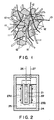
- Fig. 1 is a view for explaining behavior of a fibrous conductive material in a hydrogen absorption alloy electrode according to the present invention
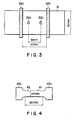
- Fig. 2 is a schematic sectional view showing a hydrogen cell using the hydrogen absorpton alloy electrode of the invention as a cathode
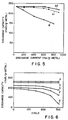
- Fig. 3 is a view for explaining an electrical conductivity of the hydrogen absorption alloy electrode
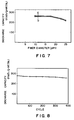
- Fig. 4 is a plane view showing a sample subjected to a tensile strength measurement for the hydrogen absorption alloy electrode
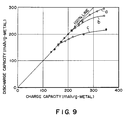
- Figs. 5 to 9 are graphs showing properties of the hydrogen absorption alloy electrode according to the present invention.
- a hydrogen absorption alloy electrode according to the present invention contains (A) a hydrogen absorption alloy powder, (B) a binder, and (C) a fibrous conductive material. These components of the electrode will be described below one by one.
- a hydrogen absorption alloy used in the present invention may be any known alloy which is capable of reversibly absorbing and desorbing hydrogen. Examples are an La-Ni alloy, a Ca-Ni alloy, a Ti-Ni alloy, an La-Co alloy, a Ti-Cu alloy, a Ti-Fe alloy, a Ca-Cu alloy and related alloys which contain other elements substituting a portion of the elements of the above alloys. In these alloys, La may be substituted with misch metal. These hydrogen absorption alloys are used in the form of powder having a particle size of about 0.1 ⁇ m to about 50 ⁇ m.
- a binder is used to bind particles of the hydrogen absorption alloy powder.
- the binder is preferably a polymeric material which is inactive in an electrolytic solution, especially an alkaline solution.
- binder include polytetrafluoroethylene, polyethylene, polyvinyl alcohol, and carboxymethyl cellulose.
- the polymeric binder can be used in the form of powder.
- polytetrafluoroethylene can be mixed with electrode components of the present invention in a dry state. When polytetrafluoroethylene is kneaded with the electrode components, it will have a fibrous structure which sticks to particles of the hydrogen absorption alloy powder. Thus, even if the hydrogen absorption alloy is micro-cracked during use, cracked particles are prevented from falling off from the electrode.
- Polyvinyl alcohol, or carboxymethyl cellulose is suspended in water to prepare a paste and is mixed with the electrode components of the present invention.
- Polytetrafluoroethylene may also be mixed with this paste. Further polytetrafluoroethylene may be coated on the surface of the electrode made of the paste.
- the binder can be used in an amount of 0.5 to 10 % by weight with respect to the total weight of the electrode composition.
- a fibrous conductive material used in the present invention is a conductive material having a length 10 times or more of its diameter.
- the fibrous conductive material includes a metal fiber and a carbon fiber.
- Metal fibers may be formed of a single metal or an alloy. The same or different kinds of metal fibers may be used. Since the metal fiber is used as one component of the hydrogen absorption alloy electrode, it is required to be stable in an electrolytic solution. As the electrode is usually used in an alkaline solution, the metal fiber is required to have a corrosion resistance to that solution.
- the fibrous metal contain at least one kind of element which is contained in the hydrogen absorption alloy used. In such a case, even if the constitutional element of the metal fiber may elute into an electrolytic solution, the poisoning of the cathode or anode by the eluted element can be prevented.
- a nickel fiber is preferably selected when an La-Ni, Ca-Ni, or Ti-Ni hydrogen absorption alloy is used.
- a cobalt fiber is preferably selected when an La-Co or Ti-Co hydrogen absorption alloy is used.
- a copper fiber is preferably selected when a Ti-Cu or Ca-Cu hydrogen absorption alloy is used. If only corrosion resistance of the metal fiber is taken into consideration, it is possible to select the metal fibers in combination with other hydrogen absorption alloys. In this case, it is possible to use fibers of a noble metal such as platinum, gold, silver, and palladium. Of various metals, the best combination for a hydrogen absorption alloy electrode is a combination of a hydrogen absorption alloy containing Ni with a fiber of nickel or a nickel alloy.
- the shape of the metal fiber varies depending on hardness of a metal for forming the metal fiber, a shape of a hydrogen absorption alloy electrode, and the like. It is required that the metal fiber does not interfere with kneading, mixing, rolling or molding, that the prepared electrode has appropriate flexibility, and that tips of the metal fibers do not protrude like whiskers on the surface of the electrode.
- the diameter of the fiber in order to prepare a hydrogen absorption alloy electrode having a thickness of 0.5 mm and an area of about 5 cm x 10 cm, if metal fibers having a length of several mm or more, the diameter of the fiber must be 100 ⁇ m or less. If the diameter exceeds 100 ⁇ m, a tensile force of the metal fibers is excessively large to degrade workability.
- metal fibers have a length of several cm to several tens of cm although its diameter is smaller than 100 ⁇ m, operation such as kneading is actually difficult. It is preferable to set a minimum value of the metal fiber length to be larger than the average particle size of the hydrogen absorption alloy powder (normally about 0.1 to 50 ⁇ m). When the metal fiber length is smaller than the minimum value, the metal fibers can be filled in the gaps between the particles of the hydrogen absorption alloy powder to increase the electrical conductance. However, an increase in mechanical strength, which is achieved upon mixing of metal fibers, cannot be expected.
- the diameter of the metal fiber preferably falls within the range of 2 or 3 ⁇ m to 50 or 60 ⁇ m and its length preferably falls within the range of 200 or 300 ⁇ m to 5 or 6 cm.
- the metal fibers may be twisted to prepare a strand.
- the content of the metal fiber is preferably 0.5 to 10 % by weight with respect to the total weight of the hydrogen absorption alloy electrode composition.
- the carbon fiber preferably has a diameter of 20 ⁇ m or less and a length falling within the range of 1.0 to 30 mm. If the diameter exceeds 20 ⁇ m, the specific surface area is decreased to degrade the degree of contact with the hydrogen absorption alloy powder, and an effect of increasing the electrical conductivity is reduced. If the length of the carbon fiber is less than 1.0 mm, the fibers are too short to form a three-dimensional chain structure. If the length of the carbon fiber exceeds 30 mm, unifom kneading during formation of an electrode cannot be properly performed. In addition, the carbon fibers tend to be cut during kneading.
- the carbon fibers are preferably mixed in an amount of 1.0 to 20.0 % by weight in the electrode.
- the content is less than 1.0 %, an increase in electrical conductivity cannot be expected.
- the content exceeds 20.0 %, uniform kneading tends to be difficult.
- fibrous conductive material 11 contacts with hydrogen absorption alloy powder particles 12 bound by fibrous binder 13 to bridge them and is bound also by binder 13. Even if the hydrogen absorption alloy is cracked and powdered during use, the cracked particles are not isolated (i.e, the cracked particles remain bridged by fibrous conductive material 11, thereby ensuring electrical conductivity). Therefore, a three-dimensional chain structure can be obtained.
- contact points between the conductive fibers and between the conductive fibers and the hydrogen absorption alloy powder are increased in number, and a hydrogen absorption alloy electrode having a low impedance and hence a high electrical conductivity can be obtained.
- Sticking of the conductive fibers with the hydrogen absorption alloy powder and an increase in friction resistance at the contact points, and a binding force of the binder for the conductive fibers cause an increase in resistance against deformation during repeated charging/discharging, thereby obtaining a hydrogen absorption alloy electrode having high mechanical strength.
- the hydrogen absorption alloy electrode according to the present invention may contain a conductive powder such as a metal powder or a carbon powder (e.g., carbon black powder).
- a conductive powder such as a metal powder or a carbon powder (e.g., carbon black powder).
- the additional conductive powder preferably has an average particle size falling within the range of 0.01 to 0.1 ⁇ m and its content preferably falls within the range up to 2.0 % by weight with respect to the total weight of the electrode composition.
- the hydrogen absorption electrode according to the present invention may further contain various catalysts (e.g., Pt, Ag, Pd) in an effective amounts.
- various catalysts e.g., Pt, Ag, Pd
- a hydrogen absorption alloy electrode In order to prepare a hydrogen absorption alloy electrode according to the present invention, the above components are kneaded and formed by a roll or the like according to a conventional method. The formed sheet is cut into pieces having a proper size. An electrical collector such as a metal net may be embedded in the electrode or applied on the surface of the electrode, thereby further improving the electrical conductivity and mechanical strength of the electrode.
- Fig. 2 shows a hydrogen cell model having hydrogen absorption alloy electrode 21 of the invention as a cathode.
- Two anodes e.g., sintered nickel electrodes
- 23a and 23b are formed on both major surfaces of electrode 21 through corresponding separators 22 electrically separating the anode and the cathode.
- This electrode assembly is dipped in electrolytic solution (e.g, a potassium hydroxide solution) 25 contained in sealed vessel 24.
- Electrolytic solution e.g, a potassium hydroxide solution
- Lead wire 26 is connected to electrode 21 and lead wire 27 is commonly connected to anodes 23a and 23b. These lead wires 26 and 27 extend outside vessel 24.
- the electrolytic solution is used in a minimum necessary amount in order to facilitate gas absorption reaction (reduction reaction of O2 gases generated from the anode into H2O on the cathode).
- gas absorption reaction reaction of O2 gases generated from the anode into H2O on the cathode
- separator is usually formed of non-woven polymeric fabric which can hold the electrolytic solution therein.
- a hydrogen absorption alloy represented by composition formula LaNi 4.7 Al 0.3 was put into a pressure-resistant tank and the tank was evacuated at 60°C and a pressure of 10 ⁇ 3 torr or less for an hour. Immediately thereafter, the tank was cooled to 10°C and hydrogen of 30 kg/cm2 was supplied thereto. The tank was kept in this state for about 2 hours. The hydrogen gas was discharged from the tank. The tank was evacuated for 3 hours while it was heated again to 90°C. The hydrogen absorption alloy pulverized during the above activation treatment. The resultant alloy powder was filtered by a 200 mesh sieve (an opening size: 74 ⁇ m).
- the hydrogen absorption alloy powder passed through the 200 mesh sieve, nickel fibers having a diameter of about 10 ⁇ m and a length of about 10 mm, and a polytetrafluoroethylene (PTFE) powder were mixed at a ratio shown in Table 1 and were kneaded.
- PTFE polytetrafluoroethylene
- Each electrode sheet prepared as described above was cut into samples each having a size of 10 mm x 30 mm.
- a pair of sheet-like current terminals 32a and 32b were brought into contact with the surface of test sample 31 and were spaced apart from each other by 10 mm.
- a pair of needle-like voltage terminals 33a and 33b were brought into contact with the surface of a portion of test sample 31 between terminals 32a and 32b and were spaced apart from each other by 5 mm.
- a voltage across terminals 33a and 33b was measured when a 1-kHz AC current was supplied across terminals 32a and 32b. In this manner, a four-terminal method was employed to measure the electrical conductivity.
- test sample 41 As shown in Fig. 4.
- the test sample 41 had central constricted portion 42 having a width of 10 mm and a length of 30 mm and wide portions 43a and 43b at its sides. Wide portions 43a and 43b were clamped by jig and were pulled, thereby measuring the tensile strength. It should be noted that a rheometer available from Fudo Kogyo K.K. was used in measurement.
- the hydrogen absorption alloy electrode sheet prepared in Example 3 was cut into test samples each having a size of 30 mm x 40 mm to prepare a cathode electrode.
- a nickel electrode having an excessive capacity served as a counter electrode (anode).
- the cathode and anode were dipped in an 8N- potassium hydroxide aqueous solution (electrolytic solution) to prepare a sample cell.
- Example 5 Following the same procedures as in Example 5, a sample cell was prepared except that the hydrogen electrode sheet prepared in Example 3 was cut into test samples each having a size of 30 mm x 40 mm to prepare an electrode and that the electrode was compressed on an electrical collector of a 40-mesh nickel net having a wire diameter of 0.15 ⁇ m at a pressure of 500 kg/cm2.
- Example 5 Following the same procedures as in Example 5, a sample cell was prepared except that the hydrogen electrode sheet prepared in Comparative Example 1 was used.
- the electrodes of Examples 5 and 6 have better discharging characteristics than that in Comparative Example 2. This indicates an increase in cell capacity and extraction of a large current.
- PTFE polytetrafluoroethylene
- the resistances of the sheets of samples A to D obtained in Example 18 can be decreased, as compared with conventional samples E and F, even if the content of the carbon fibers is reduced.
- the tensile strengths of samples A to D can be large.
- the hydrogen absorption alloy electrodes of Example 18 have a long service life. This is because the carbon fibers together with the binder constitute a three-dimensional structure of the hydrogen absorption alloy electrode, thereby improving binding force and contact between the hydrogen absorption alloy powder particles.
- a cell as in Fig. 2 was prepared using the resultant hydrogen absorption alloy electrode, and discharge capacities as a function of diameter of the carbon fiber in the electrode were measured to obtain a graph shown in Fig. 7.
- Characteristic curve a in Fig. 7 represents characteristics of the hydrogen absorption alloy electrode containing at least two types of carbon fibers having a length falling within the range of 1.0 mm to 30 mm.
- Characteristic curve b represents characteristics of the hydrogen absorption alloy electrode containing carbon fibers having a length of 30 mm.
- the resistance of the sheet and tensile strength of the resultant hydrogen absorption alloy electrode were measured.
- the resistance of the sheet was as high as 3.0 x 10² ⁇ , and the tensile strength was as high as 1.7 kg/cm2.
- a cell as shown in Fig. 2 was prepared using the hydrogen absorption alloy electrode obtained in Example 20, and the charging/discharging repeated cycle characteristics of the cell were measured. Results are shown in a graph of Fig. 8. This cell was proved to have a large discharge capacity and a long service life. This is because the electrical conductivity was increase by the addition of furnace black and carbon fibers, and also because the carbon fibers in the electrode form a three-dimensional chain stereostructure which connects particles of hydrogen absorption alloy and furnace black each other.
- Hydrogen absorption alloy electrodes were prepared following the same procedures as in Example 20 except that the content of conductive furnace black was changed in the range of 0.5 to 4.0 wt% and the content of the carbon fibers was changed in the range of 0.5 to 4.0 wt%.
- both the content of furnace black and the content of carbon fibers are related with the results. Practical cells are expected to have a discharge capacity of 250 mAh/g or more.
- the content of furnace black preferably falls within the range of 0.5 to 2.0 wt%
- the content of carbon fibers preferably falls within the range of 0.5 to 2.0 wt%
- a total content of furnace black and carbon fibers preferably falls within the range of 3.0 wt% or less.
- An electrode according to the present invention was prepared following the same procedures as in Example 18 except that LmNi 4.2 Co 0.2 Mn 0.3 Al 0.3 (Lm: misch metal enriched with La) was used as a hydrogen absorption alloy. The contents of a polytetrafluoroethylene powder and carbon fibers (diameter: 5 ⁇ m; length: 3.0 mm) were 4 wt% and 2 wt%, respectively.
- An electrode was prepared as Comparative Example A following the same procedures as in Example 22 except that 0.5 wt% of carbon powder (average particle size: 0.3 ⁇ m) was used instead of carbon fibers.
- an electrode was prepared as Comparative Example B following the same procedures as in Example 22 except that the carbon fibers are not mixed.
- Hydrogen secondary cells shown in Fig. 2 were prepared using the above electrodes, and the relationship between the charge and discharge capacities was measured. Results are shown in Fig. 9, in which curve a relates to the present invention, curve b relates to Comparative Example A, and curve c relates to Comparative Example B. As seen from Fig. 9, the hydrogen absorption alloy electrode according to the present invention provides a discharge capacity substantially proportional to the charge capacity, and has a high value of discharge capacity at an efficiency of 100 %.
- a hydrogen absorption electrode having a high electrical conductivity, high rate (large current) charging/discharging characteristic, and a large electrical capacity, having high mechanical strength represented by the tensile strength, and good workability.
Landscapes
- Chemical & Material Sciences (AREA)
- Chemical Kinetics & Catalysis (AREA)
- Electrochemistry (AREA)
- General Chemical & Material Sciences (AREA)
- Battery Electrode And Active Subsutance (AREA)
Claims (18)
- Une électrode à absorption d'hydrogène comprenant :
une poudre d'alliage à absorption d'hydrogène (12) choisie dans le groupe comprenant un alliage de La-Ni, un alliage de Ca-Ni, un alliage de Ti-Ni, un alliage de La-Co, un alliage de Ti-Cu, un alliage de Ti-Fe et un alliage de Ca-Cu; des alliages de mischmétal avec Ni ou Co; et des alliages apparentés qui contiennent d'autres éléments se substituant à une portion des éléments des alliages mentionnés ci-dessus; les particules de cette poudre sont liées par un liant polymère (13) inerte dans une solution électrolytique; et
un matériau conducteur fibreux (11) en contact avec les particules de ladite poudre d'alliage à absorption d'hydrogène pour ponter lesdites particules. - Une électrode selon la revendication 1, caractérisée en ce que la teneur en matériau conducteur fibreux est de 0,5 à 10 % en poids par rapport au poids total de l'électrode.
- Une électrode selon la revendication 1 ou 2, caractérisée en ce que la teneur en liant est de 0,5 à 10% en poids par rapport au poids total de l'électrode.
- Une électrode selon la revendication 1, 2 ou 3, caractérisée en ce la poudre d'alliage à absorption d'hydrogène a une taille de particules d'environ 0,1 à environ 50 µm.
- Une électrode selon la revendication 1, 2, 3 ou 4, caractérisée en ce que le matériau conducteur fibreux a une longueur d'environ 10 fois ou plus son diamètre.
- Une électrode selon l'une quelconque des revendications précédentes, caractérisée en ce que le matériau conducteur fibreux comprend une fibre métallique.
- Une électrode selon la revendication 6, caractérisée en ce que l'un des éléments de la fibre métallique est le même que l'un des éléments de l'alliage à absorption d'hydrogène.
- Une électrode selon la revendication 6, caractérisée en ce que le matériau conducteur fibreux comprend une pluralité de types de fibres métalliques, dont l'un au moins est le même que l'un des éléments de l'alliage à absorption d'hydrogène.
- Une électrode selon la revendication 6, 7 ou 8, caractérisée en ce que la fibre métallique comprend un métal pur ou un alliage ayant une résistance à la corrosion dans une solution alcaline.
- Une électrode selon la revendication 6, caractérisée en ce que la poudre d'alliage à absorption d'hydrogène contient du nickel comme un de ses éléments, et la fibre métallique comprend du nickel.
- Une électrode selon l'une quelconque des revendications 6 à 10, caractérisée en ce que les fibres métalliques sont toronnées.
- Une électrode selon l'une quelconque des revendications 6 à 11, caractérisée en ce que la fibre métallique a un diamètre d'environ 2 à 60 µm et une longueur d'environ 200 µm à environ 6 cm.
- Une électrode selon l'une quelconque des revendications 1 à 5, caractérisée en ce que le matériau conducteur fibreux comprend une fibre de carbone.
- Une électrode selon la revendication 13, caractérisée en ce que la teneur en fibres de carbone est de 1,0 à 20,0% en poids par rapport au poids total de l'électrode.
- Une électrode selon la revendication 13 ou 14, caractérisée en ce que la fibre de carbone a un diamètre ne dépassant pas 20 µm et une longueur de 1,0 à 30 mm.
- Une électrode selon l'une quelconque des revendications précédentes, contenant en outre du noir de carbone.
- Une électrode selon la revendication 16, caractérisée en ce que la teneur en noir de carbone est de 0,5 à 2,0 % en poids par rapport au poids total de l'électrode.
- Une pile à hydrogène comprenant un récipient scellé, une solution électrolytique contenue dans le récipient scellé, une cathode, une anode et un séparateur séparant la cathode et l'anode, ladite cathode, ladite anode et ledit séparateur étant mouillés par la solution électrolytique, selon laquelle la cathode est constituée par l'électrode selon l'une quelconque des revendications 1 à 17.
Applications Claiming Priority (4)
| Application Number | Priority Date | Filing Date | Title |
|---|---|---|---|
| JP255143/86 | 1986-10-27 | ||
| JP61255145A JPS63110552A (ja) | 1986-10-27 | 1986-10-27 | 水素吸蔵合金電極 |
| JP61255143A JPS63110553A (ja) | 1986-10-27 | 1986-10-27 | 水素電極 |
| JP255145/86 | 1986-10-27 |
Publications (3)
| Publication Number | Publication Date |
|---|---|
| EP0266162A2 EP0266162A2 (fr) | 1988-05-04 |
| EP0266162A3 EP0266162A3 (en) | 1988-08-03 |
| EP0266162B1 true EP0266162B1 (fr) | 1991-07-10 |
Family
ID=26542043
Family Applications (1)
| Application Number | Title | Priority Date | Filing Date |
|---|---|---|---|
| EP87309457A Expired - Lifetime EP0266162B1 (fr) | 1986-10-27 | 1987-10-26 | Electrode en alliage d'absorption d'hydrogène et cellule à hydrogène |
Country Status (2)
| Country | Link |
|---|---|
| EP (1) | EP0266162B1 (fr) |
| DE (1) | DE3771301D1 (fr) |
Cited By (1)
| Publication number | Priority date | Publication date | Assignee | Title |
|---|---|---|---|---|
| DE102011107331A1 (de) * | 2011-07-14 | 2013-01-17 | Karlsruher Institut für Technologie | Elektrodenmaterial, Elektrode, Verfahren zu ihrer Herstellung, elektrochemische Zelle und Batterie |
Families Citing this family (5)
| Publication number | Priority date | Publication date | Assignee | Title |
|---|---|---|---|---|
| JP2575840B2 (ja) * | 1988-09-13 | 1997-01-29 | 株式会社東芝 | 水素吸蔵合金電極の乾式製造方法 |
| DE68925580T2 (de) * | 1989-04-14 | 1996-09-19 | Katayama Tokushu Kogyo Kk | Verfahren zur Herstellung einer porösen metallischen Folie |
| US6440607B1 (en) * | 1998-06-08 | 2002-08-27 | Toshiba Battery Co., Ltd. | Nickel-hydrogen secondary cell |
| JP2988479B1 (ja) | 1998-09-11 | 1999-12-13 | 松下電器産業株式会社 | アルカリ蓄電池と水素吸蔵合金電極及びその製造法 |
| EP4447166A1 (fr) * | 2023-04-14 | 2024-10-16 | Arkema, Inc. | Formulation d'électrode pour processus à sec |
Family Cites Families (3)
| Publication number | Priority date | Publication date | Assignee | Title |
|---|---|---|---|---|
| US2977401A (en) * | 1957-10-09 | 1961-03-28 | Union Carbide Corp | Cathodes |
| GB1468591A (en) * | 1973-06-01 | 1977-03-30 | Deutsche Automobilgesellsch | Electrodes for galvanic cells |
| DE2835506C2 (de) * | 1978-08-12 | 1981-11-19 | Deutsche Automobilgesellschaft Mbh, 3000 Hannover | Biporöse Raney-Nickel-Elektrode und Verfahren zu deren Herstellung |
-
1987
- 1987-10-26 EP EP87309457A patent/EP0266162B1/fr not_active Expired - Lifetime
- 1987-10-26 DE DE8787309457T patent/DE3771301D1/de not_active Expired - Lifetime
Cited By (1)
| Publication number | Priority date | Publication date | Assignee | Title |
|---|---|---|---|---|
| DE102011107331A1 (de) * | 2011-07-14 | 2013-01-17 | Karlsruher Institut für Technologie | Elektrodenmaterial, Elektrode, Verfahren zu ihrer Herstellung, elektrochemische Zelle und Batterie |
Also Published As
| Publication number | Publication date |
|---|---|
| EP0266162A2 (fr) | 1988-05-04 |
| DE3771301D1 (de) | 1991-08-14 |
| EP0266162A3 (en) | 1988-08-03 |
Similar Documents
| Publication | Publication Date | Title |
|---|---|---|
| JP2575840B2 (ja) | 水素吸蔵合金電極の乾式製造方法 | |
| EP0552790B1 (fr) | Alliage emmagasinant de l'hydrogène et électrode et cellule le contenant | |
| JP3056054B2 (ja) | 亜鉛2次電池及び亜鉛電極 | |
| US5462821A (en) | Gallium based active material for the negative electrode, a negative electrode using the same, and batteries using said negative electrode | |
| JPS638584B2 (fr) | ||
| EP0021735B1 (fr) | Electrode de zinc pour cellules électrochimiques secondaires et cellules électrochimiques comprenant cette électrode | |
| US5034289A (en) | Alkaline storage battery and method of producing negative electrode thereof | |
| JP2708452B2 (ja) | 水素吸蔵合金電極とその製造方法 | |
| US5205985A (en) | Hydrogen storage alloy and hydride electrodes having c15 crystal structure | |
| US3870562A (en) | Use of Ni(OH){HD 2 {B in pressed plate electrodes | |
| EP0266162A2 (fr) | Electrode en alliage d'absorption d'hydrogène et cellule à hydrogène | |
| US5776626A (en) | Hydrogen-occluding alloy and hydrogen-occluding alloy electrode | |
| US4022953A (en) | Zinc electrodes for secondary batteries | |
| US4414303A (en) | Cadmium negative electrode | |
| JPS5937667A (ja) | 金属酸化物・水素電池 | |
| US5434022A (en) | Electrodes and electrochemical storage cells utilizing tin-modified active materials | |
| US5989746A (en) | Pasted nickel electrode | |
| Mrha et al. | Plastic bonded electrodes for nickel-cadmium accumulators II. Basic electrochemical parameters of the nickel oxide electrode | |
| JP4183292B2 (ja) | 二次電池 | |
| JPH06302319A (ja) | 水素吸蔵電極の製造法およびその電極を備えた金属酸化物−水素蓄電池 | |
| JPH0810596B2 (ja) | 金属酸化物・水素電池 | |
| JPS63110553A (ja) | 水素電極 | |
| JP2958786B2 (ja) | 水素吸蔵電極 | |
| JPH05166506A (ja) | 水素吸蔵電極とその製造方法およびその水素吸蔵電極を備えた金属酸化物−水素蓄電池 | |
| JPH04179052A (ja) | ニッケル水素二次電池 |
Legal Events
| Date | Code | Title | Description |
|---|---|---|---|
| PUAI | Public reference made under article 153(3) epc to a published international application that has entered the european phase |
Free format text: ORIGINAL CODE: 0009012 |
|
| 17P | Request for examination filed |
Effective date: 19880209 |
|
| AK | Designated contracting states |
Kind code of ref document: A2 Designated state(s): DE FR |
|
| PUAL | Search report despatched |
Free format text: ORIGINAL CODE: 0009013 |
|
| AK | Designated contracting states |
Kind code of ref document: A3 Designated state(s): DE FR |
|
| 17Q | First examination report despatched |
Effective date: 19900117 |
|
| GRAA | (expected) grant |
Free format text: ORIGINAL CODE: 0009210 |
|
| AK | Designated contracting states |
Kind code of ref document: B1 Designated state(s): DE FR |
|
| REF | Corresponds to: |
Ref document number: 3771301 Country of ref document: DE Date of ref document: 19910814 |
|
| EN | Fr: translation not filed | ||
| REG | Reference to a national code |
Ref country code: FR Ref legal event code: AR |
|
| PLBE | No opposition filed within time limit |
Free format text: ORIGINAL CODE: 0009261 |
|
| STAA | Information on the status of an ep patent application or granted ep patent |
Free format text: STATUS: NO OPPOSITION FILED WITHIN TIME LIMIT |
|
| 26N | No opposition filed | ||
| ET | Fr: translation filed | ||
| REG | Reference to a national code |
Ref country code: FR Ref legal event code: BR |
|
| REG | Reference to a national code |
Ref country code: FR Ref legal event code: D6 |
|
| PGFP | Annual fee paid to national office [announced via postgrant information from national office to epo] |
Ref country code: DE Payment date: 20061019 Year of fee payment: 20 |
|
| PGFP | Annual fee paid to national office [announced via postgrant information from national office to epo] |
Ref country code: FR Payment date: 20061010 Year of fee payment: 20 |