EP0266201B1 - Anordnung zum Mischen und Ausgeben von Säften - Google Patents
Anordnung zum Mischen und Ausgeben von SäftenInfo
- Publication number
- EP0266201B1 EP0266201B1 EP87309572A EP87309572A EP0266201B1 EP 0266201 B1 EP0266201 B1 EP 0266201B1 EP 87309572 A EP87309572 A EP 87309572A EP 87309572 A EP87309572 A EP 87309572A EP 0266201 B1 EP0266201 B1 EP 0266201B1
- Authority
- EP
- European Patent Office
- Prior art keywords
- concentrate
- water
- juice
- conduit
- canister
- Prior art date
- Legal status (The legal status is an assumption and is not a legal conclusion. Google has not performed a legal analysis and makes no representation as to the accuracy of the status listed.)
- Expired - Lifetime
Links
- 235000011389 fruit/vegetable juice Nutrition 0.000 title claims description 25
- 239000012141 concentrate Substances 0.000 claims description 112
- XLYOFNOQVPJJNP-UHFFFAOYSA-N water Substances O XLYOFNOQVPJJNP-UHFFFAOYSA-N 0.000 claims description 65
- 235000015205 orange juice Nutrition 0.000 claims description 14
- 238000010438 heat treatment Methods 0.000 claims description 8
- 235000021579 juice concentrates Nutrition 0.000 claims description 8
- 230000003134 recirculating effect Effects 0.000 claims description 6
- 235000013361 beverage Nutrition 0.000 claims description 5
- 239000000203 mixture Substances 0.000 claims description 5
- 238000000034 method Methods 0.000 claims description 3
- 235000008504 concentrate Nutrition 0.000 description 89
- CDBYLPFSWZWCQE-UHFFFAOYSA-L Sodium Carbonate Chemical compound [Na+].[Na+].[O-]C([O-])=O CDBYLPFSWZWCQE-UHFFFAOYSA-L 0.000 description 4
- 230000001276 controlling effect Effects 0.000 description 4
- 230000008014 freezing Effects 0.000 description 3
- 238000007710 freezing Methods 0.000 description 3
- 230000000903 blocking effect Effects 0.000 description 2
- 238000010257 thawing Methods 0.000 description 2
- 230000003028 elevating effect Effects 0.000 description 1
- 230000005484 gravity Effects 0.000 description 1
- 238000003780 insertion Methods 0.000 description 1
- 230000037431 insertion Effects 0.000 description 1
- 239000007788 liquid Substances 0.000 description 1
- 238000012986 modification Methods 0.000 description 1
- 230000004048 modification Effects 0.000 description 1
- 230000001105 regulatory effect Effects 0.000 description 1
- 239000007787 solid Substances 0.000 description 1
- 230000003068 static effect Effects 0.000 description 1
- 235000020357 syrup Nutrition 0.000 description 1
- 239000006188 syrup Substances 0.000 description 1
Images
Classifications
-
- B—PERFORMING OPERATIONS; TRANSPORTING
- B67—OPENING, CLOSING OR CLEANING BOTTLES, JARS OR SIMILAR CONTAINERS; LIQUID HANDLING
- B67D—DISPENSING, DELIVERING OR TRANSFERRING LIQUIDS, NOT OTHERWISE PROVIDED FOR
- B67D3/00—Apparatus or devices for controlling flow of liquids under gravity from storage containers for dispensing purposes
- B67D3/04—Liquid-dispensing taps or cocks adapted to seal and open tapping holes of casks, e.g. for beer
-
- B—PERFORMING OPERATIONS; TRANSPORTING
- B67—OPENING, CLOSING OR CLEANING BOTTLES, JARS OR SIMILAR CONTAINERS; LIQUID HANDLING
- B67D—DISPENSING, DELIVERING OR TRANSFERRING LIQUIDS, NOT OTHERWISE PROVIDED FOR
- B67D1/00—Apparatus or devices for dispensing beverages on draught
- B67D1/08—Details
- B67D1/12—Flow or pressure control devices or systems, e.g. valves, gas pressure control, level control in storage containers
- B67D1/1202—Flow control, e.g. for controlling total amount or mixture ratio of liquids to be dispensed
- B67D1/1234—Flow control, e.g. for controlling total amount or mixture ratio of liquids to be dispensed to determine the total amount
Definitions
- This invention relates to juice dispensing and in a preferred embodiment to dispensing orange juice from 5 + 1 concentrate (5 parts water to 1 part concentrate) at -10°F to 0°F.
- Postmix orange juice dispensing systems are known for example from FR 2126102.
- Orange juice concentrate is distributed frozen. Restaurants remove concentrate from the freezer and thaw the concentrate in a cooler prior to dispensing. The restaurant has to estimate its juice requirements at least two days in advance and place sufficient concentrate in its cooler. If the restaurant's estimates are incorrect or if someone forgets, the restaurant will run out of thawed concentrate. Also, there is often a limited amount of cooler space available for thawing orange juice concentrate. When a restaurant runs out of thawed concentrate, measures are sometimes taken to quickly thaw frozen concentrate and such measures often are inefficient and ineffective and also sometimes affect the taste of the resulting product. Orange juice concentrate has typically been 3 + 1 concentrate. The present invention is useful with 5 + 1 concentrate.
- the reduced amount of water in 5 + 1 concentrate prevents a phase change or freezing, at typical freezer temperatures of -10°F (-23°C) to 0°F (-18°C).
- the 5 + 1 concentrate at freezer temperatures does not readily flow by gravity.
- a container of 0°F (-18°C) product can be inverted and no product will flow out.
- the product is so thick that a pump's suction cannot pull product from the container. However, the product is still pliable.
- the present invention provides apparatus for reconstituting and dispensing juice comprising:
- a method of reconstituting and dispensing juice comprising:
- the invention provides a postmix beverage dispensing system for dispensing 5 + 1 concentrate at freezer temperatures from a flexible bag including placing the bag in a rigid, pressurizable container, pressurizing the container to force concentrate out of the bag, feeding concentrate through a heat exchanger to raise the temperature to about 32°F (0°C) to 40°F (4°C), feeding the thawed concentrate to a metering device along with water for controlling the mixture ratio, and then feeding the water and concentrate to a mixing chamber of a dispensing valve for dispensing the mixture as an orange juice beverage into a cup.
- the concentrate bag preferably incorporates a dip tube or dip strip with slots larger than the pulp in the concentrate and with an internal cross-sectional area much greater than that of the slots to facilitate flowing of the concentrate and to reduce pressure drops.
- the tube prevents the bag from blocking the internal passageway therethrough.
- Concentrate emerging from the bag can be as cold as -10°F (-23°C).
- the heat exchanger can use recirculating soda water and a heating element to prevent the water from freezing.
- the proper portioning of water and orange juice concentrate during reconstitution preferably incorporates a volumetric piston pump operated by the pressurized water.
- the water and orange juice concentrate can be metered by use of a flow meter to measure the water flow rate and a volumetric pump with motor drive at a fixed speed to meter the concentrate.
- Control electronics such as a microcontroller,can regulate the water flow rate by use of a motorized control valve.
- the concentrate pump's motor can be adjustable and the control electronics can then also or alternatively regulate the speed of the pump motor depending on the water flow rate.
- the actual reconstituting of the metered water and concentrate can incorporate either a static or a dynamic mixer.
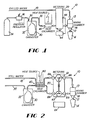
- FIG. 1 shows a postmix juice dispensing system 10 for dispensing a finished juice beverage from a nozzle 12 of a mixing chamber 16 into a cup 14.
- the system 10 feeds water and juice concentrate, in a desired ratio, for example, 5 parts of water to 1 part of concentrate, into the mixing chamber 16 wherein complete mixing of the concentrate and water takes place.
- the water is fed through a water conduit 18 to a metering device 20 and then to the mixing chamber 16.
- the concentrate is contained in a concentrate bag 30 at freezer temperatures of about -10°F (-23°C) to about 0°F (-18°C).
- the bag 30 is preferably a nonreturnable, flexible bag.
- the bag 30 is removed from a freezer and placed in a rigid, pressurizable canister 32 which is then pressurized by a pressure source (such as a CO2 or compressed air cylinder 34) and a pressure regulator 36.
- a pressure source such as a CO2 or compressed air cylinder 34
- the pressure forces the concentrate, which is not frozen (it has not undergone a phase change) because of its low water content but which is pliable, through a concentrate conduit 38 to a heat exchanger 40, then to the metering device 20, and then to the mixing chamber 16.
- This design allows dispensing of a 5 + 1 concentrate at freezer temperatures.
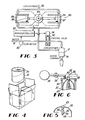
- the pliable concentrate contained in the flexible bag 30 is preferably shipped in a cylindrical container 41 (see FIG. 4) to facilitate insertion of the bag 30 into the cylindrical canister 32.
- the restaurant simply inserts the frozen bag 30 directly from the freezer into the canister 32, without requiring any thawing.
- FIG. 5 is a partial view of the bag 30 showing a dip tube or strip 42 connected to a spout 43.
- the dip strip 42 includes a central passageway 44 and a plurality of openings 46 into the passageway 44.
- the openings 46 are of a size sufficiently large to allow pulp to pass into the passageway 44 while preventing the bag from entering into and blocking the passageway 44.
- the larger cross-sectional area of the passageway 44 facilitates flowing of the concentrate and reduces pressure drops due to friction.
- the canister 32 is shown in more detail in FIG. 6 and includes a removable lid 48 that hermetically seals to the wall 49 of the canister.
- the lid 48 includes a fitting 50 for pressurizing the canister 32 (with CO2 or air, for example) and a concentrate fitting 52 for connecting the spout 43 of the bag 30 to the concentrate conduit 38.
- the concentrate in the bag 30 is preferably 5 + 1 concentrate.
- the canister is preferably pressurized to about 40 psig. This pressure forces the concentrate out of the bag to the heat exchanger 40 and then to the metering device 20 and finally to the mixing chamber 16.
- the heat exchanger 40 includes a heat source 60 and can be any known type of heat exchanger and heat source.
- the heat exchanger preferably elevates the temperature of the concentrate to about 32°F (0°C) to 40°F (4°C).
- the heat source 60 can be a thermostatically controlled electrical heating element.
- the metering device 20 (which can be any known type of metering device) provides the proper portioning of the water and orange juice concentrate.
- the device 20 can use two connected double-acting pistons in a volumetric piston pump for each of the water and concentrate conduits.
- the ratio of the volume of the water chambers to the concentrate chambers is the same as the desired mixture ratio, such as, for example 5:1 (water to concentrate).
- the water pistons can be connected to the concentrate pistons so that the pressurized water can be used to operate both pumps.
- the system of FIG. 1 also includes a solenoid on-off valve 19 in the water line, operated by a microcontroller 64.
- a microcontroller 64 When it is desired to dispense a drink, for example when a cup 14 engages a lever 15, the microcontroller 64 causes the valve 19 to open, and when dispensing is completed, it closes the valve 19.
- microcontroller 64 also operates the inlet and outlet valves for the water and concentrate to and from the metering device 20, in response, for example, to sensed positions of the pistons.
- Volumetric piston pumps are well-known and thus need not be described in detail here.
- FIG. 2 shows a preferred embodiment of the system of FIG. 1 in which a recirculating water conduit 59 is in heat exchange relationship to the concentrate conduit 38, in addition to the use of separate heat source 60.
- the water conduit 59 can be a recirculating soda water line available in the restaurant, for example.
- the heat source 60 prevents the water from freezing.
- FIG. 2 shows a particular metering device 20 which can be used.
- FIG. 2 shows a water pump 65 with two connected pistons, connected in turn to two connected pistons of a concentrate pump 66.
- a water control valve 67 of the water pump is mechanically operated by a linkage 68 connected to a reciprocating shaft 69 connecting to the two water pistons.
- Inlet and outlet valves 70 of the concentrate pump 66 are preferably controlled by the microcontroller 64 in response to sensed positions of the concentrate pistons.
- the sensing of the positions of the pistons is shown at 62, and the control of the inlet and outlet valves at 61.
- FIG. 3 shows an alternative means for metering the water and the orange juice concentrate.
- This means includes a flow meter 80 in the water conduit 18 for measuring the water flow rate; electrical pulses whose period is proportional to the water flow rate are inputted into a microcontroller 82.
- a volumetric pump 84 meters the concentrate through the concentrate conduit 38.
- the concentrate pump 84 incorporates two chambers 86 and 87 with connected pistons 88 and 89. Each piston stroke finds one piston expelling a fixed volume of concentrate while the attached chamber is filling with concentrate.
- a motor 90 moves the pistons 88 and 89.
- the motor speed can be fixed.
- the water flow rate is controlled by means of a variable size orifice in a motorized control valve 92 operated by a DC stepping motor 94.
- the microcontroller 82 controls the motor 94 to regulate the water flow rate.
- the motor 90 can be adjustable with the microcontroller 82 regulating the speed of the motor 90 to control the conc entrate flow rate depending on the water flow rate as measured by the flow meter 80, to control the mixture ratio.
- the microcontroller 82 can also control both the motor 90 and the control valve 92.
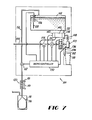
- FIG. 7 shows another embodiment of the present invention of a dispensing system 100 in which the concentrate is fed to a vented reservoir 102.
- FIG. 7 shows a water conduit 104 connected to a mixing chamber 103 and having a water flow meter 105, a motorized control valve 106 operated by a D.C. stepping motor 108, and a solenoid controlled on-off valve 110.
- FIG. 7 also shows a concentrate conduit 114 which feeds pliable concentrate from a flexible container 116 in a pressurized canister 118, through a heat exchanger 120 (including a heat source 99 and a recirculating soda water line 101), through a solenoid controlled on-off valve 122, to the reservoir 102.
- the reservoir 102 includes high and low level indicators 126 and 128, respectively, connected to a microcontroller 130, which opens and closes the on-off valve 122 in response to signals from the level indicators.
- a concentrate conduit 132 extends from the reservoir 102 to a flexible vane pump 134 (or a gerotor pump, for example), and then to the mixing chamber 103 where it mixes with the water to form a final beverage which is dispensed from a nozzle 136 into a cup 138.
- microcontroller 130 In addition to the microcontroller 130 controlling the level of concentrate in the reservoir 102, it also controls the speed of a D.C. motor 140 with encoder 142 to control the concentrate flow rate, and it controls the water flow rate by controlling the motorized water control valve 106 in response to signals from the water flow meter 105.
- the microcontroller 130 also controls the solenoid controlled, water on-off valve 110 in response to actuation of the dispensing system 100, such as by the cup 138 engaging a lever arm 152.
- this invention can be used with various juices other than the preferred orange juice.
- the juice can be thawed juice, such as thawed 3+1 juice; that is, this invention is not limited to use with pliable 5+1 concentrate at freezer temperatures.
- the preferred temperature ranges are only preferred, other freezer temperatures below 32°F (0°C) can be used, and the heat exchanger can raise the temperature to any desired temperature above 32°F (0°C).
- the heat exchanger can include a water conduit, such as a recirculating soda water line that is available in the restaurant, in heat exchange relationship thereto.
- the present invention provides a postmix juice dispensing system for use with 5 + 1 concentrate at freezer temperatures; and furthermore provides a postmix juice dispensing system for use with 5 + 1 concentrate at freezer temperatures in which the concentrate is contained in a flexible bag which is then placed in a pressurizable vessel which is pressurized to about 40 psig to force concentrate out of the bag; and furthermore provides a postmix juice dispensing system for dispensing 5 + 1 concentrate at freezer temperatures including elevating the concentrate temperature to about 32°F (0°C) to 40°F (4°C), forcing the thawed concentrate to a metering device, and then feeding the thawed and metered concentrate to a mixing chamber of a dispensing valve; and furthermore provides a postmix juice dispensing system in which 5 + 1 concentrate at freezer temperatures is placed in a flexible bag in a pressurizable vessel and forced by pressure out of the flexible bag, fed through a heat exchanger, then fed through a metering
Landscapes
- Engineering & Computer Science (AREA)
- Mechanical Engineering (AREA)
- Devices For Dispensing Beverages (AREA)
- Beverage Vending Machines With Cups, And Gas Or Electricity Vending Machines (AREA)
- Non-Alcoholic Beverages (AREA)
Claims (14)
- Vorrichtung (10) zum Wiederaufbereiten und Ausgeben von Saft, welche aufweist:(a) einen Kanister (32), welcher derart eingerichtet ist, daß er eine Menge eines Saftkonzentrats hält und ausgibt;(b) eine Mischkammer (16) und eine Düse (12) zur Ausgabe eines Getränks hiervon;(c) eine Konzentratleitung (38), die sich vom Kanister (32) zu der Mischkammer (16) erstreckt;(d) eine Wasserleitung (18), welche in die Mischkammer (16) geht; und(e) eine Dosiereinrichtung (20) in den Leitungen (18, 36) zum Steuern des Verhältnisses von Wasser zu Konzentrat, welche der Mischkammer (16) zugeleitet werden,dadurch gekennzeichnet, daß
der Kanister (32) druckbeaufschlagbar ist und derart ausgelegt ist, daß fließfähiges Saftkonzentrat mit einer Temperatur unter 32°F (0°C) ausgebbar ist, Einrichtungen zur derartigen Druckbeaufschlagung des Kanisters (32) vorgesehen sind, daß der Druck im Kanister (32) das Konzentrat in die Konzentratleitung (38) drückt, und daß Einrichtungen (40) zum Erwärmen des Konzentrats in der Konzentratleitung (38) vorgesehen sind. - Vorrichtung nach Anspruch 1, bei der die Heizeinrichtung (40) eine Umwälzwasserleitung (59) umfaßt, welche in Wärmeübertragungszuordnung zu der Konzentratleitung (38) vorgesehen ist.
- Vorrichtung nach Anspruch 1 oder 2, bei der die Dosiereinrichtung (20) eine volumetrische Kolbenpumpe wenigstens in der Konzentratleitung (38) oder der Wasserleitung (18) aufweist.
- Vorrichtung nach Anspruch 3, welche eine volumetrische Kolbenpumpe in jeder der Leitungen (18, 38) unfaßt, und bei der das Verhältnis der Pumpvolumina das gewünschte Mischverhältnis ist.
- Vorrichtung nach Anspruch 1 oder 2, bei der die Dosiereinrichtung eine Mikrosteuereinrichtung (82), einen Durchflußmesser (80) in der Wasserleitung und ein motorisch angetriebenes Steuerventil (92) in der Wasserleitung (18) umfaßt, wobei der Durchflußmesser (80) und das motorisch angetriebene Steuerventil (92) mit der Mikrosteuereinrichtung (82) verbunden sind.
- Vorrichtung nach Anspruch 5, welche einen Konzentratvorratsbehälter (102), eine Einrichtung (130), welche den Vorratsbehälter automatisch mit Konzentrat gefüllt hält, wobei die Konzentratleitung (132) das Konzentrat von der Heizeinrichtung dem Vorratsbehälter (102) zuleitet, und eine Einrichtung (134, 144) zum Zuleiten eines gesteuerten Konzentratvolumens von dem Vorratsbehälter (102) zu der Mischkammer (103) während der Ausgabe umfaßt.
- Vorrichtung nach Anspruch 6, bei der die Zufuhreinrichtung eine Pumpe (134) und einen Gleichstrommotor (140) mit einem Kodierer (142) aufweist, der mit der Mikrosteuereinrichtung (130) verbunden ist.
- Vorrichtung nach Anspruch 7, bei der die Pumpe eine Pumpe (134) mit biegsamen Schaufeln ist.
- Vorrichtung nach Anspruch 1 oder 2, welche ein magnetisch gesteuertes Ein/Aus-Ventil (122) in der Wasserleitung umfaßt.
- Vorrichtung nach einem der vorangehenden Ansprüche, bei der der druckbeaufschlagbare Kanister (32) einen abnehmbaren Verschlußdeckel (48) und einen Beutel (30) für das fließfähige Saftkonzentrat umfaßt, der im Kanister (32) sich befindet.
- Vorrichtung nach Anspruch 10, bei der der Konzentratbeutel (30) auf einer Temperatur von etwa -10°F (-23°C) bis 0°F (-18°C) ist.
- Vorrichtung nach einem der vorangehenden Ansprüche, bei der die Druckbeaufschlagungseinrichtung eine unter Druck stehende CO₂-Quelle (34) und einen Druckregler (36) umfaßt.
- Verfahren zum Wiederaufbereiten und Ausgeben von Saft, welches aufweist:(a) Ausdrücken von Saftkonzentrat aus dem Behälter (30) in eine Konzentratleitung (38);(b) Zuleiten des Konzentrats zu einer Dosiereinrichtung (20);(c) Zuführen von Wasser zu einer Dosiereinrichtung (20); und(d) Zuleiten eines gesteuerten Verhältnisses von Wasser zu Konzentrat zu einer Mischkammer (16),dadurch gekennzeichnet, daß
der Saft fließfähig ist und bei einer Temperatur von unter 32°F (0°C) aus dem Behälter herausgedrückt wird, welcher in Form eines Beutels vorliegt, sowie unter Anwendung eines Erwärmungsschrittes für das Konzentrat in der Konzentratleitung (38) über 32°F (0°C). - Verfahren nach Anspruch 13, bei dem der Saft 5 + 1 Orangensaft ist, und der Schritt zum Herausdrücken aufweist, daß ein flexibler Beutel (30) mit dem Konzentrat bei einer Temperatur von etwa -10°F (-23°C) bis 0°F (-18°C) in einen druckbeaufschlagbaren Kanister (32) gelegt wird, und daß der Kanister (32) mit CO₂ bei etwa 40 psig druckbeaufschlagt wird.
Applications Claiming Priority (2)
| Application Number | Priority Date | Filing Date | Title |
|---|---|---|---|
| US92438186A | 1986-10-29 | 1986-10-29 | |
| US924381 | 1986-10-29 |
Publications (2)
| Publication Number | Publication Date |
|---|---|
| EP0266201A1 EP0266201A1 (de) | 1988-05-04 |
| EP0266201B1 true EP0266201B1 (de) | 1992-02-19 |
Family
ID=25450150
Family Applications (1)
| Application Number | Title | Priority Date | Filing Date |
|---|---|---|---|
| EP87309572A Expired - Lifetime EP0266201B1 (de) | 1986-10-29 | 1987-10-29 | Anordnung zum Mischen und Ausgeben von Säften |
Country Status (10)
| Country | Link |
|---|---|
| EP (1) | EP0266201B1 (de) |
| JP (1) | JPS63211489A (de) |
| KR (1) | KR880005027A (de) |
| AU (1) | AU607440B2 (de) |
| CA (1) | CA1302366C (de) |
| DE (1) | DE3776753D1 (de) |
| HK (1) | HK63493A (de) |
| IE (1) | IE60558B1 (de) |
| NZ (1) | NZ222325A (de) |
| SG (1) | SG42693G (de) |
Families Citing this family (10)
| Publication number | Priority date | Publication date | Assignee | Title |
|---|---|---|---|---|
| US4886190A (en) * | 1986-10-29 | 1989-12-12 | The Coca-Cola Company | Postmix juice dispensing system |
| US4860923A (en) * | 1986-10-29 | 1989-08-29 | The Coca-Cola Company | Postmix juice dispensing system |
| EP0387477A1 (de) * | 1989-03-16 | 1990-09-19 | ROPA Wasseraufbereitungs-anlagenbau Gesellschaft m.b.H. | Verfahren zum portionsweisen Zubereiten von Mischgetränken und Ausschenkvorrichtung zur Durchführung dieses Verfahrens |
| US5012955A (en) * | 1989-10-30 | 1991-05-07 | Abc/Sebrn Techcorp. | Syrup dispensing system |
| DE3940879C1 (de) * | 1989-12-11 | 1991-08-08 | Bosch-Siemens Hausgeraete Gmbh, 8000 Muenchen, De | |
| DE3940876A1 (de) * | 1989-12-11 | 1991-06-13 | Bosch Siemens Hausgeraete | Antriebsvorrichtung in einem fluessigkeitsspendenden geraet, insbesondere in einem getraenkeautomaten |
| US5494193A (en) * | 1990-06-06 | 1996-02-27 | The Coca-Cola Company | Postmix beverage dispensing system |
| US5305923A (en) * | 1990-06-06 | 1994-04-26 | The Coca-Cola Company | Postmix beverage dispensing system |
| DE4108586A1 (de) * | 1991-03-14 | 1992-09-17 | Schenk Helga | Anordnung zum pumpen und dispensieren von hochviskosen fluessigkeiten oder dergleichen |
| ES2127083B1 (es) * | 1995-04-03 | 1999-11-16 | Ascaso Carmelo Cepero | Mejoras introducidas en el objeto de la patente n-9500658, de dosificador de concentrados para suministradores de zumos. |
Family Cites Families (9)
| Publication number | Priority date | Publication date | Assignee | Title |
|---|---|---|---|---|
| FR1063927A (fr) * | 1951-07-16 | 1954-05-10 | Baele Sa Usine | Appareil doseur et mélangeur |
| DE1245156B (de) * | 1962-02-16 | 1967-07-20 | Licentia Gmbh | Anordnung zum selbsttaetigen Mischen von Fluessigkeiten |
| FR2126102A1 (fr) * | 1971-02-25 | 1972-10-06 | Boujarel Gabriel | Installation de dosage de sirop |
| IT1101304B (it) * | 1978-12-04 | 1985-09-28 | Molinari & Tansini | Distributore-dosatore di fluidi,particolarmente indicato per la formazione di bevande a base di sciroppi densi o semi densi e liquidi similari |
| US4487333A (en) * | 1982-02-26 | 1984-12-11 | Signet Scientific Co. | Fluid dispensing system |
| JPS5927389A (ja) * | 1982-08-02 | 1984-02-13 | ザ・コカ−コ−ラ・カンパニ− | ポスト・ミツクス飲料分配装置 |
| DE8414000U1 (de) * | 1984-05-09 | 1986-08-14 | Coca Cola Gmbh, 4300 Essen | Ausgabegerät für Postmixgetränke |
| EP0172385B1 (de) * | 1984-08-22 | 1990-01-03 | Bosch-Siemens HausgerÀ¤te GmbH | Anordnung zum Mischen von Getränken |
| US4660741A (en) * | 1985-05-24 | 1987-04-28 | The Coca-Cola Company | Water purification system and method for a post-mix beverage dispenser |
-
1987
- 1987-10-28 IE IE289987A patent/IE60558B1/en not_active IP Right Cessation
- 1987-10-28 CA CA000550488A patent/CA1302366C/en not_active Expired - Lifetime
- 1987-10-28 NZ NZ222325A patent/NZ222325A/en unknown
- 1987-10-29 AU AU80473/87A patent/AU607440B2/en not_active Ceased
- 1987-10-29 EP EP87309572A patent/EP0266201B1/de not_active Expired - Lifetime
- 1987-10-29 DE DE8787309572T patent/DE3776753D1/de not_active Expired - Lifetime
- 1987-10-29 KR KR870012021A patent/KR880005027A/ko not_active Ceased
- 1987-10-29 JP JP62271966A patent/JPS63211489A/ja active Pending
-
1993
- 1993-04-12 SG SG426/93A patent/SG42693G/en unknown
- 1993-07-01 HK HK634/93A patent/HK63493A/xx unknown
Also Published As
| Publication number | Publication date |
|---|---|
| KR880005027A (ko) | 1988-06-27 |
| AU8047387A (en) | 1989-05-04 |
| DE3776753D1 (de) | 1992-03-26 |
| JPS63211489A (ja) | 1988-09-02 |
| SG42693G (en) | 1993-06-11 |
| AU607440B2 (en) | 1991-03-07 |
| EP0266201A1 (de) | 1988-05-04 |
| HK63493A (en) | 1993-07-09 |
| IE872899L (en) | 1988-04-29 |
| CA1302366C (en) | 1992-06-02 |
| NZ222325A (en) | 1991-04-26 |
| IE60558B1 (en) | 1994-07-27 |
Similar Documents
| Publication | Publication Date | Title |
|---|---|---|
| CA1331169C (en) | Postmix juice dispensing system | |
| US4860923A (en) | Postmix juice dispensing system | |
| US4901886A (en) | Bag-in-tank concentrate system for postmix juice dispenser | |
| US4830511A (en) | Postmix juice dispensing system | |
| US4889148A (en) | Flow control valve for a dispensing system | |
| US4201558A (en) | Method and apparatus for preparing and dispensing a semi-frozen product | |
| US5305923A (en) | Postmix beverage dispensing system | |
| US5494193A (en) | Postmix beverage dispensing system | |
| US8973786B2 (en) | Beverage dispenser with on-demand refrigeration | |
| AU2005206369A1 (en) | Beverage dispenser | |
| EP0266201B1 (de) | Anordnung zum Mischen und Ausgeben von Säften | |
| CA2632594A1 (en) | Ratio control in postmix dispenser | |
| US6193109B1 (en) | Pump for concentration packages | |
| US8025184B2 (en) | Flowmeter assembly | |
| CA1308081C (en) | Orange juice dispensing system | |
| US3985269A (en) | Automatic liquid dispensing apparatus | |
| EP0130057A2 (de) | Behandlung von Milch | |
| EP0587803A1 (de) | Abgabevorrichtung für getränke mit späteren mischen | |
| NZ231499A (en) | Post mix juice dispenser: reservoir automatically maintained at full level | |
| HK1132980B (en) | Flowmeter assembly | |
| MXPA06008243A (es) | Distribuidor de bebidas |
Legal Events
| Date | Code | Title | Description |
|---|---|---|---|
| PUAI | Public reference made under article 153(3) epc to a published international application that has entered the european phase |
Free format text: ORIGINAL CODE: 0009012 |
|
| AK | Designated contracting states |
Kind code of ref document: A1 Designated state(s): DE GB IT |
|
| 17P | Request for examination filed |
Effective date: 19881019 |
|
| 17Q | First examination report despatched |
Effective date: 19900619 |
|
| GRAA | (expected) grant |
Free format text: ORIGINAL CODE: 0009210 |
|
| AK | Designated contracting states |
Kind code of ref document: B1 Designated state(s): DE GB IT |
|
| ITF | It: translation for a ep patent filed | ||
| REF | Corresponds to: |
Ref document number: 3776753 Country of ref document: DE Date of ref document: 19920326 |
|
| PLBE | No opposition filed within time limit |
Free format text: ORIGINAL CODE: 0009261 |
|
| STAA | Information on the status of an ep patent application or granted ep patent |
Free format text: STATUS: NO OPPOSITION FILED WITHIN TIME LIMIT |
|
| 26N | No opposition filed | ||
| PGFP | Annual fee paid to national office [announced via postgrant information from national office to epo] |
Ref country code: GB Payment date: 19941019 Year of fee payment: 8 |
|
| PGFP | Annual fee paid to national office [announced via postgrant information from national office to epo] |
Ref country code: DE Payment date: 19941028 Year of fee payment: 8 |
|
| PG25 | Lapsed in a contracting state [announced via postgrant information from national office to epo] |
Ref country code: GB Effective date: 19951029 |
|
| GBPC | Gb: european patent ceased through non-payment of renewal fee |
Effective date: 19951029 |
|
| PG25 | Lapsed in a contracting state [announced via postgrant information from national office to epo] |
Ref country code: DE Effective date: 19960702 |
|
| PG25 | Lapsed in a contracting state [announced via postgrant information from national office to epo] |
Ref country code: IT Free format text: LAPSE BECAUSE OF NON-PAYMENT OF DUE FEES;WARNING: LAPSES OF ITALIAN PATENTS WITH EFFECTIVE DATE BEFORE 2007 MAY HAVE OCCURRED AT ANY TIME BEFORE 2007. THE CORRECT EFFECTIVE DATE MAY BE DIFFERENT FROM THE ONE RECORDED. Effective date: 20051029 |