EP0266586A2 - Verringern der Ansprechzeit für E/A-Anforderung durch Duplizierung der Daten - Google Patents
Verringern der Ansprechzeit für E/A-Anforderung durch Duplizierung der Daten Download PDFInfo
- Publication number
- EP0266586A2 EP0266586A2 EP87114910A EP87114910A EP0266586A2 EP 0266586 A2 EP0266586 A2 EP 0266586A2 EP 87114910 A EP87114910 A EP 87114910A EP 87114910 A EP87114910 A EP 87114910A EP 0266586 A2 EP0266586 A2 EP 0266586A2
- Authority
- EP
- European Patent Office
- Prior art keywords
- data
- request
- requests
- time
- stored
- Prior art date
- Legal status (The legal status is an assumption and is not a legal conclusion. Google has not performed a legal analysis and makes no representation as to the accuracy of the status listed.)
- Withdrawn
Links
Images


Classifications
-
- G—PHYSICS
- G06—COMPUTING OR CALCULATING; COUNTING
- G06F—ELECTRIC DIGITAL DATA PROCESSING
- G06F3/00—Input arrangements for transferring data to be processed into a form capable of being handled by the computer; Output arrangements for transferring data from processing unit to output unit, e.g. interface arrangements
- G06F3/06—Digital input from, or digital output to, record carriers, e.g. RAID, emulated record carriers or networked record carriers
- G06F3/0601—Interfaces specially adapted for storage systems
-
- G—PHYSICS
- G06—COMPUTING OR CALCULATING; COUNTING
- G06F—ELECTRIC DIGITAL DATA PROCESSING
- G06F3/00—Input arrangements for transferring data to be processed into a form capable of being handled by the computer; Output arrangements for transferring data from processing unit to output unit, e.g. interface arrangements
- G06F3/06—Digital input from, or digital output to, record carriers, e.g. RAID, emulated record carriers or networked record carriers
- G06F3/0601—Interfaces specially adapted for storage systems
- G06F3/0602—Interfaces specially adapted for storage systems specifically adapted to achieve a particular effect
- G06F3/061—Improving I/O performance
- G06F3/0611—Improving I/O performance in relation to response time
-
- G—PHYSICS
- G06—COMPUTING OR CALCULATING; COUNTING
- G06F—ELECTRIC DIGITAL DATA PROCESSING
- G06F3/00—Input arrangements for transferring data to be processed into a form capable of being handled by the computer; Output arrangements for transferring data from processing unit to output unit, e.g. interface arrangements
- G06F3/06—Digital input from, or digital output to, record carriers, e.g. RAID, emulated record carriers or networked record carriers
- G06F3/0601—Interfaces specially adapted for storage systems
- G06F3/0628—Interfaces specially adapted for storage systems making use of a particular technique
- G06F3/0646—Horizontal data movement in storage systems, i.e. moving data in between storage devices or systems
- G06F3/065—Replication mechanisms
-
- G—PHYSICS
- G06—COMPUTING OR CALCULATING; COUNTING
- G06F—ELECTRIC DIGITAL DATA PROCESSING
- G06F3/00—Input arrangements for transferring data to be processed into a form capable of being handled by the computer; Output arrangements for transferring data from processing unit to output unit, e.g. interface arrangements
- G06F3/06—Digital input from, or digital output to, record carriers, e.g. RAID, emulated record carriers or networked record carriers
- G06F3/0601—Interfaces specially adapted for storage systems
- G06F3/0628—Interfaces specially adapted for storage systems making use of a particular technique
- G06F3/0655—Vertical data movement, i.e. input-output transfer; data movement between one or more hosts and one or more storage devices
- G06F3/0659—Command handling arrangements, e.g. command buffers, queues, command scheduling
-
- G—PHYSICS
- G06—COMPUTING OR CALCULATING; COUNTING
- G06F—ELECTRIC DIGITAL DATA PROCESSING
- G06F3/00—Input arrangements for transferring data to be processed into a form capable of being handled by the computer; Output arrangements for transferring data from processing unit to output unit, e.g. interface arrangements
- G06F3/06—Digital input from, or digital output to, record carriers, e.g. RAID, emulated record carriers or networked record carriers
- G06F3/0601—Interfaces specially adapted for storage systems
- G06F3/0668—Interfaces specially adapted for storage systems adopting a particular infrastructure
- G06F3/0671—In-line storage system
- G06F3/0683—Plurality of storage devices
- G06F3/0689—Disk arrays, e.g. RAID, JBOD
-
- G—PHYSICS
- G11—INFORMATION STORAGE
- G11B—INFORMATION STORAGE BASED ON RELATIVE MOVEMENT BETWEEN RECORD CARRIER AND TRANSDUCER
- G11B27/00—Editing; Indexing; Addressing; Timing or synchronising; Monitoring; Measuring tape travel
- G11B27/002—Programmed access in sequence to a plurality of record carriers or indexed parts, e.g. tracks, thereof, e.g. for editing
Definitions
- This invention relates to a method of reducing response time to I/O (Input/Output) requests to access data stored in a plurality of circulating storage devices. More specifically, data is duplicated on circulated storage devices to reduce response time.
- I/O Input/Output
- information may be stored in a specific location on a storage medium and may be read out as desired.
- These storage media include, for example, magnetic recordings on drums, discs, or belts.
- the stored information may be read out by means of a transducer such as a magnetic head past which the storage medium is cyclically moved.
- information may be requested for storage faster than the transducer can remove it from storage. This results in a plurality of requests building up at the input to the system. These requests are stored in what is known as a queue storage where they await entry to the system.
- the information requested is located on a storage device at a maximum distance from the transducer, and the readout cannot occur until the storage device moves the information proximate to the transducer.
- a delay of this type reduces the efficiency of the system and may produce an even greater backlog of requests on the queue storage.
- the present invention discloses a method of decreasing response time to a request for access to data stored in a plurality of storage devices in a direct access storage system.
- a data unit of a number of data units is stored in at least two of a plurality of storage devices.
- the access time is estimated for accessing a selected data unit in each of the storage devices having the selected data unit stored therein.
- access is requested to the selected data unit in the storage device in which the access time for accessing the selected data unit is a minimum.
- total response time is unexpectedly reduced by about 30% from about 30 msec to 20 msec.
- Fig. 1 there is shown a schematic of direct access storage system. Shown are circulating storage devices 2-1 through 2-n on string 2 and storage devices 4-1 through 4-n on string 4. Storage of data in these storage devices and access to data in these storage devices is controlled by control unit 5 through device controllers 6 and 7 on strings 2 and 4 respectively. Shown also in Fig. 1 is data unit 8 which is stored in two storage devices 2-2 and 4-n on different strings.
- control unit 5 Shown also in Fig. 1 is data unit 8 which is stored in two storage devices 2-2 and 4-n on different strings.
- An example of a control unit that could be used is an IBM 3880 Storage Control Unit.
- the device controller could be for example an IBM 3380 Model A4.
- the operation of the control unit 5 and the device controllers 6, 7 are well known in the art.
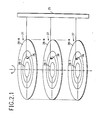
- Fig. 2.1 is a more detailed schematic of the circulating storage devices shown in Fig. 1. Shown are a plurality of disks 27 in horizontal planes. On each disk there are a number of tracks 28-1 through 28-N. Magnetic sensing units 26 which extend from arm 25 are used to read and write the data on the various tracks. Arm 25 will move to the left and right to position the sensing units 26 over the proper tracks. All the disks 27 on a given storage device, circulate as a unit at a constant speed.
- Fig. 2.2 is a schematic illustration of a top view of a disk. Shown are concentric tracks 28-1 through 28-N. The smallest quantity of data, in this embodiment, that is read out of or written into the storage device is a block 29. The data unit on the other hand can be anything from a bit to a number of blocks. The shaded area between the lines 24a and 24b is known as a sector. In this embodiment, the sectors are numbered 1 through M, and this sector number denotes the angular position on the disk of the storage device. To read data, or otherwise access data, on a given disk, a certain seek and latency time is required.
- the seek time is the time necessary for the sensing device 26 to move from a track on which it is currently located to a latter track on which data is to be accessed, easily obtained from device characteristic, as both origin and destination tracks are known.
- the latency time is the time necessary for the disk to rotate from a current sector to a latter sector where data is to be accessed, so that the latter sector of the disk is underneath the sensing device.
- the latency time for a given request may be obtained by comparing the position of the disk (determined as described below) with the known position of the data.
- each of the tracks on a given disk 27 can be divided up into, say 256 sectors, and a sector number such as n will be used to identify the angular position of information on any of these tracks. In addition to the angular position, one must also know the track on which to access or store data.
- the storage device can also be divided into a number of partitions (see 30 of Fig. 2.2), each of which may contain anything from a block to several tracks. Partition 30 of Fig. 2.2, for example, contains four blocks.
- each storage device has an associated high priority queue 31 and an associated low priority queue 32.
- Storage device 2-2 is shown only as an example. Any of the storage devices shown in Fig. 1 could have been used.
- the low priority queue 32 is used to store what is know as secondary write requests, while the high priority queue is used to store access requests or to store what is known as primary write requests.
- a read request is merely a request to read data at a particular location on an associated storage device.
- a primary write request is a request to originally store data on an associated storage device, while a secondary write request is just a request to store a copy of that data in another storage device.
- originally stored or "originally stored data” is merely used for reference purposes to distinguish it from a copy of that data that is being stored. Actually, however, duplicate data is being stored at two different storage locations. Thus, we can speak of a request to "originally store data” according to some primary write request, while a “copy of that originally stored data” is stored according to some secondary write requests.
- response time The execution time of a request from a central processing unit to read or write data in a storage device is referred to as response time. This includes queueing time in addition to service time.
- the components of the service time of a request are (1) seek, (2) latency, (3) rotational position sensing miss delay, and (4) transfer. These four components are well known in the art.
- a request is said to be serviced when data was transferred to or from the storage device in accordance with the request. That is, data stored or read in accordance with the request.
- Access time The time, that elapses between the generation of a request and the accessing of data or a location on a disk, is referred to as access time.
- access time consists of (1) queueing time, (2) seek and (3) latency. Queueing time is the time to satisfy previous unserviced requests.
- satisfying a request means that data has been written into the storage device in the case of and in accordance with a write request, or that data has been transferred from the storage device in the case of and in accordance with a read request.
- data is duplicated on at least two storage devices, preferably not on the same string.
- one of the storage devices that contains the data unit will be accessed.
- the data unit in the storage device which provides the minimum estimated access time will be accessed. This estimate is the sum of the estimates for the aforementioned three components: (1) queueing time, (2) seek and (3) latency.
- Data duplication is preferred to be on different strings so that primary and secondary write requests do not compete for the same device controller.
- satisfaction of a primary write request will be referred to as "originally storing data”, while satisfaction of a secondary write request will be referred to as storing a "copy of that originally stored data”.
- Devices are subject to failure at a rate of about three to four times per year.
- the recovery process consists of: (1) replacing the failed device by a new one, (2) restoring the data which was stored on the failed device prior to failure, and (3) updating the contents of the new device to reflect all updates which took place during the data restoration period.
- the length of the total recovery time is a very important factor in system design. A long recovery time causes the performance of the entire system to be degraded for a long period of time.
- the queue manager can be part of the central processing unit or control unit 5.
- the queue manager Since the maximum rotational delay (latency time) equals the device rotation time, i.e., 16.7 msec, in currently available DASDs, it constitutes a major component of the service time. Therefore, response time to an overall service request is effectively reduced by using seek time as one of the parameters (latency time being another parameter) for queueing control and for determining which data unit of a plurality of identical data units to access. Therefore, using the angular position as a queueing control parameter is expected to decrease response time and hence improve the overall performance of the direct access storage system.
- This simple mechanism has several advantages: (1) it does not require extra sensing or synchronization hardware components, (2) it is easily implementable in existing operating systems, and (3) it allows multiple queue managers to the same device to figure out the angular position without the need of communication or broadcasting.
- the queueing time at a particular storage device is estimated by adding the remaining service time of the request being serviced by that device to the sum of the service times of all the requests waiting in a high priority queue associated with that device. This is achieved by keeping for each storage device a tuple (t,w) where w is the total amount of service required from the device at time t.
- the tuple (t,w) provides information about the queueing time of a request joining the high priority queue associated with the device.
- the value of w decreases linearly with t, until it reaches zero when the storage device becomes idle.
- the value of (t,w) is updated every time (1) a new request joins the high priority queue and (2) an RPS miss occurs. In the first case, the amount of service required by the new request is added to w. In the second case, an additional rotation time is added to w.
Landscapes
- Engineering & Computer Science (AREA)
- Theoretical Computer Science (AREA)
- Human Computer Interaction (AREA)
- Physics & Mathematics (AREA)
- General Engineering & Computer Science (AREA)
- General Physics & Mathematics (AREA)
- Information Retrieval, Db Structures And Fs Structures Therefor (AREA)
- Signal Processing For Digital Recording And Reproducing (AREA)
Applications Claiming Priority (2)
| Application Number | Priority Date | Filing Date | Title |
|---|---|---|---|
| US92595386A | 1986-11-03 | 1986-11-03 | |
| US925953 | 1986-11-03 |
Publications (2)
| Publication Number | Publication Date |
|---|---|
| EP0266586A2 true EP0266586A2 (de) | 1988-05-11 |
| EP0266586A3 EP0266586A3 (de) | 1992-11-25 |
Family
ID=25452482
Family Applications (1)
| Application Number | Title | Priority Date | Filing Date |
|---|---|---|---|
| EP19870114910 Withdrawn EP0266586A3 (de) | 1986-11-03 | 1987-10-13 | Verringern der Ansprechzeit für E/A-Anforderung durch Duplizierung der Daten |
Country Status (2)
| Country | Link |
|---|---|
| EP (1) | EP0266586A3 (de) |
| JP (1) | JPS63124269A (de) |
Cited By (9)
| Publication number | Priority date | Publication date | Assignee | Title |
|---|---|---|---|---|
| EP0437615A4 (en) * | 1989-06-14 | 1993-06-02 | Hitachi, Ltd. | Hierarchical presearch-type document retrieval method, apparatus therefor, and magnetic disc device for this apparatus |
| EP0426184A3 (en) * | 1989-11-03 | 1993-07-28 | Compaq Computer Corporation | Bus master command protocol |
| EP0606139A3 (de) * | 1993-01-04 | 1995-01-18 | Xerox Corp | Abschicken und Terminisieren von Speicheroperationen in einem elektronischen Kopiersystem. |
| US5454105A (en) * | 1989-06-14 | 1995-09-26 | Hitachi, Ltd. | Document information search method and system |
| US5471610A (en) * | 1989-06-14 | 1995-11-28 | Hitachi, Ltd. | Method for character string collation with filtering function and apparatus |
| EP0682314A3 (de) * | 1994-04-14 | 1996-03-20 | Ibm | Redundantes Speicherplattensystem. |
| EP0675429A3 (de) * | 1988-11-11 | 1996-06-12 | Victor Company Of Japan | Datenverarbeitungsgerät. |
| US5748953A (en) * | 1989-06-14 | 1998-05-05 | Hitachi, Ltd. | Document search method wherein stored documents and search queries comprise segmented text data of spaced, nonconsecutive text elements and words segmented by predetermined symbols |
| US5757983A (en) * | 1990-08-09 | 1998-05-26 | Hitachi, Ltd. | Document retrieval method and system |
Family Cites Families (4)
| Publication number | Priority date | Publication date | Assignee | Title |
|---|---|---|---|---|
| GB1436332A (en) * | 1973-01-25 | 1976-05-19 | Honeywell Inf Systems | Magnetic disc storage systems |
| JPS5757357A (en) * | 1980-09-25 | 1982-04-06 | Nec Corp | Multiplex magnetic disk system |
| US4604687A (en) * | 1983-08-11 | 1986-08-05 | Lucasfilm Ltd. | Method and system for storing and retrieving multiple channel sampled data |
| NL8403690A (nl) * | 1984-12-05 | 1986-07-01 | Philips Nv | Werkwijze voor het lezen van informatie uit een geheugeninrichting die ten minste twee geheugens met identieke informatie bevat, en geheugeninrichting voor het uitvoeren van de werkwijze. |
-
1987
- 1987-09-17 JP JP62231253A patent/JPS63124269A/ja active Pending
- 1987-10-13 EP EP19870114910 patent/EP0266586A3/de not_active Withdrawn
Cited By (11)
| Publication number | Priority date | Publication date | Assignee | Title |
|---|---|---|---|---|
| EP0675429A3 (de) * | 1988-11-11 | 1996-06-12 | Victor Company Of Japan | Datenverarbeitungsgerät. |
| EP0437615A4 (en) * | 1989-06-14 | 1993-06-02 | Hitachi, Ltd. | Hierarchical presearch-type document retrieval method, apparatus therefor, and magnetic disc device for this apparatus |
| US5454105A (en) * | 1989-06-14 | 1995-09-26 | Hitachi, Ltd. | Document information search method and system |
| US5471610A (en) * | 1989-06-14 | 1995-11-28 | Hitachi, Ltd. | Method for character string collation with filtering function and apparatus |
| US5519857A (en) * | 1989-06-14 | 1996-05-21 | Hitachi, Ltd. | Hierarchical presearch type text search method and apparatus and magnetic disk unit used in the apparatus |
| US5748953A (en) * | 1989-06-14 | 1998-05-05 | Hitachi, Ltd. | Document search method wherein stored documents and search queries comprise segmented text data of spaced, nonconsecutive text elements and words segmented by predetermined symbols |
| EP0426184A3 (en) * | 1989-11-03 | 1993-07-28 | Compaq Computer Corporation | Bus master command protocol |
| US5757983A (en) * | 1990-08-09 | 1998-05-26 | Hitachi, Ltd. | Document retrieval method and system |
| EP0606139A3 (de) * | 1993-01-04 | 1995-01-18 | Xerox Corp | Abschicken und Terminisieren von Speicheroperationen in einem elektronischen Kopiersystem. |
| EP0682314A3 (de) * | 1994-04-14 | 1996-03-20 | Ibm | Redundantes Speicherplattensystem. |
| US5887128A (en) * | 1994-04-14 | 1999-03-23 | International Business Machines Corporation | Method and apparatus for redundant disk storage system with offset |
Also Published As
| Publication number | Publication date |
|---|---|
| JPS63124269A (ja) | 1988-05-27 |
| EP0266586A3 (de) | 1992-11-25 |
Similar Documents
| Publication | Publication Date | Title |
|---|---|---|
| US7174439B2 (en) | Hierarchical storage apparatus and control apparatus thereof | |
| JP3287203B2 (ja) | 外部記憶制御装置及び外部記憶制御装置間データ転送方法 | |
| JP3541744B2 (ja) | ストレージサブシステム及びその制御方法 | |
| US5239640A (en) | Data storage system and method including data and checksum write staging storage | |
| US6230239B1 (en) | Method of data migration | |
| US6272571B1 (en) | System for improving the performance of a disk storage device by reconfiguring a logical volume of data in response to the type of operations being performed | |
| EP0120330B1 (de) | Digitale Rechenvorrichtung und Verfahren zum Betreiben derselben | |
| JP3181446B2 (ja) | 情報記憶装置 | |
| KR100194295B1 (ko) | 데이타 처리 시스템 및 큐의 상태 갱신 방법 | |
| JP3735571B2 (ja) | ホスト・コンピュータに接続するためにテープ・ドライブを動的に選択するための方法及びシステム | |
| JP2643070B2 (ja) | データのバックアップ・コピー中の同時アクセスの方法及びシステム | |
| US6148369A (en) | Method and apparatus for providing logical devices spanning several physical volumes | |
| JPH0683687A (ja) | データ処理システム及びその方法 | |
| US7039657B1 (en) | Method, system, and program for accessing data from storage systems | |
| JPH10198607A (ja) | データ多重化システム | |
| US6678752B1 (en) | Data storage system with automatic storage request analysis and selection of optimal output media type | |
| EP0266586A2 (de) | Verringern der Ansprechzeit für E/A-Anforderung durch Duplizierung der Daten | |
| EP1760590B1 (de) | Speicherkontrollervorichtung versehen mit einem Trennungsbefehl von Volumenpaaren und Verfahren dazu | |
| JPH07225715A (ja) | キャッシュ内のデータにアクセスする方法およびシステム | |
| JPH06131233A (ja) | マルチファイル型記憶媒体のアクセス方法およびライブラリ装置 | |
| US20020199038A1 (en) | Input/output control apparatus, input/output control method and informatiion storage system | |
| JP2000187608A (ja) | 記憶装置サブシステム | |
| US6223251B1 (en) | Disk processing apparatus and a recording medium for recording a disk control program | |
| KR100292700B1 (ko) | 라이브러리내화일의관리방법및라이브러리용서버장치 | |
| US20050086249A1 (en) | Method for logical volume conversions |
Legal Events
| Date | Code | Title | Description |
|---|---|---|---|
| PUAI | Public reference made under article 153(3) epc to a published international application that has entered the european phase |
Free format text: ORIGINAL CODE: 0009012 |
|
| AK | Designated contracting states |
Kind code of ref document: A2 Designated state(s): DE FR GB IT |
|
| 17P | Request for examination filed |
Effective date: 19880910 |
|
| PUAL | Search report despatched |
Free format text: ORIGINAL CODE: 0009013 |
|
| AK | Designated contracting states |
Kind code of ref document: A3 Designated state(s): DE FR GB IT |
|
| STAA | Information on the status of an ep patent application or granted ep patent |
Free format text: STATUS: THE APPLICATION IS DEEMED TO BE WITHDRAWN |
|
| 18D | Application deemed to be withdrawn |
Effective date: 19930525 |
|
| RIN1 | Information on inventor provided before grant (corrected) |
Inventor name: FRANASZEK, PETER ANTHONY Inventor name: TANTAWI, ASSER NASRELDIN |