EP0266836A2 - Système de traitement de données avec un circuit de surveillance de séquence - Google Patents
Système de traitement de données avec un circuit de surveillance de séquence Download PDFInfo
- Publication number
- EP0266836A2 EP0266836A2 EP19870202088 EP87202088A EP0266836A2 EP 0266836 A2 EP0266836 A2 EP 0266836A2 EP 19870202088 EP19870202088 EP 19870202088 EP 87202088 A EP87202088 A EP 87202088A EP 0266836 A2 EP0266836 A2 EP 0266836A2
- Authority
- EP
- European Patent Office
- Prior art keywords
- reset
- reset signal
- input
- output
- watch
- Prior art date
- Legal status (The legal status is an assumption and is not a legal conclusion. Google has not performed a legal analysis and makes no representation as to the accuracy of the status listed.)
- Granted
Links
Images
Classifications
-
- G—PHYSICS
- G06—COMPUTING OR CALCULATING; COUNTING
- G06F—ELECTRIC DIGITAL DATA PROCESSING
- G06F11/00—Error detection; Error correction; Monitoring
- G06F11/07—Responding to the occurrence of a fault, e.g. fault tolerance
- G06F11/0703—Error or fault processing not based on redundancy, i.e. by taking additional measures to deal with the error or fault not making use of redundancy in operation, in hardware, or in data representation
- G06F11/0751—Error or fault detection not based on redundancy
- G06F11/0763—Error or fault detection not based on redundancy by bit configuration check, e.g. of formats or tags
-
- G—PHYSICS
- G06—COMPUTING OR CALCULATING; COUNTING
- G06F—ELECTRIC DIGITAL DATA PROCESSING
- G06F11/00—Error detection; Error correction; Monitoring
- G06F11/07—Responding to the occurrence of a fault, e.g. fault tolerance
- G06F11/0703—Error or fault processing not based on redundancy, i.e. by taking additional measures to deal with the error or fault not making use of redundancy in operation, in hardware, or in data representation
- G06F11/0751—Error or fault detection not based on redundancy
- G06F11/0754—Error or fault detection not based on redundancy by exceeding limits
- G06F11/0757—Error or fault detection not based on redundancy by exceeding limits by exceeding a time limit, i.e. time-out, e.g. watchdogs
Definitions
- This invention relates to a programmed digital data processing system including a watch-dog circuit arrangement, which arrangement comprises timer means to which is coupled a reset signal input, for generating an output signal in response to an interval between successive resets of the timer means exceeding a predetermined length, said system being programmed to supply predetermined reset signals to said reset signal input, and thereby reset the timer means, at intervals which do not exceed said predetermined length and being arranged to respond to the generation of a said output signal by assuming a predetermined state, said reset signals each being in the form of a multibit word having a predetermined value, which predetermined value changes for successive reset signals in a predetermined manner, said arrangement being arranged to also generate a said output signal should each reset signal supplied to the reset signal input not have the relevant predetermined value.
- the timer means may, for example, take the form of a continuously clocked counter which produces an overflow signal (the timer means output signal) should its capacity be exceeded, the counter being provided with a reset input a signal applied to which results in the counter contents being set to zero.
- the data processing system could comprise a suitably programmed microcomputer a single bit-line of one of the output ports of which is coupled to the reset input of the counter, the computer being programmed in such a way that a signal which resets the counter is periodically applied to the signal bit-line at such a rate that the counter is always reset before its contents overflow. Thus in normal operation the counter never produces an overflow signal.
- the counter contents will eventually reach the maximum, and the counter will produce an overflow signal.
- the overflow signal output may, for example, be coupled to a general reset input of the microcomputer, so that the microcomputer is itself reset under these circumstances.
- the microcomputer should incorrectly enter a program loop which does not include a step entailing the application of a reset signal for the timer to the single bit line, or which does include such a step but in which this step is repeated insufficiently frequently to prevent the counter contents overflowing.
- GB-A-1 522 810 discloses a system as defined in the first paragraph, i.e. a system which constitutes an elaboration of the simple system discussed so far.
- each reset signal takes the form of a multibit word having one of a pair of predetermined values which alternate and are each the complement of the other.
- the timer means is only reset in response to the supply of such a reset signal if that signal has the relevant predetermined value.
- a data bus which may be used to communicate the reset signals to the watch-dog circuit arrangement becomes faulty, thereby mutilating the reset signals, the timer means will not in fact be reset and the output signal will in consequence be generated. (In the known system the output signal is used to activate an alarm).
- a programmed digital data processing system is, according to the invention, characterised in that the system is programmed to assign, during each interval between the supply of successive said reset signals to said reset signal input, the next predetermined value to a said multibit word for transmission as the next reset signal, and to perform further program steps between each such assigning operation and the immediately preceding and immediately succeeding supply of a reset signal.
- each predetermined value may in principle be any manner whatsoever (bearing in mind that it is necessary for the watch-dog arrangement to "know" the resulting sequence of multibit words which will be applied to its reset signal input in operation.)
- each predetermined value may be derived from the preceding one by, for example, an arithmetic operation, e.g. by addition or subtraction of a constant.
- the predetermined value changes for successive reset signals in accordance with a cyclic sequence, enabling, for example, each predetermined value to be stored permanently in the watch-dog arrangement for comparison with the relevant reset signal received.
- such a cyclic sequence can contain any number of said predetermined values, and each predetermined value need not in principle have any particular relationship to any of the other predetermined values.
- the cyclic sequence consists of only two predetermined values each of which is a complemented version of the other, for example a byte consisting of alternate "0"s and "1"s enabling a check to be made on cross-talk between adjoining bits. Either one or both of these may be stored, preferably in random access memory, at any given time, from which it may be read for the relevant reset signal in an effectively non-destructive manner. If only one is stored at any given time, each said assigning operation may comprise complementing the currently stored value and replacing this currently stored value by the result.
- each said assigning operation may comprise changing over a pointer from one stored value to the other. Storing one or both values in random access memory provides a check on the relevant part of RAM being incorrectly overwritten in response to erroneous operation of the program.
- the timer means simply responds to each said reset signal only if the reset signal has the predetermined value, so that the timer means itself generates a said output signal when reset signals having the predetermined value are not supplied to the reset signal input during an interval which exceeds the predetermined length, even though reset signals having other values may be supplied during that interval.
- the arrangement is arranged to respond directly to the supply of a reset signal not having the predetermined value to the reset signal input by generating a said output signal.
- the system may be programmed to supply each reset signal to reset signal input within a respective predetermined time window and the watch-dog circuit arrangement may be arranged to also generate a said output signal should each reset signal supplied to the reset signal input not be supplied thereto within a said predetermined time window. It may be arranged, for example, that the watch-dog arrangement simply treats the supply of a reset signal to the reset signal input as constituting a boundary of a said interval only if this supply occurs within such a predetermined time window, so that the timer means itself generates a said output signal when reset signals are not supplied to the reset signal input within respective said time windows during an interval which exceeds the predetermined length, even though reset signals may still be supplied outside such time windows.
- the arrangement is arranged to respond directly to the supply of a reset signal to the reset signal input outside a said time window by generating a said output signal.
- reset signals are supplied outside such time windows, in which case the malfunction will be responded to.
- each said predetermined time window has a predetermined relationship to the instant at which the immediately preceding reset signal was applied to the reset signal input.
- the timer means comprises a continuously clocked binary counter to a reset input of which the reset signal input is coupled each time window may correspond to the time during which a particular bit of the counter contents has a given value.
- the system may be programmed to periodically test the value of said particular bit to determine when it has changed to the given value, to supply a reset signal to the reset signal input after such a change has been detected, and to perform further program steps between the detection of such a change and the subsequent supply of the reset signal. Performing the further program steps, i.e. separating the reset signal in time from the detection which has given rise to it, makes it less likely that, during a malfunction, the reset signal will be supplied within a said time window.
- the system is programmed to strobe the watch-dog circuit arrangement, for example by generating an address specific to the watch-dog arrangement, each time a reset signal is supplied to the reset signal input.
- This can facilitate, for example, a direct response of the watch-dog arrangement to the supply of a reset signal not having the predetermined value and/or a reset signal outside a said time window to the reset signal input.
- the system comprises a programmed microcomputer provided with an external address latch
- the address latch and the watch-dog circuit arrangement are preferably integrated on the same semiconductor chip.
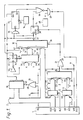
- Figure 1 shows a programmed digital data processing system which comprises a programmed microcomputer 1 provided with an external address latch 5, and a watch-dog circuit arrangement.
- Microcomputer 1 has lower order combined address and data bus lines AD0 ... AD7 and higher order address bus lines A8 ... A15 which may be coupled to other parts (not shown) of the system, for example to a program and/or data store, as indicated at 2, 3 and 4. Because the bus lines AD0 ... AD7 have a dual function the address latch 5 is provided in known manner. When microcomputer 1 outputs a 16-bit address it also outputs an address latch enable signal on an output ALE which is connected to a strobe input 7 of the latch 5. This signal causes latch 5 to store the eight lower order address bits presented to its input 6 and apply them to, inter alia, the output 4, the eight higher order address bits being applied to the output 3, after which the address/data bus lines AD0 ...
- AD7 become available for the inputting to and/or outputting from microcomputer 1 of data bits, inter alia via the data input/output 2.
- Microcomputer 1 also has in known manner an output RD for an active-low read control signal, an output WR for an active-low write control signal and an input RST for an active-low reset signal.
- Outputs RD and WR may be coupled to other parts (not shown) of the system as indicated diagrammatically at 8 and 9.
- the watch-dog arrangement comprises first and second comparators 10 and 11, an eight-into-one decoder 12, a two-into-one multiplexer 13, a frequency divider-by-two formed by a D-type flip-flop 14 the output Q of which is connected to its data input D via an inverter 44, a D-type flip-flop 15, a clock pulse source 16, a counter 17, an eight-bit-wide output buffer 18, a power-up reset pulse generator 68, two AND-gates 69 and 70, a NOR-gate 19, and two OR-gates 20 and 21.
- the output of latch 5 is connected to an eight-bit wide first input 22 of comparator 11, a fixed eight-bit byte Z being applied to an eight-bit-wide second input 23 thereof.
- the (active-low) output 27 of decoder 12 is connected to a single-bit-wide third input 24 of comparator 11 to a single-bit-wide fourth input 25 of which a fixed logic "O" signal is applied.
- Comparator 11 compares the group of bits applied to its input 22 with the group of bits applied to its input 23, and compares the bit applied to its input 24 with the bit applied to its input 25, and generates logic "O" at its output 26 if and only if correspondence occurs in both cases.
- Decoder 12 generates logic "O" at its output 27 if and only if microcomputer 1 generates a specific group of bits on the bit lines A8 ... A15 which are connected to the decoder input 46.
- the arrangement 11, 12 constitutes an address decoder for the watch-dog arrangement; comparator 11 generates logic "O" on its output 26 if and only if microcomputer 1 generates an address the eight lower-order bits of which correspond to the byte Z and the eight higher-order bits of which correspond to the bit group to which decoder 12 responds.
- the comparator input 22 and the decoder input 46 together constitute a strobe signal input of the watch-dog.
- the comparator output 26 is connected to one input of each of the OR-gates 20 and 21 to second inputs of which are connected the microcomputer outputs RD and WR respectively.
- gate 20 generates logic "O" on its output 28 if and only if microcomputer 1 addresses (strobes) the watch-dog and also generates an active-low read signal
- gate 21 generates logic "O” on its output 29 if and only if microcomputer 1 addresses (strobes) the watch-dog and also generates an active-low write signal.
- the address/data bit lines AD0 ... AD7 are also connected to an eight-bit-wide first input 30 of comparator 10 to a second eight-bit-wide input 31 of which is connected the eight-bit-wide output 32 of multiplexer 13.
- the two eight-bit-wide inputs 33 and 34 of multiplexer 13 are fed with fixed eight-bit bytes X and Y respectively.
- the control input 35 of multiplexer 13 is fed by the output of divider-by-two flip-flop 14.
- Comparator 10 has an active-low strobe signal input 36 which is connected to the output 29 of gate 21.
- the output 37 of comparator 10 is connected both to the data input D of flip-flop 15 directly and also via AND-gate 70 to the (active-low) reset input RS of counter 17.
- the (negative-edge-responsive) clock input 38 of flip-flop 15 is connected to the output of gate 21 and the clock input 39 of counter 17 is connected to the output of clock signal generator 16.
- the two inputs of gate 19 are connected to the output Q of flip-flop 15 and to the most significant bit output Qn of counter 17 respectively, its output being connected via AND-gate 70 to the active-low input RST of microcomputer 1, to the active-low asynchronous reset inputs RST of flip-flops 14 and 15, and to the second input of AND-gate 70.
- the second input of AND-gate 69 is fed from the output of the generator 68 which produces a logic "0" output pulse for a short time each time the system is powered up.
- Generator 68 may comprise, for example, a Schmitt trigger circuit the input of which is connected to one power supply line via a capacitor and to the other power supply line via a resistor.
- microcomputer 1 flip-flops 14 and 15, and counter 17 are reset on power-up and also should either the output of flip-flop 15 or the most significant bit output of counter 17 become logic "1".
- flip-flop 14 When flip-flop 14 is in the reset state it controls multiplexer 13 to supply the byte X to the input 31 of comparator 10.
- the most-significant-but-one bit output Qn-1 of counter 17 is coupled to all the bit lines AD0 ... AD7 via the multiple output buffer 18, an active-low output-enable signal input 40 of which is connected to the output 28 of gate 20.
- the output Qn-1 of counter 17 is also connected to the (negative-edge-responsive) clock input 41 of divider-by-two flip-flop 14 and also to a single-bit third input 42 of comparator 10.
- a single-bit fourth input 43 of comparator 10 is supplied with a fixed logic "1" signal.
- the signal level on the output 37 of comparator 10 is normally logic "1". Comparator 10, if and only if a logic "O" level is present on its strobe input 36, compares the byte presented to its input 30 from the bit lines AD0 ...
- AD7 with the byte (X or Y) presented to its input 31 by the multiplexer 13, and compares the level on its input 42 with the logic "1" presented to its input 43, and generates logic "O” on its output 37 if and only if correspondence occurs in both cases.
- microcomputer 1 addresses the watch-dog arrangement in two different modes, viz a read mode and a write mode in accordance with whether it produces a logic "O" on its output RD or a logic “O” on its output WR in conjunction with that address on the lines AD0 ... A15 which results in the production by comparator 11 of logic "O” on its output 26.
- the resulting enabling of the buffer 18 by the output signal of gate 20 causes this buffer to write the logic state of output Qn-1 of counter 18 onto the bus lines AD0-AD7 and hence to the microcomputer 1 which can thus ascertain what this logic state is.
- microcomputer 1 in normal operation puts that one of the bytes X and Y which is currently being presented to input 31 of comparator 10 by multiplexer 13 onto the bit lines AD0 ... AD7.
- output Qn-1 of counter 17 is in fact logic "1" comparator 10
- strobed by the logic "O” fed to its input 36 by gate 21 produces logic “O” on its output 37.
- This logic “O” resets the contents of counter 17 to zero and is also stored in flip-flop 15 which is clocked by the negative-going transition on the output of gate 21.
- the bytes X and Y are put on to the bit lines AD0 ... AD7 alternately for successive accesses of the watch-dog in the write mode, input 30 of comparator 10 therefore constituting an 8-bit wide input for a reset signal for timer/counter 17.
- a reset signal will be applied to microcomputer 1 and flip-flops 14 and 15 by gate 19 if either of the two inputs of gate 19 become logic "1" for some reason.
- a first way in which this can happen is because counter 17 (which is continuously clocked by source 16) is not reset sufficiently frequently to prevent its most significant bit output Qn from becoming logic "1".
- the program implemented by microcomputer 1 is arranged to contain watch-dog write operations at sufficiently short intervals to ensure that in normal operation this situation never occurs, provided that each such write operation gives the results set forth in the immediately preceding paragraph above.
- comparator 10 fails to produce logic "O” on its output 37 then logic "1" will be clocked into flip-flop 15, appear at its output Q and thus be applied to NOR-gate 19, resulting in a reset signal being applied immediately to microcomputer 1, i.e. without waiting for output Qn of counter 17 to become logic "1".
- microcomputer 1 in addition to the microcomputer being reset in response to the counter overflowing, in the system of Figure 1 resetting of microcomputer 1 also occurs directly in response to the generation by microcomputer 1 of a byte other than the correct one, X or Y, on the address/data bit lines AD0 ... AD7 when the watch-dog is addressed in the write mode, because flip-flop 15 is set under these conditions.
- microcomputer 1 will be reset directly should one or more of the bit outputs AD0 ... AD7 malfunction (and in fact also should one or more of the bit outputs A8 ... A15 malfunction), and also should microcomputer 1 erroneously enter a short program loop in which it does not produce the bytes X and Y alternately.
- microcomputer 1 may be programmed to store these bytes in RAM, retrieving them and rewriting the retrieved byte each time they are required. If this is the case the watch-dog arrangement will provide a check on whether the relevant part of RAM becomes corrupted for some reason, for example if the program causes the relevant storage locations to be overwritten, as may occur in certain error situations. If this should occur a reset signal for the microcomputer will be automatically generated.
- the alternating bytes X and Y may each be derived from the other; each may be, for example, the complement of the other.
- the microcomputer then being programmed to access this location each time X or Y is required, supply its contents to the watch-dog, and write the accessed byte back to the same location and, in between each pair of successive such accesses, convert the stored byte into the other while performing further program steps between each such conversion operation and the immediately preceding and immediately succeeding access/supply operations.
- the bytes X and Y are preferably 10101010 and 01010101 respectively, to provide some check on cross-talk between adjacent ones of the bit lines AD0 ... AD7.
- This feature can provide a further check on the correct implementation of the program in microcomputer 1, and is the reason for the provision of the output buffers 18 and the facility for addressing the watch-dog arrangement in the read mode.
- the microcomputer 1 can be programmed to periodically address the watch-dog in the read mode to ascertain the logic state of output Qn-1 of counter 17 and thereby determine when this state has changed from "O" to "1" and set a flag when this has occurred.
- the write mode addressing steps also included in the program may be arranged to actually take place, also resetting the flag, only if the flag is in fact set at the relevant time.
- the period of the rectangular-wave signal appearing at output Qn-1 is, of course, known, being determined by the output frequency of generator 16 and the capacity of counter 17.
- the frequency of the read-mode addressing steps and the interval between each such step and the next write-mode addressing step can therefore be chosen such as to ensure that, in normal operation, each time such a write-mode addressing step occurs, if the flag is set then the signal at output Qn-1 is still logic "1".
- each write mode addressing step is spaced in time as far as possible in the program from the immediately preceding read mode addressing step this will reduce the likelihood that, should a short program loop entered by microcomputer 1 actually include a watch-dog write-mode addressing step, it will also include the watch-dog read-mode addressing step required to prime it.
- a further advantage of testing output Qn-1 and only writing to the watch-dog when the level thereat has changed from "O" to "1" is that the repetition rate of the watch-dog write operations is automatically adjusted to lie between one half and one times the frequency of the signal at output Qn-1, enabling this repetition rate to be optimised and to be little dependent on what branches the program actually takes each time it is carried out.
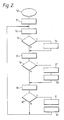
- FIG. 2 An example of the parts of the program with which microcomputer 1 may be programmed which are relevant to the present invention is shown in Figure 2, which takes the form a of flow chart.
- Figure 2 takes the form a of flow chart.
- the various blocks have the following significances.
- step 50 the byte X is written in step 51 to a location AD in RAM which is preferably one which is likely to be overwritten should the program malfunction. Moreover a flag F1 which is used to indicate when the signal at output Qn-1 of counter 17 has been determined as being logic "1” is set to logic "O” as is a flag F2 which is used to indicate when the watch-dog has been written to. Then (step 52) part of the main program of the microcomputer is carried out. It is then tested in step 53 whether output Qn-1 is logic "1", microcomputer 1 first generating address byte Z on its outputs AD0 ... AD7 and the byte to which decoder 12 responds on its outputs A8 ...
- step 54 If Qn-1 is "1" (Y) flag F1 is set to "1" in step 54, and in any case another part of the main program is then carried out in block 55. After this it is ascertained in step 56 whether flag F1 is set, i.e. whether it was determined in step 53 that Qn-1 was logic "1". If it was (Y), the contents of RAM address AD (initially byte X, for example 01010101), are written to the watch-dog in step 57 (and also rewritten to the address AD) microcomputer 1 first generating address byte Z on its outputs AD0 ...
- step 57 when step 57 occurs, output Qn-1 will still be logic "1", resulting in counter 17 being reset, changing over flip-flop 14, but no general reset occurring.
- Flag F1 is then reset and flag F2 is set to "1" (block 58) indicating that the watch-dog has been written to.
- the program then proceeds to block 59, as it does directly from step 56 if it is found there that flag F1 is not set (N).
- Block 59 represents the next part of the main program, after which flag F2 is tested (step 60) to ascertain if step 57 in fact took place. If it did (Y) the byte in RAM address AD is complemented and rewritten in step 61 so that it becomes Y to conform with the new state of multiplexer 13, after which flag F2 is reset in step 62 and the program proceeds back to block 52, as it does directly if the result of test 60 is "no" (N).
- step 57 In order that, if the result of test 53 is "yes", output Qn-1 of counter 17 will still be “1" when step 57 is performed it is arranged that, provided the system is operating correctly, the time interval between successive pairs of tests 53 plus the time to the next step 57 if it is in fact carried out is always less than one half the period of the signal appearing at output Qn-1 of counter 17.
- a delay element may be provided at the output of gate 69 in Figure 1 to ensure that any reset signal produced thereat has a sufficiently long duration before the counter 17 or flip-flop 15 which may have given rise to it is itself reset.
Landscapes
- Engineering & Computer Science (AREA)
- Theoretical Computer Science (AREA)
- Quality & Reliability (AREA)
- Physics & Mathematics (AREA)
- General Engineering & Computer Science (AREA)
- General Physics & Mathematics (AREA)
- Debugging And Monitoring (AREA)
Applications Claiming Priority (2)
| Application Number | Priority Date | Filing Date | Title |
|---|---|---|---|
| GB8626197 | 1986-11-03 | ||
| GB08626197A GB2197507A (en) | 1986-11-03 | 1986-11-03 | Data processing system |
Publications (3)
| Publication Number | Publication Date |
|---|---|
| EP0266836A2 true EP0266836A2 (fr) | 1988-05-11 |
| EP0266836A3 EP0266836A3 (en) | 1990-05-16 |
| EP0266836B1 EP0266836B1 (fr) | 1995-01-04 |
Family
ID=10606705
Family Applications (1)
| Application Number | Title | Priority Date | Filing Date |
|---|---|---|---|
| EP87202088A Expired - Lifetime EP0266836B1 (fr) | 1986-11-03 | 1987-10-30 | Système de traitement de données avec un circuit de surveillance de séquence |
Country Status (7)
| Country | Link |
|---|---|
| US (1) | US5073853A (fr) |
| EP (1) | EP0266836B1 (fr) |
| JP (1) | JP2755581B2 (fr) |
| AU (1) | AU604776B2 (fr) |
| DE (1) | DE3750948T2 (fr) |
| GB (1) | GB2197507A (fr) |
| NZ (1) | NZ222361A (fr) |
Cited By (3)
| Publication number | Priority date | Publication date | Assignee | Title |
|---|---|---|---|---|
| EP0445936A3 (en) * | 1990-03-08 | 1992-06-03 | Sony Corporation | Supervision of microprocessors |
| FR2771564A1 (fr) * | 1997-11-21 | 1999-05-28 | Sextant Avionique | Dispositif pour l'initialisation a la mise sous tension d'un circuit integre digital |
| EP1063591A3 (fr) * | 1999-05-22 | 2002-05-22 | Lucas Industries Limited | Procédé et dispositif pour détecter un état erroné dans un ordinateur |
Families Citing this family (28)
| Publication number | Priority date | Publication date | Assignee | Title |
|---|---|---|---|---|
| FR2658303B1 (fr) * | 1990-02-09 | 1992-06-19 | Neiman Sa | Dispositif de surveillance du fonctionnement d'un systeme a microprocesseur ou analogue. |
| US5278976A (en) * | 1990-04-16 | 1994-01-11 | Rolm Company | Method for detecting infinite loops by setting a flag indicating execution of an idle task having lower priority than executing application tasks |
| DE4039355C2 (de) * | 1990-12-10 | 1998-07-30 | Bosch Gmbh Robert | Vorrichtung zur Funktionsüberprüfung einer Watchdog-Schaltung |
| JP2758742B2 (ja) * | 1991-07-19 | 1998-05-28 | 日本電気株式会社 | 誤動作検出方式 |
| FR2692379B1 (fr) * | 1991-10-04 | 1996-08-14 | Aerospatiale Ste Nat Indle | Procede de detection et de passivation de pannes dans un systeme de traitement de donnees, et systeme de traitement de donnees adapte a sa mise en oeuvre |
| US5341497A (en) * | 1991-10-16 | 1994-08-23 | Ohmeda Inc. | Method and apparatus for a computer system to detect program faults and permit recovery from such faults |
| JP2658697B2 (ja) * | 1991-12-11 | 1997-09-30 | 富士通株式会社 | ウォッチ・ドック・タイマ回路 |
| JPH0683652A (ja) * | 1992-08-31 | 1994-03-25 | Sharp Corp | マイクロコンピュ−タシステム |
| JPH06168163A (ja) * | 1992-09-30 | 1994-06-14 | Nec Home Electron Ltd | Cpu監視方法及びcpu監視装置 |
| JP3135772B2 (ja) * | 1993-12-27 | 2001-02-19 | アスコ株式会社 | 車両用安全装置 |
| US5948606A (en) * | 1994-03-31 | 1999-09-07 | Eastman Kodak Company | Protective top layer and photographic products containing this top layer |
| KR100311366B1 (ko) * | 1994-11-28 | 2002-02-19 | 구자홍 | 워치독타이머기능을갖는콘트롤러 |
| US5541943A (en) * | 1994-12-02 | 1996-07-30 | At&T Corp. | Watchdog timer lock-up prevention circuit |
| US5528756A (en) * | 1995-01-30 | 1996-06-18 | Elsag International N.V. | Method and apparatus for performing supervisory functions in digital systems and obtaining diagnostics thereof |
| US5673389A (en) * | 1995-08-31 | 1997-09-30 | Ford Motor Company | Methods and apparatus for resetting a monitored system using a gray code with alternating check bits |
| US5745386A (en) * | 1995-09-25 | 1998-04-28 | International Business Machines Corporation | Timing diagram method for inputting logic design parameters to build a testcase for the logic diagram |
| KR100252250B1 (ko) * | 1996-06-28 | 2000-04-15 | 윤종용 | 시스템복구장치 |
| DE19627362C2 (de) * | 1996-07-06 | 1998-11-26 | Bosch Gmbh Robert | Schaltung zur Initialisierung und Überwachung eines Mikroprozessors |
| DE59708459D1 (de) * | 1996-08-12 | 2002-11-14 | Papst Motoren Gmbh & Co Kg | Anordnung zur überwachung eines mikroprozessors |
| DE19827430C2 (de) * | 1997-07-22 | 2001-07-12 | Siemens Ag | Überwachungsverfahren zur Erkennung von Endlosschleifen und blockierten Prozessen in einem Rechnersystem |
| US6141774A (en) * | 1998-04-17 | 2000-10-31 | Infineon Technologies North America Corp. | Peripheral device with access control |
| US6476996B1 (en) | 2000-02-15 | 2002-11-05 | Western Digital Technologies, Inc. | Disk drive comprising an actuator driver circuit for retracting a head independent of a servo microprocessor when a spindle speed fault mode is detected |
| US6779066B2 (en) * | 2000-05-01 | 2004-08-17 | Matsushita Electric Industrial Co., Ltd. | Module having application-specific program stored therein |
| KR100820789B1 (ko) * | 2001-04-06 | 2008-04-10 | 엘지전자 주식회사 | 실시간 기반 시스템 및 그의 모니터링 방법 |
| US20060235655A1 (en) * | 2005-04-18 | 2006-10-19 | Qing Richard X | Method for monitoring function execution |
| US8330502B2 (en) * | 2009-11-25 | 2012-12-11 | Freescale Semiconductor, Inc. | Systems and methods for detecting interference in an integrated circuit |
| US9697065B1 (en) | 2016-03-09 | 2017-07-04 | Nxp Usa, Inc. | Systems and methods for managing reset |
| US10157087B1 (en) | 2017-07-14 | 2018-12-18 | Nxp Usa, Inc. | Robust boot block design and architecture |
Family Cites Families (27)
| Publication number | Priority date | Publication date | Assignee | Title |
|---|---|---|---|---|
| US3919533A (en) * | 1974-11-08 | 1975-11-11 | Westinghouse Electric Corp | Electrical fault indicator |
| DE2821882C2 (de) * | 1978-05-19 | 1983-01-20 | Philips Patentverwaltung Gmbh, 2000 Hamburg | Programmsteuereinheit mit Prüfmöglichkeit |
| DE2946081C3 (de) * | 1979-11-15 | 1995-09-21 | Wabco Vermoegensverwaltung | Schaltungsanordnung zur Überwachung der Funktion eines Mikroprozessors |
| GB2070302B (en) * | 1980-02-19 | 1985-02-13 | Omron Tateisi Electronics Co | Data communication system |
| CA1160753A (fr) * | 1980-08-20 | 1984-01-17 | Canadian General Electric Company Limited | Systeme de surveillance a microprocesseur |
| US4570217A (en) * | 1982-03-29 | 1986-02-11 | Allen Bruce S | Man machine interface |
| US4538273A (en) * | 1982-11-12 | 1985-08-27 | Honeywell Inc. | Dual input watchdog timer |
| JPS603045A (ja) * | 1983-06-20 | 1985-01-09 | Nec Corp | プログラムアドレス誤動作検出装置 |
| US4594685A (en) * | 1983-06-24 | 1986-06-10 | General Signal Corporation | Watchdog timer |
| JPS6039255A (ja) * | 1983-08-12 | 1985-03-01 | Mitsubishi Electric Corp | ウオツチドグタイマのリセツト回路 |
| DE3343227A1 (de) * | 1983-11-30 | 1985-06-05 | Robert Bosch Gmbh, 7000 Stuttgart | Verfahren zur ueberwachung von elektronischen rechenbausteinen, insbesondere mikroprozessoren |
| US4759952A (en) * | 1984-01-26 | 1988-07-26 | Learonal, Inc. | Process for printed circuit board manufacture |
| JPS60193060A (ja) * | 1984-03-14 | 1985-10-01 | Mitsubishi Electric Corp | ウオツチドツグタイマ−装置 |
| JPS60263235A (ja) * | 1984-06-12 | 1985-12-26 | Omron Tateisi Electronics Co | マイクロコンピユ−タシステム |
| US4649537A (en) * | 1984-10-22 | 1987-03-10 | Westinghouse Electric Corp. | Random pattern lock and key fault detection scheme for microprocessor systems |
| US4689766A (en) * | 1984-11-16 | 1987-08-25 | Zenith Electronics Corporation | System for resetting the operation of a signal processing device upon the failure of accessng a predetermined memory location within a predetermined time interval |
| US4803682A (en) * | 1985-03-04 | 1989-02-07 | Sanyo Electric Co., Ltd. | Resetting system |
| DK190785A (da) * | 1985-04-29 | 1986-10-30 | Nordiske Kabel Traad | Fremgangsmaade til overvaagning af en databehandlingsenhed, samt anlaegtil udoevelse af fremgangsmaaden |
| JPH0789331B2 (ja) * | 1985-06-11 | 1995-09-27 | 日本電気株式会社 | タイマ回路 |
| GB2177241B (en) * | 1985-07-05 | 1989-07-19 | Motorola Inc | Watchdog timer |
| US4727549A (en) * | 1985-09-13 | 1988-02-23 | United Technologies Corporation | Watchdog activity monitor (WAM) for use wth high coverage processor self-test |
| JPS62157953A (ja) * | 1985-12-28 | 1987-07-13 | Honda Motor Co Ltd | 異常検知機能を備えたマイクロコンピユ−タ |
| JPH0795291B2 (ja) * | 1986-01-13 | 1995-10-11 | 沖電気工業株式会社 | ウオツチドツグタイマ |
| GB2197508A (en) * | 1986-11-03 | 1988-05-18 | Philips Electronic Associated | Data processing system with watchdog |
| JPS63118651U (fr) * | 1987-01-28 | 1988-08-01 | ||
| US4912708A (en) * | 1988-03-22 | 1990-03-27 | Siemens Transmission Systems, Inc. | Automatic microprocessor fault recovery system |
| US5012435A (en) * | 1988-11-17 | 1991-04-30 | International Business Machines Corporation | Multiple event timer circuit |
-
1986
- 1986-11-03 GB GB08626197A patent/GB2197507A/en not_active Withdrawn
-
1987
- 1987-10-30 DE DE3750948T patent/DE3750948T2/de not_active Expired - Fee Related
- 1987-10-30 NZ NZ222361A patent/NZ222361A/xx unknown
- 1987-10-30 EP EP87202088A patent/EP0266836B1/fr not_active Expired - Lifetime
- 1987-11-02 US US07/116,415 patent/US5073853A/en not_active Expired - Lifetime
- 1987-11-03 AU AU80617/87A patent/AU604776B2/en not_active Ceased
- 1987-11-04 JP JP62279004A patent/JP2755581B2/ja not_active Expired - Fee Related
Cited By (4)
| Publication number | Priority date | Publication date | Assignee | Title |
|---|---|---|---|---|
| EP0445936A3 (en) * | 1990-03-08 | 1992-06-03 | Sony Corporation | Supervision of microprocessors |
| US5740360A (en) * | 1990-03-08 | 1998-04-14 | Sony Corporation | Apparatus and method for resetting a microprocessor in the event of improper program execution |
| FR2771564A1 (fr) * | 1997-11-21 | 1999-05-28 | Sextant Avionique | Dispositif pour l'initialisation a la mise sous tension d'un circuit integre digital |
| EP1063591A3 (fr) * | 1999-05-22 | 2002-05-22 | Lucas Industries Limited | Procédé et dispositif pour détecter un état erroné dans un ordinateur |
Also Published As
| Publication number | Publication date |
|---|---|
| DE3750948D1 (de) | 1995-02-16 |
| EP0266836A3 (en) | 1990-05-16 |
| GB2197507A (en) | 1988-05-18 |
| DE3750948T2 (de) | 1995-08-03 |
| JP2755581B2 (ja) | 1998-05-20 |
| GB8626197D0 (en) | 1986-12-03 |
| NZ222361A (en) | 1990-06-26 |
| EP0266836B1 (fr) | 1995-01-04 |
| JPS63133238A (ja) | 1988-06-06 |
| AU604776B2 (en) | 1991-01-03 |
| AU8061787A (en) | 1988-05-05 |
| US5073853A (en) | 1991-12-17 |
Similar Documents
| Publication | Publication Date | Title |
|---|---|---|
| EP0266836B1 (fr) | Système de traitement de données avec un circuit de surveillance de séquence | |
| EP0266837B1 (fr) | Système de traitement de données avec un circuit de surveillance de séquence | |
| US4375664A (en) | Apparatus for detecting, correcting and logging single bit memory read errors using syndrome generating and decoding circuitry | |
| EP0108346B1 (fr) | Méthode de reconfiguration topographique de mémoire dans un système de traitement de données | |
| US4835675A (en) | Memory unit for data tracing | |
| US4084262A (en) | Digital monitor having memory readout by the monitored system | |
| US4359771A (en) | Method and apparatus for testing and verifying the operation of error control apparatus within a memory | |
| US4712216A (en) | Method and device for correcting errors in memories | |
| US4481579A (en) | Digital data apparatus having a plurality of selectively addressable peripheral units | |
| US4384353A (en) | Method and means for internal error check in a digital memory | |
| US5444722A (en) | Memory module with address error detection | |
| US4249250A (en) | Computer storage arrangements with overwrite warning | |
| US4488223A (en) | Control apparatus for a plurality of memory units | |
| EP0383891B1 (fr) | Controleur de pile binaire pour la verification d'adresses en pipeline | |
| US4740914A (en) | Address generator | |
| US4866662A (en) | Memory connected state detecting circuit | |
| JPH0225207B2 (fr) | ||
| KR200142931Y1 (ko) | 베이스 어드레스 자동 세팅 장치 | |
| JPS6054059A (ja) | 記憶装置 | |
| JPS62166449A (ja) | 論理装置の履歴記憶装置 | |
| JPH02310752A (ja) | メモリ素子のアドレスチェック方式 | |
| JPS6220448A (ja) | ビツトサンプル方式 | |
| KR930006579A (ko) | 프린터의 에러 자체 진단방법 | |
| JPS60205639A (ja) | アドレスストツプ回路 | |
| JPS6123242A (ja) | パリテイチエツク回路の検査方式 |
Legal Events
| Date | Code | Title | Description |
|---|---|---|---|
| PUAI | Public reference made under article 153(3) epc to a published international application that has entered the european phase |
Free format text: ORIGINAL CODE: 0009012 |
|
| AK | Designated contracting states |
Kind code of ref document: A2 Designated state(s): DE FR GB SE |
|
| RAP3 | Party data changed (applicant data changed or rights of an application transferred) |
Owner name: N.V. PHILIPS' GLOEILAMPENFABRIEKEN Owner name: PHILIPS ELECTRONIC AND ASSOCIATED INDUSTRIES LIMIT |
|
| PUAL | Search report despatched |
Free format text: ORIGINAL CODE: 0009013 |
|
| AK | Designated contracting states |
Kind code of ref document: A3 Designated state(s): DE FR GB SE |
|
| 17P | Request for examination filed |
Effective date: 19901114 |
|
| RAP3 | Party data changed (applicant data changed or rights of an application transferred) |
Owner name: N.V. PHILIPS' GLOEILAMPENFABRIEKEN Owner name: PHILIPS ELECTRONICS UK LIMITED |
|
| 17Q | First examination report despatched |
Effective date: 19920514 |
|
| GRAA | (expected) grant |
Free format text: ORIGINAL CODE: 0009210 |
|
| AK | Designated contracting states |
Kind code of ref document: B1 Designated state(s): DE FR GB SE |
|
| REF | Corresponds to: |
Ref document number: 3750948 Country of ref document: DE Date of ref document: 19950216 |
|
| ET | Fr: translation filed | ||
| PLBE | No opposition filed within time limit |
Free format text: ORIGINAL CODE: 0009261 |
|
| STAA | Information on the status of an ep patent application or granted ep patent |
Free format text: STATUS: NO OPPOSITION FILED WITHIN TIME LIMIT |
|
| 26N | No opposition filed | ||
| REG | Reference to a national code |
Ref country code: GB Ref legal event code: 732E |
|
| REG | Reference to a national code |
Ref country code: FR Ref legal event code: TP |
|
| REG | Reference to a national code |
Ref country code: GB Ref legal event code: IF02 |
|
| REG | Reference to a national code |
Ref country code: GB Ref legal event code: 732E |
|
| REG | Reference to a national code |
Ref country code: FR Ref legal event code: TP Ref country code: FR Ref legal event code: CA |
|
| PGFP | Annual fee paid to national office [announced via postgrant information from national office to epo] |
Ref country code: SE Payment date: 20050429 Year of fee payment: 18 Ref country code: GB Payment date: 20050429 Year of fee payment: 18 Ref country code: FR Payment date: 20050429 Year of fee payment: 18 |
|
| PGFP | Annual fee paid to national office [announced via postgrant information from national office to epo] |
Ref country code: DE Payment date: 20050502 Year of fee payment: 18 |
|
| PG25 | Lapsed in a contracting state [announced via postgrant information from national office to epo] |
Ref country code: GB Free format text: LAPSE BECAUSE OF NON-PAYMENT OF DUE FEES Effective date: 20051030 |
|
| PG25 | Lapsed in a contracting state [announced via postgrant information from national office to epo] |
Ref country code: SE Free format text: LAPSE BECAUSE OF NON-PAYMENT OF DUE FEES Effective date: 20051031 |
|
| PG25 | Lapsed in a contracting state [announced via postgrant information from national office to epo] |
Ref country code: DE Free format text: LAPSE BECAUSE OF NON-PAYMENT OF DUE FEES Effective date: 20060503 |
|
| EUG | Se: european patent has lapsed | ||
| GBPC | Gb: european patent ceased through non-payment of renewal fee |
Effective date: 20051030 |
|
| PG25 | Lapsed in a contracting state [announced via postgrant information from national office to epo] |
Ref country code: FR Free format text: LAPSE BECAUSE OF NON-PAYMENT OF DUE FEES Effective date: 20060630 |
|
| REG | Reference to a national code |
Ref country code: FR Ref legal event code: ST Effective date: 20060630 |