EP0267093B1 - Récipient destiné à recevoir un ou plusieurs milieux de culture pour micro-organismes - Google Patents
Récipient destiné à recevoir un ou plusieurs milieux de culture pour micro-organismes Download PDFInfo
- Publication number
- EP0267093B1 EP0267093B1 EP87402331A EP87402331A EP0267093B1 EP 0267093 B1 EP0267093 B1 EP 0267093B1 EP 87402331 A EP87402331 A EP 87402331A EP 87402331 A EP87402331 A EP 87402331A EP 0267093 B1 EP0267093 B1 EP 0267093B1
- Authority
- EP
- European Patent Office
- Prior art keywords
- casing
- lid
- container
- base
- micro
- Prior art date
- Legal status (The legal status is an assumption and is not a legal conclusion. Google has not performed a legal analysis and makes no representation as to the accuracy of the status listed.)
- Expired - Lifetime
Links
Images
Classifications
-
- C—CHEMISTRY; METALLURGY
- C12—BIOCHEMISTRY; BEER; SPIRITS; WINE; VINEGAR; MICROBIOLOGY; ENZYMOLOGY; MUTATION OR GENETIC ENGINEERING
- C12M—APPARATUS FOR ENZYMOLOGY OR MICROBIOLOGY; APPARATUS FOR CULTURING MICROORGANISMS FOR PRODUCING BIOMASS, FOR GROWING CELLS OR FOR OBTAINING FERMENTATION OR METABOLIC PRODUCTS, i.e. BIOREACTORS OR FERMENTERS
- C12M23/00—Constructional details, e.g. recesses, hinges
- C12M23/02—Form or structure of the vessel
- C12M23/10—Petri dish
-
- C—CHEMISTRY; METALLURGY
- C12—BIOCHEMISTRY; BEER; SPIRITS; WINE; VINEGAR; MICROBIOLOGY; ENZYMOLOGY; MUTATION OR GENETIC ENGINEERING
- C12M—APPARATUS FOR ENZYMOLOGY OR MICROBIOLOGY; APPARATUS FOR CULTURING MICROORGANISMS FOR PRODUCING BIOMASS, FOR GROWING CELLS OR FOR OBTAINING FERMENTATION OR METABOLIC PRODUCTS, i.e. BIOREACTORS OR FERMENTERS
- C12M23/00—Constructional details, e.g. recesses, hinges
- C12M23/28—Constructional details, e.g. recesses, hinges disposable or single use
-
- C—CHEMISTRY; METALLURGY
- C12—BIOCHEMISTRY; BEER; SPIRITS; WINE; VINEGAR; MICROBIOLOGY; ENZYMOLOGY; MUTATION OR GENETIC ENGINEERING
- C12M—APPARATUS FOR ENZYMOLOGY OR MICROBIOLOGY; APPARATUS FOR CULTURING MICROORGANISMS FOR PRODUCING BIOMASS, FOR GROWING CELLS OR FOR OBTAINING FERMENTATION OR METABOLIC PRODUCTS, i.e. BIOREACTORS OR FERMENTERS
- C12M23/00—Constructional details, e.g. recesses, hinges
- C12M23/38—Caps; Covers; Plugs; Pouring means
-
- C—CHEMISTRY; METALLURGY
- C12—BIOCHEMISTRY; BEER; SPIRITS; WINE; VINEGAR; MICROBIOLOGY; ENZYMOLOGY; MUTATION OR GENETIC ENGINEERING
- C12M—APPARATUS FOR ENZYMOLOGY OR MICROBIOLOGY; APPARATUS FOR CULTURING MICROORGANISMS FOR PRODUCING BIOMASS, FOR GROWING CELLS OR FOR OBTAINING FERMENTATION OR METABOLIC PRODUCTS, i.e. BIOREACTORS OR FERMENTERS
- C12M23/00—Constructional details, e.g. recesses, hinges
- C12M23/46—Means for fastening
-
- C—CHEMISTRY; METALLURGY
- C12—BIOCHEMISTRY; BEER; SPIRITS; WINE; VINEGAR; MICROBIOLOGY; ENZYMOLOGY; MUTATION OR GENETIC ENGINEERING
- C12M—APPARATUS FOR ENZYMOLOGY OR MICROBIOLOGY; APPARATUS FOR CULTURING MICROORGANISMS FOR PRODUCING BIOMASS, FOR GROWING CELLS OR FOR OBTAINING FERMENTATION OR METABOLIC PRODUCTS, i.e. BIOREACTORS OR FERMENTERS
- C12M25/00—Means for supporting, enclosing or fixing the microorganisms, e.g. immunocoatings
- C12M25/06—Plates; Walls; Drawers; Multilayer plates
Definitions
- the object of the present invention is a container intended to receive one or more culture mediums for micro-organisms, a method of filling this device with such a medium and its application to the detection of micro-organisms with a view to counting and identifying them.
- a sample is usually filtered through a sterile filter membrane, the filter membrane is placed on a gel culture medium in a container and this container is then incubated at a temperature and for a time sufficient to enable any micro-organisms that may be present in the sample to grow and multiply in the form of colonies visible to the naked eye, so that they can be counted and identified.
- the surface state of the gel culture medium is therefore an important factor in the success of the operation.
- Petri dishes made from glass or a plastics material, usually supplied in a sterile condition and to be used once only, in two parts, namely a lid which is merely placed on a base into which the gel nutrient medium is poured after it has been heated to liquefy it.
- the Petri dishes may be used or stored in a refrigerator to obtain the optimum storage conditions.
- the surface of the gel culture medium is then brought into contact with the microporous filter membrane on the top of which any micro-organisms have been collected and development of the micro-organisms is then dependent on capillary action through the pores of the membrane.
- the surface of the gel medium may feature a certain number of defects due either to an inadequate casting temperature or to excessively sudden cooling and the resulting so-called "orange peel” effect results in surface defects which can compromise good contact between the culture medium and the bottom of the filter membrane essential for the micro-organisms to develop.
- the surface of the gel medium is deformed as its edge is not flat but rises by capillary action up the vertical walls of the base of the Petri dish, forming what is referred to as a fillet; this limits the surface area of the gel that can be used and filter membranes with a diameter substantially less than that of the Petri dish are frequently used, whence an increase in overall size and an unused quantity of gel.
- the surface of the gel culture medium is of course exposed to risks of exogenous contamination when it is stored in Petri dishes as these are not sealed.
- Petri dishes do not enable direct counting of any germs present on a surface by simple contact between the surface of the gel medium and said surface, because of its concave shape.
- US patent 4 326 028 discloses an improved Petri dish comprising a cylindrical casing to which is attached a perforated support grid and which is intended to receive in back-to-back relationship two different culture mediums to enable observation in two compartments situated one on each side of the grid; however, the surfaces of both of the two culture mediums are subject to the same disadvantages as those that affect Petri dishes.
- An object of the present invention is an improved container enabling the same usage as Petri dishes but without the above disadvantages.
- This container intended to receive one or more culture mediums for micro-organisms, and which is preferably in a sterile form for use once only, and which may be made from glass or a plastics material, comprises three parts, namely a cylindrical casing open at both ends and provided with a perforated support grid joined by its circular edge to the inside walls of the casing and a base and a lid.
- a container in accordance with the invention is characterized in that the upper end of the casing fits in a liquid-tight way to the lid so that a culture medium at a raised temperature can be cast while the container is resting on its lid.
- the surface of the nutrient medium which is used for the contact with the micro-organisms is not the top surface resulting from pouring it but, because the container is turned over, the bottom surface which is directly in contact with the lid, to the surface state of which particular attention is given.
- the surface of the medium which is therefore molded according to the shape of the lid, thus does not have any of the defects mentioned hereinabove.
- the lid the required shape, for example a flat or slightly concave shape, it is possible to obtain a nutrient medium surface of corresponding flat or convex shape, which enables it to be applied directly by contact onto a surface to be checked for contamination, an operation which is impossible with an ordinary Petri dish.
- the container in accordance with the present invention may be employed with all microbiological test methods utilizing a microporous filter membrane and in particular the process which is the subject matter of French patent No 84 01470 filed 31 January 1984 by the applicant.
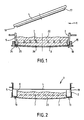
- the container 1 in accordance with the present invention comprises three component parts, namely a cylindrical casing 2, a lid 3 and a base 4.
- the casing 2 shown in figure 1 comprises a single wall 5 which is slightly frustoconical to enable a liquid-tight fit between the two open ends of the casing and the lid 3 and the base 4, respectively.
- the wall 5 is attached to a perforated support grid 7 designed to support the culture medium and which has a flat circular shape coaxial with the casing 2.
- This grid 7, which is attached at its circular edge to the wall 5 of the casing, may be in the form of an array of concentric circular elements 8 and radial elements 9 (see figure 6), preferably having a top surface, that is to say that facing towards the lid 3, that is flat and having a transverse cross-section that may be triangular.
- This form of grid retains more readily the gel culture medium when the container is in its position for use like a Petri dish, that is to say upside down relative to that shown in figure 1.
- the upper end of the casing 2 has a flat annular surface 24 lying in a plane perpendicular to the axis of the casing 2.
- the casing 2 features handling members, specifically two diametrally opposed handling lugs 13 and 14 (see figure 6).
- the lid 3 is in the form of a circular member defining an upper surface the edge of which is in one piece with a low substantially cylindrical rim 15 which is preferably slightly frustoconical to enable it to be nested in a sealed way to the open upper end of the casing 2.
- the lid 3 may be in the form of a circular member defining a flat annulus 25 cooperating with the flat surface 24 of the casing and a central inside surface 26 which is slightly concave on the side facing towards the casing, the convex other side being preferably provided with a cylindrical stand 16 of smaller diameter serving to support the container when it is turned upside down and which compensates for the convex shape of said side.
- This concave shape of the lid 3 is of particular benefit in that it enables the surface of the nutrient medium that is to be brought into contact with the micro-organisms to be detected to be molded with a convex shape.
- the base 4 is in the form of a circular member defining a flat surface the edge of which is in one piece with a small substantially cylindrical rim 17 which is preferably slightly frustoconical to enable it to be nested in a sealed way with the open lower end of the casing 2.
- Said rim 17 may incorporate a step 18 to facilitate grasping it to disengage the base 4 from the casing 2.
- the lid 3 and the base 4 may each comprise handling members to facilitate nesting them in a sealed way onto the casing 2.
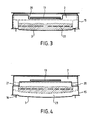
- the embodiment shown schematically in figure 2 differs from that shown in figure 1 in that the casing 2 comprises two concentric and substantially cylindrical walls 5 and 6 instead of a single wall 5.
- the outer wall 5 is slightly frustoconical to enable, as in the figure 1 embodiment, sealed nesting of the two open ends of the casing to the lid 3 and the base 4, respectively.
- the inside wall 6 is in one piece with the perforated support grid 7.
- This annulus 10 comprises a certain number of axial perforations 11, four as shown in figure 6, for example, preferably formed in a circular groove 12 situated on the upper surface of the annulus 10.
- the base 4 comprises near its edge and inside the rim 17 axial perforations 19 serving as vents and preferably situated on the same vertical line as the annulus 10 joining the two concentric walls 5 and 6 of the casing to provide communication between the volume defined by these two walls and the external environment and thus to prevent any piston effect between the base 4 and the casing 2 of the container in accordance with the invention.
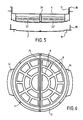
- a third embodiment shown in figures 3 and 4 differs from that shown in figure 1 or 2 in terms of the shape of the lid 3.
- the lid 3 has a rim 15 which is substantially longer in the axial direction and which includes two diametrally opposed notches 20 and 21 on the side opposite the support 16.
- a fourth embodiment shown in figures 5 and 6 differs from that shown in the previous figures in that the casing 4 comprises a sealed barrier 24, which makes it possible to introduce two different culture mediums 22 and 22 ⁇ .
- the container in accordance with the present invention given the advantages that it has, is particularly beneficial in numerous applications. It is usable not only as a Petri dish but also for checking microbiological contamination of surfaces; it is also suitable for the biological testing method and device using a sleeve which is the subject matter of the previously mentioned French patent No 84 01470; finally, it is able to contain one or more culture mediums to provide for counting different micro-organisms captured on the same microporous filter membrane, which considerably reduces the testing time, the amount of equipment to be used, and consequently the cost of the test.
Landscapes
- Health & Medical Sciences (AREA)
- Organic Chemistry (AREA)
- Life Sciences & Earth Sciences (AREA)
- Engineering & Computer Science (AREA)
- Bioinformatics & Cheminformatics (AREA)
- Chemical & Material Sciences (AREA)
- Zoology (AREA)
- Wood Science & Technology (AREA)
- Sustainable Development (AREA)
- Microbiology (AREA)
- Biotechnology (AREA)
- Biomedical Technology (AREA)
- Biochemistry (AREA)
- General Engineering & Computer Science (AREA)
- General Health & Medical Sciences (AREA)
- Genetics & Genomics (AREA)
- Clinical Laboratory Science (AREA)
- Immunology (AREA)
- Apparatus Associated With Microorganisms And Enzymes (AREA)
Claims (10)
- Récipient (1) destiné à recevoir un ou plusieurs milieux de culture (22 et 22') pour des microorganismes se présentant de préférence sous forme stérile à usage unique, comportant un boîtier (2) ouvert aux deux extrémités et muni, selon une section transversale, d'une grille de support perforée (7) reliée par sa périphérie circulaire à la paroi interne du boîtier (2), et un couvercle (3) et un fond (4), caractérisé en ce que le boîtier (2) présente une forme légèrement tronconique et le fond (4) et le couvercle (3) ont des formes légèrement tronconiques correspondantes leur permettant d'être ajustés de manière étanche sur chacune des deux extrémités ouvertes du boîtier (2) afin de permettre la coulée à chaud d'un milieu de culture alors que le récipient repose sur son couvercle.
- Récipient selon la revendication 1, caractérisé en ce que l'extrémité supérieure du boîtier (2) présente une surface plane (24) en forme de couronne située dans un plan perpendiculaire à l'axe du boîtier et qui coopère avec une surface plane correspondante (25) du couvercle (3) pour assurer l'ajustement étanche du couvercle sur cette extrémité du boîtier.
- Récipient selon l'une des revendications précédentes, caractérisé en ce que le couvercle (3) se présente sous la forme d'un élément circulaire dont la périphérie est d'une seule pièce avec un rebord (15) légèrement tronconique, ledit élément circulaire définissant une couronne plane coopérant de manière étanche avec l'extrémité supérieure du boîtier (2) et une surface intérieure centrale qui peut être légèrement concave du côté tourné vers le boîtier (2), ledit élément étant muni de préférence de l'autre côté d'un pied cylindrique (16) de plus faible diamètre servant de support lorsque le récipient (1) repose sur son couvercle (3).
- Récipient selon l'une quelconque des revendications précédentes, caractérisé en ce que le fond (4) se présente sous la forme d'un élément circulaire définissant une surface plane et dont la périphérie est d'une seule pièce avec un rebord légèrement tronconique (17), ledit rebord (17) présentant éventuellement un gradin (18) limitant l'emboîtement du fond (4) sur le boîtier (2).
- Récipient selon l'une quelconque des revendications précédentes, caractérisé en ce que le boîtier (2) comporte deux parois sensiblement cylindriques et concentriques (5 et 6) dont la paroi externe (5) est légèrement tronconique et dont la paroi interne (6) est d'une seule pièce avec la grille de support perforée (7), ces deux parois (5 et 6) étant reliées à leurs extrémités supérieures par une couronne circulaire plane de raccordement (10) présentant un certain nombre de perforations axiales (11) pratiquées de préférence dans une gorge circulaire (12) située sur la face supérieure de la couronne (10).
- Récipient selon l'une quelconque des revendications précédentes, caractérisé en ce que le boîtier (2), le fond (4), le couvercle (3) ou deux quelconques d'entre eux ou les trois, comprennent des éléments de préhension.
- Récipient selon l'une quelconque des revendications précédentes, caractérisé en ce que la grille de support perforée (7) du boîtier (2) se présente sous la forme d'un réseau d'éléments circulaires concentriques (8) et d'éléments radiaux (9) présentant de préférence une surface supérieure plane et dont la section peut être triangulaire.
- Récipient selon les revendications précédentes 3 et 6, caractérisé en ce que le boîtier (2) présente des oreilles de préhension (13 et 14) diamétralement opposées et en ce que le rebord (15) du couvercle (3) présente deux échancrures diamétralement opposées (20 et 21) conçues pour recevoir les oreilles de préhension (13 et 14) du boîtier dans deux positions situées à des profondeurs différentes par rotation de 90° du couvercle (3) par rapport audit boîtier (4).
- Procédé de remplissage avec un ou plusieurs milieux de culture pour micro-organismes du récipient (1) selon l'une quelconque des revendications 1 à 8, caractérisé en ce que l'on verse le milieu ou les milieux de culture (22 et 22') dans le récipient (1) tandis que celui-ci repose sur son couvercle (3), le fond (4) ayant été préalablement enlevé.
- Application du récipient selon l'une quelconque des revendications 1 à 8 à la détection de micro-organismes, caractérisée en ce que, après remplissage dudit récipient par le procédé selon la revendication 10, et emboîtement du fond (4) sur le boîtier (2), le récipient repose sur l'élément lui servant de fond (4) et on enlève le couvercle (3) pour utiliser la surface du milieu de culture qui était en contact avec le couvercle (3) pour recevoir les micro-organismes dont on doit détecter la présence.
Applications Claiming Priority (2)
| Application Number | Priority Date | Filing Date | Title |
|---|---|---|---|
| FR8614551A FR2605330B1 (fr) | 1986-10-20 | 1986-10-20 | Recipient destine a recevoir un ou plusieurs milieux de culture pour microorganismes. |
| FR8614551 | 1986-10-20 |
Publications (2)
| Publication Number | Publication Date |
|---|---|
| EP0267093A1 EP0267093A1 (fr) | 1988-05-11 |
| EP0267093B1 true EP0267093B1 (fr) | 1992-03-18 |
Family
ID=9339995
Family Applications (1)
| Application Number | Title | Priority Date | Filing Date |
|---|---|---|---|
| EP87402331A Expired - Lifetime EP0267093B1 (fr) | 1986-10-20 | 1987-10-19 | Récipient destiné à recevoir un ou plusieurs milieux de culture pour micro-organismes |
Country Status (5)
| Country | Link |
|---|---|
| US (1) | US4912037A (fr) |
| EP (1) | EP0267093B1 (fr) |
| JP (1) | JP2562916B2 (fr) |
| DE (1) | DE3777536D1 (fr) |
| FR (1) | FR2605330B1 (fr) |
Families Citing this family (30)
| Publication number | Priority date | Publication date | Assignee | Title |
|---|---|---|---|---|
| US5202262A (en) * | 1984-01-31 | 1993-04-13 | Millipore Corporation | Apparatus for microbiological testing of liquids |
| DE4103220A1 (de) * | 1991-02-02 | 1992-08-06 | Boehringer Mannheim Gmbh | Verfahren zur stabilisierung von 1-methylhydantoinase, verwendung einer stabilisierten 1-methylhydantoinase zur bestimmung eines analyten, entsprechendes bestimmungsverfahren sowie hierfuer geeignete mittel |
| GB2283247B (en) * | 1992-05-22 | 1996-04-17 | Sue Kheng Chong | Culture device comprising a body of culture medium |
| MY136048A (en) * | 1992-05-22 | 2008-08-29 | Chong Sue Kheng | Culturing of micro-organisms |
| US5505716A (en) * | 1993-02-02 | 1996-04-09 | Simmet; Ludwig O. | Embryo collector |
| US5601997A (en) * | 1995-02-03 | 1997-02-11 | Tchao; Ruy | Chemotaxis assay procedure |
| US5605836A (en) * | 1995-06-13 | 1997-02-25 | Chen; Chin-Yu | Modular method and device for the evaluation of the ability of biocide to penetrate biofilm |
| MX9705540A (es) * | 1996-01-30 | 1997-10-31 | Organogenesis Inc | Metodo y diseño de empaque para la crioconservacion y almacenamiento de equivalentes de tejido cultivado. |
| US5733736A (en) * | 1996-12-16 | 1998-03-31 | Springfield College | Motility channel pathogen detector and method of use |
| FR2777903B1 (fr) * | 1998-04-24 | 2000-12-29 | Millipore Sa | Procede de detection de micro-organismes et cassette convenant a sa mise en oeuvre |
| FR2777904B1 (fr) * | 1998-04-24 | 2000-12-15 | Millipore Sa | Cassette ainsi que procede et appareil d'analyse de l'air l'utilisant |
| US6261523B1 (en) * | 1999-04-27 | 2001-07-17 | Agilent Technologies Inc. | Adjustable volume sealed chemical-solution-confinement vessel |
| US6770434B2 (en) * | 2000-12-29 | 2004-08-03 | The Provost, Fellows And Scholars Of The College Of The Holy & Undivided Trinity Of Queen Elizabeth Near Dublin | Biological assay method |
| US6750039B1 (en) | 2001-03-21 | 2004-06-15 | Boston Probes, Inc. | Filtration apparatus and method for the separation of microscopic entities from a fluid |
| CA2459320C (fr) | 2001-09-06 | 2016-07-05 | Genomic Profiling Systems, Inc. | Detection rapide de cellules de replication |
| CA2623408C (fr) * | 2005-09-26 | 2014-04-01 | Rapid Micro Biosystems, Inc. | Cassette contenant un milieu de croissance |
| FR2897783B1 (fr) * | 2006-02-24 | 2008-05-30 | Millipore Corp | Dispositif pour le controle microbiologique, ensembles de controle et d'incubation le comportant et procede le mettant en oeuvre |
| EP1880764B1 (fr) * | 2006-07-20 | 2012-09-05 | ibidi GmbH | Porte échantillons destiné à l'analyse de la croissance cellulaire |
| CA2754719C (fr) | 2006-08-10 | 2013-12-31 | Allen C. Barnes | Procede et dispositif d'essai biologique portatif |
| FR2915487B1 (fr) | 2007-04-26 | 2009-06-05 | Millipore Corp | Ensemble et procede pour analyse microbiologique |
| CN101302474B (zh) * | 2007-05-11 | 2013-04-17 | 许惠茹 | 生物膜的制造方法及其培养容器 |
| AU2009296526B2 (en) | 2008-09-24 | 2015-11-19 | First Light Diagnostics, Inc. | Method for detecting analytes |
| WO2010044613A2 (fr) * | 2008-10-15 | 2010-04-22 | (주)나래바이오테크 | Récipient de culture de micro-organisme qui peut être sélectivement ouvert ou fermé et nouveau milieu de culture de micro-organisme contenant un additif hydratant |
| DK3327110T3 (en) | 2011-11-07 | 2020-04-27 | Rapid Micro Biosystems Inc | Kassette til sterilitetstest |
| EP2839021B1 (fr) | 2012-04-16 | 2022-02-23 | Rapid Micro Biosystems, Inc. | Dispositif de cultures cellulaires |
| DE102013204148A1 (de) * | 2013-02-21 | 2014-09-04 | PharmaMedia Dr. Müller GmbH | Behältnis zur Aufnahme von Nährmedien |
| CN119804399A (zh) | 2018-04-19 | 2025-04-11 | 曙光诊断学公司 | 靶标检测 |
| AU2019353145B2 (en) | 2018-10-04 | 2025-12-04 | First Light Diagnostics, Inc. | Microbial analysis without cell purification |
| US12037164B2 (en) | 2019-05-17 | 2024-07-16 | Idexx Laboratories Inc. | Devices and methods facilitating sample testing |
| CN110747113A (zh) * | 2019-12-06 | 2020-02-04 | 浙江师范大学 | 一种高效筛选病原菌拮抗菌的培养皿及其使用方法 |
Family Cites Families (7)
| Publication number | Priority date | Publication date | Assignee | Title |
|---|---|---|---|---|
| DE1069833B (de) * | 1959-11-26 | Homburg/Saar Hansarnulf von der Mosel | Kulturgcfäß zum Züchten von Mikroorganismen | |
| US3073750A (en) * | 1959-05-07 | 1963-01-15 | Talb Ind Inc | Culture dish |
| US3630849A (en) * | 1969-04-24 | 1971-12-28 | David B Land | Surface micro-organism contamination assays |
| US4326028A (en) * | 1980-09-10 | 1982-04-20 | Brown Lewis R | Antibiotic testing vessel |
| US4598050A (en) * | 1983-12-02 | 1986-07-01 | Brown Lewis R | Culture plate for surfaces |
| FR2558847B1 (fr) * | 1984-01-31 | 1986-06-20 | Millipore Sa | Dispositif et procede de controle microbiologique de liquides |
| EP0171174A3 (fr) * | 1984-08-06 | 1986-04-23 | James W. Gorman | Boíte de Pétri comportant différentes positions de fermeture pour le réglage de l'exposition à l'air ambiant |
-
1986
- 1986-10-20 FR FR8614551A patent/FR2605330B1/fr not_active Expired
-
1987
- 1987-10-19 US US07/109,977 patent/US4912037A/en not_active Expired - Lifetime
- 1987-10-19 DE DE8787402331T patent/DE3777536D1/de not_active Expired - Lifetime
- 1987-10-19 EP EP87402331A patent/EP0267093B1/fr not_active Expired - Lifetime
- 1987-10-19 JP JP62261894A patent/JP2562916B2/ja not_active Expired - Fee Related
Also Published As
| Publication number | Publication date |
|---|---|
| EP0267093A1 (fr) | 1988-05-11 |
| FR2605330A1 (fr) | 1988-04-22 |
| FR2605330B1 (fr) | 1989-01-20 |
| JPS63105669A (ja) | 1988-05-10 |
| DE3777536D1 (de) | 1992-04-23 |
| JP2562916B2 (ja) | 1996-12-11 |
| US4912037A (en) | 1990-03-27 |
Similar Documents
| Publication | Publication Date | Title |
|---|---|---|
| EP0267093A1 (fr) | Récipient destiné à recevoir un ou plusieurs milieux de culture pour micro-organismes | |
| US6193088B1 (en) | Flask vent and method of making same | |
| US5208161A (en) | Filter units | |
| US5783075A (en) | Disposable dialyzer apparatus | |
| US10465228B2 (en) | Filtration system and use thereof | |
| JP3130132B2 (ja) | 加圧液体の微生物試験のための方法及び装置 | |
| US8658422B2 (en) | Culture plate comprising a lid for lateral ventilation | |
| US3751341A (en) | Receptacle having a distendable sidewall | |
| JPH0330664A (ja) | 培養基パッケージ及び方法 | |
| EP0239058A2 (fr) | Réceptacle destiné à recevoir un milieu de culture pour micro-organismes | |
| US6170684B1 (en) | Flask vent and method of making same | |
| JP6894897B2 (ja) | 膜支持および膜濾過装置 | |
| US20130189770A1 (en) | Sample testing device | |
| US4598050A (en) | Culture plate for surfaces | |
| EP3137623B1 (fr) | Dispositif de préparation d'échantillon et procédé de préparation d'échantillon pour test de stérilité | |
| GB2182144A (en) | Culture vessel | |
| EP1069181A2 (fr) | Fermeture pour récipient à puits multiples | |
| EP0952211B1 (fr) | Procédé de détection de micro-organismes et cassette convenant à sa mise en oeuvre | |
| US20110278304A1 (en) | Holder for a culture sample | |
| JPH0351394B2 (fr) | ||
| FI91165C (fi) | Viljelypullolaitteisto | |
| CN215894637U (zh) | 一种抗原修复装置 | |
| EP3074502B1 (fr) | Dispositif et procédé d'ensemencement cellulaire | |
| JPH04228063A (ja) | 微生物のガス産生検出器具、及び該器具をもった検査キット | |
| HK1229839A1 (en) | Cell seeding device and method |
Legal Events
| Date | Code | Title | Description |
|---|---|---|---|
| PUAI | Public reference made under article 153(3) epc to a published international application that has entered the european phase |
Free format text: ORIGINAL CODE: 0009012 |
|
| AK | Designated contracting states |
Kind code of ref document: A1 Designated state(s): BE CH DE GB IT LI NL SE |
|
| 17P | Request for examination filed |
Effective date: 19880701 |
|
| 17Q | First examination report despatched |
Effective date: 19910422 |
|
| GRAA | (expected) grant |
Free format text: ORIGINAL CODE: 0009210 |
|
| AK | Designated contracting states |
Kind code of ref document: B1 Designated state(s): BE CH DE GB IT LI NL SE |
|
| REF | Corresponds to: |
Ref document number: 3777536 Country of ref document: DE Date of ref document: 19920423 |
|
| ITF | It: translation for a ep patent filed | ||
| PLBE | No opposition filed within time limit |
Free format text: ORIGINAL CODE: 0009261 |
|
| STAA | Information on the status of an ep patent application or granted ep patent |
Free format text: STATUS: NO OPPOSITION FILED WITHIN TIME LIMIT |
|
| 26N | No opposition filed | ||
| EAL | Se: european patent in force in sweden |
Ref document number: 87402331.0 |
|
| REG | Reference to a national code |
Ref country code: GB Ref legal event code: IF02 |
|
| REG | Reference to a national code |
Ref country code: CH Ref legal event code: PUE Owner name: MILLIPORE S.A. TRANSFER- MILLIPORE Ref country code: CH Ref legal event code: NV Representative=s name: FUHRER MARBACH & PARTNER |
|
| NLS | Nl: assignments of ep-patents |
Owner name: MILLIPORE |
|
| REG | Reference to a national code |
Ref country code: GB Ref legal event code: 732E |
|
| PGFP | Annual fee paid to national office [announced via postgrant information from national office to epo] |
Ref country code: GB Payment date: 20040816 Year of fee payment: 18 |
|
| PGFP | Annual fee paid to national office [announced via postgrant information from national office to epo] |
Ref country code: SE Payment date: 20040920 Year of fee payment: 18 |
|
| PGFP | Annual fee paid to national office [announced via postgrant information from national office to epo] |
Ref country code: DE Payment date: 20041007 Year of fee payment: 18 |
|
| PGFP | Annual fee paid to national office [announced via postgrant information from national office to epo] |
Ref country code: CH Payment date: 20041013 Year of fee payment: 18 |
|
| PGFP | Annual fee paid to national office [announced via postgrant information from national office to epo] |
Ref country code: NL Payment date: 20041025 Year of fee payment: 18 |
|
| PGFP | Annual fee paid to national office [announced via postgrant information from national office to epo] |
Ref country code: BE Payment date: 20041208 Year of fee payment: 18 |
|
| PG25 | Lapsed in a contracting state [announced via postgrant information from national office to epo] |
Ref country code: IT Free format text: LAPSE BECAUSE OF NON-PAYMENT OF DUE FEES;WARNING: LAPSES OF ITALIAN PATENTS WITH EFFECTIVE DATE BEFORE 2007 MAY HAVE OCCURRED AT ANY TIME BEFORE 2007. THE CORRECT EFFECTIVE DATE MAY BE DIFFERENT FROM THE ONE RECORDED. Effective date: 20051019 Ref country code: GB Free format text: LAPSE BECAUSE OF NON-PAYMENT OF DUE FEES Effective date: 20051019 |
|
| PG25 | Lapsed in a contracting state [announced via postgrant information from national office to epo] |
Ref country code: SE Free format text: LAPSE BECAUSE OF NON-PAYMENT OF DUE FEES Effective date: 20051020 |
|
| PG25 | Lapsed in a contracting state [announced via postgrant information from national office to epo] |
Ref country code: LI Free format text: LAPSE BECAUSE OF NON-PAYMENT OF DUE FEES Effective date: 20051031 Ref country code: CH Free format text: LAPSE BECAUSE OF NON-PAYMENT OF DUE FEES Effective date: 20051031 Ref country code: BE Free format text: LAPSE BECAUSE OF NON-PAYMENT OF DUE FEES Effective date: 20051031 |
|
| PG25 | Lapsed in a contracting state [announced via postgrant information from national office to epo] |
Ref country code: NL Free format text: LAPSE BECAUSE OF NON-PAYMENT OF DUE FEES Effective date: 20060501 |
|
| PG25 | Lapsed in a contracting state [announced via postgrant information from national office to epo] |
Ref country code: DE Free format text: LAPSE BECAUSE OF NON-PAYMENT OF DUE FEES Effective date: 20060503 |
|
| REG | Reference to a national code |
Ref country code: CH Ref legal event code: PL |
|
| EUG | Se: european patent has lapsed | ||
| GBPC | Gb: european patent ceased through non-payment of renewal fee |
Effective date: 20051019 |
|
| NLV4 | Nl: lapsed or anulled due to non-payment of the annual fee |
Effective date: 20060501 |
|
| BERE | Be: lapsed |
Owner name: *MILLIPORE S.A.S. Effective date: 20051031 |