EP0267106A2 - Matériau à conduction ionique - Google Patents
Matériau à conduction ionique Download PDFInfo
- Publication number
- EP0267106A2 EP0267106A2 EP87402441A EP87402441A EP0267106A2 EP 0267106 A2 EP0267106 A2 EP 0267106A2 EP 87402441 A EP87402441 A EP 87402441A EP 87402441 A EP87402441 A EP 87402441A EP 0267106 A2 EP0267106 A2 EP 0267106A2
- Authority
- EP
- European Patent Office
- Prior art keywords
- material according
- radical
- solvent
- salt
- carbon atoms
- Prior art date
- Legal status (The legal status is an assumption and is not a legal conclusion. Google has not performed a legal analysis and makes no representation as to the accuracy of the status listed.)
- Granted
Links
- 0 CN(*)S(N(*)*)(=O)=O Chemical compound CN(*)S(N(*)*)(=O)=O 0.000 description 1
Images


Classifications
-
- H—ELECTRICITY
- H01—ELECTRIC ELEMENTS
- H01B—CABLES; CONDUCTORS; INSULATORS; SELECTION OF MATERIALS FOR THEIR CONDUCTIVE, INSULATING OR DIELECTRIC PROPERTIES
- H01B1/00—Conductors or conductive bodies characterised by the conductive materials; Selection of materials as conductors
- H01B1/06—Conductors or conductive bodies characterised by the conductive materials; Selection of materials as conductors mainly consisting of other non-metallic substances
- H01B1/12—Conductors or conductive bodies characterised by the conductive materials; Selection of materials as conductors mainly consisting of other non-metallic substances organic substances
- H01B1/122—Ionic conductors
-
- H—ELECTRICITY
- H01—ELECTRIC ELEMENTS
- H01M—PROCESSES OR MEANS, e.g. BATTERIES, FOR THE DIRECT CONVERSION OF CHEMICAL ENERGY INTO ELECTRICAL ENERGY
- H01M6/00—Primary cells; Manufacture thereof
- H01M6/14—Cells with non-aqueous electrolyte
- H01M6/16—Cells with non-aqueous electrolyte with organic electrolyte
- H01M6/162—Cells with non-aqueous electrolyte with organic electrolyte characterised by the electrolyte
- H01M6/164—Cells with non-aqueous electrolyte with organic electrolyte characterised by the electrolyte by the solvent
-
- H—ELECTRICITY
- H01—ELECTRIC ELEMENTS
- H01M—PROCESSES OR MEANS, e.g. BATTERIES, FOR THE DIRECT CONVERSION OF CHEMICAL ENERGY INTO ELECTRICAL ENERGY
- H01M6/00—Primary cells; Manufacture thereof
- H01M6/14—Cells with non-aqueous electrolyte
- H01M6/18—Cells with non-aqueous electrolyte with solid electrolyte
- H01M6/181—Cells with non-aqueous electrolyte with solid electrolyte with polymeric electrolytes
-
- H—ELECTRICITY
- H01—ELECTRIC ELEMENTS
- H01M—PROCESSES OR MEANS, e.g. BATTERIES, FOR THE DIRECT CONVERSION OF CHEMICAL ENERGY INTO ELECTRICAL ENERGY
- H01M6/00—Primary cells; Manufacture thereof
- H01M6/14—Cells with non-aqueous electrolyte
- H01M6/16—Cells with non-aqueous electrolyte with organic electrolyte
- H01M6/162—Cells with non-aqueous electrolyte with organic electrolyte characterised by the electrolyte
- H01M6/166—Cells with non-aqueous electrolyte with organic electrolyte characterised by the electrolyte by the solute
-
- Y—GENERAL TAGGING OF NEW TECHNOLOGICAL DEVELOPMENTS; GENERAL TAGGING OF CROSS-SECTIONAL TECHNOLOGIES SPANNING OVER SEVERAL SECTIONS OF THE IPC; TECHNICAL SUBJECTS COVERED BY FORMER USPC CROSS-REFERENCE ART COLLECTIONS [XRACs] AND DIGESTS
- Y02—TECHNOLOGIES OR APPLICATIONS FOR MITIGATION OR ADAPTATION AGAINST CLIMATE CHANGE
- Y02E—REDUCTION OF GREENHOUSE GAS [GHG] EMISSIONS, RELATED TO ENERGY GENERATION, TRANSMISSION OR DISTRIBUTION
- Y02E60/00—Enabling technologies; Technologies with a potential or indirect contribution to GHG emissions mitigation
- Y02E60/10—Energy storage using batteries
Definitions
- the invention relates to a new ionically conductive material consisting of a salt in solution in a solvent, this material possibly being liquid or solid.
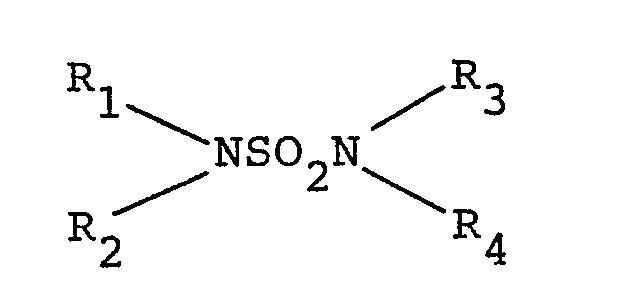
- the solvent comprises a sulfonated derivative of formula I: in which R1, R2, R3 and R4 are different or identical and represent an alkyl or oxa-alkyl radical having from 1 to 10 carbon atoms.
- R1 and R2 are identical and are a methyl radical, while R3 and R4 each represent an ethyl radical.
- the four radicals are ethyl radicals.
- Salt in solution is a metal salt derived from a strong acid. It can for example be chosen from those described in European patent 013199: "Electrochemical generators for producing current and materials for their manufacture “or among the salts described in French patent 2,587,602, French patent 2,527,610 or even French patent 2,527,611.
- the salt may consist of a sulfonated derivative represented by one of the following formulas II to V: formulas in which: - M is an alkali, alkaline-earth metal, a transition metal or a rare earth, QF is a Civalent to C en divalent radical and in particular a perfluorinated radical, - RF and R ⁇ F can be different or identical and each represents an alkyl or aryl radical having from 1 to 12 carbon atoms, said radical being advantageously perhalogenated and in particular perfluorinated, - A represents either a nitrogen atom or a group CR in which R is either hydrogen or an alkyl having from 1 to 30 carbon atoms.
- formulas II to V formulas in which: - M is an alkali, alkaline-earth metal, a transition metal or a rare earth, QF is a Civalent to C en divalent radical and in particular a perfluorinated radical, - RF and R ⁇ F can be different or identical and each
- the ionically conductive material also contains a macromolecular material in which the salt is dissolved.
- the macromolecular material is in the form of a solid electrolyte of the type described in European patent 013199 in which the sulfonated derivative of formula (I) plays the role of a plasticizing agent, that is to say that 'it allows to prevent or at least limit the phase changes of the polymer by which the polymer becomes crystalline.
- the macromolecular material can be chosen from those described in European patent 013199, that is to say polymers constituted by homo or copolymers containing chains comprising at least one oxygen or oxygen atom. nitrogen, by four or two carbon atoms. These hetero atoms can participate directly in the creation of the chain or be linked laterally to carbon atoms of a main chain.
- macromolecular materials can therefore be chosen from poly etheroxides or also from polyphosphazenes.
- This macromolecular material can be used as an electrolyte, liquid or solid for the production of electrochemical generators of electric current production, both primary and secondary, but it can also find any use employing the ionic mobility of the salt in solution.
- electrochemical generators it can be used as a solid electrolyte, but also as a component of a composite electrode, that is to say of an electrode in which each grain of active material is coated of said ionically conductive material as described in European patent 013199.
- an electrochemical generator, generator (1) comprising a negative electrode constituted by a lithium strip, a positive electrode based on TiS2 and an electrolyte constituted by lithium perchlorate in solution, in a copolymer of ethylene and methyl glycidyl ether oxide.
- FIG. 1 shows the curve (11) which gives the percentage of use as a function of the density of the discharge current.
- the positive electrode and the negative electrode are similar to those of the generators (1) and (2).
- the electrolyte is the same as that of the generator (2), but was replaced by a lithium perchlorate trifluorosulfonate imide (TFSI) of formula: (CF3SO2) 2N Li as described in U.S. Patent No. 4,505,997.
- This generator therefore included 10% by weight of TESA relative to the total weight of polymer.
- the generator No. 3 had a capacity of positive electrode 2 C / cm2.
- generator No. 4 identical to generator No. 3 but with a positive electrode capacity equal to 1 C / cm.
- the curves (41) and (31) also indicate the discharge modes (for example C / 10) which indicate the time during which the battery has been discharged.
Landscapes
- Engineering & Computer Science (AREA)
- Manufacturing & Machinery (AREA)
- Chemical & Material Sciences (AREA)
- Chemical Kinetics & Catalysis (AREA)
- Electrochemistry (AREA)
- General Chemical & Material Sciences (AREA)
- Physics & Mathematics (AREA)
- Spectroscopy & Molecular Physics (AREA)
- Secondary Cells (AREA)
- Primary Cells (AREA)
- Macromolecular Compounds Obtained By Forming Nitrogen-Containing Linkages In General (AREA)
- Compositions Of Macromolecular Compounds (AREA)
- Conductive Materials (AREA)
- Electric Double-Layer Capacitors Or The Like (AREA)
Abstract
Description
- L'invention concerne un nouveau matériau à conduction ionique constitué par un sel en solution dans un solvant, ce matériau pouvant être liquide ou solide.
- Selon l'invention, le solvant comporte un dérivé sulfoné de formule I :

- De préférence, R₁ et R₂ sont identiques et sont un radical méthyl, alors que R₃ et R₄ représentent chacun un radical éthyle.
- De préférence encore, les quatre radicaux sont des radicaux éthyle.
- Le sel en solution est un sel métallique dérivé d'un acide fort. Il peut par exemple être choisi parmi ceux décrits dans le brevet européen 013199 : "Générateurs électrochimiques de production de courant et matériaux pour leur fabrication" ou encore parmi les sels décrits dans le brevet français 2 587 602, le brevet français 2 527 610 ou encore le brevet français 2 527 611.
- En particulier, le sel peut être constitué par un dérivé sulfoné représenté par l'une des formules II à V suivantes :

- M est un métal alcalin, alcalino-terreux, un métal de transition ou une terre rare,
- QF est un radical divalent en C₂ à C₆ et notamment un radical perfluoré,
- RF et RʹF peuvent être différents ou identiques et représentent chacun un radical alkyle ou aryle ayant de 1 à 12 atomes de carbone, ledit radical étant avantageusement perhalogéné et en particulier perfluoré,
- A représente soit un atome d'azote, soit un groupement CR dans lequel R est soit un hydrogène, soit un alkyle ayant de 1 à 30 atomes de carbone. - Selon un autre mode de réalisation de l'invention, le matériau à conduction ionique contient en outre un matériau macromoléculaire dans lequel est dissous le sel. Ainsi, le matériau macromoléculaire se présente sous la forme d'un électrolyte solide du type décrit dans le brevet européen 013199 dans lequel le dérivé sulfoné de formule (I) joue le rôle d'un agent plastifiant, c'est-à-dire qu'il permet de prévenir ou du moins de limiter les changements de phase du polymère par lesquels le polymère devient cristallin.
- Dans ce mode de réalisation, le matériau macromoléculaire peut être choisi parmi ceux décrits dans le brevet européen 013199, c'est-à-dire des polymères constitutés par des homo ou copolymères contenant des chaînes comprenant au moins un atome d'oxygène ou d'azote, par quatre ou deux atomes de carbones. Ces hétéro-atomes peuvent participer directement à la création de la chaîne ou encore être liés, latéralement, à des atomes de carbone d'une chaîne principale.
- Ces matériaux macromoléculaires peuvent donc être choisis parmi les poly étheroxydes ou encore parmi les polyphosphazènes.
- A titre d'exemple, le matériau macromoléculire peut dériver de motifs monomères du type représenté
- soit par la formule suivante :
Re représentant un radical polyéther de formule générale -(CH₂-CH₂-O)p-, p ayant une valeur de 1 à 100, notamment de 1 à 2,
- soit par la formule suivante :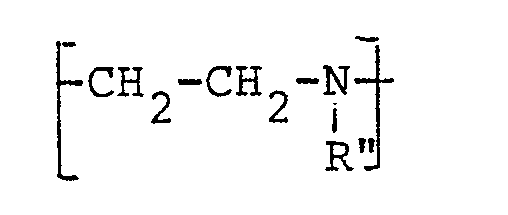
- soit par la formule suivante :
- soit par la formule suivant :
Re représentant un radical polyéther de formule générale -(CH₂-CH₂-O)p-, p ayant une valeur de 1 à 10,
- soit par la formule suivante :
- soit par la formule suivante :
- Ce matériau macromoléculaire peut être utilisé comme électrolyte, liquide ou solide pour la réalisation de génératurs électrochimiques de production de courant électrique, tant primaires que secondaires, mais il peut aussi trouver toute utilisation mettant en oeuvre la mobilité ionique du sel en solution.
- Pour la réalisation de générateurs électrochimiques, il peut être utilisé en tant qu'électrolyte solide, mais aussi en tant que composant d'une électrode composite, c'est-à-dire d'une électrode dans laquelle chaque grain de matière active est enrobée dudit matériau à conduction ionique telle que décrite dans le brevet européen 013199.
- De façon à illustrer l'invention, on donne ci-après des exemples comparatifs.
- On a tout d'abord réalisé un générateur électrochimique, générateur (1), comprenant une électrode négative constituée par un feuillard de lithium, une électrode positive à base de TiS₂ et un électrolyte constitué par du perchlorate de lithium en solution, dans un copolymère d'oxyde d'éthylène et de méthylglycidyléther.
- On a représenté sur la figure 1 la courbe (11) qui donne le pourcentage d'utilisation en fonction de la densité du courant de décharge.
- On a ensuite réalisé le même générateur (générateur 2) mais pour lequel l'électrolyte contenait 10 %, en poids par rapport au polymère, d'un solvant selon l'invention représenté par la formule suivante :

- On a représenté sur la même figure 1 la courbe (21) correspondant à ce générateur (2). On remarque que cette courbe est décalée par rapport à la courbe (1) d'environ 5 %, ce qui démontre une amélioration de l'utilisation du générateur selon l'invention.
- On a ensuite réalisé le générateur (3) suivant.
- L'électrode positive et l'électrode négative sont similaires à celles des générateurs (1) et (2). L'électrolyte est le même que celui du générateur (2) mais on a remplacé le perchlorate de lithium par un trifluorosulfonate imidure (TFSI) de formule : (CF₃SO₂)₂N Li tel que décrit dans le brevet US no 4.505.997. Ce générateur comportait donc 10 % en poids de TESA par rapport au poids total de polymère.
- Le générateur no 3 avait une capacité d'électrode positive de 2 C/cm².
- On a réalisé enfin un générateur no 4 identique au générateur no 3 mais avec une capacité d'électrode positive égal à 1 C/cm².
- On a représenté sur la figure 2, la variation du taux d'utilisation en fonction de la densité du courant de décharge pour le générateur no 1 (11), pour le générateur no 3 (31) et no 4 (41), les essais étant effectués à 25°C.
- Sur les courbes (41) et (31), on a aussi indiqué les régimes de décharge (par exemple C/10) qui indiquent le temps pendant laquelle la pile a été déchargée.
- On a remarqué, à la lecture de ces courbes, que l'on a encore amélioré le taux de décharge et que l'on a donc des générateurs puissants. On a aussi vérifié que l'on obtenait la même amélioration du taux de décharge pour des températures allant jusqu'à moins dix degrés C.
Claims (11)

Priority Applications (1)
| Application Number | Priority Date | Filing Date | Title |
|---|---|---|---|
| AT87402441T ATE100631T1 (de) | 1986-10-30 | 1987-10-29 | Ionenleitendes material. |
Applications Claiming Priority (2)
| Application Number | Priority Date | Filing Date | Title |
|---|---|---|---|
| FR8615113A FR2606216A1 (fr) | 1986-10-30 | 1986-10-30 | Materiau a conduction ionique |
| FR8615113 | 1986-10-30 |
Publications (3)
| Publication Number | Publication Date |
|---|---|
| EP0267106A2 true EP0267106A2 (fr) | 1988-05-11 |
| EP0267106A3 EP0267106A3 (en) | 1990-03-14 |
| EP0267106B1 EP0267106B1 (fr) | 1994-01-19 |
Family
ID=9340359
Family Applications (1)
| Application Number | Title | Priority Date | Filing Date |
|---|---|---|---|
| EP87402441A Expired - Lifetime EP0267106B1 (fr) | 1986-10-30 | 1987-10-29 | Matériau à conduction ionique |
Country Status (8)
| Country | Link |
|---|---|
| US (2) | US4851307A (fr) |
| EP (1) | EP0267106B1 (fr) |
| JP (1) | JP2848600B2 (fr) |
| AT (1) | ATE100631T1 (fr) |
| CA (1) | CA1310366C (fr) |
| DE (1) | DE3788845T2 (fr) |
| ES (1) | ES2061522T3 (fr) |
| FR (1) | FR2606216A1 (fr) |
Families Citing this family (40)
| Publication number | Priority date | Publication date | Assignee | Title |
|---|---|---|---|---|
| US5260145A (en) * | 1986-10-30 | 1993-11-09 | Hydro-Quebec | Production of organic cation radicals in an electrochemical cell |
| FR2606217B1 (fr) * | 1986-10-30 | 1990-12-14 | Elf Aquitaine | Nouveau materiau a conduction ionique constitue par un sel en solution dans un electrolyte liquide |
| US5274493A (en) * | 1989-07-13 | 1993-12-28 | Elf Atochem North America, Inc. | Electrochromic element, materials for use in such element, processes for making such element and such materials and use of such element in an electrochromic glass device |
| US5086351A (en) * | 1989-07-13 | 1992-02-04 | M&T Chemicals, Inc. | Electrochromic elements, materials for use in such element, processes for making such elements and such materials and use of such element in an electrochromic glass device |
| US5273840A (en) * | 1990-08-01 | 1993-12-28 | Covalent Associates Incorporated | Methide salts, formulations, electrolytes and batteries formed therefrom |
| JP2851722B2 (ja) * | 1991-07-26 | 1999-01-27 | 日本石油株式会社 | 高分子固体電解質およびその製造方法 |
| CA2051611C (fr) * | 1991-09-17 | 1996-01-23 | Michel Gauthier | Procede de preparation d'ensembles collecteurs-electrodes pour generateurs de films minces, ensembles collecteurs- electrodes et generateurs obtenus |
| US5508130A (en) * | 1992-07-22 | 1996-04-16 | Golovin; Milton N. | Solid electrolytes containing LiN(SO2 CF3)2 and a triglyme-carbonate solvent, and electrochemical cells produced therefrom |
| US5453335A (en) * | 1992-12-23 | 1995-09-26 | Arthur D Little, Inc. | Ion-conductive polymer and electrolyte additives |
| JP3878206B2 (ja) * | 1994-03-21 | 2007-02-07 | サントル・ナショナル・ドゥ・ラ・ルシェルシュ・シャンティフィク | 良好な耐食性を示すイオン性伝導材料 |
| US5755985A (en) * | 1994-09-06 | 1998-05-26 | Hydro-Quebec | LPB electrolyte compositions based on mixtures of copolymers and interpenetrated networks |
| US5514493A (en) * | 1995-03-06 | 1996-05-07 | Minnesota Mining And Manufacturing Company | Perfluoroalkylsulfonates, sulfonimides, and sulfonyl methides, and electrolytes containing them |
| US5691083A (en) * | 1995-06-07 | 1997-11-25 | Eveready Battery Company, Inc. | Potassium ion additives for voltage control and performance improvement in nonaqueous cells |
| US5705689A (en) * | 1995-06-19 | 1998-01-06 | Associated Universities, Inc. | Aza compounds as anion receptors |
| US5827602A (en) * | 1995-06-30 | 1998-10-27 | Covalent Associates Incorporated | Hydrophobic ionic liquids |
| US5691081A (en) * | 1995-09-21 | 1997-11-25 | Minnesota Mining And Manufacturing Company | Battery containing bis(perfluoroalkylsulfonyl)imide and cyclic perfluoroalkylene disulfonylimide salts |
| US5652072A (en) * | 1995-09-21 | 1997-07-29 | Minnesota Mining And Manufacturing Company | Battery containing bis(perfluoroalkylsulfonyl)imide and cyclic perfluoroalkylene disulfonylimide salts |
| US5962546A (en) | 1996-03-26 | 1999-10-05 | 3M Innovative Properties Company | Cationically polymerizable compositions capable of being coated by electrostatic assistance |
| JP4823401B2 (ja) | 1996-12-30 | 2011-11-24 | イドロ―ケベック | 過フッ化アミド塩及びイオン伝導物質としてのその使用方法 |
| CA2197056A1 (fr) * | 1997-02-07 | 1998-08-07 | Hydro-Quebec | Nouvelle matiere conductrice d'ions ayant une conductivite et une stabilite ameliorees |
| US6104967A (en) * | 1997-07-25 | 2000-08-15 | 3M Innovative Properties Company | Fault-tolerant battery system employing intra-battery network architecture |
| US6120930A (en) * | 1997-07-25 | 2000-09-19 | 3M Innovative Properties Corporation | Rechargeable thin-film electrochemical generator |
| US6100702A (en) * | 1997-07-25 | 2000-08-08 | 3M Innovative Properties Company | In-situ fault detection apparatus and method for an encased energy storing device |
| US6099986A (en) * | 1997-07-25 | 2000-08-08 | 3M Innovative Properties Company | In-situ short circuit protection system and method for high-energy electrochemical cells |
| US6146778A (en) | 1997-07-25 | 2000-11-14 | 3M Innovative Properties Company | Solid-state energy storage module employing integrated interconnect board |
| US6046514A (en) * | 1997-07-25 | 2000-04-04 | 3M Innovative Properties Company | Bypass apparatus and method for series connected energy storage devices |
| US6087036A (en) * | 1997-07-25 | 2000-07-11 | 3M Innovative Properties Company | Thermal management system and method for a solid-state energy storing device |
| US6117584A (en) * | 1997-07-25 | 2000-09-12 | 3M Innovative Properties Company | Thermal conductor for high-energy electrochemical cells |
| US5952815A (en) * | 1997-07-25 | 1999-09-14 | Minnesota Mining & Manufacturing Co. | Equalizer system and method for series connected energy storing devices |
| CA2215849A1 (fr) | 1997-09-11 | 1999-03-11 | Christophe Michot | Nouveau solvant et composition electrolytique a haute conductivite ayant une stabilite a large plage |
| CN1134083C (zh) * | 1997-09-19 | 2004-01-07 | 三菱化学株式会社 | 非水系电解液电池 |
| WO1999028292A1 (fr) | 1997-12-01 | 1999-06-10 | Acep Inc. | Sels de sulfones perfluores, et leurs utilisations comme materiaux a conduction ionique |
| EP1042838A4 (fr) * | 1997-12-02 | 2001-04-04 | Stanford Res Inst Int | Electrolytes de batterie produisant un gaz ignifugeant |
| US6235425B1 (en) | 1997-12-12 | 2001-05-22 | 3M Innovative Properties Company | Apparatus and method for treating a cathode material provided on a thin-film substrate |
| US6063522A (en) * | 1998-03-24 | 2000-05-16 | 3M Innovative Properties Company | Electrolytes containing mixed fluorochemical/hydrocarbon imide and methide salts |
| KR100644850B1 (ko) * | 1998-11-30 | 2006-11-10 | 소니 가부시키가이샤 | 비수 전해액 이차 전지 |
| US6534220B2 (en) | 2000-12-29 | 2003-03-18 | 3M Innovative Properties Company | High-boiling electrolyte solvent |
| JP4525177B2 (ja) * | 2004-05-26 | 2010-08-18 | 三菱化学株式会社 | 非水系電解液および非水系電解液電池 |
| US20050287441A1 (en) * | 2004-06-23 | 2005-12-29 | Stefano Passerini | Lithium polymer electrolyte batteries and methods of making |
| US20090045373A1 (en) * | 2006-03-10 | 2009-02-19 | Amer Hammami | Compounds, ionic liquids, molten salts and uses thereof |
Family Cites Families (12)
| Publication number | Priority date | Publication date | Assignee | Title |
|---|---|---|---|---|
| DE2831163A1 (de) * | 1978-07-15 | 1980-01-24 | Bbc Brown Boveri & Cie | Elektrochemische speicherzelle |
| FR2442512A1 (fr) * | 1978-11-22 | 1980-06-20 | Anvar | Nouveaux materiaux elastomeres a conduction ionique |
| FR2511721A1 (fr) * | 1981-08-21 | 1983-02-25 | Freyssinet Int Stup | Dispositif de raccordement incurve entre deux portions rectilignes d'un cable tendu |
| FR2527611A1 (fr) * | 1982-06-01 | 1983-12-02 | Anvar | Tetrakis trialkyl siloxy alanates de metaux alcalins, leurs solutions solides avec des matieres plastiques et leur application a la constitution d'elements conducteurs pour des generateurs electrochimiques |
| FR2527610B1 (fr) * | 1982-06-01 | 1987-08-14 | Anvar | Tetra-alkynyl borates ou -aluminates de metaux alcalins, leurs solutions solides avec des matieres plastiques et leur application a la constitution d'elements conducteurs pour des generateurs electrochimiques |
| FR2527602A1 (fr) * | 1982-06-01 | 1983-12-02 | Anvar | Bis perhalogenoacyl- ou sulfonyl- imidures de metaux alcalins, leurs solutions solides avec des matieres plastiques et leur application a la constitution d'elements conducteurs pour des generateurs electrochimiques |
| FR2576712B1 (fr) * | 1985-01-30 | 1988-07-08 | Accumulateurs Fixes | Generateur electrochimique a electrolyte non aqueux |
| US4618548A (en) * | 1985-03-18 | 1986-10-21 | Combustion Engineering, Inc. | Electrolyte additive |
| EP0347952A3 (fr) * | 1985-04-19 | 1990-02-07 | AlliedSignal Inc. | Electrodes négatives pour batteries secondaires non aqueuses composées d'alliages de sodium |
| US4668596A (en) * | 1985-04-19 | 1987-05-26 | Allied Corporation | Negative electrodes for non-aqueous secondary batteries composed on conjugated polymer and alkali metal alloying or inserting material |
| EP0260847A1 (fr) * | 1986-09-19 | 1988-03-23 | Imperial Chemical Industries Plc | Electrolytes solides |
| FR2606218A1 (fr) * | 1986-10-30 | 1988-05-06 | Elf Aquitaine | Nouveau materiau a conduction ionique |
-
1986
- 1986-10-30 FR FR8615113A patent/FR2606216A1/fr active Pending
-
1987
- 1987-10-29 AT AT87402441T patent/ATE100631T1/de not_active IP Right Cessation
- 1987-10-29 DE DE3788845T patent/DE3788845T2/de not_active Expired - Lifetime
- 1987-10-29 ES ES87402441T patent/ES2061522T3/es not_active Expired - Lifetime
- 1987-10-29 EP EP87402441A patent/EP0267106B1/fr not_active Expired - Lifetime
- 1987-10-29 CA CA000550565A patent/CA1310366C/fr not_active Expired - Lifetime
- 1987-10-29 JP JP62274584A patent/JP2848600B2/ja not_active Expired - Lifetime
- 1987-10-30 US US07/114,721 patent/US4851307A/en not_active Expired - Lifetime
-
1989
- 1989-04-17 US US07/338,949 patent/US5063124A/en not_active Expired - Lifetime
Also Published As
| Publication number | Publication date |
|---|---|
| FR2606216A1 (fr) | 1988-05-06 |
| DE3788845T2 (de) | 1994-07-28 |
| CA1310366C (fr) | 1992-11-17 |
| ATE100631T1 (de) | 1994-02-15 |
| EP0267106B1 (fr) | 1994-01-19 |
| US5063124A (en) | 1991-11-05 |
| ES2061522T3 (es) | 1994-12-16 |
| JP2848600B2 (ja) | 1999-01-20 |
| US4851307A (en) | 1989-07-25 |
| JPS63187578A (ja) | 1988-08-03 |
| EP0267106A3 (en) | 1990-03-14 |
| DE3788845D1 (de) | 1994-03-03 |
Similar Documents
| Publication | Publication Date | Title |
|---|---|---|
| EP0267106A2 (fr) | Matériau à conduction ionique | |
| CA2163336C (fr) | Materiau a conduction ionique presentant de bonnes proprietes anti-corrosion | |
| EP1863109B1 (fr) | Solvants et nouvelles compositions électrolytiques possédant un large domaine de stabilité et une conductivité élevée | |
| EP0267107B1 (fr) | Nouveau matériau à conduction ionique | |
| EP0966769B1 (fr) | Nouveaux materiaux d'electrodes derives de composes ioniques polyquinoniques et leurs utilisations dans les generateurs electrochimiques | |
| US6245465B1 (en) | Non-aqueous electrolyte solvents for secondary cells | |
| CA1222341A (fr) | Materiau macromoleculaire constitue par un sel en solution dans un copolymere | |
| EP1626041B1 (fr) | Nouveaux matériaux utiles en tant que solutés électrolytiques | |
| US6395430B1 (en) | Hybrid polymer electrolyte for lithium battery and method of preparing same | |
| CA2100075A1 (fr) | Derives de bis(perfluorosulfonyl)methanes, leur procede de preparation, et leurs utilisations | |
| EP0671386B1 (fr) | Monomères dérivés de sultones perhalogénées et polymères obtenus à partir de ces monomères | |
| KR20010072928A (ko) | 시아노 치환된 메티드 및 아미드 염 | |
| US6905762B1 (en) | Non-aqueous electrolyte solutions comprising additives and non-aqueous electrolyte cells comprising the same | |
| EP0149393B1 (fr) | Nouveau matériau macromoléculaire à conduction ionique et son procédé de fabrication | |
| EP4011946B1 (fr) | Préparation d'un électrolyte solide à base de polycarbonates | |
| EP0213985A1 (fr) | Matériau macromoléculaire à conduction ionique | |
| CH636733A5 (fr) | Pile non aqueuse. | |
| EP1714335B1 (fr) | Procede d elaboration d un dispositif electrochimique. | |
| EP1790030B1 (fr) | Materiau a conduction ionique contenant un oligoether sulfate | |
| EP0603370A1 (fr) | Copolymeres d'oxiranne et de dioxolane, leur procede de preparation et materiaux a conduction ionique les contenant | |
| FR2523770A1 (fr) | Nouveaux electrolytes solides polymeres | |
| CA2246955C (fr) | Solvants et nouvelles compositions electrolytiques possedant un large domaine de stabilite et une conductivite elevee | |
| FR2717620A1 (fr) | Additif limitant la corrosion du collecteur dans une cellule électrochimique. | |
| JP2000323170A (ja) | 電気化学的安定性に優れた非プロトン性溶媒 | |
| FR2717612A1 (fr) | Composé ionique portant un substituant fluorosulfonyle, son utilisation pour l'élaboration d'un matériau à conduction ionique. |
Legal Events
| Date | Code | Title | Description |
|---|---|---|---|
| PUAI | Public reference made under article 153(3) epc to a published international application that has entered the european phase |
Free format text: ORIGINAL CODE: 0009012 |
|
| 17P | Request for examination filed |
Effective date: 19871102 |
|
| AK | Designated contracting states |
Kind code of ref document: A2 Designated state(s): AT BE CH DE ES FR GB IT LI LU NL SE |
|
| PUAL | Search report despatched |
Free format text: ORIGINAL CODE: 0009013 |
|
| AK | Designated contracting states |
Kind code of ref document: A3 Designated state(s): AT BE CH DE ES FR GB IT LI LU NL SE |
|
| 17Q | First examination report despatched |
Effective date: 19911227 |
|
| GRAA | (expected) grant |
Free format text: ORIGINAL CODE: 0009210 |
|
| AK | Designated contracting states |
Kind code of ref document: B1 Designated state(s): AT BE CH DE ES FR GB IT LI LU NL SE |
|
| REF | Corresponds to: |
Ref document number: 100631 Country of ref document: AT Date of ref document: 19940215 Kind code of ref document: T |
|
| REF | Corresponds to: |
Ref document number: 3788845 Country of ref document: DE Date of ref document: 19940303 |
|
| ITF | It: translation for a ep patent filed | ||
| GBT | Gb: translation of ep patent filed (gb section 77(6)(a)/1977) |
Effective date: 19940408 |
|
| PG25 | Lapsed in a contracting state [announced via postgrant information from national office to epo] |
Ref country code: AT Effective date: 19941029 |
|
| PG25 | Lapsed in a contracting state [announced via postgrant information from national office to epo] |
Ref country code: SE Effective date: 19941030 |
|
| PG25 | Lapsed in a contracting state [announced via postgrant information from national office to epo] |
Ref country code: BE Effective date: 19941031 Ref country code: LI Effective date: 19941031 Ref country code: LU Free format text: LAPSE BECAUSE OF NON-PAYMENT OF DUE FEES Effective date: 19941031 Ref country code: CH Effective date: 19941031 Ref country code: ES Free format text: LAPSE BECAUSE OF EXPIRATION OF PROTECTION Effective date: 19941031 |
|
| PLBE | No opposition filed within time limit |
Free format text: ORIGINAL CODE: 0009261 |
|
| STAA | Information on the status of an ep patent application or granted ep patent |
Free format text: STATUS: NO OPPOSITION FILED WITHIN TIME LIMIT |
|
| REG | Reference to a national code |
Ref country code: ES Ref legal event code: FG2A Ref document number: 2061522 Country of ref document: ES Kind code of ref document: T3 |
|
| 26N | No opposition filed | ||
| EAL | Se: european patent in force in sweden |
Ref document number: 87402441.7 |
|
| BERE | Be: lapsed |
Owner name: HYDRO-QUEBEC Effective date: 19941031 Owner name: SOC. NATIONALE ELF AQUITAINE Effective date: 19941031 |
|
| PG25 | Lapsed in a contracting state [announced via postgrant information from national office to epo] |
Ref country code: NL Effective date: 19950501 |
|
| NLV4 | Nl: lapsed or anulled due to non-payment of the annual fee | ||
| REG | Reference to a national code |
Ref country code: CH Ref legal event code: PL |
|
| EUG | Se: european patent has lapsed |
Ref document number: 87402441.7 |
|
| REG | Reference to a national code |
Ref country code: ES Ref legal event code: FD2A Effective date: 19990601 |
|
| REG | Reference to a national code |
Ref country code: GB Ref legal event code: IF02 |
|
| PGFP | Annual fee paid to national office [announced via postgrant information from national office to epo] |
Ref country code: GB Payment date: 20060926 Year of fee payment: 20 |
|
| PGFP | Annual fee paid to national office [announced via postgrant information from national office to epo] |
Ref country code: DE Payment date: 20060928 Year of fee payment: 20 |
|
| PGFP | Annual fee paid to national office [announced via postgrant information from national office to epo] |
Ref country code: IT Payment date: 20061031 Year of fee payment: 20 |
|
| REG | Reference to a national code |
Ref country code: GB Ref legal event code: PE20 |
|
| PG25 | Lapsed in a contracting state [announced via postgrant information from national office to epo] |
Ref country code: GB Free format text: LAPSE BECAUSE OF EXPIRATION OF PROTECTION Effective date: 20071028 |
|
| PGFP | Annual fee paid to national office [announced via postgrant information from national office to epo] |
Ref country code: FR Payment date: 20061031 Year of fee payment: 20 |