EP0267464B1 - Méthode pour commander l'accès des processeurs à des dispositifs d'entrée/sortie - Google Patents
Méthode pour commander l'accès des processeurs à des dispositifs d'entrée/sortie Download PDFInfo
- Publication number
- EP0267464B1 EP0267464B1 EP87115342A EP87115342A EP0267464B1 EP 0267464 B1 EP0267464 B1 EP 0267464B1 EP 87115342 A EP87115342 A EP 87115342A EP 87115342 A EP87115342 A EP 87115342A EP 0267464 B1 EP0267464 B1 EP 0267464B1
- Authority
- EP
- European Patent Office
- Prior art keywords
- path
- processor
- control unit
- input
- current
- Prior art date
- Legal status (The legal status is an assumption and is not a legal conclusion. Google has not performed a legal analysis and makes no representation as to the accuracy of the status listed.)
- Expired - Lifetime
Links
Images

Classifications
-
- G—PHYSICS
- G06—COMPUTING OR CALCULATING; COUNTING
- G06F—ELECTRIC DIGITAL DATA PROCESSING
- G06F13/00—Interconnection of, or transfer of information or other signals between, memories, input/output devices or central processing units
- G06F13/14—Handling requests for interconnection or transfer
Definitions
- the present invention generally relates to input/output control in multi-processor data processing systems employing shared resources and, more particularly, to a device access management method which is effective to prevent device lockout due to fast channel input/output turn-around time of new, faster processors which are connected to the data processing system.
- DASD direct access storage device
- the controller requires a certain amount of time in order to do housekeeping after the end of an input/output operation. This housekeeping must be completed prior to signaling a waiting processor that the requested device is now available for an input /output operation.
- the channel requires an amount of time to process the results of an input/output operation before it can initiate a new operation on a given device. If the time that the channel requires to process the current operation and start a new one is greater than what the device controller requires for clean up, then the controller is allowed enough time to signal other processors that the device is now free.
- the device lockout problem is related to the speed of the processor and its associated channels only to the point where the channel turn-around time becomes less than the controller's turn around or housekeeping time. Once this threshold value has been breached, a given processor may hold off an even faster processor which previously had been given a device busy. In this condition, a processor may have exclusive use of a device or a controller for as long as is necessary to process pending input/output requests.
- the problem of device or controller lockout can be so severe as to lead to a system outage.
- An example where this might occur is in an airline reservation system.
- other problems become manifest.
- the records are not available to an application program for long periods of time, the records tend to age and become invalid. This can result in over booking of reservations and even booking on discontinued flights.
- the subject invention relates to multi-processor data processing systems employing shared resources such as DASDs.
- shared resources such as DASDs.
- Such systems are known in the prior art as exemplified by U.S. Patent No. 4,096,567 to Millard et al. and U.S. Patent No. 4,228,496 to Katzman et al. Neither of these patents, however, recognize the problem solved by this invention.
- U.S. Patent No. 4,004,277 to Govic discloses a switching system for permitting a secondary computer to share the peripheral equipment of a main computer.
- the Govic system does not allow equal access to the peripheral equipment.
- Bacot et al., in U.S. Patent No. 4,426,681 describe a data processing system in which conflicts raised by multiple accesses to the same cache memory by several processors are resolved. Basically, this system operates to raise a busy status to other processors when the cache is accessed by one processor.
- a n object of the present invention is to provide a device management method for a multi-processor data processing system which is effective in preventing device or controller lockout of shared resources when the lockout is due to fast channel input/ output turn-around time.
- the invention was implemented in a DASD control subsystem used in an airline reservation system.
- the problem of device lockout is overcome by monitoring device activity for a given processor while at the same time keeping track of other processors waiting for a given device.
- the device busy condition will be asserted for new input/output requests from the current processor. This action will force the offending processor to wait until the controller signals that the device is again available.
- the invention has been implemented in a multi-processor system using shared DASDs, it may be used to prevent device lockout of any shared resource including communication channels and data paths.
- the invention has special utility in very large multi-processor systems such as airline reservation systems, electronic funds transfer (EFT) systems, and point of sale systems (POS) which are installed over a period of time as the system grows and expands to include newer, faster processors than those initially installed.
- EFT electronic funds transfer
- POS point of sale systems
- the airline reservation system is a real time transaction driven appliation capable of supporting large terminal networks with thousands of terminals.
- Large airline reservation systems require multiple central processing units, each with the maximum number of channels available connected to several hundred disk storage devices. In this environment, it is essential that these devices are shared among the processors.
- the problem solved by this invention arose when an IBM 3090 processor was installed in an existing airline reservation system in preparation for the busiest time of the year for air travel. Immediately after the installation, there were reported an estimated 2500 missing interrupts daily with system outage occurring as a result. An analysis of the channel turn around time indicated that the processor turned around on an average of approximately 100 microseconds, which is much less time that the time required by the IBM 3880 control unit in the system to signal the other paths.
- the IBM 3880 control unit is described, for example, in IBM Systems and Products Guide , Ninth Ed., January 1986, at pages 53-1 to 53-6. Briefly described, this control unit provides an interface between a multi-processor network and a string of DASDs and has two data paths so that two different DASDs in the string may be accessed simultaneously by one or two processors.
- the missing interrupt problem arose because of the high processor speed of the IBM 30xx processor in relation to the IBM 3880 control unit. It takes the software approximately 450 microseconds from the input/output interrupt which finishes an input/output request until the next start request from software is made to the control unit for a new chain of input/output operations.
- the IBM 3880 control unit takes approximately one millisecond to perform the control unit initiated sequence to report owed status either after a disconnected command chaining (control unit end and device end for all available devices) or after completion of an input/output request (control unit end and device end for all devices including the end-of-chain device).
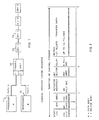
- processor 14 can turn around a new operation to say device 18 at point 1 on the timing sequence chart. This will be done before the controller 10 has had enough time to signal processor 12 that the devices other than device 16 are now available. This is an example of control unit lockout.
- processor 14 has additional input/output requests for device 16, then these operations can and will be initiated at point 3 on the timing sequence chart before processor 12 can be notified. In this scenario, processor 12 will have access to all devices except device 16 and will queue these operations up until the device is available or until some other action is initiated.
- processor 14 can completely lock out processor 12 if it has input/output operations for all the devices under the controller 10 or at least all those that processor 12 might be interested in.
- Processor 14 can lockout device 16 to processor 12 if it has sufficient input/output requests for device 16 while processor 12 also requires device 16.
- the device path management algorithm according to the present invention is designed to prevent these lockout phenomena.
- FIG. 3 shows a typical multi-processor system with shared resources. While this diagram is quite simplified, it serves to illustrate the type of system in which the subject invention is intended to be implemented. More specifically, there are shown three processors designated as processors 0, 1 and 2 and three controllers designated as controllers A, B and C. The processors have three input/output channels A, B and C corresponding to the controllers of the same designations. Similarly, the controllers have three input/output channels 1, 2 and 3 corresponding to the processors 0, 1 and 2 respectively. Each controller has a series of devices, designated as devices 0, 1, 2 and 3, connected in a string to the controller.
- processors may access any device in the system shown through that device's controller.
- processor 2 may access device 2 connected to controller B
- processor 0 may access device 3 connected to controller C.
- the controllers are of the IBM 3880 type; i.e., they have multiple paths allowing access to more than one device in the string of devices connected to the controller.
- processor 2 is accessing device 2 connected to controller B
- processor 1 may access device 1 connected to controller B.
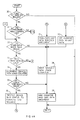
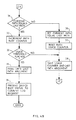
- Figures 4A and 4B are a flow diagram of the method according to the invention.
- the device management algorithm which is implemented in this method forces two or more channels to share a device when concurrent requests are pending. This is done by limiting the number of successive uninterrupted input/output requests that will be allowed when device contention exists.
- the method begins by testing in decision block 20 whether a new input/output request has been received for the device. If so, a test is made in decision block 21 to determine if another path needs the control unit. Assuming for the moment that another path does not need the control unit, a test is next made in decision block 22 to determine if another path needs this device.
- a test is made in decision block 23 to determine if the new input/output request is from the same path that previously accessed the device. If it is, then in function block 24, the device usage counter is incremented. This counter is simply a register which may be incremented each time the same processor accesses the device while there is contention for the device. The register stores a count which is equal to the number of accesses.
- a test is next made in decision block 25 to determine if the count in the device usage counter has exceeded a threshold value. If it has, then a device busy status is presented to the processor making the current input/output request thereby freeing the device for access by another contending processor. This is indicated in function block 26. The process then goes to function block 27 where the last channel serviced argument is invalidated. The device usage counter is then reset in function block 28, the device usage counter and last channel argument are saved in function block 29 before exiting.
- the process goes to decision block 31 in Figure 4B where the a test is made to determine if the current path is equal to the last path.
- the path busy counter is incremented in function block 32. This counter is similar to the device/path usage counter in function block 24 and stores a count equal to the number of input/output path accesses to the control unit. The count stored in the counter is then tested in decision block 33 to determine if a threshold value has been reached. If it has, the last path argument is invalidated in function block 34, and the device busy status is presented to the current input/output request in function block 35. At this point the process exits.
- the code for the process shown in the flow diagram is written in Program Design Language (PDL) from which source code may be readily written.
- PDL Program Design Language
- the choice of source code language will depend on the compiler installed on the system on which it is desired to run the application and on the programmer's personal preference.
- PDL is described in an article by P. Van Leer entitled “Top-down development using a program design language", IBM Systems Journal , no. 2, 1976, pp. 155 to 170.
- the second test that is made is to test for device contention. It will be recalled that the IBM 3880 DASD control unit has multiple paths. Thus, even if one of those paths is available, there still may be a contention for a specific device in the string of DASDs connected to that control unit.
- the first test is to determine if any other paths require the device currently in use as indicated by decision block 22 in Figure 4A. If so, “count the number of consecutive I/O operations which have been dedicated to the current path", and a test is made to determine if the threshold value has been exceeded, as indicated by blocks 24 and 25 in Figure 3A. If the threshold value is exceeded, then “reset counter” and “signal the current path that the device is busy", as indicated by blocks 26, 27 and 28 in Figure 4A. Finally, "save counter” and “save path argument” is performed before exiting.
Landscapes
- Engineering & Computer Science (AREA)
- Theoretical Computer Science (AREA)
- Physics & Mathematics (AREA)
- General Engineering & Computer Science (AREA)
- General Physics & Mathematics (AREA)
- Multi Processors (AREA)
Claims (9)
- Méthode pour commander l'accès des processeurs à des unités de contrôle d'entrée/sortie et à des dispositifs connectés aux unités de contrôle pour chaque demande d'entrée/sortie de canal dans un système multiprocesseur à dispositifs partagés, dans laquelle chaque processeur peut se voir accorder accès à chaque dispositif, comprenant, pour chaque nouvelle demande d'entrée/sortie par un processeur, les étapes de:
tester pour conflit d'une unité de contrôle requise par un processeur, et s'il y a conflit pour l'unité de contrôle, déterminer si un nombre prédéterminé d'accès a été fait par un processeur en cours ayant accès à l'unité de contrôle;
si un nombre prédéterminé d'accès a été fait par un processeur en cours ayant accès à l'unité de contrôle pour laquelle un autre processeur est en conflit, signaler (35) le processeur en cours par un état occupé afin de permettre l'accès à l'unité de contrôle par un autre processeur;
s'il n'y a pas conflit pour une unité de contrôle, tester pour conflit d'un dispositif connecté à l'unité de contrôle et, s'il y a conflit, déterminer si un nombre prédéterminé d'opérations d'entrée/sortie consécutives a été fait par un processeur en cours ayant accès au dispositif; et
et si un nombre prédéterminé d'opérations d'entrée/sortie consécutives a été fait par le processeur en cours sur le dispositif pour lequel un autre processeur est en conflit, signaler (26) le processeur en cours par un état occupé afin de permettre l'accès au dispositif par un autre processeur. - Méthode selon la revendication 1, dans laquelle l'étape de tester pour conflit d'un dispositif, comprend les étapes de:
déterminer (22) pour chaque demande d'entrée/sortie de canal s'il y a d'autres canaux qui demandent accès au même dispositif;
déterminer (23) si une demande de canal en cours provient d'un même canal comme dernière demande;
compter (24) les accès consécutifs à un dispositif d'entrée/sortie par un canal en cours; et
tester (25) ledit compte par rapport à une valeur de seuil prédéterminée. - Méthode selon la revendication 1, dans laquelle chaque unité de contrôle comprend une pluralité de trajets pour permettre l'accès à une pluralité de dispositifs connectés à l'unité de contrôle, et l'étape de tester pour conflit d'une unité de contrôle comprend les étapes de:
déterminer (21) pour chaque demande d'entrée/sortie de canal s'il y a d'autres canaux qui demandent accès au même trajet d'une unité de contrôle;
déterminer (31) si une demande de canal en cours provient d'un même canal comme dernière demande;
compter (32) le nombre d'accès de trajet par le processeur en cours ayant accès au trajet; et
tester (33) ledit compte par rapport à une valeur de seuil prédéterminée. - Méthode selon la revendication 1, dans laquelle chaque unité de contrôle comprend une pluralité de trajets pour permettre l'accès à une pluralité de dispositifs connectés à l'unité de contrôle, et l'étape de tester pour conflit d'une unité de contrôle comprend les étapes de:
déterminer (21) pour chaque demande d'entrée/sortie de canal s'il y a d'autres canaux qui demandent accès au même trajet d'une unité de contrôle;
déterminer (31) si une demande de canal en cours pour un trajet d'unité de contrôle provient d'un même canal comme dernière demande;
compter (32) le nombre d'accès de trajet par le processeur en cours ayant accès au trajet; et
tester (33) le compte du nombre d'accès de trajet par rapport à une valeur de seuil prédéterminée; et
dans laquelle l'étape de tester pour conflit d'un dispositif comprend les étapes de:
déterminer (22) pour chaque demande d'entrée/sortie de canal s'il y a d'autres canaux qui demandent accès au même dispositif;
déterminer (23) si une demande de canal en cours pour un dispositif provient d'un même canal comme dernière demande;
compter (24) les accès consécutifs à un dispositif d'entrée/sortie par un canal en cours; et
tester (25) le compte du nombre d'accès consécutifs par rapport à une valeur de seuil prédéterminée. - Méthode selon la revendication 4, laquelle, si la demande de canal en cours pour un trajet dans l'unité de contrôle n'est pas égale au dernier trajet, comprend en outre les étapes de:
instaurer (36) le trajet en cours égal au dernier trajet;
restaurer (37) le compte d'usages de trajet; et
conserver (38) le compte d'usages de trajet et l'argument de dernier trajet. - Méthode selon la revendication 4, laquelle, si le nombre d'accès au trajet par le processeur en cours n'a pas dépassé ladite valeur prédéterminée, comprend en outre l'étape de conserver (39) le compte d'usages de trajet et l'argument de dernier trajet.
- Méthode selon la revendication 4, comprenant en outre, après l'étape de signaler (26) le processeur en cours par un état occupé afin de permettre l'accès au dispositif par un autre processeur, les étapes de:
restaurer (27) l'argument de dernier trajet servi;
restaurer (28) le compte d'usages de dispositif et de trajet; et
conserver (29) ledit compte et l'argument de dernier trajet. - Méthode selon la revendication 4, laquelle, si un dispositif est demandé par une demande d'entrée/sortie de canal sur un trajet différent de celui d'une dernière demande de dispositif, comprend en outre les étapes de:
instaurer (30) le trajet en cours comme étant le dernier trajet;
restaurer (28) le compte d'usages de dispositif et de trajet; et
conserver (29) ledit compte et l'argument de dernier trajet. - Méthode selon la revendication 4, laquelle, si pour une demande d'entrée/sortie de canal pour un dispositif, le nombre d'accès consécutifs au dispositif par un canal en cours n'a pas dépassé ladite valeur de seuil, comprend alors en outre l'étape de conserver (29) le compte dudit nombre et l'argument de dernier trajet.
Applications Claiming Priority (2)
| Application Number | Priority Date | Filing Date | Title |
|---|---|---|---|
| US06/929,284 US4812968A (en) | 1986-11-12 | 1986-11-12 | Method for controlling processor access to input/output devices |
| US929284 | 1986-11-12 |
Publications (3)
| Publication Number | Publication Date |
|---|---|
| EP0267464A2 EP0267464A2 (fr) | 1988-05-18 |
| EP0267464A3 EP0267464A3 (en) | 1990-01-31 |
| EP0267464B1 true EP0267464B1 (fr) | 1993-03-24 |
Family
ID=25457604
Family Applications (1)
| Application Number | Title | Priority Date | Filing Date |
|---|---|---|---|
| EP87115342A Expired - Lifetime EP0267464B1 (fr) | 1986-11-12 | 1987-10-20 | Méthode pour commander l'accès des processeurs à des dispositifs d'entrée/sortie |
Country Status (4)
| Country | Link |
|---|---|
| US (1) | US4812968A (fr) |
| EP (1) | EP0267464B1 (fr) |
| JP (1) | JPH0619750B2 (fr) |
| DE (1) | DE3784998T2 (fr) |
Families Citing this family (21)
| Publication number | Priority date | Publication date | Assignee | Title |
|---|---|---|---|---|
| JP2587434B2 (ja) * | 1987-11-13 | 1997-03-05 | 株式会社日立製作所 | データの入出力処理方法 |
| US5274809A (en) * | 1988-05-26 | 1993-12-28 | Hitachi, Ltd. | Task execution control method for a multiprocessor system with enhanced post/wait procedure |
| US5253345A (en) * | 1988-07-07 | 1993-10-12 | Sears, Roebuck & Co. | Point of sale register system |
| DE68927540T2 (de) * | 1988-08-25 | 1997-04-24 | Canon Kk | Datenverarbeitungsgerät |
| US5481707A (en) * | 1991-05-19 | 1996-01-02 | Unisys Corporation | Dedicated processor for task I/O and memory management |
| US5428796A (en) * | 1992-08-26 | 1995-06-27 | International Business Machines Corporation | System and method for regulating access to direct access storage devices in data processing systems |
| JPH06314232A (ja) * | 1993-05-06 | 1994-11-08 | Mitsubishi Electric Corp | メモリ切替制御回路 |
| EP0986007A3 (fr) * | 1993-12-01 | 2001-11-07 | Marathon Technologies Corporation | Procédé pour isoler de demandes d'entrées/sorties |
| DE4344471A1 (de) * | 1993-12-21 | 1995-08-17 | Francotyp Postalia Gmbh | Verfahren und Anordnung zur Erzeugung und Überprüfung eines Sicherheitsabdruckes |
| CA2137167C (fr) * | 1993-12-22 | 1999-09-21 | Tony J. Brice | Methode et architecture de gestion de donnees |
| US5671441A (en) * | 1994-11-29 | 1997-09-23 | International Business Machines Corporation | Method and apparatus for automatic generation of I/O configuration descriptions |
| DE19503546A1 (de) * | 1995-02-03 | 1996-08-08 | Basf Ag | Wasserlösliche oder wasserdispergierbare Pfropfpolymerisate, Verfahren zu ihrer Herstellung und ihre Verwendung |
| US5768620A (en) * | 1996-04-09 | 1998-06-16 | International Business Machines Corporation | Variable timeout method in a missing-interrupt-handler for I/O requests issued by the same operating system |
| US5790397A (en) | 1996-09-17 | 1998-08-04 | Marathon Technologies Corporation | Fault resilient/fault tolerant computing |
| US5896523A (en) * | 1997-06-04 | 1999-04-20 | Marathon Technologies Corporation | Loosely-coupled, synchronized execution |
| US7031989B2 (en) * | 2001-02-26 | 2006-04-18 | International Business Machines Corporation | Dynamic seamless reconfiguration of executing parallel software |
| FR2829253A1 (fr) * | 2001-08-31 | 2003-03-07 | Koninkl Philips Electronics Nv | Controle d'acces dynamique d'une fonction a ressource collective |
| US20060020720A1 (en) * | 2004-07-23 | 2006-01-26 | Lsi Logic Corporation | Multi-controller IO shipping |
| DE602007002828D1 (de) * | 2006-08-28 | 2009-11-26 | Ibm | Verfahren zur verbesserung des transfers von ereignisprotokollierungen zur replikation gerade ausgeführter programme |
| CN101446909B (zh) * | 2007-11-30 | 2011-12-28 | 国际商业机器公司 | 用于管理任务事件的方法和系统 |
| US10481828B2 (en) * | 2017-10-10 | 2019-11-19 | Seagate Technology, Llc | Slow drive detection |
Family Cites Families (13)
| Publication number | Priority date | Publication date | Assignee | Title |
|---|---|---|---|---|
| US3593302A (en) * | 1967-03-31 | 1971-07-13 | Nippon Electric Co | Periphery-control-units switching device |
| IT998437B (it) * | 1973-08-22 | 1976-01-20 | Honeywell Inf Systems | Sistema di accesso a scansione ciclica variabile delle richieste di interruzione |
| US4130864A (en) * | 1976-10-29 | 1978-12-19 | Westinghouse Electric Corp. | Priority selection circuit for multiported central functional unit with automatic priority reduction on excessive port request |
| US4191997A (en) * | 1978-04-10 | 1980-03-04 | International Business Machines Corporation | Circuits and methods for multiple control in data processing systems |
| US4232294A (en) * | 1979-04-30 | 1980-11-04 | Control Data Corporation | Method and apparatus for rotating priorities between stations sharing a communication channel |
| FR2470412B1 (fr) * | 1979-11-19 | 1986-10-03 | Bull Sa | Procede et dispositif de comptabilisation et de gestion des evenements asynchrones emis par des appareils peripheriques dans un systeme de traitement de donnees |
| US4385382A (en) * | 1980-09-29 | 1983-05-24 | Honeywell Information Systems Inc. | Communication multiplexer having a variable priority scheme using a read only memory |
| US4396984A (en) * | 1981-03-06 | 1983-08-02 | International Business Machines Corporation | Peripheral systems employing multipathing, path and access grouping |
| US4470112A (en) * | 1982-01-07 | 1984-09-04 | Bell Telephone Laboratories, Incorporated | Circuitry for allocating access to a demand-shared bus |
| JPS595331A (ja) * | 1982-06-30 | 1984-01-12 | Fujitsu Ltd | 磁気デイスク・サブシステムにおける待ち合せ方式 |
| JPS593530A (ja) * | 1982-06-30 | 1984-01-10 | Fujitsu Ltd | I/o制御装置 |
| US4675812A (en) * | 1983-02-14 | 1987-06-23 | International Business Machines Corp. | Priority circuit for channel subsystem having components with diverse and changing requirement for system resources |
| US4603382A (en) * | 1984-02-27 | 1986-07-29 | International Business Machines Corporation | Dynamic buffer reallocation |
-
1986
- 1986-11-12 US US06/929,284 patent/US4812968A/en not_active Expired - Fee Related
-
1987
- 1987-10-02 JP JP62248207A patent/JPH0619750B2/ja not_active Expired - Lifetime
- 1987-10-20 EP EP87115342A patent/EP0267464B1/fr not_active Expired - Lifetime
- 1987-10-20 DE DE87115342T patent/DE3784998T2/de not_active Expired - Fee Related
Also Published As
| Publication number | Publication date |
|---|---|
| DE3784998D1 (de) | 1993-04-29 |
| US4812968A (en) | 1989-03-14 |
| DE3784998T2 (de) | 1993-09-30 |
| EP0267464A3 (en) | 1990-01-31 |
| EP0267464A2 (fr) | 1988-05-18 |
| JPS63128457A (ja) | 1988-06-01 |
| JPH0619750B2 (ja) | 1994-03-16 |
Similar Documents
| Publication | Publication Date | Title |
|---|---|---|
| US4812968A (en) | Method for controlling processor access to input/output devices | |
| US6141715A (en) | Method and system for avoiding live lock conditions on a computer bus by insuring that the first retired bus master is the first to resubmit its retried transaction | |
| US7945914B2 (en) | Methods and systems for performing operations in response to detecting a computer idle condition | |
| US6496890B1 (en) | Bus hang prevention and recovery for data communication systems employing a shared bus interface with multiple bus masters | |
| US6718448B1 (en) | Queued locking of a shared resource using multimodal lock types | |
| US6691194B1 (en) | Selective association of lock override procedures with queued multimodal lock | |
| US4972368A (en) | Intelligent serial I/O subsystem | |
| US6757769B1 (en) | Cooperative lock override procedure | |
| EP0382469B1 (fr) | Arbitrage d'accès de bus dans des ordinateurs numériques | |
| EP0676699B1 (fr) | Méthode de gestion de ressources partagées par plusieurs unités de traitement | |
| US5621897A (en) | Method and apparatus for arbitrating for a bus to enable split transaction bus protocols | |
| US5257356A (en) | Method of reducing wasted bus bandwidth due to slow responding slaves in a multiprocessor computer system | |
| US5682551A (en) | System for checking the acceptance of I/O request to an interface using software visible instruction which provides a status signal and performs operations in response thereto | |
| US4191997A (en) | Circuits and methods for multiple control in data processing systems | |
| GB1335031A (en) | Data processors | |
| EP0675444B1 (fr) | Schéma d'arbitrage multiple | |
| US5507032A (en) | Multiprocessor I/O request control system forming device drive queue and processor interrupt queue from rows and cells of I/O request table and interrupt request table | |
| US5754887A (en) | System for limiting access of plurality of requests to peripheral bus by halting transmission to particular peripheral devices and resuming transmission after second predetermined time period expiration | |
| EP0013740B1 (fr) | Appareil de traitement de données avec dispositif de remise à zéro du système | |
| CN120950278A (zh) | 一种访问方法、装置、设备及计算机可读存储介质 | |
| US6609178B1 (en) | Selective validation for queued multimodal locking services | |
| US5745757A (en) | Multiprocessor system with microprogrammed means for dispatching processes to processors | |
| EP1029284B1 (fr) | Controleur d'acces en memoire partagee | |
| US5613076A (en) | System and method for providing uniform access to a SCSI bus by altering the arbitration phase associated with the SCSI bus | |
| EP0049521A2 (fr) | Système de traitement d'information |
Legal Events
| Date | Code | Title | Description |
|---|---|---|---|
| PUAI | Public reference made under article 153(3) epc to a published international application that has entered the european phase |
Free format text: ORIGINAL CODE: 0009012 |
|
| AK | Designated contracting states |
Kind code of ref document: A2 Designated state(s): DE FR GB IT |
|
| 17P | Request for examination filed |
Effective date: 19880910 |
|
| PUAL | Search report despatched |
Free format text: ORIGINAL CODE: 0009013 |
|
| AK | Designated contracting states |
Kind code of ref document: A3 Designated state(s): DE FR GB IT |
|
| 17Q | First examination report despatched |
Effective date: 19911223 |
|
| GRAA | (expected) grant |
Free format text: ORIGINAL CODE: 0009210 |
|
| AK | Designated contracting states |
Kind code of ref document: B1 Designated state(s): DE FR GB IT |
|
| PG25 | Lapsed in a contracting state [announced via postgrant information from national office to epo] |
Ref country code: IT Free format text: LAPSE BECAUSE OF FAILURE TO SUBMIT A TRANSLATION OF THE DESCRIPTION OR TO PAY THE FEE WITHIN THE PRESCRIBED TIME-LIMIT;WARNING: LAPSES OF ITALIAN PATENTS WITH EFFECTIVE DATE BEFORE 2007 MAY HAVE OCCURRED AT ANY TIME BEFORE 2007. THE CORRECT EFFECTIVE DATE MAY BE DIFFERENT FROM THE ONE RECORDED. Effective date: 19930324 |
|
| REF | Corresponds to: |
Ref document number: 3784998 Country of ref document: DE Date of ref document: 19930429 |
|
| ET | Fr: translation filed | ||
| PLBE | No opposition filed within time limit |
Free format text: ORIGINAL CODE: 0009261 |
|
| STAA | Information on the status of an ep patent application or granted ep patent |
Free format text: STATUS: NO OPPOSITION FILED WITHIN TIME LIMIT |
|
| 26N | No opposition filed | ||
| PGFP | Annual fee paid to national office [announced via postgrant information from national office to epo] |
Ref country code: GB Payment date: 19950926 Year of fee payment: 9 |
|
| PGFP | Annual fee paid to national office [announced via postgrant information from national office to epo] |
Ref country code: FR Payment date: 19951009 Year of fee payment: 9 |
|
| PGFP | Annual fee paid to national office [announced via postgrant information from national office to epo] |
Ref country code: DE Payment date: 19951030 Year of fee payment: 9 |
|
| PG25 | Lapsed in a contracting state [announced via postgrant information from national office to epo] |
Ref country code: GB Effective date: 19961020 |
|
| GBPC | Gb: european patent ceased through non-payment of renewal fee |
Effective date: 19961020 |
|
| PG25 | Lapsed in a contracting state [announced via postgrant information from national office to epo] |
Ref country code: FR Effective date: 19970630 |
|
| PG25 | Lapsed in a contracting state [announced via postgrant information from national office to epo] |
Ref country code: DE Effective date: 19970701 |
|
| REG | Reference to a national code |
Ref country code: FR Ref legal event code: ST |