EP0268108A1 - Handbedienbares Instrument zum Implantieren, Verteilen und Aufblasen einer aufblasbaren Membran - Google Patents
Handbedienbares Instrument zum Implantieren, Verteilen und Aufblasen einer aufblasbaren MembranInfo
- Publication number
- EP0268108A1 EP0268108A1 EP87115608A EP87115608A EP0268108A1 EP 0268108 A1 EP0268108 A1 EP 0268108A1 EP 87115608 A EP87115608 A EP 87115608A EP 87115608 A EP87115608 A EP 87115608A EP 0268108 A1 EP0268108 A1 EP 0268108A1
- Authority
- EP
- European Patent Office
- Prior art keywords
- membrane
- instrument
- patient
- trocar
- infusion tube
- Prior art date
- Legal status (The legal status is an assumption and is not a legal conclusion. Google has not performed a legal analysis and makes no representation as to the accuracy of the status listed.)
- Ceased
Links
Images


Classifications
-
- A—HUMAN NECESSITIES
- A61—MEDICAL OR VETERINARY SCIENCE; HYGIENE
- A61B—DIAGNOSIS; SURGERY; IDENTIFICATION
- A61B17/00—Surgical instruments, devices or methods
- A61B17/34—Trocars; Puncturing needles
- A61B17/3468—Trocars; Puncturing needles for implanting or removing devices, e.g. prostheses, implants, seeds, wires
-
- A—HUMAN NECESSITIES
- A61—MEDICAL OR VETERINARY SCIENCE; HYGIENE
- A61F—FILTERS IMPLANTABLE INTO BLOOD VESSELS; PROSTHESES; DEVICES PROVIDING PATENCY TO, OR PREVENTING COLLAPSING OF, TUBULAR STRUCTURES OF THE BODY, e.g. STENTS; ORTHOPAEDIC, NURSING OR CONTRACEPTIVE DEVICES; FOMENTATION; TREATMENT OR PROTECTION OF EYES OR EARS; BANDAGES, DRESSINGS OR ABSORBENT PADS; FIRST-AID KITS
- A61F2/00—Filters implantable into blood vessels; Prostheses, i.e. artificial substitutes or replacements for parts of the body; Appliances for connecting them with the body; Devices providing patency to, or preventing collapsing of, tubular structures of the body, e.g. stents
- A61F2/0004—Closure means for urethra or rectum, i.e. anti-incontinence devices or support slings against pelvic prolapse
- A61F2/0031—Closure means for urethra or rectum, i.e. anti-incontinence devices or support slings against pelvic prolapse for constricting the lumen; Support slings for the urethra
- A61F2/0036—Closure means for urethra or rectum, i.e. anti-incontinence devices or support slings against pelvic prolapse for constricting the lumen; Support slings for the urethra implantable
- A61F2/004—Closure means for urethra or rectum, i.e. anti-incontinence devices or support slings against pelvic prolapse for constricting the lumen; Support slings for the urethra implantable inflatable
-
- Y—GENERAL TAGGING OF NEW TECHNOLOGICAL DEVELOPMENTS; GENERAL TAGGING OF CROSS-SECTIONAL TECHNOLOGIES SPANNING OVER SEVERAL SECTIONS OF THE IPC; TECHNICAL SUBJECTS COVERED BY FORMER USPC CROSS-REFERENCE ART COLLECTIONS [XRACs] AND DIGESTS
- Y10—TECHNICAL SUBJECTS COVERED BY FORMER USPC
- Y10S—TECHNICAL SUBJECTS COVERED BY FORMER USPC CROSS-REFERENCE ART COLLECTIONS [XRACs] AND DIGESTS
- Y10S128/00—Surgery
- Y10S128/25—Artificial sphincters and devices for controlling urinary incontinence
Definitions
- This invention relates to a compact, hand-held instrument which enables a physician to perform a relatively quick and simple procedure to accurately and controllably implant, dispense and inflate an inflatable membrane (e.g. a genitourinary prosthesis) at a predetermined target area within the urethral tissues of a patient to enable a patient to overcome urinary incontinence by means of increasing both localized tissue volume and passive occlusive pressure proximal to the periurethral tissues of the proximal corpus spongiousum.
- an inflatable membrane e.g. a genitourinary prosthesis
- an artificial prosthetic sphincter has often been implanted so that occlusive pressure may be applied to the urethra to restore continence.
- Artificial sphincters are well-known and specific examples thereof will not be listed.
- the implantation of an artificial sphincter commonly requires a surgical procedure which necessitates the hospitalization of the patient. Such a procedure is relatively complex and expensive, and usually requires six to eight weeks or more of recovery time.
- both the patient and his physician face approximately two months of delay before being able to activate the prosthesis to ascertain whether the surgery has been successful and the patient is continent. More particularly, because of the swollen and aggravated condition of edema of the urethral tissues during and for a period subsequent to surgery, the physician cannot precisely match the occlusive pressure available from the prosthetic sphincter to the patient's urethra. Therefore, at the time of implant, the physician must estimate the required minimal occlusive pressure needed to achieve urethral coaptation in that particular patient.
- sphincteric mechanisms are often improperly fitted or selected with inaccurate pressure ranges, so that the occlusive pressures generated by such mechanisms are either insufficient to successfully achieve continence or excessive to the point of causing ischemia and subsequent necrosis and erosion of urethral tissue. Excessive occlusive forces may undesirably minimize arteriovascular blood flow to the urethra and thereby cause ischemia and subsequent erosion of the delicate tissues. What is more, if the implant surgery should prove to be unsuccessful (i.e. the maximum occlusive pressure to be generated by the sphincter is insufficient to hold the patient incontinent or the sphincter malfunctions mechanically), then additional surgery becomes necessary to provide sphincteric adjustment, repair or explant.
- a compact, hand-held instrument to enable a physician to reliably and controllably implant, dispense and inflate an inflatable membrane at a predetermined target area within the tissue of the patient.
- the disclosed instrument may be used as part of a relatively simple, non-surgical procedure by which to accurately and safely implant an inflatable genitourinary prosthesis in the periurethral tissues of the corpus spongiousum, so that a patient ma y overcome urinary continence.
- the instrument includes an associated vernier hypodermic syringe, or the like, for supplying fluid to inflate the membrane.
- the instrument also includes an assembly of telescoping trocar elements which may be placed in a retracted condition for dilating a tunnel through the urethral tissue of the patient or in an expanded condition for placing, dispensing and inflating the membrane.
- the trocar assembly comprises a pair of articulating tunneling members which enclose and protect the membrane.
- the tunneling members may be closed around the membrane in the expanded trocar condition to form a sharp cutting nose to penetrate the urethral tissue of the patient, or, the tunneling members may be angularly separated so that the membrane is exposed to the urethral tissue for implantation and inflation therewithin.
- the membrane is affixed to a hollow, non-coring needle, which needle is attached to one end of a fluid infusion tube.
- the other end of the fluid infusion tube communicates with the vernier hyopdermic syringe, so that a measured volume of fluid can be percutaneously infused from the syringe to the membrane by way of the fluid infusion tube and the needle.
- the needle and infusion tube are retracted through a coaxially arranged trocar tube, whereby the trocar tube forms a shoulder for reliably detaching an inflated membrane from the needle.
- the trocar assembly is withdrawn from the patient with the inflated membrane remaining at the targeted tissue site.
- An inflated membrane proportionately increases local tissue volume in the area of the periurethral tissues of the corpus spongiousum to correspondingly increase the occlusive pressure applied to the urethral tissues for restoring a patient to continence.
- One or more of the membranes may be implanted and inflated, depending upon etiology, degree of residual sphincteric function, vascularity and physical properties of the patient's urethral tissues.
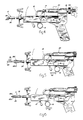
- FIG. 1 there is shown the hand-held instrument 1 which includes a control housing 2 for supporting an assembly 4 of telescoping trocar elements at one end thereof and a suitable grip or handle 6 at the opposite end.
- a hemostat 70 is attached to and slideable along the trocar assembly 4 for attachment to the patient's skin or to a surgical drape to increase axial instrument stability.
- Extending downwardly from control housing 2 is a trigger 8.
- a support bracket 12 extends upwardly from one end of control housing 2.
- An infuser terminal 14 is connected to an inlet of a fluid transfer tube 16.
- Extending upwardly from the opposite end of control housing 2 is a hypodermic syringe receptacle 18 .
- Infuser terminal 14 and syringe receptacle 18 are aligned with one another to receive and support a vernier hypodermic syringe (shown in phantom and designated 20), such that fluid may be percutaneously infused from syringe 20 by way of transfer tube 16 to inflate the inflatable membrane according to a procedure that will be described in greater detail when referring hereinafter to FIGs. 4-13.
- a longitudinally extending tracking slot 22 is formed in control housing 2.
- a retractor knob 24 and an actuator knob 26 are received within and slideable along tracking slot 22.
- Each of the retractor knob 24 and actuator knob 26 has a respective release button 29 which must be depressed to permit the retractor and actuator knobs 24 and 26 to slide along the slot 22.
- Suitable positioning indicia is marked on control housing 2 along the length of tracking slot 22 to denote certain locations to which the retractor knob 24 and actuator knob 26 are to be moved to accurately and controllably implant, dispense, and inflate a membrane within the bodily tissues of a patient.
- FIGs. 2a and 2b of the drawings the assembly 4 of telescoping trocar elements is described.
- a pair of normally opened, articulating clam shell-shaped tunneling members 28-1 and 28-2 are withdrawn into the trocar assembly 4 and retained in a closed configuration around an inflatable membrane 50 to protect the membrane and provide a sharp, blunt dilating nose by which to dilate a tunnel through the patient's tissue for implanting the membrane 50.
- the clam shellshaped tunneling members 28-1 and 28-2 are released from the trocar assembly 4 so as to be automatically opened for the purpose of permitting the membrane 50 to be positioned, dispensed, and inflated at a targeted area within the patient's tissues.
- the trocar assembly 4 comprises an outer trocar sleeve 30 which functions as a nest for receiving therewithin and closing the tunneling members 28-1 and 28-2 when the assembly is retained in the retracted trocar condition of FIG. 2b.
- An inner trocar tube 32 is coaxially arranged with outer trocar sleeve 30.
- Concentrically arranged with and slideable through inner trocar tube 30 is a fluid infusion tube 34.
- Fluid infusion tube 34 supports a non-coring, hollow needle 36 at one end thereof and provides a fluid channel which is connected at the opposite end with the fluid transfer tube 16 (of FIG. 1) for delivering fluid to the membrane 50 via needle 36.
- the membrane 50 is attached to needle 36 to receive fluid supplied by the hypodermic syringe and delivered via the needle and the fluid infusion tube 34.
- fluid infusion tube 34 has a hyperbolically-radiused base section to efficiently distribute stresses and increase resistance to breakage at the point at which non-coring needle 36 is attached. In this manner, the needle 36 will be less likely to break as a consequence of mechanical forces encountered during the placing and dispensing of membrane 50.
- the coaxial arrangement of fluid infusion tube 34 and inner trocar tube 32 creates a shoulder against which membrane 50 is reliably and safely removed from the needle 36 when fluid infusion tube 34 is retracted through inner trocar tube 32 after the membrane 50 has been suitably implanted and inflated within the tissues of the patient.
- FIG. 3 of the drawings illustrates the interconnection between the fluid supply system and the assembly 4 of telescoping trocar elements of the hand-held instrument 1, so that fluid may be supplied from hypodermic syringe 20 to membrane 50 (of FIG. 2a) by wa y of fluid transfer tube 16 and fluid infusion tube 34. More particularly, a proximal end of fluid transfer tube 16 is connected to syringe 20 at infuser terminal 14. A distal end of fluid transfer tube 16 is affixed to a proximal end of fluid infusion tube 34. Also connected to the proximal end of fluid infusion tube 34 is a moveable infusion tube collar 40.
- Infusion tube collar 40 is connected to and positioned by actuator knob 26, such that a movement of actuator knob 26 through the tracking slot 22 (of FIG. 1) causes a corresponding axial movement of both infusion tube collar 40 and infusion tube 34.
- Fluid infusion tube 34 extends from the connection with fluid transfer tube 16, through the interior of control housing 2, to the non-coring needle 36 (of FIG. 2a). Therefore, the physician may controllably move the fluid infusion tube 34 and the needle 36 between the retracted trocar condition of FIG. 2b and the expanded trocar condition of FIG. 2a whenever the actuator knob 26 is moved back and forth along the tracking slot 22.
- Inner trocar tube 52 Surrounding fluid infusion tube 34 is the inner trocar tube 52.
- inner trocar tube 52 Connected to a first end of inner trocar tube 32 is a moveable inner trocar collar 42.
- Inner trocar tube collar 42 is connected to and positioned by retractor knob 24, such that a movement, by the physician, of retractor knob 24 through the tracking slot 22 (of FIG. 1) causes a corresponding axial movement of inner trocar tube 32 between the retracted trocar position of FIG. 2b and the expanded trocar position of FIG. 2a.
- retractor knob 24 Connected to a first end of inner trocar tube 32 is a moveable inner trocar collar 42.
- Inner trocar tube collar 42 is connected to and positioned by retractor knob 24, such that a movement, by the physician, of retractor knob 24 through the tracking slot 22 (of FIG. 1) causes a corresponding axial movement of inner trocar tube 32 between the retracted trocar position of FIG. 2b and the expanded trocar position of FIG. 2a.
- retractor knob 24 causes inner trocar tube 32 to be withdrawn from the expanded trocar condition and moved into the retracted trocar condition. Therefore, the physician may safely detach an inflated membrane from needle 36 by moving actuator knob 26 and thereby causing fluid infusion tube 34 and the needle 36 which is attached thereto to slide through inner trocar tube 32 towards the retracted trocar condition (of FIG. 2b).
- the second end of inner trocar tube 32 forms a shoulder for engaging and detaching the membrane from the needle 36 as the fluid infusion tube 34 is retracted through the trocar tube 32.
- outer trocar sleeve 30 Surrounding inner trocar tube 32 is the outer trocar sleeve 30. Connected to one end of outer trocar sleeve 30 is a moveable outer trocar collar 44. Outer trocar collar 44 has a hollow configuration for receiving and supporting the coaxial arrangement of inner trocar tube 32 and fluid infusion tube 34. Outer trocar collar 44 is connected to and positioned by a tracking plate 48. Tracking plate 48 is received within and slideable along a hollow track 52 which extends axially through control housing 2. Tracking plate 48 is connected by a rod 53 and a bearing 55 to an integral arm 54 of trigger 8.
- trigger 8 in either of the directions of reference arrow 56 causes the tracking plate 48 to slide along track 52 and outer trocar collar 44 to move outer trocar sleeve 30 into either the retracted trocar condition of FIG. 2b (for receiving and closing tunneling members 28-1 and 28-2 to form a tissue penetrating nose) or the expanded trocar condition of FIG. 2a (for releasing and thereby opening tunneling members 28-1 and 28-2 for permitting the inflation of a membrane).
- Opposing detents are formed at the rearward end of tunneling members 28-1 and 28-2 and the forward end of outer trocar sleeve 30.
- pulling the trigge r 8 in a rearward direction causes outer trocar sleeve 30 to be moved rearwardly towards the expanded trocar condition (of FIG. 2a) so that tunneling members 28-1 and 28-2 can be released and opened.
- the detents of sleeve 30 and tunneling members 28-1 and 28-2 will eventually engage one another to withdraw the opened tunneling members away from, and thereby expose, the non-coring needle 36 for attachment to or inflation of the membrane.
- outer trocar sleeve 30 Likewise, pushing the trigger 8 in a forward direction causes outer trocar sleeve 30 to be moved forwardly towards the retracted trocar condition (of FIG. 2b) to thereby return outer trocar sleeve 30 to a position at which to retain and close the tunneling members 28-1 and 28-2.
- Trigger return lever 10 is pivotally connected to tracking plate 48, such that lever 10 will ride along with trigger 8 whenever the trigger is moved in either of the directions indicated by reference arrow 56.
- Trigger 8 travels between forward and rearward indexing notches 64-1 and 64-2 formed in the bottom of control housing 2 to move the outer trocar sleeve 30 between the retracted and expanded trocar conditions.
- trigger 8 must first be rotated out of an indexing notch 64-1 or 64-2 (against the bias of an associated spring) before the trigger can be pulled rearwardly or returned forwardly along control housing 2.
- Trigger return lever 10 may be locked to form a stop when the trigger 8 is located at the rearward indexing notch 64-2 to prevent an inadvertent return of the trigger to the forward indexing notch 64-1 and a premature closing of tunneling members 28-1 and 28-2. That is, trigger return lever 10 must be rotated to an unlocked position (shown in phantom) in order to permit the physician to rotate trigger 8 out of the rearward indexing notch 64-1 for moving trigger 8 forwardly for the purpose of closing tunneling members 28-1 and 28-2.
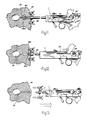
- FIGs. 4-13 of the drawings The operation of the hand-held instrument 1 for implanting, dispensing and inflating the inflatable membrane 50 is described while referring to FIGs. 4-13 of the drawings.
- the retracter knob 24 and actuator knob 26 of instrument 1 are initially moved to forward positions along tracking slot 22 (designated by indicia marked A4 and A3, respectively).
- the telescoping members of trocar assembly 4 are initially in a retracted trocar condition, and tunneling members 28-1 and 28-2 are closed to form the blunt dilating cutting nose.
- the physician using sterile procedures, then fills vernier hypodermic syringe 20 with a suitable biocompatible fluid (e.g. a radio opaque isotonic fluid, isotonic saline solution, or the like).
- a suitable biocompatible fluid e.g. a radio opaque isotonic fluid, isotonic saline solution, or the like.
- a fluid in this invention is not to be regarded as a limitation, and the syringe 20 may alternatively be filled with a suspension of particulate matter, particles, and the like.
- the trigger 8 is pulled rearwardly (in the direction of reference arrow 57 of FIG. 5) to simultaneously retract outer trocar sleeve 30 and tunneling members 28-1 and 28-2 so as to expose the non-coring needle 36 of fluid infusion tube 34.
- the physician rotates a control knob 60 (best shown in FIG. 4) of syringe 20 whereby fluid is infused from the syringe to needle 36 by way of fluid transfer tube 16 and fluid infusion tube 34 to purge any trapped air from the fluidic system of the instrument 1.
- the physician affixes an uninflated membrane 50 to the needle 36 by piercing a core of membrane 50 with needle 36 and pressing the membrane onto the needle until forward movement of the needle is blocked by a concave surface of a sel f-contained metallic needle stop (not shown).
- the membrane 50 is an elastic, elliptoidally-shaped genitourinary prosthesis, such as that disclosed in U.S. Patent Application Serial No. 881,829 filed July 3, 1986.
- the prosthesis is formed from a tear-resistant, biocompatible material, such as, for example, polyurethane, silicone, latex, or the like. Accordingly, the teachings of said patent application regarding the genitourinary prosthesis membrane 50 and the receipt of needle 36 through a core and by a needle stop of membrane 50 are incorporated herein by reference.
- the physician rotates the trigger return lever 10 (in the direction of reference arrow 58) to permit trigger 8 to move forwardly for placing the trocar assembly 4 back in the retracted trocar condition, whereby tunneling members 28-1 and 28-2 are retained within outer trocar sleeve 30 and closed around the installed membrane 50.
- the instrument 1 is now ready to enable the physician to implant the membrane 50 within the bodily tissues of the patient.
- the dilating nose of instrument 1 (as formed by tunneling members 28-1 and 28-2 of trocar assembly 4) is inserted into the patient's tissue.
- Radiographic, fluoroscopic, cystoscopic, tactile or other conventional means may be used to navigate the dilating nose into position at the patient's implant target site.
- the target site is located in the periurethral tissues of the proximal corpus spongiousum of the patient at which the physician may implant and inflate the membrane 50 to thereby enable the patient to overcome urinary incontinence by means of increasing both localized tissue volume at and passive occlusive pressure of the periurethral tissues. Therefore, the physician exerts a force upon the instrument 1 sufficient to transurethrally or perineally insert the dilating nose of trocar assembly 4 to bluntly disect a small tunnel through the patient's urethral tissue 62.
- the physician once again pulls the trigger 8 in a rearward direction (in the direction of reference arrow 59) for placing the trocar assembly 4 of instrument 1 in the expanded trocar condition of FIG. 2a.
- the outer trocar sleeve 30 is withdrawn and the tunneling members 28-1 and 28-2 are released and pulled away from membrane 50 by the sleeve 30. Accordingly, the tunneling members are opened so as to expose the previously attached and uninflated membrane 50 to the patient's urethral tissue 62.
- the physician clamps the sliding hemostat 70 to the patient's skin and/or to a surgical drape (not shown) to stabilize the instrument 1 against axial movements, either proximally or distally, and permit the physician to inflate the membrane 50 at the precise designated target area within the patient's urethral tissue 62.
- the physician inflates the membrane 50 by percutaneously infusing an incrementally regulated amount of fluid (or solid matter) from the vernier hypodermic syringe 20 to the interior of the membrane 20.
- the physician detaches a deflated membrane 50 from the needle (36 in FIG. 10) and withdraws such needle and the fluid infusion tube (34 in FIG. 10) through the inner trocar tube 32.
- the physician slides actuator knob 26 out of its initial forward position (designated by indicia marked A3) to a final rearward position along tracking slot 22 (designated by indicia marked B3).
- the rearward movement of actuator knob 26 along slot 22 withdraws the fluid infusion tube 34 through inner trocar tube 32 and safely detaches the inflated membrane 50 from needle 36 against the shoulder formed by coaxially arranged trocar tube 32.
- the inflated membrane remains precisely at its position of placement within the targeted (i.e. urethral) tissues 62 of the patient.
- the physician withdraws the inner trocar tube 32 by sliding retracter knob 24 out of its initial forward position (designated by indicia marked A4) to a final rearward position along tracking slot 22 (designated by indicia marked B4).
- Inner trocar tube 32 also has detents (not shown) which engage the tunneling members 28-1 and 28-2 to simultaneously retract such members into outer trocar sleeve 30.
- the trocar assembly 4 of instrument 1 is then withdrawn from the urethral tissues 62 in FIG. 13 without disturbing the condition or position of the inflated membrane 50. Inasmuch as only a small wound remains after withdrawal of trocar assembly 4, a single skin suture placed at the center of the wound should be sufficient to close the patient's tissue.
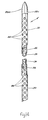
- FIG. 14 of the drawings shows an alternate trocar assembly 4 ⁇ to be used in the instrument 1 of FIG. 1. More particularly, both the outer trocar sleeve 30 and the inner trocar tube 32 are provided with a matrix of perforations or apertures 66 through which a sterilizing liquid or gas may pass for reliably and conveniently sterilizing the telescoping members of the trocar assembly 4 ⁇ .
- sterilizing gases such as ethylene oxide or sterilizing solutions such as Cidex or betadine may be passed through the perforations 66.
- Sterilization of trocar assembly 4 ⁇ may also be accomplished in a conventional autoclave, where the perforations 66 will permit an efficient circulation of sterilizing steam between trocar sleeve 30, trocar tube 32 and infusion tube 34.
- the presently disclosed instrument has been explained with reference to implanting, dispensing and inflating a single membrane 50, it is to be expressly understood that any number of such membranes may be implanted, depending upon the increased tissue volume and resulting occlusive pressure which are required to permit a patient to be restored to continence.
- the physician may cystoscopically monitor the patient's degree of coaptation of the urethral mucosa. In the event that greater occlusive pressure is needed, the physician may implant a corresponding additional number of prostheses until patient continence is restored.
- the instrument 1 has applications other than for implanting an inflatable membrane for use as a genitourinary prosthesis to enable a patient to overcome incontinence.
- the hand-held instrument disclosed herein may also be used to implant a selectively permeable (by a gas or liquid) membrane which may function as a drug delivery system.
- Other applications include an instrument for implanting a variable volume mass to replace surgically removed tissue and/or organ excisions or an injectable antiureteral reflux mass.
- Still further applications of the present invention include an instrument for implanting a testicular prosthesis, an injectable closure blockage for arteries and veins, a prosthetic sphincter, and an injectable intraocular lens,
- the inflatable membrane described in this invention is also applicable for con trollably occluding luminal passages other than the patient's urethra when it is necessary to selectively control the flow of material therethrough.
Landscapes
- Health & Medical Sciences (AREA)
- Life Sciences & Earth Sciences (AREA)
- Animal Behavior & Ethology (AREA)
- General Health & Medical Sciences (AREA)
- Surgery (AREA)
- Engineering & Computer Science (AREA)
- Biomedical Technology (AREA)
- Heart & Thoracic Surgery (AREA)
- Veterinary Medicine (AREA)
- Public Health (AREA)
- Urology & Nephrology (AREA)
- Oral & Maxillofacial Surgery (AREA)
- Cardiology (AREA)
- Vascular Medicine (AREA)
- Pathology (AREA)
- Nuclear Medicine, Radiotherapy & Molecular Imaging (AREA)
- Transplantation (AREA)
- Medical Informatics (AREA)
- Molecular Biology (AREA)
- Prostheses (AREA)
Applications Claiming Priority (2)
| Application Number | Priority Date | Filing Date | Title |
|---|---|---|---|
| US925163 | 1986-10-31 | ||
| US06/925,163 US4802479A (en) | 1986-10-31 | 1986-10-31 | Hand-held instrument for implanting, dispensing, and inflating an inflatable membrane |
Publications (1)
| Publication Number | Publication Date |
|---|---|
| EP0268108A1 true EP0268108A1 (de) | 1988-05-25 |
Family
ID=25451312
Family Applications (1)
| Application Number | Title | Priority Date | Filing Date |
|---|---|---|---|
| EP87115608A Ceased EP0268108A1 (de) | 1986-10-31 | 1987-10-23 | Handbedienbares Instrument zum Implantieren, Verteilen und Aufblasen einer aufblasbaren Membran |
Country Status (2)
| Country | Link |
|---|---|
| US (1) | US4802479A (de) |
| EP (1) | EP0268108A1 (de) |
Cited By (3)
| Publication number | Priority date | Publication date | Assignee | Title |
|---|---|---|---|---|
| EP0395778A1 (de) * | 1987-11-12 | 1990-11-07 | Strecker, Ernst Peter, Dr.-med.Prof. | Vorrichtung mit implantierbarer Infusionskammer und einem sich von dieser forterstreckenden Katheter |
| US5207644A (en) * | 1991-03-04 | 1993-05-04 | Strecker Ernst P | Device with implantable infusion chamber and a catheter extending therefrom |
| WO2010028310A2 (en) | 2008-09-05 | 2010-03-11 | Cardiopolymers, Inc | Apparatus and method for capsule formation in tissue |
Families Citing this family (169)
| Publication number | Priority date | Publication date | Assignee | Title |
|---|---|---|---|---|
| EP0375775B1 (de) * | 1986-11-29 | 1994-08-31 | Terumo Kabushiki Kaisha | Mit ballon versehener katheter |
| US5041090A (en) * | 1988-01-12 | 1991-08-20 | Scheglov Viktor I | Occluding device |
| US5165425A (en) * | 1989-07-06 | 1992-11-24 | Dow Corning France S.A. | Method of forming a flap of tissue |
| US5345927A (en) | 1990-03-02 | 1994-09-13 | Bonutti Peter M | Arthroscopic retractors |
| US5954739A (en) * | 1990-03-02 | 1999-09-21 | General Surgical Innovations, Inc. | Method of dissecting tissue layers |
| US5331975A (en) * | 1990-03-02 | 1994-07-26 | Bonutti Peter M | Fluid operated retractors |
| US5514153A (en) * | 1990-03-02 | 1996-05-07 | General Surgical Innovations, Inc. | Method of dissecting tissue layers |
| US5163949A (en) * | 1990-03-02 | 1992-11-17 | Bonutti Peter M | Fluid operated retractors |
| US5064434A (en) * | 1990-04-04 | 1991-11-12 | Haber Terry M | Genitourinary implant |
| US5149329A (en) * | 1990-12-12 | 1992-09-22 | Wayne State University | Surgical suture carrier and method for urinary bladder neck suspension |
| US5304123A (en) * | 1991-10-24 | 1994-04-19 | Children's Medical Center Corporation | Detachable balloon catheter for endoscopic treatment of vesicoureteral reflux |
| US5524633A (en) * | 1991-11-25 | 1996-06-11 | Advanced Surgical, Inc. | Self-deploying isolation bag |
| US5308327A (en) * | 1991-11-25 | 1994-05-03 | Advanced Surgical Inc. | Self-deployed inflatable retractor |
| US5330498A (en) * | 1991-12-17 | 1994-07-19 | Hill John D | Blood vessel occlusion trocar |
| US6224619B1 (en) * | 1991-12-17 | 2001-05-01 | Heartport, Inc. | Blood vessel occlusion trocar having size and shape varying insertion body |
| US5431662A (en) * | 1992-02-12 | 1995-07-11 | United States Surgical Corporation | Manipulator apparatus |
| US5571115A (en) * | 1992-02-12 | 1996-11-05 | United States Surgical Corporation | Manipulator apparatus |
| US6540764B1 (en) | 1992-06-02 | 2003-04-01 | General Surgical Innovations, Inc. | Apparatus and method for dissecting tissue layers |
| US6565589B1 (en) | 1992-06-02 | 2003-05-20 | General Surgical Innovations, Inc. | Balloon device for use in surgery and method of use |
| US6432121B1 (en) | 1992-06-02 | 2002-08-13 | General Surgical Innovations, Inc. | Apparatus and method for guiding placement of a minimally invasive surgical instrument |
| US5607443A (en) * | 1992-06-02 | 1997-03-04 | General Surgical Innovations, Inc. | Expansible tunneling apparatus for creating an anatomic working space with laparoscopic observation |
| US6312442B1 (en) * | 1992-06-02 | 2001-11-06 | General Surgical Innovations, Inc. | Method for developing an anatomic space for laparoscopic hernia repair |
| US6364892B1 (en) | 1992-06-02 | 2002-04-02 | General Surgical Innovations, Inc. | Ballon dissector with improved visualization |
| US5540711A (en) | 1992-06-02 | 1996-07-30 | General Surgical Innovations, Inc. | Apparatus and method for developing an anatomic space for laparoscopic procedures with laparoscopic visualization |
| US5307805A (en) * | 1992-07-10 | 1994-05-03 | Surgical Innovations I, L.P. | Surgical retractor assembly |
| US5437603A (en) * | 1993-09-14 | 1995-08-01 | C.R. Bard, Inc. | Apparatus and method for implanting prostheses within periurethral tissues |
| US5578048A (en) * | 1993-09-15 | 1996-11-26 | United States Surgical Corporation | Manipulator apparatus |
| US6060639A (en) * | 1994-03-04 | 2000-05-09 | Mentor Corporation | Testicular prosthesis and method of manufacturing and filling |
| US5653726A (en) * | 1994-11-03 | 1997-08-05 | Archimedes Surgical, Inc. | Retrograde dissector and method for facilitating a TRAM flap |
| USD372087S (en) | 1995-03-17 | 1996-07-23 | Advanced Cardiovascular Systems, Inc. | Syringe and sensor assembly |
| US20040138690A1 (en) * | 1995-06-05 | 2004-07-15 | Bonutti Peter M. | Fluid operated retractors |
| US6109264A (en) * | 1996-01-26 | 2000-08-29 | Lasersurge, Inc. | Apparatus for expanding body tissue |
| US5830228A (en) * | 1996-05-29 | 1998-11-03 | Urosurge, Inc. | Methods and systems for deployment of a detachable balloon at a target site in vivo |
| US5718717A (en) | 1996-08-19 | 1998-02-17 | Bonutti; Peter M. | Suture anchor |
| US6480746B1 (en) | 1997-08-13 | 2002-11-12 | Surx, Inc. | Noninvasive devices, methods, and systems for shrinking of tissues |
| US6035238A (en) * | 1997-08-13 | 2000-03-07 | Surx, Inc. | Noninvasive devices, methods, and systems for shrinking of tissues |
| US6292700B1 (en) | 1999-09-10 | 2001-09-18 | Surx, Inc. | Endopelvic fascia treatment for incontinence |
| US6091995A (en) * | 1996-11-08 | 2000-07-18 | Surx, Inc. | Devices, methods, and systems for shrinking tissues |
| US6081749A (en) * | 1997-08-13 | 2000-06-27 | Surx, Inc. | Noninvasive devices, methods, and systems for shrinking of tissues |
| US7317949B2 (en) * | 1996-11-08 | 2008-01-08 | Ams Research Corporation | Energy induced bulking and buttressing of tissues for incontinence |
| US6015421A (en) * | 1997-05-15 | 2000-01-18 | General Surgical Innovations, Inc. | Apparatus and method for developing an anatomic space for laparoscopic procedures |
| US6419624B1 (en) * | 1999-10-11 | 2002-07-16 | Uromedica, Inc. | Apparatus and method for inserting an adjustable implantable genitourinary device |
| US6045498A (en) | 1997-06-12 | 2000-04-04 | Uromedica, Inc. | Method for adjustably restricting a body lumen |
| US6645138B2 (en) | 1997-09-12 | 2003-11-11 | Uromedica, Inc. | Adjustable implantable genitourinary device |
| US6579224B1 (en) | 1999-10-11 | 2003-06-17 | Uromedica, Inc. | Apparatus and method for inserting an adjustable implantable genitourinary device |
| US7364540B1 (en) | 1997-06-12 | 2008-04-29 | Uromedica, Inc. | Implantable device and method for adjustably restricting a body lumen |
| US6475230B1 (en) * | 1997-08-01 | 2002-11-05 | Peter M. Bonutti | Method and apparatus for securing a suture |
| AU732188B2 (en) | 1997-08-13 | 2001-04-12 | Surx, Inc. | Noninvasive devices, methods, and systems for shrinking of tissues |
| US9023031B2 (en) | 1997-08-13 | 2015-05-05 | Verathon Inc. | Noninvasive devices, methods, and systems for modifying tissues |
| US20030178032A1 (en) * | 1997-08-13 | 2003-09-25 | Surx, Inc. | Noninvasive devices, methods, and systems for shrinking of tissues |
| DE69941252D1 (de) | 1998-01-14 | 2009-09-24 | Ams Res Corp | Geriffelte elektroden |
| US6045551A (en) | 1998-02-06 | 2000-04-04 | Bonutti; Peter M. | Bone suture |
| US20100114087A1 (en) * | 1998-02-19 | 2010-05-06 | Edwards Stuart D | Methods and devices for treating urinary incontinence |
| US6042563A (en) * | 1998-03-27 | 2000-03-28 | Cardiothoracic Systems, Inc. | Methods and apparatus for occluding a blood vessel |
| US6044847A (en) | 1998-06-23 | 2000-04-04 | Surx, Inc. | Tuck and fold fascia shortening for incontinence |
| US6236891B1 (en) | 1998-07-31 | 2001-05-22 | Surx, Inc. | Limited heat transfer devices and methods to shrink tissues |
| US6322584B2 (en) | 1998-07-31 | 2001-11-27 | Surx, Inc. | Temperature sensing devices and methods to shrink tissues |
| US6572639B1 (en) | 1998-07-31 | 2003-06-03 | Surx, Inc. | Interspersed heating/cooling to shrink tissues for incontinence |
| US6139569A (en) * | 1998-07-31 | 2000-10-31 | Surx, Inc. | Interspersed heating/cooling to shrink tissues for incontinence |
| US6156060A (en) * | 1998-07-31 | 2000-12-05 | Surx, Inc. | Static devices and methods to shrink tissues for incontinence |
| US20030032975A1 (en) * | 1999-01-06 | 2003-02-13 | Bonutti Peter M. | Arthroscopic retractors |
| US6312405B1 (en) | 1999-02-02 | 2001-11-06 | American Medical Systems, Inc. | Self-sealing detachable balloon |
| US6328729B1 (en) | 1999-04-27 | 2001-12-11 | General Surgical Innovations, Inc. | Colporrhaphy method and apparatus |
| US20040162519A1 (en) * | 1999-04-27 | 2004-08-19 | Helkowski Richard A. | Aortic occlusion balloon cannula |
| AU4684500A (en) | 1999-04-30 | 2000-11-17 | Uromedica, Inc. | Method and apparatus for adjustable sling for treatment of urinary stress incontinence |
| US6860892B1 (en) | 1999-05-28 | 2005-03-01 | General Surgical Innovations, Inc. | Specially shaped balloon device for use in surgery and method of use |
| US6447516B1 (en) | 1999-08-09 | 2002-09-10 | Peter M. Bonutti | Method of securing tissue |
| US6368343B1 (en) | 2000-03-13 | 2002-04-09 | Peter M. Bonutti | Method of using ultrasonic vibration to secure body tissue |
| US6635073B2 (en) | 2000-05-03 | 2003-10-21 | Peter M. Bonutti | Method of securing body tissue |
| US6964669B1 (en) | 2000-04-12 | 2005-11-15 | Ams Research Corporation | Linear delivery system for deployment of a detachable balloon at a target site in vivo |
| US10327880B2 (en) | 2000-04-14 | 2019-06-25 | Attenuex Technologies, Inc. | Attenuation device for use in an anatomical structure |
| US7470228B2 (en) * | 2000-04-14 | 2008-12-30 | Attenuex Technologies, Inc. | Method of treating benign hypertrophy of the prostate |
| US7374532B2 (en) | 2000-04-14 | 2008-05-20 | Attenuex Technologies, Inc. | High vapor pressure attenuation device |
| US6682473B1 (en) | 2000-04-14 | 2004-01-27 | Solace Therapeutics, Inc. | Devices and methods for attenuation of pressure waves in the body |
| US7306591B2 (en) | 2000-10-02 | 2007-12-11 | Novasys Medical, Inc. | Apparatus and methods for treating female urinary incontinence |
| US7160325B2 (en) | 2001-05-15 | 2007-01-09 | Ams Research Corporation | Implantable medical balloon and valve |
| CA2447100A1 (en) * | 2001-05-31 | 2002-12-05 | Tyco Healthcare Group Lp | Balloon cannula with over-center clamp |
| US20030004534A1 (en) * | 2001-06-01 | 2003-01-02 | George Stephanie A. | Balloon transporter |
| US8506550B2 (en) * | 2001-09-07 | 2013-08-13 | Medtronic Minimed, Inc. | Method and system for non-vascular sensor implantation |
| US8465466B2 (en) * | 2001-10-23 | 2013-06-18 | Medtronic Minimed, Inc | Method and system for non-vascular sensor implantation |
| US6719765B2 (en) | 2001-12-03 | 2004-04-13 | Bonutti 2003 Trust-A | Magnetic suturing system and method |
| US6793678B2 (en) | 2002-06-27 | 2004-09-21 | Depuy Acromed, Inc. | Prosthetic intervertebral motion disc having dampening |
| US7736309B2 (en) * | 2002-09-27 | 2010-06-15 | Medtronic Minimed, Inc. | Implantable sensor method and system |
| US7300448B2 (en) * | 2002-10-04 | 2007-11-27 | Tyco Healthcare Group Lp | Balloon dissector with cannula |
| ES2389919T3 (es) | 2002-10-04 | 2012-11-05 | Tyco Healthcare Group Lp | Disector de balón con cánula |
| AU2003295600A1 (en) * | 2002-11-14 | 2004-06-15 | Dharmacon, Inc. | Functional and hyperfunctional sirna |
| US7967835B2 (en) * | 2003-05-05 | 2011-06-28 | Tyco Healthcare Group Lp | Apparatus for use in fascial cleft surgery for opening an anatomic space |
| US7963975B2 (en) * | 2003-05-08 | 2011-06-21 | Tyco Healthcare Group Lp | Balloon dissector with balloon tip cannula |
| US7153308B2 (en) * | 2003-05-14 | 2006-12-26 | Ge Medical Systems Global Technology Company, Llc | Universal attachment mechanism for attaching a surgical tracking device to an instrument |
| US20100261951A1 (en) * | 2004-02-23 | 2010-10-14 | Uromedica, Inc. | Method and apparatus for an adjustable implantable continence device |
| US20060030872A1 (en) * | 2004-08-03 | 2006-02-09 | Brad Culbert | Dilation introducer for orthopedic surgery |
| US9387313B2 (en) | 2004-08-03 | 2016-07-12 | Interventional Spine, Inc. | Telescopic percutaneous tissue dilation systems and related methods |
| EP1799130A1 (de) * | 2004-09-14 | 2007-06-27 | Uromedica, Inc. | Implantationswerkzeug für ein verstellbares urogenital-implantat |
| US20060079922A1 (en) * | 2004-10-12 | 2006-04-13 | Brian Creston | Balloon anchored surgical apparatus, its use and manufacture |
| US7536225B2 (en) * | 2005-01-21 | 2009-05-19 | Ams Research Corporation | Endo-pelvic fascia penetrating heating systems and methods for incontinence treatment |
| WO2006091786A1 (en) * | 2005-02-23 | 2006-08-31 | Uromedica, Inc. | Method and apparatus for an adjustable implantable continence device |
| EP1871245A4 (de) * | 2005-04-05 | 2010-10-27 | Interventional Spine Inc | Gewebedilatationssysteme und relevante verfahren |
| US7527605B2 (en) * | 2005-06-28 | 2009-05-05 | Ethicon Endo-Surgery, Inc. | Medical-balloon inflator |
| WO2007038476A2 (en) | 2005-09-26 | 2007-04-05 | Atteneux Technologies, Inc. | Pressure attenuation device |
| US20100010530A1 (en) * | 2006-07-14 | 2010-01-14 | Ams Research Corporation | Balloon Dilation for Implantable Prosthesis |
| US20100191195A1 (en) * | 2006-10-08 | 2010-07-29 | Ira Kirschenbaum | Cannulated apparatus and method relating to microfracture and revascularization methodologies |
| WO2008070863A2 (en) | 2006-12-07 | 2008-06-12 | Interventional Spine, Inc. | Intervertebral implant |
| US8900307B2 (en) | 2007-06-26 | 2014-12-02 | DePuy Synthes Products, LLC | Highly lordosed fusion cage |
| IL196374A0 (en) * | 2009-01-07 | 2009-09-22 | Eliahu Eliachar | Passive trainer for rehabilitating and treating incontinence and methods thereof |
| AU2009205896A1 (en) | 2008-01-17 | 2009-07-23 | Synthes Gmbh | An expandable intervertebral implant and associated method of manufacturing the same |
| AU2009231637A1 (en) | 2008-04-05 | 2009-10-08 | Synthes Gmbh | Expandable intervertebral implant |
| EP2367503A1 (de) | 2008-11-25 | 2011-09-28 | AttenueX Technologies, Inc. | Implantat mit medium mit hohem dampfdruck |
| US9526620B2 (en) | 2009-03-30 | 2016-12-27 | DePuy Synthes Products, Inc. | Zero profile spinal fusion cage |
| US9393129B2 (en) | 2009-12-10 | 2016-07-19 | DePuy Synthes Products, Inc. | Bellows-like expandable interbody fusion cage |
| US9763678B2 (en) | 2010-06-24 | 2017-09-19 | DePuy Synthes Products, Inc. | Multi-segment lateral cage adapted to flex substantially in the coronal plane |
| US8979860B2 (en) | 2010-06-24 | 2015-03-17 | DePuy Synthes Products. LLC | Enhanced cage insertion device |
| AU2011271465B2 (en) | 2010-06-29 | 2015-03-19 | Synthes Gmbh | Distractible intervertebral implant |
| US9402732B2 (en) | 2010-10-11 | 2016-08-02 | DePuy Synthes Products, Inc. | Expandable interspinous process spacer implant |
| US9585672B2 (en) | 2011-02-25 | 2017-03-07 | Thd S.P.A. | Device for implanting a prosthesis in a tissue |
| IT1404712B1 (it) * | 2011-02-25 | 2013-11-29 | Thd Spa | Dispositivo per impiantare una protesi in un tessuto. |
| US8940052B2 (en) | 2012-07-26 | 2015-01-27 | DePuy Synthes Products, LLC | Expandable implant |
| US8894563B2 (en) | 2012-08-10 | 2014-11-25 | Attenuex Technologies, Inc. | Methods and systems for performing a medical procedure |
| US20140067069A1 (en) | 2012-08-30 | 2014-03-06 | Interventional Spine, Inc. | Artificial disc |
| US9717601B2 (en) | 2013-02-28 | 2017-08-01 | DePuy Synthes Products, Inc. | Expandable intervertebral implant, system, kit and method |
| US9522070B2 (en) | 2013-03-07 | 2016-12-20 | Interventional Spine, Inc. | Intervertebral implant |
| US10166376B2 (en) | 2013-06-11 | 2019-01-01 | Covidien Lp | Restricted expansion dissector |
| US10070853B2 (en) | 2013-08-14 | 2018-09-11 | Covidien Lp | Expandable balloon desufflation assembly |
| US11426290B2 (en) | 2015-03-06 | 2022-08-30 | DePuy Synthes Products, Inc. | Expandable intervertebral implant, system, kit and method |
| US9913727B2 (en) | 2015-07-02 | 2018-03-13 | Medos International Sarl | Expandable implant |
| US11596522B2 (en) | 2016-06-28 | 2023-03-07 | Eit Emerging Implant Technologies Gmbh | Expandable and angularly adjustable intervertebral cages with articulating joint |
| EP4233801B1 (de) | 2016-06-28 | 2025-11-05 | Eit Emerging Implant Technologies GmbH | Expandierbare, winkeleinstellbare bandscheiben-cages |
| US10537436B2 (en) | 2016-11-01 | 2020-01-21 | DePuy Synthes Products, Inc. | Curved expandable cage |
| WO2018094029A1 (en) * | 2016-11-17 | 2018-05-24 | Boston Scientific Scimed Inc. | Hydraulic auto crossing balloon/catheter |
| US10888433B2 (en) | 2016-12-14 | 2021-01-12 | DePuy Synthes Products, Inc. | Intervertebral implant inserter and related methods |
| US10398563B2 (en) | 2017-05-08 | 2019-09-03 | Medos International Sarl | Expandable cage |
| US11344424B2 (en) | 2017-06-14 | 2022-05-31 | Medos International Sarl | Expandable intervertebral implant and related methods |
| US10940016B2 (en) | 2017-07-05 | 2021-03-09 | Medos International Sarl | Expandable intervertebral fusion cage |
| EP3459469A1 (de) | 2017-09-23 | 2019-03-27 | Universität Zürich | Medizinische okklusionsvorrichtung |
| US12402885B2 (en) | 2017-09-23 | 2025-09-02 | Universität Zürich | Medical occlusion device |
| US11446156B2 (en) | 2018-10-25 | 2022-09-20 | Medos International Sarl | Expandable intervertebral implant, inserter instrument, and related methods |
| WO2020163625A1 (en) | 2019-02-07 | 2020-08-13 | Solace Therapeutics, Inc. | Pressure attenuation device |
| US11510766B2 (en) | 2019-02-14 | 2022-11-29 | Uromedica, Inc. | Method and apparatus for monitoring implantable device for urinary continence |
| US11369400B2 (en) | 2019-03-20 | 2022-06-28 | Covidien Lp | Balloon dissector |
| CN114641242B (zh) | 2019-09-26 | 2025-11-18 | 苏黎世大学 | 左心耳闭塞装置 |
| US11484337B2 (en) | 2020-02-06 | 2022-11-01 | Covidien Lp | Surgical access device including anchor with rachet mechanism |
| US11672563B2 (en) | 2020-02-07 | 2023-06-13 | Covidien Lp | Surgical access device with rotatably actuated fixation mechanism |
| US11547441B2 (en) | 2020-02-20 | 2023-01-10 | Covidien Lp | Retention anchor for surgical access devices |
| US12268414B2 (en) | 2020-02-26 | 2025-04-08 | Covidien Lp | Retention anchor for surgical access devices |
| US11426286B2 (en) | 2020-03-06 | 2022-08-30 | Eit Emerging Implant Technologies Gmbh | Expandable intervertebral implant |
| US12564408B2 (en) | 2020-03-25 | 2026-03-03 | Universitat Zurich | Medical occluder delivery systems |
| US11786233B2 (en) | 2020-03-27 | 2023-10-17 | Covidien Lp | Retention anchor with suture tie down for surgical access devices |
| US11432846B2 (en) | 2020-05-05 | 2022-09-06 | Covidien Lp | Surgical access device including alternating cutout fluid flow pathway for anchor inflation and deflation |
| US11376037B2 (en) | 2020-05-08 | 2022-07-05 | Covidien Lp | Surgical access device including dual lumen cannula for anchor inflation and deflation |
| US11896263B2 (en) | 2020-05-11 | 2024-02-13 | Covidien Lp | Surgical access device with fixation mechanism |
| US11439430B2 (en) | 2020-05-11 | 2022-09-13 | Covidien Lp | Surgical access device with air release mechanism |
| US11564708B2 (en) | 2020-06-15 | 2023-01-31 | Covidien Lp | Cannula assembly including an adjustable elongate shaft assembly |
| US11839404B2 (en) | 2020-07-28 | 2023-12-12 | Covidien Lp | Surgical access assembly having pre-filled air chamber |
| US11717322B2 (en) | 2020-08-17 | 2023-08-08 | Covidien Lp | Flexible cannula having selective rigidity |
| US12059176B2 (en) | 2020-10-05 | 2024-08-13 | Covidien Lp | Surgical access device with differential pressure induced fluid evacuation |
| US11844549B2 (en) | 2020-10-15 | 2023-12-19 | Covidien Lp | Surgical access device including a universal fluid flow valve |
| US11471189B2 (en) | 2020-10-29 | 2022-10-18 | Covidien Lp | Surgical access device with fixation mechanism and illumination mechanism |
| US11751906B2 (en) | 2020-10-29 | 2023-09-12 | Covidien Lp | Adapter for use with surgical access device for evacuation of smoke |
| US11583315B2 (en) | 2020-11-09 | 2023-02-21 | Covidien Lp | Surgical access device including variable length cannula |
| US12383303B2 (en) | 2020-11-10 | 2025-08-12 | Covidien Lp | Surgical access device having plural zero closure valves |
| US12137934B2 (en) | 2020-11-23 | 2024-11-12 | Covidien Lp | Surgical access device with fixation mechanism |
| US11849969B2 (en) | 2020-12-04 | 2023-12-26 | Covidien Lp | Cannula with smoke evacuation housing |
| US11850160B2 (en) | 2021-03-26 | 2023-12-26 | Medos International Sarl | Expandable lordotic intervertebral fusion cage |
| US11752009B2 (en) | 2021-04-06 | 2023-09-12 | Medos International Sarl | Expandable intervertebral fusion cage |
| US11944348B2 (en) | 2021-04-07 | 2024-04-02 | Covidien Lp | Surgical access device including an anchor having a suture retention mechanism |
| US11751907B2 (en) | 2021-04-13 | 2023-09-12 | Covidien Lp | Surgical access device with self-inflating balloon |
| US12251130B2 (en) | 2021-05-03 | 2025-03-18 | Covidien Lp | Surgical access device having a balloon and methods for manufacturing the same |
| US12121689B2 (en) | 2021-05-03 | 2024-10-22 | Covidien Lp | Surgical access device having a hollow anchor |
| US11864761B2 (en) | 2021-09-14 | 2024-01-09 | Covidien Lp | Surgical instrument with illumination mechanism |
| US12090064B2 (en) | 2022-03-01 | 2024-09-17 | Medos International Sarl | Stabilization members for expandable intervertebral implants, and related systems and methods |
Citations (3)
| Publication number | Priority date | Publication date | Assignee | Title |
|---|---|---|---|---|
| US3722500A (en) * | 1970-12-29 | 1973-03-27 | R Robinson | Abortive device and method |
| US4019499A (en) * | 1976-04-22 | 1977-04-26 | Heyer-Schulte Corporation | Compression implant for urinary incontinence |
| US4686962A (en) * | 1986-07-03 | 1987-08-18 | Habley Medical Technology Corporation | Disposable cartridge assembly for hypodermically implanting a genitourinary prosthesis |
Family Cites Families (9)
| Publication number | Priority date | Publication date | Assignee | Title |
|---|---|---|---|---|
| US2042900A (en) * | 1935-06-08 | 1936-06-02 | Floyd M James | Veinous drain tube |
| US2856920A (en) * | 1955-05-27 | 1958-10-21 | Indelicato Vincent | Vaginal appliance |
| US2854982A (en) * | 1958-01-22 | 1958-10-07 | Vito V Pagano | Nasopharyngeal tube |
| US3795246A (en) * | 1973-01-26 | 1974-03-05 | Bard Inc C R | Venocclusion device |
| US3989049A (en) * | 1973-07-30 | 1976-11-02 | In Bae Yoon | Method of applying an elastic ring to an anatomical tubular structure |
| US3895636A (en) * | 1973-09-24 | 1975-07-22 | William Schmidt | Flexible forceps |
| US4429724A (en) * | 1980-10-20 | 1984-02-07 | Cardiovascular Diagnostic Services, Inc. | Pressure generator for intravascular dilator |
| US4517979A (en) * | 1983-07-14 | 1985-05-21 | Cordis Corporation | Detachable balloon catheter |
| US4557255A (en) * | 1983-08-22 | 1985-12-10 | Goodman Tobias M | Ureteroscope |
-
1986
- 1986-10-31 US US06/925,163 patent/US4802479A/en not_active Expired - Fee Related
-
1987
- 1987-10-23 EP EP87115608A patent/EP0268108A1/de not_active Ceased
Patent Citations (3)
| Publication number | Priority date | Publication date | Assignee | Title |
|---|---|---|---|---|
| US3722500A (en) * | 1970-12-29 | 1973-03-27 | R Robinson | Abortive device and method |
| US4019499A (en) * | 1976-04-22 | 1977-04-26 | Heyer-Schulte Corporation | Compression implant for urinary incontinence |
| US4686962A (en) * | 1986-07-03 | 1987-08-18 | Habley Medical Technology Corporation | Disposable cartridge assembly for hypodermically implanting a genitourinary prosthesis |
Cited By (8)
| Publication number | Priority date | Publication date | Assignee | Title |
|---|---|---|---|---|
| EP0395778A1 (de) * | 1987-11-12 | 1990-11-07 | Strecker, Ernst Peter, Dr.-med.Prof. | Vorrichtung mit implantierbarer Infusionskammer und einem sich von dieser forterstreckenden Katheter |
| US5207644A (en) * | 1991-03-04 | 1993-05-04 | Strecker Ernst P | Device with implantable infusion chamber and a catheter extending therefrom |
| WO2010028310A2 (en) | 2008-09-05 | 2010-03-11 | Cardiopolymers, Inc | Apparatus and method for capsule formation in tissue |
| CN102202718A (zh) * | 2008-09-05 | 2011-09-28 | 心脏聚合体有限公司 | 在组织内形成囊的器械和方法 |
| EP2331184A4 (de) * | 2008-09-05 | 2012-05-23 | Cardiopolymers Inc | Vorrichtung und verfahren zur kapselbildung in gewebe |
| CN102202718B (zh) * | 2008-09-05 | 2014-09-03 | 心脏聚合体有限公司 | 在组织内形成囊的器械和方法 |
| AU2009289484B2 (en) * | 2008-09-05 | 2014-10-23 | Cardiopolymers, Inc | Apparatus and method for capsule formation in tissue |
| CN104225763A (zh) * | 2008-09-05 | 2014-12-24 | 心脏聚合体有限公司 | 在组织内形成囊的器械和方法 |
Also Published As
| Publication number | Publication date |
|---|---|
| US4802479A (en) | 1989-02-07 |
Similar Documents
| Publication | Publication Date | Title |
|---|---|---|
| US4802479A (en) | Hand-held instrument for implanting, dispensing, and inflating an inflatable membrane | |
| JP2652164B2 (ja) | 尿失禁を処置するための皮下装置 | |
| AU588477B2 (en) | Hypodermic implantation of a genito urinary prosthesis | |
| US4832680A (en) | Apparatus for hypodermically implanting a genitourinary prosthesis | |
| US5437603A (en) | Apparatus and method for implanting prostheses within periurethral tissues | |
| AU616679B2 (en) | Manually adjustable sphincteric system | |
| US10182914B2 (en) | Method of implanting a penile prosthetic with a tool having movable jaws | |
| CN212996892U (zh) | 一种可调整定位的瓣膜输送系统 | |
| EP1077647A2 (de) | Verfahren und vorrichtung zur behandlung von stressbedingter harninkotinenz | |
| CN113796988A (zh) | 一种可调整定位的瓣膜输送系统 | |
| US9724197B2 (en) | Tool with a suction feature useful for implanting a penile prosthetic cylinder | |
| CN211534598U (zh) | 一种用于小口径人工血管置换的吻合辅助装置 |
Legal Events
| Date | Code | Title | Description |
|---|---|---|---|
| PUAI | Public reference made under article 153(3) epc to a published international application that has entered the european phase |
Free format text: ORIGINAL CODE: 0009012 |
|
| AK | Designated contracting states |
Kind code of ref document: A1 Designated state(s): DE ES FR GB NL SE |
|
| RAP1 | Party data changed (applicant data changed or rights of an application transferred) |
Owner name: C.R. BARD, INC. |
|
| 17P | Request for examination filed |
Effective date: 19881118 |
|
| 17Q | First examination report despatched |
Effective date: 19900711 |
|
| STAA | Information on the status of an ep patent application or granted ep patent |
Free format text: STATUS: THE APPLICATION HAS BEEN REFUSED |
|
| 18R | Application refused |
Effective date: 19910107 |