EP0268193A2 - Verfahren zur Förderung der Exkretion von amylolytischen Enzymen aus Bakterien sowie nach dem Verfahren erhaltene Enzyme - Google Patents
Verfahren zur Förderung der Exkretion von amylolytischen Enzymen aus Bakterien sowie nach dem Verfahren erhaltene Enzyme Download PDFInfo
- Publication number
- EP0268193A2 EP0268193A2 EP87116625A EP87116625A EP0268193A2 EP 0268193 A2 EP0268193 A2 EP 0268193A2 EP 87116625 A EP87116625 A EP 87116625A EP 87116625 A EP87116625 A EP 87116625A EP 0268193 A2 EP0268193 A2 EP 0268193A2
- Authority
- EP
- European Patent Office
- Prior art keywords
- enzymes
- dsm
- excretion
- culture medium
- amylolytic enzymes
- Prior art date
- Legal status (The legal status is an assumption and is not a legal conclusion. Google has not performed a legal analysis and makes no representation as to the accuracy of the status listed.)
- Withdrawn
Links
- 102000004190 Enzymes Human genes 0.000 title claims abstract description 31
- 108090000790 Enzymes Proteins 0.000 title claims abstract description 31
- 238000000034 method Methods 0.000 title claims abstract description 22
- 230000003625 amylolytic effect Effects 0.000 title claims abstract description 16
- 230000029142 excretion Effects 0.000 title claims abstract description 15
- 230000001737 promoting effect Effects 0.000 title claims abstract description 5
- 241000894006 Bacteria Species 0.000 title claims 3
- 229940088598 enzyme Drugs 0.000 claims abstract description 29
- 108090000637 alpha-Amylases Proteins 0.000 claims abstract description 23
- 102000004139 alpha-Amylases Human genes 0.000 claims abstract description 8
- 229940024171 alpha-amylase Drugs 0.000 claims abstract description 8
- 241001148471 unidentified anaerobic bacterium Species 0.000 claims abstract description 6
- 150000001720 carbohydrates Chemical class 0.000 claims description 14
- 229920002472 Starch Polymers 0.000 claims description 13
- 239000008107 starch Substances 0.000 claims description 13
- 235000019698 starch Nutrition 0.000 claims description 13
- 239000001963 growth medium Substances 0.000 claims description 11
- IJGRMHOSHXDMSA-UHFFFAOYSA-N Atomic nitrogen Chemical compound N#N IJGRMHOSHXDMSA-UHFFFAOYSA-N 0.000 claims description 8
- 241000193403 Clostridium Species 0.000 claims description 8
- OKTJSMMVPCPJKN-UHFFFAOYSA-N Carbon Chemical compound [C] OKTJSMMVPCPJKN-UHFFFAOYSA-N 0.000 claims description 5
- 229910052799 carbon Inorganic materials 0.000 claims description 5
- 230000000694 effects Effects 0.000 claims description 5
- 239000000758 substrate Substances 0.000 claims description 5
- -1 maltotriose Chemical class 0.000 claims description 4
- 229910052757 nitrogen Inorganic materials 0.000 claims description 4
- 238000002955 isolation Methods 0.000 claims description 3
- 235000013343 vitamin Nutrition 0.000 claims description 3
- 239000011782 vitamin Substances 0.000 claims description 3
- 229940088594 vitamin Drugs 0.000 claims description 3
- 229930003231 vitamin Natural products 0.000 claims description 3
- OWEGMIWEEQEYGQ-UHFFFAOYSA-N 100676-05-9 Natural products OC1C(O)C(O)C(CO)OC1OCC1C(O)C(O)C(O)C(OC2C(OC(O)C(O)C2O)CO)O1 OWEGMIWEEQEYGQ-UHFFFAOYSA-N 0.000 claims description 2
- DBTMGCOVALSLOR-UHFFFAOYSA-N 32-alpha-galactosyl-3-alpha-galactosyl-galactose Natural products OC1C(O)C(O)C(CO)OC1OC1C(O)C(OC2C(C(CO)OC(O)C2O)O)OC(CO)C1O DBTMGCOVALSLOR-UHFFFAOYSA-N 0.000 claims description 2
- RXVWSYJTUUKTEA-UHFFFAOYSA-N D-maltotriose Natural products OC1C(O)C(OC(C(O)CO)C(O)C(O)C=O)OC(CO)C1OC1C(O)C(O)C(O)C(CO)O1 RXVWSYJTUUKTEA-UHFFFAOYSA-N 0.000 claims description 2
- 229920002307 Dextran Polymers 0.000 claims description 2
- 229920001353 Dextrin Polymers 0.000 claims description 2
- 239000004375 Dextrin Substances 0.000 claims description 2
- GUBGYTABKSRVRQ-PICCSMPSSA-N Maltose Natural products O[C@@H]1[C@@H](O)[C@H](O)[C@@H](CO)O[C@@H]1O[C@@H]1[C@@H](CO)OC(O)[C@H](O)[C@H]1O GUBGYTABKSRVRQ-PICCSMPSSA-N 0.000 claims description 2
- 229920001218 Pullulan Polymers 0.000 claims description 2
- 239000004373 Pullulan Substances 0.000 claims description 2
- 235000019425 dextrin Nutrition 0.000 claims description 2
- 150000002016 disaccharides Chemical class 0.000 claims description 2
- 150000004676 glycans Chemical class 0.000 claims description 2
- 229910052500 inorganic mineral Inorganic materials 0.000 claims description 2
- FYGDTMLNYKFZSV-UHFFFAOYSA-N mannotriose Natural products OC1C(O)C(O)C(CO)OC1OC1C(CO)OC(OC2C(OC(O)C(O)C2O)CO)C(O)C1O FYGDTMLNYKFZSV-UHFFFAOYSA-N 0.000 claims description 2
- 239000011707 mineral Substances 0.000 claims description 2
- 239000000203 mixture Substances 0.000 claims description 2
- 229920001542 oligosaccharide Polymers 0.000 claims description 2
- 150000002482 oligosaccharides Chemical class 0.000 claims description 2
- 229920001282 polysaccharide Polymers 0.000 claims description 2
- 239000005017 polysaccharide Substances 0.000 claims description 2
- 235000019423 pullulan Nutrition 0.000 claims description 2
- 150000003839 salts Chemical class 0.000 claims description 2
- 150000004043 trisaccharides Chemical class 0.000 claims description 2
- FYGDTMLNYKFZSV-BYLHFPJWSA-N β-1,4-galactotrioside Chemical compound O[C@@H]1[C@@H](O)[C@H](O)[C@@H](CO)O[C@H]1O[C@@H]1[C@H](CO)O[C@@H](O[C@@H]2[C@@H](O[C@@H](O)[C@H](O)[C@H]2O)CO)[C@H](O)[C@H]1O FYGDTMLNYKFZSV-BYLHFPJWSA-N 0.000 claims description 2
- 108010073178 Glucan 1,4-alpha-Glucosidase Proteins 0.000 abstract description 7
- 102100022624 Glucoamylase Human genes 0.000 abstract description 7
- 238000002474 experimental method Methods 0.000 description 8
- 230000015572 biosynthetic process Effects 0.000 description 7
- 241000193447 Thermoanaerobacter thermohydrosulfuricus Species 0.000 description 6
- 239000002609 medium Substances 0.000 description 5
- 239000000243 solution Substances 0.000 description 4
- 108010065511 Amylases Proteins 0.000 description 3
- 102000013142 Amylases Human genes 0.000 description 3
- 235000019418 amylase Nutrition 0.000 description 3
- 239000004382 Amylase Substances 0.000 description 2
- LFQSCWFLJHTTHZ-UHFFFAOYSA-N Ethanol Chemical compound CCO LFQSCWFLJHTTHZ-UHFFFAOYSA-N 0.000 description 2
- 239000007836 KH2PO4 Substances 0.000 description 2
- TWRXJAOTZQYOKJ-UHFFFAOYSA-L Magnesium chloride Chemical compound [Mg+2].[Cl-].[Cl-] TWRXJAOTZQYOKJ-UHFFFAOYSA-L 0.000 description 2
- 102100024295 Maltase-glucoamylase Human genes 0.000 description 2
- 241000186339 Thermoanaerobacter Species 0.000 description 2
- 241000193446 Thermoanaerobacterium thermosaccharolyticum Species 0.000 description 2
- 108010028144 alpha-Glucosidases Proteins 0.000 description 2
- XUJNEKJLAYXESH-UHFFFAOYSA-N cysteine Natural products SCC(N)C(O)=O XUJNEKJLAYXESH-UHFFFAOYSA-N 0.000 description 2
- 235000018417 cysteine Nutrition 0.000 description 2
- 244000005700 microbiome Species 0.000 description 2
- 229910000402 monopotassium phosphate Inorganic materials 0.000 description 2
- 235000019796 monopotassium phosphate Nutrition 0.000 description 2
- 230000003287 optical effect Effects 0.000 description 2
- GNSKLFRGEWLPPA-UHFFFAOYSA-M potassium dihydrogen phosphate Chemical compound [K+].OP(O)([O-])=O GNSKLFRGEWLPPA-UHFFFAOYSA-M 0.000 description 2
- 239000011573 trace mineral Substances 0.000 description 2
- 235000013619 trace mineral Nutrition 0.000 description 2
- 150000003722 vitamin derivatives Chemical class 0.000 description 2
- QTBSBXVTEAMEQO-UHFFFAOYSA-M Acetate Chemical compound CC([O-])=O QTBSBXVTEAMEQO-UHFFFAOYSA-M 0.000 description 1
- 229920000742 Cotton Polymers 0.000 description 1
- JVTAAEKCZFNVCJ-UHFFFAOYSA-M Lactate Chemical compound CC(O)C([O-])=O JVTAAEKCZFNVCJ-UHFFFAOYSA-M 0.000 description 1
- 240000002834 Paulownia tomentosa Species 0.000 description 1
- 235000010678 Paulownia tomentosa Nutrition 0.000 description 1
- 241000207200 Thermoanaerobacter acetoethylicus Species 0.000 description 1
- 241001147775 Thermoanaerobacter brockii Species 0.000 description 1
- 241000186337 Thermoanaerobacter ethanolicus Species 0.000 description 1
- 241001468159 Thermoanaerobacterium thermosulfurigenes Species 0.000 description 1
- 229940025131 amylases Drugs 0.000 description 1
- 238000012365 batch cultivation Methods 0.000 description 1
- 229940041514 candida albicans extract Drugs 0.000 description 1
- 230000030833 cell death Effects 0.000 description 1
- 230000010261 cell growth Effects 0.000 description 1
- 238000010924 continuous production Methods 0.000 description 1
- 238000004925 denaturation Methods 0.000 description 1
- 230000036425 denaturation Effects 0.000 description 1
- 238000010790 dilution Methods 0.000 description 1
- 239000012895 dilution Substances 0.000 description 1
- 238000000855 fermentation Methods 0.000 description 1
- 230000004151 fermentation Effects 0.000 description 1
- 239000012530 fluid Substances 0.000 description 1
- 239000011521 glass Substances 0.000 description 1
- 239000004615 ingredient Substances 0.000 description 1
- 230000003834 intracellular effect Effects 0.000 description 1
- 230000004807 localization Effects 0.000 description 1
- 229910001629 magnesium chloride Inorganic materials 0.000 description 1
- DHRRIBDTHFBPNG-UHFFFAOYSA-L magnesium dichloride hexahydrate Chemical compound O.O.O.O.O.O.[Mg+2].[Cl-].[Cl-] DHRRIBDTHFBPNG-UHFFFAOYSA-L 0.000 description 1
- 235000010755 mineral Nutrition 0.000 description 1
- 150000002772 monosaccharides Chemical class 0.000 description 1
- 235000018102 proteins Nutrition 0.000 description 1
- 102000004169 proteins and genes Human genes 0.000 description 1
- 108090000623 proteins and genes Proteins 0.000 description 1
- 239000012429 reaction media Substances 0.000 description 1
- 239000012137 tryptone Substances 0.000 description 1
- 239000012138 yeast extract Substances 0.000 description 1
Images



Classifications
-
- C—CHEMISTRY; METALLURGY
- C12—BIOCHEMISTRY; BEER; SPIRITS; WINE; VINEGAR; MICROBIOLOGY; ENZYMOLOGY; MUTATION OR GENETIC ENGINEERING
- C12Y—ENZYMES
- C12Y302/00—Hydrolases acting on glycosyl compounds, i.e. glycosylases (3.2)
- C12Y302/01—Glycosidases, i.e. enzymes hydrolysing O- and S-glycosyl compounds (3.2.1)
- C12Y302/01003—Glucan 1,4-alpha-glucosidase (3.2.1.3), i.e. glucoamylase
-
- C—CHEMISTRY; METALLURGY
- C12—BIOCHEMISTRY; BEER; SPIRITS; WINE; VINEGAR; MICROBIOLOGY; ENZYMOLOGY; MUTATION OR GENETIC ENGINEERING
- C12N—MICROORGANISMS OR ENZYMES; COMPOSITIONS THEREOF; PROPAGATING, PRESERVING, OR MAINTAINING MICROORGANISMS; MUTATION OR GENETIC ENGINEERING; CULTURE MEDIA
- C12N9/00—Enzymes; Proenzymes; Compositions thereof; Processes for preparing, activating, inhibiting, separating or purifying enzymes
- C12N9/14—Hydrolases (3)
- C12N9/24—Hydrolases (3) acting on glycosyl compounds (3.2)
- C12N9/2402—Hydrolases (3) acting on glycosyl compounds (3.2) hydrolysing O- and S- glycosyl compounds (3.2.1)
- C12N9/2405—Glucanases
- C12N9/2408—Glucanases acting on alpha -1,4-glucosidic bonds
- C12N9/2411—Amylases
- C12N9/2414—Alpha-amylase (3.2.1.1.)
- C12N9/2417—Alpha-amylase (3.2.1.1.) from microbiological source
-
- C—CHEMISTRY; METALLURGY
- C12—BIOCHEMISTRY; BEER; SPIRITS; WINE; VINEGAR; MICROBIOLOGY; ENZYMOLOGY; MUTATION OR GENETIC ENGINEERING
- C12N—MICROORGANISMS OR ENZYMES; COMPOSITIONS THEREOF; PROPAGATING, PRESERVING, OR MAINTAINING MICROORGANISMS; MUTATION OR GENETIC ENGINEERING; CULTURE MEDIA
- C12N9/00—Enzymes; Proenzymes; Compositions thereof; Processes for preparing, activating, inhibiting, separating or purifying enzymes
- C12N9/14—Hydrolases (3)
- C12N9/24—Hydrolases (3) acting on glycosyl compounds (3.2)
- C12N9/2402—Hydrolases (3) acting on glycosyl compounds (3.2) hydrolysing O- and S- glycosyl compounds (3.2.1)
- C12N9/2405—Glucanases
- C12N9/2408—Glucanases acting on alpha -1,4-glucosidic bonds
- C12N9/2411—Amylases
- C12N9/2428—Glucan 1,4-alpha-glucosidase (3.2.1.3), i.e. glucoamylase
-
- C—CHEMISTRY; METALLURGY
- C12—BIOCHEMISTRY; BEER; SPIRITS; WINE; VINEGAR; MICROBIOLOGY; ENZYMOLOGY; MUTATION OR GENETIC ENGINEERING
- C12N—MICROORGANISMS OR ENZYMES; COMPOSITIONS THEREOF; PROPAGATING, PRESERVING, OR MAINTAINING MICROORGANISMS; MUTATION OR GENETIC ENGINEERING; CULTURE MEDIA
- C12N9/00—Enzymes; Proenzymes; Compositions thereof; Processes for preparing, activating, inhibiting, separating or purifying enzymes
- C12N9/14—Hydrolases (3)
- C12N9/24—Hydrolases (3) acting on glycosyl compounds (3.2)
- C12N9/2402—Hydrolases (3) acting on glycosyl compounds (3.2) hydrolysing O- and S- glycosyl compounds (3.2.1)
- C12N9/2405—Glucanases
- C12N9/2451—Glucanases acting on alpha-1,6-glucosidic bonds
- C12N9/2457—Pullulanase (3.2.1.41)
-
- C—CHEMISTRY; METALLURGY
- C12—BIOCHEMISTRY; BEER; SPIRITS; WINE; VINEGAR; MICROBIOLOGY; ENZYMOLOGY; MUTATION OR GENETIC ENGINEERING
- C12Y—ENZYMES
- C12Y302/00—Hydrolases acting on glycosyl compounds, i.e. glycosylases (3.2)
- C12Y302/01—Glycosidases, i.e. enzymes hydrolysing O- and S-glycosyl compounds (3.2.1)
- C12Y302/01001—Alpha-amylase (3.2.1.1)
-
- C—CHEMISTRY; METALLURGY
- C12—BIOCHEMISTRY; BEER; SPIRITS; WINE; VINEGAR; MICROBIOLOGY; ENZYMOLOGY; MUTATION OR GENETIC ENGINEERING
- C12Y—ENZYMES
- C12Y302/00—Hydrolases acting on glycosyl compounds, i.e. glycosylases (3.2)
- C12Y302/01—Glycosidases, i.e. enzymes hydrolysing O- and S-glycosyl compounds (3.2.1)
- C12Y302/01041—Pullulanase (3.2.1.41)
Definitions
- the invention relates to a process for promoting the excretion of amylolytic enzymes (amylases and pullulanases) from thermophilic anaerobic bacteria which form the enzymes mentioned, and two enzymes which can be obtained by the process, namely pullulanase and alpha-amylase.
- amylolytic enzymes asmylases and pullulanases
- amylolytic, ie starch-degrading enzymes is known.
- WO-A-86.01 831 Clostridium thermohydrosulfuricum ATCC 33 223, batch cultivation is carried out on a culture medium containing 0.5% soluble starch, amylase, pullulanase and glucoamylase being formed, but not being excreted in the culture medium; see. also Appl. Envir. Microbiol., 49 (1985) 1168-1173.
- Clostridium thermosulfurogenes ATCC 33 743 DSM 2 229 is partially cultivated in a culture medium with 0.5% soluble starch, whereby amylase, pullulanase and glucoamylase are formed as amylolytic enzymes, but only the first-mentioned enzyme emerges into the culture medium.
- the object of the invention is to provide a method in which amylolytic enzymes are largely excreted into the culture medium during the cultivation of thermophilic anaerobic bacteria which form the enzymes mentioned.
- Such a method offers the advantage that the cells do not have to be broken up and the enzymes do not have to be separated from the cell debris and disruptive components of the cell fluid.
- the invention proposes a method for promoting the excretion of amylolytic enzymes from thermophilic, the anaerobic bacteria forming the named enzymes in the carbon sources, nitrogen sources, mineral salts and, if appropriate, culture medium containing, which is characterized in that - carries out the process continuously, - uses a higher saccharide as carbon source and - Cultivated under conditions limiting this higher saccharide.
- thermophilic, anaerobic bacteria which form amylolytic enzymes.
- Useful strains can be found in the genus Clostridium, for example their type Cl.
- thermohydrosulfuricum such as ATCC 33223, DSM 567, DSM 2247 and DSM 2355, of their type Cl.
- thermosaccharolyticum such as DSM 571 and DSM 572, and their type Cl.
- DSM 3896 in the genus Thermoanaerobacter, for example its type Th.
- Ethanolicus such as DSM 2246, in the genus Thermobacteroides, for example its type Th.
- Acetoethylicus such as DSM 2359
- Gat tung Thermoanaerobicum for example their type Th.
- brockii such as DSM 1457.
- higher saccharide is to be understood in the present context so that monosaccharides are excluded.
- higher saccharides are polysaccharides such as starch, dextrin, dextran or pullulan, and oligosaccharides such as trisaccharides, e.g. Maltotriose, or disaccharides, e.g. Maltose, and their mixtures.
- the process can be carried out at a concentration of higher saccharide of 0.1 to 3, preferably 0.2 to 1.5 and in particular 0.5 to 1.2% (weight / volume).
- a pH of, for example, 4 to 8, preferably 5.0 to 7.5 and in particular 5.5 to 7.0 may also be mentioned as an illustration.
- a flow rate of, for example, 0.01 to 0.4, in particular 0.02 to 0.3, preferably 0.02 to 0.2 and particularly preferably 0.03 to 0.15 h -1 is mentioned for illustration.
- the person skilled in the art will base himself on the fact that the minimum temperature is determined by cell growth that is too slow and the maximum temperature by protein denaturation and cell death.
- the invention further relates to a pullulanase and an alpha-amylase with the characteristics of claims 6 and 7. Since the two enzymes each have their optimum activity in the range from 5.0 to 5.5 at temperatures of 70 ° C. (pullulanase) and 60, respectively ° C (alpha-amylase) show, they can advantageously be used industrially in one and the same reaction medium.
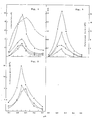
- Fig. 1-3 The influence of starch concentration on alpha-amylase and pullulanase formation and excretion in continuous culture.
- the experiments were carried out with Clostridium spec. DSM 3896 carried out at a pH of 5.9 and a temperature of 60 ° C. The flow rate was 0.075 h ⁇ 1.
- ⁇ extracellular enzyme concentration (units / l) ⁇ cell-bound enzyme concentration (E / l) ⁇ intracellular enzyme concentration (E / l) ⁇ total enzyme concentration (E / l)
- ⁇ reducing sugar (%) ⁇ Acetate (mM) ⁇ ethanol (mM) ⁇ lactate (mM)
- Fig. 4-6 The influence of pH on alpha-amylase, pullulanase and alpha-glucosidase formation and excretion in continuous culture.
- the experiments were carried out with Clostridium spec. DSM 3896 carried out in the presence of 1% starch at 60 ° C. The flow rate was 0.075 h ⁇ 1. Symbols as in Fig. 1-3.
- Fig. 7-9 The influence of the flow rate on alpha-amylase, pullulanase and alpha-glucosidase formation and excretion in continuous culture.
- the experiments were carried out with Clostidium spec. DSM 3896 in the presence of 1% starch at a pH of 5.9 and a temperature of 60 ° C. Symbols as in Fig. 1-3.
- Fig. 10-11 The influence of starch concentration on glucoamylase and pullulanase formation and excretion in continuous culture.
- the experiments were carried out with Clostridium thermohydrosulfuricum DSM 567 at a pH of 6.5 and a temperature of 60 ° C. The flow rate was 0.05 h ⁇ 1. Symbols as in Fig. 1-3.
- Fig. 12-13 The influence of pH on glucoamylase and pullulanase formation and excretion in continuous culture.
- the experiments were carried out with Clostridium thermohydrosulfuricum DSM 567 in the presence of 0.5% starch at 60 ° C. The flow rate was 0.05 h ⁇ 1. Symbols as in Fig. 1-3.
- Fig. 14-15 The influence of the flow rate on glucoamylase and pullulanase formation and excretion in continuous culture.
- the experiments were carried out with Clostridium thermohydrosulfuricum DSM 567 in the presence of 0.5% starch at a pH of 6.5 and a temperature of 60 ° C. Symbols as in Fig. 1-3.
- the experiments were carried out in 2-1 or 5-1 fermenters with a culture volume of 1 l to 2 l at 60 ° C.
- the cultures were kept anaerobic by a continuous stream of nitrogen.
- the nitrogen was sterilized by flowing it through a sterilized cotton filter.
- the cultures were stirred at 150 rpm.
- the pH was measured with a glass electrode and kept at the specified value by automatically adding 2 N KOH. After the stable phase had been reached (with at least 6 volume changes), three 10 ml samples were taken at intervals of 24 h and the activities of the amylolytic enzymes and their localization were examined. Furthermore, the fermentation products, the substrate concentrations, the pH and the optical density at 580 nm were measured.
- Table 1 shows the influence of various saccharides on the excretion of amylolytic enzymes.
- Example 1 was repeated with Clostridium thermohydrosulfurium DSM 567 with starch as the substrate.
- the medium contained the following components (% w / v): 0.25 tryptone; 0.1 yeast extract; 0.33 KH2PO4; 0.016 MgCl2; 0.0012 CoCl2.6H2O; 0.05 cysteine.HCl. 1 ml of a vitamin solution and a trace element solution were added per liter of medium.
- Example 2 was repeated for the following microorganisms with starch as the substrate: Clostridium thermoysulfurogenes DSM 2229 Clostridium thermohydrosulfuricum DSM 2247 Clostridium thermohydrosulfuricum DSM 2355 Clostridium thermosaccharolyticum DSM 571 Clostridium thermosaccharolyticum DSM 572 Thermoanaerobacter ethanolicus DSM 2246 Thermobacteroides acetoethylicus DSM 2359 Thermoanaerobium brockii DSM 1457
Landscapes
- Chemical & Material Sciences (AREA)
- Life Sciences & Earth Sciences (AREA)
- Health & Medical Sciences (AREA)
- Organic Chemistry (AREA)
- Engineering & Computer Science (AREA)
- Bioinformatics & Cheminformatics (AREA)
- Zoology (AREA)
- Wood Science & Technology (AREA)
- Genetics & Genomics (AREA)
- Biochemistry (AREA)
- General Health & Medical Sciences (AREA)
- General Engineering & Computer Science (AREA)
- Molecular Biology (AREA)
- Biomedical Technology (AREA)
- Biotechnology (AREA)
- Medicinal Chemistry (AREA)
- Microbiology (AREA)
- Enzymes And Modification Thereof (AREA)
- Micro-Organisms Or Cultivation Processes Thereof (AREA)
Abstract
Description
- Die Erfindung betrifft ein Verfahren zur Förderung der Exkretion von amylolytischen Enzymen (Amylasen und Pullulanasen) aus thermophilen, die genannten Enzyme bildenden anaeroben Bakterien sowie zwei Enzyme, die nach dem Verfahren erhältlich sind, nämlich Pullulanase und alpha-Amylase.
- Die Bildung von amylolytischen, d.h. Stärke abbauenden Enzymen ist bekannt. So wird nach WO-A-86.01 831 Clostridium thermohydrosulfuricum ATCC 33 223 ansatzweise auf einem Kulturmedium mit einem Gehalt an 0,5 % löslicher Stärke in Batchkultur kultiviert, wobei zwar Amylase, Pullulanase und Glucoamylase gebildet, jedoch nicht in das Kulturmedium ausgeschieden werden; vgl. auch Appl. Envir. Microbiol., 49 (1985) 1168-1173. Nach WO-A-86.01 832 wird Clostridium thermosulfurogenes ATCC 33 743 = DSM 2 229 ansatzweise in einem Kulturmedium mit 0,5 % löslicher Stärke kultiviert, wobei Amylase, Pullulanase und Glucoamylase als amylolytische Enzyme gebildet werden, jedoch nur das zuerst genannte Enzym in das Kulturmedium austritt.
- Aufgabe der Erfindung ist es, ein Verfahren vorzusehen, bei dem amylolytische Enzyme bei der Kultivierung von thermophilen, die genannten Enzyme bildenden anaeroben Bakterien in hohem Maße in das Kulturmedium ausgeschieden werden. Ein derartiges Verfahren bietet den Vorteil, daß die Zellen nicht zertrümmert und die Enzyme nicht von den Zelltrümmern und störenden Komponenten der Zellflüssigkeit abgetrennt werden müssen.
- Dazu wird erfindungsgemäß ein Verfahren zur Förderung der Exkretion von amylolytischen Enzymen aus thermophilen, die gennanten Enzyme bildenden anaeroben Bakterien in das Kohlenstoff-Quellen, Stickstoff-Quellen, Mineralsalze und gegebenenfalls Vitamine enthaltende Kulturmedium vorgeschlagen, das dadurch gekennzeichnet ist, daß man
- das Verfahren kontinuierlich durchführt,
- als Kohlenstoff-Quelle ein höheres Saccharid verwendet und
- unter in Bezug auf dieses höhere Saccharid limitierenden Bedingungen kultiviert. - Der Fachmann ist mit der Isolierung und Kultivierung von thermophilen, amylolytische Enzyme bildenden anaeroben Bakterien vertraut. Brauchbare Stämme finden sich in der Gattung Clostridium, beispielsweise ihrer Art Cl. thermosulfurogenes, wie ATCC 33743 = DSM 2229, ihrer Art Cl. thermohydrosulfuricum, wie ATCC 33223, DSM 567, DSM 2247 und DSM 2355, ihrer Art Cl. thermosaccharolyticum, wie DSM 571 und DSM 572, und ihrer Art Cl. spec. DSM 3896, in der Gattung Thermoanaerobacter, beispielsweise ihrer Art Th. ethanolicus, wie DSM 2246, in der Gattung Thermobacteroides, beispielsweise ihrer Art Th. acetoethylicus, wie DSM 2359, und in der Gat tung Thermoanaerobicum, beispielsweise ihrer Art Th. brockii, wie DSM 1457.
- Der Ausdruck "höheres Saccharid" ist im vorliegenden Zusammenhang so zu verstehen, daß Monosaccharide ausgenommen sind. Beispiele für höhere Saccharide sind Polysaccharide, wie Stärke, Dextrin, Dextran oder Pullulan, und Oligosaccharide, wie Trisaccharide, z.B. Maltotriose, oder Disaccharide, z.B. Maltose, und deren Gemische.
- Es ist dem Fachmann zuzumuten, die geeignete Konzentration des höheren Saccharids, den geeigneten pH-Wert und die geeignete Durchflußrate (Verdünnungsrate) zu ermitteln.
- Lediglich zur Veranschaulichung sei angeführt, daß das Verfahren bei einer Konzentration an höherem Saccharid von 0,1 bis 3, vorzusgweise 0,2 bis 1,5 und insbesondere 0,5 bis 1,2 % (Gewicht/Volumen) durchgeführt werden kann.
- Zur Veranschaulichung sei ferner ein pH-Wert von beispielsweise 4 bis 8, vorzugsweise 5,0 bis 7,5 und insbesondere 5,5 bis 7,0 genannt.
- Zur Veranschaulichung sei schließlich eine Durchflußrate von beispielsweise 0,01 bis 0,4, insbesondere 0,02 bis 0,3 vorzugsweise 0,02 bis 0,2 und besonders bevorzugt von 0,03 bis 0,15 h⁻¹ genannt.
- Hinsichtlich der Wahl einer geeigneten Temperatur wird sich der Fachmann danach richten, daß das Temperatur-Minimum durch zu langsames Zellwachstum und das Temperatur-Maximum durch Proteindenaturierung und Absterben der Zellen vorgegeben werden.
- Gegenstand der Erfindung sind ferner eine Pullulanase und eine alpha-Amylase mit den Kennzeichen der Ansprüche 6 und 7. Da die beiden Enzyme ihr Aktivitätsoptimum jeweils im Bereich von 5,0 bis 5,5 bei Temperaturen von 70 °C (Pullulanase) bzw. 60 °C (alpha-Amylase) zeigen, lassen sie sich vorteilhaft technisch in ein und demselben Reaktionsmedium verwenden.
- Nachstehend wird die Erfindung durch Beispiele anhand von Figuren näher erläutert.
- Fig. 1-3. Der Einfluß der Stärkekonzentration auf alpha-Amylase- und Pullulanase-Bildung und Exkretion in kontinuierlicher Kultur. Die Experimente wurden mit Clostridium spec. DSM 3896 bei einem pH-Wert von 5,9 und einer Temperatur von 60 °C durchgeführt. Die Durchflußrate betrug 0,075 h⁻¹.
Δ extrazelluläre Enzymkonzentration (Einheiten/l)
▲ zellgebundene Enzymkonzentration (E/l)
○ intrazelluläre Enzymkonzentration (E/l)
● gesamte Enzymkonzentration (E/l)
· optische Dichte bei 580 nm
□-□ restliche Stärke (%)
□.□ reduzierende Zucker (%)
◇ Acetate (mM)
■ Ethanol (mM)
♢ Laktat (mM) - Fig. 4-6. Der Einfluß des pH-Wertes auf alpha-Amylase-, Pullulanase- und alpha-Glucosidase-Bildung und Exkretion in kontinuierlicher Kultur. Die Experimente wurden mit Clostridium spec. DSM 3896 in Gegenwart von 1 % Stärke bei 60 °C durchgeführt. Die Durchflußrate betrug 0.075 h⁻¹. Symbole wie in Fig. 1-3.
- Fig. 7-9. Der Einfluß der Durchflußrate auf alpha-Amylase-, Pullulanase- und alpha-Glucosidase-Bildung und Exkretion in kontinuierlicher Kultur. Die Experimente wurden mit Clo- stridium spec. DSM 3896 in Gegenwart von 1 % Stärke bei einem pH-Wert von 5,9 und einer Temperatur von 60 °C durchgeführt.
Symbole wie in Fig. 1-3. - Fig. 10-11. Der Einfluß der Stärkekonzentration auf Glucoamylase- und Pullulanase-Bildung und Exkretion in kontinuierlicher Kultur. Die Experimente wurden mit Clostridium thermohydrosulfuricum DSM 567 bei einem pH-Wert von 6,5 und einer Temperatur von 60 °C durchgeführt. Die Durchflußrate betrug 0,05 h⁻¹.
Symbole wie in Fig. 1-3. - Fig. 12-13. Der Einfluß des pH-Wertes auf Glucoamylase- und Pullulanase-Bildung und Exkretion in kontinuierlicher Kultur. Die Experimente wurden mit Clostridium thermohydrosulfuricum DSM 567 in Gegenwart von 0,5 % Stärke bei 60 °C durchgeführt. Die Durchflußrate betrug 0,05 h⁻¹.
Symbole wie in Fig. 1-3. - Fig. 14-15. Der Einfluß der Durchflußrate auf Glucoamylase- und Pullulanase-Bildung und Exkretion in kontinuierlicher Kultur. Die Experimente wurden mit Clostridium thermohydrosulfuricum DSM 567 in Gegenwart von 0,5 % Stärke bei einem pH-Wert von 6,5 und einer Temperatur von 60 °C durchgeführt. Symbole wie in Fig. 1-3.
- Das kontinuierliche Verfahren wurde mit Clostridium spec. DSM 3896 (hinterlegt am 10.11.1986 bei der Deutsche Sammlung von Mikroorganismen) (Em 1) mit einem definierten Medium durchgeführt, das die folgenden Bestandteile enthielt (% Gewicht/Volumen): KH₂PO₄ 0,68; (NH₄)₂SO₄ 0,1; MgCl₂.6H₂O 0,016; CoCl₂.6H₂O 0,0012; und Cystein.HCl 0,05. Pro l Medium wurden jeweils 1 ml einer Vitamin-Lösung und einer Spurenelement-Lösung zugegeben. Der pH betrug 6,5. Das definierte Medium wurde mit den in Tabelle 1 angegebenen Sacchariden ergänzt.
- Die Versuche wurden in 2-1- oder 5-1-Fermentoren bei einem Kulturvolumen von 1 l bis 2 l bei 60 °C durchgeführt. Die Kulturen wurden durch einen kontinuierlichen Stickstoffstrom anaerob gehalten. Der Stickstoff wurde sterilisiert, indem man ihn durch ein sterilisiertes Baumwoll-Filter strömen ließ. Die Kulturen wurden mit 150 U/min gerührt. Der ph-Wert wurde mit einer Glaselektode gemessen und bei dem vorgegebenen Wert gehalten, indem man automatisch 2 N KOH zugab. Nachdem man die stabile Phase erreicht hatte (bei mindestents 6 Volumenwechseln), wurden drei 10-ml-Proben in Abständen von 24 h genommen und die Aktivitäten der amylolytischen Enzyme sowie ihre Lokalisierung untersucht. Ferner wurden die Fermentationsprodukte, die Substratkonzentrationen, der pH-Wert und die optische Dichte bei 580 nm gemessen.
- Der Einfluß der Saccharid-Konzentration, des pH-Wertes und der Durchflußrate auf die Ausscheidung amylolytischer Enzyme in das Kulturmedium sind den Figuren 1 bis 9 am Beispiel von Stärke als Substrat zu entnehmen.
- Tabelle 1 kann man den Einfluß verschiedener Saccharide auf die Ausscheidung amylolytischer Enzyme entnehmen.
- Beispiel 1 wurde mit Clostridium thermohydrosulfurium DSM 567 mit Stärke als Substrat wiederholt. Das Medium enthielt folgende Bestandteile (% Gewicht/Volumen): 0,25 Trypton; 0,1 Hefe-Extrakt; 0,33 KH₂PO₄; 0,016 MgCl₂; 0,0012 CoCl₂.6H₂O; 0,05 Cystein.HCl. Pro l Medium wurde jeweils 1 ml einer Vitaminlösung und einer Spurenelementlösung zugegeben.
- Der Einfluß der Saccharid-Konzentration, des pH-Wertes und der Durchflußrate auf die Ausscheidung amylolytischer Enzyme (Glucoamylase und Pullulanase) in das Kulturmedium sind den Figuren 10 bis 15 zu entnehmen.
- Beispiel 2 wurde für folgende Mikroorganismen mit Stärke als Substrat wiederholt:
Clostridium thermoysulfurogenes DSM 2229
Clostridium thermohydrosulfuricum DSM 2247
Clostridium thermohydrosulfuricum DSM 2355
Clostridium thermosaccharolyticum DSM 571
Clostridium thermosaccharolyticum DSM 572
Thermoanaerobacter ethanolicus DSM 2246
Thermobacteroides acetoethylicus DSM 2359
Thermoanaerobium brockii DSM 1457 - Bei den Versuchen mit den genannten Stämmen wurde bestätigt, daß sich die Exkretion von amylolytischen Enzymen durch Limitierung des höheren Saccharids als Kohlenstoff-Quelle bei den im Beispiel 1 angegebenen Werten für den pH und die Durchflußrate fördern läßt.
Claims (7)
-- das Verfahren kontinuierlich durchführt und
-- als Kohlenstoff-Quelle ein höheres Saccharid verwendet und
-- unter in Bezug auf das höhere Saccharid limitierenden Bedingungen kultiviert.
Aktivitätsoptimum bei 70 °C und pH 5,0 bis 5,5 kein Aktivitätsverlust nach 1 Tag bei 60 °C unter aeroben Bedingungen ohne Substratzugabe.
Aktivitätsoptimum bei 60 °C und pH 5,0 bis 5,5.
Applications Claiming Priority (2)
| Application Number | Priority Date | Filing Date | Title |
|---|---|---|---|
| DE3639267 | 1986-11-17 | ||
| DE19863639267 DE3639267A1 (de) | 1986-11-17 | 1986-11-17 | Verfahren zur foerderung der exkretion von amylolytischen enzymen aus bakterien sowie nach dem verfahren erhaltene enzyme |
Publications (2)
| Publication Number | Publication Date |
|---|---|
| EP0268193A2 true EP0268193A2 (de) | 1988-05-25 |
| EP0268193A3 EP0268193A3 (de) | 1988-08-24 |
Family
ID=6314147
Family Applications (1)
| Application Number | Title | Priority Date | Filing Date |
|---|---|---|---|
| EP87116625A Withdrawn EP0268193A3 (de) | 1986-11-17 | 1987-11-11 | Verfahren zur Förderung der Exkretion von amylolytischen Enzymen aus Bakterien sowie nach dem Verfahren erhaltene Enzyme |
Country Status (4)
| Country | Link |
|---|---|
| EP (1) | EP0268193A3 (de) |
| JP (1) | JPS63137676A (de) |
| DE (1) | DE3639267A1 (de) |
| DK (2) | DK165597C (de) |
Cited By (3)
| Publication number | Priority date | Publication date | Assignee | Title |
|---|---|---|---|---|
| EP0276806A3 (en) * | 1987-01-29 | 1989-06-28 | Kali-Chemie Aktiengesellschaft | Thermally stable amylases and pullulanases from two anaerobic microorganisms |
| EP0286007A3 (de) * | 1987-04-09 | 1989-06-28 | Kali-Chemie Aktiengesellschaft | Thermostabile Amylasen und Pullulanasen aus 2 anaeroben Mikroorganismen |
| US5370997A (en) * | 1989-03-20 | 1994-12-06 | Novo Nordisk A/S | Hyperthermostable alpha-amylase |
Family Cites Families (8)
| Publication number | Priority date | Publication date | Assignee | Title |
|---|---|---|---|---|
| DE1517752C3 (de) * | 1966-02-05 | 1974-10-24 | Farbwerke Hoechst Ag, Vormals Meister Lucius & Bruening, 6000 Frankfurt | Verfahren zur Herstellung von Pullulanase |
| IT1033034B (it) * | 1968-11-13 | 1979-07-10 | Cpc International Inc | Metodo per preparare enzima di pullulanasi |
| US3963575A (en) * | 1974-02-25 | 1976-06-15 | A. E. Staley Manufacturing Company | Producing pullulanase with organisms having a superior capacity to elaborate pullulanase |
| US4578352A (en) * | 1983-07-13 | 1986-03-25 | Cpc International Inc. | Novel thermostable, aciduric alpha-amylase and method for its production |
| US4628031A (en) * | 1984-09-18 | 1986-12-09 | Michigan Biotechnology Institute | Thermostable starch converting enzymes |
| DE3582020D1 (de) * | 1984-11-09 | 1991-04-11 | Hitachi Ltd | Thermostabile alpha-amylase produzierende thermostabile anaerobe bakterie, thermostabile alpha-amylase und verfahren zur deren herstellung. |
| US4613570A (en) * | 1985-02-08 | 1986-09-23 | Cpc International Inc. | Novel thermostable, aciduric alpha-amylase and method for its production |
| US4628028A (en) * | 1985-05-23 | 1986-12-09 | Cpc International Inc. | Novel thermostable pullulanase enzyme and method for its production |
-
1986
- 1986-11-17 DE DE19863639267 patent/DE3639267A1/de not_active Withdrawn
-
1987
- 1987-11-11 EP EP87116625A patent/EP0268193A3/de not_active Withdrawn
- 1987-11-16 DK DK600187A patent/DK165597C/da not_active IP Right Cessation
- 1987-11-17 JP JP28861187A patent/JPS63137676A/ja active Pending
-
1992
- 1992-06-18 DK DK80892A patent/DK80892D0/da not_active Application Discontinuation
Cited By (4)
| Publication number | Priority date | Publication date | Assignee | Title |
|---|---|---|---|---|
| EP0276806A3 (en) * | 1987-01-29 | 1989-06-28 | Kali-Chemie Aktiengesellschaft | Thermally stable amylases and pullulanases from two anaerobic microorganisms |
| EP0286007A3 (de) * | 1987-04-09 | 1989-06-28 | Kali-Chemie Aktiengesellschaft | Thermostabile Amylasen und Pullulanasen aus 2 anaeroben Mikroorganismen |
| US4929557A (en) * | 1987-04-09 | 1990-05-29 | Kali-Chemie Ag | Thermostable amylases and pullulanases from two anaerobic microorganisms |
| US5370997A (en) * | 1989-03-20 | 1994-12-06 | Novo Nordisk A/S | Hyperthermostable alpha-amylase |
Also Published As
| Publication number | Publication date |
|---|---|
| EP0268193A3 (de) | 1988-08-24 |
| DK600187D0 (da) | 1987-11-16 |
| DK165597C (da) | 1993-05-03 |
| JPS63137676A (ja) | 1988-06-09 |
| DE3639267A1 (de) | 1988-09-22 |
| DK600187A (da) | 1988-08-21 |
| DK80892A (da) | 1992-06-18 |
| DK165597B (da) | 1992-12-21 |
| DK80892D0 (da) | 1992-06-18 |
Similar Documents
| Publication | Publication Date | Title |
|---|---|---|
| DE3587623T2 (de) | Enzymatische Hydrolyse von körniger Stärke direkt bis zu Glukose. | |
| GB2145094A (en) | Novel thermostable glucoamylase and method for its production | |
| CA1120875A (en) | Method for ethanol fermentation | |
| DE2507787C2 (de) | Verfahren zur Herstellung von Pullulanase und deren Verwendung zur Stärkehydrolyse | |
| DE3788291T2 (de) | Beta-Amylase-Enzym-Produkt, Herstellung und Verwendung. | |
| EP0131253B1 (de) | Thermostabile, saure alpha-Amylase und Verfahren zu ihrer Herstellung | |
| DE3779522T2 (de) | Ein neuer amylasetyp. | |
| DE1767653C3 (de) | Verfahren zur Erzeugung von Isoamylase | |
| US4224410A (en) | Method for ethanol fermentation | |
| DE2167078C2 (en) | Amylase prepn - for prodn of maltose from starch | |
| EP0286007A2 (de) | Thermostabile Amylasen und Pullulanasen aus 2 anaeroben Mikroorganismen | |
| DE2500597C2 (de) | Verfahren zur gleichzeitigen Herstellung von beta-Amylase und alpha-1,6-Glucosidase | |
| EP0276806B1 (de) | Thermostabile Amylasen und Pullulanasen aus 2 anaeroben Mikroorganismen | |
| DE3639267A1 (de) | Verfahren zur foerderung der exkretion von amylolytischen enzymen aus bakterien sowie nach dem verfahren erhaltene enzyme | |
| DE3603348A1 (de) | Neue thermostabile, saeurebestaendige (alpha)-amylase und verfahren zu ihrer herstellung | |
| DE3788908T2 (de) | Verfahren zur Herstellung von Zuckern aus Stärke. | |
| DE2424833A1 (de) | Verfahren zur herstellung von maltose | |
| DE69014044T2 (de) | Neue alkylische Pullulanase Y mit alpha-Amylase-Aktivität, sie produzierender Mikroorganismus und Verfahren zur Herstellung dieses Enzyms. | |
| DE2717333A1 (de) | Hitze- und saeurebestaendiges alpha- amylaseenzym, verfahren zu seiner herstellung und seine verwendung | |
| DE69003252T2 (de) | Verfahren zur enzymatischen umwandlung von stärke in cyclodextrine. | |
| DE1908225C3 (de) | Biotechnisches Verfahren zur Herstellung von Enzymen, die stärkeartige Polysaccharide und Dextrane sowie Oligosaccharide der entsprechenden Bindungstypen hydrolytisch spalten | |
| DE60014655T2 (de) | Polypeptide | |
| DE3332639C2 (de) | Verfahren zur Herstellung von Maltopentaose | |
| DE2435247C2 (de) | β-Amylase, ihre Herstellung und Verwendung | |
| DE2028134B2 (de) | Verfahren zur gewinnung carbonsaeurereicher zuckersirupe |
Legal Events
| Date | Code | Title | Description |
|---|---|---|---|
| PUAI | Public reference made under article 153(3) epc to a published international application that has entered the european phase |
Free format text: ORIGINAL CODE: 0009012 |
|
| AK | Designated contracting states |
Kind code of ref document: A2 Designated state(s): AT BE CH DE ES FR GB IT LI NL |
|
| PUAL | Search report despatched |
Free format text: ORIGINAL CODE: 0009013 |
|
| AK | Designated contracting states |
Kind code of ref document: A3 Designated state(s): AT BE CH DE ES FR GB IT LI NL |
|
| 17P | Request for examination filed |
Effective date: 19880906 |
|
| 17Q | First examination report despatched |
Effective date: 19911007 |
|
| STAA | Information on the status of an ep patent application or granted ep patent |
Free format text: STATUS: THE APPLICATION HAS BEEN WITHDRAWN |
|
| 18W | Application withdrawn |
Withdrawal date: 19920806 |
|
| RIN1 | Information on inventor provided before grant (corrected) |
Inventor name: ANTRANIKIAN, GARABED, DR. Inventor name: GOTTSCHALK, GERHARD, PROF. DR. |