EP0268224A2 - Procédé d'isolation de paraffinesulfonates pauvres en sulfates alcalins et de l'acide sulfurique de mélanges de réaction de la sulfoxidation de paraffines sans production de sulfate de sodium - Google Patents
Procédé d'isolation de paraffinesulfonates pauvres en sulfates alcalins et de l'acide sulfurique de mélanges de réaction de la sulfoxidation de paraffines sans production de sulfate de sodium Download PDFInfo
- Publication number
- EP0268224A2 EP0268224A2 EP87116761A EP87116761A EP0268224A2 EP 0268224 A2 EP0268224 A2 EP 0268224A2 EP 87116761 A EP87116761 A EP 87116761A EP 87116761 A EP87116761 A EP 87116761A EP 0268224 A2 EP0268224 A2 EP 0268224A2
- Authority
- EP
- European Patent Office
- Prior art keywords
- mixing
- settling vessel
- paraffin
- sulfuric acid
- phase
- Prior art date
- Legal status (The legal status is an assumption and is not a legal conclusion. Google has not performed a legal analysis and makes no representation as to the accuracy of the status listed.)
- Granted
Links
Images
Classifications
-
- C—CHEMISTRY; METALLURGY
- C07—ORGANIC CHEMISTRY
- C07C—ACYCLIC OR CARBOCYCLIC COMPOUNDS
- C07C303/00—Preparation of esters or amides of sulfuric acids; Preparation of sulfonic acids or of their esters, halides, anhydrides or amides
- C07C303/42—Separation; Purification; Stabilisation; Use of additives
Definitions
- n-paraffins e.g. Aqueous solutions of paraffin sulfonic acids obtainable by the process of German patent 910 165 also contain sulfur dioxide, sulfuric acid and hydrotropically dissolved paraffins.
- sulfur dioxide, sulfuric acid and paraffins must be separated as gently and quantitatively as possible.
- paraffin sulfoxidation products begin to decompose at temperatures above 50 ° C, which is shown externally by the discoloration of the acidic reaction mixture from water-light to yellowish, brown to finally deep black. Even if the amount of paraffinsulfonic acid decomposed by the action of temperature is still relatively small, as long as the acidic reaction mixtures are not exposed to temperatures above 100 ° C for a long time, a small proportion of decomposed products requires considerable bleaching because of their color intensity if flawlessly bright products.
- alkaline salts of paraffin sulfonic acids are relatively stable. Temperatures below 200 ° C lead to very insignificant discolouration, even with longer heating times, which can still be easily removed with small amounts of bleach.
- the general procedure is to treat the degassed sulfoxidation mixture with a suitable organic solvent in order to separate into an organic phase which contains the paraffin sulfonic acids contains and in an aqueous phase, which contains the sulfuric acid as far as possible in the form of a generally 10 to 25% aqueous solution.
- the two phases are then separated and the organic phase is worked up further to isolate the paraffin sulfonic acids or their salts.
- the sulfuric acid can only be separated off so incompletely that the salt content in the neutralized end product is still significantly above 2% by weight (based on paraffin sulfonate), even if the amount of alcohol added to 30 wt .-% (based on the degassed sulfoxidation reaction mixture) is increased. In contrast, larger or smaller amounts of alcohol lead to an even less complete separation of the sulfuric acid.
- the degree of sulfuric acid separation increases with an increasing C number of the alcohols used, but on the other hand the work-up effort increases as the boiling points of the alcohols used increase.
- DE-OS 3 342 984 also describes a process for the isolation of low-alkali sulfate paraffin sulfonates and sulfuric acid from paraffin sulfoxidation reaction mixtures with the aid of alcohols.
- the starting point is the reaction mixture obtained in the sulfoxidation of n-paraffins, in particular C13-C18 paraffins, which has been freed from sulfur dioxide by degassing and which is at 15 to 80 ° C., in particular up to 25 to 35 ° C., from 15 to 30 , in particular 17 to 25 wt .-% of a C4-C8 alcohol is stirred.
- Isobutanol is preferred.
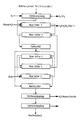
- This alkanesulfonic acid / alcohol solution is continuously fed into an apparatus which consists of three combined mixing settling vessels (so-called mixer-settlers) and a further mixing vessel.
- the paraffin sulfonic acid / alcohol solution, the upper phase of the second settler and the lower phase of the third settler are metered into the first mixer, the lower phase of the first settler and so much of the alkane sulfonic acid / alcohol Solution that the pH value in the second mixer-settler is always between 7 and 8.
- the 3rd mixer takes up the entire alkali solution required and the product phase of the 1st settler.
- the lower phase which consists of an aqueous alkali sulfate solution with a trace of alcohol (less than 1% by weight)
- the upper phase from the third settler, which are in the mixing vessel with further alkanesulfonic acid / alcohol solution are removed from the second settler the pH value of about 11 is set. This solution is then evaporated to the desired degree of concentration.
- a serious disadvantage of this procedure is the inevitable occurrence of aqueous alkali sulfate solutions which are also contaminated with traces of the alcohol used. Due to the strong tendency of this solution to foam, these traces of alcohol can hardly be removed by distillation. Before such wastewater can be fed to the biological sewage treatment plant, the concrete walls destroying sulfate must normally also be separated, which leads to further disposal problems.
- the invention thus relates to a process for isolating alkane sulfate-poor alkane sulfonates and sulfuric acid from paraffin-sulfoxidation reaction mixtures with the aid of alcohols, in which the reaction mixture freed from sulfur dioxide is mixed with a C4-C8 alcohol in a mixing vessel (1) and the lower phase from a mixing settling vessel (2) is mixed, the separating lower phase separates from dilute sulfuric acid, the remaining upper product phase together with the lower phase of a mixing settling vessel (4) into the Mixing-settling vessel (2) gives the lower phase obtained therein to the mixing-settling vessel (1), the remaining upper product phase (2) from the mixing-settling vessel (2) together with the lower phase from a mixing-settling vessel (5) and the upper phase from the mixing-settling vessel (4) into a mixing-settling vessel (3), which
- the amount of alkanol added at this point affects the alkali sulfate content in the final product, i.e. in the paraffin sulfonate melt, in such a way that the residual salt content decreases with increasing amount of alkanol.
- an alkanol content exceeding 35% only leads to an insignificant decrease in this content in the melt.
- the upper phase from the settler 1 is stirred in the mixer 2 with the lower phase from a settler 4 which, when using isobutanol as the alkanol, consists essentially of an approx. 3-10% aqueous alkali hydrogen sulfate solution.
- the upper phase then separated in the settler 2 flows into a buffer vessel, from which so much alkanolic and paraffin-containing alkanesulfonic acid solution is conveyed into the mixer 4 that a pH value between 0.5 and 7, preferably 1-5, but especially 1- 1.5 sets.
- the remaining alkanesulfonic acid solution which makes up about 2/3 of the total volume flow that flows through the buffer vessel, is mixed in a mixer 3 with the upper phase from the settler 4, consisting of an acidic alkanolic alkanesulfonate solution and with the lower phase Settler 5, consisting of an aqueous alkali / alkali sulfate solution (z. B. about 1-5% Na2SO4 and about 10-40% NaOH in the case of the preferred isobutanol) mixed.
- the lower phase of the settler 3 also an alkaline alkali sulfate solution (which may contain 6-10% Na2SO4 and 0.5-8% NaOH, for example) runs into the mixer 4, while the upper phase of the settler 3, an alkaline alkanesulfonate solution, runs in the mixer 5 the sodium hydroxide solution necessary for the neutralization of the entire alkanesulfonic acid is added.
- alkaline alkali sulfate solution which may contain 6-10% Na2SO4 and 0.5-8% NaOH, for example
- the alkaline top phase of the settler 5 flows into the neutralization, where it is adjusted to a pH of 3 to 9, preferably 5 to 8, with part of the sulfonic acid solution from the buffer vessel.
- This neutralisate is finally evaporated to melt in two falling film evaporators connected in series.
- first falling film steamer heating jacket steam pressure approx. 3-6 bar
- second falling film evaporator which is operated at a heating jacket steam pressure of 20-30 bar, in particular at approx. 22-26 bar, in a vacuum of 15-30 mbar, in particular 17-19 mbar
- the paraffin evaporates together with the remaining amounts of water and isobutanol.
- paraffin sulfonate melt thus obtained consists of approximately 97-98% alkanesulfonate, 0.8-1.3% paraffin and 1.0-1.7% Na2SO4.
- the mixer settlers 1 and 2 are operated at temperatures of 12 to 80 ° C., preferably 25-50 ° C., in particular 30-35 ° C.
- Mixer settlers 3 and 5 should be as close as possible to the boiling point of the for the purpose of optimal phase separation Mixtures, for example in the case of isobutanol as alkanol, are operated at normal pressure at 88-91 ° C. Not quite as good anymore, but still sufficiently good and getting better with increasing temperature, with isobutanol as alkanol the phase separation takes place quickly and completely even at 40-88 ° C.
- the mixer Settler 4 can then be operated at temperatures of 40-80 ° C, but also at temperatures up to 91 ° C, with a temperature of 60-85 ° C, in particular 70 ° C is optimal.
- the higher C5-C8 alkanols can be used, which have the advantage that the residual sulfate content in the end product can be reduced slightly further with increasing C chain length of the alkanol.
- the disadvantage here is that the expenditure of energy for separating water and alkanol on the one hand and alkanol and paraffin on the other increases very quickly.
- potassium hydroxide solution or other bases such as e.g. MgO or Mg (OH) 2, ZnO or mixtures of these.
- the upper phase from the settler 1 is stirred in the mixer 2 with the lower phase from a settler 4, which essentially consists of an approximately 6% sodium hydrogen sulfate solution.
- the upper phase then separated in the settler 2 then flows into a buffer vessel, from which enough is conveyed into the mixer 4 that a pH value of 1 is established there.
- the remaining alkanesulfonic acid solution from the buffer vessel which makes up about 2/3 of the total flow that flows through the buffer vessel, is in a mixer 3 with the upper phase from the settler 4, consisting of acid-reacting, isobutanolic alkanesulfonate solution and with Lower phase from the settler 5, consisting of an aqueous solution containing 14% NaOH and 3.5% Na2SO4, mixed.
- the lower phase of the settler 3 also an alkaline sodium sulfate solution with a content of 2.7% NaOH and 8% Na2SO4, runs in the mixer 4, while the upper phase of the settler 3, an alkaline alkanesulfonate solution in the mixer 5 with the necessary for the neutralization of the entire alkane sulfonic acid amount of sodium hydroxide solution.
- the amount is approximately 2.0 kg NaOH (50%).
- the alkaline top phase of the settler 5 flows into the neutralization stage, where it is adjusted to pH 7 with part of the sulfonic acid solution from the buffer vessel.
- This neutralisate is finally evaporated to melt in two falling film evaporators connected in series.
- first falling film evaporator heating jacket steam pressure approx. 4 bar
- second falling film evaporator which is operated at a heating jacket steam pressure of 24 bar in a vacuum of 18 mbar, the paraffin evaporates together with remaining amounts of water and isobutanol.
- the melt of the alkanesulfonate thus obtained consists of 97.5% Na alkanesulfonate, 1% paraffin and 1.5% sodium sulfate.
- Mixer-Settler 1 and 2 are operated at 34 ° C, Mixer-Settler 3 and 5 at 90 ° C and Mixer-Settler 4 at 75 ° C.
Landscapes
- Chemical & Material Sciences (AREA)
- Organic Chemistry (AREA)
- Organic Low-Molecular-Weight Compounds And Preparation Thereof (AREA)
Applications Claiming Priority (2)
| Application Number | Priority Date | Filing Date | Title |
|---|---|---|---|
| DE19863639464 DE3639464A1 (de) | 1986-11-18 | 1986-11-18 | Verfahren zur isolierung von alkalisulfat-armen paraffinsulfonaten und schwefelsaeure aus paraffin-sulfoxidation-reaktionsgemischen ohne zwangsanfall von natriumsulfat |
| DE3639464 | 1986-11-18 |
Publications (3)
| Publication Number | Publication Date |
|---|---|
| EP0268224A2 true EP0268224A2 (fr) | 1988-05-25 |
| EP0268224A3 EP0268224A3 (en) | 1989-05-10 |
| EP0268224B1 EP0268224B1 (fr) | 1992-01-29 |
Family
ID=6314253
Family Applications (1)
| Application Number | Title | Priority Date | Filing Date |
|---|---|---|---|
| EP87116761A Expired - Lifetime EP0268224B1 (fr) | 1986-11-18 | 1987-11-13 | Procédé d'isolation de paraffinesulfonates pauvres en sulfates alcalins et de l'acide sulfurique de mélanges de réaction de la sulfoxidation de paraffines sans production de sulfate de sodium |
Country Status (6)
| Country | Link |
|---|---|
| US (1) | US4808343A (fr) |
| EP (1) | EP0268224B1 (fr) |
| JP (1) | JPH0798791B2 (fr) |
| DE (2) | DE3639464A1 (fr) |
| ES (1) | ES2030035T3 (fr) |
| TR (1) | TR23253A (fr) |
Cited By (2)
| Publication number | Priority date | Publication date | Assignee | Title |
|---|---|---|---|---|
| WO2008135198A2 (fr) | 2007-05-03 | 2008-11-13 | Clariant Finance (Bvi) Limited | Procédé d'isolement d'acides sulfoniques paraffiniques concentrés |
| DE102014009835A1 (de) | 2014-07-03 | 2016-01-07 | Weylchem Wiesbaden Gmbh | Sekundäre Natrium-Alkansulfonate, Verfahren zu ihrer Herstellung und deren Verwendung |
Families Citing this family (2)
| Publication number | Priority date | Publication date | Assignee | Title |
|---|---|---|---|---|
| IT1198232B (it) * | 1986-12-23 | 1988-12-21 | Eniricerche Spa | Procedimento per la separazione di acido solforico da miscele acquose dello stesso con acidi paraffinsolfonici |
| IT1230155B (it) * | 1989-06-15 | 1991-10-14 | Enichem Augusta Spa | Procedimento migliorato per la preparazione di acidi paraffin-solfonici |
Family Cites Families (6)
| Publication number | Priority date | Publication date | Assignee | Title |
|---|---|---|---|---|
| US4177208A (en) * | 1970-08-07 | 1979-12-04 | Ato Chemie | Process for preparing sulphonic acids and sulphonates |
| US4178307A (en) * | 1970-08-07 | 1979-12-11 | Ato Chimie | Process for preparing sulphonic acids and sulphonates |
| BG20344A3 (bg) * | 1970-08-07 | 1975-11-05 | Ato Chimie | Метод за отделяне на сулфонови киселини и сулфонати |
| IT1074825B (it) * | 1977-01-11 | 1985-04-20 | Euteco Spa | Procedimento per la purificazione di acidi alchilsolfonici |
| DE3013808C2 (de) * | 1980-04-10 | 1982-12-23 | Chemische Werke Hüls AG, 4370 Marl | Verfahren zur Abtennung von Schwefelsäure aus dem bei der Umsetzung von Paraffinen mit Schwefeldioxid, Sauerstoff und Wasser in Gegenwart von UV-Licht anfallenden Sulfoxidationsaustrag |
| DE3342984A1 (de) * | 1983-11-28 | 1985-06-05 | Hoechst Ag, 6230 Frankfurt | Verfahren zur isolierung von alkalisulfat-armen paraffinsulfonaten und schwefelsaeure aus paraffin-sulfoxidation-reaktionsgemischen |
-
1986
- 1986-11-18 DE DE19863639464 patent/DE3639464A1/de not_active Withdrawn
-
1987
- 1987-11-11 TR TR798/87A patent/TR23253A/xx unknown
- 1987-11-13 ES ES198787116761T patent/ES2030035T3/es not_active Expired - Lifetime
- 1987-11-13 EP EP87116761A patent/EP0268224B1/fr not_active Expired - Lifetime
- 1987-11-13 DE DE8787116761T patent/DE3776500D1/de not_active Expired - Lifetime
- 1987-11-16 US US07/120,859 patent/US4808343A/en not_active Expired - Fee Related
- 1987-11-17 JP JP62290462A patent/JPH0798791B2/ja not_active Expired - Lifetime
Cited By (4)
| Publication number | Priority date | Publication date | Assignee | Title |
|---|---|---|---|---|
| WO2008135198A2 (fr) | 2007-05-03 | 2008-11-13 | Clariant Finance (Bvi) Limited | Procédé d'isolement d'acides sulfoniques paraffiniques concentrés |
| WO2008135198A3 (fr) * | 2007-05-03 | 2009-01-22 | Clariant Int Ltd | Procédé d'isolement d'acides sulfoniques paraffiniques concentrés |
| US8426642B2 (en) | 2007-05-03 | 2013-04-23 | Clariant Finance (Bvi) Limited | Method for isolating concentrated paraffin sulfonic acids |
| DE102014009835A1 (de) | 2014-07-03 | 2016-01-07 | Weylchem Wiesbaden Gmbh | Sekundäre Natrium-Alkansulfonate, Verfahren zu ihrer Herstellung und deren Verwendung |
Also Published As
| Publication number | Publication date |
|---|---|
| EP0268224A3 (en) | 1989-05-10 |
| ES2030035T3 (es) | 1992-10-16 |
| JPH0798791B2 (ja) | 1995-10-25 |
| EP0268224B1 (fr) | 1992-01-29 |
| TR23253A (tr) | 1989-07-31 |
| JPS63183556A (ja) | 1988-07-28 |
| DE3639464A1 (de) | 1988-05-19 |
| US4808343A (en) | 1989-02-28 |
| DE3776500D1 (de) | 1992-03-12 |
Similar Documents
| Publication | Publication Date | Title |
|---|---|---|
| DE3918265A1 (de) | Verfahren zur herstellung von tensidgemischen auf ethersulfonatbasis und ihre verwendung | |
| DE2139477C2 (fr) | ||
| EP0238575B1 (fr) | Procede de production de vanilline | |
| DE3013808C2 (de) | Verfahren zur Abtennung von Schwefelsäure aus dem bei der Umsetzung von Paraffinen mit Schwefeldioxid, Sauerstoff und Wasser in Gegenwart von UV-Licht anfallenden Sulfoxidationsaustrag | |
| EP0129710A1 (fr) | Procédé pour la production de pâtes aqueuses de couleur claire stable à base de sels obtenus à partir d'esters d'acides gras alpha sulfonés actifs au lavage | |
| EP0268224B1 (fr) | Procédé d'isolation de paraffinesulfonates pauvres en sulfates alcalins et de l'acide sulfurique de mélanges de réaction de la sulfoxidation de paraffines sans production de sulfate de sodium | |
| EP0143416B1 (fr) | Procédé pour la récupération de sulfonates paraffiniques, pauvres en sulfates alcalins, et d'acide sulfurique à partir de mélanges de réaction de sulfoxydation de paraffines | |
| EP0131913B1 (fr) | Procédé pour l'obtention d'acides sulfoniques de paraffines ou de sulfonates de paraffines à partir de mélanges réactionnels obtenus lors de la sulfoxydation de paraffines | |
| DE2831965A1 (de) | Verfahren zur herstellung von 2-amino- 1-naphthalinsulfonsaeure | |
| DE2419455A1 (de) | Verfahren zur herstellung von pnitrotoluol-2-sulfonsaeure | |
| EP0662955B1 (fr) | Procede de preparation de solutions d'hydroperoxides d'alkyle pauvres en eau ou anhydres | |
| DE1493977A1 (de) | Verfahren zur Herstellung von Hydrochinon aus p-Dialkylbenzol-bis-hydroperoxyden | |
| EP0135007B1 (fr) | Procédé pour l'isolation douce de sulfonate de paraffine et d'acide sulfurique à partir de mélanges réactionnels obtenus par sulfoxydation de paraffine | |
| DE1910860C3 (de) | Verfahren zur Herstellung von Alkalialkansulfonaten | |
| DE2831992A1 (de) | Verfahren zur herstellung von 2-amino- 1-naphthalinsulfonsaeure | |
| DE954249C (de) | Verfahren zur Trennung von primaeren und tertiaeren Cymolhydroperoxyden | |
| DE2837694C3 (de) | Verfahren zur Herstellung von reiner Phosphorsäure | |
| EP0305924A2 (fr) | Procédé pour la sulfonation et/ou sulfatation de composés organiques avec S03 dans un milieu réactionnel organique | |
| DE1210771B (de) | Verfahren zur Herstellung von araliphatischen Dicarbinolen | |
| EP0116349B1 (fr) | Procédé pour l'isolation de sulphonates de paraffines à partir du mélange de réaction de la sulfoxydation de paraffines | |
| DE1518012C3 (de) | Verfahren zur Herstellung von Resorcin durch saurekatalysierte Spaltung eines m Dialkylbenzolbishydro peroxyds | |
| EP0019305B1 (fr) | Procédé de traitement de liqueurs de phénolate | |
| EP0033775A1 (fr) | Procédé de séparation des acides sulfoniques du produit de réaction obtenu par réaction des paraffines avec le dioxyde de soufre, l'oxygène et l'eau en présence de lumière ultraviolette | |
| DE1004611B (de) | Verfahren zur Reinigung von vorgereinigtem oder rohem, Oxyhydroperoxyd enthaltenden m- und bzw. oder p-Diisopropylbenzoldihydroperoxyd | |
| DE1102740B (de) | Verfahren zur Gewinnung von Hydroperoxyden aus den Oxydations-produkten von dialkylierten aromatischen Kohlenwasserstoffen |
Legal Events
| Date | Code | Title | Description |
|---|---|---|---|
| PUAI | Public reference made under article 153(3) epc to a published international application that has entered the european phase |
Free format text: ORIGINAL CODE: 0009012 |
|
| AK | Designated contracting states |
Kind code of ref document: A2 Designated state(s): DE ES FR GB IT NL |
|
| PUAL | Search report despatched |
Free format text: ORIGINAL CODE: 0009013 |
|
| AK | Designated contracting states |
Kind code of ref document: A3 Designated state(s): DE ES FR GB IT NL |
|
| 17P | Request for examination filed |
Effective date: 19890906 |
|
| 17Q | First examination report despatched |
Effective date: 19910301 |
|
| GRAA | (expected) grant |
Free format text: ORIGINAL CODE: 0009210 |
|
| AK | Designated contracting states |
Kind code of ref document: B1 Designated state(s): DE ES FR GB IT NL |
|
| REF | Corresponds to: |
Ref document number: 3776500 Country of ref document: DE Date of ref document: 19920312 |
|
| ITF | It: translation for a ep patent filed | ||
| GBT | Gb: translation of ep patent filed (gb section 77(6)(a)/1977) | ||
| ET | Fr: translation filed | ||
| REG | Reference to a national code |
Ref country code: ES Ref legal event code: FG2A Ref document number: 2030035 Country of ref document: ES Kind code of ref document: T3 |
|
| PLBE | No opposition filed within time limit |
Free format text: ORIGINAL CODE: 0009261 |
|
| STAA | Information on the status of an ep patent application or granted ep patent |
Free format text: STATUS: NO OPPOSITION FILED WITHIN TIME LIMIT |
|
| 26N | No opposition filed | ||
| PGFP | Annual fee paid to national office [announced via postgrant information from national office to epo] |
Ref country code: GB Payment date: 19991018 Year of fee payment: 13 |
|
| PGFP | Annual fee paid to national office [announced via postgrant information from national office to epo] |
Ref country code: DE Payment date: 19991020 Year of fee payment: 13 |
|
| PGFP | Annual fee paid to national office [announced via postgrant information from national office to epo] |
Ref country code: FR Payment date: 19991021 Year of fee payment: 13 |
|
| PGFP | Annual fee paid to national office [announced via postgrant information from national office to epo] |
Ref country code: NL Payment date: 19991025 Year of fee payment: 13 |
|
| PGFP | Annual fee paid to national office [announced via postgrant information from national office to epo] |
Ref country code: ES Payment date: 19991130 Year of fee payment: 13 |
|
| REG | Reference to a national code |
Ref country code: FR Ref legal event code: TP |
|
| NLS | Nl: assignments of ep-patents |
Owner name: CLARIANT GMBH |
|
| PG25 | Lapsed in a contracting state [announced via postgrant information from national office to epo] |
Ref country code: GB Free format text: LAPSE BECAUSE OF NON-PAYMENT OF DUE FEES Effective date: 20001113 |
|
| PG25 | Lapsed in a contracting state [announced via postgrant information from national office to epo] |
Ref country code: ES Free format text: LAPSE BECAUSE OF NON-PAYMENT OF DUE FEES Effective date: 20001114 |
|
| PG25 | Lapsed in a contracting state [announced via postgrant information from national office to epo] |
Ref country code: NL Free format text: LAPSE BECAUSE OF NON-PAYMENT OF DUE FEES Effective date: 20010601 |
|
| GBPC | Gb: european patent ceased through non-payment of renewal fee |
Effective date: 20001113 |
|
| PG25 | Lapsed in a contracting state [announced via postgrant information from national office to epo] |
Ref country code: FR Free format text: LAPSE BECAUSE OF NON-PAYMENT OF DUE FEES Effective date: 20010731 |
|
| NLV4 | Nl: lapsed or anulled due to non-payment of the annual fee |
Effective date: 20010601 |
|
| PG25 | Lapsed in a contracting state [announced via postgrant information from national office to epo] |
Ref country code: DE Free format text: LAPSE BECAUSE OF NON-PAYMENT OF DUE FEES Effective date: 20010801 |
|
| REG | Reference to a national code |
Ref country code: FR Ref legal event code: ST |
|
| REG | Reference to a national code |
Ref country code: ES Ref legal event code: FD2A Effective date: 20011214 |
|
| PG25 | Lapsed in a contracting state [announced via postgrant information from national office to epo] |
Ref country code: IT Free format text: LAPSE BECAUSE OF NON-PAYMENT OF DUE FEES;WARNING: LAPSES OF ITALIAN PATENTS WITH EFFECTIVE DATE BEFORE 2007 MAY HAVE OCCURRED AT ANY TIME BEFORE 2007. THE CORRECT EFFECTIVE DATE MAY BE DIFFERENT FROM THE ONE RECORDED. Effective date: 20051113 |