EP0268367A2 - Interface en langage naturel indépendant du domaine pour base de données - Google Patents
Interface en langage naturel indépendant du domaine pour base de données Download PDFInfo
- Publication number
- EP0268367A2 EP0268367A2 EP87308955A EP87308955A EP0268367A2 EP 0268367 A2 EP0268367 A2 EP 0268367A2 EP 87308955 A EP87308955 A EP 87308955A EP 87308955 A EP87308955 A EP 87308955A EP 0268367 A2 EP0268367 A2 EP 0268367A2
- Authority
- EP
- European Patent Office
- Prior art keywords
- database
- natural language
- grammar
- navigation operations
- parsing
- Prior art date
- Legal status (The legal status is an assumption and is not a legal conclusion. Google has not performed a legal analysis and makes no representation as to the accuracy of the status listed.)
- Withdrawn
Links
Images

Classifications
-
- G—PHYSICS
- G06—COMPUTING OR CALCULATING; COUNTING
- G06F—ELECTRIC DIGITAL DATA PROCESSING
- G06F16/00—Information retrieval; Database structures therefor; File system structures therefor
- G06F16/20—Information retrieval; Database structures therefor; File system structures therefor of structured data, e.g. relational data
- G06F16/24—Querying
- G06F16/245—Query processing
- G06F16/2452—Query translation
- G06F16/24522—Translation of natural language queries to structured queries
-
- G—PHYSICS
- G06—COMPUTING OR CALCULATING; COUNTING
- G06F—ELECTRIC DIGITAL DATA PROCESSING
- G06F16/00—Information retrieval; Database structures therefor; File system structures therefor
- G06F16/20—Information retrieval; Database structures therefor; File system structures therefor of structured data, e.g. relational data
- G06F16/24—Querying
- G06F16/242—Query formulation
- G06F16/2423—Interactive query statement specification based on a database schema
-
- G—PHYSICS
- G06—COMPUTING OR CALCULATING; COUNTING
- G06F—ELECTRIC DIGITAL DATA PROCESSING
- G06F16/00—Information retrieval; Database structures therefor; File system structures therefor
- G06F16/20—Information retrieval; Database structures therefor; File system structures therefor of structured data, e.g. relational data
- G06F16/24—Querying
- G06F16/242—Query formulation
- G06F16/243—Natural language query formulation
Definitions
- This invention relates generally to natural language processing systems, and more specifically to a natural language system for interfacing to an entity-relationship database management system.
- the present invention referred to as the "SESAME” system, is a natural language system developed for interfacing to an entity-relationship database management system (see Chen, P.P., "The Entity-Relationship Model: Toward a Unified View of Data” ACM Transactions on Database Systems 1 (1 1976).
- the SESAME system was designed to have a domain-independent architecture, adequate coverage and resilience, and reasonable efficiency.
- ATNs can be, in a sense, too powerful for some restricted sublanguages and consequently, unduly inefficient. Semantic grammars can become very large due to their ad hoc nature; furthermore, they are not easily portable between domains.
- the SESAME system uses an augmented phrase structure grammar which retains the convenience and efficiency of a semantic grammar while removing some of its ad hoc nature. More precisely, it is a syntactic domain-independent grammar augmented with semantic variables used by the parser to enforce the semantic correctness of a query; these semantic variables are instantiated by a domain-dependent lexicon only.
- the SESAME system's basic requirement is that a change of domain should not imply a change in its knowledge of database navigation.
- the interpretation of a query is then in terms of general database navigation operations applied to domain-dependent parameters obtained from the lexicon. These operations are built compositionally as a query is parsed, and then globally simplified.
- a database navigation operation is made of a Select and a list of Join and Project, called a Path.
- the PRE system (Epstein, S.S., "Transportable Natural Language Processing Through Simplicity-The PRE System.” ACM Transactions Office Information Systems 3,2: April 1985: pages 107-120) generates queries following a similar pattern.
- the SESAME system goes further. If needed, it can intersect paths. Furthermore, it operates over a virtual database, made of the actual database schema augmented with derived entity-sets. This augmented schema is defined in a separate domain-independent component and achieves a form of mediation.
- the present invention is a natural language system for interfacing to an entity-relationship database management system, the natural language system characterized by: a) a syntactic, domain-independent grammar; b) an abstract database navigation language; and c) an algorithm that parses natural language input against the grammar to generate the navigation language.
- the present invention is a natural language system for interfacing to an entity-relationship database management system, the natural language system characterized by: a lexical analyzer means for performing synonym substitution prior to parsing a natural language input, the analyzer means being interactive with a synonym lexicon means; a parser means for parsing the output of the lexical analyzer means to generate first database navigation operations, the parser means being interactive with both a main lexicon means and a grammar means; a simplifier means responsive to the first database navigation operations for applying meaning preserving topdown rules to produce expressions in the form of second database navigation operations; and a translator means responsive to the second database navigation operations for producing as an output, database queries in the target database language, the translator means being interactive with an augmented database schema means.
- the present invention is a method of interfacing between a natural language and an entity-relationship database management system, the method characterized by the steps of: a) parsing natural language input, employing syntactic and semantic constraints; b) interpreting the natural language input in terms of generic database navigation operations; and c) translating the generic database navigation operations into actual database queries.
- the present invention is a method of interfacing between a natural language input and an entity-relationship database management system, the method characterized by the steps of: parsing the natural language input drawing upon a syntactic grammar written using an augmented phrase structure formalism and a domain-dependent lexicon to produce database navigation operations; and translating the database navigation operations into database queries, drawing upon a database schema means.
- SESAME system 10 One preferred architecture of the SESAME system 10 is characterized by separate domain-dependent and domain-independent modules. The complete structure of SESAME system 10 is pictured in Figure 1, to which attention is directed.
- the first component essentially performs synonym substitution from a synonym lexicon 12 in order to present the parser 13 with a fairly small standard vocabulary.
- Other functions performed by analyzer 11 are deletion of unknown words and correction for spelling mistakes.
- the second component is the parser 13. It implements a topdown backtrack algorithm which draws upon the syntactic grammar 16 and the domain-dependent lexicon 14. Since syntactic and semantic analysis are interleaved, parsing produces first database navigation operations 23 as an interpretation of the input.
- the third component is simplifier 17. Because first navigation operations 23 are generated bottom-up by composition, they can be very inefficient. The simplifier 17 applies meaning preserving topdown rules to produce more concise expressions.
- the fourth component, translator 18, bridges the gap between the virtual database seen by the user and the actual database 22. It outputs database queries 26 in the target database language from second navigation operations 24.
- the translator 18 has access to the augmented database schema 19 in order to decompose virtual entity-sets in terms of the actual entity-sets from which they are derived.
- translator 18 keeps track of a context of previously computed entity-sets and can refer back to it for efficiency reasons. More will be said about database navigation operations 24 later.
- DBMS database management system
- the linguistic component of SESAME system 10 takes natural language input typed in by the user and produces as output an intermediate language expression constituting the interpretation of the user's query.
- the term "as" represents assignee.
- Other terms are used to represent inventor, abstract, title, etc.
- the present invention is directed to enabling such a search using natural languages such as English.
- the lexical analyzer 11 performs substitution for synonyms in the input 15, making use of a pre-defined synonym lexicon 12. Entries in lexicon 12 fall into one of three distinct categories:
- department names are synonyms for department numbers, allowing system 10 to automatically extract and associate the name and number of each department in database 22.
- the words 20 output from analyzer 11 are passed on to parser 13 which makes use of a domain-independent grammar 16 and lexicon 14.
- the grammar 16 is written using an augmented phrase structure formalism. This formalism allows context free phrase structure rules to be augmented with variables that can be bound to the semantic categories of subconstituents. During parsing, these semantic variables are matched against one another in order to filter out inputs that are syntactically well-formed but semantically unacceptable.
- an intermediate language expression representing the interpretation of the phrase parsed by the grammar rule.
- the intermediate language expressions associated with applicable grammar rules are composed, resulting in the intermediate language interpretation of the user's query (i.e. first navigation operations 23), which is then passed on to the simplifier 17.
- the grammar 16 of SESAME system 10 combines the advantages of both syntactic and semantic grammars, making use of general lexical categories, such as noun and verb, in order to avoid the proliferation of grammar rules that is characteristic of semantic grammars, and using semantic variable matching to avoid producing as many parses as would syntactic grammars.
- grammar 16 is easier to construct and is more transparent than those written in more powerful formalisms, such as Augmented Transition Networks or Lexical Functional Grammar.
- Grammar rules may have multiple branches, to represent alternatives. Each branch consists of a syntactic part and a semantic part.
- the syntactic part of a rule looks like a BNF (Backus-Normal Form) production, except that one or more semantic variables can be associated with each non-terminal (i.e. a compound symbol that refers to a grammar rule), set off from the name of the non-terminal and each other with colons (:).
- a value prefixed by the symbol @
- the effect is to constrain the semantic variable in the subrule to take on the specified value.
- the semantic part of a rule is separated from the syntactic part by a slash (I). It consists of a semantic (Database Navigation Language) form associated with the rule and, possibly, assignments to semantic variables.
- the semantic form may be a Database Navigation Language token or a Database Navigation Language template.
- Database Navigation Language tokens are ordinary tokens or lists of tokens.
- Database Navigation Language templates are placeholders or lists of Database Navigation Language tokens and placeholders. Placeholders are of three kinds:
- the semantic value of a terminal symbol is itself.
- the semantic value of a non-terminal symbol is its semantic form, with all placeholders substituted for. Note that a non-terminal symbol is one which refers to a grammar rule; a terminal symbol is one which does not refer to (designate) any other thing.
- a variable assignment consists of a variable name followed by a tilde (°), followed by the value (list or token) to be assigned.
- a special case is when the value is the questionmark symbol (?). This is interpreted to mean that the variable may be unified with any other, without constraint.
- a partial meta-grammar for grammar 16 is given below:
- Parsing is carried out in a topdown, left to right manner, using an efficient iterative algorithm.
- JetParse The value returned by the function JetParse is a list of all successful parses found for the given goal. Note that JetParse considers a parse successful if the goal is satisfied, regardless of whether or not all the input is consumed. Prior to discussing the parsing strategy and the form in which parses are represented, some remarks on the intemal representation of grammar rules are in order.
- the grammar rules have an external, textual form, as described above.
- This external representation is loaded into the run-time system (i.e. grammar 16) from a data file and compiled (using function ReadppG- rammarRules. Appendix A, page 3) into an internal representation whose form is described below.
- the external form of the rules is designed to be read, understood, and modified with relative ease; the intemal form permits efficient parsing.
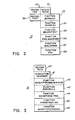
- the internal representation of a grammar rule is stored in Record Rule 40 ( Figure 3) as a record (of type Rule) consisting of its name, a list of its semantic variables (field xyzList), and a transition tree (field ParseTree) corresponding to the rule's structure.
- Each grammar rule is an instance of Record Rule 40 (i.e. there is a one-to-one correspondence between each rule and an instance).
- each path through the transition tree represents a different branch or alternative of the grammar rule, with the transitions labelled by the successive symbols (terminal and non-terminal) consumed by the branch.
- Each path in the transition tree ends at a different terminal state.
- Each terminal state has associated with it information about the semantic form and variable bindings for the corresponding branch of the rule.
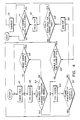
- the parser 13 operates as a state machine, cycling through six states (see Figure 4):
- the start state is ParseRule (Block 61), and RulePop (Block 70) is the terminal state. See “Appendix B Parsing Algorithm” for an outline of the parsing algorithm, which is discussed in the paragraphs below.
- the transition tree for the goal is searched in a depth-first manner.
- the parser 13 is not a generator: all applicable paths are explored during parsing, but without the ability to produce successful parses as they are found.
- Parsing begins in state ParseRule (Block 61), with retrieval of the transition tree associated with the goal.
- the parser makes use of two stacks, named Stack and SubStack, respectively. While exploring a transition tree, in state TryBranch (Block 62), SubStack is used to save information at choice points. This information is used to restore the context, in state SubPop (Block 68) upon backtracking to the choice point.
- Parses are represented by Parse records, each of which contains a list of the input unconsumed by the parse, and a parse tree.
- Parse trees contain semantic as well as syntactic information. They are represented by PSR records, each of which contains the name of the top-level rule associated with the tree, values for semantic variables associated with the rule, the semantic (Database Navigation Language) form associated with the tree, the names of the semantic variables associated with the rule, and a list of the nodes dominated by the root.
- Leaf nodes are represented by the terminal symbols associated with them.
- Internal nodes are represented by PSRT records, each consisting of a list of names of semantic variables associated with the node, as well as a PSR record representing the subtree rooted at that node.
- EvalMainForm operates by traversing a parse tree and recursively extracting Database Navigation Language tokens and filling in the Database Navigation Language templates, from the leaves of the tree upwards.
- First Database navigation operations 23 are expressed in an intermediate language that is modelled on Relational Algebra, though not all algebraic operators are provided.
- the operators that we do provide are as follows:
- RCITYSTAFFLOC might be the name of a relationship between the CITY and STAFF entity-sets, using the CITY-NAME field of the CITY entity-set and the STAFF-LOCATION field of the STAFF entity-set. Then, traversing the RCITYSTAFFLOC relationship from CITY to STAFF would yield all members of the latter entity-set whose STAFF-LOCATION field values are identical to the CITY-NAME field values of one or more members of the CITY entity-set.
- a noun qualified by a prepositional phrase would result in a SEL followed by a YFER, e.g., "staff in Ottawa” might translate to (YFER (RCITYSTAFFLOC) (SEL CITY (EQ CITY-NAME OTTAWA))) which specifies selection of all CITY records with "Ottawa” as value of the CITY-NAME field, followed by a join with the set of STAFF records having the same value for the STAFF-LOCATION field, projecting out the fields of the latter entity-set.
- YFER RCITYSTAFFLOC
- SEL CITY EQ CITY-NAME OTTAWA
- parsing a noun phrase with two qualifying phrases would correspond to an INTER of two expressions, each consisting of a SEL followed by a YFER, e.g, parsing "staff in Ottawa managed by Smith” might yield (INTER (YFER (RCITYSTAFFLOC) (SEL CITY (EQ CITY-NAME OTTAWA))) (YFER (RMANAGERSTAFFMGR) (SEL MANAGER (EQ LAST-NAME SMITH)))) where RMANAGERSTAFFMGR is the name of a-relationship between the MANAGER and STAFF entity-sets.
- Simplifier 17 analyzes intermediate language expressions and applies general, meaning preserving transformations to eliminate redundancies such as intersections of singletons, intersections of sets with their supersets, joins of singletons, and repetitious conditions on selections.
- the simplified navigation operations (i.e. second navigation operations 24) are passed on to translator 18, which will generate the corresponding database queries 26 in the target database language.
- translator 18 needs access to the database schema, which is provided to it in a file (i.e. augmented database schema 19).
- the translation of simple database navigation operations 24 into the target database language i.e. queries 26) is straightforward, and translator 18 possesses rules for translating each different type of navigation operation.
- Complex, nested intermediate language expressions are recursively decomposed until their constituents are simple enough to be directly translated.
- the translations of the subconstituents have been generated and written out to a file on disk (not shown), the translations of their embedding expressions can be generated, allowing references to entity-sets derived while translating the subconstituents.
- the file on disk (not shown) containing the database query is passed onto the database management system (DBMS) 21, which processes it and responds to the user.
- DBMS database management system
- the database schema 19 provided to translator 18 can be augmented with virtual entity-sets (not shown) in order to provide a form of mediation between the user's view of the domain and the actual organization of the database 22. This allows the user to refer to a virtual entity-set in the same manner as an actual entity-set. Moreover, since grammer 16 is domain-independent, it does not distinguish betweeen actual and virtual entity-sets when generating first navigation operations 23. During the query generation phase, translator 18 replaces references to virtual entity-sets by sequences of operations on actual entity-sets, as specified by their definitions in the augmented schema 19.
- translator 18 would make use of the definition of MANAGER in the augmented database schema 19 to translate (SEL MANAGER) to selection of the DEPARTMENT entity-set and projection of the fields corresponding to the manager's last name and initials.
- translator 18 In order to use the database 22 more efficiently, translator 18 keeps track of previously computed entity-sets, indexed by the intermediate language expressions and subexpressions corresponding to them. Then, upon being given an intermediate language expression to be translated (i.e. second navigation operations 24), translator 18 first checks whether the corresponding entity-set has been previously computed, and if so reuses it rather than computing it anew. Since translator 18 operates in a topdown, recursive manner, it always makes the most efficient use of previously computed entity-set yet has the ability to utilize them even when translating subexpressions of the original intermediate language expression.
- DNO be a field of the DEPT entity representing the dept. number.
Landscapes
- Engineering & Computer Science (AREA)
- Physics & Mathematics (AREA)
- Theoretical Computer Science (AREA)
- Databases & Information Systems (AREA)
- Mathematical Physics (AREA)
- Computational Linguistics (AREA)
- Data Mining & Analysis (AREA)
- General Engineering & Computer Science (AREA)
- General Physics & Mathematics (AREA)
- Artificial Intelligence (AREA)
- Machine Translation (AREA)
- Information Retrieval, Db Structures And Fs Structures Therefor (AREA)
Applications Claiming Priority (2)
| Application Number | Priority Date | Filing Date | Title |
|---|---|---|---|
| CA523220 | 1986-11-18 | ||
| CA000523220A CA1265871A (fr) | 1986-11-18 | 1986-11-18 | Interface pour base de donnees en langage naturel insensible au domaine |
Publications (1)
| Publication Number | Publication Date |
|---|---|
| EP0268367A2 true EP0268367A2 (fr) | 1988-05-25 |
Family
ID=4134374
Family Applications (1)
| Application Number | Title | Priority Date | Filing Date |
|---|---|---|---|
| EP87308955A Withdrawn EP0268367A2 (fr) | 1986-11-18 | 1987-10-09 | Interface en langage naturel indépendant du domaine pour base de données |
Country Status (3)
| Country | Link |
|---|---|
| EP (1) | EP0268367A2 (fr) |
| JP (1) | JPS63155325A (fr) |
| CA (1) | CA1265871A (fr) |
Cited By (33)
| Publication number | Priority date | Publication date | Assignee | Title |
|---|---|---|---|---|
| EP0454453A3 (en) * | 1990-04-26 | 1992-11-19 | Canon Kabushiki Kaisha | Information processing system |
| EP0706140A1 (fr) * | 1994-10-04 | 1996-04-10 | Hewlett-Packard Company | Archive intelligente de données |
| WO1996017311A1 (fr) * | 1994-11-29 | 1996-06-06 | St Computer Systems & Services Limited | Procede et structure pour grouper des tableaux de bases de donnees en classes et presenter chaque classe sous forme de modele entite-relation |
| US5701466A (en) * | 1992-03-04 | 1997-12-23 | Singapore Computer Systems Limited | Apparatus and method for end user queries |
| WO2000007117A3 (fr) * | 1998-07-30 | 2000-05-18 | British Telecomm | Index pour une base de donnees semi-structuree |
| DE19910621A1 (de) * | 1999-03-10 | 2000-10-05 | Thomas Poetter | Vorrichtung und Verfahren zum Verbergen von Informationen und Vorrichtung und Verfahren zum Extrahieren von Informationen |
| US6202064B1 (en) | 1997-06-20 | 2001-03-13 | Xerox Corporation | Linguistic search system |
| WO2004057495A1 (fr) * | 2002-12-20 | 2004-07-08 | Koninklijke Philips Electronics N.V. | Interrogation au moyen d'expressions indefinies |
| WO2015009353A1 (fr) * | 2013-07-17 | 2015-01-22 | Thoughtspot, Inc. | Moteur de recherche pour système d'extraction d'informations |
| US9405794B2 (en) | 2013-07-17 | 2016-08-02 | Thoughtspot, Inc. | Information retrieval system |
| US9984684B1 (en) * | 2013-06-25 | 2018-05-29 | Google Llc | Inducing command inputs from high precision and high recall data |
| US10275456B2 (en) | 2017-06-15 | 2019-04-30 | International Business Machines Corporation | Determining context using weighted parsing scoring |
| CN111325035A (zh) * | 2020-02-15 | 2020-06-23 | 周哲 | 泛化和泛在的语义交互方法、设备及存储介质 |
| US10970319B2 (en) | 2019-07-29 | 2021-04-06 | Thoughtspot, Inc. | Phrase indexing |
| US11023486B2 (en) | 2018-11-13 | 2021-06-01 | Thoughtspot, Inc. | Low-latency predictive database analysis |
| US11157564B2 (en) | 2018-03-02 | 2021-10-26 | Thoughtspot, Inc. | Natural language question answering systems |
| US11176199B2 (en) | 2018-04-02 | 2021-11-16 | Thoughtspot, Inc. | Query generation based on a logical data model |
| US11200227B1 (en) | 2019-07-31 | 2021-12-14 | Thoughtspot, Inc. | Lossless switching between search grammars |
| CN114036509A (zh) * | 2021-11-22 | 2022-02-11 | 浙江大学 | 一种基于上下文无关文法的sql注入语句变换方法 |
| US11334548B2 (en) | 2019-01-31 | 2022-05-17 | Thoughtspot, Inc. | Index sharding |
| US11354326B2 (en) | 2019-07-29 | 2022-06-07 | Thoughtspot, Inc. | Object indexing |
| US11379495B2 (en) | 2020-05-20 | 2022-07-05 | Thoughtspot, Inc. | Search guidance |
| US11409744B2 (en) | 2019-08-01 | 2022-08-09 | Thoughtspot, Inc. | Query generation based on merger of subqueries |
| US11416477B2 (en) | 2018-11-14 | 2022-08-16 | Thoughtspot, Inc. | Systems and methods for database analysis |
| US11442932B2 (en) | 2019-07-16 | 2022-09-13 | Thoughtspot, Inc. | Mapping natural language to queries using a query grammar |
| US11544239B2 (en) | 2018-11-13 | 2023-01-03 | Thoughtspot, Inc. | Low-latency database analysis using external data sources |
| US11544272B2 (en) | 2020-04-09 | 2023-01-03 | Thoughtspot, Inc. | Phrase translation for a low-latency database analysis system |
| US11580147B2 (en) | 2018-11-13 | 2023-02-14 | Thoughtspot, Inc. | Conversational database analysis |
| US11580111B2 (en) | 2021-04-06 | 2023-02-14 | Thoughtspot, Inc. | Distributed pseudo-random subset generation |
| US11586620B2 (en) | 2019-07-29 | 2023-02-21 | Thoughtspot, Inc. | Object scriptability |
| US11734286B2 (en) | 2017-10-10 | 2023-08-22 | Thoughtspot, Inc. | Automatic database insight analysis |
| US11928114B2 (en) | 2019-04-23 | 2024-03-12 | Thoughtspot, Inc. | Query generation based on a logical data model with one-to-one joins |
| US12591602B2 (en) * | 2022-09-30 | 2026-03-31 | Florida Power & Light Company | Training machine learning based natural language processing for specialty jargon |
Families Citing this family (1)
| Publication number | Priority date | Publication date | Assignee | Title |
|---|---|---|---|---|
| US8024650B2 (en) | 2006-03-31 | 2011-09-20 | Microsoft Corporation | Drilling on elements in arbitrary ad-hoc reports |
-
1986
- 1986-11-18 CA CA000523220A patent/CA1265871A/fr not_active Expired - Lifetime
-
1987
- 1987-10-09 EP EP87308955A patent/EP0268367A2/fr not_active Withdrawn
- 1987-11-16 JP JP62287584A patent/JPS63155325A/ja active Pending
Cited By (63)
| Publication number | Priority date | Publication date | Assignee | Title |
|---|---|---|---|---|
| EP0454453A3 (en) * | 1990-04-26 | 1992-11-19 | Canon Kabushiki Kaisha | Information processing system |
| US5627940A (en) * | 1990-04-26 | 1997-05-06 | Canon Kabushiki Kaisha | Method and apparatus for interactive document preparation using a natural language |
| US5701466A (en) * | 1992-03-04 | 1997-12-23 | Singapore Computer Systems Limited | Apparatus and method for end user queries |
| EP0706140A1 (fr) * | 1994-10-04 | 1996-04-10 | Hewlett-Packard Company | Archive intelligente de données |
| WO1996017311A1 (fr) * | 1994-11-29 | 1996-06-06 | St Computer Systems & Services Limited | Procede et structure pour grouper des tableaux de bases de donnees en classes et presenter chaque classe sous forme de modele entite-relation |
| GB2311636A (en) * | 1994-11-29 | 1997-10-01 | St Computer Systems & Services | Method and structure for clustering database tables into classes and presenting each class as an E-R model |
| US5809296A (en) * | 1994-11-29 | 1998-09-15 | St Computer Systems & Services Ltd. | Method and structure for clustering database tables into classes and presenting each class as an E-R model |
| US6202064B1 (en) | 1997-06-20 | 2001-03-13 | Xerox Corporation | Linguistic search system |
| WO2000007117A3 (fr) * | 1998-07-30 | 2000-05-18 | British Telecomm | Index pour une base de donnees semi-structuree |
| US7409381B1 (en) | 1998-07-30 | 2008-08-05 | British Telecommunications Public Limited Company | Index to a semi-structured database |
| DE19910621C2 (de) * | 1999-03-10 | 2001-01-25 | Thomas Poetter | Vorrichtung und Verfahren zum Verbergen von Informationen und Vorrichtung und Verfahren zum Extrahieren von Informationen |
| US7167825B1 (en) | 1999-03-10 | 2007-01-23 | Thomas Potter | Device and method for hiding information and device and method for extracting information |
| DE19910621A1 (de) * | 1999-03-10 | 2000-10-05 | Thomas Poetter | Vorrichtung und Verfahren zum Verbergen von Informationen und Vorrichtung und Verfahren zum Extrahieren von Informationen |
| WO2004057495A1 (fr) * | 2002-12-20 | 2004-07-08 | Koninklijke Philips Electronics N.V. | Interrogation au moyen d'expressions indefinies |
| US9984684B1 (en) * | 2013-06-25 | 2018-05-29 | Google Llc | Inducing command inputs from high precision and high recall data |
| WO2015009353A1 (fr) * | 2013-07-17 | 2015-01-22 | Thoughtspot, Inc. | Moteur de recherche pour système d'extraction d'informations |
| US9405794B2 (en) | 2013-07-17 | 2016-08-02 | Thoughtspot, Inc. | Information retrieval system |
| US11599587B2 (en) | 2013-07-17 | 2023-03-07 | Thoughtspot, Inc. | Token based dynamic data indexing with integrated security |
| US11017035B2 (en) | 2013-07-17 | 2021-05-25 | Thoughtspot, Inc. | Token based dynamic data indexing with integrated security |
| US11899638B2 (en) | 2013-07-17 | 2024-02-13 | Thoughtspot, Inc. | Token based dynamic data indexing with integrated security |
| US12229096B2 (en) | 2013-07-17 | 2025-02-18 | Thoughtspot, Inc. | Token based dynamic data indexing with integrated security |
| US10275456B2 (en) | 2017-06-15 | 2019-04-30 | International Business Machines Corporation | Determining context using weighted parsing scoring |
| US11734286B2 (en) | 2017-10-10 | 2023-08-22 | Thoughtspot, Inc. | Automatic database insight analysis |
| US12189691B2 (en) | 2018-03-02 | 2025-01-07 | Thoughtspot, Inc. | Natural language question answering systems |
| US11790006B2 (en) | 2018-03-02 | 2023-10-17 | Thoughtspot, Inc. | Natural language question answering systems |
| US11157564B2 (en) | 2018-03-02 | 2021-10-26 | Thoughtspot, Inc. | Natural language question answering systems |
| US11176199B2 (en) | 2018-04-02 | 2021-11-16 | Thoughtspot, Inc. | Query generation based on a logical data model |
| US11023486B2 (en) | 2018-11-13 | 2021-06-01 | Thoughtspot, Inc. | Low-latency predictive database analysis |
| US12554740B2 (en) | 2018-11-13 | 2026-02-17 | Thoughtspot, Inc. | Low-latency predictive database analysis |
| US11620306B2 (en) | 2018-11-13 | 2023-04-04 | Thoughtspot, Inc. | Low-latency predictive database analysis |
| US12038887B2 (en) | 2018-11-13 | 2024-07-16 | Thoughtspot, Inc. | Low-latency database analysis using external data sources |
| US11941034B2 (en) | 2018-11-13 | 2024-03-26 | Thoughtspot, Inc. | Conversational database analysis |
| US11544239B2 (en) | 2018-11-13 | 2023-01-03 | Thoughtspot, Inc. | Low-latency database analysis using external data sources |
| US11580147B2 (en) | 2018-11-13 | 2023-02-14 | Thoughtspot, Inc. | Conversational database analysis |
| US11416477B2 (en) | 2018-11-14 | 2022-08-16 | Thoughtspot, Inc. | Systems and methods for database analysis |
| US12493601B2 (en) | 2019-01-31 | 2025-12-09 | Thoughtspot, Inc. | Index sharding |
| US11334548B2 (en) | 2019-01-31 | 2022-05-17 | Thoughtspot, Inc. | Index sharding |
| US11928114B2 (en) | 2019-04-23 | 2024-03-12 | Thoughtspot, Inc. | Query generation based on a logical data model with one-to-one joins |
| US12259889B2 (en) | 2019-04-23 | 2025-03-25 | Thoughtspot, Inc. | Query generation based on a logical data model with one-to-one joins |
| US11442932B2 (en) | 2019-07-16 | 2022-09-13 | Thoughtspot, Inc. | Mapping natural language to queries using a query grammar |
| US12259879B2 (en) | 2019-07-16 | 2025-03-25 | Thoughtspot, Inc. | Mapping natural language to queries using a query grammar |
| US11354326B2 (en) | 2019-07-29 | 2022-06-07 | Thoughtspot, Inc. | Object indexing |
| US12099501B2 (en) | 2019-07-29 | 2024-09-24 | Thoughtspot, Inc. | Object scriptability |
| US11809468B2 (en) | 2019-07-29 | 2023-11-07 | Thoughtspot, Inc. | Phrase indexing |
| US11556571B2 (en) | 2019-07-29 | 2023-01-17 | Thoughtspot, Inc. | Phrase indexing |
| US10970319B2 (en) | 2019-07-29 | 2021-04-06 | Thoughtspot, Inc. | Phrase indexing |
| US11586620B2 (en) | 2019-07-29 | 2023-02-21 | Thoughtspot, Inc. | Object scriptability |
| US11989196B2 (en) | 2019-07-29 | 2024-05-21 | Thoughtspot, Inc. | Object indexing |
| US11803543B2 (en) | 2019-07-31 | 2023-10-31 | Thoughtspot, Inc. | Lossless switching between search grammars |
| US11200227B1 (en) | 2019-07-31 | 2021-12-14 | Thoughtspot, Inc. | Lossless switching between search grammars |
| US11966395B2 (en) | 2019-08-01 | 2024-04-23 | Thoughtspot, Inc. | Query generation based on merger of subqueries |
| US11409744B2 (en) | 2019-08-01 | 2022-08-09 | Thoughtspot, Inc. | Query generation based on merger of subqueries |
| CN111325035B (zh) * | 2020-02-15 | 2023-10-20 | 周哲 | 泛化和泛在的语义交互方法、设备及存储介质 |
| CN111325035A (zh) * | 2020-02-15 | 2020-06-23 | 周哲 | 泛化和泛在的语义交互方法、设备及存储介质 |
| US11874842B2 (en) | 2020-04-09 | 2024-01-16 | Thoughtspot, Inc. | Phrase translation for a low-latency database analysis system |
| US12242486B2 (en) | 2020-04-09 | 2025-03-04 | Thoughtspot, Inc. | Phrase translation for a low-latency database analysis system |
| US11544272B2 (en) | 2020-04-09 | 2023-01-03 | Thoughtspot, Inc. | Phrase translation for a low-latency database analysis system |
| US11379495B2 (en) | 2020-05-20 | 2022-07-05 | Thoughtspot, Inc. | Search guidance |
| US11768846B2 (en) | 2020-05-20 | 2023-09-26 | Thoughtspot, Inc. | Search guidance |
| US11580111B2 (en) | 2021-04-06 | 2023-02-14 | Thoughtspot, Inc. | Distributed pseudo-random subset generation |
| US11836136B2 (en) | 2021-04-06 | 2023-12-05 | Thoughtspot, Inc. | Distributed pseudo-random subset generation |
| CN114036509A (zh) * | 2021-11-22 | 2022-02-11 | 浙江大学 | 一种基于上下文无关文法的sql注入语句变换方法 |
| US12591602B2 (en) * | 2022-09-30 | 2026-03-31 | Florida Power & Light Company | Training machine learning based natural language processing for specialty jargon |
Also Published As
| Publication number | Publication date |
|---|---|
| JPS63155325A (ja) | 1988-06-28 |
| CA1265871A (fr) | 1990-02-13 |
Similar Documents
| Publication | Publication Date | Title |
|---|---|---|
| EP0268367A2 (fr) | Interface en langage naturel indépendant du domaine pour base de données | |
| Seneff | TINA: A natural language system for spoken language applications | |
| Guida et al. | NLI: a robust interface for natural language person-machine communication | |
| Dahl | On database systems development through logic | |
| Cimiano et al. | Porting natural language interfaces between domains: an experimental user study with the orakel system | |
| Dahl | Translating spanish into logic through logic | |
| Seo et al. | Syntactic graphs: A representation for the union of all ambiguous parse trees | |
| Waltz et al. | Writing a Natural Language Data Base System. | |
| Bais et al. | A model of a generic natural language interface for querying database | |
| Androutsopoulos et al. | Database interfaces | |
| Akerkar et al. | Natural Language Interface Using Shallow Parsing. | |
| Filipe et al. | Databases and Natural Language Interfaces. | |
| Hastings | Design and implementation of a speech recognition database query system | |
| Bais et al. | An independent-domain natural language interface for multimodel databases | |
| Johansson et al. | Iterative development of an information-providing dialogue system | |
| Rau et al. | NL∩ IR: Natural language for information retrieval | |
| Sengupta et al. | A morpho-syntactic analysis based lexical subsystem | |
| Hanane et al. | A model of a generic Arabic language interface for multimodel database | |
| Karande et al. | Natural language database interface for selection of data using grammar and parsing | |
| Meng et al. | GLR parsing with multiple grammars for natural language queries | |
| JP2606541B2 (ja) | 知識獲得方式 | |
| Ichikawa et al. | Knowledge-Base Assisted Database Retrieval Systems | |
| Burd et al. | Semantic Representations for Natural Language Query Processing | |
| ANDREW | QUERY PROCESSING | |
| Scha | Natural language interface systems |
Legal Events
| Date | Code | Title | Description |
|---|---|---|---|
| PUAI | Public reference made under article 153(3) epc to a published international application that has entered the european phase |
Free format text: ORIGINAL CODE: 0009012 |
|
| AK | Designated contracting states |
Kind code of ref document: A2 Designated state(s): DE FR GB NL SE |
|
| STAA | Information on the status of an ep patent application or granted ep patent |
Free format text: STATUS: THE APPLICATION IS DEEMED TO BE WITHDRAWN |
|
| 18D | Application deemed to be withdrawn |
Effective date: 19910503 |
|
| RIN1 | Information on inventor provided before grant (corrected) |
Inventor name: HALL, BARRY THOMAS Inventor name: AUBIN, RAYMOND Inventor name: ALI, YAWAR BAKHT |