EP0268797A2 - Halogencyclopropyl-Verbindungen, ihre Herstellung und Verwendung als herbizide Mittel - Google Patents
Halogencyclopropyl-Verbindungen, ihre Herstellung und Verwendung als herbizide Mittel Download PDFInfo
- Publication number
- EP0268797A2 EP0268797A2 EP87114775A EP87114775A EP0268797A2 EP 0268797 A2 EP0268797 A2 EP 0268797A2 EP 87114775 A EP87114775 A EP 87114775A EP 87114775 A EP87114775 A EP 87114775A EP 0268797 A2 EP0268797 A2 EP 0268797A2
- Authority
- EP
- European Patent Office
- Prior art keywords
- formula
- compound
- meaning given
- radical
- alkyl
- Prior art date
- Legal status (The legal status is an assumption and is not a legal conclusion. Google has not performed a legal analysis and makes no representation as to the accuracy of the status listed.)
- Withdrawn
Links
- 0 *c(c(NN)c1)cc([U])c1O Chemical compound *c(c(NN)c1)cc([U])c1O 0.000 description 3
- VGFXPCSALFHDIZ-UHFFFAOYSA-N N=C(C1=C2CCCC1)OC2=N Chemical compound N=C(C1=C2CCCC1)OC2=N VGFXPCSALFHDIZ-UHFFFAOYSA-N 0.000 description 1
Classifications
-
- C—CHEMISTRY; METALLURGY
- C07—ORGANIC CHEMISTRY
- C07D—HETEROCYCLIC COMPOUNDS
- C07D209/00—Heterocyclic compounds containing five-membered rings, condensed with other rings, with one nitrogen atom as the only ring hetero atom
- C07D209/02—Heterocyclic compounds containing five-membered rings, condensed with other rings, with one nitrogen atom as the only ring hetero atom condensed with one carbocyclic ring
- C07D209/44—Iso-indoles; Hydrogenated iso-indoles
- C07D209/48—Iso-indoles; Hydrogenated iso-indoles with oxygen atoms in positions 1 and 3, e.g. phthalimide
-
- A—HUMAN NECESSITIES
- A01—AGRICULTURE; FORESTRY; ANIMAL HUSBANDRY; HUNTING; TRAPPING; FISHING
- A01N—PRESERVATION OF BODIES OF HUMANS OR ANIMALS OR PLANTS OR PARTS THEREOF; BIOCIDES, e.g. AS DISINFECTANTS, AS PESTICIDES OR AS HERBICIDES; PEST REPELLANTS OR ATTRACTANTS; PLANT GROWTH REGULATORS
- A01N37/00—Biocides, pest repellants or attractants, or plant growth regulators containing organic compounds containing a carbon atom having three bonds to hetero atoms with at the most two bonds to halogen, e.g. carboxylic acids
- A01N37/18—Biocides, pest repellants or attractants, or plant growth regulators containing organic compounds containing a carbon atom having three bonds to hetero atoms with at the most two bonds to halogen, e.g. carboxylic acids containing the group —CO—N<, e.g. carboxylic acid amides or imides; Thio analogues thereof
- A01N37/32—Cyclic imides of polybasic carboxylic acids or thio analogues thereof
-
- A—HUMAN NECESSITIES
- A01—AGRICULTURE; FORESTRY; ANIMAL HUSBANDRY; HUNTING; TRAPPING; FISHING
- A01N—PRESERVATION OF BODIES OF HUMANS OR ANIMALS OR PLANTS OR PARTS THEREOF; BIOCIDES, e.g. AS DISINFECTANTS, AS PESTICIDES OR AS HERBICIDES; PEST REPELLANTS OR ATTRACTANTS; PLANT GROWTH REGULATORS
- A01N43/00—Biocides, pest repellants or attractants, or plant growth regulators containing heterocyclic compounds
- A01N43/48—Biocides, pest repellants or attractants, or plant growth regulators containing heterocyclic compounds having rings with two nitrogen atoms as the only ring hetero atoms
- A01N43/56—1,2-Diazoles; Hydrogenated 1,2-diazoles
-
- A—HUMAN NECESSITIES
- A01—AGRICULTURE; FORESTRY; ANIMAL HUSBANDRY; HUNTING; TRAPPING; FISHING
- A01N—PRESERVATION OF BODIES OF HUMANS OR ANIMALS OR PLANTS OR PARTS THEREOF; BIOCIDES, e.g. AS DISINFECTANTS, AS PESTICIDES OR AS HERBICIDES; PEST REPELLANTS OR ATTRACTANTS; PLANT GROWTH REGULATORS
- A01N43/00—Biocides, pest repellants or attractants, or plant growth regulators containing heterocyclic compounds
- A01N43/64—Biocides, pest repellants or attractants, or plant growth regulators containing heterocyclic compounds having rings with three nitrogen atoms as the only ring hetero atoms
- A01N43/647—Triazoles; Hydrogenated triazoles
- A01N43/653—1,2,4-Triazoles; Hydrogenated 1,2,4-triazoles
-
- A—HUMAN NECESSITIES
- A01—AGRICULTURE; FORESTRY; ANIMAL HUSBANDRY; HUNTING; TRAPPING; FISHING
- A01N—PRESERVATION OF BODIES OF HUMANS OR ANIMALS OR PLANTS OR PARTS THEREOF; BIOCIDES, e.g. AS DISINFECTANTS, AS PESTICIDES OR AS HERBICIDES; PEST REPELLANTS OR ATTRACTANTS; PLANT GROWTH REGULATORS
- A01N43/00—Biocides, pest repellants or attractants, or plant growth regulators containing heterocyclic compounds
- A01N43/64—Biocides, pest repellants or attractants, or plant growth regulators containing heterocyclic compounds having rings with three nitrogen atoms as the only ring hetero atoms
- A01N43/707—1,2,3- or 1,2,4-triazines; Hydrogenated 1,2,3- or 1,2,4-triazines
-
- A—HUMAN NECESSITIES
- A01—AGRICULTURE; FORESTRY; ANIMAL HUSBANDRY; HUNTING; TRAPPING; FISHING
- A01N—PRESERVATION OF BODIES OF HUMANS OR ANIMALS OR PLANTS OR PARTS THEREOF; BIOCIDES, e.g. AS DISINFECTANTS, AS PESTICIDES OR AS HERBICIDES; PEST REPELLANTS OR ATTRACTANTS; PLANT GROWTH REGULATORS
- A01N43/00—Biocides, pest repellants or attractants, or plant growth regulators containing heterocyclic compounds
- A01N43/72—Biocides, pest repellants or attractants, or plant growth regulators containing heterocyclic compounds having rings with nitrogen atoms and oxygen or sulfur atoms as ring hetero atoms
- A01N43/82—Biocides, pest repellants or attractants, or plant growth regulators containing heterocyclic compounds having rings with nitrogen atoms and oxygen or sulfur atoms as ring hetero atoms five-membered rings with three ring hetero atoms
-
- A—HUMAN NECESSITIES
- A01—AGRICULTURE; FORESTRY; ANIMAL HUSBANDRY; HUNTING; TRAPPING; FISHING
- A01N—PRESERVATION OF BODIES OF HUMANS OR ANIMALS OR PLANTS OR PARTS THEREOF; BIOCIDES, e.g. AS DISINFECTANTS, AS PESTICIDES OR AS HERBICIDES; PEST REPELLANTS OR ATTRACTANTS; PLANT GROWTH REGULATORS
- A01N43/00—Biocides, pest repellants or attractants, or plant growth regulators containing heterocyclic compounds
- A01N43/90—Biocides, pest repellants or attractants, or plant growth regulators containing heterocyclic compounds having two or more relevant hetero rings, condensed among themselves or with a common carbocyclic ring system
-
- C—CHEMISTRY; METALLURGY
- C07—ORGANIC CHEMISTRY
- C07D—HETEROCYCLIC COMPOUNDS
- C07D231/00—Heterocyclic compounds containing 1,2-diazole or hydrogenated 1,2-diazole rings
- C07D231/54—Heterocyclic compounds containing 1,2-diazole or hydrogenated 1,2-diazole rings condensed with carbocyclic rings or ring systems
- C07D231/56—Benzopyrazoles; Hydrogenated benzopyrazoles
-
- C—CHEMISTRY; METALLURGY
- C07—ORGANIC CHEMISTRY
- C07D—HETEROCYCLIC COMPOUNDS
- C07D471/00—Heterocyclic compounds containing nitrogen atoms as the only ring hetero atoms in the condensed system, at least one ring being a six-membered ring with one nitrogen atom, not provided for by groups C07D451/00 - C07D463/00
- C07D471/02—Heterocyclic compounds containing nitrogen atoms as the only ring hetero atoms in the condensed system, at least one ring being a six-membered ring with one nitrogen atom, not provided for by groups C07D451/00 - C07D463/00 in which the condensed system contains two hetero rings
- C07D471/04—Ortho-condensed systems
Definitions
- the invention relates to new halocyclopropyl compounds, their preparation by methods known per se and their use as herbicidal compositions.
- halocyclopropyl compounds of the general formula I wherein R1, R2 and R3 independently of one another are hydrogen or C 1-4 alkyl, X is hydrogen or halogen, Y halogen n 0, 1, 2 or 3 U and V are hydrogen or halogen and W is a heterocyclic radical of the formulas in which T for halogen, C 1-4 alkyl, C 1-4 haloalkyl, CN or OR9, Q for CH or N, Z for O or S, R4, R5, R6, R7 and R8 each represent a straight-chain, branched or cyclic, optionally substituted with up to six halogen atoms, C 1-7 -alkyl radical, where R4 and R5 can also together form a heterocyclic 4- to 7-membered ring which can be saturated or unsaturated, can contain further heteroatoms such as O, S or N and can optionally be substituted by one to three methyl groups or one to six halogen atoms, and R9
- halogen stands for F, Cl, Br or J.
- haloalkyl means that one or more hydrogen atoms of the alkyl radical have been replaced by halogen.
- heterocyclic rings are: pyrrole, oxazole, thiazole, imidazole, pyridine, oxazine, thiazine, pyrimidine, pyrazine, triazine, oxadiazine and thiadiazine and their di-, tetra- or optionally hexahydro derivatives.
- the reaction according to process variant a) is advantageously carried out with the aid of an acid acceptor at a temperature between 0 ° C. and 150 ° C., in particular between room temperature and the reflux temperature of the reaction mixture.
- the usual basic agents in particular aliphatic amines, such as e.g. Triethylamine or diisopropylamine, but also alkali carbonates and their aqueous solutions are suitable.
- the etherification can also be carried out in a two-phase system using a catalyst and, if appropriate, in the presence of solvents.
- Alkali hydroxides or alkali carbonates, solid or in aqueous solution serve as bases.
- the reactants themselves are suitable as solvents, if they are liquid. Otherwise, water-immiscible substances which are inert towards the bases, such as aliphatic or aromatic hydrocarbons, such as, for example, hexane, benzene or toluene, are used.
- the preferred catalysts are crown ethers, such as, for example, 1,4,7,10,13,16-hexaoxacyclooctadecane, and quaternary ammonium salts, as described in Dehmlow and Dehmlow, Phase Transfer Catalysis, Weinheim 1980.
- the starting materials are usually used in a stoichiometric ratio. However, an excess of one or the other can be advantageous in individual cases.
- the reaction according to process variants b) and c) is expediently carried out with catalysis in a suitable solvent.
- the reaction temperatures are between room temperature and 150 ° C, preferably at the reflux temperature of the reaction mixture.
- suitable solvents are dimethyl sulfoxide, halogenated hydrocarbons such as methylene chloride and chloroform, aromatic hydrocarbons such as benzene, toluene, xylene, chlorobenzene and dichlorobenzene, and other solvents which are inert to the reactants, such as diethyl ether, tetrahydrofuran or dimethylformamide.
- Acids such as acetic acid or sulfuric acid, but also acidic ion exchangers can be used as catalysts.
- the reaction according to process variant d) takes place without or using a suitable inert solvent.
- suitable solvents are dimethyl sulfoxide, halogenated hydrocarbons such as methylene chloride or chloroform, aromatic hydrocarbons such as benzene, toluene, xylene, chlorobenzene and dichlorobenzene, and other solvents which are inert to the reactants, such as diethyl ether, tetrahydrofuran or dimethylformamide.
- reaction of compounds of formula IX and compounds of formula X according to process variant e) is carried out in two ways with the aid of an acid acceptor at a temperature between 0 ° C. and 150 ° C., in particular between room temperature and the reflux temperature of the solution.
- the usual basic agents in particular aliphatic amines, such as e.g. Triethylamine or diisopropylamine, but also alkali carbonates and their aqueous solutions are suitable.
- the alkylation can also be carried out in a two phase system using a catalyst and optionally in the presence of solvents.
- Alkali hydroxides or alkali carbonates solid or in aqueous solution, serve as bases.
- the reactants themselves are suitable as solvents if they are liquid. Otherwise, water-immiscible substances which are inert towards the bases, such as aliphatic or aromatic hydrocarbons, such as, for example, hexane, benzene or toluene, are used. Crown ethers and quaternary ammonium salts are preferred as catalysts.
- the starting materials are usually used in a stoichiometric ratio. An excess of one or the other can also be advantageous in individual cases.
- the implementation according to process variant f) generally takes place in three stages without intermediate purification of the products.
- any inert organic solvent can also be used as the solvent.
- the reaction temperatures are between -20 ° C and 100 ° C, preferably between -10 ° C and room temperature.
- the reaction according to process variants g) and h) is expediently carried out at a temperature above 20 ° C., for example at 100 ° C. or at the reflux temperature of the reaction mixture.
- the reactant is an anhydride as with compound gene of the formulas XVI or XVII
- the reaction is advantageously carried out in the presence of an acid such as acetic acid, for example by working in acetic acid as a solvent.
- an inert solvent such as, for example, dichloromethane or dimethyl sulfoxide
- cyclize the intermediate product formed with acid anhydrides such as, for example, acetic anhydride.
- the reaction according to process variant h) with the compounds of the formulas XIX and XX takes place in an inert solvent at temperatures between 20 ° C. and 150 ° C., preferably at the boiling point of the solvent.
- Suitable solvents are e.g. aliphatic and aromatic, optionally chlorinated hydrocarbons, such as petroleum ether, benzene, toluene, xylene, gasoline, dichloromethane, chloroform, carbon tetrachloride, 1,2-dichloroethane, chlorobenzene, and ethers, such as diethyl and di-n-butyl ether, methyl tert.
- ketones such as, for example, acetone, methyl ethyl ketone, methyl isopropyl ketone, also nitriles, such as acetonitrile and propionetrile, and sulfoxides, such as dimethyl sulfoxide, or sulfolane.
- the reaction according to process i) is advantageously carried out in a solvent which is inert to the reactants, such as chloroform, ethers, such as dioxane or diethylene glycol dialkyl ethers, aliphatic hydrocarbons, such as cyclohexane or decane, optionally with the action of a strong base, such as alkali metal alcoholates or hydroxides, preferably in the 2nd -Phase system with the aid of a phase transfer catalyst, as described in DEHMLOW AND DEHMLOW: Phase Transfer Catalysis, Weinheim 1980, carried out at temperatures between room temperature and 200 ° C, preferably at the boiling point of the solvent.
- a solvent which is inert to the reactants such as chloroform, ethers, such as dioxane or diethylene glycol dialkyl ethers, aliphatic hydrocarbons, such as cyclohexane or decane
- a strong base such as alkali metal alcoholates or hydroxides
- the compounds according to the invention prepared by the abovementioned processes can be prepared from the Reaction mixture are isolated, for example by distilling off the solvent used at normal or reduced pressure or by extraction.
- An increased degree of purity can generally be obtained by purification by column chromatography and by fractional distillation.
- the compounds according to the invention are generally crystalline or viscous substances, some of which are readily soluble in halogenated hydrocarbons, such as chloroform, sulfoxides, such as dimethyl sulfoxide, or esters, such as ethyl acetate.
- halogenated hydrocarbons such as chloroform
- sulfoxides such as dimethyl sulfoxide
- esters such as ethyl acetate
- the compounds according to the invention can contain one or more asymmetric carbon atoms.
- the present invention includes the optically active formula and mixtures thereof. Unless stated otherwise, the racemates were obtained in the examples.
- the compounds according to the invention have excellent herbicidal activity against economically important mono- and dicotyledon weeds. It does not matter whether the substances are applied in pre-sowing, pre-emergence or post-emergence spraying.
- the compounds according to the invention show very good tolerances for rice, wheat, soybeans, corn, cotton and barley.
- the compounds of the invention can e.g. can be used to control weeds against the following plant species:
- the compounds are suitable in higher application rates for total weed control, such as in industrial and on track systems and on paths and squares.
- the compounds for weed control in permanent crops for example forest, ornamental wood, fruit, wine, citrus, nut, banana, coffee, tea, Gum, oil palm, cocoa, berry fruit and hop plants can be used.
- the amount of active ingredient used can be varied within a substantial range. It essentially depends on the type of effect you want. In general, the application rates are between 0.01 and 5 kg of active ingredient per hectare of soil, preferably e.g. in weed control, between 0.1 and 0.5 kg per ha.
- herbicides which are described in Weed Abstracts, Vol: 35, no. 3, 1986, under the title "List of common names and abbreviations employed for currently used herbicides and plant growth regulators in Weed Abstracts".
- the compounds according to the invention or their mixtures are expediently in the form of preparations, such as powders, scattering agents, granules, solutions, emulsions or suspensions, with the addition of liquid and / or solid carriers or diluents and, if appropriate, adhesives, wetting agents, emulsifiers and / or Dispersing aids applied.
- Suitable liquid carriers are, for example, aliphatic and aromatic hydrocarbons such as toluene, xylene, cyclohexanone, isophorone, dimethylformamide, mineral oil fractions and vegetable oils.
- Minerals such as gypsum, tonsil, silica gel, talc, kaolin, attapulgite, limestone and vegetable products such as flours are suitable as solid carriers.
- surfactants include calcium lignin sulfonate, polyethylene alkylphenyl ether and polyoxyethy len sorbitol esters, polyoxyethylene polypropylene polymers, naphthalenesulfonic acids and their salts, cationic surfactants with tert. Amines that are partially substituted by polyethoxy groups, phenolsulfonic acids and their salts, formaldehyde condensates, fatty alcohol sulfates and substituted benzenesulfonic acid and its salts.
- the proportion of the active ingredient (s) in the various preparations can vary within wide limits.
- the agents contain about 10 to 90 percent by weight of active ingredient, about 90 to 10 percent by weight of liquid or solid carriers and optionally up to 20 percent by weight of surface-active agents.
- the agents can be applied in a customary manner, for example using water as a carrier in spray liquor amounts of about 100 to 3000 liters / ha.
- Use of the agents in the so-called low-volume and ultra-low-volume process is just as possible as their application in the form of so-called microgranules.
- preparations can be prepared in a manner known per se, such as by grinding or mixing processes. If desired, the individual components can also be mixed shortly before they are used, as is done in practice, for example, in the so-called tank mix process.
- the hydrazone is dissolved in 130 ml of toluene, mixed with 3.3 ml of triethylamine and heated until the solution has cleared. The mixture is then cooled to about 35 ° C., 5.1 ml of diphenyl ester of phosphoric acid are added dropwise and the mixture is slowly warmed to 75 ° C. This temperature is maintained until no more nitrogen escapes, then the mixture is heated to reflux. After 12 hours, the mixture is cooled, the reaction solution is extracted three times with 10% sodium hydroxide solution, and the aqueous phase is washed twice with toluene and acidified. The product is extracted with toluene and the organic phase is dried.
- the product obtained according to the above instructions is dissolved in 300 ml of cyclohexane, 2.7 g of potassium hydroxide and 2 g of tetrabutylammonium bromide are added, the mixture is heated to reflux and then chlorodifluoromethane is introduced. After the reaction has ended (control by means of thin layer chromatography), the solution is decanted, washed twice with 1N hydrochloric acid and 10% sodium hydroxide solution, dried over magnesium sulfate and concentrated. The The residue is chromatographed on silica gel with ethyl acetate and then again with methylene chloride.
- the mixture is warmed to room temperature overnight. For working up, the mixture is cooled to 0 ° C. and slowly neutralized with 430 ml of 32% sodium hydroxide solution.
- the precipitated tin hydroxide sludge is removed by filtration with Celite, the filter cake is washed with ether and the aqueous mother liquor is extracted several times with ether.
- the combined organic phases are dried over magnesium sulfate and the solvent is stripped off.
- the compounds according to the invention were sprayed at a rate of 1 kg of active ingredient / ha, emulsified in 500 l of water / ha, onto test plant species of the genera Matricaria and Viola in the pre- and post-emergence process.
- the plant species listed were treated with the listed compounds at a rate of 0.1 kg of active ingredient / ha before emergence.
- the compounds were sprayed as an emulsion with 500 liters of water / ha evenly over the plants. 3 weeks after the treatment, the compounds according to the invention showed a high selectivity compared to known agents with excellent activity against the weeds.
- Go Gossypium hirsutum
- Gl glycine max
- Ma Matricaria chamomilla
- Vi Viola tricolor
- Av Avena fatua
- Al Alopecurus myosuroides
- the listed plant species were treated with the listed compounds at a rate of 0.3 kg of active ingredient / ha after emergence.
- the compounds were sprayed as an emulsion with 500 liters of water / ha evenly over the plants.
- the compounds according to the invention showed a high selectivity compared to the known compound with excellent activity against the weeds.
- the listed plant species were treated with the listed compounds at a rate of 0.3 kg of active ingredient / ha after emergence.
- the compounds were sprayed as an emulsion with 500 liters of water / ha evenly over the plants.
- the compounds according to the invention showed good herbicidal properties here 3 weeks after the treatment.
- Cd Cyperus difformis
- Fi Fimbristylis miliacea
- the compounds listed in the table were applied in the greenhouse at the application rates also mentioned.
- the active ingredients were placed in vessels with 1500 ml of water (water application).
- the test plants were used in the 2- to 5-leaf stage. The damage to the plants was assessed three weeks after the application.
- the compounds according to the invention are very effective against important rice weeds.
- Cd Cyperus difformis
- Fi Fimbristylis miliacea
- Sa Saggitaria pusilla
- El Eleocharis acicularis
Landscapes
- Life Sciences & Earth Sciences (AREA)
- Organic Chemistry (AREA)
- Chemical & Material Sciences (AREA)
- Health & Medical Sciences (AREA)
- Environmental Sciences (AREA)
- Engineering & Computer Science (AREA)
- Dentistry (AREA)
- General Health & Medical Sciences (AREA)
- Wood Science & Technology (AREA)
- Zoology (AREA)
- Plant Pathology (AREA)
- Pest Control & Pesticides (AREA)
- Agronomy & Crop Science (AREA)
- Agricultural Chemicals And Associated Chemicals (AREA)
- Plural Heterocyclic Compounds (AREA)
- Nitrogen Condensed Heterocyclic Rings (AREA)
- Indole Compounds (AREA)
- Heterocyclic Carbon Compounds Containing A Hetero Ring Having Nitrogen And Oxygen As The Only Ring Hetero Atoms (AREA)
Abstract
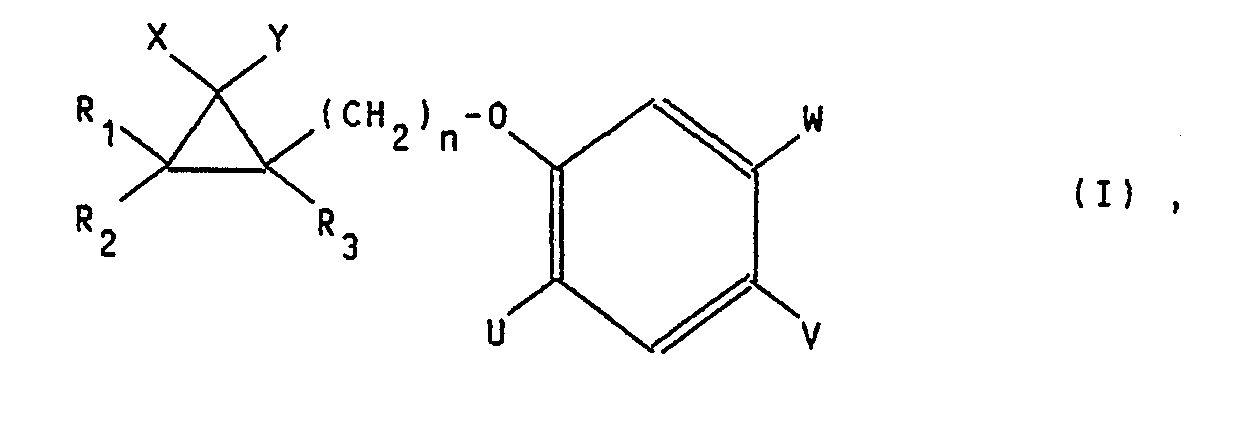
R₁, R₂ und R₃ unabhängig voneinander Wasserstoff oder C1-4-Alkyl,
X Wasserstoff oder Halogen,
Y Halogen
n 0, 1, 2 oder 3
U und V Wasserstoff oder Halogen und
W einen heterocyclischen Rest der Formeln

T für Halogen, C1-4-Alkyl, C1-4-Halogenalkyl, CN oder OR₉,
Q für CH oder N,
Z für O oder S,
R₄, R₅, R₆, R₇ und R₈ jeweils für einen geradkettigen, verzweigten oder cyclischen, gegebenenfalls mit bis zu sechs Halogenatomen substituierten C1-7-Alkylrest stehen, wobei
R₄ und R₅ außerdem gemeinsam einen heterocylischen 4- bis 7-gliedrigen Ring bilden können, der gesättigt oder ungesättigt sein kann, weitere Heteroatome wie O, S oder N enthalten kann und gegebenenfalls mit ein bis drei Methylgruppen oder ein bis sechs Halogenatomen substituiert sein kann, und
R₉ Wasserstoff, C1-4-Alkyl oder C1-4-Halogenalkyl bedeutet, Verfahren zu ihrer Herstellung und ihre Verwendung als Herbizide mit hoher Selektivität beschrieben.
Description
- Die Erfindung betrifft neue Halogencyclopropyl-Verbindungen, ihre Herstellung nach an sich bekannten Methoden und ihre Verwendung als herbizide Mittel.
- Es ist bereits bekannt, daß bestimmte Tetrahydroindazole und Tetrahydrophthalsäureimide herbizide Eigenschaften haven (EP 61 741 und 105 721). Die Wirksamkeit dieser Stoffe ist bei Vorauflauf- und Nachauflaufanwendung als gut zu bezeichnen. Nachteilig ist jedoch, daß ihre Verträglichkeit in einigen Kulturen - wie zum Beispiel bei Baumwolle, Soja und Getreide - nicht voll ausreicht.
- Es wurde nun gefunden, daß Halogencyclopropyl-Verbindungen der allgemeinen Formel I

R₁, R₂ und R₃ unabhängig voneinander wasserstoff oder C1-4-Alkyl,
X Wasserstoff oder Halogen,
Y Halogen
n 0, 1, 2 oder 3
U und V Wasserstoff oder Halogen und
W einen heterocyclischen Rest der Formeln

T für Halogen, C1-4-Alkyl, C1-4-Halogenalkyl, CN oder OR₉,
Q für CH oder N,
Z für O oder S,
R₄, R₅, R₆, R₇ und R₈ jeweils für einen geradkettigen, verzweigten oder cyclischen, gegebenenfalls mit bis zu sechs Halogenatomen substituierten C1-7-Alkylrest stehen, wobei
R₄ und R₅ außerdem gemeinsam einen heterocyclischen 4- bis 7-gliedrigen Ring bilden können, der gesättigt oder ungesättigt sein kann, weitere Heteroatome wie O, S oder N enthalten kann und gegebenenfalls mit ein bis drei Methylgruppen oder ein bis sechs Halogenatomen substituiert sein kann, und
R₉ Wasserstoff, C1-4-Alkyl oder C1-4-Halogenalkyl bedeutet,
überraschenderweise eine hervorragende Verträglichkeit für Reis, Weizen, Soja, Mais, Baumwolle und Gerste bei gleichzeitig verbesserter herbizider Wirkung zeigen. - Der Ausdruck Halogen steht für F, Cl, Br oder J. Die Bezeichnung Halogenalkyl besagt, daß ein oder mehrere Wasserstoffatome des Alkylrestes durch Halogen ersetzt sind.
- Als Beispiele für heterocyclische Ringe seien genannt: Pyrrol, Oxazol, Thiazol, Imidazol, Pyridin, Oxazin, Thiazin, Pyrimidin, Pyrazin, Triazin, Oxadiazin und Thiadiazin sowie ihre Di-, Tetra- oder gegebenenfalls Hexahydroderivate.
- Die erfindungsgemäßen Verbindungen können in an sich bekannter Weise auf folgenden Wegen dargestellt werden:
- a) Ein Halogenid der allgemeinen Formel II


- b) Zur Herstellung einer Verbindung der Formel I, in der W einen 4,5,6,7-Tetrahydroindazol-2-yl-Rest darstellt, wird ei ne Verbindung der Formel IV


- Die so erhaltenen Verbindungen der Formel I mit T in der Bedeutung von Hydroxy können gegebenenfalls weiter umgesetzt werden. Zum Beispiel erhält man durch Umsetzung mit Dialkylsulfat die entsprechenden Verbindungen mit T in der Bedeutung von Alkoxy oder bei der Umsetzung mit Phosphoroxyhalogeniden erhält man die entsprecheden Verbindungen mit T in der Bedeutung von Halogen, die dann durch Umsetzung mit NaCN in die entsprechenden Verbindungen mit T in der Bedeutung von CN überführt werden können.
- c) Zur Herstellung von Verbindungen der Formel I, in der W einen 2H-1,2,4-Triazolin-3-on-2-yl-Rest darstellt, wird eine Verbindung der Formel IV


- d) Zur Herstellung der Verbindungen der Formel I, in der W einen 3H-1,3,4-Oxadiazol-2-on-3-yl-Rest darstellt, wird eine Verbindung der Formel IV


- e) Zur Herstellung von Verbindungen der Formel I, in der W einen 2H,4H-1,2,4-Triazin-3,5-dion-2-yl-Rest darstellt, wird eine Verbindung der Formel IV

R₈ -- COOH (XII) ,
worin R₈ die in der Formel I genannte Bedeutung hat, zu einer Verbindung der Formel XI

worin R₇ die in Formel I genannte Bedeutung hat und A Chlor. Brom oder Jod bedeutet, umgesetzt. - f) Zur Herstellung von Verbindungen der Formel I, in der W einen 4,5,6,7-Tetrahydro-2H-1,2,3-triazolo[3,4-a]pyridin-8-ium-3-olat-2-yl-Rest darstellt, wird eine Verbindung der Formel XV

- g) Zur Herstellung der Verbindungen der Formel I, in der W einen 1,3,4,5,6,7-Hexahydro-2H-isoindol-1,3-dion-2-yl-Rest darstellt, wird eine Verbindung der Formel XV


- h) Zur Herstellung der Verbindungen der Formel I, in der W einen 2,3,5,6,7,8-Hexahydro-1H-imidazo[1,5-a]pyridin-1,3-dion-2-yl- oder einen 2,3,5,6,7,8-Hexahydro-1H-1,3,4-triazolo-[1,2-a]pyridazin-1,3-dion-2-yl-Rest darstellt, wird eine Verbindung der Formel XV

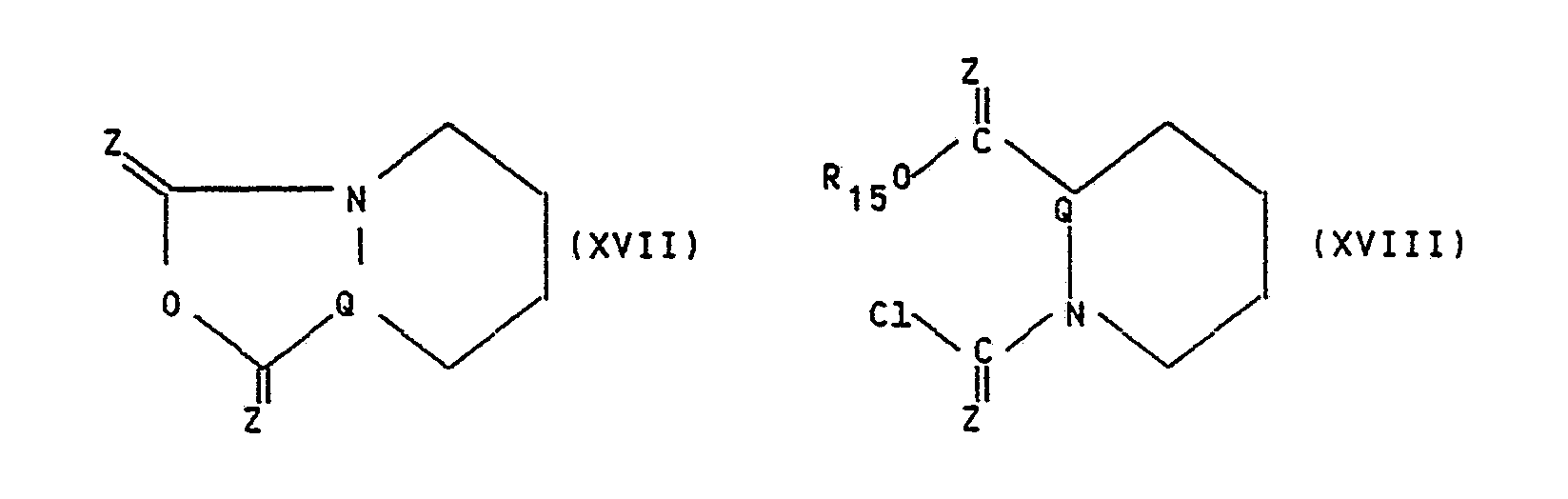
oder
eine Verbindung der Formel XV


- i) Eine Verbindung der Formel XXI


- Die Umsetzung gemäß Verfahrensvariante a) wird zweckmäßig unter Zuhilfenahme eines Säureacceptors bei einer Temparatur zwischen 0°C und 150°C, insbesondere zwischen Raumtemperatur und Rückflußtemperatur des Reaktionsgemisches durchgeführt. Als Säureacceptor sind die üblichen basischen Mittel, insbesondere aliphatische Amine, wie z.B. Triethylamin oder Diisopropylamin, aber auch Alkalicarbonate und deren wässrige Lösungen geeignet.
- Die Veretherung kann weiterhin in einem Zweiphasensystem unter Verwendung eines Katalysators und gegebenenfalls in Gegenwart von Lösungsmitteln durchgeführt werden. Als Basen dienen Alkalihydroxide oder Alkalicarbonate, fest oder in wässriger Lösung. Als Lösungsmittel geeignet sind die Reaktanden selbst, sofern sie flüssig sind. Ansonsten werden mit Wasser nicht mischbare und gegenüber den Basen inerte Stoffe, wie aliphatische oder aromatische Kohlenwasserstoffe, wie zum Beispiel Hexan, Benzol oder Toluol verwendet. Als Katalysatoren kommen vorzugsweise Kronenether, wie z.B. 1,4,7,10,13,16-Hexaoxacyclooctadecan, und quarternäre Ammoniumsalze in Frage, wie sie in Dehmlow und Dehmlow, Phase Transfer Catalysis, Weinheim 1980, beschrieben sind.
- Üblicherweise setzt man die Ausgangsstofe in stöchiometrischem Verhältnis ein. Ein Überschuß des einen oder anderen kann in Einzelfällen aber durchaus vorteilhaft sein.
- Die Umsetzung gemäß den Verfahrensvarianten b) und c) wird zweckmäßig unter Katalyse in einem geeigneten Lösungsmittel durchgeführt. Die Reaktionstemperaturen liegen zwischen Raumtemperatur und 150°C, bevorzugt bei Rückflußtemperatur des Reaktionsgemisches. Als geeignete Lösungsmittel seien beispielsweise genannt Dimethylsulfoxid, Halogenkohlenwasserstoffe, wie zum Beispiel Methylenchlorid und Chloroform, aromatische Kohlenwasserstoffe, wie zum Beispiel Benzol, Toluol, Xylol, Chlorbenzol und Dichlorbenzol, sowie andere gegenüber den Reaktionspartnern inerte Lösungsmittel, wie zum Beispiel Diethylether, Tetrahydrofuran oder Dimethylformamid.
- Als Katalysatoren können Säuren wie Essigsäure oder Schwefelsäure, aber auch saure Ionentauscher verwendet werden.
- Die Reaktion gemäß Verfahrensvariante d) erfolgt ohne oder unter Verwendung eines geeigneten inerten Lösungsmittels. Als geeignete Lösungsmittel seien beispielsweise genannt Dimethylsulfoxid, Halogenkohlenwasserstoffe, wie z.B. Methylenchlorid oder Chloroform, aromatische Kohlenwasserstoffe, wie z.B. Benzol, Toluol, Xylol, Chlorbenzol und Dichlorbenzol, sowie andere gegenüber den Reaktionspartnern inerte Lösungsmittel, wie z.B. Diethylether, Tetrahydrofuran oder Dimethylformamid.
- Die Umsetzung von Verbindungen der Formel IX und Verbindungen der Formel X gemäß Verfahrensvariante e) wird zwechmäßig unter Zuhilfenahme eines Säureacceptors bei einer Temperatur zwischen 0°C und 150°C, insbesondere zwischen Raumtemperatur und Rückflußtemperatur der Lösung durchgeführt. Als Säureacceptor sind die üblichen basischen Mittel, insbesondere aliphatische Amine, wie z.B. Triethylamin oder Diisopropylamin, aber auch Alkalicarbonate und deren wässrige Lösungen geeignet.
- Die Alkylierung kann auch in einem Zweiphasensystem unter Verwendung eines Katalysators und gegenbenenfalls in Gegenwart von Lösungsmitteln durchgeführt werden. Als Basen dienen Alkalihydroxide oder Alkalicarbonate, fest oder in wässriger Lösung. Als Lösungsmittel geeignet sind die Reaktanden selbst, sofern sie flüssig sind. Ansonsten werden mit Wasser nicht mischbare und gegenüber den Basen inerte Stoffe, wie aliphatische oder aromatische Kohlenwasserstoffe, wie zum Beispiel Hexan, Benzol oder Toluol verwendet. Als Katalysatoren kommen vorzugsweise Kronenether und quarternäre Ammoniumsalze in Frage.
- Überlicherweise setzt man die Ausgangsstoffe in stöchiometrischem Verhältnis ein. Ein Überschuß des einen oder anderen kann in Einzelfällen aber auch durchaus vorteilhaft sein.
- Die Umsetzung gemäß Verfahrensvariante f) erfolgt im allgemeinen in drei Stufen ohne zwischenzeitliche Aufreinigung der Produkte. Als Lösungsmittel kann neben Wasser auch jedes inerte organische Lösungsmittel verwendet werden. Es kann aber auch ohne Lösungsmittel gearbeitet werden. Die Reaktionstemperaturen liegen zwischen -20°C und 100°C, bevorzugt zwischen -10°C und Raumtemperatur.
- Die Umsetzung gemäß den Verfahrensvarianten g) und h) wird zweckmäßig bei einer Temperatur oberhalb 20°C, z.B. bei 100°C oder bei Rückflußtemperatur der Reaktionsmischung durchgeführt. Falls der Reaktionspartner ein Anhydrid ist wie bei Verbindun gen der Formeln XVI oder XVII, wird die Reaktion zweckmäßig in Gegenwart einer Säure wie Essigsäure durchgeführt, z.B. indem man in Essigsäure als Lösungsmittel arbeitet. Es ist aber auch möglich, die beiden Reaktionspartner ohne oder unter Verwendung eines inerten Lösungsmittels, wie z.B. Dichlormethan oder Dimethylsulfoxid, zur Reaktion zu bringen und das intermediär entstandene Additionsprodukt mit Säureanhydriden, wie zum Beispiel Acetanhydrid, zu cyclisieren.
- Die Umsetzung gemäß Verfahrensvariante h) mit den Verbindungen der Formeln XIX und XX erfolgt in einem inerten Lösungsmittel bei Temperaturen zwischen 20°C und 150°C, bevorzugt bei der Siedetemperatur des Lösungsmittels. Geeignete Lösungsmittel sind z.B. aliphatische und aromatische, gegebenenfalls chlorierte Kohlenwasserstoffe, wie Petrolether, Benzol, Toluol, Xylol, Benzin, Dichlormethan, Chloroform, Tetrachlormethan, 1,2-Dichlorethan, Chlorbenzol, sowie Ether, wie Diethyl- und Di-n-butylether, Methyl-tert.-butylether, Tetrahydrofuran, Diozan, Ketone, wie beispielsweise Aceton, Methlethylketon, Methylisopropylketon, ferner Nitrile, wie Acetonitril und Propiontril, und Sulfoxide, wie Dimethylsulfoxid, oder Sulfolan.
- Die Umsetzung gemäß Verfahren i) wird zweckmäßigerweise in einem gegenüber den Reaktionspartnern inerten Lösungsmittel, wie Chloroform, Ethern, wie Dioxan oder Diethylenglykoldialkylethern, aliphatischen Kohlenwasserstoffen, wie Cyclohexan oder Dekan, gegebenenfalls unter Einwirkung einer starken Base, wie Alkalialkoholaten oder -hydroxiden, bevorzugt im 2-Phasensystem unter Zuhilfenahme eines Phasentransfer-Katalysators, wie sie in DEHMLOW UND DEHMLOW: Phase Transfer Catalysis, Weinheim 1980, beschrieben sind, bei Temperaturen zwischen Raumteperatur und 200°C, bevorzugt bei der Siedetemperatur des Lösungsmittels durchgeführt.
- Die nach oben genannten Verfahren hergestellten erfindungsgemäßen Verbindungen können nach den üblichen Verfahren aus dem Reaktionsgemisch isoliert werden, beispielsweise durch Abdestillieren des eingesetzten Lösungsmittels bei normalem oder vermindertem Druck oder durch Extraktion.
- Ein erhöhter Reinheitsgrad kann in der Regel durch säulenchromatographische Aufreinigung sowie durch fraktionierte Destillation erhalten werden.
- Die erfindungsgemäßen Verbindungen stellen in der Regel kristalline oder zähflüssige Substanzen dar, die zum Teil gut löslich in halogenierten Kohlenwasserstoffen, wie Chloroform, Sulfoxiden, wie Dimethylsulfoxid, oder Estern, wie Essigester, sind.
- Die erfindungsgemäßen Verbindungen können ein oder mehrere asymmetrische C-Atome enthalten. Die vorliegende Erfindung umfaßt die optisch aktiven Formel und Mischungen davon. In den Beispielen wurden, sofern nicht anders angegeben, die Racemate erhalten.
- Die Ausgangsmaterialien der Formeln IV und XV können nach an sich bekannten Verfahren gewonnen werden. Einen möglichen Syntheseweg zeigt das folgende Formelschema:

- Sofern die Herstellung der übrigen genannten Ausgangsmaterialien nicht beschrieben ist, sind diese bekannt oder analog zu bekannten Verfahren herstellbar.
- Die erfindungsgemäßen Verbindungen weisen eine ausgezeichnete herbizide Wirksamkeit gegen wirtschaftlich wichtige mono- und dikotyle Unkräuter auf. Dabei ist es gleichgültig, ob die Substanzen in Vorsaat-, Vorauflauf- oder Nachauflaufspritzung ausgebracht werden.
- Überraschenderweise zeigen die erfindungsgemäßen Verbindungen sehr gute Verträglichkeiten für Reis, Weizen, Soja, Mais, Baumwolle und Gerste.
- Die erfindungsgemäßen Verbindungen können z.B. zur Unkrautbekämpfung gegen die folgenden Pflanzengattungen eingesetzt werden:
- Dikotyle Unkräuter der Gattungen Abutilon, Chrysanthemum, Brassica, Helianthus, Mentha, Sinapis, Lepidium, Galium, Stellaria, Anthemis, Chenopodium, Atriplex, Senecio, Portulaca, Ipomea, Matricaria, Galinsoga, Urtica, Amaranthus, Polygonum, Sesbania, Ambrosia, Sonchus, Solanum, Lamium, Veronica, Datura, Viola, Centaurea und Galeopsis.
- Monokotyle Unkräuter der Gattungen Avena, Alopecurus, Echinochloa, Setaria, Panicum, Digitaria, Poa, Eleusine, Brachiaria, Lolium, Bromus, Cyperus, Agropyron, Saggitaria, Cynodon, Monochoria, Fimbristylis, Eleocharis, Ischaemum und Apera.
- Die Verwendung der erfindungsgemäßen Verbindungen ist keineswegs auf die genannten Unkrautgattungen und Kulturpflanzen beschränkt, sondern erstreckt sich in gleicher Weise auch auf andere Pflanzen.
- Die Verbindungen eignen sich in höheren Aufwandmengen zur Totalunkrautbekämpfung, wie z.B. in Industrie- und auf Gleisanlagen und auf Wegen und Plätzen. Ebenso können die Verbindungen zur Unkrautbekämpfung in Dauerkulturen, z.B. Forst-, Ziergehölz-, Obst-, Wein-, Citrus-, Nuß-, Bananen-, Kaffee-, Tee-, Gummi-, Ölpalm-, Kakao-, Beerenfrucht- und Hopfenanlagen, eingesetzt werden.
- Die angewandte Wirkstoffmenge kann in einem größeren Bereich variiert werden. Sie hängt im wesentlichen von der Art des gewünschten Effekts ab. Im allgemeinen liegen die Aufwandmengen zwischen 0,01 und 5 kg Wirkstoff pro Hektar Bodenfläche, vorzugsweise z.B. bei der Unkrautbekämpfung zwischen, 0,1 und 0,5 kg pro ha.
- Sofern eine Verbreiterung des Wirkungsspektrums oder Wirkungssteigerung beabsichtigt ist, können auch andere Herbizide zugesetzt werden. Beispielsweise eigenen sich als herbizid wirksame Mischungspartner Wirkstoffe, die in Weed Abstracts, Vol: 35, No. 3, 1986, unter dem Titel "List of common names and abbreviations employed for currently used herbicides and plant growth regulators in Weed Abstracts" aufgeführt sind.
- Zweckmäßig werden die erfindungsgemäßen Verbindungen oder deren Mischungen in Form von Zubereitungen, wie Pulvern, Streumitteln, Granulaten, Lösungen, Emulsionen oder Suspensionen, unter Zusatz von flüssigen und/oder festen Trägerstoffen beziehungsweise Verdünnungsmitteln und gegebenenfalls Haft-, Netz-, Emulgier- und/oder Dispergierhilfsmitteln angewandt.
- Geeignete flüssige Trägerstoffe sind zum Beispiel aliphatische und aromatische Kohlenwasserstoffe wie Toluol, Xylol, Cyclohexanon, Isophoron, Dimethylformamid, weiterhin Mineralölfraktionen und Pflanzenöle.
- Als feste Trägerstoffe eignen sich Mineralien, zum Beispiel Gips, Tonsil, Silicagel, Talkum, Kaolin, Attapulgit, Kalkstein und pflanzliche Produkte, wie zum Beispiel Mehle.
- An oberflächenaktiven Stoffen sind zum Beispiel zu nennen Calciumligninsulfonat, Polyethylenalkylphenylether, Polyoxyethy len-sorbitester, Polyoxyethylen-polypropylen-polymere, Naphthalinsulfonsäuren und deren Salze, kationische Tenside mit tert. Aminen, die teilweise durch Polyethoxy-Gruppen substituiert sind, Phenolsulfonsäuren und deren Salze, Formaldehydkondensate, Fettalkoholsulfate sowie substituierte Benzolsulfonsäure und deren Salze.
- Der Anteil des bzw. der Wirkstoffe(s) in den verschiedenen Zubereitungen kann in weiten Grenzen variieren. Beispielsweise enthalten die Mittel etwa 10 bis 90 Gewichtsprozent Wirkstoff, etwa 90 bis 10 Gewichtsprozent flüssige oder feste Trägerstoffe sowie gegebenenfalls bis zu 20 Gewichtsprozent oberflächenaktive Stoffe.
- Die Ausbringung der Mittel kann in üblicher Weise erfolgen, wie zum Beispiel mit Wasser als Träger in Spritzbrühmengen von etwa 100 bis 3000 Liter/ha. Eine Anwendung der Mittel im sogenannten Low-Volume und Ultra-Low-Volume-Verfahren ist ebenso möglich wie ihre Applikation in Form von sogenannten Mikrogranulaten.
- Die Herstellung dieser Zubereitungen kann in an sich bekannter Art und Weise, wie durch Mahl- oder Mischverfahren, erfolgen. Gewünschtenfalls können die Einzelkomponenten auch erst kurz vor ihrer Verwendung gemischt werden, wie es zum Beispiel im sogenannten Tankmixverfahren in der Praxis gemacht wird.
- Zur Herstellung der Zubereitungen werden zum Beispiel die folgenden Bestandteile eingesetzt:
- 80 Gewichtsprozent Wirkstoff
10 Gewichtsprozent Kaolin
2 Gewichtsprozent Natriumsalz des N-Methyl-N-oleyltaurins
8 Gewichtsprozent Calciumsalz der Ligninsulfonsäure - 20 Gewichtsprozent Wirkstoff
35 Gewichtsprozent Bentonit
8 Gewichtsprozent Calciumsalz der Ligninsulfonsäure
2 Gewichtsprozent Natriumsalz des N-Methyl-N-oley-taurins
35 Gewichtsprozent Kieselsäure - 45 Gewichtsprozent Wirkstoff
5 Gewichtsprozent Natriumaluminiumsilikat
15 Gewichtsprozent Cetylpolyglycolether mit 8 Mol Ethylenoxid
2 Gewichtprozent Spindelöl
10 Gewichtsprozent Polyethylenglycol
23 Gewichtsprozent Wasser - 20 Gewichtsprozent Wirkstoff
75 Gewichtsprozent Isophorn
2 Gewichtsprozent Calciumdodecylphenylsulfonat
3 Gewichtsprozent Fettalkoholpolyglycolether - Die folgenden Beispiele erläutern die Herstellung der erfindungsgemäßen Verbindungen:
- 8,9 g (0,031 Mol) 4-Chlor-2-fluor-5-(2,2-dichlorcyclopropylmethoxy)-anilin werden in 12,5 ml Eisessig gelöst und 3,85 g 3,4,5,6-Tetrahydrophthalsäureanhydrid zugegeben. Es wird 3 Stunden unter Rückfluß erhitzt, anschließend auf Eiswasser gegossen und mit Ether extrahiert. Die Etherphase wird mit Natriumhydrogencarbonatlösung neutralisiert, mit gesättigter Kochsalzlösung gewaschen, über Magnesiumsulfat getrocknet und das Lösungsmittel abgezogen. Der Rückstand wird über Kieselgel chromatografiert, wobei mit einem Gemisch von 9 Teilen Hexan und 1 Teil Essigester eluiert wird.
- Es wurden 7,8 g = 75 % der Theorie bräunliche Kristalle mit einem Schmelzpunkt von 121-122°C erhalten.
- Analog wurden folgende Verbindungen erhalten:

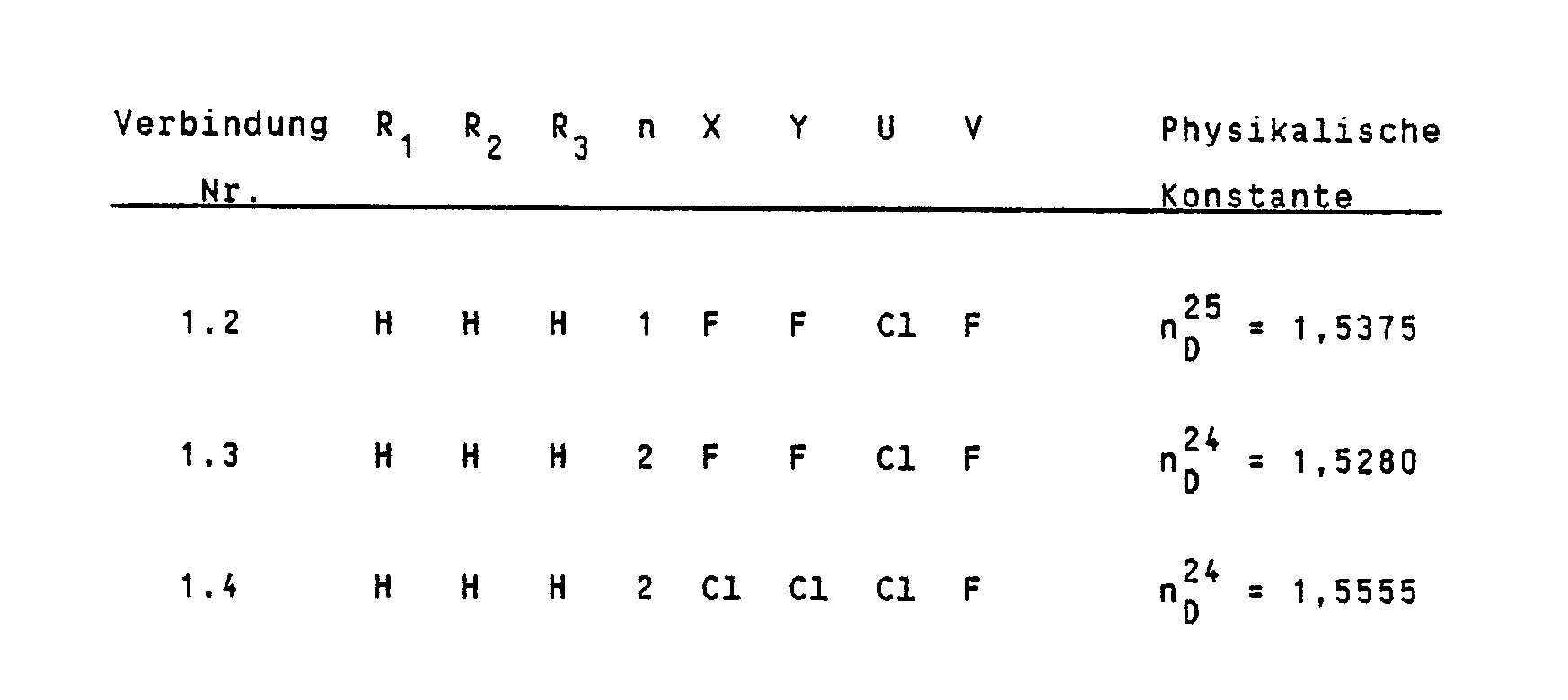
- 4,6 g 4-Chlor-5-(2,2-difluorcyclopropylmethoxy)-2-fluoranilin werden in einer Mischung aus 9,7 ml konzentrierter Salzsäure und 41,5 ml Wasser suspendiert und auf -10°C gekühlt. Dann wird tropfenweise eine Lösung von 1,38 g Natriumnitrit in 4,2 ml Wasser so zugegeben, daß die Temperatur der Reaktionsmischung -5°C nicht übersteigt. Nach beendeter Zugabe wird 1 Stunde bei -5°C nachgerührt und überschüssige salpetrige Säure mit Harnstoff zerstört, bis der Test mit Jodstärkepapier negativ ist. Die so erhaltene Lösung wird auf 0°C erwärmt und zu einer eiskalten Lösung von 2,3 g Pipecolinsäure und 8,3 ml Triethylamin in 27,7 ml Wasser getropft. Nach beendeter Zugabe wird 1 Stunde bei 0°C nachgerührt und die Reaktionsmischung mit Methylenchlorid mehrfach extrahiert. Die organischen Phasen werden vereinigt, über Magnesiumsulfat getrocknet und das Lösungsmittel abgedampft. Der Rückstand wird in 40 ml Ether aufgenommen und miot 4,14 ml Essigsäureanhydrid und 2,07 ml Pyridin versetzt. Über Nacht wird bei Raumtemperatur gerührt, anschließend auf Eiswasser gegeossen und mit Essigester extrahiert. Die organischen Phasen werden über Magnesiumsulfat getrocknet und das Lösungsmittel abgedampft. Der Rückstand über Kieselgel mit einem Ela tionsmittel (95 Teile Essigester/5 Teile Methanol) chromatografiert.
- Es werden 0,9 g = 13,4 % der Theorie Kristalle erhalten vom Schmelzpunkt 125-127°C.
- 5 g 4-Chlor-5-(2,2-difluorcyclopropylethoxy)-2-fluorphenylhydrazin werden in 18 ml Eisessig gelöst, 2,85 ml Cyclohexanon-2-carbonsäureethylester zugegeben und die Reaktionsmischung 8 Stunden lang unter Rückfluß erhitzt. Anschließend wird die Mischung auf Wasser gegeben und mit Methylenchlorid extrahiert. Die organischen Phasen werden mit Kaliumhydrogencarbonatlösung neutralisiert, mit gesättigter Kochsalzlösung gewaschen und über Magnesiumsulfat getrocknet. Nach dem Abdampfen der Lösungsmittels erhält man 8,4 g = 100 % d.Th. an Rohprodukt. Das Rohprodukt wird mit 3,6 ml Phosphoroxychlorid versetzt und die Mischung unter Rückfluß erhitzt. Nach 4 Stunden wird abgekühlt, mit Methylenchlorid aufgenommen, mit Wasser und anschließend mit gesättigter Sodalösung gewaschen, über Magnesiumsulfat getrocknet und das Lösungsmittel abgedampft. Der Rückstand wird über Kieselgel mit einer Mischung aus 95 Teilen Dichlormethan und 5 Teilen Methanol chromatografiert.
- Man erhält 2,6 g = 35,6 % der Theorie braunes Öl mit einem Brechungsindex n= 1,5345.

- Analog wurden die folgenden Verbindungen erhalten:

- 3 g 4-Chlor-5-(2,2-difluorcyclopropylmethoxy)-2-fluorphenylhydrazin werden in 40 ml Xylol gelöst, 2,4 g 1-Ethoxycarbonyl-2-piperidon und 1 g Phosphorpentoxid zugefügt und die Mischung 3 Stunden unter Rückfluß erhitzt. Anschließend wird auf 100 ml Wasser gegeben und die organische Phase abgetrennt. Die organische Phase wird mit Kaliumhydrogencarbonatlösung entsäuert, über Magnesiumsulfat getrocknet und das Lösungsmittel abgezogen. Der Rückstand wird über Kieselgel mit Essigester als Eluationsmittel chromatografiert.
- Man erhält 1,2 g = 23% der Theorie eines Öls mit dem Brechungsindex n= 1,5438

- Analog wurden die folgenden Verbindungen erhalten:


- 2,9 g 4-Chlor-5-(2,2-dicfluorcyclopropylmethoxy)-2-fluorphenyl-isothiocyanat werden in 20 ml Hexan gelöst und zu einer Lösung von 1,5 ml Piperidin-2-carbonsäureethylester in 10 ml Hexan zugetropft. Die Mischung wird 2 Stunden unter Rückfluß erhitzt. Anschließend wird das Lösungsmittel abgezogen und der Rückstand über Kieselgel mit einer Mischung aus 3 Teilen Hexan und 1 Teil Essigester chromatografiert.
- Ma erhält 3,2 g = 82 % der Theorie eines zähflüssigen Öls, dessen Brechungsindex nbei 1,54 liegt.

- Analog Herstellungsbeispiel 5 erhält man bei Einsatz von 8,33 g 4-Chlor-2-fluor-5-(2,2-dichlorcyclopropylmethyl)-phenylisocyanat und 4,69 ml Piperidin-2-carbonsäureethylester in 100 ml Hexan 7,7 g = 6 % der Theorie eines halbkristallinen Öls, dessen Kernresonanzspektrum folgende Daten liefert:
δ = 1,1 - 2,4 ppm (m) 9 H, δ = 2,7 - 3,15 ppm (m) 1H,
δ = 3,85 - 4,4 ppm (m) 4 H, δ - 6,87 (d 6 Hz) 1H,
δ = 7,3 (d 9Hz) 1H - 3 g 4-Chlor-5-(2,2-difluorcyclopropylmethoxy)-2-fluorphenylhydrazin-hydrochlorid werden in 18,5 ml Toluol suspendiert, mit 3,6 ml Triäthylamin versetzt und die Mischung bis zum Auflösen des Hydrochlorids gerührt. Dann wird ohne Kühlung langsam 1,6 ml Pivalinsäurechlorid zugetropft und die Mischung 2 Stunden bei Raumtemperatur nach gerührt. Die Reaktionsmischung wird anschließend mit Wasser, gesättigter Kaliumbicarbonatlösung und noch einmal mit Wasser gewaschen, über Magnesiumsulfat getrocknet und das Lösungsmittel abgezogen. Als Rückstand verbleiben 3,7 g eines rotes Öls, das neben Verunreinigungen Nʹ-[4-Chlor-5-(2,2-difluorcyclopropylmethoxy)-2-fluorphenyl]-pivalinsäurehydrazid enthält. Dieses Rohprodukt wird in 22 ml einer 20%igen Phosgenlösung in Toluol gelöst, langsam auf 100°C erhitzt und 3 Stunden bei dieser Temperatur belassen. Anschließend wird abge kühlt, mit 20 ml Methanol versetzt und eingeengt. Der Rückstand wird in Methylenchlorid aufgenommen, zweimal mit Kaliumbicarbonatlösung und einmal mit Wasser gewaschen, über Magnesiumsulfat getrocknet und eingeengt. Zur Aufreinigung wird das Rohprodukt über Kieselgel mit dem Laufmittel Hexan/Essigester - 4 : 1 chromatografiert.
- Man erhält 1,2 g = 24,5 % der Theorie Produkt mit einem Brechungsindex n= 1,5082.

- 1,2 g N-(4-Chlor-2-fluor-5-vinyloxphenyl)-5,6,7,8-tetrahydrophthalsäureimid wird in 5 ml Diäthylenglykoldimethyläther gelöst, die Lösung zum Rückfluß erhitzt und dann langsam die Lösung von 2,8 g Natrium-chlordifluoracetat in 20 ml Diäthylenglykoldimethyläther zugegeben. Anschließend wird noch 5 Stunden zum Rückfluß erhitzt, dann vom gebildeten Kochsalz abgetrennt und das Lösungsmittel abgezogen. Der Rückstand wird chromatografisch über Kieselgel mit einer Mischung von Hexan/Diäthyläther = 1:1 gereinigt.
- Man erhält 0,6 g = 43 % der Theorie einer kristallinen Substanz mit einem Schmelzpunkt von 105-107°C.
- 8,2 g 4-Chlor-5-(2,2-difluorcyclopropylmethoxy)-2-fluorphenyl]-hydrazin-hydrochlorid werden in 163 ml Wasser gelöst, mit 81 ml Äthanol und Tropfenweise mit einer Lösung von 2,75 ml Brenztraubensäure in 81 ml Wasser vesetzt. Eine Stunde wird nachgerührt und das ausgefallene Produkt abfiltriert und getrocknet. Man erhält 7,9 g des noch leicht verunreinigten Hydrazons, das in dieser Form eingesetzt wird.
- Das Hydrazon wird in 130 ml Toluol gelöst, mit 3,3 ml Triäthylamin versetzt und bis zum Aufklaren der Lösung erwärmt. Dann wird auf ca. 35°C abgekühlt, 5,1 ml Phosphorsäurediphenylesteraxid tropfenweise zugegeben und langsam auf 75°C erwärmt. Diese Temperatur wird solange beibehalten, bis kein Stickstoff mehr entweicht, anschließend wird zum Rückfluß erhitzt. Nach 12 Stunden wird abgekühlt, die Reaktionslösung dreimal mit 10%iger Natronlauge extrahiert, die wäßrige Phase zweimal mit Toluol gewaschen und angesäuert. Das Produkt wird mit Toluol extrahiert und die organische Phase getrocknet. Nach dem Abziehen des Lösungsmittels wird das Produkt über Kieselgel mit Essigester chromatografiert. Man erhält 3,7 g = 35 % der Theorie 1-[4-Chlor-5-(2,2-difluorcyclopropylmethoxy)-2-fluorphenyl]-3-methyl-1,2,4-triazolin-5-(4H)-on.
- Das nach obiger Vorschrift erhaltene Pordukt wird in 300 ml Cyclohexan gelöst, mit 2,7 g Kaliumhydroxid und 2 g Tetrabutylammoniumbromid versetzt, zum Rückfluß erhitzt und dann Chlordifluormethan eingeleitet. Nach Beendigung der Reaktion (Kontrolle mittels Dünnschichtchromatografie) wird die Lösung dekantiert, je zweimal mit 1n Salzsäure und 10%iger Natronlauge gewaschen, über Magnesiumsulfat getrocknet und eingeengt. Der Rückstand wird über Kieselgel mit Essigester und anschließend noch einmal mit Methylenchlorid chromatografiert.
- Man erhält 80 mg = 2 % der Theorie des Produktes mit einem Brechungsindex n=m 1,535.

- 3,6 g 2-Chlor-4-fluor-5-nitrophenol werden in Dimethylformamid gelöst und mit Kaliumcarbonat versetzt. Eine Stunde wird bei Raumtemperatur nachgerührt und dann 3,3 g 2,2-Difluorcyclopropylmethylbromid zugegeben. Anschließend wird über zwei Stunden auf 80°C erhitzt und dann auf Wasser gegeben. Die Mischung wird mit Methylenchlorid extrahiert und die organische Phase mit gesättigter Kochsalzlösung gewaschen, über Magnesiumsulfat getrocknet und eingeengt. Der Rückstand wird über Kieselgel mit einer Mischung aus 3 Teilen Hexan und 1 Teil Essigester chromatografiert. Man erhält 5 g = 93 % der Theorie gelbe Kristalle, deren Kernresonanzspektrum folgende Daten liefert:
δ = 1,1 - 2,4 ppm (m) 3 H, δ = 4,15 ppm (d 7 Hz,tr 1,5 Hz) 2H,
δ = 7,35 ppm (d 10 Hz) 1 H, δ = 7,5 ppm (d 7 Hz) 1 H - Analog wurden die folgenden Verbindungen erhalten:

- 36,9 g 4-Chlor-2-fluor-5-(2,2-difluorcyclopropylmethoxy)-nitrobenzol werden in 600 ml Ethanol und unter Zusatz von 5 g 10%-igem Palladiummetall auf Aktivkohle bei Raumtemperatur und Normaldruck hydriert. Nachdem die Wasserstoffaufnahme beendet ist, wird der Katalysator abfiltriert, das Lösungsmittel abgedampft und man erhält 29,3 g = 89 % der Theorie eines Öls, dessen Kernresonanzspektrum folgende Daten liefert:
δ = 1,1 - 2,2 ppm (m) 3 H, δ = 4,0 ppm (d 10 Hz breit) 2 H,
δ = 5 ppm (s breit) 2 H, δ = 6,5 ppm (d 7 Hz) 1H,
δ = 7,0 ppm (d 10 Hz) 1 H - Analog wurden die folgenden Verbindungen erhalten:
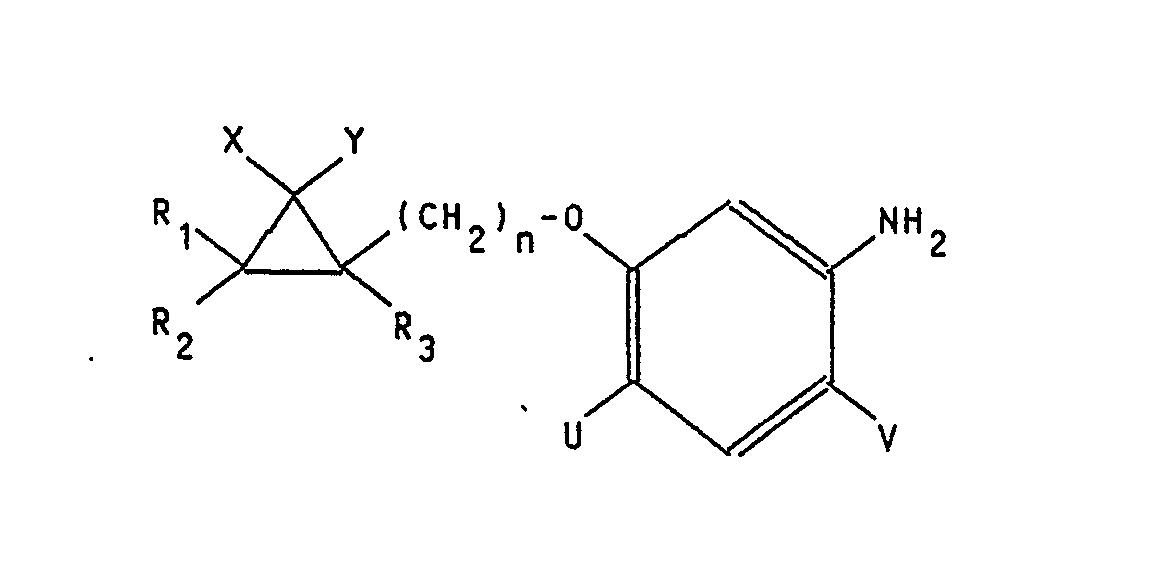

- 29,3 g 4-Chlor-2-fluor-5-(2,2-difluorcyclopropylmethoxy)-anilin werden mit 45 ml halbkonzentrierten Salzsäure vorgelegt und mit 273 ml konzentrierter Salzsäure versetzt. Dann wird auf -10°C abgekühlt und tropfenweise mit einer Lösung von 8,3 g Natriumnitrit in 17 ml Wasser versetzt, so daß die Temperatur -5°C nicht übersteigt. 3 Stunden wird bei -5°C nachgerührt und dann bei -15°C eine Lösung von 57,3 g Zinn-(II)-chloriddihydrat in 34 ml konzentrierter Salzsäure so zugetropft, daß -10°C nicht überschritten werden. Über Nacht wird auf Raumtemperatur erwärmt. Zur Aufarbeitung wird auf 0°C abgekühlt und langsam mit 430 ml 32%iger Natronlauge neutralisiert. Der ausgefallene Zinnhydroxidschlamm wird durch Filtrieren mit Celite entfernt, der Filterkuchen mit Ether gewaschen und die wäßrige Mutterlauge mehrfach mit Ether extrahiert. Die vereinigten organischen Phasen werden über Magnesiumsulfat getrocknet und das Lösungsmittel abgezogen.
- Man erhält 26 g = 100 % der Theorie Öl, dessen Kernresonanzspektrum folgende Daten liefert:
δ = 1,1 - 2,3 ppm (m) 3 H, δ = 4,0 ppm (d 8 Hz breit) 2 H,
δ = 6,85 ppm (d 7 Hz) 1 H, δ = 7,0 ppm (d 10 Hz) 1 H
- Die nachfolgenden Beispiele erläutern die Wirksamkeit der erfindungsgemäßen Verbindungen.
- Im Gewächshaus wurden die erfindungsgemäßen Verbindungen in einer Aufwandmenge von 1 kg Wirkstoff/ha, emulgiert in 500 l Wasser/ha, auf Testpflanzenarten der Gattungen Matricaria und Viola im Vor- und Nachauflaufverfahren gespritzt. 3 Wochen nach der Behandlung wurde das Behandlungsergebnis bonitiert, wobei alle Verbindungen gemäß den Herstellungsbeispielen 1 bis 9 in einem Boniturschema von 0 = keine Wirkung bis 4 = Vernichtung eine Vernichtung der Tespflanzen bewirkten.
- Im Gewächshaus wurden die aufgeführten Pflanzenspezies vor dem Auflaufen mit den aufgeführten Verbindungen in einer Aufwandmenge von 0,1 kg Wirkstoff/ha behandelt. Die Verbindungen wurden zu diesem Zweck als Emulsion mit 500 Litern Wasser/ha gleichmäßig über die Pflanzen versprüht. 3 Wochen nach der Behandlung zeigten die erfindungsgemäßen Verbindungen im Vergleich zu bekannten Mitteln eine hohe Selektivität bei ausgezeichneter Wirkung gegen das Unkraut.

- 0 = keine Wirkung
1 = schwache Schädigung
2 = mittlere Schädigung
3 = starke Schädigung
4 = total vernichtet - Br = Brassica ssp.
So = Solanumn ssp.
Go = Gossypium hirsutum
Gl = Glycine max
St = Stellaria media
Ab = Abutilon hybridum
Ma = Matricaria chamomilla
Vi = Viola tricolor
Av = Avena fatua
Al = Alopecurus myosuroides
Ec = Echinochloa crus-galli
Se = Setaria italica
Cy = Cyperus esculentus - Im Gewächshaus wurden die aufgeführten Pflanzenspezies nach dem Auflaufen mit den aufgeführten Verbindungen in einer Aufwandmenge von 0,3 kg Wirkstoff/ha behandelt. Die Verbindungen wurden zu diesem Zweck als Emulsion mit 500 Litern Wasser/ha gleichmäßig über die Pflanzen versprüht. Hier zeigten 3 Wochen nach der Behandlung die erfindungsgemäßen Verbindungen im Vergleich zu der bekannten Verbindung eine hohe Selektivität bei ausgezeichneter Wirkung gegen das Unkraut.
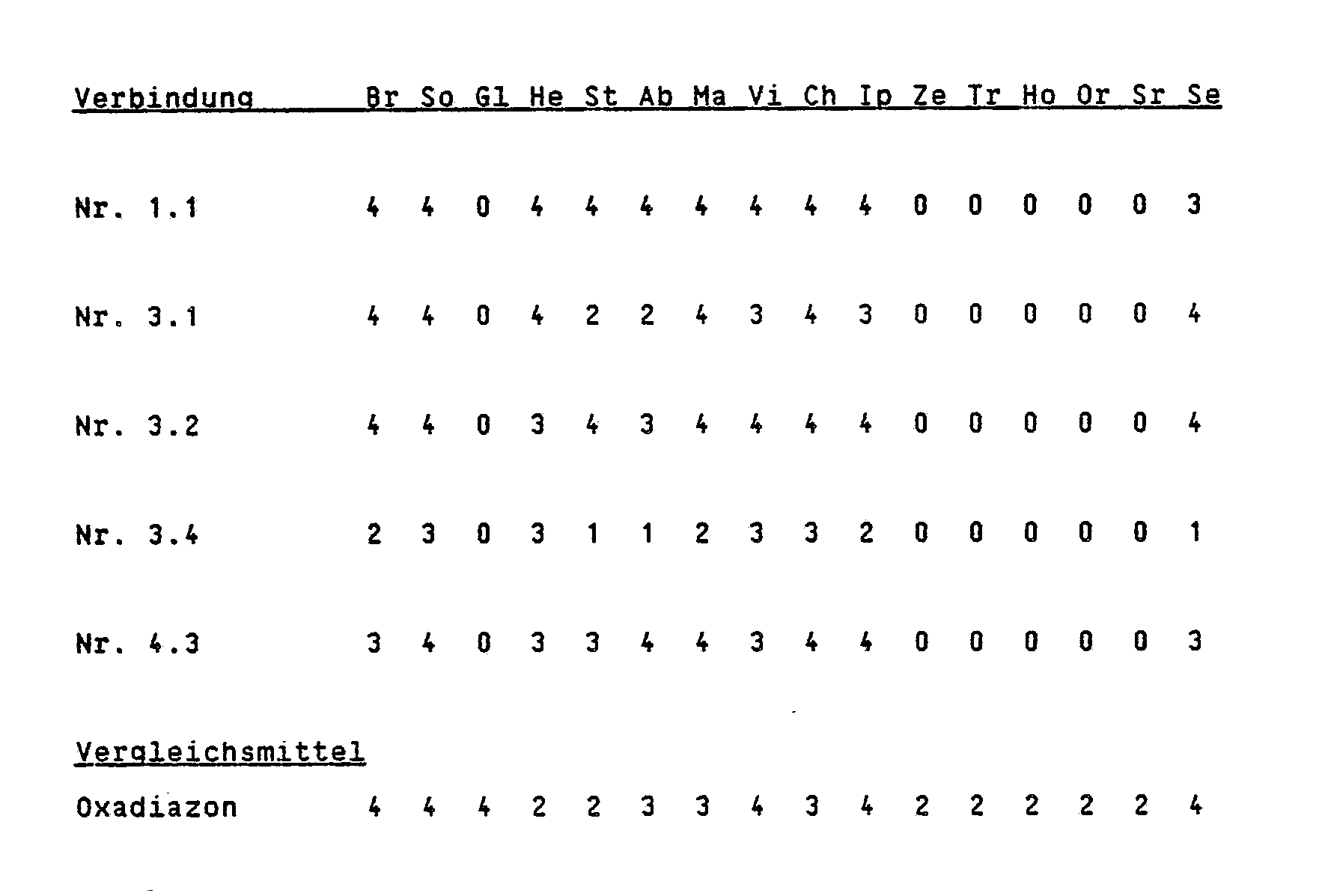
- 0 = keine Wirkung
1 = schwache Schädigung
2 = mittlere Schädigung
3 = starke Schädigung
4 = total vernichtet - Br = Brassica ssp.
So = Solanumn ssp.
Gl = Glycine max
He = Helianthus annuus
St = Stellaria media
Ab = Abutilon hybridum
Ma = Matricaria chamomilla
Vi = Viola tricolor
Ch = Chrysanthemum segetum
Ip = Ipomoea purpurea
Ze = Zea mays
Tr = Triticum aestivum
Ho = Hordeum vulgare
Or = Oryza sativa
Sr = Sorghum sativum
Se = Setaria italica - Im Gewächshaus wurden die aufgeführten Pflanzenspezies nach dem Auflaufen mit den aufgeführten Verbindungen in einer Aufwandmenge von 0,3 kg Wirkstoff/ha behandelt. Die Verbindungen wurden zu diesem Zweck als Emulsion mit 500 Litern Wasser/ha gleichmäßig über die Pflanzen versprüht. Hier zeigten 3 Wochen nach der Behandlung die erfindungsgemäßen Verbindungen gute herbizide Eigenschaften.

- 0 = keine Wirkung
1 = schwache Schädigung
2 = mittlere Schädigung
3 = starke Schädigung
4 = total vernichtet - Ec = Echinochloa crus-galli
Ce = Cyperus esculentus
Cd = Cyperus difformis
Fi = Fimbristylis miliacea - Im Gewächshaus wurden die in der Tabelle aufgeführten Verbindungen mit den ebenfalls erwähnten Aufwandmengen appliziert. Hierzu wurden die Wirkstoffe in Gefäße mit 1500 ml Wasser gegeben (Wasserapplikation). Die Testpflanzen wurden im 2- bis 5-Blattstadium eingesetzt. Drei Wochen nach der Applikation wurde die Schädigung der Pflanzen bonitiert.
- Wie die Tabelle zeigt, sind die erfindungsgemäßen Verbindungen stark wirksam gegen wichtige Reisunkräuter.

- 0 = keine Wirkung
1 = schwache Schädigung
2 = mittlere Schädigung
3 = starke Schädigung
4 = total vernichtet
- = nicht geprüft - Ec = Echinochloa crus-galli
Ce = Cyperus esculentus
Cd = Cyperus difformis
Fi = Fimbristylis miliacea
Sa = Saggitaria pusilla
El = Eleocharis acicularis
Claims (5)

X Wasserstoff oder Halogen,
Y Halogen,
n 0, 1, 2 oder 3,
U und V Wasserstoff oder Halogen und
W einen heterocyclischen Rest der Formeln

T für Halogen, C1-4-Alkyl, C1-4-Halogenalkyl, CN oder OR₉,
Q für CH oder N,
Z für O oder S,
R₄, R₅, R₆, R₇ und R₈ jeweils für einen geradkettigen, verzweigten oder cyclischen, gegebenenfalls mit bis zu sechs Halogenatomen substituierten C1-7-Alkylrest stehen, wobei
R₄ und R₅ außerdem gemeinsam einen heterocyclischen 4- bis 7-gliedrigen Ring bilden können, der gesättigt oder ungesättigt sein kann, weitere Heteroatome wie O, S oder N enthalten kann und gegebenenfalls mit ein bis drei Methylgruppen oder ein bis sechs Halogenatomen substituiert sein kann, und
R₉ Wasserstoff, C1-4-Alkyl oder C1-4-Halogenalkyl bedeutet.
a) ein Halogenid der allgemeinen Formel II


oder
b) falls W einen 4,5,6,7-Tetrahydroindazol-2-yl-Rest darstellt, eine Verbindung der Formel IV


oder
c) falls W einen 2H-1,2,4-Triazolin-3-on-2-yl-Rest darstellt eine Verbindung der Formel IV


oder
d) falls W einen 3H-1,3,4-Oxadiazol-3-on-3-yl-Rest darstellt, eine Verbindung der Formel IV


oder
e) falls W einen 2H, 4H-1,2,4-Triazin-3,5-dion-2-yl-Rest darstellt, eine Verbindung der Formel IV

R₈ -

worin R₈ die in Formel I genannte Bedeutung hat, zu einer Verbindung der Formel XI


R₇-A (X) ,
worin R₇ die in Formel I genannte Bedeutung hat und A Chlor, Brom oder Jod bedeutet, umsetzt,
oder
f) falls W einen 4,5,6,7-Tetrahydro-2H-1,2,3-triazolo-[3,4-a]pyridin-8-ium-3-olat-2-yl-Rest darstellt, eine Verbindung der Formel XV

oder
g) falls W einen 1,3,4,5,6,7-Hexahydro-2H-isoindol-1,3-di-on-2-yl-Rest darstellt, eine Verbindung der Formel XV


oder
h) falls W einen 2,3,5,6,7,8-Hexahydro-1H-imidazo[1,5-a]pyridin-1,3-dion-2-yl- oder einen 2,3,5,6,7,8-Hexahydro-1H-1,3,4-triazolo[1,2-a]pyridazin-1,3-dion-2-yl-Rest darstellt, eine Verbindung der Formel XV


oder
ein Verbindung der Formel XV mit


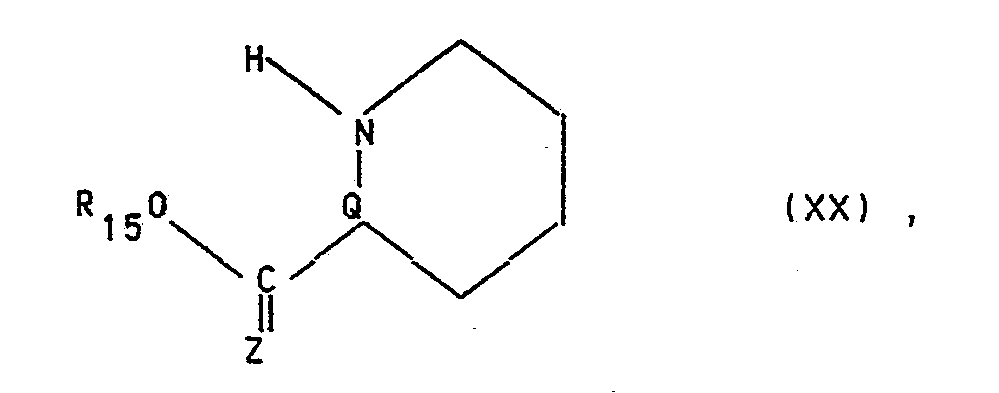
oder
i) eine Verbindung der Formel XXI

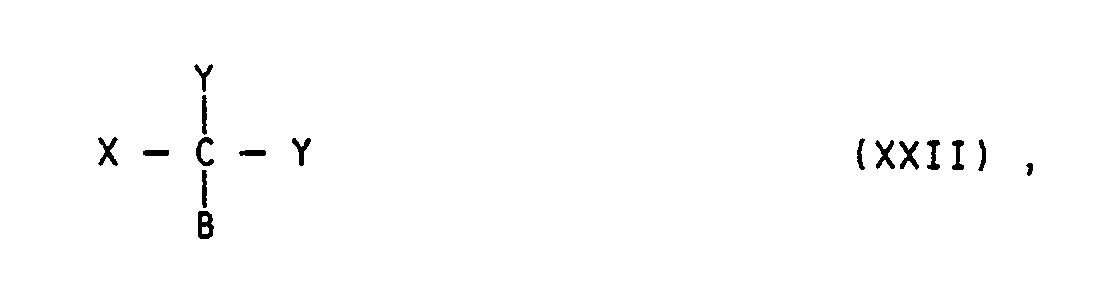

Applications Claiming Priority (2)
| Application Number | Priority Date | Filing Date | Title |
|---|---|---|---|
| DE19863635309 DE3635309A1 (de) | 1986-10-14 | 1986-10-14 | Halogencyclopropyl-verbindungen, ihre herstellung und verwendung als herbizide mittel |
| DE3635309 | 1986-10-14 |
Publications (2)
| Publication Number | Publication Date |
|---|---|
| EP0268797A2 true EP0268797A2 (de) | 1988-06-01 |
| EP0268797A3 EP0268797A3 (de) | 1989-03-29 |
Family
ID=6311886
Family Applications (1)
| Application Number | Title | Priority Date | Filing Date |
|---|---|---|---|
| EP87114775A Withdrawn EP0268797A3 (de) | 1986-10-14 | 1987-10-09 | Halogencyclopropyl-Verbindungen, ihre Herstellung und Verwendung als herbizide Mittel |
Country Status (15)
| Country | Link |
|---|---|
| US (1) | US4859230A (de) |
| EP (1) | EP0268797A3 (de) |
| JP (1) | JPS63218662A (de) |
| CN (1) | CN87106917A (de) |
| AU (1) | AU605183B2 (de) |
| BR (1) | BR8705442A (de) |
| DD (1) | DD279394A5 (de) |
| DE (1) | DE3635309A1 (de) |
| DK (1) | DK537587A (de) |
| FI (1) | FI874514A7 (de) |
| HU (1) | HU201068B (de) |
| IL (1) | IL84138A0 (de) |
| PH (1) | PH23048A (de) |
| SU (1) | SU1618273A3 (de) |
| ZA (1) | ZA877732B (de) |
Cited By (2)
| Publication number | Priority date | Publication date | Assignee | Title |
|---|---|---|---|---|
| WO1996006830A1 (en) * | 1994-08-26 | 1996-03-07 | Basf Aktiengesellschaft | N-phenyltetrahydroindazoles, their preparation, and their use as crop protection agents |
| EP0705829A1 (de) * | 1994-08-31 | 1996-04-10 | Sumitomo Chemical Company, Limited | Epoxyphenol-Derivate und Herbizide, die diese als Wirkstoffe enthaltend |
Families Citing this family (3)
| Publication number | Priority date | Publication date | Assignee | Title |
|---|---|---|---|---|
| US5852048A (en) * | 1995-03-01 | 1998-12-22 | Sumitomo Chemical Company, Limited | Ester compound and a pesticidal agent containing the same as an active ingredient |
| DE19921732A1 (de) * | 1998-07-24 | 2000-01-27 | Bayer Ag | Substituierte Benzoylcyclohexandione |
| WO2025252556A1 (en) * | 2024-06-05 | 2025-12-11 | Syngenta Crop Protection Ag | Pesticidally-active 2,2-dihalocyclopropyl compounds |
Family Cites Families (5)
| Publication number | Priority date | Publication date | Assignee | Title |
|---|---|---|---|---|
| JPS5890570A (ja) * | 1981-11-26 | 1983-05-30 | Showa Denko Kk | オキサジアゾリン誘導体及び除草剤 |
| PH18938A (en) * | 1982-09-28 | 1985-11-11 | Sumitomo Chemical Co | 2-substituted phenyl-4,5,6,7-tetrahydro-2h-indazoles and their use |
| JPS59148785A (ja) * | 1983-02-15 | 1984-08-25 | Sumitomo Chem Co Ltd | ピリドトリアゾリウム誘導体、その製造法およびそれを有効成分とする除草剤 |
| EP0259264A1 (de) * | 1986-09-03 | 1988-03-09 | Ciba-Geigy Ag | Neue 4-Methylphthalimide |
| DE3731516A1 (de) * | 1987-09-18 | 1989-03-30 | Bayer Ag | N-aryl-stickstoffheterocyclen |
-
1986
- 1986-10-14 DE DE19863635309 patent/DE3635309A1/de not_active Withdrawn
-
1987
- 1987-10-02 AU AU79373/87A patent/AU605183B2/en not_active Expired - Fee Related
- 1987-10-09 IL IL84138A patent/IL84138A0/xx unknown
- 1987-10-09 EP EP87114775A patent/EP0268797A3/de not_active Withdrawn
- 1987-10-12 DD DD87307851A patent/DD279394A5/de unknown
- 1987-10-13 SU SU874203502A patent/SU1618273A3/ru active
- 1987-10-13 FI FI874514A patent/FI874514A7/fi not_active Application Discontinuation
- 1987-10-13 BR BR8705442A patent/BR8705442A/pt unknown
- 1987-10-13 HU HU874613A patent/HU201068B/hu unknown
- 1987-10-13 CN CN198787106917A patent/CN87106917A/zh active Pending
- 1987-10-13 JP JP62256444A patent/JPS63218662A/ja active Pending
- 1987-10-14 ZA ZA877732A patent/ZA877732B/xx unknown
- 1987-10-14 PH PH35935A patent/PH23048A/en unknown
- 1987-10-14 DK DK537587A patent/DK537587A/da not_active Application Discontinuation
- 1987-10-14 US US07/108,380 patent/US4859230A/en not_active Expired - Fee Related
Cited By (3)
| Publication number | Priority date | Publication date | Assignee | Title |
|---|---|---|---|---|
| WO1996006830A1 (en) * | 1994-08-26 | 1996-03-07 | Basf Aktiengesellschaft | N-phenyltetrahydroindazoles, their preparation, and their use as crop protection agents |
| EP0705829A1 (de) * | 1994-08-31 | 1996-04-10 | Sumitomo Chemical Company, Limited | Epoxyphenol-Derivate und Herbizide, die diese als Wirkstoffe enthaltend |
| US5714437A (en) * | 1994-08-31 | 1998-02-03 | Sumitomo Chemical Company, Limited | Epoxyphenol derivatives and herbicides containing them as active ingredients |
Also Published As
| Publication number | Publication date |
|---|---|
| DE3635309A1 (de) | 1988-04-21 |
| FI874514A0 (fi) | 1987-10-13 |
| BR8705442A (pt) | 1988-05-24 |
| FI874514A7 (fi) | 1988-04-15 |
| DK537587D0 (da) | 1987-10-14 |
| PH23048A (en) | 1989-03-10 |
| IL84138A0 (en) | 1988-03-31 |
| SU1618273A3 (ru) | 1990-12-30 |
| ZA877732B (en) | 1988-06-29 |
| JPS63218662A (ja) | 1988-09-12 |
| EP0268797A3 (de) | 1989-03-29 |
| DK537587A (da) | 1988-04-15 |
| AU605183B2 (en) | 1991-01-10 |
| HUT48241A (en) | 1989-05-29 |
| US4859230A (en) | 1989-08-22 |
| CN87106917A (zh) | 1988-07-13 |
| DD279394A5 (de) | 1990-06-06 |
| AU7937387A (en) | 1988-04-21 |
| HU201068B (en) | 1990-09-28 |
Similar Documents
| Publication | Publication Date | Title |
|---|---|---|
| EP0311135B1 (de) | Heterocyclisch substituierte Azole und Azine, Verfahren zu ihrer Herstellung und ihre Verwendung als Mittel mit herbizider Wirkung | |
| DE69320050T2 (de) | Substituierte pyrazolderivate, verfahren zu ihrer herstellung und ihre verwendung als herbizide | |
| DE69213769T2 (de) | Substituierte Pyrazolylpyrazole, Verfahren zu ihre Herstellung, Zwischenprodukte und ihre Verwendung als Herbizide | |
| EP0364797B1 (de) | N-Aryl-Stickstoffheterocyclen, mehrere Verfahren zu ihrer Herstellung und ihre Verwendung als Herbizide | |
| EP0338465B1 (de) | 1-Chlorpyrimidinyl-1H-1,2,4-triazol-3-sulfonsäureamide, Verfahren zu ihrer Herstellung und ihre Verwendung als Mittel mit herbizider Wirkung | |
| US4179276A (en) | Novel imidazothiazine-1,3 (2H)-diones | |
| EP0906287A1 (de) | Substituierte pyrazolyl-pyrazolderivate und ihre verwendung als herbizide | |
| DE68919259T2 (de) | N-Phenylimide, ihre Herstellung und Verwendung. | |
| DE4117508A1 (de) | Substituierte benzthiazolderivate, verfahren zu ihrer herstellung und ihre verwendung als mittel mit herbizider wirkung | |
| US4859230A (en) | Halogencyclopropyl compounds, and use as herbicidal agents | |
| DD264839A5 (de) | Mittel mit herbizider und wachstumsregulierender wirkung | |
| EP0475236B1 (de) | N-Acylpyrrolidin-Derivate | |
| DE3809390A1 (de) | Perhydro-imidazopyridine und -pyrroloimidazole, verfahren zu ihrer herstellung und ihre verwendung als herbizide mittel | |
| DE3810706A1 (de) | Substituierte cumarinderivate, verfahren zu ihrer herstellung und ihre verwendung als mittel mit herbizider wirkung | |
| DE3740837A1 (de) | Substituierte bicyclische triazole, verfahren zu ihrer herstellung und ihre verwendung als herbizide mittel | |
| DE3819823A1 (de) | Durch zum teil kondensierte heterocyclen substituierte indole, indazole und benzimidazole, verfahren zu ihrer herstellung und ihre verwendung als mittel mit herbizider wirkung | |
| DE3539386A1 (de) | N-(s-triazolo(1,5-a)pyrimidin-2-yl)-2-alkoxy-benzolsulfonamide, verfahren zur herstellung dieser verbindungen sowie diese enthaltende mittel mit herbizider und pflanzenwachstumsregulierender wirkung | |
| EP0226947A1 (de) | Neue herbizid wirksame Imidazolinone | |
| DD285283A5 (de) | Herbizide mittel | |
| DE3922847A1 (de) | Substituierte benzoxazolinon- und benzoxazinon-derivate, verfahren zu ihrer herstellung und ihre verwendung als mittel mit herbizider wirkung | |
| DE3633485A1 (de) | Substituierte 2-pyri(mi)dyl-2'-pyridyl-(thio)-ether | |
| DE4241658A1 (de) | Substituierte 2-Thiobenzthiazole, Verfahren zu ihrer Herstellung und ihre Verwendung als herbizide Mittel | |
| DE4015647A1 (de) | Heterocyclisch substituierte 1,2,4-triazolo(4,3-a)pyridine, heterocyclisch substituierte n'-(2-pyridyl)-aldehydhydrazone als vorstufen, verfahren zur herstellung dieser verbindungen und ihre verwendung als mittel mit herbizider wirkung | |
| DE3813884A1 (de) | Substituierte 1-oxo-3-thioxo-2,3,5,8-tetrahydro-1h- (1,2,4)-triazolo(1,2-(alpha))pyridazine, verfahren zu ihrer herstellung und ihre verwendung als mittel mit herbizider wirkung | |
| EP0397295A2 (de) | 2-Phenyl-perhydro-isoindol-1-one und -1-thione, Verfahren zu ihrer Herstellung und ihre Verwendung als Mittel mit herbizider Wirkung |
Legal Events
| Date | Code | Title | Description |
|---|---|---|---|
| PUAI | Public reference made under article 153(3) epc to a published international application that has entered the european phase |
Free format text: ORIGINAL CODE: 0009012 |
|
| 17P | Request for examination filed |
Effective date: 19871009 |
|
| AK | Designated contracting states |
Kind code of ref document: A2 Designated state(s): AT BE CH DE ES FR GB GR IT LI LU NL SE |
|
| PUAL | Search report despatched |
Free format text: ORIGINAL CODE: 0009013 |
|
| AK | Designated contracting states |
Kind code of ref document: A3 Designated state(s): AT BE CH DE ES FR GB GR IT LI LU NL SE |
|
| STAA | Information on the status of an ep patent application or granted ep patent |
Free format text: STATUS: THE APPLICATION HAS BEEN WITHDRAWN |
|
| 18W | Application withdrawn |
Withdrawal date: 19910111 |
|
| R18W | Application withdrawn (corrected) |
Effective date: 19910111 |
|
| RIN1 | Information on inventor provided before grant (corrected) |
Inventor name: BLUME, FRIEDHELM, DR. Inventor name: REES, RICHARD, DR. Inventor name: ARNDT, FRIEDRICH, DR. Inventor name: FRANKE, WILFRIED, DR. |