EP0268805B1 - Verfahren zur Verringerung der Dichte einer aus thermoplastischem Harz extrudierten Schaumplatte - Google Patents
Verfahren zur Verringerung der Dichte einer aus thermoplastischem Harz extrudierten Schaumplatte Download PDFInfo
- Publication number
- EP0268805B1 EP0268805B1 EP87115045A EP87115045A EP0268805B1 EP 0268805 B1 EP0268805 B1 EP 0268805B1 EP 87115045 A EP87115045 A EP 87115045A EP 87115045 A EP87115045 A EP 87115045A EP 0268805 B1 EP0268805 B1 EP 0268805B1
- Authority
- EP
- European Patent Office
- Prior art keywords
- steam
- expansion device
- air
- foam board
- chamber
- Prior art date
- Legal status (The legal status is an assumption and is not a legal conclusion. Google has not performed a legal analysis and makes no representation as to the accuracy of the status listed.)
- Expired - Lifetime
Links
- 239000006260 foam Substances 0.000 title claims description 95
- 238000000034 method Methods 0.000 title claims description 51
- 230000008569 process Effects 0.000 title claims description 44
- 229920005992 thermoplastic resin Polymers 0.000 title claims description 18
- 239000000203 mixture Substances 0.000 claims description 23
- CURLTUGMZLYLDI-UHFFFAOYSA-N Carbon dioxide Chemical compound O=C=O CURLTUGMZLYLDI-UHFFFAOYSA-N 0.000 claims description 21
- 239000004793 Polystyrene Substances 0.000 claims description 21
- 230000009467 reduction Effects 0.000 claims description 18
- 239000004604 Blowing Agent Substances 0.000 claims description 15
- 229920002223 polystyrene Polymers 0.000 claims description 15
- 239000004338 Dichlorodifluoromethane Substances 0.000 claims description 12
- 229910002092 carbon dioxide Inorganic materials 0.000 claims description 12
- PXBRQCKWGAHEHS-UHFFFAOYSA-N dichlorodifluoromethane Chemical compound FC(F)(Cl)Cl PXBRQCKWGAHEHS-UHFFFAOYSA-N 0.000 claims description 12
- 235000019404 dichlorodifluoromethane Nutrition 0.000 claims description 12
- -1 poly(p-methylstyrene) Polymers 0.000 claims description 12
- 239000001569 carbon dioxide Substances 0.000 claims description 11
- 229960003750 ethyl chloride Drugs 0.000 claims description 11
- HRYZWHHZPQKTII-UHFFFAOYSA-N chloroethane Chemical compound CCCl HRYZWHHZPQKTII-UHFFFAOYSA-N 0.000 claims description 10
- 238000004891 communication Methods 0.000 claims description 10
- 229920000642 polymer Polymers 0.000 claims description 8
- BHNZEZWIUMJCGF-UHFFFAOYSA-N 1-chloro-1,1-difluoroethane Chemical compound CC(F)(F)Cl BHNZEZWIUMJCGF-UHFFFAOYSA-N 0.000 claims description 7
- 229920001627 poly(4-methyl styrene) Polymers 0.000 claims description 2
- 229940042935 dichlorodifluoromethane Drugs 0.000 description 11
- 238000004519 manufacturing process Methods 0.000 description 11
- PPBRXRYQALVLMV-UHFFFAOYSA-N Styrene Chemical compound C=CC1=CC=CC=C1 PPBRXRYQALVLMV-UHFFFAOYSA-N 0.000 description 10
- YMWUJEATGCHHMB-UHFFFAOYSA-N Dichloromethane Chemical compound ClCCl YMWUJEATGCHHMB-UHFFFAOYSA-N 0.000 description 6
- 210000003850 cellular structure Anatomy 0.000 description 5
- 238000001125 extrusion Methods 0.000 description 5
- 238000005187 foaming Methods 0.000 description 5
- 229920003002 synthetic resin Polymers 0.000 description 5
- 239000000057 synthetic resin Substances 0.000 description 5
- XLYOFNOQVPJJNP-UHFFFAOYSA-N water Substances O XLYOFNOQVPJJNP-UHFFFAOYSA-N 0.000 description 5
- 239000012530 fluid Substances 0.000 description 4
- OFBQJSOFQDEBGM-UHFFFAOYSA-N n-pentane Natural products CCCCC OFBQJSOFQDEBGM-UHFFFAOYSA-N 0.000 description 4
- 239000004721 Polyphenylene oxide Substances 0.000 description 3
- 230000000052 comparative effect Effects 0.000 description 3
- 238000010924 continuous production Methods 0.000 description 3
- 238000010438 heat treatment Methods 0.000 description 3
- VLKZOEOYAKHREP-UHFFFAOYSA-N n-Hexane Chemical compound CCCCCC VLKZOEOYAKHREP-UHFFFAOYSA-N 0.000 description 3
- 229920006380 polyphenylene oxide Polymers 0.000 description 3
- 239000007787 solid Substances 0.000 description 3
- SMZOUWXMTYCWNB-UHFFFAOYSA-N 2-(2-methoxy-5-methylphenyl)ethanamine Chemical compound COC1=CC=C(C)C=C1CCN SMZOUWXMTYCWNB-UHFFFAOYSA-N 0.000 description 2
- NIXOWILDQLNWCW-UHFFFAOYSA-N 2-Propenoic acid Natural products OC(=O)C=C NIXOWILDQLNWCW-UHFFFAOYSA-N 0.000 description 2
- 229920002126 Acrylic acid copolymer Polymers 0.000 description 2
- QGZKDVFQNNGYKY-UHFFFAOYSA-N Ammonia Chemical compound N QGZKDVFQNNGYKY-UHFFFAOYSA-N 0.000 description 2
- IJGRMHOSHXDMSA-UHFFFAOYSA-N Atomic nitrogen Chemical compound N#N IJGRMHOSHXDMSA-UHFFFAOYSA-N 0.000 description 2
- RGSFGYAAUTVSQA-UHFFFAOYSA-N Cyclopentane Chemical compound C1CCCC1 RGSFGYAAUTVSQA-UHFFFAOYSA-N 0.000 description 2
- IMNFDUFMRHMDMM-UHFFFAOYSA-N N-Heptane Chemical compound CCCCCCC IMNFDUFMRHMDMM-UHFFFAOYSA-N 0.000 description 2
- ATUOYWHBWRKTHZ-UHFFFAOYSA-N Propane Chemical compound CCC ATUOYWHBWRKTHZ-UHFFFAOYSA-N 0.000 description 2
- 239000000654 additive Substances 0.000 description 2
- 150000001338 aliphatic hydrocarbons Chemical class 0.000 description 2
- 238000009835 boiling Methods 0.000 description 2
- NEHMKBQYUWJMIP-NJFSPNSNSA-N chloro(114C)methane Chemical compound [14CH3]Cl NEHMKBQYUWJMIP-NJFSPNSNSA-N 0.000 description 2
- NEHMKBQYUWJMIP-UHFFFAOYSA-N chloromethane Chemical compound ClC NEHMKBQYUWJMIP-UHFFFAOYSA-N 0.000 description 2
- 150000001875 compounds Chemical class 0.000 description 2
- 229920001577 copolymer Polymers 0.000 description 2
- 230000003247 decreasing effect Effects 0.000 description 2
- 238000001035 drying Methods 0.000 description 2
- 239000004088 foaming agent Substances 0.000 description 2
- 239000007789 gas Substances 0.000 description 2
- 239000011261 inert gas Substances 0.000 description 2
- QWTDNUCVQCZILF-UHFFFAOYSA-N isopentane Chemical compound CCC(C)C QWTDNUCVQCZILF-UHFFFAOYSA-N 0.000 description 2
- CRSOQBOWXPBRES-UHFFFAOYSA-N neopentane Chemical compound CC(C)(C)C CRSOQBOWXPBRES-UHFFFAOYSA-N 0.000 description 2
- 229920006327 polystyrene foam Polymers 0.000 description 2
- 229920005989 resin Polymers 0.000 description 2
- 239000011347 resin Substances 0.000 description 2
- 239000007921 spray Substances 0.000 description 2
- YMRMDGSNYHCUCL-UHFFFAOYSA-N 1,2-dichloro-1,1,2-trifluoroethane Chemical compound FC(Cl)C(F)(F)Cl YMRMDGSNYHCUCL-UHFFFAOYSA-N 0.000 description 1
- SSZOCHFYWWVSAI-UHFFFAOYSA-N 1-bromo-2-ethenylbenzene Chemical compound BrC1=CC=CC=C1C=C SSZOCHFYWWVSAI-UHFFFAOYSA-N 0.000 description 1
- KQJQPCJDKBKSLV-UHFFFAOYSA-N 1-bromo-3-ethenylbenzene Chemical compound BrC1=CC=CC(C=C)=C1 KQJQPCJDKBKSLV-UHFFFAOYSA-N 0.000 description 1
- WGGLDBIZIQMEGH-UHFFFAOYSA-N 1-bromo-4-ethenylbenzene Chemical compound BrC1=CC=C(C=C)C=C1 WGGLDBIZIQMEGH-UHFFFAOYSA-N 0.000 description 1
- BOVQCIDBZXNFEJ-UHFFFAOYSA-N 1-chloro-3-ethenylbenzene Chemical compound ClC1=CC=CC(C=C)=C1 BOVQCIDBZXNFEJ-UHFFFAOYSA-N 0.000 description 1
- KTZVZZJJVJQZHV-UHFFFAOYSA-N 1-chloro-4-ethenylbenzene Chemical compound ClC1=CC=C(C=C)C=C1 KTZVZZJJVJQZHV-UHFFFAOYSA-N 0.000 description 1
- HLOUDBQOEJSUPI-UHFFFAOYSA-N 1-ethenyl-2,3-dimethylbenzene Chemical class CC1=CC=CC(C=C)=C1C HLOUDBQOEJSUPI-UHFFFAOYSA-N 0.000 description 1
- VTPNYMSKBPZSTF-UHFFFAOYSA-N 1-ethenyl-2-ethylbenzene Chemical compound CCC1=CC=CC=C1C=C VTPNYMSKBPZSTF-UHFFFAOYSA-N 0.000 description 1
- NVZWEEGUWXZOKI-UHFFFAOYSA-N 1-ethenyl-2-methylbenzene Chemical compound CC1=CC=CC=C1C=C NVZWEEGUWXZOKI-UHFFFAOYSA-N 0.000 description 1
- XHUZSRRCICJJCN-UHFFFAOYSA-N 1-ethenyl-3-ethylbenzene Chemical compound CCC1=CC=CC(C=C)=C1 XHUZSRRCICJJCN-UHFFFAOYSA-N 0.000 description 1
- JZHGRUMIRATHIU-UHFFFAOYSA-N 1-ethenyl-3-methylbenzene Chemical compound CC1=CC=CC(C=C)=C1 JZHGRUMIRATHIU-UHFFFAOYSA-N 0.000 description 1
- WHFHDVDXYKOSKI-UHFFFAOYSA-N 1-ethenyl-4-ethylbenzene Chemical compound CCC1=CC=C(C=C)C=C1 WHFHDVDXYKOSKI-UHFFFAOYSA-N 0.000 description 1
- HIXDQWDOVZUNNA-UHFFFAOYSA-N 2-(3,4-dimethoxyphenyl)-5-hydroxy-7-methoxychromen-4-one Chemical compound C=1C(OC)=CC(O)=C(C(C=2)=O)C=1OC=2C1=CC=C(OC)C(OC)=C1 HIXDQWDOVZUNNA-UHFFFAOYSA-N 0.000 description 1
- ISRGONDNXBCDBM-UHFFFAOYSA-N 2-chlorostyrene Chemical compound ClC1=CC=CC=C1C=C ISRGONDNXBCDBM-UHFFFAOYSA-N 0.000 description 1
- AYKYXWQEBUNJCN-UHFFFAOYSA-N 3-methylfuran-2,5-dione Chemical compound CC1=CC(=O)OC1=O AYKYXWQEBUNJCN-UHFFFAOYSA-N 0.000 description 1
- OFNISBHGPNMTMS-UHFFFAOYSA-N 3-methylideneoxolane-2,5-dione Chemical compound C=C1CC(=O)OC1=O OFNISBHGPNMTMS-UHFFFAOYSA-N 0.000 description 1
- JLBJTVDPSNHSKJ-UHFFFAOYSA-N 4-Methylstyrene Chemical compound CC1=CC=C(C=C)C=C1 JLBJTVDPSNHSKJ-UHFFFAOYSA-N 0.000 description 1
- NLHHRLWOUZZQLW-UHFFFAOYSA-N Acrylonitrile Chemical compound C=CC#N NLHHRLWOUZZQLW-UHFFFAOYSA-N 0.000 description 1
- XDTMQSROBMDMFD-UHFFFAOYSA-N Cyclohexane Chemical compound C1CCCCC1 XDTMQSROBMDMFD-UHFFFAOYSA-N 0.000 description 1
- CERQOIWHTDAKMF-UHFFFAOYSA-N Methacrylic acid Chemical compound CC(=C)C(O)=O CERQOIWHTDAKMF-UHFFFAOYSA-N 0.000 description 1
- VVQNEPGJFQJSBK-UHFFFAOYSA-N Methyl methacrylate Chemical compound COC(=O)C(C)=C VVQNEPGJFQJSBK-UHFFFAOYSA-N 0.000 description 1
- 239000004698 Polyethylene Substances 0.000 description 1
- 230000009471 action Effects 0.000 description 1
- 239000003570 air Substances 0.000 description 1
- XYLMUPLGERFSHI-UHFFFAOYSA-N alpha-Methylstyrene Chemical compound CC(=C)C1=CC=CC=C1 XYLMUPLGERFSHI-UHFFFAOYSA-N 0.000 description 1
- 230000004075 alteration Effects 0.000 description 1
- 229910021529 ammonia Inorganic materials 0.000 description 1
- 230000008901 benefit Effects 0.000 description 1
- 150000001555 benzenes Chemical class 0.000 description 1
- 239000001273 butane Substances 0.000 description 1
- 229910052799 carbon Inorganic materials 0.000 description 1
- 229960004424 carbon dioxide Drugs 0.000 description 1
- 210000004027 cell Anatomy 0.000 description 1
- 238000007796 conventional method Methods 0.000 description 1
- AFABGHUZZDYHJO-UHFFFAOYSA-N dimethyl butane Natural products CCCC(C)C AFABGHUZZDYHJO-UHFFFAOYSA-N 0.000 description 1
- 229920001971 elastomer Polymers 0.000 description 1
- RTZKZFJDLAIYFH-UHFFFAOYSA-N ether Substances CCOCC RTZKZFJDLAIYFH-UHFFFAOYSA-N 0.000 description 1
- 229920006248 expandable polystyrene Polymers 0.000 description 1
- 239000004794 expanded polystyrene Substances 0.000 description 1
- 210000000497 foam cell Anatomy 0.000 description 1
- 238000009472 formulation Methods 0.000 description 1
- 239000001307 helium Substances 0.000 description 1
- 229910052734 helium Inorganic materials 0.000 description 1
- SWQJXJOGLNCZEY-UHFFFAOYSA-N helium atom Chemical compound [He] SWQJXJOGLNCZEY-UHFFFAOYSA-N 0.000 description 1
- DMEGYFMYUHOHGS-UHFFFAOYSA-N heptamethylene Natural products C1CCCCCC1 DMEGYFMYUHOHGS-UHFFFAOYSA-N 0.000 description 1
- 229920001519 homopolymer Polymers 0.000 description 1
- 239000001257 hydrogen Substances 0.000 description 1
- 229910052739 hydrogen Inorganic materials 0.000 description 1
- 125000004435 hydrogen atom Chemical group [H]* 0.000 description 1
- FPYJFEHAWHCUMM-UHFFFAOYSA-N maleic anhydride Chemical compound O=C1OC(=O)C=C1 FPYJFEHAWHCUMM-UHFFFAOYSA-N 0.000 description 1
- 239000000463 material Substances 0.000 description 1
- WCYWZMWISLQXQU-UHFFFAOYSA-N methyl Chemical compound [CH3] WCYWZMWISLQXQU-UHFFFAOYSA-N 0.000 description 1
- 229940050176 methyl chloride Drugs 0.000 description 1
- 230000004048 modification Effects 0.000 description 1
- 238000012986 modification Methods 0.000 description 1
- IJDNQMDRQITEOD-UHFFFAOYSA-N n-butane Chemical compound CCCC IJDNQMDRQITEOD-UHFFFAOYSA-N 0.000 description 1
- 229910052757 nitrogen Inorganic materials 0.000 description 1
- 230000035699 permeability Effects 0.000 description 1
- 239000003208 petroleum Substances 0.000 description 1
- 229920000573 polyethylene Polymers 0.000 description 1
- 238000012545 processing Methods 0.000 description 1
- 239000001294 propane Substances 0.000 description 1
- 238000011160 research Methods 0.000 description 1
- 238000003856 thermoforming Methods 0.000 description 1
- 239000012815 thermoplastic material Substances 0.000 description 1
- CYRMSUTZVYGINF-UHFFFAOYSA-N trichlorofluoromethane Chemical compound FC(Cl)(Cl)Cl CYRMSUTZVYGINF-UHFFFAOYSA-N 0.000 description 1
Images

Classifications
-
- B—PERFORMING OPERATIONS; TRANSPORTING
- B29—WORKING OF PLASTICS; WORKING OF SUBSTANCES IN A PLASTIC STATE IN GENERAL
- B29C—SHAPING OR JOINING OF PLASTICS; SHAPING OF MATERIAL IN A PLASTIC STATE, NOT OTHERWISE PROVIDED FOR; AFTER-TREATMENT OF THE SHAPED PRODUCTS, e.g. REPAIRING
- B29C67/00—Shaping techniques not covered by groups B29C39/00 - B29C65/00, B29C70/00 or B29C73/00
- B29C67/20—Shaping techniques not covered by groups B29C39/00 - B29C65/00, B29C70/00 or B29C73/00 for porous or cellular articles, e.g. of foam plastics, coarse-pored
-
- C—CHEMISTRY; METALLURGY
- C08—ORGANIC MACROMOLECULAR COMPOUNDS; THEIR PREPARATION OR CHEMICAL WORKING-UP; COMPOSITIONS BASED THEREON
- C08J—WORKING-UP; GENERAL PROCESSES OF COMPOUNDING; AFTER-TREATMENT NOT COVERED BY SUBCLASSES C08B, C08C, C08F, C08G or C08H
- C08J9/00—Working-up of macromolecular substances to porous or cellular articles or materials; After-treatment thereof
- C08J9/04—Working-up of macromolecular substances to porous or cellular articles or materials; After-treatment thereof using blowing gases generated by a previously added blowing agent
- C08J9/12—Working-up of macromolecular substances to porous or cellular articles or materials; After-treatment thereof using blowing gases generated by a previously added blowing agent by a physical blowing agent
- C08J9/127—Mixtures of organic and inorganic blowing agents
-
- B—PERFORMING OPERATIONS; TRANSPORTING
- B29—WORKING OF PLASTICS; WORKING OF SUBSTANCES IN A PLASTIC STATE IN GENERAL
- B29C—SHAPING OR JOINING OF PLASTICS; SHAPING OF MATERIAL IN A PLASTIC STATE, NOT OTHERWISE PROVIDED FOR; AFTER-TREATMENT OF THE SHAPED PRODUCTS, e.g. REPAIRING
- B29C44/00—Shaping by internal pressure generated in the material, e.g. swelling or foaming ; Producing porous or cellular expanded plastics articles
- B29C44/02—Shaping by internal pressure generated in the material, e.g. swelling or foaming ; Producing porous or cellular expanded plastics articles for articles of definite length, i.e. discrete articles
- B29C44/08—Shaping by internal pressure generated in the material, e.g. swelling or foaming ; Producing porous or cellular expanded plastics articles for articles of definite length, i.e. discrete articles using several expanding or moulding steps
-
- C—CHEMISTRY; METALLURGY
- C08—ORGANIC MACROMOLECULAR COMPOUNDS; THEIR PREPARATION OR CHEMICAL WORKING-UP; COMPOSITIONS BASED THEREON
- C08J—WORKING-UP; GENERAL PROCESSES OF COMPOUNDING; AFTER-TREATMENT NOT COVERED BY SUBCLASSES C08B, C08C, C08F, C08G or C08H
- C08J9/00—Working-up of macromolecular substances to porous or cellular articles or materials; After-treatment thereof
- C08J9/22—After-treatment of expandable particles; Forming foamed products
-
- B—PERFORMING OPERATIONS; TRANSPORTING
- B29—WORKING OF PLASTICS; WORKING OF SUBSTANCES IN A PLASTIC STATE IN GENERAL
- B29K—INDEXING SCHEME ASSOCIATED WITH SUBCLASSES B29B, B29C OR B29D, RELATING TO MOULDING MATERIALS OR TO MATERIALS FOR MOULDS, REINFORCEMENTS, FILLERS OR PREFORMED PARTS, e.g. INSERTS
- B29K2025/00—Use of polymers of vinyl-aromatic compounds or derivatives thereof as moulding material
-
- C—CHEMISTRY; METALLURGY
- C08—ORGANIC MACROMOLECULAR COMPOUNDS; THEIR PREPARATION OR CHEMICAL WORKING-UP; COMPOSITIONS BASED THEREON
- C08J—WORKING-UP; GENERAL PROCESSES OF COMPOUNDING; AFTER-TREATMENT NOT COVERED BY SUBCLASSES C08B, C08C, C08F, C08G or C08H
- C08J2203/00—Foams characterized by the expanding agent
- C08J2203/14—Saturated hydrocarbons, e.g. butane; Unspecified hydrocarbons
- C08J2203/142—Halogenated saturated hydrocarbons, e.g. H3C-CF3
Definitions
- the present invention relates to a process for reducing the. density of an extruded foam board.
- reducing the density of an extruded foam board is meant the further expansion of an already foamed extruded board.
- PS thin polystyrene
- paper which is partially expanded polystyrene in sheet form
- post-expansion can be carried out by the application of heat, steam or boiling water to the PS paper.
- GB patent 1,151,117 teaches subjecting the PS paper to the action of steam whilst simultaneously maintaining the PS paper in contact with water condensed from the steam. It is taught that a sheet of original thickness of about 1.5 mm can be expanded to a sheet of about 12 mm thickness.
- EP-A-0 124 337 discloses that a conventional method of obtaining foam density reduction of polystyrene sheets is to age them for 3 to 5 days and then to employ radiant heating to expand the foam sheets thus aged. A density reduction of less than 20 percent is attained by this method. Furthermore, EP-A-0 124 337 discloses a process of thermoforming a polystyrene sheet by transporting the sheet through an atmosphere of "at least predominantly" steam at a temperature of at least 102 ° C, maintaining the sheet in the steam atmosphere for a time sufficient to cause a decrease in the density and then deforming the sheet into the desired shape.
- British patent specification 1,051,398 discloses a process of foaming a foamable polystyrene sheet of about 0.8 mm (30 mils) by heating the sheet simultaneously on one side by contact of a roll and on the other side by a steam spray. Several rolls and steam sprays are arranged in a chamber through which the foamable polystyrene sheet passes. The expanded sheet is then subjected in a separate chamber to hot air for drying the sheet and for maintaining its plasticity for subsequent pressure forming.
- US patent 3,381,077 discloses a method of introducing an impermeant inflatant such as a perhaloalkane into the closed cells of a flexible cellular structure, e.g. produced of polyethylene.
- the cellular structure is exposed to a plasticising fluid which should have an atmospheric boiling point of less than about 85°C such as methylene chloride.
- a plasticising fluid which should have an atmospheric boiling point of less than about 85°C such as methylene chloride.
- the wet cellular structure is then transferred to a vessel containing the impermeant inflatant. From there it is transferred to a vessel where the impermeant inflatant is stripped off with water or steam.
- the cellular structure is then exposed to heated air for inflating the foam.
- the process is useful for cellular structures in the form of a filament, ribbon, sheet or block having at least one linear dimension of less than 0.6 cm.
- thin polystyrene sheets which typically have a thickness of about 1 mm to 4 mm
- foam boards of a thermoplastic resin which have a thickness of 1 cm or more.
- the sheet is evenly cooled after extrusion whereby a substantially uniform foam results throughout its thickness.
- the surface of the foam however cools more quickly than the core of the foam. The surface of the foam becomes semirigid and the foam cells at the surface of the foam then collapse due to continued expansion pressure from inside the foam. Further expansion of the foam is prevented. The well known, high density skin is thereby produced.
- US patent 4,552,904 discloses a process for producing a heat- and sound-insulating rigid foam from a thermoplastic resin comprising the step of expanding an extrusion-foamed polystyrene plate in a expansion chamber. Single plates of predetermined widths and lengths are placed in the expansion chamber and allowed to expand. From Fig. 4 of that patent it becomes evident that the density of the foam is not significantly reduced in air of 90 ° C, i.e. by merely heating the foam. The foam density is, however, represented to be considerably reduced in water or steam at 90 ° C. This expansion method is useful when the expansion of the foam plates is carried out in the discontinuous process disclosed in that patent, i.e. in a process where the foam plates are processed, cut to the desired size and expanded in a separate process step in an expansion chamber.
- Fig. 3 of US patent 4,552,904 shows that a variety of density reductions meeting specific needs in the industry can be obtained by varying the temperature of the steam, by varying the residence time of the foam plate in the steam chamber or both.
- Varying the steam temperature is not convenient since partial vacuum is required to obtain steam in the chamber of less than 100 ° C or a pressure of more than one bar is required to maintain steam in the steam chamber at a temperature of more than 100 ° C.
- Varying the residence time of a foam plate or board in the steam chamber is not very convenient either.
- the extruded foam boards made from a thermoplastic resin are preferably produced in a continuous process. It may be desirable for the freshly prepared foam board to be continuously transported to the expansion chamber and expanded there. Obviously, such a process does not allow substantial and frequent variation in production speed and accordingly in residence time in the expansion chamber.
- the object of the invention is attained by a process for reducing the density of an extruded foam board made from a thermoplastic resin and having a thickness of 1 cm or more in a controllable fashion in an expansion device by exposing it simultaneously or in sequence to heated air and steam and by controlling the air temperature in the range from 60°C to 150°C and/or the relative humidity in the range from 20 to 100 percent in the expansion device, wherein the density reduction is carried out at a pressure of about one bar.
- the process of the present invention allows the density reduction of the extruded foam board in a highly controllable fashion.
- the controllable density reduction is obtainable without applying a decreased or increased pressure to the expansion device.
- the controllable density reduction is obtainable without varying the residence time of the foam board in the expansion device and accordingly without varying the transport speed of a continuous, extruded foam board from and to the expansion device.
- the process of the present invention is preferably carried out in an expansion device which comprises one or more chambers whereof at least one chamber is provided with an air inlet port which is in communication with an air source and at least one chamber, which is the same as or different from the first chamber, is provided with a steam inlet port, which is the same as or different from the air inlet port and which steam inlet port is in communication with a steam source.
- the process of the present invention is useful for reducing the density of any extruded foam board made from a thermoplastic resin which has a thickness of 1 cm or more.
- the thickness of the foam boards is from about 1.5 cm, more preferably from about 2 cm, most preferably from about 3 cm, up to about 25 cm, more preferably up to about 20 cm and most preferably up to about 15 cm.
- the foam boards can be of any suitable width, e.g. from 25 to 150 cm, preferably from 30 to 125 cm.
- the length of the foam board is not critical, typical lengths are e.g. from 0.5 to 5 m, preferably from 1 to 3 m. Particularly preferred are continuous (“endless") foam boards which have the stated width and thickness.
- the water vapour permeability of the foam is less than 1.8 perm inch (2.62 ng.Pa.s- l- m- 1 ) according to ASTM C-355-64.
- thermoplastic resins are alkenyl aromatic synthetic resins and blends of alkenyl aromatic synthetic resins with other polymers, such as polyphenylene oxide.
- Preferred blends are polystyrene and polyphenylene oxide.
- alkenyl aromatic synthetic resins a solid (under standard conditions of 1 bar and 20 ° C) polymer of one or more polymerisable alkenyl aromatic compounds.
- the polymer or copolymer ordinarily comprises, in chemically combined form, 60 percent or more by weight of at least one alkenyl aromatic compound having the general formula wherein Ar represents an aromatic hydrocarbon radical or an aromatic halo-hydrocarbon radical of the benzene series, and R is hydrogen or the methyl radical.
- alkenyl aromatic resins examples include the solid homopolymers of styrene, alpha-methylstyrene, o-methylstyrene, m-methylstyrene, p-methylstyrene, o-ethylstyrene, m-ethylstyrene, p-ethylstyrene, the vinylxylenes, o-chlorostyrene, m-chlorostyrene, p-chlorostyrene, o-bromostyrene, m-bromostyrene or p-bromostyrene; the solid copolymers of one or more of such alkenyl aromatic compounds with minor amounts of other readily polymerisable olefinic compounds such as methylmethacrylate, acrylonitrile, maleic anhydride, citraconic anhydride, itaconic anhydride, methacrylic acid, acrylic acid or rubber reinforced (either natural or synthetic
- the preferred alkenyl aromatic synthetic resins are polystyrene and poly(p-methylstyrene). Mixtures of these resins are also useful.
- the weight average molecular weight (Mw) of these alkenyl aromatic compounds, measured according to gel permeation chromotography, is preferably from about 100,000, more preferably from about 150,000 and preferably up to about 400,000, more preferably up to about 350,000.
- Such alkenyl aromatic synthetic resins are well known in the art.
- the manufacture of extruded foams from the thermoplastic resins is discussed in details in US patents 2,409,910; 2,515,250; 2,699,751; 2,848,428; 2,928,130; 3,121,130; 3,121,911; 3,770,688; 3,815,674; 3,960,792; 3,966,381; 4,085,073; 4,146,563; 4,229,396; 4,312,910; 4,421,866; 4,438,224; 4,454,086 and 4,486,550.
- thermoplastic resin is heat-plastified and a volatile fluid foaming agent is injected and mixed into the heat-plastified material under a pressure sufficiently high that foaming of the resulting mix- utre is prevented.
- the mixture passes then to one or more coolers where the temperature of the mixture is reduced and from there to a die which extrudes a generally rectangular board at atmospheric pressure.
- blowing agents are known. Any known compound capable of generating an inert gas under the conditions used to produce the foam (e.g. by reaction to produce a gas or by volatilization) is useful. It is desirable to use aliphatic hydrocarbons, cyclic aliphatic hydrocarbons and halogenated aliphatic hydrocarbons. Preferred examples are propane, butane, pentane (e.g.
- blowing agents Gases like carbon dioxide, ammonia, air, nitrogen, helium or other inert gases are also useful blowing agents. Mixtures of such blowing agents are also useful. Of particular importance is a mixture of blowing agents comprising from 3 to 45 weight percent carbon dioxide, from 5 to 97 weight percent ethyl chloride and from 0 to 90 weight percent dichlorodifluoromethane and/or 1-chloro-1,1-difluoroethane, based on the total weight of blowing agent mixture.
- One particularly preferred mixture comprises from 3 to 25 weight percent carbon dioxide, from 5 to 60 weight percent ethyl chloride and from 30 to 90 weight percent dichlorodifluoromethane and/or 1-chloro-1,1-difluoroethane.
- Another preferred mixture comprises from 3 to 45 weight percent carbon dioxide, from 55 to 90 weight percent ethyl chloride and from 0 to 25 weight percent dichlorodifluoromethane and/or 1-chloro-1,1-difluoroethane. From 1, preferably from 3 weight parts, to 18, preferably to 15 weight parts blowing agent are ordinarily used per 100 weight parts thermoplastic resin.
- the foam board is subjected to the process of the present invention in which it is further expanded by exposing it simultaneously or in sequence to heated air and to steam.
- the process of the present invention is not restricted to a continuous process, it is preferred that a continuous board of a foamed thermoplastic material having a thickness of 1 cm or more is transported through an expansion device where the extruded foam board is exposed to heated air and steam in a continuous process. It is preferred to transport a freshly produced foam board emerging from the continuous foam production line through the expansion device.
- the core of the foam is still hot, i.e. has a temperature of from about 80 ° C, preferably from about 90 ° C up to about 160 ° C, preferably up to about 140 ° C.
- the expansion device may be installed close to the foam production line or several metres away from it.
- the process of the present invention is preferably carried out at about 1 bar (at ambient pressure).
- the expansion device 10 is designed to receive an extruded foam board 32 made from a thermoplastic resin from a suitable source such as a continuous foam production line.
- the inlet end 24 and outlet end 26 of the expansion device 10 should have at least the size of the cross-section of the extruded foam board 32.
- Such extruded foam boards 32 are transportable into and through the expansion device 10 by any suitable transport means such as roller conveyors 34. Outside the expansion device 10, near the outlet end 26 transport means such as driven rolls (not shown) can be located. Further transport means (not shown) can be located between the foam production line and the inlet end 24 of the expansion device 10.
- the expansion device 10 comprises air chambers 12A, 12C, 12E in which an atmosphere comprising mainly heated air is maintained.
- the temperature in these air chambers is preferably from about 60 ° C and more preferably from about 80 ° C to about 150 ° C and more preferably to about 140 ° C.
- the temperature of the heated air need not be the same in all air chambers 12A, 12C, 12E.
- the air chambers 12A, 12C, 12E are equipped with air inlet ports 18A, 18B, 18C which are in communication with air sources 20A, 20B, 20C in which the air is preferably preheated.
- the heated air is circulated in the air chambers 12A, 12C, 12E.
- the airflow is preferably from 0.5 m/sec., most preferably from 1.0 m/sec. to 15 m/sec., most preferably to 12 m/sec.
- the air supply from the air sources 20A, 20B, 20C should be sufficient to replace the air diffusing out of the air chambers 12A, 12C, 12E through leaks in the expansion device 10.
- the air chambers 12A, 12C, 12E can be provided with auxiliary heaters (not shown) for maintaining the appropriate temperature in the air chambers.
- the expansion device 10 further comprises steam chambers 12B, 12D in which an atmosphere comprising mainly steam is maintained.
- the steam chambers 12B, 12D are equipped with steam inlet ports 14A, 14B which are in communication with steam sources 16A, 16B.
- the steam sources are preferably suitable to provide steam of one atmosphere pressure.
- the steam chambers 12B, 12D can be equipped with auxiliary heaters (not shown) in order generally to maintain a temperature of about 100 ° C.
- the steam supply can be varied.
- the steam supply is from 10, preferably from 40, to 400, preferably to 250 kg steam/hour m 3 steam chamber.
- the steam supply from the steam sources 16A, 16B should be sufficient to replace any steam condensed on or penetrated into the foam or condensing on the chamber walls or diffusing out of the chambers 12B, 12D through leaks in the expansion device 10.
- expansion device 10 illustrated by Fig. 1 comprises three air chambers wherein an atmosphere comprising mainly heated air is maintained and two steam chambers wherein an atmosphere comprising mainly steam is maintained, the expansion device is not restricted to such an embodiment.
- the expansion device can comprise one or more air chambers and combined therewith or separately one or more steam chambers. Preferred arrangements of the air chambers and steam chambers are for example
- the air sources 20A, 20B, 20C can be combined to one air source and the steam sources 16A, 16B can be combined to one steam source.
- the expansion device 10 can be equipped either with the driven rolls (not shown) or the roller conveyors 34 or with both.
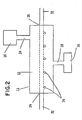
- the expansion device 11 comprises an inlet end 24 and outlet end 26.
- the foam transport means e.g. the roller conveyors 34, the driven rolls (not shown) and the optional transport means (not shown) between the foam production line (not shown) and expansion device 11 can be similar to those described with reference to Fig. 1.
- the extruded foam board 32 passes from the continuous foam production line through a single chamber 12 in which an atmosphere of steam and heated air is maintained.
- Chamber 12 is equipped with one or more steam inlet ports 14 which are in communication with a steam source 16.
- the chamber is furthermore equipped with one or more air inlet ports 18 which are in communication with an air source 20 in which the air is preferably preheated.
- the temperature in chamber 12 is preferably from about 60 ° C, more preferably from about 80 ° C, to about 150 ° C, more preferably to about 140 ° C. It is preferred to maintain the relative humidity in the chamber from 20 percent, preferably from 35 percent, to 100 percent, preferably to 85 percent. Chamber 12 can be provided with auxiliary heaters (not shown) in order to maintain the desired chamber temperature.
- Fig. 2 Although only one chamber 12 is shown in Fig. 2, it may be useful to arrange several chambers 12 in line through which the extruded foam board 32 is passed in the process of the present invention. Different temperatures, relative humidities and air-flow rates can be maintained in the different chambers. It may further be desirable that one or more chambers 12 are arranged in line with one or more steam chambers 12B, 12D and/or one or more air chambers 12A, 12C, 12E described with respect to Fig. 1. It is preferred to arrange an air chamber 12D at the outlet end of chamber 12 for drying the extruded foam board 32 after the expansion in the process of the present invention.
- the residence time of the extruded foam board 32 in the expansion device 10 or 11 depends on various factors such as desired density and the supply speed of the extruded foam board 32 from the continuous foam production line.
- the residence time of the extruded foam board 32 in the expansion device 10 or 11 is from 5, preferably from 10 sec. to 200, preferably to 90 sec.
- the density reduction of the foam can be controlled and varied by varying the temperature and/or the humidity in the expansion device whereby the total pressure in the expansion device can be maintained at about one bar, i.e. at ambient pressure.
- the process of the present invention allows controllable variation of the foam density without the necessity of varying the residence time of the extruded foam board in the expansion device and without varying the total pressure in the expansion device.
- density reductions of up to about 30 precent, preferably from about 15 to about 30 percent, are generally achieved, based on the density of the extruded foam board before alteration in the process of the present invention.
- a polystyrene foam is prepared from a composition containing polystyrene, 1.8 percent of common additives and a volatile fluid foaming agent mixture of 7 percent dichlorodifluoromethane, 0.7 percent carbon dioxide and 2.4 percent methyl chloride, all percents being based on the weight of the polystyrene.
- a 50 mm diameter extruder is used which feeds a rotary mixer.
- the rotary mixer discharge is passed through a cooler.
- the discharge from the cooler is passed to a slot die.
- the foaming temperature is about 120°C to 130°C.
- the produced foam is discharged from the slot die at a rate of about 7 m/min.
- the continuously produced foam board has a thickness of 4 cm.
- extruded foam board (the control) is not further expanded according to the process of the invention.
- the extruded foam boards of the Examples and of the Comparative Example listed in Table I are guided into an expansion device which consists of a steam chamber. (Comparative Example) or of a combination of 1) a hot air chamber and 2) a steam chamber (Examples).
- the chamber residence time in Table relates to the total residence time in all chambers, i.e., in the Comparative Example the residence time in the steam chamber is 48 sec., whereas in the Examples in Table I the residence time is 24 sec. in the steam chamber and 24 sec. in the hot air chamber (48 sec, in total).
- variable densities of the foam can be obtained by simple variation of the temperature in the hot air chamber in combination with the subsequent exposure to the steam in the steam chamber.
- the skin quality of the post expanded foam is improved with lowered hot air temperature.
- Example 1 is repeated with the exception that the blowing agent is a mixture of 7 percent dichlorodifluoromethane, 1.2 percent carbon dioxide and 3.5 ethyl chloride, based on the weight of the polystyrene.
- the extruded foam board is guided into the expansion device of Example 1 with the exception that a further hot air chamber is added after the steam chamber to the end of the expansion device and used as a drier.
- the hot air dryer is useful to provide a dried surface for further processing, such as printing, whereas the surface of the foam which has been expanded with steam alone is rather wet.
- Example 1 is repeated with the exception that the blowing agent employed is a 1:1 by weight mixture of dichlorodifluoromethane and methyl chloride.
- the blowing agent is fed at a concentration of 10.5 percent by weight of the styrene polymer.
- the extruded foam board After production, the extruded foam board is guided into the expansion device as illustrated in Figure 1.
- the total residence time of the extruded foam board in the Examples in Table III is 72 seconds, i.e. the residence time in each of the chambers is 14.4 seconds.
- a polystyrene foam is prepared from a composition containing polystyrene, 1.8 percent of common additives and a volatile fluid foaming blowing agent mixture composed of
- a 50 mm diameter extruder is used which feeds a rotary mixer.
- the rotary mixer discharge is passed through several coolers.
- the discharge from the last cooler is passed to a slot die.
- the foaming temperature is about 120 ° C to 130°C.
- the produced foam is discharged from the slot die at a rate in a range of 7 to 12 m/min.
- Table IV shows that significant density reduction is obtained in the process of the present invention.
- Example 4 is repeated with the exception that the polymer is a mixture of polystyrene and polyphenylene oxide in a weight ratio 98:2.
- the amounts of the components in the blowing agent mixture are as follows
- the extruded foam board discharged from a slot die is guided into the expansion device as illustrated in Figure 2 to which a hot air chamber is added as a drier.
- Example 4 is repeated with the exception that the foam is produced from a styrene/acrylic acid copolymer (acrylic acid content 1 weight percent).
- the blowing agent is a mixture of dichlorodifluoromethane, carbon dioxide and ethylchloride; the amounts of each component are as follows:
- the extruded foam board discharged from a slot die is guided into the expansion device as illustrated in Figure 2 to which a hot air chamber is added as a drier.
Landscapes
- Chemical & Material Sciences (AREA)
- Engineering & Computer Science (AREA)
- Medicinal Chemistry (AREA)
- Materials Engineering (AREA)
- Health & Medical Sciences (AREA)
- Chemical Kinetics & Catalysis (AREA)
- Polymers & Plastics (AREA)
- Organic Chemistry (AREA)
- Inorganic Chemistry (AREA)
- Mechanical Engineering (AREA)
- Manufacture Of Porous Articles, And Recovery And Treatment Of Waste Products (AREA)
- Extrusion Moulding Of Plastics Or The Like (AREA)
- Molding Of Porous Articles (AREA)
Claims (9)
Applications Claiming Priority (2)
| Application Number | Priority Date | Filing Date | Title |
|---|---|---|---|
| FR8614882A FR2605638B1 (fr) | 1986-10-27 | 1986-10-27 | Procede pour diminuer la densite d'un panneau extrude en materiau mousse de resine thermoplastique et dispositif pour sa mise en oeuvre |
| FR8614882 | 1986-10-27 |
Publications (2)
| Publication Number | Publication Date |
|---|---|
| EP0268805A1 EP0268805A1 (de) | 1988-06-01 |
| EP0268805B1 true EP0268805B1 (de) | 1990-05-30 |
Family
ID=9340214
Family Applications (1)
| Application Number | Title | Priority Date | Filing Date |
|---|---|---|---|
| EP87115045A Expired - Lifetime EP0268805B1 (de) | 1986-10-27 | 1987-10-15 | Verfahren zur Verringerung der Dichte einer aus thermoplastischem Harz extrudierten Schaumplatte |
Country Status (10)
| Country | Link |
|---|---|
| EP (1) | EP0268805B1 (de) |
| JP (1) | JPH0815743B2 (de) |
| KR (1) | KR910002478B1 (de) |
| AU (1) | AU595388B2 (de) |
| BR (1) | BR8705700A (de) |
| CA (1) | CA1292347C (de) |
| DE (1) | DE3762955D1 (de) |
| ES (1) | ES2016321B3 (de) |
| FR (1) | FR2605638B1 (de) |
| GR (1) | GR3000522T3 (de) |
Families Citing this family (5)
| Publication number | Priority date | Publication date | Assignee | Title |
|---|---|---|---|---|
| JPH0671756B2 (ja) * | 1988-09-30 | 1994-09-14 | 積水化成品工業株式会社 | スチレン系樹脂板状発泡体の製造方法 |
| AU642962B2 (en) * | 1990-02-16 | 1993-11-04 | Sekisui Kaseihin Kogyo Kabushiki Kaisha | Process of producing thermoplastic polyester series resin foamed material |
| CA2042340A1 (en) * | 1991-05-10 | 1992-11-11 | Motoshige Hayashi | Leather-like thermoplastic polyester series resin sheet and process for production of the same |
| EP0513408B1 (de) * | 1991-05-10 | 1997-12-29 | Sekisui Kaseihin Kogyo Kabushiki Kaisha | Lederähnliche thermoplastische Polyesterschaumstofffolie und Herstellungsverfahren |
| JP2005239742A (ja) * | 2004-02-13 | 2005-09-08 | Jsp Corp | ポリスチレン系樹脂発泡板成形体、断熱材および装飾板 |
Family Cites Families (6)
| Publication number | Priority date | Publication date | Assignee | Title |
|---|---|---|---|---|
| US3119147A (en) * | 1961-08-21 | 1964-01-28 | Koppers Co Inc | Apparatus for producing flexible styrene polymers |
| GB1051398A (de) * | 1965-01-12 | 1966-12-14 | ||
| GB1073813A (en) * | 1965-08-09 | 1967-06-28 | Swedish Crucible Steel Company | Method and apparatus for rendering polystyrene sheet material flexible |
| US3381077A (en) * | 1966-01-26 | 1968-04-30 | Du Pont | Method for inflating closed cell foams |
| GB1151117A (en) * | 1967-08-11 | 1969-05-07 | Watchwell Ltd | Treatment of Polystyrene. |
| JPS5699635A (en) * | 1980-01-14 | 1981-08-11 | Sekisui Plastics Co Ltd | Preparation of styrene resin foam plate of large thickness |
-
1986
- 1986-10-27 FR FR8614882A patent/FR2605638B1/fr not_active Expired
-
1987
- 1987-10-01 CA CA000548318A patent/CA1292347C/en not_active Expired - Lifetime
- 1987-10-15 DE DE8787115045T patent/DE3762955D1/de not_active Expired - Fee Related
- 1987-10-15 EP EP87115045A patent/EP0268805B1/de not_active Expired - Lifetime
- 1987-10-15 ES ES87115045T patent/ES2016321B3/es not_active Expired - Lifetime
- 1987-10-16 AU AU79835/87A patent/AU595388B2/en not_active Ceased
- 1987-10-23 BR BR8705700A patent/BR8705700A/pt not_active IP Right Cessation
- 1987-10-26 JP JP62268351A patent/JPH0815743B2/ja not_active Expired - Lifetime
- 1987-10-26 KR KR1019870011860A patent/KR910002478B1/ko not_active Expired
-
1990
- 1990-05-31 GR GR90400280T patent/GR3000522T3/el unknown
Also Published As
| Publication number | Publication date |
|---|---|
| ES2016321B3 (es) | 1990-11-01 |
| FR2605638A1 (fr) | 1988-04-29 |
| AU595388B2 (en) | 1990-03-29 |
| KR910002478B1 (ko) | 1991-04-23 |
| KR880004929A (ko) | 1988-06-27 |
| FR2605638B1 (fr) | 1989-09-08 |
| JPS63159034A (ja) | 1988-07-01 |
| DE3762955D1 (de) | 1990-07-05 |
| CA1292347C (en) | 1991-11-26 |
| GR3000522T3 (en) | 1991-07-31 |
| EP0268805A1 (de) | 1988-06-01 |
| BR8705700A (pt) | 1988-05-31 |
| JPH0815743B2 (ja) | 1996-02-21 |
| AU7983587A (en) | 1988-04-28 |
Similar Documents
| Publication | Publication Date | Title |
|---|---|---|
| EP0291179B1 (de) | Vorbereitung von aromatischen Polymer-alkenyl-Schaumstoffen und daraus hergestellte Gegenstände | |
| EP0093553B1 (de) | Schaumpolymer-Prozess | |
| US5120481A (en) | Process for preparing extruded foam bodies | |
| CA2012906A1 (en) | Method for rapid purging of blowing agents from foamed polymer products | |
| KR100284215B1 (ko) | 알케닐 방향족 발포체의 제조방법 | |
| CA2027002A1 (en) | Method for enhancing thermal expandability of direct-injection foams | |
| EP0268805B1 (de) | Verfahren zur Verringerung der Dichte einer aus thermoplastischem Harz extrudierten Schaumplatte | |
| US5324458A (en) | Method of molding a styrenic foam by extrusion | |
| EP0445847A2 (de) | Vorbereitung von Polymerschaumstoffen und daraus hergestellte Gegenstände | |
| EP0218640A1 (de) | Herstellung von styrenpolymerschaum und so erzeugter schaum. | |
| US4681715A (en) | Steam expandable polymeric composition and method | |
| EP0386663A1 (de) | Verfahren zur Herstellung von Styrolschaumstoffen | |
| JP3081625B2 (ja) | 押出し発泡体の製造法 | |
| EP0385349B1 (de) | Verfahren zur Herstellung von extrudierten Schaumformen | |
| JPS5851123A (ja) | ポリプロピレン系樹脂予備発泡粒子の型内成形法 | |
| EP0256754A2 (de) | Verfahren zur Herstellung von Polystyrolschaumstoffen | |
| CA2041537A1 (en) | Method for production of styrenic foam using an alcohol-alkane blowing agent composition | |
| JPH0598060A (ja) | ポリスチレンフオームの製造方法 |
Legal Events
| Date | Code | Title | Description |
|---|---|---|---|
| PUAI | Public reference made under article 153(3) epc to a published international application that has entered the european phase |
Free format text: ORIGINAL CODE: 0009012 |
|
| AK | Designated contracting states |
Kind code of ref document: A1 Designated state(s): BE DE ES FR GB GR IT NL SE |
|
| 17P | Request for examination filed |
Effective date: 19880825 |
|
| 17Q | First examination report despatched |
Effective date: 19890518 |
|
| GRAA | (expected) grant |
Free format text: ORIGINAL CODE: 0009210 |
|
| AK | Designated contracting states |
Kind code of ref document: B1 Designated state(s): BE DE ES FR GB GR IT NL SE |
|
| REF | Corresponds to: |
Ref document number: 3762955 Country of ref document: DE Date of ref document: 19900705 |
|
| ITF | It: translation for a ep patent filed | ||
| ET | Fr: translation filed | ||
| R20 | Corrections of a patent specification |
Effective date: 19900729 |
|
| REG | Reference to a national code |
Ref country code: GR Ref legal event code: FG4A Free format text: 3000522 |
|
| PLBE | No opposition filed within time limit |
Free format text: ORIGINAL CODE: 0009261 |
|
| STAA | Information on the status of an ep patent application or granted ep patent |
Free format text: STATUS: NO OPPOSITION FILED WITHIN TIME LIMIT |
|
| 26N | No opposition filed | ||
| ITTA | It: last paid annual fee | ||
| EAL | Se: european patent in force in sweden |
Ref document number: 87115045.4 |
|
| REG | Reference to a national code |
Ref country code: GB Ref legal event code: IF02 |
|
| PGFP | Annual fee paid to national office [announced via postgrant information from national office to epo] |
Ref country code: DE Payment date: 20020830 Year of fee payment: 16 |
|
| PGFP | Annual fee paid to national office [announced via postgrant information from national office to epo] |
Ref country code: GR Payment date: 20020906 Year of fee payment: 16 Ref country code: SE Payment date: 20020906 Year of fee payment: 16 |
|
| PGFP | Annual fee paid to national office [announced via postgrant information from national office to epo] |
Ref country code: NL Payment date: 20020910 Year of fee payment: 16 |
|
| PGFP | Annual fee paid to national office [announced via postgrant information from national office to epo] |
Ref country code: GB Payment date: 20020923 Year of fee payment: 16 |
|
| PGFP | Annual fee paid to national office [announced via postgrant information from national office to epo] |
Ref country code: ES Payment date: 20021010 Year of fee payment: 16 |
|
| PGFP | Annual fee paid to national office [announced via postgrant information from national office to epo] |
Ref country code: BE Payment date: 20021023 Year of fee payment: 16 |
|
| PG25 | Lapsed in a contracting state [announced via postgrant information from national office to epo] |
Ref country code: GB Free format text: LAPSE BECAUSE OF NON-PAYMENT OF DUE FEES Effective date: 20031015 |
|
| PG25 | Lapsed in a contracting state [announced via postgrant information from national office to epo] |
Ref country code: SE Free format text: LAPSE BECAUSE OF NON-PAYMENT OF DUE FEES Effective date: 20031016 Ref country code: ES Free format text: LAPSE BECAUSE OF NON-PAYMENT OF DUE FEES Effective date: 20031016 |
|
| PG25 | Lapsed in a contracting state [announced via postgrant information from national office to epo] |
Ref country code: BE Free format text: LAPSE BECAUSE OF NON-PAYMENT OF DUE FEES Effective date: 20031031 |
|
| BERE | Be: lapsed |
Owner name: THE *DOW CHEMICAL CY Effective date: 20031031 |
|
| PG25 | Lapsed in a contracting state [announced via postgrant information from national office to epo] |
Ref country code: NL Free format text: LAPSE BECAUSE OF NON-PAYMENT OF DUE FEES Effective date: 20040501 Ref country code: DE Free format text: LAPSE BECAUSE OF NON-PAYMENT OF DUE FEES Effective date: 20040501 |
|
| PG25 | Lapsed in a contracting state [announced via postgrant information from national office to epo] |
Ref country code: GR Free format text: LAPSE BECAUSE OF NON-PAYMENT OF DUE FEES Effective date: 20040504 |
|
| EUG | Se: european patent has lapsed | ||
| GBPC | Gb: european patent ceased through non-payment of renewal fee |
Effective date: 20031015 |
|
| NLV4 | Nl: lapsed or anulled due to non-payment of the annual fee |
Effective date: 20040501 |
|
| REG | Reference to a national code |
Ref country code: ES Ref legal event code: FD2A Effective date: 20031016 |
|
| PG25 | Lapsed in a contracting state [announced via postgrant information from national office to epo] |
Ref country code: IT Free format text: LAPSE BECAUSE OF NON-PAYMENT OF DUE FEES Effective date: 20051015 |
|
| PGFP | Annual fee paid to national office [announced via postgrant information from national office to epo] |
Ref country code: FR Payment date: 20061010 Year of fee payment: 20 |